Impact of second-grade teacher drives pastor’s passion to serve

DECATUR, Ga. (BP)—Church planter and pastor Emory Berry Jr.’s passion for serving the educational community has its roots in his second-grade public school teacher of decades ago.

Berry, who holds a doctorate in theology, had begun Lillie Courtney’s second-grade class at Palmetto Elementary School in Pinecrest, Fla., as the lowest-ranking student in reading comprehension.

“This teacher could have easily labeled me and put me in special classes, remedial classes, but she took a personal investment,” said Berry, founding pastor of The Favor Church, said of Courtney. “I guess she saw the potential was there, but I did not have the skillset. And she worked with me and worked with me.

“By the time I finished the second grade, I was still in a reading group by myself, but now I was in the highest reading group. So, I experienced incredible gains with my literacy because this one teacher took an investment in me,” he said. “I know the power of educators. She helped give me a hunger or taste for achievement.”

Berry counts nearly 20 active and retired educators and school administrators among the 100 or so worshipers who attend The Favor Church, which Berry planted at Easter. They include his wife Julie Ann Berry who is an assistant principal. The church sees the three local public schools in its community as a mission field.

“We are really loaded with people who have worked in the educational system,” he said. “They have a huge passion for education.”

Hosted cookout for educators

Emory Berry, founding pastor of The Favor Church in Decatur, Ga., buys supplies for a cookout the church hosted for the staff of Mary McLeod Bethune Middle School. (Submitted photo)

Aug. 5 at Mary McLeod Bethune Middle School, Berry and a group of church volunteers hosted a cookout for the 100 school teachers and staff members, cooking and serving food, encouraging educators and sharing literature on the church. The outreach spurred motivational conversations, Berry said.

“I wish more churches did this,” Berry quoted Bethune teachers. “Some said, ‘I want to take this back to my church.’ Everything from that to, ‘You know, I’ve been looking for a church home.’ A couple of people opened up about some personal things, you know, ‘If you all don’t mind, could you pray for me?’”

On July 16, The Favor Church hosted a back-to-school cookout and celebration for area elementary through high school students, featuring hot food, snacks, bounce houses, a DJ, games and giveaways including about 200 backpacks of school supplies. Donations from church members and supporters from six states and Washington, D.C., funded the outreach, Berry said.

During the 2022-2023 school year, the church will host free weekly tutoring classes at the church in various subjects, utilizing retired educators and professionals from applicable careers. Church members will volunteer as literacy coaches or book buddies at the local elementary school to improve literacy, and offer outreach to teach parents to better equip their children to succeed educationally.

Berry also is teaching youth in the church to see school as a mission field where students can build relationships, share Christ, invite classmates to church, and model Christian behavior that resolves conflicts and discourages bullying.

“School is a mission field where they can interact with their peers and learn how to relate one to another in a way that may not be consistent with how the world teaches,” Berry said. “It’s a great way for them to share Christ with their friends, so it’s an evangelistic opportunity.”

Having launched this past Easter and meeting at no cost on the Greater Fellowship Missionary Baptist Church campus, the church is able to use more resources for outreach.

Invest in the future of children

Churches have opportunities to invest in children’s futures and help them succeed, thereby giving them platforms to share the gospel, Berry said.

“We want the community to know that we are invested in their future, particularly the children,” Berry said. “We’re invested in their families. Secondly, we want to be, obviously, the hands and feet of Christ. We have been blessed and we want to be a blessing.

“That’s where our name (rests). The Favor Church, where we are experiencing the favor of God and we’re sharing the favor of God.”

As students excel, “their trajectory can be more positive, where they can go on to do something meaningful because academically, they were ready.”

Berry often tells the story of his second-grade teacher Courtney, who still lives in south Florida. During his childhood, she was his Bible study teacher at Second Baptist Church of Richmond Heights in Miami, Fla.

“Ms. Courtney was not only my second-grade teacher at the public school, but I would see Ms. Courtney on Wednesdays in Bible study.”

As motivation for learning the names of Bible books, memorizing Scripture and telling Bible stories and parables, Courtney offered what Berry calls “Big 60 cookies,” because they came 60 to a pack.

“For us kids, you would have thought those were the double-stuffed Oreos,” he said. “We wanted to master those books so we could get some of those cookies.”

Berry describes his mother Julie Lynette Berry as an “advocate for education” who “has been a positive force” in his educational philosophy, but also credits Courtney as part of the foundation that helped him succeed.

He is among the prestigious Dr. Martin Luther King International Board of Preachers at Morehouse College, is pursuing his second doctorate degree, and just released his latest book, Facts About Favor: Principles That Will Change Your Life.

“All of that’s possible because I had a second-grade teacher who didn’t allow me to be cast aside, but she invested in me,” he said. “And thanks be to God, I’ve been able to touch thousands of lives. But if she didn’t make that investment, I don’t know, my life probably would have taken a different trajectory.”


Churches serving schools as ministry partners

NASHVILLE (BP)—In the midst of the back-to-school season, Baptist churches are loving and serving the students, teachers and schools in their communities.

Churches are meeting needs in a variety of ways including hosting back-to-school bashes, offering free school supplies and giving away free backpacks.

‘Leave a legacy in the community’

First Baptist Church of Pensacola, Fla., hosted its annual back-to-school bash on July 30. This event included giveaways, games, distribution of resources and free food.

Peter Burnmeister, the church’s associate pastor of discipleship and assimilation, said the event is a great opportunity to serve their local school, C.A. Weis Elementary.

First Baptist’s relationship with the school began more than 10 years ago when members realized the school did not have a PTA. So, they formed an organization called “First Friends” that acts in a similar role.

The church also developed a ministry called Weis Initiatives, which plans out ways to serve the school beyond the back-to-school season.

After the initial year of the partnership, the school’s overall grade point average went up an entire letter grade from an F to a D.

Within a few years, the school became eligible for a significant financial grant. And the church recently broke ground on a new building specifically for ministries related to the school.

“I hope we’re beginning to leave a legacy in the community,” Burnmeister said.

“For me it’s a reminder of what can happen by having a personalized ministry partner. We’re just astonished by what has happened through simple acts of faith from people in our church.”

‘Be intentional to love and serve’

Lake Mystic Baptist Church in Bristol, Fla., is located just half a mile from W.R. Tolar K-8 School.

For the first time this year, Lake Mystic planned to give out free backpacks to registered families during the school’s open house on Aug. 8.

Located in one of least populated counties in Florida, W.R. Tolar has only a little more than 400 students among all of the grades. The nearly 100 backpacks Lake Mystic planned to give away will cover a large percentage of the student body. Each of the backpacks was filled with school supplies based on the lists provided by the school’s teachers.

Due in part to its proximity, Lake Mystic has a close relationship to the faculty and staff at the school. Many of the school’s teachers are members of the church, and the principal is even a former youth pastor at Lake Mystic.

Pastor Cody Watson said the church wants to continue to use these connections to build a strong relationship with the school.

“We just want to be intentional to love and serve,” Watson said. “With us being the closest geographical church to the school, we try to minister and truly reach those families and teachers.”

Many of the backpacks Lake Mystic will give away were given to the church by Send Relief as a part of its Backpack Sunday initiative Aug. 7.

Lake Mystic is not the only church to take advantage of the opportunity to receive backpacks from Send Relief.

North Hills Church in West Monroe, La., gave away nearly 90 backpacks to families during its back-to-school bash on Aug. 6.

Evan Knies, pastor of families and missions at North Hills, said the needs in the community are great.

He explained the church works with several schools in the area through a community Facebook page designed to meet practical needs. The church posted the sign-up form to receive a backpack on the page, and all of the slots were filled within two hours. The church purchased a few extra backpacks to meet the demand.

“There is great need that’s in our community, and we want to use this as an opportunity to meet families and to meet kids,” Knies said.


Blalock and Keahbone to lead implementation task force

NASHVILLE (BP)—Two Southern Baptist pastors with recent leadership experience in addressing sexual abuse in the SBC will fill similar roles with the Abuse Response Implementation Task Force.

Marshall Blalock, pastor of First Baptist Church in Charleston, S.C., will be chair, and Mike Keahbone, pastor of First Baptist Church in Lawton, Okla., will serve as vice chair, SBC President Bart Barber announced.

“Both of these pastors are well-respected by Southern Baptists, by survivors of sexual abuse, by state-convention leadership and by their peers,” said Barber. “I’m delighted at their willingness to serve and optimistic about the solutions that they will lead the Implementation Task Force to propose.”

Barber announced July 31 on Twitter the rest of the names making up the implementation task force would be released later this week.

Blalock served last year on the Sexual Abuse Task Force, whose report at the SBC annual meeting was widely accepted by messengers. That experience greatly impacted how he viewed the subject, he said.

“I think that most, if not all, pastors have a heart to want to help and serve people,” he said. “But if you want to lead and pastor well, it’s important to understand how sexual abuse has affected the people in your church.

 “I, along with the other pastors on the task force, didn’t realize the depth of the trauma that’s involved with someone who is abused. It’s much more traumatic and life-altering than I ever understood or knew.”

Keahbone is a member of the SBC Executive Committee and served on the 2022 resolutions committee that proposed the resolution, “On Lament and Repentance for Sexual Abuse.”

“Through those areas of service, Mike is well acquainted with the work that has gone into refining and revising various proposals for how the SBC should respond to clergy sexual abuse,” Barber said. “He is, therefore, well-equipped to lead us as we continue that process.”


David Allen no longer on faculty at Southwestern Seminary

David Allen, professor and former dean at Southwestern Baptist Theological Seminary, no longer is employed at the seminary. But the former distinguished professor of preaching and the seminary’s provost offered conflicting public statements about the nature of his departure.

Allen, who served on the seminary faculty 18 years and previously was a trustee, posted on Facebook July 28 a statement about his employment status.

Allen: ‘unilaterally designated for retirement’

He reported President Adam Greenway sent him an email April 22 informing him “his full-time faculty position would be eliminated at the end of July.”

“Greenway advised Allen further that his employment status had been unilaterally designated for retirement with the title of ‘Senior Professor,’” the Facebook post stated.

According to Allen, he sent Greenway and the seminary’s board of trustees a nine-page letter on May 28 saying he had no intention to resign or retire from his position as distinguished professor.

Allen, who recently completed a one-year sabbatical, said he had looked forward to returning to his teaching responsibilities. He characterized the senior professor post as “a retirement position void of full-time salary and benefits.”

Skaug: Allen ‘brazenly misrepresents’ seminary’s action

Benjamin Skaug, seminary provost and vice president for academic administration, issued a response disputing Allen’s account.

“Since beginning my service as provost on February 15 of this year, I have been closely involved in the conversations regarding Dr. Allen’s relationship to the seminary. I am grieved that Dr. Allen has chosen to publish a statement that so brazenly misrepresents these conversations and the seminary’s action,” Skaug wrote.

He characterized the post of senior professor as “a position of honor for faculty members who have served a significant period of time in their roles.”

He pointed to former President Ken Hemphill, former Provost Craig Blaising, former Dean Jack Terry and former Hale Chair of Prayer and Spiritual Formation Dan Crawford as senior professors.

“It is unfortunate that Dr. Allen suggests that the service these men continue to render to Southwestern Seminary is second-class service,” Skaug wrote.

‘Time to pursue new professional opportunities’

Skaug stated it was clear to the seminary Allen wanted to “devote his best time and energy” to his own Preaching Coach ministry to pastors and ministry leaders.

“We rejoice when the Lord places new callings upon the hearts of his servants, but these new callings, and the time commitments involved, often require adjustments to our previous commitments,” Skaug wrote.

“The offer of a senior professor role provided a way for the seminary to honor Dr. Allen while he was also provided the time to pursue new professional opportunities. While it was necessary to change the nature of his faculty service, to be clear, it was Dr. Allen who chose to separate himself completely from faculty service at Southwestern Seminary.”

Skaug reported the board of trustees held a called meeting via Zoom on June 3 to review personnel matters concerning Allen.

“The board affirmed the administration’s determination that Dr. Allen had written to President Greenway a de facto letter of resignation from Southwestern Seminary and affirmed the administration’s decision to accept Dr. Allen’s resignation from Southwestern Seminary, effective July 31,” he wrote.

“The board further affirmed the administration’s decision to deem Dr. Allen’s full salary and benefits received during the 2021-22 academic/fiscal year as severance, thereby releasing him from his institutionally owed post-sabbatical service obligations.”

Allen will continue to supervise doctoral students at Southwestern Seminary, Skaug said.

The day after Allen’s employment at Southwestern Seminary ended, he announced on Twitter he began serving as distinguished visiting professor of practical theology and dean of the Adrian Rogers Center for Preaching at Mid-America Baptist Theological Seminary.

History of controversy

Neither Allen nor Skaug mentioned any of the controversy that surrounded Allen.

In March, he spoke at the March Like a Champion Bible Conference in North Carolina, where former Southwestern Seminary President Paige Patterson was a keynote speaker.

Southwestern Seminary cut ties with Patterson after he was accused of mishandling alleged incidents of sexual abuse at a school where he served previously.

Five years ago, Southwestern Seminary had to issue a public apology for a racially insensitive social media post that included a photo of Allen and four other professors wearing hoodies, sideways baseball caps and gold chains. Graffiti reading “Notorious S.O.P. (School of Preaching) was scrawled across the top of the image.

During his time at Southwestern Seminary, Allen served as dean of the School of Theology and also was founding dean of the School of Preaching. Previously, he was the W.A. Criswell Chair of Preaching at Criswell College.

While he was a pastor in Texas, he served on the seminary’s board at the time when trustees fired President Russell Dilday in 1994.

EDITOR’S NOTE: Six hours after this story originally was posted, it was edited online to add the paragraph regarding Allen’s Twitter announcement regarding his new post at Mid-America Baptist Theological Seminary.


Keahbone shares resolution with forced conversion survivors

ANADARKO, Okla. (BP)—Mike Keahbone, pastor of First Baptist Church in Lawton, Okla., not only played a crucial role in drafting a Southern Baptist Convention-approved resolution decrying the forced conversion of Native peoples, but also has begun using the resolution as a way to minister to survivors.

Keahbone, a Native American with heritage from the Comanche, Kiowa and Cherokee tribes, served on this year’s SBC Resolutions Committee and helped write the resolution titled, “On Religious Liberty, Forced Conversion, and the Federal Indian Boarding School Initiative Investigative Report,” which was adopted by SBC messengers in June.

Keahbone read the resolution from the platform at a “Road to Healing” tour event on July 9, sponsored by the U.S. Department of the Interior in conjunction with the Federal Indian Boarding School Initiative. Secretary of the Interior Deb Haaland, who attended the event, is the first Indigenous person to serve in a presidential cabinet position.

The tour, a response to a recently released federal report documenting the forced assimilation and conversion of Native Americans, Alaska Natives and Native Hawaiians in the United States between 1819 and 1969, kicked off at Riverside Indian School in Anadarko, Okla. According to media reports, it is believed to be the oldest boarding school in Oklahoma, opening in 1871.

Keahbone said around 75 percent of the boarding schools mentioned in the federal report were located in Oklahoma. So, as an Oklahoma pastor, he felt led to attend the Road to Healing event, an opportunity for past victims of mistreatment in the boarding schools to tell their stories in an open-mic time.

The accounts shared at the event included one from a survivor who recalled being checked in and immediately taken to a church and forced to ask God for forgiveness for being Native American.

SBC ‘standing with Native peoples’

Keahbone said he didn’t even realize any of the survivors of the abuse were still living and described what he heard as “soul-crushing but very healing.”

“The powerful thing in that moment was I got to stand up and share this resolution and to say that Southern Baptists, the largest Protestant denomination in the country, is standing with Native peoples,” he said.

“The language in the resolution was so powerful in saying we stand against these things that hurt you, and we stand for the things that will help you.

“We’re the first denomination that I know to recognize this report and say: ‘We love you. We’re on your side. And we’re praying for you.’ I could see it in people’s faces, and I had a few people come talk to me about it after the event.”

For Keahbone, the report and the stories are personal. His great uncle, a Comanche tribe member named Perry Noyobad, lived in one of the boarding schools and was subjected to abuse such as punishment for speaking his native language.

Noyobad would later use that same language as a World War II code talker, helping the Allies communicate messages without fear of interception.

Keahbone said when his uncle was asked why he would serve his country in this way, he would say he was not fighting for what America was at the time, but for what he believed America could be.

The federal report released in May is the first volume of a full investigation carried out by the Bureau of Indian Affairs within the Department of the Interior. Titled “Federal Indian Boarding School Initiative Investigative Report,” the report said Native peoples were targeted with these efforts of forced conversion and assimilation in order to remove them systematically from their native lands.

The instances of forced conversion or assimilation often took place in the form of mandatory boarding schools. Although Southern Baptists are not specifically named in the report, it does say many of these boarding schools were run with the help of churches from various denominations.

‘Gross, ugly and  … personal’

The report was the inspiration for the resolution Keahbone wrote with fellow pastors J.T. English from Storyline Fellowship in Arvada, Colo., and Jon Nelson of Soma Community Church in Jefferson City, Mo.

“I read all 95 pages of the report, and my initial response was filled with anger and sadness, because it was starting to fill in the information gaps that I had lived with my entire life,” Keahbone said.

“I learned that some of my family members were just treated like wild animals, and they were simply stuck in survival mode. It was gross, ugly, and it started to become personal.”

The resolution he helped craft rejects any type of forced conversion or assimilation of Native peoples as antithetical to Southern Baptist beliefs about the Great Commission, religious liberty and soul freedom.

“I had never drafted a resolution in my life, and I had never even been to an SBC annual meeting in person before this year, but I really felt like this was an important thing for us to recognize,” Keahbone said.

“Bart Barber (chair of the 2022 Resolutions Committee) read every page of the report and got back with me and said we need to do something with this. Everybody on the committee was so supportive of the resolution and agreed it needed to be addressed. They allowed me to be the one to present it, and the response from the convention was overwhelming, awesome and did a lot of good for my heart.”

When thinking about his own service to Southern Baptists, both as a pastor and as a member of the SBC Executive Committee, Keahbone remembers his uncle’s philosophy, as well as the impact Southern Baptist ministry has had on his own life.

He recalls the way Southern Baptists ministered to him as a young boy growing up in the Comanche tribe, and he explained his first exposure to Christianity and the church was through Vacation Bible School at First Baptist Church Elgin, Okla.

At VBS, he experienced “safety, kindness and love,” he said. This gospel impact still drives him as he serves Southern Baptists, both for who they are and who they could be.

“I understand the impact of the gospel in my life, and I was introduced to that gospel through some godly and amazing, wonderful Christian people at First Baptist Church Elgin,” Keahbone said.

“They became a family to me, and I became a part of something, and I didn’t really realize it. All I knew was through these people I learned that God was real. I’ve just seen the Lord work too much and too often in my life to just give up on our convention. I just believe it’s worth fighting for.

“Amidst all the ugliness that we see, we are still people who proclaim the gospel, and we take the gospel all over the world. The Lord’s hand is on us, and he’s not done with us yet.”


George Liele Scholarship supports mission trip to Zambia

LUSAKA, Zambia (BP)—When Ricky Wilson began taking African American pastors on mission trips to Zambia in 2008, he had to dispel a myth.

“A number of the Africans have shared with us, what they were told (in the past) by the white missionaries, is that African Americans don’t care about the spiritual state of Africans in Africa,” Wilson said.

“Because of the conflicts and issues that African Americans were dealing with in America, (we) had a lot on our hands during those times. But it’s not because people did not care. If you notice,” the earlier groups told Zambian pastors, “we brought all these pastors. That lets you know somebody must care.”

Wilson took a team of 21 African American pastors and laypersons—including two Texas Baptist pastors—to Zambia April 22-May 6 for a multifaceted mission outreach through the Zambia Partnership he founded 15 years ago. Wilson is senior pastor of Christian Faith Fellowship in Downingtown, Pa.

Texans participating included Ross Cullins, senior pastor of Solid Rock Missionary Baptist Church in Houston, and Leonard Leach, pastor of Mt. Hebron Missionary Baptist Church in Garland.

A $5,000 George Liele Scholarship, an incentive launched in 2021 by the National African American Fellowship of the Southern Baptist Convention in partnership with the International Mission Board, helped cover expenses.

Those taking the trip raised their own fare and other expenses in the two years preceding the trip, which Wilson said amounted to $165,000.

Partnership produces multifaceted ministries

The team held three days of simultaneous revivals at several churches, conducted pastors’ and women’s conferences and training, conducted community cleanup, held a multi-village cookout, and in advance of the trip, sent clothing and books. The partnership has built nine water wells since its founding, including two completed in 2022.

Revivals drew standing-room-only crowds. Vacation Bible School drew 500 to 700 youth daily, and the cookout planned for 300 drew about 1,000, Wilson said.

Jerome Coleman, NAAF eastern regional director and senior pastor of First Baptist Church of Crestmont in Willow Grove, Pa., describes the George Liele Scholarship as a recognition that African Americans have always been on mission.

“Missions for African Americans starts in the community and expands from there. We take seriously Acts 1:8, ‘And you will be my witnesses in Jerusalem, and in all Judea and Samaria, and to the ends of the earth,’” Coleman told Baptist Press. “From South Carolina, to Georgia, to Jamaica, Liele embodied what it is to be a witness for Jesus.

“We are godly proud that Liele has finally been recognized, not only as the first American missionary, but if William Carey is considered ‘the father’ of the modern missionary movement, then George Liele is ‘the grandfather,’ since he left America and preached the gospel in Jamaica 10 years before Carey left England for India.

“We are overjoyed that, along with Annie Armstrong and Lottie Moon, (Liele) is now on the pantheon of SBC missionaries.”

Blessed to have an relationship with God

Larry Anderson, director of church health and evangelism for the Baptist Resource Network of Pennsylvania/South Jersey, traveled to Zambia for the first time this year after making other mission trips to Africa.

The Zambians he ministered to considered themselves blessed to be able to worship the Lord irrespective of any wealth, Anderson said, with praise and worship lasting 45 minutes before the sermon was preached.

“It impacted me in a major way in regard to the appreciation of the Lord and the worship of the Lord that wasn’t (based) on materialism,” Anderson said. “These folks were blessed. They were willing to worship and praise the Lord for hours. And they may have 10 percent of the materialism that we have here in America.

“We don’t really believe that we’re blessed unless we have stuff,” Anderson said. “And they believe that they’re blessed just because they have a relationship with the Lord.”

‘Ask Me Why I’m Not in Church’

Anderson, co-author with Kyle Canty of Ask Me Why I’m Not in Church, conducted a workshop on reaching the community. In preparation, he sent 100 copies of the book to Zambia in 2020, when the trip was delayed by the COVID-19 pandemic, and conducted a survey months in advance of the trip about the needs of the communities pastors serve there.

“Based on that, we went over with workbooks, with T-shirts and we created a ‘Ask Me Why I’m Not In Church’ evangelism plan and strategy for those pastors,” Anderson said. “They were so appreciative.

“The shirts are meant to be thought-provoking. One of the pastors walked right out of the conference, got into a rideshare, somebody asked him why wasn’t he in church, and he shared his faith, and this guy accepted Christ. That was the highlight.”

Wilson is working to expose other African American pastors to missions on the African continent.

Zambian pastors appreciate meeting pastors on mission who share their skin color, Wilson said. He and another pastor visited Zambia a year in advance of the trip to plan the outreach conducted April 22-May 6.

“One of the things that we found enjoyable in dispelling the myth of African Americans’ absence in Africa, is that we were poisoned against what life is like in Africa,” Wilson said. “But if a person has never been there, you really can’t say what it is.

“I’ve shared with them, … I’ve done work in Kenya, Zimbabwe, South Africa, Namibia, Botswana and Zambia,” he said, “and I’ve seen the beauty of the continent, and the beauty of the people.”

Education, evangelism, edification, economic development

Wilson encourages U.S.–Zambian church partnerships to equip Zambian churches to impact communities for Christ through education, evangelism, edification and economic development.

A.K. Malemba, pastor of the multisite Moving Gospel Ministries in Zambia, served as the central host pastor. In the 15 years the Zambia Partnership has taken mission trips to Zambia, Wilson said, Malemba has planted 21 churches and leads a network of 31 congregations.

In addition to Cullins and Leach, African American Southern Baptist pastors and leaders joining Wilson, Anderson and Canty on the trip were George Blount, senior pastor of The Rock Community Baptist Church, Lansdowne, Pa.; Byron Day, pastor of Emmanuel Baptist Church in Laurel, Md.; Hal Hopkins, pastor of Lighthouse Baptist Church of the Lehigh Valley in Breinigsville, Pa.; Brian King, senior pastor of Ezekiel Baptist Church, Philadelphia; Victor Kirk Sr., pastor of Sharon Bible Fellowship Church in Lanham, Md.; Stan Williams, Baptist Resource Network director of Next Collegiate Ministry; and Keith Watkins, senior pastor, New City Church Downtown, Macon, Ga.

The Liele scholarship is funded primarily through the approximately 4,000 congregations comprising NAAF, Coleman said, with additional funding from IMB and other contributors.

“The hope is that as awareness of the scholarship increases, funding from IMB, NAAF, other SBC churches, and other contributors will increase as well,” Coleman said. “We would love to get matching funds, an individual, group, entity, or church that would match the dollars that are contributed each year so that we can increasingly achieve the scholarship’s goal of reflecting the diversity of the Southern Baptist Convention by mobilizing and sending African American missionaries around the globe to reach a diversity of people groups with the gospel of Jesus Christ.”


CBF general assembly challenged to ‘come and see’

DALLAS—Houston Pastor Ralph Douglas West invited participants at the Cooperative Baptist Fellowship general assembly in Dallas to “come and see the unique ways God encounters us.”

Just as no two sunrises, sunsets, mountain peaks or snowflakes are identical, the ways Jesus summons his followers and the disciples Christ calls are “wonderfully different,” said West, founding pastor of The Church Without Walls in Houston.

Basing his sermon on John 1:35-51, West identified four categories of individuals Jesus called as disciples.
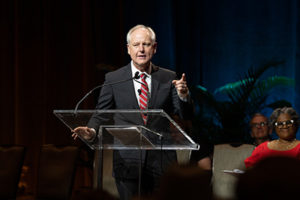
He began with the spiritual seekers who were listening to John the Baptist when John identified Jesus as “the Lamb of God” and who were asking questions “life’s big questions.”

“There were some who already were looking for something good and found something—or someone—better,” West said.

He then examined three disciples of Jesus and the types of people they represent.

Simon—whom Jesus renamed Peter, “the rock”—represented people who are full of potential that God can turn into reality, West said.

“It took some time to get Simon to rock status,” he noted, noting Peter’s initial instability and unpredictability.

Philip—whom West said is portrayed in the Gospels often either stating the obvious or missing the point—represented the “clueless” whose eyes God can open to truth.

Finally, he focused on the cynical Nathaniel, who asked, “Can any good come out of Nazareth?”

“We need converted cynics,” West said. He gave the example of a man in his church who had been an embittered follower of the Nation of Islam. Once he became an enthusiastic Christian, he discipled hundreds of other followers of Jesus.

‘Set a new table’

In his report to the general assembly, CBF Executive Coordinator Paul Baxley called on the Fellowship not just to make room at the table for others, but to “build a whole new table” that reflects “the dream of God” for his people.

CBF Executive Coordinator Paul Bailey presented his report to the CBF general assembly in Dallas. (CBF Photo)

He urged CBF to “answer a call that the Spirit is giving … to set a new table where all gifts are welcome and all gifts are unleashed.”

Baxley reported 154 churches, more than 1,000 individuals and 18 organizations contributed $1.12 million to the CBF Ukraine Relief Fund in four months. He called for ongoing prayer for people still in Ukraine and for the 5 million refugees spread across Europe.

At this point, however, Baxley announced CBF is ending active promotion of the relief fund. At the recommendation of field personnel in the region, CBF will hold back a significant portion of the funds received for long-term recovery in the months and years ahead, he said.

Preaching from Psalm 66, Pastor Courtney Stamey of Northside Baptist Church in Clinton, Miss., emphasized the importance of God’s people participating in worship services of testimony after tumultuous times.

“We need a sacred space to leach out this poison of pain, to celebrate the presence of the Holy Spirit, to confess our doubts and concerns, to lament, to cry, to sing, shout out and praise,” Stamey said. “We need it so we can truly know—deep, deep in our souls—what remains.”

From a global pandemic and racial reckoning to political division and a rise in Christian nationalism, she said, unsettling events should prompt Christians to reflect upon where “God’s steadfast love has showed up.”

‘We have carried on’

Patricia Wilson, a Baylor Law School professor and member of Seventh and James Baptist Church in Waco, completed her time as CBF moderator at the general assembly. She reflected on serving during a global pandemic.

“What I found is that God is good. We have carried on,” Wilson said. “Many things have happened despite COVID. Because we haven’t been able to have a typical general assembly, we missed greeting friends, participating in uplifting worship services. Because of COVID, our field personnel and partners were unable to carry out ministry in usual ways. Because of COVID, we became more aware of inequities and injustices that exist in our local communities, country and world.”

In spite of the challenges COVID presented, Wilson said, “My hope and optimism for CBF have never been greater.”

Incoming CBF Moderator Debbie McDaniel from First Baptist Church in Huntsville, Ala., told the general assembly: “My dream is for each of us to come and see and know the people and the resources of the Fellowship on a deeper level. As I serve you, I will pray for you as you continue your journey of discovery and living into your own unique calling to Christ’s mission.”

Valley Ranch Baptist Church in Coppell received a Mission Excellence Award from CBF for its long-term support for ministries along the Texas-Mexico border and its local English-as-a-Second-Language programs. Other mission award recipients were Heritage Baptist Church in Heflin, Ala., and First Baptist Church in Corbin, Ky.

Stephen Reeves, executive director of Fellowship Southwest and director of advocacy for CBF, announced the creation of the Suzii Paynter March Advocacy Fellowship.

Endowed by the Eula Mae and John Baugh Foundation, the fellowship will provide a current student or recent school of social work, seminary or law school graduate practical experience in advocacy.

The first fellow will work in partnership with Pastors for Children to help develop a network of advocates for public education within CBF churches.

The CBF general assembly approved a $16.5 million budget for 2023, an increase of about $2 million in anticipated revenue. To fund the budget fully, CBF will need to raise $250,000 in new contributions from churches and individuals to CBF Missions and Ministries, and it will require $225,000 in new contributions to the CBF Offering for Global Missions.

With additional reporting by Aaron Weaver and Carrie Harris of CBF.  


JD Hall disqualified from ministry by Montana church

SYDNEY, Montana (RNS)—The founder of a controversial Christian website known for its criticism of evangelical leaders for being too liberal has resigned from his church for “serious sin.”

Montana pastor Jordan Daniel “J.D.” Hall is no longer listed as pastor of Fellowship Baptist Church in Sydney, and he has been removed from the staff of Protestia, a website originally known as Pulpit & Pen.

While the church has not yet publicly acknowledged Hall’s departure, as of June 26 the church’s leadership page no longer can be found. Also on Sunday, Protestia issued a statement saying Hall had resigned as pastor of Fellowship Baptist and is “disqualified from pastoral ministry.”

“Earlier this week, the team at Protestia received allegations of serious sin committed by our brother J.D. Hall,” the statement reads. “After correspondence with leadership at Fellowship Baptist Church, we learned that J.D. was determined by the church to have disqualified himself from pastoral ministry, had resigned from the pastorate, and submitted himself to a process of church discipline. Due to J.D.’s removal from pastoral ministry, we likewise have removed him from ministry with Protestia.”

Dismissal follows lawsuits and DWI arrest

Hall’s resignation is the latest bad news for the Montana pastor and blogger.

In February, Hall filed for bankruptcy after being sued for libel for a story the Montana Gazette, another of Hall’s publications, had run about Adrian Jawort, a Native American activist. Then in mid-May, he was arrested for driving under the influence and carrying a concealed weapon while intoxicated.

Hall later settled with Jawort, retracting the story that prompted the lawsuit and issuing an apology, saying he had fabricated the story. As part of the settlement, Jawort can make a $250,000 claim against Hall in bankruptcy court. Hall currently faces an additional lawsuit, filed by the WhiteFish Credit Union, for stories published in the Montana Daily Gazette, according to the Sydney Herald.

In the past, Hall’s congregation—a self-described fundamentalist, six-day creationist, independent Baptist church—has stood by its pastor, despite his legal problems. The church issued a statement supporting Hall in February, saying he faced “trials and persecution” from liberal activists.

“We rejoice in our pastor’s persecution and suffering for the sake of our Lord, Christ. And we, as a congregation, we stand behind him 100 percent, as has already been established by the unanimous, united voice of our congregation,” the statement read.

Church initially voiced support for Hall

After Hall’s arrest, the church also issued a statement of support, claiming Hall suffered from a vitamin deficiency that caused “poor coordination, slurred speech, word displacement.” The church also said at the time Hall was overworked and would take several months off to rest. According to that statement, Hall could not return to work without his wife’s approval.

Hall has pled not guilty to the DUI and weapon charges. He also addressed the church following his arrest, according to the church’s statement in May.

“He cautioned us solemnly to be ready for what enemies of Christ would do with his situation and to brace themselves,” the statement read. “The congregation spoke openly to assure Pastor Hall he should not be ashamed, that we do not care what the world thinks, as we know the truth.”

It is unclear whether Hall’s departure from the church is related to his previous arrest.

Hall regularly targeted Southern Baptists

Hall is best known for his role as Pulpit & Pen founder, where he criticized what he saw as liberal and worldly influences affecting the evangelical church and especially the Southern Baptist Convention.

Among the site’s regular targets were Bible teacher Beth Moore, former Southern Baptist ethicist Russell Moore (no relation), professor and columnist Karen Swallow Prior, former SBC President J.D. Greear, and Tennessee preacher and Trump supporter Greg Locke.

After Facebook banned the Pulpit & Pen, the site was renamed “Protestia.” Hall also heads the Gideon Knox Group, which runs a church-based collection of media sites and other media ministries, including the Polemics Report, the Bible Thumping Wingnut podcast network and an AM radio station.

Hall’s church echoed his political views. Along with listing the church’s views about the Bible, the Trinity, baptism and other Christian doctrines, the Fellowship Baptist statement of faith includes a “repudiation of the Social Justice Movement, Critical Theory, Liberation Theology, and Marxism in all of its various forms.”

The church also offers religious liberty vaccine exemption letters.

Fellowship Baptist did not respond to a request for comment on Sunday afternoon.

After Hall’s resignation, Protestia distanced itself from the church.

“While the church’s decision to accept J.D.’s resignation from pastoral ministry leaves us no choice but to consider the allegations against him to be credible, we are unable to determine their truth with certainty and therefore cannot speak to the specifics of the accusations lest we be guilty of gossip,” according to the Protestia statement.


Conservative Baptist Network pledges return

ANAHEIM, Calif. (RNS)—In the moments after the final gavel sounded to close the Southern Baptist Convention’s annual meeting last week, Rod Martin was surprisingly cheerful.

Things had not gone well during the meeting for Martin, co-founder of the Conservative Baptist Network, whose members believe the nation’s largest Protestant denomination has been invaded by “woke” ideas like critical race theory.

Rod Martin

The network’s candidate for SBC president, Florida pastor Tom Ascol, lost. As did the group’s candidates for recording secretary, president of the annual pastors’ convention and officer candidates for the SBC’s Executive Board. And most of the motions made on the floor by Conservative Baptist Network members were voted down by an overwhelming margin.

None of that discouraged Martin, a tech entrepreneur from Florida and longtime Southern Baptist.

“We’ll be back,” he said.

In recent years, the Conservative Baptist Network and its allies, including Ascol’s Florida-based Founders Ministries, a Calvinist group, and Sovereign Nations, a Christian nationalist group, have made national headlines for their claims about liberal drift in the SBC.

They’ve rallied support on social media and through conferences, urging followers to change the SBC’s direction and “take the ship” of the denomination.

One Conservative Baptist Network supporter went so far as to unfurl a skull-and-crossbones flag at his church—leading the group and its allies to be labeled as pirates.

Yet their efforts to reshape the denomination have largely failed. Last year in Nashville, Georgia pastor Mike Stone, the network-backed candidate for SBC president, lost in a close election. And a group of Conservative Baptist Network members quit the SBC’s Executive Committee in the fall, after an unsuccessful attempt to limit an investigation into how SBC leaders handled sexual abuse.

CBN had high hopes, suffered major setbacks

The week of the 2022 annual meeting began optimistically for the Conservative Baptist Network and its allies. The group drew packed crowds for an evening with California pastor John MacArthur and Voddie Baucham, a bestselling author and anti-woke preacher, and a breakfast that featured Ascol, Martin and activist Charlie Kirk of Turning Point USA.

“I think we’re going to win today,” Martin told the crowd at the breakfast, a few hours ahead of the presidential election.

But even if they did not win, he said, the stakes were too high to give up.

After the annual meeting wrapped up, Martin and other leaders blamed the group’s losses mostly on location. Anaheim, Calif., he said, was “tough ground” for the network’s attempts at reforming the SBC. Next year’s meeting will be in New Orleans, much closer to the SBC’s Bible Belt core.

“I expect the turnout to be more like Nashville,” he said.

In Nashville, their candidate lost by a few hundred votes, at a gathering that drew more than 15,000 local church representatives known as messengers. By contrast, just over 8,100 messengers made it to Anaheim.

Location matters

An analysis by Eastern Illinois University professor Ryan Burge pointed out that the SBC meetings in the Bible Belt tend to outdraw those in other places. The Conservative Baptist Network also has a state chapter in Louisiana, which will likely aid with turnout.

And Southern Baptists in the Bible Belt are more likely to identify as politically conservative than those in California—which would likely bolster the Conservative Baptist Network cause, which is both religious and political.

During his remarks at the network breakfast, Kirk labeled the group’s supporters as courageous pastors resisting the influence of liberalism in the evangelical church. He contrasted them with “cowardly pastors” who care only “about budgets and buildings and baptisms” and “complicit pastors” who march with Black Lives Matters and “hang pride flags.”

“Our beautiful faith is under attack from within,” he said.

Kirk urged pastors to stand for liberty—seeing mask mandates and COVID-related shutdowns during the pandemic as signs of government tyranny. He also told them that if “America falls” then it will be harder for Baptists to spread the gospel.

“If we don’t recognize that we all have to agree on liberty and the gospel, we’re all going to be sharing our theological disputes in prison,” he said.

Former SBC First Vice President Lee Brand, whose term expired after the SBC meeting, told Conservative Baptist Network supporters to continue standing against worldly influences invading the denomination.

“We’re not ever going to do enough for the world to like what we have to say,” he said.

Despite their election losses, the Conservative Baptist Network and its allies have had some success. Their activism helped drive up attendance for the 2021 meeting in Nashville, the largest since the mid-1990s. And that increased attendance led SBC to move the 2023 meeting from Charlotte, N.C., to New Orleans, as the Charlotte space was too small.

‘Woke war’ continues

Anti-CRT activism by Ascol and Michael O’Fallon of Sovereign Nations also helped drive the national “woke war.” The Conservative Baptist Network and its allies played a role in a 2021 SBC resolution calling for the abolition of abortion, which would support legislation to outlaw abortion with no exceptions. A 2022 abortion resolution, also backed by the Conservative Baptist Network and its allies, which called for criminal penalties for women who have abortions, was rejected by messengers.

The network’s supporters also contributed to controversy over the future of Saddleback Church, one of the largest churches in the SBC. That church, led by bestselling author Rick Warren, ordained three women as staff pastors last year, leading to calls for Saddleback to be expelled from the SBC. The SBC’s statement of faith limits the office of pastor to men.

The SBC’s credentials committee, charged with reviewing Saddleback’s status, proposed creating a task force to study the meaning of the word “pastor”—given that many SBC churches refer to staff members as “pastor” even though they don’t preach. The idea of a study committee was met with an angry response and was withdrawn.

Martin pointed to the credentials committee as a sign that the SBC’s leadership has lost its way. Most Southern Baptists know what a pastor is, he said. While a woman can have a leadership role at a church, she can’t have the title of pastor.

“I don’t care if she’s the women’s Grand Poobah,” he said. “She can’t be a pastor.”

Views on sex abuse controversial

While the Conservative Baptist Network and its allies have found support for their opposition to critical race theory, women pastors and abortion, some of their views on the issue of sexual abuse have been controversial.

Ascol, for example, was critical of the recent Guidepost Solutions report on abuse and has been skeptical of a series of reforms approved by SBC messengers to address abuse. Mark Coppenger, a former SBC seminary president and Conservative Baptist Network steering committee member, has said the issue of sex abuse in the denomination has been overblown. Coppenger opposed the recently passed reforms to address abuse during the annual meeting.

“I really think Guidepost and those who are enthusiastic for what they’ve said are virtually slandering the convention,” he said in a phone interview. “I’m saying, you’ve got us wrong.”

Coppenger fears that reforms, such as a website to track abusive pastors, will open the SBC up to lawsuits from abuse survivors.

“We should address this in the local church and work with local authorities,” he said. “But don’t go overboard.”

At the end of the 2022 meeting, Martin stood outside the main meeting hall at the Anaheim Convention Center, greeting friends, shaking hands and admiring a new “Wrath of Khan”-themed gift he got from Victor Chayasirisobhon, a fellow “Star Trek” fan and California pastor who’d been elected the SBC’s first vice president.

Martin urged friends and allies to stick with the convention, despite the group’s 2022 losses, saying the SBC is “better together.”

“We have some arguments we’ve got to settle,” he said. “But we need to go to New Orleans and settle them and do it with courage, with fidelity to Scripture.”


Baptist women in ministry show marginal gains

A Baptist Women in Ministry survey revealed one in four have been sexually harassed or sexually assaulted while serving in their ministry setting.

About half (51 percent) of the respondents to the survey Baptist Women in Ministry conducted last fall said sexual harassment and assault were discussed rarely or never in their congregations.

“Experts assert that the rates of sexual assault and harassment are likely higher in reality than statistics reveal, because most cases go unreported,” wrote Laura Ellis, Baptist Women in Ministry project manager and author of the annual report.

“Some victims feel ashamed and fear being silenced, not believed or even blamed. Many victims have a difficult time labeling their experience as harassment or assault and find it easier to act as if it never happened. Even though the BWIM survey was anonymous, it is likely that the real number of affected women is higher.”

Baptist Women in Ministry released the survey results as part of its annual report on State of Women in Baptist Life. The June 21 release occurred one week after messengers to the Southern Baptist Convention dealt with a report on its handling of sexual abuse and debated whether to cut ties with a church that ordained three women as pastors.

The SBC was not one of the Baptist groups surveyed. The convention’s 2000 Baptist Faith and Message states, “While both men and women are gifted for service in the church, the office of pastor is limited to men as qualified by Scripture.”

Survey reveals women in ministry face obstacles

The survey revealed 86 percent of the respondents reported experiencing obstacles in ministry because of their gender.

About six in 10 (59 percent) of those who responded to the survey said they felt overlooked or silenced in their ministry settings, 63 percent said they have fight for a seat at the table, and 59 percent said their judgment was questioned in their area of expertise. Seven out of 10 women (72 percent) said they had to provide more evidence of competence than their male counterparts.

In multiple areas, the survey revealed women of color experience obstacles in their ministry even more frequently than white women.

In regard to compensation, about half (49 percent) said women in ministry were not paid equally to male counterparts.

Increase in number of female pastors and co-pastors

The State of Women in Baptist Life 2021 Report revealed an increase in the total number of women pastors and co-pastors. In 2015, the organization reported 174, while it reported 272 in 2021—due partly to data from additional groups and partly to actual increases in groups surveyed in 2015.

Baptist Women in Ministry in 2015 gathered information on the Alliance of Baptists, Cooperative Baptist Fellowship, Baptist General Association of Virginia, Baptist General Convention of Texas and District of Columbia Baptist Convention. The 2021 report also included data from American Baptist Churches USA and the General Baptist State Convention of North Carolina.

Every denominational group included in the report except one experienced a marginal increase in the percentage of women pastors in their congregations. The exception was the District of Columbia Baptist Convention, which increased from 8.9 percent in 2015 to 17.1 percent in 2021.

However, while the CBF showed a percentage increase, the total number of women pastors in its churches decreased from 117 in 2015 to 105 in 2021. The number of CBF-affiliated churches during that period decreased from 1,800 to 1,422.

‘Still much work to do’

Meredith Stone

“Each ordination, calling, installation and positive experience of a Baptist woman in ministry represented in this report is cause for celebration. But Baptist women deserve safe places where they are affirmed, respected, and empowered for ministry,” said Meredith Stone, executive director of Baptist Women in Ministry.

“Unfortunately, this report reveals that there is still much work to do for an equitable Baptist world for women to become a reality.”

The number of women pastors and co-pastors in churches affiliated with the BGCT increased slightly, from 25 in 2015 to 33 in 2021.

The Baptist General Association of Virginia posted a similar slight increase in the number of women pastors and co-pastors—48 in 2021, compared to 38 in 2015.

“Texas Baptists and the Baptist General Association of Virginia are uniquely situated as state conventions who have allowed congregations the autonomy to call women as senior pastors. However, both recorded only a marginal increase with regard to women serving as pastors or co-pastors from 2015 to 2021,” Stone said.

“In the case of people who have been marginalized by the church, autonomy—while necessary and celebrated—is not enough to see progress in the form of more people created in the divine image being able to utilize fully their gifts and callings in service of the church. More concerted and visible efforts of education, advocacy and elevation within these denominational groups will be needed to move these statistics forward.”

Status of women in theological education

Baptist Women in Ministry reported 129 female students enrolled in master’s degree programs at Baylor University’s Truett Theological Seminary in 2021, compared to 122 in 2015. The organization reported seven female students at Truett Seminary pursuing a Doctor of Ministry degree in 2021, compared to two in 2015.

Logsdon Seminary at Hardin-Simmons University had 47 women in master’s degree programs and two in its Doctor of Ministry degree program in 2015. HSU trustees voted in February 2020 to close Logsdon Seminary.

Baptist Theological Seminary at Richmond had 29 female students in master’s degree programs and seven in its Doctor of Ministry degree program in 2015. The seminary closed its doors in 2019.

“The closing of these two seminaries meant fewer options for women to receive seminary training in a Baptist context, as well as less opportunities for men to be trained alongside and by women in a uniquely Baptist setting,” Ellis wrote in the annual report.


Hispanic pastors discuss leading a church out of COVID

ANAHEIM, Calif.—Hispanic pastors from California, Florida and Texas discussed strategies to lead the church in a post-COVID world during a panel discussion in the exhibit hall at the 2022 Southern Baptist Convention annual meeting.

Luis Lopez, executive director of Hispanic relations and mobilization of the SBC Executive Committee, moderated in English the panel formed by Victor Solorzano, Eloy Rodriguez and Tony Miranda.

The pastors answered questions about how the COVID-19 pandemic affected their ministries, how they recovered and how they are moving forward.

Solorzano, pastor of Vida en Victoria in Bell Gardens, Calif., lost a dear church elder to the virus, as well as seven family members. As he led his church through the pandemic, he found returning to the basics of prayer and discipleship was the best way to weather the storm.

“We adapted our small groups and giving to be online, and now we have more people in small groups and more people giving,” he said.

Rodriguez, the pastor of Idlewild Baptist Church in Spanish in Lutz, Fla., said as horrible as the pandemic was, it laid at the church’s door the opportunity to share the gospel even more than before. “Death was very present, and speaking to eternal life was easier, because people were open to it.”

Between 2020 and 2022, Idlewild Español planted two other Spanish-speaking churches—testimony to how the Lord moves even in the most difficult of circumstances, he said.

‘Going back to the basics’

Miranda, pastor of Primera Iglesia Bautista in Austin, said the pandemic caused many church members to leave and never come back, and it exposed a need for spiritual maturity in the church.

As the church emerged from the crisis, leaders evaluated what things they would keep and what things they would discard to make ministry more effective, Miranda said.

“We are taking more care to keep in mind our online audience while we prepare our worship services,” he said. Some ministries have been eliminated, he said, because even before the pandemic they were not essential.

“It’s been about going back to the basics.”

Going back to the basics has proved to be a successful strategy for these pastors and their churches. The youth are more involved in ministry as they take on the responsibility of church technology, more people participate in small groups as they become more accessible during the week, and people give more now that they can easily do so from their phones, the pastors agreed.


Baptist pastor released after being kidnapped by cartel

Baptist pastor Lorenzo Ortiz, who operates five shelters for migrants in northern Mexico, was released unharmed after being held hostage by a Mexican cartel for about 29 hours.

Ortiz, whose ministry to migrants receives monthly financial support from Fellowship Southwest, was kidnapped along with 15 other hostages from one of his shelters about 6 p.m. on June 6 in Nuevo Laredo by a cartel operating in the region.

Initially, the cartel demanded $40,000 for his release. Later, the kidnappers reduced the ransom demand to $20,000.

However, when the ordeal ultimately ended about 11 p.m. the next evening, the cartel not only released him unharmed and without making any ransom payment, but also replaced two slashed tires on his van.

Ortiz described his experience in a 45-minute recorded teleconference interview with Cameron Vickrey, director of communication and development for Fellowship Southwest, and Elket Rodriguez, Cooperative Baptist Fellowship field representative to migrants and communities along the United States-Mexico border.

Interrogated by abductors

In the interview, Ortiz said his abductors demanded to know how much he charged each migrant family he assisted in one of his shelters.

“I told them as a pastor, we do this for free,” Ortiz said.

When the cartel members and their boss refused to believe he was providing food, shelter and transportation to migrants without charging any fee, Ortiz challenged them to check his cell phone, which was in their possession.

“If you find just one person that I charged a dollar … If you find one call where I was talking to somebody about money or any extortion, then you can pull the trigger if you want,” he recalled telling his captors.

Rodriguez explained the cartels profit from transporting migrants as part of their organized criminal activity, and they “own the turf.”

“It’s all a business to the cartel. They see humans as commodities,” he said.

The cartel that kidnapped Ortiz wanted to know if he was a competitor “cutting into [their] business,” he explained.

Rapid response by authorities

Members of the cartel sent one of the shelters a photo of Ortiz’s van with slashed tires to prove they were holding him. At that point, members of his family began contacting authorities both in Mexico and the United States.

Because of the reputation Ortiz has earned and the respect he has gained for humanitarian work in northern Mexico, the Mexican National Guard, regional authorities and local law enforcement responded quickly—taking the cartel by surprise.

With a helicopter circling overhead and armed military personnel in the streets, the cartel—whose power is based on instilling fear in others—was frightened, Ortiz said.

Even a rival cartel—who had determined three years ago Ortiz was not profiting from his ministry to migrants—called to tell the kidnappers they didn’t know who they were holding, and he needed to be released.

“The cartel was shaken. … The cartel never felt so vulnerable,” Ortiz said, adding he felt at peace because he knew Christians were praying for him.

In a phone interview, Rodriguez said from the time he learned about Ortiz begin kidnapped, he prayed for the same outcome as in the story of Abram and Sarai in Egypt. In Genesis 12, God afflicted Pharaoh and his household so severely, the Egyptian ruler told the Hebrew couple to leave.

“That’s exactly what happened,” he said. “They knew Lorenzo had to have the favor of God.”

‘A lamb among wolves’

When Ortiz began ministering to migrants in Nuevo Laredo several years ago, he was aware of the cartel activity in the region. He said he knew he was working as “a lamb among wolves,” but he felt assured “God was going to be there.”

Ortiz said he saw the kidnapping as something God permitted “to test our faith, to test our hearts.”

Some of the migrants abducted from the shelter—who were held captive longer than Ortiz—told him after their release how they sang hymns and prayed together during the time they were held hostage.

“A cartel member saw all the guys singing and praying, and when he saw that, he started crying,” he said, adding even the cartel was touched by the witness of faithful migrants.

As the cartel began releasing the migrants five at a time over the next several days, they arrived at the shelter where fellow Christians celebrated with them.

In coming days, Ortiz said, he will help them begin the process of applying for political asylum.

Ortiz recognizes the danger he faces ministering to migrants in Nuevo Laredo, and he acknowledged, “We may pay a price.”

However, he insisted, faithfulness to his calling requires him to meet needs in Christ’s name and to take the light of God’s love into dark places.

“We’re not supposed to run from the devil. The devil is supposed to run from us,” he said.