Prestonwood escrows Cooperative Program funds, cites ERLC actions

PLANO (BP)—Prestonwood Baptist Church in Plano has decided to escrow Cooperative Program funds to evaluate future support of Southern Baptist Convention causes.

At issue are what the congregation calls “various significant positions taken by the leadership of the Ethics & Religious Liberty Commission that do not reflect the beliefs and values of many in the Southern Baptist Convention,” according to a statement the church released to Louisiana’s Baptist Message.

Over the course of a year, Prestonwood’s contributions to the Cooperative Program would total about $1 million, the Message reported.

In a December interview with the Wall Street Journal, Pastor Jack Graham said Prestonwood was “considering making major changes” in its support for the SBC due to alleged “disrespectfulness” by ERLC President Russell Moore toward evangelical supporters of Donald Trump during the 2016 presidential campaign.

Graham is a member of Trump’s evangelical executive advisory board.

Moore, who publicly opposed Trump during the primary and general election cycles, said in a December blog post he never intended to criticize all evangelicals who supported Trump.

Legal brief generates criticism by some

Some Southern Baptists also criticized the ERLC for joining a friend-of-the-court brief last May in support of a New Jersey Islamic society’s right to build a mosque. The International Mission Board joined the brief as well.

First Baptist Church in Morristown, Tenn., announced last month it would escrow funds traditionally given through the Cooperative Program over concerns related to ERLC and IMB participation in the New Jersey mosque brief. First Baptist Pastor Dean Haun resigned as an IMB trustee in November over the brief.

IMB President David Platt apologized Feb. 15 for what he called the “distracting and divisive” action.

‘Disconnect’ between some agency leaders and churches

Graham, a former SBC president, said in a text message Prestonwood is engaging in “an internal evaluation” of its giving, “and our desire is not to seek publicity so we can make the right decision for our church and Southern Baptists.”

Asked whether Prestonwood also will escrow funds for the Southern Baptists of Texas Convention—the state convention with which it cooperates—Graham responded, “We’re evaluating everything.”

Graham told the Message he is “not angry at the SBC, and neither are our people, and I’m not working to start a movement to fire anyone.” He insisted he wants Prestonwood to remain “a cooperating partner (with the SBC) as we have been for many years.” However, he cited “uneasiness” among church leaders about the “disconnect between some of our denominational leaders and our churches.”

ERLC President Russell Moore issued a statement: “I love and respect Jack Graham and Prestonwood Baptist Church. This is a faithful church with gifted leaders and a long history of vibrant ministry working and witnessing for Christ.”

Bart Barber, pastor of First Baptist Church in Farmersville and member of the ERLC Leadership Council tweeted following Prestonwood’s announcement, “I love and appreciate” Jack Graham “but am an ardent advocate for #ReligiousLiberty” and for the Cooperative Program, and “I’m just heartbroken & conflicted.”



CBF launches Fellowship Southwest network

DECATUR, Ga.—The Cooperative Baptist Fellowship is launching Fellowship Southwest—a network spanning Texas, Oklahoma and the West.  

The CBF governing board adopted a motion Feb. 10 from its networking committee to affirm Fellowship Southwest.

“Fellowship Southwest is a wonderful opportunity to come alongside our incredible churches in Texas, Oklahoma and the West to cultivate Christian community and accomplish mission and ministry in harmony with one another,” CBF Executive Coordinator Suzii Paynter said.

“This network will strengthen our core commitment as Cooperative Baptists to unity in cooperation, bringing to the table churches and individuals with a variety of worship practices and beliefs who are serious about shared mission, ministry and advancing the witness of Christ.

“The convergence of Christians culturally and ecumenically who wish to partner together makes this moment ripe to set a new, big and equal table in our Fellowship. This new regional network presents great opportunity for Christian community, shared mission and impactful ministry.”

Will supplement CBF of Texas and other organizations

The new regional network will supplement the work of three autonomous CBF state/regional organizations—CBF of Texas, CBF of Oklahoma and CBF West—to promote Baptist identity, Christian cooperation and to accomplish effective mission and ministry among related partners.

Fellowship Southwest will encompass an area that is home to more than 500 CBF churches, four partner theological schools and a wide array of other partners and individuals, including CBF field personnel, chaplains, pastoral counselors, student groups and church starters.

The Fellowship Southwest network will offer an enhanced capacity for collaboration, communication and identity in the Southwest; Hispanic church and mission development in the United States and Mexico; ethnic and ecumenical partnerships; scholarships and support for young leaders; collaborative mission and ministry work; church starting and congregational revitalization; clergy health and effective ministry; advocacy and public witness; recruitment and retention of churches; referral and placement services; and cooperation with state and regional denominational bodies.

McClatchy Rick 150Rick McClatchy The new network will strengthen existing missions and church-starting partnerships among Fellowship churches in Texas, Oklahoma and the West region in addition to enhancing ongoing partnerships with Convención Bautista Hispana de Texas, Hispanic Pentecostals and churches in Mexico, CBF of Texas Coordinator Rick McClatchy said.

“Fellowship Southwest is a recognition of all that is already happening in the larger picture of the Southwest,” McClatchy said. “It is an effort to bring more intentional coordination, communication and a broader strategic vision to our mission efforts in the region.”

CBF West Coordinator Glen Foster, who provides leadership to a 13-state region and is pastor of Pantano Baptist Church in Tucson, Ariz., said the new network will “produce life-changing results” in Arizona, New Mexico and California.

“The Southwest has the highest percentage of non-English speakers,” Foster said. “Partnering to provide assistance with immigration, education and advocacy will build bridges of much-needed hope, and working together in missions will grow the kingdom of God on both sides of the U.S. border.”

CBF of Oklahoma Coordinator Steve Graham echoed McClatchy and Foster and emphasized the network will offer new points of connection between churches and will generate energy around shared mission in the Southwest.

“Fellowship Southwest will connect churches, lay leaders and ministers who are a vital part of CBF,” Graham said. “Bringing us together will harness energy and passion for the good of the cause. In our state of Oklahoma, a growing number of people are discovering that we offer ourselves as partners in conversation, ministry and mission; partners for well-being and wholeness. Connecting with our border states will increase the momentum.”

Organizational structure

The network’s organizational structure will consist of a steering committee, an advisory committee and a full-time coordinator employed by CBF. The steering committee will include representatives from CBF of Texas, CBF of Oklahoma and CBF West as the network’s originating executive members. An additional four to six members also will serve on the committee with the Fellowship Southwest coordinator as an ex-officio member of the steering body.

The advisory committee of Fellowship Southwest will be organized as a coalition of representative ministry and mission partners, serving three-year terms with the possible re-appointment for an additional three-year term. Representatives of the advisory committee will advance the priorities of the network in mission and ministry. The committee will serve as a hub from which various aspects of shared ministry are accomplished through subcommittees, task forces and other structures relevant to harmonious work and relationship.

Network leaders will convene in May for a planning retreat to discuss mission and ministry priorities, organizational structure and future full-time leadership.


Canadian named interim director of BWA women’s department

FALLS CHURCH, Va.—The Baptist World Alliance named Moreen Sharp, president of the North American Baptist Women’s Union, as interim executive director of the BWA women’s department.

Sharp, a Canadian, is a vice president of the BWA women’s department. She already serves part-time as acting executive director for the department and will become full-time interim executive director in November. Her appointment lasts until July 2020.

She succeeds American Patsy Davis, who retired Dec. 31, 2015, and served 17 years as executive director of the department.

From 2008 to 2010, Sharp was president of Women in Focus, the women’s group for Baptists of Western Canada. During that time, she also was on the boards of Canadian Baptist Ministries, Canadian Baptist Women and the North American Baptist Women’s Union, one of seven continental unions of the BWA women’s department.

She is a member of the BWA general council and the commission on human rights advocacy, as well as the general council of the North American Baptist Fellowship.

“Moreen has an excellent testimony of Christian character and is recognized by the Baptist family as capable, organized, relational and visionary,” said BWA women’s department President Ksenija Magda of Croatia. “She will be a great women’s department advocate and a gracious colleague to the BWA general secretary and staff.”

She and her husband, Paul, have been ministry partners more than 30 years in several countries. They have engaged in transitional ministry, serving various congregations in Canada on a short-term basis. She has led teaching, music and drama ministries in Japan, India and Canada.

She holds a theological degree from Regent College, an international graduate school of Christian studies in Vancouver.


Baptist Briefs: GuideStone sponsors benefits training

GuideStone sponsors training event on employee benefits. GuideStone Financial Resources will sponsor its inaugural Employee Benefits Summit, March 27-29 in Dallas, for human resources professionals, financial officers of churches and ministries, and other decision-makers for ministries. The event combines into one event content previously offered at the spring Southern Baptist Business Officers’ Conference and the fall Benefits Forum, along with an expanded menu of networking and training opportunities. Registration is $199, but an early-bird discounted price of $149.99 is available for those who register on or before Jan. 23. Summit speakers include Richard Hammar, expert in ministerial tax law; David S. Spika, president of GuideStone Capital Management; Danny Miller, legal expert on church and ministry retirement plans; Greg Baylor, senior counsel for the Alliance Defending Freedom; and Mark Rienzi, senior counsel for the Becket Fund. To register, click here


Baptist church in Washington calls lesbian couple as pastors

WASHINGTON—Calvary Baptist Church, a 155-year-old congregation in the heart of downtown Washington, D.C., named a same-sex married couple as co-pastors.

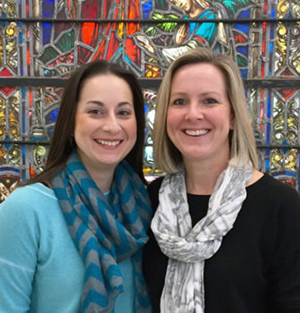
Calvary Pastors 300Co-pastors Maria Swearingen (left) and Sally Sarratt stand in front of the Burrall windows in the Palacios Chapel of Calvary Baptist Church in Washington, D.C. (Photo courtesy of Sandra Auman via Calvary Baptist Church)The congregation approved Sally Sarratt and Maria Swearingen for the senior leadership posts during worship services Jan. 8. They are scheduled to begin their new jobs Feb. 26.

“We look for the best people in the world, and that’s who they were,” said Carol Blythe, chair of the congregation’s ministerial search committee. “We’re very excited.”

Call for ‘serious dialogue’

However, the church’s decision prompted a fellow pastor in the District of Columbia Baptist Convention to call for “serious dialogue and prayerful discussion” between convention leaders and the congregation.

Joseph Lyles, pastor of Fort Foote Baptist Church in Fort Washington, Md., and former president of the National African American Fellowship of the Southern Baptist Convention, said he was “surprised” and “concerned” by Calvary Baptist’s decision to call a same-sex couple as pastors.

“I would hope that lines would be drawn” regarding cooperation with the Baptist convention, he said.

“My loving, compassionate side would not (want to disfellowship) them from the convention,” Lyles said. “Hopefully, they will come around and see the biblical light.”

No plans to disassociate

Robert Cochran, executive director of the District of Columbia Baptist Convention, issued a statement regarding the convention’s position.

“We have no plans to disassociate” with Calvary, he said. “To the best of my knowledge, the D.C. Baptist Convention, due to its respect for local congregational autonomy, has never withdrawn fellowship from any congregation.”

Cochran said he is “certain that homosexuality has been discussed” at some point since the founding of Calvary in 1861 and the convention in 1877. However, he added, “I can state with certainty that I have never discussed the issue of homosexuality with leaders at Calvary.”

Broke with Southern Baptists in 2012

Calvary Baptist severed ties with the SBC in 2012. It found itself at loggerheads with the group on several issues, including the convention’s stance against homosexual behavior. Calvary Baptist still affiliates with American Baptist Churches USA, the Cooperative Baptist Fellowship and the Alliance of Baptists.

Sarratt and Swearingen come to Calvary from Greenville, S.C., where Sarratt is associate chaplain for behavioral health in the Greenville Health System and Swearingen is associate chaplain at Furman University. Sarratt also has served as part-time associate minister at Greenville Unitarian Universalist Fellowship.

“We have found it so easy to fall in love with Calvary and its longstanding commitment to be a voice of justice and compassion for those who perpetually find the wholeness of their humanity disregarded and maligned,” the couple stated in an announcement from the church.

The women met in First Baptist Church of Greenville, and both were ordained by that congregation after it adopted and implemented a nondiscrimination policy in 2015.

Sarratt left the corporate world after she felt called to ministry and obtained a master’s degree in theological studies from Emory University.

Swearingen, who is fluent in English and Spanish, earned a master of divinity degree from Duke Divinity School, where she won an award for her preaching.

Amy Butler, Calvary’s previous senior minister, left to become pastor of New York’s Riverside Church in 2014.

Compiled from reports by Lauren Markoe of Religion News Service and David Roach of Baptist Press


Music and worship draw focus of Baptist scholars

SAN ANTONIO (BP)—Topics such as the biblical argument for congregational singing and a case for multigenerational worship services are drawing the attention of Baptist scholars.

At the most recent Evangelical Theological Society in San Antonio, at least eight presentations—five by scholars at Baptist-related institutions—focused on worship-related topics.

Case for congregational singing

Jonathan Welch, pastor of worship development at The Summit Church in Raleigh-Durham, N.C., presented a theological case for congregational singing, arguing Scripture demonstrates at least 10 functions of corporate singing among God’s people.

Worship leaders entrusted to select music for worship services should “choose songs that facilitate the full breadth of theological functionality” represented by 10 points he identified, said Welch, a doctor of philosophy student at Southeastern Baptist Theological Seminary.

Congregational singing praises God, expresses worship in particular cultural forms associated with the singers, can connect worshippers with history, orients believers toward an eternity of worship, allows worshippers to proclaim God’s word to each other, expresses unity and solidarity within body of Christ, teaches doctrine, expresses and influences emotions, can be an evangelistic witness and is a type of prayer, Welch said.

“The gospel of grace frees the Christ-follower from the works-righteousness of singing to please God,” Welch said. “But Christians who abstain from singing practically disavow the 10 theological functions of congregational song.”

‘Radical participatory nature’ of corporate worship

David Toledo, assistant professor of music ministry at Southwestern Baptist Theological Seminary, drew insights for planning and conducting worship services from 1 Corinthians 14. That passage, he argued, “provides the rationale and scriptural basis for the balance of form and freedom that is cherished by those in (the) Free Church tradition.”

worship340David Toledo, assistant professor of music ministry at Southwestern Baptist Theological Seminary, argues for the “radical participatory nature” of corporate worship. (File Photo)Toledo argued for “the radical participatory nature” of corporate worship, noting the Apostle Paul’s teaching that each person in the congregation has a spiritual gift to be exercised in corporate gatherings.

“Congregations must recover the appreciation of the giftedness of the entire assembly” rather than focusing worship services exclusively on talented leaders through a concert-like setting, Toledo said,

Toledo drew on Paul’s teaching about the use of tongues in worship—although he did not advocate speaking in tongues—to offer insight on corporate prayer. Such prayer should be characterized by “Spirit-led expression” and “tempered by an understanding that the other members of the congregation must be able to offer their affirmation and endorsement of the spoken prayer.”

Freedom in worship should be balanced by “a fierce commitment to the supremacy of the word of God in all matters of practice and theology,” he asserted.

‘Questionable’ doctrine but memorable hymns

Scott Aniol, assistant professor of church music at Southwestern, argued the hymn writer Isaac Watts expressed his views on the Trinity “in questionable ways” at times in sermons and writings, despite his legacy of hymns with strong Trinitarian lyrics.

watts 300Watts, an 18th-century English minister who has been called “the father of English hymnody,” wrote “When I Survey the Wondrous Cross” and “Alas! And Did My Savior Bleed,” among other hymns.
Charges that Watts was “less than orthodox in his doctrine of the Trinity” stem largely from works he published in the mid-1720s, Aniol stated. Although Watts seemed to affirm orthodox Trinitarian doctrine earlier and later, he argued between 1724 and 1727 that Jesus possesses “two distinct persons”—God and man. Traditional Christian doctrine asserts Jesus possesses one indivisible person and two natures.

Watts also said he could not reconcile “both the literal deity and literal personality of the Trinity,” Aniol said, and Christ may be due “mediate or subordinate forms of worship.”

By the end of his life in 1748, it appears Watts reversed “some of his more questionable views from earlier works,” but he continued to argue “belief in a particular explanation of the Trinity is not necessary for salvation,” Aniol said.

In the end, whether Watts rejected a traditional view of the Trinity at some point in his life is far less significant than the lasting impact of his hymns, Aniol insisted.

“Many of his hymns are strongly Trinitarian” and “have inarguably had a more lasting influence upon Christians and their worship than his treatises,” he said.

UMHB professor touts benefits of multigenerational worship

Robert Pendergraft, assistant professor of church music at the University of Mary Hardin-Baylor, argued the work of developmental psychologist Erik Erikson suggests all generations within a church would benefit from attending corporate worship together.

“Age segregation in worship stunts maturation and growth of the congregants by not embracing the needs of those at varying developmental stages,” Pendergraft said.

“This is not just a critique of those that separate children from the service, but also is directed toward any generational marketing, be it toward children, youth, young adults or senior adults.”

Pendergraft traced the eight life stages proposed by Erickson—a 20th-century psychologist who drew from Judeo-Christian monotheism—and argued aspects of corporate worship benefit individuals at each stage. For example:

  • “The presence of children with their parents in worship allows the infant to develop … trust (in parents) … and allows the congregation to be constantly reminded” of its need to trust God in the same manner, he asserted.
  • Intergenerational worship allows children “to begin mimicking the actions of those in the congregation,” he said.
  • In corporate worship, mature believers can “walk alongside” adolescents “who are searching for a place of acceptance and point them toward the right defining source of their identity, the unchanging gospel of Jesus Christ,” Pendergraft said.
  • Older adults can observe a new generation of worshippers and “realize they have left a legacy for the future,” he said.

Logistical considerations of intergenerational worship were beyond the scope of the paper, Pendergraft said in an interview.

“All congregants should have parts of the service in which they can cognitively and physically participate,” he insisted.


Former Glorieta homeowners seek rehearing for LifeWay lawsuit

DENVER—An Arkansas Baptist couple filed a petition for the entire 10th Circuit Court of Appeals to rehear their lawsuit against LifeWay Christian Resources that challenged the sale of Glorieta Conference Center near Santa Fe, N.M.

Kirk and Susie Tompkins of Little Rock, Ark., filed the petition Jan. 4—two weeks after the court of appeals affirmed a lower court’s dismissal of their suit against LifeWay, the Southern Baptist Convention’s Executive Committee and both organizations’ officers and chief administrators. 

“We have not yet thrown in the towel,” Kirk Tompkins said in an email.

The couple filed a petition for a review by all the available judges in the federal circuit court, rather than a typical three-judge panel. The court’s website includes a statement identifying this as “an extraordinary procedure, and if the court finds the petition frivolous, the filing party may be ordered to pay a money penalty of up to $500.” 

The Tompkinses asserted LifeWay misled and mistreated individuals who owned homes on leased land at Glorieta. They insisted LifeWay offered significantly less than market value for the houses when the agency sold the conference center to a new corporation called Glorieta 2.0.

In their petition for a panel rehearing, the Tompkinses point out they brought their suit without the benefit of legal counsel. The petition cites precedents indicating the documents they filed “cannot be held to the same standard as pleadings drafted by attorneys,” and the court should provide “wide latitude” when considering their case.

When the court of appeals appointed an attorney, the lawyer “failed to provide oral preparation and evidence” for oral arguments, the petition asserts.

The couple sought $12.5 million in damages for themselves and others affected by the sale. When the U.S. District Court dismissed the original lawsuit, they filed an appeal. 

However, a federal appeals court affirmed the lower court’s decision. Circuit Judge Carlos F. Lucero ruled the couple “lacked prudential standing,” and while the lease arrangement “operated to the detriment” of the Tompkinses, it did not reach the legal standard of procedural or substantive “unconscionability.”

“Each step of the way, the courts have wisely demonstrated the frivolity of the suit and strongly affirmed LifeWay’s position,” said Thom Rainer, president and chief executive officer of LifeWay.

“There is nothing new here. We have full confidence this latest effort will be denied by the court.” 


Federal appeals court affirms dismissal of lawsuit regarding Glorieta sale

DENVER—A federal appeals court affirmed a lower court’s dismissal of the lawsuit an Arkansas Baptist couple brought against LifeWay Christian Resources that challenged the sale of Glorieta Conference Center near Santa Fe, N.M.

Kirk and Susie Tompkins of Little Rock, Ark., sued LifeWay, the Southern Baptist Convention’s Executive Committee and the officers and chief administrators of each. They claimed LifeWay misled and mistreated leaseholders, offering them significantly less than market value for their homes built on Glorieta property when the agency sold the 2,100-acre conference center to a new corporation called Glorieta 2.0.

Tompkins asserted LifeWay “won a hollow legal victory but not a moral victory” when the 10th Circuit U.S. Court of Appeals dismissed his case

Thom Rainer, president and chief executive officer of LifeWay, applauded the appeal court’s dismissal of “this long, arduous lawsuit.”

“Each step of the way, the courts have wisely demonstrated the frivolity of the suit and strongly affirmed LifeWay’s position,” Rainer said.

The Arkansas couple sought damages totaling $12.4 million for themselves and others affected by the Glorieta sale. After the U.S. District Court for New Mexico dismissed the original suit, the Tompkinses filed an appeal. 

Circuit Judge Carlos F. Lucero affirmed the lower court ruling, saying the couple “lacked prudential standing.” Furthermore, while the lease arrangement “operated to the detriment” of the Tompkins family, it did not reach the legal level of procedural or substantive “unconscionability,” he ruled.


Russell Moore responds to Southern Baptist detractors

WASHINGTON (RNS)—Southern Baptist ethicist Russell Moore, who has drawn praise and pans for his critiques of President-elect Donald Trump, apologized to Southern Baptists who think he was critical of anyone who voted for the Republican candidate.

“There’s a massive difference between someone who enthusiastically excused immorality and someone who felt conflicted, weighed the options based on biblical convictions, and voted their conscience,” he said in a column published Dec. 19.

His column appeared on the same day The Wall Street Journal reported some of Moore’s critics are considering withdrawing support for the Southern Baptist Convention’s Ethics and Religious Liberty Commission, which Moore has led since 2013.

The Journal quoted Robert Jeffress, senior pastor at First Baptist Church in Dallas and a Trump supporter, who said members of his church don’t believe the commission “represents our church’s beliefs.”

Some SBC members fear Moore’s stances will limit their access to the new administration. And Louisiana Baptists asked their leaders to study recent actions of the ERLC, although the convention’s executive director, David Hankins, called defunding the agency “a last resort.”

“I’m not aware of any churches that have pulled funding yet, but I’m aware some have said they’re going to,” Hankins told the newspaper. “People are mulling their options.”

In his column, Moore explained why he didn’t vote for either Trump or Democratic nominee Hillary Clinton.

“For me, to vote for either candidate, I felt, would be to sin against my own conscience,” he said.

But he urged those who made a similar decision and those who did vote at the top of their ballots to not judge one another. He also called for Christian unity as well as prayers for Trump: “We owe it to him to work with him for the common good everywhere possible.”

In the midst of the campaign, Trump tweeted that Moore was “a terrible representative of Evangelicals and all of the good that they stand for. A nasty guy with no heart!” Moore tweeted in response, “Sad!”

Now, Moore has been the subject of an #IStandWithMoore Twitter hashtag campaign, while former GOP presidential candidate and fellow Southern Baptist Mike Huckabee has been quoted by TownHall.com as saying, “I am utterly stunned that Russell Moore is being paid by Southern Baptists to insult them.”

The swirl of debate around Moore is not new. He previously has been outspoken about and criticized for his statements on issues such as immigration, the Confederate flag and religious liberty for Muslims.

In his column, Moore said there were times during the campaign when he thought it would be “negligent” to keep quiet.

“It is precisely because Southern Baptists are pro-life, pro-family, pro-religious freedom, pro-racial reconciliation, and pro-character-in-public-office that I felt it was my responsibility to speak out on those issues,” he said. “For me, to remain silent—rightly or wrongly—felt negligent.”

Ken Barbic, the chairman of the ERLC’s trustees, continues to support Moore. He told Baptist Press, the news service of the denomination, Moore is “a gospel-centered and faithful voice for Southern Baptists.”


BWA extends nomination deadline for human rights award

FALLS CHURCH, Va.—The Baptist World Alliance has extended the deadline for nominations for the 2017 Denton and Janice Lotz Human Rights Award from Dec. 16 to Jan. 20.

Any Baptist individual, church or organization can submit a nomination, and any Baptist is eligible to receive the award.

The award is intended to recognize and give visibility to men and women who have done outstanding work in defending and promoting human rights as defined by the Universal Declaration of Human Rights. Individuals may not nominate themselves.

Previous recipients include former President Jimmy Carter, ethicist Glen Stassen, Gustavo Parajon of Nicaragua, Edgar Palacios of El Salvador and Ilie Coada of Moldova.

The award recipient will be announced at the March 2017 BWA Executive Committee meeting, and BWA will present the award at its annual gathering July 2017 in Bangkok, Thailand.

To download the nomination form, click here


Florida church’s Christmas musical undaunted by hurricane

ST. AUGUSTINE, Fla. (BP)—Michael Arnold and his family were among hundreds of St. Augustine residents who fled their homes two months ago as Hurricane Matthew trailed close behind.

While St. Augustine didn’t take a direct hit from the hurricane, coastal flooding from its storm surge and high force winds wreaked havoc and destruction for many residents.

When area bridges reopened and Arnold returned home after a three-day mandatory evacuation, he discovered his garage had been flooded and roof needed to be replaced.

The first weekend of December marked another homecoming of sorts for Arnold, as he and more than 200 members of Anastasia Baptist Church debuted their Christmas musical, “The Innkeeper Presents—We Call Him Savior.”

‘I’m a new man’

For Arnold, who played a minor role in the church’s Christmas musical two years ago, the opportunity to play the role of Jacob, a modern-day innkeeper, is symbolic of his real-life discovery of Jesus as his personal Savior.

“I’m a new man,” said Arnold, a 46-year-old language arts teacher, regarding his spiritual rebirth in mid-life. “I’m completely different than I was just two years ago.”

Ray Garner, 68, a financial planner and former church planter/music minister, said that’s “the No. 1 purpose” of the script his wife, Donna, wrote to go along with the 19-song arrangement, which also includes several original lyrical and musical compositions written by members of Anastasia Baptist Church.

The production featured a 40-member adult choir, 27-member orchestra and nearly 30-member children’s ensemble, including six classical ballet dancers.

“Our purpose is to equate the baby in the manger with the God-man who went to the cross and was crucified and resurrected,” Garner said. “He had to die so that we could live.”

Adaptations continue to be made to musical

David Elder, Anastasia Baptist’s worship pastor since 2005, reported since the church’s first production of “The Innkeeper” in 2009, new characters, plot developments and musical compositions were added in 2010 and with each subsequent production every two years.

Some “creative license” was employed again this year to present Jesus’ life, miracles and teachings by juxtaposing the biblical-historical characters with 21st-century contemporaries, as well as adding fictional characters such as Jesus’ childhood friend and neighbor named Isaac, Elder explained.

“We wanted to show what happened then impacts today,” Elder said.

In one scene, for example, one side of the stage shows Jesus and his disciples sharing the Last Supper, while on the other side of the stage, a group of modern-day Christians share communion.

Among other scenes, an older couple recalls Jesus’ first recorded miracle of turning water to wine at their wedding at Cana. Meanwhile, a modern-day older couple recounts the blessings of putting Christ first throughout their long-lasting marriage.

In another scene, the musical features a monologue of the adulteress who is forgiven by Jesus, as well as a scripted testimonial from a woman in the audience about her own infidelity and Christ’s forgiveness and reconciling power in her marriage.

“They need to know in their brokenness that there is a Savior who forgives,” Garner said.

Not an ‘antiseptic Christmas card version’ of the Nativity

Wynne Toler, a 55-year-old draftsman for a steel fabrication company, has portrayed the first-century innkeeper named Yacob since 2009. In a church that averages about 1,500 people for weekly worship, Toler still isn’t sure how he landed the role, but he’s glad for it.

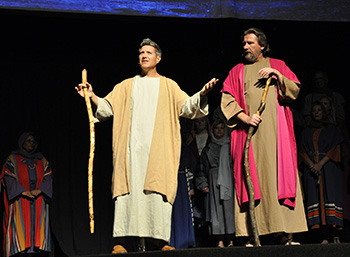
Mike Arnold and Wynne Toler 350 Mike Arnold (left) and Wynne Toler play innkeepers in Anastasia Baptist Church’s Christmas musical, which moved forward despite Hurricane Matthew’s onslaught on St. Augustine, Fla., in mid-October. (Photo courtesy of Anastasia Baptist Church)The story of societal skepticism surrounding Jesus’ virgin birth and King Herod’s decreed slaughter of Jewish boys age 2 and younger dispels the “antiseptic Christmas card version” so often depicted, Toler said.

“It certainly wasn’t peaceful when Christ was born,” Toler said. “There was way more going on than we think about in this story.”

Having narrated five renditions of “The Innkeeper” over the last seven years, Toler began studying his revised 15-plus-page script in late May. Often recognized by strangers nearly everywhere he goes throughout St. Augustine, Toler said he appreciates the importance of his Christian witness both on- and off-stage.

“It reminds me a lot that I may be the only Jesus that they see,” he said. “We preach the entire time we’re up there (on stage), but it doesn’t sound like preaching.”

Too important to be deterred by a hurricane

When Hurricane Matthew left a swath of destruction across the barrier island south of Jacksonville, Toler said, there was never a doubt the church’s Christmas musical still would happen.

“The message is way too important,” he said. “Sometimes God sends us challenges to find out how really committed we are to him.”

Since Hurricane Matthew’s onslaught in mid-October, church volunteers have helped about 130 families, more than half of whom aren’t members of Anastasia Baptist, with recovery efforts.

For about a week after the storm, dozens of church volunteers provided hundreds of hot meals prepared in the church’s kitchen and delivered donations of clothes, canned food and bottled water. Anastasia Baptist, a multiple-campus congregation, sustained minor damage on its island campus when a tree fell on the roof of the church’s missions and evangelism office.

Southern Baptist disaster relief volunteers from around the state as well as Alabama also helped repair flood and wind-ravaged homes.

“There are going to be hurting people for weeks and months to come,” said Neill Robins, coordinator of the church’s storm-recovery outreach efforts. “It’s like a war zone on some parts of the island.”

Meanwhile, about 1,500 people attended the church’s Christmas musical Dec. 2 and 4 in the Christian Life Center on the island campus, even though the outdoor Bethlehem Village had to be scaled back because church volunteers have been focused on storm-recovery outreach efforts.

On stage, Arnold said, the opportunity to pray alongside his mother and 11- and 14-year-old daughters after dropping to his knees while carrying a cross during the musical scene portraying Christ’s crucifixion was life imitating art at its best.

“It’s a pretty realistic depiction of what my family has done for me,” Arnold said. “I’m looking forward to knowing that people will come to Christ because of what we’ve done.”


Baptist Briefs: BJC announces religious liberty essay contest; WMU Foundation makes grant to aid fire victims

Religious tests in immigration topic of religious liberty essay contest. High school juniors and seniors can win up to $2,000 for college in the 2017 Religious Liberty Essay Scholarship Contest, sponsored by the Religious Liberty Council of the Baptist Joint Committee for Religious Liberty. Essays of 800 to 1,200 words must explore the idea of using religious tests as part of the United States’ immigration and refugee policies.  The grand prize is $2,000 and a trip for two to Washington, D.C. Second prize is $1,000, and third prize is $500. High school students in the graduating classes of 2017 and 2018 are eligible to enter the contest. Entries must be mailed to the Baptist Joint Committee and postmarked by March 10, 2017, to be eligible. Winners will be announced by the end of next summer, and the grand prizewinner will be recognized in Washington, D.C., next October. Essays will be judged on the depth of their content, the mastery of the topic and the skill with which they are written. Students should develop a point of view on the issue and demonstrate critical thinking, using appropriate examples, arguments and other evidence to support their position. Click here for complete contest rules and entry forms. For more information, contact Charles Watson Jr. at (202) 544-4226 or by email at cwatson@BJConline.org.

WMU Foundation makes grant to aid fire victims. In the wake of wildfires in eastern Tennessee, national Woman’s Missionary Union and the WMU Foundation awarded a $5,000 grant from the HEART—Humanitarian Emergency Aid for Rebuilding Tomorrow—Fund to help ministries aid victims in the area. The grant, to be dispersed through Smoky Mountain Resort Ministries and Sevier County Associational WMU, will help meet the immediate physical needs of local residents who lost their homes. The WMU Foundation is accepting donations to the HEART Fund for disaster relief victims online here or by mail to WMU Foundation HEART Fund, 100 Missionary Ridge, Birmingham, AL 35242.