How to reject purity culture but keep your faith

(RNS)—Whether it was wearing a “True Love Waits” ring, reading I Kissed Dating Goodbye or awaiting a fairy-tale marriage, as a teenager Camden Morgante was all-in on what is often referred to as “purity culture,” a set of beliefs and accompanying resources that emphasize saving sex until marriage.

The culture that developed around these teachings—books, rings, conferences, branded Bibles and more—had a particular heyday within evangelical circles in the 1990s and early 2000s.

Now a mental health professional with a doctorate in psychology, she understands the emotional, physical and spiritual repercussions that can result from what she describes as purity culture’s false promises.

But rather than causing her to leave Christianity behind, reckoning with the negative impact of purity culture has only made her more certain of what she believes and why.

That’s in part why she has written a book.

“My main goal was to help readers see that they can heal from purity culture and hold onto their faith,” Morgante told RNS.

Written with the firsthand knowledge of a onetime purity culture proponent and the insight of a psychologist, Recovering from Purity Culture: Dismantle the Myths, Reject Shame-Based Sexuality, and Move Forward in Your Faith is a new release from Baker Books that offers practical tools for stepping toward healing.

RNS spoke to Morgante about alternatives to purity culture’s sexual ethic, the connections between purity culture and sexual disorders and how to avoid perpetuating purity culture in adulthood. This interview has been edited for length and clarity.

What are some similarities between purity culture and the regency-era approach to marriage and sex in shows like Bridgerton?

I define purity culture as a largely evangelical movement that peaked in the 1990s to 2000s that attempted to persuade young people to avoid sex. But certainly the belief in virginity, especially for women, has been present for hundreds, if not thousands of years, and in many cultures.

When I started watching Bridgerton, a show that I really like, the similarities really stuck out to me. Women’s virtue is tied to their virginity and desirability as a partner, and they’re considered unclean or damaged if they are even alone with a man. You also see the flip-switch myth perpetuated in that show, this idea that once you get married, sex is just automatically going to be amazing. And the truth is that sex is a learned skill that we have to work on together.

You write that purity culture can contribute to rape culture. How so?

Purity culture includes this modesty culture of policing women’s clothing choices and caring about what the opposite sex thinks about your clothing. The whole purpose of being modest is to prevent men from lusting after you.

It’s not a big jump from that to rape culture, where you blame women for their sexual assault by questioning, ‘What were you wearing? Who were you with?’ Certainly we see rape culture not just in the church; it’s part of our society as well.

And the ‘Me Too’ movement has brought a lot of needed attention, but we need more attention to that in the church, too, and the ways that these well-intentioned teachings about purity have inadvertently contributed to allowing sexual abuse to occur and to be covered up in the church.

Can you explain how, from your perspective, a sexual ethic based on consent can trade one form of legalism for another?

In my chapter on reconstructing your sexual ethic, I am taking a middle perspective of criticizing both an ethic of shame, which is what I call purity culture, and an ethic of consent, which is a dominant perspective in our society today, and also the dominant perspective often in progressive Christianity as well.

The reason I criticize that is because it doesn’t do the work to discover the deeper “why” of one’s sexual ethic. Even if you no longer hold to a traditional Christian sexual ethic of waiting until marriage and faithfulness between the two spouses, there’s still more to your sexual ethic than just, as long as it’s legal and consensual, it’s fine.

I really wanted to challenge people to dig deeper and to see that when you swing the pendulum and exchange purity culture for what society is offering you, you’re still not doing the work of discovering your own beliefs and values and then making choices aligned with those beliefs.

What might be an alternative to both purity culture and the ethic of consent?

A values-congruent sexual ethic is the middle path I recommend. And I recognize that can look different to people. I wanted to be honest about where I landed, but I want you to have your own process. I encourage people to figure out their own values and make choices aligned with those values.

As you note in your book, Sheila Wray Gregoire and her team found that Christian women report vaginismus at more than twice the rate of the general population. What does that have to do with purity culture?

Vaginismus is a sexual pain disorder for women that makes sex extremely painful or even impossible, because the vaginal walls spasm and clench up. I conceptualize purity culture as a form of trauma for some people, because it can lead to a traumatic response in your body.

I have clients who’ve been married for 15 years to a healthy spouse who’s safe and loving and faithful, and yet their body still cringes. They still feel shame about sex. They’re in their head, instead of in their body during sex.

There are all sorts of physical responses even after people have intellectually left behind the myths of purity culture. Because purity culture uses fear and shame as tools of control to persuade people to avoid sex before marriage, that doesn’t just get turned off once you’re married.

And so, I think vaginismus is a response to that where the body is recoiling and reacting to attempted penetration by clenching up and closing off, literally, because you’ve been taught to avoid sex for so long and suppress your sexuality.

As a psychologist, what are some initial recommendations you might give to someone experiencing the physical consequences of purity culture?

I start off by validating their experience. These symptoms are normal, and I see them a lot in my clients. Research shows that the sexual responses of people who come out of purity culture look very similar to the sexual responses of sexual assault survivors. I help them understand these reactions in their body, so they’re not carrying that shame of thinking there’s something wrong with them.

And then one of the best tools I have found in my practice is mindfulness meditation. People can start to develop a relationship with their body that helps the embodiment process begin. Instead of suppressing and avoiding, denying, my goal is to help them embrace and connect and integrate to the different parts of themselves.

Purity culture doesn’t just impact people physically—it can have spiritual repercussions, too. What has that looked like for your clients?

I wanted to also destigmatize the process of deconstruction in the book. Rethinking your beliefs really goes hand in hand with recovering from purity culture, because it’s going to open up broader questions about the purpose of sex, our theology of suffering, gender roles, singleness, sin and grace. I want people to know it’s healthy.

I cite James Fowler’s theory of spiritual development in the book. His theory shows how, as our abstract thinking develops, our spirituality will also have more complexity. Those who remain in more black-and-white thinking, they’re going to remain at earlier stages of faith development. So while deconstruction is normal, it can be painful and isolating, and for that reason, we need community. And we need to know that we don’t have to lose our identity as Christians.

I use the analogy of house repairs in the book. It doesn’t have to mean demolishing one’s spiritual house. It can be a renovation of your faith house, and Jesus can be with you in that process.

What advice do you have for how Christians might avoid passing purity culture on to future generations?

In the book, I offer strategies and scripts for parents. That can look like having ongoing conversations and starting early, talking about their bodies, talking about and modeling consent in shame-free ways.

Embed the conversation about sexuality in broader conversations about values. How do we show respect for others and their bodies? How do we show respect for our own bodies and our own desires or boundaries?

Help your kids think through different moral dilemmas that come up on TV or with friends. That way, they’re learning how to think, and it’s not just you telling them what to think.


Webinar explores how to thrive throughout the election

Panelists in a webinar sponsored by Baylor University explained hyper-politicization from philosophical, psychological and theological perspectives. Then they offered concrete strategies for political desaturation.

David Corey moderates the panel discussion on political desaturation. (Screenshot)

David Corey, director of Baylor in Washington, moderated the Oct. 15 webinar on “Political Desaturation: How to Thrive Before, During, and After the 2024 Election.”

Joining him were panelists Robert Talisse, a political philosopher from Vanderbilt University; psychiatrist and author Curt Thompson; and theology-trained leadership coach Elizabeth Oldfield, who joined from the UK.

Framing the discussion, Corey posed the question: If political engagement is a virtue in democracy and it’s a “good thing” for people to be active in politics, how can there be such a thing as political oversaturation?

Robert Talisse provides a philosophical perspective in the panel discussion. (Screenshot)

Talisse responded the idea of having “too much of a good thing” is readily accepted in other areas.

“You know, the 12th bite of a cheesecake is really just not as good a thing as the first three bites,” he noted.

As a “better example,” he described a friend of his who set a goal to become physically fit.

The goal was a positive one, but the commitment to becoming physically fit took over. She lost sight of virtually everything else in her life in pursuit of that goal. The woman became so focused on workouts and her physical health project, it began to affect relationships and isolate her from friends.

He pointed out fitness didn’t stop being good, but “what fitness was good for” got lost in the hyperfocus on fitness itself.

Similarly, he observed, “There’s a good that is achieved in being an active democratic participant. But when that project becomes the center of everything that we do, it becomes a little bit like my friend in the gym.”

Elizabeth Oldfield offers theological insight to the panel. (Screenshot)

Diminishing common life

The politicization of institutions and relationships that aren’t intrinsically political did not previously exist to the extent it does now, Oldfield noted. It’s a development she attributes to “the retreat of other forms of common life.”

Psychology and theology, she said, always have known about deeper needs.

“We need belonging. We need to be part of something. We need a story that is bigger than us. We need meaningfulness and a stable sense of self,” she said.

In the past, those had been formed locally in multiple connections—to family, guilds based on common types of work or types of people, faith and religious identity, and stability in these areas. But all those ways people used to find meaning and identity have eroded, she said.

“So, all of that weight, all of that longing, all of that need doesn’t have as many places to go,” Oldfield asserted.

Her feeling is that it now either “goes into trying to stabilize ourselves as a consumer,” or it goes into “trying to give ourselves a sense of identity as a political animal,” and “finding ourselves” in a broader political story.

Neither of those is “supposed to take that weight,” Oldfield noted. “They are not designed for that.”

Curt Thompson views the issue through the neuro-psychological perspective of psychiatry. (Screenshot)

Addiction and idolatry

From a psychological standpoint, Thompson suggested hyperfocus aptly could be termed “addiction.” Or it could be described biblically as “idolatry”—the idea that “I’m going to commit myself to something at the expense of all other good things.”

It’s not always easy to determine when the line between healthy participation and addiction or idolatry has been crossed.

“Most people who are addicted find that their power in that addiction has everything to do with their isolation,” Thompson said. “The more isolated I am, the more likely I am to need something to cure me of my isolation.”

The addiction is the attempt to cure the isolation. But the data shows community is the most helpful way for addiction to be resolved and healed, Thompson asserted.

“We find ourselves weighted with our grief, weighted with our fear, weighted with our shame.”

But individuals don’t turn to deeper modes of healing for these issues “that we all really have in common as humans—the Democrats and the Republicans both have lots of grief,” he noted.

“But we turn to our different addictions,” isolated from those things that “actually bring us the most health and regeneration”—relationships, faith and religious institutions.

Talisse pointed out the level of disagreement or division on political topics hasn’t increased since the 1990s, but “the level of animosity toward perceived political opponents has skyrocketed.”

“We don’t disagree more severely, but we dislike each other more,” to the point of liking to dislike each other. “We’re addicted to negative affect toward perceived outsiders.”

Whereas politics once was viewed as something necessary but not deserving of passion, with the retraction of local forms of common life, politics has taken on a “sacred weight,” Oldfield said.

Politics has become the “only way that we know how to negotiate these goods. The only way we know how to actually be together, and increasingly seems to be cannibalizing our common life and our ability to hold each other as really human.”

Thompson asserted, culturally, “we are accounting for our collective grief over a period of many, many years.”

Ways to push back division

One way to overcome divisions when “things get testy,” Thompson suggested, is to ask the questions: “What is it you really want? … Do you want to be angry with me? … “What are you afraid of?” These questions, asked with vulnerability, help focus on what is held in common between people of differing positions.

Our two-party, “fairly zero-sum” political system “trains us to win” and “defend our own,” which is theologically problematic, Oldfield noted, “leading us to not know how to have a common life.”

But healthy societies find ways to keep in check the natural tendency to prefer “people like me” so all the members can recognize the humanity of others and take others’ needs into consideration in decision making, she claimed.

To desaturate from hyper-politicization, Thompson suggested inviting one person who thinks “differently from you” to coffee and ask that person questions in “genuine curiosity.”

Take “steps of embodiment” to form a relationship—actually get in the room “with someone who is different from you,” and ask: “What is it like to live with someone like me?”

Ask these types of questions that will lead to finding the many things two people, even of opposing viewpoints, invariably will have in common, he said.

Oldfield agreed, suggesting people must get out of comfort zones and “unclench a little bit from our fear,” knowing a “fight or flight” sensation is to be expected, but can be pushed through.

In these efforts, banish contempt, she urged, consciously resisting the impulse to view a person who disagrees with an angry disgust that will trigger shame and lead to rejection of the bridge-building efforts.

Additionally, to achieve political desaturation, she suggested withdrawing from political news and conversation, if one has already come to a decision about a vote—with the caveat one shouldn’t become so far removed as to miss new information that might change that decision.

We cannot “Save ourselves, with the capital ‘S’” through politics, panelists asserted. Theologically, politics isn’t the answer.

Desaturation does not equal political disengagement, but it is a necessary action to combat some of the political dysfunction, they agreed.

“We have to do the work,” to keep in check the impulses that would drive toward deeper division and away from community, Thompson noted.

That’s true even when the opposing viewpoint seems “abhorrent,” Oldfield agreed, so that learning to see political opponents as fellow human beings with a common set of needs becomes a possibility again.


Pastors burned out and exhausted, but that can change

(RNS)—America’s pastors are tired.

The decline of organized religion, the aftermath of a worldwide pandemic, political polarization—and the burden of caring for their congregation’s soul—have left many clergy feeling burned out and wondering how long they can hang on.
The title of a 2024 report from the Hartford Institute for Research summed up what clergy are saying: “I’m Exhausted All the Time.”

Small wonder that about half of clergy had thought about leaving their congregation—or the ministry altogether—in recent years.

“This is a challenging time for all congregations. They’re getting smaller, they’re getting older, they’re not as vital as they once were, and then the pandemic traumas of closing and opening,” said Scott Thumma, director of the Hartford Institute and leader of a five-year study of how COVID-19 affected congregations.

Racial divides and political issues have disrupted faith communities, Thumma said. All these factors have undermined the relationship between religious leaders and their congregations, leading to clergy burnout and discouragement.

Pay attention to mental health

That has made it crucial for clergy to pay attention to their mental health, experts say.

While burnout and poor mental health for clergy may often be gradual, the recovery process requires a lot more intentionality, said Rae Jean Proeschold-Bell, director of the Duke Clergy Health Initiative at Duke University.

That’s why it’s important for clergy to monitor feelings of being overwhelmed so they can be addressed before becoming a larger issue, she said.

Making plans for incorporating intentional practices can help clergy decrease stress and regain spiritual well-being. During the pandemic, the Duke Clergy Health Initiative partnered with the United Methodist Church for a study on mindfulness practices.

Clergy took eight classes on mindfulness techniques. They participated, on average, for 28 minutes a day for six months. They saw a reduction in stress and an improvement in their heart rate variability—the heart’s ability to recover.

Proeschold-Bell recommended clergy try a practice called the Daily Examen, which has been practiced by Catholics and other contemplative Christians.

“There’s a little bit of gratitude. And then review the last 24 hours of the day with gratitude, but also to notice what emotions came up for them during that review,” Proeschold-Bell said.

“Pray on that with God, and if they felt like they needed forgiveness for anything, to ask for forgiveness from God. And if they needed guidance, pray for that guidance. And then they closed it out with, again, gratitude for the day.”

Other intentional practices include exercise, taking time to eat nourishing foods and getting enough sleep. The most important thing is taking time away from work and its stressors so clergy can connect and meet their physical and psychological need, experts say.

Therapy can be helpful

Therapy also can help, said Gary Gunderson, professor of faith and the health of the public at the Wake Forest School of Divinity. Therapists can be great resources for clergy to talk about the issues they are facing without judgment for struggling.

“Pastors and priests, people in ministry, people in caring professions, they carry a lot of suffering,” said Mary Beth Werdel, director of the Pastoral Mental Health Counseling program at Fordham University.

“It becomes heavy, and we can’t hold that alone. Having a person or community to talk to is really important,” said Werdel.

Thumma said clergy who were experiencing poor mental health often overlooked spiritual practices such as making time for prayer.

“Rather than run to God or to spiritual practices, they retreated from them,” he said.

Having a clear plan for an intentional health or well-being practice can lead to flourishing when it comes to mental health for clergy. Clergy dealing with poor mental health may feel a lack of agency within their work life, Gunderson said. Engaging in these practices can bring back a sense of agency and the capacity to choose good things for themselves.

Make time for fun

This includes making time for things that are fun. It’s easy to remove a movie night with a friend from your busy schedule, but to be proactive against burnout, it’s important to have time away from work and invite play into your life, Werdel said.

Conflict between clergy and their congregation can also lead to poor mental health.

“There’s a real strong relationship that, in some ways, is probably more than many other vocations, between what’s going on at work and how well the person feels,” Thumma said.

Having a space where the congregation and the clergy can be honest about their feelings and process issues together can help repair the relationship between them. Conflict around the pandemic in many congregations has not been resolved.

“I think there’s some compensatory grieving that needs to happen and rebuilding of people’s trust,” Thumma said.

This can be for other issues the congregation is facing as well.

“The most important thing a congregation can do is to create a safe culture,” Gunderson said. “The congregation should be healthy for everyone in the congregation, including clergy, to find a voice and to be able to talk about what’s actually going on in their life.”

It is particularly healthy for the clergy person to be able to voice doubts and stresses, instead of being viewed as the mascot.

“What is healthy for the clergy is healthy for everyone else in the congregation,” Gunderson concluded.

Find better ways to collaborate

Post-COVID, clergy and their congregations may need to reevaluate their relationships—and find better ways to collaborate. That might include a shift in expectations, Werdel said.

“There’s a sense that you are the one that’s going to fix everything, that you are the one… that you alone are essential in solving all the problems of the world,” Werdel said. That is too much pressure on one person.

“Have you lost the ability to delegate? Are you micromanaging? These experiences will lead to burnout because they have to do with the belief of control that is not healthy,” she said.

Therapy can help identify these expectations, and having a supportive team within the leadership of the ministry can also help remove some of those beliefs by sharing the load of the labor.

Werdel cautions clergy not to ignore their emotional well-being.

“Our emotional worlds matter, they matter deeply, and they’re connected right to our spiritual experiences,” she said. Pushing through feelings of overwhelm and burnout will affect both your mental and spiritual health.


Hoogstra led Christian higher ed through decade of change

WASHINGTON (RNS)—After 10 years of leading the Council for Christian Colleges and Universities, Shirley Hoogstra has a new title: president emerita.

One of her last tasks as president involved her frequent role as a speaker in a higher education setting.

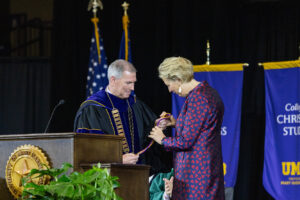
Randy O’Rear presents Shirley V. Hoogstra, J.D., 7th president of the Council for Christian Colleges & Universities, with a Distinguished Service Award for her many years of service to Christian higher education. (UMHB Photo)

“You often don’t know what God is up to until later,” Hoogstra recalled saying at the recent convocation for a new class at Michigan’s Handlon Correctional Facility that was participating in a program of Calvin University.

“And I said to the inmates: ‘Pay attention. This particular opportunity to be a college graduate may be something that in your rearview mirror turns out to be very clear that God had a particular purpose in giving you this opportunity.”

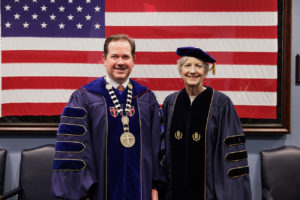
Shirley V. Hoogstra, president of the Council for Christian Colleges & Universities, received an honorary doctorate from Dallas Baptist University. She is pictured with DBU President Adam C. Wright. (DBU Photo)

In an Oct. 2 interview in the building housing the new headquarters of the Christian college association, Hoogstra said she looks back herself and sees how her former career as a Connecticut law firm partner prepared her to lead CCCU through a decade of high-profile religious freedom fights around LGBTQ rights on campuses.

Hoogstra, who has been succeeded by David A. Hoag, former president of Warner University in Florida, said she has “no regrets” about her shift from litigator to aiding 180 CCCU member institutions worldwide as they pivoted to hybrid classes and continue to determine effective ways to finance education and encourage the faith of their students.

Shirley Hoostra speaks at Dallas Baptist University. (Photo / Ken Camp)

Hoogstra, who is in her 60s, spoke with RNS about leading CCCU over the last decade, supporting diverse leadership in Christian education and increasing interfaith dialogue among officials of faith-based colleges and universities.

The interview was edited for length and clarity.

How is the period of transition going as you work with your successor, David Hoag, before retiring on Oct. 31?

Well, of course, you don’t get a playbook for these things. Early on in the year of 2023 I proposed a formal three-month transition period. I thought I would remain the president during those three months, and (my successor) would be president-elect. But on the day of Dr. Hoag’s appointment, July 7, I realized no, we need to have him step into the president role after 30 days, and then I’ll be president emerita. Two salaries, right? The board approved that budget.

David has already made good changes in terms of meeting structures and new promotions. But we’re walking side by side in meetings, before and after meetings, and I am able to give him play-by-play insights and play-by-play conversations as they are in real time.

You have overseen a decade of leadership for the Council for Christian Colleges and Universities. How would you sum up the state of Christian higher education, especially in North America?

Christian higher education is a growing sector because Christian higher education has a distinctive, which is the education with a moral compass. It’s also growing, because there’s been a huge equalizing effect amongst colleges and universities.

With the internet and with people offering online, in-person, graduate, undergraduate, parents and students have lost the need for the hierarchy of institutions generally, unless it’s maybe the top 10, and are now going for fit. So families of faith or students who want a particular major or minor or student experience feel freer to pick a campus that matches their values.

Is there any specific action CCCU has taken since an appeals court in August upheld the Hunter v. U.S. Department of Education decision in a lower court that dismissed claims by LGBTQ students? They unsuccessfully sought removal of a religious exemption in Title IX gender discrimination rules for federally funded religious institutions.

The Title IX exemption is more secure today than it’s ever been. The importance of the case cannot be understated. This was a unanimous decision, and the decision found that the Title IX exemption is fully constitutional. The plaintiffs in this case may, in fact, try to get a further review in the 9th Circuit. We are hopeful that, because it was a unanimous decision, they will not take it up for review.

Do you consider this one of the successes of your time leading CCCU? And why or why not?

Yes. It’s a success. The Title IX exemption, which allows religious institutions—Christian colleges and universities prime among them—to live according to their mission, is a cornerstone of our work. And the CCCU, under my leadership, has had a three-part strategy. We had the court strategy, where we have been a leading voice in amicus briefs around religious freedom. The second one was this legislative effort (leading to the 2022 Respect for Marriage Act) where we have basically been part of changing the dynamic of a both/and approach: If you’re going to do LGBTQ civil rights, you’ve got to do religious freedom. And then this is an executive branch strategy. And in the executive branch, the Title IX exemption and other religious exemptions found in other titles allow the day-to-day operation to go unimpeded.

There have been, it appears, some CCCU member institutions that have been caught between conservative stakeholders, like parents and donors, and faculty who’ve expressed support for gay marriage or been accused of being “woke.” How does CCCU advise or take a role in those situations?

CCCU does not advise campuses on HR matters. And the cases that happen always have more to the story than is ever revealed in newspaper articles. That being said, the CCCU has been long on the record about saying that diverse views in classroom situations are important.

Compared to other private higher education institutions, we have more diverse conversations and more and different perspectives are more often raised in Christian college campuses than in secular campuses. So I think our campuses are doing a good job in making sure our students are prepared for world-class conversations.

In the wake of the death of George Floyd, Christian colleges got pushback for statements about racial justice by critics who said prayers and panel discussions were not sufficient. At the time, you committed yourself to help keep the “next generation of leaders” from giving up the possibility of concrete actions. Are there ways CCCU and its institutions have sought to address concerns about diversity and inclusion?

Yes, since George Floyd’s murder, there has been an intentional effort to make sure leaders of color are fully supported in our Multi-ethnic Leadership Development Institute, a key support mechanism where leaders of color come together, talk about their situations, learn from peers and come away refreshed and encouraged.

In our (quadrennial) 2022 International Forum, our speaker array reflected the CCCU’s commitment to have voices of leaders of color on the plenary stage to make sure this could be a central conversation in the very important set of conversations following George Floyd’s murder and the subsequent tragedies of other men and women of color.

Since 2019, you have worked to bring together presidents and other leaders of colleges and universities who have a different faith perspective than CCCU, which is an evangelical organization. What have been some specific outcomes of those gatherings with leaders of institutions affiliated with Catholics, Mormons, Jews and Muslims?

This ability to convene national voices with institutions that have common cause is one of the more significant successes of the CCCU in the last 10 years. Prior to 2014 there was an insider’s approach to Christian education, and since 2015 there has been a larger aperture about finding partners and allies who believe faith matters in higher education.

One of our newest outgrowths of early panels, which happened at the (CCCU) Presidents Conference, is a new Commission on Faith-based Colleges and Universities out of the American Council on Education, where members across higher education can be part of a group that is thinking concretely about the value of religious education in America.

What’s ahead for you when your retirement officially begins on Oct. 31?

I’m going to be writing the history of this decade at the CCCU. I am going to be doing some speaking and moderating of some conversations, which I have loved doing since my role at “Inner Compass” (a public television series) at Calvin University years ago, and I would like to spend more time understanding how prison education can advance the Matthew 25 imperative: “When I was sick you looked after me and when I was in prison you came to visit me.”


Chaplaincy: From ‘cultural competency’ to ‘cultural humility’

Neighborhood chaplain Mary Flin envisions a world where there is no space where people can be without access to spiritual care.

In a recent webinar hosted by B.H. Carroll Theological Seminary’s Marsh Center for Chaplain Studies, “Essential Lessons from Chaplains Ministering in Unique Cultures,” Flin discussed her ministry in urban Topeka, Kan.

Flin is the dean and director of Soul Center for Urban Chaplaincy through the Urban Ministry Institute of Topeka. Soul is a seminary for the urban poor, she explained.

In collaboration with World Impact, its mission is “to train leaders from hard spaces to serve in those hard spaces.”

Whereas some might look at the poor, incarcerated or formerly incarcerated as “some of the world’s biggest challenges and problems, we see those individuals as individuals with the most potential,” Flin noted.

‘Subject matter experts

Pointing out that these people are “the subject matter experts” of all the things that are so difficult, Flin explained how neighborhood chaplaincy is providing opportunities to stabilize communities, where leaders can be developed from within.

Flin didn’t come to chaplaincy on purpose, she explained. With changing administrations in the prisons and jails where their seminary was established, it seemed reasonable to get chaplaincy credentials in place to support their work in the jails.

But she “stepped into chaplaincy” and began to see the impact spiritual care has in promoting flourishing. So, the seminary began to look at developing a model for neighborhood chaplaincy—“to have pastoral care in a secular environment around the church in high poverty neighborhoods.”

Developing a model of neighborhood chaplaincy, the institute hopes to help “stabilize high-poverty neighborhoods, so that urban leaders can emerge and serve,” Flin said.

In studying “cultural competence,” which she felt she understood fairly well, Flin came across the notion of “cultural humility.” She latched onto it, not as an excuse to avoid becoming as competent in the cultures she serves as she can be, but as motivation to remain “a learner” in her ministry.

“We incarcerate about 25 percent of our high-poverty neighborhoods at any given time,” Flin stated. The center recognizes the incarcerated church as a fully functional church, and they provide seminary training for ministers to the incarcerated congregation.

But, when incarcerated persons reenter society, they are not supposed to return to the communities they came from—which have detrimental influences—even if they’ve encountered Christ and made faith commitments.

Likewise, a community church might have the heart to serve, “but the heart is only one part of the body.” The body needs hands and feet, she continued. The local churches avoid these neighborhoods, because they are afraid, she continued.

“The incarcerated church is afraid to go back, and the neighborhood church is afraid to go in,” Flin stated.

So, these communities then become “abandoned spaces” that feel the “increasing pressure of spiritual and human oppression,” especially now with more and more displaced people.

The neighborhood where Flin serves and lives had the highest per capita homicide rate and highest infant mortality rate in Kansas in 2023.

“Our people in Central Park are tribal and nomadic. We are desperate, and we are without personhood,” she explained.

So, how can the spiritual needs of this population be met? The Soul Center’s answer: develop and train an “army of chaplains and partners to listen, to love and to serve.”

Flin said the center’s desire is “to see the impact of spiritual care documented in health care spaces demonstrated in our neighborhoods, making them a hub for service,” to hopefully “begin to move the needle on social determinants.”

Citing Isaiah 65:1 and Matthew 25:40-45 as the theological underpinning to their model, Flin pointed out the judgment in the last verse of the Matthew passage.

It’s vital to minister to “the least of these” to serve Jesus, she noted. And “chaplaincy gives us a way to go there.”

She was a neighbor in her environment for 12 years before she became a neighborhood chaplain. But she said, “everyone knows what a chaplain is.” So, when Flin came to be known as one, she said, it “upped my game” in reaching her neighbors.

“The challenge in an urban neighborhood is that people begin to be identified by the challenges,” Flin explained.

“We are primarily homeless. We are primarily in active addiction. We are mostly without mental health meds.

“There are 60 to 70 of us meeting for dinner every Sunday night. And we are in and out of incarceration,” she said, describing the group she serves.

Having chaplain credentials allows Flin to follow her people to the jail or hospital to continue their spiritual care, she explained.

Neighbor Night is the weekly meal Flin hosts on Sunday evenings. The idea of Neighbor Night was for people coming out of jail to have a place to come to dinner, she explained, but “it has become a great deal more,” said Flin.

Hold on to cultural humility

Flin believes her neighbors will teach her all she needs to know about all these different cultures, as long as she holds onto “cultural humility”—openness to understanding incarceration, reentry or addiction—“to understand walking in, everything I know is going to have to come from my neighbors.”

The methods of accomplishing neighborhood chaplaincy include the table, stories and an ethic of incarnation and sacrifice.

“It is 24/7,” she said. Since her community is up at night, much of her ministry happens then.

“We garden together at 11:00 at night,” she continued, recounting stories shared as they worked and the opportunities to sit down and “unpack” the deep hurts those conversations opened.

She was raised in a Christian tradition that emphasized sacrifice, so she sees it as a natural and essential piece of Christian living.

People ask her about her work in urban ministry: “How are you going to be safe?” She explains Christianity calls for sacrifice, she said.

This isn’t a model only for her community, Flin explained. “You can do this in your neighborhood, and your missional community will look entirely different.”

Her missional community includes 70 to 80 homeless or underhoused people. Yet, the ministry isn’t a feeding ministry. Rather, the missional community share meals together as family, supporting one another and giving to one another.

Flin said others have taken note of the good things happening in her neighborhood. Donations of food for the meals come unsolicited. She has the kitchen and the table, but it is a community of people coming together to stabilize the neighborhood from within.

The church she attends nearby supports the work. In addition to the current ministry focus, Flin envisions growing a community health ministry, with mobile clinics coming to the neighborhood and her house as the hub.

(Left to right from top left) Webinar panelists Ron Fraser, president and CEO of trucker chaplaincy group TFC Global; Moderators Jim Spivey and Jim Browning, March Center for Chaplain Studies; Will Whitman, school minister of Mercersburg Academy; Mary Flin,  Soul Center for Urban Chaplaincy; and Jeffrey Claes, “Sidecar,” director of BikerChaplain.com. (Screenshot / Calli Keener)

Other conference presenters discussed chaplaincy ministries within the unique populations of truck drivers, bikers and a secular boarding school in Pennsylvania.


Self-care essential to avoid ministerial burnout

People in helping professions of all kinds risk experiencing compassion fatigue and burnout, but ministers face an additional issue, clinical psychologist Don Corley of Waco asserted.

“They feel the weight of carrying the spiritual pain of others,” he said. “Ministers care for others’ spiritual well-being.”

Scott Floyd, director of counseling programs at B.H. Carroll Theological Seminary, identified conditions that contribute to burnout:

  • Unrealistic job demands.
  • Unclear job expectations.
  • Conflict.
  • Dealing with individuals in distress.
  • Feeling that tasks are never completed.
  • Lack of recognition for accomplishments.
  • Feeling second-guessed or criticized.

“If I work with groups of ministers, read through that list and ask how many of them experience one or more of those, they usually just laugh, because they experience so many of those all the time,” he said.

Isolation can contribute to burnout, he noted. Ministers may not have friends outside the church in whom they can confide. If they have close friends in the church, sometimes they face criticism for “playing favorite,” he added.

Ministers often work long hours dealing with high-stress situations that naturally create fatigue, but Floyd distinguishes between weariness, exhaustion and burnout.

Weary ministers need a couple of days away from work and a good night’s sleep to rejuvenate, he noted. Exhausted ministers may require an extended vacation or a long-term sabbatical to rest.

Burnout, on the other hand, takes a deeper biological and emotional toll, he said.

“A pastor or minister can get into a cycle where you’re tired, so you don’t exercise, you don’t take care of your own spiritual needs, you don’t eat healthily. And so, it becomes part of cycle that moves downward,” Floyd said.

Warning signs

Early warning signs that may indicate a minister is approaching burnout include physical symptoms such as headaches, stomachaches, high blood pressure, tight neck muscles and difficulty sleeping.

“There is full-scale burnout that a person experiences, but there are a lot of ministers who seem to exist at a sub-level right under that,” Floyd said. “Some are functioning in the midst of burnout, but there’s another big group who are walking right along the edge.”

Ministers may find themselves emotionally numb—not experiencing expected joy or sorrow. Others may observe changes in their personality or uncharacteristic impatience.

A minister may also notice his or her mind wandering, lack of productivity at work and “replaying conversations over and over,” Floyd said.

Under normal circumstances, the burdens of ministry can take a toll. But in recent years, additional factors—namely political polarization and a global pandemic—have contributed to ministerial burnout, Floyd observed.

Both in society at large and in the church, he observed a tendency of people to “identify my tribe and the other tribe, and to locate you so quickly and so completely into one of those categories.”

He pointed to the challenge of “conversation and behavior monitoring” on the part of some in the church. Those individuals are quick to relegate a minister to “the other tribe” on the basis of a single word or phrase, or on the minister’s perceived failure to “go far enough” in taking a stand on a particular issue, he noted.

The time surrounding the COVID-19 pandemic—and its aftermath—led to a significant increase in burnout, he added.

Ministers faced criticism for “doing too much” or “not doing enough” in terms of protecting the congregation, he observed.

After the pandemic, some pastors also faced the reality of smaller congregations, smaller budgets and smaller staffs, he noted.

“I think congregations’ expectations of pastors sometimes can be so extreme that even if the pastor has less help and less budget, it probably doesn’t lower the expectations of what the pastor can or should do,” Floyd said. “Self-expectation and congregant expectations add a lot of pressure.”

Taking steps to prevent burnout

Congregations can help by designating individuals on a rotating basis to cover night and weekend calls, so the pastor is not always the first person who has to respond to emergencies, Floyd suggested.

“I think ministry staff can work with congregations to help them identify what realistic expectations of ministry are,” he said.

Corley agreed ministry is inherently stressful, but “stress is not the problem,” he asserted.

In fact, stress can be energizing and motivating if it is perceived positively, he said. The problem is an inability to handle stress in healthy ways.

Corley believes overworked ministers should add one more thing to their “to-do” list if they want to avoid burnout.

“Mitigate stress by adding activities that are uplifting,” he said.

He particularly suggested activities that foster relationships, such as coffee with a friend, dinner with a spouse or simply taking a walk with someone and having a conversation.

Corley believes ministers often fail to consider two key words in Jesus’ command to love your neighbor: “as yourself.”

“The standard of love we have for others is how we care for ourselves,” he said. “It’s circular, not linear. Love ourselves while also loving others. Love others while loving ourselves. One begets the other. They’re all wrapped up in one.

“If you don’t take care of yourself, you cannot care for others.”

At the recent “Leadership for the Long Haul” conference at Baylor University, Corley participated in a public conversation about resilience in ministry with Charlie Dates, who simultaneously serves as pastor of two Chicago churches—Salem Baptist Church and Progressive Baptist Church.

Dates emphasized the importance of servant leadership, noting the need for ministers to be present to provide comfort in times of loss or bereavement.

However, he also emphasized the need for pastors to build in times for rest on a regular basis, to care for themselves and to delegate some responsibilities to others.

“I do my best to observe a sabbath during the week,” he said. “I’m not going to die for the church. Jesus already died for it.”

Biblical picture of a crash and burn

An incident in the life of the Old Testament prophet Elijah offers an instructive “picture of ministerial burnout,” Floyd said.

After the trial by fire on Mount Carmel, where Elijah triumphed over the prophets of Baal in dramatic fashion, Queen Jezebel threatened Elijah’s life. He fled to the wilderness, where he sat under a tree, praying God would take his life.

“That was a big-time crash, and it comes right after a huge spiritual victory,” Floyd said. “He goes from a huge spiritual accomplishment to despair.”

When God sent an angel to Elijah, he first touched the prophet. Then the angel gave him food to eat and water to drink. The angel let Elijah take a nap and then gave him more food and water before taking him on a 40-day journey to Mount Horeb.

Once Elijah arrived at Mount Horeb, God asked him, “What are you doing here?”

Elijah responded with “a grievance story—a rehearsed summary of how he feels he had been wounded,” Floyd said. Elijah told God what he had done for him, only to be forsaken.

“I alone am left, and they are seeking my life, to take it away,” Elijah told God.

After sending an earthquake and fire, God again asked Elijah, “What are you doing here?”

“Of course, God doesn’t ask questions because God needs information,” Floyd said. “I think he’s asking the question because Elijah needs to realize something about himself.

“There are times when God asks questions, and they’re not for God’s sake. They are for our sake.”

Recovery from burnout is a process—a “journey”—that takes time for healing, renewal and rejuvenation, Floyd asserted.

“It is through a whole process. It’s through touch and water and food and journey and mystery and struggle and question and wrestling,” he said.

“It seems there’s a lot there, if we can figure out how we take care of people physically, how we take care of them emotionally, how we let their bodies rest and their minds rest.

“My experience is that Baptist life is not conducive to rest. It really lends itself to busyness.”


Everett: Solving hunger and poverty requires teamwork

Crossing lines to work together is essential in addressing hunger and poverty, advocate Jeremy Everett of Baylor University told participants at the Fellowship Southwest Compassion & Justice Conference, Sept. 21 in Dallas.

Everett, founding director of the Baylor Collaborative on Hunger and Poverty, recounted an event where multiple parties showed up across sectors to meet a need.

The days leading up to COVID-19’s widespread arrival in the United States were fraught with concern of an impending crisis the USDA saw coming among the food-insecure population, Everett said.

Weeks before the pandemic hit in its full intensity, Everett was in Washington, D.C., on an unrelated matter, when he received an unexpected call from the head of the U.S. Department of Agriculture requesting his immediate presence at the Whitten Building.

A call from the USDA secretary is not an everyday occurrence, even for the director of an organization dedicated to cultivating “scalable solutions to end hunger,” Everett stated.

While he assumed he’d done something terribly wrong to be called in, Everett found out it was even worse than that.

Everett recalled being warned the coming pandemic would be much worse than anyone knew, a shutdown of an unknown duration was likely, and people facing food insecurity would be severely impacted.

The lead up

In the summer of 2019, the Baylor Collaborative—then known as the Texas Hunger Initiative—had piloted a 10-week food-distribution program called “Meals to You,” using selected rural counties in Texas as “the test kitchen.” The program was designed to meet the unique food distribution needs of rural communities.

“Meals to You” involved shipping a week’s worth of food directly to the homes of children who participated in meal programs. It had proven to have equal impact on food insecurity, if not greater, than the USDA model of feeding children, which until then had been “the gold standard.”

The USDA secretary and undersecretary wanted to know: “Is there any way that you can scale up the ‘Meals to You’ program nationwide?”

The department estimated 25,000 families would need “Meals to You” provisions, Everett explained. Without discussing the question of scalability with his staff, Everett committed to scaling the program nationwide.

Shortly after he left the Whitten Building the estimate grew to 50,000 families. By the time he was on a plane back to Waco, 150,000 was the number.

The implementation

By the time of kickoff the following week, the Baylor Collaborative and McLane Global had 270,000 children signed up to receive meals “because their parents didn’t know how in the world they were going to provide food for their kids during a shutdown,” Everett recalled.

“Kids were so remote in Alaska, they required seaplanes and boats and barges to be able to get food boxes to children where they were living,” he continued.

Mules were used to deliver food boxes into the Grand Canyon. The United States Postal Service and United Parcel Service drivers dropped off food boxes elsewhere.

 “What was remarkable about this endeavor was the USDA brought their best to bear,” Everett said.

Congress’ bipartisan support made sure they had the resources they needed to provide food for the hungry, he continued. The private sector of the food industry stepped up with Pepsi-Co, Chartwells and other major food companies’ social enterprises arms providing and packaging the food.

UPS Go Brown—without being asked, because they’d recognized the increased shipments into some areas—played a major role in the distribution of boxes, with some delivery drivers relocating “during a pandemic to get food boxes out to the kids, because they knew they needed it.”

Everett asserted “all these groups brought their best to bear.” And it showed collaboration is possible and critical.

“The only way that we can solve for these big social issues is working together,” he said. And this case demonstrated “it is still possible to get bipartisan agreement on critical intervention.”

The Baylor Collaborative team works with the three-prong approach of research, practice and policy. The research continued to demonstrate the efficacy of the program when practiced over several years. In fact, the more rural and remote the child, the more beneficial the “Meals to You” program proved to be.

So, the Baylor Collaborative was able to go back to Congress, show their research, and earn bipartisan legislation to make “Meals to You” a permanent solution available to food insecure children in rural areas.

The work isn’t finished

Everett urged attendees to seek out opportunities to serve the hungry and the poor by proximity to the problem, because Jesus embodied a preference for the poor and identified the poor as members of his family.

“Sometimes we treat the poor like they just need to be better at financial management,” but disability and structural racism, the two biggest predictors of poverty, aren’t issues of poor financial training, he suggested.

Hunger and poverty are on the rise globally after many pre-pandemic years of improvement, but widespread food insecurity is a litmus test for the health and wellbeing of the world, a nation or a community.

When society turns a blind eye to children dying of hunger around the world in areas of conflict and crisis, or here in the states where governors turn down funding to expand child nutrition for their own political gain, “hunger becomes a litmus test for our souls,” Everett asserted.

“What has spiritually gone awry to justify child starvation or to act passively, offering our thoughts and prayers, as if we have no agency to improve these conditions?”


Gen Z’s life in ‘Digital Babylon’ presents opportunities

Barna and Impact 360 concluded a series of Gen Z reports Sept. 12 with Leading Gen Z, a simulcast highlighting their final set of conclusions, based on more than a decade of research.

Presenters David Kinnaman, CEO of Barna, and Jonathan Morrow, director of cultural engagement and student discipleship for the Impact 360 Institute, took turns illuminating their findings, offering insights into discipleship opportunities for this generation.

Describing himself as “a geek, for Christ’s sake,” Kinnaman pointed out Gen Z is the first generation to have grown up with digital tools all around them.

He characterized that atmosphere as “digital Babylon, where access to ideas, alienation from specific ways of thinking about life and tradition, and skepticism of authority sort of define them.”

Kinnaman noted how much of a challenge “digital Babylon” presents in impacting Gen Z for Jesus. It has changed the landscape of what people immerse themselves in and the ways they think about what it means to be human and live a life of meaning, he observed.

Living in digital Babylon

“We’re living in a world, aren’t we, where the Google search bar is sort of like our best friend, our adviser, our educator, our counselor,” he said.

“It really is remarkable how these digital devices, these smartphones, social media—it’s really close to what we could invent if we were trying to invent the Holy Spirit—our ever-present help in time of trouble and lost directions. And maybe you need a good friend, right?”

But looking at what the data shows about this generation immersed in the digital world offers an opportunity to understand what the world looks like to them, Kinnaman said.

Christianity has never faced a time like this, Kinnaman suggested, with these kinds of challenges and complexities.

He also pointed to the nuances, “in terms of the persuasiveness of what it means to be Christian and how do we actually help this generation—how do we help ourselves—learn to be rooted and built-up in Christ in this current digital Babylon.”

Discussing the “inner world” of Gen Z, Kinnaman explained this generation is characterized by anxiety and ambition.

They want to accomplish great things and see the world. If they are Christians, they “want to see the church restore its credibility in the world, and they’re ambitious to do that,” he said.

“But the flip side of this is this level of anxiety and this hum … sort of like static electricity that is always in our heads about all the things we haven’t done yet and haven’t accomplished.”

Knowing Gen Z is experiencing anxiety around their ambition offers leaders who work with them an opportunity. Leaders can help them develop a good “theology of ambition” that recognizes it’s God’s work, and not one’s own, that allows people to accomplish all that God has called them to do, Kinnaman explained.

Struggling to transition to adulthood

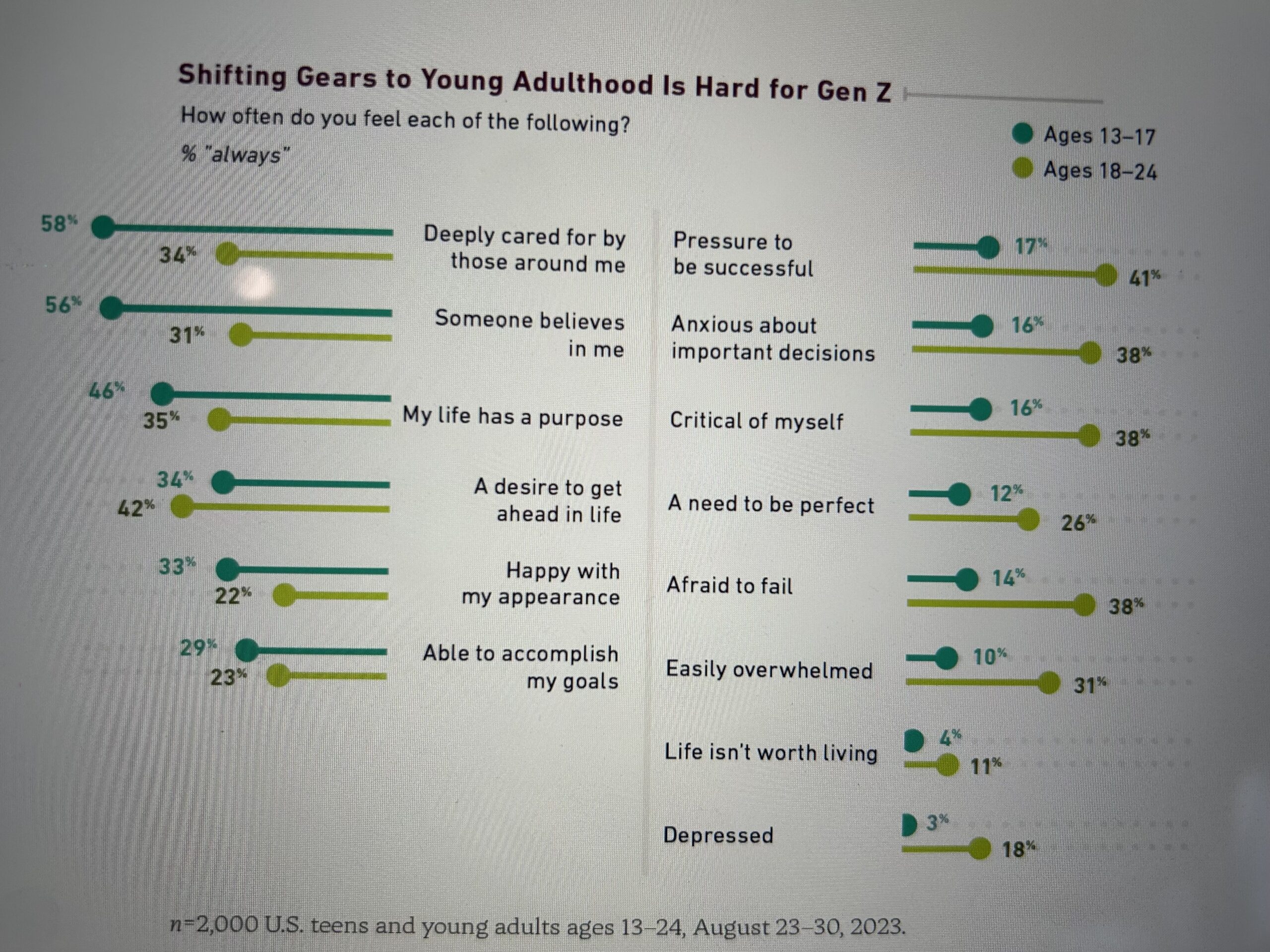
Graph showing shift between adulthood and teen years is hard for Gen Z. (Screenshot)

The data Kinnaman discussed breaks survey participants into two groups, those 13 to 17 years old and those 18 to 24 years old.

Looking at the transition from teen to young adult shows an opportunity for churches to meet a need, Kinnaman noted. There is a significant gap between what teens and young adults in Gen Z reported in terms of how deeply cared for they felt—58 percent of those aged 13 to 17 compared with 34 percent of those aged 18 to 24 reported always feeling deeply cared for by those around them.

Likewise, 56 percent of teens reported always feeling “someone believes in me,” compared with only 31 percent of young adults.

Additionally, young adults were more likely than teens to report negative feelings—reporting always feeling: pressure to be successful (41 percent to 17 percent); anxiety about important decisions (38 percent to 16 percent); self-critical (38 percent to 16 percent); and afraid to fail (38 percent to 14 percent).

In light of the continuing trend to delay marriage and having children—which might help offset some of the reported negative feelings—these gaps offer churches a considerable opportunity to support Gen Z in transitioning to adulthood, Kinnaman suggested.

While the gaps may partly reflect young adults are simply perceiving these “heartbreaking indicators of mental health and challenges” more when they leave childhood, they still need a strong support system, which churches can provide, Kinnaman noted.

Not all bad news

Kinnaman highlighted one positive post-pandemic development. Gen Z has a better understanding of mental health and broader vocabulary and willingness to talk about it. But the data around the mental health issues they face still shows Gen Z is struggling.

Four percent of teens and 11 percent of young adults reported always feeling like life isn’t worth living. Suicide isn’t new, Kinnaman pointed out, but what is new is the access (to Google) and “the alienation from the community of faith and those that can love us.”

What’s new is the increased skepticism toward authority—“the digital Babylon markers,” he continued.

“In digital Babylon, where it’s like: ‘Man, I’m feeling really lonely,’ and you’re going to pull up your phone. And you’re going to go: ‘What do I do?’—search bar—to deal with the loneliness that I’m feeling.”

These are real people dealing with real existential crises reflected in the numbers—young people who would benefit from Christians coming alongside them as they sort through the complex transitions they’re thinking about and experiencing.

That reality presents a “fields-are-white-unto-the-harvest” level of opportunity for Christians who work with Gen Z students and young adults, Kinnaman declared.

Barna and Impact 360’s reports contain many more findings about Gen Z, with suggestions for how the openness of this generation can be a catalyst in reaching them for Jesus. The researchers expressed optimism about the generation, noting quite a few characteristics of Gen Z they considered to be quite positive.


Disability and Church: Building a culture of belonging

WACO—Commit to “one next move” toward building a culture of belonging for individuals impacted by disability, program director of the Baylor Collaborative on Faith and Disability Jason Le Shana challenged attendees of a faith and disability workshop at Baylor University, Sept. 17.

Le Shana pointed out society often neglects people with disabilities and “doesn’t reflect God’s heart” for individuals impacted by disability. But “we believe that the church is called to be the body of Christ in the world,” he said.

Because “when certain parts of the body are neglected, that’s not good for the body in general,” it’s important for church members to think about what gets in the way of movement—in this area of people with disabilities being invited fully into the life of the church.

Churches need to consider what it might look like for disabled people “to be embedded at that DNA, normalized cultural level of church life,” Le Shana suggested.

He defined church culture as an often unspoken or unstated pattern of shared basic assumptions that exist within the group and imperceptibly govern the way members of the group behave. Changing church culture is difficult, Le Shana conceded, but committing to one next move is a good place to start.

Joni & Friends

Daniel Moreno, ministry relations manager for Joni & Friends Texas, discusses five stages of belonging and cultural change. (Photo / Calli Keener)

Daniel Moreno, ministry relations manager for Joni & Friends Texas, explained the organization advocates for the disabled community within the walls of the church because they believe disabled ministry isn’t just an option, but a command, found in Luke 14:21-23.

Joni & Friends has a vision of a world where every person with a disability finds hope, dignity, and their place in the body of Christ. In his role, Moreno works with churches in Texas, empowering them to evangelize, disciple and serve people living with disability—which Moreno suggested comprise “the largest unreached people group in the U.S.”

Moreno said social and physical boundaries exist to including disabled people in church, but these barriers are not new.

For an example of the longstanding nature of disability disenfranchisement, Moreno turned to the story of Bartimaeus in Mark 10:46-52. The followers of Jesus’ rebuke of Bartimaeus, a blind man, highlights an uncomfortable truth—“the people of God often are the biggest barrier to people impacted by disability to enter the doors of the church,” Moreno said.

But, Jesus told his followers to call Bartimaeus to him. When he was healed, Bartimaeus chose to follow Jesus—whose Messiahship he recognized—“with the very people that rebuked him.”

Moreno encouraged churches to think about where the church and its individual ministries fall within five stages of cultural change, when it comes to meeting the needs of the disabled community: unawareness, evaluation, care, friendship and contribution.

The first stage, unawareness of what disabled people and their families experience and need, is addressed by seeking information and becoming knowledgeable about disability ministry considerations.

When a church has become aware of a need to change in order to meet the needs of its disabled members, it’s at the evaluation stage and needs training in how to make the right changes for their church.

From evaluation, the church moves to the care stage, when time together—abled and disabled—is beginning to happen.

Then the church moves into the friendship stage, where individuals with disabilities are beginning to be seen as part of the fabric of the church and are missed when they aren’t there.

Finally, the church reaches the fifth stage of cultural change—contribution—where individuals impacted by disability are given the opportunity to participate in the body, serving as equal, valued members.

When people come to church, they expect to be discipled. Church is about making disciples. Moreno insisted families impacted by disability have the same right to expect church to aid in “fostering a gospel-centered heart” in them and/or their children, regardless of abilities.

People impacted by disability aren’t excluded from the Great Commission, he explained, neither in being recipients of the message, nor in participating in its fulfillment. The gospel and the Great Commission are for everyone.

How is it, then, that the church continues to exclude people with disabilities, Le Shana asked—because: “Change is hard.”

However, “it’s not all bad news,” Le Shana said, there is scholarship on how to do this. He challenged attendees to consider committing to “one next move” they could make in their churches to help build a culture of belonging.

It starts with one

Jason Le Shana, program director of the Baylor Collaborative on Faith and Disability, discusses the power of ‘one next move’ to create change. (Photo / Calli Keener)

Citing the book, It Starts with One, by J. Stewart Black and Hal Gregerson, Le Shana asserted the main reason change is so hard is “as humans, we tend to pursue feelings of competence and success.”

Humans don’t like to feel like failures. Change requires a willingness to live in and with incompetence until the new way of doing things is mastered, according to the book. And people are not naturally going to want to do that, Le Shana said.

Churches tend to measure success in terms of the three “Bs”—budgets, buildings and bodies. If things seem to be going well in those areas, churches can fall into a trap—thinking they’ve figured out how to do the right thing and do it well.

Then they discover there’s something wrong with the right thing.

Le Shana gave examples of a church that’s been known for its loud, spirited worship music learning the worship is painful to families in the church dealing with sensory processing challenges or a church good at quiet, contemplative liturgical-style worship struggling to welcome a visiting person prone to verbalizations and movements.

In each case, the church must decide whether to keep doing the thing well that they’ve been doing—which has become the “wrong” thing because it’s a barrier to participation—or move forward toward a new “right thing,” which at least at first, they can expect to do poorly, Le Shana continued.

To move forward “requires us to face our own collective incompetence,” so change is hard. But, organizational change literature points to a key in fostering change: the power of simple movements. Not grand strategies, but simple movements, or behaviors, is where change starts, Le Shana said.

“Don’t underestimate the power of simple actions undertaken faithfully over time” to effect change in church culture. And, he challenged, consider what movement “God might be calling you to.”


Faith leaders key to providing access to mental health care

(RNS)—When it comes to mental health, “too blessed to be stressed” isn’t an altogether helpful catchphrase, according to the American Psychiatric Association.

“You can be blessed, and you can be stressed. That’s OK,” said Amy Porfiri, managing director of the American Psychiatric Association Foundation. “We want to hopefully avoid that type of messaging, that it’s a moral failing, that mental health is a spiritual failing.”

For over a decade, the American Psychiatric Association has worked to reduce the stigma around mental health in religious contexts. But while awareness around mental wellness is at an “all-time high,” according to Rawle Andrews, executive director of the APA Foundation, “we still have a lag when it comes to actually accessing care, or giving ourselves permission to access care,” he said.

That “lag” is reflected in a new American Psychiatric Association poll released Sept. 16, which suggests there could be a disconnect between faith communities and the people they serve when it comes to mental health.

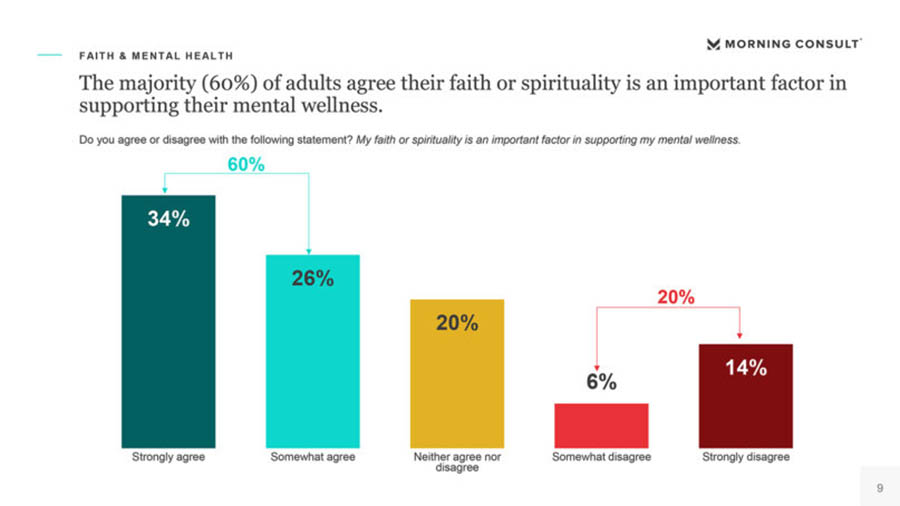
A survey of over 2,000 participants conducted by Morning Consult on behalf of the American Psychiatric Association found while 60 percent of U.S. adults say their faith or spirituality is an important factor in supporting their mental wellness, only 52 percent of those who belong to a religious community agree that their faith community “discusses mental health openly and without stigma.”

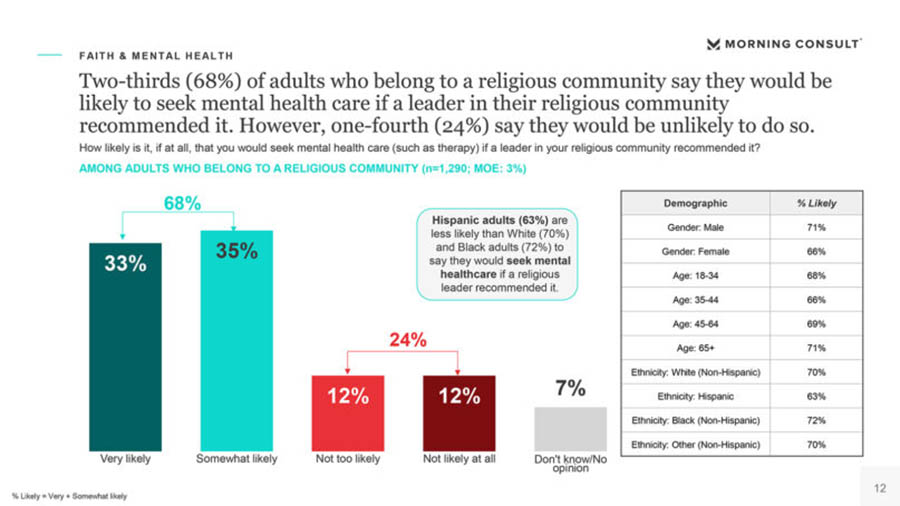
When it comes to addressing that gap, findings indicate faith leaders are key. Of survey participants who belong to a religious community, 57 percent said they’d be likely to reach out to a faith leader if they were struggling with their mental health, and 68 percent said they’d be likely to seek mental health care if a religious leader in their community recommended it.

“Our faith leaders have almost become a … first responder when it comes to getting people connected to care,” said Andrews.

Porfiri noted that, anecdotally, parishioners experiencing mental health struggles are often more comfortable turning to a faith leader than making an appointment with a therapist.

How and when to make referrals

But faith leaders don’t always receive training on mental health.

“What we learned is that our faith leaders oftentimes feel very ill-equipped,” she said.

Enter the second edition of the American Psychiatric Association Foundation’s Mental Health: A Guide for Faith Leaders. First published in 2015, the guide includes what Porfiri called a “mental health 101” section and recommendations for how and when faith leaders should make a referral to a mental health professional.

For instance, the guide teaches faith leaders to consider making referrals for congregants experiencing family dysfunction or prolonged grief or whose emotional and behavioral problems don’t meaningfully improve after six to eight sessions.

When making referrals, the guide suggests having a list of qualified professionals on hand and differentiating between clinical care and spiritual support. The guide also lists steps for responding when someone resists clinical treatment.

“I don’t think anything we do with a faith guide is going to make a clinician out of a faith leader, but it certainly will make them turn what we like to say difficult conversations into comfortable or courageous conversations around faith and mental health,” Andrews said.

Compassion fatigue and burnout

In light of more recent concerns about clergy burnout, the updated guide makes clear that faith leaders aren’t solely responsible for congregants’ mental health. A new section includes different models for how faith communities can link congregants with clinical services, from embedded or affiliated mental health clinics to simply having a current set of mental health resources on hand.

The guide also includes suggestions for dealing with clergy compassion fatigue and burnout, including keeping tabs on symptoms, from emotional numbness to increased irritability and chronic fatigue, and taking steps to delegate tasks, schedule sabbaticals and build supportive relationships with people outside of work.

“We have to start seeing our faith leaders as human beings as well,” said Andrews. “They can’t just be 24/7, 365. That has to be part of the message.”


Views about Latino voters’ faith often distorted

WASHINGTON (RNS)—There are more Latino voters in the United States than ever. As reporters and pundits seek to understand this important voting bloc, they’re digging into the faith of Hispanic communities.

But as this election cycle brings yet another flurry of trend pieces about Latino evangelicals, some narratives distort the big picture of Latino faith. Others are just myths.

Consider the facts about Latino voters and their faith:

The share of U.S. Latino adults who are evangelical has been relatively steady in the last decade.

Many trend pieces about Latino voters claim that there has been a significant spike in the Latino evangelical population. However, that narrative doesn’t bear out in the polling.

In 2022, Pew Research Center found 15 percent of U.S. Latino adults were evangelical, the same percentage that was evangelical in 2012. In the years in between, that statistic has dropped to 14 percent or been as high as 19 percent.

The Public Religion Research Institute found in 2013 Hispanic Protestants, a category that also includes nonevangelicals such as mainline Christians, made up 3 percent of Americans. In 2023, those numbers grew to 4 percent.

The small growth PRRI has tracked comes as the overall number of U.S. Latinos is growing, as is the share of the U.S. population they represent. In 2022, Latinos made up nearly 1 in 5 Americans, up from 16 percent in 2010.

This growth does not translate to a significantly expanding Latino evangelical population, yet this misunderstanding persists.

A segment on MSNBC’s “Morning Joe” on Sept. 5 broadcast that narrative, with journalist Paola Ramos saying, “You even have some scholars like Mark Mulder from Calvin University that predict that by 2030, over 50 percent of Latinos will identify as evangelical.”

In an email, Mulder told RNS Ramos had misquoted a prediction he and others made in a 2017 book that included all Latino Protestants, a larger category.

Asked whether he stood by that prediction in 2024, Mulder pointed out the book had been written in 2015, almost a decade ago.

“Right now, no, that does not seem plausible,” he wrote.

A December 2023 poll by PRRI also found Hispanic Protestants’ net gain in membership is relatively small. Only 1.4 percent of the U.S. population has become Hispanic Protestant after growing up with a different childhood religion, but 0.9 percent of those raised Hispanic Protestants have left the faith.

In polling released in August, PRRI found younger Latino adults in both the 18-to-29 and 30-to-49 age cohorts were more likely to be Protestant than older generations, a trend that has held over the last decade.

But while evangelical Protestants have almost always outnumbered nonevangelical Protestants by more than 2-to-1 overall, that gap has been smaller in the 18-to-29 age cohort over the years, with relatively higher representation of nonevangelical Protestants. PRRI pollsters caution that it can be difficult to draw certain conclusions when sample sizes are small.

Eli Valentín, an ordained Pentecostal and founder of the think tank Institute for Latino Politics and Policy, said although Latino evangelical political engagement is currently peaking, this group’s involvement in the religious right began during George W. Bush’s presidency.

While many Latino evangelical traditions began after white evangelical proselytization, the groups had more distance between them in political engagement and worship traditions until recently, said Valentín, a Democratic strategist. Still, Latino evangelical Protestants remain politically diverse.

In 2022, Pew found half of Latino evangelicals identify as Republicans or lean that way, and 44 percent identify as Democrats or lean that way, making the group more conservative than Catholic or religiously unaffiliated Latinos.

A poll from The 19th and SurveyMonkey conducted Aug. 26 to Sept. 4 and released Sept. 10 found 63 percent of Hispanic Protestants would vote for Donald Trump if the election were held today, and 29 percent would vote for Kamala Harris.

More Hispanic Protestants than the national average (36 percent) said inflation and the cost of living was the issue that mattered most to them, with 44 percent identifying that as a priority. And while only 6 percent identified abortion as their top issue, 57 percent of Hispanic Protestants said abortion should be illegal in most or all cases.

Religiously unaffiliated Latinos are seeing the largest growth of any faith category among Latinos.

In 2022, 30 percent of U.S. Latino adults were religiously unaffiliated, up from 10 percent in 2010, according to Pew polling. But the trend pieces haven’t followed. Almost half (49 percent) of U.S. Latinos ages 18 to 29 are religiously unaffiliated, while older generations tend to affiliate with religion.

This group leans significantly Democratic, with 66 percent identifying with the party or leaning that way and 24 percent identifying with Republicans.

In The 19th’s Sept. 10 poll, 59 percent of Hispanics who said their religion was “nothing in particular” indicated they would support Harris if the election were held today, and 28 percent said they would support Trump. Three percent indicated support for a third candidate, and 10 percent were undecided.

Atheist and agnostic Hispanics, who make up only about 5 percent of Hispanics polled, more heavily favored Harris, with 68 percent support. Less than a quarter (22 percent) said they would support Trump, and 4 percent said they would support a third candidate, with 5 percent remaining undecided.

Both groups have high support for abortion rights, even as fewer than 1 in 10 in each group cited it as their top issue. Eighty-seven percent of Hispanics whose religion is “nothing in particular” think abortion should be legal in most or all cases, and 94 percent of Hispanic atheists or agnostics say the same.

Like other groups, a plurality of Hispanics whose religion is “nothing in particular” say inflation and the cost of living is the top issue (39 percent), and 32 percent of Hispanic atheists and agnostics agree.

Catholics are still the largest religious group among Latinos.

Even as Catholicism experiences a strong trend of disaffiliation, 43 percent of U.S. Latino adults are Catholic, according to Pew data from 2022.

More U.S. Latinos leave the Catholic ChurchPRRI found in 2023 that 11.6 percent of the general U.S. population are Hispanic Catholics. In the general U.S. population, 3.7 percent are former Hispanic Catholics and 0.4 percent are Hispanic Catholic converts.

While white Catholics are more likely to be Republican, Latino Catholics are more likely to be Democratic. In 2020, Latino Catholics backed Joe Biden over Trump by a 35-point margin.

In a 2023 Pew poll, 60 percent of Latino Catholics said they were Democrats or leaned Democratic, while 35 percent said they were Republicans or leaned Republican.

In the 19th’s Sept. 10 poll, a third of Hispanic Catholics (33 percent) said they would vote for Trump if the election were held today, while about half (52 percent) indicated they would support Harris. About 1 in 10 (11 percent) are undecided, and another 2 percent plan to vote for a third candidate.

Like other groups, 40 percent of Hispanic Catholics said inflation and the cost of living is the most important issue.

While only 1 in 20 (5 percent) cited abortion as their top issue, 70 percent of Hispanic Catholics said it should be legal in all or most cases, despite U.S. Catholic bishops’ teaching that the “threat of abortion” should be Catholic voters’ “preeminent priority.” About a quarter (28 percent) said it should be illegal in most or all cases.

A birds-eye view of the data shows the Latino evangelical population is not significantly growing. Instead, religious disaffiliation is chipping away at the Catholic base. The impacts of these trends on this year’s election remain to be seen.

“When it comes to Latino voters, the faith component, the religious component is still underexplored,” Valentín said.


Successful leaders accept help, says Joni Eareckson Tada

CHICAGO (RNS)—Good leaders often are told to play to their strengths and hide their weaknesses. That really never has worked for disability activist and nonprofit leader Joni Eareckson Tada.

Paralyzed from the neck down, she can’t disguise what many people perceive as a weakness. And, ultimately, that has been pivotal to her success, said Tada, 74.

She wasn’t tempted to pretend she could do it all herself and she has always been well aware she needs help.

So, when Tada, an author and artist known mostly as just “Joni,” took the stage at this summer’s annual Global Leadership Summit held at Willow Creek, a Chicago-area megachurch, she told the pastors and other leaders gathered that if they want to succeed they are going to have to admit their imperfections.

“The most effective leaders do not rise to power in spite of their weakness,” she said. “They lead with power because of their weakness.”

That lesson is a day-to-day reality for Joni, who was paralyzed at age 17 more than 50 years ago. As a result, she relies on others for the most mundane of tasks.

With that help, she became a best-selling author, a popular speaker, an artist who paints by holding the brush in her mouth, and leader of Joni and Friends, a nonprofit with a nearly $40 million-a-year budget that assists families living with disabilities.

She spoke with RNS in late August about her speech to the Global Leadership Summit, her latest book, and what she has learned in four decades as a nonprofit leader. This interview has been edited for length and clarity.

The speakers at the Global Leadership Summit are often folks who have had unprecedented success and tell stories focused on winning. But that’s not exactly your message, is it?

My speech was mainly about how God delights in recruiting people who don’t naturally shine with their giftedness. He delights in using their weakness to get things done.

The whole point was to talk about how God loves to leverage weakness and minimize power. That’s not the way the kingdoms of this world work, but it is the way of what many call the upside-down kingdom of the Bible. You have to be poor in order to be rich. You have to be weak in order to be strong. You have to be humble in order to be exalted. Those kinds of things.

Those things are not necessarily considered leadership skills or leadership tactics.

Most gifted leaders tend to rely on their own strengths without relying on the strengths of others—and especially the strength of God. I think leadership is a spiritual gift. So, if leadership is a gift from God, then he is the source of the strength, the ingenuity, the passion and the vision that leaders have.

You are a successful writer and speaker and have an ability to connect with people. You lead a thriving nonprofit. And yet, you also have to rely on others for the simplest of things. What have you learned from that?

I have to rely on people just to help me with the most menial tasks—bathing, dressing, getting me up in my wheelchair. There are countless times when I must rely on others, and that teaches you to be grateful and to admit I can’t do this by myself. I’ve got to ask for help. And when help is provided, I’d better be grateful.

A lot of those things have translated into the way I lead. I surround myself with capable leaders, people who are more gifted than I am—people whose ideas I welcome. Just because I’m the CEO does not mean that I hog the spotlight. It’s always a team effort.

That’s why it’s called Joni and Friends.

Joni and Friends has been around for 45 years. Have you seen things change in how churches deal with disabilities during that time? 

I think churches, for the most part, have been woefully behind our society in many respects. I helped draft the original Americans with Disabilities Act, and we have gotten rid of discriminatory policies that prevented qualified people with disabilities from getting jobs, and barriers have been removed. But the church is exempt from a lot of that, and so the church lagged behind for many years.

My campaign for the last 45 years has been to help the church see that God thinks people with disabilities should be treated with special honor, and they should be embraced and welcomed.

The church is stepping up to speed now. We are excited to see so many congregations across the country developing effective outreaches to those with disabilities, putting people with disabilities in places of leadership, and accommodating more people.

I wanted to pivot for a second and ask you about your book about Brother Lawrence, the monk who wrote about finding God’s presence while doing mundane tasks like working in the kitchen. Why revisit that book now?

Well, I read that book back in the ’60s, when it was very popular, and everybody seemed to be reading it. Then when COVID occurred in 2020, and we were all sequestered and reading everything we had on our bookshelves, I pulled it down, reread it, looked at it, and thought, “Oh, my goodness, this is the way I live.”

I practice the presence of Jesus every single day. Except I’m not working among pots and pans in a kitchen. I’m working with wheelchairs and battery chargers and leg bags and bedpans and things like that.

It was an interesting journey looking through it and thinking, “Wow, I can write something a little more current,” but yet, at the same time, introduce a whole new generation to Brother Lawrence, in hopes that they will pick his work off the library shelf as well.

RNS does a lot of reporting on the changing religious landscape and the way that the loss of influence has made religious people very tense and worried. What do you say to people who worry about losing cultural power?

Culture is not changed just because you vote somebody into office. It begins with your own life, the way you relate at the grocery store, the way you relate to your neighborhood. If everybody who is worried about losing influence would just start influencing for good the people in their neighborhood—the elderly person down the street, the mom with a special-needs child—we can make a difference. That’s where culture happens.

When we care for people in our neighborhoods, in the grocery store and in the marketplace, we invite other people to care, and we invite other people to experience what community should be like. Culture changes on a local level, (with) prayer and a good solid witness. In other words: “Here’s my life. What can I do to make your life happy and more meaningful? How can I serve you today? What can I do to assist you?”

I mean, we’re all starved for that kind of person in our lives. Each of us can be that person in our communities, and I think that’s where the influence starts.