Clear identity crucial for downtown churches

Clarifying its identity is essential for a church committed to remaining in a downtown setting, congregational consultants and pastors of vibrant in-town churches observe.

"I think the most important question a congregation can ask is: Who is God calling us to be?" said Beth Kennett of the Center for Congregational Health in Winston-Salem, N.C. "And wherever they are located, they must add to the question: Who is God calling us to be in this particular place?"

Churches that understand who they are "may be able to more effectively and compassionately minister to the needs around them," said Kennett, the center's network coordinator for healthy faith communities.

"Downtown churches have to blow a certain trumpet," said George Bullard, strategic coordinator for the Columbia Partnership, a church consultancy. "If they blow an uncertain trumpet, they're in trouble."

Without clarifying their identity, churches may do good things in their context but won't know why they're doing them, said Bullard.

"They have to be clear about their identity, their core ideology, their understanding of the mission of the New Testament church and God's purpose for this specific church," he added.

A good place to start is identifying a church's strengths and matching those with surrounding needs, said Kennett, a former pastor in North Carolina.

"There is something real about knowing what your strengths are," she said. "One of the things I do is asset mapping—thinking creatively about your assets. That has been a powerful process in helping churches."

Before engaging in new mission initiatives, First Baptist Church in Knoxville, Tenn., evaluated its own assets, Pastor Bill Shiell said. Instead of first identifying the needs around them, "we have tried to ask, 'What are our strengths, and where do they match with a need?'" said Shiell.

"See what is in your hands specifically," agreed Warren Hoffman, pastor of Third Baptist Church in St. Louis. "Think entrepreneurially."

Through that process, Third Baptist discovered resources to support ministries in St. Louis's urban core.

"We received $550,000 from a daughter church which we outlived and have set up an Urban Ministry Fund that awards monies in the form of a grant," said Hoffman. "There monies are granted twice a year to church ministries and outside missions. This is relatively new, but the goal is to award approximately $25,000 a year to creative mission entrepreneurs in our church and outside the church in the St. Louis urban community, which have dreams of service to the city that we can affirm and assist."

Confidence in its strengths keeps a church from engaging in ministries for which it may not be best equipped, said Steve Wells, pastor of South Main Baptist Church in Houston.

"You have to say no with conviction so you can say yes with abundance," said Wells. "You have know who you are and when great ideas come along for which you lack skills, you don't say 'yes.' You realize, 'That's not us.' You have to make the right decisions."


Faith Digest: Belief in God declining worldwide

Belief generally declined globally. Belief in God is declining slowly in most countries around the world, according to a new poll, but true believers still can be found in developing countries and Catholic societies. The Beliefs about God Across Time and Countries report, released recently by researchers at the University of Chicago, found the Philippines to be the country with the highest belief, where 94 percent of Filipinos said they were strong believers who always had believed. At the opposite end, at just 13 percent, was the former East Germany. The report covered data from 30 countries that participated in at least two surveys in 1991, 1998 or 2008. In 29 of the 30 countries surveyed in 2008, belief increased with age: Belief in God was highest for those ages 68 or older (43 percent), compared to 23 percent of those younger than 28. While overall belief in God has decreased in most parts of the world, three countries—Israel, Russia and Slovenia—saw increases. Atheism and unbelief were most prominent in northwest Europe and some former Soviet states, with the exception of majority-Catholic Poland (just 3.3 percent).

Faith DigestBible translated into Inuktitut. According to United Bible Societies, the complete Bible has been rendered into 469 tongues as of 2010, and this spring, Inuktitut can be added to the list. An entire Bible in the language of Inuit people and the most widely spoken aboriginal tongue in Canada's Arctic will be dedicated at an igloo-shaped church in Nunavut, an autonomous region carved out of the Northwest Territories in 1999. Begun in 1978, the massive task marks the first time in Canada a translation of the whole Bible was accomplished entirely by native speakers of the language rather than by white missionaries. The full translation follows the completion in 1991 of an Inuktitut New Testament, now in its fifth edition. Canada's last census found about 33,000 speakers of Inuktitut, part of the Eskimo-Aleut family of languages.

Narnia or Neverland? Evangelicals prefer Narnia, Catholics opt for Wonderland, and mainline Protestants are split between hitching a ride to Hogwarts, Narnia or Neverland. Those are the results from a unique poll by the television show 60 Minutes and Vanity Fair magazine. The survey asked 1,000 Americans what fantasy land they'd most like to visit. Evangelicals showed a clear preference—28 percent—for Narnia, the fantastical world of C.S. Lewis' series The Chronicles of Narnia. Alice's Wonderland was many Catholics' cup of tea, with 21 percent saying they'd like to take a trip down the rabbit hole. Peter Pan's Neverland (18 percent), Harry Potter's Hogwarts (18 percent) and J.R.R. Tolkien's Middle Earth (16 percent) weren't far behind. Mainline Protestants were split similarly between Neverland (19 percent), Narnia (18 percent) and Hogwarts (18 percent). Among those listed as "other" religions, Hogwarts was the clear favorite (31 percent). And Middle Earth led the way for those who professed no religious affiliation (23 percent). The survey, conducted in late 2010 and recently highlighted by the Center for Applied Research in the Apostolate at Georgetown University, includes a margin of error of plus or minus 3 percentage points.

Compiled from Religion News Service


Women find a friend in the Apostle Paul, Truett professor says

HOUSTON—Contrary to popular opinion, women not only have a friend in Jesus, but also find a friend in the Apostle Paul, seminary professor Todd Still told a recent conference sponsored by Christians for Biblical Equality .

Too often, Christians pit Jesus against Paul, and some even have adopted the view of Irish playwright George Bernard Shaw, who labeled Paul as “the eternal enemy of woman,” said Still, the William H. Hinson Professor of Christian Scriptures at Baylor University’s Truett Theological Seminary.

Todd Still

Women played a pivotal role in Jesus’ ministry and in Paul’s mission, Still asserted. Jesus treated women with dignity and acknowledged their worth, extending healing even to those who were regarded as ceremonially unclean, he noted.

“Far from being inconsequential or token, Jesus viewed women as full participants in his mission and in the kingdom of God,” he said.

While many Christians readily accept the idea that Jesus defied conventional first-century views about women by valuing them, they see Paul as an oppressor of women, Still observed. He pointed particularly to passages in 1 Timothy and 1 Corinthians, where women—or wives—were commanded to submit to men and keep silent.

However, Still insisted, those specific instructions need to be viewed in light of Paul’s affirmation of women who occupied leadership roles in churches—notably Euodia and Syntyche in Philippi, Phoebe in Cenchreae, Priscilla and Chloe in Corinth and Ephesus, and Junia, Julia, Mary and others in Rome.

“It likely comes as little to no surprise that Jesus affirmed the dignity of women, treating them as those created in the divine image, and that women played a pivotal role both in Jesus’ earthly and post-resurrection ministry. It may, however, come as a surprise to some that Paul’s calling of women/wives to silence and submission is tempered—if not trumped—by his affirmation of mutuality, yea equality, of women and wives in marriage and ministry,” he said.

Both Jesus and Paul affirmed women in principle and in practice, Still insisted.

“Pauline prohibitions and restrictions, I would contend, are occasional exceptions to this general rule,” he said. “As such, they are contextual, not continual; time-bound troubleshooting, not timeless delimiting; a chapter in a book, but not the whole enchilada. More often than not, there is inclusion and embrace, and it is this trajectory that we trace.”

The example of both Jesus and Paul should guide modern Christians’ attitudes  toward women, Still insisted.

“If it was the practice of Jesus and Paul to join hands with women in mission and ministry, should this be our contemporary practice as well?” he asked. “Yes, yes and a thousand times yes, we will answer.”


Race & Faith

A neighborhood watchman in Florida shoots and kills a hoodie-wearing African-American teenager. Two white suspects in Tulsa, Okla., confess to the Easter weekend shooting of five people in a predominantly black neighborhood.

Trayvon Martin Million Hoodie March in New York City was one of many such protest marches conducted in reaction to the shooting of the teen by a neighborhood watchman in Florida. (Photo/Frank Daum)

Periodically, racial tensions that have simmered beneath the surface bubble up, some Christian leaders note, illustrating just how far-removed modern America is from the "beloved community" envisioned by Martin Luther King Jr.

"We can legislate fairness, but we cannot legislate love. That is up to us," said Mark Croston, pastor of East End Baptist Church in Suffolk, Va., and president of the Baptist General Association of Virginia.

Christians must lead by example to improve race relations, he said.

"I believe that all truly Christian churches must be open to racial inclusion and human compassion. We sing, 'Jesus loves the little children, all the children of the world. …" This is true, so we must, too," said Croston, an African-American.

Croston points to the vision in the New Testament book of Revelation of people representing every nation, tribe and language worshipping Christ. If Christians are serious when they pray, "Thy kingdom come, thy will be done on earth as it is in heaven," he said, they must "with intentionality work toward this reality."

But the heavenly vision seems remote for many, and racial divisions remain a clear and present problem, some observers noted sadly.

Predictable pattern

When stories about racially inspired violence capture public attention, events follow a predictable pattern, said Alan Bean, executive director of Friends of Justice.

Inspired by preachers like Martin Luther King Jr., African-Americans in the early 1960s marched to secure civil rights. But some social observers note King's dream of the "beloved community" still is far from reality, as evidenced by the recent rhetoric surrounding the Trayvon Martin shooting.

"When the status quo is threatened by systemic racial bias, the propaganda machine goes into overdrive. This normally involves the assertion that a liberal media is making excuses for thuggish behavior. If the folks on the receiving end of unjust treatment can be redefined as one of 'those' people, the horrific details no longer matter," Bean, an American Baptist minister in Arlington, wrote in a recent column for Associated Baptist Press.

As the stories gain media attention, he continued, "America quickly divides into protestors claiming that the narrative du jour is a prime example of systemic racism, and debunkers insisting it is nothing of the kind."

The church's role

Historically, African-American churches have played a central role in providing a voice for people who have felt victimized and for exposing racism. In many cities, a particular church or a few churches continue to play a key role as ombudsman in the African-American community, said Michael Bell, pastor of Greater St. Stephen First Baptist Church in Fort Worth.

"It's where people go for direction when they are seeking resolution of difficulties and solutions to their problems," said Bell, a past-president of both the Baptist General Convention of Texas and the Texas African-American Fellowship.

More specifically, African-Americans know which churches are able to do something substantive about their problems, he noted.

"They go to a church where the pastor has a reputation as being a prophetic voice," Bell said. "My church expects me to speak up. I have never received a negative email, text or letter from a church member complaining that I was too involved in community issues outside the church."

Elizabeth Eckford, one of the Little Rock Nine, is pursued by a mob outside Little Rock's Central High School. (UPI Photo/Library of Congress)

However, in many—perhaps most—predominantly white churches, pastors do not feel that same degree of freedom, he added.

The African-American church has become even more relevant and gained increasing influence as racial tensions have heightened in recent years, Bell insists.

"Distrust and suspicions that had been under the surface have bubbled up. Racism has become more overt and evident in in the last few years," he said, comparing racists to "roaches so bold they don't run from the light anymore."

A cloud of suspicion

Relations between white and blacks, even among Christians, suffer from a failure to address deep-seated issues such as the way African-Americans often are viewed with suspicion—a matter brought to the forefront recently when George Zimmerman shot and killed Trayvon Martin in Sanford, Fla., he observed.

"It's like putting cold cream on cancer. Unattended, the malady will intensify, because it hasn't been addressed. We try to move on without really dealing with it," Bell said.

"We (African-Americans) have a historical memory informed by a hermeneutic of suspicion. Periodically that will come to the surface, and the obvious issues will be addressed. The symptoms will be addressed without dealing with the disease. We won't go beneath the surface. …We fear it will take too much out of us."

Some African-American ministers note the fear young men in their communities feel about being stopped by police for "DWB—driving while black."
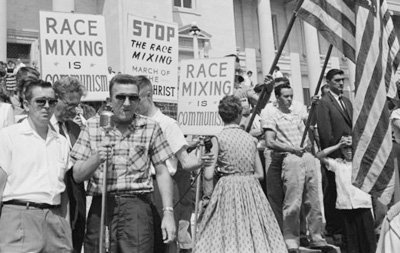
White citizens rally at the Arkansas state capitol, protesting the integration of Central High School in Little Rock. (U.S. News & World Report Photo/Library of Congress)

In a video on the American Baptist Home Mission Societies website, Executive Director Aidsand Wright-Riggins appeared in a hoodie to tell stories from his own experience about the cloud of suspicion under which African-American young men live.

Wright-Riggins recalled how he was stopped by police officers—once while knocking on the door of a white church member and once while approaching his own home. He also told how his son was pulled over twice driving between his parents' home and his university dormitory.

"I appeal to all of us, as we look at the millions of persons around us, and particularly those of color—particularly black boys—that we don't make an automatic assessment because they might be dressed differently or look different or somehow feel that they are out of place in our society," he said, "that we relegate them to the margins or, even worse, that we assign them to the morgue."

A troubling divide

The Trayvon Martin case illustrates "a troubling divide in public perception," Bean wrote in a recent blog on the Friends of Justice website.

"On one side of the fault line, people identify with George Zimmerman's suspicion of young black males wearing hoodies. On the other side, folks identify with a victim of racial profiling and vigilante justice," he wrote.

The 1963 March on Washington for civil rights featured blacks marching alongside Christians and Jews. But some social observers note the dream of the "beloved community" still is far from reality, as evidenced by the recent rhetoric surrounding the Trayvon Martin shooting. (RNS FILE PHOTO)

In his opinion column written for Associated Baptist Press, Bean noted: "Real-life narratives are messy because life is messy. Victims of injustice get caught up in the mess. They don't play their roles with the disciplined panache of a Rosa Parks. They talk back; they fight back; they come out swinging. And that's when bad things happen. That's when the tragedy quotient gets high enough to catch the media's attention."

"Why did George Zimmerman feel called to defend his neighborhood from intruders?" Bean continued. "Why did he see Trayvon Martin as out of place, an anomaly. Because he was wearing a hoodie? Because he was walking with a particular gait? Because he appeared overly interested in his surroundings?

"Eliminate Martin's blackness from the equation, and it is impossible to imagine Zimmerman reacting as he did. Zimmerman defined criminality in racial terms. Who, or what, taught him to think this way? … Our national conversation will continue to revolve around messy narratives."


Ministry enables amputees to stand with hope

NASHVILLE (RNS)—Allan Doyle used to have big dreams and little faith.

He'd grown up Methodist but dropped out of church after high school. A bad marriage in his early 20s ended in divorce, leaving Doyle afraid he would spend most of his life alone.

Gracie and Peter Rosenberger

His main goal was to save enough money from serving in the Army to go to college and become a corporate lawyer. "I wanted to make as much money as possible," said Doyle, 39.

But the Iraq War changed all that.

In 2003, Doyle was in Saddam Hussein's palace in Tikrit when a stone from one of the walls fell on him, crushing his left leg. Doctors had no choice but to amputate it below the knee.

A few months later, Doyle was fitted with his first artificial leg. Along the way, he rediscovered his faith and found a new calling as a prosthetist—a medical professional who fits amputees with new limbs.

This summer, he'll spend a week in Ghana with Nashville-based Standing With Hope, a nonprofit that helps provide high-quality limbs for people of the West African nation.

"I just want to help people walk again," said Doyle.

When they founded Standing with Hope seven years ago, Gracie and Peter Rosenberger had the same goal. The couple met in college at Belmont University in Nashville, where she was an aspiring Christian singer who hoped someday to be a missionary.

Standing With Hope President Peter Rosenberger (left) observes Ghana Health Services' senior prosthetic technician James Annang making adjustments to a patient's new limb. Standing With Hope Field Director Daniel J.M. Kodi stands by, as well. (RNS PHOTO/Courtesy of Standing With Hope)

A week before Thanksgiving in 1983, she fell asleep while driving in rural Tennessee. She endured dozens of surgeries, hoping doctors could repair her shattered legs. The recovery was excruciating.

Doctors weren't able to save her legs, and both were amputated. That left her with a fearful and uncertain future, until she got her first prosthetic legs. She was able to recover enough to walk and play basketball in the driveway with her two boys, and to realize her dream of becoming a singer. A highlight of her career was singing for President George W. Bush in 2004 at an event in Nashville.

She's also visited wounded soldiers at Walter Reed National Military Medical Center. Without those new legs, she said, none of that would have been possible.

"They gave me my life back," she said. "I had no idea what I was capable of. I want to offer people the same hope that's been offered to me."

The Rosenbergers founded Standing With Hope in 2003 and starting working in Ghana two years later.

The nonprofit ships the parts and supplies needed to build legs to the National Prosthetics and Orthotics Center run by Ghana's National Health Service in the capital city of Accra. Most of the parts are recycled from old prosthetic limbs that have been donated to Standing With Hope.

Technicians trained by Standing With Hope then use those recycled parts to assemble and fit the new limbs on amputees.

Jim McElhiney, a Spring Hill, Tenn.-based prosthetist who's a longtime friend of the Rosenbergers, helped design the training program.

Gracie Rosenberger, founder of Standing With Hope, assists Abraham, a patient in Ghana, as he receives a prosthetic limb. (RNS PHOTOS/Courtesy of Standing With Hope)

Initially, he was skeptical, saying the program wouldn't work if it relied too heavily on Americans to build and fit artificial limbs.

"I didn't want to do it at first," he said. "Look, if I go over there for weeks once a year, how many legs can I make? The need is so much bigger than I—even if I had a team of 50 prosthetists—could handle."

With the help of Standing With Hope, technicians at the clinic in Accra now can build custom limbs to fit amputees, as well as provide follow-up care.

"We put hundreds and hundreds of legs on people, but each person needs adjustment over the years. If the patient is young, they might need new legs as they grow. It is a lifelong commitment to each patient."

Last fall, Standing With Hope started a new program they hope will expand the number of prosthetics they can provide in Ghana. Inmates at a Nashville prison now disassemble donated limbs and sort the parts for shipping to Africa. The charity's biggest need is for more donated limbs, Rosenberger said.

{youtube}6sisuto-g9c{/youtube}
Gracie Rosenberger and the story of Standing with Hope.

At the clinic, each patient also gets a bag with cleaning supplies and tools needed to care for the new limb. The bag also includes an explanation of the charity's Christian mission.

Peter Rosenberger, who will make his 10th trip to Ghana this summer, said he and other volunteers don't push their faith. But if the patients are interested, he shares with them how faith in Jesus motivates the charity's work.

He recalls telling one patient about how Christianity gave his wife hope after she lost her legs. "I told him, 'You are literally standing on her belief,'" he said. "She trusted on that belief, and every step you take, you are standing on that faith.'"


Merging churches across racial lines demands work

As its neighborhood shifts, a congregation often chooses to sell its facility and relocate. Many times, church's members have moved to a different part of town and want a building close to where they live.

At St. Paul Baptist Church at Shively Heights in Louisville, Ky., pastors Lincoln Bingham (center left) and Mark Payton (center right), along with their wives, lead their newly united congregation in prayer in 2009. (PHOTO/David Winfrey)

Members either give away or sell the facility to another church in the neighborhood, usually one that ministers to the area's largest ethnic group.

Blended community

A few congregations, however, choose to create something new by merging two distinct churches. But creating a blended Christian community takes work.

St. Paul Baptist Church at Shively Heights in Louisville, Ky., drew national media attention when the historically black St. Paul Missionary Baptist and the predominately white Shively Heights Baptist merged to create the blended congregation in August 2009.

Pastor Lincoln Bingham of St. Paul Baptist reached out to Shively Heights' pastor, Mark Payton, when Payton moved to the area 26 years earlier. The two became close friends, and as more African-Americans moved into the area, the two began talking about ways to minister to their community.

The pair wanted to lead their congregations to minister. But St. Paul's didn't have the facilities it needed, and Shively Heights members didn't have the economic resources to cover the upkeep on its building. Bingham and Payton felt God showing them a merger would be the best way to reach a community of nearly 300,000 people—both black and white.

Merger hasn't been all that uncommon in the past 20 to 25 years, but often the result reverts to one primary culture, or a church will hold two distinct services to accommodate each culture. As co-pastors, Payton and Bingham have worked hard to lead the blended congregation to remain blended.

Currently, the church's makeup is about 60 percent black and 40 percent white. While the community is predominately African-American, the racial mix of new members since the merger has been about 50/50, with a few Hispanics and other minorities joining, as well.

The congregation works at keeping a blend, even in its programs and governance. All Sunday school classes have two teachers—one black and one white—who rotate responsibilities each month. Every committee has a balanced representation, and the pastor scheduled to preach isn't announced ahead of time. "They know who it is when they see the bulletin," Payton said with a laugh.

Members concentrate on ministry, with an organized evangelistic outreach every Monday night, Vacation Bible School each summer and an annual back-to-school block party. For the past three years, the church has offered a basketball league, attracting 500 to 600 participants and spectators each weekend during the season.

"We've really been amazed at how well it is working," Payton said. "We just tried to determine what God's will is. … We just don't think there's room for prejudice."

Slowly becoming one

Members of New Home Baptist Church in Kansas City believed God had called them to reach the unchurched in Kansas City. In 2010, the church had about 200 members, with about 75 percent African Americans and 25 percent other groups. But they quickly outgrew their building. To continue making an impact on the area, they needed more room.

The nearby Mount Washington Baptist Church had been a large urban congregation in its heyday in the 1960s. But by 2008, when Tom Renfro became pastor, the congregation had dwindled to about a dozen senior adults. "Our youth department was two people in their 60s," Renfro quipped. Everyone else had long been retired.

New Home's pastor, Clarence Newton, and Renfro began discussing possibilities. New Home needed the room Mount Washington had, and Mount Washing-ton needed a future. Members decided both visions could be realized by merging.

The new congregation, though, decided to maintain each culture's identity by offering two services—one traditional and one contemporary. The traditional service, which Renfro led, became the home of Caucasian members, while black members chose the contemporary service, with Newton preaching.

Last year, when church decided it no longer could afford two pastors, Renfro resigned. Both the traditional and contemporary services still are offered, with Newton preaching both services.

Each has become a little more blended as older blacks have chosen the traditional service and young whites have moved into the contemporary worship.

The church has baptized more than four dozen people since the merger.

Renfro anticipates Mount Washington will become a predominately black Baptist church in the near future.

"But overall, the merger has been a success because the building is being used, and the church is reaching people for Christ and moving forward," he said.


Veteran minister reflects on losses in African-American church life

BELTON—After more than five decades of ministry, George Harrison understands what African-American Christians have gained and lost in the last half-century.

Black church music chronicles the African-American experience, and veteran minister George Harrison wants to see that heritage preserved and passed along to the next generation.

Harrison, pastor emeritus of First Baptist Church-NBC in Waco and a veteran church musician, vividly remembers life in segregated Central Texas. Growing up in Belton, he recalled how a society where whites and blacks existed in separate spheres that rarely intersected severely restricted his view of reality.

"Even though I could see beyond my community, it was like I was wearing blinders," he said.

The end of Jim Crow laws opened up opportunities for African-American advancement—and for whites to benefit from the contributions of black Americans, he noted.

"Desegregation was good for the nation. … Desegregation had great value in terms of opening up opportunities to learn about other cultures," he said.

Even so, Harrison acknowledged, segregation created a unified—albeit restricted—black community with the church at its center.

"There was a richness in the close-knit community," he said. "You can't gain without losing. You can't lose without gaining."

In a closed, segregated society, Harrison got an early start in ministry as a church musician and composer. He began playing the piano at age 3 and wrote his first song, "Flowers in the Spring," at age 6. After he taught the song to the other children at Macedonia Baptist Church in Belton, where his father was chairman of deacons, the church called him to direct the children's choir and begin leading music in worship. At age 12, he began preaching.

Without question, Harrison recognizes he gained personally from the changes that occurred as a result of the Civil Rights Movement. He earned his undergraduate degree at the University of Mary Hardin-Baylor, where he directed the premiere choral group and traveled extensively as a student recruiter.

After graduation, he worked several years in a post with a railroad company that allowed him to enter a master's degree-equivalency program before pursuing further graduate courses at Baylor University and Southwest Texas State University.

He also served as pastor of churches in Temple, Gatesville and Lampasas, as well as Macedonia Baptist Church in Belton. In 1987, he became pastor of First Baptist Church-NBC in Waco.

About that same time, he was named director of cultural affairs at Baylor University and the first director of Heavenly Voices, the university's Black Gospel choir.

He went on to serve in several administration posts at Baylor. In 2003, Harrison returned to UMHB, first as director of community services and cultural affairs and later as director of digital media services.

Through it all, Harrison has maintained his love for music—particularly music distinctive to the African-American church. And he has made it his mission to help preserve that musical heritage.

Harrison produces a local radio program, "Gospel Now." He also leads occasional seminars that explore the meaning of Spirituals dating back to days of slavery, as well as more recent Black Gospel songs.

"There is a rich culture in those songs, and it's endangered. There's a richness in our worship, and the new generation has no idea about it," he said.

Even so, Harrison hopes the black church can regain its central role in the lives of African-Americans and recapture its ability to instill a clear sense of identity in young people. And he wants to teach the rising generation of black church leaders—as well as anyone else who will listen—about the history chronicled in African-American church music.

"The music tells the story," he said.


Faith Digest

Brits OK prayer at town halls. The British government has fast-tracked a move to restore the rights of towns and cities to hold prayers as part of their official business, effectively overriding a High Court order to stop the practice. Communities Secretary Eric Pickles spearheaded the introduction of a new "general power of competence of local authorities in England" that gives new powers to local governments to resume prayers and to sidestep the court ruling issued two months ago. In its own decision against Bideford Town Council, in southwest England, the High Court said in February it was illegal for town halls to continue with the centuries-old practice of conducting prayers at the start of official meetings. The British government now says, "Parliament has been clear that councils should have greater freedom from interference." In broadening these new powers to town and parish councils, it adds, it enables them to innovate and "hands them back the freedom to pray."

Faith DigestPoll: Christianity good for the poor and children, bad for sex. Americans feel the Christian faith has a positive impact on help for the poor and raising children with good morals, according to a new poll, but it gets a bad rap on its impact on sexuality in society. In a new study conducted by Grey Matter Research, more than 1,000 American adults were asked if the Christian faith had a positive, negative or no real impact on 16 different areas of society, such as crime, poverty and the role of women in society. Strong majorities (72 percent) said Christianity is good for helping the poor and instilling morality in children. Around half (52 percent) said Christianity helps keep the United States a strong nation, and nearly as many (49 percent) said the faith has a positive impact on the role of women in society. Americans hold their most negative perception for how Christianity impacts sexuality, with 37 percent who feel there was a negative impact, compared to only 26 percent who feel it was positive. The total sample of 1,011 adults selected at random from all 50 states had a margin of error of plus or minus 3.1 percentage points.

Cure for homosexuality? London's mayor axed an ad campaign spearheaded by two conservative Christian groups because their ads suggest homosexuality is a disease that can be cured through prayer. Core Issues Trust and Anglican Mainstream made posters reading: "Post-gay and proud. Get over it!" and had planned to plaster them on the sides of London's iconic double-decker red buses. The slogan mimicked a recent drive by the pro-gay rights group Stonewall, which used the line: "Some people are gay. Get over it." Core Issues and Anglican Mainstream both fund "reparative therapy" for gay men and lesbians to "cure" them of homosexuality. The Christian groups' campaign had been scheduled to cover the sides of buses for two weeks, but London Mayor Boris Johnson stepped in to ban it. "It is clearly offensive to suggest being gay is an illness someone recovers from," Johnson said. "And I am not prepared to have that suggestion driven around London on our buses."

Compiled from Religion News Service


Children collateral damage in divorce

DECATUR, Ga. (ABP) – Dissolution of a marriage is painful not only for couples, but also affects communities of faith and especially the children of divorce, a speaker said April 20 at a [Baptist] Conference on Sexuality and Covenant sponsored by the Cooperative Baptist Fellowship and Mercer University’s Center for Theology and Public Life.

Emily Holladay

Emily Holladay, a student at Mercer’s McAfee School of Theology whose parents split while she was in college, said many people who voiced concern about her parents’ divorce seemed unaware that she, too, was hurting.

“Even though it wasn’t my marriage, the divorce had a profoundly unsettling effect on my life,” Holladay said at the three-day conference at First Baptist Church in Decatur, Ga. “As a child, as a product of my parents’ marital relationship, I was extremely shaken by their broken covenant. And I had no choice in the matter.… There’s nothing I could have done to change my parents’ decision, but I was and am forced to live with the consequences.”

Holladay said churches need to do more to support married couples and families along their journey. “Marriage is hard,” she said. “No one couple can stand alone without the love and encouragement of a community. Married couples should be able to feel like their church community is a place they can come, with all their baggage in tow, for healing and comfort.”

Holladay said that includes pre-marital counseling before couples tie the knot but doesn’t end there. “If a minister and a church are going to stand behind a couple as they enter into an engagement and counsel them in the months before their wedding, they need to do so throughout the couple’s marriage as well,” she said.

“As it is, there seems to be little to no accountability within most churches, and couples do not know where to turn when marriage is not as easy as they thought it would be,” Holladay said. “And since church is where we come in our Sunday best, it is hard to see that they are not the only couple facing challenges.”

Holladay said by signing a marriage license or performing a wedding ministers “should be saying they choose to encourage the couple with all their baggage and commit to walking alongside them as they struggle and as they flourish.”

“So many marriages fail simply because the couples do not have the tools to work through their problems, and they feel their church community would ostracize them rather than support them,” she said.

Holladay said her parents’ experience taught her that more than two people are affected by a divorce. “At its core, divorce is destructive to an entire community,” she said. “Marriage is intended to emanate God’s love, and when it ends, society questions God’s perfect love.”

“Divorce creates division within a community and pain between family members,” she said. “Members of the community feel forced to take sides with either of the divorcees, and family members are torn between their parents, children and the life they were accustomed to.”

Holladay said nothing in her own life has caused her to question God’s love as much as growing up in an unloving home and her parents’ unwillingness to reconcile.

Even after marriages fail, Holladay said, churches can help divorced couples find closure and move forward together. That can include support groups or even just knowing what kind of questions to ask or how to be present with grieving parties. “If the community does not know how or learn how to respond, the grieving process will be extended and we risk continuing patterns of fractured and broken relationships,” she said.

Holladay said children of divorced parents need healthy models of covenant relationships. “I think a major reason why divorce continues to be such a problem in the United States is that so many people grow up in broken households,” she said. “They do not know how to make relationships that work, because they don’t witness healthy relationships. Divorced or divorcing parents can also get so wrapped up in their own problems and struggles that they are not always able to be fully present with their children. As a church body, if we say we are family, we need to stand in when families struggle to provide emotional support for one another.”

“It is my hope and prayer that as churches and Christians, we can learn how to be a covenant community together and how we should respond when individual covenants end, so that children like me and families like mine don’t have to grieve alone,” she said.

–Bob Allen is managing editor of Associated Baptist Press.


Boundaries of covenant sometimes unclear, speakers assert

ATLANTA—The boundaries of covenant in regard to sexuality can be unclear for single adults, lesbian/gay/bisexual/transgender individuals and senior adults, speakers told a [Baptist] Conference on Sexuality and Covenant.

Many single adults are “making up the rules as they go along” because they lack leadership and guidance, said Roz Nichols, an African-American single woman and pastor of Freedom’s Chapel Christian Church in Memphis, Tenn.

“What we are lacking is a way to express ourselves in our intimate relationships that is born out of our understanding of our faith and our human sexuality,” Nichols said.

Christian conversation on sexuality must recognize sex as basic to who human beings are, she insisted.

“We are, like all of God’s creation, hardwired to crave food, sleep, water, and—yes—sex,” she said.

Recognizing the basic hunger for sex as healthy does not mean “anything goes,” she insisted.

“On the contrary, I am seeking just the opposite. I am seeking to elevate all that we do with our bodies to the level of the sacred,” Nichols said.

Rather than viewing the biblical condemnation of fornication as referring only to sex outside of marriage, she called for a broader, deeper and more expansive understanding.

“I would argue that we begin to think and rethink of fornication not merely in terms of not having sex because we are not married, but in terms of how we prostitute ourselves, objectifying others, bartering our bodies in exchange for momentary release from the loneliness,” she said.

“In this regard, we commit fornication not simply because we are not married, but because we have failed to value ourselves and we fail to value the other person.”

When it comes to covenant relationships, lesbian/gay/bisexual/transgender people of faith may have lessons to teach the church as a whole, said Cody Sanders, a gay pastoral counselor and member of Broadway Baptist Church in Fort Worth.

“Traditional marital relationships in the U.S., especially in Christian contexts, come with a host of culturally conditioned gender expectations that are imbued with unequal power relations between women and men,” he asserted.

“Yet, when no predefined gender roles exist to unthinkingly guide how intimate relations are to be fostered, the potential—at the very least—is present for covenants forged not by centuries of gender-role residue—much of which has served to subjugate women to male dominance—but through commitments to mutuality and equality.

“While same-sex relationships are not immune from power inequalities, persons in same-sex relationships must, of necessity, give explicit considerations to relational roles and power relations when these relationships are not between man and woman, but between men and men or women and women.”

Because many LGBT people have been rejected by their families of origin, they have formed covenantal communities of support and friendship from which others can learn, he added. And because they have been rejected by many churches, they have been forced to think deeply and creatively about the connection between sexuality and faith, he added.

Mature dialogue in churches about sexuality—particularly regarding same-sex relations—demands self-education, Sanders insisted.

“This self-education, as well as congregational education, should not only engage the written works of scholars, but should generously engage the living human documents of the transgender, lesbian, bisexual and gay persons in our midst,” he said. “We have much to teach you.”

Sanders rejected the idea that same-sex relations are a second-class status that falls short of the ideal.

“Rather than a tolerable but undesirable Plan B, LGBT relationships are stellar examples of covenant forged in the fires of oppression, marginalization, injustice and violence,” he said.

Among senior adults, sexuality is “a world of gray,” said Rhonda Blevins, associate pastor at Tellico Village Community Church in Loudon, Tenn.

“A discussion about sexual ethics and the senior adult requires nuance and compassion—often the ethical dilemmas for those in this age group emerge from loss, whether death, divorce or illness,” she said.

Any responsible sexual ethic for a single senior adult “must reject the permissive sexual culture of our day while affirming the inherent sexual nature in each man and woman of God,” Blevins asserted.

“A one-size-fits-all ethic falls short when senior adult sexuality is taken seriously,” she continued.

“Good Christian people may reject the proposition that sexual ethics for seniors is a world of gray, but the convention wisdom of ‘sex within marriage, celibacy without’ is a failed sexual ethic for seniors because it fails to offer compassion for the 16.4 million single senior adults in America. … It fails to recognize the growing crisis of older adults facing isolation and loneliness.”

Blevins called churches to what she considers a balanced approach.

“Too far in the direction of compassion and the church may promote a reckless sexuality that cheapens sex. Too far in the direction of appropriateness and the church slides back to its all-to-familiar role of guilt mongering,” she said. “Senior adults need a truly Christian sexual ethic that is both lovingly appropriate and honorably compassionate.”


Gushee: Covenant best model for sexual relationship

DECATUR, Ga. (ABP) – The co-convener of a conference on sexuality and covenant said April 20 that long-term committed relationships are the best model for Christians struggling to make sense of changing morals about sex.

David Gushee

“I believe that covenant is a, if not the, single best way that has emerged in the great Christian tradition to talk about what we are supposed to do with our sexuality, and for that matter, our relationality,” said David Gushee, an ethics professor at Mercer University, co-sponsor with the Cooperative Baptist Fellowship of the April 19-21 conference at First Baptist Church in Decatur, Ga.

Gushee defined covenant as a “voluntarily entered sacred pact between two persons and between those two persons and the God to whom both are committed.” In Christian-influenced countries like the United States, he said, it also has legal status and is the socially approved context for having and raising children.

For adults, Gushee said, covenant is a “divinely given response to human nature, human potential and human sin.”

“If we lived in a sinless Eden, we would not need covenants,” Gushee said. “Our hearts would always be true. Our relationships would be always sturdy. We would never be so angry as to want to give up. We would never be attracted to another lover. We would just follow our sexual-relational urges to the first available attractive person and then mate for life, like pigeons or ducks.”

He described covenant as both a concession to and provision for sin. “Covenants are the best possible arrangement for binding human bodies and lives in this not-best-of-all possible worlds,” he said.

Gushee said covenant is also better for children. “It is good news for children when they never need to wonder who or where their father or mother might be,” he said. “It is good news because their father and mother are far more likely to be bonded permanently to each other than in any other adult sexual-relational arrangement.”

Gushee said he thinks children have a natural expectation that their parents will remain together. “The adults may not be aware of that expectation, but their children are deeply aware of it, especially when it breaks.”

“Children want to know their parents,” Gushee said. “They want their parents to love them and be involved in their life. Children want their parents to treat each other right and keep the promises they made to each other, which is one reason why children of divorce so often fantasize about their parents getting back together.”

Gushee said he doesn’t think the main issue facing the church today is which groups of people are to be viewed as eligible to make covenants. “The main issue is to rescue the very practice of covenant before it disappears forever, not only in society but in our own house,” he said.

There was a time, Gushee said, when churches would have covenants committing members to walk together instead of moving from church to church. Today, he said, church is often viewed as just another product to be consumed.

“I call on churches to be better and more faithful covenant communities, not casual drive-up products but covenanted communities of brothers and sisters in Christ there for each other in good times and bad,” he said.

–Bob Allen is managing editor of Associated Baptist Press.


Christians need to formulate embodied theology, speaker asserts

ATLANTA—Varied views on the human body in the Bible and church tradition shape modern Christians’ attitudes about sexuality, ethicist Melissa Browning told a [Baptist] Conference on Sexuality and Covenant.

Christians need to formulate “an embodied theology … that is rooted in and takes seriously our relationship to our bodies,” Browning told participants at the April 19-21 event at First Baptist Church in Decatur, Ga. The Cooperative Baptist Fellowship and Mercer University’s Center for Theology and Public Life sponsored the conference. That kind of theology rooted in experience challenges Christians to re-examine their views on same-sex relations, she asserted.

Melissa Browning

Melissa Browning

"While there are resources within the Scripture for mutuality and equality, there are also texts that devalue women's bodies or maintain strict gender hierarchies that shape opposite-sex relationships today. For those of us seeking to dismantle their hierarchies, same-sex relationships can point toward justice, modeling a form of relationality that is not hierarchal and is less caught up in the constraints of gender," she said.

Ancient beliefs about the body and sexuality—such as early physicians who saw sex as dangerous because they believed it caused the blood to boil and Stoic philosophers who sought a life free from passions—influenced early Christian views, said Brown, an alum of Baylor University’s Truett Seminary.

Those beliefs—reflected in the writing of the Apostle Paul in the New Testament—diverged considerably from the Hebrew Scriptures and its celebration of sex as seen in Song of Songs “by placing sexuality primarily in the realm of rules that regulate the passions,” said Browning, adjunct instructor in ethics at Lexington Theological Seminary, McAfee School of Theology at Mercer University and Kennesaw State University.

“In the Pauline letters, we see a much different view of sex,” Browning asserted. “The body is not to be trusted. Salvation happens not in the body, but in the mind. Marriage is a way of quenching desire. … Sex within marriage was good because it kept desire at bay. … Nowhere in Paul’s writings is there a place where sexual desire is seen as good.”

Paul’s writings deeply influenced Augustine and, consequently, much Catholic theology, she observed.

Jesus provided a different view of the body than Paul by emphasizing an embodied ministry that encompassed every aspect of human experience, Browning said.

“Jesus took on human form—the form of a body—to know our sufferings, to meet our spiritual and bodily needs. For Jesus, bodies and spirits were never separate,” she said, pointing to the times Jesus fed hungry people, healed the sick and violated taboos by touching people considered untouchable.

“For Jesus, the stuff of the body, the stuff of creation, was good. It was the stuff of life,” she said.

Jesus remained mostly silent on issues that capture much of the attention in modern ethical debates, such as same-sex relations and views about family, she said.

“Jesus never married and called his family those who followed him, not those related to him by blood,” she noted.
Modern Christians, on the other hand, seem “a bit infatuated with sexual sins” and make attitudes toward sexuality “a litmus test for faith,” Browning said.

“Sex does not define us entirely. It is not all-important. It is only part of who we are as moral people, as people of God,” she insisted.
“I believe that part of the reason that we allow sex to define us—and each other—comes from our mistrust of our bodies. With the Apostle Paul, we see the body as the space of desire that must be disciplined. We do not love or trust our bodies—at least, not enough.

“We too often neglect the words from creation that call the body good. We too often forget the example of Jesus who touched and healed bodies, of Jesus who was embodied—God embodied in human form.”

Embodied theology demands that Christian overcome a dualistic view of mind and body and ask the right questions about sexual ethics, Browning said.

“Marriages, like any other relationships, can be just or unjust,” she said. Browning noted her research on HIV-positive women in Tanzania, where 80 percent of the women contracted HIV from an unfaithful spouse.

“What does it mean to listen to the stories of HIV-positive women and do theology from the body? What does it mean to allow the experiences of their bodies to inform the way we think about sexual ethics about covenant, about which relationships are just and which relationships are unjust?” she asked.

“The bodily experiences of women abused and raped within their marriages reminds us that a marriage document alone carries little moral weight.”

Browning called on Christians to “do theology from the body,” listening to lived experiences—even those that make them uncomfortable.

“When we do theology from the body, we not only remember our physical bodies, but the bodies of those around us, others in our community, the body of Christ. … How might our gay and lesbian, bisexual, transgender and queer sisters and brothers be teaching us to finally accept sex as grace and gift?”

Browning urged Christians to ask hard questions about the link between traditional understandings of marriage and patriarchal institutions.

“When we listen to the body, when we love the body, when we do theology from the body, we learn that lived experience matters,” she said.