Gen Z fearful, but Scripture reduces anxiety, study shows
September 17, 2024
PHILADELPHIA (BP)—Generation Z, the first to grow up with smartphones and tablets, is the most fearful and anxious of any age, the American Bible Society said in its latest release from the 2024 State of the Bible.
But regular Bible engagement, a practice that attracts only 11 percent of Gen Z, reduces anxiety by half and can improve other markers of emotional health, study authors said.
“Our youngest adults (ages 18-27) have more fears, greater anxiety, lower self-esteem and less affirmation from peers than any older generation. This news sounds an alarm for all Christians to do what they can to help,” said John Plake, American Bible Society chief innovation officer and State of the Bible editor in chief.
“The good news is that our data shows the Bible makes a major difference. For instance, Gen Z reports far more clinical anxiety symptoms than any older group. But young adults who engage with the Bible—reading it regularly and applying it to their lives—experience half the anxiety of their peers.”
Impact of Bible engagement
Scripture-engaged Gen Z can score just as well as any other group on several measures of emotional health, but the group ranks lowest in Scripture engagement among all generations. As such, all findings regarding Bible engaged Gen Z members are from a comparatively small cohort, study authors said.
Extreme fears of grief and loss, family stress or trauma, and financial stress or hardship are chief among their concerns, cited among nearly a third of Gen Z respondents, followed by moderate levels of fears of those matters among 45 percent of Gen Z, study authors said.
2024 State of the Bible / American Bible Society
Researchers gauged anxiety on a scale of 0 to 20, based on responses to five questions about clinical symptoms of anxiety. Overall, Gen Z fell at 6.6 on the anxiety scale, followed by Millennials at 6.1, Gen X at 5, and Boomers+ at 3.3.
Differences were found when Gen Z was separated into older and younger groups and by gender, but study authors were careful to draw conclusions, based on the small size of the study subset. Still, older female Gen Z members, ages 23 to 27, scored 7.9 on the anxiety scale, compared to young Gen Z females, who scored 6.6.
“The Bible says, ‘God cares for you, so turn all your worries over to him’ (1 Peter 5:7); ‘Don’t worry about anything, but pray about everything’ (Philippians 4:6); and ‘Don’t worry about tomorrow’ (Matthew 6:34). From these and another dozen references, we see the Bible promoting trust and prayer as powerful responses to anxiety,” study authors wrote.
“So, do people who engage with Scripture report less anxiety? Yes, and the difference is stunning.”
Bible-engaged Gen Z members, on the whole, ranked 3.4 on the anxiety scale, about the same as Bible-engaged Boomers+, 3.1. But Bible-disengaged Gen Z members registered anxiety levels of 7.1.
Gen Z is the least likely to turn to the faith community and medical professionals for help navigating mental health issues, researchers found. Instead, Gen Z is more apt to turn to a trusted family member or social media for help, although only 15 percent of Gen Z would turn to social media platforms for help.
Regarding fears, financial stress or hardship strikes extreme fear in 31 percent of Gen Z, compared to 21 percent of Gen X, 20 percent of Millennials and 12 percent of Boomers.
Grief and loss? Thirty-one percent of Gen Z are extremely fearful, outpacing 21 percent of Millennials, 19 percent of Gen X and 14 percent of Boomers. Extreme fear of family stress or trauma befalls 29 percent of Gen Z, 20 percent of Millennials, 19 percent of Gen X and 10 percent of Boomers.
Other concerns cited, all falling below 20 percent for all generations, were fears of physical and sexual assault, verbal attacks or bullying; racism, bigotry or discrimination; or fear of hostility from people one has offended. People are fearful of war and civil unrest, mass shootings and the effects of global warming.
Among other findings:
52 percent of Americans have personally experienced or witnessed trauma, and a fifth are affected by it most or all of the time.
23 percent of Gen Z say trauma overwhelmingly impacts their lives.
Millennials, at 27 percent, are the most likely to have met with a mental health counselor in the past year; followed by Gen Z at 24 percent, Gen X at 23 percent, and Boomers+ at 12 percent.
State of the Bible is based on a nationally representative survey conducted for the American Bible Society by NORC (previously the National Opinion Research Center) at the University of Chicago, using the AmeriSpeak panel. Findings are based on 2,506 online interviews conducted in January 2024 with adults in all 50 states and the District of Columbia.
The report’s authors, Daniel A. Cox and Kelsey Eyre Hammond noted: “Over the last two decades, which witnessed an explosion of religious disaffiliation, it was men more than women who were abandoning their faith commitments.
“In fact, for as long as we’ve conducted polls on religion, men have consistently demonstrated lower levels of religious engagement. But something has changed.”
The study authors explained their recent survey reflected a reversal from this long-standing norm. Details on how the survey was conducted or what questions were asked were not included in the report, only noting the survey of 5,459 U.S. adults was conducted by the Survey Center on American Life in 2023.
Evidence of a flip
The authors said the survey they conducted showed 57 percent of people who disaffiliated among Baby Boomers were men and 43 percent were women—whereas 54 percent of Gen Z adults who left their formative religion are women, while 46 percent are men.
Additionally, research released jointly Sept. 10, by Barna and Gen Z-focused Impact 360, noted nearly half of Gen Z (49 percent) say they personally made a commitment to Jesus Christ that is still important in their life today. Two in five (38 percent) say they have not, and 14 percent are not sure.
However, the report stated when grouped by age (young adult and teen) and sex, “we see that young adult female Gen Z are the least likely to say yes (44 percent), compared with young adult male Gen Z (51 percent), and teens both male (52 percent) and female (50 percent).”
So, Gen Z females—whether young adult or teen—are less likely than Gen Z males to report a personal commitment to Jesus, according to the Barna/Impact 360 report, adding support to growing evidence that young women may be becoming less religious than young men.
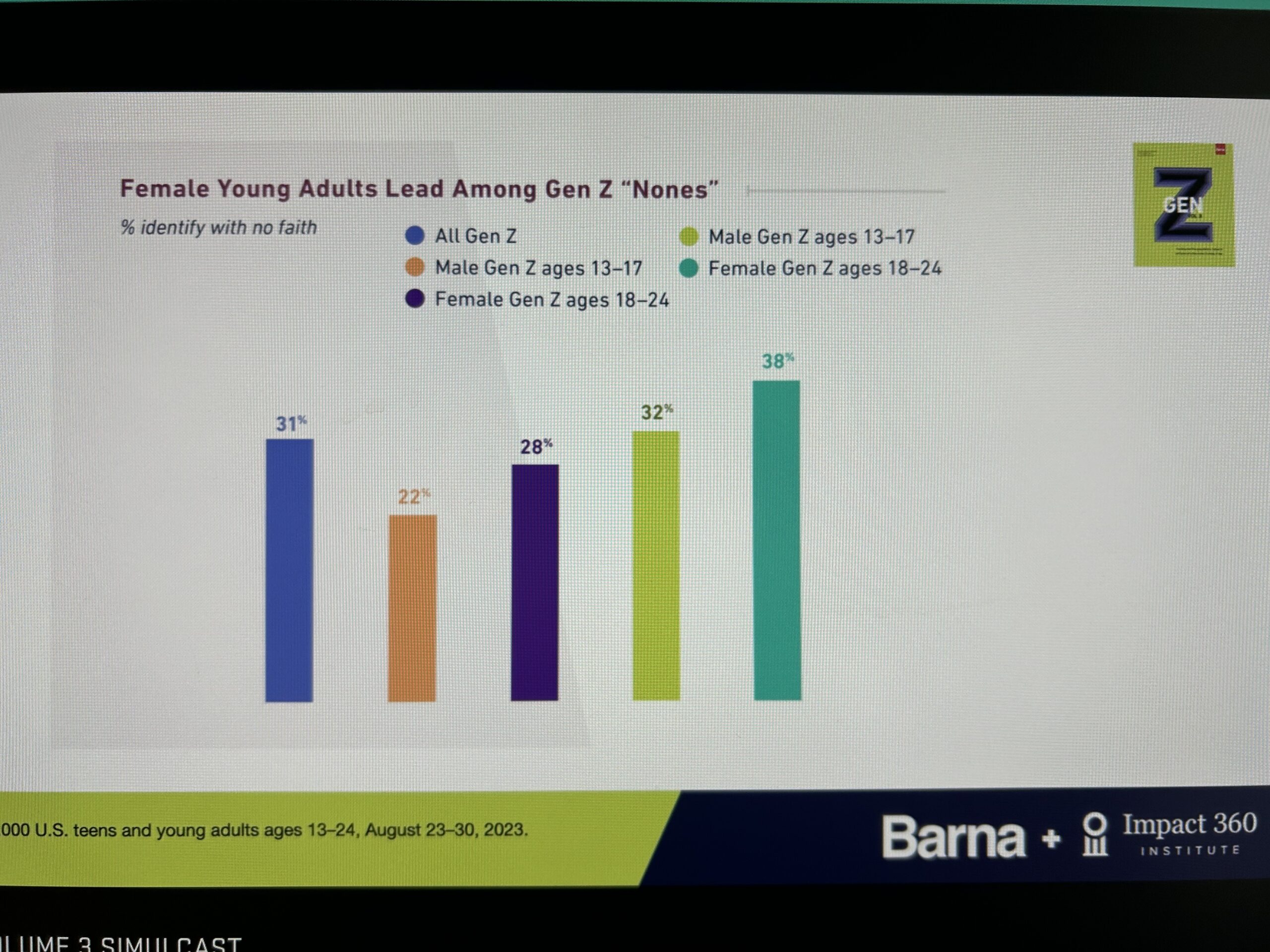
Barna/Impact 360 data shows Gen Z women have surpassed Gen Z men in disaffiliation. (Simulcast Screengrab)
In a simulcast on Sept. 12, Barna CEO David Kinnaman highlighted data from the report confirming the shift explicity. Gen Z women are the most likely to identify as “nones”—38 percent of Gen Z women identify with no faith compared with 32 percent of Gen Z males.
Hammond and Cox stated their concern that while many conservative churches’ memberships have held steady despite the rise of the “nones,” or people who report no affiliation to any religion, those successes may not hold with the current generation of young women.
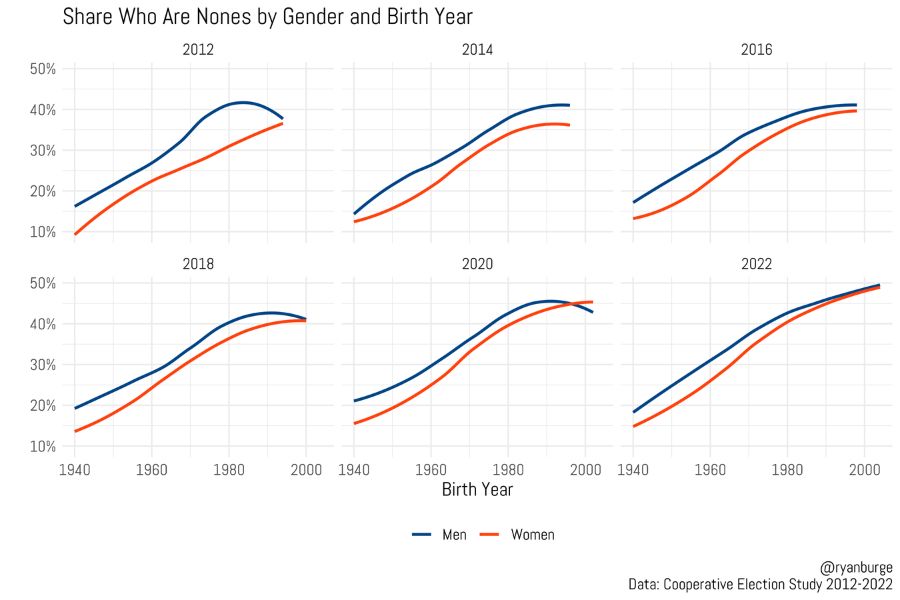
(Chart courtesy of Ryan Burge, used with permission.)
Ryan Burge, an American Baptist and a political scientist regarded as a premier statistician of religious life in the United States, also noted in June of 2023 that something was going on with women. When he analyzed data from the Cooperative Election Study, a pattern emerged suggesting young women were losing their religion in ways not previously seen.
In charting by birth year, for prior generations who reported religious identities of “atheist, agnostic or nothing in particular,” the lines ran parallel, with men slightly more likely than women to identify as nones.
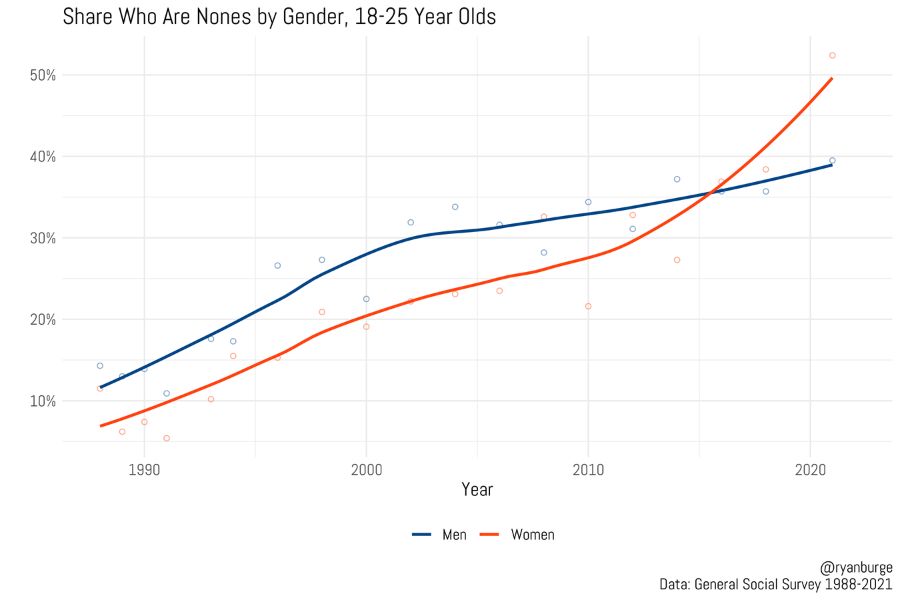
(Chart courtesy of Ryan Burge, used with permission)
But, “among those born around 2000, the gap has essentially disappeared. Women are just as likely to be nones as men. This same general trend is evident in the last three election years of data. It’s hard to believe that it’s just noise when it’s so replicable,” Burge noted.
Contributing factors
Cox and Hammond suggested in their analysis of the Survey Center on American Life findings that “feminism, gender and a cultural mismatch” are at the heart of the reversal.
“Sixty-one percent of Gen Z women identify as feminist, far greater than women from previous generations,” the report stated.
“Younger women are more concerned about the unequal treatment of women in American society and are more suspicious of institutions that uphold traditional social arrangements,” Cox and Hammond contended.
“Nearly two-thirds (65 percent) of young women said they do not believe that churches treat men and women equally,” the report continued, pointing to the Southern Baptist Convention’s strong stance against women serving in equal positions to men in the church.
The analysis also noted a “cultural misalignment between more traditional churches and places of worship and young women who have grown increasingly liberal since 2015.” Cox and Hammond cited the 2022 General Social Survey showing 54 percent of young women believe abortion should be available with no restrictions as evidence of this liberal shift.
Additionally, in March Gallup reported young women are more likely than men to hold LGBTQ+ identities.
Almost three in 10 Gen Z women, (28.5 percent) identify as LGBTQ+, compared with 10.6 percent of Gen Z men. Among millennials, 12.4 percent of women and 5.4 percent of men have an LGBTQ+ identification, the Gallup report stated.
A Public Religion Research Institute report in March found 47 percent of young people who left their childhood religion said “negative treatment of gay and lesbian people” was an important factor in their disaffiliation.
Texas considerations
Todd Still (Baylor Photo)
In Texas, Todd Still, dean of Baylor University’s Truett Theological Seminary, said a shift in young women becoming less religious is not something he’s seen verified at the seminary, yet. In fact, he said women already come close (60 percent male to 40 percent female at last count) and next year even may equal men in enrollment.
He acknowledged that “going where you’re wanted” may play a role in the rising number of women at Truett. Some of the women at Truett otherwise might have attended one of the SBC seminaries, but recent SBC stances related to women may have persuaded them to seek theological education at Truett where they know they will be treated more equally.
Despite strong female enrollment, Still said, if additional research does bear out the Survey Center on American Life’s claims that disaffiliation among young women has overtaken that of young men and Gen Z women are disaffiliating with the churches of their childhood, “this does signal, or should signal, concern for churches.
“Because as they [Hammond and Cox] rightly note, frequently, the involvement of women—at least historically—has been greater, the sacrifice has been greater, attendance, obviously, has been higher. If these are early results, it’s disconcerting.”
Jill Hudson (TXBWIM Photo)
Jill Hudson, executive director of Texas Baptist Women in Ministry, an organization that supports women serving in vocational ministry in Texas, also was unaware of reports women may have overtaken men in claiming no specific religious identity.
However, she said in her work with women in Texas, she has seen young women who previously held strong religious convictions reach a place of disaffiliation.
Hudson said when young women graduate from seminary and begin seeking employment in Texas Baptist churches, they often are met with disappointment.
Believing they’ve discerned God’s call to ministry accurately, done what they’ve needed to do to get hired [earn a Master of Divinity degree], and then being unable to find a church who will hire them can lead to a crisis of faith, Hudson explained.
She said it’s extremely discouraging to these women to apply for positions at churches that claim to support women in ministry, only to have it turn out the church, in reality, only meant children’s minister, not whatever the position was to which they applied.
These new graduates learn they have choices—leave Texas, switch denominations or take a ministerial role not in line with what they believe to be what God is calling and has equipped them to do—none of which are choices they want to make, she continued.
These young women are “deeply Baptist,” Hudson said, until the reality of what it’s like to be a woman seeking to serve in vocational ministry in Texas unmoors them. Sometimes, that means losing faith not only in the church and Baptist life, but in themselves and/or in God, because they cannot bridge the mismatch between their internal faith and the cultural reality.
Hudson said she is available to work with churches on matters related to women in ministry and on having difficult conversations that may help stem the outflow of Gen Z women from the faith.
Dedication to women in ministry reaffirmed
Still concluded: “At Truett Seminary, we work intentionally and tirelessly to equip God-called men and women for gospel ministry and to resource and connect our students and graduates, both women and men, with ministry opportunities that align with their callings.
“We are aware of and sympathetic toward any number of the unique challenges women in ministry face, and we strive to facilitate meaningful ministry placements for them in various and sundry ways, not least through our Office of Ministry Connections.
“Simultaneously, our seminary intentionally seeks to serve churches as they search for ministry candidates, including women.
“In fact, in any given year, our Ministry Connections team will consult with more than 400 churches and nonprofits in an effort to assist our students, alumni and friends to find meaningful places of service in and alongside Christ’s church.
“While we do not always succeed, our annual, effective placement rate of both our men and women graduates historically falls between 90 and 95 percent.”
Editors note: Paragraph 9 and the accompanying graph were added after the story initially was posted.
Political journalist insists: ‘It doesn’t have to be this way’
September 17, 2024
(WACO)—Two months before November elections, Tim Alberta challenged a packed house in the Armstrong Browning Library on the Baylor University campus in Waco to trust in God and stop failing the test.
Alberta is a staff writer for The Atlantic and New York Times bestselling author of American Carnage and The Kingdom, the Power, and the Glory.
“We are here to discuss the crisis in the American church,” Alberta began. But, he pointed out, “There is nothing new under the sun.”
So, the things the white evangelical church in America is dealing with right now really span all the way back to the 4th century with Constantinople and earlier.
Even though it may feel new now, Alberta said, God’s people have been dealing with the pitfalls contributing to the current crisis among evangelicals a long time—so long, it’s a story woven all through the Old and New Testaments.
While Alberta acknowledged it is not only evangelical white American Christians who are struggling, this is the tradition he is part of and knows best. So, when he speaks of the “American church,” white evangelicals are who he means, he explained.
A church in crisis
The American church has become, “in some ways, every bit a secularist’s fever dream—hateful, bullying, hypocritical—more consumed with winning the culture wars than with promoting peace on earth and goodwill toward men.”
“We have acted and spoken in ways that bleed the church of its credibility, while diminishing its capacity to evangelize a world that is unbelieving and desperately in need of Christ,” Alberta said.
“The stench of scandal and the lack of accountability that perpetuates it drags the precious name of Jesus through the mud.”
Alberta lamented the damage that has been done to churches “crumbling under the weight of political strife. The Lamb of God is being appropriated as a mascot for the elephants, and in some cases for the donkeys, too.”
He described pastors who have treated their pulpits as “cable news sets” to “weaponize the word of God to justify their lust for worldly idols, grafting the enduring power of the gospel onto their ephemeral obsession with winning elections,” subjugating their enemies, and imposing a version of Christianity focused on strength and status.
Alberta pointed out this religion they promote includes none of the “self-sacrificial love that turns enemies into friends, friends into brothers and brothers into co-heirs of the kingdom of God,” which is terrible news.
Alberta suggested that to consider this bad news, however, requires a turning to the good news.
The unexpected, “insane” truth that almighty God chose to be “humbled, even humiliated in ways that we cannot fathom,” giving up his majesty and glory to be dishonored on a cross, and that cross would someday become a profound symbol of victory, must be part of the conversation.
The Three ‘Ts’
Then, Alberta got to his main point—“The Three ‘Ts’ that we face inside the church today and has us in crisis—the temptation, the threat and the test.” He said he would “attempt to discuss the nature of following Jesus and why it is so difficult, where we go wrong and how we might do better.”
“All of us, myself included” face these obstacles, even Jesus’ closest followers.
Turning to Luke 4 and Jesus’ temptation, Alberta noted the synoptic Gospels introduce Jesus as an adult in this story, where he is offered the world by Satan.
Jesus responds to the temptation of worldly power with the words: “Get thee behind me, Satan. For it is written, thou shalt worship the Lord thy God and serve him only.”
But Simon, later named Peter, offers a foil to this response by Jesus, Alberta said. Peter was looking for a Messiah who would return the kingdom of Israel to a place of prominence. He hated the oppressive, occupying Roman forces and wanted them defeated.
“Simon … was obsessed with making Israel great again” and restoring worldly power, Alberta said.
Yet Jesus proclaims a new kingdom is here, the kingdom of God. Simon, in following Jesus, comes to understand—and answers Jesus when he is asked in Matthew—that Jesus is the Son of God, no doubt hoping, even expecting, to stand beside Christ and reign, Alberta continued.
But the problem is, Peter does not understand what the kingdom of heaven is all about, Alberta said. Because when Jesus began to explain that he will go to Jerusalem to be killed, “Peter pulls Jesus aside and begins to rebuke him,” and says never, never will this happen.
What does Jesus say in response, Alberta asked, but the same words he’d spoken at his temptation: “Get behind me Satan.”
Jesus addressed Peter in this way because “Peter is flirting with the same temptation”—the temptation to rule the world, to focus on the here and now, Alberta said.
“Peter was pursuing victory in this world, while Jesus was pursuing victory over this world,” Alberta stated.
The American church, Alberta suggested, struggles with this same temptation and perhaps even more so because it believes, as does Alberta, “that we are blessed … and when you believe that we are blessed … be careful, because those blessings, pretty quickly, pretty quietly can become indistinguishable from entitlements.”
The threat was real, Alberta said. The Jewish culture was under attack. All around them there seemed to be a coordinated assault on their faith and the traditional values of Israel. He said he could sympathize with their hope for a Messiah who would come to eliminate the threat.
They wanted a “political strongman” to come do whatever needed to be done to set everything right, Alberta continued. “Desperate times call for desperate measures. The ends justify the means, don’t they?”
The arc of Peter’s life shows his struggle with the temptation to pursue worldly power and eliminate the threat to his people, God’s people, Alberta said.
But with Jesus, the means matter very much, Alberta contended. Only by the spotless Lamb of God could the salvation of the world be attended to.
Jesus promised his followers not worldly success or power, but hardship and pain. The trials Peter faced, he often failed. But in his letters, Peter’s words are “almost unrecognizable.”
In 1 Peter, he tells his audience they are exiles, blessed despite threats. They can withstand the temptations and threats, because through Jesus they are now co-heirs to an otherworldly kingdom.
Good news/bad news
Alberta said Peter is presenting a good news/bad news scenario: “The good news is the kingdom and the power and the glory that belongs to God can be ours also. The bad news is it’s not free, and it’s not easy. It requires suffering. It requires fiery ordeals. We will be tested.”
“We think so much about the ends justifying the means,” Alberta said, but “we are being tested.”
The means matter—the Christian response to testing brings them closer to Jesus and demonstrates to those outside the faith the validity of Christianity. The early Christians’ faithfulness under trials facilitated Christianity’s growth, Alberta explained.
Alberta said the American church today is again being tested, tempted under threat to cling to power, “and we are failing.”
But it doesn’t need to be this way. Christians can fix their eyes on the eternal, seeing themselves as exiles here and citizens of another kingdom.
“Let God handle these big, thorny, scary problems,” he said. Instead, focus on how these challenges or threats actually are opportunities to draw closer to Jesus and share him with others.
Most hit worship songs are a team effort
September 17, 2024
(RNS)—In January 2023, Chris Brown and a group of fellow songwriters working on a live worship album for Elevation Church, a nondenominational megachurch in Charlotte, N.C., sat down for a writing session.
In the room with Brown were Pat Barrett, Chandler Moore, Brandon Lake and Cody Carnes, authors of such worship staples as “Good, Good Father,” “Build My Life” and “The Blessing,” which can be heard in churches of every size and stripe across the United States.
During the session, Brown pulled out a song that he, Lake and Elevation’s pastor, Steven Furtick, had been batting around for a year with little success. Tinkering with it that day in January, they decided the result, which combines soaring vocals over a galloping beat, was good enough for the album but, said Brown, “We really didn’t see it doing much.”
On stage at Elevation, moments before they debuted it, at a live recording session for the new album, they were still piecing together the song’s opening. But backed by a choir and gaining energy from the live audience, the song took off.
“We left that night going, ‘That was crazy, but we’re still going to put it at the end of the album,’” said Brown.
The song, “Praise,” has since become just the latest example of the power of a tight coterie of songwriters in Christian music, who have increasingly worked together to produce hits.
A live video of “Praise,” recorded that night and posted on YouTube in May 2023, has been viewed 103 million times, and the song, having topped the Billboard Hot Christian Music chart for 25 weeks, has been nominated for a song of the year Dove Award by the Gospel Music Association.
In recent years, songs from the so-called Big Four megachurches—Elevation; Bethel Community Church in Redding, Calif.; Hillsong, a megachurch headquartered in Australia; and Passion City Church in Atlanta—have dominated the Top 25 lists for Christian Copyright Licensing International and PraiseCharts, which track what songs are played in churches.
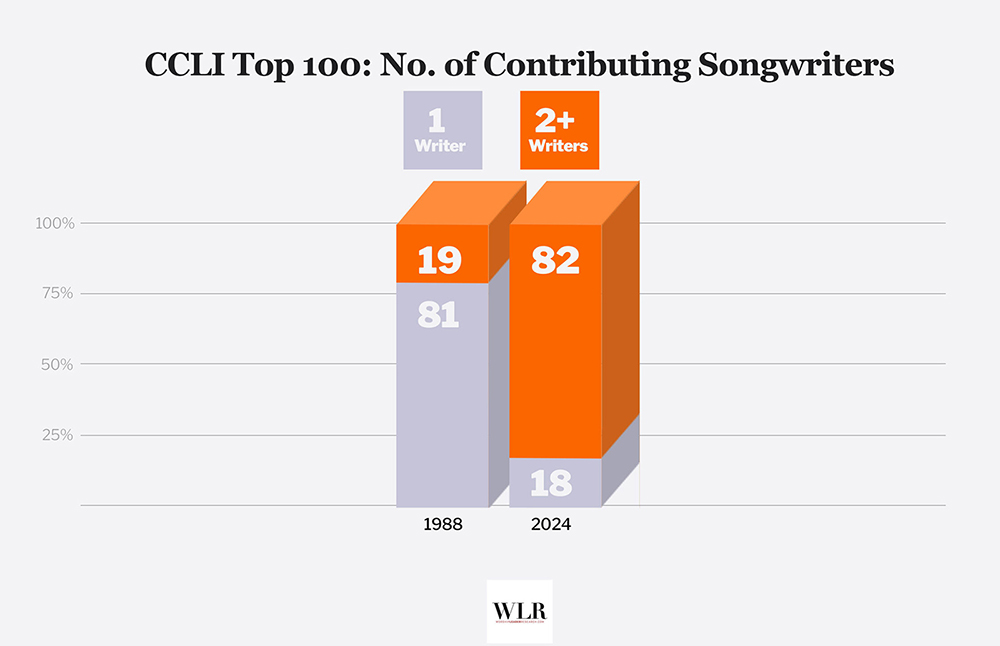
An academic song tracking effort, Worship Leader Research, wrote in a new report that 82 percent of the songs on the CCLI Top 100 in 2024 had at least two writers. When the CCLI Top 100 chart debuted in 1988, only 19 percent had more than one writer—and most of those were written by the legendary gospel music team of Bill and Gloria Gaither.
The “Praise” co-writers Brown, Barrett, Furtick, Carnes, Moore and Lake, like most of the collaborators on recent Top 25 hits, have ties to the Big Four.
“What started as a large pool of individuals contributing their voices to the contemporary worship soundscape eventually became a collection of interconnected enclaves,” according to the Worship Leader Research report.
Many songwriters largely unknown to worshippers
Many of the most successful worship songs have become more associated with the churches that produced them than the songwriters who wrote them.
Jason Ingram, lead singer of the Christian band One Sonic Society, has co-written the hits “Goodness of God” and “Great Are You Lord” to go with more than a dozen of the songs highlighted in the Worship Leader Research study, but he remains relatively unknown in the public eye.
Other successful Christian songwriters such as Ed Cash, co-writer of “Goodness of God” and “How Great Is Our God,” or Jonas Myrin, who co-wrote “Cornerstone” and “10,000 Reasons” and later went on to write for Barbra Streisand, also have relatively low profiles.
Since many churches don’t use hymnals or print music in bulletins—the lyrics tend to be projected on screens around their sanctuaries—congregations don’t always see the names of writers.
“I think the reason why Jason Ingram isn’t considered a household name in general is—especially if you’re a congregant and never even looking at a chord chart—you’ll never see his name, even though he’s around,” said Shannan Baker, a postdoctoral fellow at Baylor University and member of the Worship Leader Research team.
Marc Jolicoeur, a worship pastor from New Brunswick, Canada, and member of the research team, theorizes co-writing is more liable to transform a songwriter’s solo inspiration into something that feels accessible for congregations. He cited a writer’s saying that one should write with the door closed, but rewrite with the door open.
“There’s the idea that many hands won’t just make light work but will make work that might rise to the top,” he said, adding writers often show up to co-writing sessions with works in progress that just need a bit of help to work.
The presence of a well-known co-writer also may help a worship song get more notice, Baker said. She pointed to the ongoing popularity of “Great Are You Lord,” by David Leonard and Leslie Jordan, both of the band All Sons and Daughters, and Ingram.
“I think that song, in and of itself, is a perfect example of the power of a career songwriter, elevating a song,” she said. “All Sons and Daughters had a following, but the minute you add Jason Ingram into that mix, they have a hit.”
Brown, who helps produce Elevation’s worship songs, said he had great respect for past songwriters who wrote on their own, but he appreciates the chance to collaborate with friends and fellow writers. The church, he said, has helped create an environment where that can flourish.
Brown said that’s in large part because the church—and not an outside music label—controls the creative process. If a song or an album is not ready, the church isn’t under pressure to release it.
“We are our own label, so to speak,” he said. “It’s always been that creativity is king.”
Doing the songwriting at the church rather than in a Nashville writing room helps as well, he added. Brown said he doesn’t mean to knock Nashville, which is a hub of songwriting, but said the feel of the church’s writing room is more hospitable and more open to inspiration.
“We worked hard through the years to create an environment where the goal is to go away having enjoyed this day together, feel spent and hopefully inspired,” he said.
In co-writing, Brown said he often learns from others—how they create melodies or find the right cadence to the lyrics or just the right words to make a song better.
“If I partner with someone else creatively or with several other people, there’s a chance it can turn into something even greater—or go in a way that I never saw it going,” he said. “Not to over-spiritualize it, but I think it’s cool to acknowledge that we need each other.”
And in the process, something unexpected may appear.
Ohio State football players lead on-campus baptism service
September 17, 2024
More than 60 students were baptized during a special on-campus service at Ohio State University on Aug. 26.
A group of Buckeye players were among those who helped lead the event, which reportedly attracted a crowd of more than 800 people.
“Witnessed the ‘Invitation to Jesus’ in person last night led by several players from @OhioStateFB team,” said Jeremy Westbrook, executive director-treasurer of the State Convention of Baptists in Ohio, on the social media platform X.
“Over 60 students stood to profess Christ & follow in baptism!! Had the joy of passing out hundreds of Bibles to those who desired to read who Jesus really is!! Let’s go!!”
The Lantern student newspaper reported, “Four tub-sized buckets of water sat near a stage, on which football players stood to deliver testimonies. Over the next nearly two hours, the crowd grew to over 800 people.”
Ohio State football players who were among those leading the baptism service were TreVeyon Henderson, Emeka Egbuka and J.T. Tuimoloau, according to WSYX ABC 6.
A university spokesman told ABC 6 the service was “not an official football team event” and that Revive Student Organization reserved space for the event.
One parent posted on social media: “The most incredible night I have experienced in a longggg time! God is moving on The Ohio State campus! So many came and were touched by God! So many were baptized! Watching over 2000 students worshipping…an Unbelievable experience! Our boys are changing lives! #ProudMama.”
UTA scholar examines contemporary Black church
September 17, 2024
ARLINGTON (RNS)—Jason Shelton has made a deep scholarly dive into the world of the Black church.
But not everything in his new book, The Contemporary Black Church: The New Dynamics of African American Religion, was learned at the University of Texas at Arlington, where Shelton is a sociologist.
Shelton drew as well from his experience growing up in Black churches, in his familial home in Ohio and in Los Angeles—at United Methodist, Church of God in Christ, African Methodist Episcopal and nondenominational churches—and searching as an adult for the right spiritual space for his family.
“It was important to me to find a thriving Black Methodist congregation that I could raise my daughters in, and my wife and I had a difficult time,” he said in a recent interview.
“Here we are in (the Dallas-Fort Worth area), and it’s hard to find a young congregation that’s thriving, where I feel like my daughters can develop their own memories and find bonds with other kids, and we can be with other young families. And so that really made me realize there’s a story here to be told about religion in Black America.”
Shelton, 48, and a colleague developed what he calls “Black RelTrad,” a coding scheme that allowed him to delve into the beliefs and practices of a range of Black believers, including Protestants, Catholics and non-Christians.
Shelton, who also is the director of UTA’s Center for African American Studies, talked with RNS about religious differences in Black America, the effects of “disestablishment” on Black churches and whether those who identify as “spiritual but not religious” can be reclaimed by them.
The interview was edited for length and clarity.
You open your book recalling your connections with churches from different expressions of the Black church and leaders such as the Rev. James Lawson and Bishop Charles Blake. How did that experience shape you?
Those early years were definitely formative, in that they left me with impressions about various ways that African Americans express faith. When I got to Ohio, I was able to compare St. James (AME Church in Cleveland) to Holman United Methodist Church, and then compare them to the nondenominational church that my parents were attending in Cleveland, and then compare that to West Angeles (Church of God in Christ).
They all left these distinct impressions about variation and diversity. Decades later, I would look back and say, “O my gosh, modern-day researchers have clearly lumped Black folks together like we’re this monolithic group.” And I just knew in my own walk in life that was not the case.
For years, experts such as Eddie Glaude have asked if the Black church is dead. As you look at the numbers, do you agree or disagree?
I wouldn’t say that it is dead, but certain denominations are in a lot of trouble—that Black Methodist tradition I’ve called home is in a lot of trouble. I’d say the Baptists are also a tradition that has to look and see some trouble down the road.
On the flip side, I would say the Holiness Pentecostal tradition in Black America has always been small, but it’s held its ground over the decades. The Black Catholic tradition, always been small, but held its ground.
So is the Black church dead? It really depends on which traditions we’re talking about.
What do you see as the main difference between the mainline African American Protestants and the evangelical African American Protestants?
These are Black folks who are believers, and on a Sunday, how they think about, practice their faith, oftentimes are still very similar in orientation. That being said, (some) Black Methodists seem to be a lot more open on LGBT issues, whereas we know the AME (African Methodist Episcopal) tradition is very clear, uh-uh, that’s not a line clergy are ready to cross.
The four traditions in today’s world that comprise the heart of the contemporary Black church are the Baptists, the Methodists, the Holiness Pentecostals and the nondenoms. Of the four of those, the nondenoms are more likely to vote for a Republican presidential candidate. That’s a big break from what we’ve seen in the past.
You describe the “Third Disestablishment in Black America.” What does it mean for the Black church?
You’re seeing these young people, particularly millennials, moving away from organized religion in very strong numbers. The baby boomers held on. It started with my generation in the late 1990s, those Gen Xers. But now with the millennials, it’s moving and taking big jumps forward in terms of the number of African Americans who are not affiliating with organized religion.
You mention the changing levels of education of the Black clergyperson and the Black churchgoers. What’s happened there? What’s at stake?
The idea was that the Black preacher was the leader of the community for most of Black history. In light of all that racism and segregation, the pastor was typically the most educated person in the community because that person could stand up and read the Bible and interpret the Bible and speak to the masses in that congregation.
Fast-forward the clock: African Americans in church are oftentimes more educated than the senior pastor in the pulpit. In this modern, technological, mainstream American society, you can sit in church and question what the pastor’s saying in real time.
I argue that a consequence of the success of the Civil Rights Movement is that the church has become voluntary. There was the time that we were expected to be at church. Of course, it’s holding in particular families, don’t get me wrong. But overall, as more and more Black folks have made it to the middle class, and as more and more of us have more options on Sundays, it has undermined organized religion in Black America, and education is the driving force.
You say, though, that there are strong reasons to believe that some of the SBNR—spiritual but not religious—can be reclaimed.
A great number of these SBNRs still believe in God. A great number of these SBNRs still go to church, and some go to church more than once a month. Those are the folks that can be maybe more easily reclaimed, as compared to the person who has completely moved away from organized religion and just says, “Oh no, I don’t believe those beliefs about God,” or “I don’t believe those things about Christ.”
But there’s got to be some kind of reckoning and some kind of reconciliation to bring those folks back in.
You cited hopes of Christians you interviewed for changes that could help draw more young people back to church. Can you give an example? Are you aware of churches that are succeeding?
One of them was to remove status barriers within the church, the classic idea that a pastor wears the robe. Less formality was one of those things. Another one of those things, which a lot of people emphasized, was giving leadership opportunities to 30-somethings.
I can tell you, in my own personal life, part of the reason that we picked the church we did is that a lot of those things are happening. We don’t call our pastor “Reverend,” we call him Derek. There are a lot of young people in leadership. Grandmama is on the usher board too, but there are a lot of younger people that are engaged and a part of it as well. Those are the kinds of things that, particularly, folks have found welcoming.
What worries you most about the state of the contemporary Black church?
Who speaks for the poor? The Black church has spoken for the poor. As the church declines, we’re not only losing the most important institutional anchor we’ve had, we’re also losing an important political and social institution that helped to try to force America to say: “Here’s the counterpoint to everything is fine and great. No. Look over here. There’s more work to be done.”
Regardless of what people’s faith is, and how they affiliate, and what they may say or may not say about a particular faith, for a great number of us, there’s still a sense that there are problems that need to be addressed for us as African Americans. There’s a commonality that connects us as African Americans, at least for our generation.
Who knows what it is in the future? But that is something, I think, to be optimistic about.
‘Strawberry Fields’ inspiration bears Salvation Army fruit
September 17, 2024
(RNS)—Let me take you down to Strawberry Fields. No, not the memorial in New York’s Central Park to the former Beatle John Lennon, who was slain in Manhattan in 1980.
Instead, go to the place that inspired his song—where the Salvation Army is conducting an experiment in mixing tourism with faith and social action.
The original Strawberry Field was a children’s home in Liverpool, just around the corner from John Lennon’s childhood home.
It inspired the Beatles’ 1966 track “Strawberry Fields Forever”—penned by Lennon, who added an “s” to its name. It also may be one of the most innovative projects undertaken by the Salvation Army, the Christian anti-poverty movement founded in mid-1800s London.
Strawberry Field is known for its red gates festooned with strawberry motifs, which are often thronged with tourists taking selfies and some adding to the graffiti on the gates’ stone pillars.
But the Salvation Army has deployed the site’s connection to the Beatles to draw more visitors to fund its mission and encourage people who never would consider stepping inside a church to find out about Christianity.
Innovative spaces
The children’s home, closed in 2005, has been demolished. In its place is a new structure that contains a prayer space, a café and an exhibition about Lennon and the Beatles that includes one of Lennon’s pianos.
The building also houses a training project to help young people with special needs get into work.
The piano on which John Lennon composed “Imagine,” loaned to Strawberry Field by the George Michael estate, on display at the Salvation Army museum in Liverpool, England. (Photo / Catherine Pepinster)
Stymied by COVID-19 pandemic closures when it first opened in September 2019, it is at last coming into its own. Last year, Strawberry Field welcomed 120,000 paying visitors.
This year the Salvation Army expects even more. International Beatles Week, which started Aug. 22, will put it on the tourist trail that includes the nearby childhood homes of Paul McCartney and Lennon, local Beatles museums and other landmarks.
But none of the rest combine religion with Beatles tourism.
The Strawberry Field project is the result of years of discussion and prayer by the Salvation Army after it closed the children’s home.
The worldwide movement, founded by William and Catherine Booth to work in urban slums, became known as the Salvation Army in 1878.
It adopted a quasi-military structure, with officers rather than clergy leading it and members wearing uniform. Its membership across the world of 1.5 million still focuses on social action, and its officers—like Strawberry Field’s mission director, Kathy Versfeld—still wear the uniform.
Lennon is not a natural icon for a Christian organization. In 1966, he told an interviewer his band was “bigger than Jesus,” and opined: “Christianity will go. It will vanish and shrink.”
In the uproar that followed, more than 30 United States radio stations banned Beatles’ tracks, and young people were urged to burn their Beatles records and memorabilia.
In August 1966, as the Beatles launched a U.S. tour, Lennon said at a press conference: “I’m not anti-God, anti-Christ, or anti-religion. I was not knocking it. I was not saying we are greater or better.”
Rather than comparing himself to Christ, he said, he was trying to explain the decline of Christianity in the U.K.—which has seen more prosperous days.
Considering this history, honoring Lennon took more than a leap of faith, according to Versfeld.
Invite tourists to become seekers
“The Salvation Army through its research discovered a surprising fact, and that was that every year 60,000 John Lennon fans and Beatles fans were bringing themselves uninvited to the red gates, and many came not knowing what Strawberry Field was,” she said.
“The Salvation Army realized there was the potential not just for a commercial operation here,” she added, “but an opportunity for engagement with those individuals who would not quickly come through the doors of a Salvation Army church or center.”
The Beatles interactive display at Strawberry Field in Liverpool, England. (Photo / Catherine Pepinster)
The refrain of Lennon’s song—“Let me take you down, to Strawberry Fields”—is reflected in the Salvation Army’s invitation to explore its site, including the gardens where Lennon used to play. He later remembered visiting the home’s annual summer fete with his Aunt Mimi.
Paul McCartney—who wrote his song “Penny Lane” about his own childhood memories of Liverpool, in response to Lennon’s memories of Strawberry Field—has said the Salvation Army home and gardens were a utopia for the young Lennon.
“The bit he went into was a secret garden … and he thought of it like that. It was a little hideaway for him … living his dreams a little, a getaway. It was an escape,” McCartney says in Craig Brown’s biography of The Beatles, One, Two, Three, Four.
The Salvation Army said it wants visitors to Strawberry Field to be able to “find out more about what it means to explore spirituality and faith” and that the Army strives to be “an inclusive community with God at the center … but you do not have to belong to a Christian church—or any religious tradition at all to take part in what’s on offer here.”
‘To open the gates and do good’
Versfeld and her team want to challenge people who visit the center: “Strawberry Fields Forever—but what does last forever?” she asked. “What does abundance look like and what does it mean for us to open the gates and to do good?”
Lennon’s song “Imagine” is highlighted at Strawberry Field as an anthem for peace, its words carved in stone in the garden.
The upright Steinway piano, on which he composed the song, is on loan to the site from the estate of the late British singer-songwriter George Michael, who bought it at auction in 2000.
The bandstand, in the shape of a drum, at Strawberry Field in Liverpool, England. (Photo / Catherine Pepinster)
According to Allister Versfeld, Kathy’s husband and development director of Strawberry Field, it was the Salvation Army’s mission that convinced Michael’s representatives to lend the piano.
“They spent the day here. It was the work done here that convinced them it should come here,” he said.
Visitors today are invited to assist in Strawberry Field’s employment and training programs, Steps to Work, which are supported in part by the £11.20 admission fee—about $15—for the Beatles interactive display, together with spending in the café and the gift shop.
A ukulele band is among those who volunteer their time. On a recent day their version of the Beatles’ “Ob-La-Di, Ob-La-Da” filled the café. In the garden, there is space for people to spend time in contemplation—while at a far end is a giant bandstand shaped like a Salvation Army drum.
“This drum is on its side because in our early days people would see the band marching down the high street, and the drum would be used as a place of prayer,” explained Versfeld.
The doors are open seven days a week for tourists and local people alike. When the Versfelds arrived, the famous strawberry gates had been shut for years, but now, says Kathy, “The gates are open for good.”
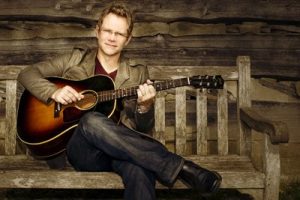
Steven Curtis Chapman reflects on the next chapter
September 17, 2024
NASHVILLE (BP)—When he was only 19 years old, Steven Curtis Chapman decided to impersonate George Jones.
There was no better place to mimic the country legend’s voice and mannerisms than as part of Chapman’s job at Opryland USA.
Steven Curtis Chapman describes his faith journey in an “I Am Second” short film, a series of video testimonies featuring a diversity of Christian celebrities produced by a Plano-based ministry. (Screen Capture Image)
He did it so well, it brought an invite for the teenager to perform across the parking lot at the Grand Ole Opry.
“I stepped onto the famous stage, and the band hit the first chord as though we had rehearsed it a thousand times,” he recounted in his 2017 book Between Heaven and the Real World: My Story. “Wow, this really is the big-time! I thought.
“I stepped up to the microphone and launched into my best imitation of [‘He Stopped Loving Her Today’]. …I finished the first verse, then sang the chorus, nailing them both.
“I went on to the second verse, and my mind raced as the words came to me. I finished by hitting and holding the high note in the chorus: ‘He stopped loving herrr … today.’”
The crowd erupted with a standing ovation. Legendary country star Roy Acuff, who had introduced Chapman moments earlier, was so impressed he asked for another chorus of the song.
Thrown off guard, Chapman drew a total blank on the lyrics as the band began to play. Trying to help him out, they played through the opening again … and again … and again. A few of the musicians even began to shout some of the words in his direction, all of this in front of the crowd that had just moments before thundered their approval and Chapman’s family, whose previously beaming faces were now something else entirely.
He finally got his bearings and finished the chorus. Acuff couldn’t help but comment after he made his way back to Chapman on the stage, noting that some words were left out and asking what went wrong.
Although Jones was then at the peak of his career, his drinking had—more than a few times—affected his performances, whether by causing him to fall off the stage or forget his lines or even not show up at all.
Chapman noted in his book that there is nothing funny about such issues with alcohol. But as he stood there on the Opry stage he needed a response, and quick.
“Oh, I just wanted to do it like George does it these days,” he told Acuff.
“The crowd howled with laughter, and they began applauding again,” Chapman wrote.
Peaks and valleys along the way
The applause never has died for Chapman, but the 37 years since his first album have brought a lot of chapters for a career now in its fifth decade. There have been goals met, and there have been curveballs.
There have been mountains, but there have also been very deep valleys, such as the 2008 death of his 5-year-old daughter Maria Sue.
There have been his roles as musician, husband, father, friend, son, business partner and international ministry leader, all under the umbrella of one guy with a guitar who just wants to sing songs that tell people about Jesus.
On July 27, the Opry stage served as another moment for Chapman as friend Ricky Skaggs officially extended the invitation to become its newest member.
“My dad didn’t listen to music in the car very much, but I remember as a kid riding along with him and my older brother,” Chapman told me recently. “One night he turned on the radio, and I heard a bunch of static, and then this music came through the speakers.
“‘Hey boys, that’s the Grand Ole Opry,’ he said. ‘That’s as good as music gets.’ Something told me this was special, magical, even.”
After hearing repeatedly that he was a fine songwriter whose voice just wasn’t strong enough to be a recording artist, Chapman finally broke through with his first album in 1987’s “First Hand.”
The next five years brought a meteoric rise and honors alongside the genre’s most glorious mullet. 1992’s “The Great Adventure” brought an end to the latter but sent Chapman to stadium-level success.
Career achievements and personal challenges
His career achievements now include 59 Dove Awards, five Grammys and 16 million albums sold, ten of those reaching Gold or Platinum. In 2023 Chapman’s name became the first and only on the list of Contemporary Christian Music artists to have 50 No. 1 songs.
Steven Curtis Chapman
It could’ve been different. Throughout his career Chapman struggled with his success and the time it took him away from home, the stress it placed on his wife Mary Beth to raise six kids while he was in a different city. Many times, he sought counsel and considered stepping away.
“I really did try to think through if it were possible,” he said. “Even here, at this place in my life right now my wife throws around the R-word of retirement.”
Taking a different route early on could have led to a standard work week, he said, while still serving in a local church, perhaps as a worship leader. Something with music would certainly have been in his life such as giving lessons, as his 85-year-old dad still does at Chapman Music in Paducah, Ky.
“I believe somewhere I would’ve ended up in ministry on some level,” he said. “But I also feel very much like this is what God made me to do.”
He and his wife Mary Beth are considering writing a book about their marriage. On Oct. 13 they’ll celebrate 40 years.
“We’ve had people tell us that we should share our story,” he said. “We’ve resisted, because we’ve both said very clearly in our books that we don’t have it figured out. By the grace of God and trial and error, we’ll go three steps forward and 40 steps back, then 40 steps forward and two steps back.
“Yet, by his grace, we’re still together and realizing there are some things that we can share that could really encourage people from our journey.”
The “R-word” doesn’t appear to be in Chapman’s near future. Music remains very much in his life, but his favorite audience knows him as PopPops and are happy to be part of an Instagram reel.
Nov. 1 will bring his official induction to the Grand Ole Opry. His sons, Caleb and Will Franklin, will join him onstage alongside his dad, Herb Sr.
“It’s how I’ve always processed life,” he told me on music’s role. “The pain, joy, confusion, you know, trying to understand the mystery of God and his word and how to apply that to my life. With my family and marriage, those are the places where God is the most real, where I’m most aware of my need for him, his truth and his wisdom.
“As long as I’m breathing and able to have a thought in my head, I’m probably going to be writing songs.”
Seven screen-free weeks changed one man’s view of God
September 17, 2024
(RNS)—It all started when Carlos Whittaker received that perky Sunday morning iPhone notification summarizing his time spent on his handheld screen in the past week.
Seven hours and twenty-three minutes on average per day.
Whittaker, an author and former worship pastor, did some quick math and realized that number translated to nearly 100 full days a year.
If he lived to be 85, he’d have spent a decade looking at his phone. While most of his work centers around his social media community—his “Instafamilia”—he knew something needed to change.
Whittaker messaged Daniel Amen, a psychiatrist with nearly 3 million followers on TikTok, earning him the nickname, “America’s most popular psychologist.”
How much time, Whittaker wanted to know, would he need to take away from all digital devices to effect real change in his brain. Amen quoted him close to two months.
Using a screen-free Sony camera to document the journey, Whittaker ditched his phone and spent two weeks with Benedictine monks in the California desert, two weeks working on an Amish farm in Ohio and three weeks with his family—both at home in Nashville and on a trip to Yellowstone—all free from any connectivity.
You got your start as a worship leader for churches like Hillsong. How has your worship evolved over the years?
For a long time, I was a “professional evangelical.” I went from worship pastor to signed worship artist, touring and playing shows. Now, I rarely even speak in churches anymore. I just love going to church with my family now. Worship looks like what I’m doing now: worshipping with people that don’t believe like me, holding my own and having a blast doing it.
Your ah-ha moment came when you saw how much time you were spending on your phone. But why a desert with Benedictine monks? Why Amish farmers?
I started multiplying the seven-plus hours I was spending and realized that’s two cycles of the sun a week. Once I made the decision to not look at screens, I thought of places without them: the Benedictine monastery in the high desert of Southern California. My wife’s father was a volunteer in the ’80s and ’90s there, so she made an intro for me.
A friend of mine married a former Amish guy, so they were my connection to the sheep farming family in Mount Hope, Ohio.
Then I moved back home for three weeks—I mean, anybody can do this with monks and the Amish, but can I do this around my family in Nashville?
How did unplugging impact your spirituality?
It really disturbed and disrupted it. I realized how much (focus) I place on random pastors’ YouTube sermons and podcasts. I was constantly filling my mind with content, but when all that went away, it was just me and my mind. God got really tangled up.
The first week at the monastery was like a massive deconstruction and reconstruction in seven days. I had some very deep conversations with monks that shook up my faith a lot and then got to build it back.
When I look at my faith, when I am just consuming, consuming, consuming on all of these devices, that builds a box around who God can be. God got way bigger than I think I had ever pictured he was going to get.
What did wellness look like for you in the seven weeks? Did you pick up any new exercise or spiritual habits?
Savoring is something that I never thought about as a spiritual practice, but I realized pretty quickly that I’ve stopped savoring anything, because we get things so quickly.
Multitasking is the worst thing to ever happen to us. I drank coffee out of ceramic mugs for eight straight weeks. It just tasted better. I was able to savor it. Now when I go to a coffee shop, I never get my coffee to go. I’m like, if I don’t have four minutes to sit and savor, you know?
I’d say the second thing is just slowing down. If there’s one thing the monks taught me, it’s to move at what I call God speed.
What was the hardest part?
The first four days by far. It was heart palpitations, panic attacks, night sweats. It was like coming off of this drug, and I don’t really think the drug is the phone. It was more like this drug of control and knowledge and having to know all the time.
Suddenly, I wasn’t able to get out of my own head. Because at the monastery, it was 23 hours a day of silence. To go from seven and a half hours a day on my phone to just being in my head, it was awful.
But day five, it felt like an elephant stepped off my chest. It stopped being an experiment about a phone. Suddenly it was an experiment about all of these incredible things that were on the other side of the phone that I’d forgotten about.
The other worst day was turning my phone back on.
What do we miss when we can Google every question that pops into our brain?
We miss being who God created us to be. I don’t think our souls or our psyches were created with that capacity to know as much as we know. I think we miss wondering. When I lost access to information, I thought, “Wow, I don’t think I’ve wondered since, like, the 1990s!”
I’d walk outside and wonder how hot it is. I’d reach for my phone. Well, I guess I’m just going to have to wonder. We ask questions, but we don’t wonder anymore, because Google kills wonder. Questions lead to more questions, which I think leads to creativity. We should all maybe know a little less, and we’ll human a little more.
You write about experiencing panic attacks and mental health struggles.
I’ve struggled for a long time with a kind of fear of sickness and health. I would Google symptoms, so it was mind-blowing to see the worry go away when I didn’t have this false sense of control in my hands.
I’ve removed some apps that were causing me to worry more than I should. One of those is Life360, an app I used to track my kids and make sure I knew where they were, how fast they were going. My mom said: “Carlos, I’m so glad I didn’t have that app. I just had to trust that you’d be home before the sun went down.” All of these things that give us a false sense of control are actually adding anxiety to our lives.
You suggest replacing your phone with a point-and-shoot camera to document an activity with loved ones. What other practical steps can we take to reconnect?
I’ve deleted all the news apps off my phone. I deleted X off my phone, and I subscribe to this thing called the newspaper. Every morning, I walk in my front yard, it feels like the 1960s. If anything happens I need to know about, either someone tells me or I find out about it the next morning.
I’m no longer part of this rage ecosystem. I bought an alarm clock and set it next to my bed. It wakes me up without any notifications, and I’m just a lot happier.
I no longer use the map app to find my way. I look it up before I leave my house, write it on a piece of paper. I will get lost on the way, but I’ll find my way slowly but surely. I think God created us to find our way. I love getting lost now. All of these things have helped me reconnect to who I was created to be.
You emphasize it’s not just about screen time—it’s about connecting when you’re not on your devices.
This isn’t a book about how bad phones are. It’s a book about how beautiful things are on the other side of the phone. I’ve gone down to four hours a day on my phone.
It’s not because I’ve placed rules on screen time—I’ve just fallen in love with having conversations, having 90-minute meals. One hundred years ago the average meal lasted 90 minutes. Today, it lasts 12 minutes. Try 30 minutes. Set an alarm, put it in the kitchen.
We’ve lost the ability to have crucial conversations about things that we disagree with over something that we love, a shared plate. The longer you eat, the better the relationships get.
Availability key in aiding refugee resettlement
September 17, 2024
CLARKSTON, Ga. (BP)—Christians can use different approaches to help refugees adjust to life in the United States, but they all tend to revolve around the subject of availability.
“We’re needing people willing to do life with refugee families,” said Jason Lee, Mission/Go pastor at Clarkston International Bible Church in Clarkston, Ga.
When resettled refugees enter the United States, various timetables begin, Lee said. They need to be enrolled in an English-as-a-Second-Language program within 10 days. The same goes for enrolling in employment services. Children are supposed to be enrolled in school within the first 30 days.
Lee also directs the Acts 17 Initiative to help those families settle and begin a new life. Launched in 2017, its goal is to educate, equip, engage and network with churches toward developing partnerships and strategies that assist immigrants and refugees.
“We ask churches to make a three-to-six-month commitment and serve as something akin to foster parents for these families,” he said. “In the first three months there are all these timelines that have to happen in the resettlement process. The parents are trying to do things like get a job and learn public transportation.
“Those already acclimated to American life can help them navigate those things.”
Ministering to the sojourner
Clarkston has become known as the South’s Ellis Island. In 2021, the United Nations Refugee Agency reported 339,179 refugees entering the United States. That figure grew to 409,202 in 2023.
Crestview Baptist Church in Griffin, south of Atlanta, partnered with the Acts 17 Initiative five years ago.
“It opens your eyes,” said Thomas Hill, lead pastor. “We’ve helped at different events with things like sports, games, crafts and telling Bible stories to children. It has helped our church connect into those families.
“Scripture calls us to be aware of the sojourner, the people who had to leave their homes. Jason has his pulse on how churches can plug in. It helps open your eyes to what’s right there in your backyard.”
Acts 17 is locally based, but committed to helping churches nationwide build refugee and immigrant ministries suited for their context.
One example at Clarkston International Bible Church is through church members who are also schoolteachers, making the most of that role to assist refugee families. Another example is through a group of women who are involved in a sewing ministry and teach others those skills.
Something as simple as learning how to pay a power bill online can go a long way in helping families rebuild a sense of security and consistency. Learning English, of course, is crucial for reading everything from important documents to road signs.
“We’re helping them learn basic survival tools, like using Google Translate to understand the basic timeline required for new arrivals,” Lee said. “The resettlement agency may not have the bandwidth for a case worker to help get kids enrolled in school, finding an ESL program and other opportunities. If their children are beyond high school age, we help them get their GED and a job.
“The church comes in to help.”
Time together opens doors for gospel conversations, he added.
“We’ve seen Muslims open their homes to Christians. They may have come here kind of hostile in their thinking toward American Christians,” he said. “But I can take you to a number of homes where they would now say, ‘Those American Christians helped us.’”
Nearly half of world’s migrants are Christian
September 17, 2024
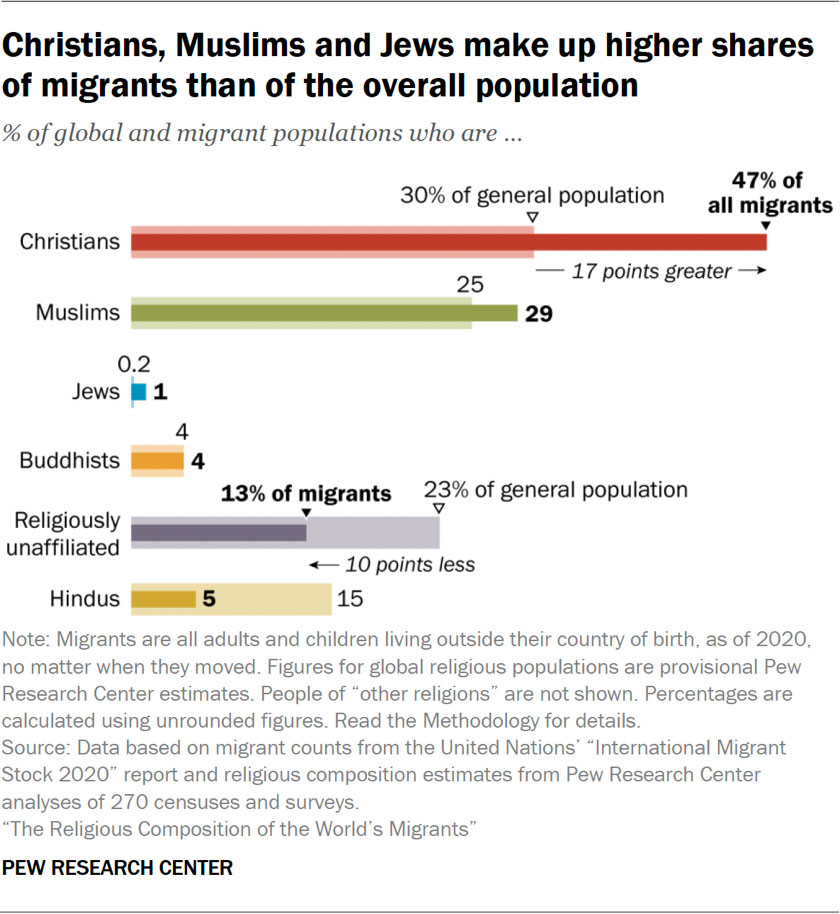
(RNS)—The world’s 280 million immigrants have greater shares of Christians, Muslims and Jews than the general population, according to a new Pew Research Center study released Aug. 19.
“You see migrants coming to places like the U.S., Canada, different places through Western Europe, and being more religious—and sometimes more Christian in particular—than the native-born people in those countries,” said Achsah Callahan, the study’s lead researcher.
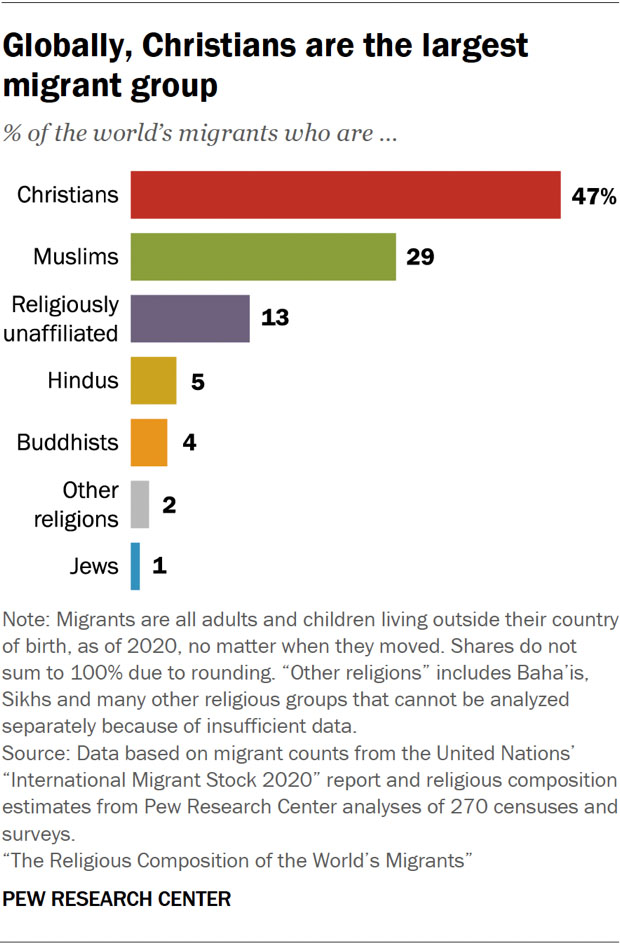
While Christians make up about 30 percent of the world’s population, the world’s migrants are 47 percent Christian, according to the latest data collected in 2020.
The study found Muslims make up 29 percent of the migrant population but 25 percent of the world’s population.
Jews—only 0.2 percent of the world’s population but 1 percent of migrants—are by far the most likely religious group to have migrated, with 20 percent of Jews worldwide living outside their country of birth, compared to just 6 percent of Christians and 4 percent of Muslims.
Four percent of migrants are Buddhist, matching the general population, and 5 percent are Hindu, compared to 15 percent of the world population.
Over the past 30 years, migration has outpaced global population growth by 83 percent, Pew reported.
U.S. migrants more likely to be religious
“Christians, Muslims and Jews make up higher shares of migrants than of the overall population” (Graphic courtesy Pew Research Center via RNS)
Though people immigrate for many reasons, including economic opportunity, to reunite with family and to flee violence or persecution, religion and migration are often closely connected, the report finds.
U.S. migrants are much more likely to have a religious identity than the American-born population in general.
The influx of religious migrants can have a significant impact on the religious composition of their destination countries. In the case of the United States, “immigrants are kind of putting the brakes on secularization,” Callahan said.
While about 30 percent of individuals in the United States overall identify as atheist, agnostic or religiously unaffiliated, only 13 percent of migrants to the United States identify with those categories.
Pew studied data from 270 censuses and surveys, estimating the religious composition of migrants from 95,696 combinations of 232 origin and destination countries and territories.
Their analysis focused on the “stock,” the total number of people residing as international migrants, rather than “flows,” numbers measured over a specific time.
This methodology allowed them to study all adults and children who live outside their countries of birth, regardless of when they immigrated.
“We’re not only interested in the religious composition of people who arrived in a destination country in the last year or in the last five years,” explained Callahan.
According to the report, measuring the total “stock” of migrants reflects slower changes, “patterns that have accumulated over time.”
Migrants move where their religion is prevalent
The study found that migrants frequently move to countries where their religious identity already is represented and prevalent. For example, Israel is the top destination for Jews, with 51 percent of Jewish migrants (1.5 million) residing there.
Saudi Arabia is the top destination for Muslims, with 13 percent (10.8 million) residing in the area.
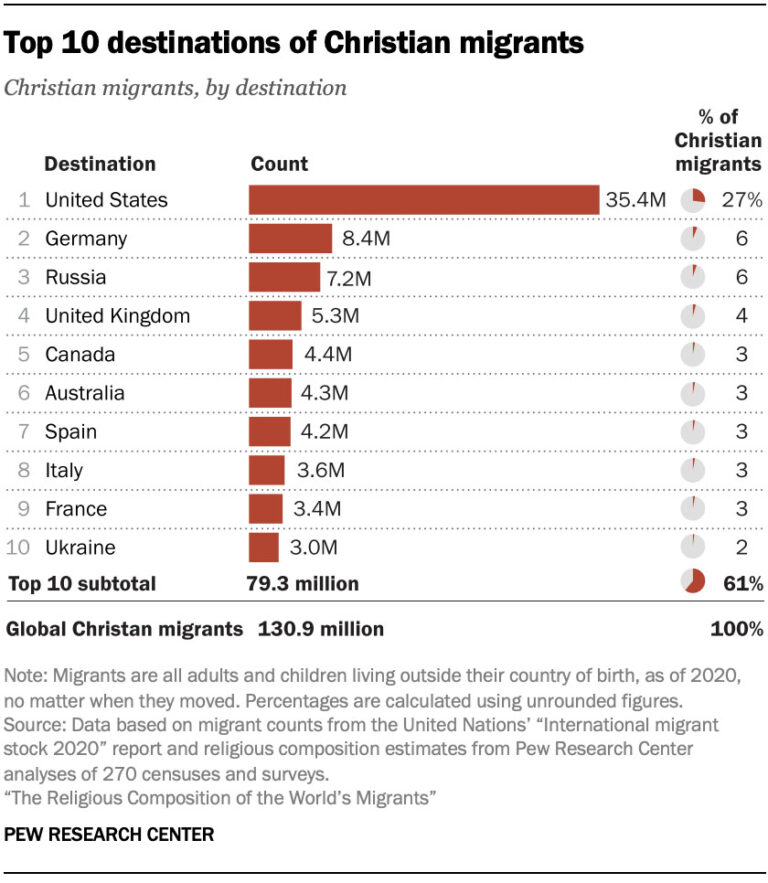
Christian migrants, by destination. (Graphic courtesy Pew Research Center via RNS)
Christians and religiously unaffiliated migrants share the United States, Germany and Russia as their top three destinations.
The majority of the world’s Christian migrants originate from Mexico and settle in the U.S., Pew found. They typically are looking for jobs, improved safety or to reunite with family members.
Meanwhile, 10 percent of the world’s Muslim migrants (8.1 million) were born in Syria, fleeing regional conflict after a war broke out in 2011.
The report attributes high rates of Jewish migration partly to Israel’s Law of Return, which grants Jews the right to receive automatic citizenship and make “aliyah,” a move to Israel.
As of 2020, about 1.5 million Jews born outside of Israel now live within the country’s borders. Jewish migrants to Israel often come from former Soviet republics, such as Ukraine (170,000) and Russia (150,000).
The United States has the second highest population of Jewish migrants (400,000), with a quarter moving from Israel.
Across the board, however, Callahan said immigration levels across religious groups have remained fairly stable over time. Despite consistent numbers, she advocated for doing this study because of the popularity of a 2012 Pew report, Faith on the Move.
The two studies used different methodologies, and Callahan described Faith on the Move as a “snapshot” of religion and immigration in 2010.
“A lot of people have asked for an update to it, and we get a lot of questions related to religion and migration,” she said.
Despite demand for the data, “Faith on the Move was really the last report we put out that focused on this.”
Many of the findings in the new report are similar to the 2012 study, and Callahan found the results relatively unsurprising.
“Even in that older data, you can see that religious minorities were so much more likely to leave their country of origin and migrate to a country where their religious identity was more prevalent,” she said.
“Globally, Christians are the largest migrant group” (Graphic courtesy Pew Research Center via RNS)
Sutherland Springs church demolishes site of mass murder
September 17, 2024
SUTHERLAND SPRINGS (BP)—The site of the deadliest church shooting in the nation no longer stands, as First Baptist Church of Sutherland Springs moved forward Aug. 12 with a 2021 decision to demolish its former sanctuary.
Church members voted 69-35 in August 2021 to demolish the sanctuary after a gunman killed 25 there in November 2017, including a pregnant woman, and injured 20 others before killing himself.
While a lawsuit challenged the decision, it was not filed until May 2024. On July 15, a judge’s ruling removed a restraining order that had prevented the demolition.
Abner Neill, who became lead pastor of the congregation in late 2023, has helped it move forward in ministry to the unincorporated town of fewer than 1,000 people, discussing with church members and leaders how to proceed with demolishing the building.
“We were having internal discussions about what to do and when to do it, and that’s when the lawsuit got filed and a temporary restraining order was issued,” Neill told Baptist Press Aug. 12. “The judge did not renew the restraining order mid-July. So, we said we’re going to wait a little and just let the dust settle.”
Former pastor Frank Pomeroy, who had led the church 20 years and lost a daughter in the massacre, retired in 2022.
The building had served as a temporary memorial, and there had not been an urgency to demolish it, Neill said.
“There was not a sense of urgency in tearing it down until such time as we had a really good idea of what would replace that temporary memorial as a permanent memorial,” Neill said. “It was left up so that we could give an extended period of time for people to reconcile themselves to the fact that it would be going away, and they could say their goodbyes.”
Contractors removed asbestos Aug. 10, bulldozed the sanctuary Aug. 12, and were demolishing the office building Aug. 13, Neill said.
Since 2019, the congregation has worshiped in a new facility funded by the North American Mission Board with gifts made through the Southern Baptist Convention’s Cooperative Program and other donations.
The demolition was delayed as the congregation grappled with the feelings associated with the loss of life and community when Devin Kelley methodically walked through the sanctuary Nov. 5, 2017, killing or injuring dozens before killing himself.
Mixed emotions and disagreement continues
While emotions and views remain mixed among congregants and community members, Neill believes the demolition is best for the community.
“We’ve got some folks who their vote was ‘no’ (in 2021), and if we voted today, their vote would still be ‘no.’ Their hearts are tender right now,” he said.
“Many of our folks, including many who were a part of the church at the time of the tragedy—they may or may not have been in attendance that day—many of them have expressed privately that they are ready to move on.
“For this to finally happen brings them to a place of closure. I had someone tell me just yesterday,” Neill said Aug. 12, “now that we’re doing this, we can get back to just focusing on ministry. That’s kind of the heart that we’re dealing with.”
While opinions vary, Neill said the church is united in ministry.
“I think it will help us move forward,” he said, “in that I have had people in the surrounding community who have said things to the effect of, ‘As long as that’s there, I won’t come.’”
In the lawsuit filed May 17 in the 81st Judicial District Court of Wilson County, plaintiffs Amber Holder and her daughter Aimee Crowder, both of Texas, and Deanna Staton of Alabama sought a preliminary injunction to dismiss the vote to demolish the building and have a new vote but were unsuccessful.
In the lawsuit, the plaintiffs asserted they had been unlawfully removed from the church membership rolls and were thereby unable to vote.
Judge Russell Wilson declined at a July 15 court hearing to extend the restraining order preventing the church’s demolition, effectively making the lawsuit moot as soon as the demolition occurred.
At the hearing, church attorneys argued the court should not interfere with church bylaws, ksat.com reported after the hearing.
First Baptist Sutherland Springs remains active in community ministry, offering a free community breakfast Sundays at 9 a.m., a free community supper Thursdays at 6 p.m., and feeding about 140 families weekly through its food pantry, Neill estimated.
The church averaged 115 in Sunday worship in 2022, according to the 2023 Annual Church Profile, with a total membership of 274.
First Baptist Sutherland Springs is actively searching for a youth pastor and operates a second campus 20 miles north of Sutherland Springs in St. Hedwig.
A memorial prayer garden remains on the grounds alongside the new church, and the congregation is considering a memorial garden on the site of the demolished sanctuary, Neill said.


 The “Praise” co-writers Brown, Barrett, Furtick, Carnes, Moore and Lake, like most of the collaborators on recent Top 25 hits, have ties to the Big Four.


 There have been mountains, but there have also been very deep valleys, such as the 2008 death of his 5-year-old daughter Maria Sue.