One woman’s challenge to transition to new life as ‘one’

JACKSONVILLE, Fla. (ABP)—When a couple is asked to pledge "until death do us part" in a wedding ceremony, chances are no one really imagines then what that will be like. After all, it's a celebration of the beginning, isn't it? Why think about the end?

But the end comes sooner than later for some couples, either by death or by divorce, and life as they knew it must be reshaped to a new reality—being single again.

Anita Snell

Meet Anita Snell. She never dreamed she would be one of nearly 700,000 women who lose their husbands each year. But in October 2007, the unthinkable happened. Snell became part of that statistic when her pastor husband, Jack, died from pancreatic cancer.

"It never occurred to me to think about the death part," said Snell, who now lives in Jacksonville, Fla. "Then through the years as I began to face life-and-death issues with others, I always 'planned' to be the first to die because I observed it was much easier for men. Statistics show that men are able to rebuild a life with another much easier than women because of the numbers. … And because I loved him so much, I knew others would love him, too. Well, that was the plan."

Unfortunately, her plan didn't work out the way she had hoped. She was right about the numbers—according to the U.S. census, there are more than four times as many widows as there are widowers. But she was the one left.

That poses a real challenge for society in general and the church in particular. But Snell found both the church she and her husband were attending and the church where he had been a longtime pastor to be real sources of comfort for them as they dealt with his illness and subsequent death.

"The churches where we had served and where we were members could not have been more loving and supportive through the illness and the initial grief period," Snell said. "They wrapped loving, supportive, arms around me and my family and held us secure. It was a very tangible presence of God's love."

There were three memorial services, and the church family in each helped with all the planning and arrangements.

"Such a wonderful tribute to him and comfort to me," she recalled. "Since the illness had been long and very painful, they were there every step of the way, and following his death, they initially continued to 'be there.'"

Even though they have continued to affirm the grief process, Snell said, the challenge has become more difficult for her as she seeks to find the place of new relationship—as a single.  

"This is a two-way struggle," she asserted. "It is a difficult journey to rebuild a life that has been so thoroughly integrated with another—both for the widow and for the church family. There seem to be some of the same issues that occur with a divorce. It is rather painful for all concerned."

Because of the difficulty, often it is just easier to avoid dealing with it, she said.  "It has been much easier for me to fill my life with work and avoid the 'life alone' issues. And strangely, it also has been a little easier to meet new people than to pick up the pieces with old friends who related to me as a couple."

As long as the relationships are within the church program and activities, Snell has found the church does a good job of including all who participate. When it comes to life outside, however, she feels the church as individual members might do more.  

"As I am experiencing the social structures of life as a widow, I am finding it is more difficult to stay involved," she said, adding that she understands it is a "two-way street."

"I know that I need to be pro-active in making a place, but I think I have also been guilty of thinking that 'life goes on' for those who are alone and not being pro-active in including them in the commom-day activities of life," she said. "I find that, for myself, it is taking a lot of energy, and I have to remain conscious of planning to have others into my home and continue reaching out.  

"Remaining alone and having a pity-party is no way to live though, and I think that God calls us to the 'life more abundant,' even through grief. God calls us to others for relationship—without others in our life, we lose touch with God."

If she could offer any advice for congregations seeking to minister to people who have lost their spouses, she would say this: "It is important to know that grief is not over in a few weeks or even at a year. Most of the time, it takes years to rebuild."

For her, the most difficult time is eating alone, so she would encourage members to invite someone who is alone to join them in a meal. Also, including them in couples parties and with families helps bring reality back to life.

But her most important suggestion gets to the very basis of relating—and one of the most dramatic changes for one who has lost a spouse. It is something she thinks is missed and perhaps needed the most.  

"Give an affectionate holding of the hand, arm around the shoulder, or hug," she said.  "This can go a long way to keep them 'in touch' with a sense of belonging."


Single adults represent tremendous mission field

A hidden mission field exists—one that encompasses more people than live in many small countries. And it could be just outside the walls of any given church.

Single adults make up more than 40 percent of the U.S. population, according to some studies, and Dennis Franck believes church members just need to open their eyes to see them.

Single adults make up more than 40 percent of the U.S. population.

"We're becoming a single nation," noted Franck, national director of single adult/young adult ministries for the Assemblies of God.

And, he admits, he didn't really see singles until he became a youth pastor in the 1970s and started seeing them all around him—at church, at community events, in the grocery store.

"My wife and I started listening to their stories … and saw the need," he said.

Part of the inability to see singles as a unique group is because churches, for the most part, are family-focused.

"Churches are very family-oriented," noted Linda Hardin, the single adult ministry consultant for the Church of the Nazarene. "That's both a good and a bad thing."

Congregations need to minister to families, but, Hardin pointed out, singles can feel left out.

"I want to strengthen families … but not to the exclusion of the needs of singles," Franck agreed.

Both denominational workers added the singles population will continue to grow, particularly as aging baby boom-ers divorce or are widowed.

"We are becoming a singles nation," Franck said. He defines singles as unmarried adults, aged 18 and older, who are singles by "chance, change or choice, whether theirs or someone else's."

Personal experience opens some eyes to the need. Tommy West had been in the ministry 30 years when his marriage unraveled. Because he had been serving in Georgetown and knew the Central Texas city, he decided to remain and joined Crestview Baptist Church.

Single again, he joined Crestview's single adult Bible study group with about 30 members. Within about six months, he became the teacher. Later, the church called him as part-time singles minister, and then as full-time minister of education. "Still there was that core group … and some of that group is still in ministry," he said.

Even when a congregation recognizes the group, members often aren't sure how to minister to and with singles. "A lot of churches have a college and career class and think that, therefore, 'We have a singles ministry,'" West said.

To be effective, ministry to the group must take into account singles' needs. Churches even must recognize the difference between young adult and single adult ministries. Most young adults, those 18 to 25 years old, don't usually describe themselves as single, but rather refer to themselves as not married yet, Franck ex-plained.

He promotes ministry to two groups—singles 18 to around 30 and those 30 to 60 years old—with flexibility as life stages change. Some remain with the first group past age 30, and some stay with the second group after 60 rather joining a maturing adult ministry.

Regardless of age, the key is to meet needs—particularly for friendship and socialization. Singles are "looking for closeness. … They're looking for commonality, not just marital status," said Stacey Hamby, a single parent and a member of Pleasant Valley Baptist Church in Liberty, Mo.

"So many are lonely, especially single-agains. … Many have almost become recluses," West said. "Many are hungry for relationship, … and many, I think, are looking for and are hungry for a faith relationship."

About three years ago, West discovered Chuck, a man living in his car on Crestview's parking lot. Chuck was angry over his situation and had not been in church for about 30 years. But as he was drawn into the singles ministry, "he made the connection horizontally (with people) and vertically (with God)," West said. Now Chuck works for the church.

Franck also sees friendship as common to singles, regardless of age. "They go home to an empty apartment. They need same- and opposite-sex friendships," he said. "Churches need to provide opportunities. If the churches don't, where will they (singles) find it? I believe churches have dropped the ball."

But singles must remain aware they need more than connections with other singles, Hardin noted. "There must be balance. Singles have got to have both single and married friends, and they even need that balance in church life."

While singles perceive different needs as their life stages change, they share other common needs. Not all single individuals want to marry, but many do. Franck believes they need discussions about healthy dating and healthy marriage. Some need premarital counseling. Others who have been divorced or widowed may need re-marital education.

They need opportunities to discuss major life issues—intimacy, finances, parenting, employment and other needs—from a single perspective, Franck added.

And whether they recognize it or not, singles need opportunities for service. Many who have been deeply wounded can find renewed compassion through helping others. "Service opportunities are important because people in general are selfish, by nature and by necessity. Singles especially are selfish by necessity … because they have to do everything for themselves," Franck said.


Singles ministry tough, but vital

RALEIGH, N.C.—Greg Belcher understands why many churches avoid keeping or starting a ministry specifically to "single adults."

It's tough.

A large part of the difficulty in singles ministry is the huge umbrella the term covers.

The Assembly of God's national Caribbean cruise for single adults drew about 175 people from 25 states. "Purposes of the cruise were for a healthy vacation, fun, travel and personal growth," said Dennis Franck, national director for single adult/young adult ministries for the Assembly of God churches.

"Singles" are not monolithic but fall across every age range and life spectrum. They are never married—like Belcher—divorced, separated and widowed. And they come in all ages, from very young adults just out of high school to senior adults who have lost a spouse after 50 years together.

Single adults have unique needs. Those under age 30 are concerned primarily with intimacy and careers. Their intimacy needs are wrapped up in whom they will marry. Over age 30, their needs are transitional, he said. Some have gone through a relationship that has ended, and some are coming to terms with the fact they may never marry.

Many singles are parents and often have needs. Many churches hesitate to bring on a "needs-based ministry," Belcher said. And unfortunately, some churches don't quite know what to make of unmarried adults and are clumsy in their approach.

Belcher, singles pastor for the large Hope Community Church in Raleigh, N.C., committed to reach the bulging demographic of adults who are not married. Younger singles, especially, cringe at the "single" designation, but Belcher has not found a better term.

About 95 percent of people will marry, but nearly half will divorce, he said. Of those who get remarried, two-thirds will divorce. If they marry again, three-fourths will divorce.

"The church is not helping them to get whole," said Belcher, who admits many church members perceive single adults, especially never-marrieds, with an attitude that may be best defined as "mistrust."

Some never-marrieds skip their high school class reunions because they dread the incredulity and inevitable questions—"You're not married? You don't have kids?"—as well as the implication there is something wrong with them.

Still, Belcher views singles ministry as "kind of a marriage ministry." Since the vast majority of people will one day marry, he wants to help them develop a strong identity in Christ that will lower divorce rates.

"Singles ministry is, for me, an amazing opportunity, an untapped entrepreneurial opportunity to change lives like never before," Belcher said.

In Raleigh, often identified as a premier city for singles in America because of its universities and high-tech work force, few churches take advantage of what every corporate marketer knows—how to identify their product to the singles market.

Another difficulty is that many single adults are single parents. Lori Little, who has written curriculum for single moms, said if the mothers are not involved in the body of Christ, neither are their children.

Of 18 million single moms in America, she said, only about 10 percent are in church.

When single adult ministry was prominent, with publications devoted to Christian singles and national conferences held for them, Labor Day events at national conference centers like Ridgecrest drew 3,000. This year Belcher said organizers expect 300.

A major singles event in Oklahoma was cancelled for lack of registration. "The churches just aren't pushing it," he said.

"You have to work hard to make sure a single adult ministry stays Christ focused," Belcher said. "The gravitational pull of single adult ministry is to become something you don't want it to be."

Belcher, who was a senior pastor in Marietta, Ga., before joining Hope Community as its first full-time singles minister, said the number of people who have come through the church through various ministries who indicated they are "single" has increased from 800 to 2,400 in the past 12 months. About 900 circulate fairly regularly in the singles ministry.

Nationally, only 13 percent of all churches report offering single adult-specific activities.

According to researcher James Tanner, only 2.6 percent of churches that offer some form of singles activity (that is 2.6 percent of the 13 percent) are viewed to have single adult ministries that are growing and attracting new single adults to the church.

Rich Hurst, director of singles ministry resources with David C. Cook Publishing, said when he was pastor at McLean Bible Church, a group of over-30, never-married professionals told him, "We are the most ignored group in this church."

Maybe they're just too tough.


Political rhetoric more religious than voters

WASHINGTON (RNS)—Has America gotten more religious—or just American politics?

The country has grown less religious since the 1970s, while frequent churchgoers now are much more likely to vote Republican or support the Tea Party, according to recent studies.

Pennsylvanian Joan Falcone attends a Tea Party rally at the state capitol in Harrisburg, Pa. New research indicates the Tea Party is as much about increasing the role of religion in government as about cutting taxes and limiting the size of government. (RNS FILE PHOTO/Sean Simmers/The Patriot-News)

As a result, faith-filled rhetoric and campaign stops make Americans appear more Christian than they really are, according to Mark Chaves, a Duke University professor of sociology and religion.

The rise of megachurches, with their memberships in the thousands, also fuels the misperception that most Americans attend services weekly, when only one in four Americans actually do, he added.

"The Michele Bachmanns and Rick Perrys of the world are playing to a base that's much smaller than it was in the 1970s and 1980s," said Chaves, whose new book, American Religion: Contemporary Trends, analyzes trends based on data from the General Social Survey and the National Congregations Study.

Using data collected between 1972 and 2008, Chaves said, America not only is losing its religion, but also has lost confidence in religious leaders and wants them to be less involved in politics.

Researchers say the trends reflect myriad factors—disillusionment with clergy and political scandals; the country's increasing diversity, fueled by immigration and intermarriage; and younger generations that tend to be more highly educated and socially liberal.

Chaves also interprets these trends as a "backlash" against the politicization of religion that began with Jerry Falwell and the rise of the Religious Right in the 1970s.

Mark Chaves is a professor of sociology and religion at Duke University Divinity School. (RNS PHOTO/Courtesy Duke University )

The findings—along with new research by Harvard professor Robert Putnam and Notre Dame professor David Campbell, co-authors of American Grace: How Religion Divides and Unite Us—paint a shifting portrait of American politics.

The Tea Party's sinking approval rating—currently at 20 percent, below Republicans, Democrats, atheists and Muslims—signals a growing discomfort with mingling faith and politics, including the kind of "overt religious language and imagery" sometimes used on the campaign trail, Putnam and Campbell recently wrote in The New York Times.

What's more, Putnam and Campbell say, the Tea Party is much more religious than originally thought. "The Tea Party's generals may say their overriding concern is a smaller government," they concluded, "but not their rank and file, who are more concerned about putting God in government."

Among the other findings in American Religion:

• There is a declining (though still very high) belief in God or a higher power: In the 1950s, 99 percent of Americans said they believed in God; in 2008, about 93 percent did.

• Nearly 20 percent of Americans now say they have no religion, compared to just 3 percent in 1957.

• Only 25 percent of Americans attend weekly religious services, although up to 40 percent claim they do.

• Fewer Americans approve of their religious leaders getting involved in politics. In 1991, about 30 percent of Americans strongly agreed religious leaders should avoid political involvement; by 2008, 44 percent felt that way.

• Belief that the Bible should be taken literally dropped from about 40 percent in the early 1970s to about 30 percent in 2008; Chaves said this trend corresponds with the rise in college education.

From 1972 to 2008, the percentage of people with great confidence in religious leaders declined from 35 percent to less than 25 percent. A sharp dip around 2002 was probably due to the Catholic Church clergy abuse scandal, but otherwise the trend consistently has been downward for decades, along with interest in joining the clergy.

Immigration from Africa and Asia, intermarriage and assimilation have diversified America's religious beliefs since the early 1970s.

Continuing that trend, Chaves believes Americans will grow more accepting of Muslims over the next generation, as has happened with other minorities.

He cited Putnam and Campbell's "Aunt Susan Principle," the idea that people are less suspicious of other faiths when someone they know is a member.


Faith Digest

King Arthur loses burial battle. A self-styled druid who identifies himself as a legendary British king lost his bid to rebury immediately prehistoric human remains at a sacred pagan burial site. John Timothy Rothwell—who changed his name to King Arthur Pendragon in court documents—lost his court battle to win custody of the cremated remains from a team of experts at Sheffield University. London's High Court ruled scientists had not acted unreasonably three years ago when they dug up the remains of more than 40 bodies, thought to be more than 5,000 years old. Forensic experts now are allowed to keep the ashes for study and analysis until 2015. Researchers are expected to rebury them in the same spot where they were found at England's prehistoric pagan stone circle at Stonehenge.

Quote by first century apostle, not First Avenger. "We often suffer, but we are never crushed. Even when we don't know what to do, we never give up." Who said it? According to a recent poll, more Americans attributed the passage to comic book hero Captain America, Martin Luther King Jr. and former President George W. Bush than its actual source—the Apostle Paul in the New Testament book of 2 Corinthians. A survey commissioned by the American Bible Society found 56 percent of Americans surveyed misattributed the quote. Only 12 percent correctly attributed it to the Bible. The survey by Harris Interactive was conducted online among 2,572 adults.

Failed circumcision gets mom probation. A 30-year-old Portland, Ore., woman who botched a home circumcision of her 3-month-old son has been sentenced to five years probation. Keemonta Peterson, inspired after reading the Old Testament, decided she wanted her son to be circumcised. But because she believed he was too old to be circumcised by doctors, she decided to do it herself, after watching YouTube videos. She called 911 after the failed circumcision left her son bleeding uncontrollably and in great pain. Peterson pleaded guilty to first-degree criminal mistreatment and agreed to undergo mental health treatment and work with a mental health probation officer. Two other charges of abuse were dismissed. Doctors completed the circumcision and the boy has fully recovered, Multnomah County Deputy District Attorney John Casalino said.

Churches to reclaim property. A prominent Czech church leader has welcomed an agreement that would allow churches to reclaim land and buildings seized under communist rule but forfeit state subsidies in return. A draft settlement finalized in Prague allows religious groups to retrieve assets confiscated after the 1948 communist takeover, while obtaining financial compensation for others. Separately, Turkish Prime Minister Recep Tayyip Erdogan announced his government will return properties seized from recognized minority religious groups in 1936. Some Catholics and most Protestants are not on the government's official list of minority religions.

Compiled from Religion News Service


Interfaith understanding remains elusive 10 years after 9/11

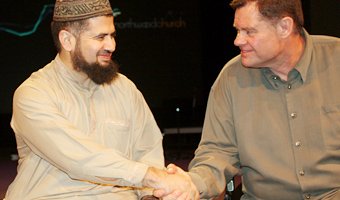
WASINGTON (RNS)—In a post-9/11 bid to better relations with local Muslims, Pastor Bob Roberts invited Muslims to his NorthWood Church in Keller for question-and-answer sessions, a cooking club and to help on a few home remodeling projects.

The result: Roberts lost "a bunch of church members," he said.

Pastor Bob Roberts lost "a bunch of church members" after he invited local Muslims leaders, including Imam Zia ul Haque from the Islamic Center of Irving, to Northwood Church in Keller for dialogue. (RNS PHOTO/Courtesy Northwood Church)

In Denver, Pastor Max Frost asked volunteers from his Roots Vineyard church to help paint a local mosque. Friends and family told him it was a bad idea.

And at Hillsboro Presbyterian Church in Nashville, Tenn., Nancy McCurley started an interfaith Scripture study with local Muslims, only to be told by a critic that "in a year's time, this church will be a mosque."

In the 10 years since the 9/11 terrorist attacks exposed the deep divide between America's Judeo-Christian majority and American Muslims, a host of projects have tried to foster interfaith understanding.

To be sure, there have been signs of hope for the future of interfaith relations. But along with progress has come polarization—threats of Quran burnings, protests of proposed mosques and fears of Islamic law in the U.S. legal system.

A month after the 9/11 attacks, an ABC News/Washington Post poll found that 47 percent of Americans had a favorable opinion of Islam. By 2010, that figure had only gotten worse, dropping to 37 percent.

That begs the question: Has the flurry of activities aimed at interfaith understanding actually accomplished anything?

Eboo Patel, founder of the Chicago-based Interfaith Youth Core, said the furor over the proposed Park51 Islamic cultural center near Ground Zero highlighted the need to gauge the quality, not just quantity, of interfaith efforts.

"Tens of thousands of people in the country who were participating in interfaith projects basically were watching this on TV, … saying, 'What difference does our work make on a national level?'" said Patel, who is Muslim.

As activists like Patel push to foster meaningful relationships between Islam and other faiths, there has been pushback from groups who have no interest in such relations, or who question aspects of Islam.

Gustav Niebuhr, author of Beyond Tolerance, said the divide reflects three types of Americans—the pro-interfaith crowd, the anti-Muslim segment and "the-don't-know-too-much middle" that can be swayed by either side.

Recently, the two poles have debated the possible influence of Shariah, or Islamic law, even though there has been no concerted effort by American Muslims to introduce it into American courtrooms.

"The problem is when people think of Shariah, the only image that comes to mind is the Taliban stoning some poor woman to death in Afghanistan," said Niebuhr, a professor at Syracuse University. "That's the outer limit."

In a growing circle of evangelical churches, there has been a sort of reverse pushback by leaders who are turned off by fellow Christians trying to block mosque construction and blaming Islam for 9/11.

Joseph Cumming, an evangelical who directs the Yale Center for Faith and Culture Reconciliation Program, said more evangelicals are asking what Jesus would do when it comes to relating to Muslims.

"There's a hunger in churches to ask that question," he said. "That wasn't being asked before 9/11."

Mahan Mirza, vice president of academic affairs at Zaytuna College, a new Muslim school in Berkeley, Calif., said Christian-Muslim relations generally are better on the local level, where he has seen an increase among evangelicals who think the Bible requires such outreach.

"Sometimes that's couched in the language of love your enemy so … it's not done in spite of Christian teachings; it's done because of Christian teachings," said Mirza, a former professor at the University of Notre Dame.

Last year, Rick Love started Peace Catalyst International in Chandler, Ariz., which sponsored dinners with members of a local mosque and his Vineyard church to foster what he calls "Jesus-centered peacemaking communities."

He cautions fellow evangelicals to be humble before criticizing the harsh punishments demanded by others' scriptures: "I praise God that we don't live under the Old Testament," he said.

Yet some evangelical leaders, including Southern Baptist agency executive Richard Land, have been condemned for supporting Muslims.

"Southern Baptists were comfortable with me advocating that Muslims have the right to have mosques," said Land, who supported a proposed mosque in Murfreesboro, Tenn. "What they were not comfortable with was me being part of a coalition that was filing a suit in order for them to have these mosques."

Suhail Khan, a Muslim member of the advisory council of the interfaith Buxton Initiative, said he is alarmed Americans' declining favorable views of Muslims.

He blames a "cottage industry of hate" for the shift and finds himself answering more questions about Shariah than the basics of what Muslims believe when he visits evangelical churches.

"I'm having to undo all kinds of misinformation and very hateful misinformation," said Khan.

Undeterred, Patel puts much of his hope in the 200 colleges and seminaries—including nine evangelical schools—that participated in a recent White House event kicking off yearlong interfaith service projects. He expects many of the students will eventually launch similar projects at companies and in cities where they move after graduation.

"I think that college campuses are going to be models of interfaith cooperation, and I think they're going to graduate a generation of interfaith leaders," he predicted.


Faith & Work

In an uncertain and unstable economy, how do Christians reconcile work as a reflection of the image of God in them with high unemployment and under-employment rates?

Should believers reexamine what defines "meaningful" work? How do Christians reconcile faith issues in the face of unemployment?

Work is a reflection of God's image in the human race, some Christian ethicists believe. The concept of working didn't grow out of man's disobedience but came from God.

"God worked and then rested in the Genesis account," noted Bill Tillman, who occupies the T.B. Maston Chair of Christian Ethics at Hardin-Simmons University's Logsdon Seminary in Abilene. "Work went on in the Garden of Eden before the fall."

David Gushee , distinguished professor of Christian ethics at Mercer University, agreed. "Part of being made in the image of God is that we were made for meaningful work," he said.

Social and emotional problems sometimes arise over the understanding of how that image plays out in individual lives. "We are workers as God works," Gushee added. "But that doesn't necessarily mean paid work … or mean work that sends chills down our back."

The image of God understanding also has translated to self-image. "Too often, the so-called Protestant work ethic gets reduced to finding our self-identification through work," Richard Land, president of the Southern Baptist Convention's Ethics & Religious Liberty Commission, explained. "When people can't find work … it hits their self-identification.

"We shouldn't find our identification in work. … We should find it in God's Son … who has a plan for our life."

But self-fulfillment must be addressed, Tillman said. "We are working on behalf of our vested interest … our livelihood … and for the common good … and also for the more intangible sense of fulfillment and satisfaction."

While the unemployed first may talk about the need to support their families, "in the longer term, we hear people say, 'I'm of no use to this society,'" he explained. "After people are unemployed for a while, they often say, 'I'll take just any kind of work.'… That's when the intangible takes hold … and can lead to depression."

The intangible reasons make it all the more necessary for governments to ensure full employment for citizens. "It is the responsibility of society to create opportunities for everyone to have something to do, because it is essential to being human," Gushee said.

"When we are chronically deprived of access, unemployment corrodes the spirit, creates depression, frustrates us in the image of God in our productivity. It's bad for the human spirit and bad for the economy."

While job loss can be devastating economically and emotionally, Tarris Rosell, professor of pastoral theology, ethics and ministry praxis at Central Baptist Theological Seminary in Shawnee, Kan., believes it can open people's eyes to new possibilities.

"There are many employed persons who are not engaged in anything like 'meaningful work,' that is, their occupation—what occupies their work hours—is not their vocation—that to which God calls," he said. Many have been employed for years in a job "that perhaps had meaning mostly as means of a paycheck and little else."

"In contrast, Frederick Buechner wrote that our vocation lies at the intersection of what the world needs and what makes us glad—or 'makes your heart sing,'" added Rosell, who also fills the Rosemary Flanigan Chair for the Center for Practical Bioethics in Kansas City and is a clinical associate professor of the history and philosophy of medicine for the University of Kansas School of Medicine.

Often, job loss forces individuals to consider other alternatives, and many seek higher education, including seminary, to follow their "true or new vocation."

Rosell emphasized that much of the work in which people are engaged is detrimental, and he considers loss of it "a good thing."

"Some occupations actually entail work that the world does not need—manufacturing jobs of products that are harmful to persons and/or the environment, or that involve purchasers of activities that are meaningless or a distraction from what is good, or products that simply encourage wasteful and unnecessary consumerism," he said.

"Other jobs involve the worker in acts of violence and destruction, contrary to the call of Jesus on those who would follow him in this life."

While God created work and the human desire to be productive, unemployment is a result of people's actions or inaction, Rosell believes, not necessarily as individuals, but as special-interest groups and society as a whole.

"Surely, much of the unemployment problem is a direct consequence of having engaged human workers in jobs that were not what the world needed in the first place," he said.

Other causes, he added, included human greed, corruption "in high places," corporate evil and the "growing disparity between what executive officers take as salary and bonuses relative to what everyone else is allotted."

As long the economy operates from a cyclical approach of highs and lows, unemployment often is seen as inevitable.

"We don't need to revise our understanding of meaningful work," Gushee declared. "We need to look at our social contract that seems to readily accept the boom-and-bust concept."


Churches offer ‘Soul Food,’ encouragement to the unemployed

When people are in trouble following natural disasters, churches usually respond rapidly and generously.

The disaster of chronic unemployment creates a different set of challenges, but some churches across the country provide models of ministry to people affected by economic instability by meeting immediate needs for food and shelter.

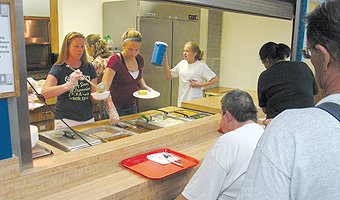
Volunteers at First Baptist Church in Jefferson City, Mo., serve a community meal, primarily to benefit the unemployed and underemployed.

First Baptist Church of Dalton, Ga., wants to concentrate on assisting its community, instead of focusing on its own survival. "We're looking at ways to expand our footprint," Pastor Bill Ireland explained.

First Baptist began its Soul Food ministry in 2008 after the economic downturn hit the construction industry. "There were people in the church who became concerned about the homeless and the working poor," Ireland said.

Often called the "Carpet Capital of the World," Dalton was hit especially hard, and unemployment remains higher than the national average.

Through Soul Food, the church provides a meal two or three times each month. This year, the congregation expanded its ministry to include special events for children and plans to start a choir.

The church is considering some other possibilities of ministry to adults. The church has called a recent seminary graduate as minister of community ministries and missions.

"We may not be able to do everything, but we want someone who wakes up every morning thinking about ways to minister," Ireland said.

Other churches across the country, such as First Baptist Church in Jefferson City, Mo., provide community meals, as well. The Jefferson City church also is considering other long-term ministries.

Several, such as First Baptist Church in Decatur, Ga., collect special offerings to assist with rent and utility bills.

Volunteers (left to right) Sandra Blackwell, Cindy Petway and Drake Bargeron serve hot dogs to participants at an end-of-school party sponsored by the Soul Food ministry at First Baptist Church in Dalton, Ga.

First Baptist in Decatur also has helped the unemployed through its Jobless, Not Faithless program. In the past, the ministry provided regular group meetings to encourage and pray with those who had lost jobs.

As the economy improved for a while in the area, attendance began to decline. Although no longer offered for groups, the ministry is available one-on-one to individuals looking for jobs.

Some churches that have provided job-search assistance—including interview, search and resume skills—have tapped into programs available through not-for-profits or government.

First Baptist in Decatur uses a ministry package available from Internet-based Crossroads Career Network, Christian employment support. According to its website, the network of member churches uses a six-step process of career exploration and job-search techniques.

In North Texas, First Baptist Church of Lewisville has participated in Career Connection, an organization that serves the Dallas-Fort Worth area. The Lewisville church served as a satellite location, open to church members and the community.

First Baptist member Steve Smith helped begin the site when he was without a job. The group stopped meeting a couple of months ago as its numbers declined.

"It did help a lot of people," he said. "But the economy has improved in North Texas, and some gave up looking for work. Some had been out of work for so long that they lost interest."

He suspects the need may arise again since the economic recovery faltered recently.

First Baptist Church in Georgetown offered Careers in Transition at one time but currently sends people to the Georgetown Job Café, a local networking opportunity, and to services offered by the Texas Workforce Commission.


Christians called to address both immediate needs, social inequities

While many churches reach out to meet the immediate needs of people who have lost jobs, Christians also are called to tackle underlying social issues related to employment and to partner with others to help make long-term changes, some ethicists advocate.

Government involvement

"Churches need to play a part in the local, state, regional and national debate about work," said Bill Tillman, the T.B. Maston Chair of Christian Ethics at Hardin-Simmons University's Logsdon Seminary in Abilene.

Not only should Christians speak up about the number of jobs available, but they also should advocate for salary levels and quality. Tillman noted the current economic downturn hit Texas at a slower pace than in many parts of the country and even more slowly in Abilene. Unemployment in the West Texas city stands at only 6 percent to 7 percent, but most jobs are lower-paying, he said.

Congregations can partner with government and social advocacy groups to affect change, David Gushee, distinguished professor of Christian ethics at Mercer University, said.

He pointed out how government, unions and social advocacy groups worked together when recession hit Germany.

"They found a way to keep people on the payroll, even if they couldn't work full time. Some work is better than no work," he said.

All strata of society—including churches and their members— should be involved in solving the unemployment problem, the ethicists insisted.

"This is a mission field," Tillman said. "But Baptists haven't been in the mindset of seeing economics as a mission."

Gushee agreed. "Those (Christians) who can should be activists and advocates for a more humane society. The economy is for people. That's the thing to remember," he said.

"This is yet one of many examples where pastors and church leaders have the opportunity to give a unique Christian perspective … on economic and social ethics … by using the pulpit and other forums."

Unemployment must be addressed systemically. "Baptists don't have an institutional or systemic approach," Tillman added. "The Baptist approach grows out of individualism."

Connections

One way to take a systemic approach is to partner with others and to use available broad system connections. For example, Tillman noted, First Baptist Church and First Central Presbyterian Church partner to minister in Abilene.

And the churches tap those who are in positions of authority. "They find the people who are in the systems, using leverage into the larger system," he said.

A state representative is a member of one church, and Abilene's mayor is a vice president in the Hendrick Medical System, a health care system related to the Baptist General Convention of Texas.

"Churches with professionals and systems … can work with the pastor to address the systems, first through conversation," Tillman said. "Opportunities are closer to us than we know, offering channels that we haven't explored before."

Create jobs

Individual Christians could use their own resources as a way to create opportunities for others. "Corporations and those (Christians) who run businesses need to think about the 25 million people out of work and open their purse strings to create jobs," Gushee said.

Christian entrepreneurs might develop businesses or not-for-profits to create jobs, said Tarris Rosell, professor of pastoral theology, ethics and ministry praxis at Central Baptist Theological Seminary in Shawnee, Kan., and the Rosemary Flanigan Chair at the Center for Practical Bioethics in Kansas City.

In collaboration with others, Rosell has been part of starting a church, a nonprofit organization for refugee resettlement, a nonprofit that matches uninsured patients with pro bono health care providers, and a program to educate clergy and faith communities about depression. Currently, he is helping create a nongovernmental organization for the prevention of intertribal violence in Kenya.

"The results have been, in part, new jobs and meaningful work as vocation," he said.

Churches can create jobs, too, by budgeting for them, whether full-time or part-time, Gushee added.

Volunteerism

While the ethicists agreed volunteerism isn't the best answer to unemployment, it can help people regain some measure of self-esteem and add productivity to society.

"I think that what people need is to be employed. It's not the best full answer … but volunteering and other forms of service should not be overlooked for meeting needs of productivity," Gushee said.

Volunteerism may lead to employment opportunities, Richard Land, president of the Southern Baptist Convention's Ethics & Religious Liberty Commission, believes.

"The church should find places for them (the unemployed) to work, even volunteer work," he said, "for often, volunteer work can launch them into a new career, or they may discover things they didn't know they could do."


Islamic terrorism a real threat, but how big is it?

WASHINGTON (RNS)—After a car bomb detonated on Wall Street killing 38 people, federal investigators came up with a possible link to an overseas group.

Islamic terrorists? Al-Qaida? No, Italian anarchists.

The year was 1920, and in those days anarchists were the equivalent of today's terrorists, waging acts of mass destruction against Western capitalism.

Charles Kurzman, professor of sociology at the University of North Carolina, thinks 20th century anarchist violence bears a resemblance to the Islamic terrorism of the 21st century in one sense: Neither resulted in a spiraling escalation of violence.

"In many ways," said Kurzman, "Islamic terrorism is simply the latest form of transnational revolutionary violence to grab global attention."

Put another way: This too shall pass.

While mindful of the pain and suffering terrorism has caused, Kurzman has written a book challenging the dominant narrative that worldwide terrorism is out of control.

In The Missing Martyrs: Why There Are So Few Muslim Terrorists, Kurzman argues Islamic terrorism has accounted for a miniscule number of murders compared with violent death tolls from other causes.

In the United States, for example, fewer than 40 people died at the hands of terrorists in the 10 years since the attacks of Sept. 11, 2001. That compares with about 140,000 other murders during the same time.

The bad news, said Kurzman, is Islamic terrorists really are out to kill Americans. The good news is there are very few of them. In fact, of less than 40 killed at the hands of terrorists over the past decade, none were tied directly to al-Qaida. These include the 2002 Beltway sniper attacks, in which 10 people were killed in the Washington, D.C., area, and the 2009 Fort Hood shootings in which U.S. Army Maj. Nidal Malik Hasan killed 14 people.

That count does not include the many failed terrorist bombings united by a common theme—incompetence. Had these plots, such as the bungled 2010 Times Square car bomb, succeeded, the death toll would have been much higher.

The truth is, Kurzman said, the more terrorists kill, the less popular they become. That does not mean the world is safe from terrorism, and he cautions America may well see another horrific terrorist attack.

It does mean the U.S. government should examine the evidence and ratchet down the discourse, he said.

That goes for the Muslim radicalization hearings held by Rep. Peter King, R-N.Y., as well as presidential candidate Herman Cain's statements that he would require Muslim government appointees to take a loyalty oath.

"The narrative right now is that Islamic terrorism is either no threat at all, or it's a pandemic throughout the community," said Alejandro Beutel, government and policy analyst for the Muslim Public Affairs Council.

"Charles Kurzman's very scholarly approach to the issue is something we want to move toward. There is a threat out there, but it's a tiny minority of individuals."

What, then, of the supposed sympathy for terrorist acts among Pakistanis or Palestinians, among whom Osama bin Laden has been a popular figure?

Borrowing a term from author Tom Wolfe, who coined the phrase "radical chic," Kurzman calls it "radical sheik," playing on the Arab word for "leader." It's an expression of resistance against Western imperialism, a kind of sign of disdain for power and authority, not an actual vote of confidence for terrorism.

A sociologist of revolutions, who has spent a large part of his academic career studying the 1979 Iranian Revolution, Kurzman is active with the Triangle Center on Terrorism and Homeland Security. The center is a think tank consisting of experts from Duke University and the University of North Carolina. He was the principal author of a recent study that showed the number of U.S.-instigated terrorist incidents dropped by more than half in 2010.

Several years ago, Kurzman started taking Arabic courses so he could do a better job reading al-Qaida propaganda and digital bulletin board discussions by young Muslims.

He knows his argument that there are few Muslim terrorists is counter-intuitive, even provocative.

But the Harvard- and Berkeley-trained professor is convinced it's a necessary corrective.

"It may be a hard sell to ask people to calm down," Kurzman said. "It doesn't make as compelling a read as scary stories and imminent threats of hidden dangers. …

"I'm not saying terrorism is insignificant, or that I have no feelings for people who have lost loved ones due to terrorism.

"But I think we should also look at the days when nothing happens. This is a story about something that did not occur."


Singer/songwriter clings to faith during family trials

NASHVILLE, Tenn.—Singer/songwriter Aaron Shust and his wife, Sarah, have relied on their faith in Christ to sustain them as their 2-year-old son, Nicky, has battled eosinophilic esophagitis—a rare and extremely painful condition that does not allow the body to take in any nutrition.

With a deeper understanding of God's amazing grace and immense love for his children, Aaron Shust's new album, This Is What We Believe, reflects a journey of hope and healing.

This condition has also caused Nicky to battle several other serious medical issues, including silent aspiration and septic shock.

"The doctors have told us that this is the most severe case they have ever seen, even in adults," Shust said. "It's been heartbreaking to see everything he has gone through."

While spending several months in the hospital, doctors tried six food formulas, but Nicky's body rejected each of them. With the seventh formula as the last available option, the Shusts rejoiced when Nicky's body accepted it without any problems.

Although the doctors still believed Nicky would need to be on a feeding tube and would require steroids for the rest of his life to manage the pain, this formula finally was a step in the right direction and offered a glimmer of hope. 

Throughout the ordeal, the Shusts went online to research the side effects of each steroid, and they continued to ask their family and friends to pray for Nicky's healing. 

Not long after, the Shusts re-ceived stunning news from Nicky's doctors. All of the test results were coming back normal, and there was no longer a single trace of eosinophilic esopha-gitis in Nicky's body.

The doctors could not offer any explanation as to why the disease had disappeared. But the Shusts know the reason.

"We were on our knees before God in prayer, and now we're on our knees before him with thanksgiving," Shust said. "When your whole world is suddenly shaking, you need a firm place to stand. You see what it is in your life that's stable, true and strong enough to hold you up. You reach for that, run to that and find out what you really believe."

Walking through the difficult season left an indelible mark on Shust's songwriting. With a deeper understanding of God's amazing grace and im-mense love for his children, Shust's new album, This Is What We Believe, reflects a journey of hope and healing.

"Through all of the sickness and heartache, my family has run to God and his promises," Shust said. "We've been forced to our knees, but this trial has made life exponentially more meaningful.

"And through it all, God has never left us. He brought strength to our weakness, peace to our uncertainty and healing to our wounds.

"He's given us the grace to handle what we didn't believe we could. And ultimately, he's let us experience the joy of seeing his miraculous grace at work.

"To witness your own child being healed of something that doctors told you was permanent, painful and incurable—well, if that doesn't move your heart to worship, I don't suppose there's anything that will."


Virginia man on quest to develop national religious history museum

WASHINGTON (RNS)—For Chris Stevenson, faith isn't just personal—it's national.

Stevenson, 41, first became interested in the intersection of faith and public life while studying civics in college. A few decades later, he said, he had a revelation of sorts.

"There was one great story that remains to be told by a professional museum—the indispensability of faith in America's history," he said.

Chris Stevenson, chief organizer for efforts to create a National Museum of American Religion, stands in front of the Smithsonian Castle. (RNS PHOTO)

Thus, the idea to found a National Museum of American Religion in Washington, D.C., was born.

But Stevenson, a business manager for an air traffic organization in northern Virginia, has found that turning his dream into reality is an unexpectedly complicated undertaking involving a number of logistical, professional and personal challenges.

For example, he was not the only one lobbying for a new national museum in Washington. Several other projects—the National Museum of the American Latino, the National Women's History Museum and the American Museum of American People—have been proposed to Congress and the Smithsonian Institution in recent years.

"There are new museums proposed and created all the time, but it's very hard to move from the paper stage to the practical, real stage," said Kym Rice, director of the museum studies program at George Washington University.

Rice cited money, especially in the midst of the American economic downturn, as a chief stumbling block for museum proposals.

"It's hard to make these institutions financially secure. … Even if they're nonprofits, they have to have some financial base. It's a huge endeavor," she said.

Indeed, most groups seeking to found a museum on the National Mall in Washington are backed by well-funded committees that boast big-name supporters and extensive websites. Stevenson's efforts are modest at best. The project still is run almost entirely by Stevenson, with only occasional assistance from a two-person board of advisers.

"We're just beginning the initial funding stage," Stevenson said. "I'm mostly just cold-calling and cold- e-mailing people."

Stevenson, a Mormon, also acknowledges some reservations about his project. "People think I have an agenda."

Despite roadblocks, Stevenson remains committed.

"People often underestimate people who are passionate, committed and even-handed," said Robert Wilson-Black, a vice president of the evangelical Washington-based group Sojourners, who also serves as one of the museum's advisory board members. "Lots of monuments and museums start with a person who is just dogged."

And Stevenson is nothing if not dogged. Inspired by the success of the new National Museum of African American History and Culture, he insists a National Museum of American Religion is a viable idea.

"My first thought was to make it a Smithsonian museum," Stevenson said. "We would like to have it around the Mall. Washington, D.C., is our nation's capital. … (The museum) belongs in D.C. because it's about American religion."

Stevenson even has a list of exhibits he would like to house in the museum, including expositions on religion and immigration, religion in politics, religion in American architecture and America's effect on other world religions.

And Stevenson thinks big, dreaming of large-scale, hands-on exhibits like a room that could change into any worship space at the touch of a button or an interactive experience modeled after the participatory civil rights sit-ins held at the National Museum of American History earlier this year.

"I'd like to see a participatory Scopes Monkey Trial. … People could sit in as the jury or as the people watching."

But Rice and others question how the museum would balance the need to please visitors while giving all religions fair treatment.

"It would be different in that it's thematic and not based on an ethnicity. … Museums are about the dissemination of knowledge and not about a particular view."

Stevenson insists the museum would maintain balance by remaining true to three guiding principles—objectivity, refraining from declaring one tradition as "true," and "presenting the information without judging whether a religion has been beneficial or detrimental to American history."

Stevenson also hopes to avoid bias by getting religious players from throughout the theological spectrum involved in the project, an effort he says will create a more inclusive museum.

Stevenson's fervor doesn't make the experience any less difficult.

In addition to his day job and working on the museum, Stevenson also moonlights several hours a week as the head of America's Quilt of Faith, a group that "champions the indispensability of faith to the American experiment in self-government."

Still, Stevenson finds a balance. "I use vacation days sometimes, but I'm not obsessed to the point of neglecting" his family.

Ultimately, Stevenson confesses much work must be done before construction on the museum can begin, but he hopes to get it completed in "5 to 10 years."

"I am convinced we can (build this museum) because we have a religious history." Stevenson said. "It exists. There is truth out there. … We'll just do the best we can and get at that truth."