Faith Digest

Americans cite negatives of Christianity. When asked about Christianity’s recent contributions to society, Americans cited more negatives than benefits, according to a recent survey. The negative contribution cited most was hatred or violence in the name of Jesus, according to the Barna Group survey. Other frequently cited examples included opposition to gay marriage and the Roman Catholic Church’s sex abuse scandal. The positive contribution mentioned most was Christians’ helping the poor, as well as evangelism and influencing the country’s values. Researchers, who asked open-ended questions, found that one in four respondents could not name a single positive contribution made by Christians in recent years to American society. Just 12 percent could not think of a single negative contribution. The findings were based on telephone interviews Aug. 16-22 with a random sample of 1,000 U.S. adults and had a margin of error of plus or minus 3.2 percentage points.

Public school students throw punches more. A recent survey of 43,000 high school students found public school students were more likely to participate in physical violence, while private school students were more likely to have teased or taunted someone, and more likely to have felt bullied themselves. Fifty-two percent of public school students say they have hit someone in anger in the past year, according to the study by the Josephson Institute Center for Youth Ethics, compared to 47 percent of students in private religious high schools and 41 percent of students in secular private high schools. The study found 60 percent of boys at religious school have “bullied, teased or taunted” someone at least once in the past year, compared to 55 percent of boys in public or secular private schools. Girls in religious schools also were more likely to have verbally bullied someone than girls in the other two categories. About a quarter (23 percent) of religious-school students have “mistreated someone because he or she belonged to a different group,” compared to 21 percent of public school students and 15 percent of secular private students.

American politics lacks civility, poll shows. Four out of five Americans, regardless of party or religious affiliation, think the lack of respectful discourse in the United States political system is a serious problem, according to a PRRI/RNS Religion News Poll. About half of white evangelicals and black Protestants think the country is more divided over religion than it was in the past, compared to less than 40 percent of Catholics and white mainline Protestants. Young adults—at 50 percent—are less likely than seniors—at 61 percent—to say Americans are more divided over politics. But they are more likely than seniors to say Americans are divided over religion—42 percent of young adults and 33 percent of older adults, respectively. The PRRI/RNS Religion News Poll was based on telephone interviews conducted Nov. 5-8, after the midterm elections, with 1,022 U.S. adults. The poll has a margin of error of plus or minus 3 percentage points.

–Compiled from Religion News Service



Fair Trade movement has Christian roots

WASHINGTON (ABP)—In 1946, a faithful Mennonite named Edna Ruth Byler took a trip to Puerto Rico and was shocked by the poverty she encountered—and the seeming hopelessness of the artisans who produced goods that could be sold in the United States for much more than the makers received for them. And a movement was born.

Today, Ten Thousand Villages—which continues as an official program of the Mennonite Central Committee—is the most direct result of Byler’s decision to begin selling handcrafted Puerto Rican products out of the trunk of her car after she got home. The nonprofit group now has stores across the United States and Canada that sell hand-crafted home furnishings, accessories and other high-quality gifts.


Moses Joe sands new recycled glass beads for Global Mamas. (PHOTO/Courtesy of Carmen Iezzi/Fair Trade Federation)

“Byler believed that she could provide sustainable economic opportunities for artisans in developing countries by creating a viable marketplace for their products in North America,” according to a description on the organization’s website.

“She understood the beauty and the hard work behind the products the women were creating around her, yet no matter how hard they worked and how much they did, things didn’t get any better for them,” said Carmen Iezzi, executive director of the Fair Trade Federation. Her organization—a coalition of for-profit companies and nonprofit advocacy groups in the United States—is part of a movement toward sustainable economic development birthed, in part, by Byler’s efforts.

Fair trade emphasizes offering consumers the choice of purchasing a product from a company whose business practices maximize economic good not only for the consumer’s budget and the company’s bottom line, but also for the originators of the product.

The concept can be most easily illustrated via the example of coffee, Iezzi said.

“There are lots of different options when you get up to enjoy your morning coffee,” she noted. “With conventional coffee, not only is the price that the farmers re-ceive typically low-er than the actual cost of what it took to make that coffee, but the companies that sell this coffee typically do whatever they can to fund middlemen who exploit the poor, to lie, to maximize their own profits at the sake of the environment.”

But pointing to a fair-trade company called Equal Exchange, Iezzi noted the company purchases its coffee beans “directly from the farmer cooperatives (and) pays above even the fair-trade price. They are very open and honest about from whom they buy—they know these farmers, they are on the ground with them, they invest in capacity building—to deliver not only a better product, but also to empower the farmers for their own independence so if something happened to Equal Exchange, they farmers could still sell their product.”

The company also invests funds in projects to benefit the communities where its coffee is grown —such as schools and roads.

“I think that there is a very clear correlation between Christian values and the consumer choices that we make, and fair trade provides an excellent opportunity to live the commands that are so clear in the Bible with the everyday choices that we make,” Iezzi said.

“So, I think that fair trade presents a great opportunity for folks to not only get great products, but to also create this incredible impact for the poor.”

She noted a Bible study curriculum focusing on trade and consumer decisions is produced by Partners for Just Trade. Called “Fair Trade: Using our Purchasing Power for Justice and Hope,” it’s available at http://www.partnersforjusttrade.org.

Other Christian groups have taken up the fair-trade banner, and many churches sell fair-trade products.

The Southern Baptist Woman’s Missionary Union operates a program called WorldCrafts that sells fair-trade products from around the globe.

Good News Goods is the fair trade initiative of the Texas Baptist Christian Life Commission, and it brings fair trade products and ministry opportunities to churches and universities all across Texas.

“The purpose of Good News Goods is not to promote fair trade as an issue,” the group’s website says. “Rather, our goal is to support these particular missional businesses that are vetted by our trusted partner, Trade as One, so that the ministries and compassionate businesses that we know through this relationship are supported in their redemptive work of bringing good news to the poor and freedom to the captive.”

Some economists—such as Mercer University professor William Mounts, who describes himself as a libertarian—are suspicious of the “fair trade” label, because they often see it held up as a more-moral counterpoint to free trade.

“Free trade maximizes freedom, which I think Jesus gave us,” he said.

“It seems to me, in my experience in economics, that the quickest way for people to advance their standard of living is to be free—not to be fair, to be free,” Mounts added.

Often, in instances where companies are accused of exploiting workers, it’s not really free trade, he insisted.

“Usually you’ll find in situations like that some sort of government manipulation—government restriction—is allowing the exploitation to persist,” he said.

But Iezzi said free-trade capitalism and fair trade are not necessarily mutually exclusive—because organizations like hers empower both consumers and developing-world communities with more freedom.

“I think fair trade is actually quite the opposite. It’s about enabling people to change their own lives through hard work,” she said.

“It really is about trying to race to the top, to expect more of ourselves and to enable people to reap the benefits of the work that they’ve done.

“The labor behind a product that we enjoy is considerable. And there’s great honor in that, and I think that’s sometimes overlooked.”


Q&A with Dave Ramsey on moral decision-making

Dave Ramsey is founder of the Lampo Group and one of the most widely recognized experts on the intersection of Christian principles and personal finance. He agreed to an e-mail interview about ethical financial decision-making for Christians.

Dave Ramsey

Q: When it comes to financial decisions (entering into debt, investing, consumer choices), what is the proper ethical framework for Christians to use?

A: God has given us more than 800 Scriptures in the Bible about money and personal finance. These Scriptures include lessons on debt, budgeting and much more. You can see through the Scriptures how we are to handle money God’s way. 
For example, God teaches us the importance of budgeting in Luke 14:28-30. He says, “For which of you, intending to build a tower, does not sit down first and count cost, whether he has enough to finish it—lest, after he has laid the foundation, and is not able to finish, all who see it begin to mock him, saying ‘This man began to build and was not able finish’?” 

Q: What are Christians in a capitalist, consumerist culture called to do in regard to financial decisions when following a counter-cultural Savior?

A: If you study God’s word and learn what he has to say about money and personal finance, you will be able to confidently make financial decisions. Proverbs 22:7 says, “The rich rules over the poor, and the borrower is slave to the lender.” We are taught here that debt is dumb, and we should not borrow money from others.

Q: When it comes to consumer and investment decisions, how closely are Christians called to scrutinize the practices of the companies they patronize or the funds/industries in which they invest?

A: When it comes to investing, you should never invest with anyone that you do not trust, and you should never invest in anything you do not understand thoroughly, and by that I mean upside down, frontward and backward. 
 
Q: In the midst of a severe economic downturn, are Christians actually called to spend more and invest more to do their part to benefit the common good?

A: Proverbs 21:20 says, “In the house of the wise are stores of choice food and oil, but a foolish man devours all he has.” People all over the country are struggling to make ends meet, and if you do not have the money to spend, whether it is investing or consumer spending, you should not feel obligated to do so. We got into this economic mess because people spent money they didn’t have and bought things they couldn’t afford. But if after doing your budget you find that you have extra money, you should look carefully at investing it, saving it, or even giving it away. You are responsible for taking care of your family, not the U.S. economy.


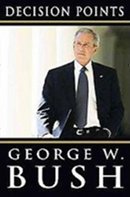
Bible reading shaped life, decisions, Bush writes

WASHINGTON (RNS)—Former President George W. Bush made no secret his politics were tinged by his religious faith, but now says he never would have made it to the White House without a fateful—and faith-filled—decision to quit drinking in 1986.

President Bush marks a National Day of Prayer in the East Room of the White House. (RNS FILE PHOTO/Joyce N. Boghosian/White House)

“I could not have quit drinking without faith,” Bush writes in his recently released memoir, Decision Points. “I also don’t think my faith would be as strong if I hadn’t quit drinking.”

Across 497 pages, Bush recounts the ways religious faith shaped his life and his politics. While religion is not a central thrust of the book, it’s nonetheless a constant theme.

Attending Presbyterian and Methodist churches in Midland, Bush writes that “religion had always been a part of my life, but I really wasn’t a believer.”

That changed with his decision to quit drinking a year after evangelist Billy Graham visited the Bush vacation home in Maine in 1985.

At that time, Bush said, he was an occasional reader of the Bible, which he viewed as “a kind of self-improvement course.” During that well-known walk with Graham, the evangelist said the point of the Scriptures was to follow Christ, not just to improve himself.

“Billy had planted a seed,” Bush wrote.

Months after returning to Texas, Bush joined a weekly Bible study.

He soon started reading the Bible every morning, a practice he continued throughout his time at the White House.

While Graham helped Bush overcome alcohol, a Texas pastor inspired him to pursue the presidency. At a service to mark his second inauguration as Texas governor, Bush heard Mark Craig, pastor of First United Methodist Church in Austin, recount the biblical story of a once-hesitant Moses leading the Israelites into the Promised Land.


“We have the opportunity, each and every one of us, to do the right thing, and for the right reason,” Bush recalled Craig preaching. At the other end of the pew, Barbara Bush mouthed to her son, “He is talking to you.”

Once in the White House, Bush’s faith played a role in both presidential and personal decisions. His push for global AIDS relief was fueled by his visit to a Ugandan clinic, where he left feeling challenged by the biblical admonition: “To whom much is given, much is required.”

His moral views also contributed to his decision to limit federal funding of embryonic stem cell research. When he decided in 2001 to try to bar the use of federal funds “to support the destruction of life for medical gain,” Bush said he was struck by the personal nature of the criticism.

“They mocked my appearance, my accent and my religious beliefs,” he wrote. “I was labeled a Nazi, a war criminal, and Satan himself,” but Bush says the “shrill debate” never prompted him to second-guess his decision.

Bush also defends his Office of Faith-based and Community Initiatives, which he said helped more than 5,000 charities receive federal grants.

As president, his reliance on faith continued through his last day in the White House.

“I began Tuesday, January 20, 2009, the same way I had started every day for the past eight years: I read the Bible,” he wrote in his epilogue.


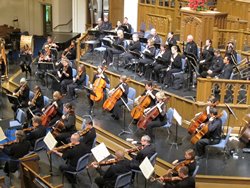
Music into manna: symphony concert benefits church’s hunger ministry

FORT WORTH (ABP) — A free concert at a North Texas church turned into a blessing for the city's hungry and homeless.

When members of the Fort Worth Symphony Orchestra approached Broadway Baptist Church about staging a concert as a gift to the community, it sounded like a good idea. Then the musicians added that they wanted the event to benefit the church's Agape Meal ministry.

More than 850 persons attended the benefit concert by musicians of the Fort Worth Symphony Orchestra.

An offering during the 90-minute concert in Broadway's sanctuary on Nov. 16 raised $5,600 for the Agape Meal. That's enough to cover the cost of about seven weeks of meals served every Thursday evening in the church's fellowship hall, said Brent Beasley, senior pastor.

Beasley said linking good music and a good cause complemented the church's mission. He quoted French philosopher Albert Camus, who said: "In this world there is beauty, and there are the humiliated. And we must try, hard as it is, not to be unfaithful to one or the other."

"At Broadway, we see our mission as trying to hold together both the love and worship of God through the beauty of the arts and the love and care for the poor and broken who are our neighbors," the pastor said. "This was a great chance to be faithful to beauty and the broken in the same event."

One of several community ministries supported by the church's partnership with Buckner International, the Agape Meal has dished up a hot meal once a week for more than 15 years. Meals are served family style on white cloth-covered tables with real plates, glasses, silverware and linen napkins. Diners are welcomed as guests by volunteers who serve the food, refill drinks and host tables.

Each week the church serves about 175 guests.

An offering during the 90-minute concert in Broadway's sanctuary on Nov. 16 raised $5,600 for the Agape Meal.

"The Agape Meal is about feeding the hungry, but it is more than that," Beasley said. "It is a meal with dignity, and it gives us the opportunity to sit down together around the table with our homeless friends and build relationships. Jesus made a point of breaking down social barriers by sharing a meal with all sorts of people, and we're just trying to follow his example."

Beasley said he hopes members of the symphony will someday play at one or more of the Agape Meals.

Bassist Brian Perry, who worked with Broadway organist Al Travis to organize the concert, won't be surprised if that happens. "The Agape Meal is such a neat concept," he said, adding that colleagues were "thrilled and deeply touched by the whole experience."

"It's heartwarming to know, especially during this season of the year, that the money raised will be enough to get this ministry past Christmas," he said.


David Wilkinson is executive director of Associated Baptist Press. He formerly was on staff at Broadway Baptist Church in Fort Worth.


U.S. is feeling charitable, just not through churches

WASHINGTON (RNS)—Americans are being more generous to religious charities, but why are they skimping on their giving to churches?

A new report from Empty Tomb, an Illinois-based Christian research organization, contains an analysis that found from 2007 to 2008, Protestant churches saw a decrease of $20.02 in per-member annual charitable gifts.

Meanwhile, Empty Tomb’s analysis of federal data found annual average contributions to the category of “church, religious organizations,” which includes charities like World Vision and Salvation Army, increased by $41.59.

John and Sylvia Ronsvalle direct Empty Tomb, a Champaign, Ill.-based research firm that tracks church giving and financial statistics. (RNS PHOTO)

Sylvia Ronsvalle, executive vice president of Empty Tomb, said the good news/bad news difference is stark: Giving to religious charities is up, but giving to churches is down.

One reason? Churches spend more money on congregational finances and less on missions beyond the church walls, which is unappealing to people who want to support specific causes with a tangible, visible benefit.

“People overall give to vision, and this is just what we’ve observed, that you see that kind of outpouring when there is a specific need,” said Ronsvalle, who co-wrote the 20th edition of the State of Church Giving through 2008 with her husband, John.

For example, The Salvation Army’s iconic Red Kettle Campaign, which provides food, toys and clothing to the needy during Christmas, reached a new record in charitable gifts in 2008 that was up 10 percent from the year before.

Israel Gaither, the national commander of The Salvation Army, attributed the increase in charity to Americans’ willingness to serve during a time of great need, aided by increased use of user-friendly technology like cashless kettles, the iPhone and the Online Red Kettle.

According to the Empty Tomb report, U.S. churches devote more than 85 percent of their spending on “congregational finances” such as salaries, utility bills and brick-and-mortar maintenance. Religious charities, meanwhile, can focus on serving people outside their institutions.

The report’s hefty subtitle calls out churches on their lack of charity: “Kudos to Wycliffe Bible Translators and World Vision for Global At-Scale Goals, But Will Denominations Resist Jesus Christ and Not Spend $1 to $26 Per Member to Reach the Unreached When Jesus Says, ‘You Feed Them?’”

Christian Smith, the director of the Center for the Study of Religion and Society at the University of Notre Dame, said the main reasons Christians hold back on their generosity are bad personal financial habits, distrust of where the money is going and a lack of teaching from the pulpit.

Churches trying to serve and survive in difficult economic times should not obsess about finances, Smith said, but he conceded that the financial bottom line is a daily reality for congregations.

“Obviously, churches are more than financial,” he said. “They are more than about just money, but it takes resources to hire people and put programs into action and to serve the community.”

Conrad Braaten, pastor of the Washington’s Lutheran Church of the Reformation, said his Capitol Hill congregation continues to support outreach ministries—a food pantry, a GED and job-training program, and repairing houses of low-income homeowners—despite difficult financial times.

Even though the church has seen a decline in giving, he said it has continued charity work by “tightening the belt” on operating expenses.

“That’s why the church exists,” he said. “When we’re focused in upon ourselves, we’ve lost our reason for being.”

Ronsvalle worries about the long-term implications for philanthropy since churches are where most people learn how to be generous. A U.S. Bureau of Labor Statistics survey found 92 percent of charitable giving from people under the age of 25 went to church or religious charities.

“Religion,” Ronsvalle said, “serves as the seedbed of philanthropic giving in America.”


Young Christians seek community among the poor

GRESHAM, Ore. (RNS)—In the two years since David Knepprath and Josh Guisinger moved into the rough-and-tumble Barberry Village complex, about a dozen young Christian men and women have made Barberry Village their home.

Their goal: Create a sense of community in a chaotic neighborhood overrun with drugs, prostitution and gangs.

Their work mirrors, in some ways, the “new monasticism” movement, in which Christians move into urban or rural areas to work with the poor.

David Knepprath (left) and Tyrone Wing (right) live at the rough-and-tumble Barberry Village in Gresham, Ore., as part what they call “intentional living” among the poor. (RNS Photo)

It’s not an easy way to live. Some neighbors have been suspicious. Safety is an ongoing concern. And some of these urban missionaries have burned out on a project that can be a 24-hour-a-day burden.

Yet they’ve been so successful that other complex owners have asked them to replicate their efforts. Congregations have volunteered their services. A woman from Virginia is moving to the Portland area so she can do similar work in another neighborhood.

Now, at least once a month, churches cook meals for the residents at Barberry Village. In early August, children were invited to a three-day Bible camp.

Guisinger and Knepprath and their friends also helped people move. They’ve thrown birthday parties for neighbors. And they cleaned up one woman’s flooded apartment.

Police officers still are dispatched to Barberry Village on a regular basis, sometimes more than once a day. But many neighbors say the complex is safer, friendlier and better for children. A former manager called the young men and women a “godsend.”

“I hope they continue to do this,” said Eugenia Swartout, who lives at the complex with her family. “It gives us some safety and security knowing there are kind people out here and not just bad guys.”

In the beginning, it was just a group of guys sitting around and talking about their faith. Knepprath and Guisinger were buddies in their early 20s, looking to create a ministry that went beyond church walls.

They didn’t want to dabble, though. They wanted to dive in, 24/7.

With guidance from a nonprofit called Compassion Connect, they moved with friends into an apartment, putting two sets of bunk beds in one room and using the other two bedrooms as an office and a closet.

Still, they remained outsiders who could live in almost any neighborhood they chose. They had to strike a delicate balance; they didn’t want to come on too strong and alienate their neighbors.

David Knepprath, center, sings with other members of the Clear Creek Community Church and residents at the Barberry Village apartments in Gresham. Two years ago, Knepprath and three friends moved into the low-income apartment complex so they could work with their new neighbors. (Benjamin Brink/The Oregonian)

So, while they were open about their Christianity, they didn’t plunge into conversations about their faith. Nor did they move in acting as if they could solve the social ills at Barberry Village.

“Our perspective from the start was that we’re not here with all the solutions, or even thinking we know all the problems,” said Knepprath, who has since moved out but remains active in the ministry.

Guisinger hasn’t been bothered by the crime. He previously worked in street ministry and, when he was a kid, his parents invited in strangers who needed help. Living among the poor, however, was something he’d never experienced.

“I wondered if I would be able to relate,” he said. “I grew up in a wealthy family. I never lacked a meal or insurance or anything like that.”

Knepprath lived at the complex after he got married but moved recently to be closer to his job. Guisinger and his friend Jared Simons now have two new roommates. Even after nearly two years, Guisinger has no plans to move.

Instead of staying holed up in their apartments, neighbors now go outside and get to know one another. They invite each other over for dinner. It’s more like a neighborhood than an anonymous apartment complex.

Jesse Danner, a former heroin and cocaine addict who’s been clean for three years, arrived in April 2009 with his wife and their children.

He was worried about moving into the complex, given its reputation. But he met Knepprath and Guisinger when they invited his family for a community meal. Later, Danner’s wife started going to church and was baptized on a camping trip. Now Danner goes to church, too.

One day last October, Knepprath came over and asked Danner for some help with a computer. They walked across the parking lot to a friend’s place. But Knepprath didn’t really need help.

“They actually threw a birthday party for me,” Danner said. “It’s the only one I’ve ever had.”


Faith Digest: How much is a Bible website worth?

How much is a Bible website worth? A disgruntled investor has sued Bible.com, saying the website’s name alone should make it a “goldmine.” James Solakian filed suit against Bible.com, according to the Reuters news agency. He says the website should be worth as least as much as Dictionary.com, Reference.com and Thesaurus.com, which together sold for $100 million in 2007. R.S. “Bud” Miller, an Arizona pastor, registered the domain name in 1996 for $50, and Solakian acquired 28 percent of the company’s equity in 2001. According to the website, it draws more than 2 million visitors each month and is part of a nonprofit ministry that offers daily devotionals, Bible verses and biblical answers for hot topics.

Study notes fitness benefits of faith for black women. Adding faith to the exercise regimen of African-American women may prompt them to be more fit, a UCLA study shows. Researchers studying black women from three Los Angeles churches who participated in faith-based physical activity found the women increased their walking by about three miles per week. The study results, published in the Journal of the American Geriatrics Society, involved 62 women. All participated in exercises but some also listened to Scripture reading and participated in group prayer. Others, in a control group, listened instead to lectures on topics such as memory loss and identity theft. The women involved in the faith-based program increased their weekly steps by 78 percent, while those in the control group saw a 19 percent increase.

Most think sex offenders should be in pews. Nearly eight in 10 respondents who participated in a Christianity Today International survey said convicted sex offenders should be welcomed in church pews. The vast majority of survey participants agreed—so long as offenders who were released from prison were subject to appropriate limitations and kept under supervision. A significant majority—83 percent—said a demonstration of repentance is a key factor in shaping views about whether or not convicted offenders should be welcomed by a congregation. Two in three respondents said their views would depend on whether one or more of the victims of the offender attend the church. The survey was based on the responses of 2,864 people.

Americans want more forgiveness—theoretically. Most Americans want more forgiveness, but they are picky about choosing who to forgive, a new survey showed. Sixty-two percent of American adults said they need more forgiveness in their personal lives, and 94 percent wanted to see more forgiveness in the country, according to a study by the Michigan-based Fetzer Institute. More than half of Americans said there are situations where people never should be forgiven, including abuse, sexual crimes, murder and other intentionally committed crimes. The survey found a majority of Americans also believe forgiveness is conditional. Findings were based on an online survey taken Aug. 4-15 by 1,000 U.S. adults. It has a margin of error of plus or minus 3.1 percentage points.

Compiled from Religion News Service


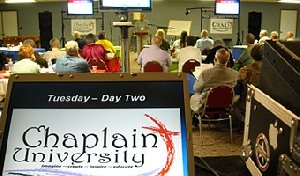
Resort ministry chaplains trained at Chaplain University

Thirty-one students who completed Chaplain University, a training program offered by Christian Resort Ministries International, have been endorsed and qualified for service in RV parks and other recreational settings throughout the United States.

Eddie Bevill (left), a member of the Christian Resort Ministries board of directors, talks with student Eldon Glenn about the ministry opportunities for graduating chaplains. (PHOTO/Robert N. Ruesch)

Christian Resort Ministries requires lay chaplains, who apply for assignment without any formal training at a Bible college or seminary, to complete 30 hours of training within their first 18 months.

All new chaplains receive 40 hours of Hands on Ministry training developed by the Baptist General Convention of Texas, with an additional 12 hours of division-specific chaplaincy training taught by division managers at Chaplain University. 

Chaplains also are required to complete six hours of continuing education annually.

In addition, chaplains are trained in NOVA disaster response, suicide intervention and first-responder intervention, said Dennis Maloney, general director of Christian Resort Ministries International.

Students attend Chaplain University, a training program offered by Christian Resort Ministries International.

“We want our chaplains to be equipped to be the finest they can be and be able to bring the word of the saving grace of Jesus Christ to those who don’t know and who know him. … Jesus clearly states, in Acts 1:8, we need to be his witness in Jerusalem, and all Judea, and Samaria, and to the ends of the earth. Resort ministry in RV parks, campgrounds and resorts spans all the requirements in the Acts passage,” Maloney said.

Christian Resort Ministries has endorsed chaplains who serve in 25 Texas resorts, particularly in the Rio Grande Valley.

Chaplain University is a three- phase teaching process over three years and is offered in the Branson, Mo, area each year in the fall.

For more information about resort chaplaincy, visit www.crmintl.org.


Small dedicated following keeps shape-note singing alive

BIRMINGHAM, Ala. (RNS)—The archaic sounds that fill the historic former church sanctuary echo, hauntingly, like a whispering ghost from the past.

Inside the 1902 building that once housed Second Presbyterian Church, the elaborate archways bounce back the sound of Sacred Harp singing.

Tim Cook leads a class for shape-note singing at the University of Alabama at Birmingham. The ancient music is based on different shaped notes and is sung a cappella. (PHOTO/RNS/Mark Almond/The Birmingham News)

It’s a style of music that once dominated rural evangelical religion, in the days before the Civil War and church organs, when a capella singing was the norm. It’s never entirely died out, in part because of people like Tim Cook.

“It was once common throughout the South,” said Cook, a shape-note singing aficionado who brought his lessons to the former church that’s now part of the University of Alabama at Birmingham campus.

Cook’s group of more than a dozen interested singers sat facing Cook as the song leader, holding wide-page hymnbooks filled with notes in the shapes of open and solid squares, diamonds, triangles and ovals.

Throughout the 1800s, the mournful harmonious sounds of a capella shape-note singing reverberated in churches throughout the South. It’s now experiencing a renaissance of sorts in Sacred Harp songbooks and conventions. But while Sacred Harp singing has surged, the more-complicated seven-shape-note Alabama Christian Harmony singing struggles to stay alive.

“We certainly don’t want it to die out,” said Emily Creel of Burleson, Ala., who carries on her family’s generations-long love affair with the music. “We do it to promote the heritage and tradition of the music.”

The Internet has helped create a revival for shape-note singing, connecting singers and bringing them together for events across the country.

{youtube}YHUfHNEZDPc{/youtube}

Cook says having the notes in different shapes makes it easier to read and sing the music in four-part harmony.

Participants sing the actual note sounds first: “fa” for triangle shape notes, “sol” for oval, “la” for square and “mi” for diamond-shape notes. Then they sing it with the lyrics.

The combination of archaic harmonies and old-style lyrics can be jolting to outsiders. To others, it’s addictive. Many of the shape-note songs were written by English composers such as Isaac Watts and Charles Wesley, set to old English dance tunes and carried from churches in rural England by colonial settlers.

The tradition was carried to the South, where many churches continued the shape-note a capella singing of the hymns with complex harmonies. The songs may have archaic, cryptic names such as “Old Hundred,” better known in many hymnbooks as “The Doxology.” “Amazing Grace” appears in shape-note books as “New Britain.”

When pianos and organs became common in churches, a capella singing began to disappear, along with the complicated harmonies in the old hymnbooks.

Cook took up shape-note singing after moving from Michigan to Atlanta in 1995, and now he teaches it and leads singings.

“I’ve always like to sing a capella, four-part harmony,” Cook said. “When I heard this the first time, I said, ‘That is the voice of heaven.’”


Greg Garrison writes for The Birmingham News in Birmingham, Ala.


‘Love makes a difference’ for children who need homes, musician insists

NASHVILLE, Tenn. —While performing concerts around the country, Dove Award-winning recording artist Mark Schultz often shares his testimony and personal story of adoption in hopes of raising awareness for orphan care and helping young families recognize this desperate need.

“It must have been so hard for my biological mother to give birth to a baby and say with tears in her eyes: ‘There’s so much I want to give you that I can’t. So, I’m going to love you by giving you to someone who can take care of you,’” Schultz said. 

Mark Schultz

“That’s amazing to me, and every day I’m grateful for the parents who adopted me when I was two weeks old and helped me to become the person I am today.”

Schultz hopes that having his songs featured on national television programs such as 48 Hours and Extreme Makeover: Home Edition will provide opportunities to spark conversations with non-Christians and lead them into a relationship with Christ.

His latest album, Come Alive, is a collection of songs that explore life’s greatest joys and toughest challenges while celebrating God’s presence in every moment.

“I would hope that as people listen to these songs and identify with the struggles, that they would know that God is the same through the struggles as he is during the triumphant moments,” Schultz said. ”His love and faithfulness never change.”

Desiring to help make a difference in the lives of orphans, Schultz went on a 3,500-mile bicycle ride across America in 2007, which raised more than $250,000. 

As a strong advocate for adoption, Schultz and his wife, Kate, who is a doctor, are considering adopting children with special needs.

“My wife came home one day from the hospital and brought up the subject,” Schultz explained. ”She asked me what I thought about adopting children with special needs, even children that the doctors believed would only live a short time on this earth. She lovingly said that caring for children in this situation is something we should consider and pray about for our future. 

“She shared: ‘Before they go to heaven, I want them to experience what a great Christmas is like, what a great birthday is like and most importantly, let them know they are loved well on this earth—before they get to heaven and are held in the arms of God.’ The more I thought about it, I realized that as Christians, we are called to love. If that means loving a baby that will be here seven minutes or 70 years, it’s showing love that makes a difference.”


Photographers capture infants’ brief lives on film

MADISON, Ala. (RNS)—For the entire lifetime of his daughter, Joey Karr smiled into her eyes. Then the infant, who couldn’t overcome a fatal form of dwarfism, died in his wife’s arms as their other three children patted their sister.

Photographer Kelly Clark Baugher caught that lifetime of love in photos—images now sacred with the weight of life and loss that the death of a baby brings.

Joey Karr shares a lifetime of love with his daughter, Janie Beth, after she is unhooked from life support. The family was photographed as part of the Now I Lay Me Down to Sleep project. (PHOTO/RNS/Courtesy Kelly Clark Baugher)

Baugher is one of a small but devoted number of professional photographers who volunteer their time at hospitals to take pictures of heartbreakingly short-lived joy.

A Colorado-based group, Now I Lay Me Down to Sleep, sends professional photographers—if the families request them—to record their child’s brief life.

“It’s one of the most wonderful things I’ve ever done,” Baugher said as she looked through photos from more than 60 families she and photographer Mary Ellen Pollard have served.

“It’s almost as though time slows down in that room. I will never forget the feeling. I felt God in that room.”

She refers to the hospital rooms where parents sit with an infant that was stillborn or has been disconnected from life support when death has become the kindest option. The photographers stay at the periphery, quietly working without a flash as they record the fleeting moments.

The idea is macabre only for people who haven’t lived through it, said Ken and Amy Salter, who became the parents of twin boys born last fall, one of whom died after months in neonatal intensive care. They agreed to have their last minutes photographed when nurses suggested they call Baugher.

“The photographs are a lasting comfort,” said Amy Salter, who now volunteers as a parent coordinator for Now I Lay Me Down to Sleep. “Yes, it was difficult, but to have pictures, to remember the little smile he makes, his little fuzzy head—it’s priceless.”

{youtube}MlKhrCORF8w{/youtube}

The photographers make a CD of the photographs after they edit the photos, giving parents finished pictures with the calm sheen of magazine shots. Parents can choose to print them or look at them—or not. Many find themselves returning to them often for a quiet space of remembering and weeping, Salter said.

Nurses who have assisted families going through such a wrenching time have seen how the photos become, later, a source of comfort as people thread the long valley of grief.

“Pictures, as well as clothing, footprints, handprints, stuffed animals and blankets are tangible reminders to these families of the precious little life they have lost,” said Ashley Ray, a nurse in Huntsville, Ala., who works with bereaved parents.

“It is so awesome to be able to offer these families professional photos of their sweet babies.”

For the photographers, it’s a ministry, Mary Ellen Pollard said.

“I had my son two months early, and he is still with us on this side of heaven,” Pollard said. “He spent two months in the NICU. We were told he was not going to survive, but our son went home. Beside us, there was a family whose daughter didn’t. I needed to do something to give back.”

The photographs help to make the lifetime of their daughter real, said Joey and Michelle Karr, who lost their daughter, Janie Beth.

“The one time Janie Beth opened her eyes, Kelly happened to catch that on film. I never even noticed she was taking a picture,” Joey Karr said.

But Baugher noticed the moment when the tiny face peers up at her father from his arms.

“It’s like she looked right into his soul,” Baugher said,


Kay Campbell writes for The Huntsville Times in Huntsville, Ala.