Consider worship through lens of autism, researcher urges

WACO—“Do I belong here?” When people with autism and their families ask the question about church, it may be difficult to answer.

If churches want autistic individuals and their families to feel welcomed and supported, they must reconsider worship “through the lens of autism,” researcher Armand Léon van Ommen said at a recent community talk hosted by Baylor University’s Truett Theological Seminary and the Baylor Collaborative on Faith and Disability.

Van Ommen, senior lecturer in practical theology at the University of Aberdeen, conducted his research by listening to people with autism and their families, with a focus on nonspeakers.

So, his talk included many first-person accounts of study participants’ experiences, without including their names.

He identified four key areas to think about through the lens of autism: church as sensory, church as social, thinking differently and “what you do is who you are.”

Church as sensory

“Church is a highly sensory space,” van Ommen said. Since differences in sensory perception is characteristic of autism, churches need to consider how sensory stimulation in worship services affects people with autism, he said.

Autistic individuals might be hypersensitive and find sensory stimulation overwhelming. They may be hyposensitive, having a muted response to stimulation. Or they may be sensory-seeking.

Stimming [self-stimulating behavior including arm or hand-flapping, finger-flicking, rocking, jumping, spinning or twirling, head-banging and complex body movements] could be seen as sensory-seeking,” van Ommen said.

Differing sensory perception means “lows can be lower to the extent that it can be [physically] painful,” van Ommen said. Participants in his study reported if something in the worship service impacts negatively, they “could need to recover for a full day after Sunday worship.”

The auditory aspect of worship can be challenging for autistic people, not only related to volume, but also balance, van Ommen said. One study participant noted when the music is out of tune, it is so painful, “it makes me feel quite ill … like I want to vomit.”

Touch involved in worship also can be hard. Holding hands to pray or greetings with handshakes and hugs “can be cringy” for autistic people, van Ommen said. However, he added, autistic people often welcome hugs—but only from friends.

“You have to understand, when I ask for accommodations, it’s not to be catered to, but it’s so I can participate at all,” one study participant said.

Church as social

Church also is highly social. Since differences in social interaction and communication are characteristics of autism, churches should think about how the social aspects of church pose hurdles for autistic people, van Ommen said.

Encounters with the welcome team at the door, navigating past groups of people to get to the worship center, finding a seat, and people unexpectedly chatting with them all are social stressors before the worship service even begins for autistic people, who “are constantly second-guessing social clues and what people say,” van Ommen said.

However, it’s a myth that autistic individuals only care about themselves or that if an “autistic person doesn’t initiate contact, they aren’t interested in me,” he continued.

Social interactions are “daunting but desired,” van Ommen said. Social situations can be difficult, but every autistic person he has worked with desires relationship, he added.

Thinking differently

Autistic people think differently from non-autistic people. One study participant described “seeing patterns, shapes and colors in the liturgy.”

If the liturgy was delivered well, she could participate in worship—seeing these colors shapes and patterns, even when she visited a liturgical service conducted in a language she did not speak, she reported.

But if it was delivered poorly, even when she could understand the words, the delivery kept her from seeing the patterns, colors and shapes necessary for her to worship, van Ommen said.

Autistic people are good at seeing theological practices as the social constructs they are and pointing out things that don’t quite ring true, van Ommen said.

“Autistic people are much more likely to stick up our hand and say: ‘That doesn’t make sense. Teach me that better,’” one study participant said.

Van Ommen said questions from autistic people aren’t always welcome, but we need to listen to autistic people’s theology.

“You don’t have to agree with it,” another autistic person said. “And you probably won’t. But I suppose my dream church would be one open to slightly different ways of looking at things, rather than imposing quite a neurotypical theology onto everybody.”

‘What you do is who you are’

In conclusion, van Ommen discussed the idea that what you do is who you are, or worship practices reflect and shape what worshippers believe.

The mother of an autistic person said, “If you were to analyze it, what happens in our services actually says a lot about what we think is normal, or what we are prepared to accept as normal, and it also says something about what we think is normal in God.”

So, van Ommen said, it is important to create space for autistic members of the body of Christ to feel loved and accepted—as is.

“I don’t want to take joy of the others away by accommodating me,” another participant said. “I just want people ‘to get me’. When I am not supported by the community, I cannot, in turn, give back to the community.”

The church cannot do without autistic people if Christians take 1 Corinthians 12:21-23 seriously, van Ommen said. In the body of Christ, those parts which might be considered weaker should be treated with the greatest esteem.

One autistic person commented: “We are treated as projects, not as people who can contribute. Yet we offer so much.”

Van Ommen suggested churches turn things around.

“What if we started to think about a church where autistic people are central and if the rest want to participate, great,” he said.

To learn more about the subject, find Léon van Ommen’s podcast here.


New ending for ‘How Great Thou Art’

(RNS)—The well-known and beloved-by-many words of “How Great Thou Art” have had a long and varied trajectory from Swedish poem to German hymn to a tradition at Billy Graham crusades.

In celebration of the 75th anniversary of the hymn’s popular English translation, Grammy-winning Christian singer-songwriter Matt Redman has teamed up with 15 other artists and released a new version, continuing the hymn’s transatlantic trek that has led it to be featured in countless hymnals and recorded on hundreds of albums.

“Someone wrote something out of the depths of their heart toward God, and then it got wings,” Redman said in a late February interview. “It’s just phenomenal to think—isn’t it?—that Elvis recorded this, and he gave it some extra wings. And then Carrie Underwood’s version is another version a lot of people talk about.”

Redman first sang and played the hymn as a teenage guitar player in an Anglican church in the English village of Chorleywood because, he said, its chord structure was easier to manage than other hymns. Now, he has added to the complex history of the hymn after being approached by the British charity that owns the copyright for it, the Stuart Hine Trust.

Hine was a British missionary who published the English words in his gospel magazine in 1949. He was inspired by a Russian hymn—which was based on an original Swedish poem—when he was traveling hundreds of miles via bicycle to distribute Bibles and preach through the Carpathian Mountains that traverse Eastern Europe.

Ukrainian aid tied to new verse

Redman worked with Australian native Mitch Wong on the commission of “How Great Thou Art (Until That Day),” which features a new verse, a different beat and a chance to provide humanitarian aid to Ukrainians and other Eastern Europeans in the midst of war.

“We decided we’re going to have the word ‘war’ in this hymn,” said Redman, who noted he thinks worship songs should not be considered “escapist” means to momentarily leave behind the problems of the world.

“Now, that’s not a normal kind of hymn word. It’s not something people often would think of singing on a Sunday morning, but it felt like an important word.”

The new stanza of the hymn reads: “Until that day / When heaven bids us welcome / And as we walk this broken warring world, / Your kingdom come, / Deliver us from evil, / And we’ll proclaim our God how great You are! / With hope we’ll sing our God how great You are!”

The hymn has been played over 2.5 million times on digital streaming platforms in the month since its release on Jan. 26 by Capitol CMG Publishing. Phil Loose, one of the trustees, said it is too soon to know how much money the recording has raised.

The Stuart Hine Trust, which has supported Christian outreach and Bible translation, intends to use the proceeds from the writing, production and royalties of the recording to provide humanitarian aid and support rebuilding efforts in Eastern Europe.

‘How Great Thou Art’ through the years

Over its lifetime, the hymn has faced moments of relative obscurity and waves of popularity. It dates to 1885 or 1886, when Swedish editor Carl Boberg got caught in a thunderstorm and wrote the first version, then titled “O Store Gud” (or “O Mighty God”), after marveling at the calm that followed the storm. It was published in a newspaper, then set to music in his country.

Though some of its history is hazy, music professor C. Michael Hawn wrote that an English translation made it into some hymnals but “never caught on.”

In the early 1900s, the words were translated into German and then Russian, which Hine heard sung while in the Eastern European mountains. He paraphrased the first two verses in English and was inspired to write the third and fourth verses of “How Great Thou Art” over a 14-year period, according to his trust’s website.

The website quotes him as writing, “The thoughts of the first three verses of How Great Thou Art! were born, line by line, amid my unforgettable experiences in those mountains.”

The fourth verse, which begins with the words, “When Christ shall come with shout of acclamation,” was written in 1948 to assuage the grief of Eastern Europeans after the end of World War II.

In the 1950s, the hymn began to have what Redman called a “wildfire moment” when singer George Beverly Shea started using it at the “crusades” of evangelist Billy Graham—including one at New York’s Madison Square Garden that was broadcast on television and lasted 16 consecutive weeks.

Shea wrote in his 2004 book, How Sweet the Sound: Amazing Stories and Grace-filled Reflections on Beloved Hymns and Gospel Songs, about how he changed the lyrics “consider all the works thy hands have made” to “consider all the worlds thy hands have made” and modified “I hear the mighty thunder” to “I hear the rolling thunder.”

“I got a bang when I used to hear Elvis Presley sing my two words,” he said in a Religion News Service interview about the rock-and-roll singer, who won his first Grammy for his 1967 rendition of the hymn and earned another for his 1974 live version of it.

Congregational hymn

Brian Hehn, director of The Hymn Society’s Center for Congregational Song, said the hymn lends itself to both congregational singing and solo and duet voices, as in Redman’s and Wong’s new version.

“I think it does point to the general singability of the song,” he said. “And that’s one of the reasons why it’s very popular, right? Because congregations can sing it. It feels good to sing.”

The hymn, which was popular in the society’s March Madness-type tournament in 2019, is sung both in churches that use contemporary Christian music and is featured in hymnals used in mainline Protestant, African American and Catholic churches.

Hehn notes the new version leaves out the second verse often found in hymnals, and the new verse moves more quickly to the hymn’s focus on a belief in the atonement of Jesus.

“The new stanza also acknowledges the tension between living in the ‘in between’ time where Christ’s victory over death has been completed and yet there is still death and sin because that final day when all tears are wiped away has not yet arrived,” Hehn added via email.

“With the nod towards that ‘in between’ time and the addition of the word ‘hope,’ they’ve transformed what was originally a song of praise appropriate for any season into what I read as an Advent hymn!” he wrote.

Collaborative effort on newest release

The latest version featured coast-to-coast logistics, with some of the contemporary Christian and country artists recording their parts in California and others in Tennessee at Nashville’s RCA Studio B, where Presley once recorded it.

Worship leader Chris Tomlin and country band Lady A’s Hillary Scott sing the first verse of the hymn, while Redman and producer Matt Maher sing the new last verse. Other sections include vocalists Naomi Raine of Maverick City Music, TAYA and Blessing Offor.

Jon Reddick, a worship pastor at Church of the City in the Nashville suburb of Franklin, was part of the recording session in California. He said he enjoyed both the “synergy” of the artists coming together and the chance to sing a song they knew but were also getting to learn in a new way with the additional verse.

“You’re in the room with people you even know and love and admire, or just getting to meet and still admire,” said Roddick, who expects to lead the new version in his congregation when he concludes his time on TobyMac’s Hits Deep Tour.

“It was creative. It was fun. It was spirit-filled. It was a moment.”

Redman said producers were challenged to figure out which voices to use for which parts of the hymn, as they asked each singer to perform more lines than the ones in which they are heard on the recording. Though the compiling of the recordings was like a “jigsaw puzzle,” he said, getting people into the studios was easier.

“When we approached all the people to be part of it, we had a lot of green lights very quickly,” he said, noting they came together for the music and the Ukraine-related mission. “You could tell how dearly they loved the hymn.”


Survey finds pockets of support for Christian nationalism

(RNS)—A new report released Feb. 28 found roughly 3 in 10 Americans express some sympathy for Christian nationalism, with its greatest popularity concentrated in the Southeast and Upper Midwest.

The findings appear in a study from the Public Religion Research Institute, which probed public support for Christian nationalism as part of a broader survey of more than 22,000 adults.

To assess feelings about Christian nationalism, respondents were asked whether they completely agree, mostly agree, mostly disagree or completely disagree with five statements, including “the U.S. government should declare America a Christian nation” and “U.S. laws should be based on Christian values.”

PRRI broke out four categories depending on how people responded to the questions. Those most supportive of the ideology—10 percent of the country—were dubbed Adherents, followed by Sympathizers, who represent 20 percent of the country. Those who disagreed with the statements were classified as Skeptics (37 percent) or Rejecters (30 percent).

Christian nationalism by state

Mississippi and North Dakota showed the highest levels of support for Christian nationalism, with Adherents and Sympathizers making up 50 percent of those states. They are followed by Alabama (47 percent), West Virginia (47 percent), Louisiana (46 percent), Tennessee (45 percent), Kentucky (45 percent), Nebraska (45 percent) and Wyoming (45 percent).

States exhibiting the least support for Christian nationalism were Oregon (17 percent), Massachusetts (18 percent), Maryland (19 percent), New York (19 percent), New Jersey (20 percent) and Washington (20 percent).

Adherents make up 12 percent and Sympathizers make up 22 percent of Texas. Skeptics are the largest group in Texas at 39 percent, followed by Rejecters at 24 percent.

Voting patterns reflected the presence of Christian nationalist ideas as well. “Residents of red states are significantly more likely than those in blue states to hold Christian nationalist beliefs,” the report reads. Researchers later note, overall, nearly 4 in 10 residents of red states express support for Christian nationalism.

Christian nationalism by party

The survey also noted a strong correlation between support for Christian nationalism and support for the Republican Party, as well as for former President Donald Trump, who long has made appeals to Christian nationalists on the stump.

Last week, in addressing the annual gathering of National Religious Broadcasters, a disproportionately evangelical Christian group, Trump promised the crowd: “If I get in, you’re going to be using that power at a level that you’ve never used before.” He later added: “With your help and God’s grace, the great revival of America begins on Nov. 5.”

In PRRI’s survey, among those who hold favorable views of Trump, 55 percent qualify as Christian nationalists (21 percent Adherents and 34 percent Sympathizers). Only 15 percent (4 percent Adherents and 11 percent Sympathizers) of those who hold favorable views of President Joe Biden were identified as Christian nationalists.

“As the proportion of Christian nationalists in a state increases, the percentage of residents who voted for Trump in 2020 also increases,” the report reads. “If the analysis is restricted to white Americans only, the relationship between state-level support for Christian nationalism and votes for Trump in 2020 becomes even stronger.”

Christian nationalism by faith

The survey found support for Christian nationalism concentrated in two religious groups: white evangelical Protestants (66 percent) and Hispanic Protestants (55 percent).

Christians who ascribe to beliefs often associated with Pentecostals and charismatic Christianity—such as modern-day prophecy, spiritual healing and the prosperity gospel—were particularly drawn to the ideology.

Trump supporters—some holding Bibles and religious banners— gather outside the Capitol, Wednesday, Jan. 6, 2021, in Washington. (AP Photo/John Minchillo)

Christian nationalism has been associated with political violence in part because of the ideology’s visible influence on the Capitol insurrection that took place on Jan. 6, 2021.

According to PRRI’s survey, there’s reason to suspect that association is not a coincidence: Christian nationalists are about twice as likely as other Americans to believe political violence may be justified, with 38 percent of Adherents and 33 percent of Sympathizers agreeing “because things have gotten so far off track, true American patriots may have to resort to violence to save the country.”

The survey also offered a potential preview of how Christian nationalism—and the political coalitions associated with it—could end up shaping this year’s presidential election. Asked about immigration and access to guns, about 50 percent of Adherents said they would vote only for a candidate who shared their views on the issues.

But the most ardent Christian nationalists hardly will be the most powerful force come November. Asked about abortion, half of Rejectors—who alone nearly outnumber Adherents—said they were unwilling to support a candidate who differs from them on their mostly liberal abortion views.

This story was reported with support from the Stiefel Freethought Foundation. With additional reporting by Editor Eric Black.


Christians disagree about Alabama embryo ruling

(RNS)—When Alabama Supreme Court Chief Justice Tom Parker issued his concurring opinion earlier this month in the court’s controversial ruling declaring frozen embryos children, he did so with an unapologetically religious flair.

The Feb. 16 ruling—which has resulted in all but halting in vitro fertilization procedures, which can use frozen embryos to help people become pregnant, in the state—drew on anti-abortion language in the Alabama Constitution to conclude embryos created during IVF have the same rights as children.

Alabama Supreme Court Justice Tom Parker speaks on the steps of the state judicial building on April 5, 2006, in Montgomery, Ala. When the court ruled this month that frozen embryos are children, Parker, now the chief justice, made explicit use of Christian theology to justify the court’s decision in his concurrence, where his language echoed the broader anti-abortion movement. (AP Photo/Jamie Martin, File)

Parker, amid references to theologians and the Bible, concluded that by declaring frozen embryos children, Alabama was modeling a “theologically based view of the sanctity of life” that insists “human life cannot be wrongfully destroyed without incurring the wrath of a holy God.”

Parker may have presented his policy position as rooted in an authoritative Christian view, but he may be in the minority when it comes to his fellow religious Americans—including Christians.

Religious views on fertility treatments

While personal views on IVF are harder to assess, there seems to be broad familiarity with the practice among religious groups.

When Pew Research asked adult respondents last year whether they have used fertility treatments to have children or know anyone who has, white Catholics were the mostly likely to say yes (55 percent), followed by white mainline Protestants (48 percent), white evangelicals (44 percent)—all higher percentages than those who identified as atheist or claimed no particular religion (40 percent).

Hispanic Catholics (29 percent) and Black Protestants (26 percent) were the least likely to say they used fertility treatments or know someone who has, although Pew researchers told Religion News Service that finding “appears to be driven more by differences across race and ethnicity than religion.”

In addition, the researchers elsewhere noted wealthier people are more likely to say they’ve used fertility treatments or know someone who has, an “unsurprising” finding given the high cost of IVF, which can range from $15,000 to $20,000.

Some of the outspoken opinions on IVF fall along predictable lines, mirroring that of the abortion debate. Religious advocates for abortion rights support IVF, and the Catholic leadership opposes it.

Denominational views on IVF

But IVF is arguably a narrower issue: Even among religious groups that seek to ban abortion, many do not agree the destruction of frozen embryos is the same as taking a life. Some mainline denominations do not even have an official position on IVF, such as the Evangelical Lutheran Church in America.

Other groups openly have praised the practice, particularly more liberal-leaning mainline denominations.

The Episcopal Church has endorsed IVF since 1982, and the United Church of Christ passed a resolution at its 1989 General Assembly that referenced IVF before declaring the denomination “supports the rights of families to make decisions regarding their use of the reproductive technologies.”

“A lot has changed in the field of reproductive technologies since 1989, but our values have been consistent in this regard,” Rev. Shari Prestemon, the UCC’s current acting associate general minister, told RNS in a statement.

“We support the rights of individuals and families to make these very private decisions for themselves, and urge care and compassion for these families along what can often be such a painful and challenging journey,” Prestemon wrote.

Even denominations that have expressed ambivalence about abortion have nonetheless voiced openness to IVF.

Although the United Methodist Church has issued statements saying it is “reluctant to approve abortion” and declared in 2016 that people “should not create embryos with the sole intention of destroying them,” it grants an exception for IVF.

A UMC denominational resolution stated that “obtaining and fertilizing multiple ova may be justified” even if embryos are lost, because it helps “avoid the necessity of multiple attempts to obtain ova.”

Religious reactions to Alabama ruling

Religious advocates for abortion rights were among the first to voice outrage over the Alabama court’s ruling, arguing it furthers a disputed theological claim about when life begins—one not shared by all religious Americans.

Rev. Katey Zeh (Courtesy photo)

“I don’t think anyone could make a biblical claim about this because the technology of IVF is very modern,” said Rev. Katey Zeh, the head of the Religious Coalition for Reproductive Choice, a group that advocates for abortion rights.

“There’s a huge spectrum of theological opinion about when life begins or when personhood begins,” she told RNS in an interview. “There’s no consensus here, so there’s a lot of hubris in claiming—especially in the legal standing—that this is the theological viewpoint of an entire religious tradition. That’s certainly not true.”

Zeh argued opposition to IVF often is fueled by broader faith-based campaigns against abortion, with some religious leaders and activists insisting the destruction of unused frozen embryos is tantamount to an abortion.

Some religious institutions, such as the Catholic Church, have enveloped opposition to IVF into their larger anti-abortion stance.

A 1998 document promoted by the U.S. Conference of Catholic Bishops deemed the discarding of unused embryos in IVF is “a terrible offense against human life,” arguing that while a baby may still be born, “other lives are usually snuffed out in the process.”

Evangelical support for IVF

Meanwhile, Southern Baptists such as Andrew T. Walker, a professor at Southern Baptist Theological Seminary, have called on the denomination to adopt an official resolution addressing IVF at its next convention later this year.

“When you consider the moral goods that Scripture holds as inseverable for where conception ought to occur, IVF is ruled out,” Walker posted on X earlier this month.

But there is even some evidence evangelicals support IVF, at least according to Republican officials.

In the wake of the Alabama ruling, the National Republican Senatorial Committee sent out a memo discouraging candidates from voicing agreement with the decision. According to Politico, the memo cited a survey conducted in October by a consulting firm associated with Kellyanne Conway, former President Donald Trump’s onetime senior counselor, that found 83 percent of evangelicals support IVF.

Attempts to reach the polling firm associated with Conway, The Polling Co., were unsuccessful.

For advocates such as Zeh, the Alabama Supreme Court’s ruling, which already has ground IVF procedures to a halt in many parts of Alabama, crosses a moral line by putting infertility treatments even further out of reach.

“It just feels so similar to rulings about abortion—the lack of regard to the people whose lives are actually impacted,” she said. “As a person of faith, that’s what feels so immoral to me.”


New animated series encourages kids to watch the Bible

WASHINGTON (RNS)—The Christian production company Revelation Media will unveil its new animated Bible project on Easter, with the first segment aiming to depict the stories of the Book of Genesis in a child-friendly way.

Steve Cleary

Watching the iBible will appeal to digital natives more than reading Scripture, said Steve Cleary, executive director and producer of the series.

“We want kids to read their Bible, but if we don’t reach them in a visual manner, we’re seeing the result. They don’t. They’re not reading their Bible,” he said.

He believes short attention spans and a growing aversion to reading are making it impossible for kids to get interested in the Bible. Churches are late to the party when it comes to finding creative ways to interest internet-savvy kids in biblical texts, Cleary said.

His solution is to reach young kids where they are—on screens. From the creation story to the death of Joseph, the 42 episodes will tell stories from the Old Testament in hopes of increasing a younger generation’s biblical literacy.

This animated Bible translation, the first of its kind, he said, strives to be a “legitimate Bible translation.” All scripts of the seven-minute episodes are approved by the Summer Institute of Linguistics, an evangelical nonprofit that rates the accuracy of Bible translations.

‘You’ll never forget what you see’

The episodes, which are planned to depict the Hebrew Bible and the New Testament, were also reviewed by Anglican, Presbyterian, Baptist, Pentecostal and Methodist clergy members. The entire project is expected to take years to complete.

In the meantime, an episode titled “The Real Story of Jesus” is already available for users who want to skip to the Gospels. Each episode is also followed by a discussion prompt for kids to consider.

With a background in animation—Cleary co-produced the animated “The Pilgrim’s Progress” in 2019—he said he’s seen the power of visual learning for Generation Z and Generation Alpha.

 “You can read something dramatic and easily forget it. But you’ll never forget what you see,” said Cleary, who has recruited around 50 people to work on the project now.

The 500,000 viewers who watched “Pilgrim’s Progress” during the COVID-19 lockdown were also the first to hear about the iBible project via email, and their monetary donations supported the project’s early days. According to a Revelation Media press release, the entire iBible project will require $25 million in funding.

Touching on taboo topics

Cleary said translating the Bible in short animation clips allows pastors and parents to touch on taboo topics with kids.

A scene from “The Great Flood (Part 1),” part of the animated Bible series produced by iBible. (Image courtesy of Revelation Media)

For a long time, the iBible team was torn on how to tell stories of violence and abuse appropriately for kids. The first feedback from parents on the episode depicting the rape of Dinah, the daughter of Leah and Jacob, convinced the project team that showing these parts of the Scriptures was essential. It also forces churches to have tough but essential discussions with kids.

“If we’re going to do the whole story, we can’t shy away from that,” said Cleary, before adding, “The hard stories ended up being the biggest benefit, honestly, to getting churches involved.”

The first episodes will be available in English, Swahili, Hindi, Spanish, Farsi and Bulgarian. Cleary hopes it will be translated into more languages soon and distributed in hundreds of countries.

Translators from all over the globe joined the project. The Ukrainian team working from Lviv since 2022, before the war with Russia broke out, said it has pursued its efforts despite being psychologically impacted by the war.

“Our mission transcends the challenges we face,” said the team’s manager, according to a Revelation media press release.


Can American churches learn to embrace the uncoupled?

WASHINGTON (RNS)—Laura Hepker, a 50-year-old single IT manager, has felt like a unicorn in the evangelical Christian churches that she knew from a young age.

“The structures of the church are very much designed for family,” she said.

Data suggests Hepker is anything but a unicorn. Almost half of American adults are now single (including the widowed and divorced), and a Pew Research Center study a few years ago suggested the majority of unmarried men and women aren’t looking to date—and if they are, it’s complicated.

Meanwhile, many churches suffering a decline in attendance tend to focus on traditional families. Studies have shown parents choose churches with their children’s Christian formation in mind, and many pastors are charged with providing ministries that attract these parents to help their congregations survive in an increasingly secular culture.

Why marginalize a large group?

The emphasis on family ministry, however, is stuck in the demographics of mid-century America, when houses of worship were thriving.

“The church model that worked in 1960 doesn’t work anymore,” said Peter McGraw, a professor of marketing and psychology at the University of Colorado at Boulder and author of the recently published Solo.

In an environment where churches are hoping to attract and retain members, McGraw argues, “Why do anything that marginalizes a large group of your congregation?”

McGraw advises churches to look closely at their demographic. Singles, he said, are more prone to be involved in their communities.

“If your goal is to build community, recognize the ways that singles are involved in building community,” McGraw said. “It’s not a dramatic shift, but it requires a shift for people to feel like they belong.”

That includes, he suggests, not only creating inclusive congregational groups, but details like making sure that promotional materials such as emails and newsletters target everyone.

Invite singles into ‘normal spaces’

Evangelical churches seem to be the most dedicated to pursuing families as members—or creating families out of their unpaired members.

Katelyn Lettich, a 28-year-old director of the evangelical Christian organization Young Life, said it seems as if the best the churches she has attended can offer young single members is dating opportunities.

Katelyn Lettich

She advocates putting more unmarried people on church boards and planning committees to make sure singles’ voice are heard, but also to signal they are as welcome as marrieds.

“Invite single people into normal spaces,” Lettich said.

Younger singles aren’t the only ones looking to be included. Lindy Dimeo, 68, a retired crisis pregnancy center director, is a member of Blue Ridge Community Church, a small evangelical church near Charlottesville, Va. Dimeo and her husband played in the worship band together, but after he died, she took a few months off.

“At the time it was hard living a single life in a family-oriented culture,” she said.

But she added it’s possible to grow into a churchgoer in one’s own right. Almost 20 years after her husband’s death, Dimeo said: “It would be nice to have somebody special, but it doesn’t impact my life at church anymore. My church is a very close community.”

Christian communities playing catch-up

Mainline Protestant churches, while perhaps less focused on the theology of family, also have room for improvement, said Pastor Jennifer Schultz of Bethlehem Lutheran Church in Los Alamitos, Calif.

Schultz is divorced and said her congregation, largely retired adults, has never known her as anything but single. It has never been an issue, she said.

“We provide a space for single people, but don’t dwell on it, and don’t make them feel any different,” Schultz said.

But she believes Christian communities are playing catch-up when it comes to welcoming singles, whether young adults, widowed or divorced.

“One of the gifts of the church is that it has the potential to be a community for a variety of people. But I do think maybe we’re kind of behind the ball on that,” she said.

McGraw suggests congregations reevaluate their tactics and to redefine “family” to include broader feelings of community.

Kenny Champagne

Until moving to a new church a few months ago, Kenny Champagne, 39, ran a large young adult ministry at a multicampus congregation in northern Virginia. Most of his charges, who ranged in age from early 20s to upper 30s, were single, he said, but he added, “I don’t think any of them got involved in the ministry with the idea of looking for a significant other.”

One of the primary aims of the group was nurturing friendships and a sense of community, he said, instead of trying to pair them up.

There are signs that some churches are intentionally forming with all types of members in mind. Recently, Hepker found The Table, an Episcopal congregation in Indianapolis that she described as “one of the more relaxed and accepting churches I have ever attended.”

‘Just accepted for being a person’

At The Table, a multigenerational congregation, “you’re just accepted for being a person, and not for your marital or relationship status,” she said.

Nathan Baker, 33, another evangelical who found his way to The Table after a period of “deconstructing” his faith, said he grew up with the expectation that a full life would involve marriage and a “godly family.”

Now on the vestry at The Table, he said single people are part of the fabric of the social and discipleship groups.

“While God intended us to be in relationship with other people,” Baker said, “the pinnacle experience of that isn’t marriage, it’s vulnerable community life together.”

Lettich said more than being OK, singlehood ought to be seen as “a gift.”

“There is something very cool about this time of life,” she added. “I can truly invest in God and the people around me. I’m actually content. I’m not just pining for my next relationship.”

While many people don’t take her at her word, she said: “I think the church is coming around to the idea that single people hold value. They’re not just waiting for marriage, and they don’t have to be waiting for marriage to be a pillar in the church or to be treated as an equal partner, in ministry or in life.”

For those concerned Christians who ask uncoupled friends why they are still single, Lettich has a pithy riposte: “The Bible says not one thing about dating.”


Editors create Breathe Life Bible with George Floyd in mind

WASHINGTON (RNS)—Michele Clark Jenkins and Stephanie Perry Moore have known each other almost three decades and have worked together on two specialty editions of the Bible. But more than friends and colleagues, they say, they hold each other spiritually accountable.

People raise their fists during a June 5, 2020, rally in Las Vegas against police brutality sparked by the death of George Floyd, a black man who died after being restrained by Minneapolis police officers. (AP Photo/John Locher).

After the death of George Floyd, a Black man killed in 2020 by a white Minneapolis police officer, the duo say they felt compelled to do something new that combined their faith and their desire to advance racial and social justice.

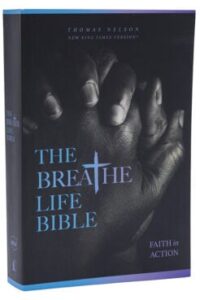
The result is The Breathe Life Bible, the title echoing Floyd’s repeated insistence, “I can’t breathe,” as he was restrained with the officer’s knee on his neck.

The tome introduces each biblical book with a “Breathe It In” segment and features “#Oxygen” tidbits that point to what they consider promises in the scriptural verses.

The Bible includes devotions written by Christian leaders, including Bernice A. King, daughter of Martin Luther King Jr. and CEO of the Atlanta peacemaking center named for him; NAACP CEO Derrick Johnson; and Thelma T. Daley, president of the National Council of Negro Women.

Michele Clark Jenkins and Stephanie Perry Moore are editors of “The Breathe Life Bible.” (Courtesy Photo)

Each of these contributors expands on different imperatives summed up in the acronym BREATHE: believe, reconcile, exalt, act, trust, hope, elevate.

“You can be a part of groups that are doing things for change,” said Moore, 54, in a joint interview with Clark Jenkins. “You can also have an inward and a personal relationship with God for him to guide you on your own heart and mind on what you should do.”

Clark Jenkins, 69, wrote 49 “We Speak” segments that give brief first-person introductions to Bible characters and short interpretations of their role.

“It has been taught that the curse of Ham is on Black people and that’s why we were enslaved,” she said in the interview. “And that’s why we are on the lower rung of society and why we’ve been oppressed all these years. And that’s just incorrect. And so, we wanted to make sure that when I’m talking about who people are, that we dispel rumors.”

They talked to Religion News Service about their reaction to Floyd’s killing and their hopes for their new Bible. The interview was edited for length and clarity.

Why did you decide to co-edit The Breathe Life Bible and why now?

Clark Jenkins: The summer that George Floyd was assassinated was a very contemplative time, and so Stephanie and I started talking, and really the question before us was: There’s so much happening, there’s injustice, we’re feeling oppressed. What are we supposed to do as Christians? Are we supposed to go into our prayer closets and not come out? Throw Molotov cocktails through Macy’s window? That’s what caused us to want to do this project, to talk about how we as faithful people are supposed to respond, no matter what’s thrown at us.

Stephanie, you wrote in the acknowledgments that this Bible is “a road map of how we can allow the Father to lift the weight of this world off the oppressed.” How do you think a Bible might do that?

Moore: When you think about faith in action, there’s no other way to walk with the Lord than to have the Bible, every piece of it—your favorite Scripture, what your pastor might say from the pulpit in taking a passage from the word. It’s a lamp unto our feet and a light unto our path.

Michele, there are sidebars labeled “Inhale” and “Exhale” and verses that you label “Oxygen.” Are you hoping that this Bible will be a tool for physical as well as spiritual exercises?
MCJ: The stresses of life affect us spiritually, mentally and physically. And so, to that extent, yeah, we want the burdens of your life to be lifted, we want people to have joy. We want people to be able to breathe. We wanted people to have guidance and to feel comfortable with how they were taking action in their life because it was biblically based.

The King James Version has long been a favorite translation for African Americans. Is that why you choose to use the New King James Version for this Bible?

SPM: You’re right on. We’ve got about 30 different contributors. We have some women, some men, pastors, presidents of (seminaries), gospel singers, rocket scientists. But when we polled a lot of them, the New King James Version of the Bible was one that was always pretty much on the top.

You contrast this Bible with the Slave Bible, the 19th-century American edition that omitted passages about freedom and God’s delivery of the oppressed. Does your Bible pay special attention to those very passages?

MCJ: Not purposely. Places that we really highlighted were those that really talk about how we demonstrate our faith through our actions. So, it focuses on when the Bible talks about fighting injustice and oppression and our responsibility to do that.

George Floyd comes up a number of times in the commentary. Are you seeking to reach those who have been involved in the Black Lives Matter movement or the protests that followed his death?

SPM: Personally, it affected me. And that was one of the reasons why I was called, with Michele, to figure out what we could do. If not us, then who? To be able to work together with folks who were hurting, to be able to change that with other people that are stakeholders and faith leaders. To be able to put together a comprehensive piece that hopefully could be hope in the midst of a lot of pain.

MCJ: This Bible is geared towards anybody, by the way. Although we write it from an African American perspective, it’s not just for African Americans. It’s for anybody who wants to put their faith in action.

We know that faith without works is dead. Now that you have faith, the question is, what do you do with your life? How do you live your life? How do you go through your life—the good, the bad and the ugly? And so, this is for anybody who struggles with those questions.


‘Autism Pastor’ Hardwick now living with cancer

WASHINGTON (RNS)—When Pastor Lamar Hardwick was diagnosed with autism at age 36, it was like he was meeting himself for the first time.

“I spent my whole life not knowing what people wanted from me, what they expected from me,” Hardwick told Religion News Service. “When I was diagnosed, it was like for the first time I understood I was human.”

Not long after his life-changing diagnosis, Hardwick began blogging about faith and autism. A few viral posts later, he adopted the moniker given to him by one of his new online connections: The Autism Pastor.

Hardwick soon was speaking at national conferences and securing book deals, all while pastoring a church, completing a Doctor of Ministry program (and, later, starting a Ph.D.) and ministering directly to folks on the autism spectrum. Described by friends and colleagues as “brilliant” and “surprisingly funny,” Hardwick is also known for his dynamic sermons.

“He’s soft-spoken, until he’s preaching,” said Larry Asplund, who served on a pastoral team with Hardwick.

Recently, Hardwick has faced another earth-shattering diagnosis: stage 4 cancer. While his treatment has forced him to retire from his church at age 45, his hope-filled mantra for this season comes directly from Scripture: “I will not be shaken,” Hardwick quoted from the Psalms.

Even as his body copes with the cyclical aftershocks of prolonged chemotherapy, he remains a prolific writer, especially on nights when steroids keep him wired. His next book, How Ableism Fuels Racism: Dismantling the Hierarchy of Bodies in the Church, is set to be released from Brazos Press later this month, and he has another two books in the works.

Early struggles with undiagnosed autism

Hardwick’s early life was shaped by his father’s dual career as a Missionary Baptist Church pastor and member of the U.S. army. He was born in Killeen but moved frequently in childhood, including to Germany for nearly four years, and the destabilization didn’t help with the social challenges he faced as a kid with undiagnosed autism.

“It felt like the whole world was in on an inside joke that I didn’t get,” Hardwick said.

In church, Hardwick appreciated the predictable rhythms and rituals: Communion every first Sunday, choir practice on Wednesdays, Sunday school. In his historically Black church context, autism and other disabilities usually went unmentioned. The exception was the disabled folks on the “sick and shut-in list” that embellished the back of the bulletin.

Despite his academic abilities, by high school Hardwick still struggled socially. He sought relief in drugs and alcohol.

“What I discovered was, the only way to be … a ‘people person’ that people thought I should be was when I was in an altered state,” said Hardwick, who added that using substances made him less of a target for being bullied. “Fortunately, I hit a wall where I realized that this is not a long-term strategy.”

That wall came in the form of a freak car accident during his first year of college at Concordia University Wisconsin. He viewed the crash as what he called “a Jonah experience.” While no illegal substances were involved in the crash, Hardwick felt like he’d injected chaos into the lives of his friends by fleeing from God.

“I think that was one of the ways that God caught my attention,” Hardwick said, adding it felt as if God was telling him to realize the impact his life had on those around him.

One of those people is now his wife, Isabella, whom he credits with being one of his greatest spiritual influences.

In the wake of the accident, Hardwick kicked his drug and alcohol habits, and his spiritual outlook was transformed. For the first time, he began to think of God as someone intimately concerned about him.

‘I was able to soar’

Eventually, Hardwick discerned a call to ministry. He moved to attend Candler School of Theology at Emory University. In 2010, he was hired as a youth pastor at New Community Church in LaGrange, Ga. In one year, he grew a dwindling youth program of about 12 teens to one with 150, he said.

Pastor Lamar Hardwick speaks at Tri-Cities Church in East Point, Ga. (Photo by Tonesha Smith Photography)

“They just felt comfortable coming to our church, because I was just as socially awkward as they were,” Hardwick joked.

When the church’s lead pastor resigned in 2012, Hardwick was tapped to serve as the interim pastor. And in many ways, he excelled.

“He’s a master preacher,” said Asplund, who was on the pastoral staff at New Community Church. “People would come just to hear him preach.”

But when he left the sanctuary platform, Hardwick was expected to remain a charismatic figure. And that was simply not in his skill set.

“People said I looked angry or mean, that I am standoffish. I would hear people say things like, ‘He walked past me, and he didn’t speak’—all the things that I knew I would never intentionally do,” said Hardwick.

Hardwick had been hearing comments like these since he was a kid. But now, the stakes were higher. The feedback prompted him to seek out a diagnosis, and in 2014, a clinical psychologist confirmed he was on the autism spectrum.

After disclosing his diagnosis to his church, the congregation built in support staff to focus on pastoral areas that were more difficult for him. Church members became more aware of and sensitive to his needs around social activities and sensory input. In the new environment, Hardwick said, “I was able to soar.”

Advocate for autism awareness in church

His diagnosis led Hardwick to reevaluate not only how churches could be more hospitable toward individuals on the spectrum—by providing sensory bags with fidgets and noise canceling headphones, by not pushing nonconsensual touch and by posting clear signage for those who struggle with self-regulation and impulse control, for instance—but also to ask how churches could center people with disabilities in general.

After eight-plus years at New Community Church, in 2019 Hardwick transitioned to a lead pastor role at Tri-Cities Church in East Point, Ga., where he continued to make disability justice part of the church’s ethos.

“He made it as important of a topic as any other thing we did as a church,” said Jamie Stoval, who served as the kids’ pastor at Tri-Cities Church.

In 2021, Hardwick’s ideas culminated in the book Disability and the Church: A Vision for Diversity and Inclusion.

Beth Golik, operations director for Key Ministry, an organization that helps churches welcome kids with hidden disabilities, described the book as the go-to resource for churches looking to prioritize disability justice.

“It gives people a new perspective on the fact that this is not a niche ministry,” Golik said. “This is what our churches need to be thinking about across the board in every ministry.”

Challenge of living with cancer

The book launch came amid a time of challenge for the pastor. In 2020, Hardwick was diagnosed with stage 3 colorectal cancer.

Several rounds of treatment and a surgery later, his case was in remission, but in 2022 the cancer returned. This time, though, tiny cancerous specks had also appeared on his lungs, and the doctors determined that because of the cancer’s location, surgery wasn’t an option.

“The last word was we’re going to do palliative chemo, which is just to control the cancer, but we’re not going to be able to remove it,” Hardwick said. “So, we’re dealing with stage 4, but the chemo is controlling it.”

In March 2023, Hardwick ended up in the emergency room twice for severe stomach pain. The doctors dismissed his symptoms as constipation and only gave him pain medication after his second visit.

After Hardwick and his wife drove to a hospital an hour away, a doctor discovered a bowel obstruction caused by scar tissue from Hardwick’s cancer treatment. His colon was dilated almost 9 centimeters, and he was “about a couple hours to a day away from dying,” Hardwick recalled.

In his forthcoming book, How Ableism Fuels Racism, Hardwick recalls this incident and interrogates how the suffering of both Black and disabled bodies has been normalized—in part, he argues, because pain has been associated with bodies viewed as morally inferior.

“Enslaved Africans were considered inherently disabled,” Hardwick told RNS. Categorizing Black folks as inherently flawed and in need of white supervision “justified racial slavery as an act of Christian benevolence,” he added.

In his book, Hardwick argues ableism and racism are interlinked, creating a hierarchy of bodies based on who is perceived as better, and more believable. This hierarchy also plays out in theological debates—theologies authored by people of color, including liberation theologies, are viewed not only as doctrinally inferior, but as originating from inherently deficient people groups, he contends.

After his chronic battle with cancer led him to retire as lead pastor of Tri-Cities Church, Hardwick posted a GoFundMe to tide his family over until disability benefits kick in. But even in retirement, Hardwick is scheduled to speak at several conferences on the topic of faith and disabilities this spring.

His community continues to pray for healing.

“His priority will always be reaching those that other people think are unreachable,” Stoval said. “I don’t think we have enough people doing that. I don’t want to lose that yet.”

After Asplund’s wife died from cancer, Hardwick preached at her funeral—and he wants Hardwick to preach at his funeral, too.

“He’s a champion,” Asplund said. “It slowed him down, but he’s ready to finish his Ph.D., he’s ready to go on and teach and write.”

Asplund noted several of his own doctoral students at Regent University already cite Hardwick as an authority on the topic of faith and disability.

As for Hardwick, he continues to describe himself as “unshaken.”

“It doesn’t mean things are not shaking. Lots of things are shaking and moving and rocking and being flipped over all around me,” he said. “But as far as my soul, I feel very solid.”


Alistair Begg won’t back down on trans wedding advice

WASHINGTON (RNS)—For the past few weeks, Alistair Begg, pastor of Parkside Church in Chagrin Falls, Ohio, and host of the Truth for Life radio program, has been caught in what he calls “a storm in a teacup” over advice he gave about attending a transgender wedding.

That advice, he said in a recent sermon, was based on Jesus’ command for Christians to love even those they disagree with or disapprove of.

“Jesus said you are supposed to love your enemies,” said Begg, drawing on a series of Bible texts to claim Christians should show compassion—and not condemnation—for those who have gone astray.

The sermon was a response to a controversy over comments Begg made during a promotional interview for a book last fall, which recently went viral on social media.

During the interview, Begg recounted talking to a woman whose grandchild was getting married to someone who was transgender. Begg, who opposes same-sex weddings, suggested she go to the wedding and bring a gift. By doing so, she would show her love for her grandchild—even though she did not approve of the wedding.

“Your love for them may catch them off guard, but your absence will simply reinforce the fact that they said, ‘These people are what I always thought: judgmental, critical, unprepared to countenance anything,’” the evangelical pastor said. He added Christians have to take risks in order to show love to those around them.

Begg’s comments set off a firestorm among some of his fans and supporters—in particular those in conservative Calvinist and other evangelical communities. White evangelicals remain one of the least likely of all U.S. religious groups to support same-sex marriage, according to the Public Religion Research Institute.

Thirty-eight percent of white evangelicals say they support same-sex marriage, according to PRRI. By contrast, 87 percent of nones, 81 percent of Jews, 77 percent of Buddhists, 77 percent of white mainline Protestants and about three-quarters of Catholics approve of same-sex marriage.

Radio network drops program

American Family Radio, an evangelical broadcasting network, dropped Truth for Life, a program based on Begg’s sermons, last week after his advice resurfaced and went viral.

It also led to a series of articles by other Christian leaders, saying Christians should not attend LGBTQ weddings.

“After all, attendance so as to show ‘love’ or avoid giving offense is a form of blessing, just without the name,” wrote Carl Trueman, professor of biblical and religious studies at Grove City College, for the Catholic publication First Things.

Tim Wildmon, president of the American Family Association, hosted a special broadcast explaining why the group parted ways with Begg. Wildmon said the ministry got calls complaining about the broadcast and reached out to Begg, whose radio program had appeared on AFR for more than a decade.

“The goal of the call was reconciliation, but reconciliation with truth,” said Walker Wildmon, an AFA vice president. He added Begg refused to back down from his comments, which Walker Wildmon compared to a dad offering to drive his alcoholic child to a bar.

A staffer from Parkside Church told Religion News Service Begg has no comment about being dropped from American Family Radio.

Begg, a native of Scotland who has lived in the United States for four decades, said he has long taught that sex outside of a marriage between a man and a woman is wrong, and so he was surprised at the controversy over his comments and the accusations that he had abandoned Christian teaching.

“Now, we can disagree over whether I gave that grandmother good advice. Or not,” he said. “Not everybody on the pastoral team thinks I gave very good advice.”

‘On the side of compassion’

During the sermon, he drew from the New Testament parable of the prodigal son—which emphasizes forgiveness over judgment—and the parable of the good Samaritan, which emphasizes compassion over claims of holiness. Both stories, he said, showed the power of God’s grace.

He also drew from a story Jesus told of a shepherd who had 100 sheep and lost one of them—and left the 99 behind to find the one that was lost.

“I tell you that in the same way there will be more rejoicing in heaven over one sinner who repents than over ninety-nine righteous persons who do not need to repent,” Jesus says in Luke 15.

Begg warned his congregation about Christians who seem unwilling to show grace or forgiveness to others, telling his congregation to be wary of pastors who are eager to loudly condemn sinners. Begg said he was thinking with his “grandfatherly hat” when he gave that advice, hoping to help that grandmother show God’s love

“All I was thinking about was how can I help this grandmother,” Begg said, adding that he didn’t want her to lose her grandchild.

To a different person in different circumstances, he said, he might have given different advice. But he has no plan to repent of his advice, no matter what happens on social media.

Begg also said he was glad his advice to this grandmother—rather than his other sermons about sexuality—had gone viral.

“Because If I’ve got to go down on the side of one or the other, I’ll go down on this side,” he said. “I’ll go down on the side of compassion.”


Are the Five Love Languages helpful?

WASHINGTON (RNS)—When Katie Frugé and her husband, Lafayette, decided to get married in 2007, they were 21 and did not know what they did not know.

Katie Frugé

“We were too young to get married and too young really to care,” said Frugé, who is now director of the Christian Life Commission and the Center for Cultural Engagement at the Baptist General Convention of Texas.

For guidance, the young couple turned to The Five Love Languages, a popular book by North Carolina author and pastor Gary Chapman. First published in 1992, the book explores different ways people express love—words of affirmation, physical touch, quality time, acts of service and giving gifts—in hopes of helping couples find happiness.

The book claims understanding each other’s love language can help create healthy marriages. Frugé recalls thinking the book held the key to a bright future.

“We thought: ‘We’ll just learn each other’s love languages, and everything’s going be hunky-dory. We’re not going to ever have any fights, and we’re both going to feel fully satisfied all the time,’” she said.

Married life proved more complicated.

Frugé said she and her husband are still happily married 17 years later, but there were a lot of bumps, including several health crises.

“We had the sickness and health part,” she said. And they needed more love along the way than a formula could provide.

“When I’m diagnosed with cancer, I don’t need my husband to go out and buy me a gift at that moment,” she said.

Pop culture phenomenon

Once popular mostly in evangelical Christian circles, the Five Love Languages have exploded into a pop culture phenomenon. The dating app Bumble offers a Five Love Languages quiz, the concept has been featured on The Bachelorette and in major media outlets, while the Five Love Languages channel on TikTok has attracted tens of millions of views.
Chapman has sold more than 20 million copies of his books and launched a cottage industry of conferences, related books and an online quiz taken tens of millions of times.

All of that attention has led researchers such as Emily Impett, a psychology professor and director of the Relationships and Well-Being Laboratory at the University of Toronto Mississauga, to ask if the claims of the Five Love Languages stand up to scientific scrutiny, and perhaps nearly as important: What can scholars learn from the popularity of Chapman’s work?

Does Chapman’s theory hold up to scrutiny?

Emily Impute

A new paper in Current Directions in Psychological Science suggests Chapman’s theory about how love works doesn’t quite add up. For the paper, Impett and a pair of colleagues looked at a series of studies that tried to test three key ideas about the Five Love Languages: that people have a primary love language, that five love languages exist and that people are happier with a partner who speaks their primary love language.

The studies, said Impett and her colleagues, don’t support that theory.

For example, people will choose a preferred language if forced to in a quiz. However, researchers found that if asked about all five love languages on an individual basis—people rate all of them highly.

The researchers also found some important ideas, such as supporting a partner’s or spouse’s goals, don’t fit in the Five Love Language model, and people who have the same love languages aren’t happier than other couples.

“Love is not akin to a language one needs to learn to speak but can be more appropriately understood as a balanced diet in which people need a full range of essential nutrients to cultivate lasting love,” Impett and her colleagues wrote.

They did suggest Chapman’s book has filled a need for couples in that “it provides partners an opportunity to reflect on, discuss, and respond to one another’s needs.”

Impett said reading the love languages book—which includes examples of how to practice showing love in different ways—is much more helpful than using the online quiz. That’s in part because the focus on finding a partner’s primary love language can be too restrictive and ends up putting people into a box.

Instead, she told Religion News Service, “All of the behaviors Chapman identified are important.”

“We are not suggesting that people necessarily are multilingual (skilled at all five behaviors) but that they should learn to be since the five behaviors that Chapman identifies are really important things people can do to maintain their relationships.”

All the love languages matter

Gary Chapman

On that point, Chapman agrees.

The 86-year-old author, who recently stepped down after 50 years on the staff of Calvary Baptist Church in Winston-Salem, N.C., said all of the love languages matter.

“There is absolutely no question that what makes one person feel loved doesn’t necessarily make another person feel loved,” he said in an interview. “But I don’t want to communicate that you only speak the person’s primary love language.”

Chapman, who still travels and speaks at marriage conferences and other events, said he was surprised by some of the paper’s findings but appreciates researchers taking his work seriously. The more research, he said, the better.

He said he continues to be surprised at how popular the idea of love languages has been. Chapman developed the idea for the book while counseling troubled couples at his church. Those couples, he said, were often at their wit’s ends, because each partner thought they were acting in loving ways, but the other partner felt unloved.

A master storyteller, Chapman recalled one husband saying he cooked dinner most nights, shared in the housework and lawn work, and did all he could to support the family. But his wife felt distant because he was so busy helping out at home that they never had time to talk.

Looking over his counseling notes, Chapman began to look for patterns and eventually came up with the five love languages.

“It’s a simple concept,” he said. “But I knew from my counseling and working with couples—it would help people if they could get that concept. In all of my writing, I’ve tried to put the cookies on the bottom shelf, so people can understand it easily.”

Valuable to identify needs and communicate

That approach is something researchers say they can learn from.

In their paper about the love languages, they said Chapman’s book has connected with people because it uses “intuitive metaphors, which may resonate with people and convey an easily digestible message free of scientific jargon.”

Impett also said the focus on finding a primary love language can overshadow the reason why so many people find Chapman’s book helpful. The book, she said in an email, “gets people to identify any currently unmet needs (areas of improvement) in their relationship and opens up lines of communication to address those needs.”

Chapman, who has been married 62 years, said that’s the point. He said love begins with emotion but is sustained by having the right attitude and by acting in ways that put your spouse or romantic partner first.

That right attitude, he said, can be summed up this way: “I want to do anything and everything I can do to help you become the person that you want to be. I want to do everything that would be good for you.”

Meleah Smith of Chattanooga, Tenn., who coaches “brands and bands” on marketing, said the idea of five love languages never really connected with her. She knows the book has worked for other people, but for her, it’s too simplistic, said the 40-something, who described herself as “single as a Pringle.”

Smith said she has plenty of love in her life, with friends, her church and her family—she helps manage her brother’s band—but no romantic relationship. She said the love languages can be too easy at times—tempting people to avoid the hard work of getting to know someone and paying attention to them.

“If I have to give you a list of things you have to do for me, maybe we are not a good match,” she said.

After 17 years of marriage, Frugé had some advice for those using the five love languages. Remember that people need all kinds of love, not just one kind. Pay attention to them—rather than running to a book for all the answers.

Sometimes the answers you need are right in front of you.

“Thriving relationships occur when you have a partner who understands and knows you, sees what your need is and meets you in that moment.”


Study: Most evangelicals chose Christ during childhood

EXPORT, Pa. (BP)—Most adult evangelicals made their professions of faith in Christ in childhood, newly released findings from Infinity Concepts and Grey Matter Research and Consulting revealed.

More than 90 percent of the adult evangelicals in the United States who were surveyed said several factors motivated them to accept Christ as Savior, with parents, churches, other family members, individual Bible reading and pastors ranking highest.

Seven out of 10 adult evangelicals (72 percent) made their faith commitments to Christ before 18, and only 4 percent of respondents said they chose Christ in the four years preceding the study.

The age of belief and the factors influencing belief are valuable insights in designing evangelism strategies, researchers said.

“Parents are an enormous influence on their children. Do you try to reach adolescents directly,” researchers posed, “or do you also invest in teaching or training parents or other family members how to have spiritual conversations with their children?”

The influence of both parents was cited as the strongest factor in their faith decision by 28 percent of those polled, followed by 16 percent who cited the church they attended as the strongest factor for them personally.

Other family members were cited as the strongest factor by 11 percent of respondents, followed by 10 percent who cited their personal Bible reading, and 7 percent who referenced pastors.

Researchers were not discouraged by the low percentage of evangelicals who came to faith in the four years preceding the study, as 16 million respondents became Christians in adulthood.

“Adult evangelism is far from futile,” researchers wrote. “But by far, the biggest impact is among youth and children, especially between the ages of 5 and 12. Half of today’s evangelical adults came to their beliefs during these formative years; a total of around 43 million evangelical Protestant adults came to their faith before adulthood.”

Other significant factors leading people to salvation were life’s difficulties, events, spouses, friends, other church leaders, direct experiences with God, radio or television, and books other than the Bible. “Something online” ranked lowest.

Consider varied factors leading to salvation

The numerous factors in play in salvation can encourage evangelicals in ministry, researchers said, and understanding the findings can help evangelicals reach the unsaved.

“One commonly expressed frustration Christians have with evangelism is the failure to see results. They plant a seed, and hope or expect to see something sprout directly from that effort,” researchers wrote. “You may not see the plant actually sprout, but you may be one of those important factors influencing someone’s eventual decision.”

Only 46 percent of evangelicals point to a specific time when they were saved. Instead, 37 percent said they were raised as Christians, and 16 percent said their decision to follow Christ was gradual.

Researchers defined evangelicals to encompass 23 percent of the population, using a racially inclusive definition developed by Lifeway Research. It defines evangelicals as those who view the Bible as the highest authority in their beliefs, say it’s important to them to encourage non-Christians to trust Jesus as their Savior, cite Jesus’ work on the cross as the only sacrifice for forgiveness of sin, and that salvation is in Christ alone.

The online study was conducted in early 2023 among 1,010 evangelical Protestants, using several research access panels and stringent quality controls, researchers said.


New Pew study debunks myths about the nonreligious

WASHINGTON (RNS)—America’s religiously unaffiliated—the “nones”—largely are defined by what they are not, rather than what they are. So, as they’ve multiplied, it’s perhaps unsurprising they’ve also been shrouded in myths and misconceptions.

They’ve sometimes been pegged as a group that’s wholly secular and hostile to religion, or conversely as a cohort that has uniformly adopted spirituality rather than religion. They’ve also been characterized as morally directionless or civically disengaged.

A new Pew Research Center report on America’s nones shows the truth is more complicated.

“Just like there’s many differences among religious people, turns out there are many differences among non-religious people, too,” said John Green, professor emeritus of political science at The University of Akron and an adviser on this study. “And I think this report adds some real substance to that.”

Not that different than the public at large

In fact, sociologist Ryan Cragun suggests the report shows America’s nones aren’t much different from the rest of the American public—at least not anymore.

“In the 1980s, the nones actually looked pretty different. They were small, they were 5 to 7 percent of the U.S. population, disproportionately male, disproportionately white, very young. Not likely to be married. Highly educated, pretty high incomes,” said Cragun, a professor at the University of Tampa who is also an adviser on this study. “Today, the nones kind of look like everybody else.”
“At some level, we’re saying, hey, actually, this is just your neighbor,” he added.

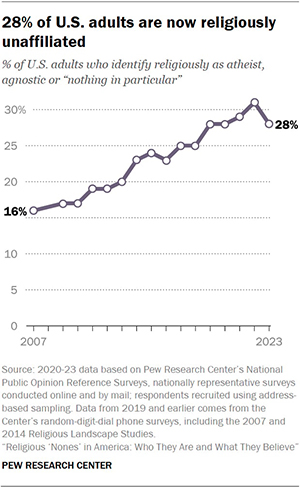
Pew’s findings, which come from a survey of 11,201 respondents conducted in the summer of 2023, show that, at 28 percent—a 12 percent increase since 2007—the religiously unaffiliated cohort now makes up a sizable portion of the U.S. population.

They’re also still leaning young and Democratic, with 69 percent under age 50 and 62 percent of nones identifying as Democrats or leaning toward the Democratic Party.

But in contrast to where they were 40 years ago, today’s religiously unaffiliated are roughly split between men and women, and their racial makeup broadly mirrors that of the general population.

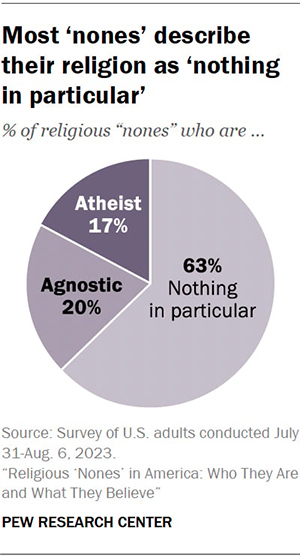
Pew’s study shows many nones believe in something, even if it doesn’t fall into traditional religious categories. While 20 percent say they are agnostic and 17 percent identify as atheist, the majority of nones (63 percent) fall into the more ambiguous “nothing in particular” category.

And although only 13 percent say they believe in the God of the Bible, more than half (56 percent) say they believe in some other higher power.

“There can be a temptation to assume that all religious nones are nonbelievers … that they must all have secular worldviews,” said Greg Smith, associate director of religion research at Pew and the primary researcher for this study. “And this report shows that’s not really true.”

About half of nones say they are spiritual or that spirituality is very important to them. Green also pointed out not all of them are hostile to religion. Though 43 percent of nones say religion does more harm than good in society, 41 percent say religion does equal amounts of harm and good.

Though these findings reveal more about the beliefs and spiritual inclinations of the nones, Cragun said further research is necessary, especially because the current study doesn’t pinpoint exactly what respondents mean when they say they are spiritual or believe in a higher power.

While some might see spirituality or a higher power as connected to the supernatural, others could see spirituality as grounded in something more tangible, like nature.

While about half of the nones are spiritual, the study reveals the other half say they are not, and by many measures the group still remains distinctly nonreligious. A full 90 percent seldom or never go to religious services, 71 percent say they seldom or never pray, and 81 percent say religion is not too important or not at all important in their lives.

“The religious nones certainly are not all nonbelievers, but they are way less religious on average than people who identify with a religion,” Smith said. “Religious nones, by and large, are really disconnected from religious organizations of any kind.”

Despite their disengagement from institutional religion, the report debunks the myth that religious nones lack a moral framework. More than 8 in 10 (83 percent) say the desire to avoid hurting people is key to helping them decide between right and wrong, and about the same number, 82 percent, say they also rely on logic and reason.

“Almost all of those people have very clear moral understandings of the world,” Cragun said.

Generally less engaged civically

The report confirms, on the whole, nones are less civically engaged than their religiously affiliated peers (less likely to volunteer, less likely to vote), but it also complicates that narrative.

Of religiously affiliated Americans, those who attend religious services at least once a month are more likely to volunteer than those who don’t attend services regularly. And of the nones, atheists and agnostics turn out to vote at rates that are similar to the religiously affiliated.

“It’s those who described their religion as nothing in particular who tend to be less civically engaged,” said Smith. “So, there’s differences within the nones between atheists and agnostics on the one hand, and nothing in particular on the other.”

Civic engagement isn’t the only point on which the “nothing in particulars” differ from atheists and agnostics. Atheists and agnostics include far more men than women and are more likely to be white, to have more education and to identify as Democrats or lean toward the Democratic Party than those who said they were “nothing in particular.”

Green suggested one reason for these divisions, at least in the civic engagement category, is because atheists and agnostics have a firmer belief system than those who select “nothing in particular.”

“People who believe in things are much more likely to generate high levels of what social scientists called social capital by belonging to organizations, by associating with like-minded people. And from that social capital comes all types of activities—political activities, volunteering, charitable giving,” Green said.

“But people who are defined by what they’re not are much less likely to have high levels of social capital.”

Nancy Ammerman, professor emerita of sociology of religion at Boston University and an adviser on the study, suggested while atheists and agnostics are those who have the privilege to go against social convention and reject religious affiliation, the “nothing in particular” group is likely made of people who don’t fit the social and cultural stereotypes of the common churchgoer.

“What goes along with that is that they’re likely to have fewer resources. They’re more likely to be single, not to have children at home, to be less well educated, as we see in this study, and just generally to be more marginal to social institutions in general,” Ammerman said.

While many questions about the nones remain, the report makes two things clear: the nones are not monolithic, nor are they going away any time soon.