‘Jesus’ film producers plan release of animated version

WASHINGTON (RNS)—The Jesus Film Project is producing an animated Jesus film that is set to release in theaters around Christmas 2025.

“Do you realize that there are more people in the world today who have little to no knowledge of Jesus than ever before in history?” asked Pastor David Platt, former president of the Southern Baptist Convention’s International Mission Board.

Platt spoke at the announcement of the new project at the Museum of the Bible in Washington on Nov. 30, where Jesus Film Project staffers joined animators and supporters.

“What an opportunity we have to use a medium that God has ordained to reach not just people, but the next generation with the gospel,” Platt said.

Similar events announcing the film were held in South Korea and Uganda.

The original Jesus film, released in 1979, has been translated into more languages than any other movie, according to the Guinness World Book of Records. The 2,100th translation recently was completed.

‘Relevant for kids. and for families’

Josh Newell, executive director of Jesus Film Project, said he views animation as a fitting means to speak to younger generations about the life of Jesus.

“Animation is a compelling way to tell stories,” he said in an interview ahead of the event. “There’s a moral resonance that people have with the story of Jesus, that what he teaches is good and is true, and is relevant for kids and for families.”

The new film’s director, Dominic Carola, has worked on films such as The Lion King, Mulan and Lilo & Stitch. He said the animators are working closely with historical experts to depict the faces and clothing of characters living in the time of Jesus, including Jesus himself.

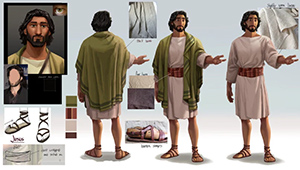
A “concept image” of the Jesus character from the forthcoming animated version of the “Jesus” film. (Image courtesy Jesus Film Project)

“He’s from the Middle East, he’s Jewish, so we knew there’s certain skin tones, textures, things that we can lean into, because this is the part of the world he came from,” Carola said in an interview ahead of the launch, noting the importance of getting confidential feedback from global focus groups.

“We don’t want him to be a surfer from Malibu or looking like somebody from a GQ magazine. He walked among us, and he lived in the flesh. So we went through a very strict process of trying to stay in these bumper rails.”

Carola said he and the animation team will have to approach certain parts of the story of Jesus, such as the crucifixion, “definitely delicately.”

“We don’t want to minimize what he did for us, obviously, but we certainly can’t show it to the level of The Passion of the Christ,” he said. “We’re not doing that. So it’s a fine line.”

The clip that aired Thursday at the Museum of the Bible, depicting the Gospel story of Jesus’ raising the synagogue leader Jairus’ daughter from the dead, was shown to focus groups in different cultures and countries. Newell said even those who might never have heard of Jesus reacted positively to the story.

Grow from 100 to 2,100 languages

While the original film, produced in a docudrama style, was two hours long, the new version is expected to run about 90 minutes. Both are based on the Gospel of Luke, but the storytelling will differ in pace through the animation.

“We will linger in those moments of where there aren’t words in the Bible, and we’ll see Jesus interact in some new ways that we didn’t see in the previous version,” said Newell. “There’s going to be some surprising scenes that are added to it that we really think are fun and meaningful from the Gospel of Luke that we’re going to share.”

As of mid-November, Newell said, about a third of the estimated project cost of $150 million had been raised. Some donors made contributions in honor of Paul Eshleman, Newell’s predecessor, whose family created a memorial fund after his death on May 24 at the age of 80.

Josh Newell speaks about the Jesus Film Project at the Museum of the Bible on Nov. 30 in Washington, D.C. (RNS Photo / Adelle M. Banks)

Newell said he hopes the animated version will launch in 100 languages and that three to five years later, it, like the live action version, will have expanded to 2,100.

The latest translation is in the language of the Waorani tribe. Jim Elliot, a U.S. missionary, was killed when he sought to spread the Christian gospel among the Waorani people in Ecuador in 1956. Newell said in a statement that the version in this language follows a request for it and features voice actors from different Waorani communities.

Gabe Handy, executive program director for the film, said he expects the quality of animation will match other biblical animated films, such as The Prince of Egypt, but the new Jesus film will feature three-dimensional animation, also used in films such as Pixar’s Toy Story.

“They are using some virtual reality in the pre-production process, in some of the design and modeling that they’re doing,” he said of the animators in an interview at the museum before the start of the event. “Because they’re doing it in that way, that’s producing some assets for us that we can apply beyond just making a movie.”

The producers are hoping to create ancillary footage for use in immersive digital experiences. Users of virtual reality goggles, for instance, might follow Jesus along the Via Dolorosa as he approaches Calvary or travel the rocky trip on the Sea of Galilee where the Bible says Jesus calmed the waters.

Bill Bright, the late founder of Cru, previously known as Campus Crusade for Christ, asked Eshleman after the original film debuted in U.S. theaters in 1979 to translate and dub it into dozens of languages. Eventually the ministry, first known for its work on college campuses, crossed the 2,000 mark in 2022.

Asked what Bright, who died in 2003, might think of the new version of the film he debuted 44 years ago, Newell said he believes the founder would approve.

“He would love it because he was so creative,” said Newell, who joined Cru’s staff 25 years ago when Bright was nearing the end of his leadership.

“Anything that we can do to kind of continue that trajectory of reaching younger people and giving them the opportunity to share about Jesus themselves and make an impact and an influence, he’s all over that.”

Editor’s Note: The first paragraph was edited after it originally was posted. RNS ran a correction, clarifying the Jesus Film Project — not Cru — was producing the animated film.


Evangelicals see Israel-Hamas war in light of End Times

DALLAS (RNS)—The End Times are not a topic Robert Jeffress needs much prompting to talk about.

When war broke out between Israel and Hamas on Oct. 7, the senior pastor at First Baptist Church in Dallas, quickly prepared a sermon series on the Apocalypse, which would be accompanied by a forthcoming book on the subject.

On Nov. 5, as the last notes of “Redemption Draweth Nigh,” a hymn about Jesus’ return, resonated in First Baptist’s 3,000-seat sanctuary, Jeffress asked his audience, “Are we actually living in what the Bible calls the End Times?”

The war in Gaza is not the only sign Jeffress submitted as evidence that the period presaging Jesus’ Second Coming, detailed in the Bible’s Book of Revelation and other Scriptures, is coming closer.

He noted, too, rising crime rates, the proliferation of nuclear weapons and natural disasters before announcing, “We are on the verge of the beginning of the End Times.”

“Things are falling into place for this great world battle, fought by the super powers of the world, as the Bible said. They will be armed with nuclear weapons,” Jeffress said.

Looking at current events as fulfillment of prophecy

Other prominent evangelicals have taken up the theme in their sermons. The day following Hamas’ attack, in which Israeli cities were barraged and some 1,200 people were massacred, Greg Laurie, senior pastor at the Harvest Riverside Fellowship in California, framed the violence in terms of End Times prophecy.

“The Bible tells us in the End Times that Israel will be scattered and regathered,” Laurie said. “The Bible predicted hundreds of thousands of years ago that a large force from the North of Israel will attack her after she (Israel) was regathered and one of the allies with modern Russia, or Magog, will be Iran or Persia.”

Before calling the church to pray for peace in Jerusalem, Laurie added, “If you get up in the morning and read this headline “Russia Attacks Israel,” fasten your seatbelt, because you’re seeing Bible prophecy fulfilled in your lifetime.”

While apocalyptic theology is threaded throughout the Bible and came to America with the Puritans, End Time prophecy has gone through cycles of popular acceptance among Christians. It has different strands, but in its most widely known version, known as dispensationalism, Israel is a linchpin to the events of the last days, when, after the Rapture, a coterie of 144,000 Jews are to be converted to Christ before eternity begins.

Israel’s supporters ‘on the right side of God’

Evangelical Christian pastors such as Jeffress have long prompted the United States to be an actor in these events. In his second sermon in the End Times series, on Nov. 12, Jeffress quoted the speech he gave at the ceremony dedicating the new U.S. embassy in Jerusalem in 2018: “For America to be on the right side of Israel is the same as being on the right side of history, and the right side of God.”

The embassy’s move from Tel Aviv to Jerusalem was the fulfillment of a promise Donald Trump made in 2016 as he ran for president for the first time, one applauded by pro-Israel evangelicals. In August 2020, as he ran for reelection, then-President Trump told a campaign rally in Wisconsin: “We moved the capital of Israel to Jerusalem. That’s for the evangelicals.”

Also present the day Jeffress spoke in Jerusalem was the televangelist John Hagee, who in 2006 founded Christians United for Israel, now the largest pro-Israel organization in the United States. On Oct. 22, Christians United hosted a “Night to Honor Israel” rally at Hagee’s Cornerstone Church in San Antonio, with Israeli public figures on hand, as well as U.S. Senators Ted Cruz and Tom Cotton.

Pastor John Hagee, Christians United For Israel founder and chairman, speaks during a CUFI Night to Honor Israel event, during the CUFI Summit 2023, Monday, July 17, 2023, in Arlington, Va., at the Crystal Gateway Marriott. (AP Photo/Jacquelyn Martin)

Hagee was also a speaker at the giant pro-Israel rally held Nov. 14 in Washington, where he reaffirmed his commitment to Israel.

“There is only one nation whose flag will fly over the ancient walls of the sacred city of Jerusalem. That nation is Israel, now and forever,” he said, greeted by cheers.

Claiming some 10 million members, Hagee’s organization has become powerful politically, according to Daniel Hummel, author of Covenant Brothers: Evangelicals, Jews and U.S.-Israeli Relations.

“It is quite a large group, but it’s even more significant that they are organized and have demonstrated over the years that they can actually focus their energy on a local level and a national level to advocate their position,” Hummel said.

The group’s gatherings have become an obligatory stop for GOP presidential hopefuls wishing to articulate their support for Israel in front of Christian Zionists.

“Most of them don’t get into the prophecy stuff,” said Hummel. “They’ll talk more about the national interests that the U.S. has in supporting Israel and about the cultural values that Israel and the U.S. share.”

But Hagee often speaks about the prophecies that drive his support for Israel. A week after Hamas’ attacks, Hagee’s Sunday sermon detailed the unfolding of the End Times, while a timeline illustrating every step from Jesus’ resurrection to the renovation of Earth by fire was displayed in the background.

The recent Hamas attacks draw us closer to the church’s Rapture, he claimed.

“The Bible blessed the Jewish people directly and through the Jewish people blesses us, the Gentile people,” he said.

Hagee added: “Israel is God’s prophetic clock; when the Jewish people are in Israel, the clock is running. When the Jewish people are out of Israel, the clock stops.”

Some view Christian Zionism as insensitive

This logic scandalizes some scholars as well as Jews, who see evangelical support for Israel as compromised by its cosmic hope for their conversion.

“They (Christian Zionists) believe a tiny minority of living Jews will, in the End Times, convert to Christianity, and the rest will be damned to hell for their disbelief,” wrote Steven Gardiner, research director at the Political Research Associates, in a 2020 essay titled, End Times Antisemitism.

In a 2005 sermon, Hagee himself claimed God sent Adolf Hitler to perpetrate the Holocaust to push European Jews toward Israel. He later made clear he didn’t view either Hitler or the Holocaust as positive.

But End Times theology need not be raw to come across as insensitive to the violence suffered by both sides in the long-running Israeli-Palestinian conflict.

On Nov. 12, Jeffress began his sermon by asking the congregation if they knew what could explain the numerous attacks against Israel.

“Spiritual reasons,” he said.


Research: Practicing Christians more generous than others

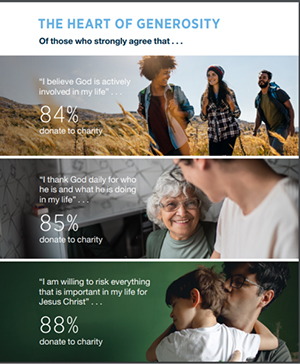
NASHVILLE (BP)—Practicing Christians outpaced non-practicing Christians and nonbelievers in giving to charities including churches in 2022, the American Bible Society said in the latest release from its 2023 State of the Bible report.

The vast majority of practicing Christians (95 percent) gave to charities in 2022, compared to 68 percent of non-practicing Christians and 51 percent of nonbelievers. The American Bible Society defines practicing Christians as those who identify as such, attend church at least monthly and consider their faith very important in their lives.

“When people practice a meaningful Christian faith, they give, and they give more,” the American Bible Society said in the report’s eighth chapter, focused on generosity. “Again and again we see people transformed by God’s Word, with hearts pried open by God’s love, people of faith moved to share what they have with others—even if they don’t have much to spare.”

Churches, ministries and other houses of worship were the top recipients of charitable gifts for the year, with religion one of the few sectors realizing an increase in receipts, the report stated. But when accounting for inflation, the estimated $143.57 billion in religious contributions—a 5.2 percent increase over 2021—represented a 2.6 percent decline.

“Religious organizations—including local churches, parishes, or temples as well as local and international ministries—receive the greatest portion of charitable giving,” the report stated. “Our data confirm what other researchers have found.”

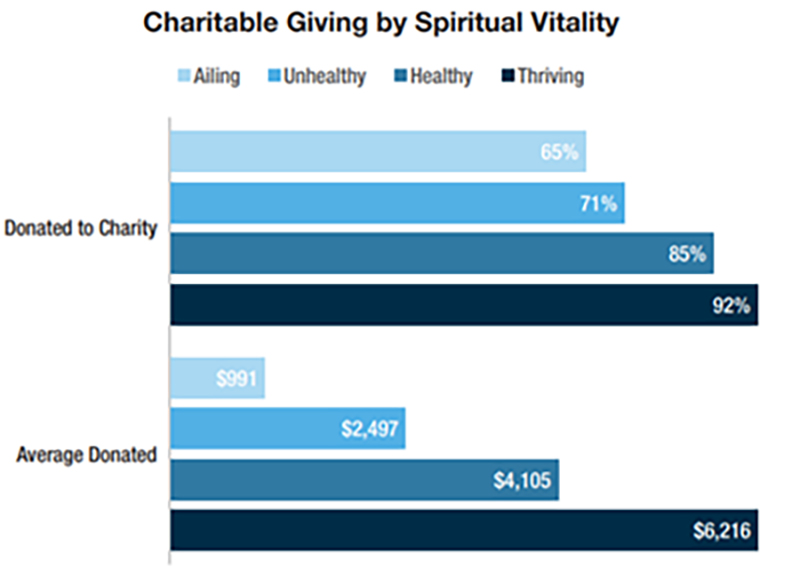
The American Bible Society also gauged giving by spiritual vitality, with 92 percent of those thriving spiritually giving to charities, compared to 85 percent of those with healthy spiritual vitalities, 71 percent of those with unhealthy spiritual vitalities, and 65 percent of those ailing spiritually.

Those thriving averaged $6,216 in annual giving, compared to the $991 in giving by those ailing spiritually. The American Bible Society spiritual vitality gauge, used for the first time in the 2023 study and asked only of professing Christians, rates spiritual health based on answers to nine concise questions focusing on belief, spiritual practices and faith in action.

Other findings on generosity include:

  • Regardless of faith, 68 percent of American households donated to charity in 2022, a rebound from the 62 percent who gave in 2021.
  • Elders, those age 78 and above, are by far the most generous age group, with 83 percent giving to charity and nearly half of those giving at least $1,800 a year.
  • People give to causes they consider important, regardless of their income or expenses.
  • People who volunteer, whether in the church or the community, are also more generous financially.
  • Percentage wise, families earning $30,000 or less a year give more money than those earning $100,000 or more, although larger income earners give larger numerical amounts.

 “While people who make more money give more money, the percentage of income donated by those who give runs much higher among lower income groups. When someone is earning an annual income of $30,000 or less, a contribution of $1,800 or more is a substantial portion (at minimum, 6 percent),” the American Bible Society said, comparing the giving to the story of the widow’s mite recorded in Mark 12 and Luke 21.

“The one-fifth of low earners who contribute at that level are digging deep, giving sacrificially.”

The State of the Bible annually looks at the Bible, faith and the church in America. The American Bible Society collaborated with the University of Chicago’s National Opinion Research Center in designing the study conducted online and via telephone. The survey, conducted Jan. 5-30, produced 2,761 responses from a representative sample of adults 18 and older within the 50 states and the District of Columbia.


New normal settles for churches after pandemic

BRENTWOOD, Tenn.—For two years now, almost every church in America has been holding in-person worship services, but not every pre-pandemic worshiper has returned.

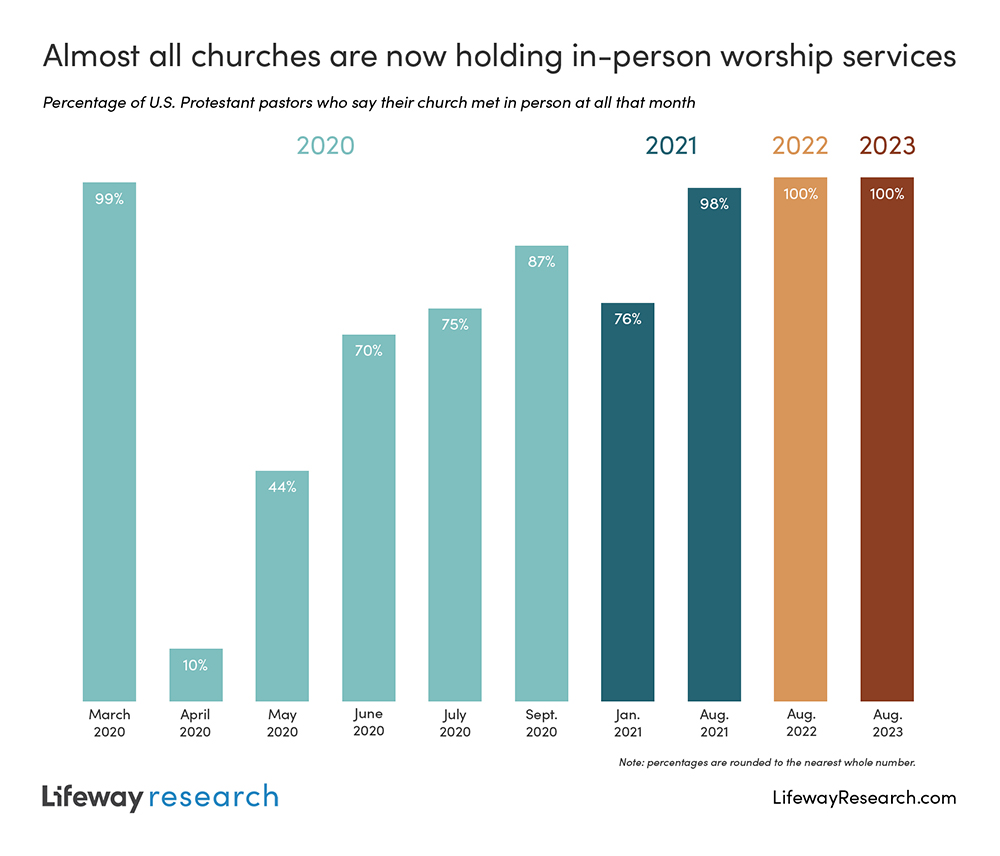
The final Lifeway Research tracking data for U.S. Protestant churches’ COVID-19 recovery finds 100 percent (rounded to the nearest whole number) of reporting churches met in person in August 2023, capping off a rebound since the early months of the pandemic.

In March 2020, immediately prior to the widespread COVID-19 outbreak, 99 percent of congregations held in-person worship services. The next month, only 10 percent did so. By June 2020, most churches (70 percent) were physically gathering.

That percentage continued to climb, reaching 87 percent by September 2020. Following a brief dip in January 2021 to 76 percent, almost all churches held in-person services in August of that year (98 percent) and January 2022 (97 percent).

Last August, 100 percent (rounded) of congregations gathered in person for worship.

“During the height of the pandemic, churches took very different approaches on whether and how to meet in person,” said Scott McConnell, executive director of Lifeway Research. “Two years ago, almost all churches that would reopen had done so.”

Rebounding attendance

While 100 percent of churches have returned, that’s not the case for everyone in the pews. But the vast majority are back. On average, churches have seen 9 in 10 churchgoers return.

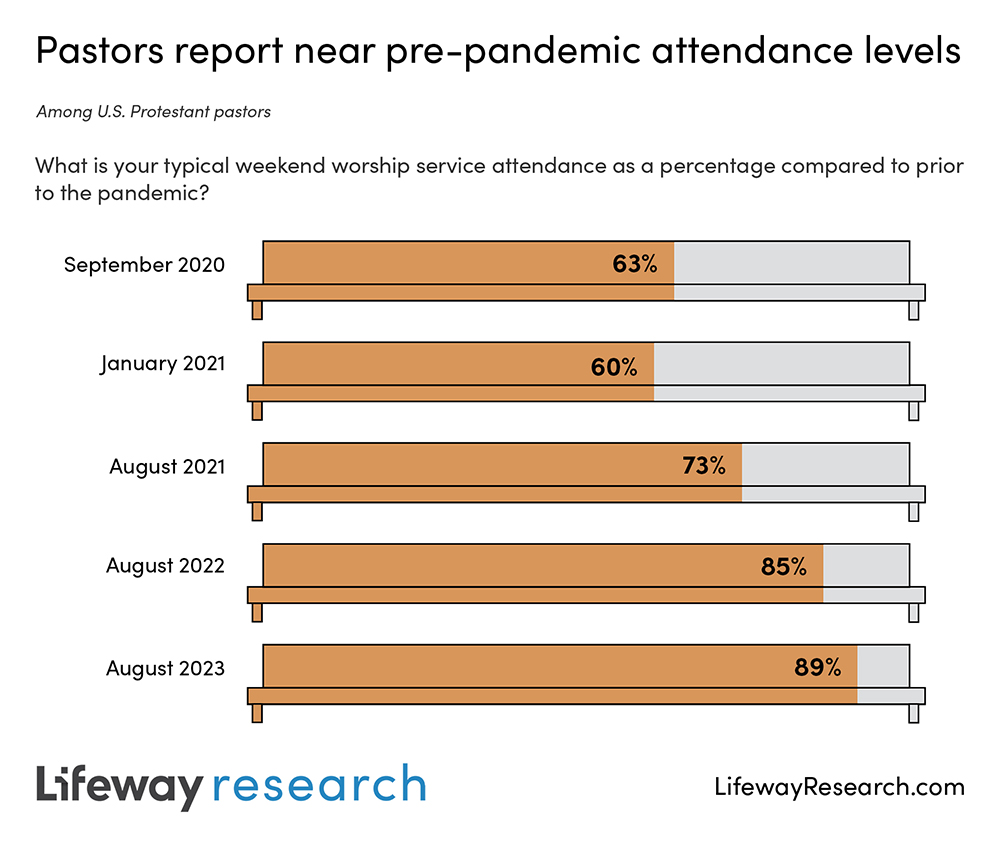
U.S. Protestant pastors report current attendance at 89 percent of their typical worship service crowds in early 2020, prior to the start of the pandemic. This is the high-water mark for churches attempting to recover pre-pandemic attendance levels.

In January 2021, 60 percent of pre-COVID churchgoers gathered in person with their congregations. By August of that year, that climbed to 73 percent. Last year, pastors estimated they were at 85 percent of their previous attendance.

Around 9 in 10 U.S. Protestant churchgoers (91 percent) told Lifeway Research in February 2021 they planned to attend worship services at their church at least as much or more as they did prior to the pandemic once they felt COVID-19 was no longer an active threat.

At 89 percent of their pre-pandemic attendance, churches seem to have reached most of those who expressed a desire to return.

Pandemic-related issues did not seem to be a major driving force of churchgoers changing congregations, according to a 2023 Lifeway Research study. Among regular churchgoers who have switched churches as an adult, just 14 percent mentioned COVID-19 issues as a factor.

“Some church switchers left due to disagreement over how COVID was handled at their church and others found a new church since theirs was closed for an extended period of time,” said McConnell.

“But the vast majority of people have remained at their same church. In fact, most churchgoers who have changed churches as an adult arrived at their current church before the pandemic.”

Currently, two-thirds of U.S. Protestant churches (67 percent) have fewer than 100 people for a typical worship service, including 30 percent who have fewer than 50. Around a quarter (26 percent) average between 100 and 249, while 7 percent have 250 or more.

Older pastors, those who are at least 65 years old, are the most likely to be leading the smallest congregations (47 percent). Those churches with fewer than 50 in attendance are more likely to be in the Northeast (36 percent) compared to the South (27 percent). Additionally, the smallest congregations are more likely to be Methodist (41 percent) or Presbyterian/Reformed (35 percent) compared to Baptist (23 percent).

Growth not taken for granted

While most churches declined during the pandemic, some congregations are reporting stability or even growth.

Fewer than 1 in 10 churches (8 percent) say their current attendance is less than 50 percent of what it was before the pandemic. Less than a quarter of congregations (23 percent) say they are between 50 percent and less than 70 percent of previous attendance.

Around 3 in 10 (29 percent) report 70 percent to less than 90 percent. Another 17 percent say they are between 90 percent and 100 percent.

Almost a quarter (23 percent) say their typical worship services today have more people than they did in early 2020.

In January 2021, 2 percent of churches reported an increase in worship service attendance compared to prior to COVID-19. That grew to 9 percent in August 2021, 17 percent last year and 23 percent today.

“Even before the pandemic, growth was not what the typical church was experiencing,” said McConnell. “COVID-19 leveled church experiences to where almost no one was seeing growth. Today, a noticeable number of churches are growing again. But mindsets have adjusted to the reality that growth is a gift from God and is not to be taken for granted.”

Pastors who are 44 years old or younger are more likely than those 65 and older to say the current attendance at their congregation is more than it was prior to the pandemic (28 percent vs. 18 percent). Evangelical pastors are also more likely than their mainline counterparts to report growth over the past four years (26 percent vs. 18 percent).

Denominationally, pastors at nondenominational (27 percent), Lutheran (21 percent) and Baptist churches (18 percent) are more likely than Methodists (11 percent) to report relative attendance stability with worship services between 90 percent to 100 percent compared to prior to the pandemic.

Additionally, Pentecostals (27 percent), Presbyterian/Reformed (27 percent) and Baptists (23 percent) are more likely than Methodists (14 percent) to say their worship service attendance has grown since 2020.

A trend during the pandemic has been smaller churches’ ability to recover pre-COVID attendance levels quicker than other size congregations. The latest study finds this has continued. Most small churches (58 percent) are near or above their pre-pandemic worship service attendance levels.

In 2023, pastors of churches with pre-pandemic attendance of fewer than 50 are among the most likely to be between 90 percent to 100 percent of their early 2020 worship service attendance levels (23 percent).

Those smallest congregations are the most likely to report growth in their August 2023 attendance, with 35 percent saying their average worship service attendance has increased in the past four years.

The phone survey of Protestant pastors was conducted Aug. 29 to Sept. 20. Each interview was conducted with the senior pastor, minister or priest at the church. Responses were weighted by region and church size to reflect the population more accurately. The completed sample is 1,004 surveys, providing 95 percent confidence that the sampling error does not exceed plus or minus 3.2 percent. Margins of error are higher in sub-groups.


Barna: Most Christians don’t want churches to use AI

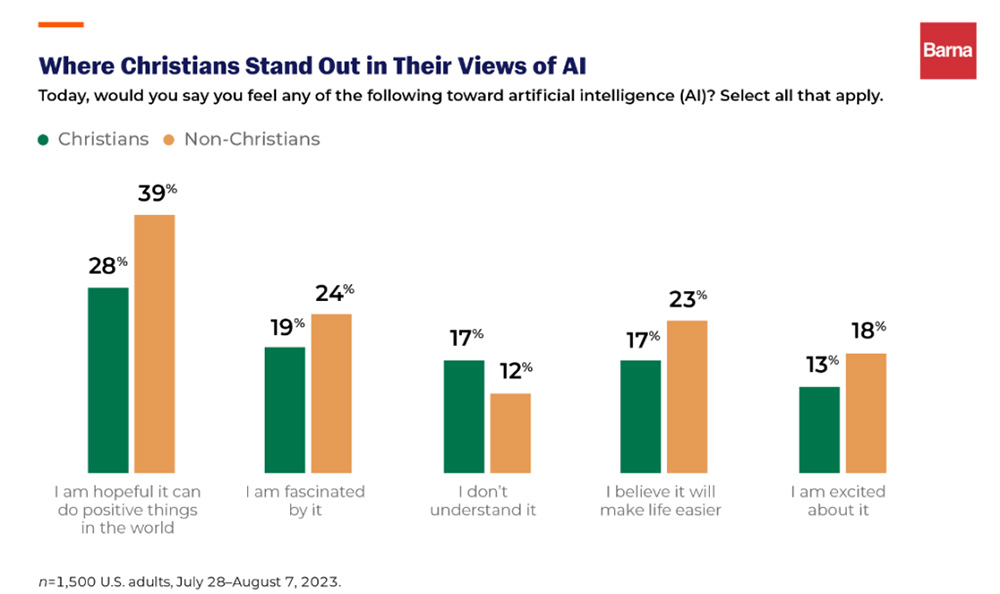
VENTURA, Calif. (BP)—Christians have less confidence in artificial intelligence than non-Christians, especially when it comes to AI use by churches, Barna Group and Gloo researchers found.

More than half of Christians, 51 percent, said they don’t believe the church and AI should ever intersect. About the same portion, 52 percent, said they’d be disappointed to learn their own church was using AI.

AI has been explored for such uses as sermon preparation and transcription, language translation including Greek and Hebrew, and the creation of art or graphics for sermon illustrations.

Only 22 percent of Christians said AI is good for the church, researchers found, with only 6 percent of respondents strongly expressing the belief.

The skepticism should encourage churches to evaluate AI carefully and responsibly, Gloo, a tech platform for ministry leaders, said in releasing the data Nov. 8. Christians have a responsibility to explore how AI can be used for good, godly purposes that will advance human flourishing, Gloo believes.

“We at Gloo believe we have a moral imperative to use these types of technologies,” Steve Billings, director of Gloo AI initiatives, said on Moody Radio just days in advance of the release. “And not just to use them for our own pleasures, or to see the world use them to advance the world’s purposes, but for us to really pursue what are God’s purposes for these types of technologies.”

Among the study’s top findings:

  • More than a quarter of Christians, 28 percent, are hopeful AI can do positive things in the world, compared to 39 percent of non-Christians.
  • 27 percent of Christians said they don’t know whether the church should use AI, which Gloo and Barna said indicates a sizable portion of Christians are still making up their minds.
  • 19 percent of Christians are fascinated by AI, compared to 24 percent of non-Christians.
  • A greater percentage of Christians, 17 percent, don’t understand AI, than the 12 percent of non-Christians who said the same.

Researchers compared the plight of AI, promoted in ministry by such tools as ChatGPT, OpenAI, Jasper and Midjourney, to that of the internet, which sparked skepticism when it was introduced, but is seen widely as essential today.

Kenny Jahng, founder of AIForChurchLeaders.com, recently shared this perspective to attendees at a Barna-led cohort on tech and AI:

“There’s all this fear that AI is going to be taking over the world, it’s going to be human versus machine. [But] if we step back and look at it, there are things that AI is really good for,” Barna quoted Kenny Jahng, who is also editor-in-chief of ChurchTechToday.com. “Technology is here to serve us and not the other way around.”

The findings are based on an online survey of 1,500 American adults, conducted July 28-Aug. 7 by a consumer research panel. Representation was spread across regions, race/ ethnicity, education age and gender, based on U.S. Census Bureau numbers.


Young people define ‘sacred moments’ broadly

WASHINGTON (RNS)—A majority of young Americans from a variety of faiths and no faith say they have experienced a sacred moment, according to a new survey, but their definitions of what is sacred may not line up with those of their parents or grandparents.

The Springtide Research Institute report, “The State of Religion & Young People 2023: Exploring the Sacred,” pushes back on the notion that Gen Z exhibits a simple disinterest in matters of the divine or the spiritual.

More than half—55 percent—of the more than 4,500 people ages 13 to 25 who were surveyed told Springtide’s researchers that they have discovered what Springtide called “experiences that evoked a sense of wonder, awe, gratitude, deep truth, and/or interconnectedness in your life.”

Of those who had, 69 percent said they had experienced a sacred moment more than once in nature, 68 percent said they’d done so in the privacy of their home, and 55 percent said at a place of worship. Respondents could select more than one option.

Besides answering the survey, conducted in October 2022, almost three dozen submitted to interviews with researchers who listened to their descriptions of these moments.

‘The sacred in nontraditional spaces’

Tricia Bruce, director of the Springtide Research Institute, said the report highlights “the prevalence and the overlap of the sacred in nontraditional spaces” even as, increasingly, young people say they have never crossed the thresholds of houses of worship.

“Certainly, we might expect young people to tell us, ‘Yes, I’ve experienced the sacred when I attended a religious service or in prayer,’ and they do. But they also told us: ‘I experienced the sacred in nature,’ ‘I experienced the sacred when I got into college,’ ‘I experienced the sacred in a virtual connection,’” Bruce told Religion News Service in an interview.

“Creative spaces that we may not think of as sacred themselves, or as religious, or we may not materially construct as such, young people are telling us that, in fact, that’s where the sacred lives for them.”

Nearly a third of those surveyed—31 percent—told Springtide they had never participated in a spiritual or religious community. Also, 72 percent of young people trust organized religion only somewhat (45 percent) or not at all (27 percent).

Bruce said the report has implications for faith leaders, particularly youth ministers, who may have been focusing on answering the question, “How do we get young people back?”

Clergy might want to redefine what they consider sacredness, she said. “If we’re looking for the sacred, maybe for young people it does mean going together to have these experiences in these places and beginning to open wide the world as a potentially sacred place through those personal, relational and extraordinary moments.”

For example, Springtide found 56 percent of young people said they considered their daily or weekly engagement in art as religious or spiritual practices, as did 54 percent of those who spent time in nature, 49 percent of those who read and 45 percent of those who prayed.

In interviews for the report, the top five terms voiced by young people defining “the sacred” were: special, relationships, places of worship, religion and God.

The report urged faith leaders and other adults who work with young people in religious or secular settings to consider fostering what Springtide called a “sacred sensibility” by helping them connect to the divine in new ways, build close relationships with others and feel emotions that contribute to well-being.

In interviews, young people said they were yearning for such opportunities, “even if they make me uncomfortable,” said one respondent.

Among the ways adults can answer those requests, Springtide suggests, is to listen to how young people define sacredness and be vulnerable about expressing their own faith, which could help those younger than them on their own spiritual journeys.

“Inviting young people beyond the traditional and typical provides room for them to experience something beyond the ordinary,” the report states.

Other findings about young people from the 72-page report include:

  • 68 percent say they are at least slightly religious—32 percent slightly, 25 percent moderately and 10 percent very.
  • 78 percent say they are at least slightly spiritual—32 percent slightly, 29 percent moderately and 17 percent very.
  • 28 percent say they have become more spiritual or religious over the past two years.

The research is based on a sample of 4,546 young people ages 13 to 25 with a margin of error of plus or minus 2 percentage points. The respondents included 62 percent ages 18 to 25 and 38 percent ages 13-17.

The data, collected in October 2022, is nationally representative for age, gender, race/ethnicity and region. But the report notes it is unclear how representative it is about religion so “data are therefore best understood as tracking broad patterns rather than providing precise point estimates.”

Springtide, a Minnesota-based research institute, was founded in 2019 and is rooted in the tradition of the De La Salle Christian Brothers, a Roman Catholic lay religious organization that has focused on addressing the needs of young people.


Church switchers note reasons for congregational change

BRENTWOOD, Tenn.—When churchgoers move to a new congregation, most say their reasons for change had a little to do with both their old and new churches.

Lifeway Research studied 1,001 U.S. adults who identify as Protestant or nondenominational, attend church worship services at least twice a month and have attended more than one church as an adult.

During the research screening process, it was determined 53 percent of U.S. regular churchgoers say they have attended more than one church as an adult.

Among those who have switched congregations, 63 percent say they’ve regularly attended only two to three churches as an adult, while another 22 percent have attended four to five congregations.

Fewer say they’ve been active at six to seven churches (8 percent), eight to nine (3 percent) or 10 or more (4 percent).

For most of those changing churches, changing homes was a factor. Three in 5 church switchers—60 percent—say a residential move impacted their decision to leave their previous church and begin attending a new one.

 “The reason pastors and churchgoers talk about church switchers is because it is not a negligible number of people changing churches,” said Scott McConnell, executive director of Lifeway Research.

“However, chronic church switching is not the norm. The biggest group of churchgoers are those who have been at the same church throughout their adult lives, and the next biggest group are those whose church changes were necessitated by moving too far to attend their previous church.”

Reasons for leaving

Still, 40 percent of church changes were driven by something other than a residential move. When examining reasons people switched to a new congregation without moving, several factors stand out.

More than 1 in 4 church switchers say they changed because some things changed about the church they did not like (29 percent), the church was not fulfilling their needs or reasons for attending church (29 percent), they became disenchanted in some ways with the pastor (27 percent) or they became disenchanted with the church (26 percent).

For 22 percent, the change happened because they could not agree with some of the church’s teachings or positions on issues or politics. One in 5 say they felt out of place at their previous church—20 percent—or changes in their life situation caused them to stop attending (18 percent).

Issues related to COVID-19 drove 13 percent of church switchers to find a new congregation. Around 1 in 10 say they left because they had problems or conflicts with someone else at the church or the congregation itself had a conflict (11 percent) or their beliefs or attitudes toward church and religion changed (9 percent).

For 2 percent, they had to find a new church because their previous one closed. Another 23 percent say they stopped attending for other reasons.

 “The typical person changing churches has multiple reasons for making this change,” McConnell said. “Broadly speaking, people leave a church when they disagree with change, are disgruntled or disagree with the church’s positions. It is much less common to see people leaving because their own religious beliefs changed.”

For each of the reasons given by those whose church change was not the result of a residential move, more specific church-switching justifications exist.

  • Changes in the church

Among the 29 percent who say they changed churches because the church itself changed, more than half (53 percent) say too many things in general changed.

Around 2 in 5 (39 percent) say the church’s teachings on political or social issues changed in ways they didn’t agree with. For 1 in 3, the church’s religious teachings or beliefs changed in ways they didn’t agree with (34 percent) or the pastor or church staff they liked left the church (33 percent).

  • Unfulfilled needs

For the 29 percent who say they switched due to the church not fulfilling their needs, most (62 percent) say their previous church was not helping them to develop spiritually. For 2 in 5 (41 percent), they did not feel engaged or involved in meaningful work in the church.

Around a quarter say they did not become friends or close with anyone at the church (27 percent), the church did not help them find happiness (26 percent), the church did not help them find answers to questions in their life (22 percent) or no one seemed to care about their situation or problems (22 percent).

  • Pastoral problems

The 27 percent who left their previous church due to the pastor have a mix of complaints. They’re most likely to say the pastor seemed hypocritical (36 percent). A third (33 percent) say the pastor was not a good preacher. Around 3 in 10 say the pastor was judgmental of others (30 percent) or seemed insincere (29 percent). Close to a quarter say the pastor had a moral or ethical failure (24 percent) or had no clear purpose or vision (23 percent).

  • Congregational disappointments

Among the 26 percent who switched after being disenchanted with their previous congregation, 32 percent point to members being judgmental of others, 30 percent say members seemed hypocritical, 29 percent believe the church didn’t really seem to be a place where God was at work, 29 percent say the church settled for mediocrity and 26 percent believe the church was run by a clique that discouraged others from getting involved.

  • Teaching and issue disagreements

More than 1 in 5 (22 percent) of those who left a congregation for non-residential move reasons say it was related to the church’s teaching or position on issues.

The specific reasons under that category paint a complicated picture. One in 3 (33 percent) say the pastor or church seemed aligned with a particular political party or ideology. Another 31 percent point to teachings on theological issues, 26 percent to teachings on applying the Bible to life issues and 24 percent to teachings on moral issues.

For 28 percent, their previous pastor or church was too liberal for their taste, while 23 percent say their previous pastor or church was too conservative. Additionally, 22 percent say the church was too politically active, while 8 percent say the congregation didn’t engage in politics enough.

More than 1 in 5 say their pastor expressed woke opinions (22 percent) or ignored injustice (22 percent). One in 5 (20 percent) say they felt judged based on their political views.

  • Out of place

For the 20 percent who say they felt out of place at their previous church, the top reason was because they had a different view of church or religion than the other members (43 percent).

Many also said their home or family situation was different than most members (30 percent), they felt out of place in terms of social class or education (28 percent) or most other members were a different age than them (23 percent). Few say they left because most other members were of a different ethnicity (6 percent).

  • Life changes

Among the 18 percent who say life changes pulled them away from their previous church, 26 percent say family or home responsibilities prevented them from attending, and 24 percent point to a work situation keeping them away.

Relationship issues played a role for some, including 19 percent who divorced, separated or were widowed, 17 percent who were taking or going with someone else who no longer attended, and 11 percent who got married. Another 15 percent say illness or infirmity kept them away.

Around 1 in 10 say they simply got too busy to attend (11 percent), they just wanted a break from church (11 percent) or their children’s activities were on Sunday (8 percent).

  • COVID-19

The pandemic contributed to the decisions of 13 percent of those who changed churches for reasons other than a residential move. The primary reason those churchgoers say they switched congregations is their previous church closed temporarily (55 percent), and 9 percent say their church closed permanently.

Other reasons revolve around different responses to COVID-19. A quarter (25 percent) say their previous church focused too much on streaming services. For 21 percent, their church did not take COVID-19 seriously enough.

Almost 1 in 5 (19 percent) say the church implemented COVID-19 policies they disagreed with, and 15 percent say the pastor or church expressed an attitude toward COVID-19 that differed from their own. Close to 1 in 10 say the church made no changes due to the pandemic (11 percent), and 9 percent say the church argued too much about COVID-19.

Old versus new

Church switchers are slightly more likely to say their decision to change congregations was motivated by a need or desire to join their current church (52 percent) than to leave their previous one (48 percent). Understandably, those who changed churches are likely to say their current church is performing better than their previous one.

When comparing their current church and the one they left, more than half of church switchers say their current congregation meets their needs more with sermons that are consistently engaging or enlightening (58 percent), preaching that is relevant to their life (58 percent), church members and pastors who seem authentic (57 percent), being welcoming or friendly (57 percent), fostering spiritual growth (56 percent), caring for the community in tangible ways (56 percent), having unity among members (55 percent) and doing things with excellence (55 percent).

Most church switchers also say they see God at work in people’s lives at their new congregation more than their previous one (57 percent), find it easy to worship because of the style and elements of the worship service (54 percent), have developed deep relationships with fellow church members (52 percent) and agree with the teachings, beliefs or doctrines (52 percent).

Not quite half say their current church is better at making them feel like they don’t want to miss services (49 percent), providing them with opportunities to use their talents (49 percent), being actively involved (49 percent) and having worship services that are convenient for them to attend (48 percent).

Many say their current church and previous church are the same in those areas. Only on three topics do at least 1 in 10 church switchers grade their previous church higher—13 percent say they have fewer deep relationships with fellow church members in their current church; 13 percent say they are less actively involved; and 10 percent say their current church provides fewer opportunities to use their talents to serve.

“Almost half of church switchers are motivated by the need to get out of a church they are displeased with. But that doesn’t mean the change won’t impact them for the better,” McConnell said.

“While the biggest improvements reported by church switchers are things they receive, large numbers also report that personal spiritual growth, deeper relationships, increased involvement and service resulted from their church move.”

Thinking specifically about preaching, church switchers praise their current pastor’s sermons more when compared to their previous one. Almost 9 in 10 (89 percent) say the sermons in their current church are clear and understandable, compared to 48 percent who say the same about their previous church.

Similar percentages say sermons at their current church are interesting enough to hold their attention (88 percent) versus at their previous church (44 percent).

For each issue, church switchers are far more likely to praise their current church’s sermons than sermons from their previous church, including being relevant to their life (85 percent vs. 49 percent), challenging them to live and think as Scripture teaches (84 percent vs. 43 percent), teaching them something they didn’t already know (84 percent vs. 43 percent), focusing on a specific topic (82 percent vs. 44 percent) and focusing on a specific text from the Bible (81 percent vs. 44 percent).

Church switchers are most likely to say their current church is the same size as their previous church (56 percent). Among those who changed church size, however, they’re more likely to move to a larger one (27 percent) than switch to a smaller church (17 percent). A statistically significant number moved to a church with more than 250 in worship attendance (27 percent), compared to those who previously were in such a church and switched (22 percent).

Half (49 percent) of church switchers say their previous church had a traditional style of worship, while only 38 percent say the same about their new congregation.

Most of those who switched worship styles made their way to a congregation with a mix of contemporary and traditional, as 30 percent say that mix described their previous church and 39 percent say it describes their current one.

Additionally, 20 percent say their previous congregation was contemporary, and 23 percent say the same about their new one.

Committed to the current congregation

Those who have left one church and joined another seem to be as bought in or more so in their current congregation as their previous one. Almost 3 in 4 (73 percent) say they formally joined or became members at their current church, similar to the 71 percent who say they did the same at their previous congregation.

Church switchers are more likely to say they are involved in their current church compared to their previous one in several ways, including attending worship services in person (76 percent vs. 59 percent), being a consistent financial supporter of the church (66 percent vs. 51 percent), volunteering when opportunities arise (60 percent vs. 43 percent), attending a small group (56 percent vs. 41 percent) and holding a non-leader position with regular responsibilities (47 percent vs. 35 percent).

They are just as likely to say they held a leadership position at their previous church (34 percent) as they are to say they are holding a leadership position at their current church (34 percent). Church switchers are more likely to say they serve on a church council or board at their current church (33 percent) compared to their previous one (25 percent).

Most church switchers seem to believe their switching days are behind them now. Almost 4 in 5 (78 percent) say they plan to continue attending the same church in the foreseeable future. Close to 1 in 5 (19 percent) say they plan to continue attending the same church, but they’re open to switching in the future. Few (3 percent) say they are actively looking for a new church.

 “The lack of engagement among members often concerns pastors. Ironically, one thing that appears to spur some people to get more involved at church is leaving to go to a new church,” McConnell said.

“While few pastors would encourage such a move, challenging people to focus less on what displeases them and instead investing in relationships and serving others is a journey worth taking.”

The online survey of American Protestant churchgoers was conducted July 26 to August 4 using a national pre-recruited panel. Respondents were screened to include those who identified as Protestant/non-denominational and attend church worship services at least twice a month and have attended more than one church as an adult.

Analysts used quotas to balance gender, age, region, ethnicity, education, and religion to reflect the population more accurately. The completed sample is 1,001 surveys, providing 95 percent confidence that the sampling error from the panel does not exceed plus or minus 3.1 percent. Margins of error are higher in sub-groups.



Many teens think sex too pervasive on TV, study finds

LOS ANGELES (BP)—A plurality of adolescents think sex and romance are overused in television shows and would like to see more platonic friendships portrayed, an annual University of California at Los Angeles study of 10- to 24-year-olds found.

Particularly, 47.5 percent of adolescents ages 13 to 24 think sex is unnecessary for most television plots, 44.3 percent think romance is overused in media, and 51.5 percent want to see more content focused on friendships and platonic relationships, UCLA found in its 2023 Teens and Screens Report released in October.

The numbers should signal Hollywood to stop marketing “explicit sexual content to teens,” the Parents Television Council said in response to the findings.

“These survey results prove that teens are tired of being saturated with sexual content,” Parents Television Council Vice President Melissa Henson said. “It’s time for a new playbook, Hollywood, and it would be a monumental and welcome change.”

Sex and romance ranked 13th among the top 19 storylines teens said they want to view, with hopeful, uplifting content about people beating the odds topping the chart, and stories featuring nonbinary and LGBTQ and related identities at the bottom of the list.

The Parents Television Council called out Hollywood for such shows as HBO’s “Euphoria,” which spotlights high school students navigating life in a world of drugs, sex, trauma and social media; Disney-owned Hulu’s “PEN15,” a comedy with foul language that features middle school teens exploring topics including sex and drug use; and Netflix’s “Sex Education,” with teenagers exploring sexuality in a way that Movieguide has critiqued as “near pornographic.”

The survey results show teenagers want to view a fuller spectrum of relationships, and also support other recent studies showing teens are less driven by sex than were their parents and grandparents, study co-author and UCLA adjunct professor Yalda T. Uhls said.

“We know that young people are suffering an epidemic of loneliness and they’re seeking modeling in the art they consume,” Uhls said. “While some storytellers use sex and romance as a shortcut to character connection, it’s important for Hollywood to recognize that adolescents want stories that reflect the full spectrum of relationships.”

Quarantines during the COVID-19 pandemic likely contributed to views expressed in the study, the Parents Television Council believes.

Teens “were deprived of real-life time to learn about relationships during lockdowns, and now they need to see and understand how all kinds of relationships work, not just portrayals of romantic or solely sexual relationships,” Henson said.

UCLA’s 2023 report, conducted by the Center for Scholars & Storytellers, surveyed 1,500 people ages 10 to 24 in August, including 100 young people from each participating age bracket, and reflecting 2020 U.S. Census findings in race and gender.


Baptist praises process followed in Catholic Synod

Some observers criticized the recent Roman Catholic Church’s Synod on Synodality for failing to take bold positions on controversial issues. But a Baptist participant at the Synod believes other Christians could learn from the process Catholics followed.

 “Synodality is an unfamiliar word, not only amongst Protestants, but also—I quickly discovered—amongst many Catholics, as well. It means ‘walking together’ or also ‘accompaniment.’ There was a strong focus on listening to one another and seeking to discern together—in contrast to only debating,” Baptist theologian Elizabeth Newman said.

Elizabeth Newman
(Photo / https://scholars.duke.edu/)

Newman from the United States and Valérie Duval-Poujol from France served as Baptist World Alliance fraternal delegates to the Synod on Synodality.

The summit of 464 Catholic bishops, priest and laity—including women—gathered to discuss a range of issues, based on two years of conversations in Catholic parishes around the world.

As chair of the BWA Commission on Baptist Doctrine and Christian Unity, Newman is a veteran of Baptist-Catholic dialogues. She participated in conversations between the BWA and Pontifical Council for Promoting Christian Unity, a long-term initiative.

“I believe this kind of ecumenical initiative is important because, as the Baptist World Alliance acknowledges, while for Baptists the local church is wholly church, it is not the whole church,” she said.

“God gathers us in local congregations of discipleship, gatherings that are at the same time part of a larger reality—the church universal. Ecumenism is the active reminder of this truth.

“There is, of course, division and even discord. God calls Baptists and all Christians, however, to seek unity,” she continued, citing John 17:20. “Unity is a way of sharing in God’s mission.”

Religion News Service reported 364 voting participants in the monthlong summit produced a 42-page document, Synthesis Document for a Synodal Church in Mission. RNS noted most of the 20 points in the document passed with overwhelming majorities, but no single paragraph received full consensus.

At the Synod, participants were divided into groups of 12 and “invited to address specific questions that arose out of earlier synodal discussions from the seven continents,” Newman explained.

“Each group considered shared convergences, divergences amongst themselves and ongoing questions that the group had,” she said. “The groups had facilitators, and all members were allowed equal time to speak.”

Prayer and contemplation practiced

Newman praised the Synod’s emphasis on prayer and sensitivity to the Spirit’s leadership.

“In addition to prayer at the opening and closing of each session, there were periods of silence, two to four minutes, usually following about 30 minutes of listening,” she said.

“As I experienced it, the Synod is seeking to form its participants to see synodality as a contemplative way of being. I think Baptists and all Christians could learn from this way of being with one another in contrast to the temptation to be reactive.

“At the same time, synodality is not only listening. The focus is discerning together in light of Scripture and tradition.”

She expressed hope the “contemplative process of synodality” and emphasis on prayer not only will shape congregational discussions, but also future ecumenical dialogue.

Synodality also includes “a strong emphasis on the poor, the migrants, those on the periphery or those who feel excluded from the church,” she added.

“How might fuller attention to those on the margins shape and build up our understanding of being church together?” she asked.

Role of women explored

As expected, the role of women in the church figured prominently in Synod discussions. The Women’s Ordination Conference officially said it was “dismayed by the failure of the Synod to take seriously the overwhelming calls to open all ordained ministries to women.” Even so, it applauded the Vatican for allowing 54 women to vote alongside male bishops for the first time at the summit.

The Synod gave serious attention to asking how to acknowledge fully women’s gifts and roles in the church, Newman said.

“It was quite moving to hear women from different parts of the world speak to the need for their presence and gifts to be more fully received in the life of the Catholic church,” she said. “For me, this discussion related to discussion about authority, which some emphasized, was not simply power as in the secular sphere. Authority is service to assist growth, promoting others and not oneself, and is rooted in the grace of God.”

Newman noted the Synod opened the possibility of ordaining women to the diaconate, if not the priesthood. She pointed out Lottie Moon—the revered 18th century Baptist missionary to China—supported a revival of the order of deaconesses, whom she called “holy handmaids of the Lord.”

“While Baptists and Catholics have differences in understanding the role of ‘deacon,’ it would be fruitful ground to explore as a shared possibility for women,” she said.

Challenge of secularization examined

The Synod devoted particular attention to Christian witness in the midst of secularization, particularly in the Western Hemisphere, Newman noted.

“This secularization included the loss or weakening of faith across the generations,” she said. “This would be a shared concern for Baptists and other Protestants, as well.”

Discussion focused on how to include young people in various church roles, listen to their concerns and strengthen their spiritual formation, with special attention to communicating in a digital context, she observed.

“I talked with one sister who has a huge following on TikTok, where she responds to questions that young folks send in,” she said.

Signs of common ground?

Despite distinct theological differences between Catholics and Baptists, Newman saw evidence of common ground in the discussions at the Synod.

“I think many Baptists would have been surprised to hear Catholics emphasizing a personal relationship or encounter with Jesus. This emphasis was in response to reflecting on co-responsibility and a shared understanding of all participating in the mission of the church,” she said.

“Baptists have long emphasized lay involvement in mission. At the same time, Baptists and Catholics can continue to learn from one another how our mission to the faith is to be lived out.”

In small-group discussions at the Synod, Newman noted “a strong emphasis on the witness of holiness or the idea that you’re sharing your own person as well as the good news. Holiness and transformation are part of the gospel.”

Baptists and other Protestants—who accept the priesthood of believers as a central doctrine—could learn from continued ecumenical dialogue with Catholics, she noted.

“The priesthood of all believers is no solo flight, but a communion that radiates,” she said.


After 250 years, ‘Amazing Grace’ holds enduring power

WASHINGTON (RNS)—James Walvin, a former Church of England choirboy and professor of history at the University of York, doesn’t remember encountering “Amazing Grace,” in song or in his hymnal.

It wasn’t until he traveled to the United States to research the history of slavery that he came upon the hymn introduced by John Newton, a former slave trader, in 1773.

Since then, Walvin, the author of the new book Amazing Grace: A Cultural History of the Beloved Hymn, has submerged himself in the hymn, which turns 250 this year and has become a staple of Sunday services that has been adapted and adopted by preachers, performers and presidents.

“I wasn’t too keen on Elvis’ version,” Walvin said after a recent visit to the Library of Congress’ “Amazing Grace” collection, which includes more than 3,000 recordings of the song—the only one of Newton’s hundreds of hymns that gained such international stature.

“I certainly was not keen on (1960s orchestra leader) Mantovani’s version,” he added. “I was amazed to listen to Janis Joplin’s version. I mean, who’d think of Janis Joplin and ‘Amazing Grace?’”

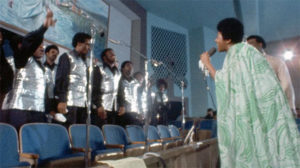
Aretha Franklin interacts with James Cleveland’s Southern California Community Choir while recording her “Amazing Grace” album at a Los Angeles Baptist church in 1972. (Photo courtesy of NEON via RNS)

Among the thousands of versions, Walvin is especially fond of bass-baritone Paul Robeson’s but gives a nod to “Queen of Soul” Aretha Franklin as well as “a choir from Soweto, an extraordinarily haunting version of it,” saying they are all “effective in their own different, very distinctive ways.”

Walvin, 81, a longtime non-Christian, spoke to Religion News Service about the hymn, its composer and the “electrifying event” when President Barack Obama drew on its power.

The interview was edited for length and clarity.

Why has “Amazing Grace” endured for 250 years?

“Amazing Grace” survived, particularly in the United States and especially in African American communities, because its words speak to a human condition of suffering, and people coming out of suffering, and its music has a kind of haunting refrain that soothes. It has a unique combination of important phraseology—words, verses—and the beguiling music.

How do you explain the fact that John Newton, a former slave trader, wrote a hymn that’s treasured by enslaved people and their descendants?

I think young people find it very hard to get their heads around the fact that here is a hymn of great Christian significance written by a man who’s stained by the brutality and violence of slavery. It’s a historical paradox, really.

But it extends beyond that hymn. There are millions of people at the time, on both sides of the Atlantic, ensnared in slavery, one way or another, who are deep Christians, God-fearing men and women who see no contradiction in their faith and their behavior toward Africans. And that’s one of the extraordinary, difficult things to understand.

You write that Newton spent years trying to become a Church of England priest before he was able to lead a parish and share his hymns. So, this song might never have reached the international stage?

Yes, it speaks to John Newton’s perseverance. To become a minister, you had to have gone to one of the two main universities, Oxford or Cambridge, and he hadn’t been close to either of them. He was not formally educated. Yet he was a deeply learned man, and a deeply religious man. He had to fight against the institutions and against the church to let him in.

Though most of the words are 250 years old, the tune we know best today is newer. How did that come about?

The music that we associate with “Amazing Grace” today is not what people sang for 60 years after Newton wrote it in (December) 1772. We know from the Lomax family—a father and son who recorded folk songs in the United States in the backwoods—that people sang the words through an extraordinary variety of songs. But it’s the music that we now know came together with the words in the 1830s that actually creates that combination that is so potent and so durable.

You trace the hymn’s growing stature as the radio and recording industries grew. Is there an apex? Maybe President Obama’s singing it in 2015, in his eulogy for Mother Emanuel African Methodist Episcopal Church’s Rev. Clementa Pinckney?

I think what Obama did was to tap into the familiarity and popularity of the hymn in the United States. Obama knew if he sang it on that particularly very emotive moment that he would secure the backing of this largely African American audience in Charleston.

When he begins to sing, it looks as if it’s spontaneous, and no one would claim that President Obama has a good singing voice. But it is an astonishing moment. And if you look at the way the clerics behind him rise to the occasion, and the background musicians—they’re scrambling to get their instruments lined up and working with the president.

He knew the congregation would follow him, and he knew that, by 2015, “Amazing Grace” had become effectively a second national anthem. Very few people don’t know it, don’t know of it or don’t recognize it.

You note that advertisers have used “Amazing Grace.” Can you name some examples?

People sell candies. They sell doughnuts. They sell funeral plans with “Amazing Grace” in the background. Sometimes people don’t notice but it’s that subconscious music that somehow or other lulls people into a sense of appreciation for what’s being promoted.

“Amazing Grace” was part of the soundtrack of the civil rights movement. What role did it play in the life of the Rev. Martin Luther King Jr. in particular?

At the end of those long, grueling days, when he’s exhausted, threatened by all kinds of horrible violence, as he was trying to unwind and relax in the evening, Mahalia Jackson would sing “Amazing Grace” to him on the telephone. If that isn’t an extraordinary insight into both those people, Jackson and King, I don’t know what is. Here is one of America’s great gospel singers and one of America’s great leaders, united in “Amazing Grace.”

While there are many performances of “Amazing Grace” that you praise, you call the use of a few of its lines by Jan. 6 insurrectionists “a shameless hijacking of a much-loved American song.”

It is interesting that a small section of the crowd tried to use the hymn, but they ran out of steam. No one knew the words after the first verse.

How have you celebrated the 250th anniversary?

The anniversary was launched in Olney in Buckinghamshire, which is where it was written and first performed on New Year’s Day in 1773. I was there. I talked about the hymn in this little village where this lovely church still exists—where Newton was the rector.

I’m going to speak at the end of this year’s celebrations. (Earlier this month) I spoke at a care home in York to only 12 people—old people mostly not really very alert for all the obvious reasons, but they wanted to hear me talk about “Amazing Grace.”


Churches cannot afford to go it alone, author advises

WASHINGTON (RNS)—America’s congregations are in trouble these days.

They’ve faced polarization, a worldwide pandemic, shrinking memberships, a changing culture and uncertain futures.

Like most of us, they could use a few friends to face their troubles with and figure out together how best to respond, says Samford University sociologist Jennifer McClure Haraway.

 “Congregations are experiencing a lot of change in opportunities and challenges,” Haraway said. “We navigate those more effectively when we work together. When we feel like we’re alone, we tend not to navigate them as well.”

In her new book No Congregation Is an Island, Haraway hopes to remind churches and other houses of worship of the benefits of working together. The book is based on a survey of more than 400 congregations in and around Birmingham, Ala., about how they partner with other congregations.

After finishing her initial studies in 2017 and 2018, Haraway wrote a series of academic papers about her findings. But, she said, no one aside from her fellow scholars read the studies.

“Those articles are very technical, and I can’t hand them to any local minister, even though they have practical applications,” she said.

That led to turning her findings into a short and helpful book that would be accessible to congregational leaders. Based on her initial findings along with follow-up interviews and stories, the book looks at how congregations work together with folks from their own tradition as well as those from other groups—and gives tips on how to collaborate better.

Build friendships with other ministry leaders

One of her tips: Go to denominational meetings, which still matter even during a time when those denominations are in decline. But go for the friendship, not necessarily the programs or debates.

“One of the most important things these events can and should nurture are the relationships between ministers and leaders,” she writes.

While working in their own tradition is simpler—having shared theology and common practices makes trust easier—ministers shouldn’t limit themselves to only cooperating with folks from the same denomination, Haraway says. Otherwise, they might miss out on the insights that come from people who have a different point of view.

Working across traditions can be complicated, Haraway writes, especially if groups have different views on core doctrines. Still, as the leader of one non-denominational church put it, there’s a benefit in breaking free of groupthink.

“Sometimes I just want to talk with my mom’s Methodist pastor and see what they’re talking about, because I think they’re probably having a different conversation,” Haraway recalls him saying. “That would be helpful for me.”

The 438 congregations in the study include houses of worship from eight counties, all in the middle part of Alabama. Most are Christian, given Alabama’s place in the Bible belt, but the study did include mosques and synagogues. The congregations ranged from churches with a handful of members to megachurches.

Despite their differences, the congregations in the study often had a great deal in common. One chapter of the book compares the Churches of Christ, a group that uses no instruments in worship, with the Church of Jesus Christ of Latter-day Saints.

The two groups are different from the outside: the Churches of Christ are fiercely independent and skeptical of any hierarchical structures, while the Latter-day Saints have a highly organized and interdependent structure with clear leaders at the top. Both have their own distinct theology.

Yet, both are so-called restorationist movements—founded by people trying to capture something essential about Christianity they believed was lost. Both have a clear sense of their mission and an identity tied to that mission.

“That makes them very tight-knit,” Haraway said.

‘It takes time to develop trust’

One of the last chapters of the book deals with groups that cooperate across racial lines. Almost half the groups Haraway studied had no ties to congregations that had a different racial makeup.

That did not surprise her, given the country’s continuing racial divides and the way churches often closely associate with other congregations from their own denominations—and those denominations are divided racially.

Pastors from different predominantly white groups are much more likely to have full-time roles, while many Black and Hispanic pastors are bivocational, having a day job alongside their ministry. That can make difficult even something as simple as setting a time for pastors from different backgrounds to meet.

The book offers no easy solutions but does offer some advice from congregations that have been able to work together in diverse settings.

“To build healthy partnerships across race, know that it takes time to develop trust,” she advises. “Be patient and be willing to do what it takes.”

Haraway said congregations get three different kinds of help from each other: emotional support, informational support and what she called “instrumental” support. Sometimes they need ideas or a partner who can collaborate on projects.

And sometimes a bit of emotional support—especially for pastors—is crucial, she said.

“One of the ministers I talked with said that he was recently talking with another local pastor who said, ‘You know, some days I just want to quit,’” she said. “And that other pastor said: ‘Me too. Let’s go get lunch.’”


Women’s ministry valued but room for improvement

NASHVILLE—Ministry leaders and female churchgoers believe ministry to women is working in their congregations, but both feel there’s room for improvement.

Lifeway Research surveyed 1,001 evangelical and Black Protestant female churchgoers in the United States, along with 842 women’s ministry leaders, for the State of Ministry to Women study.

While acknowledging areas that need more investment, both leaders and those involved see value in their church’s ministry to women. Women in the pews, however, experience those benefits firsthand.

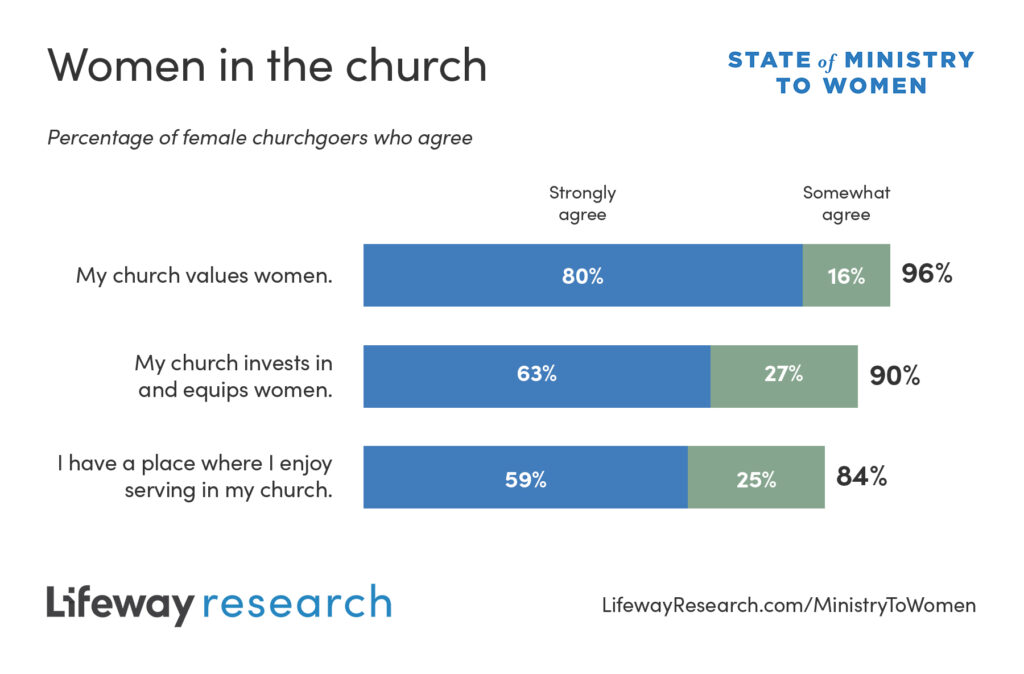
Among women who attend church once a month or more, 96 percent say their church values women, including 80 percent who agree strongly.

Fewer, however, believe their church invests in and equips women or say they have a place where they enjoy serving in their congregation. While 90 percent agree their church invests in and equips women, 63 percent strongly agree. Additionally, 84 percent of women churchgoers have somewhere they enjoy serving in their church, with 59 percent who strongly agree.

“While women are positive about their churches, 1 in 5 indicate there is room for improvement in how well their church values them,” said Scott McConnell, executive director of Lifeway Research.

“Even more women indicate their church could improve in proactively investing in women, with 37 percent withholding the highest rating for how well their church equips women.”

Still, most of the women are involved in their congregation beyond merely attending worship services. Two in 3 (66 percent) are involved in some type of small group or class for adults at least once during a typical month, including 28 percent who say they attend four times or more.

For around 2 in 3 churchgoing women (63 percent), their congregation has an organized women’s ministry. And another 21 percent say their church has activities specifically for women but nothing formal. Few say their church doesn’t have any activities for women (8 percent) or that they aren’t aware of any (7 percent).

Among those with some type of women’s activities at their church, female churchgoers point to the value that comes from having a women’s ministry. Benefits include stronger relationships among women in the church (68 percent), opportunities for women to be refreshed and restored spiritually and emotionally (65 percent), a place to ask questions and openly discuss faith topics (58 percent), stronger cross-generational relationships (56 percent) and a safe place for women to be transparent about needs and hurts (56 percent).
Other women’s ministry benefits according to women at churches with activities for them are support for what the church as a whole is encouraging (44 percent), receiving more biblical teaching than they would without it (35 percent), more serving in the community (30 percent), more relevant biblical application for women (30 percent), more serving in the church (28 percent) and more ministry done among women (27 percent). Less than 1 percent say none of these are added benefits for their church from their women’s ministry.

When asked what help they’ve received personally from their church’s women’s ministry, close to half say they have developed significant relationships with other women in the church (55 percent) and significant relationships with women in different age groups from their own (50 percent).

 Slightly fewer say it has made them more interested in attending activities that help them spiritually (45 percent), they’ve had more intentionality to their walk with Christ (38 percent), found a place to use their gifting to serve others in their church (36 percent) or have been mentored by a more mature believer (33 percent).

Around 3 in 10 say the women’s ministry has given them tangible ways to serve the local community (32 percent), more confidence to present the gospel (30 percent) and more motivation to invite people to church (28 percent).

“Women report that women’s ministry has specifically helped them build meaningful relationships, provided true encouragement and allowed them to explore elements of their faith that were particularly relevant to them,” McConnell said.

“Without the church offering these activities specifically for women, most say they wouldn’t have developed significant relationships and gotten to know women in other age groups. And many others report that their engagement in church activities, serving, sharing their faith and being intentional about their walk with Christ hinged on things their church’s women’s ministry provided.”

Community-building and discipleship activities

Close to 9 in 10 women say their church offered some type of activity specifically to develop community among new and existing women in their church, with the most popular events being some type of gathering around food like a potluck or lunch (63 percent) and holiday events (58 percent).

More than 3 in 4 women whose church provided these types of community activities (77 percent) say they participated in at least one last year, including 19 percent who say they attended more than five such events.

Almost 9 in 10 women say their church conducted some events in the past year to disciple women and encourage their walk with Christ. Churchgoers were most likely to say their church offered Bible studies for women (57 percent), times for women to pray together (46 percent) and opportunities to serve in the community (42 percent).

Almost 3 in 4 (73 percent) say they participated in at least one of these within the last year, including 15 percent who attended five or more of those events.

Churches seem to want to provide Bible studies that fit the schedules of women in different life circumstances. Among those who said their church offered Bible studies, 67 percent say they offered them outside of work hours, 58 percent say some were during the day on weekdays and 38 percent say the church did Bible studies specifically for moms with young children.

When asked for the reasons they chose not to participate in a women’s ministry event or gathering in the past year, female churchgoers pointed to several hindrances. A third (33 percent) said family obligations kept them away. Around 1 in 5 said they needed to work (23 percent), were out of town or sick (23 percent), had other activities planned (22 percent), some logistical reasons like the timing or cost (21 percent) or they had other priorities (19 percent).

Fewer said it was about the event itself—the topic was not for their life stage (9 percent), they had a lack of interest in the topic (7 percent), certain women were or were not going to be there (4 percent) or the plan for the event (4 percent). Around 1 in 8 (12 percent) don’t think they missed any women’s events in the past year.

Meeting spiritual and personal needs

Female churchgoers see ministry to women as a way to meet a host of spiritual and personal needs, and most say the church has been meeting those needs.

The top need women say they’ve been hoping women’s ministry activities in their church would help them with personally is growing closer to Jesus (71 percent). Most also want support when difficult things happen (60 percent), the ability to make friends (57 percent) and help when they feel discouraged (53 percent). A sizeable percentage also say they want their church’s women’s ministry to help them feel included (48 percent), heal from hurt (42 percent), deal with struggles in their faith (39 percent) and feel needed (31 percent).

Among the women who identified each of those areas, at least 7 in 10 say their church has offered activities that have helped them with that need, including 79 percent who said their church offered an activity that helped them grow closer to Jesus.

“A large majority of women are getting help from their church in the areas where they need it,” McConnell said. “But between 21 percent and 28 percent of women indicate specific needs that have not been addressed. This is more likely to occur in churches that do not have an organized ministry to women or activities specifically for women.”

Motivation for ministry

Those leading ministry to women in their churches are leading out of obedience to God rather than for personal gain, the survey indicated. More than 3 in 4 women (77 percent) say they are leading because they feel called. Another 55 percent say they chose to lead because there was a need, and 51 percent say they lead because it’s their gifting. The majority say each month they sense God confirming their call to lead (95 percent).

As they serve, most women’s ministry leaders say they feel God is guiding them in their leadership (94 percent). And they lead sacrificially, with more than 4 in 5 (83 percent) serving as volunteers or unpaid staff members. Far fewer leaders are paid part-time staff members (9 percent) or paid full-time staff members (8 percent).

Most women’s ministry leaders say discipling women and encouraging their walks with Christ is the top priority for their ministries (57 percent).

Events play an important role in reaching this goal. More than 4 in 5 (88 percent) women’s ministries offer Bible studies for women to disciple them and encourage their walks with Christ. Most also offer time for women to pray together (57 percent). Others provide opportunities to serve in the community (48 percent) or attend conferences as a group (40 percent).

By far, women’s ministry leaders say offering Bible studies for women is one of the most effective events for encouraging women on their faith journey with Christ (80 percent). Leaders also say offering times for prayer (23 percent), attending conferences (16 percent) and providing opportunities to serve the community (13 percent) are some of the most effective events for encouraging women in their faith.

As women’s ministry leaders invest in the women in their congregations, they see the impact of their ministries goes far beyond themselves. Most say their ministry does well or very well at encouraging the spiritual growth of women (89 percent), encouraging women to obey God (82 percent) and engaging existing women in their church to serve others (61 percent).

Close to half say their ministry works well or very well at mobilizing women to turn from sins (52 percent), connecting existing women in their church into their community (50 percent) and mobilizing women to invite people to church (49 percent).

As women’s ministry leaders reflect on the role their ministry plays in the local church, most say their church values their women’s ministry (93 percent).

Most (94 percent) also say their ministry regularly receives support from their pastor, with more than 3 in 4 (76 percent) strongly agreeing. And 71 percent say their church provides the women’s ministry with funds from the church budget. But few (5 percent) conduct women’s ministry planning together with the church staff.

“Very few women’s ministry leaders doubt they have support from their pastor or that their ministry is valued by their church. But some indicate there is room for improvement,” McConnell said.

“Moving in a unified direction with the church’s goals requires communication. With so few women’s ministry leaders on staff and few of them planning alongside staff members, there are no doubt missed opportunities for maximizing the value of women’s ministry within the church.”

Challenges identified

Women’s ministries in churches face many challenges. But leaders say the biggest challenges their ministries face are women not attending or participating (48 percent) and connecting with women in different age groups (45 percent).

Women’s ministry leaders also see a variety of areas they feel they need to develop as leaders, with their top leadership needs having to do with recruiting leaders (43 percent), vision and direction (40 percent) and teaching and training (33 percent).

And women’s ministry leaders are not alone in these challenges. According to the Greatest Needs of Pastors study from Lifeway Research, Protestant pastors say developing leaders and volunteers (77 percent), training current leaders and volunteers (68 percent) and establishing a compelling vision (45 percent) are some ministry difficulties they face that are top priorities for them.

 “Churches with no organized ministry to women have a significant opportunity to make a change and help women spiritually. Finding a leader to begin offering relational, Bible-focused, relevant activities is critical for these churches,” McConnell said.

“For churches who already have a women’s ministry, the greatest opportunity comes from women attending the first time, because participating in women’s ministry causes many women to be more interested in activities that help them spiritually.”

Lifeway Research conducted the online survey of American evangelical and Black Protestant female churchgoers March 13-17, 2023, using a national pre-recruited panel. Analysts used quotas and slight weights to balance age, region, ethnicity, education, religious service attendance and religious tradition to reflect the population more accurately.

The completed sample is 1,001 surveys, providing 95 percent confidence the sampling error from the panel does not exceed plus or minus 3.2 percent. This margin of error accounts for the effect of weighting. Margins of error are higher in sub-groups.