Women’s ministry valued but room for improvement

NASHVILLE—Ministry leaders and female churchgoers believe ministry to women is working in their congregations, but both feel there’s room for improvement.

Lifeway Research surveyed 1,001 evangelical and Black Protestant female churchgoers in the United States, along with 842 women’s ministry leaders, for the State of Ministry to Women study.

While acknowledging areas that need more investment, both leaders and those involved see value in their church’s ministry to women. Women in the pews, however, experience those benefits firsthand.

Among women who attend church once a month or more, 96 percent say their church values women, including 80 percent who agree strongly.

Fewer, however, believe their church invests in and equips women or say they have a place where they enjoy serving in their congregation. While 90 percent agree their church invests in and equips women, 63 percent strongly agree. Additionally, 84 percent of women churchgoers have somewhere they enjoy serving in their church, with 59 percent who strongly agree.
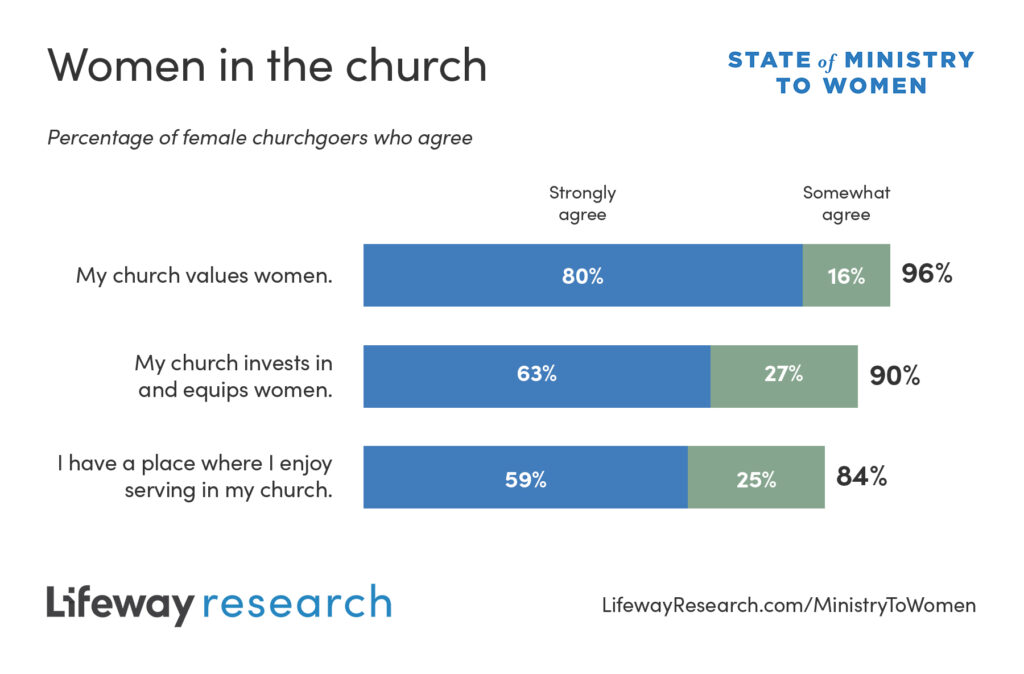
“While women are positive about their churches, 1 in 5 indicate there is room for improvement in how well their church values them,” said Scott McConnell, executive director of Lifeway Research.

“Even more women indicate their church could improve in proactively investing in women, with 37 percent withholding the highest rating for how well their church equips women.”

Still, most of the women are involved in their congregation beyond merely attending worship services. Two in 3 (66 percent) are involved in some type of small group or class for adults at least once during a typical month, including 28 percent who say they attend four times or more.

For around 2 in 3 churchgoing women (63 percent), their congregation has an organized women’s ministry. And another 21 percent say their church has activities specifically for women but nothing formal. Few say their church doesn’t have any activities for women (8 percent) or that they aren’t aware of any (7 percent).

Among those with some type of women’s activities at their church, female churchgoers point to the value that comes from having a women’s ministry. Benefits include stronger relationships among women in the church (68 percent), opportunities for women to be refreshed and restored spiritually and emotionally (65 percent), a place to ask questions and openly discuss faith topics (58 percent), stronger cross-generational relationships (56 percent) and a safe place for women to be transparent about needs and hurts (56 percent).

Other women’s ministry benefits according to women at churches with activities for them are support for what the church as a whole is encouraging (44 percent), receiving more biblical teaching than they would without it (35 percent), more serving in the community (30 percent), more relevant biblical application for women (30 percent), more serving in the church (28 percent) and more ministry done among women (27 percent). Less than 1 percent say none of these are added benefits for their church from their women’s ministry.

When asked what help they’ve received personally from their church’s women’s ministry, close to half say they have developed significant relationships with other women in the church (55 percent) and significant relationships with women in different age groups from their own (50 percent).

 Slightly fewer say it has made them more interested in attending activities that help them spiritually (45 percent), they’ve had more intentionality to their walk with Christ (38 percent), found a place to use their gifting to serve others in their church (36 percent) or have been mentored by a more mature believer (33 percent).

Around 3 in 10 say the women’s ministry has given them tangible ways to serve the local community (32 percent), more confidence to present the gospel (30 percent) and more motivation to invite people to church (28 percent).

“Women report that women’s ministry has specifically helped them build meaningful relationships, provided true encouragement and allowed them to explore elements of their faith that were particularly relevant to them,” McConnell said.

“Without the church offering these activities specifically for women, most say they wouldn’t have developed significant relationships and gotten to know women in other age groups. And many others report that their engagement in church activities, serving, sharing their faith and being intentional about their walk with Christ hinged on things their church’s women’s ministry provided.”

Community-building and discipleship activities

Close to 9 in 10 women say their church offered some type of activity specifically to develop community among new and existing women in their church, with the most popular events being some type of gathering around food like a potluck or lunch (63 percent) and holiday events (58 percent).

More than 3 in 4 women whose church provided these types of community activities (77 percent) say they participated in at least one last year, including 19 percent who say they attended more than five such events.

Almost 9 in 10 women say their church conducted some events in the past year to disciple women and encourage their walk with Christ. Churchgoers were most likely to say their church offered Bible studies for women (57 percent), times for women to pray together (46 percent) and opportunities to serve in the community (42 percent).

Almost 3 in 4 (73 percent) say they participated in at least one of these within the last year, including 15 percent who attended five or more of those events.

Churches seem to want to provide Bible studies that fit the schedules of women in different life circumstances. Among those who said their church offered Bible studies, 67 percent say they offered them outside of work hours, 58 percent say some were during the day on weekdays and 38 percent say the church did Bible studies specifically for moms with young children.

When asked for the reasons they chose not to participate in a women’s ministry event or gathering in the past year, female churchgoers pointed to several hindrances. A third (33 percent) said family obligations kept them away. Around 1 in 5 said they needed to work (23 percent), were out of town or sick (23 percent), had other activities planned (22 percent), some logistical reasons like the timing or cost (21 percent) or they had other priorities (19 percent).

Fewer said it was about the event itself—the topic was not for their life stage (9 percent), they had a lack of interest in the topic (7 percent), certain women were or were not going to be there (4 percent) or the plan for the event (4 percent). Around 1 in 8 (12 percent) don’t think they missed any women’s events in the past year.

Meeting spiritual and personal needs

Female churchgoers see ministry to women as a way to meet a host of spiritual and personal needs, and most say the church has been meeting those needs.

The top need women say they’ve been hoping women’s ministry activities in their church would help them with personally is growing closer to Jesus (71 percent). Most also want support when difficult things happen (60 percent), the ability to make friends (57 percent) and help when they feel discouraged (53 percent). A sizeable percentage also say they want their church’s women’s ministry to help them feel included (48 percent), heal from hurt (42 percent), deal with struggles in their faith (39 percent) and feel needed (31 percent).

Among the women who identified each of those areas, at least 7 in 10 say their church has offered activities that have helped them with that need, including 79 percent who said their church offered an activity that helped them grow closer to Jesus.

“A large majority of women are getting help from their church in the areas where they need it,” McConnell said. “But between 21 percent and 28 percent of women indicate specific needs that have not been addressed. This is more likely to occur in churches that do not have an organized ministry to women or activities specifically for women.”

Motivation for ministry

Those leading ministry to women in their churches are leading out of obedience to God rather than for personal gain, the survey indicated. More than 3 in 4 women (77 percent) say they are leading because they feel called. Another 55 percent say they chose to lead because there was a need, and 51 percent say they lead because it’s their gifting. The majority say each month they sense God confirming their call to lead (95 percent).

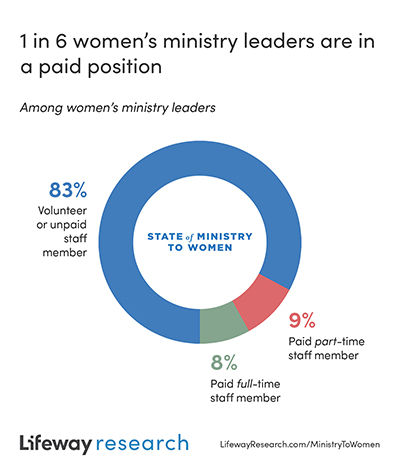
As they serve, most women’s ministry leaders say they feel God is guiding them in their leadership (94 percent). And they lead sacrificially, with more than 4 in 5 (83 percent) serving as volunteers or unpaid staff members. Far fewer leaders are paid part-time staff members (9 percent) or paid full-time staff members (8 percent).
Most women’s ministry leaders say discipling women and encouraging their walks with Christ is the top priority for their ministries (57 percent).

Events play an important role in reaching this goal. More than 4 in 5 (88 percent) women’s ministries offer Bible studies for women to disciple them and encourage their walks with Christ. Most also offer time for women to pray together (57 percent). Others provide opportunities to serve in the community (48 percent) or attend conferences as a group (40 percent).

By far, women’s ministry leaders say offering Bible studies for women is one of the most effective events for encouraging women on their faith journey with Christ (80 percent). Leaders also say offering times for prayer (23 percent), attending conferences (16 percent) and providing opportunities to serve the community (13 percent) are some of the most effective events for encouraging women in their faith.

As women’s ministry leaders invest in the women in their congregations, they see the impact of their ministries goes far beyond themselves. Most say their ministry does well or very well at encouraging the spiritual growth of women (89 percent), encouraging women to obey God (82 percent) and engaging existing women in their church to serve others (61 percent).

Close to half say their ministry works well or very well at mobilizing women to turn from sins (52 percent), connecting existing women in their church into their community (50 percent) and mobilizing women to invite people to church (49 percent).

As women’s ministry leaders reflect on the role their ministry plays in the local church, most say their church values their women’s ministry (93 percent).

Most (94 percent) also say their ministry regularly receives support from their pastor, with more than 3 in 4 (76 percent) strongly agreeing. And 71 percent say their church provides the women’s ministry with funds from the church budget. But few (5 percent) conduct women’s ministry planning together with the church staff.

“Very few women’s ministry leaders doubt they have support from their pastor or that their ministry is valued by their church. But some indicate there is room for improvement,” McConnell said.

“Moving in a unified direction with the church’s goals requires communication. With so few women’s ministry leaders on staff and few of them planning alongside staff members, there are no doubt missed opportunities for maximizing the value of women’s ministry within the church.”

Challenges identified

Women’s ministries in churches face many challenges. But leaders say the biggest challenges their ministries face are women not attending or participating (48 percent) and connecting with women in different age groups (45 percent).

Women’s ministry leaders also see a variety of areas they feel they need to develop as leaders, with their top leadership needs having to do with recruiting leaders (43 percent), vision and direction (40 percent) and teaching and training (33 percent).

And women’s ministry leaders are not alone in these challenges. According to the Greatest Needs of Pastors study from Lifeway Research, Protestant pastors say developing leaders and volunteers (77 percent), training current leaders and volunteers (68 percent) and establishing a compelling vision (45 percent) are some ministry difficulties they face that are top priorities for them.

 “Churches with no organized ministry to women have a significant opportunity to make a change and help women spiritually. Finding a leader to begin offering relational, Bible-focused, relevant activities is critical for these churches,” McConnell said.

“For churches who already have a women’s ministry, the greatest opportunity comes from women attending the first time, because participating in women’s ministry causes many women to be more interested in activities that help them spiritually.”

Lifeway Research conducted the online survey of American evangelical and Black Protestant female churchgoers March 13-17, 2023, using a national pre-recruited panel. Analysts used quotas and slight weights to balance age, region, ethnicity, education, religious service attendance and religious tradition to reflect the population more accurately.

The completed sample is 1,001 surveys, providing 95 percent confidence the sampling error from the panel does not exceed plus or minus 3.2 percent. This margin of error accounts for the effect of weighting. Margins of error are higher in sub-groups.



Online worshippers lead in Bible reading frequency

PHILADELPHIA (BP)—Bible users who worship God online are most likely to read the Bible at least weekly apart from church service, the American Bible Society said in the latest installment of its 2023 State of the Bible report.

Among online worshippers, 74 percent read the Bible at least weekly, whether they worship solely online or online and in person. Of in-person-only worshippers, 32 percent read the Bible at least weekly, the American Bible Society stated.

“This might seem surprising to those who see online church as a lesser experience, used by people who are less committed spiritually,” the society said in the report’s seventh chapter, focused on Bible use and technology. “We suspect that these numbers speak to the personal nature of online attendance.”

Online attendance, often done alone or with immediate family, “can be more about hearing about God and from God,” the Bible society speculated. “It’s personal, as Bible reading often is.”

The findings are among the results of an 18-minute survey conducted in January among a representative sample of adults 18 and older within the 50 states and the District of Columbia. Percentages are based on 2,761 responses.

The release delved into how many people read the Bible at least weekly outside of normal church services and certain descriptive characteristics concerning them.

Among the top findings:

  • 25 percent of American adults use the Bible at least weekly, amounting to about 65 million people.
  • More than half of evangelicals, 53 percent, report reading the Bible weekly, compared to 21 percent of Catholics who do so.
  • Black Americans far surpass others in reading the Bible at least weekly, with 38 percent reporting so, compared to 23 percent among all other ethnic groups combined. Nearly one in five Blacks (19 percent) read the Bible daily, outpacing all other groups combined, which numbered 8 percent.

Curiosity about Scripture doesn’t necessarily drive Scripture reading, the Bible society found. About 39 million U.S. adults say they are extremely curious about Scripture, but they don’t read it at least weekly. More than half of Americans—52 percent—wish they read Scripture more, but only 14 percent increased their Bible reading in the past year.

Among the top impediments to reading Scripture more frequently were a lack of time (26 percent), a lack of excitement (15 percent), not knowing where to start (17 percent), and difficulty in relating to the language (15 percent).

Among other findings:

  • The popularity of digital Scripture sources is about the same as in 2022. Just under 70 percent of Bible users read a printed Bible at least monthly, 50 percent read a digital Bible app at least monthly, and 48 percent read Scripture through internet searches at the same frequency.
  • Elders continue to favor printed Bibles at 87 percent, while 46 percent of Boomers are most likely to watch a Bible program on video.
  • Bible apps and podcasts are most popular among Millennials, 42 percent, and Gen X, 39 percent; with digital Bibles and online Bible reading plans also most popular among those generations.
  • Gen Z is most likely to access Scripture through internet searches.

The State of the Bible annually looks at the Bible, faith and the church in America. The American Bible Society collaborated with the University of Chicago’s National Opinion Research Center in designing the study conducted online and via telephone to NORC’s AmeriSpeak Panel.

Previous chapters of the 2023 study revealed various aspects of how Scripture engagement impacts daily life. Future chapters will offer new insights on how the Bible affects philanthropic habits and summarize highlights from 2023 research.


A third of Asian Americans say religion is very important

WASHINGTON (RNS)—More Asian Americans identify as atheist, agnostic or nonreligious than before, according to a survey by Pew Research Center.

But 40 percent of those Pew surveyed, who included Americans of Chinese, Filipino, Indian, Japanese, Korean and Vietnamese backgrounds, said they feel close to a religion for reasons aside from religion, such as family or cultural ties.

Pew’s survey, which studied over 7,000 participants over the course of a year, found that Asian Americans are part of the ongoing trend of Americans who don’t follow any religion, often referred to as “nones.” Today, 32 percent of Asian Americans are religiously unaffiliated, compared with 26 percent in 2012.

Asian Americans as a whole are mostly Christian (34 percent), especially Korean (59 percent) or Filipino Americans (74 percent), who are evenly split between Protestantism and Catholicism (16 percent and 17 percent). Born-again or evangelical Protestants make up 10 percent of Asian Americans.

However, Asian Americans who identify as Christians have shown the sharpest declines in affiliation with religious institutions since 2012, dropping by 8 percentage points.

More than half (56 percent) of Chinese Americans and close to half (47 percent) of Japanese Americans said they are not affiliated with any religion, comprising the largest groups of religious nones. They are also the groups least likely to consider religion very important.

Buddhists and Hindus, both at 11 percent, were the next largest faith groups. Vietnamese Americans are the most likely of the Asian origin groups to identify as Buddhist (37 percent), and Indian Americans are far more likely than the other groups to be Hindu (48 percent).

The survey’s findings reflected a complex understanding of religiosity in many Asian American cultures, in which religious identity can mean more than just adhering to a set of beliefs. In particular, daily life in Asian countries can be infused with practices associated with Buddhism, Hinduism, Daoism, Shintoism and Confucianism, even among those who do not identify as religious.

One Vietnamese Buddhist told the researchers, “Confucianism and Daoism is part of my culture. However, for me, it’s a school of philosophy. I do not identify myself as being a Daoist or Confucian.”

While only 11 percent of Asian American adults say their religion is Buddhism, for example, 21 percent feel close to Buddhism for other reasons.

Religiously unaffiliated Indian Americans report this phenomenon at much higher rates than nones of other Asian origin groups, saying they feel close to Hinduism for reasons aside from religion.

Reported affinity toward more than one religion

Many Asian Americans also reported feeling an affinity toward more than just one religion, the survey found. Four in 10 Asian American adults expressed a cultural connection to one or more groups that they do not claim as a religious identity, but still feel close to.

One Hindu participant expressed a connection to Buddhism “because some of the practices of Buddhists, they are very much similar” to Hindu practices.

The survey found 18 percent of Asian Americans do not identify religiously as Christian, yet say they feel close to Christianity aside from religion, including, for example, the American celebration of Christmas.

“My whole life I was exposed to Christmas and all this stuff. Even though I don’t believe in it, we had to give gifts … so it was always part of our culture, even though we don’t believe in it,” said one non-Christian Indian participant who grew up in the United States.

On the whole, Asian Americans are slightly less likely than Americans as a whole to say religion is very important in their lives, the survey says.

Asian American Muslims (60 percent) and Christians (54 percent) are much more likely to feel that religion is very important in their lives than are Asian American Hindus (33 percent) and Buddhists (31 percent), and also are the likeliest to say they attend religious services or visit a temple, shrine or other religious space at least monthly.

Regular religious attendance is more common among Korean and Filipino Americans than among Vietnamese, Japanese or Chinese Americans. And as a whole, Asian Americans born in a country other than the United States are far more likely than those born here to say they attend religious services at least monthly (32 percent versus 21 percent).

Twenty-one percent of all Asian Americans surveyed said they attend services at least weekly.

Worship trends vary among traditions, but 36 percent of Asian Americans say they have an altar, shrine or religious symbol that they use for home worship. Of those who do, many identify as Buddhist or Hindu.

But worshipping at home is also fairly common among Catholic Filipino Americans, with 66 percent of them saying they have an altar at home.

As many Asian Americans expressed a dual-belonging with more than one religion, 30 percent of Asian Americans said all or most of their friends have the same religion they do. Seventy-seven percent of Asian Americans say they would be comfortable if a family member married outside of their faith.


Is religion good for you? It’s complicated, Gallup says

\WASHINGTON (RNS)—A new report from Gallup finds religious people around the world report being more positive, have more social support, and are more involved in their communities than those who are not religious.

The study, based on 10 years of data, also finds the well-being of religious people varies from country to country and is often hard to measure. Even if researchers find that religion is good for you, people who are not religious may not care about its benefits or want anything to do with it.

“Gallup World Poll data from 2012-2022 find, on a number of well-being measures, that people who are religious have better well-being than people who are not,” according to the report, published last week.

Data about nine aspects of life

The study included data about nine aspects of people’s lives, from their positive interactions with others and their social life to their civic engagement and physical health. Each of the nine indexes included a score of 0 to 100, based on answers to a series of questions.

For the positive experience index, respondents were asked questions such as “Did you smile or laugh today?” and “Were you treated with respect?”

For civic engagement, they were asked questions about whether they gave to charity or helped a stranger.

The physical health index asked if they had health issues that kept them from doing things people their age usually do and whether they were in physical pain.

For community basics, they were asked about housing and infrastructure.

Religious people scored higher on five of Gallup’s indexes: social life (77.6 compared with 73.7 for nonreligious people), positive experience (69 to 65), community basics (59.7 to 55.6), optimism (49.4 to 48.4) and civic engagement (35.8 to 31).

They scored about the same as nonreligious people in two indexes: a “life evaluation” of whether they were thriving or suffering and their local economic confidence.

Religious people scored lower on two indexes: negative experience and physical health.

The differences between religious and nonreligious people were most prominent in highly religious countries.

Researchers noted that even small differences can have a significant impact on a global scale.

“Each one-point difference in index scores between religious and nonreligious people represents an effect for an estimated 40 million adults worldwide,” the report stated.

“For example, the four-point difference between religious and nonreligious people on the Positive Experience Index means that an estimated 160 million more adults worldwide have positive experiences than would be the case if those adults were not religious.”

Interest and involvement in religion declining

The report suggests religion and spirituality could be a possible asset in dealing with the mental health crisis in many countries. However, they noted, the number of people interested in or involved in religion is declining.

For the report, Gallup partnered with the Radiant Foundation, which promotes a positive view of religion and spirituality and is associated with The Church of Jesus Christ of Latter-day Saints.

Jeff Jones, Gallup poll senior editor, said measuring the impact of religion and spirituality on wellness is complicated, especially as people become less religious and the way they practice spirituality evolves.

“With the changing nature of religious landscapes and spiritual practice, it can make quantitative measurement amid the changes challenging, as the traditional forms of spirituality—namely, attending formal religious services, are becoming less common and people are seeking other ways to fulfill their spiritual needs,” Jones said in an email.

The report, which also includes quotes from experts and a review of past research on the connection between wellness and religion, notes that even as researchers become more aware of the positive outcomes of religion, people are less interested in religion around the world.

While they have no polling data on the decline of religion, the report suggests several causes for that decline, including growing polarization that pits religious and nonreligious people against each other. Nonreligious people at times see religious people as a threat. Religious people, especially from larger faith groups, can wield their power in ways that others see as harmful.

“Religious groups and individuals—particularly from the dominant religious group in a society—who are hostile to other religious groups may promote a cultural context that is harmful to the well-being of those outside the group,” the report states.

“Resentment toward the dominant group may also tune people out to their messages, both those that are harmful (out‑group animosity) but also that are helpful (serving others).”


Half of pastors say economy is hurting their churches

BRENTWOOD, Tenn.—As churches continue to navigate economic challenges in the United States, half of surveyed pastors say the economy is harming their churches as giving fails to keep up with inflation.

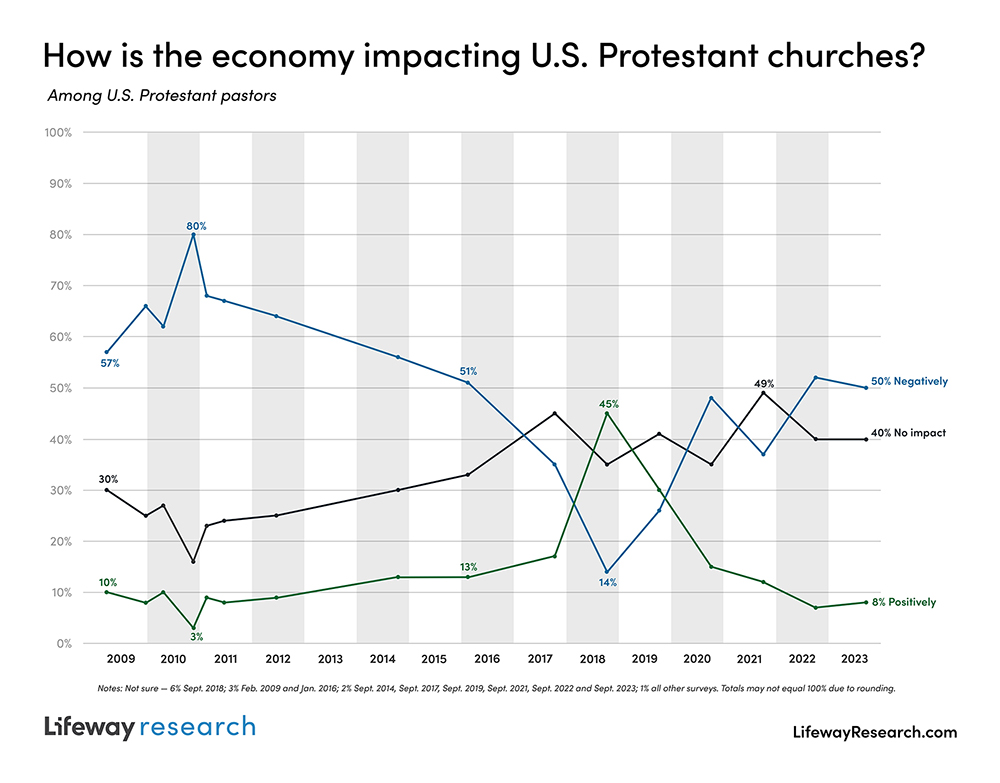
A Lifeway Research study of U.S. Protestant pastors found 50 percent say the current economy is negatively impacting their churches. Meanwhile, 40 percent say the economic circumstances aren’t having an effect. Fewer than 1 in 10—8 percent—say the current economy is a positive factor for their churches.

Last year was the first time since 2016 more than half of pastors felt the economy was impacting their churches negatively and the first time since 2012 fewer than 10 percent of pastors expressed belief the economy was positively impacting their churches.

Only twice in the study’s 15-year history—in 2018 and 2019—were pastors more likely to say the economy was having a positive impact than a negative one.

“The good news is the economy is not negatively impacting more churches than last year, despite persistent inflation and slower economic growth,” said Scott McConnell, executive director of Lifeway Research. “The bad news is that most churches continue to feel pain and discomfort from current economic realities.”

Although pastors continue to report a negative economic impact, churches have maintained stable levels of giving near their planned budgets and comparable to last year’s giving. But in most churches, increases in giving have not kept up with inflation in 2023.

Around 7 in 10 U.S. Protestant pastors say since the beginning of 2023, giving at their church is at or exceeding budget, with 46 percent saying giving has been about what was budgeted and 22 percent saying it’s higher. Three in 10 say giving is below their 2023 budget.

Tough time to set a budget

“This was not an easy year to set a budget, as many predicted a softening in the nation’s economic well-being,” McConnell said. “Whether churches lowered expectations or not, most are meeting or exceeding their budget.”

Compared to last year’s actual receipts, 7 in 10 pastors say giving at their churches is at or above 2022 levels, including 38 percent who say it’s the same as last year, and 33 percent saying it’s above. Fewer than 1 in 4 (23 percent) say offerings are below 2022.

When asked by what percentage their churches’ offerings have increased or decreased, more pastors say giving is the same as 2022 or above. More than 2 in 5 (44 percent) say it has remained the same. Twelve percent of pastors say giving has increased less than 10 percent. Thirteen percent say it has increased 10 percent to 24 percent. Four percent say it has increased by 25 percent or more since 2022.

Around 1 in 5 report a decrease in giving, including 4 percent who say offerings are down by  less than 10 percent. Twelve percent say they are down 10 percent to 24 percent. Four percent say they have declined by 25 percent or more.

When the income experiences of churches are combined, the average church saw an increase of 0.79 percent in offerings from 2022 to 2023.

“Finances are not just difficult for those churches in which giving is down,” McConnell said. “Most churches are not seeing growth in offerings that keep pace with inflation (currently 3.7 percent annually according to the Consumer Price Index). So, many churches are still cutting spending and giving raises that are smaller than their pastors and staff need.”

Size matters

Although the economy’s impact on churches has remained stable compared to last year, small churches are still the most likely to face financial struggles. Small churches were some of the first to recover pre-pandemic levels of attendance after COVID-19, but many have struggled to face the economic challenges in the years since. Large churches are less likely to be struggling in the current economy.

Pastors at the largest churches—those with 250 or more in attendance—are the least likely to say the economy has somewhat or very negatively impacted their churches this year (34 percent). They are also the most likely to report that giving levels are above those in 2022 (57 percent).

Meanwhile, pastors of churches with attendance less than 100 are among the most likely to say offerings have been lower than budgeted this year and below 2022’s offerings.

“In a smaller church, if economic factors hurt even a couple of families, chances are the church feels it,” McConnell said. “There is no looking around expecting someone else to step up to cover it. It just hurts.”

The phone survey of 1,004 Protestant pastors was conducted Aug. 29 to Sept. 20. The calling list was a stratified random sample, drawn from a list of all Protestant churches. Each interview was conducted with the senior pastor, minister or priest at the church. Analysts weighted responses by region and church size to reflect the population more accurately. The completed sample is 1,004 surveys, providing 95 percent confidence the sampling error does not exceed plus or minus 3.2 percent. Margins of error are higher in sub-groups.


Jerry Falwell legal battle with Liberty University escalates

WASHINGTON (RNS)—The ongoing legal battle between Liberty University and Jerry Falwell Jr. has taken yet another twist, as the school’s former president has alleged misconduct by its board of directors and attempted to ban the university from using images of his late father.

In an amended complaint filed in federal court last week, Falwell Jr., who resigned from his post in August 2020 in the wake of multiple scandals, alleged several board members, including former interim Liberty President Jerry Prevo and former Southern Baptist Convention President Jerry Vines, diverted university funds to their private causes.

“During his lifetime, Dr. Falwell earned a reputation as a major proponent of financial integrity in religious and educational institutions and led the way in restoring public trust and confidence in such institutions after financial scandals associated with other, unrelated church leaders rocked the evangelical community in the 1980s,” Falwell Jr.’s lawyer argued in the amended complaint, filed Sept. 13.

The reference to “Dr. Falwell” is to Jerry Falwell Sr. “The JERRY FALWELL brand will not be associated with such conduct,” the amended complaint stated.

Falwell Jr. also alleges the board overlooked sexual misconduct by former leaders, including an unnamed former president, only to turn on Falwell Jr. when his life fell apart. Falwell Jr. also alleges the board exploited a near-fatal lung condition he suffered and harassed him by not paying him retirement benefits.

“The JERRY FALWELL brand does not stand for such abhorrent treatment, which is antithetical to the reputation by which it is known,” the complaint alleges.

The complaint lays much of the blame at the feet of Prevo, who the complaint alleges diverted school funds to his personal foundation and used the school’s corporate jet to fly to his homes in Alaska and Arizona—$35,000 per trip and $20,000 per trip, respectively, according to the amended complaint.

Falwell also alleges Prevo made many of his decisions after consulting with evangelical leader Franklin Graham.

“Upon information and belief, Franklin Graham is Prevo’s closest advisor; during the limited times Prevo appeared on campus to fulfill his duties as interim president, he would speak with Graham virtually every day by phone before making any decisions,” the complaint alleges.

Liberty calls allegations ‘improper and unsupported’

Asked about the complaint, a Liberty University spokesperson sent Religion News Service a statement.

“In response to Liberty’s compelling motion to dismiss his complaint, Jerry Falwell, Jr. filed an amended complaint containing improper and unsupported allegations designed to diminish former colleagues, family, and friends and to discredit the university where he formerly served,” the statement read.

“These personal attacks have no place in a legal dispute over the use of a person’s name, image, and likeness. Liberty will file the appropriate response to these claims in due time and defend its legal right to continue the use of Dr. Jerry Falwell’s name.

“Furthermore, we stand by our initial statement that Liberty University and its Board of Trustees have only sought to honor the visionary leadership of Dr. Jerry Falwell and the mission of training Champions for Christ.”

In addition to the complaint, RNS obtained from multiple sources an email sent by Falwell Jr. to Liberty board members discussing the latest legal filing. In the email, Falwell accuses David Corry, Liberty’s general counsel, of waging a three-year “campaign” to “use millions of dollars of Liberty student tuition money to make me look as bad as possible in public and to the Board of Trustees.”

Falwell also accused Corry of malpractice and incompetence and suggested some members of Liberty’s executive committee want to “gain control of Liberty, benefit personally from Liberty” and “determine who will be Liberty’s future leaders.”

Later in the email, Falwell claimed he had intended to end the legal battle but “had no choice but to strike back this Spring to protect my family’s reputation and future after forgiving 7 times 70,” apparently referencing a biblical quote from Jesus about how many times to forgive enemies.

The back-and-forth touches primarily on one of two lawsuits making their way through federal court. In March, the former Liberty president sued the university and the executive committee of the school’s board, alleging they have failed to pay him $8.5 million in retirement benefits.

Those benefits, the suit alleges, could only be withheld if he were fired for cause or if he engaged in “any Competitive Activity,” according to the complaint filed in U.S. District Court for the Western District of Virginia.

Board says retirement benefits should be forfeited

The board alleges the retirement benefits should be forfeited because Falwell deceived them regarding his own personal failings and his and his wife’s fiscal and alleged immoral behavior with a young man named Giancarlo Granda.

“Most damaging of all, perhaps, was Falwell’s post-contractual revelation of his overall and disqualifying departure from Liberty’s core Christian values at the time he was in the process of being Liberty’s long-term spiritual leader,” the school’s lawyers argued in a filing this month asking a federal judge to dismiss the case.

Jerry Falwell Sr. was pastor of Thomas Road Baptist Church. (File Photo)

In July, Falwell sued the school again for using his father’s name, image and portrait—all trademarked—without permission of the Dr. Jerry L. Falwell Family Trust, which owns the trademark.

The lawsuit pits the Falwell brothers against each other. Jerry Falwell Jr. alleges his brother, Jonathan Falwell, betrayed the family trust by siding with the university against him in regard to the trademark and is doing so for personal gain—and asserts Jonathan Falwell convinced their sister to have Jerry Falwell removed as a co-trustee of the family trust.

He also says the school rescued Thomas Road Baptist Church—where Jonathan Falwell succeeded their father as pastor—from financial ruin and asserts his brother hides how much money he gets from the school.

“Upon information and belief, Liberty and Jonathan have colluded to avoid publicly reporting additional income that Jonathan receives from Liberty, whether directly or indirectly, in the form of contributions to TRBC,” the complaint alleges.

The elder Jerry Falwell, a controversial leader of the religious right, founded Liberty in the 1970s and spent a decade promoting the school. When he died in 2007, the school received $29 million in life insurance benefits, which rescued the school from debt.

Falwell Jr. alleged in his July complaint the school no longer had permission to use his father’s image.

The school contested, filing a motion in late August to have the suit dismissed, arguing, among other things, that Falwell Jr. did not have authority to sue on behalf of the family trust, as his brother and co-trustee—who is also Liberty’s chancellor—did not consent.

The initial trademark lawsuit consisted primarily of a list of examples of how the school was using Jerry Falwell Sr.’s name and image.

After the school filed its motion to dismiss the case, Falwell Jr.’s attorneys filed an amended complaint, making a series of allegations about misconduct by school leaders, including “through a series of questionable self-dealing transactions that have the appearance of kickbacks” and overlooking sexual misconduct by former leaders.


Nonbelievers adhere to some Bible-based values

PHILADELPHIA (BP)—Biblical values, especially those regarding pro-social behavior, influence the lifestyles of nonbelievers, researchers said in the latest release from the 2023 State of the Bible from the American Bible Society.

Nonbelievers scored higher than nonpracticing Christians in most Bible-based behaviors studied, researchers found.

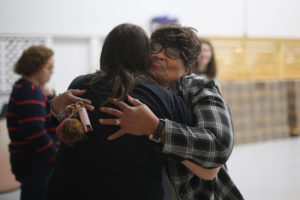
Kay Bennett, executive director of Baptist Friendship House, receives a hug from one of the participants at the ministry center’s weekly Bible study. Bennett noted that the Friendship House mission statement simply states, “Meeting needs through love, action and truth.” (WMU photo by Pam Henderson)

“Our research shows that even those Americans who are most hostile toward the Bible value biblical behaviors like loving your neighbor, caring for creation and welcoming the stranger,” said John Farquhar Plake, American Bible Society chief ministry insights officer.

Plake promotes the findings as helpful for churches engaging in community outreach.

“This shared passion for neighborly behavior is a new avenue for ministry leaders to start conversations about the values Americans share,” he said. “And their ultimate source in Jesus and his word.”

In the sixth chapter of the report released Sept. 14, the American Bible Society explored the conjunction of Scripture, Christianity and behavior in such practices as welcoming immigrants, befriending people of other races and other religions, and advocating for the oppressed.

The study considered behavior such as living a healthy lifestyle, caring for one’s mental health and practicing wise money management. How important is it to engage in the community, being aware of civic and government issues, personally participating in civic and government issues, and submitting to government leaders?

In addition, researchers specifically asked whether participants considered it important to be a good neighbor, to care for those in prison and to care for the environment.

“We know that when people engage with the Bible’s message, it transforms their hearts,” Plake said. “And, by looking more closely at pro-social behaviors that are directly inspired by the Bible’s teachings, we can see how Scripture influences the way we live our lives.”

Among the top findings regarding nonbelievers or non-Christians:

  • 51 percent advocate for the oppressed, compared to 46 percent of practicing Christians and 25 percent of nonpracticing Christians.
  • 50 percent befriend other races, compared to 54 percent of practicing Christians and 31 percent of nonpracticing Christians.
  • 46 percent welcome immigrants, compared to 40 percent of practicing Christians and 22 percent of nonpracticing Christians.
  • 43 percent befriend people of other religions, compared to 45 percent of practicing Christians and 30 percent of nonpracticing Christians.

Researchers looked at Scripture including the story of God’s creation in Genesis 1, the command to care for those in prison in Hebrews 13:3, the Parable of the Sheep and the Goats in Matthew 25, and commandments to love your neighbor in Leviticus 19:18 and Matthew 22:39.

Researchers found:

  • 66 percent of nonbelievers think it’s important to care for the environment, compared to 54 percent of practicing Christians and 44 percent of non-practicing Christians.
  • In a category that all respondents scored high, 75 percent of practicing Christians think it’s important to be a good neighbor, compared to 63 percent of nonbelievers and 54 percent of nonpracticing Christians.
  • In a less favorable category, 36 percent of practicing Christians think it’s important to care for those in prison, 25 percent of non-Christians think so, and 13 percent of nonpracticing Christians hold the belief.

The State of the Bible annually looks at the Bible, faith and the church in America. The American Bible Society collaborated with the University of Chicago’s National Opinion Research Center in designing the study conducted online and via telephone.

The 18-minute survey, conducted Jan. 5-30, produced 2,761 responses from a representative sample of adults 18 and older within the 50 states and D.C.


Pushback to the spread of megachurch praise music

NASHVILLE (RNS)—The crowds seen buzzing last week outside the Bridgestone Arena, a regular host to the NCAA basketball tournament and a hometown venue for country music acts, were coming not to take in a game or a concert, but to sing, write and bond over Christian hymns.

The annual Sing! Global conference, held Sept. 4-6, drew about 8,500 Christian worship music leaders and other church musicians, pastors, vendors and hymn composers from as many as 35 countries. An estimated 80,000 others in 120 countries participated online.

They attended breakout sessions on congregational singing, songwriting and children’s and family ministry. Others addressed themes such as “Hymns in Hard Places,” evangelism and singing at home. They listened to speakers, live recording sessions and late-night performances.

Most of all they came to sing together—tunes from historic hymnals, from Celtic traditions and new creations—and to share a common love and culture of sacred music.

“I like seeing all different denominations represented, kind of breaking down the walls and seeing the church at large,” said Amy Bauman, from Appleton, Wisc. Over the hum of strangers getting acquainted in the lunch line, Bauman said she and her fellow singers had come to be reenergized and have their “flames reignited.”

Criticizing ‘shallow’ theology

But there is another story about a battle for American hymnody that has been on display since the Sing! Global conference was founded in 2017 by Keith and Kristyn Getty, a husband-and-wife hymn writing team.

For more than a decade, American worship services have started to leave traditional hymns behind.

Churches are forsaking historic chestnuts such as “Be Thou My Vision,” whose words date to the sixth century with music from the early 1900s, or “Love Divine, All Loves Excelling,” adapted in the mid-1700s by the Methodist Charles Wesley from a popular opera number of the time.

The most popular church music now originates in bands associated with megachurches such as the Bethel Church network in California, Elevation Church in North Carolina, Atlanta’s Passion City Church (“How Great Is Our God”) and the global megachurch Hillsong (“Oceans”).

One recent study found that of the 38 most played songs, 22 were released by one of the four most prominent megachurches. An additional eight songs were released by artists with ties to those churches, and six more were collaborations with megachurch artists or cover songs.

Those who gather in Nashville are in part a bulwark against the takeover by megachurch music, known as “praise and worship” songs. Praise songs are palatably positive, easy for a large crowd to sing along to and focus on a personal, emotional closeness to God. But these features, critics say, come with a theological vagueness and a musical blandness.

“Unfortunately, some of the modern music of contemporary Christian music has become almost secularized, or has become popular tunes, but pretty shallow gospel,” said Mark Hosny, assistant professor of music and worship arts at Trevecca Nazarene University.

“As believers, there is nothing wrong with upbeat songs. We’ve just got to be sure that what drives that narrative is talking about the gospel of Jesus Christ.”

Expressing ‘concrete truth’ in song

Keith and Kristyn Getty (Courtesy Image)

The Gettys answer this call, according to people who attended their conference.

“I think what sets these types of hymns apart from some of the current trends is that there are very specific, concrete things being said. It is not vague, it is not general,” said Cliff Johnson, a pastor from Hope, Ark., who attended the conference last week. “There is a very concrete truth being proclaimed, understood, and felt that you can build your life upon.”

Despite Sing! Global’s popularity, Hosny said he doesn’t expect churches to swing all the way back to the traditional hymnody. But he takes it as a sign of a desire in congregations for a “deeper and richer” theology than what they have been getting.

Adam Perez, assistant professor of worship studies at Belmont University in Nashville, pointed out that the Gettys, with roots in the evangelical Reformed tradition, tend to write and record hymns that explicitly outline doctrinal truths. They provide a sense of theological and missional certainty to listeners, appealing to the desire for certainty in a complex world.

The Gettys are “actually in-between the hymn people and the modern worship people,” said Perez.

And they are hardly the only ones to try to preserve the historic hymn tradition. Perez adds that traditional hymns don’t have to come with traditional theology.

Perez recently completed a term on the board for the Hymn Society, founded in 1922, whose own conference is aimed at the people producing, writing and editing hymnals and songs for Presbyterians, Evangelical Lutherans, Episcopalians, Roman Catholics and United Methodists.

“The hymns there are much more theologically liberal, much more open to ambiguous poetic devices,” he said.

At Sing! Global, some attendees were less concerned with worship music battles than with the important role that songs of faith have in handing Christianity down by providing a link to the witness of past generations.

“My grandmother was the one that always sang hymns. Then my mom sang hymns. So, for me, it is a connecting, intergenerational faith that shows through hymns, specifically,” said one children’s music director from a Florida church.

“I don’t really remember my grandmother necessarily sitting down and saying, ‘Hey, this is Jesus, let me tell you about him,’ but she sang ‘I’ll Fly Away’ while sweeping every day.”


Meet the pastor behind that ‘quitting the church’ essay

WASHINGTON (RNS)—Alex Lang thought he was done with the pastorate for good.

On Sunday, Aug. 27, Lang bid farewell to the congregation at First Presbyterian Church in Arlington Heights, Ill., where he’d served for a decade.

Alex Lang at First Presbyterian Church in Arlington Heights, Ill., where he’d served for a decade. (Screen Grab Image)

His final sermon done, Lang sat down and typed out some thoughts on why he left not only First Presbyterian but the pastorate altogether. Lang posted that essay a few days later on his website, thinking his few hundred regular readers might be interested.

He was partly right. His regular readers were interested. And so were about 350,000 of Lang’s colleagues.

Lang’s essay, entitled “Why I Left the Church,” went viral—and prompted a national conversation among clergy about the pressures of the profession and how they talk about those pressures.

Over coffee and in Facebook posts and denomination offices, Lang’s essay became the topic du jour for clergy around the country. Some resonated with his concerns, while others saw his leaving as a lack of faith.

“I’ve done more than 50 articles,” said the 43-year-old Lang during an interview at his home outside of Chicago. “Usually, nobody cares.”

Essay resonated with pastors

His more recent essay became a blank slate for people to write their own experiences on. Many of those experiences are difficult—as pastors have become burnt out caring for people’s souls amid the decline of organized religion known as the “Great Dechurching” and the aftermath of the COVID-19 pandemic.

 “Alex raised issues that are relevant and resonated with clergy serving congregations and other institutions,” said Craig Howard, executive presbyter of the Presbytery of Chicago, of which First Presbyterian is a part. “These issues include isolation, organizational calcification, burnout, and bullying.”

After reading Lang’s essay, Howard said he emailed other clergy in the Presbyterian Church (USA) in the Chicago area, inviting them to meet up and talk. That meeting, he said, led local leaders to work on some resources to help pastors with spiritual care and mental health issues.

In his essay, Lang talked about the burden of knowing his congregation’s secrets and their sorrows—which became, at times, more than he could bear.

“What you don’t realize is that, over time, the accumulation of all that knowledge starts to weigh you down,” he wrote. “Your mind is a repository for all sorts of secrets and, if you’re human, you feel sympathy and empathy for their suffering.”

That portion of Lang’s essay resonated with Devyn Chambers Johnson, co-pastor of Covenant Congregational Church in North Easton, Mass. She said it’s hard for congregation members or those outside the church to understand that part of a pastor’s life.

While helping professionals like therapists or counselors also support people in crises, they don’t do so on the scale that a pastor does, something she said her husband and co-pastor, Ryan, helped put into perspective.

“Therapists only have a few dozen people to care for,” she recalled her husband saying. “At church, you have hundreds of people that you help with their hurts and griefs. That is something people don’t realize.”

Add to that the logistics of the pastorate—preparing sermons, raising funds, working with committees and dealing with all the small details needed to keep a congregation running—and it can be a lot.

Chambers Johnson said she felt more prepared for the burdens of the pastorate because her father was a pastor—so she knew what she was getting into. She also said caring for people in her church is a privilege—that some of the most holy moments of her life came when she was present with people in grief or crisis.

“That’s the part of the job I would not trade for everything,” she said.

Pressures take toll on pastors

Scott Thumma, director of the Hartford Center for Religion Research, said adapting to the COVID-19 pandemic—and responding to the Black Lives Matter movement, political polarization and the reality that congregations are shrinking and aging—has all taken a toll on pastors.

Thumma, who has been studying the impact of the pandemic, said a growing number of pastors have begun to think about leaving the pastorate.

“It’s absolutely clear that people are stressed and tired and worn out,” he said. “And they think about quitting. But they are not giving up.”

Thumma said only 3 percent of clergy think about leaving all the time—a percentage that hasn’t changed much in recent years. And he said that overall, clergy have a fairly positive outlook on life, according to a recent study done by Hartford.

Nathan Parker, pastor of Woodmont Baptist Church in Nashville, said he’d had mixed reactions to Lang’s piece, which he said circulated widely among his Southern Baptist colleagues. For his part, he said he had more sympathy for Lang’s congregation than for Lang himself.

Parker worried Lang hadn’t relied enough on God—or that he hadn’t helped his people rely more on God and less on themselves.

“I don’t want anyone to feel sorry for me,” said Parker, adding that without God’s help, the job of a pastor is impossible.

Sparking helpful conversations

Kerri Parker, executive director of the Wisconsin Council of Churches, said Lang’s essay had led to some helpful conversations about the struggles clergy face. Some of those clergy, she said, have a complicated relationship with the church.

“If they were on a dating app with the church, they would say they are not a thing,” she said. “But they are not, ‘not a thing.’ But they would not necessarily tell someone they are fully an item.”

She said clergy are tempted to take everything on themselves—and don’t rely on either God or their colleagues. That’s despite most clergy taking ordination vows that remind them that everything does not depend on them.

Parker said that no amount of self-care or great planning and new ideas can overcome the challenges churches face.

“We are used to holding everything together because we don’t know what else to do,” she said. “When it all goes to heck, it just goes.”

She said Lang’s essay was a gut check for pastors. Parker added a colleague put it this way: “When we try and bear the burdens of ministry without turning them over to God, we are doomed to failure.”

Lang had doubts about doctrine

For Lang, things are more complicated. He admits to being a perfectionist—memorizing his sermons, trying to make everything at church run perfectly—and trying to help his congregation follow the teachings of Jesus in the modern world.

He also says he had doubts about many of the traditional teachings of the Christian faith—such as the resurrection of Jesus or the virgin birth—and whether Jesus was the only way to find salvation. He said that he thought by modernizing theology and speaking to people in an engaging, down-to-earth manner, he could help draw people outside the church into the faith.

That didn’t work the way he hoped. Even those who were interested in his ideas found it hard to connect to a traditional congregation. COVID-19 also wrecked many of the plans the church had for the future.

Lang said he also recognized that after a decade, the church needed new leadership.

“They need someone else with new ideas to take them in a new direction,” he said.

Still, leaving was hard, something that was evident in his last sermon, which was filled with laughter and tears and a sense of genuine affection between a pastor and his flock.

Lang joked about his own failings and paid tribute to congregation members who went above and beyond the call of duty. He also thanked them for taking a chance on him as a young pastor.

Perhaps the most moving moment of the sermon came as Lang described the fraught relationship he’d had with his mother growing up. He said she was often critical, telling him he was not good enough, while Lang admitted judging his mother’s shortcomings.

While in college, Lang said one of his mentors challenged him to live out the teachings of Jesus—and to love her even though he saw her as an enemy. That changed everything, he said, recounting the story with tears in his eyes.

“If you embrace Jesus’ teaching—and that kind of unconditional love—you can revolutionize the world,” he said.

When he left, Lang’s congregation gave him a piece of Kintsugi art—made from broken pottery that had been mended with gold. That kind of pottery was a metaphor for his life, he said, that despite the struggles and his own failings, there is still beauty.

He said he remains skeptical about the future of institutional Christianity. But he is hopeful about the congregation he left behind.

In his last sermon, Lang urged the congregation to stay committed to the work they have been doing, despite the change in leadership. The church is always bigger than the pastor, he told them.

Then he gave thanks.

“You all have conveyed God’s unconditional love to me, more profoundly than just about anything in my life,” he said.


Discovery indicates Jewish rebels captured Roman weapons

JERUSALEM (RNS)—Fifty years ago, Israeli archaeologists discovered an ancient Hebrew inscription on a stalactite in a remote cave in the desert east of Jerusalem, where the land begins to slope down toward the Dead Sea.

In June, hoping to find additional inscriptions not visible to the naked eye, three researchers—an archaeologist, a geologist and a photographer trained in multi-spectral photography—returned to the cave.

Archaeologists work in a cave above the Dead Sea in eastern Israel in August. (Photo by Oriya Amichai, Israel Antiquities Authority)

While exploring a new level of the cave, one of the researchers discovered the iron head of a Roman javelin, known as a “pilum,” in a hidden narrow crevice.

The trio immediately contacted the Israel Antiquities Authority, which has been conducting a systematic search of Judean desert caves for the past six years. The agency aims to preserve any remnants of Dead Sea scrolls or other ancient artifacts in the archaeology-rich region, keeping them out of the hands of looters and off the black market.

Soon after discovering the javelin, the archaeologists discovered a cache of four 1,900-year-old swords, all of them remarkably well-preserved. Even more remarkable were the swords’ wood and leather accessories, which the desert’s arid climate had prevented from decaying.

Three of the swords were identified as Roman spatha swords, with 2-foot-long blades, and a shorter weapon, a ring-pommel sword, with an 18-inch-long blade.

The weapons were most likely left in the cave by Jewish rebels involved in the Bar Kokhba revolt in 132 to 136 A.D., the Jews’ final attempt to force the Romans out of the ancient land of Israel after nearly two centuries of occupation. During the revolt, bands of Jewish fighters and refugees lived in the caves that dot the forbidding Judean landscape.

The uprising failed, and the Romans expelled most of the surviving Jews and changed the territory’s name from “Judaea” to “Syria Palaestina.”

The swords may represent a small victory amid this defeat.

“It appears that the weapons were hidden by the Judean rebels, after they were seized from the Roman army as booty,” the Israel Antiquities Authority said in a public statement.

For the archaeologists, the discovery is a major triumph.

“Finding a single sword is rare—so four? It’s a dream! We rubbed our eyes in disbelief,” the researchers wrote.

‘Maybe the best preserved’ Roman swords ever found

Israel Antiquities Authority researchers examine one of the swords recently discovered near the Dead Sea. (Photo by Emil Aladjem, Israel Antiquities Authority)

The swords were discovered in what is today the En Gedi Nature Reserve, about 100 miles from Jerusalem, according to Eitan Klein, who co-directed the Israel Antiquities Authority’s sweeping excavation of the cave after the first weapon was discovered.

Klein said the swords “are maybe the best preserved” Roman swords ever discovered anywhere in the world.

“Usually, you find only the blade without the handle. Here you have the entire sword, with equipment,” he said.

The Judean Desert has yielded thousands of ancient artifacts thanks to its extremely hot and dry climate, which enables organic materials to be preserved for thousands of years. About 90 percent of the Dead Sea Scrolls discovered in the Judean Desert after the Second World War were written on vellum, made from processed animal hides.

“We can assume there were many more such scrolls in Jerusalem,” Klein said, but the city’s much higher humidity would have destroyed them.

When the researchers examined the swords, they knew from their design that they had been manufactured by Roman armorers during the second century A.D.

“We believe that the people who hid the swords in the cave were not Roman soldiers,” Klein said. “It is very difficult to access the cave. So, the strong probability is that they were hidden by the Jewish rebels who fought against the Romans. We already knew that caves in very close proximity to this cave were used during the Bar Kokhba revolt.”

A Bar Kokhba-era coin found in the cave added further evidence.

Three of the swords were discovered inside their wooden scabbards. The site also contained leather strips and wooden and metal bits belonging to the weapons.

Now relocated to the Israel Antiquities Authority’s climate-controlled facility, researchers are carrying out Carbon-14 testing on the weapons’ organic materials to better determine their age, as well as investigating the exact type and source of the metal, wood and leather.

They also are hoping DNA testing will reveal something about the ancient people who handled—or were impaled by—the weapons.

“We should know more, perhaps in the coming days and weeks,” Klein said.


Religious exodus explored in ‘The Great Dechurching’

WASHINGTON (RNS)—Jim Davis and Michael Graham knew something was up in their hometown of Orlando, Fla., but they couldn’t put their finger on it.

At the time, both were pastors at Orlando Grace Church, an evangelical congregation, and saw a study showing their community had the same percentage of evangelicals as less traditionally Christian cities like New York and Seattle.

Their city also ranked low on a list of “Bible-minded cities”—with a profile more akin to cities with secular reputations than Bible Belt communities like Nashville, Tenn., or Birmingham, Ala.

None of it made sense to them. Orlando was home to the headquarters of Cru, a major campus ministry, along with Wycliffe Bible Translators and other major Christian nonprofits, as well as booming and influential megachurches like First Baptist and Northland Church. Orlando felt different from New York or Seattle.

“Then it hit us. It’s because our people used to go to church,” Davis said.

He and Graham knew of a number of people who had stopped going to church, and the two pastors started wondering how common that was. They began looking for data, and while there were studies of the so-called nones—who do not identify with any faith group—there were few about churchgoing habits.

Research led to sobering conclusions

Eventually, they decided to do one of their own.

With the help of friends, they raised about $100,000 and enlisted the help of two political scientists who survey religious trends in the U.S.—Ryan Burge at Eastern Illinois University and Paul Djupe of Denison University—to create what they think is the largest ever study of folks who stopped going to church.

That study, combined with other data about America’s changing religious landscape, led them to a sobering conclusion.

“More people have left the church in the last 25 years than all the new people who became Christians from the First Great Awakening, Second Great Awakening, and Billy Graham crusades combined,” Davis and Graham write in their new book—The Great Dechurching: Who’s Leaving, Why Are They Going, and What Will It Take to Bring Them Back?

The book and the study that prompted it were driven by both curiosity and stubbornness.

“If we’ve got a question that we need an answer to, we’re not going to stop until we get it,” said Graham, now program director for the Keller Center, which helps churches adapt to the changing religious landscape.

Davis and Graham said they wanted the study to be informative and rigorous, which is why they decided to work with academic researchers. The study included a survey of 1,043 Americans to determine the scope of dechurching, defined as having attended service at least once a month in the past and now attending less than once a year. That initial survey found about 15 percent of Americans are dechurched.

A second phase included a survey with detailed questions for 4,099 dechurched Americans. Their answers were sorted in clusters using machine learning, creating groups of people who had statistically similar answers to questions.

“It’s a wonderful way to look at religion without any sort of bias or prejudice,” Burge said. “It just lets the data speak for itself.”

The book appears to have struck a nerve with both church leaders and the broader public. Data from the book was featured in a series of New York Times columns about the changing religious landscape and what it might mean for American culture.

Burge said the book’s surveys build on previous studies of the nones, as well as studies showing the decline of congregational life in the United States. The 2020 Faith Communities Today study, for example, found the median congregation in the United States stood at 65 people, down from 137 two decades ago.

A recent look at the impact of the impact of the COVID-19 pandemic found the median congregation in 2023 is now 60 people. Meanwhile, the Pew Research Center projects that nones could make up as much as half the population by 2070.

“For a long time, the church declined and no one really cared,” Burge said. “And now people are seeing the decline and saying, ‘Wow, this is really becoming a problem now.’ We have reached an inflection point where people are talking about religion in a more thoughtful, nuanced, statistically driven way.”

Different categories of dechurched Americans

The dechurching study eventually yielded profiles of different kinds of dechurched Americans.

  • “Cultural Christians” attended church in the past but had little knowledge about the Christian faith.
  • “Mainstream evangelicals” are mostly younger dropouts.
  • “Exvangelicals” are an older group who had often been harmed by churches and other Christian institutions.
  • “Dechurched BIPOC (Black, indigenous and people of color) Americans” overwhelmingly were Black and male.
  • “Dechurched mainline Protestants and Catholics” had much in common despite their theological differences.

The researchers also sorted dechurched Americans into two major categories. The “casually dechurched” lost the habit of attending services because they moved or had scheduling conflicts. The “church casualties” stopped attending because of conflict or because they’d experienced harm.

Each of the five profiles had a wide range of reasons for leaving their churches and why they might be open to returning. For so-called cultural Christians, they left in part because their friends weren’t there (18 percent) and because attending was not convenient (18 percent), but also because of gender identity (16 percent) or church scandal (16 percent).

Mainstream evangelicals dropped out because they moved (22 percent) or services were inconvenient (16 percent) but also because they did not feel much love in church (12 percent).

Exvangelicals in this study left because they did not fit in (23 percent), because they did not feel much love in the congregation (18 percent), because of negative experiences with evangelicals (15 percent) and they no longer believed (14 percent).

Many BIPOC dechurched Americans left in their early 20s, often because they did not fit in (19 percent) or had bad experiences (11 percent).

Mainline Protestants left because they moved (25 percent) or because they had other priorities (15 percent) or did not fit in (14 percent), while Catholics who are dechurched said they did so because they had other priorities (16 percent) or had different politics than others in their parish (15 percent) or the clergy (15 percent).

Davis said people leaving churches often is seen as a catastrophe caused by church misconduct or hurt. That plays a role, he said, but the reasons people leave are more complicated and sometimes more mundane.

Will the dechurched return?

Dechurched also differ in why they might return. Mainstream evangelicals were looking for friendship, while mainline and Catholic dechurched Americans were more interested in spiritual practices and outreach programs.

Many dechurched Americans might return to churches if they found a stable and healthy congregation, Davis and Graham noted. But those congregations aren’t always easy to find, given the level of polarization affecting churches and other institutions.

Among other findings, Americans who have higher levels of education or are more successful in life are less likely to drop out. That concerned Davis, who worries churches only work for people on the so-called success path in life.

“Institutions in America tend to work for people who are on a traditional American path,” he said. “And unfortunately, the church has become one of those American institutions.”

Despite the sobering statistics, Davis and Graham remain hopeful about the future and end their book with a set of exhortations for church leaders.

Part of their advice: Be patient.

The Great Dechurching didn’t happen overnight and won’t be reversed quickly.

Congregations will need what the authors call “relationship wisdom” and a “quiet, calm and curious demeanor” where leaders are quick to listen and slow to speak.

“The path forward is not easy,” they write, “but it is simple.”


Church dynamics still in flux after pandemic

WASHINGTON (RNS)—Three years after the start of the COVID-19 pandemic, churches have fewer people in the pews but more money in the collection plate and less conflict than they had in 2020.

Despite their struggles, many congregations are optimistic about the future. Clergy dissatisfaction, on the other hand, remains on the rise.

Those are among the findings of the latest report from the Hartford Institute for Religion Research, part of a five-year study of the impact of the pandemic on America’s churches.

This latest report drew from surveys for 4,809 congregations from 58 denominational groups, including an oversampling of 20 denominations, as part of the Exploring the Pandemic Impact on Congregations study. The surveys were fielded from January to May this year.

“It is apparent that congregational dynamics are still in a state of flux,” said Scott Thumma, director of the study. “Churches, and especially clergy, continue in a recovery phase. Even though aspects of church life are rebounding, the destiny of many faith communities is still uncertain.”

The median attendance at local congregations stood at 60 people as of spring 2023, down slightly from 65 in the spring of 2020, according to the report—a decline of 9 percent. About a third (30 percent) of churches said they’d experienced significant decline, while a quarter (24 percent) experienced some decline. Twelve percent stayed the same, while 11 percent said they’d experienced some growth.

One in 4 congregations (22 percent) had experienced significant growth.

That pattern—half of churches reporting decline while a third reported growth—is similar to the pattern at the beginning of the pandemic, according to the report.

Researchers also found 16 percent of worship attendees were new people in 2023, up from 5 percent in 2020. A number of people also continue to attend services online—an average of about 25 people, according to the congregations that track their online attendance. About half of congregations do so, with a median attendance of 75 overall, including online and in-person.

“Congregations remain optimistic about the future, but it is also apparent they are continuing to wrestle with the troubling conditions that were in existence long before COVID-19 arrived,” the report’s researchers wrote.

Significant increase in giving

Giving at congregations went up by about 42 percent over the past three years, from a median of $120,000 in 2020 to $170,000 in 2023.

“Even adjusting for inflation, this still represents a remarkable increase of over 25 percent since 2020,” according to the report.

Online giving appears to have played a role in boosting donations. Congregations that offer online giving reported higher per capita giving, ranging from $2,052 at congregations where online giving is used a little to $2,428 where online giving is used a lot.

Congregations that do not offer online giving options reported per capita giving of $1,809.

The report noted only 31 percent of churches reported using online giving in 2015, whereas now 67 percent do so, and nearly half (48 percent) use this method “a lot.”

Researchers suspect capital campaigns and other fundraising projects that were postponed in 2020 may have been started in 2023, boosting the giving.

Despite the boost from online donors, the return to in-person worship appears to play a role in increased giving. In congregations where there are more virtual worshippers than in-person worshippers, the median per capita giving was $1,053. In congregations where most of the attendees are in person and few are virtual, giving was $2,479 per capita.

“Whatever the reasons for the rise, it will be interesting to watch this trend in future surveys,” researchers wrote. “This is especially true since the growth in income did not translate into a significantly more positive assessment of the congregation’s financial health compared to their self-perception of five years earlier.”

Giving to religious groups—including congregations and other faith-based charities—grew by 5.2 percent in 2022, according to the Giving USA report. Those donations made up about a quarter (27 percent) of all giving to charity—and religion was the only sector in the Giving USA report where giving went up.

While online worship persists, other forms of activities—such as youth programs, adult education and prayer groups—that were held online during the pandemic are now mostly in person.

“Half of churches are not holding any small groups or Bible studies online, 40 percent do not use online platforms for their administrative and committee meetings, and 40 percent have no e-newsletter,” according to the report.

In other findings, volunteerism is bouncing back, with congregations reporting a third (35 percent) of their members volunteer regularly, up from 15 percent in 2021 and 20 percent in 2022. That number, however, does not match the 45 percent who volunteered in 2020.

Decline in conflict

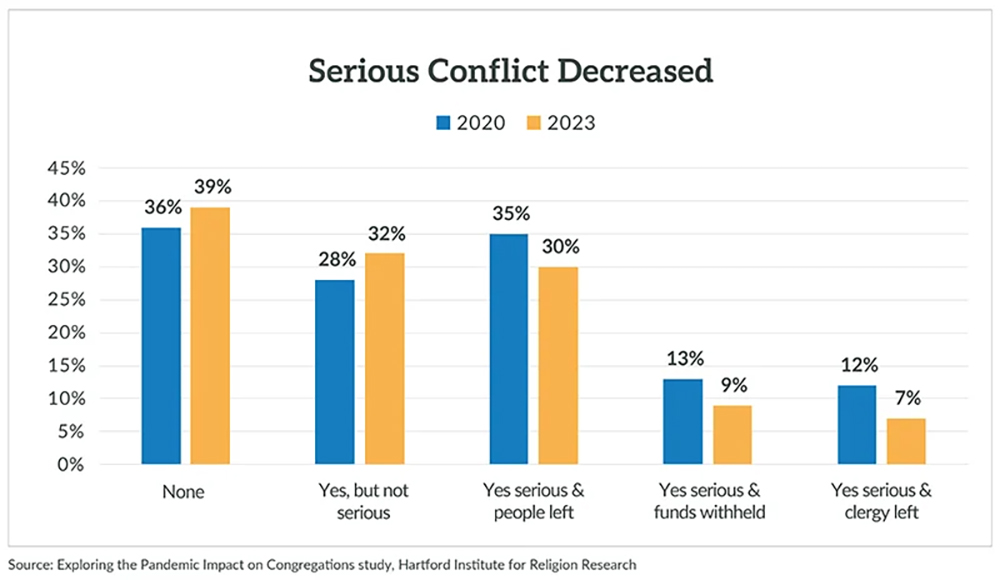
Conflict at congregations has also declined, with 7 percent reporting conflict was so serious that clergy left, 9 percent saying people withheld funds due to conflict and 30 percent saying people left due to serious conflict. In 2020, 12 percent of congregations reported clergy left due to conflict, 13 percent said people withheld funds due to conflict, and 35 percent said people left.

Thirty-nine percent said there was no serious conflict in 2023, up from 36 percent in 2020, while 32 percent said there was conflict but it was not serious, up from 28 percent in 2020.

Almost half of congregations (45 percent) said they were very positive about the future, while a third (36 percent) were somewhat positive. Nine percent were somewhat negative, and only 2 percent said they were very negative.

Clergy dissatisfaction remains high

However, the percentage of clergy who have thought about leaving both their church and the ministry altogether has risen since 2020.

In 2021, most clergy in the survey (79 percent) said they had never thought about leaving their current church, while 13 percent said they thought often about leaving. In 2023, the number who never thought about leaving had dropped to 62 percent, while 29 percent said they thought about it often.

As for leaving the ministry altogether, two-thirds of clergy (62 percent) said in 2021 they had never thought about doing so, while 27 percent said they thought about it often. In 2023, 49 percent said they never thought about leaving, while a third (34 percent) have thought about it often.

 Congregations also have less enthusiasm for change, three years after the start of the pandemic. In the summer of 2021, 86 percent of congregations said they were willing to embrace change in order to meet their challenges—including 47 percent who strongly agreed they were willing to change. In 2023, two-thirds (66 percent) were willing to change—with only 20 percent strongly agreeing.

Researchers said congregations appear to be hopeful they can face the challenges ahead of them. But those challenges are significant.

“Amid these positive signs remain some structural and organizational challenges that indicate all is not entirely rosy. Even given the rebounding attendance and level of optimism, the broad pattern of considerable membership decline remains ever-present.”