Filmed stage adaptation of ‘The Hiding Place’ to be released

NASHVILLE (BP)—A filmed stage adaptation of The Hiding Place, the true story of Corrie Ten Boom and her family’s hiding of Jewish refugees from the Nazis during World War II, is set for a special theatrical release.

The story follows Corrie, along with her sister Betsie and father Casper, as humble watchmakers in the Netherlands who risk their lives seeking to hide Jews from the horrors of the Third Reich just around the corner.
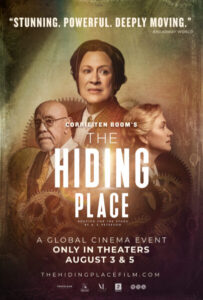
The stage play, adapted from Corrie’s internationally best-selling memoir, was filmed last year in front of a sold-out audience in Nashville. It will show in select theaters nationwide Aug. 3 and Aug. 5 before an international release Aug. 16.

The project was adapted for the stage by A.S. “Pete” Peterson.

“I was really excited to be able to have a chance to work on it, but the more I dug into the project, the more I became aware of the huge, long-lasting legacy of Corrie Ten Boom,” Peterson said.

“This is not just something that I can take lightly and potentially mess up. I really need to do the hard work of honoring how many people love this story. It was something I needed to take with enormous seriousness and responsibility.”

The Ten Booms’ story has gained fame among evangelical Christians over decades.

Corrie’s memoir has sold millions of copies over the nearly 50 years since its publication in 1974. A film adaptation, produced by Billy Graham’s World Wide Pictures, was released in 1975.

Peterson was commissioned by a theater founded by Jeanette Clift George, who played Corrie Ten Boom in the 1975 movie, to write the story for the stage to honor George after she died in 2017.

Tell classic story in a fresh way

Because the theater format is three-dimensional, it allows the classic story to be told in a fresh way, he said.

“You necessarily have to figure out what works for the medium in which you’re wanting to tell the story,” Peterson said.

“The stage is necessarily three-dimensional, which is kind of what separates it from film and the novel artform.

“I had a lot of fun landing on the idea of the clock shop and the Ten Booms as watchmakers, which is kind of an important theological idea. The Dutch Reformed tradition believes really strongly in the sovereignty of God, that God is in control at all times and you can trust in that,” he said.

“In that context, leaning on this idea of the whole show almost being a clockwork that has been designed by its maker … kind of reinforces the story.”

The project was directed for the stage by Matt Logan, who said it was not always easy for Corrie to hold strong to her theological beliefs.

“She (Corrie) was a real person, and she had doubts and the struggle for faith was real,” Logan said.

“I think that’s the powerful point of telling stories. That struggle allows us as an audience to go: ‘Oh I struggle with that. I struggle with faith. I struggle with doing the right thing. And this is showing me they did too, and yet were still able to be resilient.’”

Actress calls role a personal ‘wake-up call’

Corrie is played in the film by Nashville stage actress Nan Gurley, who told Baptist Press portraying Ten Boom was a “wake-up call” for her own Christian faith.

“There’s always the challenge when you play a real historical figure,” Gurley said. “You want to get it right and you want to tell it truthfully and authentically.

“Telling this kind of a story can be a personal wake-up call, where you go: ‘OK I profess to know Christ. I profess to follow Christ and try to live a life of obedience. But what hills would I die on?’

“The Ten Booms choose to put their lives at risk to save Jews. … It had a huge impact on me in a positive way to think, what will I die for if I’m ever challenged this way.”

Gurley said Corrie and the Ten Boom family can be an example to Christian believers because they were prepared for their big moment before it came.

Before they helped hundreds of Jews escape to safety during the war, the family would often foster the children of missionaries in their home.

Even though Corrie struggled with doubt, she would later return to the very concentration camp where she was held and turn it into a rehab facility for survivors.

“The story of Corrie and her sister Betsie and her father needs to be told generation after generation,” Gurley said.

“It’s easy to look at Corrie and Betsie and Casper Ten Boom and go, ‘Oh they were these icons of the faith.’ These are amazing people who did the impossible and sort of put them on a shelf as an icon of the faith.

“I want people to be encouraged that these were ordinary, unknown people living hidden lives of obedience day after day. The rhythm of their lives was an open door in hospitality. The stakes were life and death, but they were ready for it.”

Peterson hopes this new medium for the Ten Booms’ story of forgiveness, love and hospitality will inspire believers to draw close to each other.

“In the middle of a shooting war … their weapon of choice was to love their neighbor and to be hospitable to the people around them no matter who they were,” Peterson said.

“I believe that art creates gathering points for community. If we create a great stage play or a great film, people go to see that together and rightfully done, that should result in community. That’s something that I believe is vital to the church.”



Gallup: Belief in spiritual entities at 23-year low

WASHINGTON (BP)—Belief in God, Satan, angels, heaven and hell is at a 23-year low in America, Gallup Poll said in its latest update.

Gallup found 74 percent of Americans surveyed believe in God compared to 90 percent in 2001, the greatest decline in the study.

The study also revealed:

  • 69 percent believe in angels, down from 79 percent in 2001.
  • 67 percent believe in heaven, down from 83 percent.
  • 59 percent believe in hell, down from 71 percent.
  • 58 percent believe in Satan, down from 68 percent.

Protestants, frequent church attendees and Republicans were the most likely to express belief in all five entities. Smaller majorities of Catholics and Democrats also expressed belief, but among infrequent church attendees, most only believe in God and angels.

Other demographic groups more likely to believe in all five entities are adults ages 34 and older, adults without a college degree, and adults with lower household incomes. Specifically, Gallup said those making less than $40,000 a year registered higher in belief than those making over $100,000.

Gallup pollsters found:

  • 12 percent don’t believe in God, and 14 percent were undecided.
  • 18 percent don’t believe in angels, and 13 percent were undecided.
  • 18 percent don’t believe in heaven, with 15 percent undecided.
  • 27 percent don’t believe in hell, with 14 percent undecided.
  • 28 percent don’t believe in the devil, with 14 percent undecided.

Gallup has polled Americans on the topic five times since its initial poll in 2001, with the May 2023 poll including 1,011 adults, Gallup said July 20 in releasing the findings.

“Gallup has documented sharp declines in church attendance, confidence in organized religion and religious identification in recent years.

“As the percentage of believers has dropped over the past two decades, the corresponding increases have occurred mostly in nonbelief, with much smaller increases in uncertainty,” Gallup said. “This is true for all but belief in God, which has seen nearly equal increases in uncertainty and nonbelief.”

Among weekly church attendees, belief in the entities ranges from 98 percent to 84 percent, with 98 percent believing in God, 94 percent in angels, 92 percent in heaven, 86 percent in Satan, and 84 percent in hell.

The numbers are lower among those who attend church less than monthly, with 57 percent believing in God, 52 percent believing in angels, 48 percent believing in heaven, 41 percent believing in hell and 40 percent believing in Satan.


Former inmate helps prisoners prepare for new life

WASHINGTON (RNS)—Some 600,000 people leave U.S. prisons every year, only to encounter a series of roadblocks to reintegration.

Stanley Frankart knows. He was one of those people.

Stanley Frankart was under the legal system’s supervision on and off for 18 years. (Courtesy photo)

Frankart’s various forms of incarceration began at age 10, when he broke a schoolmate’s jaw. He then cycled in and out of juvenile detention centers and correctional institutions on various drug charges. When he was 16, he shot someone in the face and got a 10-year sentence.

By the time he left prison in 2017, he had spent 18 years under the supervision of the legal system.

These days, Frankart goes back once a week to his old prison, Richland Correctional Institution in Mansfield, Ohio, to coach soon-to-be-released prisoners who are hoping to make a new life when they are released.

Through a nonprofit he founded in 2015 called Young Christian Professionals, the 32-year-old former prisoner teaches a blend of what he calls Christian character development and professional business practices to help incarcerated people prepare for life on the outside.

“It was just natural that I was here to minister and pastor individuals who come from where I come from,” said Frankart, who is married and the father of two girls.

Young Christian Professionals has a staff of 75, mostly volunteers, who run an eight-week curriculum in prisons across Ohio—with startups in Michigan, Pennsylvania and Illinois—followed up by one-on-one support for prisoners after they’re released.

The program pairs study of Christian principles with practical employment skills. It teaches prisoners how to shake someone’s hand, look them in the eye, tie a necktie and properly enunciate. Frankart calls this “business etiquette,” much of which he himself learned from books.

About 1,800 prisoners and their family members have gone through the program, which Frankart started while still in prison. Funding comes mostly from The Witness Foundation, which trains and funds Black Christian leaders.

Reentry into the free world is challenging

Stanley Frankart. (Courtesy of The Witness Foundation)

Frankart was part of the inaugural cohort of Witness Fellows and recently shared his story on a “Footnotes” podcast with Jemar Tisby.

Reentry is a huge challenge for many formerly incarcerated, who encounter a combination of laws and rules that block them from jobs, housing and voting.

A report from the Brennan Center for Justice found “a prior criminal conviction all but ensures a lifetime straddling the poverty threshold.” Most employers conduct background screening on candidates for full-time positions.

Various state legislatures have enacted as many as 27,000 rules barring formerly incarcerated people from holding professional licenses. Public housing is often denied to people with a criminal record.

Those hardships disproportionately affect Black Americans. While Black Americans make up 13 percent of the population, they account for 38 percent of people in prisons and jails. They are incarcerated at five times the rate of whites.

When President Joe Biden designated April as “Second Chance Month” to bring awareness to these barriers and promote opportunities for former prisoners, he directed the federal Small Business Administration to offer more business startup loans to applicants with criminal records.

Frankart, who also leads a weekly “reentry worship” at Crossroads United Methodist Church in Canton, Ohio, believes church and parachurch ministries have not done a good enough job helping former prisoners reenter society.

“That connectivity piece that gets missed when people just come in for programs or Bible studies—there’s no relational component,” he said.

He describes leaving prison with a black plastic trash bag stuffed with his belongings and not even a ride to a halfway house in Mansfield, Ohio, where he was due to report later that day.

These days, he personally drives just-released prisoners to their destinations and often buys them their first meal.

“We get involved in whatever resources they may need. Maybe it’s housing, maybe it’s employment, maybe it’s expungement (of offenses), driver’s licenses. Whatever the case may be, we walk with them through that experience.”

More support needed for reentry

Harold Dean Trulear, national director for Healing Communities USA, an organization that trains congregations to help prisoners after their release, said there are many groups dedicated to offering support for those reentering society, but probably not enough.

“The sheer numbers of people coming home every year far exceeds the capacity of these organizations,” said Trulear, who is also associate professor of applied theology at Howard University in Washington, D.C. “And that’s why there’s always room for more.”

Frankart’s own turnabout began on the floor of Richland one day in 2011, when he was 21 years old. Two gangs got in a fight, and Frankart found himself on the floor badly beaten, kicked and stabbed.

“I remember laying on the ground and realizing in that moment how powerless I was over my own life,” he told Tisby on the podcast. “And so through this process, I’m on the ground and I said, ‘God, Jesus, whoever you are, if you’re real, get me off of this ground.’”

That began a journey in which he attached himself to three Christian men in prison and began studying the Bible under their direction. He followed that up with self-study, including a 16-week Urban Ministry Institute capstone curriculum and a leadership role in the local prison chapter of Fellowship of Christian Athletes.

In 2015, he was sitting in the prison’s library studying when he saw what he called a ragtag group of men and started a conversation with them. It then dawned on him, “Your mission field is here.”

Young Christian Professionals was born.

Prisoners don’t have to be believers to enroll, and there’s no expectation that they profess a Christian faith when they leave. But they will be exposed to Christian teachings.

The best part of the program, Frankart said, is that many people who have reentered society successfully will go on to volunteer to help others.

“We kind of have what we call a replicable model,” Frankart said. “We raise up individuals who want to spearhead the initiative. We support them. We walk with them through that process.”


Russell Moore urges evangelicals to stop lying and come back to Jesus

(RNS)—Russell Moore has a bit of advice for his fellow American Christians in his new book, Losing Our Religion.

Don’t lie.

A simple principle, based on the Ninth Commandment’s ban on bearing false witness, and one many Christian leaders are tempted to break by repeating claims that are popular but untrue, argues Moore.

“I’m not really talking to the people who are intending to deceive and destroy—yes, I would hope they stop lying too,” said Moore in a recent interview about the new book. “I’m talking more about the disconnect between what people really believe and what the expectations of the tribe demand. And that is what I see to be so dangerous and exhausting to people.”

Following Moore’s advice could come with consequences. The former Southern Baptist ethicist was a rising star in 2013, when he was elected president of the Southern Baptist Convention’s Ethics and Religious Liberty Commission after the group’s former leader left amid scandal.

Moore was known for his love of 1970s outlaw country stars Waylon Jennings and Willie Nelson, his advocacy for immigration reform and his skepticism about the close ties between the Republican party and evangelicals.

Things went well until the rise of Donald Trump, which turned evangelical leaders into would-be contestants on a real-life version of “The Apprentice”—Trump’s reality television series—“all clamoring to make the cut on the next episode and fearful of hearing the words you’re fired,” he writes in Losing Our Religion.

Moore’s criticism of Trump as a candidate and as president, along with his advocacy for survivors of abuse in the SBC, made him enemies and eventually cost him his job. In 2021, he resigned from the ERLC to take a new role at Christianity Today, where he is now the editor-in-chief.

Inspiration for new book

His new book was inspired by conversations Moore has had in recent years with disillusioned evangelicals, some of whom he said are feeling a sense of despair at the state of the church and American culture. The book is part altar call for his fellow evangelicals and part retelling of the surprising lessons he’s learned in recent years.

The book recounts Moore’s struggles to reconcile what he believed with how he saw Christian leaders acting during the Trump era. He recalls a Baptist leader who told him he was playing the game of leadership wrong.

That leader suggested Moore give people “90 percent of the red meat they expect”—referring to conservative politics and the culture wars—and then he could spend 10 percent of his time on things he cared about, like immigration.

He also recalled being told to “get real”—meaning he should give up on naive ideals like telling the truth or acting with personal integrity, because the cultural and political stakes were too high for such niceties.

“People who have higher expectations for themselves and for others are often made to feel naive and stupid,” he said.

That willingness to do anything to succeed in politics, he writes, was rooted in the way churches treated celebrity pastors and leaders. As long as they got the job done, those celebrities could be terrible people and Christians would shrug it off.

That habit of overlooking the character flaws of Christian celebrities—such as disgraced former megachurch pastors Bill Hybels and Mark Driscoll or abusers like the late evangelist Ravi Zacharias—made it easier for evangelicals to overlook Trump’s flaws, Moore said in an interview.

Downstream consequences

The way being a star pastor means you can get away with anything meant it was easier for Christians to accept unethical politicians.

“There’s always this sense of the mission is too important to be worried about character,” he said.

Moore said he often knew something was wrong in Southern Baptist and evangelical circles but talked himself out of saying anything—because everyone else seemed to be acting as if everything was OK.

He recalled teaching about a famed meeting between SBC legends Paige Patterson and Judge Paul Pressler at the Cafe Du Monde in New Orleans that helped launch a conservative takeover of the nation’s largest Protestant denomination, as if it were the SBC equivalent of Martin Luther nailing his 95 Theses to the Wittenberg door.

That mythology didn’t match the “Machiavellian lack of character” he saw among SBC leaders. Still, he said, it was as if there were things he was not allowed to notice or to say anything about. He realizes now he should have trusted his instincts.

“When I look back over my life and ministry, there were countless times where my mind was wrong,” he said. “And there were a lot of times when my heart was wrong—but very few times where my gut was wrong.”

Many Christian leaders stay silent—or make claims they know are not true—out of fear, Moore argues in the book. Pastors who go along with the crowd get to keep their job. Those who step out of line are punished. And all it takes is a few angry donors or church members to make a pastor’s or leader’s life miserable.

He predicts many pastors in the future will have day jobs or side hustles to protect themselves—rather than because the church can’t afford to pay them a salary.

“Pastors are increasingly not wanting to put their entire lives under the threat of one small group of people within a congregation,” he said.

Friends and lessons

Despite his concerns about the state of the church, Moore is hopeful. During his challenges, he’s made a number of new friends among people he used to view as “theological squishes”—people too willing to compromise on doctrine or theological lightweights.

Among his dearest friends is bestselling author Beth Moore (no relation), herself now a former Southern Baptist, who helped him keep the faith at some of his worst moments.

He said he was grateful for these new friends and for the way people stuck by him in unexpected ways.

He is also surprisingly hopeful about the future of the Christian church in America. In the interview, Moore recalled spending time teaching a semester at the University of Chicago, where he’d spent his days in the classroom and his evenings talking with groups of evangelical students. They often would ask practical questions about how to pray or how to relate to their fellow students in a secular setting.

Those students, he said, were serious about living out their faith.

“I would tell them, ‘I don’t think your classmates hate you as much as you think they do,’” he said. “‘And if you would just have a little more confidence, then you actually could engage them.’”

These days, Moore gets hope from younger Christians, his friends, his faith and the lessons of Willie Nelson. In the book, Moore tells the stories of Nelson’s early struggles to break into country music, only to fail because he was trying to be someone he wasn’t.

Nelson left Nashville, traded country music’s marketing and rhinestone cowboys for bandanas and a more authentic sound, and found an audience, along with fellow outsiders like Jennings.

There’s a lesson in that for Christians, he said.

“Often there will be a small group of people who look like dissenters and rebels but who actually love and care about their institution or their tradition,” he said. “But it means there’s going to be change.”


Baylor announces inaugural chair in study of Black worship

WACO—Baylor University announced July 24 the appointment of Stephen Newby as the inaugural holder of the Lev H. Prichard III Chair in the Study of Black Worship established in 2021. Newby will serve in the Baylor University School of Music.

Newby brings a background in music, scholarship and ministry to the new position, which provides interdisciplinary leadership, research and scholarship efforts associated with the growth of Baylor’s Black Gospel Music Preservation Program, housed within Baylor University Libraries.

“This is a dream job, and words cannot express my gratitude to the Prichard family for establishing this position,” Newby said.

“Gospel music and Black worship is an integral part of the American fabric. The opportunity to serve and collaborate with others to preserve and share this music is amazing. I think this can provide a foundation to help us present the incredible treasure of this music that we have before us,” he added.

A member of the Seattle Pacific University faculty since 2004, his most recent positions include professor of music, director of composition and director of the Center for Worship. While at Seattle Pacific, he earned a National Endowment for the Arts grant and has contributed numerous journal articles, chapters and published pieces to music scholarship.

Additionally, Newby has served on the faculties of the University of Michigan and Trevecca Nazarene University.

While serving as a full-time faculty member, Newby has built a parallel career as a renowned composer, fusing elements of Black gospel and jazz in churches, symphony halls, musical theatre stages and more.

A composer of classical, gospel, jazz and chamber music, Newby’s versatility has taken his music to numerous stages and concert halls. His most recent commissions were performed by the Seattle Symphony and in Seattle’s 5th Avenue Theater. He also has served as a worship leader with Maranatha Music and Promise Keepers, with multiple published recordings to his credit.

Scholarship, music and ministry

Before joining the Seattle Pacific faculty, Newby served as a minister of music at Antioch Bible Church in Seattle, Wash. The ministry call has maintained a grip on his life in a variety of settings, including a recent appointment as minister of worship at Peachtree Church in Atlanta.

As a child of ministers—Newby’s father was a Missionary Baptist preacher and his mother a minister of music—Newby says a career involving music and ministry was “in my genes. The education piece is attributed to curiosity.”

In addition to three degrees in music, Newby attained a Master of Arts degree in theology while on faculty at Seattle Pacific. That training led him to full-time jobs in higher education and ministry, while continuously composing and publishing pieces in a variety of genres—most notably the fusion of classical, gospel and jazz.

Newby’s multifaceted musical background and renowned academics will further intertwine in the Prichard Chair role. He sees the Prichard Chair as allowing him “to lean into” his various interests while being able “to pass this on to the next generation.”

Baylor ties

Before joining the Baylor faculty, Newby’s association with the university goes back nearly 10 years to his initial visit to the Pruit Memorial Symposium. In 2013, the symposium began a partnership with the Black Gospel Music Preservation Program to explore the cultural heritage of Black gospel music. Newby first attended the symposium in 2014.

As Newby brings leadership to the Black Gospel Music Preservation Program and Pruit Symposium through the Prichard Chair position, he assumes the mantle from a friend, collaborator and mentor—Bob Darden, master teacher and emeritus professor of journalism, public relations and new media, who retired in May. Darden founded the Black Gospel Music Preservation Program in 2005.

Newby is currently working with Darden on an upcoming biography of the late influential Christian music performer and writer Andraé Crouch titled Soon & Very Soon: The Transformative Music and Ministry of Andraé Crouch, The Light Years.

“Because of the Pruit Symposium, I’ve always had my eyes on Baylor,” Newby said. “I’ve had a great appreciation for the collegiality and excellent scholarship produced at those gatherings. That was a wonderful draw for me.

“And when I look at all this—the program and archives, the symposium and the investment through the Prichard’s generosity—where else in the United States is anything like this going on?”


Christian creators design chatbots with ‘biblical worldview’

WASHINGTON (RNS)—From a young age, Nils Gulbranson remembers asking a lot of questions during Bible studies. Gulbranson describes spending his free time as a teen Googling Christian scholars’ views on different topics, digging through sermons and scouring YouTube videos until he found satisfying answers.

With the release of Chat GPT, the former computer science student turned finance intern saw an opportunity to build the resource he wished he’d had as a young evangelical Christian in Minnesota.

About three months ago, Gulbranson, 23, started work on Biblemate.io, a “Christian ChatGPT” to help interrogative minds who are looking for biblical answers to life’s difficult questions.

“The big difference from ChatGPT is that it’s a model grounded in a biblical and theological view of the world,” Gulbranson, now a finance intern in Boston, said about his version of the chatbot. It relies on an ever-growing database of sermons, books and academic articles to inform the answers it offers.

AI raises ethical questions

The launch of ChatGPT in November 2022 by the research laboratory OpenAI has spurred both excitement and trepidation among Christians, forcing existential questions on the level of what it means to be human, along with ethical dilemmas: How much is too much help from a chatbot when writing a sermon? What about leading a whole worship service, like a ChatGPT avatar did in early June at a Lutheran church in Germany?

Gulbranson sees a number of uses for Biblemate.io in a church context—for pastors doing sermon research, for church volunteers drafting a Bible study guide, for curious teens like he once was who want to go deeper in youth group.

But he also hopes non-Christians will use the chatbot for their questions about God. He pointed to one of his favorite features, the “explain to me like I’m 5” tool.

“You type a hard-to-understand theological concept, and it would dumb it down and explain it the way you would to a 5-year-old kid,” he said.

“The goal is to give responses rooted in unwavering biblical truth,” said Gulbranson, who said he tried to generate sources from “well-respected scholars” for his database, citing William Lane Craig and C.S. Lewis. Of course, Gulbranson acknowledged, not every Christian agrees on just what is biblical truth.

For example, he explained, on a question such as whether Christians should speak in tongues, the chatbot should pull out what the Scriptures say and then offer perspectives from different denominations.

Gulbranson wants Biblemate.io to give politically neutral responses on topics where Christians often don’t see eye to eye, such as same-sex marriage or LGBTQ ordination.

“I don’t want to create a division because we see it all the time with Christians that are more conservative and Christians that are more progressive,” said Gulbranson, who declined to reveal which camp he identifies with.

“Jesus himself was not a socialist. He wasn’t a capitalist. He never explicitly said: Hey, this is the correct political ideology,” he added.

Seeking input on how to improve product

Soon after its release, Gulbranson sought feedback from other Christians on social media. On the Facebook group “AI for Church Leaders & Pastors,” he brainstormed with fellow AI enthusiasts about how to improve his new chatbot.

The group of nearly 4,000 members, including pastors, churchgoers and worship leaders, chats about creative ways to use tools such as ChatGPT, Jasper (an AI content generator) or MidJourney (images generator) in their ministries.

Joe Suh, an engineer, also finds himself regularly asking for advice from the group on his new project. At the beginning of the year, he started developing Pastors.ai, a chatbot that draws on churches’ sermon libraries to answer people’s questions. It’s a chatbot, Suh said, that he initially designed for himself.

“I wanted to be able to ask my pastor some very personal questions: How should Christians think about divorce? How do we love our LGBTQ+ neighbors? Questions I would be a little bit shy to ask in person. Now we can do that, because it’s read hundreds of hours of sermons,” he said.

For this 45-year-old who has worked in Silicon Valley for 25 years, Pastors.ai was also an occasion to reconnect with his faith. When his church moved online during the pandemic, staying engaged and paying attention was hard, he admitted.

Excited by ChatGPT’s launch, he teamed up with co-workers from the e-commerce software firm he founded in 2022 and worked full time on the chatbot.

Recently, Pastors.ai obtained OpenAI credits and Suh plans to demonstrate the tool at numerous AI events this year.

Mixed reactions from Christians

The biggest challenge, he said, is to get churches to accept it.

“There are mixed reactions. In one camp, people are blown away. They think it’s magical,” Suh said. “A second camp is a bit more skeptical, especially church leaders.”

Some pastors even went as far as questioning the chatbot’s claims, arguing the tool distorts their words.

“That has been an interesting reaction,” Suh said with a laugh.

In a recent article, RJ Kang, a Presbyterian pastor from Illinois, pointed out that as interesting as these AI tools are, church leaders need to remain careful “not to rely on it as a replacement for the discernment that comes from prayer and seeking God’s will.”

In November 2020, as part of his monthly prayer intention, Pope Francis noted AI could “make a better world possible, if it’s joined to the common good,” but he also invited Christians to pray the tool always remains at the service of human intelligence.

During June’s Southern Baptist Convention meeting in New Orleans, messengers adopted resolutions regarding AI, urging pastors to use these tools in “honest, transparent, and Christlike ways.”

For Gulbranson, this vigilance isn’t surprising.

“It’s a new uncharted territory,” he said. “AI among Christians might seem a bit taboo.”

It’s only a matter of time before churches understand more clearly how these technologies work and how to benefit from AI tools, explained Suh. “Once they know, they will make rules around it.”


Black Christians register higher in holistic spiritual health

PHILADELPHIA (BP)—Black Christians score 10 percent higher than all other Christians in spiritual vitality, according to a new scale of holistic spiritual health the American Bible Society introduced in its 2023 State of the Bible report.

The Spiritual Vitality Gauge measures spiritual health through a set of nine concise questions focused on beliefs, practices and faith in action among self-identified Christians, the Bible society said July 13 in releasing its findings in the report’s fourth chapter.

The higher score among African Americans, when compared to whites and Hispanic Americans, should not be surprising, the American Bible Society said, as Black Christians lead in nearly every measure of spiritual life the study uses.

“State of the Bible research shows overwhelmingly that Black Christians lead the way on virtually every desirable metric. This group has a lot to teach the rest of the American church,” the American Bible Society wrote.

“People in this group are more likely to attend church weekly, to read the Bible, to be ‘Scripture Engaged,’ to be ‘Bible Centered,’ and now to display spiritual vitality in their lives.”

Religion has been a source of resiliency for many racial and ethnic groups, the American Bible Society said, referencing a 2020 article from researchers at Case Western University based on a study of historical and contemporary literature. The church’s appeal to Black Americans is both spiritual and practical, the Case Western article asserts.

“Historically and contemporaneously, the Black church, in addition to being a religious institution, is a social, cultural, civic, educational and political institution that is central to Black communities,” the article reads.

“Because of social, economic, and institutional disenfranchisement, Black Americans have traditionally had difficulty accessing public and private services. As a result, Black churches tend to offer a greater number of community programs and mental health services than white churches.”

Specifically, Black Christians registered 76 on the spiritual vitality scale of 0-100, at least 10 percent higher than the 68 among Hispanic Americans and the 69 among whites.

How do people connect with God?

The American Bible Society also explores the various ways people connect with God in the study’s fourth chapter, incorporating nine spiritual temperaments bestselling author and former Southern Baptist pastor Gary Thomas presented in the 1996 book Sacred Pathways.

Naturalists, those who connect best with God while in nature (32 percent); ascetics, connecting most with God while alone, reading the Bible or praying (14 percent); and contemplatives, connecting with God when they sense he is touching their heart (11 percent), ranked as the top three temperaments among study participants. Thirteen percent of those studied feel no connection to God.

Consequently, those who connect best with God in nature were least likely to attend church services, with 72 percent almost never attending church and only 11 percent attending weekly. Contemplatives scored highest in church attendance, with 48 percent attending weekly and 31 percent attending almost never. Among ascetics, 42 percent attend weekly.

In addition to church attendance, the American Bible Society studied how spiritual temperaments impact spiritual commitment, beliefs about God and scriptural engagement.

Evangelical Protestants and historically Black Protestants were more prevalent among ascetics, with the temperament accounting for 23 percent of both groups; followed by naturalists, accounting for 22 percent of Evangelical Protestants and 21 percent of historically Black Protestants.

The State of the Bible annually looks at the Bible, faith and the church in America. The American Bible Society collaborated with the University of Chicago’s National Opinion Research Center. The 18-minute survey, conducted Jan. 5-30, produced 2,761 responses from a representative sample of adults 18 and older within the 50 states and D.C.


Few worship leaders avoid Hillsong and Bethel songs

WASHINGTON (RNS)—For the past decade, a handful of megachurches have dominated worship music, churning out hits such as “Goodness of God,” “What a Beautiful Name,” “King of Kings” and “Graves Into Gardens.”

hillsong concert400Although churches like Australia-based Hillsong and Bethel Church in California have met with scandal and controversy, worship leaders still keep singing their songs.

A new study released July 11 found few worship leaders avoid songs from Hillsong and Bethel, two of the so-called Big Four megachurches that dominate modern worship music.

The study revealed most worship leaders connect with songs because they’ve experienced them firsthand at a conference or by listening to them online, or because a friend or church member recommended them, rather than seeing the song at the top of the charts or on a list of new songs.

Elias Dummer, a Christian musician turned marketer who is part of the research team behind the study, said most worship leaders think they have good reasons for picking the songs they use in worship. But they may not be aware of how social forces—like the popularity of certain churches—affect their choices.

“While people say that they care about the songs, they pick the same four churches over and over again,” Dummer said.

The new study is based on a survey of more than 400 church worship leaders in the United States and Canada conducted in the fall of 2022, drawn from both social media groups of worship leaders and an email list from a major music publisher.

How do worship leaders select music?

Worship leaders were asked what they thought about the pace of new music being produced, how they picked new songs, what they thought the motivations were behind new songs and whether they’d pick a song—or avoid it—based on the artist or church that produced it.

Only 16 percent of worship leaders said they were less likely to choose a song with ties to Hillsong, while about 1 in 4 said they were less likely to choose songs with ties to Bethel (27 percent).

More than half of worship leaders said they were likely to choose songs with ties to Hillsong (62 percent) while nearly half (48 percent) said they were likely to choose songs with ties to Bethel.

Researchers also found recommendations from friends on social media (54 percent), congregation members (56 percent) and church leaders (76 percent) made it more likely that worship leaders would choose a song. Hearing a song at a live event (76 percent) or streaming online (70 percent) also made it more likely they’d choose a song.

“The most influential factors in discovering a new worship song are peer endorsements and personal experiences,” the study indicated. “Worship leaders mainly trust their friends and fellow church leaders to provide them with song recommendations.”

Just under half (47 percent) of those worship leaders were concerned about the number of new songs available for churches to sing. The study found the big four churches release about 40 to 50 new songs each year, on top of the hundreds of songs available from other sources—from modern hymn writers to artists on YouTube.

About 40 percent said there is a bit too much new music, while a small number (4 percent) said they were “completely overwhelmed” by new music. A quarter (27 percent) said they could handle more music.

That last number surprised research team member Marc Jolicoeur, worship and creative pastor at Moncton Wesleyan Church in Moncton, New Brunswick, Canada.

“We can’t exactly say why they would want more songs, whether that means they’re looking for more diverse theological views, for more diverse styles, or more diverse voices,” he said.

What inspires new worship songs?

Only a third of worship leaders thought songs were written with the needs of local churches in mind, while slightly more thought songs were divinely inspired.

Just over half (57 percent) thought songs were inspired by something that happened in a writer’s life. Few believed songwriters wrote songs out of obligation to a contract.

For his part, Dummer said worship songwriters likely do have contractual obligations to meet—and it is unlikely they have moments of personal spiritual inspiration for all of the songs they write.

“There’s a lot of throwing things against the wall,” he said.

Still, it’s more likely that worship songwriters are writing from personal experience than from trying to communicate theological principles, said research team member Shannan Baker, a postdoctoral fellow at Baylor University. That’s in part because it would be easy to get things wrong by using the wrong phrase or word.

Baker said she’d done some interviews with writers who said they often start writing sessions with other musicians by talking about what’s going on in their life and seeing if a theme emerges. Despite the popularity of megachurch-driven hit music, worship leaders often consider songs on a case-by-case basis, rather than thinking about where those songs came from, she said.

Glenn Packiam, a former worship leader and songwriter turned pastor, said understanding how songs get written—or how they get chosen for worship—is a complicated task. And it often starts by trying to figure out what song, or what message, works best in a local congregation.

“Our No. 1 priority was to write songs for the people in our church,” said Packiam, who led worship for years at New Life Church in Colorado Springs. “We wanted to write songs that helped the church find language for the various experiences that we’re going through.”

 He pointed to a song called “Overcome,” written by Jon Egan, a colleague of his at New Life in the early 2000s. That song became a rallying cry for the church when New Life pastor Ted Haggard resigned in scandal and later, when the congregation was reeling from a shooting at the church.

“That song ended up being a gift for our church,” he said.

Packiam, now pastor of Rockharbor Church in Costa Mesa, Calif., went on to study worship music as a ritual while earning his doctorate.

Once songs go out into the world, they will mean different things in different contexts, Packiam said. They may provide comfort to those grieving or inspiration to those facing a challenge. The songs have a life of their own once people begin to sing them in worship.

Packiam believes there are more than consumer forces at work in worship songs.

“I don’t want to look at a particular song or a particular church that’s making music and say, ‘Oh gosh, it’s just a conglomerate machine,’” he said. “What if the Lord is blessing this and causing it to produce fruit?”


Study: Big churches sound alike, small churches vary widely

WASHINGTON (RNS)—Step into a big Baptist church on Sunday morning. Chances are you’ll hear the same popular worship songs played at other big churches around the country.

But show up in a small church, and you never know what you’ll find—anything from “How Great Thou Art” to “Take Me Home, Country Roads.”

Will Bishop

“Smaller churches are like the Wild West,” said Will Bishop, associate professor of church music and worship at Southern Baptist Theological Seminary in Louisville, Ky. “Anything goes.”

Bishop has been working on a recent survey project to understand better the worship music used in Southern Baptist churches, especially smaller congregations.

He said companies like Christian Copyright Licensing International—better known as CCLI—do a good job tracking the most popular songs used in churches.

But they often miss out on some of the details of worship in local congregations, such as who is picking songs or who plays them. They also miss when churches sing out of hymnals or other songbooks, rather than projecting songs on a screen.

The charts also can leave the impression the only songs being sung in worship are hits from Hillsong, Bethel and other megachurches.

That’s true in big churches, he said, but not everywhere. Music at big churches is often put together by full-time staffers who have time to track down all the latest songs and follow the latest trends.

“They’re all going to the same conferences. They’re all kind of hanging out with the same people, he said. “If you’re in a small church, you may not have any connections. You’re not going to conferences. You may not know what’s going on in the bigger world.”

Bishop began working on his survey to help his students know what to expect when they start working in churches. He sent surveys to more than 900 congregations in five different parts of the country: Louisville, Memphis, Oklahoma City and New York, along with rural Colorado and Louisiana.

He eventually collected data from 127 congregations—not a representative national sample, but enough, he said, to give a snapshot of the worship life of local churches. He asked details, like who picked songs, whether churches sang contemporary songs or hymns, whether some songs were banned, as well as asking for a church’s favorite hymns.

Among the findings:

  • About 1 in 5 churches sang more hymns than modern songs, while a third sang as many hymns as modern tunes.
  • Four in 10 sang more modern songs than hymns.
  • Only 1 in 10 sang mostly modern songs, while the same percentage sang mostly hymns.
  • Worship leaders pick most of the music, often with no input from the church’s pastor.
  • Almost every church (89 percent) projects lyrics on a screen, while two-thirds of churches (65 percent) said they never use hymnals.
  • One in five said women were not allowed to lead worship singing.
  • About 90 of the churches had banned at least one song—most often songs from charismatic megachurches Bethel and Hillsong.

One church banned any songs written by popular worship artist Chris Tomlin, while another banned the popular anthem “How Deep the Father’s Love for Us.”

Bishop also asked churches to list their favorite hymns, then compiled a list of the most popular contemporary songs. The top song was “Living Hope,” co-written by Phil Wickham, a well-known worship artist, followed by the modern hymn “In Christ Alone,” and then three older hymns: “It Is Well with My Soul,” “Amazing Grace” and “How Great Thou Art.”

‘Hymn singing is not dead’

The resilience of hymns can get overlooked if you just look at the top 20 charts of worship songs, said Bishop, which mostly feature new songs.

 “Hymn singing is not dead,” he said. “At least among Southern Baptists.”
At Owingsville Baptist Church in Owingsville, Ky., services feature a mix of contemporary songs and older hymns, said Waynanne Caudill, who helps lead singing on Sundays.

Services usually start with a contemporary song, like “Living Hope,” and there’s often another contemporary song before the sermon. The pastor often picks those songs, said Caudill, hoping newer songs will appeal to younger families in the congregation. Church members will also sing four or five hymns.

Despite being a small-town church—Owingsville has one stoplight and a Walmart, Caudill noted—about half the church, which draws around 50 people, is made up of younger folks.

Caudill said she likes the mix of hymns and more modern songs—even though she’d prefer to sing songs by older Christian artists like the late Rich Mullins and the late Keith Green. She’s OK with more modern songs, but the Hillsong hit “Oceans” never sat right with her.

“The song says I’m going to walk on the water, and most days I’m really not,” she said. “And that has weighed on me. You know, I want some more real stuff.”

Her favorite: “Oh, Lord, You’re Beautiful,” by Green.

Data dates back 85 years

Bishop’s survey is based on an influential 1938 study that helped shape Southern Baptist church music in the 20th century. Published in 1939, that study used survey techniques popularized by George Gallup to gather data from 1,093 local congregations.

That survey found most churches (83.7 percent) used a piano for services, while 18 percent had reed organs—also known as pump organs—and relatively few (4.8 percent) had pipe organs. One in 20 (4.8 percent) had no instruments at all.

About half of the churches spent no money on their music programs in 1938, and few had trained professionals on staff. Music was led most often (58.8 percent) by a male quartet, while 6.95 percent of churches had orchestras.

Several smaller surveys found about a third of churches had choirs (1952), and large churches were more likely to have a full-time janitor than a minister of music (1956).

Bishop’s new survey found today almost three-quarters (72 percent) of churches have a worship band, while just over a third (36.5 percent) have an adult choir. However, only 7 percent have a junior choir, which he saw as a worrisome sign that churches weren’t investing in the future of their music programs.

Some favorites are perennial

The 1938 survey also included a list of favorite songs among churches. The most popular song was “What a Friend We Have in Jesus,” followed by “I Am Thine, Oh Lord,” “Standing on the Promises,” “Have Thine Own Way” and “The Old Rugged Cross.”

“What a Friend We Have in Jesus” didn’t make the list of most popular songs in Bishop’s survey, but several others that appeared in the 1938 list remain popular, including “Amazing Grace,” “The Old Rugged Cross” and “Holy, Holy, Holy.”

 Martin Cherry, an associate pastor and worship leader at Flatonia Baptist Church, between San Antonio and Houston, said the congregation often sings “What a Friend We Have in Jesus” and other older hymns during services, though with a more modern arrangement. The church had been mostly traditional until about a decade ago and slowly transitioned to more contemporary music.

Cherry said he and other leaders try to pick songs that fit the church’s identity, rather than trying to copy the latest trends.

“When churches try to push too hard, in different styles of music, it’s like asking your people to put on a costume, pretending to be something you’re not.”

He said “What a Friend We Have in Jesus” feels more relevant in the COVID era, given how isolated and divided people feel.

The church tried singing “Living Hope,” which is popular in other churches, but it just didn’t take.

Bishop’s survey did include some surprising results. He’d heard that some churches will play secular songs in services and decided to ask if that was the case.

Some of the responses seemed to fit in church, like Carole King’s “You’ve Got a Friend” and Bill Withers’ “Lean on Me.”

Others, like “The Lion Sleeps Tonight” and “Take Me Home, Country Roads,” left him scratching his head.

If a church really was doing a singalong of the John Denver hit during services, “I’d like to see a video of that,” Bishop said.


Researchers use AI to help translate the Bible

WASHINGTON (RNS)—Out of the 7,100 languages that exist, the Bible has been translated into more than 700, making it the most-translated book in the world. Yet, those remaining languages—many of them extremely rare—have vexed Bible translators for decades.

Two scientists are looking to new advancements in artificial intelligence to help close the gap.

“We want to reach all the languages on Earth. The goal is to reach everyone,” said Joel Mathew, a research engineer who alongside Ulf Hermjakob recently launched the Greek Room, an AI-powered technology to help streamline the highly technical process of biblical translation.

Combining Hermjakob’s long experience with natural language processing technologies and Mathew’s field knowledge of Bible translation, the two USC Information Sciences Institute researchers developed the technology with an aim to target “very low-resource languages that are not even in the top 500,” Mathew said.

The Greek Room includes three main tools: spell-checking, world alignment that ensures consistency in translation, and Wildebeest, used to detect improper characters in a script.

The two scientists met in 2015 when Mathew joined USC to complete a master’s degree in computer science. There, he met Hermjakob in the AI division of the Information Sciences Institute. They bonded over a shared passion for languages and their Christian faith.

Mathew, the son of two Bible translators, has observed firsthand the difficulties that come with manual translation by local church members. In his hometown, New Delhi, he took notes of all the tasks that technology could accomplish.

Spell-checking usually requires many people and time, he explained. In the context of translation into rare languages, only local church members are qualified, and they don’t have technology to back their work.

“These are not trivial problems. These are very hard problems. But big companies are not interested in solving them. It’s not their business model to target very rare languages,” he said.

When Mathew shared with him some of the problems Indian translators faced on the ground, Hermjakob jumped at the occasion.

“I always had this feeling to know how, at some point, I could apply my skills to my faith,” said Hermjakob, who earned a Ph.D. in computer science from the University of Texas.

Change the traditional model of biblical translation

With their project, Mathew and Hermjakob want to work on languages that do not even have a written system, grammar codes, dictionaries or spell-checkers.

“We are thinking of languages like Uyghur or Oromo,” Hermjakob said. Oromo is spoken in Ethiopia and Northern Kenya.

Recently, they have been approached by an Indian consultant specifically interested in the spell-checking and world-alignment tool for Bible translation in Kolami, a language spoken in western India that counts 130,000 native speakers.

The Greek Room also hopes to change the traditional model of Bible translation. Historically, translations were done by Western missionaries, who could only work on two languages at most in their lifetime, Hermjakob explained. With the Greek Room, the two researchers encourage a local church-driven model.

“Local churches and local language communities are asking for translations of the Bible in their heart language,” Mathew said. In a multilingual context, he added, the heart language is the one in which people express their deepest feelings and is usually their native language.

This first version of the Greek Room focuses on quality control so translators can prioritize other tasks that require more judgment, like finding a way to translate a concept that doesn’t exist in a given language. In their next version, the two researchers want the tool to suggest better translations.

Now that their codes and data are available on GitHub, they hope other users will integrate their research into their tools and innovate further.

Their initiative, supported by the Wycliffe Bible Translators USA organization, is part of a broader program directed by Every Tribe, Every Nation that hopes to make the Scripture available in every language by 2033.


Scripture, forgiveness, spiritual gifts aid flourishing

PHILADELPHIA, Pa. (BP)—Engaging with Scripture, forgiving others and using spiritual gifts help people flourish and lead hopeful lives, the latest release from the American Bible Society’s 2023 State of the Bible shows.

People who rank highest in Scripture engagement report the highest levels of human flourishing when considering six factors including happiness/life satisfaction, character/virtue, and meaning/purpose, the American Bible Society said in releasing in the third chapter of the annual study, now in its 13th year.

“Our research confirms something millions of Christians know through personal experience—that the Bible has the power to transform our lives and make us happier, healthier and whole,” said John Farquhar Plake, chief ministry insights and innovation officer at the American Bible Society and editor-in-chief of the State of the Bible series.

“We find that Christians who are committed to their faith, fully engaged in the Bible and transformed by its message, flourish in every domain of human experience.

“While these Scripture-engaged Christians go through the same hardships as everyone else, the difference is they experience life’s ups and downs through a worldview shaped by the Bible’s message of hope,” Plake said in releasing the findings.

“No matter the circumstances, those who trust in God and connect with him through Scripture are happier than those who haven’t yet sought God in his word.”

Practicing forgiveness

Forgiving others results in higher levels of human flourishing, the American Bible Society said. People who said they can forgive others, even when the offending party doesn’t seek forgiveness, proportionately rank higher in human flourishing at 7.7, compared to 6.0 for those who described themselves as least able to forgive.

The American Bible Society queried only Christians when considering how using one’s spiritual gifts impacts flourishing. Christians who most strongly felt that they used their spiritual gifts to fulfill God’s purposes scored highest on the human flourishing index at 8.4, compared to a 6.3 ranking among those who felt less strongly that they used their gifts for God’s purposes.

Christians who know and use their spiritual gifts score 19 percent higher on the human flourishing scale, including an average score that is 28 percent higher in the area of meaning and purpose, and 17 percent higher when measuring “persevering hope,” the study found.

In other findings released in the third chapter, the American Bible Society found physical exercise, meditation and prayer also positively impacted human flourishing.

 “Note that these were exercises of three different types: completely physical, spiritual but not necessarily religious (meditating), and most likely religious (prayer),” the American Bible Society wrote of its findings.

“All three showed substantial increases (six-tenths of a point) on the Human Flourishing scale and similar increases on the component categories.” Physical exercise impacted mental and physical health the most, the American Bible Society said.

Additionally, those who allowed others to hold them accountable scored 10 percent higher on the flourishing index when compared to those who did not allow human accountability.

Index measures human flourishing

Harvey University’s T.H. Chan School of Public Health developed the index by which the American Bible Society measures human flourishing, with Scripture-engaged people averaging highest on the scale at 7.9, with a particularly high result in “meaning and purpose,” 8.3.

In addition to happiness/life satisfaction, character/virtue, and meaning/purpose, other factors considered when assessing human flourishing are social relationships, financial and material stability, and mental and physical health, all based on self-reporting attitudes.

The American Bible Society plans to release monthly findings from the report, with upcoming releases focusing on the faith and perspectives of Generation Z, and how emerging technology impacts Bible engagement.

The State of the Bible annually looks at the Bible, faith and the church in America. The American Bible Society collaborated with the University of Chicago’s National Opinion Research Center in designing the study conducted online and via telephone to the center’s AmeriSpeak Panel.

The 18-minute survey, conducted Jan. 5-30, produced 2,761 responses from a representative sample of adults 18 and older within the 50 states and D.C.


Most churches have security plans, armed members

BRENTWOOD, Tenn.—Most churches have some type of security measures in place during worship services, a Lifeway Research survey revealed.

Pastors point to intentional plans and armed church members more than other measures, and compared to three years ago, more say they have gun-carrying congregants.

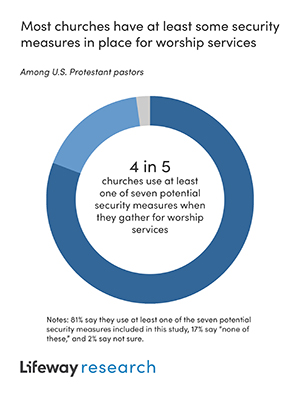
When asked about their protocols when they gather for worship, around 4 in 5 U.S. Protestant pastors (81 percent) say their church has some type of security measure in place, according to a study from Lifeway Research.
Still, more than 1 in 6 (17 percent) say they don’t use any of the seven potential measures included in the study, and 2 percent aren’t sure.

“Churches are not immune to violence, disputes, domestic disagreements, vandalism and burglary,” said Scott McConnell, executive director of Lifeway Research. “

While loving one another is a core Christian teaching, churchgoers still sin, and nonchurchgoers are invited and welcomed. So real security risks exist whether a congregation wants to acknowledge them or not.”

What plans do churches have in place?

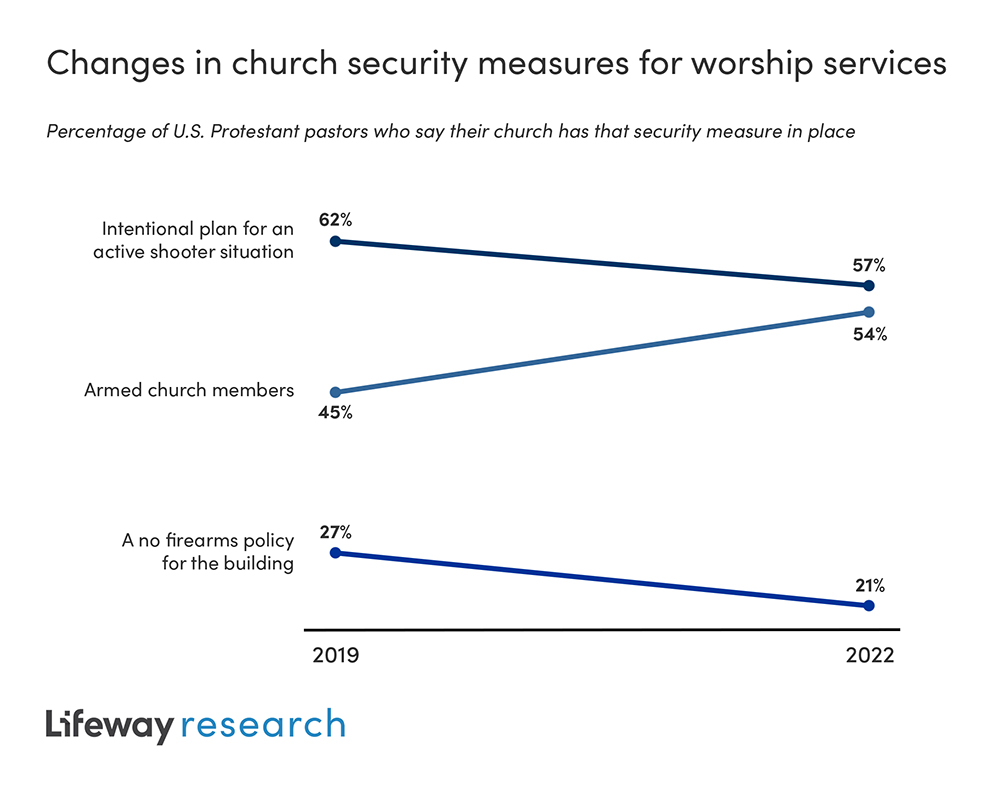
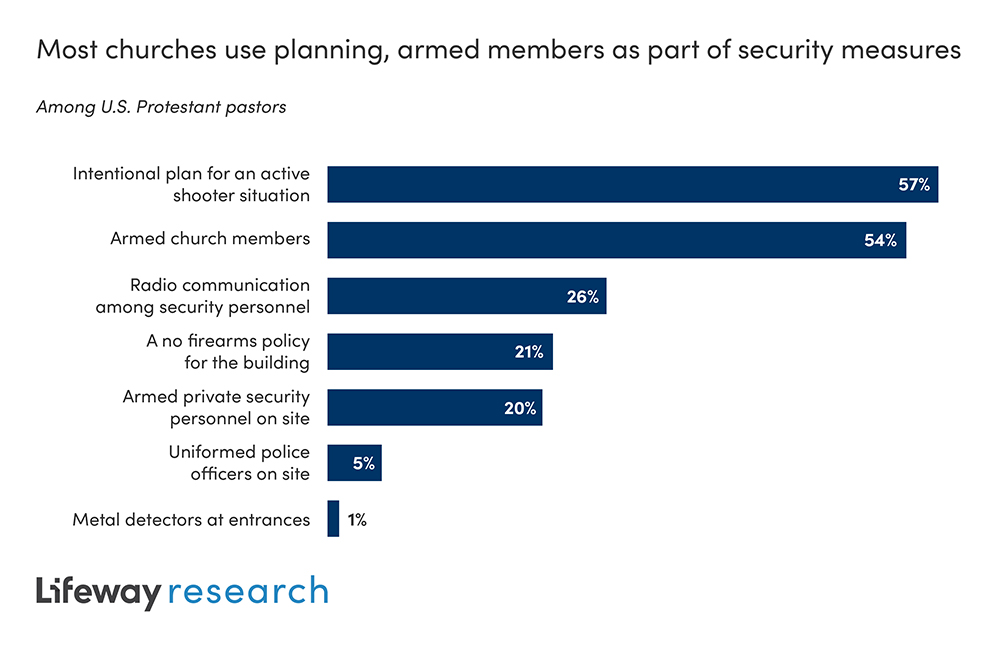
In terms of security specifics, pastors are most likely to say their congregation has an intentional plan for an active shooter situation (57 percent). Additionally, most (54 percent) also say armed church members are part of the measures they have in place.

Around a quarter (26 percent) use radio communication among security personnel, while 1 in 5 say they have a no-firearms policy in the building where they meet (21 percent) or armed private security personnel on site (20 percent). Fewer have uniformed police officers on church grounds (5 percent) or metal detectors at entrances to screen for weapons (1 percent).

 “Most churches are small. So, security plans often don’t need to be elaborate or expensive,” McConnell said.

Around half of the fatal shootings in churches since 1999 have occurred in the South. Pastors in that region are among the most likely to report their congregation has an intentional plan for an active shooter situation (64 percent), radio communication among security personnel (34 percent) and armed private security on site (26 percent).

Additionally, Southern pastors are the most likely to say they have armed church members (65 percent) and uniformed police officers on site (9 percent).

Size and denomination make a difference

More worshipers in attendance often leads to increased security measures. The larger the church, the more likely it is to have armed private security personnel on site and radio communication among security personnel.

Churches with 250 or more in attendance are the most likely to have armed church members (74 percent) and uniformed police officers on site (27 percent). Those large congregations are also among the most likely to have an intentional plan for an active shooter situation (74 percent).

Pastors at churches with worship attendance of fewer than 50 people (29 percent) are the most likely to say they aren’t using any of the methods of preparation considered in this study.

Mainline pastors (22 percent) are more likely than evangelical pastors (14 percent) to not use any of the seven potential ways of security preparation at their churches. Denominationally, Lutheran (34 percent) and Presbyterian/Reformed pastors (30 percent) are at least twice as likely as pastors at non-denominational (14 percent), Restorationist movement (13 percent), Pentecostal (12 percent) or Baptist (8 percent) churches to say they don’t use any of the security measures.

African American pastors are three times more likely than white pastors to say they have uniformed police officers on site (12 percent vs. 4 percent). African American pastors are also more likely than white pastors to say part of their security measures includes radio communication among security personnel (37 percent vs. 25 percent) and a no-firearms policy in the building where they meet (34 percent vs. 21 percent).

Meanwhile, white pastors are more likely than African American pastors to say they have armed church members (56 percent vs. 33 percent).

Some things have changed

Compared to three years ago, pastors say they’re more likely to rely on armed churchgoers and less likely to have a no-firearms policy for their building. Fewer also say they have an intentional plan for an active shooter, compared to a 2019 Lifeway Research study.

Previously, 45 percent of U.S. Protestant pastors said armed church members were part of their congregation’s security measures. Now, more than half (54 percent) include that in their attempts to keep churchgoers safe. In 2019, 27 percent said they enforced a no-firearms policy at their building. That has dropped to 21 percent now.

Churches also are less likely to rely on intentional planning to address potential security threats. In 2019, 62 percent said they had such a plan in place for an active shooting situation. Since then, the percentage of pastors who say that is the case at their church has fallen to 57 percent.

“While churches may have different convictions on how to maintain security, it is surprising that fewer churches have an intentional plan for an active shooter than did in 2019,” McConnell said. “As churches cut back on activities during COVID, this may have been one of the initiatives that did not resume for some churches.”

The phone survey of 1,000 U.S. Protestant pastors was conducted Sept. 6-30, 2022. The calling list was a stratified random sample, drawn from a list of all Protestant churches. Responses were weighted by region and church size to reflect the population more accurately. The completed sample is 1,000 surveys, providing 95 percent confidence the sampling error does not exceed plus or minus 3.2 percent. Margins of error are higher in sub-groups.