How Jemar Tisby became a symbol of ‘wokeness’

WASHINGTON (RNS)—Over the past decade, Jemar Tisby’s life has largely been shaped by two forces: the Bible, and the deaths of young Black men, often at the hands of law enforcement.

About a decade ago, Tisby, then a seminary student in Jackson, Miss., helped start a new group called the Reformed African American Network—an offshoot of the “Young, Restless, and Reformed” movement that had spread like wildfire among evangelical Christians in the first decade of the 21st century.

The group hoped to write about racial reconciliation from the viewpoint of Reformed theology, the ideas most closely associated with the ideas of John Calvin and popularized at the time by preachers and authors such as John Piper. But amid this resurgence of Reformed thought, there were few resources to be had on race issues.

Then, in 2012 in Florida, Trayvon Martin, a Black teen, was killed by the neighborhood watch coordinator of a gated community. All of a sudden, people in the movement were listening.

At the time, Tisby said in an interview, he and others raised their hands and said they had something to offer. The mostly white leaders of the Reformed movement, he said, welcomed them.

“I believed them,” he said. “I thought: ‘We are here. They must want us here.’”

Over the next few years, Tisby, a former pastor turned history professor, became a leading voice on race among evangelicals through his writing and as co-host of “Pass the Mic,” a popular podcast.

Jemar Tisby spoke on “How to Fight Racism” at the invitation of the Baylor Institute for Studies of Religion in 2019. (Photo/ Ken Camp)

He wrote op-eds on race and faith for The Washington Post and published the bestselling The Color of Compromise, which details the long history of racism in American Christianity.

How to Fight Racism, a 2021 follow-up, was named Faith and Culture Book of the Year by the Evangelical Christian Publishers Association.

Conservative concern about ‘wokeness’

But Tisby’s success has since collided with conservative concerns about “wokeness”—a byword that encapsulates liberal critiques of systemic racism, America’s racial history and other social justice themes.

In recent months two college English professors at Christian colleges—one in Florida, the other in Indiana—have been dismissed for allegedly talking too much about race in their classes.

In both cases, critics pointed to the appearance of Tisby’s work on class syllabuses to claim the professors were undermining their students’ Christian faith.

 “I’ve become, for the far right, a symbol of everything that’s wrong with how people who they call the left are approaching race,” Tisby told Religion News Service.

The “woke war” playing out in school boards, on college campuses and in church pews has been driven by activists like Christopher Rufo and by conservative evangelical authors and preachers who warn that wokeness and academic notions such as critical race theory are heresy.

As a result, evangelical pastors who were once outspoken about the need to confront racism have gone silent, or in some cases, been driven from the movement altogether.

Black exodus from evangelical world

Some black Christians—including Tisby and his colleagues at the Witness, as the former Reformed African American Network is now known, have left the evangelical world, sometimes quietly and other times loudly.

Some, like Tisby, have found it harder to leave—finding their ties to the evangelical world difficult to unwind even when they are told they are not wanted. Last year, the board of Grove City College, a Christian school in Pennsylvania, apologized for a 2020 sermon Tisby gave at a campus chapel session after an online petition accused him of promoting critical race theory.

White evangelical institutions have recognized a need in recent years to become more diverse in order to prosper as the country’s demographics change. But their donors often bridle as schools and churches change, causing a backlash that drives away people of color.

Anthea Butler, religious studies professor at the University of Pennsylvania and author of White Evangelical Racism, a 2021 book about the racial divides of the evangelical movement, said evangelicals have a long history of welcoming Christians of color into their movement and then ousting them if they ask too many questions about race.

She said college leaders, like those behind the report at Grove City, or other Christian leaders who have denounced Tisby want to make an example of him as a warning to others.

“They want to punish him,” she said.

Tisby deeply immersed in evangelicalism

A native of Waukegan, Ill., Tisby found Christianity while in high school when a friend invited him to a church youth group meeting. Attending the University of Notre Dame, he began to think about a call to ministry.

In South Bend he also discovered Calvinist theology after a friend sent him a copy of Piper’s 1986 book Desiring God.

After graduating in 2002 and a year working for Notre Dame’s campus ministries, he joined Teach for America and was sent to teach sixth graders in impoverished Phillips County, Ark., in the Mississippi Delta.

The experience changed the direction of his life.

“This is cotton country—the land of slavery and sharecropping,” Tisby said. “You can see it in the landscape. You can see it in the generational poverty.”

The predominantly Black community was marked by a lack of jobs, poor medical care, food deserts and a struggling school system.

“The thing that struck me was that there are churches on every corner,” Tisby said. “Not only were they racially divided, it also didn’t seem like they were having much impact in the community. That’s where I started thinking about the relationship between faith and justice.”

After four years at the school, he took a year off to study at Reformed Theological Seminary in Orlando, Fla., before returning, this time as a principal.

 “I just felt God wasn’t done with me in the Delta,” he said.

He finished his divinity degree at a seminary in Jackson, Miss., working part time in the school’s admissions office. He was charged with helping recruit Black students and helped to start an African American leadership initiative.

Pushback both familiar and surprising

Afterward, he enrolled at the University of Mississippi and earned a doctorate in history. He is now a professor at Simmons College of Kentucky, a historically Black school in Louisville.

The recent pushback against his work, he said, seems both familiar and surprising. As a historian, Tisby has traced the ways American Christians have tried to claim that the faith is colorblind. The love of Jesus, they maintain, should break down divides between people of different ethnicities.
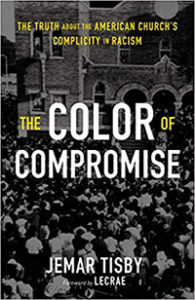
But rarely, Tisby said, do Christians manage to overcome racial differences. In The Color of Compromise, Tisby recounts how English settlers in Virginia faced a dilemma. In their homeland, Tisby writes, the custom was to free slaves who converted to Christianity. In 1667, the Virginia General Assembly decided that, no matter what the Christian faith taught, baptism would not make slaves free.

Tisby recounted some of that history in his 2020 chapel sermon at Grove City College. He had first been invited to speak in 2019 but his visit had been delayed by scheduling conflicts and complications of the COVID-19 pandemic.

School leaders later said they had invited him as a Christian writer who could help the school’s students grapple with racial reconciliation. Tisby, who had spent years in white evangelical spaces, felt he had a message the students there could hear.

“What I picked up on was, we’re willing to give you a hearing, but this is not what we typically do,” he said.

A year later a group of alumni and parents from Grove City launched a petition, claiming the school had been overrun by “wokeness” and critical race theory.

The petition cited Tisby’s speech as a sign the school had lost its way, but school leaders claimed it was Tisby who had changed course.

“The Jemar Tisby that we thought we invited in 2019 is not the Jemar Tisby that we heard in 2020 or that we now read about,” they told a board committee.

Early signs of looming division

Tisby traces white evangelicals’ suspicions of their Black counterparts to the 2014 protests in Ferguson, Mo., that followed the shooting death of Michael Brown. The protests, which brought the Black Lives Matter movement to national attention, drove a wedge between Black and white Christians, he wrote in a 2019 Washington Post op-ed.

The split gained momentum in 2018 with a gathering in Memphis, Tenn., to commemorate the 50th anniversary of the death of Martin Luther King Jr.

Sponsored by the Ethics and Religious Liberty Commission of the Southern Baptist Convention and the Gospel Coalition, a prominent Reformed evangelical group, the event featured a host of prominent leaders, including Piper, Texas megachurch pastor Matt Chandler, Baptist pastor Charlie Dates, legendary Black pastor and community organizer John Perkins and Russell Moore, then president of ERLC.

These preachers urged attendees to address the scourge of racism that stained the life of the church. Moore told attendees that enduring racism was leading younger Christians to question their faith.

“Why is it the case that we have, in church after church after church, young evangelical Christians who are having a crisis of faith?” said Moore, who has since left the SBC and is editor-in-chief of Christianity Today. “It is because they are wondering if we really believe what we preach and teach and sing all the time?”

That same week, an association of Southern Baptists in Georgia kicked a church out for racist actions against another SBC church. The Georgia Baptist Convention followed suit, as did the national Southern Baptist Convention annual meeting.

Opposition to CRT as a rallying cry

But in April of 2018, Tom Ascol, an extremely conservative Southern Baptist pastor from Florida, criticized Thabiti Anyabwile, a well-known pastor in Washington, D.C., for writing about the sin of racism. Ascol, who would later run for SBC president largely on his opposition to critical race theory, produced a documentary about what he called liberal drift in the denomination.

The pushback had begun. By that fall, a group of conservative pastors, many of them Calvinists, signed “The Statement on Social Justice & the Gospel,” which responded to “questionable sociological, psychological, and political theories presently permeating our culture and making inroads into Christ’s church.”

In 2019, a resolution passed by the Southern Baptist Convention called critical race theory a “tool” to understand society and led to calls for the convention to denounce the resolution.

Those Southern Baptist debates over critical race theory long preceded debates in the general public.

Ryan Burge, a political scientist, noted that Google searches for the term critical race theory or CRT were nearly nonexistent when Baptists started debating it. Only later did the debate spill out into the mainstream to be used by politicians, including Donald Trump, to rally supporters. It has since been equated with Marxism and other ideas anathema to conservatives.

Lerone Martin, associate professor of religious studies and director of the Martin Luther King Jr. Research and Education Institute at Stanford University, said that evangelicals have long found it easier to label Black leaders as leftists or Marxists rather than to deal with the reality of racism.

“That way, anything they dislike or oppose can be dismissed wholesale,” he said.

Tisby said he’s not an apologist for CRT or any ideology. He reads the Bible and history and tries to tell the truth, he said in an interview. That is his job as a Christian and as a historian. And he doesn’t think he’s all that special.

“I don’t think there’s anything in particular about my approach that is novel or different than what a lot of people have said for a long time.”


Most churchgoers say they want to serve, but few do it

BRENTWOOD, Tenn.—Although most churchgoers say they want to serve in their communities for gospel impact, there is a noticeable gap when it comes to the number who are already volunteering for a charity.

Most Protestant churchgoers say their churches encourage them to serve people not affiliated with their church and that they want to do so. But few have volunteered in the past year, a new study by Lifeway Research reveals.

More than 4 in 5 churchgoers say their churches encourage every adult to serve people outside their church (84 percent) and they want to serve these people in hopes of sharing the gospel (86 percent).

Despite saying they want to serve people who are not a part of their church, few churchgoers are even serving within the context of their own churches. Two in 3 (66 percent) churchgoers say they have not volunteered for a charity (ministry, church or non-ministry) in the previous year. Three in 10 (30 percent) say they have, and 4 percent are not sure.
According to the latest findings of the U.S. Census Bureau, 23 percent of Americans volunteered through an organization between September 2020 and September 2021.

“The easiest way to serve others is when a charity or group organizes the effort,” said Scott McConnell, executive director of Lifeway Research. “They recognize the need, come up with a plan and often gather needed resources. You just have to show up. Churchgoers say they want to, but less than a third showed up to help a charity in the previous year.”

In another 2022 Lifeway Research study, Protestant pastors said churchgoers were more likely to serve in the church than in the community.

Pastors estimated, on average, 42 percent of their adult churchgoers were involved with regular responsibilities at their churches. And pastors estimated an average of 27 percent of adult churchgoers were involved in serving in the community.

The gap between desire and action

Younger churchgoers—ages 18 to 34 (91 percent) and 35 to 49 (91 percent)—are more likely than those 50 to 64 (84 percent) and older than 65 (79 percent) to say they want to serve people in their community who are not affiliated with their church.

However, the oldest churchgoers (those over the age of 65) are the most likely to say they participated in any type of volunteer work in the previous year (40 percent).

Denominationally, Methodists are the most likely to say their churches encourage them to be involved in ministry that serves community members not affiliated with the church (98 percent) and among the most likely to say they want to do this in hopes of sharing the gospel (95 percent). Still, Methodist churchgoers are the most likely to say they did not participate in any volunteer work in the previous year (88 percent).

“This study did not measure service churchgoers may have done individually for their neighbors. Meeting such needs as they arise is a great form of service,” McConnell said. “But some of the most widespread needs in communities require volunteers working together, something that the majority of churchgoers don’t do over the course of a year.”

A similar gap between desire and action exists for Christians sharing their faith, according to a 2022 Evangelism Explosion study conducted by Lifeway Research. More than 9 in 10 (93 percent) self-identified Christian adults in the U.S. say they are at least somewhat open to having a conversation about faith with a friend. And around 4 in 5 (81 percent) feel similarly about speaking about faith with a stranger.

Yet, in the past six months, 53 percent had a conversation about faith with a loved one. And 40 percent had a conversation about faith with a stranger.

Although many factors may contribute to this gap, pastors identified one in a 2021 Lifeway Research study that may play a role in churchgoers’ hesitation to get involved in both evangelism and community service—comfort. More than 2 in 3 Protestant pastors (67 percent) say comfort is a modern-day idol that has significant influence in U.S. churches.

Cultivating desire that leads to action

Theological beliefs and church attendance frequency contribute to the likelihood a person wants to serve and will have actually volunteered outside of their congregation.

Those who attend a worship service at least four times a month are more likely than those who attend one to three times a month to want to serve people in their communities (88 percent v. 82 percent). The most frequent church attendees are also the most likely to have volunteered in the past year (37 percent).

Additionally, those with evangelical beliefs are more likely than those without to have a desire to serve those in their communities who are unaffiliated with their churches (90 percent v. 83 percent) and to have served in the past year (37 percent v. 25 percent).

“Service is contagious. When you are regularly participating in the life of your church, people you get to know will ask you to serve with them,” McConnell said. “Doing good things with friends is enjoyable and easier to find time to do.”

Lifeway Research conducted the online survey of American Protestant churchgoers Sept. 19-29, 2022, using a national pre-recruited panel. Quotas and slight weights were used to balance gender, age, region, ethnicity, education and religion to reflect the population more accurately. The completed sample is 1,002 surveys, providing 95 percent confidence the sampling error does not exceed plus or minus 3.3 percent. Margins of error are higher in sub-groups.


Bestselling author and retired pastor Tim Keller dies at 72

WASHINGTON (RNS)—Tim Keller, an influential Presbyterian Church in America minister who founded a network of evangelical Christian churches in New York City, died. He was 72.

Known for his brainy and winsome approach to evangelism, Keller founded Redeemer Presbyterian Church in Manhattan in 1989 and grew the congregation into a hub for a network of churches across the city.

His 2008 book, The Reason for God: Belief in an Age of Skepticism, reached The New York Times bestseller list. His books sold more than 3 million copies.

Keller had been under treatment for pancreatic cancer after announcing in June 2020 that he had the disease. On May 18, Keller’s son Michael posted a message that his father had been released from the hospital and would receive hospice care at home.

“It is with a heavy heart that I write today to inform you that Redeemer Presbyterian Church founder and long-time senior pastor, Tim Keller, passed away this morning at age 72, trusting in the sure and certain hope of the resurrection,” Bruce Terrell, a leader of the Redeemer Leadership Network, wrote in an email announcing Keller’s death.

“We are forever grateful for his leadership, heart and dedication to sharing the love of Christ with others. While we will miss his presence here, we know he is rejoicing with his Savior in heaven,” Terrell wrote.

‘The Bible came alive’

Born Sept. 23, 1950, in Allentown, Penn., Timothy James Keller grew up in a Lutheran church and, later, in a congregation of a small denomination known as the Evangelical Congregational Church.

His mother wanted him to be a minister. But like many college students, he lost interest in practicing Christianity while studying at Bucknell University, even though he was a religion major, according to a recent biography.

Keller later recounted having a conversion experience as the result of being involved in an InterVarsity student ministry, where he learned to study the Bible from a ministry leader named Barbara Boyd.

“During college, the Bible came alive in a way that is hard to describe,” he wrote in his book, Jesus is the King.

“The best way I can put it is that, before the change, I pored over the Bible, questioning and analyzing it. But after the change, it was as if the Bible, or maybe Someone through the Bible, began poring over me, questioning and analyzing me.”

While attending Gordon-Conwell Seminary north of Boston, he became friends with Kathy Kristy, whom he had first met when visiting her sister, a classmate of Keller’s. After a rocky start, the two began dating while attending a summer class at Westminster Theological Seminary in Philadelphia, according to Timothy Keller: His Spiritual and Intellectual Formation, a recent biography by Collin Hansen. They later married.

After seminary, Keller became pastor of West Hopewell Presbyterian Church in Hopewell, Va., part of the newly formed Presbyterian Church in America, where he spent five years. There, his ministry was shaped by lessons he’d learned at the Ligonier Study Center run by R.C. Sproul, an influential Calvinist author and preacher. In particular, he held regular question-and-answer discussions with the congregation.

He then spent five years teaching at Westminster Theological Seminary before moving to New York to plant Redeemer in Manhattan. That startup church began meeting in space rented from a Seventh-day Adventist congregation.

Redeemer Church flourished in Manhattan

The church grew quickly to a group of 250, according to a history posted on its website. Unlike many urban churches, which drew crowds with rock bands, Redeemer became known for its traditional worship style and for Keller’s sermons, appealing to the mind as well as the heart. Redeemer eventually grew into a congregation of more than 5,000 and became known for planting other congregations in New York and beyond.

Keller told Christianity Today in a 2022 podcast he wanted people to see the Christian gospel as “intellectually credible” and to recognize that “it offers something that they’ve been looking for all their lives.” He said he also wanted newcomers to be “gratified participants.”

“They felt that they were not trespassers, they felt welcomed, they felt that they were expected, and they were not under pressure to immediately bow the knee,” he said.

Author Jonathan Rauch became friends with Keller in recent years. Despite their differences—Keller was a conservative evangelical pastor, Rauch is Jewish, atheistic and openly gay—Rauch said he never doubted his friend’s love.

“Though he was a man of profound learning, he always expressed it with curiosity and humility,” he said. “Though he was devoted to the church and a builder of institutions, he never forgot that individuals come first. Tim’s pastorate was universal, a gift to believers and unbelievers alike. When I hear the term ‘Christlike,’ I’ll think of him.”

“I was blessed to get to know Tim a bit over the past year,” said Karen Swallow Prior, a professor of literature and Religion News Service columnist. “He went out of his way a couple of times to reach out to me and offer personal encouragement and support at specific moments when I needed it. That showed me exactly the kind of person he is, and that’s the kind of person I want to be. Tim’s legacy is deep, wide, and immeasurable.”

Keller also was a leading figure in the Neo-Reformed movement as one of the co-founders of The Gospel Coalition. “We are a fellowship of evangelical churches in the Reformed tradition deeply committed to renewing our faith in the gospel of Christ and to reforming our ministry practices to conform fully to the Scriptures,” the group’s preamble says.

Conservative but not confrontational

Known for his conservative but non-confrontational approach to ministry, Keller came under fire in recent years from critics who said his “winsome” approach to engaging with culture no longer works in such a polarized time.

Keller told Religion News Service in a 2022 interview he found such criticism puzzling. As an evangelical pastor in New York, he said, his views were often in conflict with the broader culture. But that was not going to stop him from acting like a Christian.

 “This was never the neutral territory,” said Keller, who stepped down as pastor of Redeemer in 2017. “We always had opposition.”

John Starke, pastor of Apostles Church Uptown in New York City, said, “While Tim is often known for listening to his critics, I’m glad he listened to Jesus here more.”

Starke said Keller taught him the connection between knowledge and vibrant spirituality, but also how to pray.

“Tim taught many of us pastors who ministered in urban contexts how to have a cultural and theological grid when we thought and talked about the world around us,” Starke said. “But he also taught us how to pray for revival and experience personal spiritual renewal. It was both, and both were important to him.”

Unlike other evangelical pastors, Keller was skeptical of Donald Trump. He was part of a 2017 closed-door gathering of evangelical leaders who met at Wheaton College to try to figure out the movement’s future in the age of Trump.

“As the country has become more polarized, so has the church, and that’s because the church is not different enough from modernity,” Keller reportedly said at the meeting. “There’s now a red evangelicalism and a blue evangelicalism.”

Despite his illness, Keller kept writing. In his 2022 book, Forgive, he described the power of forgiveness, something he said many of his fellow Christians have lost faith in.

“A secret to overcoming evil is to see it as something distinct from the evildoer,” he wrote, “Our true enemy is the evil in the person and we want it defeated in him or her.”

In their update about Keller’s health on Thursday, Keller’s family said that he was grateful for all those who have prayed for him.

“I’m thankful for my family, that loves me. I’m thankful for the time God has given me, but I’m ready to see Jesus,” he prayed, according to the family update. “I can’t wait to see Jesus. Send me home.”

In addition to his wife and son Michael, Keller is survived by sons David and Jonathan, a sister, Sharon Johnson of Sorrento, Fla., his daughters-in-law Jennifer, Sara and Ann-Marie, and seven grandchildren.


Looking beyond childhood religion grows stronger faith

PHILADELPHIA (BP)—Christians tend to follow their mother’s religion, but those who have changed their religion since childhood are spiritually healthier, the American Bible Society said.

The answer likely lies in the quest involved in exploring Christianity, the American Bible Society said in its latest release from the 2023 State of the Bible report.

“It didn’t matter which Christian tradition they had come from or moved to, the process of moving itself seemed to boost the vitality of their faith,” the Bible society stated.

More than three-quarters of Christians—77 percent—follow their mother’s religion. But those who have changed their faith while remaining Christian consistently scored higher on several variables related to living faithfully, the Bible society said in the second chapter of the 2023 report.

Those who have changed their faith are slightly more Scripture engaged, have a higher belief in Bible accuracy, hold religious faith as more important and are more curious about Jesus and the Bible.

Of those who have changed faiths, 64 percent believe the Bible is totally accurate in all the principles it presents, compared to 47 percent of those who retained their childhood faith.

Three-quarters of those who have changed their faith since childhood rate their religious faith as very important in their lives, compared to 68 percent of those whose faith remained the same.

Three-quarters of those who have changed religion are curious to know more about Jesus, compared to 64 percent of those who’ve retained the religion of their childhood. And 78 percent of switchers are curious to know more about Scripture, compared to 66 percent who haven’t switched.

The differences are true in each major denominational group including evangelical, mainline and historically Black Protestants, as well as Catholics.

“We explored the personal faith journeys of people since childhood, as well as their commitment to Christ today. When people change their faith, they often wind up with a stronger one,” the Bible society stated.

“Their quest for a truer expression of their relationship with God carries them into deeper engagement. We observed the movement of faith through a continuum that included seeking and claiming and enjoying a relationship with Jesus.”

Strengthened faith after searching

Researchers also linked the phenomenon to the fact that those who search outside their childhood faith tend to develop a deeper connection to newfound faith, a matter of owning their relationship with Christ.

“Internalization of Christian truth is a lifelong process,” researchers said. “As they seek the best expressions and connections for their faith or their growing understanding of the Bible’s teaching, some people will pull up stakes from one religious tradition and move to another. This is not necessarily a loss of faith commitment. It can actually signal spiritual growth.

“Sometimes seekers return to their spiritual roots with a stronger faith.”

The American Bible Society plans to release monthly findings from the report, with upcoming releases focusing on spiritual vitality in America, how the Bible impacts human flourishing, the faith of Generation Z, how the Bible impacts behavior, and technology and the Bible.

Now in its 13th year, the State of the Bible report annually looks at the Bible, faith and the church in America.

The American Bible Society collaborated with the University of Chicago’s National Opinion Research Center in designing the study conducted online and via telephone to the research center’s AmeriSpeak Panel. The 18-minute survey, conducted Jan. 5-30, produced 2,761 responses from a representative sample of adults 18 and older within the 50 states and D.C.


Churchgoers encouraged to adopt or provide foster care

BRENTWOOD, Tenn.—More pastors are encouraging members to adopt and provide foster care at a time when adoptions have declined in the United States.

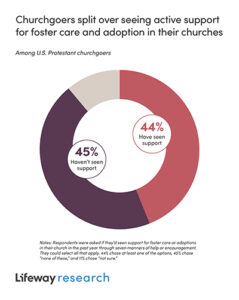
A Lifeway Research study found more than 2 in 5 U.S. Protestant churchgoers (44 percent) say their congregation and its leaders are involved proactively with adoption and foster care in at least one of seven ways.

A similar percentage (45 percent) say they haven’t seen other churchgoers or leaders provide any of the specific types of care or support, while 11 percent aren’t sure.

“Caring for the fatherless is repeatedly prioritized throughout Scripture,” said Scott McConnell, executive director Lifeway Research. “But the Bible does not pretend caring for another like your own child is convenient or easy.”

More than 1 in 10 churchgoers say someone in their congregation has provided foster care (16 percent), adopted a child from the United States (13 percent) or adopted a child from another country (11 percent) within the last year.

Compared to five years ago, fewer churchgoers say they’ve seen members of their church actively participate in adoption and foster care. In a 2017 Lifeway Research study, 25 percent of U.S. Protestant churchgoers said a church member provided foster care, 17 percent said someone adopted domestically and 15 percent said a member adopted internationally in the past year.

Adoptions and the prevalence of foster care have fallen among all Americans in recent years. The number of U.S. children in foster care dropped from 436,556 with 124,004 waiting to be adopted in 2017 to 391,098 with 113,589 waiting to be adopted in 2021, according to a report from the Adoption and Foster Care Analysis and Reporting System. Adoptions, both domestically and internationally, have declined as well.

Need is great and may grow greater

Some experts have speculated, however, that the overturning of Roe v. Wade will result in increased strain on the foster care system and additional children in need of adoption.

In a Lifeway Research study conducted just prior to the Supreme Court’s decision on abortion rights, around 3 in 4 Americans (74 percent) said churches and religious organizations in states that restrict access to abortion have a responsibility to increase support and provide options for women who have unwanted pregnancies.

“It is likely the pandemic limited some families in considering foster care or adoption,” McConnell said. “But the need is still great in the U.S. and could grow larger in states with abortion restrictions.”

Churchgoers in the parenting age range often are more likely to say they’ve seen someone in their church step up in these areas in the past year. Those ages 18 to 34 (19 percent) and 35 to 49 (22 percent) are more likely than those 65 and older (10 percent) to say someone in their congregation has provided foster care.

Churchgoers 35 to 49 (16 percent) are twice as likely as those 50 to 64 (8 percent) and 65 and older (9 percent) to say someone at their church adopted internationally. Those 18 to 34 (19 percent) and 35 to 49 (20 percent) are twice as likely as those 50 to 64 (10 percent) and 65 and older (8 percent) to have seen a domestic adoption in their church within the last year.

Nondenominational churchgoers (22 percent) are among the most likely to have seen foster care in their churches. Methodists are among the most likely to say a fellow church member has adopted either internationally (18 percent) or domestically (31 percent).

Despite the decrease in churchgoers seeing members actively participate, many say within the last year they’ve heard leaders broach the subject and seek to support the issue in other ways.

Around 1 in 6 say their church leaders have raised funds for families who were adopting (18 percent), encouraged families to provide foster care (17 percent) or encouraged families to consider adoption (16 percent).

Additionally, 10 percent say their church leaders have provided training for foster parents in the last year.

Churchgoers are more likely now to say they’ve seen leaders help in these ways compared to 2017. Five years ago, 12 percent of churchgoers said leaders encouraged members to provide foster care, 8 percent saw leaders raise funds for families who were adopting, and 6 percent said leaders provided training for foster parents.

 “While some forms of encouragement have become more common in churches in the last five years, 8 in 10 churchgoers have not seen or heard each of these forms of help or encouragement,” McConnell said.

Again, proximity to parenting age increases the likelihood of someone having seen leaders encourage members in these ways. Churchgoers under 50 are more likely than those 50 and older to say they’ve seen leaders raise funds, encourage providing foster care and encourage adoption. Those 65 and older (4 percent) are least likely to say they’ve seen leaders at their church provide foster care training.

Methodists are among the most active in providing assistance and encouragement. They’re among the most likely to say they’ve seen leaders raise funds for adoption in the past year (42 percent) and the most likely to say their leaders have encouraged churchgoers to consider adoption (48 percent) and provide foster care (41 percent).

 Comparable to 2017, 45 percent of U.S. Protestant churchgoers say their church hasn’t helped in any of these ways in the past year.

“Not every exhortation from pastors and church leaders is heard or understood by laity, but only a minority of churchgoers recognized encouragement for families to adopt or provide foster care this last year,” McConnell said.

 Churchgoers 65 and older (59 percent) are most likely to say they haven’t seen their church provide any of the assistance or support asked about in the study. Females (49 percent) are more likely than males (39 percent) to select “none of these.”

Denominationally, Presbyterian/Reformed (60 percent), Lutheran (55 percent) and Baptist (50 percent) churchgoers are more likely than Restorationist movement (26 percent) and Methodist churchgoers (20 percent) to say their churches haven’t helped in these ways.

Lifeway Research conducted the online survey of American Protestant churchgoers Sept. 19-29, 2022, using a national pre-recruited panel. Quotas and slight weights were used to balance gender, age, region, ethnicity, education and religion to reflect the population more accurately. The completed sample is 1,002 surveys, providing 95 percent confidence the sampling error does not exceed plus or minus 3.3 percent. Margins of error are higher in sub-groups.


Habitat’s ‘theology of the hammer’ offers hope

WASHINGTON (RNS)—Habitat for Humanity was built on a pair of simple yet profound ideas. Everyone deserves a decent place to live. Anyone who wants to help make that happen is welcome to pick up a hammer and get to work.

For nearly five decades, those ideas—which Habitat’s founder referred to as the “theology of the hammer”—have helped Habitat grow from its humble beginnings at a Christian commune in Georgia into a worldwide housing nonprofit that’s helped more than 46 million people around the world find a place to call home.

Among those homes are 30 “Unity Build” houses in Nashville, Tenn., built by an interfaith coalition of congregations over the past three decades. Those congregations believe very different things about God, said Kevin Roberts, a former pastor and director of faith relations and mission integration for Habitat for Humanity of Greater Nashville. But they share a common conviction about helping their neighbors.

Working together in polarized times

That makes a Habitat build site a rare place where people who disagree can work together in polarized times. All they need is a willing pair of hands.

“When you step onto the Habitat build site and someone puts a paintbrush or a hammer or a saw in your hand, no one asks, ‘Who did you vote for?’” said Roberts. “No one asks, ‘Where did you go to church or did you go at all?’”

That inclusive approach has helped Habitat thrive despite the many challenges facing faith-based charities in the United States, including aging supporters in shrinking congregations, a loss of faith in organized religion, and the nation’s growing polarization.

Jonathan Reckford, CEO of Habitat for Humanity International, said the nonprofit’s mission is to put God’s love in action by providing housing. To do that, he said, requires bringing a wide range of people together.

Jonathan Reckford, CEO of Habitat for Humanity International, said the nonprofit’s mission is to put God’s love in action by providing housing. (Courtesy Photo by Habitat for Humanity)

Using volunteers to help build a Habitat house is a social change strategy, Reckford said, one that invites people to care about affordable housing and about working with their neighbors. That’s an important task in today’s isolated and polarized times.

“My observation is that when people serve together, they focus on what they have in common,” Reckford said in a phone interview. “They focus on shared values, as opposed to when we sit by ourselves online. Then it’s all about how we are different.”

Reckford hopes to expand that kind of intentional bridge-building in the coming years through a new initiative called Team Up—a partnership of Habitat, Catholic Charities, the YMCA and Interfaith America. The initiative was first announced last fall at a White House summit.

The idea is to address the nation’s divisions by inviting people to build friendships as they serve together to meet community needs. For Habitat, that will likely involve more intentional community building on the worksite and an increased focus on interfaith cooperation.

Deep Christian faith and ‘radically inclusive’

Reckford said Habitat’s core Christian identity and its commitment to interfaith work go hand in hand. Faith in God is at Habitat’s center, but God is “not a border” to keep others out.

That deep faith, he said, allows Habitat to be “radically inclusive” and to welcome anyone who wants to lend a hand.

“We should not have to give up what has made Habitat successful in order to be joyfully welcoming of others,” he said.

Reckford suspects community service will become increasingly important for churches and other faith groups in the future, as people become more skeptical of organized religion.

Habitat, he said, was born in church basements and grew by tapping into the energy and faith of people who were already church members. Now many churches will have to reach out to people who aren’t part of their community to continue their ministry, he said.

“In our increasingly unchurched culture, community service is going to be the front door for more and more faith communities,” he said. “The first invitation might be ‘Come to serve with me’ rather than ‘Come worship with me.’”

Service offers venue for interfaith dialogue

Eboo Patel, president of Interfaith America, said his organization’s work was shaped in part by his experience working on an overseas Habitat for Humanity project in Hyderabad, India, in the early 2000s.

Eboo Patel, president of Interfaith America

Interfaith America—then known as Interfaith Youth Core—was just getting off the ground, and Patel and others volunteered on a project in a city that had experienced religious violence.

On that project, Hindus, Muslims and Christians worked side by side.

The experience left Patel convinced of the power of service as “a common table for interfaith conversations,” he said.

As he looked further into Habitat’s history, he learned the group’s late founder, an Alabama lawyer named Millard Fuller, began the work in part so his Christian friends could get along.

“Millard Fuller’s original vision was: Hey, my evangelical and mainline friends can’t even talk about Jesus because it just leads to an argument,” Patel said. “But we can serve together.”

That ecumenical approach to working together naturally led to interfaith work, said Patel. The idea of helping your neighbors, he said, is common among many faiths. No matter what they believe about God, each faith has its own version of the theology of the hammer.

There’s something “extra sacred” when people of different faiths work together for the benefit of others, according to Patel.

“Everyone has a story to share,” he said. “You’ve opened up what we called mutually enriching conversations between people of different faiths.”

Recently, Pikes Peak Habitat for Humanity, based in Colorado Springs, dedicated its second interfaith-build house, which brought together Christians, Jews, Muslims and Buddhists, along with a Native American group.

“We try to pair two faith congregations together from different traditions so that they have the opportunity while on the construction site for the day to get to know one another,” said Chloe Henry, the Faith in Action program manager for Pikes Peak Habitat.

Pike’s Peat Habitat has also organized an interdenominational Christian house build as well as interfaith dialogue events where people can talk about how their faith inspires them to care about affordable housing. This past year’s interfaith event focused on the topics of increasing Black homeownership and on building a community where everyone belongs.

Nashville Habitat also has held interfaith dialogues, as well as interfaith worship services—involving Jewish, Hindu, Muslim and Christian clergy—at Congregation Ohabai Sholom, a Nashville synagogue better known as the Temple.

The Temple first became involved with Habitat when a past president of the synagogue wanted to get congregations involved in a social action project, said Rabbi Shana Mackler, who also serves as a senior scholar. The Unity Build began with three congregations and now involves nearly two dozen.

“We have stayed involved largely because people love direct action projects, and because it gives us the opportunity to connect with other houses of worship and religious communities in doing good, meaningful work,” she said.

For Lauren Brooks-Gregory, the interfaith service at the Temple is one of the most important aspects of the Unity Build. Brooks-Gregory, who is 40, said she first became involved in Habitat as a teenager and learned about the Unity Build through her Calvary United Methodist Church, where she grew up.

The church has long been a supporter of Habitat for Humanity of Greater Nashville, which has helped 1,000 families become homeowners.

She said the interfaith service sets the tone that everyone involved is committed to the same goal—putting a roof over a family’s head.

Brooks-Gregory took over as a volunteer coordinator for the Unity Build in 2022 and said she wants to build on the legacy of those who came before her. In her role, she works alongside the point people in each congregation, who are responsible for raising funds and finding volunteers. She said there’s room for congregations small and large to get involved.

She hopes the interfaith work of Habitat will become even more intentional in the future. A former youth pastor who now does training for an electrical contractor, Brooks-Gregory said strengthening relationships between people of different faiths takes intentional effort and planning—especially in trying times.

“The effort to get along is ever-changing,” she said. “It just looks different right now. But the struggle has always been there.”

Brooks-Gregory said she loves the way Habitat puts people in motion to get something constructive done, while they get to know each. That provides space for understanding, she said.

“Let’s practice interfaith dialogue. But also, hand me that two-by-four.”


More Americans pray in a car than in a house of worship

WASHINGTON (RNS)—Despite reports of declining worship attendance and religious affiliation, 6 in 10 Americans say that they pray, a new survey reports.

A higher percentage—85 percent—say they engage in a spiritual practice to connect with a higher power, whether prayer, meditation, mindfulness, reciting affirmations or spiritually based yoga. Prayer is the most common of the five practices, with 39 percent of Americans saying they practiced meditation and 38 percent practicing mindfulness.

Findings of the survey of more than 1,700 Americans were released by the Radiant Foundation on Thursday (May 4), which is the National Day of Prayer.

It showed U.S. adults who pray often do so at dawn or when they awaken (50 percent) or at bedtime (55 percent). More people report that they pray in their car (61 percent) than in a place of worship (46 percent).

“These results make it clear that there is more praying taking place than people expect. People are praying in a variety of ways and in unexpected places throughout the day,” said John Dye, executive director of Skylight, a Radiant Foundation website that offers spiritual content, such as prayer, affirmations and yoga, aimed at young adults.

“They are frequently exploring their spiritual side and using prayer to work through adversity, find meaning, and create connection with a Higher Power.”

A distinct majority of those who pray (87 percent) said they believed they’d received an answer to their prayers in the last 12 months.

The top reasons cited for prayer were for a loved one in crisis (76 percent) or when someone else was sick (71 percent).

Other findings looked at how and with whom people prayed.

Eight in 10 reported regularly praying by themselves. Younger respondents—in particular millennials and Gen Zs—were more likely than younger boomers and Gen Xers to report they prayed regularly with members of their spiritual group or family. Nearly a quarter said they pray routinely around their pets.

More than three-quarters of those who pray use at least one spiritually related object when they do.

The most popular objects, based on a provided list of 20, were books and other texts, used by a quarter of respondents at least a few times a week. Others included burning objects such as candles (19 percent), a journal (18 percent), a pillow or kneeling pad (18 percent), a rosary or prayer beads (18 percent) or iconography (18 percent).

The survey was commissioned by Skylight and conducted by the Boston-area research firm City Square Associates. A total of 1,783 U.S. adults ages 18 to 64 participated in the online survey, which had a margin of error of plus or minus 2 percentage points. Many of the questions on prayer were asked only of the 1,090 Americans who indicated they pray.


New books spotlight women’s leadership in New Testament

WASHINGTON (RNS)—Emerging from the narrow entrance to a cave south of Jerusalem, scholar Joan Taylor found herself saying a blessing for Salome.

Salome is described in the Gospels as following and ministering to Jesus and is named as one of many women present at his death and at his tomb after his resurrection.

Ancient Greek graffiti inside the cave also asks “holy Salome” for mercy, suggesting to Taylor and her travel companion, scholar Helen Bond, that Salome may have been remembered as a healer in the early centuries of the church, just as many of Jesus’ male disciples were.

“These early women disciples of Jesus should be celebrated. They should be restored somehow, as this place should be restored,” Taylor says, sitting outside the cave in the British Channel 4 documentary Jesus’ Female Disciples: The New Evidence.

“They were working alongside the men. They were as important to the early Jesus movement as the men were,” she continues. “They are clearly there in our texts, and to forget that is a shame. If it’s all about men and the band of 12 men around Jesus, we’re forgetting the other half of the story.”

The documentary gained unexpected attention, with the duo writing it receiving more press coverage than any other religious program since the BBC’s Son of God in 2001.

Women’s roles in the Bible ‘have been obscured’

Taylor and Bond—who also wrote the book Women Remembered: Jesus’ Female Disciples, which details the scholarship that didn’t fit into their 50-minute film—aren’t the only scholars working to restore the picture of Jesus’ first female followers.

Several new books are taking a fresh look at the roles of women in Jesus’ ministry and in the early church.

“It’s not that we’re making new discoveries about women. It’s not that we’re trying to rewrite history. It’s simply that women have been obscured, and women’s actual roles in the Bible have been obscured,” said Beth Allison Barr, the James Vardaman Professor of History at Baylor University and author of The Making of Biblical Womanhood: How the Subjugation of Women Became Gospel Truth.
“It’s time when we’ve got to see them for how they really are,” she said.

That time comes as many Christians—particularly white evangelicals—are asking questions about how their faith was formed and what they were taught it meant to be a Christian, Barr said. That includes ideas around women and gender roles.

“People are like, ‘Hey, maybe what I was always taught about this—maybe there’s more to the story.’ And, I mean, it’s such an encouraging moment,” Barr said.

Gupta: ‘I was wrong’ about women in ministry

Nijay Gupta—professor of New Testament at Northern Seminary and author of Tell Her Story: How Women Led, Taught, and Ministered in the Early Church, released in March with a foreword by Barr—said he was forced to reconsider his belief that the Bible forbid women from leadership in the church when he was in seminary.

Gupta had been warned to stay away from women studying for a Master of Divinity degree because they were being “disobedient,” he said. He ended up marrying one.

And the more women he met in seminary, the more he realized they believed the same things he did about the truth of the Bible.

Two years of research into what the Bible said on the topic started with him writing a paper on why women shouldn’t be in ministry and ended with him writing a paper on why they must.

In the New Testament, Gupta encountered Nympha, who not only hosted a church in her home but is described in the same way church leaders are described elsewhere. When writing about her in Tell Her Story, he was tempted to name the chapter “The Most Important Early Christian You’ve Never Heard Of,” he said.

He also reencountered Mary, the mother of Jesus, whom he always envisioned frozen in time as a teenager in the Christmas story. But, he realized, she was there throughout Jesus’ life, at his death and even afterward among the disciples when the Holy Spirit arrived at Pentecost.

Gupta started teaching and writing about the stories of women found in the New Testament because, he said, “I was wrong, and I was so sure of being right before.”

How we view these women has impacts far beyond biblical interpretation, he said.

“An accumulation of modern life experiences tells us if the Bible is God’s word, if it’s the authority for Christians, we need to take seriously everything in there, and that’s going to affect how we treat women today,” he said.

Focusing on neglected women in Scripture

Other scholars have focused their attention on individual women who receive passing reference in the New Testament.

Phoebe, whose name appears in a list of greetings from the apostle Paul at the end of the Book of Romans, takes center stage in Susan Hylen’s book Finding Phoebe: What New Testament Women Were Really Like, published in January. The two verses about Phoebe describe her as “sister,” “deacon” and “benefactor.”

Hylen, professor of New Testament at Emory University, uses those lines as a jumping-off point to investigate some of the “vague clues” the New Testament gives about the lives of the women in its pages.

She offers historical context to help readers reach their own conclusions about the roles women may have played in the early church and beyond, which may look different than they had assumed.

“I sense right now that there are a lot of churches where it hasn’t been conventional for women to have leadership roles, but people are open to it,” she said.

The scholars argue much of what they’re writing isn’t new.

‘An exercise in amplification’

Gupta describes Tell Her Story in its introduction as an “exercise in amplification” of the stories of women in the biblical text.

Taylor, professor of Christian origins and Second Temple Judaism at King’s College London, points to the work of German theologian Elisabeth Schüssler Fiorenza, who pioneered the field of feminist biblical interpretation in the 1980s and 1990s with such works as In Memory of Her: A Feminist Theological Reconstruction of Christian Origins and But She Said: Feminist Practices of Biblical Interpretation. Taylor studied  Schüssler Fiorenza’s methodology at Harvard Divinity School.

Bond said she still was surprised to encounter women as more than “light relief” in the biblical texts.

“This is genuinely part of the story that hasn’t filtered out from academic towers and academic institutions,” said Bond, professor of Christian origins and head of the School of Divinity at the University of Edinburgh.

Diana Butler Bass author Grateful
Diana Butler Bass

Much of what is being written now about women in the New Testament “is really an evangelical phenomenon,” according to popular author and public scholar Diana Butler Bass.

“I think these questions have been, by and large, explored very thoroughly, and pursued with great success, in Catholic and liberal Protestant circles for more than four generations already, but now evangelicals are just finding them.”

The 1970s and 1980s saw a surge of feminist biblical scholarship as mainline Protestant denominations began to ordain women, Butler Bass said, pointing to the work of Rosemary Radford Ruether and Elizabeth Johnson.

Still, Butler Bass said, she was surprised when a sermon she delivered last summer sharing new scholarship about Mary Magdalene—whom she called “first among the apostles, really, when it comes to women in the New Testament”—went viral.

In the sermon, she pointed to the work of Elizabeth Schrader Polczer, incoming assistant professor of New Testament at Villanova University. Schrader Polczer’s research suggests the oldest text of the Gospel of John was altered to split in two the character of Mary in the story of Jesus raising Lazarus from the dead.

As a result, today’s Bible translations place sisters Mary and Martha—who are featured in a different story in the Gospel of Luke—in the passage. Schrader Polczer argues instead it should be Mary Magdalene in the passage, making one of the first statements of belief in Jesus as the Messiah.

That would put Mary Magdalene, who is named elsewhere in the Bible as traveling with Jesus and his disciples and as the first witness to Jesus’ resurrection, on par with Peter among Jesus’ disciples, Butler Bass said.

After delivering the sermon to a largely progressive Christian audience of mainliners and exvangelicals last July at the Wild Goose Festival, Butler Bass sent the audio to her Substack subscribers. By the time she arrived home a few hours later, it had been downloaded nearly 100,000 times.

To date, she believes it has been listened to 750,000 times.

But imagine, she said, if the church had been listening to Mary Magdalene and other women named in the New Testament all this time.

“Is there a pathway to finally reimagine the nature of leadership in early Christian communities and the ways in which Jesus understood the callings of men and women?” Butler Bass said.


‘Letter from Birmingham Jail’ still relevant, faith leaders say


WASHINGTON (RNS)—It’s been 60 years since Martin Luther King Jr. wrote his famous “Letter from Birmingham Jail” on scraps of paper, but faith leaders say his response to white clergy critics endures as a “road map” for those working on justice and equal rights.

Recent events and exhibitions tied to its anniversary have revealed the ongoing interest in and relevance of King’s letter, in which the civil rights leader wrote: “Injustice anywhere is a threat to justice everywhere. We are caught in an inescapable network of mutuality, tied in a single garment of destiny. Whatever affects one directly, affects all indirectly.”

Georgetown University’s Center on Faith and Justice held a virtual event April 26 to mark 60 years since King penned the letter on April 16, 1963, after being jailed for his organization of a nonviolent demonstration on Good Friday that year in the Alabama city. The letter was released publicly the next month and was included in his 1964 book Why We Can’t Wait.

Jim Wallis, the center’s director, noted how King wrote that the greatest “stumbling block” for freedom-seeking Black Americans was—rather than a Ku Klux Klan member—the “white moderate, who is more devoted to ‘order’ than to justice; who prefers a negative peace which is the absence of tension to a positive peace which is the presence of justice.”

Wallis pointed to the current debate in some school districts over what books children can and can’t read as an example of why the letter continues to be relevant.

“We know that it is impossible to build a truly multiracial democracy if we do not wrestle honestly and directly with its legacy and current manifestations of white supremacy,’’ he said. “At the moment when some are trying to erase our history, especially our racial history, remembering and learning from the past is now more important than ever.”

King’s letter was addressed to eight clergymen, whom he called “my Christian and Jewish brothers,” after they questioned the need for and the urgency of the Birmingham campaign he had led as the president of the Southern Christian Leadership Conference.

Bishop Vashti McKenzie, the interim president of the National Council of Churches, shared at the event how King’s letter guided her family’s prayers for her older brother’s safety as he traveled that year by bus to the South to aid the movement.

‘A road map’ for positive change

“It was a fearful time, a fearful time when something had to be done,” she said. “The African diaspora is calling you to do it. And King gives us a road map on how to begin that process of change.”

Pastor Otis Moss III of Chicago’s Trinity United Church of Christ

Pastor Otis Moss III of Chicago’s Trinity United Church of Christ called the letter part of the “extracanonical material” his family thought necessary to read beyond the Bible.

“What’s so important about it today is you still have people who have ecclesiastical positions but have no moral authority and who are trying to claim moral authority,” said Moss, who, like McKenzie, was required to read the letter at the historically Black college he attended.

“He was talking to the Christian nationalists of his day and setting them straight and saying, ‘You have no moral authority.’”

The 60th anniversary of the letter has been marked with talks at churches, a parade in Oklahoma City and exhibits of related artwork at the New Jersey State Museum, as well as the display of an early draft at the New York International Antiquarian Book Fair.

Faith leaders at the Georgetown event and in interviews commented on King’s stated concerns in his letter, which included that the church could “be dismissed as an irrelevant social club” and that he has daily met “young people whose disappointment with the church has turned into outright disgust.”

In an interview, Randal Maurice Jelks, author of the 2022 book Letters to Martin: Meditations on Democracy in Black America, said the letter deeply resonated with a churchgoing public of the 1960s but remains relevant in teaching people of a range of faith perspectives today.

What the letter, which was more than 6,000 words long, “continues to point out is that people do have to take a side in the struggle for justice, whatever those justice struggles are, and you can’t be, as King would say in that letter, lukewarm about that.”

‘The mission didn’t stop with the man’

Pastor Melech E.M. Thomas of Bethel AME Church in Selma, N.C.

Melech E.M. Thomas, a millennial pastor of an African Methodist Episcopal Church, said in an interview he thinks King’s “masterful” letter should be heard in U.S. history classes and in seminaries rather than just a mention of his name or his legacy.

“In every pulpit, this year, there should be some type of reading, public reading of excerpts of the letter from the Birmingham jail, just to remind us of why we are the church and what God has called us to do,” said Thomas, pastor of Bethel AME in Selma, N.C.

“The mission didn’t stop with the man. We have an obligation to continue what he called us to do and I hope that myself and my generation, as we are coming into leadership, will continue to do the same.”

In an interview, Sojourners President Adam Russell Taylor said King’s letter offers a theologically and civically grounded challenge to not be silent that still applies to churches today. Taylor noted the fallout from clergy he thinks were not courageous enough to speak amid false statements that the last presidential election was stolen.

Taylor pointed to a recent Brookings Institution and Public Religion Research Institute survey that found that 29 percent of Americans qualify as Christian nationalists but, by a ratio of 2-to-1, Americans reject a Christian nationalist view.

“If the people in the middle were really willing to stand up and speak out more, I think we could reach a tipping point,” Taylor said. “Which way we tip is really up to all of us, but I think it’s that middle that we really need to activate and inspire to be much more outspoken and much more courageous.”

A questioner at the Georgetown event inquired about how predominantly white faith communities can join with racially diverse groups on racial justice issues.

Moss responded by citing an anti-violence event in downtown Chicago the previous Saturday featuring hundreds of men, most of them Black. The gathering represented new efforts by his congregation and others that were supported by a range of houses of worship, from Pentecostal congregations to synagogues. He called it an opportunity to “change the narrative” about how the city’s youth are viewed and affirmed.

“We did a walk downtown, not against our children, but to say that we love them,” he said, adding that his is one of several churches planning to offer some 750 jobs to youth this summer. “They were saying that we’re in this together. This is our city. These are our children.”


Churchgoers still tithing but outside of church

BRENTWOOD, Tenn.—Most churchgoers see tithing as a biblical command and give at least 10 percent of their income. But they have more diverse opinions on the “where” and “how” of tithing.

More than 3 in 4 American Protestant churchgoers say tithing is a biblical command that still applies today (77 percent), according to a Lifeway Research study. One in 10 (10 percent) says it is not. And 13 percent are uncertain about the matter.
Compared to 2017, fewer churchgoers today believe tithing is a biblical command that still applies (77 percent vs. 83 percent) and more are not sure (13 percent vs. 10 percent).

“Giving 10 percent of your earnings to God is still a widespread standard among churchgoers,” said Scott McConnell, executive director of Lifeway Research. “The small decline in considering tithing a command appears to be more from a lack of teaching on the subject than a rejection of such teaching.”

The youngest adult churchgoers, those age 18 to 34, are the least likely to agree tithing is a biblical command that still applies today (66 percent). Denominationally, Lutherans are least likely to agree (59 percent).

Those with evangelical beliefs are more likely than those without evangelical beliefs to say tithing is biblical and currently applicable (85 percent vs. 71 percent).

And those who attend a worship service at least four times a month are more likely than those who attend one to three times a month (80 percent vs. 72 percent) to agree.

How much do churchgoers give?

By definition, a tithe is one-tenth. And while more than 3 in 4 churchgoers believe giving a tithe is biblical, only half (51 percent) give 10 percent or more of their income to the church they attend.

Three in 10 (31 percent) say they give a tithe, and 19 percent give more. More than 1 in 5 (22 percent) say they try to give but aren’t always consistent. And 16 percent say they regularly give less than a tithe.

Another 9 percent say their finances make it difficult to give, and 2 percent say they do not give.

Although fewer give 10 percent of their income to the church today compared to 2017 (31 percent vs. 37 percent), the percentage of churchgoers who give 10 percent or more has remained relatively steady (51 percent vs. 54 percent).

Today, fewer churchgoers regularly give less than a tithe (16 percent vs. 20 percent). And more try to give but are not consistent (22 percent vs. 17 percent).

“Believing God wants you to tithe and doing it are two different things,” McConnell said. “Some who do not tithe are consistent with their giving at a lower threshold, and others give when they feel they are able. Like many exhortations in Scripture, giving your finances to God is not necessarily easy in practice.”

Several church-related factors impact a person’s likelihood of giving to the church they attend. Baptist (40 percent), Presbyterian/Reformed (34 percent) and non-denominational (34 percent) churchgoers are more likely to tithe 10 percent of their income than Lutheran (19 percent), Restorationist Movement (17 percent) and Methodist (12 percent) churchgoers.

Additionally, those who attend worship services at least four times a month (34 percent) are more likely to tithe than those who attend one to three times a month (26 percent). And those with evangelical beliefs are more likely than those without evangelical beliefs to tithe (39 percent vs. 25 percent).

Where can you tithe?

Most churchgoers who say tithing is an applicable biblical command say tithe money can be given to their church (90 percent). Most also say tithes can be given to a Christian ministry (55 percent). Fewer say tithes can be given to an individual in need (42 percent) or to another church they don’t regularly attend (34 percent). One in 4 believe tithes can be given to a secular charity (25 percent). And 1 percent are not sure.

Today, fewer churchgoers than in 2017 say tithe money can be given to their church (90 percent vs. 98 percent).

And more said tithes can be given to Christian ministries (55 percent vs. 48 percent), an individual in need (42 percent vs. 34 percent) or a secular charity (25 percent vs. 18 percent).

Denominationally, Lutheran (98 percent), Presbyterian/Reformed (96 percent), Baptist (93 percent) and non-denominational (92 percent) churchgoers are among the most likely to say tithe money can be given to their churches.

Lutheran and Presbyterian/Reformed churchgoers are also among the most likely to say tithes can be given to another church they don’t regularly attend (58 percent and 53 percent, respectively) or a Christian ministry (72 percent and 68 percent).

Lutherans are also among the most likely to say tithes can be given to a secular charity (45 percent), and Presbyterian/Reformed churchgoers are among the most likely to say they can be given to an individual in need (51 percent).

Conversely, Baptists are among the least likely to say tithes can be given to a Christian ministry (51 percent), individuals in need (37 percent), another church they don’t regularly attend (34 percent) or a secular charity (19 percent).

Those with evangelical beliefs are more likely than those without evangelical beliefs to say tithe money can be given to their churches (95 percent vs. 85 percent), while those without evangelical beliefs are more likely than those with such beliefs to say tithes can be given to a secular charity (29 percent vs. 20 percent).

Does method matter?

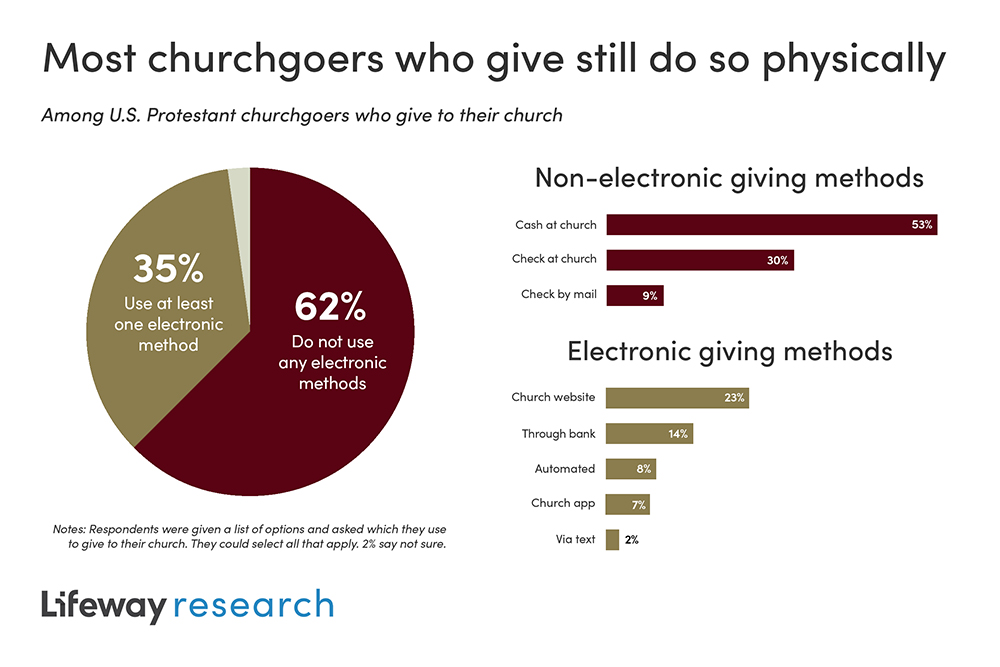
Although the past five years have seen a noticeable increase in online giving, most churchgoers still give cash at church (53 percent). Fewer give a check at church (30 percent) or mail one to the church (9 percent).

Others give electronically on the church website (23 percent), through their bank (14 percent), through an app the church provided (7 percent) or via text (2 percent). And 8 percent of churchgoers have automated payments set up for their tithes.

Nearly half as many churchgoers today compared to 2017 give a check at church (30 percent vs. 59 percent).

But more churchgoers mail checks to the church today (9 percent vs. 3 percent).

And more are giving electronically through all formats—church website (23 percent vs. 11 percent), banks (14 percent vs. 5 percent), automated payments (8 percent vs. 3 percent) or church app (7 percent vs. 3 percent).

Those 18-34 are among the most likely to give cash at church (75 percent), on the church website (28 percent), through an app the church provided (10 percent) or via text (7 percent). Churchgoers 65 or older are the most likely to give a check (47 percent).

“While electronic giving has grown significantly in the last five years, 6 in 10 (62 percent) churchgoers who give do not yet utilize electronic giving methods to give to their church,” McConnell said. “Churches would likely be better served by emphasizing the motivation to give than the mode.”

Lifeway Research conducted the online survey of American Protestant churchgoers Sept. 19-29, 2022, using a national pre-recruited panel. Quotas and slight weights were used to balance gender, age, region, ethnicity, education and religion to reflect the population more accurately. The completed sample is 1,002 surveys, providing 95 percent confidence the sampling error does not exceed plus or minus 3.3 percent. Margins of error are higher in sub-groups.


Rapture triggers haunt the Left Behind generation

WASHINGTON (RNS)—When a pandemic caused shutdowns across the globe in March 2020, Stacie Grahn thought it was the literal end of the world.

Stacie Grahn

“I thought: ‘This is it. We’re all in our homes. Is this when we’re all going to disappear?’” Grahn said in a phone call from British Columbia. “With the vaccine, I thought: ‘Is this how they’re going to separate us? Is this going to be the mark of the beast we have to take?’”

For those like Grahn who are taught the rapture can happen at any second, the End Times are more than fodder for apocalyptic fiction. Fear-saturated stories about the saved being transported to heaven while the world faces havoc and hellfire can generate lifelong panic, paranoia and anxiety, reorienting people’s lives around what’s to come instead of what is.

These religious beliefs have societal implications, too. Why care about the refugee crisis or climate change if the world is doomed?

Rapture a relatively recent concept

Belief in the Second Coming of Christ is as old as the church, but the concept of the rapture is a relatively recent early 19th-century phenomenon, most often embraced in evangelical or fundamentalist circles.

In the late 20th century, it was reinforced through popular media, including Hal Lindsay’s 1970 bestseller The Late Great Planet Earth, which interpreted world events as signs of the end times, as well as the 1972 thriller A Thief in the Night and, in the 1990s, Tim LaHaye and Jerry B. Jenkins’ wildly popular Left Behind series.
But, as Grahn could tell you, these ideas aren’t relics of the past. Grahn’s grandmother first introduced her to the rapture at a young age via videos of End Times ministries and preachers like JD Farag. Anything her grandmother planned was with an asterisk.

“We can plan that, but the Lord could be coming back,” Grahn recalled her grandmother saying.

Prepping for disaster

Unlike Grahn, Nikki G, 46, came to view the rapture as gospel later in life. In 2010, she uprooted her life to join the International House of Prayer in Kansas City, Mo. As a survivor of several high-control religious groups. she asked to go by her first name due to safety concerns.

Nikki was attracted by the fervency of the group, which has been hosting 24/7 worship and prayer since 1999 and has a distinct End Times flavor.

“We believe that the church will go through the Great Tribulation with great power and victory and will only be raptured at the end of the Great Tribulation. No one can know with certainty the timing of the Lord’s return,” the organization’s website says.

As a result of the apocalyptic messaging she heard in these groups, Nikki said she rejected materialism, began canning food and strategized survival tactics. But prepping to survive until the rapture took a toll on Nikki.

“It’s very dehumanizing,” Nikki said. “You’re not present. You’re always in the future. You are disassociated from your body, your nervous system and yourself, and ultimately you become the theology. … I was no longer Nikki, when I was in all of that.”

She experienced nightmares, flashbacks and insomnia years after leaving.

Anecdotal evidence of anxiety and fear

Therapist Mark Gregory Karris said, while there’s little research on rapture-related trauma, anecdotal evidence suggests people can experience anxiety, fear and disrupted life plans because of such teachings. He said it especially is true among those who emphasize the immediacy of the rapture, the torment of those left behind and the need to be good enough to win God’s approval. Some who ingest these beliefs see future plans as futile, even faithless.

That was the case for Diana Frazier, 39, who grew up in an Assemblies of God church in Poulsbo, Wash.

“I remember sobbing multiple times as a little kid, thinking I will never get to get married, I will never get to have children. There’s no point in having any kind of dream for my future because I’ll be in heaven,” she said. “And then I would have guilt and shame, even as a little kid, because I’d know I was supposed to be happy about that.”

As a teen, Frazier participated in a youth group-sponsored hell house, a riff on haunted houses that portrayed sinful scenarios—like drunken car crashes and an abortion clinic—that led to hell.

Afterward, participants were invited to say the “sinner’s prayer.” Inundated with images of the terror she’d face if she wasn’t chosen by God, Frazier constantly was vigilant, ready to respond to disaster. But there was a cost.

“Humans aren’t meant to survive like that. Walking around with a fire extinguisher going all the time when there’s no fire is exhausting.”

Frazier paused her education after receiving her associate degree, in part because she thought Jesus would arrive at any time. Even when she had doubts, the risk of leaving her church community felt too high. She’d be forsaking her friends, her family and, later, as a parent, potentially jeopardizing her kids’ salvation.

“I’d be literally losing everything, for what? To go to college? Get a career?” she asked.

Fear of being ‘Left Behind’

“Left Behind” movie poster, photo courtesy of Stoney Lake Entertainment.

April Sochia, 41, grew up in a Baptist community in the Adirondack Mountains of New York state and began to fear the rapture after reading the Left Behind series in college.

“I felt great pressure to force my kids to say the sinner’s prayer, because it was their ticket to heaven,” she said. “If the rapture happened, they had to say the sinner’s prayer, but it had to be genuine enough so they wouldn’t get left behind.”

According to Nikki, who now works as a certified trauma recovery coach, it’s common for people who believe in the rapture to evaluate and judge themselves constantly, seeking to be right with God so they won’t be judged harshly in the end times.

Andrew Pledger, 23, was part of the Independent Fundamental Baptist movement as a child in Walkertown, N.C., when his 4-H Club took a field trip to a local farm. Before the farm tour started, Pledger went to the bathroom. When he came out, no one was there.

“I remember just dread and fear going throughout all of me,” he said. “I couldn’t hear anyone’s voices, they were just gone. I remember running around the yard screaming and yelling for my mother … those five minutes of that fear and rapture anxiety, it was a lot.”

Though Pledger no longer believes in the rapture, his body remembers. Just over a month ago, a plane flew low over his current home in Greenville, S.C., and the sound—so familiar in the rapture genre—shocked him into fight or flight mode.

“It’s so frustrating, the cognitive dissonance of, I don’t believe in the rapture anymore, but I experienced that,” he told RNS.

Concept ‘read back’ into the New Testament

Therapist Karris said much like people experience phantom limbs, people can experience “phantom ideas” even after rejecting the idea of the rapture.

“That’s why it lasts so long, because we’re talking about it being in the tracks of the nervous system,” he said.

Of course, belief in the rapture doesn’t always translate into trauma. For some, the promise of being chosen by God and escaping the world’s troubles is profoundly reassuring.

Still, the fact that some experience severe consequences shouldn’t be downplayed, Karris asserted.

Tina Pippin, a professor of religion at Agnes Scott College in Decatur, Ga., said the rapture isn’t strictly biblical. It’s a concept that’s “read back” into New Testament passages, which get “sort of appropriated or misappropriated,” Pippin said, in Scriptures like 1 Thessalonians 4, which says that those who are “alive and are left” will “meet the Lord in the air.”

With 39 percent of American adults believing humanity is living in the end times, Pippin said, it’s important to assess the far-reaching implications of apocalyptic beliefs.

“The rapture is not just a theological position, it’s also a political one, and I think a really dangerous one,” said Pippin, who criticized those who ignore or even welcome global tragedies as precursors to Jesus’ return.

As awareness around rapture anxiety grows, many who’ve been impacted by rapture teachings are reassessing their beliefs and finding physical, emotional and spiritual healing.

During the height of the pandemic, Frazier stepped away from her church community. She still believes humans are “all divinely connected” and hopes to return to school to become a therapist.

For Grahn, the rapture panic she felt during the pandemic was the beginning of her faith unravelling. She no longer believes in Christianity or the rapture and holds space for religious trauma survivors on social media through her @apostacie accounts.

Her grandmother is still awaiting a heavenly ascent.

“I wouldn’t bring it up with my grandma. … They believe, as much as we know Christmas is on Dec. 25 every year, they believe it will happen at any moment,” said Grahn. “To them, it’s heaven or hell. They’re not going to give that up or take that chance.”


US-born Latinos more likely to be ‘nones’ than Catholic


WASHINGTON (RNS)—While Catholicism continues to lose more Latinos than any other religious group, it still remains the largest faith of U.S. Hispanic adults, even as an increasing number identify as religiously unaffiliated, a new Pew Research Center survey found.

Former Catholics have cited the clergy sexual abuse scandal, a lack of LGBTQ inclusivity and the rule that women can’t be priests as reasons for leaving the church, with Pew finding the share of Latinos identifying as Catholic dropping from 67 percent in 2010 to 43 percent in 2022.

The Pew survey, which released its report April 13, surveyed 3,029 U.S. Latino adults in August last year and asked respondents about their religious upbringing to learn “how that compares with their current religious identity.”

Among the 65 percent who said they were raised Catholic, 23 percent said they no longer identified as such.

“They’ve left the Catholic church, but they now identify with some other faith or no faith at all. That’s a pretty steep decline,” Pew researcher Besheer Mohamed told Religion News Service.

Still, Latinos remain about twice as likely as U.S. adults overall to identify as Catholic, and considerably less likely to be Protestant. Meanwhile, the share of Latinos who say they are atheist, agnostic or “nothing in particular” stands at 30 percent, up from 10 percent in 2010 and from 18 percent a decade ago in 2013, according to Pew.

Additionally, U.S.-born Latinos are less likely to be Catholic (36 percent) and more likely to be unaffiliated (39 percent) than older Hispanics and those born outside America.

The number of religiously unaffiliated Latinos is on the rise, but as Mohamed noted, overall “it’s still a minority,” considering the 70 percent who continue to identify with a religion. Beyond that, even the unaffiliated are not “completely secular,” Mohamed said.

The Pew study found a substantial minority (29 percent) of Latinos who don’t have a religion continue to pray at least weekly.

Protestants are the second-largest faith group after Catholics, accounting for 21 percent of Hispanic adults, a share Pew reports has been relatively stable since 2010. During this time, Latino Protestants have been more likely to identify as evangelical or born-again (15 percent) than to say they are not (6 percent), according to Pew.

Religion has been referred to as the “largest demographic divider among Hispanic Americans,” according to a 2020 analysis from the Public Religion Research Institute, which found Latino Protestants are more conservative, Republican and supportive of former President Donald Trump than Latinos who are Catholic or religiously unaffiliated.

With U.S. Latinos regarded as the fastest-growing racial and ethnic group, Republicans, conservative pastors and right-wing organizations have centered faith in their outreach to Latino voters, particularly those who identify as evangelical.

Pew found 28 percent of Latino Republicans say they’re evangelical Protestants, compared with the 10 percent of Latino Democrats who say the same. Latino immigrants also are more likely than U.S.-born Latinos to be evangelical (19 percent vs. 12 percent). Evangelicalism was found to be particularly widespread among Latinos with Central American origins.

In the survey, about 31 percent of Central Americans identified as evangelical Protestants, a higher share than among Puerto Ricans (15 percent) and Mexicans (12 percent).

When looking at Latino evangelical Protestants, half identified with the Republican Party or said they were independents who lean toward the GOP, with 44 percent identifying as Democrats or Democratic-leaning independents.

Among Latino Catholics, in contrast, 21 percent said they were Republicans, while 72 percent identified as Democrats. Religiously unaffiliated Latinos are also heavily Democratic (66 percent Democratic vs. 24 percent Republican), according to Pew.

Jonathan Calvillo, an assistant professor of Latinx studies at Emory’s Candler School of Theology, previously told RNS that “religious nones will likely support more progressive political positions, while evangelicals will lean more conservatively.”

Calvillo noted even as Latino Protestants don’t always lean Republican, the voices that speak for them are often more conservative, leaving him to wonder: “To what extent are Latino Protestants being pushed in this direction?”