Keller Center hopes to help churches in a changing culture
February 8, 2023
WASHINGTON (RNS)—In houses of worship across the United States, the sight of empty pews gives the impression organized religion in the United States is in trouble.
Increasingly, those who study church attendance and related matters are doing the math. In a recent study that projects what faith in America might look like in 50 years, Pew Research Center found that the number of Americans who identify as religious—which has been shrinking for decades—will continue to decline as the number of those with no religion will continue to grow.
Trend lines look negative
For Christianity, there’s no mathematic model that predicts a reversal of fortunes.
Clearly, Christian leaders are worried, especially those of the evangelical persuasion, whose main goal is to spread the word and reach more people with the Christian message.
“This is the largest and fastest transformation of religion in American history,” said Collin Hansen, vice president for content and editorial director for the Gospel Coalition, an evangelical group that produces resources for churches. “The demographics don’t suggest any positive turn around the corner.”
That reality led Hansen and his colleagues to launch the Keller Center for Cultural Apologetics, a new initiative designed to help pastors and other Christian leaders adapt to a “post-Christendom culture.”
Tim Keller retired as pastor of Redeemer Presbyterian Church in New York in 2017. (Courtesy photo via RNS)
Named for influential evangelical writer Tim Keller, founder of Redeemer Presbyterian Church in New York City, the center hopes to support “a new generation of bold evangelists and effective apologists who will communicate the unchanging gospel for a changing world.”
Hansen, author of a new biography on Keller, summed up the challenges facing churches this way in an online announcement about the new center: “Many of our neighbors view Christianity as yesterday’s news but also as the source of today’s problems.”
Major cultural shift
That’s far from how Christianity was seen in the past, at least in the United States and other Western cultures. In a video announcing the center’s mission, Keller argues those cultures not only had a positive view of Christianity, but also provided a basic vocabulary of the faith, along with an understanding of ideas like sin and salvation and the basic teachings of Jesus.
In that context, “evangelism was just connecting the dots,” said Keller. If they wanted deeper spiritual answers, people came to church.
But today’s churches can no longer rely on that cultural support.
“What if you can’t get them in the door?” Keller asks. “How do you win people to Christ in a post-Christian area? And the church does not have any idea how to do that.”
Offer a ‘thoughtful, Christ-centered alternative’
Autumn Ridenour, one of two dozen experts named as fellows of the Keller Center, said she was drawn by the idea of offering “a thoughtful, Christ-centered alternative that considers emerging cultural issues with deep theological reflection, compassion, and neighbor love.”
A professor of Christian ethics at Gordon Conwell Theological Seminary, she said the center wants to pair “the transformative work of the gospel with social action and a more global understanding of Christianity.”
“I saw a connection between the ideas in The Keller Center in its desire to bring together various thinkers, pastors, and academicians and my own desire for gospel renewal and spiritual formation within the broader global church,” she wrote in an email.
The center’s work will be informed by a national survey of people who have left churches, conducted in partnership with political scientists Ryan Burge, a Baptist pastor and professor at Eastern Illinois University, and professor Paul Djupe of Denison University, who both study the changing religious landscape. The findings of that study will be published in a forthcoming book, The Great Dechurching, co-written by Keller Center staffer Michael Graham.
Hansen said he hopes the center will help churches create space where Christians and their neighbors can meet and build friendships.
Connect with 21st century Americans
The launch of the center reflects a larger concern among evangelicals about their ability to connect with Americans in the 21st century. Along with political polarization, exacerbated during the Trump presidency, and the growth of the so-called nones, who claim no religion, there’s been a loss of faith in institutions, including organized religion.
Evangelical leaders are fighting back broadly, in efforts such as the billion-dollar “He Gets Us” ad campaign, which includes television commercials—including a pair planned for the Super Bowl—and billboards around the country that relate the life and teaching of Jesus to modern day.
Ed Stetzer, director of Wheaton College’s Billy Graham Center, who consulted with the “He Gets Us” campaign, called the ads “pre-evangelism,” establishing a familiarity with Jesus that pastors and other evangelists in the past could expect in nearly any American.
“The more distant Christian memory becomes in culture, the more you will need apologetics centers and pre-evangelism ad campaigns, he said.
Stetzer said Keller’s reputation for ministering in a secular urban setting makes him an apt model for the center that bears his name.
“As the rest of the country becomes more like New York, they are going to want to hear from someone who has been in a similar situation and has been effective,” he said.
Hansen said he hopes the center will help people see the scope of changes that churches are facing in the culture. The loss of faith in institutional religion, he said, affects congregations across the Christian spectrum.
“We need all hands on deck,” he said. “We need to raise the awareness and urgency around this transformation.”
Churchgoers say they desire ethnic diversity at church
February 8, 2023
NASHVILLE, Tenn.—Although pastors are doing more to encourage racial reconciliation and churchgoers say their church is doing enough to be ethnically diverse, nearly half of surveyed churchgoers say their church needs to become more ethnically diverse.
In a survey of American churchgoers, 49 percent say their church needs to become more ethnically diverse, including 18 percent who strongly agree. At the same time, nearly 7 in 10 say their church is doing enough to be ethnically diverse (69 percent).
“When a church is largely one ethnicity, making progress toward ethnic diversity is not easy. Yet that doesn’t mean many of these churches are not trying,” said Scott McConnell, executive director of Lifeway Research.
For some, these two things are connected. African American churchgoers (60 percent), churchgoers who attend a worship service one to three times a month (56 percent), and those without evangelical beliefs (57 percent) are the most likely to say their church needs to become more ethnically diverse.
And these groups are among the least likely to say their church is doing enough to be ethnically diverse. Nearly 3 in 5 African American churchgoers (59 percent) say their church is doing enough to be ethnically diverse.
Nearly 2 in 3 churchgoers who attend one to three times a month (64 percent) and those without evangelical beliefs (66 percent) say the same.
Denominationally, Methodist (90 percent) and Restorationist movement (71 percent) churchgoers are most likely to agree their church needs to become more ethnically diverse. And Baptists (62 percent) and Lutherans (58 percent) are among the least likely to agree their church is doing enough to be ethnically diverse.
Age and gender are also factors in a person’s perception of ethnic diversity in the church. The youngest adult churchgoers—those age 18-34 (63 percent) and 35-49 (63 percent)—are more likely than those 50-64 (46 percent) and over 65 (33 percent) to agree their church needs to become more ethnically diverse.
And females (65 percent) are less likely than males (73 percent) to say their church is doing enough to be ethnically diverse.
Pastoral leadership in racial reconciliation
Lifeway Research asked U.S. Protestant pastors about their engagement in a variety of practices to encourage racial reconciliation.
In the past three months, most pastors have discussed racial reconciliation with leaders in their church (63 percent) and spent time socializing with neighbors of other ethnicities (70 percent).
More than 2 in 5 have led times of corporate prayer for racial reconciliation (44 percent), preached on racial reconciliation (44 percent), invested church funds in changing local economic inequalities (44 percent), and met regularly with pastors of other ethnicities (46 percent).
Fewer have led a public lament over racial unrest or injustice in the past three months (16 percent). And 8 percent of pastors said they had not engaged in any of these activities to encourage racial reconciliation.
Compared to a 2016 Lifeway Research study, more pastors are socializing with neighbors of other ethnicities (70 percent v. 57 percent), discussing the issue with church leaders (63 percent v. 51 percent), meeting regularly with pastors of other ethnicities (46 percent v. 40 percent), and investing church funds in changing local economic inequalities (44 percent v. 31 percent).
However, fewer pastors today are leading times of corporate prayer for racial reconciliation (44 percent v. 53 percent) or leading public laments over racial unrest or injustice (16 percent v. 20 percent).
“It’s encouraging to see pastors increasingly engaged in many activities that foster racial reconciliation,” McConnell said. “Perhaps the most surprising is the growth in the number of churches engaged financially in righting economic inequalities.”
Factors in racial reconciliation engagement
Demographics such as age and ethnicity are factors in a pastor’s likelihood of engaging in some of these activities. Pastors over 65 (60 percent) are the least likely to socialize with neighbors of other ethnicities, while Hispanic pastors are among the most likely (82 percent).
Pastors over 65 are also the least likely to meet regularly with pastors of other ethnicities (35 percent).
African American pastors are the most likely to invest church funds in changing local economic inequalities (65 percent) and among the most likely to lead a public lament over racial unrest or injustice (34 percent).
Mainline pastors are more likely than evangelicals to engage in many of these practices. Mainline pastors are more likely than evangelical pastors to invest church funds in changing local economic inequalities (55 percent v. 41 percent), discuss the issue with leaders in the church (72 percent v. 59 percent), preach on racial reconciliation (55 percent v. 40 percent), lead a public lament over racial unrest or injustice (20 percent v. 12 percent), or lead corporate prayer for racial reconciliation (55 percent v. 41 percent).
When it comes to preaching on racial reconciliation, pastors in the Midwest are least likely to have preached on the topic in the last three months (36 percent). And pastors with doctoral degrees are among the most likely to have preached on racial reconciliation (51 percent).
Denominationally, Methodist (65 percent) and Presbyterian/Reformed (64 percent) pastors are more likely than Baptist (34 percent), Lutheran (36 percent), Pentecostal (44 percent),
Restorationist movement (38 percent) or non-denominational (38 percent) pastors to invest church funds in changing local economic inequalities.
Pastoral leadership in breaking bread together
Lifeway Research also asked when Protestant pastors last had a meal with fewer than 10 people that included someone of another ethnicity.
More than 2 in 5 (41 percent) said they had done so in the last week, and 27 percent had done so in the last month. Another 13 percent had eaten a meal with a small group of people that included someone of another ethnicity in the last six months.
Few had only done so in the last year (5 percent), more than a year ago (6 percent) or never (5 percent). And 3 percent were not sure.
Compared to 2016, pastors today are less likely to have had a small group meal with someone of another ethnicity in the last six months (81 percent v. 88 percent).
“It is possible that COVID-19 broke some habits of pastors dining with people of other ethnicities,” McConnell said.
“Two groups whose churches were closed the longest during the pandemic, African American and mainline pastors, also have a few more pastors who haven’t had a meal with someone of another ethnicity in the last year.”
Younger pastors—18-44 (47 percent) and 45-54 (47 percent)—and those in the West (54 percent) are among the most likely to say that in the last week they’ve had a meal with a small group that included someone of a different ethnicity.
Pastors with no college degree (29 percent) and pastors of churches with attendance fewer than 50 (32 percent) are the least likely to say they’ve done so in the last week.
And pastors of the smallest churches (11 percent), African American pastors (15 percent) and mainline pastors (10 percent) are the most likely to say it’s been more than a year since they’ve had dinner with someone of a different ethnicity in a small group setting.
Lifeway Research conducted the online survey of American Protestant churchgoers Sept. 19-29, 2022. Analysts used quotas and slight weights to balance gender, age, region, ethnicity, education and religion to reflect the population more accurately. The completed sample is 1,002 surveys, providing 95 percent confidence the sampling error does not exceed plus or minus 3.3 percent. Margins of error are higher in sub-groups.
Lifeway Research conducted the phone survey of Protestant pastors Sept. 6-30, 2022. Quotas were used for church size, and researchers weighted responses by region and church size to reflect the population more accurately. The completed sample is 1,000 surveys, providing 95 percent confidence the sampling error does not exceed plus or minus 3.2 percent.
Green family and others hope ad campaign promotes Jesus
February 8, 2023
WASHINGTON (RNS)—The first time she saw an ad for “He Gets Us,” a national campaign devoted to redeeming the Jesus “brand,” Jennifer Quattlebaum had one thought on her mind: Show me the money.
An ordinary mom who works in marketing, Quattlebaum loved the message of the ad, which promoted the idea Jesus understands the human condition. But she wondered who was paying for the ads and what their agenda was.
A Las Vegas-themed He Gets Us campaign advertisement at Harmon Corner in Las Vegas. (RNS Photo / Courtesy of He Gets Us)
“I mean, Jesus gets us,” she said. “But what group is behind them?”
For the past 10 months, the “He Gets Us” ads have shown up on billboards, YouTube channels and television screens—most recently during NFL playoff games—across the country.
The campaign is a project of the Servant Foundation, an Overland Park, Kan., nonprofit that does business as The Signatry. But until recently, the donors backing the campaign remained anonymous.
In early 2022, organizers told Religion News Service only that funding came from “like-minded families who desire to see the Jesus of the Bible represented in today’s culture with the same relevance and impact he had 2000 years ago.”
Hobby Lobby founder provides funds
But in November, David Green, billionaire co-founder of Hobby Lobby, told talk show host Glenn Beck his family was helping fund the ads. Green, who was on the program to discuss his new book on leadership, told Beck his family and other families would be helping fund an effort to spread the word about Jesus.
“You’re going to see it at the Super Bowl—‘He gets Us,’” said Green. “We are wanting to say—we being a lot of people—that he gets us. He understands us. He loves who we hate. I think we have to let the public know and create a movement.”
Jason Vanderground, president of Haven, a branding firm based in Grand Haven, Mich., working on the “He Gets Us” campaign, confirmed the Greens are one of the major funders, among a variety of donors and families who have gotten behind it. Donors to the project are all Christians but come from a range of denominational backgrounds, Vanderground said.
Organizers also signed up 20,000 churches to provide volunteers to follow up with anyone who sees the ads and asks for more information. Those churches are not, however, he said, funding the campaign.
The Super Bowl ads alone will cost about $20 million, according to organizers, who originally described “He Gets Us” as a $100 million effort.
“The goal is to invest about a billion dollars over the next three years,” he said. “And that is just the first phase.”
Comparable to ad budgets of major brands
A billion-dollar, three-year campaign would be on a par with advertising budgets for major brands such as Kroger grocery stores, said Lora Harding, associate professor of marketing at Belmont University in Nashville, Tenn.
“This is a really remarkable ad spend for a religious organization or just a nonprofit in general,” said Harding, who worked on the “Open hearts, open minds, open doors” campaign for the United Methodist Church.
Despite the cost, advertising at the Super Bowl makes sense for “He Gets Us,” Harding said. Organizers want to reach a mass audience that is paying attention. Super Bowl ads have become part of the pageantry of the big game.
“There just aren’t ways to reach an attentive, engaged audience that size anymore,” she said.
She also said the anonymity of the group behind the ads plays to the group’s advantage. It would be easy for viewers to dismiss an ad coming from a faith-based organization or religious group. The “He Gets Us” ads wait until the end to mention Jesus and don’t point to any specific church or denomination.
“That makes it even more powerful and hits the message home in a really compelling way,” she said. “I think it does make Jesus more relevant to today’s audiences.”
Some are skeptical
Some viewers, including some evangelical Christians, are skeptical. Author and activist Jennifer Greenberg supports the idea of trying to reach those outside the faith and wants people to understand that Jesus gets them. But that’s not the whole message of Christianity.
“Yes, Jesus can relate to you,” she said. “But what did Jesus come primarily to do? He came to die for our sins.”
Connecting emotionally with Jesus is great, she added. But that won’t save your soul.
Michael Cooper, an author and missiologist, agrees. While Cooper is a fan of the ads, saying they powerfully communicate the human side of Jesus, they leave out his divinity.
“I began to wonder, is this the Jesus I know?” he said.
Cooper and a colleague offer what he called a “constructive critique” of the campaign in an upcoming article for the Journal of the Evangelical Missiological Society. That article calls for clearer messaging about the divine nature of Jesus.
“This wasn’t just a great teacher or preacher who was incarnated,” he said. “This was God himself.”
How will ads play in politicized climate?
Ryan Beaty, a former Assemblies of God pastor and current doctoral student at the University of Oklahoma, said he’s been fascinated by the ads and wonders how the country’s political polarization may affect how the ads come across.
His conservative friends, he said, see the ads—such as one depicting Jesus as a refugee—as too political. Other folks who are more liberal see the ads as not going far enough.
Beaty also wonders if people outside the church will find the ads more compelling than true believers.
“People of no faith—or moderate leanings toward faith—will find these more compelling than people who identify with the Christian faith or strongly identify with politics,” he said.
Seth Andrews, a podcaster, author and secular activist based in Tulsa, Okla., said the campaign seems to be marketing a version of Jesus more in touch with modern American culture than earlier, more dogmatic versions.
“They are latching on to this touchy-feely, conveniently vague, designer Jesus,” he said.
Andrews poses the question of what Jesus would think of the amount of money spent on the ads. Would he prefer that the money be spent on ministering to people’s physical needs or making the world a better place?
“Or would he say, no, go ahead and spend $100 million to tell everybody how great I am?” Andrews asked.
While the ads are meant to reach what Vanderground called “spiritually open skeptics,” a secondary audience is Christians, whose reputations have fallen on hard times in recent years.
“We also have this objective of encouraging Christians to follow the example of Jesus in the way that they love and treat each other,” he said.
For her part, Quattlebaum said, in the end, she’s a fan of the ads, because they focus on the main message of Christianity.
“It all goes to Jesus,” she said. “And if it all goes back to Jesus, it all goes back to love.”
El panorama protestante hispano en los Estados Unidos está lleno de iglesias vibrantes y en crecimiento
February 8, 2023
NASHVILLE, Tennessee. — Las iglesias hispanas en los Estados Unidos están enfrentando desafíos únicos, pero están teniendo éxito en la construcción de una comunidad dentro de sus congregaciones y alcanzando a personas fuera de sus iglesias.
Lifeway Research se asoció con dos docenas de denominaciones y redes de iglesias para incluir lo que probablemente sea el mayor número de congregaciones hispanas protestantes en los Estados Unidos que han sido invitadas a un solo estudio de investigación. Patrocinado por Lifeway Recursos, La Asociación Evangelística de Billy Graham y Samaritan’s Purse, el estudio encuestó a 692 pastores de congregaciones que son por lo menos 50% hispanas.
“Durante décadas, la población hispana en los Estados Unidos ha estado creciendo exponencialmente y es imperativo que las iglesias estén informadas sobre las necesidades específicas de esta comunidad”, dijo Giancarlo Montemayor, director de las publicaciones mundiales de Lifeway Recursos. “Este estudio nos ayudará a continuar la conversación sobre cómo servir a nuestros hermanos y hermanas de una manera más estratégica”
Un resumen rápido de las congregaciones hispanas
El estudio revela una imagen de las iglesias hispanas que muestra que son más nuevas, más jóvenes y que evangelizan de una manera más eficaz que una iglesia protestante típica en os Estados Unidos.
La mayoría de las iglesias protestantes hispanas (54%) se establecieron desde el año 2000, incluyendo 32% que fueron establecidas en el año 2010 o después. Menos de 1 de cada 10 (9%) trazan su historia antes del año 1950.
Las iglesias no solo son relativamente nuevas, sino que la mayoría de las personas en las congregaciones también son nuevas en los Estados Unidos. La mayoría son estadounidenses de la primera generación (58%), que nacieron fuera del país. Una cuarta parte de ellos son de la segunda generación (24%), con padres que nacieron fuera de los Estados Unidos. Y el 17% de ellos nacieron en los Estados Unidos de padres que también nacieron en los Estados Unidos. Como resultado, la mayoría realizan sus servicios solo en español (53%), mientras que el 22% de los servicios son bilingües.
La mitad de las iglesias (50%) se encuentran en un área metropolitana grande con una población de 100,000 habitantes o más. Alrededor de 3 de cada 10 (31%) están ubicadas en ciudades pequeñas, el 9% están en áreas rurales y el 8% están en los suburbios.
En una iglesia protestante hispana típica, un tercio de la congregación (35%) tiene menos de 30 años, incluyendo un 18% que son menor de 18 años de edad. Otro 38% tiene entre 30 y 49 años de edad y el 28% tiene 50 años de edad o más.
“El crecimiento en el número de iglesias hispanas en los Estados Unidos ha sido extraordinario”, dijo Scott McConnell, director ejecutivo de Lifeway Research. “Mientras que algunas de estas congregaciones se iniciaron dentro de iglesias angloamericanas – El 14% de las congregaciones hispanas en este estudio actualmente están realizando servicios dentro de una iglesia que predominantemente no es hispana – el ímpetu misional claramente ha venido desde dentro de la misma comunidad hispana ya que dos tercios de estas congregaciones están dirigidas por un pastor inmigrante de la primera generación”
En las iglesias protestantes hispanas en los Estados Unidos, el promedio de asistencia al servicio de adoración es 115 personas. Al igual que la mayoría de las otras iglesias, aún no se han recuperado por completo de la pandemia. En enero de 2020, antes de la pandemia de COVID-19, el promedio de asistencia era de 136. Aun así, el 13% de las iglesias se encuentran actualmente en sus niveles de asistencia antes de la pandemia. Y el 32 % dice que sus iglesias han crecido en los últimos tres años, a pesar de la pandemia.
Casi todos los pastores protestantes hispanos (99%) están de acuerdo, incluyendo el 94% que están totalmente de acuerdo, que su congregación considera que las Escrituras son la autoridad para su iglesia y para sus vidas.
Alrededor de 7 de cada 10 pastores (69%) dicen que su iglesia tiene los recursos financieros necesarios para apoyar su ministerio, que incluyen algunos aspectos que son comunes entre la mayoría de las demás congregaciones protestantes. La mayoría de las iglesias protestantes hispanas dicen que ofrecen estudios bíblicos o grupos pequeños semanales para los adultos (74%), reuniones de oración semanales (66%) y grupos pequeños semanales para los niños (52%). Menos iglesias tienen grupos pequeños semanales para los jóvenes (45%), grupos pequeños semanales para los jóvenes adultos (40%), discipulado o tutoría individual / 1 a 1 (34%), estudios bíblicos en grupos grandes por la noche (25%) o servicios de adoración por la noche (24%). Solo el 3% dice que no ofrece ninguno de estos ministerios.
Cuando se les preguntó acerca de trasladar a los participantes del servicio de adoración de fin de semana a grupos pequeños, el 42% de los pastores dijeron que por lo menos la mitad de sus asistentes adultos están involucrados en grupos de estudios bíblicos, incluyendo el 15% que dice que por lo menos el 75% está participando en un grupo pequeño. Alrededor de un tercio de los pastores (34%) dicen que menos de 1 de cada 4 asistentes son miembros de grupos pequeños de estudios bíblicos, incluyendo el 9% de los pastores que dicen que ninguno de los que asisten a los servicios de adoración están involucrados en un grupo.
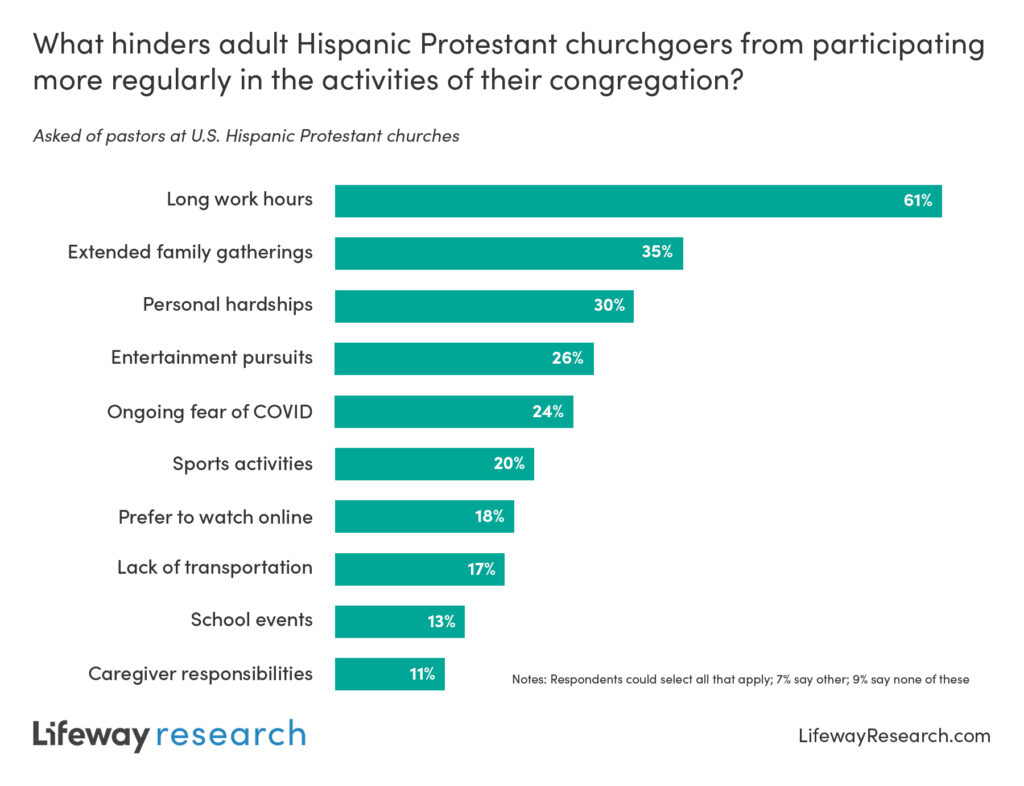
Con respecto a lo que impide que su congregación participe con más regularidad en las actividades de la iglesia, la mayoría de los pastores señalan las largas horas de trabajo de sus miembros (61%). Otros dicen que son las reuniones familiares (35%) y las dificultades o crisis personales (30%). Alrededor de una cuarta parte de los pastores indican que son las actividades recreativas o de entretenimiento (26%) y el miedo que persiste a COVID (24%). Una menor parte de los pastores dicen que son las actividades deportivas (20%), la preferencia de ver los servicios en línea (18%), la falta de transporte (17%), eventos escolares (13%) o responsabilidades como proveedor de cuidado a una o mas personas (11%).
“Muchas de las actividades dentro de las iglesias protestantes hispanas son muy parecidas a las de las iglesias que no son hispanas en los Estados Unidos, con los servicios de adoración, las reuniones de oración, los estudios bíblicos y clases de la escuela dominical siendo las más comunes”, dijo McConnell. “Pero los pastores de las congregaciones hispanas señalan que las familias inmigrantes tienen menos tiempo para la iglesia ya que muchas familias trabajan largas horas, tienen tradiciones familiares y se ven afectadas por las distracciones culturales en los Estados Unidos”.
Alcance evangelístico / compartiendo el evangelio
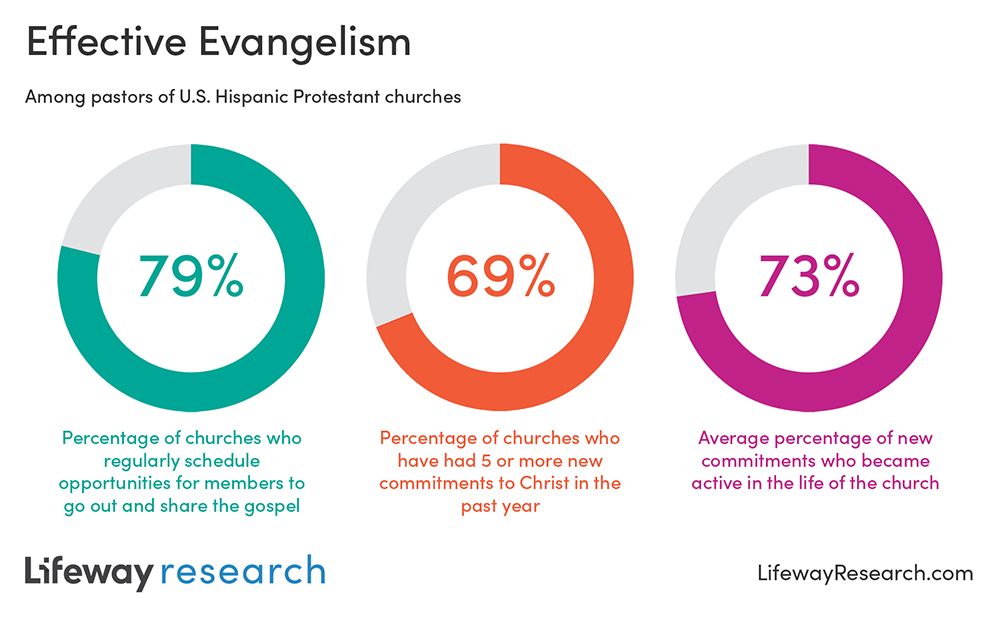
Casi 4 de cada 5 pastores en las iglesias protestantes hispanas en los Estados Unidos (79%) dicen que regularmente programan y organizan oportunidades para que los miembros puedan salir y compartir el evangelio.
Específicamente, la mayoría de los pastores dicen que sus actividades para compartir el evangelio en el último año incluyeron a miembros de la iglesia invitando a personas a asistir a la iglesia (86%), usando las redes sociales para compartir las actividades de la iglesia (74%), eventos especiales para los niños como la Escuela Bíblica de Vacaciones, actividades de la Semana Santa o festivales de otoño (59%), programas comunitarios como la distribución de alimentos, entrega de juguetes o ropa (58%) y miembros de la iglesia que comparten el evangelio en sus conversaciones con otros (56%). Además, algunas congregaciones compartieron el evangelio en persona puerta a puerta (30%), enseñaron como compartir el evangelio con otros (24%) y apoyaron económicamente el inicio de una nueva iglesia (12%). Casi ninguna iglesia (1%) dijo que no han podido hacer ninguna de estas actividades recientemente.
Su manera de compartir el evangelio y alcanzar a las personas parece ser efectivo, ya que cerca de la mitad (47%) dicen que 10 o más personas han indicado que han entregado sus vidas a Cristo en el último año, incluyendo el 24% que han visto 20 o más personas entregar sus vidas a Cristo. Menos de 1 de cada 10 (9 %) informan que nadie ha entregado su vida a Cristo.
A medida que han alcanzado a estas nuevas personas, los pastores dicen que la mayoría se han quedado en la iglesia. Según los pastores, casi 3 de cada 4 (73%) de estos nuevos creyentes son participantes activos en la vida de la iglesia. Como resultado, el 88% de los pastores protestantes hispanos dicen que constantemente escuchan informes de vidas transformadas en sus iglesias.
“Las congregaciones hispanas son muy activas en involucrar y atraer a nuevas personas”, dijo McConnell. “No solo hay mucha actividad de evangelización en las iglesias hispanas, sino que Dios también las está bendiciendo con nuevas personas que se comprometen a seguir a Jesucristo”
Construyendo una comunidad
Según sus pastores, a medida que los nuevos miembros se unen a las iglesias protestantes hispanas, ellos forman parte de congregaciones que están activas en tratar de crecer juntas. Casi 9 de cada 10 pastores (88%) dicen que su iglesia tiene un plan para fomentar la comunidad en su iglesia, incluyendo el 53% que están totalmente de acuerdo.
Los pastores señalan muchas actividades que son esenciales para construir un fuerte sentido de comunidad dentro de sus congregaciones. Por lo menos 9 de cada 10 pastores dicen que orar juntos (96%), estudiar la Biblia juntos (95%), elegir llevarse bien y promover la unidad (93%), dar la bienvenida a personas de diferentes culturas y orígenes (93%), elegir ser transparentes y ser responsable unos con otros (89%) y verificar o darse cuenta cuando otros están ausentes (90%) son aspectos muy importantes o extremadamente importantes en la unidad en sus iglesias. Además, la mayoría de los pastores dicen lo mismo acerca de los miembros de su iglesia que trabajan juntos para servir a las personas de la comunidad (79%), socializan fuera de la iglesia (81%) y comparten recursos entre ellos (74%).
La mayoría de los pastores dicen que han escuchado que los miembros de su iglesia están participando en cada una de esas acciones por lo menos varias veces en el último mes.
“El compañerismo entre los creyentes en una congregación local es algo que la Biblia comunica que debe ocurrir”, dijo McConnell. “Las iglesias hispanas toman esto en serio e invierten en estas relaciones”.
Los pastores hispanos
Entre los pastores de las congregaciones protestantes hispanas de los Estados Unidos, el 93% son hispanos. Casi todos (95%) son pastores principales o los únicos pastores de una congregación hispana, mientras que el 5% son pastores de un campus hispano con una iglesia de varios sitios. El estado de empleo en la iglesia de más de la mitad de los pastores (56%) es a tiempo completo, el 27% son bi-vocacionales, el 10% están empleados a medio tiempo, el 6% son voluntarios y el 1% están en puestos interinos.
Casi la mitad de los pastores en las iglesias protestantes hispanas (48%) tienen entre 50 y 64 años de edad. Los pastores tienen más que el doble la probabilidad de tener menos de 50 años (37%), incluyendo un 4% que son menor de 30 años, que de tener 65 años de edad o más (16 %).
Casi 8 de cada 9 pastores (85%) son hombres. Dos de cada 3 pastores (66%) son estadounidenses de la primera generación, mientras que el 15% son de la segunda generación y el 19% son de la tercera generación. Cerca de 3 de cada 4 pastores se han graduado de una universidad, incluyendo el 44% que tienen un título de posgrado, mientras que el 17% tiene alguna educación universitaria y el 10% tiene una educación secundaria o tiene menos educación.
Teológicamente, 4 de cada 5 pastores (79%) de iglesias protestantes hispanas en los Estados Unidos se identificaron como evangélicos. Alrededor de 1 de cada 6 pastores (16%) dicen que son protestantes convencionales.
Patrocinado por Lifeway Recursos, La Asociación Evangelística de Billy Graham (BGEA), y Samaritan’s Purse, la encuesta en línea de 692 pastores de congregaciones hispanas en los Estados Unidos se llevó a cabo desde el 6 de septiembre al 1 de noviembre de 2022. Los encuestados fueron invitados por denominaciones y redes individuales. Las invitaciones se hicieron principalmente por correo electrónico y se les proporcionó a los pastores un enlace a la encuesta en línea. Cada encuestado fue evaluado para estar seguro de que ellos funcionaban como el pastor principal o el pastor de un campus hispano o de una congregación de habla hispana. Los encuestados fueron evaluados para estar seguro de que la congregación era una iglesia hispana o multiétnica o un servicio de adoración o campus de habla hispana dentro de una iglesia que no es hispana. Los pastores de un campus o servicio de adoración de habla hispana recibieron instrucciones de responder solo por ese campus / servicio de adoración. Solo se incluyeron las congregaciones que su membresía estaba compuesta por lo menos de un 50% de hispanos.
Se uso pesos ligeros / ponderación para ajustar los valores de las respuestas variables entre las denominaciones. La muestra completa fue de 692 encuestas. La muestra proporciona un nivel de confianza de 95 % de que el error de muestreo no exceda más o menos 5.0%. Este margen de error tiene en cuenta el efecto de la ponderación / peso. Los márgenes de error son más altos en los subgrupos, incluyendo 11 preguntas que fueron hechas intencionalmente a la mitad de los encuestados para poder mantener la duración de la encuesta razonable para cada encuestado.
Hispanic Protestant landscape full of vibrant churches
February 8, 2023
NASHVILLE, Tenn.—Hispanic churches in the United States face unique challenges but are finding success in building community within their congregations and reaching those outside their walls.
Lifeway Research partnered with two dozen denominations and church networks to include what is likely the largest number of Protestant Hispanic congregations in the U.S. ever invited to a single research study.
Sponsored by Lifeway Recursos, the Billy Graham Evangelistic Association and Samaritan’s Purse, the study surveyed 692 pastors of congregations that are at least 50 percent Hispanic.
“For decades, the Hispanic population in the U.S. has been growing exponentially, and it is imperative for churches to be informed about the specific needs of this community,” said Giancarlo Montemayor, director of global publishing for Lifeway Recursos.
“This study will help us to continue the ongoing conversation of how to serve our brothers and sisters in a more strategic way.”
Congregational snapshot
The study reveals a picture of Hispanic churches that are newer, younger and more effectively evangelistic than the average U.S. Protestant church.
Most Hispanic Protestant churches (54 percent) have been established since 2000, including 32 percent founded in 2010 or later. Fewer than 1 in 10 (9 percent) trace their history prior to 1950.
Not only are the churches relatively new, but most people in the congregations are also new to the United States. The majority are first generation Americans (58 percent), born outside of the country. A quarter are second generation (24 percent), with parents who were born outside of the U.S. And 17 percent were born in the U.S. to parents who were also born in the U.S.
A majority conduct their services only in Spanish (53 percent), while 22 percent are bilingual.
Half of the churches (50 percent) are in a large metropolitan area with a population of 100,000 or more. Around 3 in 10 (31 percent) are located in small cities, 9 percent are in rural areas and 8 percent are in suburbs.
In the average Hispanic Protestant church, a full third of the congregation (35 percent) is under age 30, including 18 percent under 18. Another 38 percent are aged 30 to 49, and 28 percent are 50 and older.
“The growth in the number of Hispanic churches in the U.S. has been remarkable,” said Scott McConnell, executive director of Lifeway Research.
“While some of these congregations were started within Anglo churches—14 percent of Hispanic congregations in this study currently are conducting services within a church that is predominantly non-Hispanic—the missional impetus has clearly come from within the Hispanic community itself as two-thirds of these congregations are led by first-generation immigrant pastors.”
In U.S. Hispanic Protestant churches, the average worship service attendance is 115. Like most other churches, they’ve not yet fully recovered from the pandemic. In January 2020, prior to the COVID-19 pandemic, the average attendance was 136. Still, 13 percent of churches are around their pre-pandemic levels. And 32 percent say they’ve grown in the past three years, despite the pandemic.
Almost every Hispanic Protestant pastor (99 percent) agrees, including 94 percent who strongly agree, their congregation considers Scripture the authority for their church and their lives.
Around 7 in 10 (69 percent) say their church has the financial resources it needs to support their ministry, which include some aspects that are common among most other Protestant congregations.
Most Hispanic Protestant churches say they regularly offer weekly adult small groups or Bible studies (74 percent), weekly prayer meetings (66 percent) and weekly children’s small groups (52 percent).
Fewer have weekly youth small groups (45 percent), weekly young adult small groups (40 percent), one-on-one discipleship or mentoring (34 percent), evening large group Bible study (25 percent) or evening praise and worship (24 percent). Just 3 percent say they offer none of these.
When asked about moving weekend worship service participants to small groups, 42 percent of pastors say at least half of their adult churchgoers are involved in group Bible studies, including 15 percent who say at least 75 percent are connected to a small group.
Around a third (34 percent) say fewer than 1 in 4 churchgoers also are members of small-group Bible studies, including 9 percent of pastors who say none of those attending worship services are involved in groups.
As to what hinders their congregation from participating more regularly in church activities, most pastors point to long work hours for their churchgoers (61 percent). Others say extended family gatherings (35 percent) and personal hardships or crises (30 percent).
Around a quarter point to recreational or entertainment pursuits (26 percent) and lingering fear of COVID (24 percent). Fewer say sports activities (20 percent), a preference to watch online (18 percent), lack of transportation (17 percent), school events (13 percent) or caregiver responsibilities (11 percent).
“Many of the activities within Hispanic Protestant churches look similar to those in non-Hispanic churches in the U.S. with worship services, prayer meetings, Bible studies and Sunday School classes being common,” McConnell said.
“But pastors of Hispanic congregations are quick to point out immigrant families often have less time for church, as many are working long hours, have family traditions and are impacted by American cultural distractions.”
Evangelistic outreach
About 4 in 5 pastors at U.S. Hispanic Protestant churches (79 percent) say they regularly schedule opportunities for members to go out and share the gospel.
Specifically, most pastors say their outreach activities in the past year included church members inviting people to church (86 percent), using social media to share church activities (74 percent), children’s special events like VBS, Easter egg hunts or Fall festivals (59 percent), community programs like food distribution, toy giveaways or providing clothing (58 percent), and church members sharing the gospel in conversations (56 percent).
Additionally, some congregations did door-to-door evangelism (30 percent), evangelism training (24 percent) and provided financial support for a new church start (12 percent). Hardly any churches (1 percent) say they have not been able to do any of those recently.
Their outreach seems to be effective, as close to half (47 percent) say 10 or more people have indicated a new commitment to Christ in the past year, including 24 percent who have seen 20 or more such commitments. Fewer than 1 in 10 (9 percent) report no new commitments.
As they’ve reached these new individuals, pastors say most are sticking around. Almost 3 in 4 (73 percent) of those new commitments have become active participants in the life of the church, according to pastors. As a result, 88 percent of Hispanic Protestant pastors say they consistently hear reports of changed lives at their churches.
“Hispanic congregations are very active in engaging new people,” McConnell said. “Not only is there much evangelistic activity in Hispanic churches, but God is also blessing them with new people who commit to following Jesus Christ.”
Building community
As new members join Hispanic Protestant churches, they become part of congregations that are actively trying to grow together, according to their pastors. Almost 9 in 10 (88 percent) say their church has a plan to foster community in their church, including 53 percent who strongly agree.
Pastors point to numerous activities as vital to building a strong sense of community within their congregations.
At least 9 in 10 say praying together (96 percent), studying the Bible together (95 percent), choosing to get along and promoting unity (93 percent), welcoming those from different cultures and backgrounds (93 percent), choosing to be transparent and accountable with one another (89 percent) and checking-in or noticing when others are absent (90 percent) are very or extremely important aspects of unity in their churches.
Additionally, most say the same about members working together to serve people in the community (79 percent), socializing outside of church (81 percent) and sharing resources with each other (74 percent).
Most pastors say they’ve heard about their church members engaging in each of those actions at least a few times in the past month.
“Fellowship among believers in a local congregation is something the Bible communicates should be taking place,” McConnell said. “Hispanic churches take this seriously and invest in these relationships.”
Among pastors of U.S. Hispanic Protestant congregations, 93 percent are Hispanic themselves. Almost all (95 percent) are the senior or only pastor of a congregation, while 5 percent are Hispanic campus pastors with a multi-site church.
More than half (56 percent) serve as a full-time pastor, 27 percent are bivocational, 10 percent are part-time, 6 percent are volunteer and 1 percent are in interim positions.
Almost half of pastors in Hispanic Protestant churches (48 percent) are between the ages of 50 and 64. Pastors are more than twice as likely to be under 50 (37 percent), including 4 percent under 30, than 65 or older (16 percent).
Almost 8 in 9 pastors (85 percent) are male. Two in 3 (66 percent) are first generation Americans, while 15 percent are second generation and 19 percent are third. Close to 3 in 4 are college graduates, including 44 percent who have a graduate degree, while 17 percent have some college and 10 percent have a high school education or less.
Theologically, 4 in 5 (79 percent) pastors at U.S. Hispanic Protestant churches self-identified as evangelical. Around 1 in 6 (16 percent) say they’re mainline.
The online survey of pastors of Hispanic congregations in the United States was conducted Sept. 6 to Nov. 1, 2022. Slight weights were used to adjust for varying response rates across denominations. The completed sample is 692 surveys, providing 95 percent confidence the sampling error does not exceed plus or minus 5.0 percent. This margin of error accounts for the effect of weighting. Margins of error are higher in sub-groups.
Theology lab tackles complex topics with humility
February 8, 2023
WASHINGTON (RNS)—The word “evangelical” is a bit like the word “apocalypse.”
Dennis Edwards. (Photo courtesy of North Park Theological Seminary)
Both have theological meanings understood by pastors and church insiders. But the general public has other ideas.
“For the specialists, apocalypse means ‘revelation’ or ‘unveiling,’” said Dennis Edwards, dean of North Park Theological Seminary in Chicago. “But for the masses, apocalypse means disaster.”
The same is true for the word “evangelical.” While that word has a set of theological connotations about the Bible and Jesus, for most Americans today it’s synonymous with conservative Republican Christians.
“I don’t think we’re ever going to recapture the real meaning of apocalypse,” Edwards said. “I sometimes wonder if we can ever recapture the sense of evangelical—meaning something that comes from the ‘evangel’ or good news, the message that Jesus has come to rescue humanity.”
Edwards was one of the featured speakers in an online theology lab run by Highrock Church, a multiethnic congregation that’s part of a network of churches in the Boston area that bear the same name.
Provide a broader understanding of faith
The lab, a series of online discussions that began in the fall of 2022 and run through this spring, is designed as an exercise in theological formation for laypeople, said Scott Rice, a theologian in residence at Highrock.
The idea is to give church members—and other interested Christians—a broader understanding of their faith and the way Christianity is lived out in the world.
The church has held past discussions about Black theology and Asian American theology. For the current series, Rice said, group members wanted to talk about American evangelicalism, in part because Highrock belongs to a denomination—the Evangelical Covenant Church—with the word right there in its name.
It’s a reality that has become more complicated as the term “evangelical” has become more politicized and identified with conservative politics, especially under former President Donald Trump.
While not all church members identify with that term, he said, the church has been influenced by the broader evangelical movement.
“We are a community where some identify as evangelical and some do not,” he said. “Some want to keep using the word and some do not.”
Creating an online learning community
The discussions are held online so people from different congregations in the network can take part in what he called a learning community. Rice and Meghan DeJong, a pastor at Highrock, help lead the discussion with speakers and moderate the follow-up question and answer sessions. Then participants break up into small groups to discuss what they have learned.
“Folks have a chance to process together,” Rice said. “There is no one saying this is exactly what you have to believe to be part of the community.”
Rice and other Highrock leaders have stressed the need for humility and curiosity during the conversations, urging participants to listen carefully to the speaker, even if they disagree with what’s being said. And not everyone has to agree in order to be part of the community, Rice said.
“We want our people to see thoughtful conversations happening with people who have different points of view,” he said.
The theology lab began with speakers from Highrock’s denomination, including Edwards and North Park church history professor Hauna Ondrey, as well as author and speaker Dominique DuBois Gilliard.
Former Southern Baptist ethicist Russell Moore, now editor of Christianity Today magazine, and Walter Kim, president of the National Association of Evangelicals, spoke at a session just before Thanksgiving.
Beth Allison Barr
Upcoming speakers include Calvin University historian and bestselling author Kristin Kobes Du Mez, Sojourners founder Jim Wallis, author and Baylor University professor Beth Allison Barr and New York Times columnist David Brooks.
During their conversation in November, Kim and Moore talked about the growing polarization in the United States, the threat of Christian nationalism and the way evangelicalism has become closely tied to conservative politics.
Moore also talked about the role of “conflict entrepreneurs,” a term coined by author Amanda Ripley. Those entrepreneurs, Moore said, benefit from driving up conflict in polarized times. He also called Christian nationalism a form of the prosperity gospel that operates on a national level, rather than a personal one.
Moore told participants that many of the old alliances among evangelicals fell apart during the Trump era, and new ones have started to form. Even so, many in the movement are still dealing with “disillusionment, frustration, instability and fear.”
“I don’t know a church that’s not either tense or divided—or aware that they are not and on guard, because they are just waiting for (conflict) to happen,” Moore said.
Although Highrock and its home denomination are not part of the NAE, the church has ties with Kim from his time as a pastor in the area. The NAE leader said he was thankful for the charitable nature of the conversations during the theology lab, which he said could be a model for the broader church.
Complex times, complicated discussions
Complex times, he said, require complicated discussions characterized by curiosity and an openness to listen. Christians can have those discussions without compromising their convictions.
“I am really grateful there is a local church modeling this kind of discussion,” he said.
DeJong said Moore and Kim, like other speakers in the series, spoke with both honesty and humility.
“Those are values that we hold in our relationships at Highrock, and so to have people who carry gravitas in Christian circles just enter into our conversations with that same posture is encouraging,” she said. “It shows that Christians all over the theological and geographical map are wrestling with similar questions, and that they’re not alone.”
Joe Marcucci, a pastor at Highrock who works with a prison ministry and other community outreach, facilitated one of the discussion groups. A former church planter and senior pastor at another church, Marcucci said he has mixed feelings about the term “evangelical” and its ties to politics.
“I feel like we’ve lost the evangelism part of evangelicalism,” he said.
The discussions in the theology lab are a good first step, Marcucci said. There’s a balance between listening with respect and still acknowledging that people disagree, he added.
No one wants open conflict during the discussions, he said. But moving the conversation forward may be uncomfortable.
“To do that, there has got to be some messiness to it,” he said. “I don’t know if we have gotten to that point yet.”
That idea of listening to different points of view reflects their denomination’s ethos, said Rice, which makes room for diverse perspectives. That ethos has been tested in recent years as the Covenant church, like other denominations, has faced conflict over issues of sexuality and how to adapt to the challenges of a diverse and polarized nation.
Edwards said people in churches don’t often know how to listen to each other, because they are so concerned about being on the right side of issues. So, they don’t have the patience to listen or consider that they might be wrong, or that someone else, with a different point of view, might be worth hearing.
“For a lot of people, it’s about being right, not being gracious,” he said. “The idea is I need to get this right. And you’re telling me something I haven’t heard before, so you must be wrong. It makes those kinds of conversations very difficult.”
Abuse expert says church leaders have ‘utterly failed God’
February 8, 2023
WASHINGTON (RNS)—Not long after Diane Langberg began working as a clinical psychologist in the 1970s, a client told her that she had been a victim of sexual abuse at the hands of her father. Not sure of what to do, Langberg went to talk to her supervisor.
The supervisor, Langberg recalled, dismissed the allegations.
“He told me that women make these things up,” Langberg said. “My job was to not be taken in by them.”
The supervisor’s response left Langberg in a dilemma. Did she believe her client? Or did she trust her supervisor’s advice?
“The choice I made is pretty obvious at this point,” the 74-year-old Langberg said in a recent interview.
For the last five decades, Langberg has been a leading expert in caring for survivors of abuse and trauma. When she began, few believed sexual abuse existed, let alone in the church. Churches were seen as a refuge for the weary and some of the safest places in the world.
Today, she said, there’s much more awareness of the reality of sexual abuse and of other kinds of misconduct, especially the abuse of spiritual power.
Still, many congregations and church leaders have yet to reckon with the damage that has been done to abuse survivors where churches turned a blind eye to the suffering in their midst.
“We have utterly failed God,” she said. “We protected our own institutions and status more than his name or his people. What we have taught people is that the institution is what God loves, not the sheep.”
The daughter of an Air Force colonel, who grew up attending services in a variety of denominations, Langberg still has faith in God. And she remains a churchgoer, despite the failings of Christian leaders and institutions. Still, she said, those churches and institutions have a great deal to repent of and make amends for.
Langberg, author of Redeeming Power: Understanding Authority and Abuse in the Church, spoke with Religion News Service about the sex abuse crisis in the Southern Baptist Convention, what lessons she’s learned over the past five decades and why she keeps the faith despite the church’s flaws.
This interview has been edited for clarity and length.
When it comes to sexual abuse, there are a growing number of church leaders who say, “We get this now and we can fix it.” But are they aware of the long-term consequences that come with mishandling abuse allegations over a long period of time?
Perhaps it would be helpful to first think about not the church but marriage. If somebody has an affair, they cry and say they are sorry. Then a year later, they have an affair with somebody else. How many affairs are going to be OK before you leave?
That is the kind of thing that has happened regarding the Southern Baptists. This has gone on for a really, really long time. And now they want to say they get it. It’s too soon. Even if they were doing absolutely everything they could to get it, it’s too soon.
How can church leaders start to regain trust?
The first step is not asking for it. The first step is to say: “I want to know what this has done to you. I want to know the ways that it’s been hurtful, I want to really understand the depths of what we did, and how it affects you, not just in terms of church, but in terms of understanding God himself.”
To realize that this person whom God loves has been damaged by us who represent God. And we can’t fix that.
We have utterly failed God. We protected our own institutions and status more than his name or his people. What we have taught people is that the institution is what God loves, not the sheep.
What have you learned in 50 years of this work?
I don’t think we really understand the level of deception that occurs in people who abuse. We think that if they cry and say they are sorry, that’s a good thing. But it doesn’t touch the practice of deception that runs their lives and that runs their organizations. We’re very naive about that. You can’t marinate yourself in the lies and deception that are needed to keep abusing—and then say, “I’m sorry,” and have that change who you are.
There’s been a growing awareness about the dangers of the abuse of children and a willingness to address that issue on the part of churches. But many churches have a difficult time with the idea that adults can be abused. There’s an idea that if you are an adult, then a pastor can’t abuse you.
I find that outrageous, to put it mildly. The word “abuse” means to use wrong. I don’t think we understand the power that comes with the position of being a pastor. I mean, do we really think pastors can’t abuse that power? That they’re above this?
That’s a ridiculous thought about any human being. We’re all sinners. We’re all deceptive. We all deceive. To say just because somebody is a pastor means they can’t be abusive is naive.
If you had a group of Southern Baptist leaders right now in front of you, what would you tell them?
I would tell them that the first thing they need to find is humility. You can’t do something wrong for decades and then say, “Oh, we’re sorry, we did it wrong,” and think that now you understand it. It’s not possible for any human.
You can’t cry and say you are sorry and ask for forgiveness and then it’s all fixed. My reading of the Scriptures and how sin gets ahold of us, and blindness gets ahold of us, would suggest that’s way off the mark.
What have you learned from survivors of abuse?
We don’t realize the level of courage that has been displayed right in front of us. Particularly in Christendom, if you tell the story of surviving abuse, you’re not only going against the person who did it, you’re going against God’s people, you’re going against his church, which adds up to going against God.
And survivors often lose their place in the church. They lose any status they had. They lose honor. They lose trust. All because of the things that were done to them.
Have you ever thought of giving up?
I cut my teeth working with Vietnam vets and with women who told me about abuse that nobody believed. The diagnosis of post-traumatic stress disorder hadn’t come out yet. So, people thought vets were making it up because they were weak, and the women were making it up because they wanted attention. It was a very lonely road.
And somewhere along the way, I told God I was quitting. He obviously convinced me not to do that. Then when I began to realize how much of this was in the church, I wanted to walk away. He convinced me to stay. And I’m very glad I did.
Scholar applies King’s philosophy of truth in post-truth age
February 8, 2023
WASHINGTON (RNS)—Martin Luther King Jr. is known as a civil rights activist, a minister and a world leader who gained the Nobel Peace Prize.
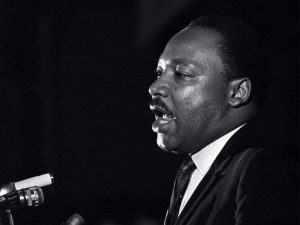
Martin Luther King Jr. makes his last public appearance at Mason Temple in Memphis, Tenn., on April 3, 1968. The civil rights leader was standing on the balcony of the Lorraine Motel when he was killed by a rifle bullet on April 4, 1968. (AP Photo via RNS/Charles Kelly)
In a recent book, longtime King scholar Lewis V. Baldwin adds other titles to the man whose birthday is marked with a federal holiday, including ethicist, theologian and philosopher.
In a thick volume, The Arc of Truth: The Thinking of Martin Luther King Jr., Baldwin continues his study of King. After previously concentrating on King’s cultural roots and his prayer life, the emeritus professor of religious studies at Vanderbilt University focuses on what the leader had to say about truth.
“We’re living in an age of lies and conspiracy theories and alternative truths, disinformation,” he told Religion News Service in an interview. “I wanted to write a book that would speak to that and since I am a King scholar, I thought King would be a great case study for getting at these kinds of challenges, because King had a lot to say about the power of truth, of truth telling and of truth sharing.”
Baldwin, 73, spoke to RNS about how King defined truth, how his legacy has been distorted and how 20th-century civil rights activists compare to 21st-century protesters.
The interview has been edited for length and clarity.
Since your book is titled The Arc of Truth, perhaps we should start with how you think the Rev. Martin Luther King Jr. defined truth.
Dr. King defined truth in some of his speeches as the legitimate extension of facts. He saw the relationship between facts, truth and reality. At other points, he speaks of truth as coming to terms with reality. He used that kind of terminology especially when he spoke in terms of objective truth, objective truth being those truths that are universally accepted and those truths that are verifiable.
You say that King “who sought, spoke, and acted on truth” in the 20th century has become “the target of so much untruth” in this current century. What are some of the examples of this that concern you most?
The man and his legacy are being distorted. His legacy is being hijacked, misinterpreted. For an example, on the extreme right of the political spectrum, there are those who argue that Dr. King was opposed to affirmative action, and they make that argument without any proof at all.
There are also those on the right who make the argument that Dr. King, if he were alive, would be opposed to critical race theory. Some have argued that he would be a Republican if he were alive. So, all of these claims are made without any foundation whatsoever.
Because the people who make the claims obviously have not read Dr. King. They don’t understand his message. So, in a sense, Dr. King has become a victim of this post-truth age, because right-wing extremists have made him a convenient and useful symbol in an orchestrated and coordinated effort to promote their own conservative social, cultural and political agenda for this nation.
Are there concerns that you have about people on the left and how they have depicted King in these days?
Not really. I think King, for the most part, has been depicted in a proper way. The only problem I have with the left is that there has not been enough of a pushback on what is happening on the right, in terms of their distortion of Dr. King’s message, his ideals.
You write of King’s kitchen vision after he received a phone call from a white supremacist in 1956, threatening his life. What difference did it make for his ministry and activism to have that moment?
Dr. King actually came to a clearer sense of himself as an ethical prophet through that vision in the kitchen, because the voice that spoke to him that night, around midnight, said: “Stand up for justice; stand up for truth. And lo, I will be with you, even until the end of the world.”
Those are the words of Jesus from the New Testament. So, he found through religious experience what he had not been able to find in philosophy and theology.
You note that King wrote: “There is some element of truth in all religions.” How did his connection with leaders like Mohandas Gandhi, Rabbi Abraham Joshua Heschel and Thích Nhất Hạnh enhance his interest in religious diversity and distaste for religious bigotry?
Dr. King came up with a new and creative approach to interreligious dialogue, rooted in a Christian-Jewish-Hindu-Buddhist-Islamic solidarity against structures of oppression and exclusion and injustice. He tried to intersect people of different religions in his struggle for both civil and human rights.
I think it speaks not only to his universal concern for humankind. It also speaks to his theological and philosophical liberalism, because you don’t have fundamentalists talking about respecting other religions. But Dr. King argued that no religion has a monopoly on truth.
How do you analyze what you call “the truth-telling about who and what King was as a human being,” specifically that he fought against racism so much and less so about sexism, and he was described in some reports as an adulterer?
I explain that in terms that Dr. King used himself. Dr. King argued that we’re all paradoxical creatures. We have a capacity for good and a capacity for evil. And the struggle in life for him, he said, was always to keep that good self in control of that evil self.
We have both, and at times we all fall, and that’s just a fact of life. And he admitted over and over that he was not a saint, that at times he had fallen short.
But the important thing was that he was always interested in doing the will of God, even if he failed. Interestingly enough, when it came to the philandering, the adultery issue, Dr. King ultimately admitted to his own wife that this had occurred. I think that speaks to his capacity as a truth-teller.
Dr. King argued that truth grows. I think, if he were alive today, he would be very supportive of women’s liberation. But it was not a major issue in that time, and he did make statements, of course, against this idea of women being subservient to men.
You also said that marching along Southern highways and in the streets was for King a “visual message about not surrendering to the machinations of evil and untruth.” Do you think more recent protests, including by supporters of the Black Lives Matter movement, and maybe others, are accomplishing the same goal, or are they different in some ways?
This is how Dr. King understood the civil rights movement: When you go out and march, boycott and hold prayer vigils in the street, demonstrations in the street, all of that is designed to expose evil in society and to force people to confront and deal with that evil.
So, I would say, in that sense, Black Lives Matter demonstrations, the MeToo movement demonstrations, demonstrations held by students in the March for our Lives against guns, they are all the same in that regard.
Israel excavates ancient Pool of Siloam site
February 8, 2023
JERUSALEM (BP)—Assyria’s King Sennacherib was planning to capture Judah. Somehow, King Hezekiah had workers dig a tunnel through solid rock and divert Judah’s water supply to the Pool of Siloam, hiding it from the enemy.
That was 2,700 years ago.
Clues to how the work was done, as well as biblical evidence from Jesus’ Judean ministry, might be unearthed as Israel excavates the full Pool of Siloam that has fascinated archeologists more than 150 years.
Baptist seminary professor viewed site
New Orleans Baptist Theological Seminary professor Jim Parker viewed the excavation site and tunnel while on an instructional tour of Jerusalem.
“It’s still a great mystery how they did it,” said Parker, professor of biblical interpretation and executive director of the seminary’s Michael and Sara Moskau Institute of Archeology. Hezekiah “was able to protect and defend the water system.”
The work is referenced but not detailed in 2 Kings 20:20, which indicates the details are written in “The History of the Kings of Judah,” an extrabiblical book.
“We don’t know that there were written sources that went forward that went into the (biblical) canon,” Parker said. “It seems like there was another set of writings where they kept up with all of the details of what the king did and everything. But today, we don’t have those. Those are lost.”
Excavation of the full pool, believed to be about one acre in size, will be valuable in affirming Scripture, Parker said.
“It affirms the biblical fact that this pool existed, and the tunnel existed, and it operated together,” he said. “It also gives an idea into some of the rituals of the temple.”
Site holds ancient significance
The Pool of Siloam is where Israelites washed to purify themselves spiritually before entering the temple. John’s Gospel reports Jesus healed a blind man at the pool.
The site of the pool was discovered in 2005 when workers unearthed steps to the pool while repairing a sewage line, but only a small portion of the site has been excavated. The pool was the reservoir for the waters of Gihon Spring, which were diverted through Hezekiah’s tunnel.
“This was all pure water,” Parker said. “And coming out of a spring, it’s called living water. Water that’s moving, by nature, it’s called living water.”
The Israel Antiquities Authority, the Israel National Parks Authority and the City of David Foundation announced in December 2022 the beginning of the full excavation of the pool.
“The Pool of Siloam, located in the southern portion of the City of David and within the area of the Jerusalem Walls National Park, is an archeological and historical site of national and international significance,” the groups said in a press release.
Rendering of the Pool of Siloam, Second Temple period. (Shalom Kveller, City of David Archives)
“Due to its location and importance, the Pool of Siloam was renovated and expanded some 2,000 years ago at the end of the Second Temple period. It is believed that the pool was used during this time as a ritual bath by millions of pilgrims who converged at the Pool of Siloam before ascending through the City of David to the Temple.”
Scholars have theorized how Hezekiah dug the tunnel to divert the spring, Parker said.
“They dug it from both ends. We think it’s something over a year, it could be as much as two years as they were digging through solid rock. It’s still a great mystery how they did it, and how they were able to meet each other,” he said. “It’s almost 1,700 feet long. So, they dig and meet somewhere about halfway.
“There’s actually an inscription inside the tunnel that they met there. When you’re in the tunnel looking, you can see the tool marks on the rock and you can tell which ones were coming from which direction, the way they dug,” Parker said. “So it’s a very interesting thing to see.”
Will be open to tourists
Israeli authorities did not provide a timeline of the excavation but said tourists will be able to view the work, and they said the pool would be accessible by tourists in “the coming months.”
Parker is hopeful the excavation will unearth additional artifacts supporting Scripture.
“Once we have it fully uncovered, we’ll be able to measure and see everything, so we’ll understand the process fully,” he said. “Many times, we find things like that that would point us to another discovery or another truth,” such as coins, pottery and other artifacts.
“You never know what you’re going to find, … all of these things that will be important to the additional understanding of the word (of God).”
The excavation will afford a valuable teaching tool.
“As we teach, we’ll take the Bible verses that bring all of this together, and then we’ll have a visual element just in front of us, and a very large one that we can show and discuss and understand,” he said.
The excavation can also provide clues to other miracles Jesus performed at pools of water, such as healing the man at the Pool of Bethesda who had been paralyzed 38 years.
“That’s also a place with a water feature that Jesus went to and did a miracle. That will help us understand, too, how that looked,” he said. “The same period of time, probably the same (type of) construction. That had five porticos in it. This is going to have just this one large pool.”
More Americans stay away from church since pandemic
February 8, 2023
WASHINGTON (RNS)—At the beginning of the COVID-19 pandemic, nearly every congregation in the United States shut down, at least for a while. For some Americans, that was the push they needed to never come back to church.
A new report, which looked at in-person worship attendance patterns before the beginning of the pandemic and in 2022, found a third of those surveyed never attend worship services. That’s up from 25 percent before the start of the pandemic.
The pandemic likely led people who already had loose ties to congregations to leave, said Dan Cox, one of the authors of the new study and a senior fellow in polling and public opinion at the American Enterprise Institute.
“These were the folks that were more on the fringes to begin with,” said Cox. “They didn’t need much of a push or a nudge, to just be done completely.”
As part of the 2022 American Religious Benchmark Survey, researchers from the American Enterprise Institute and NORC at the University of Chicago asked 9,425 Americans about their religious identity and worship attendance. Those surveyed had answered the same questions between 2018 and early 2020.
Researchers then compared answers from between 2018 and 2020 to answers from 2022 to understand how attendance patterns changed during the COVID-19 pandemic.
“We are looking at the attendance patterns and religious identity of the exact same people at two different time periods,” said Cox.
The new study focused on attendance at in-person services versus online services. While some people—including the immunocompromised and their families—may still be attending digital services, measuring online engagement is “messier,” said Cox, and very different from in-person involvement. For example, he said, tuning in to a service for a few minutes is much different than going to a service in person.
Young adults particularly likely to skip church
The report also noted the decline in attendance most affected groups that had already started to show a decline before the pandemic—particularly among younger adults, who were already lagging before the pandemic and showed the steepest drop-off since.
Liberal Americans (46 percent), those who have never married (44 percent) and those under 30 (43 percent) are most likely to skip worship service altogether and saw the largest declines in attendance rates.
By contrast, conservatives (20 percent), those over 65 (23 percent) or those who are married (28 percent) are less likely to say they never attend services and saw less drop-off.
One in 4 Americans (24 percent ) said in 2022 that they attend regularly—which includes those who attend nearly every week or more often. Another 8 percent attend at least once a month—for a total of 32 percent who attend regularly or occasionally. That was down slightly from a total of 36 percent in 2020.
In 2022, just over a third (36 percent) said they attend at least once a year. Another third (33 percent) said they never attend—up from 25 percent in 2020.
Cox said generational shifts and the broader polarization in society likely played a role in the attendance decline.
Younger Americans are less likely in general to identify as religious or attend services—the 2021 General Social Survey found that 41.5 percent of Americans between 18 and 29 said they never attend services, with 20.6 percent saying they attend more than once a month.
Political differences come to light
New political battlefronts also opened up during the pandemic, with vaccines and masks becoming points of contention and markers of political identity rather than public health interventions.
Conservative churches were likely to reopen sooner than more liberal congregations—making it easier for people to attend those churches in person.
The change in attendance patterns did not affect every group equally.
More than half of Latter-day Saints (72 percent) and white evangelicals (53 percent) said they attended service regularly in 2022, about the same rate as before the pandemic.
Other groups saw little drop-off in regular attenders as well, including Black Protestants (36 percent), white Catholics (30 percent), Hispanic Catholics (23 percent), white mainliners (17 percent) and Jews (10 percent), all reporting similar regular attendance rates in 2022 as before the pandemic.
The survey did show, however, that in most faith groups, the infrequent attenders were the largest group. That includes about half of white Catholics (46 percent), Hispanic Catholics (47 percent), white mainliners (51 percent) and Jews (54 percent).
Black Protestant regular attenders (36 percent) and infrequent attenders (35 percent) were about the same size.
Some hope in a dismal report
Cox found some hopeful news in the report, in that people have not given up their religious identity for the most part, even if they don’t attend. That gives religious leaders a chance to reconnect with larger numbers of people who still identify with religious traditions but don’t participate.
“These are the people who haven’t completely separated,” he said, so there is still a chance to reengage with them.
The folks who rarely attend services are also most at risk of disappearing completely. If that happens, churches and denominations would be in big trouble, said Cox.
“There are millions of people in that category,” he said. “If they go, I think it’s going to cripple a lot of a lot of denominations, and a lot of congregations are going to have to fold.”
Cox also worried about an increase in what he called “religious polarization,” between people who are active in religious congregations and those who have no involvement at all.
“We’re going to quickly come to a place where a good chunk of the country is not only going to have different views about religion, and different religious experiences, they’re not going to be able to relate to each other in any real way,” he said.
Reconnecting won’t be easy
Reengaging with people who have loose ties to churches will not be easy, said author and scholar Diana Butler Bass, who studies the changing religious landscape. Some people may prefer to attend services or engage spiritual practices online. Others have family challenges and aren’t able to attend.
And disputes over theology and liturgy can make it difficult to be part of a church.
Then there’s the human element.
Even before the pandemic, Americans were experiencing a loneliness crisis, with fewer spending time with friends or participating in social and civic activities. Many have lost the habits and skills of making friends and creating community, said Bass.
“Churches haven’t really figured that out,” she said. “They often say they are friendly but aren’t really—and lack ways of speaking about friendship theologically and developing friendship as a genuine practice of community.”
Many churches are struggling
The decline in attendance overall comes at a time when many congregations are struggling. The median congregation size in the United States dropped from 137 people in 2000 to 65 as of 2020, according to the Faith Communities Today study. Those Americans who do attend services often go to large congregations, leaving many smaller local churches and houses of worship in difficult straits.
Most congregations have seen attendance decline by about a quarter during the pandemic, said Scott Thumma, director of the Hartford Institute for Religion Research at Hartford International University.
That decline has hit smaller churches particularly hard. Most churches, he said, have fewer than 100 people. If 25 people are missing from those churches, that has a huge impact.
During the early days of the pandemic, Thumma said, churches innovated because they had to in order to survive. Now that the crisis of the pandemic has ebbed, they need to make long-term adaptations.
“What happened in the pandemic is that all of us were huddling in the basement, while a tornado was going over our heads,” he said. “Now everyone has come out of the basement and everything is completely different. Now we have to be intentionally creative.”
Churches also need to remind people of the importance of gathering together and to invite people to get involved in community outreach and other acts of service, said Thumma, such as volunteering for a food pantry or other ministry.
“Everything has to be hyper-intentional now,” he said.
While things are difficult, focusing on the future works better than just looking at things that are going wrong, said Thumma, who often consults with congregations and is the principal investigator in the long-term study Exploring the Pandemic Impact on Congregations.
“The focus should be, how can we become a better church—rather than, how do we re-create what we used to have?”
Ahead of the Trend is a collaborative effort between Religion News Service and the Association of Religion Data Archives made possible through the support of the John Templeton Foundation.
Churchgoers value time with God but practices vary
February 8, 2023
NASHVILLE, Tenn.—Most Protestant churchgoers say they spend time alone with God at least daily, but there’s a range in what they do in that time and what resources they use.
A Lifeway Research study reveals nearly 2 in 3 Protestant churchgoers (65 percent) report they intentionally spend time alone with God at least daily, with 44 percent saying daily and 21 percent saying more than once a day.
Meanwhile, 17 percent of churchgoers say they are alone with God several times a week, and 7 percent say once a week. Others say they are alone with God a few times a month (5 percent), once a month (2 percent), less than once a month (3 percent) or never (1 percent).
This time looks different for different churchgoers, but they are more likely to talk to God through prayer than to listen to him through Scripture. Churchgoers say they most often pray in their own words (83 percent), thank God (80 percent), praise God (62 percent) or confess sins (49 percent).
Fewer than 2 in 5 read from the Bible or a devotional (39 percent). Fewer repeat a set prayer (20 percent), consider God’s characteristics (18 percent) or something else (1 percent).
But if churchgoers were to read something during their time alone with God, most would read from a physical Bible (63 percent). Others would read the Bible in a different format such as a Bible that includes additional commentary or devotional thoughts (25 percent) or Scripture from an app (20 percent).
Fewer than 1 in 3 say they would read from a devotional book that prints some Scripture (32 percent), and even fewer say they would read from a devotional book that doesn’t print Scripture (8 percent). Still, others say they would read a devotional from an app (7 percent) or read something else (3 percent).
When it comes to spending time alone with God, females (48 percent) are more likely than males (38 percent) to say this is a daily habit for them. Those in the South (49 percent) are also among the most likely to say they spend time alone with God on a daily basis.
One in 4 Baptists (25 percent) say they have alone time with God more than once a day. And those with evangelical beliefs (30 percent) are more likely than those without evangelical beliefs (15 percent) to say the same.
Church attendance is also an indicator of quiet time frequency. Those attending worship services at least four times a month (26 percent) are more likely than those who attend one to three times a month (13 percent) to say they spend time alone with God more than once a day.
“We see a pattern in Scripture of followers of God withdrawing to spend time alone with him. Jesus Christ himself also did this,” said Scott McConnell, executive director of Lifeway Research. “Most Protestant churchgoers continue this relational interaction with God and use a variety of resources as they do.”
Prayer practices differ
When spending time alone with God, some prefer to pray in their own words, while others would rather repeat a set prayer.
Younger churchgoers—ages 18-34 (31 percent) and 35-49 (26 percent)—are more likely than those 50-64 (16 percent) and over 65 (11 percent) to say they repeat a set prayer during their alone time with God.
And those ages 50-64 (85 percent) and over 65 (89 percent) are more likely than those 18-34 (77 percent) and 35-49 (77 percent) to say they pray in their own words.
“There are many reasons to pray a set prayer. Whether someone is praying the model prayer Jesus gave or repeating the same request to God each day, these can be meaningful,” McConnell said. “At the same time, Scripture also records Psalms and prayers within its narrative accounts that show how personal and forthright we can be when talking to God in our own words.”
Females (86 percent) are more likely than males (79 percent) to pray in their own words. And those in the South (86 percent) are more likely to pray in their own words than those in the Northeast (77 percent).
Evangelical beliefs and the frequency of church attendance also are factors in how a person prefers to pray. Those who attend worship services at least four times a month are more likely than those who attend less frequently to pray in their own words (85 percent vs. 79 percent). But those who attend a worship service one to three times a month are more likely than those who attend more frequently to repeat a set prayer (24 percent vs.16 percent).
Those with evangelical beliefs are more likely than those without such beliefs to pray in their own words (92 percent vs.76 percent), while those without evangelical beliefs are more likely than those who hold those beliefs to repeat a set prayer (22 percent vs.16 percent).
What does ‘time alone with God’ mean?
What it means to spend time alone with God varies from person to person. But there are some indicators of which practices are most important to different demographics.
While females are more likely than males to say they praise God (66 percent vs.57 percent) or read from the Bible or a devotional (42 percent vs.36 percent), men are more likely than women to say they consider God’s characteristics (21 percent vs.16 percent) when spending time alone with him.
Older churchgoers—those 50-64 (45 percent) and older than 65 (42 percent)—are more likely than those 18-34 (32 percent) and 35-49 (34 percent) to say they read from the Bible or a devotional when spending time alone with God. And those over the age of 65 are the least likely to say they consider God’s characteristics (10 percent).
Evangelical beliefs and church attendance frequencies are also indicators of a person’s preferences in spending time alone with God.
Those who attend worship services the most (four or more times a month) are more likely than those who attend one to three times a month to praise God (67 percent vs.53 percent), confess sins (55 percent vs.38 percent) or read from a Bible or devotional (46 percent vs.28 percent).
And those who hold evangelical beliefs are more likely than those who do not hold evangelical beliefs to thank God (87 percent vs.74 percent), praise God (76 percent vs.51 percent), confess sin (64 percent vs.38 percent) or read from the Bible or a devotional (52 percent vs.29 percent).
But those without evangelical beliefs are more likely than those with evangelical beliefs to consider God’s characteristics (20 percent vs.15 percent).
“An earlier discipleship study from Lifeway Research showed that praising and thanking God is one of the top five predictors of high spiritual maturity,” McConnell said. “This is a widespread practice among churchgoers when they are alone with God.”
What do churchgoers read in quiet times?
Several factors play into what a churchgoer wants to read when spending time alone with God. The youngest adult churchgoers (ages 18-34) are the most likely to read Scripture from an app (40 percent) and the least likely to read from a devotional book that prints some Scripture (21 percent). And females are more likely than males to say they would prefer to read a devotional from an app (9 percent vs.4 percent).
Those with evangelical beliefs are more likely than those without evangelical beliefs to say they would read from a Bible (78 percent vs.52 percent) if they were reading something in their time alone with God. And those without evangelical beliefs are more likely than those with evangelical beliefs to say they would read from a devotional book that doesn’t print Scripture (11 percent vs.3 percent) or Scripture from an app (22 percent vs.17 percent).
While those who attend a worship service at least four times a month are more likely than those who attend one to three times a month to say they would read the Bible in their quiet time (70 percent vs.52 percent), those who attend one to three times a month are more likely than those who attend more often to say they would read a devotional from an app (9 percent vs.5 percent).
Lifeway Research conducted the online survey Sept. 19-29, 2022, using a national pre-recruited panel. Researchers used quotas and slight weights to balance gender, age, region, ethnicity, education and religion to reflect the population more accurately. The completed sample is 1,002 surveys, providing 95 percent confidence that the sampling error does not exceed plus or minus 3.3 percent. Margins of error are higher in sub-groups.
Ten most significant religion stories of 2022 named
February 8, 2023
WASHINGTON (RNS)—News of the past 12 months tells a story of deepening division in American and global society, as issues from abortion to same-sex marriage to antisemitism seemed not only to inflame debate between individuals but to destabilize institutions.
Faith communities and organizations, often at the center of some of the year’s most indelible moments, were no less vulnerable to these roiling shifts.
Religion News Service editors selected what they considered the 10 most significant faith-related stories in 2022.
The U.S. Supreme Court overturns Roe v. Wade
When Justice Samuel Alito’s draft opinion in Dobbs v. Jackson Women’s Health Organization leaked, it gave the country, and activists on both sides, time to prepare for the Court’s 6-3 decision to return abortion law to the states.
Anti-abortion protesters gather outside the Supreme Court in Washington, Friday, June 24, 2022. The Supreme Court ended constitutional protections for abortion that had been in place nearly 50 years, a decision by its conservative majority to overturn the court’s landmark abortion cases. (AP Photo/Jose Luis Magana)
Christian-run pregnancy centers vowed to expand, while pro-choice advocates mounted protests and prepared lawsuits, including a synagogue in Palm Beach County, Fla., that sued Gov. Ron DeSantis over the state’s imminent ban on abortions after 15-weeks of pregnancy.
The victory at the court for religious conservatives, 50 years in the making, proved to be a mixed blessing. Voters in Kansas and Michigan rejected ballot measures favoring strong abortion restrictions and pro-choice sentiment seemed to fuel the Democrats’ hold in the 2022 midterm elections. Muslim, Jewish and Christian faith leaders put out statements affirming abortion rights.
Even Pope Francis, receiving U.S. House Speaker Nancy Pelosi in the days following the Dobbs ruling, tacitly rejected ongoing efforts by U.S. Catholic bishops to deny Communion to Pelosi and other pro-choice Catholic politicians.
Russia invades Ukraine
Whatever prompted Russian President Vladimir Putin to order an invasion of Ukraine in February, his ally in Moscow, Patriarch Kirill of the Russian Orthodox Church, made clear Russia’s “special military operation” was motivated at least in part by moral considerations. He cited the West’s spiritual and cultural imperialism, marked by the proliferation of “gay parades,” an apparent reference to LGBTQ Pride Day celebrations common in Western countries.
Russian Orthodox Patriarch Kirill in the Christ the Saviour Cathedral in Moscow, on Jan. 7, 2021. (AP Photo/Alexander Zemlianichenko)
The war for Ukraine’s soul is playing out more concretely in the conflict between Kirill’s Russian Orthodox Patriarchate and the Orthodox Church of Ukraine, which declared its independence under its own patriarch in 2018.
For Kirill and the Russian leaders, political and religious, said one U.S. Orthodox Christian leader, “The idea that the Ukrainians could have an independent church not under the jurisdiction of Moscow is just unfathomable.”
Kirill’s support for the war created cleavages within his own church and brought opprobrium from faith leaders around the world. The World Council of Churches considered expelling the Russian Orthodox delegation, while Pope Francis excoriated the war, even as he tempered his direct criticism of Kirill and Russia in hopes of keeping lines of dialogue open.
An interfaith group of clergy gathered at Good Shepherd Roman Catholic Community in Colleyville to support law enforcement and the families of those taken hostage in the 11-hour standoff Jan. 15at Congregation Beth Israel. Pastor Bob Roberts of Northwood Church in Keller stands far left next to Azhar Azeez; Rabbi Andrew Paley is at center front and Imam Omar Suleiman is behind him, wearing a Muslim head covering. (Via Twitter January 16 / Distributed by RNS)
Two weeks into the new year, an armed British Muslim entered Congregation Beth Israel, a synagogue in Colleyville and held its rabbi and three others hostage for 11 hours.
The incident was the latest to rock American Jews, who have watched as anti-Jewish conspiracies, stemming back to the Charlottesville and the 2018 massacre at Pittsburgh’s Tree of Life synagogue, have gained footholds across the country. The Colleyville incident, which spurred new security measures, was followed by reports of physical abuses and taunts of Jews on the streets of U.S. cities.
The violence has been matched by rhetoric from white Christian nationalists and the rapper Ye, formerly known as Kanye West, who in October began a series of antisemitic statements, mainly on Twitter, mischaracterizing or threatening Jews, while claiming that Black people themselves are Jews.
The rising antisemitism prompted the White House to hold a roundtable on how to combat it, led by Second Gentleman Douglas Emhoff, who said: “We cannot make this normal. We cannot.”
Christian nationalism pushes into the political mainstream
Gov. Ron DeSantis appears in a controversial ad titled “God Made a Fighter.” (Video Screen Grab)
Those fears seemed to be realized as Gen. Michael Flynn and pastor Greg Locke held rallies that were part political event, part religious revival and as candidates in the midterm elections, most notably state senator Doug Mastriano in his bid for Pennsylvania governor, fused Christianity and patriotism in increasingly blatant fashion.
By September, a survey showed 3-of-4 Republican evangelical Christians would like to see the United States declared a Christian nation.
Mastriano lost his election, but more potent candidates have signaled that they will tap Christian nationalist themes. Weeks after announcing his re-election campaign, Donald Trump dined with the rapper Ye and Nick Fuentes, a conservative commentator and passionate white Catholic nationalist, while Florida Gov. Ron DeSantis, Trump’s biggest rival for the Republican nomination, ran commercials late in his gubernatorial run titled “God made a fighter.”
United Methodist churches move to begin schism
With the UMC’s General Conference meeting originally scheduled for 2020 postponed for a third time to 2024, many conservative Methodists gave up waiting for a vote to approve an orderly dissolution of the 54-year-old denomination over LGBTQ issues and began disaffiliating from their regional bodies, known as annual conferences.
Some joined the newly launched Global Methodist Church, while other large churches are going their own way, or planning to form smaller networks. Still others have chosen to sue the UMC to free themselves of the financial obligations that are part of the existing disaffiliation process.
Leaders of the UMC largely have supported churches who have applied to leave, while cautioning that they won’t abide churches that foment schism or spread misinformation about the reasons for their departure.
Hindu nationalism makes inroads in United States
The Hindu nationalist movement that has gripped India since Prime Minister Narendra Modi’s Bharatiya Janata Party came to power in 2014 found echoes in the Indian American community, including disturbing signs of growing anti-Muslim sentiment.
Much of the fallout has occurred on American campuses, where life on campus has been politicized for many Hindu students, while some Hindu groups have protested a heightened awareness of caste discrimination as a form of Hinduphobia in itself.
Pope Francis travels to Canada to apologize for mistreatment of indigenous people
After meeting with Indigenous people at the Vatican in March to hear accounts of historic abuse in church-run residential schools in Canada, Pope Francis announced he would go on a “journey of reconciliation” to Iqaluit, the tiny capital of Canada’s northernmost province, Nunavut, to apologize for the mistreatment and cultural assimilationindigenous communities suffered at the hands of Catholic clergy.
On his three-day trip, Francis also held up indigenous people as models of caring for the environment and respect for elders, and urged young people, “supported by the example of your elders,” to “care for the earth, care for your people, care for your history.”
The apologies were met with relief from many indigenous leaders, but also brought criticism from survivors and families of other indigenous communities who did not see the apology as enough.
LGBTQ faculty and students stake a claim on religious campuses
The slow fracturing of religious colleges over the affirmation of LGBTQ students and faculty broke into public view this year as students and faculty pressured school administrators to confront their policies and the theology behind them.
Calvin College, a flagship school of Reformed Christianity, trustees allowed faculty members to dissent from a confession of faith that regards sex outside of heterosexual marriage as sinful.
At Seattle Pacific University, associated with the Free Methodist Church, faculty and students sued the board to end a policy barring people in same-sex relationships from being hired.
While conservative Christian schools were cited as “unsafe” for LGBTQ students, Yeshiva University in New York was ordered by a court to recognize an LGBTQ club the school claimed would violate its Orthodox Jewish values.
Southern Baptist Convention confronts its history on sexual abuse
In Anaheim, Calif., messengers to the Southern Baptist Convention’s annual meeting in June approved a series of reforms to address sexual abuse in the nation’s largest Protestant denomination—including the creation of a website that will track abusive pastors and church workers.
Anderson Cooper of 60 Minutes interviewed SBC President Bart Barber. (Video Screen Grab)
They were spurred in part by a report released a month earlier that found SBC leaders had downplayed the issue of abuse in local churches for years while demonizing abuse survivors as enemies of the church.
At the same gathering, the delegates elected as SBC president Bart Barber, pastor of First Baptist Church in Farmersville, who in personal statements and in an appearance on 60 Minutes, has sought to hold individual pastors and the convention at large accountable for its attitudes toward sexual misconduct.
Big and small U.S. religious groups welcome a tide of refugees
Pavlo Romaniuk said members of First Baptist Church in Hallsville opened their hearts to his family when they relocated as refugees from Ukraine. (Photo / Ken Camp)
In what one aid official called a “return to moral leadership,” the Biden administration proposed in September accepting up to 125,000 refugees to the United States for the second year in a row. In the previous months, thousands fled Russia’s invasion of Ukraine, while nearly 60,000 Venezuelans made contact with U.S. border authorities.
Many of these people will be resettled by nine faith-based organizations designated by the federal government as official partners. One of those nine is the Lutheran Immigration and Refugee Service, which in November received a $15 million donation from philanthropist MacKenzie Scott.
In June, Islamic Relief Worldwide, the Lutheran World Federation and HIAS (formerly the Hebrew Immigrant Aid Society), announced they are strengthening their cooperation to provide a more effective response.


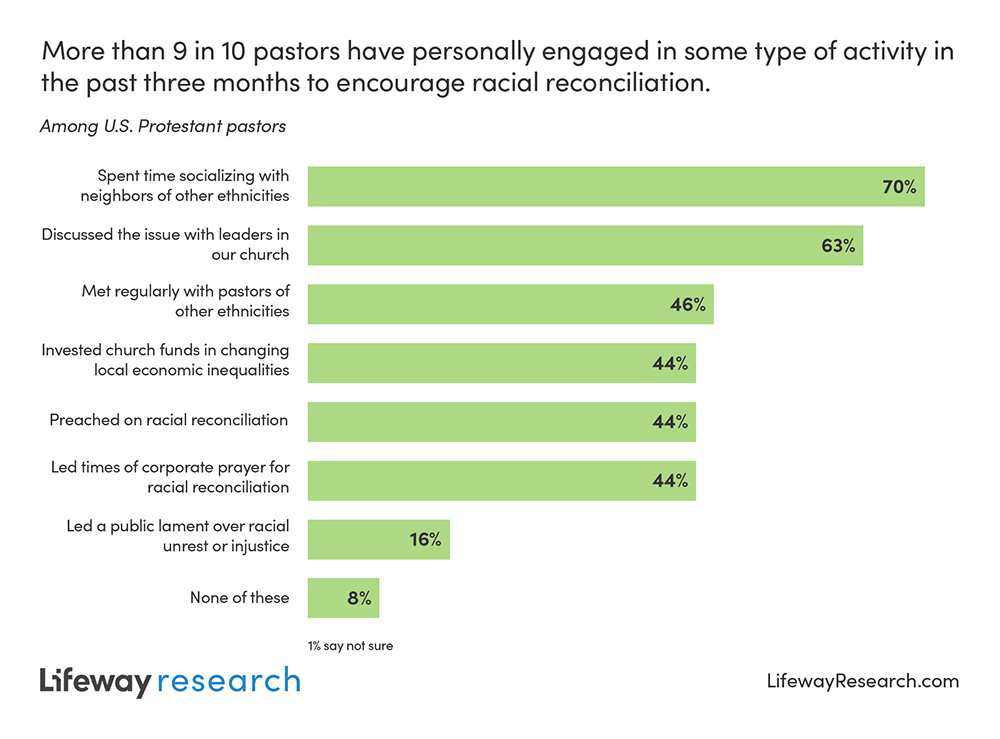


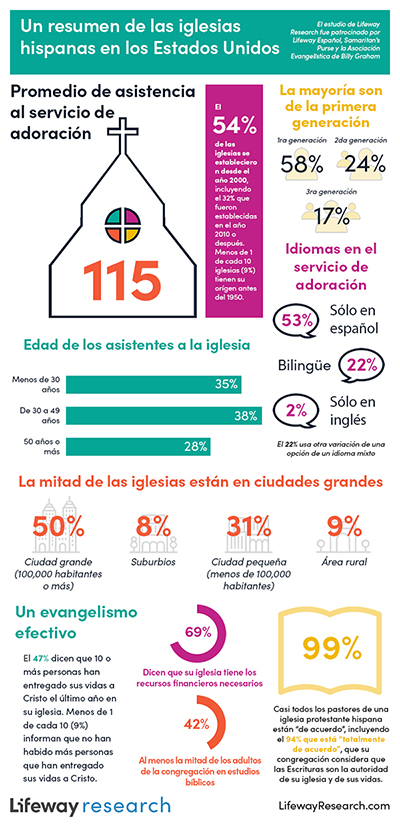 El estudio revela una imagen de las iglesias hispanas que muestra que son más nuevas, más jóvenes y que evangelizan de una manera más eficaz que una iglesia protestante típica en os Estados Unidos.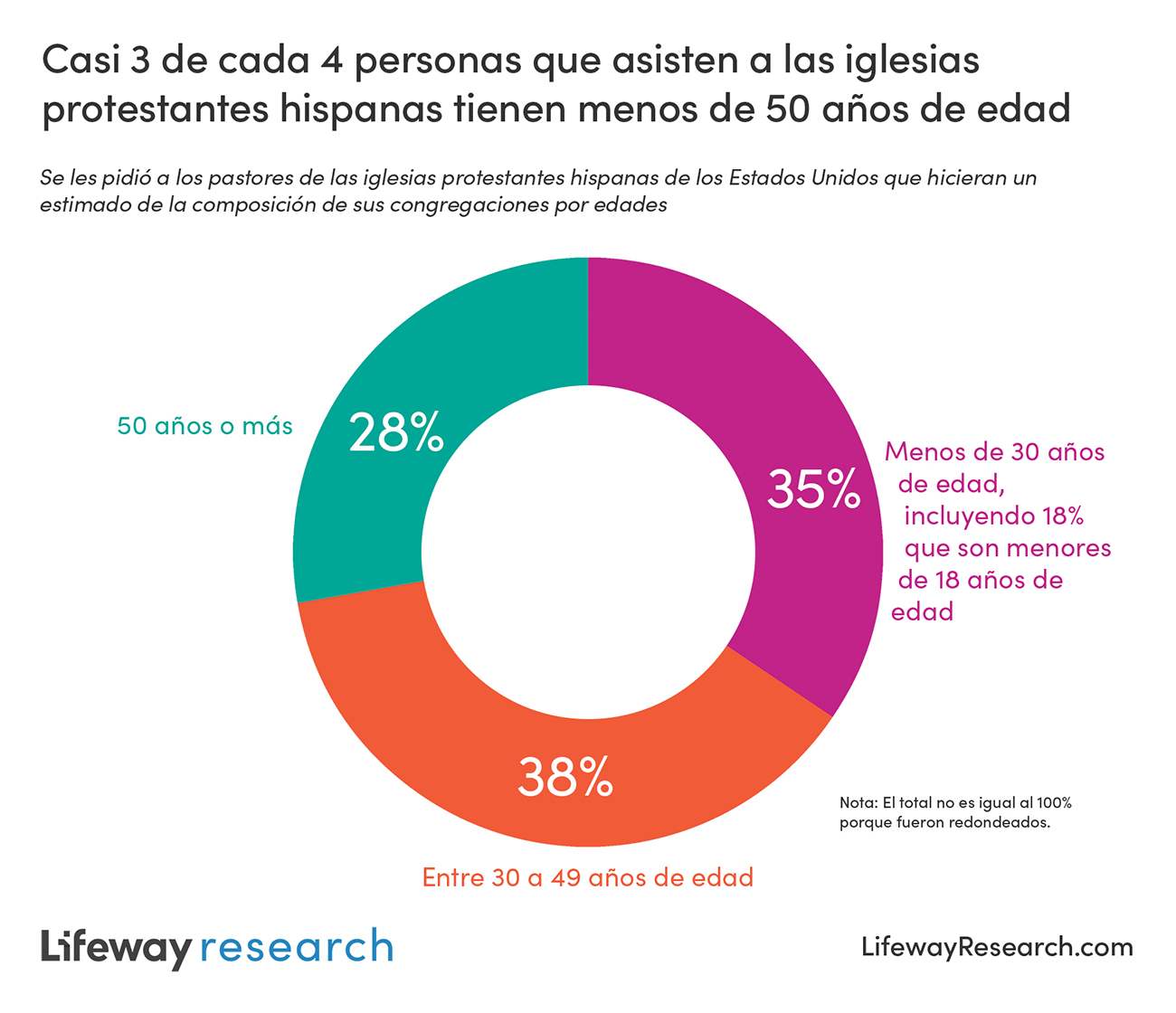
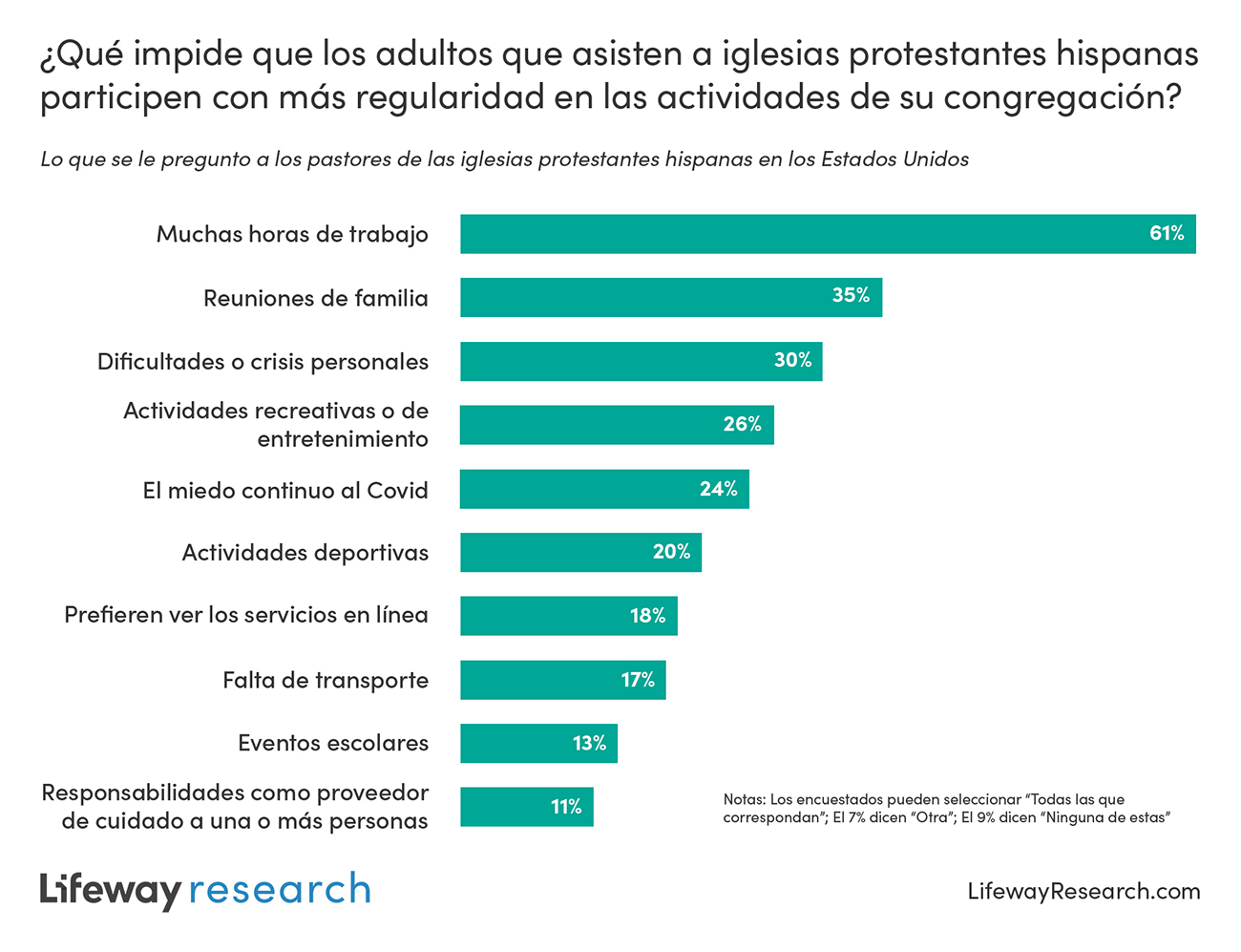
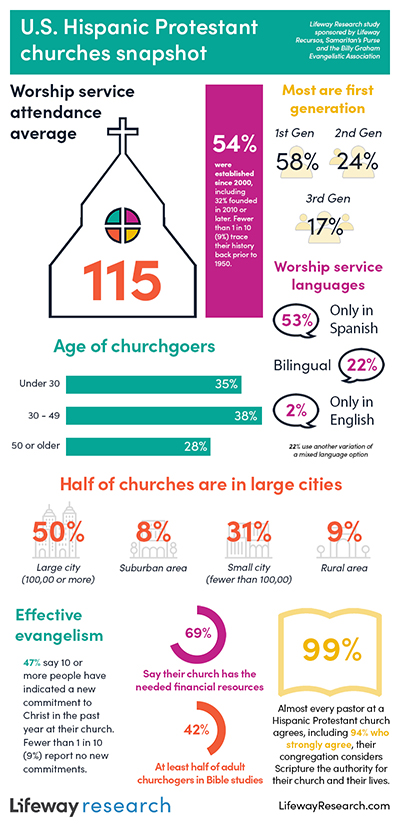 Most Hispanic Protestant churches (54 percent) have been established since 2000, including 32 percent founded in 2010 or later. Fewer than 1 in 10 (9 percent) trace their history prior to 1950.