Fewer than half of Americans may be Christian by 2070

WASHINGTON (RNS)—America long has prided itself on being a country where people can choose whatever religion they like. The majority has long chosen Christianity, but by 2070, that may no longer be the case.

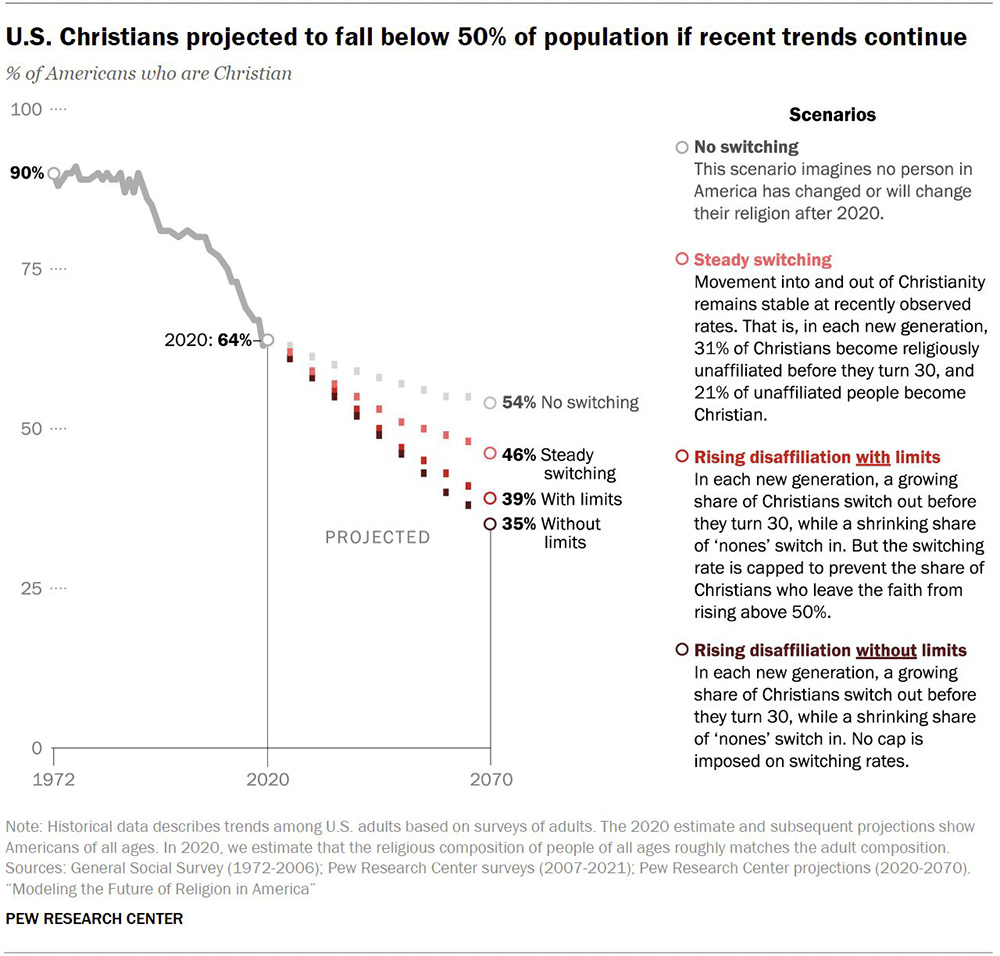
If current trends continue, Christians could make up less than half of the population—and as little as a third—in 50 years.

Meanwhile, the so-called nones—the religiously unaffiliated—could make up close to half of the population. And the percentage of Americans who identify as Muslims, Jews, Hindus, Buddhists and other non-Christian faiths could double.

Those are among the major findings of a new report from the Pew Research Center regarding America’s religious future—a future where Christianity, though diminished, persists while non-Christian faiths grow amid rising secularization.

Using multiple factors to project future

Researchers projected possible religious futures for the United States using a number of factors, including birth rates, migration patterns, demographics like age and sex, and the current religious landscape.

They also looked at how religion is passed from one generation to another and how often people switch religions—in particular, Christians who become nones, a number that has been increasing in recent years.

They projected four different scenarios, based on differing rates of religious switching—from a continued increase to no switching at all.

“While the scenarios in this report vary in the extent of religious disaffiliation they project, they all show Christians continuing to shrink as a share of the U.S. population, even under the counterfactual assumption that all switching came to a complete stop in 2020,” according to the report. “At the same time, the unaffiliated are projected to grow under all four scenarios.”

Increasing numbers become disaffiliated

Currently, about a third (31 percent) of Christians become disaffiliated before they turn 30, according to Pew Research. Twenty-one percent of nones become Christian as young adults. Should those switching rates remain stable, Christians would make up 46 percent of the population by 2070, while nones would make up 41 percent of the population.

If disaffiliation rates continue to grow but are capped at 50 percent of Christians leaving the faith, then 39 percent of Americans are projected to be Christian by 2070, with 48 percent of Americans identifying as nones.

With no limit placed on the percentage of people leaving Christianity and with continued growth in disaffiliation, Christians would be 35 percent of the population, with nones making up a majority of Americans (52 percent).

If all switching came to a halt, then Christians would remain a slight majority (54 percent), while nones would make up 34 percent of Americans, according to the projection model.

Non-Christian faiths would rise to 12 percent to 13 percent of the population, largely due to migration, in each scenario. Migration does affect the percentage of Christians, as most immigrants coming to the United States are Christians, said Conrad Hackett, associate director of research and senior demographer at Pew Research Center.

“Still the greatest amount of change in the U.S., we think currently and in the future, will come from switching,” he said.

Projections not predictions

Researchers stressed the report contained projections based on data and mathematical models, not predictions of the future.

“Though some scenarios are more plausible than others, the future is uncertain, and it is possible for the religious composition of the United States in 2070 to fall outside the ranges projected,” they wrote.

One reason for the decline among Christians and the growth among the nones in the models is age. While Christians have more children than nones, they are also older. Pew estimates the average Christian in the United States is 43, which is 10 years older than the average none.

“The unaffiliated are having and raising unaffiliated children while Christians are more likely to be near the end of their lives than others,” Stephanie Kramer, a senior researcher at Pew, told RNS in an email.

Using mathematical models, Pew has also projected the future of religion around the world. Those models were adapted for different regions, said Hackett. Muslims, for example, he said, tend to have the youngest population and the highest fertility rates, driving the growth of that faith.

However, he said, in the Gulf states, migration has brought many Christians from other countries to the region as temporary workers.

Examining multiple variables

The current report takes advantage of the amount of data collected about the U.S. religious landscape. Researchers also looked at intergenerational transmission for the first time, said Kramer.

“The variables we use to study that were: What is the mother’s religion? And what is the teen’s religion,” she said. “If that was a match, we consider the mother’s religion transmitted.”

Researchers also looked at a relatively new trend of disaffiliation among older Americans. Sociologists have long focused on younger people, who are most likely to switch religions. But in the United States and other countries, older people are also starting to switch at growing rates.

“It’s not as large scale, but it’s still significant,” said Hackett. “And it’s contributing to the religious change that we have experienced and that we expect to experience in the years ahead.”

Hackett said that the projections do not show the end of Christianity in the U.S. or of religion in general, which he expects to remain robust. And most nones, while claiming no religion, do not identify as atheists.

Kramer said the United States appears to be going through a pattern of secularization that has happened in other countries, though “we may be a bit behind,” she added.

Other factors outside the model—such as changing immigration patterns and religious innovation—could lead to a revival of Christianity in the United States, according to the report. But none of the models shows a reversal of the decline of Christian affiliation, which dropped from 78 percent in 2007 to 63 percent in 2020, according to Pew research.

In the report, researchers note that “there is no data on which to model a sudden or gradual revival of Christianity (or of religion in general) in the U.S.”

“That does not mean a religious revival is impossible,” they wrote. “It means there is no demographic basis on which to project one.”

Ahead of the Trend is a collaborative effort between Religion News Service and the Association of Religion Data Archives made possible through the support of the John Templeton Foundation.


Gen Z leads in desire to share their faith

PHILADELPHIA (BP)—Gen Z matches adults age 76 and older in a desire to share their faith, an American Bible Society study revealed.

Furthermore, Gen Z—adults 25 and younger—lead all ages in their openness to spiritual conversations, the Bible society said Sept. 8 in releasing its latest chapter of the 2022 State of the Bible.

More than half—54 percent—of Gen Z and Elders, defined as individuals 76 and older, expressed a desire to share their faith with others, the Bible society’s study showed.

About six out of 10 Gen Z adults—engaged in individual spiritual conversations with three or more persons in the past year, more than any other age group studied.

“We asked a range of questions with different phrasing—sharing faith, having spiritual conversations, talking about the message of the Bible,” the American Bible Society stated. “The Bible itself expresses the work of evangelism in various ways (preaching, reconciling, conversing, answering), so we felt comfortable approaching the subject in different ways.”

‘Greater openness to spiritual conversations’

The findings are a good report for Gen Z, the American Bible Society said, in contrast to the previous release from the 2022 report placing a large percentage of Gen Z among committed Christians who don’t attend church at least once monthly.

“We’re especially encouraged by Gen Z. Our last chapter included some causes for worry, but here we see a desire for faith-sharing among Scripture-engaged young people,” the Bible society said in releasing the report’s sixth chapter, focused on evangelism. “We also see signs of a greater openness to spiritual conversations in the Gen Z culture.

“As with many other factors in State of the Bible, evangelism is strongly associated with Scripture engagement and church attendance. Those who are committed to the Bible and the church are far more likely to be committed to sharing their faith.”

Factors that likely influence Gen Z’s gospel sharing are changes in American culture that have made the gospel “genuinely new” to Gen Z. American culture is “less overtly Christianized,” and methods of evangelism have adjusted to include Christian music, films, novels, streaming television and internet memes, the Bible society observed.

Among other generations, 45 percent of Millennials and Gen X, and 50 percent of Boomers said they wanted to share their faith.

When it came to actually sharing their faith with others, 54 percent of Boomers said they shared their faith with at least three people in the past year, the age category ranking closest to Gen Z. Among others, 52 percent of Millennials, 51 percent of Gen X and 45 percent of Elders shared their faith with at least three others.

Gen Z breaking barriers

“Are we seeing a generational shift in openness to spiritual matters?” the Bible society asked. “Where previous generations learned to avoid religious talk, our findings suggest that Gen Z is breaking those barriers.”

Feeling inadequate in social interactions (19 percent), a lack of knowledge of faith issues (15 percent) and fear of what others will think of them (12 percent) rank as the top three obstacles to evangelism among Scripture-engaged Christians of all ages.

Gen Z described their top obstacles as a lack of knowledge of faith issues (31 percent), guilt about inconsistencies in their own lives (22 percent), and being unsure about their own faith (19 percent).

Yet, practicing Christians overwhelmingly (96 percent) expressed some degree of satisfaction with their church’s role in helping them learn to share their faith, with 29 percent extremely satisfied, 31 percent very satisfied, 23 percent satisfied and 14 percent somewhat satisfied.

The desire to share one’s faith is also impacted with such factors as educational level, decreasing as education increases; residency, with rural communities surpassing suburbanites; race and ethnicity, with more non-Hispanic Blacks expressing a desire to evangelize than non-Hispanic whites; and southerners surpassing westerners and northeasterners.

American Bible Society researchers collaborated with the University of Chicago’s National Opinion Research Center to survey a nationally representative group of American adults on topics related to the Bible, faith and the church. The study conducted online via telephone produced 2,598 responses from a representative sample of adults 18 and older in all 50 states and Washington, D.C.


New church construction reflects changing needs

NASHVILLE (BP)—More than 100 years ago, Southern Baptist P.E. Burroughs wrote on the importance of vestibules, the small gathering areas common in many churches to be built throughout that century.

P.E. Burroughs’ book “Church and Sunday-School Buildings” became a guide for many Southern Baptist churches built in the 20th century.

Vestibules “are worth far more than their cost,” he said. “They lend an air of welcome; they provide waiting room for people who arrive during prayer or such other parts of the service as may delay the incoming congregation; they encourage sociability.”

Burroughs’ book from which that passage originated—Church and Sunday-School Buildings—was published by the Baptist Sunday School Board in 1917, the same year he was asked to lead its newly-created architectural department.

For many Southern Baptists it became a guide during an unprecedented construction boom of churches in the two decades following World War II, a time that also witnessed a period of high attendance and church programs galore to occupy the space.

Time is undefeated, though. Eventually, those same buildings showed their age. Drastic upgrades or new construction become necessary.

‘A sense of community’

Coupled with the recent church planting movement, churches are getting a new look with architects and ministry leaders focused on the needs of today while not ignoring the input of those like Burroughs from a century ago.

One of the operative words in developing those plans is “together.”

“It seems that churches are moving toward a more intimate setting where people can be reached,” said Kevin Goins, a Panama City, Fla.-based architect.

“It’s about a sense of community. For me the lobby is just as important as the [worship area]. It’s where relationships are formed and you catch up with folks.”

The Baptist Sunday School Board, and then after becoming Lifeway, had its own department of architects and related personnel for church construction through 2013, at which point it began to partner with an outside firm for that purpose.

A former production coordinator for Lifeway’s Church architecture division, Goins still works with churches today.

“Trends are for ‘smaller,’” he said. “People are going back to the community church.”

He stressed that the church’s sanctuary remains a focus for its purpose and mission.

Also, its overall size doesn’t necessarily mean it can’t foster a sense of community.

Connections and commons spaces valued

Alan Dobbins, the managing partner of Myrick, Gurosky + Associates (MG+A) in Birmingham, Ala., said large connection and commons spaces have become some of the most important on church campuses in his company’s work designing church buildings.

“Since the early 2000s, major areas of focus have been on reaching younger families through dynamic children and student spaces. Worship will always be a key component and the biggest trends we’re seeing in these spaces are the incredible investments being made in technology,” he said.

The late 1990s and early 2000s brought many relocation projects and new builds for MG+A, when megachurches were building large multi-phased campuses, Dobbins said.

During and after the Great Recession, the focus shifted to renovations on existing structures when churches were forced to do more with less.

“This was also a result of churches simplifying program needs, which decreased square foot requirements,” he said.

“The trend has been for churches to maximize their facilities by multi-using spaces and utilizing more off-campus resources such as small groups meeting in homes.”

‘People want to be together’

First Baptist Church in Lafayette, La., partnered with MG+A in a remodel that came a few years before senior pastor James Pritchard arrived in April 2020. First Baptist Church in Forney, where he previously served as teaching pastor, had undergone a remodel roughly during the same time as First Lafayette.

“Main Street” at First Baptist Church in Lafayette connects other buildings to one central commons area. (Photo by Dennis Clark, FBL)

Pritchard recognized differences and similarities for each.

First Lafayette is in downtown and relatively landlocked, while First Forney had 30 acres to work with. Forney also needed to address areas such as a large special needs ministry that requires more space and specific equipment.

Both had something in common, however.

“People want to be together,” Pritchard said. “Architecture follows ministry strategy, and you see that desire to gather and linger.”

First Lafayette basically has three large buildings that were connected in the remodel to form a central “main street.” The large atrium setting has a coffee bar, seating and couches for attendees.

“It’s become a gathering place for the entire church,” said Pritchard.

At First Baptist in Forney, the classic architecture of the previous building funneled people to the sanctuary but did so just as quickly at the conclusion of service to the parking lot.

“The new building has a place to stay, and people would do that for an hour or so after church,” he said. “They hang around and visit because they can.”

Congregations want their permanent space

Other congregations have different starting points.

Many church plants begin their existence in locations such as homes, a storefront or even a section of another church’s building. There comes a day, though, when many if not all look to get their own location.

That tends to happen, said Dobbins, when a church reaches a point where its financial resources can support such a move.

“There is certainly a burn-out factor that comes with using a temporary space every week and the challenges that come along with setup and takedown,” he said. “This places a significant importance on a young church plant’s ability to reach that critical mass in a timely manner.”

The North American Mission Board worked with MG+A in the construction of a new worship facility for First Baptist Church in Sutherland Springs, which rebuilt after a mass shooting.

Loans are available to church planters who pass NAMB’s assessment as well as go through a process with NAMB’s church loans team. Those loans are available for church plants to purchase or, in some cases, build, said NAMB spokesman Mike Ebert.

“As they mature, most plants refinance with another lender and pay off the loan with us. Most church plants utilize a local contractor and there are too many of them for us to be able to make recommendations,” he said. “We do suggest questions to ask and how best to walk through the due diligence process with a general contractor.”

Changing trends

A 2015 volume of The Journal of Florida Baptist Heritage pointed to trends over the last 50 years, moving away from construction plans espoused in Burroughs’ book, which was updated in 1920 with minor changes.

Rooms in architectural plans of some churches built in the 20th century included those dedicated to specific purposes, such as to the study of missions. From P.E. Burroughs, “Church and Sunday-School Buildings”

For one, several large churches such as First Baptist in Orlando constructed or remodeled modern buildings “to create mega-church stadium seating facilities with the latest in sound, lighting and audio-video technology.”

Another trend came in large churches buying out existing structures such as defunct shopping malls and essentially transforming them into churches. First Baptist in Lakeland, Fla., did this and established a new name—Church at the Mall. It has since changed its name to Lakes Church and meets among three campuses.

A third trend is churches gathering in homes until affordable meeting space can be found. The Florida journal cited it specifically among the hundreds of mission congregations in economically challenged areas.

Don Hepburn of the Florida Baptist Convention wrote that particular article for the journal and concluded with “the ‘church’ can now be defined theologically as a ‘people,’ but also may be defined by its purpose and place.”

Healthy relationships are important for mental health. A congregation is no different, with studies showing resilient faith in young adults is connected to strong relationships within church.

Burroughs placed a priority on worship space.

“The auditorium should be marked by reverent dignity such as will inspire worship,” he wrote. He didn’t care for “irregular and sometimes fantastic proportions of some modern (for him) auditoriums [that] must grieve and even offend worshippers.”

That included pictures on the walls or ceilings, memorial pictures and “ill-conceived Bible scenes wrought into the windows.”

But he also addressed the importance of providing space for “meeting social demands” such as a “social room” that could be used for a number of purposes including banquets, lectures and “moving pictures or musicals.”

Prioritize investment in technology

Technology has changed in order to keep people connected, but it is no less needed.

“Churches can underestimate the value and cost of … investment in technology,” Dobbins said. “Coming out of the pandemic, we all realized just how important it was to carry the message outside the walls of the church with live stream and broadcast capability.

“Churches should be prioritizing their investment in these technologies as having just as much importance as actual physical spaces.”

That aside, the experience of remote worship that many congregations had in the spring and summer of 2020 drove home the importance of being together in-person.

“Churches have figured out in recent decades that fellowship and connection happens in a more natural way when spaces are intentionally designed for that purpose,” Dobbins said. “New churches are designed to have enough commons space for people to connect.”

Goins has worked with churches to accommodate interesting requests and requirements. North Jacksonville (Fla.) had to design around an eagle’s nest. A South Carolina church incorporated an old airplane into its youth building.

Others want a link to the past even as they step forward into the future. A stained-glass window is carefully moved and placed within a wall or room of a new building.

One small church asked Goins to design a simple, no-frills worship area that would have made P.E. Burroughs proud.

“The important thing for the church is to have a strong, clear vision,” he said. “Their goal is to find ways to reach their community.”


Pandemic pastoring report documents new era in ministry

WASHINGTON (RNS)—In 2020, attendance was soaring at Emerywood Baptist Church in High Point, N.C. Giving was steady. The church was getting ready to send more than 25 people on a mission trip.

Then came the COVID-19 pandemic.

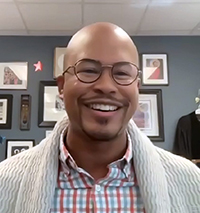
Timothy Peoples

And then—just as Emerywood had canceled all its plans and adjusted to outdoor worship to slow the spread of the virus—came the murder of George Floyd and the summer’s mass protests against racial violence.

As the Black senior minister of a predominantly white Southern church with an address on Country Club Lane, Timothy Peoples said, he told his congregation, “You can’t call me ‘pastor’ and [a racial slur] at the same time.”

In the middle of it all, the minister said, he had a breakdown.

Surveyed ministers from 20-plus denominations

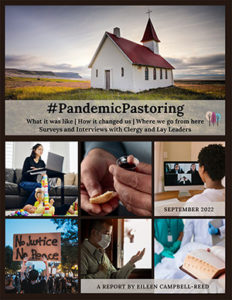
Peoples isn’t the only minister to face challenges pastoring through the pandemic, according to the results of the #PandemicPastoring report released Sept. 1 by researcher Eileen Campbell-Reed.

Campbell-Reed, visiting associate professor of pastoral theology and care at Union Theological Seminary in New York City and creator of the “Three Minute Ministry Mentor” podcast and video blog, surveyed more than 100 Christian pastors, chaplains, campus ministers and lay leaders from more than 20 denominations between June 2020 and April 2022.

Participants included clergy she had been following for more than a decade as part of the Learning Pastoral Imagination Project, as well as ministry and lay leaders from Austin Presbyterian Theological Seminary and the Cooperative Baptist Fellowship’s Helping Pastors Thrive initiative.

As the COVID-19 pandemic stretched from that first spring into summer, Campbell-Reed said, she realized its impact on ministry wasn’t going to be short-lived.

At the same time, ministry leaders were steering their congregations through pressing issues of racism, gender inequity and increasing partisan divisions.

Examined impact of ‘multiple pandemics’

Eileen Campbell Reed

She wanted to learn how these “multiple pandemics” were changing the jobs—and lives—of pastors and other ministry leaders.

“I think we have indeed entered into a new era of ministry,” Campbell-Reed said, announcing the findings of her report in a webinar hosted by Good Faith Media.

“I didn’t really know that until I delved deeply into this data.”

Campbell-Reed was joined in the webinar by Peoples and other clergy from the CBF, Christian Church (Disciples of Christ), African Methodist Episcopal Church and Presbyterian Church (USA). None of the clergy in the webinar were participants in the #PandemicPastoring report’s surveys and interviews.

They shared their experiences of pastoring in a pandemic—like Sarah McClelland-Brown, now pastor of First Presbyterian Church of Warner Robins, Ga.

McClelland-Brown said she left her small, rural Disciples of Christ congregation in 2020 when members wanted her to return to preaching in person. She was pregnant with her second child at the time.

Ministers identify challenges

Among some of the challenges clergy identified in the #PandemicPastoring report were relationships and leadership concerns like burnout, figuring out how to lead in unprecedented times and minimizing harm to others.

Other concerns evolved as the pandemic wore on, Campbell-Reed noted. In summer 2020, it was about adapting quickly to online or outdoor worship and speaking out on racial justice issues. By the next summer and fall, it was coping with grief and managing conflict within their congregations.

The last few years brought moments of surprise and delight, too. Some clergy named stronger relationships—both with other people and with God. Some pointed out their congregations’ creativity and ability to adapt to new ways of worshipping together.

Pastors demonstrate resiliency

Most surprising to Campbell-Brown was the resiliency of pastors, she said.

While the difficulties of the pandemic drove Peoples to a breakdown, members of his congregation picked him back up again. They gave him some time off, then gathered around his desk when he returned and told him this was work they had to do together, not work he had to do alone.

“I’ve said over and over. The pandemic shutdown was actually really good for us,” he said.

While it led some to leave his church, it created space for others to be vulnerable, to share their experiences, to confront their privileges and to take action.

“We finally took on hard discussions and challenges that we had been putting off for so long,” Peoples said.

Reason for hope

The #PandemicPastoring report isn’t the only recent research to find reason to hope after years of pandemic.

Several surveys by the Evangelical Council for Financial Accountability show that some church leaders saw growth in their congregations despite the prevalence of COVID-19.

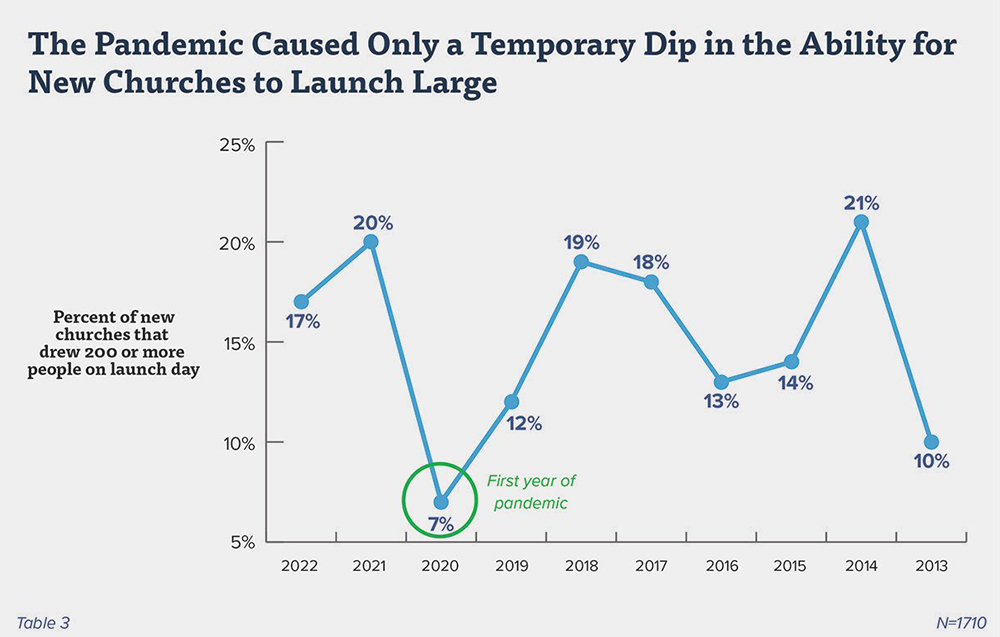
A survey earlier this year by ECFA of 1,710 North American founding pastors and church leaders concluded that while only 7 percent of new churches drew 200 or more people on their launch day in 2020, that number rebounded to 20 percent in 2021. That compared with 12 percent in 2019 and 19 percent in 2018.

A separate survey of 151 multisite directors or campus pastors shows that about two-thirds, or 64 percent, said they were part of a congregation that launched a new campus between 2019 and 2022.

“I’m part of a church that did that,” said Warren Bird, ECFA senior vice president of research, at a separate webinar on church planting in the COVID-19 era on Tuesday.

“It was exciting. It was one more way to reach out during the pandemic and to see spiritual fruit happen.”

Report from the Evangelical Council for Financial Accountability


Evangelicals say environmental activism biblically mandated

WASHINGTON (RNS)—The National Association of Evangelicals unveiled a sweeping report on global climate change, laying out what its authors call the “biblical basis” for environmental activism to spur fellow evangelicals to address the planetary environmental crisis.

“Creation, although groaning under the fall, is still intended to bless us. However, for too many in this world, the beach isn’t about sunscreen and bodysurfing but is a daily reminder of rising tides and failed fishing,” reads the introduction of the report, penned by NAE President Walter Kim.

“Instead of a gulp of fresh air from a lush forest, too many children take a deep breath only to gasp with the toxic air that has irritated their lungs.”

Biblical case for creation care

But the authors admit persuading evangelicals is no small task, considering the religious group historically has been one of the demographics most resistant to action on the issue.

The nearly 50-page report was released Aug. 29. Titled “Loving the Least of These: Addressing a Changing Environment,” it opens with a section that insists protecting the environment is a biblical mandate.

“The Bible does not tell us anything directly about how to evaluate scientific reports or how to respond to a changing environment, but it does give several helpful principles: Care for creation, love our neighbors and witness to the world,” the report reads.

The authors go on to cite passages such as Genesis 2:15 (“God then took the man and settled him in the garden of Eden, to cultivate and care for it”), Matthew 22 (“Love your neighbor as yourself”) and Deuteronomy 15 (“Give generously to them and do so without a grudging heart”).

“We worship God by caring for creation,” the report reads.

Another section outlines the basic science behind climate change, but the report, produced in partnership with the NAE’s humanitarian arm World Relief, returns often to the real-world impacts of climate change, such as how air pollution created by fossil fuels can have negative outcomes for children’s health or disproportionately affect the poor.

Kim suggested the emphasis on lived experiences, which are often tied to churches or evangelical organizations, is by design.

“One of the things that you’ll see in this document is not simply scientific information, though that is there, or biblical argumentation, although that is there, but you also hear stories of actual impact on communities,” he said in an interview.

‘Understand the human dimension’

Real-world examples help readers “understand the human dimension of the impact of climate change,” he explained.

“I think people of faith responded very deeply, because we’re wired to follow in the footsteps of Jesus of loving God and loving our neighbor.”

Dorothy Boorse, a biology professor at Gordon College and the chief author of the report, agreed.

“One of the things that can be true for evangelicals is they have a very deep desire to care for others, and they often have a deep spirit of hospitality,” she said.

Appealing to concerns about health and care for children, Boorse said, can “spark an imagination” in evangelicals that climate change is “not different from other problems in the world that we feel committed to care about, such as education, food availability or disaster relief.”

The focus on persuasion may be the result of necessity. The NAE has spoken out on environmental issues before (the new report functions as an update of a similar document published in 2011). But while mainline Protestant Christian groups and Pope Francis have repeatedly signaled the urgency of addressing climate change, many prominent evangelical leaders have suggested the opposite.

White evangelicals least likely to agree

Last year, Franklin Graham, son of famed evangelist Billy Graham, dismissed climate change as “nothing new” in a Facebook post and compared it to biblical instances of extreme weather—such as the flood in Genesis or the years of famine and drought in Egypt—that are depicted as acts of God.

The result often has been a religious community resistant to acknowledging the source of the issue, much less acting to prevent it. In a Pew Research survey conducted in January, white evangelicals were the religious group least likely to agree that human activity contributes to climate change, with only 54 percent saying humanity contributed a great deal or some to the trend. By comparison, 72 percent of white nonevangelicals, 73 percent of white Catholics, 81 percent of Black Protestants and 86 percent of Hispanic Catholics said so.

But as Boorse points out in the report, there has been some movement since the 2011 report was published, particularly among young evangelicals: A year after that document was unveiled, Young Evangelicals for Climate Action was founded.

“One huge pattern that I observed is that young evangelicals are very concerned about the environment,” said Boorse, who sits on the advisory board of Young Evangelicals for Climate Action. “There’s an entrenchment of certain ways of thinking that just takes a long time to change.”

Rising global sea level points to urgency

Nia Riningsih, one of few residents who stayed behind after most of her neighbors left due to the rising sea levels that inundated their neighborhood on the northern coast of Java Island, checks salted fish she dries as her daughter Safira plays at their house in Mondoliko village, Central Java, Indonesia, Nov. 7, 2021. (AP Photo/Dita Alangkara)

Activists say the change can’t come soon enough. In addition to ongoing droughts in various parts of the world, the NAE report was unveiled the same day as news broke that, given the current pace of climate change, 3.3 percent of the Greenland ice sheet—around 110 trillion tons of ice—is slated to melt into the sea, raising global sea levels nearly a foot between now and 2100.

Asked if she was hopeful the report and similar efforts could urge evangelicals to muster their resources and help prevent further environmental calamities, Boorse acknowledged she often is frustrated by fellow faithful who espouse baseless conspiracy theories about climate change or express open hostility to science in general.

“That has been very challenging for me in my professional life,” she said. “But I feel God has privileged me with the task of speaking to a group of people that I know and love, and trying, consistently, to talk about this as a real phenomenon—and it needs our attention.”

For Boorse, the necessity of the work—and the tenets of her faith—sustain her for the fight ahead.

“I’ve decided to be hopeful,” she said. “I think everybody has to, or you’d never get anything done.”


Writer and minister Frederick Buechner dies at 96

WASHINGTON (RNS)—Frederick Buechner was asked on numerous occasions how he would sum up everything he had preached and written in both his fiction and nonfiction.

The answer, he said, was simply this: “Listen to your life.”

That theme was constant across more than six decades in his career as a “writer’s writer” and “minister’s minister”—an ordained evangelist in the Presbyterian Church (USA) who inspired Christians across conservative and progressive divides with his books and sermons.

Buechner died peacefully in his sleep on Aug. 15 at age 96, according to his family.

Early success with first novel

Born Carl Frederick Buechner on July 11, 1926, in New York City, he moved frequently with his family in his early childhood as his father searched for work, settling in Bermuda after his father’s death by suicide when he was 10.

His studies at Princeton University were interrupted by World War II, but he completed his bachelor’s degree in English in 1948. He quickly achieved fame with the 1950 publication of his first novel, A Long Day’s Dying.

When his second novel, in his own words, “fared as badly as the first one had fared well,” he moved to New York City to lecture at New York University and focus on his writing.

It was in New York City that he had an experience that changed the course of his life and work. He began attending Madison Avenue Presbyterian Church.

Desire to learn more about Christianity

Growing up, neither side of his family had a “church connection of any kind,” as he put it, but he went because he happened to live next door and “because I had nothing else to do on a Sunday,” he recounted in a video posted on YouTube by the Frederick Buechner Center.

One Sunday, he was struck by a particular turn of phrase by the church’s pastor, George Buttrick: “Christ is crowned in the hearts of those who love him and believe in him amidst confession and tears and great laughter.”

He recounted: “I was so taken aback by ‘great laughter’ that I found the tears springing to my eyes.”

He later told Buttrick he wanted to learn more about Christianity, to more than simply join the church. The pastor pointed the young writer to Union Theological Seminary—with some misgivings. Buechner quoted Buttrick in his autobiography The Sacred Journey as saying, “It would be a shame to lose a good novelist for a mediocre preacher.”

Buechner graduated with a Bachelor of Divinity degree—he’d later receive nine honorary degrees—and was ordained as an evangelist in 1958 at the same church where he had been so moved by Buttrick’s words.

That same year, he launched the religion department at Phillips Exeter Academy in New Hampshire, where he taught for nine years before moving with his family to their farmhouse in Vermont. He later was awarded lectureships at Harvard and Yale universities and held teaching positions at Tufts University, Calvin College and Wheaton College.

Prolific author spanning multiple genres

In 2016, Princeton Theological Seminary President Craig Barnes launched the Buechner Writing Workshop at the seminary, calling Buechner a “minister’s minister.”

Over the course of his life, Buechner wrote nearly 40 books across a number of genres: fiction, autobiography, theology, essays and sermons.

Among his novels, Lion Country was a finalist for the 1972 National Book Award and Godric a finalist for the 1981 Pulitzer Prize for fiction. His short story “The Tiger,” published in The New Yorker, took third prize in the O. Henry Awards in 1955.

Listening to one’s life became a theme in his work, because, he said in a 1989 appearance on the Chicago Sunday Evening Club, if there was a God and if God were as concerned with the world and involved in it as Christianity says, then surely one of the most powerful ways God speaks to people is in what happens to them.

That’s something bestselling memoirist Anne Lamott, a progressive Christian who wrote the introduction to the 2016 book “Buechner 101,” has said she took away from Buechner’s writing.

It gave Lamott the confidence, after paying attention to her own life, “to share that with my readers and to trust that that is ultimately all we have to share with one another—is our truth in our very own voice,” she said in a YouTube video posted by the Frederick Buechner Center to mark Buechner’s 90th birthday.

Influential across denominational lines

While Buechner was ordained in a progressive mainline Protestant denomination, his fans also included Catholics and conservative evangelicals.

Russell Moore, the former head of the Southern Baptist Convention’s Ethics & Religious Liberty Commission who recently was named editor in chief of Christianity Today, credited Buechner’s writing with making him a better evangelical in a 2017 commentary for the magazine.

“J. Gresham Machen and Carl F.H. Henry taught me that I needn’t put my mind in a blind trust in order to follow Jesus. Buechner taught me the same about my imagination,” Moore wrote.

James Martin, editor at large of America Media, said in another YouTube video posted by the Frederick Buechner Center that the author was “instrumental in my early days as a Jesuit.”

On Monday, Martin tweeted: “I’m so sorry to hear of the death of Frederick Buechner, who led a long and fruitful life and was one of my favorite spiritual writers. The Sacred Journey is one of the most beautiful spiritual memoirs ever written. May he rest in peace with the God he loved for so long.”

Buechner, who split his time between Vermont and Florida, is survived by his wife, Judith Buechner, three daughters, a son-in-law and 10 grandchildren.


Millennials adopt digital worship but hold to real life faith

WASHINGTON (RNS)—No small number of millennials was first introduced to personal technology tending to their tamagotchis during recess. Only later did the dot-com revolution, smartphones and social media invade every part of their lives, from relationships to health to music—and faith.

Today, meditation podcasts, TikTok sermons and livestreams of Friday (Jumah) prayers are all at everyone’s fingertips.

A study out of Canada suggests this last generation to experience a smartphone-free childhood still is keeping one foot firmly planted in the real world—at least when it comes to religion.

The study, led by University of Waterloo sociologist Sarah Wilkins-Laflamme, found that a sizable minority of millennials in the United States and Canada (32 percent) turns to digital religious or spiritual activities on at least a monthly basis. But only 5 percent said they do so without engaging in in-person forms of religion or spirituality once a month or more.

“For the most part, people are both involved in person and supplement that through digital religion,” Wilkins-Laflamme explained.

Digital worship complements in-person religion

The findings will comfort faith leaders who worry that technology will displace religiosity, said Pauline Cheong, a professor at Arizona State University who researches religion and communication technologies but wasn’t involved in the Canadian study.

Digital religion “is not a disruption or huge tear in the social fabric,” Cheong said. “There are a lot of savvy religious users using it to complement existing ties” to religion.

A millennial herself, Wilkins-Laflamme set out to gauge to what extent her generation, which is less likely to participate in organized religion than previous generations, engages with religion online.

She surveyed 2,514 respondents in March 2019. The study, therefore, does not account for how the pandemic may have changed millennials’ digital habits during a time when many houses of worship went online.

“The overall takeaway for me was that digital religion is definitely a thing, but it’s a thing that only a chunk of the (millennial) population does,” Wilkins-Laflamme said.

Millennials also participate in digital religion to varying degrees. Wilkins-Laflamme left the definition of digital religion largely up to respondents; it could include anything from using a Bible app to watching a spirituality-themed Instagram reel.

Forty-one percent of U.S. respondents reported passively consuming any kind of religious or spiritual digital content at least once a month, while only 32 percent of U.S. respondents took the time to post about religion or spirituality on social media monthly.

Millennials in Canada, where the population is less religious overall, were active at lower rates, with 29 percent taking in digital religious content and 17 percent posting it.

What about Gen Z?

It’s not yet clear whether Gen Z, who are more digitally native than millennials, will engage in real-world religion as much as their elders. Paul McClure, a sociologist who studies religion and technology at the University of Lynchburg, applauded Wilkins-Laflamme’s study but noted that his own research shows that greater Internet use is associated with lower levels of religiosity.

His latest study, published in June, found that among U.S. youth ages 13 to 19 years, increased screen time is negatively associated with religious commitment, even when their parents are highly religious.

“We cannot say for sure that screen-based media is actively making adolescents less religious,” McClure’s study states. “But it is clear that screen time either displaces or substitutes for religious belief, identity and practice among adolescents from religious families.”

Cheong agrees that while millennials are taking advantage of new virtual resources, digital advances alone won’t be enough to appeal to younger generations.

“Moving forward, religious organizations and leaders need to do what they can to maintain and sustain the trust, to cultivate healthy relationships,” she said.

That may mean trying to bypass their smartphones and getting young people involved face-to-face. But Wilkins-Laflamme’s study suggests that any religious leader interested in connecting with both Gen Zers or millennials needs to take digital religion seriously.

“Religious groups who don’t have an online presence will really struggle with those two generations,” she said.

Ahead of the Trend is a collaborative effort between Religion News Service and the Association of Religion Data Archives made possible through the support of the John Templeton Foundation.


John Perkins still mobilizes Christian communities at 92

WASHINGTON (RNS)—At 8 a.m. on Tuesdays in July, as usual, John Perkins was participating in his weekly Zoom Bible study.

Officially the leader and the attraction for the more than 200 who log on each week, Perkins is far from the sole speaker, and that’s the way he wants it.

“I’m learning from them, because they are doing really good research,” said Perkins, 92, of his co-leaders, both pastors and lay people, each of whom teaches from their perspective. “We want our Bible class to be a model of what the influential pastor or the influential leader can do back in their own hometown.”

This collective approach has been Perkins’ way of doing ministry since he began.

In November, shortly after having surgery for colon cancer, Perkins went where he has gone for years—the annual meeting of the Christian Community Development Association, which he helped organize decades before.

It was worth the journey from Mississippi to Missouri, he said, to see his friends and to continue to motivate them while he could.

“Really to pass on, in my own way, this mission that we have arrived at together,” he said in a phone interview. “I just came to encourage and to say goodbye.”

A farewell tour it may be, but Perkins has been in motion as long as he’s been in ministry, moving mostly between his native Mississippi to California and back, always focused on his goals of transforming communities through faith and racial reconciliation.

Overcoming hatred and bitterness

Along the way Perkins has overcome the deaths of loved ones and his onetime hatred of white people, who included police who took the life of his brother and, years later, nearly killed him. Perkins, who at times was one of the few Black leaders in predominantly white evangelical settings, credits particular Caucasians for being there for him to introduce him to the Christian faith, bind his wounds and comfort him when he was mourning.

Born in 1930, Perkins lost his mother to starvation when he was just 7 months old. When he was 16, his brother was killed by a police chief after the young man grabbed the blackjack the officer had used to strike him.

Perkins fled to California in the 1940s after his brother’s death and a decade later launched a union of foundry workers in that state. After the Korean War broke out, he was drafted and served three years in Okinawa, Japan. After he returned stateside, he later became a Christian and was ordained a Baptist minister.

Returning to his native state in 1960, Perkins turned out to be as much an organizer as a clergyman. He started a ministry in Mendenhall that provided day care, youth programs, cooperative farming and health care. He registered Black voters and boycotted white retailers. When he visited college students at a Brandon, Miss., jail who had been arrested after a protest in 1970, he was tortured—“beaten almost to death,” he writes in his latest book—by law enforcement officers.

After recovering, he moved to Jackson, Mississippi’s capital, where he mentored college students.

Relocation, redistribution, reconciliation

John Perkins’ beliefs about social justice grew out of his study of the Bible. (Photo from 1975 / Courtesy of the John and Vera Mae Perkins Foundation)

In 1976, Perkins published his influential book Let Justice Roll Down, codifying his principles of relocation, redistribution and reconciliation—known as Perkins’ “Three Rs”—as a way to address systemic racism with social action.

“Justice is an economic issue,” Perkins said. “It’s the management and stewardship of God’s resources on the Earth.”

In 2006, Christianity Today placed Let Justice Roll Down at No. 14 on a list of the top 50 books that had shaped evangelicals over the previous five decades.

The late Ron Sider, former president of Evangelicals for Social Action (now Christians for Social Action), said Perkins has “phenomenal” influence, cultivating—possibly more than “any single American”—holistic ministries meeting both spiritual and physical needs of people in rural and urban settings.

The ministry at Sider’s Mennonite church in Philadelphia, said Sider in an interview before his death on July 27, “is modeled on John Perkins, as are hundreds of others around the country.”

Perkins encouraged “collective prosperity,” where wealth is distributed equitably, and living in neighborhoods close to the poor, something he has done in the South and in the West.

“I’d say a lot of white suburban folks like me were deeply challenged by his call to justice and to the three Rs of his ministry,” said Jo Kadlecek, communication manager of Baptist World Aid Australia, who was inspired by Let Justice Roll Down and later co-authored a book with Perkins after he sought her out.

“‘You know Jesus didn’t commute from heaven,’ he’d say frequently, referring to urban ministers’ belief that Christians who help poor and underserved communities should consider residing near them.

Leaving a lasting legacy

Perkins returned to California in the 1980s, in part to hand off the leadership of what he’d built in Mississippi and to let others develop those skills. Perkins’ family founded the Harambee Christian Family Center in a high-crime area of Pasadena, offering after-school and teen programs and providing urban missions training to visiting church work groups.

“You win the trust of parents, you win the trust of community leaders, because you’re proving, day by day, that you want to develop children and young people,” said Rudy Carrasco, who served as the center’s executive director and is now a program director for the Murdock Charitable Trust in Vancouver, Wash. “I learned that from John Perkins. … And he’s doing it now.”

In 1989, Perkins cofounded the CCDA, taking his ideas from his own books and his own previous ministries. The group urges thousands of annual conference attendees to focus on building churches and sharing the gospel in local communities while also renovating houses, hosting medical clinics and tutoring schoolchildren to prepare them for college.

Sider said Perkins’ efforts on racial reconciliation contributed to the “evangelical center” growing more diverse to the point that the National Association of Evangelicals—on whose board Perkins served in the 1980s—now has an African American board chair, an Asian American president and a woman vice chair.

“That’s enormous progress, and it’s the sort of thing that John’s influence has helped to create,” Sider said.

In the 1990s, after returning to Jackson, Perkins founded the Spencer Perkins Center, named for his son who died suddenly in 1998 after suffering a heart attack at the age of 44. The center focused, as had other ministries of his father, on evangelism, affordable housing and helping poor children and families.

‘The Ridiculous Paradox of Suffering’

The elder Perkins has summed up his life’s work and learnings in what he calls his “manifesto,” a trilogy of books that concluded with the publication of Count It All Joy: The Ridiculous Paradox of Suffering.

In the book, Perkins recounts some of the tragedies he has faced but talks of suffering as a part of faith, rather than a failure of it.

“This is the message that I want to leave as a witness to the next generation,” he writes in the introduction. “It’s not only given that we should believe on God, but that we should suffer for his names’ sake.”

Shane Claiborne, co-founder of Red Letter Christians and who has known and worked with Perkins more than 20 years, said Perkins has long demonstrated “ministry of presence.”

Claiborne said Perkins’ approach to Bible study, whether early in the morning at CCDA conferences or online on YouTube and Facebook, is symbolic of the way he has lived his life.

“Almost everything that John does is collaborative,” said Claiborne, who co-wrote with him the 2009 book Follow Me to Freedom: Leading and Following as an Ordinary Radical. Claiborne has joined Perkins in an online Bible study, as has megachurch pastor Rick Warren and civil rights lawyer Bryan Stevenson.

Participants “might not have all the same theological assumptions, but they’ve got some wisdom he wants them to share, and they’re his friends,” Claiborne said.

Perkins has been trying to build co-laborers rather than view himself as the only one to emulate.

“My dad, he has a hard time with people thinking that he is this person that people should be following,” Priscilla Perkins, co-president of her parents’ foundation, said as the online Bible study came to a close. “No, it’s Christ that we’re following, so we want to make sure that everybody knows that.”

Over the last two decades, institutions of higher learning such as evangelical Calvin University and Jackson State University—a historically Black school—have recognized her father with a program, or with a scholarship named in honor of Perkins and his wife Vera Mae.

Seattle Pacific University has had a John Perkins Center since 2004 and has held training events, lectures and a day of service for incoming students in hopes of moving them from charitable to community development activities.

John Perkins Center Executive Director Caenisha Warren said Perkins’ principles have become ingrained in her. She recalled seeing an article about adding a fourth R to the 3 R’s.

She started reading it, “only to discover it was talking about the other 3 R’s of reading, writing and arithmetic, when I truly assumed it was the Perkins 3 R’s—relocation, redistribution, reconciliation,” she said in an email to RNS.

Perkins once said he didn’t want buildings erected in his name because they might not last. “I have to say it: It feels good,” he said of the programs named for him.

But his sense of satisfaction does not mean he feels the work he accomplished with his wife of seven decades has been sufficient.

“Deep down in my heart I find joy, but I also see that we could have done more,” said Perkins, who was honored in June as a Black Christian “elder” at a Museum of the Bible gala. “But I’m thankful as I look back at it.”


Russell Moore named Christianity Today editor

WASHINGTON (RNS)—Russell Moore, the former Southern Baptist ethicist, was named editor in chief at Christianity Today.

Moore takes over editorial leadership from president and CEO Tim Dalrymple, who assumed dual roles following the departure of former Editor-in-Chief Daniel Harrell.

Moore joined Christianity Today as a public theologian in 2021 after resigning as president of the Southern Baptist Convention’s Ethics and Religious Liberty Commission. His tenure there had been controversial, in part because of his opposition to Donald Trump and for advocating for sexual abuse reforms.

“I could have won the conflict that needed to be fought,” he said last fall, in reflecting on his departure with fellow former Southern Baptist Beth Moore. “But I realized I would have to have a conflict. And I didn’t want to be the kind of person I would be on the other side of that.”

Moore previously was dean of the School of Theology at Southern Baptist Theological Seminary.

Dalrymple said Moore will help Christianity Today answer the question: “What does it look like to be a faithful follower of Jesus Christ in our time?”

 Christianity Today is considered the premier publication for evangelicals, founded in 1956 by legendary evangelist Billy Graham.

The publication also named Kate Shellnutt, a longtime staffer, as editorial director of news and online and brought on Christian publishing veteran Joy Allmond as chief of staff of editorial.

As editor in chief, Moore will set the vision and direction for the editorial team and will also speak into “the great questions and challenges of our time,” Dalrymple wrote in an email. He called Moore a man of conviction who has a vision for the kingdom of God and “casts that vision with courage and grace.”

“I really do believe this is a moment of extraordinary peril and extraordinary potential for the church,” Dalrymple said. “The forces driving us apart are powerful. But if we can recapture a compelling vision of the kingdom of God, and reclaim the unity that is already ours in the spirit, it could change the course of history.”


When does church conflict become spiritual abuse?

WASHINGTON (RNS)—Concerns about spiritual abuse have become common in recent years—at churches large and small.

Consider the fall of megachurch pastors like Mark Driscoll, of the now-disbanded Mars Hill Church in Seattle, and Bill Hybels, founder of Willow Creek Community Church outside Chicago, both accused of creating toxic cultures ruled by fear and intimidation.

Elders at Saddleback Church, one of the nation’s largest congregations, recently said an investigation found “no pattern of abuse” at a church run by Andy Wood, who has been named successor to Saddleback founder Rick Warren. The elders noted there had been conflict at Echo Church, where Wood and his wife, Stacie, were longtime pastors, but added that “disappointment and hurt are not the same as abuse.”

Elders at Hope Community Church in Austin, a small multiethnic community, came to a similar conclusion after the conflict there led to allegations of spiritual abuse. As a result, half the church left amid calls for an outside investigation.

At the heart of these conflicts is a question: When does a disagreement, an unhealthy culture or the normal challenges of church life turn abusive?

The answer is not always clear. But there is a growing consensus spiritual abuse is real and something to be worried about.

Spiritual abuse, at its core, involves the misuse of spiritual authority. And it goes beyond run-of-the-mill church conflict, said Scot McKnight and Laura Barringer, co-authors of A Church Called Tov: Forming a Goodness Culture That Resists Abuses of Power and Promotes Healing.

Instead, there’s a pattern of using spiritual ideas to manipulate or coerce others, they said.

“What is good is used to harm and deceive,” said Barringer.

‘Power through fear culture’

In their book, McKnight and Barringer describe what they call a “power through fear culture” at unhealthy churches, which often revolve around a powerful pastor or leader. In that kind of culture, even a small disagreement with a pastor could lead to a spiritual war.

The backlash to questions is often disproportionate, said McKnight, and can lead to people being shunned or fired. In response, some people do whatever they can to prove their loyalty, while others will keep their concerns to themselves, putting up with unhealthy behavior out of fear of hurting the church.

Lisa Oakley (Courtesy of the University of Chester)

Lisa Oakley, associate professor in applied psychology at the University of Chester, describes spiritual abuse in her co-authored book, Escaping the Maze of Spiritual Abuse, as a “systematic pattern of coercive and controlling behavior in a religious context” and sees it as related to emotional and psychological abuse.

“This abuse may include: manipulation and exploitation, enforced accountability, censorship of decision making, requirements for secrecy and silence, coercion to conform, control through the use of sacred texts or teaching, requirement of obedience to the abuser, the suggestion that the abuser has a ‘divine’ position, isolation as a means of punishment, and superiority and elitism,” she wrote.

One of the most widely publicized examples of allegations of spiritual abuse in recent years took place at Mars Hill Church in Seattle, which was retold last year in a popular podcast from Christianity Today.

Led by Driscoll, known for his in-your-face style of preaching and his embrace of hypermasculine theology, the church grew quickly to one of the largest congregations in the country.

It imploded in 2014, prompted by allegations of bullying, plagiarism and spiritual abuse that eventually led Driscoll to step down. His resignation came just a few months after he was kicked out of the Acts 29 church planting network for “ungodly and disqualifying behavior.”

Driscoll blamed Satan, social media, secular culture

Driscoll was interviewed last year at a 2021 leadership conference run by Echo Church in San Jose. During a conversation with Wood—soon-to-be lead pastor of Saddleback Church—Driscoll described the troubles at his former church as a “board war” and blamed the devil, social media and secular culture for causing church conflict.

Church governance should be set up to protect a pastor’s power, he argued.

“You’re going to have people who are literally in your organization, sent there by Satan, to seek to steal, kill and destroy,” he said. “And they’ll call it love and accountability.”

After leaving Mars Hill, Driscoll moved to Arizona, where he now is pastor of Trinity Church in Scottsdale. He has also embraced charismatic and Pentecostal ideas about leadership. During his talk, he said modern-day apostles—whom he described as mostly suburban megachurch pastors—should rule over churches and other pastors, rather than those churches and pastors being overseen by a local church board or elders.

Driscoll’s idea met with enthusiastic approval from Wood, who described Driscoll as a mentor, someone who had helped shape his ministry and befriended him and his wife.

“We love you guys,” Wood told Driscoll.

In a statement, Wood defended Driscoll’s appearance at the conference, noting he was “not given a speaking platform” but was interviewed about lessons he’d learned from his experiences.

“The conversation was intended to help other leaders avoid the same mistakes he made and was a sincere attempt to help people lead with love.”

Questions seen as disloyalty

Lori Adams-Brown, a former associate campus pastor at Echo Church, argues Wood has followed Driscoll’s example too closely. Adams-Brown and her husband, Jason, joined the staff of Echo in 2019, after two decades as missionaries. Early on they said they learned that asking questions was seen as an act of disloyalty. Any complaints or concerns about the church were seen as “gossip” and expressly forbidden.

“If you gossip, you’ll be fired,” Adams-Brown told RNS.

An Echo spokesperson said the church has a confidentiality policy designed to prevent gossip and sharing church secrets but declined to share that policy.

Things went south for Adams-Brown when church leaders began making plans to hold in-person, outdoor, socially distanced services early in the pandemic. Adams-Brown said that in a staff meeting, she raised concerns about how they were going to pull off adding in-person services to what they were already doing.

Before long, Adams-Brown said she was accused of being disloyal and undermining Wood. That conflict eventually became abusive, she told RNS in an interview. She and her husband also detailed their concerns in a letter to Echo Church elders.

“There is a culture of never questioning, silencing, rewriting the narrative, and Andy with all the spiritual authority has to be followed without question,” they wrote.

Submit or leave

At Hope Church in Austin, what started as internal conflict also led to accusations of abuse. Tensions at the church exploded after the departure of James Gómez, a former associate pastor at Hope. His departure led to confusion and anger among church members.

The elders gave church members two choices: submit or leave. Church elders also brought a “prophetess” to a church meeting, where she detailed an elaborate dream about the lead pastor being under attack by the devil. They also cited two prophetesses in their report.

“To make it clearer, in the words of two prophetesses in our church, we are here because the evil one has used the words of a few to inflict damage upon our church,” they wrote.

The conflict at Hope cost Cristal Porter her church and her job. She’d been working at the church part time when Gómez resigned. When she asked questions, she said, church leaders saw her as disloyal.

Kyle Howard, a preacher and trauma-informed soul care provider, sees the use of prophetesses to bolster leaders at Hope as troubling. Howard, who has spoken to Hope members and is advocating for an independent investigation, said that crosses the line from unhealthy church practice to abuse.

“They leveraged spiritual power—that is supposed to be used to reconcile—and made it a tool to silence people,” he said.

The conflict at Hope, and churches like it, is unlikely to be resolved without significant outside help, said Steve Joiner, executive director of the Institute for Conflict Management at Lipscomb University in Nashville. He called the situation at Hope a “level 5” organizational conflict, made worse by social media.

He also said once a conflict hits level 5, each side sees the other as evil. They also feel the need to protect others and so they broadcast their concerns to the world.

To deescalate that kind of conflict, churches need outside help, said Joiner. That can be hard in what he called a “personality-driven church,” where everything revolves around a charismatic leader. Those kinds of churches rarely have good organizational systems in place.

A church in level 5 conflict will need at least 6 to 9 months to deescalate, said Joiner. That would require everyone involved to agree to a set of rules dictated by an outside conflict management expert. But he said church leaders often have a hard time doing that, saying that “big personalities hate being controlled.”

“The problem can no longer be solved by pointing out who is right or who is wrong,” he said. “There has to be a series of processes they agree to that allow them to lower the temperature enough to function.”


Evangelical activist and author Ron Sider dies at age 82

WASHINGTON (RNS)—Ron Sider, an author, seminary professor and evangelical social justice activist, died July 27. He was 82.

His son Ted announced his father’s death in a post on Ron Sider’s Substack newsletter website, saying he “died suddenly … of a cardiac arrest.”

Sider, a longtime professor at Palmer Theological Seminary, is best known for his 1977 book, Rich Christians in an Age of Hunger, and for founding Christians for Social Action, which seeks to rally Christians to put their faith to work in support of the common good.

“The big lie of contemporary advertising is that we get love and joy and fulfillment through things,” said Sider in 2004 as he was completing his fifth edition of Rich Christians in an Age of Hunger. “Every religion in the world knows and says we get joy and fulfillment through right relationships with God and neighbor.”

Christians for Social Action was inspired by “The Chicago Declaration of Evangelical Social Concern,” a 1973 document that “specifically called for a rejection of racism, economic materialism, economic inequality, militarism, and sexism,” according to a history posted on the organization’s website. Originally founded as Evangelicals for Social Action, the group changed its name in September 2020 to Christians for Social Action.

The group’s current executive director, Nikki Toyama-Szeto, mourned Sider’s passing in a statement, calling him a “gentle, humble man who lived both simply but also prophetically.”

“I’m deeply grateful for him,” Toyama-Szeto said via email. “He was a man of profound insight and deep conviction. But through it all, I deeply appreciated his humble posture—he also asked questions, he was always seeking to understand and learn more, and he never took himself too seriously.”

A native of Fort Erie, Ontario, Sider was raised among Anabaptists in the Brethren in Christ Church. After earning a doctorate in history at Yale, he began teaching at Messiah College in Pennsylvania, then moved in 1977 to Eastern Baptist Theological Seminary, which later was renamed Palmer Theological Seminary.

“Over the years, Ron has challenged the followers of Jesus to embrace and live out the twin biblical mandates of evangelism and social action in his teaching, writing, and speaking,” according to his seminary biography. “His effective ministry has borne fruit in the seminary classroom, the local and global church, and further afield in the public sphere, both in the United States and abroad.”

‘Tireless proponent of peace and justice’

Adam Russell Taylor, president of Sojourners, called Sider “a prolific author and tireless proponent of peace and justice.”

“His book Rich Christians In An Age of Hunger had a profound impact on me and so many others,” Taylor posted on Twitter. “May he rest in peace and love.”

Author and Christian activist Shane Claiborne said Sider “has been a dear friend for so many years… such a faithful voice for Jesus and justice. He will be missed,” in a Twitter post.

Sider, who previously had health issues, described to Religion News Service in a November 2021 interview how he had a brush with death early that year.

“I almost died,” he said, recalling how he was leaving a hospital after bladder cancer surgery when he suffered “a massive blood clot” that affected his heart and lungs. He said his wife, who was allowed to enter the room with doctors when he was rushed back into the facility, described the situation to him.

“She started singing and praying and then she said, ‘Ron come back. We need you’ and I blinked an eyelash. She said, ‘Ron, if you hear me, blink your eyes and I did,’” recalled Sider, who said a friend joked that the medical crisis occurred on the day before the Jan. 6 insurrection, preventing him from having to immediately watch footage of it. “So I’m alive and the cancer is gone, and I’m very grateful.”

In 2020, Sider edited The Spiritual Danger of Donald Trump: 30 Evangelical Christians on Justice, Truth, and Moral Integrity. The book compiled theological critiques of then-President Trump, lamenting, among other things, his personal behavior and approach to climate change.

“We’re all saying that if you start with a biblical set of norms, then there are huge problems with both the character and the policies of Donald Trump,” Sider told RNS at the time. “I hope a significant number of white evangelicals will, in fact, take that seriously in this election year.”

Sider often included his name and his presence with groups known for their anti-abortion stance but also took an expansive view of what “pro-life” meant.

“We continue to be very concerned with abortion and we’re opposed to abortion,” said Sider, then president emeritus of Evangelicals for Social Action, in an RNS interview after speaking to an evangelical conference that preceded the 2016 March for Life. “We want to reduce it, but it also relates to death by starvation and smoking and racism.”

Among other causes he espoused was work to address climate change. Amid an evangelical divide on the issue, Sider was one of the dozens of signatories of a 2006 document titled “Climate Change: An Evangelical Call to Action.”

He said he respected some who chose to oppose activism on global warming but was saddened by their stance.

“Frankly,” he told RNS at the time, “they’re going to look really silly in another 10 years.”


Young Bible-engaged care about prisoners, immigrants

PHILADELPHIA (BP)—Younger Christians who engage with Scripture are more apt to care for prisoners and immigrants as neighbors than are older Christians, the latest release from the 2022 State of the Bible reveals.

While older Scripture-engaged Christians, those age 77 and above, more often say it’s important to be good neighbors, the difference is likely attributable to seniors’ narrower definition of the term neighbor, the American Bible Society said in releasing the chapter focusing on being a good neighbor.

“It’s possible that many of these seniors … are defining neighbor very specifically, if they have developed deep relationships with those who have lived near them for years,” the American Bible Society said in releasing the fourth chapter of the report.

“In the digital world of younger respondents, when people routinely interact with others on the other side of the globe, the concept of neighbor becomes more abstract.”

Among the Scripture-engaged of all ages, being a good neighbor ranked as highest among what the American Bible Society described as pro-social priorities, followed by advocating for the oppressed, caring for the environment, caring for those in prison, befriending people of other religions, befriending people of other races, and welcoming immigrants.

All priorities ranked between 4.4 and 5.3 on a scale gauging importance between a low of 1 and a high of 6.

But Gen Z ranked higher than other generations in caring for those in prisons, scoring 3.7 compared to seniors or elders who ranked 3.5; and 4.2 in welcoming immigrants, compared to 3.5 among seniors, the American Bible Society reported from the study conducted in January.

“For a representative cross-section of American adults, being a good neighbor and caring for the environment are the highest rated priorities overall,” the American Bible Society said. “The questions on prisoners and immigrants have the lowest ratings.”

Study participants described as comprising a “movable middle” on Scripture engagement, and those who are disengaged scripturally ranked lowest in all categories except caring for the environment. Here, those described as scripturally disengaged tied with participants described as Scripture-engaged, ranking at 4.8 in environmental care.

Studied neighborly characteristics and desires

The American Bible Society studied neighborly characteristics among American adults in its 2021 report as well, but in 2022 in addition to actual activities, looked at the desires of Americans regarding neighborliness.

The study considered Americans’ desires in following Jesus’ teachings on loving neighbors and focused on seven specific categories indicated above.

“Controversy swirls around a number of these issues. Some might be considered more political than religious,” the American Bible Society said. “Yet, though they might disagree on specifics, students of Scripture apparently recognize a biblical call to act on these matters—to welcome, befriend, care and advocate.”

“This year’s report shows clearly that Scripture-engaged people make better neighbors. They care for people in need. They take civic duty seriously. They realize they don’t know everything, and they admit that in conversation. They serve others in a variety of ways.”

Previous chapters, released in April, May and June, focused on the level of Scripture engagement, how the Bible shapes ideas about spiritual things, and how Scripture engagement impacts trauma survivors.

Future chapters, scheduled for monthly releases, will focus on faith, the Bible and technology, and generosity.

American Bible Society researchers collaborated with the University of Chicago’s National Opinion Research Center to survey a nationally representative group of American adults on topics related to the Bible, faith and the church.

The study conducted online via telephone produced 2,598 responses from a representative sample of adults 18 and older in all 50 states and Washington D.C.