Lucado finds peace in quiet providence amid personal struggles

SAN ANTONIO (RNS)—Pastor and bestselling author Max Lucado believes the story of Esther can help guide Christians through challenging times.

Lucado should know.

The biblical book bearing Esther’s name has helped him through his own bout with a breakthrough case of COVID-19 and his recent diagnosis with a serious health condition, called an ascending aortic aneurysm.

Not to mention the national upheaval of a pandemic, a reckoning over racial justice, a rancorous presidential election and a siege of the U.S. Capitol, all in the past year.

During that time, Lucado, teaching pastor at Oak Hills Church in San Antonio, created daily Coronavirus Check-In videos online and saw a bump in sales of his books, with titles like Anxious for Nothing and Unshakeable Hope.

He also unpacked the story of Esther, the Jewish queen who saves her people from genocide in the biblical account, for his latest book, You Were Made for this Moment: Courage for Today and Hope for Tomorrow.

“The theme of the book of Esther, indeed, the theme of the Bible, is that all injustices of the world will be turned on their head,” he writes in You Were Made for this Moment.

“When we feel like everything is falling apart, God is working in our midst, causing everything to fall into place. He is the king of quiet providence … and he invites you and me to partner in his work.”

Lucado spoke with Religion News Service about You Were Made for this Moment, the book of Esther and his recent diagnosis. This interview has been edited for length and clarity.

What made you decide to write about Esther?

As 2020 kicked off, I was just like everybody else—just really pushed back on my heels with all the struggles of the spring of 2020. I was actually scheduled to teach a series at our church on stewardship, but that seemed really tone deaf. Everybody was just reeling from the pandemic and the stress and insecurity and fear.

So I recalibrated and began thinking, “Is there a series in the Bible that deals with a global calamity?” Of course, they’re all over the place. I’d already preached through Joseph, already preached about Exodus, but I’d never taught on the life and the story of Esther. I’ve always wanted to. I’ve loved that story for all my life. So I said, “OK, we’re going to study through this as a church,” and it really resonated because it is a story of a global calamity, at least in terms of the Hebrews. They had no out. It was just overwhelming. It seemed like there was no solution, and then God turned it around in the story and provided deliverance.

How did writing You Were Made for this Moment during the COVID-19 pandemic and other upheavals this past year and a half impact how you read and thought about the book of Esther?

I don’t think I was aware how the two main Hebrew characters, Mordecai and Esther, were really clandestine in their faith initially. They blended into the culture, and they were happy to be thought of as Persian. They were so Persian, he could work for the king and she could sleep with the king, and nobody knew they were Jewish.

In the day in which we live, it seems more difficult to know how to live a Christian life and not be a jerk, on one extreme, or not be invisible, on the other extreme. How can I lead a Christian life in which I have a deeply rooted faith and yet still be a great neighbor, still be good for society, still not be that person that people roll their eyes at—that we really are the constructive force for good in the world?

The other is just the fear the Jewish people must have felt. The king of Persia was a misogynist, partying, oblivious, clueless—more of a drinker than a thinker kind of guy—and then his righthand man (Haman) just decided to annihilate all the Jews. Remember these are exiles. These are marginalized people. So if you’re a Hebrew in those days, you really feel outmaneuvered by fate, outnumbered by your foes.

I think the pandemic left people feeling weary, worried and wounded by the uphill battle, and I think it’s still going on. I remember when I presented this book to the publisher, I said, “Unfortunately, this would have been great to release it in the beginning of the pandemic,” because when I presented it, I thought the pandemic was ending. We all did. And now it’s still going on.

Why do you believe Esther’s story can guide readers through challenging times—not just pandemics and politics, but the personal struggles that have continued during this time, too?

I think we are so mesmerized by stories in Scripture that are dramatic, like the splitting of the Red Sea or the raising of the dead. Those stories are extraordinary and inspirational.

But the story of Esther is interesting because there’s no visible miracle. The reality of their world is kind of like the reality of ours; that is, most of us don’t experience those dramatic miracles. The theology behind Esther is quiet providence. It’s kind of behind the scenes. Esther’s famous for being one of two books in the Bible, along with Song of Solomon, in which the name of God does not appear.

I think the relevancy of the story to our day is most of us don’t have these dramatic miracles, but we can—by virtue of this story and others—trust the behind-the-scenes work of God in the middle of our challenge.

You’ve faced your own personal struggles. You recently announced you’d been diagnosed with an ascending aortic aneurysm. Any update on your health?

We were really caught off guard by this because I’m in good health. It’s asymptomatic. But I was actually having a calcium test done, and in the process of the calcium test, it became clear to the doctor that I have this aneurysm. It’s pretty sizable. Since I announced it, I have come to learn it’s just shy of being large enough where surgery is mandatory. It’s an option right now, so we’re still doing tests.

Initially, I had about three or four days in which I felt like I couldn’t get my emotions under control. I kept thinking: “Oh man, I’ve got this ticking time bomb in my chest. It’s going to rupture at any moment.” But I’ve really felt peaceful.

You had a breakthrough case of COVID-19 two months ago, too.

Boy, I did, and it knocked me off my feet. I thought I had dodged the bullet because I was vaccinated, but it knocked me down for about three days. I really was sick. But then, I got over it. I’m thankful I was vaccinated. I think that helped it from ever getting into my lungs. I was sick—so sick I could hardly get off the couch, and my wife would only see me wearing a hazmat suit. But we made it.

How has what you took from studying the book of Esther helped you through your own challenging times?

There were times, especially with the surfacing of the aneurysm story, I was so thankful I had just spent the last month looking at a great story of God’s providence because it gave me some tools in my tool chest to go to.

Number One, I had this great story of Esther that was really fresh in my mind.

Number Two, I was really reacquainted with some of the promises in Scripture that mean so much to us. Romans 8:28—“Everything works together for the good of those who love him and are called according to his purpose”—gave me a Scripture upon which to meditate. Also, Philippians 4—that there is a “peace that passes understanding.” I came to experience that peace. In fact, I think I have that peace even to this day.

I probably should be more worried than I am, but I just really feel peaceful about it.

What do you hope readers will take away from the book?

In the story of Esther, Mordecai eventually discloses he is a Jew … and then he sends a message to Esther that relief and rescue will come, and who knows but you have been placed in this position for such a time as this? I think that’s a message all of us can receive.

If God truly is sovereign, if we’re truly under his provision, if there is a good God overseeing all the affairs of mankind, then he has placed you and me on the planet at this time for some reason. Being faithful to him during a time like this is really our highest call. None of us would have chosen to have to live through a pandemic. Nobody wants to live through the World War. Nobody wants to live through the holocaust of Haman. But we don’t get that choice.

We are called to live out our faith during tough times. In these days of politics and pandemic, in which people can be so angry at each other and so easily triggered, we really need a quorum of people who will do their best just to live out their faith and make each neighborhood a better place.



Fernando Ortega: Centuries of family, art and the church

Fernando Ortega has recorded 21 albums—so far. He keeps a regular concert schedule throughout the United States, led worship for eight churches, and has been a touring musician with Anne Graham Lotz. He recently published a collection of his photography and stories in Fernando’s Birds.

Before all of that, he was in the college ministry at Hoffmantown Baptist Church in Albuquerque, N.M., where he played piano for worship services and the youth choir. And before that, he was shaped by his family’s long and storied history in northern New Mexico. The following interview is in commemoration of Hispanic Heritage Month.

UPDATED: The last question and response were inadvertently left off the original post of this interview.

Tell us about where you grew up and your family.

I grew up in Albuquerque, N.M. I have three siblings: a younger sister, younger brother and an older sister. We were close growing up and remain close as adults, and especially so since the deaths of our parents in recent years. All of us are musically inclined, though my brother and I are the only professional musicians in the family.

How long has your family been in New Mexico?

This is such a great question right now, because my daughter Ruby and I have been constructing the Ortega Family Tree since the beginning of 2021.

I have searched through many kinds of records online, especially census documents, and I’ve been able to trace back several generations to find the first Ortega in New Mexico from whom we are descended. His name was Francisco de Ortega, and he was born in the Albuquerque vicinity in 1614. His wife was Isabel de Zamora. They had four children: Simon, Maria, Tiburcio and Clementa. Francisco de Ortega is my daughter Ruby’s ninth great-grandfather.

How does your family influence your view of Christianity?

I definitely feel the weightiness and importance of such a long line of generational Catholic Christianity in my family, even though I have been a Protestant all my life.

My grandparents Juan Melquiades and Apoloñita Ortega were the first in my ancestry who converted to Presbyterianism sometime in the early 1900s. That conversion was not without its consequences in the family and also the village of Chimayo, N.M., where they lived, but over time, those hard feelings subsided, and both my grandparents died as highly respected and devout Christians in their community.

So, yes, Presbyterianism is what I was steeped in since my birth. The relatively loose—in relation to Catholicism—liturgy and liturgical calendar of that denomination is what shaped me and my siblings and defined the way we lived out our faith and our church life.

If I think about it, though, my awareness of the church calendar was only mild growing up. I don’t recall ever being particularly mindful of the church seasons—particularly Advent or Lent—though the Presbyterian liturgy during both seasons is very specific.

As a teenager, I jumped ship from Presbyterianism and spent several years in a vibrant, though fairly bizarre, Pentecostal church. Our Friday night services at that church were, to put it mildly, wild.

Those gatherings lasted hours. They began with music and dancing, marching around in dance chains, speaking and singing in tongues, followed by a lengthy teach-or-preach, followed by “the anointing” falling on whomever was leading, and culminating in a “laying on of hands” service where healings and demon deliverance took place.

And then, there was the “afterglow.”

I remember our Christmas Eve service always included a birthday cake for Baby Jesus, lit up with Fourth of July sparklers. We danced around that cake like mad. Years later, as a Southern Baptist—long story—the Christmas Eve service was also quite loud and grand, including a gargantuan choir and orchestra.

I mention Christmas Eve simply because in both churches, after our loud celebrations were done, I always found myself driving around Albuquerque in search of the nearest Catholic church where I could participate in a much more quiet and reverent Midnight Mass—a ceremony characterized by solemnity and awe. I suppose it was the religious sensibilities of my ancestors that drove me to such a place on Christmas Eve.

Your family shows up in your music—whether by name or less obviously. How does your family shape and inform your music?

My family was very musical growing up. My dad and mom had an interesting and eclectic collection of vinyl that included Italian and French folk songs, classical pieces like Handel’s Water Music, Mexican folk songs, Doris Day, Andy Williams. I have vivid memories of lying on the floor and listening to all those discs and absorbing the vibe.

My parents were very faithful at spending lots of time with both sides of the family. So, we were in the car a lot, driving to Chimayo, Mora, Santa Fe, Los Alamos, and then there were the frequent fishing trips during summer. All that to say, we sang in the car all the time, and harmonized with each other.

And of course, in church we sang with the hymnal in front of our faces. I learned early on how to follow the four voices on the page—bass, tenor, alto and soprano.

You spent a significant part of your musical career in California and then returned to New Mexico. Of all the places you could go after California, why New Mexico?

I’ve thought about this a lot the last several years. I loved California. My former wife and I had a sweet, tiny cottage-esque house in Laguna Beach in a dreamy, hippy-ish party of town. It was charming and peaceful in that canyon, and a brief 10-minute walk to the Pacific Ocean, for crying out loud. But I always was feeling the tug of my home in New Mexico.

All during those 22 years of living in California, I longed to be back in New Mexico, with my family, of course, but I also missed the landscape of the high desert and the Southern Rockies. And after moving back to Albuquerque, I knew I was where I needed to be. But now that I’ve been able to research and contemplate the long history of the Ortegas in this place, it all makes even more sense. The last few pieces of the puzzle are now in place.

More recently, you’ve become an avid photographer. Your favorite subject seems to be birds. How did that start?

I had a bazillion rewards points with my American Express account. Among some of the amazing stuff I was able to get for free, I scored an entry-level Canon camera and a couple of lenses.

One day my sister Cristina invited me to go photograph birds with her, something she’d already been doing for years. We traipsed through the woods along the Rio Grande and spotted all kinds of birds I never knew existed.

At one point, I was lying on my back on a huge fallen tree trunk, staring up at the sky when a majestic, chunky white hawk flew directly over. I recklessly aimed my camera at the bird and took some remarkably sharp images. It was a ferruginous hawk, and it instantly became my favorite raptor. I was immediately taken by the experience.

Coming back to your family: You have a daughter. What part of the Ortega heritage do you see her taking forward?

Sadly, I’ve really let the ball drop with Ruby and the Spanish language. She had a few decent teachers when she was in elementary school, but now that she’s in secondary, she doesn’t have any Spanish classes. That’s something I’d really like to remedy.

I failed to mention earlier that a huge part of the Ortega family’s history is the weaving of textiles. My grandfather Juan Melquiades was a weaver of great renown here in New Mexico, as were his father and three of his brothers. When Grandpa died in 1991, the Smithsonian Institution acquired a couple his weavings and parts of his loom, which were all displayed in the National Museum of American History. Those artifacts now are part the Institution’s permanent collection.

My brother Armando and I learned to weave from my grandfather. I would be crazy not to pass the art down to Ruby, who is very artistically inclined.


Racism, not abortion, birthed the religious right, scholar asserts

WASHINGTON (RNS)—White evangelicals have long held that the 1973 Supreme Court ruling legalizing abortion propelled the rise of the political movement known as the religious right.

Wrong, says Randall Balmer. In his new book, Bad Faith: Race and the Rise of the Religious Right, he asserts race, rather than abortion, galvanized white evangelical political action.

Specifically, as Balmer shows, it was government interference in “segregation academies” such as Bob Jones University in Greenville, S.C., that launched the religious right. Bob Jones and other schools, such as Jerry Falwell’s Lynchburg Christian Academy, refused to admit Black students. As a result, President Richard Nixon ordered the Internal Revenue Service to deny them tax-exempt status as a charitable institution.

In 1971, the Supreme Court agreed. In Green v. Connally, the court held that racially discriminatory schools are not entitled to a tax exemption. Bob Jones University had its tax-exempt status revoked in 1976.

White evangelicals were furious. But they could not organize politically by defending racial segregation. Instead, conservative political activists such as Paul Weyrich and Richard Viguerie landed on opposition to abortion as a more “high-minded defense” for their movement, Balmer writes. 

That took a while. As Balmer shows, when the Supreme Court legalized abortion, few white evangelicals had anything bad to say about abortion. Baptists such as W.A. Criswell, the former president of the Southern Baptist Convention and pastor of First Baptist Church in Dallas, applauded the ruling. But by the election of Ronald Reagan in 1980, the strategy began to bear fruit.

Balmer, a Dartmouth College religion professor, has deep evangelical bona fides. He is the son of a pastor in the Evangelical Free Church of America, grew up in Midwestern churches and later attended Trinity Evangelical Divinity School in Deerfield, Ill., before going on to Princeton to earn his doctorate in religion.

Religion News Service talked to Balmer about his book and his views on the future of white evangelical political involvement.  The following interview was edited for length and clarity.

Who were you trying to reach with this book?

Much of my work in the last 20 years or so has been directed to evangelicals themselves and trying to call them back to the history of their own movement as well as the New Testament itself. I’ve long been of the opinion that evangelicalism took a wrong turn, or I guess you could say, a right turn, in 1980, and the movement has never been the same.

How aware are evangelicals of the movement’s origins?

I don’t think people are aware of it at all. What’s striking to me is both the audacity and mendacity of leaders of the religious right claiming this was a movement rooted in opposition to abortion. That’s simply not the case. Nevertheless, that myth has taken root among evangelicals. They think this movement is pristine and has noble origins when in fact the origins are in racism.

You say the roots of the movement being in racism matters because unattended racism has a tendency to fester. Explain that.

You can have this beautiful building with fancy appointments, but if the foundations are rotten and it’s built on rotten timber, it’s compromised. For me, it helps to unlock the puzzle of 81 percent of white evangelicals supporting Donald Trump in 2016. This is a movement that purports to be based on family values, and you simply can’t make that association with Donald Trump. That was powerfully explanatory to me. The missing link between the origin of the religious right in defense of racial segregation in the 1970s, is Ronald Reagan.

You come close to saying Reagan was a racist.

The evidence is pretty overwhelming. Reagan began his political career in opposition to the 1964 Rumford Fair Housing Act in California. He opposed the Civil Rights Act and the Voting Rights Act of 1965. Throughout his campaigns he frequently invoked the phrase “law and order.” His frequent reference to welfare queens, women of color who supposedly live lives of luxury on the public dole.

For me, the clincher was that Reagan opened his general election campaign in 1980 in, of all places, Neshoba County, Miss., where 16 summers earlier members of the Ku Klux Klan, in collusion with the local sheriff’s department, abducted, tortured and killed three civil rights workers.

Reagan was the master of symbolism. He invoked that time-worn segregationist battle cry: “states’ rights.” He’s the missing link between the origins of the religious right and Donald Trump in 2016.

A new Pew analysis finds white evangelicals have not abandoned the movement in the wake of President Trump and, in fact, the more white Americans liked Trump, the more they identified as evangelical. What does that say about the movement’s claim to be religious?

The term “evangelical” has been stripped of all meaning, with the politicalization of the movement. This is a movement in which I was reared. It’s part of my DNA. I’m very proud of its history going back to the 19th century. The movement I see today is unrecognizable. I don’t see anything that reflects the teachings of Jesus. I don’t see anything that is consonant with the noble legacy of 19th century evangelical actors, which invariably took the side of those on the margins of society.

Evangelicals didn’t always get it right. But if you look at their overall record, it was remarkable. That’s why I find the term “Christian right” deeply offensive. I don’t find anything Christian in the actions and agenda of the religious right.

Do you see any way where evangelicals might return to the religious framework of the past?

If there’s any hope, it lies with the younger generation. I don’t see the younger generation continuing on the same trajectory as their parents. There’s some restiveness in their ranks. If there’s hope for the movement, it lies with them.

How does the new Texas abortion bill change things?

I don’t question the pro-life sympathies of evangelicals. There’s going to be a great celebration on their part if Roe v. Wade is overturned. In the long term, there will be a massive backlash. We think we have culture wars now, but what we’re seeing is only going to be the beginning. It would unleash a torrent of dissent reflected at the ballot box and probably in more violent ways as well. I hope I’m wrong.


Churches adopt pandemic-era Airbnb models

HOUSTON (RNS)—After the death of the congregation’s founding pastor a few years ago, membership at Cullen Missionary Baptist Church in Houston took a nosedive.

With less revenue coming in pledges and the expenses of keeping the church, which takes up nearly a city block, running, “we had more space than we knew what to do with and didn’t have the people or resources to pay for it,” said current pastor Andre Jones.

That’s when Cullen Missionary Baptist Church turned to Church Space, a platform akin to Airbnb that allows houses of worship to rent their sanctuaries, fellowship halls and kitchens to other congregations and organizations for as much as $30,000 a year.

“Without Church Space, I don’t know if we would still be here,” said Jones. “Those funds and resources that came in have been lifesaving.”

Churches seek to rent out unused space

Since COVID-19 struck in March 2020, many churches have found themselves in Cullen’s position. Faced with declining revenues and empty buildings, churches have looked for ways to make a virtue of unused space.

Some have rented out offices and classrooms for those working and learning remotely. Others have hosted “ghost kitchens” that allow restaurants without storefront locations to prepare food for delivery services like Door Dash or Uber Eats. During the pandemic, Church Space has grown from 45 renters and churches to more than 3,700.

Church Space co-founder and CEO Day Edwards. (Courtesy photo)

“We have also unfortunately seen a 200 percent increase in funeral rentals,” said Day Edwards, co-founder of Church Space.

But for churches in the United States and the United Kingdom, offering a variety of rentals to local tourists, professional chefs or burnt-out frontline workers has done undeniable good. Sometimes offering church camping (known as “champing”) experiences to travelers has been the difference between eking by or closing altogether.

Edwards and her co-founder, Emmanuel Brown, launched Church Space in Houston in 2019. The churches who participated in Church Space’s pilot program earned an average of $23,000 to $38,000 in their first year, according to Edwards.

Church Space currently has about 150 host sites across the United States but tends to be concentrated across the Bible Belt. Brown, a pastor himself, said Church Space is “for churches and by church leaders” and works to ensure that host churches are matched with renters who share their values.

“We truly believe that when churches earn more they’re able to do more, not just in their congregation but also in their community,” said Edwards.

The Church Space model allows participating churches to maintain their tax-exempt status, though the co-founders declined to share additional details. “It’s something that sets Church Space apart from the other competitors,” said Edwards.

UK churches rent space for spiritual respite

In the United Kingdom, another Airbnb-like service operated from Yorkshire, England, is in the business of providing spiritual respite.

“Both Jasper and I were exhausted in parish ministry,” said Tina Hodges, who owns All Hallows, a former Anglican church, with her husband. “We both spent 20 years ordained as Anglican priests in the Church of England … I was meeting an awful lot of people who were in need of a retreat and was recognizing the need for sacred space.

As “Eagle’s Retreat,” the former All Hallows, which sits on land where Christians have worshipped since the 6th century, features a renovated interior that highlights the building’s stained-glass windows, spiral staircase and barrel ceiling. It also includes updates like flat-screen TVs and a jacuzzi.

For additional fees, the couple offers services such as spiritual direction and marriage counseling. They also offer scholarships for those who can’t afford the stay, and according to the website, they “particularly welcome those who have been bereaved, bruised or worn down in life.”

The array of services in the sacred space seems perfectly suited to the pandemic. “I can’t even tell you how many holidays we’ve given for free this year,” said Hodges. “We’ve had a lot more people who’ve needed space or needed people to talk to … many people who are key workers, including ministers, who have just been falling apart at the seams.”

Hodges said that taking time to enjoy Yorkshire’s remote and scenic dales or soak in the church’s ancient beauty has brought healing to many of their guests.

“There are places where we have hallowed ground,” said Hodges. “And this is one of them.”

‘Champing’ in historic sanctuaries

There are others: The United Kingdom offers those who don’t mind roughing it the chance to go church hopping. An organization called the Churches Conservation Trust offers an experience called “Champing,” or church camping—overnighting in a historic sanctuary.

From April to October, champers can spend the night snuggled on camp beds in the sanctuaries of churches for a modest fee. (Dogs stay for free.)

Lest champers feel guilty snoozing under the vaulted arches of a 17th-century country church, the proceeds go toward restoring the churches and providing jobs in the communities where the churches are located.

“Quite often, the churches themselves do not have a ready source of income,” said Guy Foreman, head of enterprise at Churches Conservation Trust. “Champing is very much part of a suite of opportunities that historic churches can utilize to build income that helps support their upkeep.”

Foreman said that while participation dipped in 2020, the current season is the “best we’ve ever had.” Foreman attributed the popularity to U.K. citizens looking for a creative staycation.

The lobby of The Russell, part of Mission Hotels in Nashville. (Courtesy photo)

A church-based charitable approach to vacationing is also the idea behind Mission Hotels, based in Nashville. The five-year-old company’s three refurbished churches no longer host weekly worship and instead host guests in beds fashioned with church pew headboards.

Mission Hotels’ model is similar to traditional Airbnbs except that most of the profits are donated to local charities.

Micah Lacher, owner of Mission Hotels, is a person of faith who sees the hotels as a way to continue the mission of the original churches.

“We are providing a refuge and home for our guests with every stay,” said Lacher. “We are pouring into the community and creatively meeting needs for those who are underserved. These churches were doing just the same when they were in the spaces.”

Lacher estimates Mission Hotel’s donations have been used to provide more than 100,000 showers, meals and beds through their nonprofit partners Nashville Rescue Mission, ShowerUp Nashville, Room in the Inn and People Loving Nashville.


Research shows pandemic takes toll on emotional health

WACO—Research confirms what many have suspected—the COVID-19 pandemic is taking a toll on Americans’ mental and emotional health.

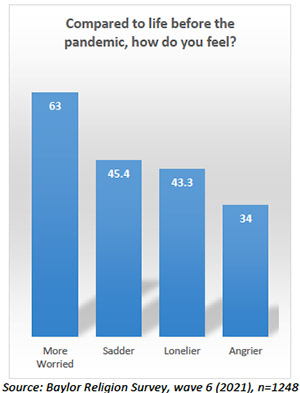
Findings from the latest national Baylor Religion Survey found the pandemic has made Americans significantly angrier, sadder, lonelier and more worried.

Wave 6 of the religion survey provided Baylor University researchers with an opportunity to examine the mental health of the American public by asking individuals to reflect on their emotional state during the pandemic compared to their life before.

Across four emotions—worried, sad, lonely and angry—more than one-third of Americans reported feeling these emotions more strongly compared to before the pandemic. This pattern particularly was apparent for feeling worried, especially for parents with children living at home.

Americans in poor physical health were more likely to experience all four negative emotions compared to those in better health.

“It is not surprising that parents with children also felt more worry. With abrupt school closures and the complete shut-down of social and recreational activities for children, parents had additional reasons to worry about the state of their children’s future and how to manage their care and education on a daily basis while in many cases shifting to remote work,” said researcher Laura Upenieks, assistant professor of sociology at Baylor.

Young and single adults, Democrats and urban Americans were the groups more likely to experience an increase in negative emotions due to the pandemic. While less likely to be in poor health, young adults—Americans age 18 to 34—in particular experienced increased feelings of loneliness and worry due to the pandemic.

“This group might have borne the brunt of heightened uncertainty as they found themselves trying to attain education or work credentials or trying to establish a career or family life. Such potent disruptions during these formative years, as well as a complete upheaval to their social lives, might have created greater emotional responses,” Upenieks said.

Republicans and Americans in rural areas felt the negative emotional impact of COVID somewhat less. Living in a less population-dense area may have influenced different emotional responses for rural residents, said researcher Rebecca Bonhag, a Baylor sociology doctoral candidate.

“Rural residents may have felt less at risk for infection or could have a stronger social support network living close by,” Bonhag said. “They are also more likely to be conservative, which ties in with the party affiliation trend we observe from the survey results. Polarized media consumption likely has something to do with the partisan trend.”

Baylor Religion Survey researchers now are delving deeper into the causes and effects of these emotional shifts and patterns. With the pandemic continuing to influence day-to-day life, there are concerns that negative emotional responses could continue to impact the lives of Americans.

“If research from the Great Recession of 2007 to 2009 has taught us anything, the emotional inequalities produced and further exacerbated by the COVID-19 pandemic will continue to reverberate for years to come. Every effort should be made to identify vulnerable groups and provide them adequate resources, like counseling, to manage these negative emotions before they potentially spiral into clinical diagnoses,” Upenieks said.


‘In Christ Alone’ still inspires after 20 years

NASHVILLE (RNS)—The melody that changed Keith Getty’s life was first scratched out on the back of an electric bill in a humble flat in Northern Ireland.

At the time, he thought it wasn’t that great. But it was the best he could come up with.

So, he sent a recording of the melody on a CD to Stuart Townend, an English songwriter he’d met a few months earlier at a church conference, in hopes Townend might be able to turn the melody into a serviceable hymn.

Getty was right.

Success came as a surprise to creators

That melody became the basis for “In Christ Alone,” released in 2001. It is one of the most popular songs in Protestant churches, according to the Christian Copyright Licensing International, which tracks songs sung in churches. The song also launched a new era of modern hymn writing.

And it all came as a surprise to the tune’s authors.

In a 2016 interview recounting the origins of “In Christ Alone,” Townend said there was nothing memorable about his meeting with Getty.

“We got together, we had a coffee, nothing particularly eventful happened,” Townend recalled. “He said he’d send me a CD with some of his song ideas. … It arrived and I wasn’t expecting anything.”

Then he popped in the CD and immediately changed his mind. He eventually called Getty and the two talked about writing a musical version of a church creed that would recount the story of the life, death and resurrection of Jesus.

The song originally started with the line “My hope is found in Christ alone.” Getty suggested switching the verse around to start with “In Christ alone.” After some hesitation, Townend did so, and the song came to life. Getty has described Townend’s lyrics for the song as “absolutely brilliant,” capturing the story of Christian faith in a powerful and lovely way.

Paved the way for other modern hymns

Getty has sometimes called “In Christ Alone” a “rebel song”—a kind of protest against the more contemporary worship songs that sound more like pop music than traditional hymns. It was the first of a series of modern hymns he’s helped write, combining singable melodies with theological reflection.

He believes they are the type of songs Christians need in a complicated and ever-changing world.

“If we’re going to build a generation of people who think deep thoughts about God, who have rich prayer lives, and who are the culture-makers of the next generation, we need to be teaching them songs with theological depth,” he said in a 2016 interview about his approach to hymn writing.

Keith and Kristyn Getty (Courtesy Image)

Getty and his wife, Kristyn, who perform together and tour with their four kids and an Irish-themed band, are back in Nashville, Tenn., after nine months on lockdown in Northern Island, where they have a home. Being back in Ireland was respite for the Gettys after a decade and a half of touring, recording and building a music publishing business. They spent much of the time walking on beaches, hanging with their kids and hosting weekly hymn sings on Facebook Live.

They returned to Nashville just in time for their annual Sing! conference, which is expected to draw about 6,500 people, with an additional 40,000 streaming online. The event, held this year on Sept. 13-15, has drawn more than 16,000 people in person in the past and has included packed hymn singing events at both the Grand Ole Opry and the Bridgestone Arena in downtown Nashville.

Presbyterian minister Kevin Twit, founder of Indelible Grace, a Nashville music company that sets traditional hymns to new tunes, is a big fan of the Gettys. He sees “In Christ Alone” as a marriage between well written and inspiring lyrics and a hymn tune that’s both compelling and flexible. The song works as well on a pipe organ with a choir as it does in a small church with a guitar and a handful of voices, he said.

“That’s hard to do,” he said.

Theological depth in contemporary setting

Twit, who leads the Reformed University Fellowship at Belmont University in Nashville, said “In Christ Alone” appeared on the scene just as a number of younger evangelicals were looking for songs with more theological depth than the contemporary songs they had learned in church growing up. Getty, Twit said, understands the way songs people sing in churches shape both their theology and the way they live their lives.

“I think he really gets that worship is formative,” he said.

Constance Cherry, professor emeritus of worship and pastoral ministry at Indiana Wesleyan University, believes “In Christ Alone” has succeeded by combining the traditional structure of a hymn with the kind of instrumentation used in more contemporary worship settings.

She said the structure of a hymn makes it easier for hymn writers like Getty and Townend to dig deep into a theological topic.

Cherry also appreciates that the Gettys are focused on creating hymns that make it easier for congregations to sing together. That’s a lost art, she said, in a time when many more contemporary worship songs are modeled after what is popular on the radio. While she appreciates contemporary praise songs, she said they are often focused more on the musicians than on the congregation.

“Every worship song in any worship service has one goal—and that is for the people to sing,” she said.

Brian Hehn, director of the Center for Congregational Song, the outreach arm of The Hymn Society in the United States and Canada, also points to the flexibility and beauty of the melody of “In Christ Alone” for the hymn’s enduring success. The melody falls in a comfortable range for most people and is simple and accessible while still intriguing to listen to. And it works for praise bands and choirs alike—a key to a successful congregational song, he said.

Broad and theologically complex lyrics

Townend’s lyrics, Hehn added, are beautifully crafted and full of nuance. They walk the worshipper through the life of Jesus, from the Incarnation—“Fullness of God in helpless babe,” as the hymn puts it—to the death of Jesus and then his resurrection. The song also connects God to the life of worshippers, “from life’s first cry to final death.”

Because of that, the hymn works in a variety of settings, from a Christmas or Easter celebration to a regular Sunday service.

The song also contains surprising theological complexity, said Hehn. It’s perhaps best known for a line about the wrath of God being satisfied in the crucifixion, which reflects a theology known as penal substitutionary atonement that’s commonly accepted in evangelical churches. But that has led other churches to change the lyrics of the hymn—and caused the song to be dropped from a Presbyterian Church (USA) hymnal after a proposed lyric change was rejected.

But “In Christ Alone” also references the Christus Victor view of the atonement, which celebrates Jesus’ victory over the grave, and the ransom view of the atonement, which stresses that God purchased forgiveness of human sin from the devil with the sacrifice of Jesus.

“I find that wonderfully broad,” he said.

While congregational singing may be on decline in American churches, Hehn said, it remains vital in many churches around the world. And there will always be a need for songs like “In Christ Alone.”

“No matter how you interpret the Bible, it is impossible to get around the fact that we’re supposed to sing together,” Hehn said.


Survey: Most Americans know and trust their neighbors

NASHVILLE, Tenn.—Despite quarantines and social distancing keeping people in their homes during the pandemic, Americans still say they know their neighbors, a Lifeway Research study reveals.

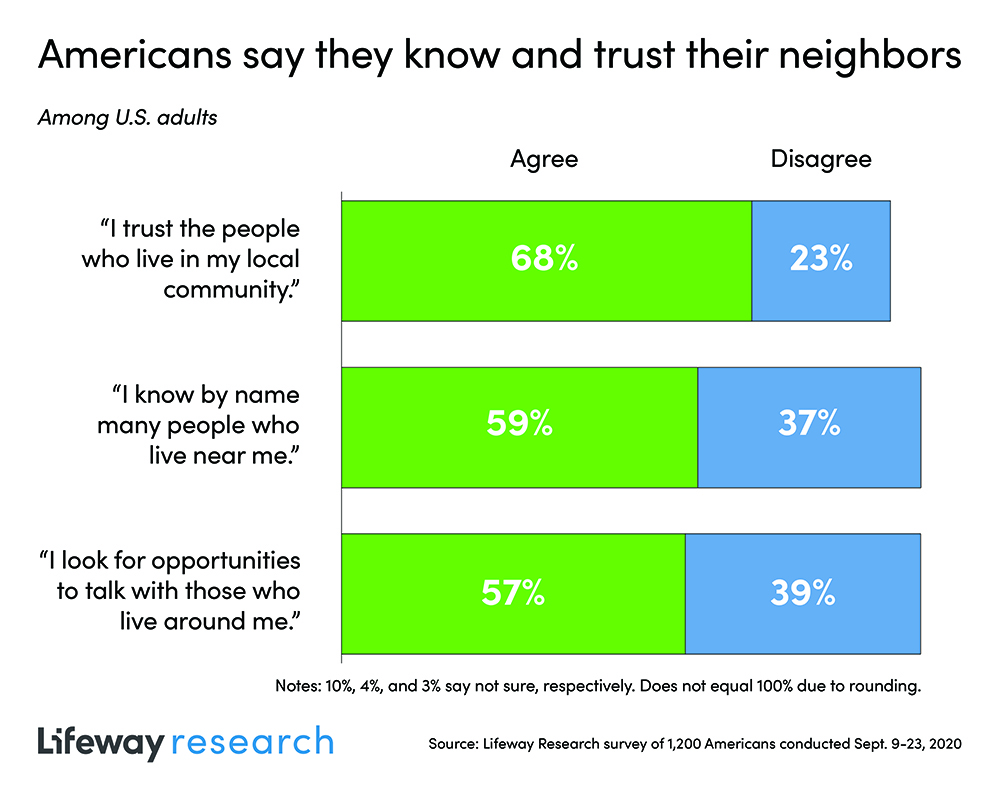
Almost 7 in 10 U.S. adults (68 percent) say they trust the people who live in their local community. Close to a quarter of Americans (23 percent) disagree, and 10 percent say they aren’t sure.

“Trust is the basis of a peaceful society,” said Scott McConnell, executive director of Lifeway Research. “It’s a hopeful sign that amid months of distancing and political unrest more than two-thirds of Americans trust those in their community.”

Men (72 percent) are more likely than women (63 percent) to say those who live around them are trustworthy. Those 65 and older are most likely to agree (79 percent), while younger adults, aged 18-34, are least likely to agree (59 percent).
Residents of the South (24 percent) are more likely than those in the Midwest (18 percent) to disagree and say they don’t trust the people who live in their community.

Religious identity makes a difference

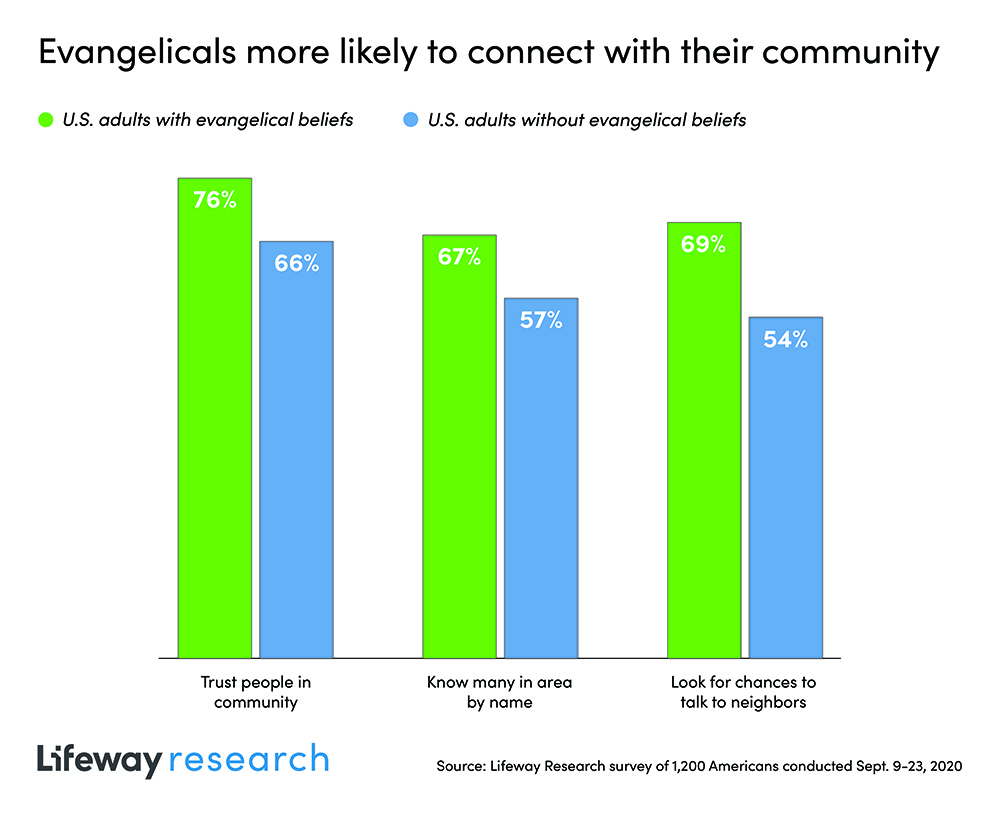
Religious identification and practice also play a role in the likelihood someone is trusting of those in their neighborhood. Protestants (71 percent) and Catholics (69 percent) are more likely to agree than the religiously unaffiliated (60 percent). Americans with evangelical beliefs (76 percent) are also more likely to trust their community than those without evangelical beliefs (66 percent).

Specifically among those who identify as Christian, those who attend church services at least four times a month (17 percent) are less likely than those who attend less than once a month (25 percent) to express doubt about trusting the people who live near them.

Six in 10 Americans (59 percent) say they know the names of many people who live near them. More than a third (37 percent) disagree, and 4 percent aren’t sure.

Those with a bachelor’s degree or more (65 percent) are more likely than those who have a high school diploma or less (55 percent) to know those in their neighborhood by name. Among religious groups, the unaffiliated are most likely to disagree (44 percent).

Christians who attend church at least monthly (71 percent) are more likely than those who attend less frequently (51 percent) to say they know the names of their neighbors. American adults who hold evangelical beliefs (67 percent) are also more likely than those without such beliefs (57 percent) to say they know the people who live near them by name.

“Remembering the names of people you meet is the first sign that you care about them,” McConnell said. “For Christians, caring can also include praying for those individuals by name and for their relationship with God.”

Looking for conversations and connections

The conversations may have taken place through masks or six feet apart, but most U.S. adults are seeking chances to have a conversation with their neighbors.

Almost 3 in 5 Americans (57 percent) say they look for opportunities to talk with the people who live around them. Four in 10 disagree (39 percent), and 3 percent aren’t sure.

Again, men (65 percent) are more likely than women (50 percent) to seek out such moments of conversation. Those 65 and older (69 percent) are the age range most likely to agree.

Those with a bachelor’s degree (66 percent) or a graduate degree (64 percent) are more likely than those with a high school diploma or less (51 percent) to look for opportunities to talk with neighbors.

The religiously unaffiliated are the most likely to want to stick to themselves, as 49 percent disagree they are seeking such community conversations.

Christians who attend church at least monthly (71 percent) are more likely than those who attend less frequently (51 percent) to look for opportunities to talk to those who live around them. Those with evangelical beliefs (69 percent) are also more likely than those without such beliefs (54 percent) to want those times of discussion.

“Those with lower trust and fewer connections in the community are also the groups less likely to want to seek out conversations with others. This is true of the religiously unaffiliated and those with a lower socioeconomic level,” McConnell said.

“Despite a greater interest in talking with neighbors among Christians who frequently attend church, a Lifeway Research study before COVID revealed that these conversations do not always include faith. In fact, 55 percent of Protestant churchgoers had not shared with anyone how to become a Christian in the previous six months.”

The online survey was conducted Sept. 9-23, 2020, using a national pre-recruited panel. Researchers used quotas and slight weights to balance gender, age, region, ethnicity, education and religion to reflect the population more accurately. The completed sample of 1,200 surveys provides 95 percent confidence that the sampling error from the panel does not exceed plus or minus 3.2 percent. Margins of error are higher in sub-groups.


NRB spokesman fired after pro-vaccine statements

WASHINGTON (RNS)—The spokesman for a major evangelical nonprofit was fired for promoting vaccines on the MSNBC “Morning Joe” cable news show.

Daniel Darling, senior vice president of communications for the National Religious Broadcasters, was fired Aug. 27 after refusing to admit his pro-vaccine statements were mistaken, according to a source authorized to speak for Darling.

Daniel Darling, senior vice president of communications for the National Religious Broadcasters, was fired for promoting vaccines on the MSNBC “Morning Joe” cable news show. (Screen Capture Image)

His firing comes at a time when Americans face a new surge of COVID-19 infections due to the highly contagious Delta variant even as protesters and politicians resist mask mandates or other preventive measures.

During a broadcast on Aug. 2, Darling, an evangelical pastor and author, told host Joe Scarborough about how his faith motivated him to get a COVID-19 vaccine. Darling described the vaccines as an amazing feat of discovery by scientists, some of whom share his Christian faith.

Darling said he was proud to be vaccinated.

“I believe in this vaccine, because I don’t want to see anyone else die of COVID. Our family has lost too many close friends and relatives to COVID, including an uncle, a beloved church member and our piano teacher,” Darling told Scarborough.

He expressed similar views in a recent USA Today opinion piece.

Fired without severance

Earlier this week, leaders at NRB, an international association of Christian communicators with 1,100 member organizations, told Darling his statements violated the organization’s policy of remaining neutral about COVID-19 vaccines. According to the source, Darling was given two options—sign a statement admitting he had been insubordinate or be fired.

When he refused to sign a statement, Darling was fired and given no severance, the source told RNS.

Troy Miller, CEO of NRB, confirmed Darling no longer was with the organization. He did not respond to a question about the role Darling’s statements about vaccines played in his departure.

“Dan is an excellent communicator and a great friend. I wish him God’s best in all his future endeavors,” Miller told RNS in an email.

In a statement reported by Ruth Graham of the New York Times, Darling said he was “sad and disappointed that my time at NRB has come to a close.”

“I am grieved that the issues that divide our country are dividing Christians,” he said, adding that he intended to devote himself to “unifying believers around the truth of the gospel.”


Book examines policies shaping Dallas neighborhoods

Collin Yarbrough, who grew up in Wilshire Baptist Church in Dallas, recently published Paved a Way: Infrastructure, Policy and Racism in an American City about the city he’s called home most of his life.

Through his work in utility engineering and some graduate research, Yarbrough learned about the unjust side of city zoning and planning. In particular, he learned how historic Black and Hispanic neighborhoods were disinvested in and later demolished, paved over, cut off or redeveloped to the exclusion of those historic communities.

In Paved a Way, which is not necessarily written with the church in mind and contains some gritty language, Yarbrough shares back stories of Little Mexico, Deep Ellum, Fair Park, Tenth Street and Central Expressway through North Dallas.

From his narrative, the church can gain a glimpse into forces affecting their communities, their members and even their properties. The following author interview focuses on those aspects of the book.

You mention being a utility engineer in the past tense. What work do you currently do?

I am currently a full-time graduate student starting my Ph.D. in civil engineering this fall. Most of my work and research centers around infrastructure and environmental justice issues in our cities.

What faith principles guide your decisions in that work?

Justice for the marginalized is such a recurrent theme in the biblical text. In my time at seminary, it really was those understandings of repeated calls for justice that called me back to engineering. One thing is for certain, when we talk about building the kingdom of God, we are a long way off from “on earth as it is in heaven.”

Why did you choose the five neighborhoods you cover in Paved a Way?

It really was just following the unraveling of history as I continued finding stories and digging deeper into Dallas’ history. It started with the North Dallas Freedman’s Town, and as I continued to follow Central Expressway to other highways surrounding downtown Dallas, I found neighborhoods like Little Mexico and unheard histories of places like Deep Ellum and Fair Park.

You mention speeding past neighborhoods on Central Expressway or the Dallas North Tollway without being aware of the old neighborhoods you were driving past. Knowing what you know now, what signs can people look for to recognize unjust zoning or city planning in their communities?

The first sign is to think about your city and ask if there is a neighborhood described as being “undesirable.” Chances are good that neighborhood did not come by that narrative by accident, but is the product of disinvestment over time. I also look for areas where industrial facilities are located and even where brand new developments may be going up, signaling a change in a neighborhood.

Where do you see the same practices happening in other Dallas neighborhoods? Lake Highlands in northeastern Dallas, especially along Skillman Street, comes to mind.

That stretch of Skillman has been on my mind for about a decade and is probably my first inkling of understanding injustice in the built environment.

When I was in college, there were several affordable apartment complexes right in the heart of Lake Highlands. They were torn down and the land sat vacant—some still is—for years before new higher-end development was put up. Today, the diversity breakdown at nearby Lakewood Elementary tells you everything you need to know.

This is happening similarly in Trinity Groves in West Dallas and the Bishop Arts District in North Oak Cliff, just to name a couple.

You ask important questions throughout the book and seem to leave the answers to readers, rather than answering them yourself. For example: “Who makes the final decisions in this neighborhood? Who is left out? Who determines the value of space? Who designed [roads, buildings and neighborhoods]? What was there before them? What needs did they serve?”

Why did you use that approach?

I felt if I directly answered the questions for readers, they might feel let off the hook of doing any self-reflection themselves. Readers also are getting a glimpse into the kinds of questions I continue to come back to in my own mind, day after day. They’re a meditation on the built environment.

Stories abound of once-thriving churches struggling to survive as their neighborhoods change. I imagine many of those churches are caught up in the kind of disinvestment you discuss. How are churches affected by unjust zoning and city planning?

You’re exactly right. In fact, there is a church in West Dallas across the street from the largest sulfur dioxide polluter in Dallas County—GAF Shingles. I was at a community organizing meeting a few weeks ago when the pastor of that church raised his hand asking if his congregation was safe. Congregational health takes on a whole new meaning when you consider that context.

In practical terms, how can churches be involved in seeking justice in the zoning and planning of their surrounding communities?

The biggest thing is getting outside the walls of the church and being engaged with and following the lead of your surrounding communities. So much of this work is as simple as being aware of what is going on in our cities.

In my experience, neighborhood groups and nonprofits made up of members of the community are keenly aware of injustices there, and those are the voices I seek out.


Coach Bowden saw players as more than a jersey

TALLAHASSEE, Fla. (BP)—Clint Purvis walked the sidelines with Bobby Bowden 21 years and was his friend for 33.

In that time, he witnessed a sporting legend grow, as Bowden became one of the winningest college football coaches in history, leading Florida State University to two national championships.

But for Purvis, longtime chaplain for the FSU football team, those accolades only begin to tell the impact left by Bowden, who died Aug. 8.

“He was anointed and had God’s favor,” Purvis told Baptist Press. “Tallahassee isn’t exactly like the Bible Belt. Coach was able to present the message of Christ in such a way that even those who didn’t want anything to do with God respected him. He was one of the most competitive men I knew and wanted to win, but he wanted every player who came to this place to know Jesus and that he could make a difference in their life.”

‘At peace’ when he faced pancreatic cancer

In July, Bowden announced he had been diagnosed with a terminal medical condition his son, Terry, recently disclosed as pancreatic cancer.

“I’ve always tried to serve God’s purpose for my life, on and off the field, and I am prepared for what is to come,” the 91-year-old Bowden said in a statement July 21. “My wife Ann and our family have been life’s greatest blessing. I am at peace.”

A month earlier, Bowden had made his last public appearance at the North American Mission Board’s Send Luncheon, surprising friend and fellow coach Mark Richt.

As a head coach at the University of Georgia and University of Miami, Richt’s testimony had become as regarded as his skill in winning football games. Now as Send Relief’s national spokesperson, Richt was asked by NAMB President Kevin Ezell to recount his testimony and Bowden’s influence when Richt was an assistant coach at Florida State.

“If Coach Bowden were here today, what would you say to him?” Ezell asked. Before Richt could finish his answer, Ezell motioned to Bowden, sitting in a chair positioned behind Richt, for the reunion.

“Prayers for Ann and the Bowden family!” Richt posted to Twitter on Aug. 9. “Much love and respect and thankfulness for Coach’s influence in my life!!”

Long and notable career in college football

A native of Birmingham, Ala., Bowden was a star athlete at Woodlawn High School who dreamed of being a quarterback at the University of Alabama. He accomplished that goal, but after one semester in Tuscaloosa, he moved back to Birmingham to marry his high school girlfriend, Ann Estock, and transfer to Howard University.

Bowden played at Howard, now Samford University, but it would also become his first football coaching job when he took an assistant position there. He moved on to be the head football, baseball and basketball coach at South Georgia College before moving back to Howard as head football coach, compiling a 31-6 record. An assistant coaching position at Florida State followed before Bowden moved to become an assistant coach at West Virginia University.

In 1968, WVU’s in-state rival, Marshall University, made a strong push for Bowden to be its next head coach. Bowden thought about it, but declined. He eventually would become West Virginia’s head football coach. In his first year at WVU, the plane transporting Marshall’s football team and coaches home from a game crashed, killing everyone on board.

“I’ve thought about that a lot over the years,” he said. “That could have easily been me coaching that team, and I’d have been wiped out just like all the others. … There were a lot of people I knew on that plane—a lot of good people.”

Bowden became the head coach in Tallahassee in 1976. The Seminoles had won only four games over the previous three seasons. Florida State went 5-6 in Bowden’s first year, and it was his only losing record at the school.

Success came so quickly that in the 1980s, head-coaching offers came from Louisiana State University, Auburn and Alabama. The Crimson Tide actually had two opportunities to hire Bowden, passing on him the first time for Bill Curry. In 1990 it was Bowden’s chance to say ‘no thanks,’ and Alabama hired Gene Stallings.

Operated with an eternal perspective

By that time, Bowden was 60 years old, and he considered Florida State “his school.” Time had become a factor, and instances like the Marshall plane crash had given Bowden a perspective on eternity that became intertwined with his coaching philosophy.

The 1986 death of lineman Pablo Lopez led Bowden to present the gospel to his team the next morning, an action that led Richt to faith in Christ. Hours after Bowden’s death, Purvis posted to Facebook a handwritten letter from Bowden to his children that he wrote after a car accident took the life of his grandson and son-in-law the week of the 2000 Miami game. The letter explained that though they mourned at the moment, their faith continued to be in Jesus.

Bowden was a member of First Baptist Church in Tallahassee 43 years before joining Bradfordville First Baptist, another area church, in May 2019. Alongside his duties as FSU football chaplain, Purvis also serves in ministry through First Baptist.

Bowden’s high profile opened up opportunities to witness, but he was strategic about it, said Purvis, who prayed with Bowden a week before he died.

“He was very good at doing it in such a way that it didn’t offend others,” he said. “If those of other faiths respected him as a man, they’d respect his message. You have to earn the right to be heard, and he earned the right to present the message.”

In the competitive world of big-time college football, the right to be heard tends to come with winning. In the early 1990s, stacked FSU teams had heartbreaking back-to-back losses to in-state rival Miami when each year a wide-right field goal in the final seconds dashed the Seminoles’ championship hopes.

Bowden ‘saw the big picture’

Not even the team chaplain was safe from ridicule, as people told Purvis he hadn’t prayed hard enough for those footballs to curve left. He’s fairly certain they weren’t kidding.

“Any loss was tough on Coach, but at the same time, he saw the big picture and knew that anything he did was sovereign under the lordship of Jesus Christ,” Purvis said. “God’s will was bigger than his wishes.”

In 1993, Florida State finally celebrated its first football national championship. For Bowden, the weight of winning the big one had finally lifted. FSU’s success continued throughout the decade, which ended with another national title after the 1999 season.

Under Bowden, the FSU team attended church every Sunday, in keeping with a promise the coach made to parents in living rooms across America while on the recruiting trail. Those of other faiths or who didn’t want their son to attend were not compelled to do so, but the overwhelming majority were thankful, Purvis said.

That became part of Bowden’s legacy as well. Many of his players didn’t come from Christian backgrounds or have a Christian witness. They grew up around drugs and gangs. Those influences and decisions often followed them to Tallahassee. When it came to administering discipline, Bowden relied on his Christian faith.

“He learned to not take a situation at face value,” Purvis said. “There was always another side to the story. Some people make mistakes with their heart, some with their head. When that mistake comes from the heart, it’s probably a character issue. A lot of these players, though, make mistakes with their head. They’re young, naïve and need correction.

“He always said he treated his players the way he would want someone to treat his own children. He didn’t see them as just a number or position. He saw beyond the uniform they wore to the people they are.”


Americans most want to avoid fear and anxiety

NASHVILLE, Tenn.—After what was a scary year for many, more Americans say they want to avoid fear.

According to a study from Nashville-based Lifeway Research, when asked which feelings they seek to avoid the most, 4 in 10 U.S. adults (41 percent) say fear. Far fewer say shame (24 percent) or guilt (22 percent). Around 1 in 10 aren’t sure.

Fear topping the list is a marked change from a 2016 Lifeway Research study that found Americans more evenly divided, but with shame (38 percent) being the emotion people most wanted to avoid, followed by guilt (31 percent) and fear (30 percent).

“For many Americans, circumstances in 2020 led to an increased focus on their fears,” said Scott McConnell, executive director of Lifeway Research. “Many feared getting COVID; others feared social unrest during protests; and politicians played on people’s fears in ads and speeches.”
Adherents of non-Christian religions (57 percent), adults 65 and older (49 percent), and those with a high school diploma or less (46 percent) are among the Americans most likely to say they want to avoid fear most of all.

Whites (25 percent) and African Americans (30 percent) are more likely to try to avoid shame than Hispanics (18 percent). But whites (23 percent) and Hispanics (25 percent) are more likely to want to avoid feelings of guilt than African Americans (15 percent).

When thinking about the adversity they faced last year, Americans looked around, looked up and looked at their bank accounts to provide them with hope.

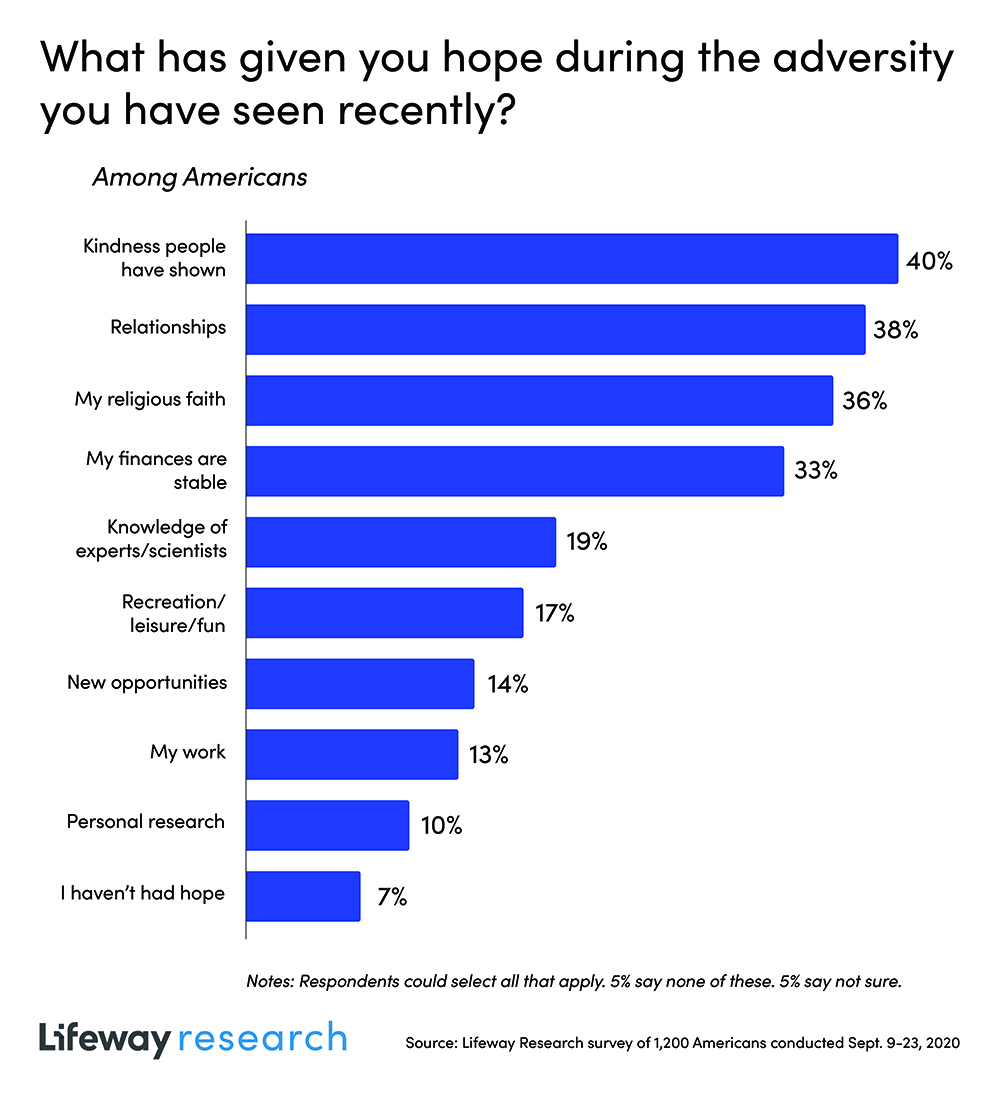
The top source of hope for U.S. adults through 2020 is the kindness people have shown (40 percent), followed closely by relationships (38 percent), their religious faith (36 percent), and their finances being stable (33 percent).

“About half as many Americans who identify with a religious faith credit that faith with giving them hope during 2020,” McConnell said. “The Christian faith points followers of Jesus to a more hopeful future, which should shine even brighter during dark times.”

Fewer Americans drew hope from the knowledge of scientists and experts (19 percent), recreation or fun they had (17 percent), new opportunities (14 percent), their work (13 percent), or research they’ve done themselves (10 percent). One in 20 say none of these (5 percent) or they’re not sure (5 percent).

Around 1 in 14 U.S. adults (7 percent) say they haven’t had any source of hope during the problems they’ve faced in 2020.

Americans who struggle to find hope are more likely to be those with a high school diploma or less (8 percent) and the religiously unaffiliated (12 percent). Only 1 percent of Americans with evangelical beliefs say they had no hope in 2020 compared to 8 percent of those without such beliefs. Among Christians, those who attend worship services four times a month or more (2 percent) are less likely than those who attend less than once a month (7 percent) to have faced last year without hope.

When asked what they desire most in life, Americans are more likely to choose personal freedom (36 percent) than a desire to overcome (32 percent) or a desire for respect (24 percent), while 8 percent aren’t sure. In 2016, Lifeway Research found 40 percent of Americans had a desire for personal freedom, 28 percent a desire to overcome and 31 percent a desire for respect.

“The events of 2020 led some to reevaluate their priorities, with fewer desiring respect. But most responded from what was already a priority for them,” McConnell said. “Resistance to social distancing mandates was likely motivated by the desire for personal freedom. Speaking up about racial injustice was likely motivated by the desire to overcome power differences in society.”

Men (39 percent) are more likely than women (33 percent) to say they desire personal freedom most of all. College graduates (44 percent) are also more likely than those with a high school diploma or less (32 percent) to point to freedom as their top desire.

Younger adults are more likely to say they want to overcome, and older adults are more likely to want respect.

African Americans (39 percent) and Hispanics (40 percent) are more likely than whites (28 percent) to say they most desire to overcome.

U.S. adults are almost twice as likely to say the outcome they value most is obtaining security and safety (45 percent) compared to reaching their potential (25 percent) or bringing honor to my family and friends (24 percent).

Women (48 percent), along with adults 50-64 (51 percent) and those 65 and older (55 percent) are among those who most value safety. Younger adults (18-34) are the most likely to say their primary value is reaching their potential (39 percent).

While Americans overwhelmingly say they get the most satisfaction from doing the right thing, they’d much rather eliminate anxiety from their lives than wrongdoing.

Around 4 in 5 adults (79 percent) say it would bring them the most satisfaction to know they had done the right thing, compared to their political party being in power (7 percent) or obtaining social recognition or status (7 percent).

When asked what they would remove completely from their life if they could, however, Americans pick anxiety (46 percent) over wrongdoing (34 percent) and humiliation (11 percent).

U.S. adults are also most likely to say someone suffering unfairly (60 percent) angers them the most compared to someone breaking the law (29 percent) or someone embarrassing their community (5 percent).

“When Americans approach life so differently, it’s not surprising that we frequently misunderstand each other,” said McConnell.

The online survey of 1,200 Americans was conducted Sept. 9-23, 2020, using a national pre-recruited panel. Analysts used quotas and slight weights to balance gender, age, region, ethnicity, education and religion to reflect the population more accurately. The completed sample of 1,200 surveys provides 95 percent confidence the sampling error from the panel does not exceed plus or minus 3.2 percent. Margins of error are higher in sub-groups.


John Lewis’ co-author talks faith and voting rights

WASHINGTON (RNS)—Famed congressman John Lewis once told his then-campaign worker Andrew Aydin how a comic book depicting Martin Luther King Jr. played a key role in raising awareness about the civil rights movement.

Decades later, Lewis and Aydin teamed up to create the award-winning March, a graphic novel trilogy that tells the story of the civil rights movement from Lewis’ perspective

Andrew Aydin. (Photo by The 1Point8)

Now, Aydin is helping shepherd Run, written in partnership with Lewis, who died last year, and an artistic team. The new graphic novel continues the story of March after voting rights legislation was adopted but not welcomed by all.

Aydin, a white Christian with United Methodist roots, was Lewis’ digital director and policy adviser and is co-founder of Good Trouble Productions, which produces nonfiction graphic novels.

“In this book we ask the question: Is America ready to share its bounty with people of color?” said Aydin, who wrote his Georgetown University master’s thesis on the 1957 comic book about King.

“I think if you look at this through a religious lens, it is long overdue that America should share its bounty with all people, including and most specifically people of color, who’ve been left out and left behind for too long.”

Aydin, 37, talked to Religion News Service about the message of Run, what he learned from Lewis and the role of the faith community in continuing voting rights activism.

The interview has been edited for length and clarity.

It has been just over a year since the death of John Lewis, who was your mentor, your boss and your friend. Is there a key moral or spiritual lesson from him that you continue to carry with you?

The lesson I hold with me most from John Lewis and his life and his example is that you have to be persistent. You have to keep pushing and pulling. You have to keep working ’cause the struggle never ends. We’re only shepherds of it during our time.

The book opens with a scene outside a church two days after the Voting Rights Act was signed into law in 1965, with John Lewis and other protesters seeking to worship at a white church in Americus, Ga. What did that timing show?

Opening the book two days after the signing of the Voting Rights Act, at a protest in Americus, Ga., in which John Lewis was arrested, is meant to show how fast the pushback was to the progress, how slow the implementation of these laws was at that time and continues to be. That just because you had a law on the books didn’t mean the struggle was over, didn’t mean change had happened.

The civil rights protesters were met by a Ku Klux Klan leader who declared, “The Klan is the only salvation of the white man other than Jesus Christ.” How would you compare John Lewis’ approach to the intersection of race and religion with that of the Klan members?

I think the Klan frequently perverted the teachings of Jesus Christ, particularly the New Testament, to their own purposes to manipulate people. And it’s unfortunate. John Lewis was a devotee of the social gospel, of the gospel Dr. King preached. It’s important to understand this conflict because we’ve seen it continue to play out in our politics, in our religious communities throughout the country up to today, and it’s no doubt going to continue. I think you hear sometimes people misquoting Scripture for their own ends. There’s an all-too-often occurrence of cloaking themselves in religion as the means to deflect from the sinister motives.

The book tells of the death of Episcopal seminarian Jonathan Daniels and the attack on then-Catholic priest Richard Morrisroe in Lowndes County, Ala. John Lewis expresses his frustration that “the white supremacist power structure continued to be willing to murder in cold blood” to halt voting rights of Black people. Did he have an answer for how to counter that?

It gets back to the central conflict. It is incredibly difficult to separate the pain of seeing Black and white bodies beaten, murdered and killed because of what they believe in and because of the fight for equality. And that can hurt people’s soul. It can cause them to become bitter, and it can cause them to become hostile.

John Lewis was always trying to keep people together. He would say, “Don’t get down. Do not become lost in a sea of despair. Be hopeful. Be optimistic.” That’s why this book is dedicated to the preachers of hope. Because the only way to survive, the only way to succeed is to maintain that discipline and that hope and that optimism. Because it’s the only thing that’s worked.

As John Lewis eventually withdrew completely from the Student Nonviolent Coordinating Committee, how did his faith help him manage the rejection from a movement he described as having been his family?

John Lewis was raised and trained in the Baptist tradition. And part of that is understanding you will face good days and bad, you will be tested, you will have to endure if you want to succeed and if you want to help people.

The book illustrates the role of religious leaders in the fight for voting rights in the 1960s. How do you compare that work to the involvement of faith leaders in the new battles over voting rights occurring today?

The movement was led by reverends and ministers, and they’re a model for what faith leaders can do today to guarantee every citizen the right to participate equally in the democratic process. If you’re going to be a moral leader of your community, if you’re going to be a faith leader in your community, that means you have an obligation to ensure each person is counted, each person has a voice, each person is treated as a valuable equal human being, with all the rights and privileges that come with it.

Like John Lewis, you express hope in achieving the beloved community he long sought. How long do you think that will take and do you ever doubt it will be achieved?

I believe it will be achieved. But it may take a lifetime. It may take many lifetimes. This is the perpetual struggle, and even if it is achieved that does not mean the struggle is over, because then you have to protect it. We’ve seen that same struggle with the Voting Rights Act. Just because it was passed and reauthorized in a bipartisan way many times over since, sections have been struck down, it’s not been reauthorized, we can’t get new legislation through the Congress anymore.

When we think about that in the context of the beloved community, it’s the perfect example, because even if we do achieve it tomorrow, it does not mean the struggle is over. That means it’s only begun a new chapter.