Americans most want to avoid fear and anxiety

NASHVILLE, Tenn.—After what was a scary year for many, more Americans say they want to avoid fear.

According to a study from Nashville-based Lifeway Research, when asked which feelings they seek to avoid the most, 4 in 10 U.S. adults (41 percent) say fear. Far fewer say shame (24 percent) or guilt (22 percent). Around 1 in 10 aren’t sure.

Fear topping the list is a marked change from a 2016 Lifeway Research study that found Americans more evenly divided, but with shame (38 percent) being the emotion people most wanted to avoid, followed by guilt (31 percent) and fear (30 percent).

“For many Americans, circumstances in 2020 led to an increased focus on their fears,” said Scott McConnell, executive director of Lifeway Research. “Many feared getting COVID; others feared social unrest during protests; and politicians played on people’s fears in ads and speeches.”

Adherents of non-Christian religions (57 percent), adults 65 and older (49 percent), and those with a high school diploma or less (46 percent) are among the Americans most likely to say they want to avoid fear most of all.

Whites (25 percent) and African Americans (30 percent) are more likely to try to avoid shame than Hispanics (18 percent). But whites (23 percent) and Hispanics (25 percent) are more likely to want to avoid feelings of guilt than African Americans (15 percent).

When thinking about the adversity they faced last year, Americans looked around, looked up and looked at their bank accounts to provide them with hope.
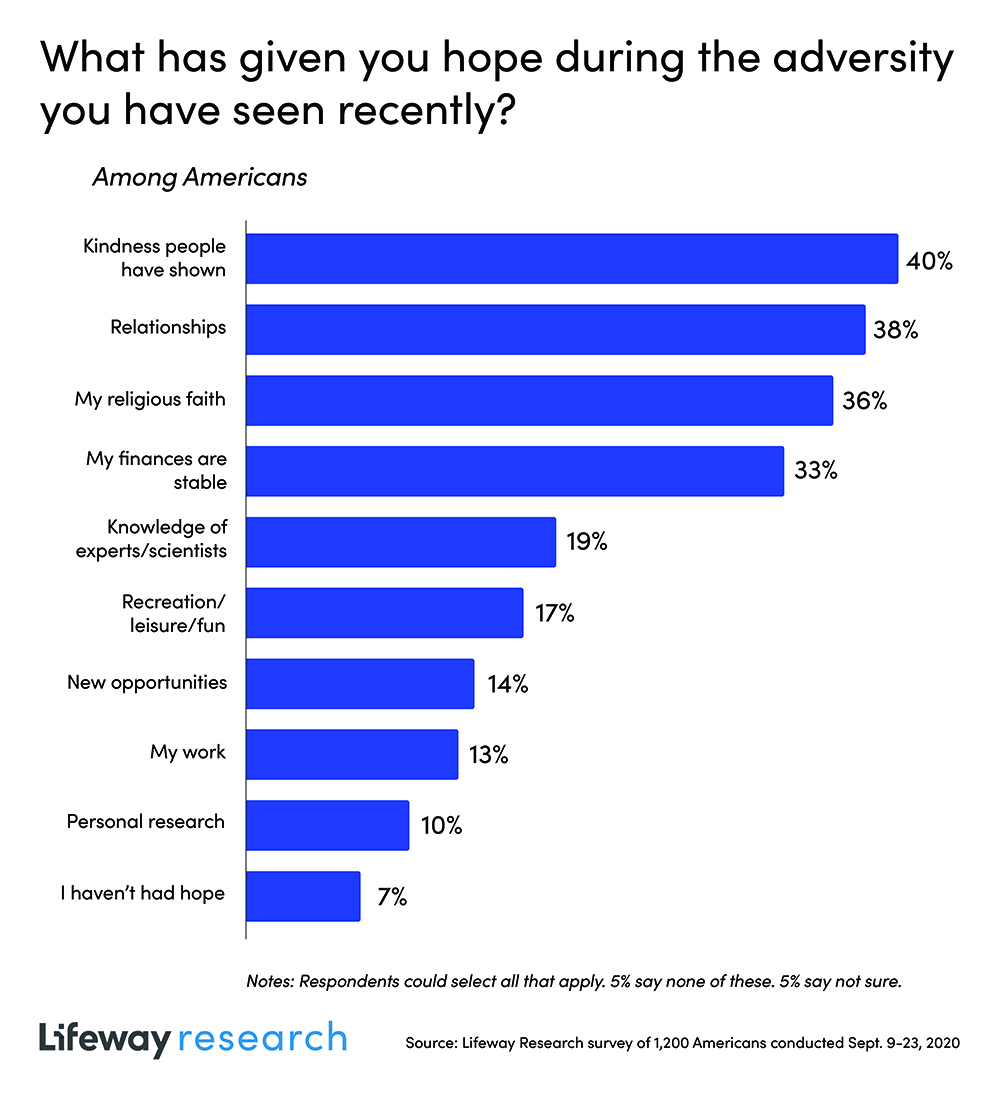
The top source of hope for U.S. adults through 2020 is the kindness people have shown (40 percent), followed closely by relationships (38 percent), their religious faith (36 percent), and their finances being stable (33 percent).

“About half as many Americans who identify with a religious faith credit that faith with giving them hope during 2020,” McConnell said. “The Christian faith points followers of Jesus to a more hopeful future, which should shine even brighter during dark times.”

Fewer Americans drew hope from the knowledge of scientists and experts (19 percent), recreation or fun they had (17 percent), new opportunities (14 percent), their work (13 percent), or research they’ve done themselves (10 percent). One in 20 say none of these (5 percent) or they’re not sure (5 percent).

Around 1 in 14 U.S. adults (7 percent) say they haven’t had any source of hope during the problems they’ve faced in 2020.

Americans who struggle to find hope are more likely to be those with a high school diploma or less (8 percent) and the religiously unaffiliated (12 percent). Only 1 percent of Americans with evangelical beliefs say they had no hope in 2020 compared to 8 percent of those without such beliefs. Among Christians, those who attend worship services four times a month or more (2 percent) are less likely than those who attend less than once a month (7 percent) to have faced last year without hope.

When asked what they desire most in life, Americans are more likely to choose personal freedom (36 percent) than a desire to overcome (32 percent) or a desire for respect (24 percent), while 8 percent aren’t sure. In 2016, Lifeway Research found 40 percent of Americans had a desire for personal freedom, 28 percent a desire to overcome and 31 percent a desire for respect.

“The events of 2020 led some to reevaluate their priorities, with fewer desiring respect. But most responded from what was already a priority for them,” McConnell said. “Resistance to social distancing mandates was likely motivated by the desire for personal freedom. Speaking up about racial injustice was likely motivated by the desire to overcome power differences in society.”

Men (39 percent) are more likely than women (33 percent) to say they desire personal freedom most of all. College graduates (44 percent) are also more likely than those with a high school diploma or less (32 percent) to point to freedom as their top desire.

Younger adults are more likely to say they want to overcome, and older adults are more likely to want respect.

African Americans (39 percent) and Hispanics (40 percent) are more likely than whites (28 percent) to say they most desire to overcome.

U.S. adults are almost twice as likely to say the outcome they value most is obtaining security and safety (45 percent) compared to reaching their potential (25 percent) or bringing honor to my family and friends (24 percent).

Women (48 percent), along with adults 50-64 (51 percent) and those 65 and older (55 percent) are among those who most value safety. Younger adults (18-34) are the most likely to say their primary value is reaching their potential (39 percent).

While Americans overwhelmingly say they get the most satisfaction from doing the right thing, they’d much rather eliminate anxiety from their lives than wrongdoing.

Around 4 in 5 adults (79 percent) say it would bring them the most satisfaction to know they had done the right thing, compared to their political party being in power (7 percent) or obtaining social recognition or status (7 percent).

When asked what they would remove completely from their life if they could, however, Americans pick anxiety (46 percent) over wrongdoing (34 percent) and humiliation (11 percent).

U.S. adults are also most likely to say someone suffering unfairly (60 percent) angers them the most compared to someone breaking the law (29 percent) or someone embarrassing their community (5 percent).

“When Americans approach life so differently, it’s not surprising that we frequently misunderstand each other,” said McConnell.

The online survey of 1,200 Americans was conducted Sept. 9-23, 2020, using a national pre-recruited panel. Analysts used quotas and slight weights to balance gender, age, region, ethnicity, education and religion to reflect the population more accurately. The completed sample of 1,200 surveys provides 95 percent confidence the sampling error from the panel does not exceed plus or minus 3.2 percent. Margins of error are higher in sub-groups.



John Lewis’ co-author talks faith and voting rights

WASHINGTON (RNS)—Famed congressman John Lewis once told his then-campaign worker Andrew Aydin how a comic book depicting Martin Luther King Jr. played a key role in raising awareness about the civil rights movement.

Decades later, Lewis and Aydin teamed up to create the award-winning March, a graphic novel trilogy that tells the story of the civil rights movement from Lewis’ perspective

Andrew Aydin. (Photo by The 1Point8)

Now, Aydin is helping shepherd Run, written in partnership with Lewis, who died last year, and an artistic team. The new graphic novel continues the story of March after voting rights legislation was adopted but not welcomed by all.

Aydin, a white Christian with United Methodist roots, was Lewis’ digital director and policy adviser and is co-founder of Good Trouble Productions, which produces nonfiction graphic novels.

“In this book we ask the question: Is America ready to share its bounty with people of color?” said Aydin, who wrote his Georgetown University master’s thesis on the 1957 comic book about King.

“I think if you look at this through a religious lens, it is long overdue that America should share its bounty with all people, including and most specifically people of color, who’ve been left out and left behind for too long.”

Aydin, 37, talked to Religion News Service about the message of Run, what he learned from Lewis and the role of the faith community in continuing voting rights activism.

The interview has been edited for length and clarity.

It has been just over a year since the death of John Lewis, who was your mentor, your boss and your friend. Is there a key moral or spiritual lesson from him that you continue to carry with you?

The lesson I hold with me most from John Lewis and his life and his example is that you have to be persistent. You have to keep pushing and pulling. You have to keep working ’cause the struggle never ends. We’re only shepherds of it during our time.

The book opens with a scene outside a church two days after the Voting Rights Act was signed into law in 1965, with John Lewis and other protesters seeking to worship at a white church in Americus, Ga. What did that timing show?

Opening the book two days after the signing of the Voting Rights Act, at a protest in Americus, Ga., in which John Lewis was arrested, is meant to show how fast the pushback was to the progress, how slow the implementation of these laws was at that time and continues to be. That just because you had a law on the books didn’t mean the struggle was over, didn’t mean change had happened.

The civil rights protesters were met by a Ku Klux Klan leader who declared, “The Klan is the only salvation of the white man other than Jesus Christ.” How would you compare John Lewis’ approach to the intersection of race and religion with that of the Klan members?

I think the Klan frequently perverted the teachings of Jesus Christ, particularly the New Testament, to their own purposes to manipulate people. And it’s unfortunate. John Lewis was a devotee of the social gospel, of the gospel Dr. King preached. It’s important to understand this conflict because we’ve seen it continue to play out in our politics, in our religious communities throughout the country up to today, and it’s no doubt going to continue. I think you hear sometimes people misquoting Scripture for their own ends. There’s an all-too-often occurrence of cloaking themselves in religion as the means to deflect from the sinister motives.

The book tells of the death of Episcopal seminarian Jonathan Daniels and the attack on then-Catholic priest Richard Morrisroe in Lowndes County, Ala. John Lewis expresses his frustration that “the white supremacist power structure continued to be willing to murder in cold blood” to halt voting rights of Black people. Did he have an answer for how to counter that?

It gets back to the central conflict. It is incredibly difficult to separate the pain of seeing Black and white bodies beaten, murdered and killed because of what they believe in and because of the fight for equality. And that can hurt people’s soul. It can cause them to become bitter, and it can cause them to become hostile.

John Lewis was always trying to keep people together. He would say, “Don’t get down. Do not become lost in a sea of despair. Be hopeful. Be optimistic.” That’s why this book is dedicated to the preachers of hope. Because the only way to survive, the only way to succeed is to maintain that discipline and that hope and that optimism. Because it’s the only thing that’s worked.

As John Lewis eventually withdrew completely from the Student Nonviolent Coordinating Committee, how did his faith help him manage the rejection from a movement he described as having been his family?

John Lewis was raised and trained in the Baptist tradition. And part of that is understanding you will face good days and bad, you will be tested, you will have to endure if you want to succeed and if you want to help people.

The book illustrates the role of religious leaders in the fight for voting rights in the 1960s. How do you compare that work to the involvement of faith leaders in the new battles over voting rights occurring today?

The movement was led by reverends and ministers, and they’re a model for what faith leaders can do today to guarantee every citizen the right to participate equally in the democratic process. If you’re going to be a moral leader of your community, if you’re going to be a faith leader in your community, that means you have an obligation to ensure each person is counted, each person has a voice, each person is treated as a valuable equal human being, with all the rights and privileges that come with it.

Like John Lewis, you express hope in achieving the beloved community he long sought. How long do you think that will take and do you ever doubt it will be achieved?

I believe it will be achieved. But it may take a lifetime. It may take many lifetimes. This is the perpetual struggle, and even if it is achieved that does not mean the struggle is over, because then you have to protect it. We’ve seen that same struggle with the Voting Rights Act. Just because it was passed and reauthorized in a bipartisan way many times over since, sections have been struck down, it’s not been reauthorized, we can’t get new legislation through the Congress anymore.

When we think about that in the context of the beloved community, it’s the perfect example, because even if we do achieve it tomorrow, it does not mean the struggle is over. That means it’s only begun a new chapter.


Most pastors feel supported by other local ministers

NASHVILLE, Tenn.—The vast majority of pastors say they feel support from other ministers in their communities, but that encouragement is less prevalent in some places.

According to a Lifeway Research study, 82 percent of Protestant pastors in the United States say they feel supported by other local pastors in their area, with 44 percent strongly agreeing. Few (14 percent) disagree, while 4 percent aren’t sure.

“Nobody can identify with a pastor like another pastor. That’s why relationships between pastors are so vital,” said Scott McConnell, executive director of Lifeway Research. “It’s one thing to be aware and know the names of other pastors who are sharing the same gospel message in your community. It’s another to invest in supporting and encouraging each other.”

Large church pastors, those with weekly worship service attendance of more than 250, are the most likely to say they feel supported by other local pastors (89 percent).

In the Northeast, where there are traditionally fewer Protestant churches, pastors are less likely to agree they feel supported by other pastors (75 percent) than pastors in the Midwest (84 percent).

Denominational differences noted

Restorationist movement pastors (68 percent) are less likely to feel local pastor support than Lutheran (88 percent), Pentecostal (87 percent), Baptist (83 percent), or Presbyterian/Reformed pastors (83 percent).

A Lifeway Research study on denominations found Restorationist movement pastors also are the least likely to say they or their congregation considers it vital to be part of a denomination or denomination-like group, while Lutheran pastors are the most likely to see such denominational connections as important.

A 2015 Lifeway Research study on pastors leaving the ministry found about 1 percent each year leave the pastorate prior to retirement, and more than 1 in 3 (35 percent) agree they feel isolated as a pastor.

While a large majority of pastors say they feel supported by other local ministers, most are getting that support from only a handful of area pastors. Slightly more than half of U.S. Protestant pastors (54 percent) say they personally know and spend time with fewer than 10 other local pastors.

One in 20 pastors (5 percent) aren’t connected with any area pastors, while 8 percent only have relationships with one to two other ministers. A quarter of pastors (24 percent) say they know three to five, and 18 percent spend time with six to nine other pastors.
The remaining 46 percent of pastors enjoy personal connections with 10 or more pastors, including 27 percent who say they personally know 10-15 and 19 percent who spend time with 16 or more.

“When it comes to pastors encouraging other pastors, there is strength in numbers,” McConnell said. “Knowing 10 or more local pastors increases the likelihood pastors can connect beyond the similarities in their role and makes them less vulnerable when a pastor friend leaves the area.”

Pastors’ perceptions of support from other local pastors are related to how many other local ministers they know and spend time with multiple times a year. Pastors who strongly agree they feel supported know and spend time with an average of 17 other local pastors. This decreases to 10 for those who somewhat agree they are supported. Pastors who somewhat disagree they feel supported by pastors in their area know and spend time with an average of eight other pastors, and those who strongly disagree know only five other pastors.

Demographic differences highlighted

As with local support, smaller church pastors and those in areas with fewer Protestant churches are more likely to miss out on large numbers of pastoral friends.

Protestant pastors in the South (23 percent) and Midwest (19 percent) are more likely than those in the Northeast (10 percent) to say they personally know 16 or more other area pastors.

Small church pastors, those with less than 50 in attendance, are more likely to say they only know one to two other local pastors (12 percent) than those with worship attendance of 100-249 (6 percent) and 250 or more (5 percent).

Non-denominational (8 personal connections) and Restorationist Movement pastors (8) average fewer local pastor relationships than Pentecostal (17), Methodist (16), and Baptist pastors (12).

“While denominational connections may limit the variety of the types of relationships a pastor may have with neighboring pastors, belonging to a denomination does appear to aid in building relationships between pastors,” said McConnell.

The mixed mode survey of 1,007 Protestant pastors was conducted Sept. 2–Oct. 1, 2020, using both phone and online interviews. Each survey was completed by the senior or sole pastor or a minister at the church. Responses were weighted by region and church size to reflect the population more accurately. The completed sample is 1,007 surveys (502 by phone, 505 online). The sample provides 95 percent confidence the sampling error does not exceed plus or minus 3.4 percent. This margin of error accounts for the effect of weighting. Margins of error are higher in sub-groups. 


West deletes ‘Modest Is Hottest’ video after pushback

WASHINGTON (RNS)—Christian musician Matthew West thought he was poking fun at overprotective dads with a new song “Modest Is Hottest.”

Instead, he stepped into a firestorm about evangelical purity culture.

The song, which he posted on his YouTube channel, featured lyrics like “Modest is hottest, the latest fashion trend. It’s a little more Amish, a little less Kardashian,” and claims that boys really love “a turtleneck and a sensible pair of slacks.”

A video of the song showed West trying to cover up his teenage daughters, who greet his efforts with a series of eye rolls.

The lyrics also include a line about West grounding his daughters for wearing crop tops and a prayer asking God to make them “more like Jesus and less like Cardi B.”

‘Demeaning’ according to critics

Critics say the song—which gained attention during the recent Southern Baptist Convention annual meeting—promotes evangelical purity culture that blames women for the inappropriate actions of men and has been used to blame abuse survivors for tempting their abusers.

Singer and songwriter Audrey Assad described the phrase “modest is hottest” as “demeaning to women AND men.”

“‘Modest is hottest’ centers men and their preferences in how women should look—still sets being found hot by men as the ultimate goal for women—and positions all men as creeps who can’t handle seeing a woman’s bare skin without turning into out of control monsters,” she wrote.

The video for the song has been removed from West’s YouTube channel. The song itself can still be found on Spotify.

“I’m blessed to be the father of two amazing girls,” he wrote on Twitter after pulling the song. “I wrote a song poking fun at myself for being an over-protective dad and my family thought it was funny. The song was created as satire, and I realize that some people did not receive it as intended. I’ve taken the feedback to heart. The last thing I want is to distract from the real reason I make music—to spread a message of hope and love to the world.”

A well-known Christian songwriter and artist, West has been nominated several times for Grammys and has been named Billboard’s Christian songwriter of the year. He played “Modest Is Hottest” at a lunch event during the SEND conference that preceded the SBC annual meeting.

Attempted satire

His 2020 satirical song “Quarantine Life” has been played more than 2 million times on YouTube, and he said that he was trying to make fun of himself in the song.

Christian attempts at satire have backfired in the past, most notably in the case of the Babylon Bee, which started out as an Onion-like publication poking fun of evangelical church culture only to become part of the culture wars and fake news disputes of the Trump era.

Evangelicals long have promoted what critics call the “sexual prosperity gospel,” which promised that God would bless those who put off sex until marriage. That often involved young women attending “purity balls” and wearing rings to symbolize their promises to abstain from sex.

In recent years, evangelical churches have dealt with a series of abuse scandals in which pastors and other leaders have been accused of sexual misconduct. In one case, a megachurch pastor received a standing ovation after he admitted to past “sins” after being accused of coercing a teenage girl into oral sex when he served as a youth pastor while a college student.

Messengers at the Southern Baptist Convention’s recent annual meeting passed a resolution calling for anyone who commits sexual abuse to be permanently banned from ministry.


Author Philip Yancey still believes in amazing grace

WASHINGTON (RNS)—When he first moved to the Rocky Mountains in the early 1990s, bestselling author and speaker Philip Yancey set a goal of climbing all the 58 peaks in Colorado that are over 14,000 feet tall.

Now 71, Yancey has accomplished that goal. He and his wife, Janet, still enjoy hiking and mountain climbing. But their focus has changed.

“We’ve gone from trying to check off the peaks to enjoying the wildflowers along the way,” said Yancey. “Maybe that is part of the maturing process.”

Yancey is perhaps best known for his 1997 book, What’s So Amazing About Grace?, a look at Christian teachings on forgiveness and how grace plays out in people’s lives. A new video curriculum of the book has just been released, with updated stories and a series of talks from Yancey. A new memoir from Yancey, called Where the Light Fell, is due this fall.

Yancey’s books—with titles like Where Is God When It Hurts?, The Jesus I Never Knew, Church: Why Bother? and Finding God in Unexpected Places—have sold millions of copies since the 1970s, drawing readers to his thoughtful take on the Christian life.

That take is a far cry from his youth, where he grew up in a fundamentalist, King James-only church near Atlanta that often viewed the outside world with fear.

Nearly 25 years after What’s So Amazing About Grace? was first published, its message remains relevant, Yancey said.

“We all felt if there’s ever a time for the message of grace, now is the time,” he said. “It’s such a divided country, and the church has not been a helpful part of that. “

Religion News Service national writer Bob Smietana spoke to Yancey recently by Zoom. This interview has been edited for length and clarity

What do you think people are missing about grace right now?

You know, I coined the word “ungrace” in the book. And it seems to me “ungrace” is always present, it just takes different forms. When I was growing up in a very fundamentalist, rigid, legalistic, hellfire brimstone church, the ungrace was mostly about behavior. There were all these rules—don’t go mixed swimming, don’t go bowling, don’t go dancing, don’t go to movies, you know, all that. That was a form of ungrace that I encountered in adolescence and childhood.

And then it changed. It took a political cast, where the ungrace was more directed toward how you handle people who disagree with you. Because politics is an adversary sport. And as soon as you jump in, the temptation is to play the power games.

What do you think keeps people from believing in grace and extending it to others?

I keep coming back to the word “fear.” In the evangelical movement where I grew up, it was the fear of hell, for sure. And fear of the world. And then fear of electing a Catholic president and John Kennedy and fear of the Left Behind series, fear of homosexuals, fear of secular humanism, fear of communism.

But we’re still living in that kind of fear-based environment. It seems to me that’s kind of a fatal flaw of our movement.

 What surprises you these days?

I’m reminded regularly of God’s sense of humor. We had a bird feeder outside our house and an entire ecosystem developed around that bird feeder. You know, the laws of nature are pretty tough. They boil down to this: Big animals eat little animals. But in our bird feeder, there were two exceptions: a skunk and a porcupine.

When you look at these animals, I mean they’re actually beautiful, amazing works of art. But they’re just comical. And I love that aspect of God. I had never thought of God having a sense of humor, a sense of whimsy, but the animal world surely shows that.

If you could talk to evangelical leaders right now or to people in the pew, what would you tell them?

I go back to that beautiful discourse in John Chapters 13 to 17, which is Jesus’ last time with his disciples. He’s turning over the whole thing to them. And they haven’t really proven themselves. In fact, they’ve proven themselves unreliable. So, what did he do? He washed their feet. And he said to them, this is your stance in the world. You’re a servant, you’re not the leaders. Then he said, you should be known by your love. And you should be known by your unity. Those three things.

Yet so often the church seems more interested in cleaning up society, you know, returning America to its pristine 1950s. That’s the myth we have—we are making America pure again, cleaning it up.

Jesus lived under the Roman Empire, Paul lived under the Roman Empire, which was much worse morally than anything going on in the United States. They didn’t say a word about how to clean up the Roman Empire, not a word. They just kind of dismissed it.

So, why are we here? Well, we’re here to form the kind of community that makes people say, “Oh, that’s what God had in mind.” We’re here to form pioneer settlements of the kingdom of God, as N.T. Wright puts it. It’s about demonstrating to the world what the whole human experiment is about.

Let’s remember why we are here. We love people, we serve and we show them why God’s way is better. Let’s concentrate on that rather than tearing people down or rejecting them or denigrating them in some way. We’re here to bring pleasure to God. I believe we do that by living in the way God’s Son taught us to live when he was on earth.


Will Willimon puts his preaching toolbox to the test

WASHINGTON (RNS)—Good preaching took a hit during the coronavirus, with many preachers speaking into their computers from their living rooms or from an empty sanctuary, cut off from the eyes and ears of their listeners.

Will Willimon, Duke Divinity School faculty member, preaches in the Duke Chapel. (Photo courtesy of Duke Divinity School)

A 30-minute documentary about Will Willimon, one of the most effective preachers in the English-speaking world, according to a Baylor University survey, shows how a master craftsman approaches the task.

Filmed before the pandemic but released last month on South Carolina’s ETV, “A Will to Preach” follows Willimon, 75 and still preaching and teaching at Duke Divinity School, as he goes from Scripture study to sermon.

Willimon has worn many hats over the years. He was dean of the Duke Chapel for 20 years, a bishop in the North Alabama Conference of the United Methodist Church for eight years and the author of about 70 books.

But at heart he’s a preacher, still delivering sermons each Sunday—currently at First Baptist Church in Asheville, N.C., filling in for the summer for a minister who is on sabbatical.

Willimon
William Willimon, an acclaimed preacher and professor at Duke Divinity School, delivered the 2016 T.B. Maston Lectures in Christian Ethics at Hardin-Simmons University. (HSU photo by Phil Dosa)

A native of South Carolina, Willimon never lost his deep Southern accent or his ability to charm listeners with stories. He tells stories in a conversational way but often leaves listeners pondering a witty or enigmatic ending.

His friend and sometime collaborator, the theologian Stanley Hauerwas, once wrote that Willimon is a master of the “Southern con,” by which he meant someone much smarter than he lets on but able to sweet-talk people with his down-home gift of gab.

Religion News Service spoke to Willimon about how he approaches preaching and what makes for a good sermon. The interview was edited for length and clarity.

The documentary starts with a quick discussion of the merits of using the lectionary, the prescribed Scripture readings for the church year. Why do you like using the lectionary?

In a sense, you preach what you’re told to preach. It can protect the congregation from the minister’s pet crusades. It can also protect the church from being jerked around by the concerns of the moment and the obsessions of that particular demographic. The Scripture sets the agenda.

But it also means there are moments when Scripture doesn’t want to talk about what we want to talk about. My own church—the United Methodist Church—is splitting over sexual orientation. Scripture isn’t interested in sexual orientation. I like the way the lectionary says, “How about spending some time talking about what Scripture thinks is important?”

The documentary talks about how you approach preaching by telling stories. When did you first realize you needed to be a storyteller to be a good preacher?

When I was growing up, I thought there’s so many uninteresting sermons because sermons needed better ideas and there were no good ideas in my preacher’s sermons. So as a young preacher I tried to have some stirring, engaging, maybe even controversial idea that I worked into a Christian insight.

But at some point I learned you can’t talk about Jesus in abstractions and in ideas. It’s concrete, it’s the incarnation, it’s a story. To preach that story, narrative is uniquely suited. Our lives are narratively constructed. For most of us, life is a matter of trying to find a coherent narrative by which our life has a beginning, a middle and an end.

I guess I ended up telling stories because I noted that nobody remembered the theoretical aspects of my preaching. All they remembered was the stories.

One of the risks of telling a story is that people interpret it from a variety of perspectives. But of course, that’s also the risk biblical writers will take. Those multiple interpretations means the Holy Spirit is working in people’s souls. That’s only a problem if you think a preacher’s job is to give you one authoritative, final interpretation.

Someone in the documentary says you make up stories. Why?

A story is a conglomeration of things that have happened. I’ve been preaching at First Baptist Church in Asheville, and I was saying Jesus doesn’t always deliver us from difficulty but puts us in difficulty. I ended by talking about an older woman from Raleigh going to a Black Lives Matter demonstration at 11 o’clock at night. That’s a true story. Yet some of the details I changed a bit. But I ended my sermon by saying, “What kind of savior would put an old lady out in downtown Raleigh in the middle of a demonstration with glass breaking?” And I said, “The same kind of savior that put the disciples in a boat during a storm.” The story illustrated the point better than simply the abstract statement “Jesus puts people sometimes in peril.”

Race is a subject that comes up in the documentary. Is that something you talk a lot about?

I’m from Greenville, S.C. I was heavily influenced in my early days of ministry by a few pastors who did some remarkably courageous things and many paid dearly for it. My students will sometimes say: “Oh, I can’t get into this issue. Everything is so politicized now and America is so divided.”

I said: “I’m sorry if you don’t deal well with controversy, and I’m sorry if you can’t handle someone saying, ‘I disagree with you.’ But that comes with the territory of preaching. And it can even be part of the adventure.”

Stanley Hauerwas once wrote an essay about you in which he (facetiously) described your technique as the “Southern con.” What do you think of that?

My defense is I think God gives us whatever you’ve got as a preacher. If you are charming to the point of deceitfulness, God says, “Let me use that. Try not to deceive people. But charm them if you can.” As Emily Dickinson said, “Tell all the truth. But tell it slant.” If you tell it directly, the light of truth can blind people.

Also, I’m from the 1960s, and I have an authority problem. I’ve never liked to be told, “You need to do this and you need to do that.” I’ve tried to entice people into goodness. I try to instruct but also leave people room to make that discovery themselves and to willingly go in a certain direction.

I’ve been watching preaching online (during the pandemic). Much of the preaching is scolding and kind of “Hello, good morning. Let me tell you, we have a racial problem in America. You wouldn’t know that. But I’m telling you that. And here’s what you need to do next week to work on that.” Well, where’s God in all of that? I resist that kind of preaching. How about trusting (listeners) to be concerned about these matters, too?

People have noted you often end sermons abruptly or enigmatically.

So did Jesus. Many parables have no explanation, no ending. I think partly a sermon is a communal product. A sermon doesn’t end until God says it’s over. Many times, God doesn’t say it’s over until months later in the heart and mind of a hearer. It’s a sign that, in a sense, to be a Christian means you’re busy living out sermons in your own life.

Someone once told me, “You didn’t really apply; you didn’t tell us how to use this in our daily lives.” Well, I said, “I don’t know how you would use this in your daily work. That’s your problem. Apply it, and let me know how it goes.” I don’t want Christians to think it’s all tied up in a bow and finished. This is one you finish in your own discipleship, in your own life.


Pastors say abusive peers should step down permanently

NASHVILLE, Tenn.—As Christian groups and denominations debate the proper response to clergy sexual misconduct, most pastors believe those who commit such crimes should leave public ministry permanently.

At the recent Southern Baptist Convention annual meeting, the topic of pastoral sexual abuse and assault dominated much of the conversation and business, including passing a resolution that “any person who has committed sexual abuse is permanently disqualified from holding the office of pastor.”

A Lifeway Research study revealed a significant majority of U.S. Protestant pastors share that opinion, whether the victim is a child or an adult.

“Most current pastors believe the office of pastor is incompatible with having sexually abused or assaulted another,” said Scott McConnell, executive director of Lifeway Research. “This does not convey that they believe these behaviors are beyond God’s forgiveness, but a large majority believe sexual abuse is a permanent disqualification from ministry leadership.”

Sexual abuse of a child

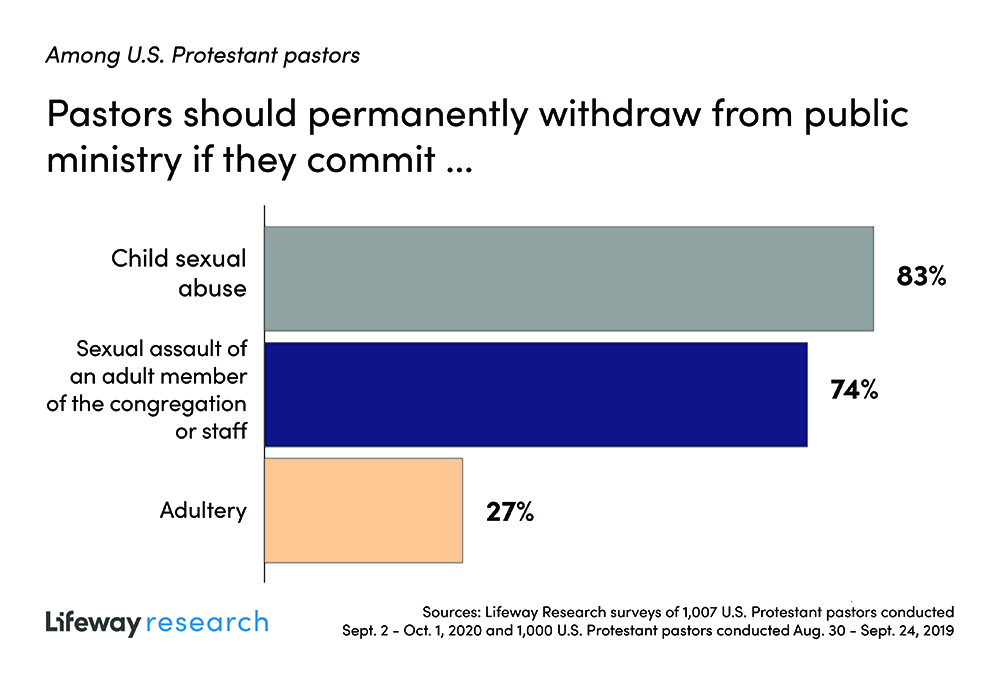
More than 4 in 5 Protestant pastors (83 percent) say if a pastor commits child sexual abuse, that person should withdraw permanently from public ministry. For 2 percent the time away should be at least 10 years, while 3 percent say at least five years and 3 percent say at least two years.

Few point to a shorter time frame as appropriate—1 percent say at least 1 year, and fewer than 1 percent say either six months or three months. Another 7 percent say they aren’t sure how long the time frame should be.

While majorities of every demographic group of pastors support a permanent exit from public ministry for child sexual abuse, some are less supportive than others. Pentecostal pastors (60 percent), African American pastors (67 percent), pastors with no college degree (69 percent), and pastors 65 and older (76 percent) are among those least likely to support permanent withdrawal.

The U.S. Sentencing Commission reported 98.8 percent of sexual abuse offenders were sentenced to prison and their average sentence was almost 16 years.

“The five years or less time frame, that 7 percent of pastors suggest is appropriate, does not even cover the length of the typical prison sentence for offenders convicted of sexual abuse,” McConnell said.

“In contrast, more than 10 times that number of pastors do not hesitate to say the disqualification from ministry should be permanent for a pastor who commits child sexual abuse.”

Adult sexual abuse/assault

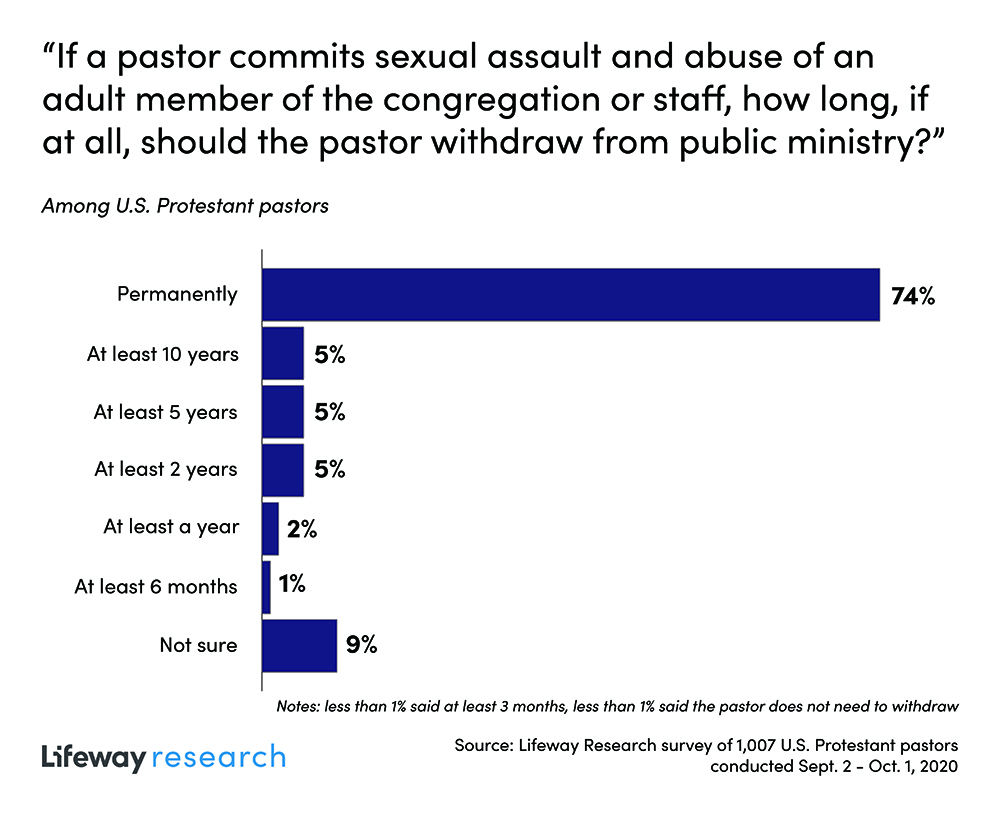
A sizable majority of Protestant pastors (74 percent) also supports a permanent withdrawal from public ministry for any pastors who commit sexual assault and abuse of any adult member of the congregation or staff. One in 20 say the time away should be at least 10 years (5 percent), at least five years (5 percent), and at least two years (5 percent).

Again, few pastors back shorter time frames, with 2 percent saying at least a year, 1 percent at least six months, and fewer than 1 percent at least three months. Fewer than 1 percent say the pastor does not need to withdraw at all. Almost 1 in 10 (9 percent) say they’re not sure.

Pentecostal pastors (44 percent) are the only demographic in which a majority do not support permanent withdrawal from public ministry for pastors who commit sexual assault of adults under their care and supervision in church. Other demographics are also less supportive of the pastor stepping away permanently, including African American pastors (58 percent), pastors without a college degree (63 percent), and pastors 65 and older (69 percent).

“When someone sexually assaults an adult, it is both a violent sin and a crime. It is the opposite of the love, care and respect toward another the Bible teaches,” McConnell said.

“The role of pastor has incredibly high standards in the Bible, including that the overseer of those in the church be above reproach or beyond criticism. Seventeen percent of pastors think someone could move beyond reproach in this matter given enough time.”

A 2019 Lifeway Research study found many Protestant churchgoers believe there are additional undisclosed instances of Protestant pastors sexually abusing children or teens (32 percent) or sexually assaulting adults (29 percent).

In that same study, 3 in 4 churchgoers (75 percent) say they want a careful investigation of the facts if someone accused a pastor at their church of sexual misconduct. Few (14 percent) say their reaction would be to want to see the minister protected.

Compared to their perspective on abuse, pastors are much more divided over the proper response to adultery, according to an additional 2019 Lifeway Research study.

What about adultery?

While clear majorities say pastors who commit child sexual abuse or sexual assault should withdraw permanently from ministry, only 27 percent believe that should be the result of a pastor committing adultery. A plurality (31 percent) is not sure.

“While adultery implies a consensual affair, it is not such a simple distinction for those serving in the role of pastor, as indicated by the 31 percent who were not sure in the previous survey,” McConnell said.

“For a pastor who holds a position of trust and spiritual authority over those in their congregation, an adulterous relationship with one of them, where an imbalance of power exists, would still constitute sexual assault.”

The mixed mode survey of 1,007 Protestant pastors was conducted Sept. 2 – Oct. 1, 2020 using both phone and online interviews. Each survey was completed by the senior or sole pastor or a minister at the church. Analysts weighted responses by region and church size to reflect the population more accurately. The completed sample is 1,007 surveys (502 by phone, 505 online). The sample provides 95 percent confidence the sampling error does not exceed plus or minus 3.4 percent. Margins of error are higher in sub-groups.


‘Fierce freedom’ speaks truth to power, even within the church

The theology of too many churches fails to recognize the radically inclusive and countercultural ministry of Jesus, public theologian Jacqui Lewis said during a teleconference sponsored by the Baptist Joint Committee for Religious Liberty.

“I am grieving as a Black person the impotence of our religiosity,” said Lewis, senior minister at Middle Collegiate Church in New York City and author of Fierce Love.

“I am grieving as a Black person how many white clergy colleagues say—sincerely—that they don’t believe Jesus was for justice. Really? How is that possible?”

Feeding the masses, freely offering healing, welcoming women and children, and treating a Samaritan as the “star” of one of his stories were inherently political acts counter to the prevailing culture, Lewis insisted.

Jesus “stood in solidarity” with the outcasts, the disenfranchised and the marginalized, and he called his disciples to follow the narrow way that leaves no room for privilege, she asserted.

“What would Jesus do in the context of fierce love and fierce freedom? How would he respond to queer people?” she asked, noting the “shocking” suicide rate among transgender teens.

‘Disruption of white supremacy’

“Fierce freedom” speaks truth to power, including religious power “that looks more like empire than the reign of God,” Lewis said.

Far too often, white supremacy and American Christianity are “interlaced,” she said.

“What if we make it an essential nature of the way that we do church, do faith…that we build in the disruption of white supremacy?” she asked.

White supremacy shackles all Americans “to fear, to inequality, to shame (and) to injustice,” Lewis said.

“White rage is what put the knee on George Floyd’s neck. White rage is what puts white supremacy on the necks of all people of color, all who are not normative,” said Lewis.

She expressed her frustration with the way the United States too often “treats Black grief as a threat and white rage almost as a sacrament.”

Lewis disputed the assertion offered in the immediate aftermath of the Jan. 6 insurrection at the U.S. Capitol: “This is not who we are.”

“Well, that’s not true. It is precisely who we are. We are a nation built on violence. We are a nation built on stolen land by stolen bodies,” she said. “We are a nation in which racism is so woven into the fabric of our democracy, it’s hard to pull them apart.”

‘We have not overcome … We are not free’

Many of the same elected officials who approved Juneteenth as a federal holiday voted to erode voting rights and support laws that contribute to making the incarceration rate and poverty rate for Black Americans exponentially higher than that of white Americans, she asserted.

“We have not overcome. We are not liberated. We are not free,” Lewis said.

Countering cries of “Black lives matter” with “all lives matter” or “blue lives matter” reflects the “gentle, soft white rage folding into the inability to just look straight at the church’s collusion in anti-Black racism,” Lewis said.

In both active and passive ways, churches collude with systemic racism and discrimination—and Lewis insisted white conservative evangelical churches are not the only ones.

“I think too many of us are afraid to name the way progressive Christianity and conservative Christianity are too often pitted against each other but not allied on disrupting racism,” she said.

She challenged religious leaders to a “fierce courage, so that telling the story of anti-racism from our pulpits and in our classrooms and in our small groups is rewarded.”

When Trayvon Martin was killed, Lewis recalled telling her church board it no longer was enough for Middle Collegiate Church simply to be multiethnic and multiracial.

“We needed to be anti-racist in everything we did—all the policies, all the procedures, all the programming, all the work,” she said.

In spite of the pandemic, Middle Collegiate Church grew significantly because people “gravitate” to truth—“the truth of the gospel of Jesus Christ,” she said.


Pastors value denominations but unsure about future

NASHVILLE, Tenn.—As many Protestant denominations prepare to gather this summer for their national meetings, most pastors believe it is vital for their church to be part of a denomination but doubt the importance of those types of ties lasting another decade.

A Lifeway Research study asked Protestant pastors their thoughts on the importance of denominations and how they believe denominations will fare in the next 10 years.

“Among Protestant churches in the United States, there continues to be denominational splits and disputes, the emergence of new local and national non-denominational networks, and the presence of a large number of churches that do not belong to a denomination, convention or conference,” said Scott McConnell, executive director of Lifeway Research. “This begs the question whether those within Protestant denominations still see value in them.”

Denominations valued

About 8 in 10 Protestant pastors whose church is in a denomination or denomination-like group (78 percent) say they personally consider it vital to be part of a denomination, with 53 percent strongly agreeing, according to the Nashville-based research firm. One in 5 disagree (20 percent), while 2 percent are not sure.

Pastors believe their congregations share their opinion about the denominational ties. A similar percentage (77 percent) say their congregation believes it is vital for their church to be part of a denomination, though fewer strongly agree (44 percent). Again, 21 percent disagree, and 2 percent are not sure.

“While the connections of some denominations are completely voluntary, those of others are deeply rooted in their polity,” McConnell said. “Yet communicating the importance or the benefits of relating to the denomination in this way cannot be taken for granted. One in 5 pastors do not see that value today.”

Some pastors are more likely to believe connecting to a denomination is vital to them personally. Younger pastors (18-44) are more likely to agree than those 65 and older (83 percent to 74 percent). White pastors (80 percent) are also more likely to see that tie as vital than African American pastors (63 percent).

There are also distinctions within different denominational streams. Mainline pastors (92 percent) are more likely than evangelical pastors (76 percent) to say being a part of a denomination is important to them personally. Among specific denominational groups, Lutherans (95 percent) are the most likely to agree, and pastors in the Restorationist movement (31 percent) are the least likely to agree.

Decreasing importance?

Despite most pastors affirming the personal and congregational importance of being connected to a denomination, a majority believe that value will decrease in the next decade. More than 6 in 10 pastors currently at a church in a denomination or denomination-like group (63 percent) say the importance of being identified with a denomination will diminish in the next 10 years. Around a third of pastors (32 percent) disagree, and 5 percent are not sure.

In many cases, those pastors most likely to see personal and congregational value in denominational connections are those most likely to see that importance continue through 2030. Young pastors (18-44) are the least likely to say identifying with a denomination will diminish in importance in the next decade (54 percent).

“Many, including pastors, who predicted the demise of Protestant denominations in the U.S. have not proven prophetic,” McConnell said. “The fact that younger pastors are less pessimistic could signal better days ahead for denominations or at least fewer memories of the worst days.”

While it is impossible to know how those predictions will fare 10 years from now, pastors shared similar views in 2010, according to a previous Lifeway Research study.

Strong agreement has dipped slightly on the questions of denominational importance since 2010, but overall agreement has remained largely unchanged. A decade ago, 76 percent of denominationally connected pastors said they considered it vital to be part of a denomination personally, and 76 percent said their congregation felt the same.

In 2010, 62 percent believed the importance of being identified with a denomination would be diminished by now. The total percentage who sees a coming decline is near the current 63 percent, but fewer today are as confident in their prediction. A decade ago, 28 percent strongly agreed the importance would diminish. Today, the percentage dropped to 19 percent.

Pastors may be more pessimistic about their denominations than those in their communities. A 2015 Lifeway Research study on Americans’ views of denominations found most were open to churches connected to major Christian groups. No matter the denomination, fewer than half of Americans, even among the nonreligious, said a church connected to that denomination was “not for me.”

When asked whether they had a favorable or unfavorable opinion, or were not familiar enough to form an opinion of specific denominations, favorable percentages were higher than unfavorable for each group, and every denomination had unfavorable percentages below 28 percent.

The mixed mode survey of 1,007 Protestant pastors was conducted Sept. 2–Oct. 1, 2020, using both phone and online interviews. Each survey was completed by the senior or sole pastor or a minister at the church. Researchers weighted responses by region and church size to reflect the population more accurately. The completed sample is 1,007 surveys (502 by phone, 505 online). The sample provides 95 percent confidence the sampling error does not exceed plus or minus 3.4 percent. Margins of error are higher in sub-groups.


Young evangelicals show lessened support for Israel

WASHINGTON (RNS)—A new survey suggests a younger, more diverse generation of evangelical Christians is undergoing a marked shift regarding their views on politics and Israel.

Among the poll’s findings—a seemingly rapid turn away from support for Israel, raising questions about whether the country’s leaders can maintain long-term support within a key religious constituency in the United States.

An Israeli air strike hits a building in Gaza City, Monday, May 17, 2021. The Israeli military unleashed a wave of heavy airstrikes Monday on the Gaza Strip, saying it destroyed 15 kilometers (9 miles) of militant tunnels and the homes of nine Hamas commanders as international diplomats worked to end the weeklong war that has killed hundreds of people. (AP Photo/Hatem Moussa)

According to a poll conducted March 22-April 2 and overseen by the social research firm Barna Group and scholars at the University of North Carolina at Pembroke, 42 percent of self-identified evangelical and born-again Christians age 18 to 29 said they supported neither Israel nor Palestinians regarding conflict in the region.

Among those who picked a side, 24.3 percent said they supported, leaned toward or very strongly supported Palestinians, whereas 33.6 percent expressed the same sentiment for Israel.

UNCP professors Motti Inbari and Kirill Bumin, who oversaw the survey and teach about religion and political science, respectively, told Religion News Service those numbers differed sharply from a poll they conducted in 2018.

In that survey, nearly 69 percent of young evangelicals supported or leaned toward support for Israel, with only 5.4 percent saying the same about Palestinians living in the occupied territories. At the time, around 26 percent of those polled said they supported neither.

Inbari and Bumin were quick to acknowledge the sample size for young evangelicals in the 2018 poll was smaller, as it was a subset of a larger survey looking at evangelicals across multiple age groups.

The polls also have different levels of racial diversity. In the 2018 poll of all evangelicals, 65 percent of respondents were white, 19 percent were Black and 9.6 percent were Hispanic or Latino. But in the 2021 UNCP poll of young evangelicals, 45.4 percent were white, 24 percent were Black, 14.8 percent were Hispanic or Latino and 15.7 percent were of another ethnicity.

Even so, researchers noted the views of young evangelicals in the 2018 survey didn’t differ strongly from that of evangelicals generally, suggesting a shift in the intervening years: In 2018, nearly 75 percent of evangelicals overall supported or leaned toward support for Israel, with only 2.7 percent saying the same about Palestinians and 22 percent saying they supported neither.

Differences between white and Black evangelicals

Another point of comparison: Whereas researchers said they generally did not see significant differences between racial subgroups of evangelicals regarding support for Israel in 2018, they found wide rifts in this year’s young evangelicals survey.

An Israeli artillery unit fires toward targets in the Gaza Strip, at the Israeli Gaza border, Monday, May 17, 2021. (AP Photo/Heidi Levine)

Among young white evangelicals in the 2021 poll, nearly 20 percent leaned toward or expressed various levels of support for Palestinians, almost 37 percent leaned toward or expressed support for Israel, and 43 percent said they backed neither. But among young Black evangelicals, 34 percent leaned toward or expressed support for Palestinians, 26 percent said the same about Israel, and around 39 percent supported neither.

Any change in support for Israel among evangelicals could have far-reaching implications. Ron Dermer, who served as Israeli ambassador to the United States from 2013 to 2021, recently suggested “passionate and unequivocal” evangelical support for Israel is equally if not more important than U.S. Jewish support, pronouncing to Israeli journalist Amit Segal: “The backbone of Israel’s support in the United States is the evangelical Christians.”

Dermer added that “if you look just at numbers, you should be spending a lot more time doing outreach” to evangelical Christians than to Jewish Americans.

Evangelical pastors were among those who spoke at the 2018 ceremony in Jerusalem to commemorate then-President Donald Trump’s decision to move the U.S. Embassy there, and Trump himself said in 2020 he made the controversial decision “for the evangelicals.”

Changing views on the End Times

Asked to speculate about why young evangelicals are gravitating toward different schools of thought, Inbari and Bumin pointed to ongoing analysis of young evangelical pastors and their views on End Times theology. Support for Israel among conservative Christians is often attached to dispensational premillennialist religious beliefs, which mark Jewish presence in Israel as a crucial part of the End Times.

But scholars said recent research has drawn attention to a new crop of younger evangelical pastors who espouse amillennial or post-millennial theology that believes “Israel’s role in the End Times is no longer consequential for redemption.”

“We are thinking that perhaps young evangelicals we see in our sample in 2021 are gravitating to churches led by these amillennialist and post-millennialist, younger, more diverse preachers,” Inbari said. “So, the messages they’re receiving fundamentally contrast with the more pro-Israel message we see in the broader evangelical community.”

In addition, Inbari and Bumin noted a curious trend: Among young evangelicals, the more often they hear about the importance of Israel, the less likely they are to support it.

“Typically we expect that socialization would produce positive effect toward Israel: When you talk to other evangelicals about the importance of supporting Israel, that will create a positive effect and increase one’s support for Israel,” Bumin said.

“We find the complete opposite for younger evangelicals: There is this almost teenage angst, where hearing frequently about the importance of Israel actually leads them to support Israel less.”

Diverse views about politics and policies

In addition to thoughts on Israel, their findings defied narrow categorizations of evangelicals, which often point to how white evangelicals in particular backed Trump in 2016 and generally supported him throughout his tenure as president.

Among the young evangelicals in the UNCP survey, the largest share (33.7 percent) said they were Democrats, whereas 24.8 percent identified as Republicans. They also tended to back the 2020 Democratic presidential candidate: 45.8 percent said they voted for Biden last year, compared with 25.7 percent who said they supported Trump. Another 4 percent voted for a different candidate, and more than 20 percent didn’t vote at all.

Here again, there were racial differences Young white evangelicals were more likely to vote for Trump (39 percent) than Hispanic or Latino evangelicals (15 percent) or Black evangelicals (7 percent). The same was true of party identification, with around 36 percent of white evangelicals identifying as Republicans compared to 15 percent of Hispanic or Latino evangelicals and less than 8 percent of Black evangelicals.

Yet those numbers may surprise political strategists who often point to Trump’s clout among white evangelicals of all voting ages in 2016, when he won 80 percent to 81 percent of the overall group according to Pew Research.

“The assumption is evangelicals are … all lumped together as hard-core supporters of the GOP, conspiracy theorists, (and) Trumpists,” Bumin said. “What we see, in fact, is immense diversity in their views—from the pastors all the way down to the ordinary parishioners. We see diversity in fundamental beliefs, as well as in policy attitude.”

Inbari put a finer point on it: “The conventional wisdom views evangelicalism as the Republican base, and what you see in the results of this research is that this is not so true about young evangelicals.”

In addition to young evangelicals, several religious groups have seen opinions change on Israel in recent years, with Black pastors, in particular, becoming especially vocal in their support for the Palestinian cause during the region’s recent flare-up in violence.


Religion a key topic for millennial moms during pandemic

WASHINGTON (RNS)—Religion was an important topic of conversation between mothers and their children during the pandemic, according to an annual “State of Motherhood” survey from Motherly, a website focused on millennial motherhood.

The report, released earlier this month, showed that some 31 percent of mothers said they had discussed religious issues with their children last year. This trailed only gender equality (33 percent) and racism (46 percent) as the most discussed issue between children and their parents in 2020.

“Every family has different religious beliefs and differing ideas about how to pass those concepts along to their kids,” said Liz Tenety, a co-founder of Motherly.

Some 23 percent of millennial mothers said they wished there was information available that reflected their “values, religion or spirituality.” The highest topics of interest were balancing family with career (49 percent) and the stages of life (43 percent).

“Millennials are in a record number of interfaith marriages, including those with varying religiosity between partners. In a world where faith is often expressed more personally than shared communally, parents have an opportunity to share their unique beliefs and practices with their kids or to evolve the religious beliefs and traditions in which they were raised,” Tenety said.

Data from the report showed 12 percent of mothers surveyed said they had discussed Islamophobia or antisemitism or both with their kids. While not a huge share, that percentage represents a greater swath of people than the combined Muslim and Jewish population of the United States, suggesting the issue is of broad concern for mothers.

Mom’s don’t need to have all the answers

Tenety stressed family conversations about faith stretch over a lifetime, meaning parents don’t need to be afraid to answer their children’s questions or to admit they don’t have all the answers.

“Parents can talk openly about what they believe and why it matters, and model those practices and rituals with their kids. Kids ask big questions, so don’t be afraid to share your beliefs with your children, or even to say the often-true words, ‘I don’t know the answer, but I love that you ask questions like that,’” she said.

There were other findings in the survey that possibly related to the pandemic: Nearly all mothers (93 percent) described being burned out in providing care for their children, a sentiment that may explain why mothers considered paid family leave (73 percent) and affordable child care (67 percent) as the most important public policy issues related to motherhood.

The State of Motherhood survey is now in its fourth year. This year’s edition included feedback from 11,000 women who are among the site’s 30 million-plus users.

In March, a Gallup poll cast new light on the role of religion in America. That poll found that for the first time in eight decades—since polling on the topic began—less than 50 percent of Americans belonged to a place of worship.

Edge Research, which ran the survey for Motherly, weighted the findings of Motherly’s online poll by crossing the date with a demographic representation of American mothers based on the U.S. census. From an initial 11,000 mothers who responded to the Motherly survey, the final dataset includes the data from 5,809 moms aged 25 to 40.


Safe to sing at church yet? Depends who you ask

WASHINGTON (RNS)—On Pentecost Sunday, some members of Southwood Lutheran Church in Lincoln, Nebraska, sang hymns without masks for the first time in more than a year.

They vocalized “Multilingual Grace” in four languages after music director Denise Makinson taught them how to express thanks in Spanish, Arabic, Swahili and Korean.

“I do have to say it was quite emotional yesterday to hear the congregation singing all the hymns,” Makinson said in an interview on May 24. “It was definitely something I missed.”

Pentecost is often celebrated as the “birthday” of the Christian church. It frequently includes a reading from the New Testament Book of Acts about the Holy Spirit descending on Jesus’ followers, who then begin to speak and understand languages they had not known.

“I think they were also emotional about it, to hear people’s voices,” Makinson said of Southwood’s congregants.

Some people sang with masks on, others with them off—a mix that is likely to continue across the country for a while as congregations navigate the “new normal” of the continuing pandemic when not everyone is vaccinated.

Hymn Society: ‘There is still risk’

The Centers for Disease Control and Prevention’s recent announcement that fully vaccinated people could generally resume pre-pandemic activities has played a part in new decisions by congregations. But the CDC’s guidance was about individuals; its advice for “communities of faith” has not been updated since Feb. 19 and currently does not mention singing.

The Hymn Society’s Center for Congregational Song has declared in its own latest guidance: “We do not currently recommend that congregations sing.”

Its May 20 blog post also included questions that might further guide congregations about higher- or lower-risk activities. They covered such topics as the percentage of fully vaccinated congregants, the chances of some congregants remaining unmasked and not distanced, and whether people wear their masks properly.

But, it added, no matter how those questions are answered, “There is still risk.”

Multiple factors to consider

Brian Hehn, director of the center, said it’s been difficult to know how to instruct churches at this time.

“There are so many factors that go into determining whether or not it’s safe that it’s really hard to advise people, and it’s also hard for them to make a decision,” he said.

He noted air exchange rates as an example of one factor religious leaders must consider as they try to gauge the best way to reduce the movement of aerosols in the air of a sanctuary. Scientists have found singing could expel aerosolized virus particles more than speaking can.

“Most people have no idea what their air exchange rate is, so you have to contact your air conditioning company and do research on what kind of system you have and how it was installed and whether it’s filtered,” Hehn said.

Fewer concerns about outdoor worship

Ed Phillips, co-convenor of the Ecumenical Consultation on Protocols for Worship, Fellowship and Sacrament, said his organization is also coming down on the side of caution, urging mask-wearing indoors for “any sort of congregational responses or singing that would cause us to use a loud voice or sustained singing voice.”

He said “restrictions are much less necessary” for outdoor worship.

Milton L. McDaniel Sr. attends a service at Boskydell Baptist Church on Aug. 2 in Carbondale, Ill. (AP Photo/Wong Maye-E)

“Our guidance around singing at this point is to take a relatively conservative approach because congregations tend to be multigenerational gatherings and also gatherings where we will have both vaccinated and unvaccinated people, possibly of differing ages,” said Phillips, associate professor of historical theology and Christian worship at Emory University’s Candler School of Theology.

The group, which has consulted with the CDC, plans to officially release its final guidance in English, followed by a version in Spanish, in June.

Phillips said the consultation advises congregation leaders to use websites such as covidactnow.org to keep tabs on the latest information about the pandemic, along with advice from their local health officials, to determine what is considered safer in their particular situation.

Makinson, of the Nebraska church, said her congregation’s loosening of mask restrictions for congregational singing came on the first Sunday after a mask mandate in her community expired.

With about 200 people at each of the three services, she said it was fitting that some masks came off and singing could be heard more fully on Pentecost Sunday.

“We were definitely hoping the Spirit was present and protecting everyone,” she said.