Churchgoers proud of church’s COVID-19 response

NASHVILLE, Tenn.—Throughout the COVID-19 pandemic, churches have responded to serve churchgoers in a variety of ways, and churchgoers are overwhelmingly proud of how their church handled the crisis.

A new study by Lifeway Research reveals almost 9 in 10 Protestant churchgoers (86 percent) say they are proud of how their church has responded during the coronavirus pandemic, with 58 percent strongly agreeing. Relatively few (9 percent) disagree.

Inversely, a fairly small segment of churchgoers (12 percent) say they are ashamed of how their church responded to the crisis. More than 4 in 5 (84 percent) disagree, with 73 percent strongly disagreeing.

Some churchgoers, however, are more likely than others to see their church’s handling as shameful. Young adult churchgoers (aged 18 to 29) are more likely to agree (26 percent).

“Pastors have heard their share of second-guessing for how they have handled their church’s response to COVID-19,” said Scott McConnell, executive director of Lifeway Research. “But a large majority of churchgoers agree with their church’s various responses, and few are critical overall.”

Changing in-person attendance practices

In January 2021, half of Protestant churchgoers (51 percent) didn’t attend any in-person church services. For some, that was because their congregation didn’t gather in person, which has been the case throughout the pandemic.

In late March and April of 2020, fewer than 1 in 10 Protestant churches held in-person services in a given week, according to a previous Lifeway Research study among pastors. By June, however, the majority of churches were gathering in person again.

In September 2020, 87 percent of churches held in-person services. However, that fell to 76 percent in January 2021.

In the latest study, Lifeway Research found attending in person has not been an option recently for almost a quarter of Protestant churchgoers (22 percent). One in 5 (20 percent) say their church stopped in-person services months ago and have not resumed, while 2 percent say they stopped for the first time recently and have not resumed.

Most churchgoers experienced some type of back-and-forth with the availability of in-person services.

For 3 in 10 (31 percent), in-person services stopped at their church for a short period of time and have since resumed. Another 22 percent say in-person services were halted for much of the year but have resumed. Around 1 in 6 (17 percent) say in-person services at their church have stopped and started more than once.

Few, only 1 in 20 churchgoers (5 percent), say their congregation continued to gather in person throughout the pandemic.

Widely varied experiences
“The experiences of churchgoers have varied greatly, because their churches have responded differently to the impact of the pandemic on their church and local community,” McConnell said. “A large minority of churchgoers attend a church that did not offer in-person services for much of 2020. As January illustrates, just because a church offered in-person services does not mean every churchgoer was willing to participate in that way with the coronavirus still actively circulating.”

African American churchgoers are most likely to say their church stopped in-person services many months ago and have not resumed (40 percent). That matches the responses of African American pastors during the pandemic, who have been among the most likely to say their churches were not gathering in person and have been suffering during COVID-19.

In a previous Lifeway Research study, they were the most likely to say the economy is negatively impacting their church and giving has decreased. In a September study, African American pastors were also the most likely to say they had to cut staff pay or benefits (21 percent) and delete a staff position (18 percent).

Churches got creative quickly

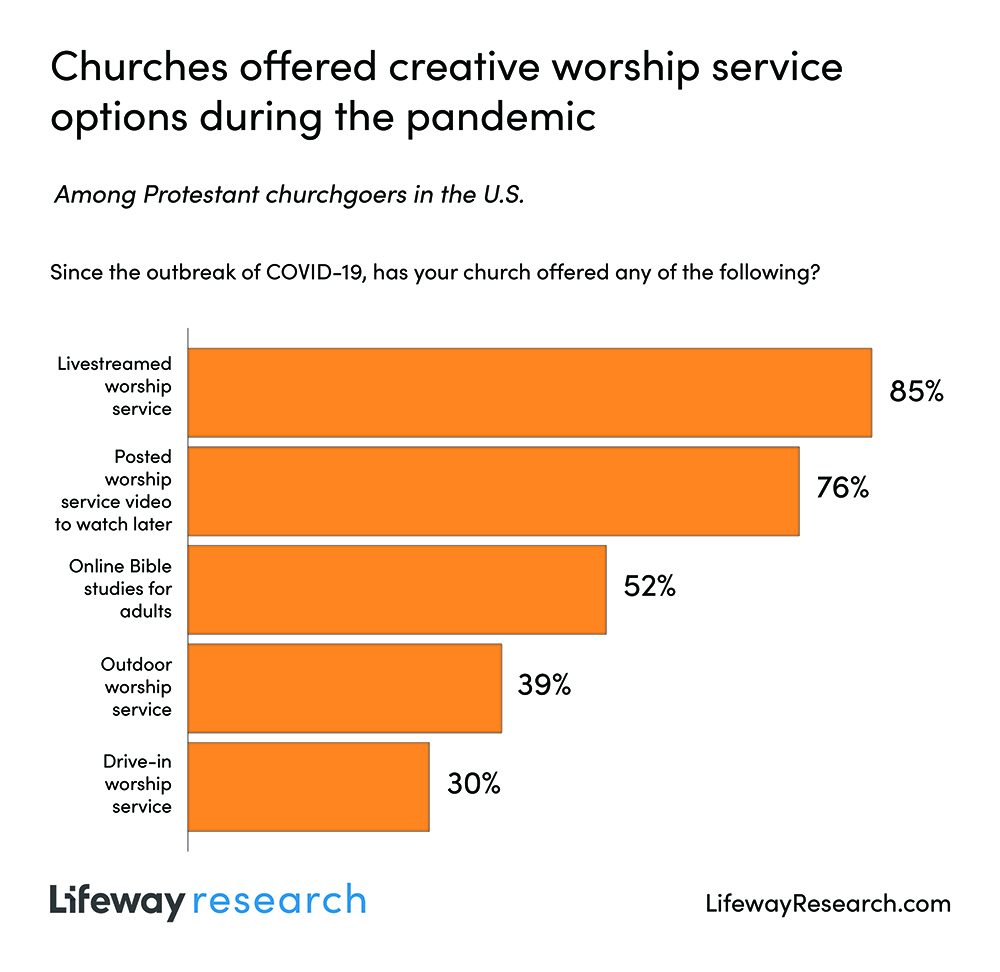
As regulations and guidelines caused many churches to cancel traditional gatherings, many got creative with the types of services they offered during the pandemic.

More than 4 in 5 churchgoers (85 percent) say their church offered livestreaming of their worship service. Of those who say their church livestreamed services, 83 percent participated in it. Only 12 percent of churchgoers say their church didn’t offer livestreaming worship services.

Most of those who say their church offered livestreaming say they placed the video on the church website (55 percent). Half (51 percent) said the church used Facebook Live. Around a third (34 percent) said it was on YouTube. More than 1 in 5 (22 percent) say it was on a video conferencing tool like Zoom.

Around 3 in 4 churchgoers (76 percent) say their church posted videos of worship services that could be watched at any time. Among those who say their church provided this, 80 percent watched a worship service in this way. Around 1 in 7 (15 percent) say their church did not offer that.

Half of churchgoers (52 percent) say their church offered online Bible studies for adults. Most of those who say their church offered it (59 percent) participated in them. Three in 10 (29 percent) say their church didn’t offer them. Adult churchgoers under 50 are more likely to say their church offered online Bible studies and they participated in them than churchgoers 50 and older.

Two in 5 churchgoers (39 percent) say their church had outdoor worship services. Most of those who say their church offered it (58 percent) participated in it. More than half of all churchgoers (54 percent) say their church didn’t offer worship services outside during the pandemic.

Three in 10 (30 percent) say their church had drive-in worship services where attendees remain in the cars. More than half of churchgoers whose church offered drive-in services (56 percent) participated. More than 3 in 5 (62 percent) say their church did not offer those types of services. Younger churchgoers, those aged 18 to 29, are more likely to say their church offered drive-in services and they participated in them than churchgoers over 50.

“Much like the old children’s song, churches have been inside, outside, upside and downside during this pandemic,” McConnell said. “It would be a stretch to say churchgoers have been ‘happy all the time,’ but amid the variety of approaches and technology used, a majority of churchgoers participated at some point in what their church offered.”

Most churchgoers say they participated in some alternative worship services specifically in January 2021. More than half (53 percent) say they participated in an online worship service at their church. A quarter (25 percent) took part in a worship service on TV. Fewer say they were part of an online worship service at another church (16 percent) or listened to a worship service on the radio (9 percent).
The online survey of 1,000 American Protestant churchgoers was conducted Feb. 5-18 using a national, pre-recruited panel. Respondents were screened to include those who identified as Protestant/nondenominational and attended religious services at least once a month in 2019. Analysts used quotas and slight weights to balance gender, age, region, ethnicity and education to reflect the population more accurately. The completed sample is 1,000 surveys, providing 95 percent confidence the sampling error from the panel does not exceed plus or minus 3.2 percent. Margins of error are higher in subgroups.




Most Protestant pastors see gender change as immoral

NASHVILLE, Tenn.—As legislatures in Washington, D.C. and across the country discuss issues surrounding individuals who identify as a gender different from their biological sex, a clear majority of U.S. Protestant pastors see such gender fluidity as morally wrong.

A new Lifeway Research study revealed about 3 in 4 Protestant pastors say identifying as a gender different from one’s biological birth gender is morally wrong. Similar numbers say the same about attempts to physically change genders.

“American culture increasingly views morality differently than historic Christianity,” said Scott McConnell, executive director of Lifeway Research. “When pastors articulate Christian teaching, it often sounds very different from the cultural narrative because it rejects a basis for morality centered on the individual.”

Among U.S. Protestant pastors, Lifeway Research found 72 percent say it is morally wrong for an individual to identify with a gender different from the biological sex they were born, including 62 percent who strongly agree. Around 1 in 7 (14 percent) disagree, and another 10 percent do not believe it is a moral issue.

In an earlier study Lifeway Research asked the same questions of Americans. Forty-four percent of Protestant Americans and 35 percent of all Americans agreed it is morally wrong for someone to identify with a gender different from the sex they were born.

However, in the 2020 State of Theology study from Lifeway Research, 79 percent of American adults agree God created male and female.

“Protestant pastors are more likely than Americans who identify as Protestant to consider it wrong to identify as a gender different from your biological sex,” McConnell said. “While most Americans accept the biblical narrative of God designing male and female, pastors take changing that design much more seriously.”

Denominational and geographic differences

Evangelical pastors are more than twice as likely as mainline Protestant pastors to agree identifying with a different gender is immoral (84 percent to 32 percent).

Denominationally, Pentecostals (90 percent) and Baptists (89 percent) are more likely to agree than pastors in the Restoration movement (69 percent), Lutherans (60 percent), Presbyterian/Reformed pastors (45 percent) and Methodists (43 percent).

Protestant pastors in the Northeast are the most likely to say this is not a moral issue (17 percent).

More than 3 in 4 pastors (77 percent) say it is morally wrong to change the gender you were born with through surgery or taking hormones, with 71 percent strongly agreeing. Fewer than 1 in 8 disagree (12 percent), and 7 percent say it’s not a moral issue, according to the Lifeway Research study.

“Whether it is a physical sex-change or public identification, a large majority of pastors see a person’s biological sex as something a human should not change,” McConnell said.

Evangelical pastors are more than twice as likely as mainline pastors to say this is immoral. Nine in 10 evangelical pastors (90 percent) believe attempting to physically change genders is morally wrong, compared to 37 percent of mainline pastors.

Denominational groups also have a similar breakdown as the previous question. Pentecostals (96 percent) and Baptists (94 percent) are more likely to view attempts to change gender as immoral than Restorationist movement pastors (75 percent), Lutherans (69 percent), Presbyterian/Reformed pastors (49 percent) and Methodists (48 percent).

Half of pastors know a transgender person

The latest estimation from Gallup finds 0.6 percent of the U.S. adult population identifies as transgender. Only among the youngest generations does the amount top 1 percent—1.2 percent of millennials and 1.8 percent of Generation Z.

Still, according to the Lifeway Research study, close to half of pastors (48 percent) say they know someone who is transgender. Slightly fewer (41 percent) say they don’t know any individuals who identify as transgender, while 11 percent say not that they know of.

In 2015, Lifeway Research found 27 percent of Americans personally knew someone who identifies as transgender.

Mainline pastors are more likely than evangelicals to say they know someone who identifies as transgender (63 percent to 45 percent). Methodists (63 percent) are more likely to know an individual who identifies as transgender than are Restorationist movement pastors (47 percent), Lutherans (47 percent), Pentecostals (40 percent) and Baptists (39 percent).

Pastors who are of other ethnicities (57 percent) are more likely than African American pastors (36 percent) to say they personally know someone who identifies as transgender. White pastors are in between at 48 percent.

Additionally, pastors with graduate degrees and pastors of churches with more than 250 people are more likely to say they know someone who identifies as transgender.

“Despite close to half of pastors saying they personally know someone who identifies as transgender, most still view identifying as a different gender as immoral,” McConnell said.

“As lawmakers debate establishing protections for those who identify as a different gender from their biological sex at birth, it waits to be seen if Congress will seek to force pastors and their churches to implement changes contradictory to their religious convictions.”

The mixed mode survey of 1,007 Protestant pastors was conducted Sept. 2 to Oct. 1, 2020, using both phone and online interviews. Each survey was completed by the senior or sole pastor or a minister at the church. Researchers weighted responses by region and church size to reflect the population more accurately. The completed sample is 1,007 surveys (502 by phone, 505 online), providing 95 percent confidence the sampling error does not exceed plus or minus 3.4 percent This margin of error accounts for the effect of weighting. Margins of error are higher in sub-groups.


No turning back: Churches embrace technology

NASHVILLE (BP)—Facebook timelines changed forever on Sunday, March 15, 2020.

Many—if not most—churches opted to go digital-only worship services that day after witnessing such steps as county, state and national leaders declaring COVID-19 a national emergency and professional and collegiate sports suspending activities.

As church leaders looked to make services available for members, Facebook scrambled to keep up with the increased demand, created in large part by congregations livestreaming worship services on the social media platform.

The following weeks brought a sink-or-swim time for churches regarding technology. Those not using it before had to learn quickly. Offering plates were traded for giving through an app. Living room couches became pews. Laptops at the kitchen table hosted Sunday school classes, prayer group gatherings and church staff meetings. The word “zoom”—up to then classified as a verb—became a noun (“Let’s meet on Zoom”) and then a verb again, as in “We’re going to Zoom Sunday night.”

Of the seismic changes brought by COVID-19, the expansion of online platforms for churches is among the biggest. With Barna Research showing that just 3 percent of churches remained open as usual in late March 2020, finding other options to meet became paramount.

One year later, COVID cases are on the decline, vaccinations are becoming increasingly common and people are venturing out from their homes more often. Yet, even as the number of churchgoers attending in-person has continued to rise, leaders are quick to say that the need for an online presence isn’t going anywhere.

Reimagining, not replacing

Tommy Green, executive director-treasurer of the Florida Baptist Convention, said the inclusion of online tools by churches and entities like his are going to be a necessity going forward.

“Everyone prefers to meet in person, but we still have those who are hesitant to do so,” he said. “There seems to be great engagement with people online. To be clear, that doesn’t replace the ability to build relationships when you’re together, but it can be a positive if done well.”

Respondents to the Barna report agreed in-person gatherings were preferred, with 81 percent calling them “very important” for experiencing God alongside others. Fifty-two percent may seem like a low number for churched adults choosing primarily physical gatherings, but 35 percent said they would like a hybrid of those conducted in physical as well as digital settings—a blended term known as “phygital” ministry.

“It doesn’t replace existing community,” the report said. “Rather, it is an enhancement of community by reimagining the tools that the body of Christ can use to reach people with the hope of Jesus. Phygital ministry uses technology as a tool to support the mission of the church in both the physical and digital realms—to grow across multiple contexts and to multiply everywhere that people gather, online or in person.”

Sixty percent of churched adults hoped their church would continue to use digital means of gathering post-pandemic, Barna reported. This would help not only keep members engaged who can’t attend in person, but also benefit those preferring to visit churches online.

When it comes to classes designed to explore the Christian faith, for example, 40 percent of unchurched adults with high digital openness said they would be more willing to attend online rather than in person (23 percent).

Over the last year, the Florida Baptist Convention not only offered training for churches to strengthen their online footprint; they also provided cameras, microphones, sound systems and other equipment for those who didn’t have the budget nor foreknowledge of a once-in-a-century pandemic.

“For many churches, [technology] wasn’t part of their culture,” said Green, whose father died of COVID in January. “We wanted to help fill in those gaps and assist them in having a quality product to share their ministry.”

Texas Baptists quick to provide resources

Soon after the pandemic hit, the Baptist General Convention of Texas offered churches multiple resources related to livestreaming worship services and online giving. Texas Baptists and BaptistWay Press made available free downloadable Bible study materials on the theme “Faith > Fear.”

Pastor Daniel Camp preaches to South Garland Baptist Church via Facebook Live on March 22 in response to restrictions made necessary by the COVID-19 pandemic. For many congregations, March 22 was the second service held fully online; others held their services online for the first time. (Photo / Ken Camp)

The Truett Church Network—an outreach of Baylor University Truett Theological Seminary—offered series of Zoom meetings and Facebook Live webinars on subjects such as “Preaching to a Dispersed Congregation,” as well as a guide to creating participatory online worship services.

Particularly during the lockdown last year, many Texas Baptist pastors used Facebook and other social media platforms to post daily devotionals or weekday Bible studies, in addition to Sunday worship services. Some have reduced the frequency of their social media posts but have continued to maintain a strong online presence throughout each week.

In 45 years with Colorado Baptists, Steve Hoekstra has served in numerous capacities including pastor and church planter. Currently, he’s the director of the convention’s western office, located in Montrose, as well as the statewide resort and leisure ministries director. He said his conversations with pastors shows an acknowledgement and shift in doing ministry.

“Pastors aren’t wanting to get back in church so they can stop ministering online. Most of the ones I talk to are excited about continuing [those online platforms],” Hoekstra said. “The biggest thing I’m hearing is that we can’t let this [opportunity] go.”

Hoekstra joins the general consensus that in-person gatherings are preferred. However, obstacles like distance are neutralized with these new tools. Colorado winters can also be a hurdle.

“My guys are getting people who have never visited their church, or any church,” he said. “They’re getting emails from all over the country from people who have watched their service. One even heard from someone in Malaysia, who said they enjoyed [that pastor’s] church.”

New paradigm likely permanent

Online tools and the accessibility they give a church may lead pastors to think it’ll open up a whole new era of church-hopping. However, the Barna study revealed 90 percent of respondents remained engaged throughout the pandemic with the church they attended beforehand. The report said those connections are fostered through various steps, such as sharing new media during the week like podcasts or Instagram videos as well as appointing new positions such as online pastors.

Green said not only is the new paradigm likely permanent, but it’s one that can benefit churches in all settings. Today, anyone with a smartphone can match or even exceed the reach that previously had been reserved for those with a sponsored radio or TV platform.

“Only time will tell how many [online tools] will be needed and how much we’ll go back to meeting in one place,” he said. “But we’ve seen the value in it. Churches of all sizes have learned to use this technology.”

If you want to see proof, he added, “Scroll through Facebook on a Sunday. You can’t help but find a church.”

With additional reporting by Managing Editor Ken Camp. 


American churchgoers say they’ll return post-COVID

NASHVILLE, Tenn.—Churchgoers aren’t attending in-person worship services yet at pre-pandemic levels, but most say they value gathering with their congregation and are eager to do so when the threat of COVID-19 ends.

A Lifeway Research study of 1,000 Protestant churchgoers in the United States revealed  when COVID-19 no longer is an active threat to people’s health, 91 percent plan to attend in-person worship services at least as often as they did before the coronavirus pandemic. That includes almost a quarter (23 percent) who plan to attend more than they did previously.

Few regular churchgoers say they will attend less than before (6 percent), rarely attend (2 percent) or stop attending in-person services completely (1 percent).

Almost all churchgoers (94 percent) say they greatly value the times they can attend worship services in person with others from their church. Few (4 percent) disagree.

“Two-thirds of pastors whose churches were open for in-person worship in January saw attendance of less than 70 percent of their January 2020 attendance,” said Scott McConnell, executive director of Lifeway Research. “Many of these pastors are wondering if those who haven’t returned ever will. Nine in 10 churchgoers plan to when it is safe to do so.”

Young adult churchgoers, ages 18 to 29, are the most likely to say they will attend church more often after COVID-19 than they did before (43 percent).

Evangelicals by belief are more likely than those without evangelical beliefs to say they will attend more after the pandemic (28 percent to 19 percent).

Church involvement

About 9 in 10 churchgoers (87 percent) stuck with the same church throughout the pandemic. Few say they switched to another church in the same area (5 percent), switched churches because of a move (3 percent), or no longer have a church they consider their own (5 percent).

Among this group of Protestant churchgoers who attended at least once a month in 2019 and who still have a church, 56 percent say they attended worship services four times or more in January 2020 prior to the spread of COVID-19. Another 30 percent attended two or three times, while 7 percent say they attended once.

In January 2021, however, 51 percent didn’t attend any in-person services—22 percent said it was because none were offered by their church, and 30 percent chose not to attend their church’s in-person services. Around 1 in 5 (21 percent) say they attended in person four times or more. Slightly fewer (18 percent) attended two to three times and 7 percent attended once.

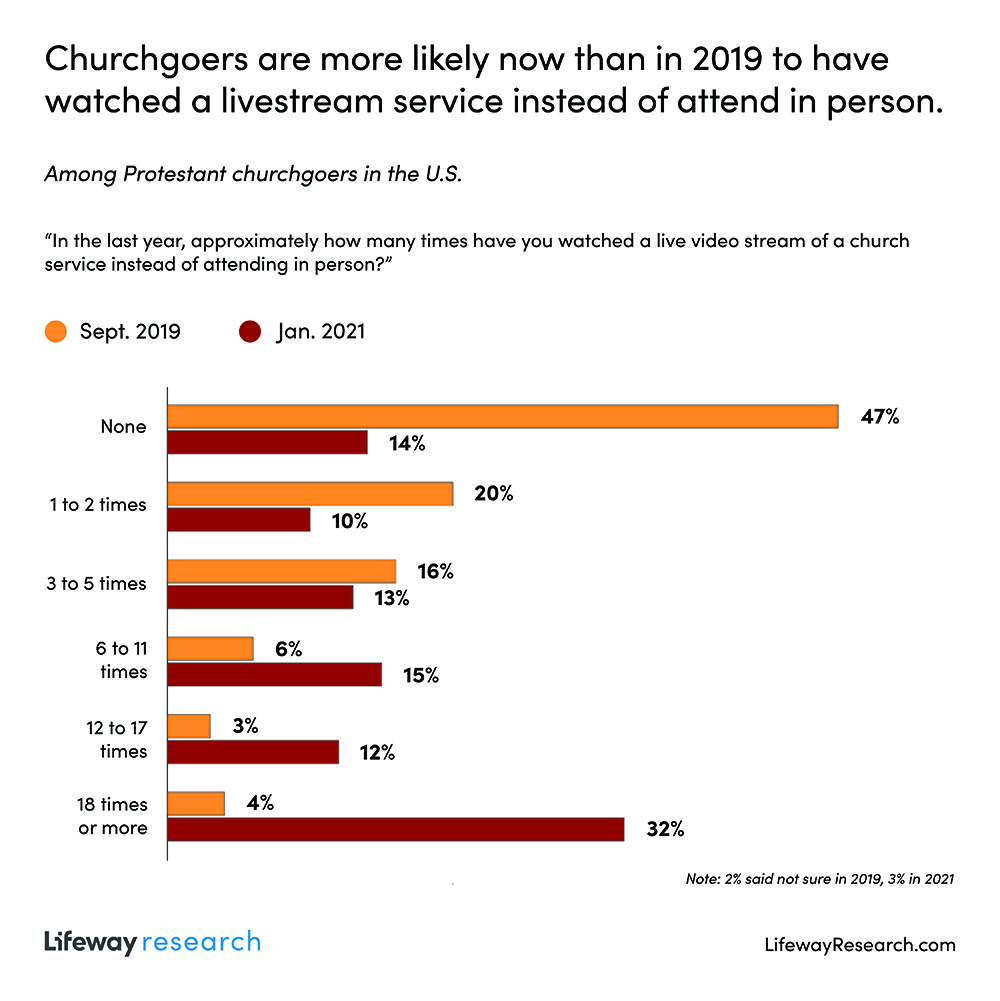
More than 4 in 5 churchgoers (83 percent) say they watched a livestream of a church service instead of attending in person at least once in 2020. Far more watched via livestream last year than said the same when asked before the pandemic.

A September 2018 Lifeway Research study showed 4 percent of churchgoers said they had watched a live video stream of a church service instead of attending in person 18 times or more in the last year, compared to 32 percent now. Two years ago, almost half of churchgoers (47 percent) said they hadn’t replaced an in-person service with a livestreamed one, while only 14 percent say the same today.

“Churches livestreaming services during COVID-19 has made this experience commonplace among churchgoers,” McConnell said. “Despite the increased exposure to this concept, however, relatively few have made this a weekly habit.”

Among churchgoers surveyed, 7 in 10 (71 percent) consider themselves to be a “devout Christian with a strong faith.” Around a quarter (23 percent) say they consider themselves a Christian, but not particularly devout. Fewer say they are a Christian but are not currently practicing the faith (5 percent).

Most churchgoers (54 percent) say the events of 2020 caused them to grow closer to God, including 27 percent who say they became much closer. Another 39 percent say they stayed about the same. Far fewer (7 percent) say they grew more distant.

Currently, 11 percent of churchgoers say they are questioning their faith, while 87 percent disagree.

“The faith of most churchgoers remains resilient despite a year filled with much uncertainty and fewer options for meeting in person with others from church,” McConnell said. “During these trying times, churchgoers were almost eight times more likely to relate to God more than less.”

Younger churchgoers (18 to 29) are the most likely to say they became much closer to God (37 percent), but also the most likely to say they are currently questioning their Christian faith (24 percent).

Personal impact

Thinking back on January 2021, few churchgoers say they lived life close to normal. Around 1 in 10 (9 percent) say they had a normal number of contacts with few precautions. Slightly more say they had a normal number of contacts with people outside their home but with precautions (13 percent). Another 1 in 10 (10 percent) say they had limited contact with others but took few precautions.

A plurality of churchgoers (36 percent) say they had a limited number of contacts with precautions (36 percent). Around a quarter (26 percent) say they only had very brief contacts such as essential shopping. For 7 percent of churchgoers, they had no contact with anyone in January.

For most churchgoers, the yearlong pandemic has brought some tangible challenges, including 8 percent who say they have been diagnosed with COVID-19.

More than 2 in 5 (42 percent) say someone in their church has been diagnosed with the disease and 18 percent say a fellow church member died from it. A previous Lifeway Research study, found 88 percent of Protestant pastors say a church attendee has been diagnosed with COVID-19 and 29 percent say a member died from COVID-19.

Around 1 in 7 churchgoers (15 percent) say they have lost income because of reduced hours at work, while 6 percent say they lost their job.

On a more positive note, many churchgoers have helped each other and reached out beyond their church. Around 2 in 5 (41 percent) say they have checked on others in their church, while a similar number 38 percent say people in their church have checked on them. One in 10 say others in their church have helped them with tangible needs. For 15 percent, the pandemic period has provided an opportunity to share the gospel with someone.

“Like other Americans, churchgoers have seen the effects of COVID-19 first-hand,” McConnell said. “Many churchgoers have also felt the benefits of being part of a church as members checked on them or provided assistance.”

The online survey of 1,000 American Protestant churchgoers was conducted Feb. 5-18 using a national, pre-recruited panel. Respondents were screened to include those who identified as Protestant/non-denominational and attended religious services at least once a month in 2019. Researchers used quotas and slight weights to balance gender, age, region, ethnicity and education to reflect the population more accurately. The completed sample is 1,000 surveys, providing 95 percent confidence the sampling error from the panel does not exceed plus or minus 3.2 percent. Margins of error are higher in sub-groups.


White evangelicals least likely to get COVID vaccine

WASHINGTON (RNS)—Since before the COVID-19 vaccines hit the market, experts predicted Black Americans would choose to be vaccinated at dramatically lower rates than white Americans due to a historic mistrust of the health system.

Media stories defined the causes for “vaccine hesitancy,” while physicians worried about how to overcome it.

Scores of health systems, churches and religious coalitions responded by offering up houses of worship as sites for mobile vaccine distribution.

A new Pew Research survey suggests that either the campaigns were effective or the worry was misplaced: 64 percent of Black Protestants, the researchers found, “definitely or probably” plan to get vaccinated—up sharply from November when little more than 40 percent said they planned to get vaccinated.

It’s not that vaccine hesitancy is a myth. It’s merely strongest among another group—white evangelical Christians.

A religious breakdown of the February survey of U.S. adults shows only 54 percent of white evangelicals “definitely or probably” plan to get vaccinated.

As troubling, white evangelicals are the least likely to say they should consider the health effects on their community when making a decision to be vaccinated.

Only 48 percent of white evangelicals said they would consider the community health effects “a lot” when deciding to be vaccinated. That compares with 70 percent of Black Protestants, 65 percent of Catholics and 68 percent of unaffiliated Americans.

Less trust in science

John Fea, a U.S. historian at Messiah University who studies evangelicals, said he wasn’t surprised white evangelicals seemed least likely to want to take advantage of the vaccine.

“There’s a long history of anti-science within American evangelicalism,” Fea said. “It goes back to the Scopes trial and evolution in the 1920s,” in which evangelicals debated Darwin’s theory of evolution.

Fea said the distrust of science is related to their belief that God will protect them.

“Getting a vaccine is a lack of faith,” as some evangelicals see it, Fea said.

As a group, 58 percent of Protestants—including mainline Protestants, evangelicals and Black Protestants—said they would consider community health effects “a lot.” The religious breakdowns did not include Jews or Muslims, who each constitute less than 2 percent of the American public.

Cary Funk, director of Science and Society Research at Pew, said white evangelicals generally express lower levels of trust in the vaccine research-and-development process and are also less likely to report getting a seasonal flu vaccine every year.

Partisan differences

The larger survey also showed partisan differences play a big role in assessing the likelihood of getting vaccinated. Democrats are far more likely than Republicans to say they plan to get, or have already received, a coronavirus vaccine (83 percent to 56 percent).

White evangelicals, who are overwhelmingly Republican, are less likely to want to get the vaccine for partisan reasons as well, Fea said.

Former President Trump received one of the vaccines before leaving office and has claimed credit for their quick development, most recently during an appearance at the Conservative Political Action Conference on Feb. 28.

But he did relatively little to encourage their use while in office and faced criticism for his reluctance to abide by COVID-19 regulations, including casting doubt on the efficacy of mask use. He did encourage his supporters to get vaccinated at his CPAC address.

The survey also showed atheists and agnostics scored highest of all the religious groups in their willingness to get vaccinated. But a subgroup of the religiously unaffiliated, popularly known as “nones,” scored much like other Protestants. Among the nones, 64 percent said they would “definitely or probably” get a vaccine—an identical number to Black Protestants.

Nones are generally disconnected from not only religion but civic life generally, as opposed to atheists and agnostics who have well-formed ideological commitments.

RNS national reporter Jack Jenkins contributed to this story.  


Fewer churches held in-person services in January

NASHVILLE, Tenn.—Most churches have found a way to continue meeting despite the ongoing pandemic, but fewer met in person in January as COVID-19 cases spiked across the country.

A new study from Nashville-based Lifeway Research found 76 percent of U.S. Protestant pastors say their churches met in person in January, down from 87 percent who said the same in September.

Even among those who are holding in-person services, few are near pre-pandemic attendance levels. Around 3 in 10 pastors (31 percent) say their attendance in January 2021 was less than half what it was in January 2020, months before the coronavirus prompted national lockdowns.

Slightly more (37 percent) note attendance between 50 percent and 70 percent. Another 3 in 10 say attendance is close to normal (70 percent to 100 percent). Few (2 percent) have grown in their in-person attendance compared to one year ago.

“Churches continue to evaluate when to meet in person based on local conditions and cases within their congregation,” said Scott McConnell, executive director of Lifeway Research. “Even when a church determines it’s safe to meet, their individual members will return on their own timetable.”

Mainline pastors (39 percent) are more than three times as likely as evangelical pastors (12 percent) to say they did not meet in person in January.

Pandemic hits home

Compared to last summer, the winter spike of COVID-19 cases brought more pastors face-to-face with the pandemic. Three times as many now say someone in their church has been diagnosed with COVID-19, and almost six times as many pastors report an attendee dying from it.

About 9 in 10 Protestant pastors (88 percent) say a church attendee has been diagnosed with COVID-19, up from 28 percent in July 2020. Close to 3 in 10 (29 percent) say a member died from COVID-19, compared to 5 percent last summer.

Pastors of churches with 200 or more in attendance are the most likely to say someone in their congregation died from COVID-19 (51 percent), while pastors of churches with fewer than 50 are the least likely (15 percent).

Younger pastors (18- to 44-years-old) are the most likely to have lost a church attendee to the coronavirus (41 percent), as well as pastors in the South (38 percent).

“The respect pastors in specific regions had last summer for the devastation of this pandemic has now spread throughout the nation,” McConnell said. “For a growing number, the loss of life has reached a dear saint or regular attendee in their own congregation.”

Much of the financial challenges remain the same. Similar numbers from July 2020 say an attendee lost a job (50 percent) and had income impacted by reduced work hours (72 percent) at any time during the coronavirus pandemic.

Despite those difficulties, pastors say the pandemic has provided opportunities for their church to serve others and even reach new people.

Almost all pastors (90 percent) say people in their church have helped each other with tangible needs during the pandemic. About 3 in 4 (73 percent) report attendees meeting tangible needs in the community connected to the pandemic.

Close to 9 in 10 pastors (88 percent) say new people who have not attended their church in the past have attended or connected online during the pandemic. A quarter (25 percent) say an attendee has seen someone make a commitment to follow Christ after sharing the gospel.

Impact on small groups

When asked to estimate what percentage of small groups or Sunday school classes that existed in their church before the pandemic are currently meeting, have stopped meeting temporarily, or no longer exist, pastors say most of their church’s small groups (62 percent) are still meeting in some way.

Pastors estimate more than a third of groups (36 percent) are meeting in person, while 25 percent are meeting online or by phone. Another third of church classes are not currently meeting, and 6 percent of classes no longer exist.
Mainline pastors (56 percent) are more than twice as likely as evangelical pastors (26 percent) to say none of their groups are meeting in person.

“Each group of adults faces the same questions as the church about when and how to meet,” McConnell said. “Technology has allowed a majority to meet in some form, but many are waiting or need help knowing how to restart.”

More than a third of pastors (38 percent) say none of their small groups are meeting in person. Around 3 in 10 (30 percent) say most of their groups are in-person.

Some churches have not been able to adapt to using technology to meet, as 41 percent of pastors say none of their groups are meeting online or by phone.

One in 5 pastors (20 percent) report having a small group end since the start of the pandemic. Fewer than 1 in 20 (4 percent) say most of their groups no longer exist at all.

Among the pastors of churches where a majority of adult small groups are not meeting, there remains significant questions about when most groups will start meeting again. Only 3 percent believe that will happen this month. Nearly a quarter (22 percent) think sometime in March, April or May.

Others are looking for this summer (17 percent) or the fall (20 percent) before most groups will start back. More than a third (36 percent) say they are not sure when most groups will start to meet again.

Ministries to youth and children

Among churches that had student ministry activities prior to the pandemic, 4 in 5 are meeting in some way, and most are holding some in-person activities.

Around a third (32 percent) of pastors who had student ministries before the pandemic, say all of their student ministry activities now are meeting in person. A quarter (25 percent) say only some activities are in-person. Another 22 percent say the only activities currently happening are online. Slightly fewer (21 percent) say they aren’t holding any student activities in-person or online now.

Among those that are holding some in-person gatherings, more than 3 in 4 (77 percent) say their attendance is at least half what it was prior to the pandemic, including 5 percent who say they’ve grown.

For those that aren’t meeting at all or only online, more than a quarter (28 percent) expect to resume in-person student ministry activities by May. Others are aiming for this summer (18 percent), this fall (19 percent) or next year (4 percent). Around 3 in 10 (31 percent) say they’re not sure when they’ll start meeting in person again.

Children’s ministries similarly are divided in how they are approaching the pandemic and future planning, though pastors are more likely to say they aren’t having any kids’ activities.

Among pastors who say their church had kids’ ministry activities prior to the pandemic, 25 percent say all of their activities are in person, and another 24 percent say some events are in-person. One in 5 (21 percent) say the only activities happening now are online, while 30 percent aren’t having any kids’ ministry activities currently.

For those that are hosting in-person kids’ activities, 71 percent say they have at least half of their pre-pandemic attendance, including 2 percent who say they have more now than they did prior to the pandemic.

Among the kids’ ministries not meeting at all or holding only online activities, 25 percent expect to resume in-person events by the end of spring, 17 percent say this summer, 26 percent are looking toward this fall, and 1 percent aim for 2022. Three in 10 pastors are not sure when they’ll start back in-person kids’ ministry activities.

The online survey of 430 Protestant pastors was conducted Feb. 1-11. Each survey was completed by the senior or sole pastor or a minister at the church. Analysts weighted responses by church average attendance, region, ethnicity of pastor and whether the pastor self-identified as evangelical or mainline to reflect the population more accurately.

The final sample is 430 usable surveys. The sample provides 95 percent confidence the sampling error does not exceed plus or minus 6.2 percent. Margins of error are higher in sub-groups.


Barna: To understand Black experience, learn about Black faith

WASHINGTON (RNS)—Most religious Black Americans say understanding the role of religion in the lives of Black people is essential for understanding the African American experience, a new Barna Group survey finds.

Four out of five Black adults in the United States who have ties to a faith group agree to some extent (41 percent “strongly” and 38 percent “somewhat”) that “to understand the African American experience, it is necessary to understand the role of religious faith in the lives of Black people.”

The percentage of religious Black Americans who agree with that statement has grown to 79 percent today from 71 percent in 1996.

The findings, released Feb. 18, are the second of several planned reports from Barna’s State of the Black Church project. The first, released in January, found that most attendees of Black churches say African Americans generally feel politically powerless, but those worshippers also see Black congregations as a source of comfort and control.

The results are based on responses from some 1,800 Black American adults, including more than 800 who attend a Black church. The California research firm conducted the survey in the spring of 2020.

Half of Black church attendees—defined in the study as African Americans who attend a majority Black church—agree “strongly” that faith is a crucial dimension of the Black experience. Additionally, almost 4 in 10 (38 percent) agree “somewhat” about that.

But a larger segment of Black church attendees—69 percent—agree pastors of Black churches are the Black community’s most important leaders. In 1996, 63 percent agreed with that statement.

Not unexpectedly, a higher percentage of Black church attendees (77 percent) agree in 2020 about the role of these pastors in Black communities. But Barna noted that “perhaps surprisingly,” higher percentages of some young Black church attendees agree “strongly” compared to Boomers.

‘Desirability’ of worship varies by generation

The study found Black church attendees tend to have stronger positive views about the Black church than African American adults in general. When asked, “When you hear ‘The Black Church’ mentioned, what is your immediate response?” Black church attendees selected “important” and “safe” most often. But about one-third of the general Black population chose “old-fashioned,” and about one-fifth chose “stifling.”

There was a noticeable drop in the percentage of respondents who said church involvement was “desirable.” While 90 percent of Black adults agreed with that description in 1996, only 74 percent agreed in 2020. The question did not specify Black church involvement, but a higher percentage of Black church attendees (94 percent) said in 2020 that they consider being active in a church to be desirable.

Two-thirds of Boomers (66 percent) who are Black church attendees say church involvement is “very desirable,” compared to about half of younger Black church attendees (55 percent Gen Xers, 51 percent millennials, 46 percent Gen Zers). All of the generational numbers are lower among the general Black adult population (49 percent Boomers, 44 percent Gen Xers, 39 percent millennials, 41 percent Gen Zers).

“The data speak to the challenge and opportunity facing Black faith leaders as they steward the influence of their Church communities for a new era,” the research firm said as it announced its second report.

The report was developed by Barna with partners including American Bible Society, Black Millennial Café, Compassion International, Lead.NYC and Urban Ministries Inc.

The findings were based on an online survey, conducted April 22 to May 6, of 1,083 U.S. Black adults and an additional 822 Black church attendees. It had a margin of error of plus or minus 2.3 percentage points.

The 1996 findings were based on a phone survey of 802 U.S. Black adults and have a margin of error of 3.3 percentage points.


Pew study details Black Americans’ faith and religious practice

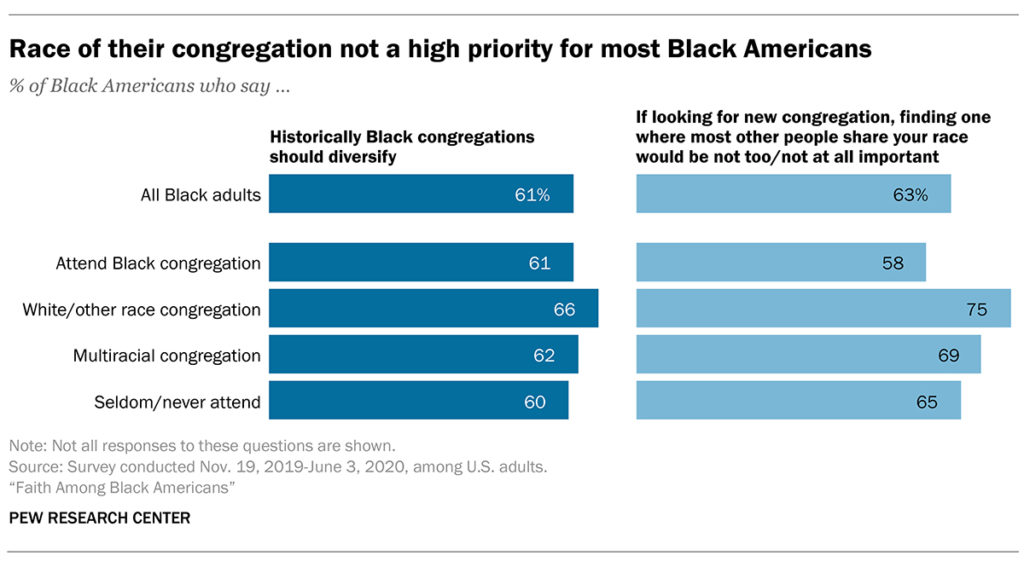
WASHINGTON (RNS)—Most Black Americans attend predominantly Black congregations, but a majority think such congregations should welcome people of other races, a study from Pew Research Center shows.

“Most Black Americans, including those who go to Black churches, say that they think congregations that have historically been Black should work to diversify rather than trying to retain their traditional racial character,” said Besheer Mohamed, a Pew senior researcher.

“They say that if they were looking for a new church, the race of a congregation and the race of leadership would be not that important.”

Pew describes its new 176-page report, based on a survey of 8,660 Black adults, as its “most comprehensive, in-depth attempt to explore religion among Black Americans.”

“The number of Black respondents in this study is bigger than most entire studies,” said Mohamed.

He said the breadth of the study could help dispel the notion the Black church is monolithic and could also demonstrate there is more to Black religious life than what happens in church.

“When we ask (about) when you’re making major life decisions, they’re much more likely to say they rely on prayer and personal religious reflection than to say they rely on advice from clergy and religious leaders,” he added.

Black Christians also regard some topics as a matter of faith, even if they aren’t spoken explicitly from the pulpit.

“People see, for example, opposing racism as essential to their faith, whether or not they’re hearing sermons about it,” Mohamed said.

Differences noted within Black America

The large sample size allowed researchers, who conducted their survey from November 2019 through June 2020, to learn some specific differences in beliefs and practices within Black America.

For example, while 44 percent of Black adults overall say clergy should officiate same-sex wedding ceremonies, 37 percent of Black Protestants agree, compared to 62 percent of Black Catholics and 64 percent of religiously unaffiliated Black people.

“Despite the fact that Catholics remain a relatively small share of the Black religious profile, that difference is really striking,” said Mohamed, who is also co-author of the “Faith Among Black Americans” report.

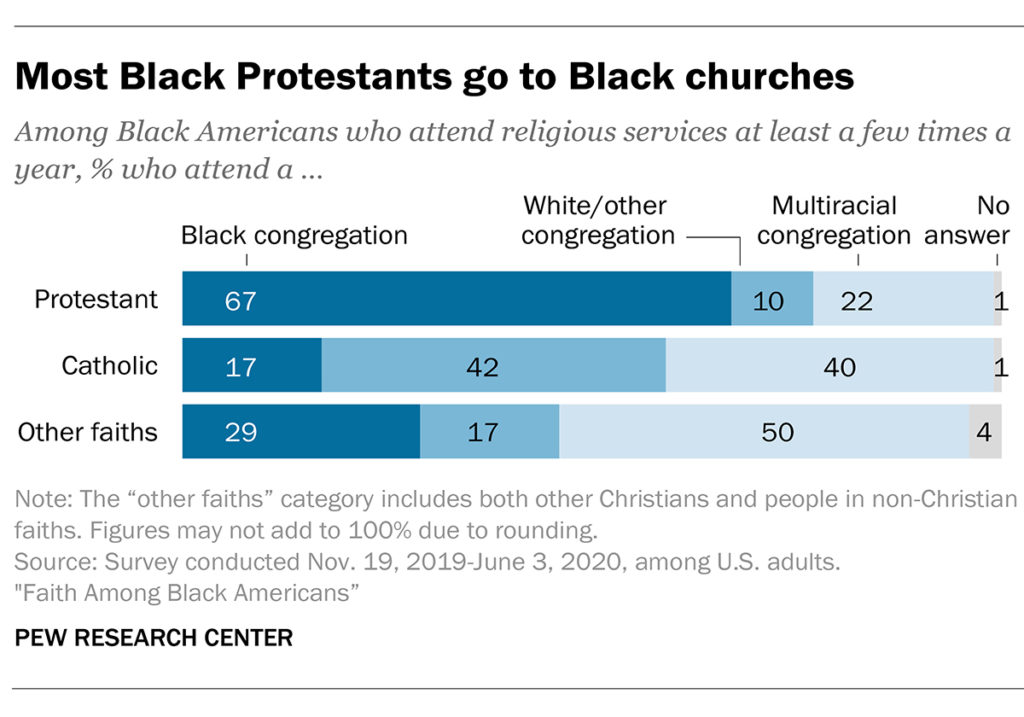
Researchers defined Black congregations as those where most or all attendees are Black and senior religious leaders are Black. Congregations labeled “white or other race” have attendees who are mostly white, Asian, Hispanic or mostly of a different (non-Black) race and are where most or all of the religious leaders are of the same different race as one another. Multiracial congregations primarily are those where no single race makes up the majority of attendees.

Black Protestants comprise two-thirds (66 percent) of Black Americans, while Catholics are 6 percent of that population. Another 3 percent identify with “other Christian faiths,” mostly Jehovah’s Witnesses, and an identical percentage (3 percent) affiliate with non-Christian faiths, most often Islam.

Almost one-fifth (21 percent) are not affiliated, mostly “nothing in particular,” but 3 percent of the unaffiliated say they are agnostic or atheist.

The study also showed differences between Black Americans based on their place of birth and their age.

African immigrants are more likely to be religiously affiliated than U.S.-born Black Americans, but less likely to be Protestant. Both African-born and Caribbean-born Black adults are more likely to be Catholic than Black adults who were born in the United States.

Almost half of U.S.-born Black adults support the idea of religious leaders conducting same-sex ceremonies (46 percent), while 21 percent of African-born adults and 32 percent of Caribbean-born Black adults do.

The study found 23 percent of Black Protestants are affiliated with historically Black denominations, such as the National Baptist Convention USA, Church of God in Christ and the African Methodist Episcopal Church; 32 percent were ambiguous or vague about their affiliation, such as describing themselves as “just Pentecostal” or “just Baptist,” while 30 percent were aligned with mainline or evangelical denominations that are not historically Black. Fifteen percent said they were nondenominational.

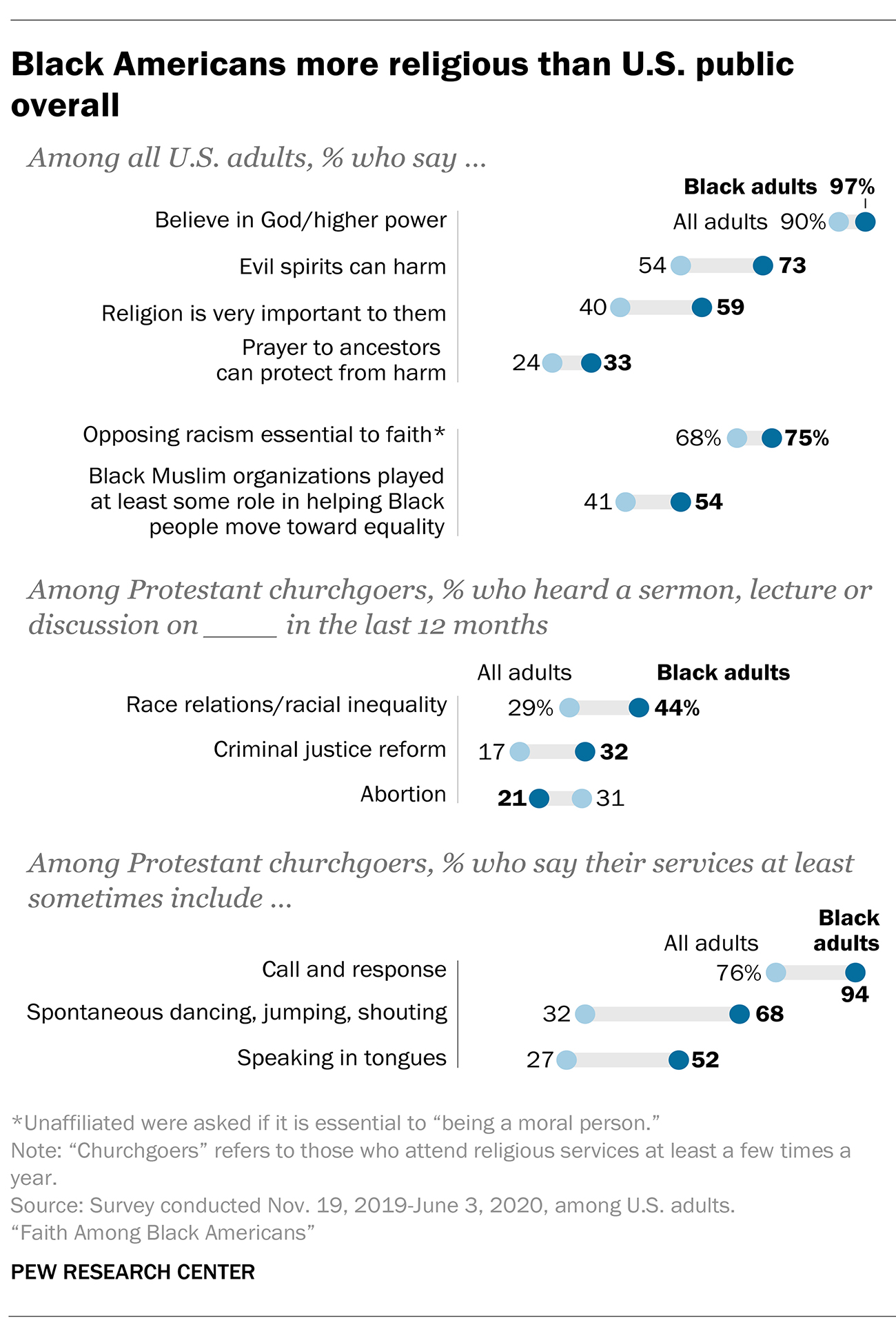
Almost all (99 percent) of Black Americans who attend a Black Protestant church at least a few times a year said they had heard “amen” or other so-called call-and-response expressions of approval in their services; three-quarters (76 percent) said there was dancing, shouting or jumping and more than half (54 percent) said there was praying or speaking in tongues.

Those who attend white, multiracial, Catholic and other Christian churches almost uniformly were less likely to report these experiences. But more than half (54 percent) of Black Americans attending multiracial Protestant churches also reported that speaking and praying in tongues occurred in those settings.
Younger Black adults are less likely to attend predominantly Black congregations, with almost half (53 percent) of both Generation Z (born after 1996) and millennials doing so, compared to two-thirds (66 percent) of both baby boomers and members of the silent generation (born before 1946).

Younger Black adults were also less likely to say they were raised in a Black church, and those who do attend religious services are less likely to attend a congregation that is predominantly Black.

African Americans are more religious than Americans overall, based on their belief in God or a higher power (97 percent compared to 90 percent); opposition to racism being essential to their faith (75 percent compared to 68 percent); believing evil spirits can harm (73 percent to 54 percent); and saying religion is very important to them (59 percent compared to 40 percent).

The study also looked at some of the tensions between what Black Americans think Black congregations should be doing and their actual actions. Mohamed said some findings show Black Americans are more egalitarian than their congregations.

“Men and women are almost as likely to say that opposing sexism is essential to their faith—essential to what being a Christian means to them, if they’re Christian—as to say that opposing racism is, but they’re much less likely to hear sermons about sexism than racism. So we definitely see this difference.”

Among other findings:

  • Church shopping: When looking for a new house of worship, Black Americans want a congregation to be welcoming (80 percent) and offer inspiring sermons (77 percent). Other factors are less likely to be considered “very important,” including belonging to their denomination (30 percent).
  • Prayer: 63 percent of Black Americans say they pray daily; one in five (20 percent) pray at a home altar or shrine at least a few times a month.
  • Sermons: An equal number of Black Protestant churchgoers—nearly half—have heard sermons on the topic of racial inequality (47 percent) and on voting (47 percent).
  • Political party: Almost two-thirds of Black Democrats (64 percent) who go to religious services attend a Black congregation, compared to fewer than half of Black Republicans (43 percent). By a 2-1 margin (22 percent to 11 percent) Black Republicans are more likely than Black Democrats to attend houses of worship where most of the congregants are white.
  • Time: More than a quarter of Black religious service attendees (28 percent) say their services last about two hours, and a third (33 percent) say they last an hour and a half. Another 14 percent say their services last more than two hours.

The study had an overall margin of error of plus or minus 1.5 percentage points for the sample of 8,660 Black adults and margins of error for specific groups, ranging from plus or minus 1.5 percentage points for U.S.-born Black respondents to plus or minus 8.6 percentage points for African-born respondents. An overall sample of 13,234 U.S. adults had a margin of error of plus or minus 1.5 percentage points.


Report reveals Zacharias’ long history of sexual abuse

ALPHARETTA, Ga. (BP)—Internationally-known evangelist and apologist Ravi Zacharias sexually abused women at least as far back as February 2014, according to a report commissioned by Ravi Zacharias International Ministries.

In 2018, Zacharias addressed messengers at the Southern Baptist Convention annual meeting in Dallas, and he was a popular speaker at apologetics events involving Southern Baptists. Zacharias died May 19, 2020, from cancer at age 74.

Four cell phones used by Zacharias, whose ministry lasted approximately 50 years, provided the bulk of evidence he had multiple relationships with women who were not his wife. That evidence includes well over 200 “selfie”-style photographs of women, many of them explicit, as well as conversations over email the report termed as “amorous.” As the “silent partner” of two Atlanta-area massage parlors, Zacharias made unwanted advances and pressured therapists toward inappropriate touching.

In a statement, the RZIM board called the report’s findings “horrendous.”

“We believe not only the women who made their allegations public but also additional women who had not previously made public allegations against Ravi but whose identities and stories were uncovered during the investigation,” it read.

“Tragically, witnesses described encounters including sexting, unwanted touching, spiritual abuse and rape. We are devastated by what the investigation has shown and are filled with sorrow for the women who were hurt by this terrible abuse.”

In its statement the board said it has enlisted victims advocate Rachael Denhollander as a consultant and “confidential liaison” to educate board and senior leadership as well as work with survivors.

RZIM hired the Miller & Martin law firm to conduct an independent investigation following a Sept. 29, 2020, report by Christianity Today on accusations of sexual abuse against Zacharias from three women who were employees of the Atlanta-area massage parlors.

That came three years after Zacharias denied accusations of an illicit online sexual relationship with a woman in Canada. That woman, later identified as Lori Ann Thompson, confidentially settled the dispute in the fall of 2017 with a nondisclosure agreement.

In the Washington Post, Thompson expressed appreciation for RZIM’s apology, but said “it must be backed by action.”

“I’d like to know how each member of the executive leadership feels they themselves have failed,” she said. “Don’t hide behind the institution. We almost didn’t make it out of this. … We almost lost our marriage. We’re not looking to be litigious, but we’re looking for them to be accountable. They tried to actively crush our family.”

According to documents filed with the Georgia Secretary of State, Zacharias was involved as a “silent partner” with two spas in Alpharetta, Ga.—Touch of Eden and Jivian Wellness.

Therapists at those spas told Christianity Today Zacharias would repeatedly “try for more than a massage” and sent “obvious cue[s] that he wanted more.” Over time, several therapists told investigators those requests morphed into acts of sexual abuse.

Of the more than 50 individuals—including more than a dozen massage therapists—who were interviewed for the report, only one said Zacharias engaged in sexual intercourse with her. The woman, who was struggling financially at the time she met Zacharias, said he offered to help pay for her schooling and monthly living expenses as well as compensate her for the massages.

According to investigators, “she told us she ‘felt obligated’ to do what he asked because of the financial support he provided.” The woman went on to describe the encounters, which lasted a number of years, as rape.

Zacharias, she said, would make her “pray with him to thank God for the ‘opportunity’ they both received. She said he called her his ‘reward’ for living a life of service to God, and he referenced the ‘godly men’ in the Bible with more than one wife.”

He often would warn her against speaking out, telling her “she would be responsible for the ‘millions of souls’ whose salvation would be lost if his reputation was damaged,” the report said.

Zacharias concealed his activities by a variety of means. His chronic back pain was well-known and even acknowledged by the Miller & Martin report. Thus, it stated, “he was able to hide his misconduct in plain sight” because his actions often took place when he was alone with massage therapists.

In addition, Zacharias covered his tracks electronically. Witnesses said he carried at least two phones with him at all times that were on a separate plan from those used by RZIM. He also insisted on remaining separate from official RZIM communication platforms through the use of private email addresses and while at the organization’s headquarters would use the public wireless access rather than RZIM’s virtual private network.

Zacharias claimed these steps were for security purposes, but the result was no one at RZIM would have had access to his devices or email communications. The report also said Zacharias would use encrypted platforms where deleted messages are impossible to retrieve.

Attempts by RZIM staff to confront or question Zacharias’ behavior were quickly rebuffed.

Typically, at least one male RZIM staff member traveled with Zacharias to give an appearance of accountability. A personal masseuse also frequented these trips, and when a high-level RZIM staff member expressed concern over the appearance of impropriety, Zacharias “grew angry and barely spoke to this staff member for a long time.” Another staff member who spoke out was “demonized” by Zacharias and “accused of spreading rumors.”

They joined a growing number of staff who were met with indignation after speaking out or asking questions. According to the report, Zacharias would be “strident and inflammatory,” describing critics as “nasty people” and “lunatics” engaging in “satanic-type slander and falsehood.”

After many details of Thompson’s communications with the evangelist were made public, Zacharias attempted to explain himself in an all-staff virtual meeting in January 2018. Many in attendance found his reasoning “nonsensical,” but when they expressed doubts about his story “they were ignored, marginalized, and accused of disloyalty.”

Prior to the 2018 SBC annual meeting, RZIM’s board had assured the Committee on Order of Business that Thompson’s accusations were without merit, said Steve Gaines, pastor of Bellevue Baptist Church near Memphis, who was SBC president at the time.

“We were assured that the single allegation at that time had been settled and was false,” he told Baptist Press. “The more recent revelations from the investigation of Ravi Zacharias have broken our hearts. We grieve for every woman who was abused in any way.

“This behavior is deplorable. I commend RZIM for the independent investigation. Sexual abuse is sin and must be dealt with.”

In January, Lifeway Christian Resources confirmed it was among merchants who had removed RZIM materials from their inventory “based on the allegations that have been widely reported.”

RZIM’s UK Board, Zacharias Trust, issued a statement after the investigation’s findings applauding the women who had come forward while announcing “a clear separation from the global RZIM organization.”

Zacharias was born in Madras, India, and grew up in Delhi. Raised Anglican, he was originally a skeptic until surviving a suicide attempt at 17 years old. He would go on to become an evangelist and rose to prominence in 1983 when he spoke in Amsterdam for a Billy Graham crusade.

He founded RZIM in August 1984. Based in Atlanta, the organization claims a team of nearly 100 speakers and ministry in 15 countries. During Zacharias’ ministry, he spoke to audiences and groups around the world and wrote more than 30 books.


More than a quarter of white evangelicals believe QAnon

WASHINGTON (RNS)—A new survey reports more than a quarter of white evangelical Protestants believe a QAnon conspiracy theory that purports former President Donald Trump is secretly battling a cabal of pedophile Democrats.

About half of the group express support for the debunked claim that antifa was responsible for the recent insurrection at the U.S. Capitol.

Experts say the data point to a widening ideological divide not only between white evangelicals and other religious groups in the country, but also between white evangelical Republicans and other members of their own party.

The survey, conducted by the conservative American Enterprise Institute, reported 29 percent of Republicans and 27 percent of white evangelicals believe the widely debunked QAnon conspiracy theory is completely or mostly accurate.

QAnon has infiltrated other faiths as well, with 15 percent of white mainline Protestants, 18 percent of white Catholics, 12 percent of non-Christians, 11 percent of Hispanic Catholics and 7 percent of Black Protestants saying they believe it.

Large subsets of each group—ranging from 37 percent of non-Christians to 50 percent of Hispanic Catholics—said they “weren’t sure” whether the theory was true.

White evangelicals primed to embrace conspiracy theories

According to Daniel Cox, director of AEI’s Survey Center on American Life, the report suggests conspiracy theories enjoy a surprising amount of support in general, but white evangelicals appear to be particularly primed to embrace them.

“There’s this really dramatic fissure,” he said.

There was also significant support among white evangelicals for the claim that members of antifa, or anti-fascist activists, were “mostly responsible” for the attack on the U.S. Capitol—a discredited claim repeated by former Trump lawyer Rudy Giuliani and conservative religious leaders such as Franklin Graham. FBI officials have said there is “no indication” antifa played a role in the insurrection.

Even so, the story has had staying power in the minds of many Americans, including 49 percent of white evangelical Protestants who said the antifa claim was completely or mostly true. So did 36 percent of white Catholics, 35 percent of Hispanic Catholics, 33 percent of white mainline Protestants, 25 percent of Black Protestants and 19 percent of non-Christians.

Among the religiously unaffiliated, 22 percent also expressed belief in the theory.

Politically segregated group

Asked to explain why white evangelicals appear disproportionately likely to embrace conspiracy theories, Cox noted that, as a group, they do not fit a stereotype of conspiracy theorists as people disconnected from social interaction. Instead, most retain strong connections to various social groups.

But white evangelicals stand out in a different way: The vast majority say some or a lot of their family members (81 percent) or friends (82 percent) voted for Trump in the 2020 election—more than any other religious group.

“People who do strongly believe in these things are not more disconnected—they are more politically segregated,” Cox said.

The resulting social echo chamber, he argued, allows conspiracy theories to spread unchecked.

“That kind of environment is really important when it comes to embracing this kind of thinking,” he said. “You’re seeing people embrace this sort of conspiratorial thinking, and everyone in their social circle is like, ‘Yeah, that sounds right to me,’ versus someone saying, ‘You know, we should look at this credulously.’”

Not limited to QAnon

White evangelicals express robust support for other conspiracy theories as well. Close to two-thirds (62 percent) believe there was widespread voter fraud in the 2020 election—despite courts refuting such claims—and roughly the same percentage (63 percent) believe President Joe Biden’s victory was “not legitimate.”

A majority (55 percent) also said they believed it was mostly or completely accurate to say “a group of unelected government officials in Washington, D.C., referred to as the ‘Deep State’ (has) been working to undermine the Trump administration.”

Cox said forthcoming data will highlight the ideological distinctiveness of white evangelicals even among people who identify as Republicans or who lean toward the party, signaling an “increasingly important divide in the GOP among people who identify as evangelical Christian and those who do not.”

“If you’re a Republican but identify as an evangelical Christian, you’re far more likely to believe in voter fraud in the 2020 election,” he said. “You’re far more likely to believe that Biden’s win was not legitimate. You’re more likely to believe in the QAnon conspiracy. You’re more likely to believe in the ‘Deep State.’”

White evangelicals also stood apart from other religious groups when asked about the potential for violent action: 41 percent completely or somewhat agreed with the statement “if elected leaders will not protect America, the people must do it themselves even if it requires taking violent actions.”


Americans less optimistic about race relations

NASHVILLE, Tenn.—Fewer Americans believe the nation has made significant progress in race relations, and a majority say things grew worse under Donald Trump’s presidency.

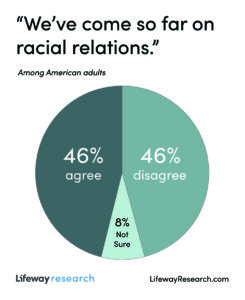
A recent Lifeway Research study, conducted prior to the 2020 election, finds U.S. adults are less likely now than in 2014 to agree with the statement “We have come so far on racial relations.”

According to the most recent study, 46 percent say Americans have made worthwhile progress in race relations—28 points fewer than in 2014 when 74 percent said the same.
Americans are also twice as likely to disagree than in 2014. Today, 46 percent don’t believe we have come a long way on race relations, while it was 23 percent in 2014.

“With a change in methodology from telephone in 2014 to online, we cannot say definitively if this decreased optimism is an actual change in sentiment or increased forthrightness,” said Scott McConnell executive director of Lifeway Research. “Regardless, optimism on race relations is lower than we previously thought.”

White Americans are the most likely to say we’ve made significant progress (51 percent), while African Americans are the most likely to disagree (66 percent).

Religiously unaffiliated Americans are the religious group least likely to agree with the statement (38 percent). Among Christians, those who attend at least monthly (57 percent) are more likely than those who attend less frequently (39 percent) to believe the nation has come a long way on race relations. Americans with evangelical beliefs are more likely to agree (58 percent) than those without such beliefs (43 percent).

Religious influence

When thinking about how to improve race relations, most Americans (57 percent) say religious leaders play a positive role. Around a quarter (24 percent) disagree, and 18 percent aren’t sure.

Currently, some of the most skeptical of religious leaders’ positive impact on race relations are the religiously unaffiliated, young adults and those without much formal education. Religiously unaffiliated adults are the most likely religious demographic to disagree (38 percent).

Those age 18-34 are the least likely to say religious leaders play a positive role in race relations (50 percent) and most likely to say they aren’t sure (27 percent). Those with a bachelor’s (67 percent) or graduate degree (63 percent) are more likely to agree religious leaders help than those with a high school degree or less (51 percent).

Among Christians, the more often they attend church services, the more likely they are to believe religious leaders play a positive role in race relations.

“Those who are around church the most see religious leaders’ contributions to race relations,” McConnell said. “However, there appears to be a need for both more positive contributions and for such stories to be shared, as more than a quarter of the non-religious and young adults don’t see it.”

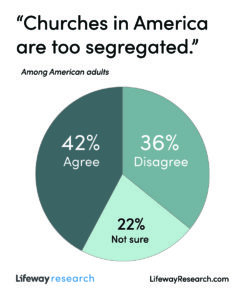
Americans are divided over whether U.S. churches are too segregated. More than 2 in 5 (42 percent) believe that to be true, while 36 percent disagree and 22 percent aren’t sure.
Young adults, those age 18-34, are more likely to view churches as too segregated (46 percent) than those 50 and older (38 percent). Half of African Americans (52 percent) and Hispanics (50 percent) agree, compared to 38 percent of white adults.

Slightly more than a third of Protestants (37 percent) believe churches are too segregated, the lowest among religious groups. The religiously unaffiliated (48 percent), other religions (47 percent) and Catholics (45 percent) are all more likely to say congregations are too racially segregated.

A previous Lifeway Research study found evidence churches are becoming more diverse, though most are still mostly one ethnic group. In 2017, 81 percent of Protestant pastors said their church was predominantly one racial group, down from 86 percent in 2013.

Better or worse?

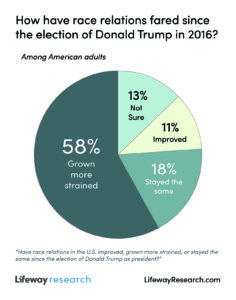
In the latest Lifeway Research survey, most Americans (58 percent) say race relations in the country grew more strained since the election of Trump as president, while 18 percent say things have stayed the same and 11 percent say relations have improved.

African Americans (72 percent) are most likely to say race relations grew more strained under President Trump, but majorities of Hispanics (61 percent) and whites (54 percent) also agree.

The latest survey shows 71 percent of Americans agree with the statement: “We’ve got so far to go on racial relations,” while 21 percent disagree. The portion of those who believe we have much farther to go is down from 81 percent in 2014. Among African Americans, however, 81 percent still agree that the U.S. has a long way to go.

For 7 in 10 Americans (69 percent), racial diversity is good for the country. Around a quarter (23 percent) disagree. This is down from 2014 when 82 percent of Americans said they believed our nation’s racial diversity was beneficial. The percentage of white Americans who see diversity as good fell almost 20 points (85 percent in 2014 to 66 percent today).

Among those that identify as Christian, those who attend church less than once a month are the least likely to see racial diversity as good for the U.S. (63 percent).

“This seems to be an area where pastors are influencing those who are in the pews,” said McConnell. “In the 2017 Lifeway Research study, 93 percent of Protestant pastors said every church should strive to achieve racial diversity. Those that attend more frequently are more likely to see diversity as a benefit to our country.”

The online survey of 1,200 Americans was conducted Sept. 9-23, 2020, using a national pre-recruited panel. Analysts used quotas and slight weights to balance gender, age, region, ethnicity, education and religion to reflect the population more accurately. The sample includes an over-sample of Americans with evangelical beliefs providing additional reliability for breakouts of this group.

The completed sample is 1,200 surveys, providing 95 percent confidence tthe sampling error from the panel does not exceed plus or minus 3.2 percent. Margins of error are higher in sub-groups.


Belonging beats belief in building trust, study finds

WASHINGTON (RNS)—The Bible and other sacred texts are filled with warnings about the importance of putting trust in the right place.

“Trust in the Lord with all your heart,” the Book of Proverbs advises. “Do not put your trust in princes, in mortal man who cannot save,” warns another Proverbs verse.

But does faith in God affect one’s ability to trust other people? And can religion help build trust? Those are the questions a pair of sociologists had in mind while working on a new study exploring the connection between religion and trust, especially at a time when trust—at least in the United States—is on the decline.

Many people think religion can build trust, the study’s authors wrote. But that may not always be the case.

Using data from the General Social Survey, Rubia Valente from Baruch College and Adam Okulicz-Kozaryn of Rutgers University isolated two aspects of religion—individual religiosity, with a focus on prayer and belief in God, versus social religiosity, measured by attendance at services or membership in a religious group.

They found higher levels of belief predicted less trust, while higher levels of belonging predicted more trust. They also discovered those who belong to religious groups or attend services have a lower level of misanthropy, or dislike of other people.

“People that are socially religious—what we classify as belonging—they’re more likely to like people and have a lower misanthropy level,” said Valente.

Valente said the study’s findings reminded her of some of the messages she heard in church while growing up in Brazil, especially about putting your trust in God and not in other people.

Often, she said, religious people are seen as trustworthy by others in the broader culture. But that trust doesn’t always extend the other way.

“That doesn’t seem to be the case, at least when it comes to individual religion,” she said.

Valente and Okulicz-Kozaryn used a series of questions from the General Social Survey to measure levels of both trust and misanthropy.

To measure, they looked at results for a question that asked, “Generally speaking, would you say that most people can be trusted or that you can’t be too careful in dealing with people?”

Studying social and individual religiosity

To measure misanthropy, the researchers looked at results for the trust question from the General Social Survey along with two others: one that asked if people, in general, are helpful or looking out for themselves and a second that asked whether people, in general, treat others fairly or look out for themselves.

As part of their study, the researchers controlled for factors like race, economic status or marital status, all of which are known to show different levels of trust. For example, white respondents, those with higher income and people who are married often have higher levels of trust, said Valente.

They also looked for the “net effect” of each of the two kinds of religiosity—social and individual.

To help explain their results, the researchers used a social theory about “ingroup favoritism” and “outgroup derogation/prejudice.” A circle of trust based on individual religiosity can reduce trust in general because “there is only an adherent and her God in the circle.”

“Social religiosity, on the other hand, explicitly adds other adherents in the circle,” they wrote.

The study is important, Okulicz-Kozaryn said, because trust has been on the decline in American culture. Understanding what factors affect levels of trust is important, he said, and religion seems to play a role in developing or inhibiting trust.

“We’re not saying you should be less religious and that’s going to boost trust,” Valente said. “That’s not it.”

At the same time, she said, religious people should be aware that high levels of belief could lead to a lack of trust, something that seems incongruent with religious teachings about loving your neighbors.

Findings from earlier study

A 2019 Pew Research study found two-thirds (66 percent) of Americans believe religious and nonreligious people are equally trustworthy.

Evangelical Protestants were most likely (40 percent) to say religious people are more trustworthy than nonreligious people. Atheists (35 percent) were most likely to say nonreligious people are more trustworthy than religious people.

The 2019 Pew survey also included questions about trust, fairness and helpfulness, similar to those in the General Social Survey.

According to previously unpublished data from Pew, those whose religious identity was “nothing in particular” were less likely to say people can be trusted (44 percent), that people would try to be fair (35 percent) or that others would help others (31 percent).

Those who identified as part of a historically Black tradition also were less likely to say people can be trusted, are helpful or fair.

Jews and Mainline Protestants were more likely to say people can be trusted, are helpful or fair.

Similar to Valente and Okulicz-Kozaryn’s work, the Pew study showed that those who attended worship services weekly or more also were more likely to say people can be trusted, are helpful or fair. Those who seldom or never attend services were less likely.

Produced as part of Ahead of the Trend, collaborative effort between Religion News Service and the Association of Religion Data Archives, and made possible through the support of the John Templeton Foundation.