Two-thirds of teenagers drop out of church as young adults

Church pews may be full of teenagers, but a new study says most of them likely won’t be in church on Sunday mornings after they graduate from high school.
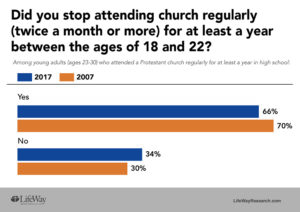
Two-thirds (66 percent) of American young adults who attended a Protestant church regularly for at least a year as a teenager say they also dropped out for at least a year between the ages of 18 and 22, according to a new study by LifeWay Research.  Thirty-four percent say they continued to attend twice a month or more.

While the 66 percent may be troubling for many church leaders, the numbers may appear more hopeful when compared to a 2007 LifeWay Research study. Previously, 70 percent of 18- to 22-year-olds left church for at least one year.

“The good news for Christian leaders is that churches don’t seem to be losing more students than they were 10 years ago. However, the difference in the dropout rate now and then is not large enough statistically to say it has actually improved,” said Scott McConnell, executive director of LifeWay Research.

“The reality is that Protestant churches continue to see the new generation walk away as young adults. Regardless of any external factors, the Protestant church is slowly shrinking from within.”

One-year break or gone for longer?

The dropout rate for young adults accelerates with age, the study found.

While 69 percent say they were attending at age 17, that fell to 58 percent at age 18 and 40 percent at age 19. Once they reach their 20s, around one in three say they were attending church regularly.

“Overall Protestant churches see many teenagers attending regularly only for a season. Many families just don’t attend that often,” said McConnell.

“As those teenagers reach their late teen years, even those with a history of regular church attendance are pulled away as they get increased independence, a driver’s license or a job. The question becomes: Will they become like older adults who have all those things and still attend, or will students choose to stay away longer than a year?”

Ben Trueblood, director of student ministry at LifeWay, said those numbers speak to the issue at hand. “We are seeing teenagers drop out of the church as they make the transition out of high school and student ministry,” he said. “This moment of transition is often too late to act for churches.”
Virtually all of those who dropped out (96 percent) listed a change in their life situation as a reason for their dropping out. Fewer say it was related to the church or pastor (73 percent); religious, ethical or political beliefs (70 percent); or the student ministry (63 percent).

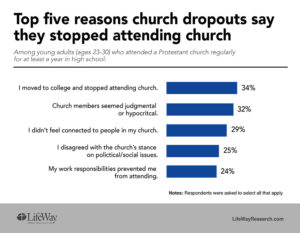
The five most frequently chosen specific reasons for dropping out were: moving to college and no longer attending (34 percent); church members seeming judgmental or hypocritical (32 percent); no longer feeling connected to people in their church (29 percent); disagreeing with the church’s stance on political or social issues (25 percent); and work responsibilities (24 percent).

Almost half (47 percent) of those who dropped out and attended college say moving to college played a role in their no longer attending church for at least a year.

“Most of the reasons young adults leave the church reflect shifting personal priorities and changes in their own habits,” McConnel said. “Even when churches have faithfully communicated their beliefs through words and actions, not every teenager who attends embraces or prioritizes those beliefs.”

Among all those who dropped out, 29 percent say they planned on taking a break from church once they graduated high school. Seven in 10 (71 percent) say their leaving wasn’t an intentional decision.

“For the most part, people aren’t leaving the church out of bitterness, the influence of college atheists, or a renunciation of their faith,” Trueblood said.

“What the research tells us may be even more concerning for Protestant churches: there was nothing about the church experience or faith foundation of those teenagers that caused them to seek out a connection to a local church once they entered a new phase of life. The time they spent with activity in church was simply replaced by something else.”

Why some stay connected

Not all teenagers leave church as a young adult. A third (34 percent) say they consistently attended twice a month or more through the age of 22.
Those who stayed saw the church as an important part of their entire life. When asked why they stayed in church, more than half say the church was a vital part of their relationship with God (56 percent) and that they wanted the church to help guide their decisions in everyday life (54 percent).

Around four in 10 (43 percent) say they wanted to follow the example of a parent or other family member.

Similar numbers say they continued to attend because church activities were a big part of their life (39 percent), they felt church was helping them become a better person (39 percent), or they were committed to the purpose and work of the church (37 percent).

Among all young adults who attended church regularly at least one year as a teenager, almost half (45 percent) currently attend at least twice a month, including more than a quarter (27 percent) who attend once a week or more.

Another 8 percent say they attend once a month, while 25 percent say they attend a few times a year. Twenty-two percent of those who attended regularly at least one year as a teenager now say they do not currently attend at all.

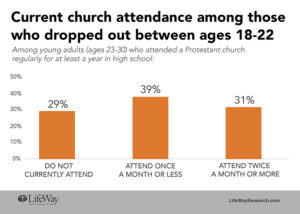
Among those who dropped out for at least a year, 31 percent are currently attending twice or month or more.

“On some level, we can be encouraged that some return,” said Trueblood, “while at the same time, we should recognize that when someone drops out in these years there is a 69 percent chance they will stay gone.”

Intentional ministry required

He advised churches to begin by working to lower the number who leave in the first place. “There are steps we can begin taking with those currently in student ministry that will keep them connected from the beginning of these years.”

An important step involves equipping adult leaders for ministry to teenagers.

“One of the most influential aspects of a student’s spiritual development is the investment of multiple adults speaking into their lives,” Trueblood said. “Since that’s the case, church leaders need to make an intentional effort to regularly train the volunteers who work with students. Equipping adults to serve in student ministry is vital to the spiritual health of students.”

Trueblood also asserted churches should have a strategic focus on individuals during those traditional college years. “In many places this is a forgotten, under-resourced ministry area,” he said. “Focus is placed on children, students, and then not again until someone enters the ‘young family’ stage. This needs to change.”

Among those who attended a Protestant church as teenager, 7 in 10 say they’re Protestant now. Another 10 percent identify as Catholic. Few say they are agnostic (4 percent) or atheist (3 percent).

“While some young adults who leave church are rejecting their childhood faith, most are choosing to keep many of the beliefs they had, but with a smaller dose of church,” said McConnell.

The survey was conducted September 15 – October 13, 2017. A demographically balanced online panel was used for interviewing American adults between the ages of 23 and 30 years old.

Analysts used light weights to balance gender, ethnicity, education and region. The sample was screened to include only those who attended a Protestant church twice a month or more for at least a year in high school. The completed sample is 2,002 surveys.

The sample provides 95 percent confidence that the sampling error from the online panel does not exceed plus or minus 2.4 percent. This margin of error accounts for the effect of weighting. Margins of error are higher in sub-groups.
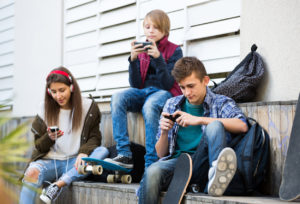


Resolved to unplug? Faithful reflect on digital lives

WASINGTON (RNS)—For Humza Deas, Instagram was a place to share his creative work that led to collaborations with Kanye West and major brands. For Kaylyn Slevin, it became a place to share her love of fashion and interest in modeling. For Emma Crockett, it was a place to connect with friends at her Christian high school.

(Photo / verkeorg / CC BY-SA 2.0)

But the popular image-sharing social media platform also was a place where the three teenagers encountered rumors, stalkers and bullies, according to Social Animals, a 2018 documentary film from Subconscious Films.

Instagram can edit its users’ lives into something that seems picture-perfect, going from success to success. It can turn people into brands, put metrics such as “likes” and followers on their sense of worth and open their lives to comments from strangers.

“I don’t really like it, but I keep doing it,” Crockett said in the film.

Filmmaker Jonathan Ignatius Green (RNS Photo Courtesy of NoFilter Picture)

Filmmaker Jonathan Ignatius Green, who calls Instagram the “epitome of social media,” hopes his documentary will open up discussions about how not just teens but also adults engage social media.

It’s a topic to which many people of faith are bringing their beliefs.

“I think this has now been part of our culture long enough that we’re kind of catching up to the reflection that is probably due this behavior,” Green said.

Tech-Wise Family Challenge

Christian author Andy Crouch and Barna Group, a research organization focused on the intersection of faith and culture, recently launched The Tech-Wise Family Challenge.

The 21-day challenge, inspired by Crouch’s 2017 book The Tech-Wise Family, encourages participants to rethink the role of technology in their lives and homes. The challenge includes questions for discussion and recommended action steps like spending Sundays screen-free, finding a place for devices to “rest” at home and making cookies or something else “hands-on” together.

Andy Crouch (Courtesy photo via RNS)

Time to unplug from social media and devices is important, said Crouch, because where there once was a rhythm to the day—an end to the workday and an escape from bullying—smartphones keep all those things within arm’s reach all the time.

When people complain about how obsessed teenagers are with their phones, Crouch said he asks them, “Have you seen the parents?”

“I really think I’m actually more concerned about the way this is shaping adult life,” he said.

And Christians, he argues, should think about the spiritual impact of technology and whether it is shaping them to be more like Christ—to love God and love their neighbor.

God is watching

Much of the guidance Gil Student included in A Torah Guide for the Digital Age: The Ten Tenets of Social Media, which he wrote several years ago for Jewish Action, is “really just common sense,” he said. Don’t treat others differently online than you would in person. Don’t spread rumors and lies. Don’t believe everything you read.

It also happens to be Jewish teaching, said Student, director of the Halacha Commission for the Rabbinical Alliance of America.

So is the idea that God always is watching—even though people can act online as if nobody can see and their posts aren’t easily searchable, he said.

Student pointed to a story in the Talmud about a famous rabbi who was dying. The rabbi’s followers came to his deathbed to ask him for a blessing. He blessed them, saying their fear of God should be as great as their fear of other people. If they feared God the way they did others, Student said, they would behave properly.

Not all bad

But social media isn’t all bad, according to faith leaders. It connects people with one another and with apps for reading Scripture or for meditation. It’s a place to ask questions and to find spiritual care and development—to meet needs religious institutions are not.

Social media also has given voice to digital organizers and campaigns such as the Muslim Antiracism Collaborative, as well as everyday Muslims who can respond to portrayals of Islam in pop culture and share the diversity of their religion, said Najeeba Syeed, associate professor of interreligious education at Claremont School of Theology.

Syeed, who has researched Muslim women’s use of social media, said she has seen it bring people together in interfaith dialogue, learning not just about different religious beliefs but also how different religions address many of the same issues they are facing.

“I think that’s really important work, and I think that when it’s done well, it increases religious literacy,” she said.

Still, the professor said, that can be stressful and emotionally draining.

These are the kinds of conversations Green said he hopes “Social Animals” will spark. And one thing the filmmaker said he’s seen in the reaction to the documentary as he’s screened it across the country is how willing and ready people are to reflect on their digital behaviors.

“It does feel like something that we’re still getting used to and still figuring out what’s healthy and what mental health looks like with these tools in our pockets and what relationships and sociability look like,” he said.

“The short version is there’s just a real eagerness to engage in the topic and talk about it.”


Why ‘Silent Night’ endures after 200 years

WASHINGTON (RNS)—It was the night before Christmas, and not a creature was stirring. Except for the mice at St. Nicholas Church in Oberndorf, Austria, who were busy chewing through the bellows of the organ.

Stained glass window depicting Franz Xaver Gruber in the Silent Night memorial chapel in Oberndorf. (CC BY 2.0)

Their handiwork left the church’s priest, Joseph Mohr, scrambling to find music for a Christmas Eve service. So he dashed off a few lines about the night Jesus was born and asked composer Franz Xaver Gruber to set the lyrics to a simple tune, played on guitar.

On that night 200 years ago, the two stood in front of the church’s nativity set and performed a song that began with words “Stille Nacht, heilige Nacht.”

Better known as “Silent Night,” the song would go on to become one of the season’s most beloved Christmas carols, translated into more than 300 languages and sung all over the world by artists from Bing Crosby to Beyoncé.

At least, that’s how the story goes.

Antidote to a ‘noisy chapter in history’

Legends aside, the song endures in part because it brings a sense of calm to the hustle and bustle of the Christmas season, said Brian Lee, head of the music department at Moody Bible Institute in Chicago.

“We seem to live in such a noisy chapter in history,” Lee said. “I think even just the title of the song in and of itself speaks to people.”

In Austria, where “Silent Night” has been declared part of the nation’s cultural heritage, the country’s tourism office has planned a number of events, including concerts and exhibits, to celebrate the song’s anniversary this year. The events included a concert late last month at Trinity Church, a historic Episcopal church in New York City, where it is believed the song first was performed in the United States.

Moody also planned its annual Candlelight Carols program around the song—linking it to the famed Christmas Eve truce during World War I. During that brief respite from fighting, British and German troops set down their weapons and sang “Silent Night,” among other carols.

‘Haunting, unique and yet painfully simple’

And modern hymn writers Keith and Kristyn Getty are making the song part of their Irish Christmas Tour, with stops at Carnegie Hall and the Kennedy Center.

Singing carols is as old as Christmas itself, Keith Getty noted in an email. The story of Christmas and the birth of Jesus, he said, begins with Mary, Zechariah, Simeon and angelic choirs all bursting into songs.

But “Silent Night” is unique, he said.

“Its simplicity makes it easily accessible even for kids—both lyric and melody are haunting, unique and yet painfully simple,” Getty said. “If only we had the potion to reinvent that!”

Part of the song’s genius is its simplicity, said Michael Hawn, a global hymnologist and professor emeritus of church music at Perkins School of Theology at Southern Methodist University. The lyrics and music paint a scene, and it “doesn’t try to do too much,” he said.

Origin story mostly true—sort of

Most of the story about its origins is true. But the details don’t quite match the legend.

While “Silent Night” may have been performed for the first time 200 years ago, Mohr had penned the poem a bit earlier, amid a trying time in Austria’s history at the end of the Napoleonic wars.

It’s true the church’s organ wasn’t working properly, but Hawn called the tale about the mice “a little bit over the top.” Using a guitar to accompany the song turned out to be “providential,” he said.

On the guitar, “Silent Night” sounds like a lullaby, according to the hymnologist. Its gentle 6/8 time signature mimics a mother rocking her child—appropriate alongside lyrics about the baby Jesus sleeping in heavenly peace.

After its debut, it spread as a folk song, said Paul Westermeyer, professor emeritus of church music at Luther Seminary in St. Paul, Minn. The Rainer family singers, a traveling singing group from Austria, then brought it to America, performing the song in 1839 at Trinity Church.

Twenty years later, a priest at Trinity, John Freeman Young, published the first English translation of three verses of “Silent Night.” Young had been ordained at St. John’s Episcopal Church in Tallahassee, Fla., and later became bishop of Florida.

Link between Silent Night and Jingle Bells?

Betsy Calhoun, director of music at St. John’s, said the church wasn’t aware of its ties to the origins of “Silent Night” until this past year, when a musicologist researching the 200th anniversary of the song reached out to the church. The church also has ties to another famed Christmas carol: It’s home to the organ on which James L. Pierpont composed “Jingle Bells.”

St. John’s, like many other churches, has ended its Christmas Eve services for years with “Silent Night,” sung acapella by candlelight.

There’s always a tense moment when the lights dim and candle flames drift, and once, Calhoun remembers someone’s hair catching fire during a service.

For countless churchgoers, though, that moment of quiet reflection captures what Christmas is all about—a moment amid the noise of the holidays when all is calm and bright. It’s a moment to gather with family and friends to remember a holy infant so tender and mild.

“It’s just a very hushed, calm, just unified spirit that kind of takes over, and it is very moving,” Calhoun said.


Beth Moore, Max Lucado share stories of sexual abuse

WHEATON, Ill. (RNS)—For popular Bible teacher Beth Moore, the church always has been a safe harbor. That especially was true when she was growing up. Church was a place where she could escape from the sexual abuse she experienced at home, she said.

Beth Moore addresses participants at Wheaton College at a summit on sexual abuse and misconduct. (RNS photo / Emily McFarlan Miller)

“I’ve seen glimpses with my own eyes what a church can do for victims of sexual abuse and assault. I am a survivor,” Moore said.

Moore was a featured speaker at a one-day summit on sexual abuse and harassment Dec. 13 at Wheaton College in suburban Chicago—and one of many who described their own experiences of abuse and harassment.

Some shared their stories of sexual abuse for the first time, including bestselling Christian author and pastor Max Lucado and child advocate Kelly Rosati.

‘Amplify a conversation others have started’

“We’re trying to help amplify a conversation others have started,” said Ed Stetzer, executive director of the Billy Graham Center at Wheaton, which organized the summit.

Evangelicals have not always done a good job of listening to survivors, Stetzer told attendees at the summit, and “we want to do better.”

“We’ve tried to listen to survivors today. You’ve noticed the overwhelming theme was people who have walked through this journey,” he said.

About 750 people registered for the event, according to organizers. Another 300 signed up to watch the livestream, and more than 40 groups livestreamed the event, including churches, universities and the headquarters of the Evangelical Free Church of America.

It comes as a survey from Nashville, Tenn.-based LifeWay Research earlier this year found that about two-thirds of Protestant pastors say members of their congregation have experienced sexual or domestic violence. Fewer than half of those pastors said their training equipped them to address the issue.

At the summit, prominent evangelical Christians from a number of denominations urged churches to educate themselves about mandated reporting laws in their states regarding sexual abuse, pressed for more female leaders in the church and denounced abuses of power by church leadership.

Panelists tell how trauma affects survivors

And a panel of trauma and counseling experts from the college shared a clinical understanding of how trauma affects survivors and how the church can help them heal. They stressed the importance of believing survivors when they come forward and simply sitting with them in their sorrow.

“We expect someone who’s experienced trauma just to get up and be OK, and because things have been shattered, it’s going to take time to put them back together,” said Nancy Nealious, a trauma recovery and licensed clinical psychologist in the Wheaton College Counseling Center.

In his closing remarks, Lucado revealed he was sexually abused as a child by a community leader. That’s why he said he accepted the invitation to speak at the summit—because he understands the difficulty of “regaining a balance, having gone through this type of situation.”

As he listened to other speakers, he also said he felt the need to repent for what he called “locker-room banter” from his days playing football, for conversations with women in which he “could have done better” and a condescending attitude he has adopted at times as a senior pastor. Men need to listen and to hear the stories women are sharing, he said.

“Now is the time for across-the-coffee-table conversations that begin with this phrase: ‘Help me to understand what it’s like to be a female in this day and age,’” Lucado said.

Critics voice concerns

The conference was not without its critics.

Former evangelicals Emily Joy and Hannah Paasch, the creators of the #ChurchToo hashtag, were not invited to speak at the summit. The two offered their responses to its sessions throughout the day on social media, stressing the view that evangelical beliefs help create an environment where abuse can occur.

Kelly Aten, a community group leader at Renewal Church, a nondenominational congregation in West Chicago, Ill., said she appreciated that speakers made clear sexual abuse is a sin. But they could have clarified that the abuser—not the victim—had sinned.

Survivors already may be dealing with feelings of guilt or shame, as well as a “blame culture” that too often asks what she was wearing or what she did to invite the abuse, said Aten, who attended the summit with a group of female leaders from Renewal.

Abuse is not just a sin, said Aubrey Sampson, a member of the church’s preaching team who identified herself as a survivor. It’s also a crime—a point she said more speakers could have made clear.

It is the church’s turn

Still, those in the group said they had learned a lot and hoped to take what they have learned back to Renewal. They hope to create an environment where people can feel safe and experience healing.

“The leaders in our church need to be equipped and encouraged and empowered to know, ‘What do we do?’” Sampson said. “How do we lead our people? How do we shepherd our people well?”

That was something that had resonated with them in Moore’s talk.

The Bible teacher recounted new headlines every month exposing crime and coverups in churches and other Christian institutions. She pointed out how secular groups have responded.

Now, Moore said, it is the church’s turn.


Astronauts gather at National Cathedral to remember Apollo 8

WASHINGTON (RNS)—Sometimes, the most profound truths about humanity and God are revealed when people take a small step back—or rocket about 238,000 miles into space.

Astronaut James Lovell had that epiphany 50 years ago as he became one of the first astronauts to orbit the moon.

‘In the beginning, God …”

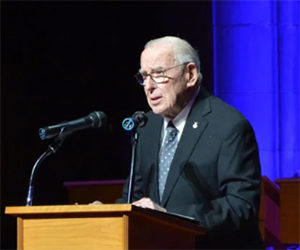
Apollo 8 astronaut Jim Lovell speaks during an event commemorating the 50th anniversary of his 1968 space mission at the Washington National Cathedral. (RNS photo by Jack Jenkins)

Lovell spoke at the Washington National Cathedral on Dec. 11 as part of a celebration of the 50th anniversary of the 1968 Apollo 8 mission that sent Lovell and fellow astronauts William Anders and Frank Borman into space to circle Earth’s gray satellite.

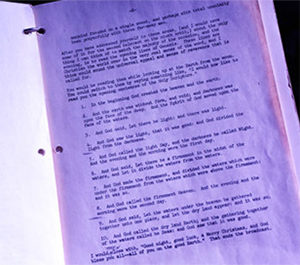
The mission, which lasted from Dec. 21 to Dec. 27, 1968, included an unusual religious element: As the trio of spacefarers rounded the moon on Christmas Eve, they paused to read the first 10 verses from the Book of Genesis.

“From the crew of Apollo 8, we close with good night, good luck, a Merry Christmas and God bless all of you—all of you on the good Earth,” Borman said, in what was then the most-watched broadcast in history.

The themes of religion, space and caring for the “good Earth” were recounted over and over as religious leaders and NASA officials addressed a crowd gathered beneath a canopy of swirling stars projected onto the cathedral’s sprawling ceiling.

A holy journey

Randy Hollerith, dean of the cathedral, opened the festivities by reflecting on the unique way Apollo 8 impacted life here on Earth—especially the famed “Earthrise” photo.

Projectors illuminate the ceiling of the Washington National Cathedral scenes of the cosmos on Dec. 11, 2018. (RNS photo by Jack Jenkins)

“This amazing mission that I would call a pilgrimage revealed not only the dark side of the moon, but it gave us the most powerful images of our small and fragile world—God’s precious gift, awash in an unimaginably large universe,” Hollerith said. “I think of it as a holy journey not only for what it accomplished, but for what it revealed to us about our place in God’s grand creation.”

Hollerith’s sentiment was echoed by Michael Curry, presiding bishop of the Episcopal Church, who drew parallels between the experience of spaceflight and encounters with divine mystery.

“The exploration of space is part of the human quest for knowledge, and the human quest for knowledge is to know God’s creation,” Curry said in an interview before the ceremony. “There is something awe-inspiring about (space) that must be akin to the awe experience of the mystics, who from a different angle beheld this world and look at it from within.”

‘This is God’s world’

During his address, Curry discussed how cosmic awe can fuel Earth-bound activism. He said many have claimed the famous Apollo 8 “Earthrise” photo helped jump-start the modern environmentalist movement, and he called on those present to continue that tradition by taking action on climate change.

“This is God’s world. We are here because the great God Almighty looked back and said: ‘I’m lonely. I’ll make me a world.’ Deep in the fabric of this creation, we are a part of it—not the sum total of it,” Curry said during his talk, which was broadcast live on NASA TV.

The flight manual from which the Apollo 8 astronauts read the Genesis passage during their 1968 mission on display at the Washington National Cathedral. (RNS photo by Jack Jenkins)

He hoped the commemoration would be “a moment of re-consecration and dedication” of the mission of NASA and others “to explore new worlds, to seek out vast knowledge and then to mobilize the great knowledge of science and technology and the wisdom of humanity, to mobilize it now to save this oasis, our island home.”

To drive his point home, Curry led the crowd in a slow, soft rendition of “He’s Got the Whole World in His Hands.”

Curry’s environmentalist message likely resonated with the next speaker, NASA Administrator Jim Bridenstine. Earlier this year, the former Republican congressman from Oklahoma became one of the few high-level Trump appointees to throw his support behind the scientific evidence for climate change and declare that humans are contributing to it.

Bridenstine’s remarks at the cathedral focused on the sheer audacity of the Apollo 8 mission. He noted the astronauts’ Christmas message reached those in Soviet Russia, where religious celebrations were discouraged by the officially atheistic government.

He then cited the Genesis passage to frame NASA’s plans to return to the moon. He explained that ice found there could provide resources and even rocket fuel for future space missions to Mars, the moons of Jupiter and beyond.

That Scripture passage says that “God separated the waters, the water below the firmament … and the waters above the firmament,” he said. “We now know that there are hundreds of billions of tons of water ice at the poles of the moon.”

Religion’s role in space program

Religion has played a perhaps surprising role in the space program since the beginning.

A few months after the Apollo 8 Scripture reading, Apollo 11 astronaut Buzz Aldrin, a Presbyterian, had Communion on the moon—complete with bread and a small vial of wine—just hours before stepping out on the lunar surface with Neil Armstrong. Astronaut Edgar Mitchell carried microfilmed copies of the King James Bible on Apollo 14.

In 1996, astronaut Jeffrey Hoffman, who is Jewish, read the opening verses of Genesis from a Torah scroll while in orbit.

Eleven years later, the Malaysian space agency convened a group of more than 150 Islamic scholars to determine how Muslim astronaut Sheikh Muszaphar Shukor could pray while orbiting the planet in the International Space Station.

Fusions of space and faith also have sparked controversy.

The Apollo 8 Genesis reading triggered a lawsuit by famed atheist activist Madalyn Murray O’Hair, who argued the crew’s actions violated the Establishment Clause of the First Amendment. The case made it all the way to the Supreme Court, which dismissed it by citing lack of jurisdiction.

Hollerith mentioned the National Cathedral retains a piece of the otherworldly in its walls. One of the stained-glass windows in the main sanctuary is called the “Space Window”—a gift from former NASA Administrator Thomas O. Paine—and contains a piece of moon rock collected during Apollo 11. The window was illuminated for the occasion.

‘What is our place in the universe?’

While NASA doesn’t promote any specific faith or religion in general, the agency’s work can touch on broader spiritual concerns, Bridenstine said.

“I will tell you, as the administrator, when I talk to people in the community, there is an element of spirituality that is present in the work that we do,” he said. “The Scripture is very clear that God created the heaven and the earth. … There are other spiritual questions, like: Are we alone in the universe? Could there be life on a world that is not our own? These are scientific questions, but also gets to maybe a deeper philosophical understanding of ‘what is our place in the universe?’”

Asked about the possibility of sending faith leaders into space, Bridenstine said NASA “absolutely” would be amenable to the idea.

“I think it’d be fantastic. Why not?” he said, pivoting to a discussion of NASA’s role as customer in the rapidly expanding private space industry.

“The vision I would like to present is a vision where anybody from any walk of life would have access to space, the same as we have right now to airliners,” he said. “It doesn’t matter if it’s somebody from the clergy, or just a faith leader of some kind—everybody should have access.”

The evening concluded with an address from Lovell, who recounted in vivid detail his first historic journey around the moon and back.

As he reflected on his first thoughts upon seeing the Earth emerge above the lunar horizon, he repeated the evening’s theme: Traveling to the moon was about exploration, yes, but also about understanding life here on Earth.

“I arrived on a planet with a proper mass to have the gravity to retain water and an atmosphere— the essentials for life. I arrived on a planet orbiting a star at just the right distance to absorb that star’s energy,” he said.

He paused, then added: “In my mind, the answer was clear: God gave mankind a stage on which to perform. How the play ends is up to us.”


Most Americans still say they want more Christ in Christmas

NASHVILLE, Tenn.—Most Americans want more religious meaning to the Christmas season. For about one-third, that includes the way seasonal greetings are expressed.

A new study from LifeWay Research found two-thirds of Americans (65 percent) say, “Christmas should be more about Jesus.”

Those looking for more Christ in Christmas in 2018 are proportionately fewer than four years ago, however. According to a 2014 LifeWay Research study 79 percent of Americans at that time said Christmas should be more about Jesus.

While similar numbers disagreed in 2014 and 2018 (18 and 19 percent respectively), the percentage who said they were unsure if Christmas should be more about Jesus jumped from 3 percent four years ago to 16 percent today.

“Saying Christmas should be more about Jesus is a little like saying Thanksgiving should be more about giving thanks. It’s in the name of the holiday,” said Scott McConnell, executive director of LifeWay Research. “Yet, it appears there is less cultural expectation for celebrations of the Christmas holiday to include the religious aspect.”

Much of the shift came from non-Christians. In 2014, a majority of members of other faiths (63 percent) and almost half of the non-religious (46 percent) agreed that Christmas should be more about Jesus. Today, those numbers have been cut in half.

In 2018, around a third of Americans of other religious persuasions (35 percent) and slightly more than a quarter of the non-religious (28 percent) believe Christmas needs more Christ.

Fewer Christians also say Christmas should be more about Jesus. In 2014, 92 percent agreed, while 81 percent agree today. Still, 97 percent of those with evangelical beliefs agree today.

Some say ‘Bah, Humbug’ to ‘Happy Holidays’

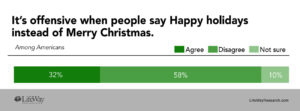
One of the ways some want to see more recognition of Jesus in the celebrations this time of year is in our greetings. Around a third of Americans (32 percent) say it is offensive when someone says “Happy holidays” instead of “Merry Christmas.” A similar number (33 percent) say the same about using “X-mas” instead of “Christmas.”

Those numbers are similar to four years ago. In 2014, 39 percent found “X-mas” offensive and 29 percent said the same about “Happy holidays.”

Today, 40 percent of Christians find “Happy holidays” to be offensive, compared to 12 percent of members of other religions and 15 percent of the non-religious. Around two-thirds of those with evangelical beliefs (65 percent) say they are offended by “Happy holidays” being used instead of “Merry Christmas.”

Americans 50 and over are almost twice as likely to say they find “Happy holidays” offensive than those under 50—42 percent to 22 percent.

“It’s likely that Christians and older Americans are nostalgic for previous years or reluctant to acknowledge that not everyone celebrates Christmas this time of year,” McConnell said.

“Many have the idea that most Americans are the same or that we share one culture of baseball, apple pie and Christmas, but that’s not the case. And when we encounter someone who believes differently from us, that can be jarring and even seem offensive for some.”

Frequent religious service attenders are more likely to be offended by “Happy holidays.” Almost half of those who attend a worship service once a week or more (47 percent) say the substitute greeting is offensive, compared to 35 percent who attend once or twice a month, 32 percent of those who attend a few times a year, 23 percent of those who attend once a year or less, and 21 percent of those who say they never attend.

“Instead of refusing to accept there are other belief systems in our country today, Christians may be better served finding a way to wish their non-Christian friends and family would experience all the blessings possible during the season in which believers celebrate God blessing Earth with his Son,” McConnell suggested.

LifeWay Research conducted the study of 1,004 Americans, Sept. 21-23. Analysts used sample stratification and base weights for gender, age, race/ethnicity, region, metro/non-metro, home ownership, education and income to reflect the most recent U.S. Census data. The sample provides 95 percent confidence that the sampling error does not exceed plus or minus 3 percentage points. Margins of error are higher in sub-groups.


Wheaton summit focuses on evangelicals and sexual abuse

CHICAGO (RNS)—For years, Nancy Beach had no idea other women had stories similar to hers.

Beach, the first woman to serve as a teaching pastor at Willow Creek Community Church, said her boss acted sexually inappropriately toward her in the late 1990s.

Willow Creek Community Church in South Barrington, Ill., has been in turmoil since sexual misconduct allegations came to light against its founder, Bill Hybels. (RNS Photo/Courtesy of Willow Creek Community Church)

Instead of speaking out, she said she went silent, like so many other women, wanting to protect the church and families involved and thinking her situation was an isolated case.

When she learned other women said they had similar encounters with Willow Creek founder Bill Hybels, she decided to speak out earlier this year. Eventually, Hybels, who has denied the allegations against him, retired early after about 10 women accused him of misconduct.

Honest conversation

Like others who have shared their stories of sexual harassment and abuse this year, Beach hopes other women won’t have to wait so long to speak out. It’s time, she said, for evangelical churches to have an honest conversation about sexual misconduct.

She plans to tell her story at Reflections: A GC2 Summit on Responding to Sexual Harassment, Abuse and Violence, a one-day evangelical gathering around the topic Dec. 13 hosted by the Billy Graham Center at Wheaton College, an evangelical Christian school in the Chicago suburbs.

There’s never been a more important time to address the topic of sexual misconduct in the church, according to Beach.

“I think this is just an opportunity to, instead of avoiding the conversation, open it up and to hear from many different voices coming from different areas of expertise,” she said.

#SilenceIsNotSpiritual image courtesy of SilenceIsNotSpiritual.org

The summit comes just over a year after artists Emily Joy, who does not use her last name professionally, and Hannah Paasch first appended the hashtag #ChurchToo to their tweets, giving survivors of sexual violence, abuse and harassment within the church a place to share their stories. They had been inspired by the #MeToo movement started by activist Tarana Burke, which brought to light accusations against a number of powerful men, particularly in media and entertainment.

Accusations against high-profile figures

Since then, several high-profile leaders in the evangelical world have been accused of sexual misconduct.

Andy Savage, a teaching pastor at Highpoint Church in Memphis, resigned in March after Jules Woodson accused him of sexually abusing her when she was a teenager and he was a youth pastor in Texas. Her story was one of the first to bring national attention to the #ChurchToo movement.

In April, an investigation by the Chicago Tribune revealed decades of alleged misconduct by Hybels. That investigation rocked not just Willow Creek but also the thousands of churches that had modeled themselves after the suburban Chicago megachurch.

Southwestern Baptist Theological Seminary trustee chairman Kevin Ueckert (left) addresses trustees at a special called meeting at the Fort Worth campus May 22. The board met to discuss the controversy surrounding Paige Patterson (right), then president of the seminary. (Photo by Adam Covington/SWBTS via BP)

Then this summer, the Southern Baptist Convention grappled with how to address the issue after Paige Patterson was ousted from Southwestern Baptist Theological Seminary amid reports he mishandled rape allegations by students.

Laurie Nichols, director of communications for the Billy Graham Center and one of the organizers of the event, said Reflections aims to give churches the tools they need to respond to victims of sexual harassment and abuse.

“We really want to equip churches in this area,” Nichols said. “A lot of pastors just don’t feel equipped to deal with this issue, and church leaders don’t feel equipped and a lot of women in the church don’t feel like they know how to share their stories.”

This is the center’s third GC2 summit, which is a reference to the Great Commission—“Go and make disciples of all nations”—and Great Commandment, Jesus’ command to love God and love one’s neighbor. Previous summits have focused on the refugee crisis and mass incarceration.

Let survivors’ voices be heard

Organizers also want survivors to have a voice and to know the church cares about them, Nichols said.

The schedule of the summit includes time for lament and prayer, as well as panel discussions and keynote addresses with titles like “Dear Church Leaders, Here’s How You Ought to Respond to Survivors in Your Church,” “When Jesus Heals” and “Seeking Accountability and Integrity.”

Licensed and trained team members will be on site to offer attendees support and referrals to further counseling, in partnership with the school’s counseling center and school of psychology. Proceeds from ticket and livestream sales will go to New Name, a local faith-based outreach to women in the adult industry.

Beth Moore, author and speaker, Russell Moore, president of the Ethics & Religious Liberty Commission, and Matt Carter, pastor at Austin Stone Community Church in Austin, discuss preventing and dealing with sexual abuse within the church at the Cooperative Program’s booth in the exhibit hall at the Kay Bailey Hutchison Convention Center June 11 prior to the two-day Southern Baptist Convention June 12-13. (Photo / Kathleen Murray / SBC Newsroom)

Among the speakers are Beth Moore and Christine Caine, two popular authors and speakers who have spoken out about their experiences of sexual abuse and support for the #MeToo movement.

Other speakers from Wheaton bring backgrounds in psychology and counseling: Nancy Nealious, a trauma recovery specialist and licensed clinical psychologist in the college’s counseling center; Tammy Schultz, a trauma and sexual abuse counselor and professor of counseling; Jenny Hwang, managing director of the college’s Humanitarian Disaster Institute; and Wheaton College Provost Margaret Diddams, a psychologist who is part of an advisory group currently investigating allegations against Hybels.

Nichols said speakers come from diverse backgrounds, but all hold evangelical beliefs.

Some critique evangelical perspective

But critics say it’s important for evangelicals to hear from voices outside the church. Those voices are missing from the conference, said Emily Joy, who left evangelicalism and now attends an Episcopal church.

She asserted evangelical teachings about sex—including the belief sex should be reserved for a man and woman within the context of marriage—form a “bedrock of sexually dysfunctional culture in conservative evangelicalism, and these speakers are not interested in dismantling it.”

She, Paasch and a few others plan to host their own teachings on social media offering “alternative information” during Wheaton’s summit, she said.

“My idea is not to just critique this—which deserves critique—but also to offer something constructive and proactive as well,” she said.

Emily Joy also is concerned the summit doesn’t have enough survivors or experts in dealing with issues of sexual abuse in its speaker lineup.

At least four of the 17 speakers listed on the summit website are survivors of sexual harassment or abuse, according to Nichols, who also identifies as a survivor. However, only one of the speakers, Jeanette Salguero, chief operating officer of Calvario City Church in Florida, is identified as a survivor in her summit bio.

Both a sin and a crime

Woodson, who identifies as Christian, is concerned about its inclusion of Caine, who has ties to Hillsong, an Australian megachurch whose founder, Brian Houston, is under fire for his handling of allegations his father had sexually abused several children.

She said evangelicals need to recognize sexual abuse is a problem within the church, and it is not just a sin but also a crime. They also need to listen to survivors, advocates and organizations like GRACE—Godly Response to Abuse in the Christian Environment—that were working to bring the issue to light before it was trending.

“We need to be having this conversation. Absolutely, we need to be equipping people and educating them about this topic. All of that is so important,” Woodson said. “But this (summit) just seems to me really lacking depth.”

Still, Emily Joy said the fact such an event is being held at an evangelical institution this year is “proof that we’re making progress insofar as we’re forcing them to confront these things.”

Hwang agreed evangelicals need to have a healthy conversation about sexuality. Many treat sex as a taboo topic, related to guilt and shame, according to the head of the Humanitarian Disaster Institute. That is unhealthy, she said, and can make it even harder to discuss sexual abuse.

Beach, the leadership coach once on staff at Willow Creek, worries that churches will react to the sexual abuse crisis by creating more rules that restrict women from leadership roles—in order to reduce the risk of misconduct. She believes God created men and women to work shoulder to shoulder together in ministry, she said. She’s experienced it, too—and that’s the story she wants to tell now at Reflections.

She said the summit is “only the beginning.”

“It’s just one day. It’s not going to solve everything,” Beach said. “But I think it’s a step in the right direction. That’s my hope.”


Income and education affect church shopping

Highly educated and affluent Americans are more likely than others to search for a new church—and chances are good they will do their homework before joining a different congregation, according to findings from Pew Research Center.

Recent Pew Research Center analysis of survey data collected in 2015 reveals education and income levels relate directly to whether Americans look for a new religious congregation and how they look for another place to worship.

‘Where people look, think and act like me’

To a large degree, income and education not only affect whether Americans shop around for a place to worship, but also tend to define the type of church they select, a Baylor University sociologist noted.

“People choose churches where they feel comfortable. … Often, that means a church where people look, think and act like me,” said Kevin Dougherty, associate professor of sociology at Baylor.

While many churches continue to be segregated by race and ethnicity, Dougherty noted, many worshippers today also gravitate toward congregations that are largely homogenous in terms of income, education and political affiliation.

About half (49 percent) of American adults have searched for a new church at some point. However, the Pew researchers’ analysis shows a sharp contrast between the 59 percent of college-educated Americans who have sought a new church and the 38 percent with a high school education or less who have looked for a new congregation.

Doing their homework

Among those Americans who have looked for a new place to worship, 44 percent of those with an annual family income of $75,000 or more checked online to gain information about a congregation. Among those with family income in the $30,000 to $74,999 range, 37 percent did online research. Fewer than three in 10 (28 percent) of Americans with family income less than $30,000 checked the Internet for more information about a church.

The percentage of Americans who talked with friends or colleagues about a particular congregation to learn more also relates to family income—71 percent for those with family income of $75,000 or more, 67 percent for those in the $30,000 to $74,999 range and 65 percent with family income of $30,000 or less.

“The Pew findings look consistent with what I know of the literature and follow an accepted logic; that is, people with higher socio-economic status have more time, money and resources to invest in thinking deeply about their life choices—because they can,” said Paul Froese, professor of sociology and research fellow for Baylor’s Institute for Studies of Religion.

The link to education is even stronger. Researchers discovered 71 percent of Americans who graduated from college talked to church members before choosing a new place to worship, compared to 63 percent of those with a high school education or less.

“This goes against the argument that higher educated individuals are leaving the church. Those with higher education and higher income have not necessarily given up on organized religion. They are just making different choices,” Dougherty said. Factors other than denominational affiliation tend to enter into the selection, unlike previous generations, he noted.

Location and worship style are key factors that determine where college graduates choose to worship, with 77 percent saying those matters played an important role in their choice, Pew researchers discovered.

Fewer than two-thirds (64 percent) of Americans with a high school education or less said location was a major consideration when they chose a church, while 71 percent said worship style was important.

Religious education for children ranked higher among those with a high school education or less (62 percent) than among college graduates (51 percent) as a reason for choosing a church.

Eager to serve? Maybe not.

Neither a majority of Americans with a high school education or less or those with college degrees cited opportunities to volunteer as a major factor in selecting a church, but opportunities to serve ranked higher among those with less formal education (46 percent) than among those with a college degree (39 percent).

Three-fourths of Americans with family income of $75,000 or more cited location as a major factor in choosing a church, compared to 67 percent of those with an income less than $30,000.

A majority of Americans with family income less than $30,000  (55 percent) said having friends of family in a congregation played an important role in selecting a church, compared to 47 percent of those with a family income of $75,000 or more.

Almost half of Americans with family income less than $30,000 (48 percent) named opportunities to volunteer as a key factor in choosing a church, compared to 39 percent of those with a family income of $75,000 or more.

Location, location, location

Generally, Americans are much more willing to travel significant distances to attend a place of worship than people in other countries, Dougherty noted.

Kevin Dougherty

“To a large degree, that is a reflection of the free market approach in religion here in the United States, where there’s a plethora of congregational choices,” he said.

Nearly half (47 percent) of churchgoing Americans live six minutes to 15 minutes from their place of worship, and nearly one-fourth (23 percent) travel 16 minutes to 30 minutes to church, Dougherty noted, reporting findings from the Baylor Religion Survey.

Not surprisingly, suburban mega-churches tend to attract families in higher socio-economic groups because they have a wide selection of high-quality programs to offer, and those families have the time and resources to drive a significant distance to a church that provides what they want, Dougherty said.

At the same time, race and ethnicity may increase the distance worshippers are willing to travel, while income tends to limit the distance, he observed. For instance, among African-American Protestants, 40 percent report commuting 16 to 30 minutes, and 19 percent say they drive more than 30 minutes to attend a place of worship.

“A significant number of religious commuters drive from the suburbs and exurbs to attend the historic family church,” Dougherty said.

However, people with limited income and time constraints are least able to drive a significant distance to worship, he observed.

“Certainly, people with higher income have higher mobility,” Dougherty said. “On the other hand, someone who has to report to work on Sunday afternoon at a convenience store can’t afford to drive 45 minutes and then go out to eat afterward. It’s just not practical.”


Movie depicts John’s Gospel with predominantly black cast

WASHINGTON (RNS)—For creator Harry Lennix, the new movie Revival!—a retelling of the Gospel of John with a mostly black cast—is a film whose time has come.

“I think to be able to imagine yourself as somebody like Christ is a great, powerful tool that has been denied us, not necessarily even from outside sources,” said Lennix, a black writer, producer and actor in the film.

Neither John nor the other gospel writers describe Jesus’ skin color, but Lennix, in an interview just after the film’s world premiere Dec. 4 at the Museum of the Bible, said depicting him as a man of color is something black people often “don’t have the daring to delve into, and that’s a shame.”

The movie features singers Chaka Khan as Herodias, Michelle Williams as Mary Magdalen and Mali Music as Jesus. It was released Dec. 7 in 10 cities from New York to Los Angeles and is expected to expand to more cities in January.

‘Vital to have the authentic voices’

Lennix, co-star of NBC’s The Blacklist, said the production—which mixes onstage, movie-set and technological performances—was conceived at his New Antioch Church of God in Christ in Los Angeles, with an aim to include spirituals and gospel music.

“New Antioch is made up of mostly black people,” he said of the Pentecostal congregation. “When it comes to singing that kind of music, it is vital to have the authentic voices.”

Harry Lennix portrays Pontius Pilate in “Revival!” (Photo courtesy of TriCoast Worldwide / https://revivalthemovie.com/media/)

Lennix’s twin goals for the look and the sound of the movie were met in his choice for the character of Jesus. Mali Music is a Grammy-nominated gospel and R&B artist who added original songs to the movie, including “Not My Will,” sung in the Garden of Gethsemane as Jesus contemplates his pending crucifixion.

“Acting as Christ and portraying Christ is so powerful, but portraying Christ in a musical is even more because no one thinks how he would sing, what words it would be, how his voice would be,” Music said before the premiere, attended by 350 faith, business and community leaders.

In addition to Music’s and other contemporary gospel tunes, spirituals are used to accompany the story: “Down By the Riverside,” in the scene where Jesus is baptized by John the Baptist; “Oh Mary Don’t You Weep,” as Mary and Martha share a short-lived grief over the death of their brother Lazarus; and “Wade in the Water.” During the latter, dancers surround an onstage boat and use blue strips of fabric to simulate waves as Jesus walks on water.

‘Color correction’

Lennix said he chose the Gospel of John in part because it was the poetic book that included “dense imagery” that was “perfect for film,” with the wedding at Cana where Jesus turned water into wine and the raising of Lazarus from the dead.

The former Catholic seminary student—Lennix had considered joining the priesthood—cited Romans 8, which speaks of conforming to God’s image, as a key motivation for the people who partnered on Revival!

“That’s a mighty thing—so that you can be conformed to look like him in his image,’ and nobody does that with us,” Lennix said of black people. “So I’ve taken the liberty.”

T’Keyah Crystal Keymáh plays Rebah, a female member of the Sanhedrin, the traditionally male tribunal of rabbis, who calls for Jesus’ death. She embraced the focus on what she called “the color correction” of the film.

“It’s not colorblind casting, in my opinion; it is correct,” said Keymáh, who was an original cast member of the sketch comedy series In Living Color. “The people of that time were brown so this is, to me, not a black version of something. It’s just telling of a story.”

Revival! is not the first time a predominantly black cast has recounted biblical stories. Playwright Langston Hughes’ Black Nativity, which premiered more than a half-century ago, was adapted into a 2013 movie that mostly focused on the baby Jesus, Mary and Joseph.

More than a decade ago, Lennix played a Pharisee as part of an all-black cast of voices for the audio Bible “Inspired By … The Bible Experience.”

Lennix, who created his own adaptation of John’s gospel, unexpectedly joined the cast as Pontius Pilate when Scottish actor and Braveheart star Angus Macfadyen was not able to film his scenes because a snowstorm canceled his flight.

“It’s kind of a big part and so I had to figure out a way that somebody could know those lines,” Lennix recalled. “Since I wrote them I figured, ‘Why not?’”


About a quarter of churchgoers unsure about Sabbath

NASHVILLE, Tenn.—The Genesis account of creation describes God working six days to create everything and then resting on the seventh, but about one-fourth of American Protestant churchgoers aren’t sold on following his example.

Seventy-seven percent say they take an intentional day of rest, according to a new LifeWay Research study of U.S. Protestants who attend church once a month or more.

Seven in 10 Protestant churchgoers take their Sabbath on Sunday. Few take it on Saturday (5 percent), Friday (1 percent) or Monday (1 percent), while 23 percent say they don’t take a day of rest.

“Americans are a privileged society for people to often enjoy two days off a week. For many, this may make observing a Sabbath day something many churchgoers don’t give much thought to,” said Scott McConnell, executive director of LifeWay Research.

“Today, however, we see blue laws being repealed and most businesses open seven days a week. U.S. Postal Service trucks are now out delivering packages on Sunday. Taking a Sabbath may be something people have to become even more intentional about.”

Females (26 percent) are more likely than males to say they don’t take a Sabbath rest (18 percent).

Assemblies of God/Pentecostals (32 percent) and Lutherans (31 percent) are more likely than Baptists (18 percent) to say they don’t take a day of rest.

A 2015 LifeWay Research survey found 85 percent of pastors at evangelical and historically black churches say they unplug from their ministerial duties at least one day a week.

Commanded or not?

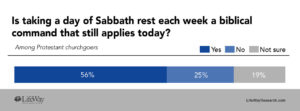
More than half of Protestant churchgoers (56 percent) say taking a day of Sabbath rest each week is a biblical command that still applies today. A quarter disagree, and 19 percent aren’t sure.

“Almost half of church attendees aren’t sure if one of the Ten Commandments still applies today,” McConnell said. “Perhaps the most important biblical teaching on the Sabbath came when Jesus said, ‘The Sabbath was made for man, not man for the Sabbath.’ Clearly, God didn’t need the rest when he modeled it, but humans need to recharge regularly.”

Churchgoers in the South (58 percent) are more likely to see the biblical command of a Sabbath rest as applicable today than their counterparts in the Northeast (46 percent).

Baptist and non-denominational churchgoers (60 percent each) are more likely to say Sabbath is still applicable than those at Assemblies of God/Pentecostal congregations (45 percent).

Those in churches with attendance of 1,000 or more (67 percent) are more likely than those in churches with 100 to 249 in attendance (56 percent) and those in congregations with less than 50 (54 percent) to say it’s a biblical command for today.

How is Sabbath observed?

Going to church is the primary way most churchgoers say they observe a Sabbath. Almost 8 in 10 (79 percent) of those who observe a Sabbath say attending a religious service is part of their Sabbath-keeping. Two-thirds (65 percent) say they do so by spending time with family.

Fewer say avoiding paid work (33 percent), taking a nap (30 percent) or avoiding labor or chores of any kind (25 percent) are part of how they observe a Sabbath day.

A small number say they avoid shopping (11 percent), refrain from attending paid events or entertainment (6 percent) or refrain from media of some kind, like TV, radio or social media (3 percent).

“There is more variety in how people observe the Sabbath than when they observe it,” said McConnell. “But there are far fewer people avoiding things on the Sabbath, like paid work and chores, than those who say they keep the Sabbath by doing things, like attending church and spending time with friends.”

Differences in ethnicity and education lead to significant differences in attitudes toward the Sabbath.

White churchgoers are among those more likely to say the Sabbath still applies (59 percent), that they rest on Sunday as opposed to other days (75 percent) and that they observe the Sabbath by attending a religious service (84 percent), spending time with family (73 percent), avoiding paid work (36 percent) and taking a nap (35 percent).

Churchgoers with a high school degree or less are among those less likely to say the Sabbath still applies (52 percent), that they rest on Sunday as opposed to other days (66 percent) and that they observe the Sabbath by avoiding paid work (29 percent) and spending time with family (57 percent).

They are also more likely to say they don’t take a Sabbath rest (25 percent) than those with some college (18 percent).

LifeWay Research conducted the study of 1,010 American Protestant churchgoers Aug. 22-30, 2017. Analysts used sample stratification and base weights for gender, age, race/ethnicity, region, metro/non-metro, home ownership, education and income to reflect the most recent U.S. Census data. The methodology provides 95 percent confidence the sampling error does not exceed plus or minus 3.1 percentage points. Margins of error are higher in sub-groups.


Museum displays Slave Bible that leaves out freedom

WASHINGTON (RNS)—On display on the ground floor of the Museum of the Bible there is a lone volume that stands out from the many versions shown in the building devoted to the holy book.

It’s a small set of Scriptures whose title page reads “Parts of the Holy Bible, selected for the use of the Negro Slaves, in the British West-India Islands.”

The so-called Slave Bible, on loan from Fisk University in Nashville, Tenn., excludes 90 percent of the Hebrew Bible, or Old Testament, and 50 percent of the New.

Its pages include “Servants be obedient to them that are your masters,” from Paul’s letter to the Ephesians, but missing is the portion of his letter to the Galatians that reads, “There is neither bond nor free … for ye are all one in Christ Jesus.”

Since opening more than a year ago, the museum has featured this 15-inch-by-11-inch-by-4-inch volume in an area that chronicles Bible-based arguments for and against slavery dating back to the beginnings of the abolition movement.

Marks 400th anniversary of slaves in the New World

In anticipation of next year’s 400th anniversary of the arrival of the first African slaves in the New World, in Jamestown, Va., the Slave Bible will be on special view until April in an exhibition developed with scholars from Fisk and the Smithsonian’s National Museum of African American History and Culture.

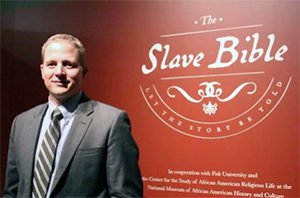
Seth Pollinger, director of museum curatorial, at the Slave Bible exhibit. (RNS Photo / Adelle M. Banks)

“We feel it’s an opportunity to contribute to important discussion today about the Bible’s role in relationship to human enslavement and we know that that connects to contemporary issues like racism as well as human bondage,” said Seth Pollinger, director of museum curatorial.

“We’ve had such visitor interest in this book, probably wider interest in this single artifact than any other artifact in the museum.”

The rare artifact is just one of three known across the world. The other two are housed at universities in Great Britain.

Fisk’s scholars believe its version may have been brought back from England in the late 19th century by the school’s famed Jubilee Singers, who sang spirituals to Queen Victoria during their European tour.

Dichotomy of coercion and conversion

The exhibition draws on the dichotomy of coercion and conversion, keeping slaves in their place while also attempting to tend to their souls. On two walls, portions of the Bible that were excluded from the slaves’ text are juxtaposed with verses determined to be appropriate for them.

“Prepare a short form of public prayers for them … together with select portions of Scripture … particularly those which relate to the duties of slaves towards their masters,” said Anglican Bishop of London Beilby Porteus, founder of the Society for the Conversion of Negro Slaves, in 1808.

The Slave Bible exhibit at the Museum of the Bible features a version of the Scriptures specifically printed for converting slaves to Christianity. (RNS Photo / Adelle M. Banks)

Anthony Schmidt, curator of Bible and religion in America for the Museum of the Bible, said that quote “kind of shatters our ideas of these abolitionists being so progressive.”

“Porteus held to very racist views, even as he fought for the freedom of enslaved Africans in these colonies,” Schmidt said.

A London publishing house first published the Slave Bible in 1807 on behalf of Porteus’ society.

Absent from that Bible were all of the Psalms, which express hopes for God’s delivery from oppression, and the entire Book of Revelation.

“That’s where you really have the story of the overcomer, and where God makes all things right and retribution,” Pollinger said of the final book found in traditional versions of the Christian Bible.

The Slave Bible’s Book of Exodus excludes the story of the rescue of the Israelites from slavery in Egypt, the liberation that gives the biblical book its title.

“It’s conspicuous that they have Chapter 19 and 20 in there, which is where you got God’s appearance at Mount Sinai and he gives his law,” said Pollinger. “The Ten Commandments would be Exodus 20 but missing is all of the exodus from Egypt.”

Draws focus to omitted Scriptures

Scholars acknowledge that the little-known Bible can be a shocking discovery for students and museum visitors alike.

Holly Hamby of Fisk University (Photo by Vando Rogers/Fisk University Photographer)

“When they first encounter the Slave Bible, it’s pretty emotional for them,” said Holly Hamby, an associate professor at Fisk who uses the artifact as she teaches a class on the Bible as literature. Many of the students at the historically black university are Christian and African-American, most of whom are descendants of slaves, including those in the West Indian colonies.

“It’s very disruptive to their belief system,” said Hamby, who is currently teaching from a digitized version of the Slave Bible.

Some students wonder how they could have come to the Christian faith with this kind of Bible possibly in their past. Others dive deeper into the complete Bible, including the Exodus story.

“It does lead them to question a lot, but I also think it leads them to a powerful connection with the text,” she said. “Very naturally, seeing the parts that were left out of the Bible that was given to a lot of their ancestors makes them concentrate more on those parts.”

The museum has plans for conferences and panel discussions to further explore the unusual artifact and its complex meanings.

Pollinger hopes it will offer a chance for a more diverse range of visitors, black and white, to join in discussions, just as white and black scholars have worked in recent months on the exhibit.

“This exhibit is going to destabilize people; it’s going to disturb people and it’s not necessarily one group rather than the other,” said Pollinger, who hopes that learning about this piece of Bible history will foster greater understanding.

In a quotation displayed in the exhibit, Brad Braxton, director of the Center for the Study of African American Religious Life at the National Museum of African American History and Culture, says: “This religious relic compels us to grapple with a timeless question: In our interpretations of the Bible, is the end result domination or liberation?”

Hamby suggested the exhibit should feature current Fisk students’ voices, so it includes a video of them discussing questions surrounding the controversial take on the Bible.

“My favorite question is the last question on the list that we asked them, which is: Do you think that this Bible is still the good book?” she said of questions the students were asked and the public will have an opportunity to answer for themselves.

For her part, Hamby, a United Methodist, says: “It’s a good book. I still believe in the Bible on the whole but not this version of it.”

EDITOR’S NOTE: See related article here


Most Protestant churchgoers say they abstain from alcohol

NASHVILLE, Tenn.—Most Protestant churchgoers say the Bible teaches against drunkenness, but that doesn’t stop about four in 10 from taking a drink now and then.

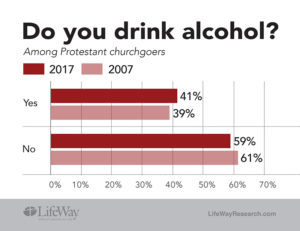
While 41 percent say they consume alcohol, 59 percent say they do not, according to a new LifeWay Research study. That’s a slight shift from 10 years ago, when 39 percent said they consumed alcohol, while 61 percent said they did not.

Gallup surveys over the last 75 years typically have shown two-thirds of all American adults occasionally drink alcoholic beverages, including 63 percent in 2018.

“While alcohol consumption continues to be seen as mainstream in the United States, churchgoers’ attitudes about drinking haven’t changed much in the past decade,” said Scott McConnell, executive director of LifeWay Research.

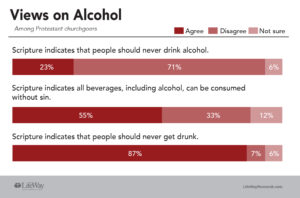
The latest LifeWay study shows 87 percent of Protestant churchgoers agree Scripture says people should never get drunk, up from 82 percent in 2007.

But when it comes to total abstinence, fewer than a quarter (23 percent) believe Scripture indicates people should never drink alcohol. A majority (71 percent) disagree. The share of churchgoers who say Scripture teaches against any kind of alcohol consumption has decreased six percentage points over the last decade.

When Christians drink socially, many Protestant churchgoers believe they could cause other believers to stumble or be confused. In 2017, 60 percent agree and 32 percent disagree. The portion who say drinking socially could cause others to stumble dropped slightly from 63 percent in 2007.

Researchers also found slightly more than half of the surveyed churchgoers say Scripture indicates all beverages, including alcohol, can be consumed without sin (55 percent) and that Christians exercise biblical liberty when partaking alcohol in reasonable amounts (54 percent).

Demographic factors matter

Attitudes and behaviors related to alcohol use vary based on age, geography, denominational affiliation and other demographic factors.

Male churchgoers are more likely than women to say they drink alcohol (48 percent compared to 37 percent).

Lutherans (76 percent) and Methodists (62 percent) are more likely to say they imbibe than Baptists (33 percent), non-denominational Christians (43 percent) and Assemblies of God/Pentecostals (23 percent).

Protestant churchgoers ages 18 to 34 are evenly split on their alcohol consumption with 50 percent saying they drink and 50 percent saying they don’t. Forty-one percent of churchgoers ages 35 to 49 say they drink, while 59 percent do not; 44 percent of 50- to 64-year-olds say they consume alcohol, while 56 percent do not. Churchgoers age 65 and above were the least likely age group to say they drink alcohol, with 32 percent saying yes to drinking alcohol and 68 percent saying no.

Among churchgoers, those with a higher education are more likely to say they drink than those with less education. Churchgoers with a graduate degree are most likely to say they drink alcohol (62 percent) followed by those with a bachelor’s degree (59 percent), some college (46 percent) and those who are high school graduates or less (26 percent).

“Churchgoers’ perspectives on alcohol are not changing very fast,” McConnell said. “The majority believe that biblically they can drink, but they choose not to.”

LifeWay Research conducted the study of 1,010 American Protestant churchgoers Aug. 22-30, 2017. Analysts used sample stratification and base weights for gender, age, race/ethnicity, region, metro/non-metro, home ownership, education and income to reflect the most recent U.S. Census data. The methodology provides 95 percent confidence the sampling error does not exceed plus or minus 3.1 percentage points. Margins of error are higher in sub-groups.
Comparisons were made to a LifeWay Research phone survey conducted in April-May 2007 among 1,004 Protestant churchgoers.