Baylor study: Percentage of multiracial U.S. churches doubled

WACO—The percentage of multiracial congregations in the United States nearly doubled from 1998 to 2012, with about one in five American congregants attending a place of worship that is racially mixed, according to a Baylor University study.

While Catholic churches remain more likely to be multiracial—about one in four—a growing number of Protestant churches are multiracial, the study found.

The percentage of Protestant churches that are multiracial tripled, from 4 percent in 1998 to 12 percent in 2012, the most recent year for which data are available.

In addition, more African-Americans are in the pulpits and pews of U.S. multiracial churches than in the past, according to the study.

dougherty130
Kevin Dougherty

Multiracial congregations are places of worship in which less than 80 percent of participants are of the same race or ethnicity.

“Congregations are looking more like their neighborhoods racially and ethnically, but they still lag behind,” said lead author Kevin D. Dougherty, associate professor of sociology at Baylor. “The average congregation was eight times less diverse racially than its neighborhood in 1998 and four times less diverse in 2012.”

His co-author, Michael O. Emerson, provost of North Park University in Chicago, added: “More congregations seem to be growing more attentive to the changing demographics outside their doors, and as U.S. society continues to diversify by race and ethnicity, congregations’ ability to adapt to those changes will grow in importance.”

For the study, Dougherty and Emerson analyzed data from the National Congregations Study, a nationally representative survey conducted in 1998, 2006-2007 and 2012, with a cumulative sample of 4,071 congregations. The study by Dougherty and Emerson—“The Changing Complexion of American Congregations”—is published in the Journal for the Scientific Study of Religion.

The study found:

  • One-third of U.S. congregations were composed entirely of one race in 2012, down from nearly half of U.S. congregations in 1998.
  • Multiracial congregations constituted 12 percent of all U.S. congregations in 2012, up from 6 percent in 1998.
  • The percentage of Americans worshipping in multiracial congregations climbed to 18 percent in 2012, up from 13 percent in 1998.
  • Mainline Protestant and evangelical Protestant churches have become more common in the count of multiracial congregations, but Catholic churches continue to show higher percentages of multiracial congregations. One in four Catholic churches was multiracial in 2012.
  • While whites are the head ministers in more than two-thirds (70 percent) of multiracial congregations, the percentage of those led by black clergy has risen to 17 percent, up from fewer than 5 percent in 1998.
  • African-Americans have replaced Latinos as the most likely group to worship with whites. In the typical multiracial congregation, the percentage of black members rose to nearly a quarter in 2012, up from 16 percent in 1998. Meanwhile, Latinos in multiracial congregations dropped from 22 percent in 1998 to 13 percent in 2012.
  • The percentage of immigrants in multiracial congregations decreased from over 5 percent in 1998 to under 3 percent in 2012.

Previous research shows congregations have adopted varying ways to encourage racial diversity, among them integrating music genres, using more participatory worship, hosting small groups to foster interracial networks and creating programs to address racial or ethnic issues. Churches with shorter histories are more likely to have diversity, and change is harder to bring about in long-established congregations.

The new study by Dougherty and Emerson concluded the complexion of American congregations is indeed changing—and the authors see benefits for American society.

“During a several-year period of heightened racial tensions, the growth of multiracial congregations is a dramatic development,” Emerson said. “Such congregations are places of significantly increased cross-racial friendships and cross-racial common experiences.”


Baylor expert identifies signs of elder abuse

WACO—About 5 million older adults in the United States are abused, neglected or exploited each year, according to the Administration for Community Living, and a Baylor University gerontology expert wants people to know how to identify elder abuse.

Family members, hospital staff and law enforcement submit most reports of abuse, said James Ellor, professor in Baylor’s Diana R. Garland School of Social Work.

But churches and other organizations also should be diligent, he said, noting clergy are considered mandatory reporters in many states.

“No one group of caring persons can solve this problem alone. It takes a community of caring lay and professional leaders to even try to start to make a difference,” Ellor said. “If signs are noticeable, the next steps will depend on the type of abuse. In most cases, counseling support is critical, but often the need for medical help or legal help is also very important.”

Elder abuse—intentional or negligent acts by a caregiver or trusted individual—comes in many forms. They include neglect or isolation, physical abuse, sexual abuse, exploitation or financial abuse, emotional and psychological abuse, verbal abuse and threats.

  • Physical abuse may be identified by odd bruising, broken bones or contusions that are not easily explained. One sign that quickly raises suspicion is when broken bones or bruises happen repeatedly. Drug overdoses or the withholding of drugs are also challenging.
  • Emotional abuse could include yelling at the senior, humiliating him or her, blaming and/or scapegoating.
  • Sexual abuse is contact without consent. “We see this often between spouses, particularly when one spouse has dementia,” Ellor said.
  • Neglect is possibly one of the most common types of abuse, Ellor noted. “It simply means not taking the time to respond to a wide variety of needs when one is the designated caregiver,” he said.
  • Financial exploitation may take a variety of forms. “Laws governing guardianship and power of attorney try to address this, but family members who take money from seniors as cash or property are the most common culprits,” Ellor explained.
  • Fraud can involve financial exploitation or even heath care fraud, but it generally involves either over-charging, selling unnecessary benefits of something, or it may include trying to sell something that would benefit one’s children.
  • Self-neglect also is a form of elder abuse. “Some seniors simply choose to not help themselves, often in the name of leaving money or property to family members,” Ellor said. “Evidence of this could be that they don’t purchase needed medications or other resources.”

Report suspected mistreatment to local adult protective services, long-term care ombudsman or law enforcement agencies that can investigate the situation, Ellor urged.


How do birth mothers feel about decisions to place infants for adoption?

WACO—New research findings from Baylor University’s Diana R. Garland School of Social Work could change the adoption landscape for birth mothers struggling with the life-altering decision to place their children.

How is the level of satisfaction felt by birth mothers—feeling they made the right decision in placing children for adoption—affected by time?

“Little is known about the interaction of these two variables,” said Elissa Madden, associate professor of social work at Baylor and lead author of the study, “The Relationship Between Time and Birth Mother Satisfaction with Relinquishment.”

Much of Madden’s research focuses on the birth mother experience in the adoption process—a historically underrepresented area of study, she said.

“This article seeks to address a clear void in the literature, and we hope it has some implications for future practices and adoption policies,” she said.

The research, published in the journal Families in Society, centers on data from an online survey of 223 birth mothers who relinquished an infant for adoption during the last 25 years. This time period was selected because it reflects an increased acceptance and emphasis on open adoption arrangements between birth and adoptive parents, according to the study.

Of those surveyed, nearly seven out of 10 reported periodic contact with the adopted child; most parents (94 percent) reported only a single child relinquished; a majority (56 percent) parented other children after the relinquishment; and on a scale of 1 to 5, participants reported a mean satisfaction with relinquishment score of 3.11.

Among the study’s findings:

  1. Satisfaction is not static.

While many birth mothers reported satisfaction with their decision, the findings show the more time that has passed since the birth mothers placed their child, the less overall satisfaction some birth mothers felt. Some prior research suggests birth mothers’ grief and adjustment attenuates with the passage of time. However, the researchers note, “the findings of this analysis highlight the importance of not confusing birth mother’s satisfaction with her decision and the feelings of loss that she may feel about the placement.”

A birth mother may feel she made the right decision regarding placement and yet still experience ongoing feelings of loss and grief even years later, Madden said.

  1. Age had an inverse relationship with satisfaction.

“As with time since the relinquishment, age of the respondents predicted an incremental decrease in satisfaction for every year they have aged,” researchers wrote. “It may be that the distance afforded by time, along with the internal resources and perspective that often comes with age, may have provided an opportunity for birth mothers to look back and reflect on what could have been.”

  1. Higher education and higher income led to decreased satisfaction.

“It is possible that birth mothers who have achieved educational and/or financial success may now feel dissatisfaction with their decision to place their child as they now believe, in retrospect, that they would have been able to acquire sufficient resources necessary to successfully parent their child,” researchers wrote.

Additionally, the researchers noted that some birth mothers may feel educational and financial success may have been achieved “at the expense of their opportunity to parent their child.”

  1. Birth mothers who have current contact with their child were more likely to express satisfaction with their decision.

“Prior research suggests that for some birth mothers, having contact with the child helps reduce feelings of anxiety about the child’s life and well-being, worries they may be having about the child feeling abandoned, and/or guilt about their decision,” the researchers wrote.

  1. Birth mothers who work full-time were more likely to express increased satisfaction.

“While the rationale for this finding is not immediately clear, it is possible that birth mothers who are employed full-time have achieved personal fulfillment or otherwise found success through their employment,” researchers wrote.

“It is also possible that for some birth mothers, there is recognition that they have less time or perhaps fewer resources for parenting and thus are more satisfied with their decision to place their child.”

What are the implications of this research?

Madden said there are long-term consequences for all members of the adoption triad—birth mothers, those seeking to adopt, and the adoption professionals making the arrangements. She said, specifically, adoption professionals need to be well versed in the positive and negative repercussions for birth mothers.

“Adoption professionals must be especially attuned to the needs and concerns of expectant mothers who seek their counsel, as many lack a full understanding of their options,” Madden said, reflecting on her earlier research.

Madden and her fellow researchers believe this study and others like it could lead to changes in the adoption process.

They suggest:

  • Annual “grief and loss” training for adoption professionals
  • State and federal policies ensuring birth mothers have access to ongoing post-relinquishment support services
  • Free grief support groups for all birth mothers
  • Adoption of national standards to ensure expectant mothers and prospective adoptive parents receive standardized information detailing the benefits of ongoing post-adoption contact
  • Stipends for expectant mothers to hire independent legal counsel to represent the mothers at the relinquishment and during sensitive discussion regarding post-adoption


Churches must abandon 600 MHz wireless sound systems

WASHINGTON (BP)—Churches that haven’t updated their wireless sound system may have trouble being heard on any given Sunday, as the federal government is phasing out the 600 MHz frequencies many congregations use.

The Federal Communications Commission will complete the transition of the 617-652 MHz and 663-698 MHz spectrum bands from wireless microphones and television broadcasts by July 13, 2020. The transition began last year.

The frequencies are being transitioned to wireless communicators such as cellphone companies to meet industry demand, and will become unavailable for use by wireless mic systems by the 2020 deadline or earlier, according to the FCC.

Violators could face fines or additional criminal penalties, the FCC reported.

T-Mobile bought 45 percent of the available 600 MHz spectrum during a 2017 auction when the transition began, the company announced, with a purchase price of $7.99 billion.

Older sound systems most likely affected

Churches that haven’t updated their wireless sound systems in recent years are more vulnerable to sound system failure, said Mike Harland of LifeWay Christian Resources.

“Where it would impact churches is if they have wireless equipment that may be a few years old, and not be aware that it falls into those categories that have been discontinued and not available,” said Harland, director of LifeWay Worship.

“If they’re not aware of that, they could actually walk out on Sunday and nothing work, and they may not know why.”

Frequency information should be recorded on a mic’s receiver or within the mic’s battery compartment, Harland said.

“If they’ve bought something recently, this is very likely not an issue,” he said. “But if it’s something they’ve had a number of years, they would want to check that ahead of time.”

Many systems may be reconfigured

Many systems can be reconfigured to a legal operating frequency, according to industry insider Worship Facilities.com. In addition to churches, other industries likely affected by the FCC change include local theaters, schools, conference centers and sports stadiums.

With the completion of the transition, some bands in the 600 MHz range will still be available, including those below 608 MHz, from 614-616 MHz, from 653-657 MHz for licensed use and from 657-663 for unlicensed use, the FCC reported.

Manufacturers and distributors have been aware of the pending changes and likely have discontinued the availability of systems operating on the affected frequencies. Such equipment can range in price from the hundreds to the thousands, depending on the intended use. Churches using wireless systems for broadcast would need a higher quality, Harland said.

Some companies that have sold 600 MHz equipment are offering trade-in discounts, including Sennheiser, Samson, Lectrosonics, Shure and Audio-Technica, according to Kenny Lamm, worship consultant for the Baptist State Convention of North Carolina. Deadlines for refunds are as early as June 30.

The transition follows the FCC’s removal of the 700 MHz band from wireless systems in 2010.


Americans love VBS, even if they are not usually churchgoers

NASHVILLE, Tenn.—Back in the 1890s, a pair of Sunday school teachers—D.T. Miles of Hopedale, Illinois, and Virginia Hawes of New York City—both had the same idea. School kids were off for the summer. So, why not invite them to church to study the Bible and maybe sing a few songs and have some fun along the way?

The idea was a hit.

Today, Vacation Bible School remains one of the most popular church programs in America. Two-thirds of American parents say they plan to send kids to VBS this summer—even if they skip church themselves.

Six in 10 Americans attended VBS

Six in 10 Americans say they went to VBS growing up. And almost everyone involved had a great time, according to a new survey from Nashville-based LifeWay Research.

“Each week of the summer there are thousands of VBS programs going on around America,” said Scott McConnell, executive director of LifeWay Research. “It’s one of the things that people love about church.”

LifeWay Research surveyed 1,200 American adults about their experience with VBS.

Twenty-two percent say they went every summer growing up, while 14 percent said they went most summers. Another 13 percent went occasionally. Five percent went more than once. Forty percent never went.

Many attended because of a family tie. Forty-two percent say they went to VBS because their family attended that church. Twenty-five percent participated because their parent or another family member was one of the leaders. Twenty-six percent attended because the church was near their home. Twenty-five percent went because a friend invited them.

Precious memories

Among their memories: spending time with kids their own age (46 percent), learning Bible stories (45 percent), singing songs (40 percent), creating crafts (37 percent) and playing games (34 percent).

One in six (17 percent) remember making a spiritual commitment at VBS.

Most (88 percent) say VBS helped them better understand the Bible. That includes two-thirds who either completely (37 percent) or mostly agree (26 percent). Twelve percent disagree.

Among Americans who didn’t go to VBS as a child, 31 percent didn’t go to church at all, 31 percent attended a church that did not offer VBS, 10 percent said they were too busy, and 7 percent weren’t invited. Five percent say their family went to a church that offered VBS, but they weren’t interested in going.

More than half (61 percent) of American adults who did not go to VBS agree they still have some positive thoughts about the program. That includes 28 percent who completely (14 percent) or mostly agree (14 percent). Thirty-three percent slightly agree. Thirty-nine percent disagree.

A majority of Americans (57 percent) who did not go to VBS also believe the program could have helped them better understand the Bible—at least a little. Forty-three percent disagree.

About half (52 percent) agree the program could have affected their spiritual growth. Forty-eight percent disagree.

VBS matters

The survey’s results are a great reminder of why VBS matters, said Jana Magruder, director of LifeWay Kids.

“It’s a strong affirmation of the work that churches put into VBS programs,” said Magruder. “I hope churches are encouraged by this research to continue to host VBS for their communities.”

About half (47 percent) of parents with kids under 19 say their child has been to VBS.

The most common reasons: The family attended the church where the program was held (38 percent) or the parents were also taking part in VBS (33 percent). Twenty-nine percent say they valued their child’s spiritual growth. Twenty-seven percent valued studying the Bible.

A quarter (26 percent) say their child went to VBS because someone—other than family—invited them.

Positive experience

Most parents (95 percent) say VBS was a positive experience for their child. A similar number say VBS helped their child better understand the Bible (94 percent) and influenced their child’s spiritual growth (95 percent). Most (95 percent) also say that VBS is one of their child’s most meaningful church experiences.

Among the reasons parents didn’t send kids to VBS: The family didn’t go to church (29 percent), the family was too busy (14 percent) or the child was too busy (13 percent).

Still, parents who didn’t send their kids to VBS have a positive view of the program (83 percent) and say it would have helped their child better understand the Bible (69 percent) or grow spiritually (71 percent).

Two-thirds of parents say children likely to attend VBS

This summer, Vacation Bible Schools may be packed again, according to LifeWay.

Two-thirds of parents (64 percent) say their child is likely to go to VBS this year—including about half who completely (29 percent) or mostly (18 percent) agree. A third (36 percent) disagree.

More than half (58 percent) say their child may go to more than one VBS. Forty-two percent disagree.

“Two-thirds of American parents are eager to send their children to a church activity where they will have fun experiences centered on what churches care about most—Bible stories, the gospel and worship,” Magruder said.

Many parents say they’ll send their kids to VBS even if it’s held at someone else’s church. Sixty percent say they will encourage their child to attend a VBS program at a church where the parent does not attend services.

More parents will encourage their child to attend VBS at another church if a friend invites them (69 percent).

“People still believe Vacation Bible School is good for kids,” McConnell said. “Even parents who don’t go to church want their kids to go to VBS.”

A demographically balanced online panel was used for interviewing American adults. LifeWay Kids sponsored the study.

The survey was conducted March 7-10, 2018. Analysts used quotas and slight weights to balance gender, age, ethnicity, education and region. The completed sample is 1,200 surveys, which provides 95 percent confidence the sampling error from the online panel does not exceed plus or minus 3 percentage points. This margin of error accounts for the effect of weighting. Margins of error are higher in sub-groups.


Churchgoers say they tithe but not always to the church

NASHVILLE, Tenn.—Most churchgoers say the Bible commands them to give, but their tithes don’t always go in the offering plate.

Half of Protestant churchgoers say their tithes can go to a Christian ministry rather than a church. A third say tithes can go to help an individual in need. And more than a few—18 percent—say tithes can even go a secular charity, according to a new LifeWay Research study.

“For many churchgoers, tithing is just another term for generosity,” said Scott McConnell, executive director of LifeWay Research.

For the study, LifeWay Research surveyed 1,010 Americans who attend services at a Protestant or nondenominational church at least once a month, as well as 1,000 Protestant senior pastors.

Follow the biblical command

Most churchgoers believe they are commanded to give. Many believe in the idea of tithing, often understood as giving away 10 percent of a person’s income.

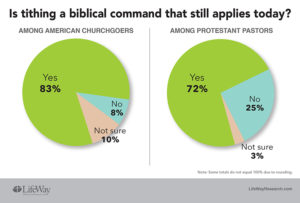
Eighty-three percent agree when asked, “Is tithing a biblical command that still applies today?” Eight percent say it is not. Ten percent aren’t sure.

Most of those in the South (85 percent), as well as the Northeast (74 percent), say tithing applies today. So do African-American (87 percent) and white churchgoers (80 percent).

Those with evangelical beliefs (86 percent) say it is a biblical command for today. So do 79 percent of other churchgoers. Many Baptists (87 percent), Pentecostals, (86 percent), nondenominational churchgoers (81 percent) and Lutherans (68 percent) agree as well.

More than half (54 percent) of churchgoers say they give at least 10 percent of their income to the church. That includes 37 percent who say they tithe and 17 percent who say they give more than 10 percent. One in 5 (20 percent) give regularly but less than 10 percent. A similar number (17 percent) say they try to give but aren’t always consistent. Eight percent say finances make it hard for them to give. Two percent do not give to their church.

“Even those who can’t tithe believe that giving matters,” McConnell said. “Most churchgoers say they give—even if it’s a struggle.”

The more churchgoers attend services, the more likely they are to tithe. Fifty-seven percent of those who attend services at least once a week say they give at least a tithe. That drops to 28 percent for those who go once or twice a month. A third (35 percent) of those who attend once or twice a month say they are not consistent in giving—compared to 14 percent of those who attend at least once a week.

Those who go one or two times a month are twice as likely to say finances make it hard to give (13 percent) than those who attend at least once a week (7 percent).

Two-thirds (64 percent) of those with evangelical beliefs say they give at least 10 percent to the church. Forty-one percent of other churchgoers say they give at least a tithe.

Share the wealth

Tithes can be spread around, according to churchgoers. Ninety-eight percent say money from tithes can go to their church. Half (48 percent) say funds can go to a Christian ministry. A third say tithes can go to another church (35 percent) or an individual in need (34 percent).

Some churchgoers (18 percent) say their donations to a secular charity can be part of their tithe. That includes more than four in 10 Lutherans (44 percent) and a third of Methodists. Baptists (12 percent) and Assemblies of God/Pentecostal churchgoers (13 percent) are less likely to say donations to a secular charity can be part of their tithe.

Lutherans (55 percent) are most likely to say their tithe could include gifts to an individual in need. Nondenominational churchgoers (37 percent), a third of Assemblies of God/Pentecostal churchgoers and more than one-fourth of Baptists (28 percent) are less likely to agree. So are churchgoers with evangelical beliefs (28 percent).

Fewer than half of churchgoers (47 percent) say only giving to the church counts for tithing.

Traditional methods of giving dominate

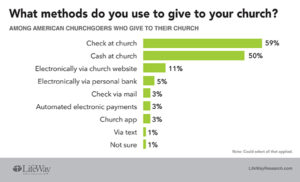
Whatever amount they give, churchgoers prefer to drop their tithes and other donations in the offering plate at church. Six in 10 churchgoers (62 percent) give to their church by check. That includes 59 percent who give a check at church—and 3 percent who mail one. Half say they give cash at church. Eleven percent give through their church website. Five percent give electronically through their bank. Three percent have automatic payments set up, while another 3 percent give using a church app. Some give through more than one method.

There’s something about putting cash or a check in the offering plate that still appeals to churchgoers, McConnell said.

“Giving is considered an act of worship—and clicking on a mouse may not feel as holy as putting your offering in the collection plate,” said McConnell.

Preaching about money

As part of the study, LifeWay Research asked Protestant senior pastors how often they talk about tithing.

Two-thirds say they preached about tithing at least once in the past year. Nine percent had preached on tithing in the last month. Twenty-eight percent had done so in the past six months, while 31 percent had preached on tithing between six months and a year earlier. Five percent had preached in the last two years. Six percent had preached three or more years ago about tithing. One in five never made tithing a primary focus of a sermon.

Pastors are less likely than churchgoers to say tithing still is a biblical command.

Seventy-two percent of pastors say tithing is “a biblical command that still applies today.” Twenty-five percent say it is not. Three percent are not sure.

Pentecostal (94 percent), Holiness (91 percent) and Methodist (88 percent) pastors are most likely to say tithing still applies today. Baptist (77 percent), Lutheran (56 percent) and Presbyterian/Reformed pastors (54 percent) are less likely.

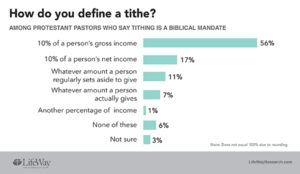
Of pastors who say tithing is still a biblical command, 73 percent define tithing as giving 10 percent of a person’s income. More than half (56 percent) say it should be 10 percent of a person’s gross income. Seventeen percent say it should be 10 percent of a person’s net income. Eleven percent say a tithe is whatever a person sets aside to give, while 7 percent say it is whatever the person actually gives.

“Both pastors and churchgoers see giving as a vital part of their faith,” said McConnell. “They don’t always agree on how much a churchgoer should give. But most seem to see 10 percent as an ideal to strive for.”

LifeWay Research conducted the churchgoers study Aug. 22–30, 2017. The completed sample of 1,010 surveys provides 95 percent confidence the sampling error does not exceed plus or minus 3.1 percentage points. Margins of error are higher in sub-groups.

The phone survey of Protestant pastors was conducted Aug. 30–Sept. 18, 2017. The completed sample of 1,000 surveys provides 95 percent confidence the sampling error does not exceed plus or minus 3.2 percentage points. Margins of error are higher in sub-groups.


Founder of black liberation theology James Cone dies at 79

WASHINGTON (RNS)—James H. Cone, the scholar known as the “founder of black liberation theology,” died April 28. He was 79.

The author of such books as Black Theology & Black Power and God of the Oppressed joined the faculty of New York City’s Union Theological Seminary in 1969.

“In so many ways, James Cone has been Union Theological Seminary for the past 50 years,” said Union President Serene Jones. “To say his death leaves a void is a staggering understatement. His prophetic voice, deep kindness and fierce commitment to black liberation embodied not just the very best of our seminary, but of the theological field as a whole and of American prophetic thought and action.”

His theology contrasted sharply with traditional theological approaches in that he articulated God’s identification with blacks in the United States. In portraying Christ’s blackness, he upended the assumptions of a field dominated by white theologians and helped spawn other theories of liberation.

In the introduction of his most recent book, The Cross and the Lynching Tree, Cone noted he was making connections many others had not.

“Despite the obvious similarities between Jesus’ death on a cross and the death of thousands of black men and women strung up to die on a lamppost or tree, relatively few people, apart from black poets, novelists and other reality-seeing artists, have explored the symbolic connections,” he wrote.

Cone’s book was honored with the 2018 Grawemeyer Award in Religion, a joint award from Louisville Presbyterian Theological Seminary and the University of Louisville. In April, he was elected as a fellow of the American Academy of Arts and Sciences, an honor earlier received by former President Barack Obama, Supreme Court Justice Sonia Sotomayor, and author and educator Ta-Nehisi Coates.

A native of Fordyce, Ark., Cone was an ordained minister in the African Methodist Episcopal Church.

Cone was promoted to the position of full professor of theology in 1973 at Union and was named the Bill & Judith Moyers Distinguished Professor of Systematic Theology in 2017. He taught and researched Christian theology at the seminary, focusing on black liberation theology and the liberation theologies of Africa, Latin America and Asia. He also taught about 19th- and 20th-century European-American theologies.

The bishops of the AME Church said Cone “touched, trained and molded generations of Ph.D. trained theologians and prophetic Christian servant leaders serving in pulpits and ministries around the world. Dr. Cone was truly a hero and ‘shero’ maker.”

Cornel West, Harvard Divinity School professor of the practice of public philosophy, summed up the life of his friend and colleague: “James Cone was the theological giant and genius in our midst! He was the greatest liberation theologian to emerge in the American empire—and he never ever sold out.”


Most Americans believe but not always in the God of the Bible

WASHINGTON (RNS)—A new Pew Research survey reveals nine out of 10 Americans believe in a higher power of some sort. A slim majority—56 percent—say they believe in the all-loving, all-knowing, all-powerful God of the Bible, while another 33 percent claim belief in a less-specific higher power or spiritual force.

The Pew Research report of 4,729 respondents conducted online in December offers some insight into the diversity of U.S. beliefs.

“One of the key questions that motivated the study was to get more detail among those who say they don’t believe in God,” said Gregory Smith, associate director of research at Pew.

“Among those people who say ‘no’ in a straightforward way when asked, ‘Do you believe in God?’ what are they rejecting? Are they rejecting belief in God or a higher power altogether?”

Most ‘nones’ believe in some higher power

In the survey, those who answered that they do not believe in God were asked a follow-up question, whether they believed in “some other higher power or spiritual force in the universe.”

The research shows there are hardcore disbelievers—about 10 percent who say they don’t believe in the God of the Bible or a higher power. But among the so-called “nones”—a broad category of atheists, agnostics and those who answer “none of the above” on questions about religion—fully 72 percent believe in a higher power of some kind.

Two previous Pew surveys found belief in God generally is falling. A 2007 Pew survey tabulated belief in God at 92 percent; by 2014 it was 89 percent. This most recent poll, though methodologically different— it was an online poll as opposed to a telephone poll—put the number at 80 percent.

Belief in God as described in the Bible is highest among Christians—80 percent, the survey found. Evangelicals and black Protestants had the highest rates of belief in a God of the Bible—91 and 92 percent respectively.

That number falls to 72 percent among mainline Protestants and 69 percent among Catholics.

Only one-third of Jews, by contrast, believe in the God of the Bible. The survey did not include enough respondents who were Muslim or members of other faiths to be included.

Differences according to demographics

The survey also showed those under age 50 viewed God as less powerful and less involved in earthly affairs than do older Americans, and among college graduates, only 45 percent believe in the God of the Bible.

Views of God also tend to differ by political party and race. Seventy percent of Republicans believe in the God of the Bible, while only 45 percent of Democrats do. But among Democrats, there are big differences in views of God when it comes to race; 70 percent of non-white Democrats believe in the God of the Bible—comparable to the rate among Republicans.

Belief in a higher power was found in every segment of the religiously unaffiliated population. Overall, 70 percent of the nones said they believe in a spiritual force. Among agnostics, it was 62 percent. Even among atheists, nearly one in five (or 18 percent) said they believe in a higher power.

Why do nonbelievers believe?

Just why so many agnostics—and even atheists—believe in a higher power is a matter of debate.

Ryan Cragun, a sociologist at the University of Tampa who studies the nonreligious, said some people may say they believe in a higher power to avoid the social stigma and even discrimination atheists face.

“To what extent are they saying that to avoid prejudice is an interesting question,” Cragun said.

He pointed to studies suggesting that white heterosexual men are the most likely to say they’re atheist because they have a certain social privilege that others don’t, and therefore may feel less at risk in making such a statement.

Others say the category of belief with its binary options—yes or no—can’t fully account for the diversity of human experience. Transcendence, for example, can be a supernatural experience but also a natural one, said Elizabeth Drescher, a professor of religious studies at Santa Clara University and the author of Choosing Our Religion: The Spiritual Lives of America’s Nones.

Some people may have faith in life’s animating force or in the human spirit, she said.

“There are lots of people who experience things in their lives that feel mysterious or unexplainable or awe-inspiring and who might logically identify as nonreligious or nonbelieving, but who nonetheless have a sense that we don’t know everything,” Drescher said. “The reality of people’s experience is much more complex and nuanced.”

The margin of sampling error for the full sample of 4,729 respondents was plus or minus 2.3 percentage points.


Willow Creek responds to new allegations against Hybels

SOUTH BARRINGTON, Ill. (RNS)—As the allegations against former Willow Creek Community Church Senior Pastor Bill Hybels mount, his congregation is trying to cope—spiritually and practically.

During worship services April 22, Lead Teaching Pastor Steve Carter recalled standing before the congregation less than two weeks ago with church elders and praying over Hybels, who has denied several accusations of misconduct with women.

Carter told the congregation how he watched the founding pastor of the Chicago-area megachurch walk offstage afterward—and keep going.

World watches to see how church responds

As Carter again stood in the same spot, his voice breaking at times, he delivered a message about Joshua, who succeeded Moses to lead the Israelites into the Promised Land.

Carter said he felt a “profound sense of sadness” because “we were supposed to enter the Promised Land together. There was more work to be done.”

But like Joshua, he continued, God was calling the congregation to be strong and courageous.

“I believe that God has given us this moment, that he’s been preparing us for this. … Right now, while the world is watching, how will a church respond to these circumstances?” Carter asked the congregation.

“This is our black swan moment. How many black swans does it take to prove they exist? Just one, and this is our time.”

New allegations reported

The moment arrived as Willow Creek’s board of elders released a letter to church members announcing it will examine new allegations against Hybels and “respectfully reach out to each woman who has made an accusation,” according to the Chicago Tribune.

Christianity Today reported several new allegations, including claims from Maureen Girkins, former president of Zondervan, which published many of Hybels’ books.

Girkins alleged Hybels made comments about her appearance and pressured her to spend time with him alone, even insisting they work out the terms of a publishing contract on his private jet—without her husband, who had been hospitalized during a conference they were attending.

They follow a number of accounts, first revealed in a Tribune investigation, from women in his congregation and on its staff chronicling invitations to hotel rooms, comments about appearances, uncomfortably long hugs and an unwanted kiss. One unnamed woman also said she had a consensual affair with Hybels, though she later denied it when contacted by an elder.

Previous investigations by elders and a lawyer specializing in workplace issues had cleared Hybels of any misconduct, according to the Tribune investigation.

At least seven women now have accused Hybels of acting inappropriately with women and abusing his power as head of Willow Creek, by Christianity Today’s tally.

The influential megachurch has eight locations in the Chicago area, including a 7,000-seat worship center at its main campus in South Barrington and the Willow Creek Association, a nonprofit focused on leadership development.

Hybels resigned earlier this month following the Tribune investigation—several months ahead of his planned retirement. He has denied all accusations, calling them “flat-out lies.”


Neighborhoods shape attitudes on race more than congregations

WACO—Whites in multiracial congregations have more diverse friendship networks and are more comfortable with minorities, but that is due more to the impact of neighbors and friends of other races than to congregational influence, a Baylor University study found.

“Solving America’s racial problems may be hoping too much from religious congregations,” said Kevin Dougherty, associate professor of sociology at Baylor and co-author of the study. “Where people live is more influential than where they worship in shaping racial attitudes.”

While a small but growing number of congregations gather worshippers across racial lines and count diversity as a central part of their mission, most Americans who attend worship do so mainly with those of their own race or ethnicity. That is the case in nearly nine of 10 congregations, researchers said.

“The responsibility for moving toward racial integration still rests considerably with the majority group,” Dougherty and Edward C. Polson, assistant professor in Baylor’s Diana R. Garland School of Social Work, wrote in the article.

“People of color were historically excluded from institutions and areas of social life controlled by white Americans—including religious congregations and denominations,” Polson said.

“Changing this pattern is not an easy thing and generally requires that the group who has historically done the excluding acknowledge the injustices that have led to the current reality and then take steps to foster more inclusive organizations. For predominantly white congregations or denominations in the U.S., this might mean acknowledging a history of racial discrimination and then taking steps to foster more diverse and inclusive leadership and membership.”

White non-Hispanics are the largest racial group in the United States, and the size and cultural prominence of white Americans continue to give this group a position of power in American society, Dougherty said.

The study—“Worshiping across the Color Line: The Influence of Congregational Composition on Whites’ Friendship Networks and Racial Attitudes”—is published in the American Sociological Association’s journal Sociology of Race and Ethnicity.

Researchers analyzed data from Baylor Religion Survey’s second wave, collected in fall 2007. The survey was administered by the Gallup Organization to 1,648 respondents in a national random sample of English-speaking adults.

Researchers discuss findings

Q: You mention in your study that a unique strength of U.S. religious life is that we are free to choose whether and where to worship—but that freedom may contribute to continued segregation. Why? 

POLSON: American religion has long been segregated by race and ethnicity. Much of this was the direct result of discriminatory practices and policies. As towns grew and religion spread early in U.S. history, separate congregations would often be established for black and white Baptists or Methodists or Catholics in an area.

When there weren’t separate congregations, black and white congregants were often required to worship separate from one another in the same congregation; white congregants in the main sanctuary and black congregants in balconies or meeting at separate times.

Eventually, however, many groups that were excluded from full participation in the mainstream groups of the day sought to establish their own congregations and religious denominations.

Among African-Americans, for example, we see the establishment of groups such as the Church of God in Christ and the African Methodist Episcopal Church. Ethnic and immigrant groups also often sought to maintain unique religious and social identities by establishing congregations identified with their religious and ethnic heritage such as the Greek and Russian Orthodox churches.

Fast-forward to today, and a legacy of religious segregation combined with Americans’ freedom to choose their place of worship tends to reinforce the color line in American religion. People are free to choose where and with whom they want to worship. This freedom generally contributes to higher levels of commitment and participation.

However, in practice, it also means that people often choose congregations that reflect their own racial and ethnic background. Worshippers tend to be attracted to groups that appeal to their own experiences, preferences, and social networks. These still tend to be patterned significantly by race and ethnicity. Patterns of religious segregation in religious life continue then, often without much serious thought or reflection on the part of worshipers and religious leaders.

DOUGHERTY: At the most intimate levels of people’s lives—family, friends and faith—the United States remains a racially divided nation. When people choose a congregation, they commonly choose to be with others they see as similar to themselves. The outcome is congregations are segregated by race, social class and now increasingly by politics.

Q: How do you define a multiracial congregation?

POLSON: A multiracial congregation is one in which the majority group represents less than 80 percent of the whole congregation and other groups make up greater than 20 percent. Eighty percent may seem like an arbitrary threshold. However, when the majority group makes up less than 80 percent, research shows that contact between attenders of different racial and ethnic groups is more likely to occur.

This is important because it is regular and sustained contacts between attenders in worship services, small groups and Bible studies that are likely to affect attenders’ friendship networks and influence their attitudes and opinions about other groups.

Q: Your article notes that previous research shows that multiracial congregations tend to become less diverse over time. Why might that be?

POLSON: I think this is one of the most challenging realities facing diverse congregations or those that hope to become more diverse. We know that congregational growth typically occurs as a result of individuals inviting friends, neighbors and co-workers. We also know that those networks tend to be patterned by race.

White attenders are more likely to know and invite white individuals; African-Americans are more likely to know and invite African-Americans. As a result, the majority group in a congregation grows more quickly; there are simply more of them inviting others to come and participate.

The minority group doesn’t grow at the same rate and over time tends to become a smaller and smaller percentage of the congregation. This may lead members to feel more marginalized.

This is not an easy cycle to alter, because it’s often a result of the composition of worshipers’ extended social networks. Congregations hoping to remain diverse must pay attention to how individuals and families are recruited into the group.

DOUGHERTY: Multiracial congregations can be difficult to sustain. Forging relational bonds across racial lines proves to be a challenging proposition for congregations. If a member does not feel integrated within a congregation, they may seek out a different place of worship.

Q: You found that the influence of worshiping with another race/ethnicity seems to be most pronounced for whites in congregations with Hispanics. Any theories on why?

POLSON: We found that, for white attenders, worshiping in a congregation with a larger percentage of Hispanic worshipers was related to having more friendships with Hispanic people. This was not the case, however, for friendships between whites and African-Americans or Asian people.

In other words, only for white and Hispanic people did worshiping together seem to significantly increase the prevalence of cross-group friendships. This is likely the result of both a long-standing pattern of segregation between whites and African-Americans in the U.S. and there being a smaller number of Asian-Americans in many U.S. communities.

Q: How can congregations “cross the color line” better? 

POLSON: Our study suggests that congregations do have a role to play improving race-relations in the U.S. Positive contact in local congregations seems to contribute to improved cross-group relations generally.

However, our findings also highlight the reality that healing long-standing divisions between white Americans and people of color, especially African-Americans, will require more than simply worshiping together. It will likely require continued structural and policy changes in American life—changes that decrease racial segregation in other areas of life.

We found that the presence of African-Americans, Hispanic and Asian people in neighborhoods actually had a more significant impact on white attenders’ friendship networks than worshiping together. Congregations hoping to cross the color line and improve race-relations in their communities may do well to consider tangible ways they can support such changes and foster connections between different racial and ethnic groups.

Q: Is that anything you want to explore in the future to further shed light on racial segregation?

DOUGHERTY: Future research should explore the experiences of racial and ethnic minorities in multiracial congregations. This is difficult to do with survey data. Researchers will need to oversample ethnic minorities in national surveys. Another pressing need is a national study of congregations over time.  Researchers need to follow a national sample of congregations over five to 10 years to understand when, how and why a congregation’s membership changes, as well as the implications of such changes.

Other findings from the study include:

  • Religious whites, on average, report the most comfort with Asians; a comparable level of comfort with Hispanics; and noticeably less comfort with blacks.
  • Older respondents and those who are married report having fewer non-white friends.
  • Men, regular religious attendees and more liberal respondents report having more nonwhite friends.
  • Respondents living in the East and the Midwest reported having fewer non-white friends than those in the South, while people living in the West report having more.
  • Whites in mainline Protestant churches report fewer cross-racial friendships than whites in evangelical churches.
  • Older respondents, men and those who view Scripture as literally true are less comfortable with non-whites.
  • Education, higher income, religious service attendance and political liberalism are positively related to comfort with non-whites.
  • Southern whites are significantly less comfortable with non-whites than are non-whites in any other U.S. region.


Personal touch drives churchgoer giving 

By Bob Smietana / LifeWay Research

NASHVILLE, Tenn. (BP)—When it comes to charity, a personal touch works 10 times better than Facebook—at least for churchgoers.

A new report from Nashville-based LifeWay Research found more than half of Protestant churchgoers say a personal connection inspired them to give money to a charity for the first time. Social media inspired only 4 percent of similar donations.

Three-quarters of churchgoers support at least one charity besides their church. Almost half do volunteer work. A similar number changed the charities they support.

Churchgoers like to give—and to get involved, said Scott McConnell, executive director of LifeWay Research.

“The question is: Where will churchgoers give this year? The answer lies in having a personal connection,” McConnell said. “It turns out charity really does start close to home.”

The nationally representative study asked adults who attend a Protestant church at least once a month to look at their charitable giving from 2016.

Sixty percent of those churchgoers gave to the same number of charities in 2016 as they did the previous year. Fifteen percent gave to more charities. Eight percent gave to fewer, while 15 percent were not sure.

Among those who donated to charities, 49 percent made changes in which charities they supported in 2016. This included about a third (31 percent) who gave to a charity they’d never supported before.

“The reality is that funding for charities is anything but stable,” McConnell said. “When a donor adds a charity, it can take away from ministries they have supported in the past.”

Personal connections matter

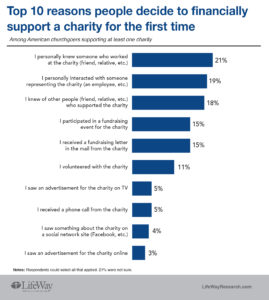
When asked what factor prompted them most to give, 21 percent say they knew someone who worked there. Nineteen percent had met someone from the charity, while 18 percent say friends of theirs supported the charity. Fifteen percent had been to a fundraiser, while 15 percent had received a letter from the charity. Eleven percent had volunteered for the charity.

Phone calls (5 percent), television ads (5 percent), social network sites (4 percent), online ads (3 percent) and email appeals (2 percent) were less influential.

LifeWay Research also asked churchgoers how many charities they gave to last year, aside from their local congregation. Those charities could be religious or nonreligious. The donations could not be property or volunteer time.

Seventy-three percent of churchgoers gave to at least one charity beyond their church.

This includes 15 percent who gave to one additional charity and 58 percent who gave to multiple charities. About a third (34 percent) gave to two or three additional charities. Nineteen percent gave to between four and seven charities. About 6 percent gave to eight or more additional charities.

About a quarter (27 percent) gave to no additional charities.

Differences by denomination noted

Churchgoers from Assemblies of God and other Pentecostal backgrounds are most likely to give only to their church (38 percent). Nondenominational Christians (30 percent) and Baptists (29 percent) were more likely to give only to their church than Lutherans (14 percent).

Lutherans (29 percent) are more likely to give to five or more charities than Baptist (13 percent), nondenominational (12 percent) or Assemblies of God/Pentecostal churchgoers (10 percent).

About half (48 percent) of churchgoers say they volunteer at a charity—including their church. Forty-four percent don’t volunteer. Eight percent aren’t sure.

Those who go to church at least once a week (51 percent) are more likely to say they volunteer than those who attend once or twice a month (30 percent). More than half of Methodist (63 percent), Lutheran (55 percent) and nondenominational churchgoers (53 percent) volunteer. Baptists (38 percent) are less likely.

“Donors come and go frequently,” McConnell said. “It helps to know why they give in the first place—typically a personal connection to the ministry or charity.”

LifeWay Research conducted the study Aug. 22–30, 2017. The survey was conducted using the Web-enabled KnowledgePanel, a probability-based panel designed to be representative of the U.S. population.

Initially, participants are chosen scientifically by a random selection of telephone numbers and residential addresses. Persons in selected households are then invited by telephone or by mail to participate in the KnowledgePanel. Those who agree to participate, but who do not already have Internet access, are provide at no cost a laptop and ISP connection. For this survey, a nationally representative sample of U.S. Protestant and nondenominational adults (18 and older) who attend religious services once a month or more often was selected.

Analysts used sample stratification and base weights for gender, age, race/ethnicity, region, metro/non-metro, home ownership, education and income to reflect the most recent U.S. Census data. Study-specific weights included for gender by age, race/ethnicity, region and education to reflect General Social Survey 2016 data.

The completed sample is 1,010 surveys, which provides 95 percent confidence the sampling error does not exceed plus or minus 3.1 percentage points. Margins of error are higher in sub-groups.


Christian group asks Netflix to pull series after teen suicides

WASHINGTON (RNS)—A conservative Christian organization has asked video streaming giant Netflix to pull 13 Reasons Why, a dramatic series critics say glamorizes suicide, after several teens who reportedly watched the show took their own lives.

“This is not a partisan issue, not a conservative issue, but an issue of what we’re putting in front of our teens,” said Walker Wildmon of the American Family Association. The Tupelo, Miss.-based group said it has collected more than 30,000 signatures on a petition calling for the cancellation.

“Fourteen-year-old Anna Bright from Alabaster, Alabama, killed herself April 18, 2017, after binge-watching the … series,” according to an AFA letter to Netflix CEO Reid Hastings sent late last month. Netflix, which has more than 100 million subscribers, had not responded to the AFA request as of publication of this story.

‘Facing these issues head-on’

But Nic Sheff, one of the show’s editors and writers, has defended the straightforward depiction of suicide on the popular show, which is about to begin in its second season.

Once suicidal himself, Sheff said he survived because he heard a graphic story of suicide that repelled him. He wrote in Vanity Fair last year: “Facing these issues head-on—talking about them, being open about them—will always be our best defense against losing another life.”

While Netflix does not release ratings for its programming, entertainment trade magazine Variety reported 13 Reasons Why generated 11 million messages on Twitter, making it the “most-tweeted-about” show of 2017.

The AFA letter said Bright was “not the only one” to commit suicide after watching the show.

“Bella Herndon and Priscilla Chiu, both 15-year-olds from California, also took their own lives just days after watching Hannah Baker kill herself” on the show, it read. The character, age 17 in the show, is portrayed by 22-year-old actress Katherine Langford, who was nominated for a Golden Globe Award for her performance.

Netflix’s media relations department didn’t respond to a request for comment. Previously, the company said it would add cautionary messages and post-show resources for viewers.

Concern about encouraging suicide

The show is based on a 2008 novel by Jay Asher. Netflix rated the series MA-17, which means it’s aimed for adult audiences and some material may be unsuitable for those under 17.

Numerous media reports and studies—including one published in an American Medical Association peer-reviewed journal—note a spike in online searches for information on how one could commit suicide after the show premiered.

An October 2017 JAMA Internal Medicine editorial voiced concern about the show and suggested the “strong response” to the series “may encourage others to produce similar shows.”

“This immersion into the story and image may have a particularly strong effect on adolescents, whose brains are still developing the ability to inhibit certain emotions, desires, and actions,” the editorial stated. The group called on producers to follow “safe messaging guidelines” when producing such programs.

Additionally, psychologist Dan Reidenberg of Bloomington, Minn., had warned Netflix not to air the series, according to a 2017 Syracuse Post-Advance report.

Reidenberg, executive director of Suicide Awareness Voices of Education, said Netflix “made very clear to me” that cancellation wasn’t an option.

AFA’s Wildmon said the campaign also was an informational effort. He called the series “a very dark show, but it’s dark towards our teenagers.”

“It targets them; it’s very dark; it glorifies suicide,” he said. “We’re trying to inform adults you need to keep an eye on what your kids are watching.”