Big churches, big bucks: Southern senior pastors take top salaries

WASHINGTON (RNS)—Large churches in the South tend to pay their senior pastors the highest salaries, a new survey finds.

That’s one of the conclusions on churches and finances released by Leadership Network, a Dallas-based church think tank, and the Vanderbloemen Search Group, a Houston-based executive search firm for churches and ministries. A total of 727 North American churches with attendance ranging from 1,000 to more than 30,000 answered questions, more than double the number of congregations featured in previous studies.

pastor salary infographic425The survey found 14 percent of large churches have a financial bonus structure for their top leader.

Warren Bird, research director at Leadership Network, said pastors long have held a lofty place of authority in the South, and that may be why they are paid more in that region.

Northeastern churches are the second-highest-paying, followed by the West and the Midwest. The lowest-paying region in North America is Canada.

The higher pastor salaries in the South contrast with lower-than-average wages for the region. The Department of Labor Bureau of Statistics reports average annual wages of workers in all the states in the Deep South—Alabama, Georgia, Louisiana, Mississippi and South Carolina—are lower than the U.S. annual wage of $49,804.

Emerging trends

Although researchers agreed not to divulge specific salaries of particular pastors or the identity of participating churches, they were able to determine trends in these congregations that reflect about one-quarter of the nation’s Protestant worshippers. For example:

• The larger the church, the more the senior pastor is likely to be paid.

•  The second-in-command at many churches earns about 70 percent of the salary of the top executive.

• Three-quarters of the churches gave pay raises between 1 percent and 5 percent, and the most common raise was 3 percent for 2014.

“Bigger means more employees, more volunteers, more moving parts and a greater scope of leadership required,” Bird said. “That reality usually leads to more compensation across a host of organizations.”

Reflects a wider social trend

In fact, the common pay raise also reflects a wider social trend. Towers Watson, a Virginia-based professional services company, released a separate survey that found U.S. employers plan to give their professional employees an average pay raise of 3 percent in 2015.

Researchers for the large-churches survey found donations are slightly higher at churches that pass the plate, but all churches in the study offered more than one option for giving—81 percent provide online giving options; 37 percent had a donation box in the lobby; and 25 percent had an electronic kiosk in the lobby. Far surpassing churches of other sizes, congregations with more than 10,000 worshippers were least-likely to pass offering plates.

“If your stereotype is that every church passes the plate, they don’t,” Bird said.

Online giving has been growing in popularity for seven years, he said. Bird recently visited a church in Australia that gets 80 percent of its donations via the Internet. One Maryland megachurch gets 40 percent of its giving through online donations.

How much do congregants know about the finances of their churches? Most congregations will get some kind of a report from their leaders, Bird said.

“It is extremely rare that the entire congregation will be privy to specific salaries,” he said.

Congregations need to know more about finances

But even people with inside knowledge about church salaries need to know more about how to handle their finances, said Holly Tate, director of business development at Vanderbloumen.

“Churches are known to fall behind in compensation trends, and they end up losing their staff because of it,” she said.

The survey also found:

• 80 percent of the large churches were predominantly white, while 20 percent were made up mostly of another racial or ethnic group or were multi-ethnic.

• The larger the church, the more likely it is to be a multisite congregation.


Hispanic Christians launch initiative to boost student achievement

WASHINGTON (RNS)—With minority students making up a majority of public school enrollments, a national group of Hispanic evangelicals is calling for strong ties between churches and schools to encourage better academic results.

Carlos Campo of the National Hispanic Christian Leadership Conference speaks at a recent National Press Club news conference about his group’s educational programs. (RNS photo by Adelle M. Banks)The National Hispanic Christian Leadership Conference, which includes 40,000 churches in the United States, has launched a website with resources and a bilingual parental toolkit that its officials hope will bridge an “opportunity gap” between Hispanics and other students.

“We say that pastors and principals should meet,” said Carlos Campo, chair of the NHCLC’s Hispanic Education Alliance, at a recent National Press Club news conference. “We say that parents and professors should meet so that we no longer have these false dichotomies, these barriers that keep us apart.”

Campo introduced other new programs, including “Becas and Bibles,” which encourages churches to give children Bibles and seed money for scholarships when they are baptized or christened. “Beca” is the Spanish word for “scholarship.”

A joint study conducted by NHCLC and Barna Group in 2012 found at least 25 percent of Hispanic-American children don’t graduate from high school, and the percentage is much higher in some communities, Campo reported.

The new website FaithandEducation.com includes resources for students about choosing a career, how to be successful in college, and scholarship applications to select evangelical universities. Its parental tips feature a guide to “help your child make it to college,” details about the importance of a high school diploma and lists of English-as-a-Second-Language opportunities.

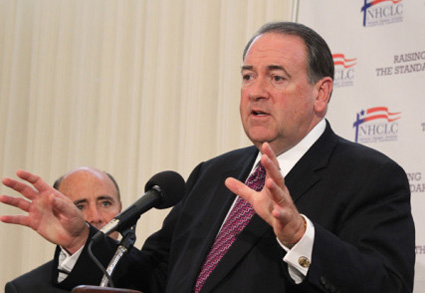
mike huckabee425Former Arkansas Gov. Mike Huckabee speaks during a recent National Press Club news conference for the National Hispanic Christian Leadership Conference. *RNS photo by Adelle M. Banks)Former Arkansas Gov. Mike Huckabee joined Campo in the announcement.

Referring to the program, the former Southern Baptist pastor said, “It will remind the parents that it is your responsibility to make sure that your children are getting the very best education that they are possibly able to receive.”

The NHCLC has supported the Common Core State Standards, which will be implemented in dozens of states this fall but have been criticized by some conservatives. At the news conference, Campo called the standards “redeemable,” while Huckabee, who now considers them “toxic,” said he wants to “fight for students” rather than over the program.

Edwin Hernandez, director of the University of Notre Dame’s Project for the Study of Latino Religion, said the NHCLC initiatives are “important first steps in creating awareness and raising symbolically as well as rhetorically the power of the pulpit to the importance of education.”

They represent a change he has observed from past acquiescence about education from Hispanics who often shy away from challenging the U.S. educational system.

But he said that in addition to celebrating achievement and bolstering parents’ roles, Hispanic Christians must push the educational institutions for student success.

“These institutions may not be serving us well,” he said. “You have to be vigilant: ‘How well is our student doing?’”


Churches need to rethink service options for retiring baby boomers

Many churches rely on retirees as volunteers to keep some programs and activities vital and growing. Some congregations turn to mature adults for the basics—answering phones, stuffing envelopes and other office or maintenance duties—to help hold down administrative costs.

Shifts in how Boomers choose to volunteer is impacting church ministries.But as the baby boomer generation retires, church leaders who hope to continue to tap into retiree time and resources may need to rethink the ministries they ask mature adults to take on.

The U.S. Bureau of Labor Statistics’ 2013 “Volunteering in the U.S.” report indicates volunteerism among 45- to 64-year-olds declined in the previous two years. What forces may be driving that trend, and what can congregations do to attract volunteers?

The generation preceding the boomers—the builders—tended to commit to an organization or group, such as church or a civic club, noted Amy Hanson, an expert on aging and boomers.

“Boomers and subsequent generations tend to want to volunteer for a certain project or a cause that is near and dear to their heart,” noted Hanson, author of Baby Boomers and Beyond: Tapping the Ministry Talents and Passions of Adults Over 50.

Many boomers move away from volunteering once their children leave home or as a result of downsizing their lifestyle, said Frank Fain, director of educational services for The Baptist Home in Missouri. Some give up volunteering for school events and church functions geared for children and youth because they gave their time when their own children participated in those activities.

amy hanson400Amy Hanson, author of Baby Boomers and Beyond: Tapping the Ministry Talents and Passions of Adults Over 50.Some give up volunteering so that they have time to travel or pursue other interests they did not have time to do before, Fain added.

Financial need also drives availability, he said. Some mature adults who lost their jobs in the market downturn in 2008 were unemployed for a year or longer. Those who volunteered during that time returned to the workforce once they found positions. Many now work two jobs, just to realize the same income of their former post, Fain said.

Much of the volunteer work boomers do is not counted in most surveys. Family caregiving is a notable category, and the hours spent caring for parents and children aren’t “registered” volunteer hours.

Church leaders sometimes do not recognize all the work volunteers do. “In our own congregational settings, involvement in ‘everyday’ ministries … (such as) Sunday school, deacons (and) children’s ministry often gets overlooked,” noted Dennis Myers, a gerontology expert for the Baylor University School of Social Work.

He believes church members already committed to volunteering for long-time congregational programs, such as Bible study, will remain with them. However, churches might lose some volunteer hours to other activities.

“I do see some loss in ministries that depend on the discretionary time of retirees—extended mission involvements and ‘beyond-the-walls’ ministries in the community,” Myers said.

dennis myers400Dennis Myers, a gerontology expert for the Baylor University School of Social Work.The key to enticing baby boomers to volunteer is to tap into their passions, Hanson and Myers agreed. And congregations must recognize and respect that boomers prefer short-term commitments, rather than signing up for a multi-year stint.

“While the builder generation was willing to sign on and teach the Sunday School class for 20 years, the boomers want to know that they can be gone to see their grandkids play soccer or take a spontaneous trip with their spouse,” Hanson pointed out.

Focus on “small bites” and “passion” is Myers’ advice. “Linking the volunteer experience to a sense of call and a powerful opportunity to give back and do the things they always wanted to do but did not for a lot of reasons is compelling,” he explained.

“Boomers have an entrepreneurial spirit and an attitude that they can change the world,” Hanson added.

She calls on congregations to think beyond stapling papers and answering phones to unleashing the generation to lead ministries that use their skills and meet community needs. “This is a group that can make a significant difference for Christ, and we need to empower them to do it,” Hanson said.

frank fain250Frank Fain, director of educational services for The Baptist Home in Missouri.Churches looking to the boomer generation to bolster or revitalize senior adult ministry may be disappointed, Fain explained. While most congregations think boomers will move right into the ministry, they likely will not, because they view it as something for their parents and grandparents.

Boomers do not want a connection to anything labeled “senior,” these experts agreed. “Volunteer recruitment in this cohort needs to be highly individualized, clearly focused and absent any link with ‘senior adult’ ministry,” Myers explained.

Just as volunteerism needs to be focused, so does giving. Myers sees baby boomers as “basically generous,” but appeals to the generation’s need to strike the same chords— passion and specific projects or social concerns.

Boomers—just like all believers—must be reminded of the biblical mandate to give, Hanson noted.

“Giving is a discipleship issue. It’s about continuing to grow as a follower of Christ,” she said.

retirement service425Many Boomers move away from volunteering once their children leave home or as a result of downsizing their lifestyle. (ABP/Shutterstock Image)“Our world sends the message that you should work hard and build up a nest egg in order to retire and enjoy life, but the Bible has a counter-culture message.”

Church leaders need to remember not all boomers are relatively affluent and able to give, Myers pointed out.

“Boomers are also in poverty and struggle to meet basic needs on a day-to-day basis,” he said.

Others suffer health issues, and many struggle with early dementia, he added.

Congregations also must be aware that not all boomers are believers, he noted. Meeting social needs with them may open opportunities to minister to them.


Faith Digest: Turbans no substitute for helmets, Ontario official insists

Ontario Premier Kathleen Wynne informed Sikhs in her province they are not exempted from motorcycle helmet laws. Failure to wear a helmet presents “a road safety risk,” Wynne wrote in a letter to the Canadian Sikh Association. “Ultimately, the safety of Ontarians is my utmost priority, and I cannot justify setting that concern aside.” In jurisdictions requiring helmet use, mortality rates for motorcyclists have declined 30 percent, and head injuries have gone down 75 percent, she wrote. The Sikh association said it had worked for years to get an exemption on religious grounds, stressing devout Sikh men are required to wear turbans to cover unshorn hair, over which motorcycle helmets do not fit. It noted two Canadian provinces—Manitoba and British Columbia—as well as Great Britain do not require turbaned Sikhs to wear a helmet.

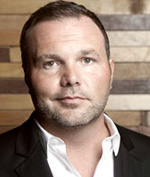
Embattled Driscoll takes leave from Mars Hill. Controversial Seattle megachurch founder Mark Driscoll will step down for at least six weeks while Mars Hill Church leaders review formal charges lodged by 21 pastors that he abused his power. mark driscoll150Mark DriscollThe 43-year-old pastor has been under fire in recent months for plagiarism, inappropriate use of church funds and improper behavior toward subordinates. Returning from vacation Aug. 24, Driscoll addressed Mars Hill worship services through a pre-recorded message. “I’m very sorry for anything I’ve done to distract from our mission by inviting criticism, controversy or negative media attention,” he said, announcing he will not do any outside speaking for the foreseeable future and will postpone publication of his next book. “I have begun meeting with a professional team of mature Christians who provide wise counsel to help further my personal development and maturity before God and men,” Driscoll told the congregation. Mars Hill Church has claimed as many as 14,000 members at 15 locations across five states each Sunday. Earlier, Driscoll was removed from Acts 29, a church-planting network of more than 500 congregations he helped found, after board members said they found a pattern of “ungodly and disqualifying behavior.”

Dominican Republic may seek extradition of former Vatican envoy. Jozef Wesolowski, the ex-Vatican envoy stripped of diplomatic immunity after claims he sexually abused young boys in the Dominican Republic, may face a criminal trial in the Caribbean country. Francisco Dominguez Brito, the Dominican Republic’s attorney general, issued a statement saying it was “just and positive” for the Vatican to remove Wesolowski’s immunity and the country would consider seeking the former archbishop’s extradition so he could stand trial there. The Vatican does not have an extradition agreement with the Dominican Republic, but Italy could decide to extradite Wesolowski if he leaves the confines of the 108-acre Vatican City State. Federico Lombardi, the Vatican’s chief spokesman, said Wesolowski had lost his diplomatic immunity and may now be exposed to proceedings where specific legal jurisdictions apply. In June, Wesolowski was defrocked after a Vatican tribunal found him guilty under canon law of abusing young boys. He recently appealed that sentence, and a final decision is expected in October, Lombardi said. Polish authorities also have been looking to extradite the former archbishop.


God at Nuremberg: How an American pastor came to comfort Nazis

WASHINGTON (RNS)—Henry Gerecke was a minister to monsters.

That’s what Tim Townsend writes about an unassuming Lutheran pastor from Missouri who shepherded six of the most notorious Nazis to the gallows in Mission at Nuremberg: An American Army Chaplain and the Trial of the Nazis.

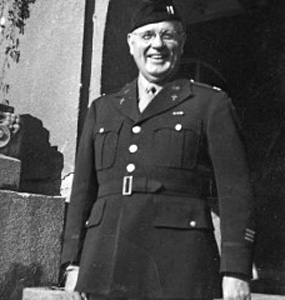
henry gerecke nuremberg300Henry Gerecke, a Lutheran Church Missouri Synod Army chaplain, was charged with caring for men such as Hermann Goering, Albert Speer and Wilhelm Keitel—men responsible for the mass-extermination of 6 million European Jews. (RNS Photo)The book is one of a string of new titles that dust off a remote corner of World War II history—the role religion played both in and beyond the conflict.

“That’s why I wanted to write this book,” said Townsend, a senior writer and editor for The Pew Research Center in Washington, D.C.

“A large part was trying to figure out why did the Allies provide spiritual comfort for men who were on trial for what was ultimately called the Holocaust. They clearly did not have anyone’s spiritual welfare in mind when they were murdering Jews. So, why did we feel it was necessary and humane to provide them with chaplains to see to their spiritual comfort?”

Townsend combed the National Archives for some piece of paper, some order that explained more deeply why the Allies felt those charged with the most horrendous crimes of the century needed—even deserved—a chaplain of their own, beyond the fact the Geneva Conventions required it.

American culture long has accepted the idea of chaplains ministering to criminals, from the common thief to the death-row murderer. But what about genocidal killers overseas?

misson at nuremberg book200Townsend finds his answer in Gerecke, a Lutheran Church Missouri Synod pastor charged with caring for men such as Hermann Goering, Albert Speer and Wilhelm Keitel—men responsible for the mass-extermination of 6 million European Jews. How, he asks, did he understand his role in leading the condemned Nazis to their deaths?

Gerecke volunteered in 1943, when the Army was desperate for chaplains. His unit was sent from England to Germany after the Germans surrendered in 1945.

There, he visited Dachau, where hundreds of thousands of Jews were gassed and cremated in ovens.

As the Nuremberg Trials began, higher-ups heard about a German-speaking Army chaplain and asked Gerecke to take on the role of ministering to 21 high-ranking Nazis on trial for their lives.

In saying yes, Gerecke played one of the most puzzling and under-examined roles in what Townsend calls “the judicial improvisation we now call the Nuremberg trials.”

“Gerecke was the perfect choice,” Townsend said. “He was able to go in with his mind and his eyes wide open. He had seen Dachau, he knew what these people were responsible for, but he was able to move past that in terms of his ability to relate to them.”

Townsend thinks Gerecke looked beyond the terrible men imprisoned in front of him to the children they had once been. One of the most lovely—and chilling—pieces in the book comes when Gerecke accompanies Keitel up the 13 steps of the gallows and prays aloud with him a German prayer both were taught by their mothers.

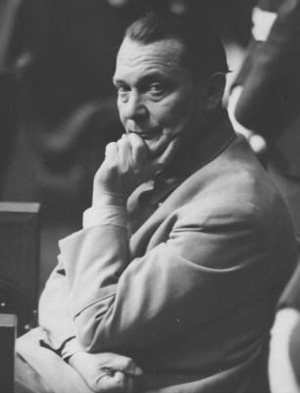
herman goering300Nazi defendant Hermann Goering in the prisoners’ dock at the International Military Tribunal trial of war criminals at Nuremberg. (Wikipedia Image / Harry S. Truman Library, courtesy of USHMM Photo Archives)“He knew that he needed to save the souls of as many of these men as he could before they were executed,” Townsend said. “I think for him, he thought it was a great gift he had been given.”

And not one he took lightly. Gerecke did not give communion to any of the Nazis unless he believed they truly were penitent and made a profession of faith in Jesus. Only four of the 11 sentenced to hang met Gerecke’s standard.

One who did not was Goering, who many historians credit with helping to create “the Final Solution”—the genocide of the Jews. When he and Gerecke discussed the divinity of Jesus, Goering disparaged the idea.

“This Jesus you always speak of,” Goering said to Gerecke, “to me he is just another smart Jew.”

Gerecke held that unless he accepted Jesus as his savior, Goering could not receive communion.

“You are not a Christian,” Gerecke told Goering, “and as a Christian pastor, I cannot commune you.”

Within hours, Goering was dead, robbing the hangman by swallowing cyanide he had secreted in his cell.

“This Jesus you always speak of,” Goering said to Gerecke, “to me he is just another smart Jew.”

In the end, Gerecke walked five men to the gallows. After the war, some fellow pastors criticized him for not granting Goering communion. Others criticized him for ministering to such monsters in the first place.

During the trials, a rumor spread among the Nazis that Gerecke would go home before the end. They wrote a letter to his wife, Alma, asking her to please let him stay. That letter, which Townsend first saw in a St. Louis exhibit, led him to the story.

“Our dear Chaplain Gerecke is necessary not only for us as a minister, but also as the thoroughly good man that he is,” the letter reads above the signatures of Goering, Keitel, Speer and others. Then it includes a word Townsend writes is not often associated with Nazis: “We simply have come to love him.”


Feelings of persecution run deep, even when ill-founded

The steady cultural shift away from church and faith may spell persecution for traditional Christians, Matt Cook often hears from fellow Baptists. It’s a fear born of constant news reports and anecdotes about young people leaving congregations in droves, churches merging or closing, and fewer Americans raised with any kind of God-consciousness at all—let alone a belief in Christ and his resurrection.

matt cook130Matt CookCook, pastor at First Baptist Church in Wilmington, N.C., typically responds by explaining that, while sometimes unsettling, such developments are a far cry from persecution—especially considering the ongoing suffering of Christians and other religious minorities in places like Iraq and Syria.

“That (societal) shift is real,” Cook said. “But there is a significant difference between us becoming a more diverse culture and there being actual persecution in our culture.”

The topic resurfaced earlier this month when Cook read an Alan Noble article in The Atlantic titled “The Evangelical Persecution Complex,” which lays out the tendency among conservative American Christians to see and claim anti-religious abuse at the hands of government, the courts, the gay community and others.

The rise of gay marriage and reports of Christian photographers being forced to shoot pictures at gay weddings are, some evangelicals contend, proof Bible-believing Christians are squarely in the sights of an increasingly secular and pluralistic nation.

Cook was so moved by the piece, he posted it on Facebook and urged his friends to read it.

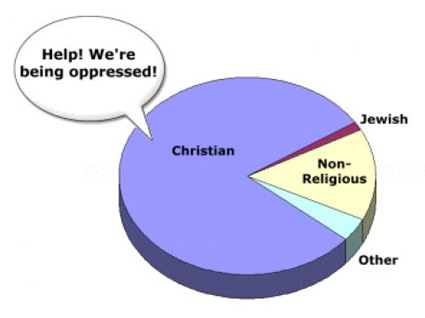
oppression chart425(Flickr Creative Commons image by Joe Wolf)“Crying wolf on religious persecution is dangerous,” Cook said in a comment with the link. “It desensitizes people to the real thing around the world, and it runs counter to the whole idea of loving our neighbors as ourselves.”

While scholars who study religious persecution agree that claiming oppression where there really is none is dangerous, they also add the phenomenon is practically inevitable—especially among Christians and even more so among American Christians.

It’s mainly, but not exclusively, conservative Christians who make those claims in the United States today. But others—including former Southern Baptists driven to create and join the Cooperative Baptist Fellowship and other moderate movements—in some cases have clung to feelings and rhetoric consistent with victimhood from past events.

And no wonder: Those experts say the need for persecution is built into the fabric of the Christian faith, and Americans love being David against Goliath.

It starts with Americans loving to be the underdog, said Noble, author of The Atlantic article and assistant professor of English at Oklahoma Baptist University in Shawnee.

alan noble130Alan NoblePowerful members of government, the leaders of major Christian movements and an army of born-again bloggers claim they and their followers are oppressed for their traditional biblical beliefs.

“Every group does this—everyone does this,” Noble said in an interview. “We even have wealthy people who complain about being persecuted by tax laws that take their money and give it to the poor.”

The United States began as an underdog nation founded by persecuted people, which provides a handy narrative for any group when a court decision or election goes against them.

“Evangelicals have bought very uncritically in this very popular narrative,” Noble said.

Feelings of persecution also are common during church denominational shifts, and certainly were present during the fundamentalist takeover/conservative resurgence in the Southern Baptist Convention.

When liberals and moderates feel oppressed, Noble said, they tend to express it through social justice issues.

“That might go into advocating for the poor and minority groups,” he said.

Conservatives tend to funnel that fear into faith-based legal and political efforts—often with support generated by conservative media outlets that hype the persecution angle.

Another incentive to claim persecution is its connection to Christ, Noble said.

“For many evangelicals, the lack of very public and dramatic persecution could be interpreted as a sign that they just aren’t faithful enough,” Noble wrote in his article. “If they were persecuted, they could be confident they are saved.”

candida moss130Candida MossBut that’s nearly unavoidable, said Candida Moss, professor of New Testament and early Christianity at the University of Notre Dame.

Moss, an expert on the history of Christian persecution and martyrdom, said the religion itself is based on oppression and suffering.

Jesus told his followers to take up their crosses to follow him, and he subsequently was persecuted and crucified. Martyrdom stories about the apostles and later saints cemented that worldview, she said.

“So today, many believe they are persecuted—whether they are or they aren’t,” said Moss, author of the 2012 book Ancient Christian Martyrdom: Diverse Practices, Ideologies, and Traditions.

One way to determine if an individual or group is experiencing actual persecution, Moss said, is by examining the reactions of those experiencing oppression.

Around the world, people subjected to deliberate suffering at the hands of others are likely to emphasize, somewhat quietly, that they are not threats to those in power. These groups usually are too frightened to make caustic remarks or wage political fights against their oppressors, Moss said.

But when Christians, particularly in the West, publically are vocal about being persecuted, she said, “They usually are not.”

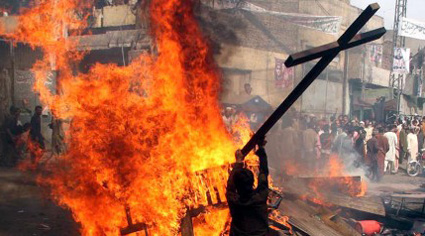
pakistan burn christian homes425Muslims burn Christian homes in Pakistan in 2013. (American Center for Law and Justice Photo)High-profile, high-volume claims of persecution make sense only from a position of relative social and political comfort and acceptance and when there is a sizeable “empathetic audience,” she said.

Even so, Christians must be careful not to hang onto those victim feelings too long, Noble added.

“The danger of this view is that believers can come to see victimhood as an essential part of their identity,” he said.

Cook, currently moderator-elect of the CBF, said he can identify with that after growing up amid the denominational battles that led to the migration away from the SBC.

He watched his father, then an official with the Southern Baptist Sunday School Board, now LifeWay Christian Resources, go through the roller coaster of job insecurity for years. This along with political upheaval at seminaries predisposed him toward a conflict-driven spirituality.

“I would say I spent the better part of my last years in college and first years in seminary looking for that controversy—going and looking for that fight—because I wanted to be in it,” Cook said.

But seeing how spiritually toxic that was for him led him to turn away from those battles. As he moved into a calmer faith, Cook said, he saw how damaging his prior persecution complex had been to his relationship with God.

One result was to notice the genuine suffering of others, he said.

“Finally, I got to see how foolish it was to see myself as persecuted compared to other Christians globally,” Cook said.


Faith Digest: Civil rights groups urge feds to purge anti-Muslim materials

Civil rights and religious groups say efforts to rid federal agencies of anti-Muslim bias have faltered, and prejudice against Muslims persists, particularly in training anti-terrorism officers. Seventy-five groups—including the Council on American-Islamic Relations, Auburn Seminary and the NAACP—sent a letter to the White House urging an audit of federal law enforcement training material. muslim bias200Woman with an American flag wrapped around her head. (RNS Photo courtesy of Rob Byron via Shutterstock)The groups point to a reference to “Mohammed Raghead” in a memo and the claim by a former FBI official that the CIA’s director is a “closet Muslim.” Anti-Muslim sentiment, flagged several years ago, prompted the White House to order an assessment of the intelligence community’s training materials and policies—but that never happened, the letter charges. Instead, the groups wrote, administration officials settled on expanded sensitivity training and other measures that don’t directly address the continued use of anti-Muslim materials. A National Security Council representative said the letter will be reviewed and a response issued.

American nuns honor feminist theologian. The nation’s largest leadership group for Catholic nuns bestowed its top award on a theologian who has been condemned by the U.S. Catholic bishops for her book examining the nature of God. A top Vatican official warned the Leadership Conference of Women Religious that honoring Sister Elizabeth Johnson, author of Quest for the Living God and longtime Fordham University professor, would be considered provoking the Holy See and U.S. bishops. The conference represents 80 percent of the 51,600 women religious in the United States. The organization has been under fire since 2012, when the Congregation for the Doctrine of the Faith, the Roman Catholic Church’s top orthodoxy enforcement group, ordered the nuns to revise their statutes and move away from “radical feminism.”


Faith Digest: Acts 29 Network removes Driscoll

The Acts 29 Network board of directors removed Seattle megachurch pastor Mark Driscoll from the church-planting network of more than 500 churches he helped found after a pattern of “ungodly and disqualifying behavior.” In a related move, LifeWay Christian Resources announced it would suspend sales of Driscoll’s books while officials “assess developments regarding his ministry.” Driscoll has been an influential but edgy pastor within conservative evangelical circles several years. His Mars Hill Church attracts about 14,000 people at 15 locations across five states each Sunday. But he has been provocative, occasionally profane, and has faced allegations of plagiarism and inflating his book sales. After the Acts 29 board action, all of Driscoll’s Mars Hill Church locations have been removed from the network’s website.

Booted Bibles back in Navy lodges. Gideon Bibles are going back in the Navy’s nightstand drawers. In June, the U.S. Navy ordered housekeepers at thousands of Navy-owned guest lodges near U.S. and international bases to remove the Bibles and any other “religious materials” from their rooms. Scriptures would remain available on request. But public outcry, prompted by a recent social media alert from the American Family Association and protests by the Chaplain Alliance for Religious Liberty, led the brass to reverse course Aug. 15. Now, the Navy’s “religious accommodation policies with regard to the placement of religious materials are under review,” Navy spokesman Cmdr. Ryan Perry wrote in an email to Stars and Stripes, the daily military newspaper. Meanwhile, the Bibles—New Testament and Psalms but no Hebrew Bible—will be tucked back into nightstand drawers. A letter from the Wisconsin-based Freedom From Religion Foundation prompted the original order to remove the Bibles. The atheists proposed that the Navy offer Bibles and other texts—including an atheist treatise, “The Born Again Skeptic’s Guide to the Bible”—on request at lodge front desks.


Faith Digest: Formerly imprisoned Sudanese Christian relocates to U.S.

Meriam Ibrahim, the Sudanese woman sentenced to death for refusing to renounce her Christian faith and then spared after an international campaign, left Italy to fly to the United States, where she plans to build a new life. Ibrahim, who met Pope Francis on the first day of her weeklong stay in Rome, boarded a flight bound for Philadelphia with her husband, Daniel Wani, and their two young children. The 26-year-old and her family expected to join Wani’s brother, Gabriel, and his wife and three children in Manchester, N.H., where they run the nonprofit organization South Sudan Community of New Hampshire. Ibrahim was released after a nearly yearlong ordeal that spawned intense diplomatic efforts by the Italian government, American lawmakers and the Vatican. She was forced to give birth to her baby girl, Maya, while shackled in a prison cell in Khartoum in May. Antonella Napoli, president of Italians for Darfur, said Ibrahim hopes to write a book about her life. Sudanese authorities accused Ibrahim of apostasy and sentenced her to the death penalty for converting from Islam to Christianity. She insisted she never converted but was brought up a Christian, although her father, who left the family when she was very young, is a Muslim.

Immigration activists arrested at White House. The U.S. Park Police arrested more than 100 religious leaders and activists in a White House protest aimed at halting deportations and aiding immigrants living in the United States illegally. The direct action sponsored by Church World Service and Casa de Maryland, an immigration advocacy group, brought leaders from New England to Hawaii to the nation’s capital. The police completed the arrests of 112 people by mid-afternoon, charging each with “blocking passage” on the sidewalk outside the White House, a misdemeanor, said Sidney Traynham, a spokesman for Church World Service. Each went through a “post and forfeit” process, paying $50 in cash and forfeiting their right to a trial. By 5:15 p.m., all of the people arrested had been released from a processing center in the Anacostia neighborhood of Washington.


Who bears responsibility for unethical clergy?

Ministers are held responsible for their actions—sometimes by civil authorities and ultimately by God. But what responsibility should the local church and the denomination bear for unethical behavior of pastors and other ministers?

That question is difficult for religious bodies that follow a congregational form of governance. And congregational polity has become the primary basis for refusal by many groups, including many Baptist denominations, to compile lists of ministers caught in unethical or immoral behavior, particularly sexual misconduct.

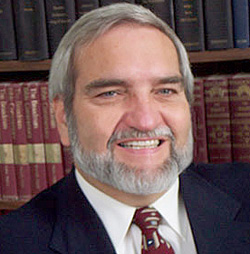
Joe Trull, retired professor of Christian ethics at New Orleans Baptist Theological Seminary and former editor of Christian Ethics Today magazine.Establishing an inclusive procedure is more difficult for denominations without a hierarchical structure, said ethicist Joe Trull of Denton.

“As Baptists, we want to maintain our belief in local-church autonomy and are hesitant to be viewed as telling churches what to do,” said the retired professor of Christian ethics at New Orleans Baptist Theological Seminary and former editor of Christian Ethics Today magazine. “I think denominations could do more, but they are so afraid of someone accusing them of exerting control.”

Healthy accountability structures within the local church are a way to minimize the possibility of clergy misconduct, said Daniel Darling, vice president for communications at the Southern Baptist Convention’s Ethics & Religious Liberty Commission. The pastor is placed under that accountability as a form of service to the congregation, Darling noted.

daniel darling130Daniel DarlingFor Tarris Rosell, who holds the Rosemary Flanigan Chair at the Center for Practical Bioethics in Kansas City, Mo., ability or empowerment determines responsibility. As a professor of pastoral theology, ethics and ministry praxis at Central Baptist Theological Seminary in Shawnee, Kan., he insists anyone who has the ability—and who is empowered—to respond is responsible.

Congregations have the responsibility to put policies and procedures in place, to do background checks and to have whistleblower policies that allow church leaders and members a safe way to report abuses, including financial misconduct. Those who are disempowered become the most vulnerable, he said.

Jerry Cain, chancellor of Judson University in Elgin, Ill., believes both the pastor and the congregation have obligations. “The pastor should be expected to live a holy life of unquestioned morality, yet should be protected from detractors who wish to diminish his reputation,” Cain said.

tarris rosell130Tarris RosellHe also emphasized church policies, including background checks, perusal of a potential pastor’s social media usage and annual pastoral reviews. The evaluation should include questions about all areas of the pastor’s ministry and home life “and other topics that might be a source of temptation,” he said.

American Baptist Churches USA is one of the few Baptist groups that have another level of accountability for ordination. While congregations determine who they will ordain, another jurisdiction—an ABC regional or associational body—must officially recognize the ordination for it to be valid, and in most cases, a regional or area minister is involved.

Cain sees using that process as another possible way to deter or punish misconduct. “Like an educational accrediting agency, it might be good for the denomination to review ordinations every decade to see if a pastor should retain his papers. Should ordination be for life?”

Baptist groups should put some type of ethical code in place for ministers, Trull believes. Most professions have a code of ethics developed and sometimes enforced by their members. While the American Baptists do not enforce a pastoral code of ethics, they provide guidelines for churches to develop their own code.

jerry cain300Jerry Cain, chancellor of Judson University.While serving as a consultant for the Baptist General Convention of Texas, Trull encouraged state leaders to adopt a ministerial code of ethics churches could use. Instead, the BGCT developed a covenant of ethics, which Trull believes does not carry the same weight.

Rosell and Darling both pointed out most ministers faithfully serve and do not violate members’ trust, but accountability in place protects everyone.

Understanding relationships at all levels of ministry, particularly within the local church, is a way in which pastors and members can bear responsibility and promote accountability, Rosell said.

He likens the relationship to that between a benefactor and beneficiary. The relationship centers on the beneficiary.

For example, Rosell explained, the relationship between the pastor and a dentist who is a church member differs depending upon place. In the church, the minister holds the role of benefactor. The “power” of the relationship resides in him, with the dentist at greater vulnerability.

If the two are in a social or other setting as peers, power and vulnerability are relatively equal.

When the pastor goes to the dentist’s office and seeks the dentist’s professional expertise, the roles are reversed. The dentist has the power and the minister is more vulnerable, Rosell said.

Ministers cannot avoid the multiple roles both they and members hold, he added. But they must be aware of where they are on the spectrum of each relationship because role reversal can open the possibility for confusion and abuse.


Obamacare changes the way faith-based hospitals deliver care

Whether most Americans like it or not, the Affordable Care Act—also known as Obamacare—is now the law, and faith-based health-care providers say it’s changing the way hospitals view patient care.

A new poll by the Kaiser Family Foundation says public support for the Affordable Care Act is at an all-time low, with 53 percent of Americans voicing an unfavorable impression of the law. Numerous lawsuits challenge it, and House Republicans have voted more than 50 times seeking its repeal.

Brian KeeleyWhile almost everyone agrees the 3,000-page law passed by Congress and signed by President Obama in 2010 is far from perfect, healthcare providers don’t have the luxury of watching all the wrangling from the sidelines.

“Whether you agree with Obamacare or not, it’s the law of the land,” Brian Keeley, president and CEO of Baptist Health South Florida, said in blog announcing roll-out of the Health Insurance Marketplace last October. “Baptist Health is well-positioned to meet the challenges and changes of healthcare reform.”

Hugh Greene, CEO of Baptist Health in Jacksonville, Fla., said in a presentation last year the law didn’t come out of a vacuum. Greene said two primary factors—spiraling costs and increasing numbers of the uninsured—have been driving the need for healthcare reform for several years.

hugh greene127Hugh Greene“It is a travesty in the most sophisticated democracy on the face of the earth that nearly 50 million Americans do not have access to the health insurance system as you and I know it,” Greene said. “We see them in the form of the uninsured who come to our emergency rooms on a daily basis.”

Greene was part of the Health Systems Learning Group, a self-organized group of 43 organizations—including 36 nonprofit health systems—participating in meetings across the country over the course of 18 months inspired by passage of the Affordable Care Act and eager to transform their organizations and communities.

Another member, Gary Gunderson, vice president for faith and health of Wake Forest Baptist Medical Center in Winston-Salem, N.C., describes the law as “a huge landmark” in the history of mission-based health care and “a tremendous opportunity for the faith community to help make it work.”

A different perspective

“The gift of the faith communities at the intersection of faith and health is that we don’t just see it as a journey of death and disease and disability and gradual entropic decline of everything we love and care for in our life, and then we die,” Gunderson said at a “Navigating the Affordable Care Act Conference” hosted by Garrett-Evangelical Theological Seminary last fall. “Actually, we think life is going on.”

Gunderson, a one-time anti-hunger activist who co-launched SEEDS at Oakhurst Baptist Church in Decatur, Ga., before joining the Carter Center as director of the Interfaith Health Program in 1992, said he doesn’t share the view that faith communities once were at the lead of healthcare ministries but that no longer is true.

gunderson conference425Gary Gunderson speaks during the opening plenary of the Navigating the Affordable Care Act Conference at Garrett-Evangelical Theological Seminary last fall.“I think faith-based health care is still in the lead,” Gunderson said. “In a curious way, we just don’t talk about who we actually are very much.”

Gunderson serves on the advisory council of Stakeholder Health, an on-going learning collaborative of 40-plus health systems and other organizations that see the current public-policy environment as an opportunity for positive change in America’s health-care delivery system.

“The mission, in almost every case, has a deep religious resonance that’s something to the effect that we want to be an agent of advancing the health of our whole community,” Gunderson said of the participating institutions.

Greene insists the old healthcare system—which costs more and has worse outcomes than those in other industrialized nations—is not sustainable. Under Obamacare, Greene explains, the model shifts “from volume to value” in determining how much hospitals get paid.

“We are rewarded based on volume,” Greene said of the old system. “Every time we do something, we get paid. When we do something else, we get paid again.

“And if we don’t do anything, we don’t get paid. So it is a fee-for-service, volume-driven system.”

The new model re-orients payment incentive toward services and activities that improve patient care by linking reimbursements to patient satisfaction and positive outcome.

nursing staff425For example, Greene said, congestive heart failure is the most common cause of hospital readmission. Until Obamacare, if a patient were treated and released and later readmitted with a relapse, each visit was billed as a separate hospital stay. Under the Affordable Care Act’s Hospital Readmissions Reduction Program, hospitals that readmit certain patients within 30 days of discharge are penalized. The idea is to shift the focus from acute care to prevention, and to get more patients under the care of a primary physician instead of more expensive visits to the emergency room.

Early reports indicate in some cases, ER volumes actually have increased under Obamacare, but more of the patients showing up now have insurance. That means instead of eating the cost of uninsured patients, hospitals now are more likely to get paid for emergency room care.

Baptist Memorial Health Care, with 14 affiliate hospitals serving 110 counties in Tennessee, Mississippi and Arkansas, undertook a comprehensive community health needs assessment beginning in late 2011, both to comply with current requirements set forth in the Affordable Care Act and to further the health system’s own commitment to community health improvement.

Greene says the Affordable Care Act “is the most significant and complex piece of healthcare legislation in this country since the passage of Medicare and Medicaid in 1965.”

“Nothing comes close,” he said.

The bill in its current form has many flaws, he asserted. Malpractice reform, a huge factor driving up costs of healthcare, did not make it into the law for political reasons. Unlike Medicare, which was tweaked after passage to address unintended consequences, Greene said, the current deadlock in Congress makes it highly unlikely fixes are coming anytime soon.

Hospitals voluntarily took a cut in the amount they are reimbursed by Medicare, thinking the increase in newly insured patients from Medicaid expansion would more than make up the difference, Greene said. They didn’t anticipate the Supreme Court ruling that states could refuse to accept federal funds to expand Medicaid coverage, and that a number of them would do so.

Under Obamacare, Greene explains, the model shifts “from volume to value.”

In his home state, Greene said, “We are turning away $50 billion of federal money and leaving 1.1 million Floridians uninsured.”

Some already struggling hospitals may close. Other big-city hospitals, meanwhile, are exploring partnerships to reduce duplication of services that can cost vastly different amounts even within the same community.

Baptist Health South Florida, headquartered in Coral Gables, signed a preliminary agreement in February to explore possible affiliation with Bethesda Health, another not-for-profit hospital based in Boynton Beach.

“We see a very positive cultural fit between our two organizations, which is the foundation for any partnership,” Baptist Health CEO Keeley said. “This possible affiliation would give us the opportunity to jointly develop and share best practices in order to continue improving quality and access to care for our patients. It will also allow us to better prepare for healthcare reform and the Affordable Care Act.”

Kentucky’s Baptist Health—formerly Baptist Healthcare System—formed a joint purchasing agreement for the acquisition and distribution of supplies with Norton Healthcare, expected to save $15 million over five years for medical and surgical supplies, implants and devices.

Partnerships provide economy of scale

“It’s a new day in healthcare,” said Michael Reeves, system executive of supply chain services for Baptist Health. “Providers are under intense pressure to hold down costs because of the Affordable Care Act and other reforms, and doing business the way we’ve always done it simply won’t do. Partnerships like these provide economies of scale and allow us to be more efficient in our delivery of quality care.”

Early reports indicate hospitals are getting a stronger-than-expected benefit from a new influx of low-income patients whose bills are paid by the government’s Medicaid program. The administration says 6.7 million people have signed up for Medicaid and other healthcare programs for the poor since Obamacare enrollment began last October.

HCA Holdings Inc., the largest for-profit hospital chain, reported a 6.6 percent drop in uninsured patients at its 165 hospitals. In four states that expanded Medicaid, the reduction grows to 48 percent.

A big challenge for churches is “to convince people of faith that their faith compels them to the intersection of faith and health,” Gunderson said.

A ‘profound opportunity’

Most uninsured Americans are not the indigent or elderly, because they are covered by Medicaid or Medicare, he explained. Rather, it’s those who work but don’t get insurance from their job and cannot afford to pay for it on their own. Those people often are concentrated in communities where churches already minister, he noted.

The Affordable Care Act presents “a profound opportunity” for congregations already committed to a particular community to both “invent some new stuff, and reinvent some stuff we’ve already got,” Gunderson said.

He used a church soup kitchen to illustrate. “Some of the people who are eating soup actually need insurance,” Gunderson said. “You’re in relationship to them, so what you think is part of the soup kitchen answer of the world turns out to be part of the Affordable Care Act part of the world.”

The same is true of other groups with structure and a role to play, including less-obvious examples like a prayer group for older women, he added.

“It turns out that’s relevant,” Gunderson said. “They are probably all on Medicare. They don’t need to sign up for the exchange, but they have daughters and sons and their neighbors. They’re relevant.”


Gay, celibate Christians ‘easily misunderstood’

WASHINGTON (RNS)—When Julie Rodgers came out as a lesbian at age 17, her mom responded by taking her to an ex-gay ministry in Dallas. Rodgers had grown up in a nondenominational evangelical church, where she assumed being gay wasn’t an option.

Rodgers, now 28, spent several years in Exodus, the now-defunct ex-gay ministry, before deciding she couldn’t become straight after trying to date men. Instead, she has chosen celibacy.

washed and waiting246“Washed and Waiting” by Wesley Hill is a book on being gay and celibate.For years, those who were gay or struggled with homosexuality felt they had few good options—leave their faith, ignore their sexuality or try to change. But as groups like Exodus and reparative or conversion therapy have become increasingly unpopular, Rodgers is among those who embrace a different model—celibate gay Christians, who seek to be true to both their sexuality and their faith.

Straddling one of America’s deepest cultural divides, Vanessa Vitiello Urquhart wrote in a recent piece for Slate that celibate gay Christians present a challenge to the tolerance of both their churches and the secular lesbian, gay, bisexual and transgender community. Celibate gay Christians often find themselves trying to translate one side for the other. But frequently, neither side really understands what it’s hearing.

“We can be easily misunderstood, to put it nicely, by both sides of the culture war,” Rodgers said. “For those who have a more affirming position, it’s as if we’re repressed, self-hated homophobes, encouraging the church to stand in its position on sexuality. And conservative Christians think that those who shift on sexuality are being rebellious.”

Moving from ex-gay

Christians’ shift away from ex-gay therapy came amid larger cultural changes, including a wider societal acceptance of homosexuality and a rapid embrace of same-sex civil marriage.

In 2009, the American Psychological Association adopted a resolution that mental health professionals should avoid telling clients they can change their sexual orientation. Since then, California and New Jersey have passed laws banning conversion therapy for minors, and several other states have considered similar measures.

Earlier this year, the 50,000-member American Association of Christian Counselors amended its code of ethics to eliminate the promotion of reparative therapy and encouraged celibacy instead.

“Counselors acknowledge the client’s fundamental right to self-determination and further understand that deeply held religious values and beliefs may conflict with same-sex attraction and/or behavior, resulting in anxiety, depression, stress and inner turmoil,” the revised code says.

Mark Yarhouse, a Regent University psychology professor who has done research on ex-gay Christians, just now is beginning to study celibate gay Christians. “Evangelicals are so enamored with marriage, it’s been hard for them to value singleness and celibacy,” he said.

gay chambers425Alan and Leslie Chambers married in January 1998. (RNS Photo courtesy Alan Chambers)Some Christians left ex-gay ministries and eventually began to embrace a position more affirming of gays and lesbians. Josh Wolff, a gay 2009 graduate of Biola University’s Rosemead School of Psychology who is now a licensed clinical psychologist, said he went to reparative therapy for nearly two years before fully embracing his sexuality.

“I’ve seen a real shift away from some of the language (that) you need to go to counseling, you can experience healing that can make you straight,” Wolff said. “When Exodus came forward and said, ‘We’re sorry for some of the harm that we’ve done,’ I think it was a wake-up call to many members of faith communities that for the vast majority of people, these treatments don’t work.”

Rediscovering celibacy

Celibacy is a better trend for Christians than conversion therapy was, said Alan Chambers, who led Exodus before shuttering it last year.

“Celibacy is an age-old concept, so I think it’s a great option for a lot of people. People have been so afraid of it,” Chambers said. “The only option before it was to stay completely silent or adopt this ex-gay mentality.”

Some evangelicals mine Catholicism’s centuries-old tradition of celibacy, said Wesley Hill, a professor of New Testament at Trinity School for Ministry, who wrote Washed and Waiting, a 2010 book on being gay and celibate.

gay wesley hill425Wesley Hill is a New Testament professor at the Trinity School for Ministry and author of “Washed and Waiting,” a book on being gay and celibate. (RNS Photo by Rebecca Murden courtesy of Trinity School for Ministry)“They already have a rich history of celibacy that I had to discover as an evangelical,” Hill said. “Twenty years ago, being gay would be considered irredeemably bad, something to be delivered from or be changed. (Celibacy) leads me to form close bonds with friends, to have self-denial and sacrifice.”

Eve Tushnet, a 35-year-old whose book Gay and Catholic comes out in October, is fast emerging as a significant voice on sexuality and Catholic teaching.

“I felt like there’s a lot of things I don’t understand, but I can do my wrestling and doubting from within the church,” she said.

Tushnet grew up somewhere between agnosticism and Judaism, and when she became a Catholic in 1998, she didn’t know of other openly gay Christians who were following the church’s teaching on sexuality.

Confronting loneliness

“Because marriage, the standard American solution to the problem of the human heart, is typically unavailable to gay Christians, we’ve had to confront loneliness earlier and more publicly than many of our peers,” she wrote in The American Conservative.

gay eve tushnet300Eve Tushnet is a conservative, Catholic writer and celibate lesbian. (RNS Photo courtesy May Goren)For some like Tushnet, the loneliness of celibacy has been tempered by communities such as Spiritual Friendship, a blog for celibate gay Christians. Hill co-founded the blog with Ron Belgau, who grew up Baptist and converted to Catholicism at 24. Belgau said celibacy was one of the things that attracted him to the Catholic Church.

“The ex-gay message was appealing, because the problem was solved, and we didn’t need to talk about it,” said Belgau, who spent some time in the Catholic Church’s Courage ministry that encourages celibacy for gays and lesbians.

“If you realize that a lot of people will have an ongoing attraction to same-sex and can be kept secret, you have to deal with as a church how we’re going to talk about this. With the ex-gay message, we can farm this out and continue with our nuclear family model.”

Major religious traditions, including the Roman Catholic Church, the United Methodist Church and the Church of Jesus Christ of Latter-day Saints (Mormons), teach homosexuality only becomes sinful when a person chooses to act on it.

Sanctification

“Sanctification is not getting rid of our temptations, but pursuing holiness in the midst of them,” Moody Bible Institute professor Christopher Yuan wrote in Christianity Today. “If our goal is making people straight, then we are practicing a false gospel.”

But some Christians are debating whether identifying as gay or having a same-sex orientation is itself unbiblical.

gay rosaria butterfield300Rosaria Butterfield is a former lesbian who rejects the ex-gay label. (RNS Photo courtesy Rosaria Butterfield)“My conclusion is that if sexual orientation is one’s enduring pattern of sexual attraction, then the Bible teaches both same-sex behavior and same-sex orientation to be sinful,” Denny Burk, a biblical studies professor at Southern Baptist Theological Seminary, wrote in a blog post for the Southern Baptist Convention’s Ethics & Religious Liberty Commission.

Rosaria Butterfield, a former lesbian who rejects the “ex-gay” label and the movement behind it, disputes Burk’s interpretation of sexual orientation. 

“The Bible doesn’t speak against attraction,” said Butterfield, a mother of four whose conversion story went viral after it was published in Christianity Today. “It speaks against attraction that becomes lust.”

While she affirms celibate gay Christians, she says they should not use “gay” as a descriptive adjective.

“The job of the adjective is to change the noun,” said Butterfield, who will speak at the Southern Baptist Convention’s Ethics & Religious Liberty Commission’s fall conference on sexuality. “Our sexuality exists on a continuum, but our Christianity does not.”