Religiously unaffiliated less likely see seek funerals led by ministers
Once upon a time, even the unchurched came to church for at least one occasion—their funerals. It was an era when nearly everyone, even those who rejected religion, had some connection to faith, however distant.
 George MasonBut today, the number of Americans with no religious affiliation at all has grown so much they’ve achieved their own name—the “nones.” Pew Research has found a fifth of the American population—including a third of adults under 30—are connected to no faith communities. Many never had any association with church, synagogue, mosque or other house of worship.
And when they die?
“They’re not coming to us,” said George Mason, senior pastor at Wilshire Baptist Church in Dallas.
Some Baptist pastors note the number of requests they receive from the religiously unaffiliated has decreased over the years, instead of increasing as that population grows.
It makes sense, Mason said.
“If you put yourself in their mindset, they don’t suddenly, at the point of death, say, ‘Let me go find the expert on this sort of thing,’” he said. “Instead, they will create their own ritual.”
Preachers aren’t the only ones noticing those new rituals. Funeral homes are scrambling to meet the challenge posed by the do-it-yourself and home-funeral movements.
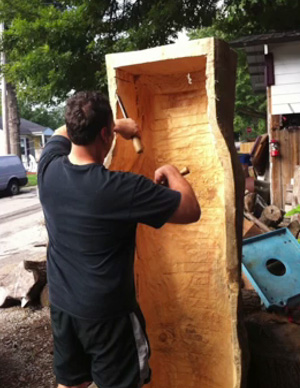 In 2013, the sons of Gilbert Becker of Blue Springs, Mo., carved a casket from a neighbor’s tree, and he was laid to rest in woods where the family spent time camping and fishing. (RNS Image)The Huffington Post reported last year about a small but growing number of Americans opting out of the after-death industry in favor of home-preparation of bodies; simple, wooden caskets; and even backyard burials in some cases.
In response, the National Funeral Directors Association reports mortuaries have responded with a variety of services aimed at attracting consumers, including more personalized services and the use of information technology.
The Waco Tribune-Herald recently published a story detailing how digital media is transforming the way Americans mourn. Online guest books, grieving on Facebook, video and electronic photo tributes of the deceased and streaming music have become the norm, the newspaper reported.
And the demand for such services is increasing.
Wilshire often is asked to provide digital projectors in the sanctuary or chapel where its funerals are held, Mason said. The church denies those requests because the equipment isn’t present in those spaces.
“But in the reception area, we will provide a TV with a DVD or two,” he said.
But rise in technology requests have accompanied another trend at Wilshire.
“What we’re seeing more is people choosing the cremation option, because it’s less expensive,” Mason said.
 Barry HowardAnd this growing group includes regulars from the congregation, said Barry Howard, senior minister at First Baptist Church in Pensacola, Fla.
“We have church people who no longer want to have a funeral,” he said. Some take care of the remains themselves and even opt out of any kind of memorial or other service.
“I’ve had very active church members who will say, ‘Mom just wanted to have something private—no funeral, no visitation,’” Howard said.
While the majority seeks traditional funerals at church, some will ask Howard to speak at 20-minute graveside services.
“There are just all kinds of variations,” he said. “There’s a plethora of ways it can be done.”
But people with no church affiliation are turning up less and less for any kind of service, Howard added.
“They don’t want to go to a church or to a funeral home,” he said. “The unchurched seem not to desire a minister at all.”
 Jack GlasgowOne minister reported an exception to that trend. Jack Glasgow, senior pastor at Zebulon (N.C.) Baptist Church, noted the numbers of requests he receives from the families of the religiously unaffiliated has remained steady over the 30-plus years he has pastored his congregation. He also gets many requests from Christians who didn’t belong to a church.
He guesses it’s because he is well known and connected in the community. But Glasgow said he conducts funerals for those folks in much the same way he would for long-time members of his congregation—getting to know the deceased by sitting down with the family.
His funeral sermons for non-Christians highlight the qualities of the person being memorialized. Their lack of faith will speak for itself, he said.
In Pensacola, Howard agreed and said sensitivity is the key if and when the unchurched is the subject of a funeral sermon.
He added he had plenty of opportunities to see how such sermons should not be preached growing up Baptist in the rural South.
“If someone had attended church and people knew their faith, they’d preach them right into heaven,” Howard said. “And if they didn’t go to church … they would say ‘Well, it’s too late for Jimmy, but it’s not too late for you,’ and they would turn it into an evangelistic enterprise.”