WASHINGTON (RNS)—Former President Donald Trump announced Ohio Sen. J.D. Vance—a Roman Catholic—will be his running mate as he seeks reelection.
Before his election to the Senate in 2022, Vance was a tech venture capitalist and the author of the bestselling memoir Hillbilly Elegy about his family history, upbringing in Middletown, Ohio, and the broader struggles facing white working-class Americans.
Vance, an adult convert to Catholicism and married to a Hindu woman, has a complicated relationship with religion and, after his recent support for keeping mifepristone, an abortion pill, legal, with the GOP’s religious base.
Here are five faith facts about Vance:
Vance is an adult convert to Catholicism.
Vance converted to Catholicism in August of 2019, when he was baptized and confirmed at St. Gertrude Priory in Cincinnati, Ohio, by Henry Stephan, a Dominican friar. According to an interview with American expatriate and writer Rod Dreher, who was present at the baptism, Vance chose St. Augustine as his patron saint.
Vance told Dreher that he’d converted because he “became persuaded over time that Catholicism was true” and had observed that the people who meant the most to him were Catholic.
Vance said his conversion would have happened sooner if not for the clergy sexual abuse crisis, which “forced me to process the church as a divine and a human institution, and what it would mean for my 2-year-old son.”
Before becoming Catholic, Vance, now a father of three, was raised by Christian relatives, including many who didn’t go to church. Around when he started law school, he “went through an angry atheist phase,” as he told Dreher.
If elected, he would be the second Catholic vice president in U.S. history—after Joe Biden.
Vance is tied to ‘Catholic integralism,’ an ideology that seeks Christian influence over society.
“Catholic integralism” is an intellectual movement that—experts say—prefers a “soft power” approach to exerting Christian influence over society.
Thinkers in the movement herald the importance of a Christian “strategic adviser” to people in power.
As Kevin Vallier, a professor at Bowling Green State University and expert in Catholic integralism, told RNS earlier this year: “There’s the sense that the liberal order is so corrupt that elite Catholics have to find positions of influence and use them in a kind of noble and appropriate way,” he said.
Harvard University’s Adrian Vermeule, a leader in the movement, stated integralists once viewed Trump as a figure similar to Constantine the Great, the Roman emperor who converted to Christianity.
Vermeule has also praised Trump by likening him to Hungarian Prime Minister Viktor Orbán, a leader widely decried as being authoritarian.
Vance, for his part, spoke at a 2022 gathering at the Franciscan University of Steubenville that was widely associated with integralism and “new right” politics. Vance has yet to answer questions about his own thoughts regarding Catholic integralism.
Vance’s wife, Usha, is not Christian and was raised in a Hindu household.
According to a recent interview with Fox and Friends, Usha Chilukuri Vance, J.D. Vance’s wife, is “not Christian.”
The two met in Yale Law School and married shortly after graduation. Usha, a native Californian, was raised by Indian immigrants in a Hindu household but has said she was very supportive of Vance’s conversion to Catholicism.
“I did grow up in a religious household,” said Usha, who clerked for Supreme Court Chief Justice John Roberts as well as Brett Kavanaugh before he became a Supreme Court justice. Roberts and Kavanaugh are both Catholic.
“My parents are Hindu,” Usha said. “That is one of the reasons why they made such good parents. That made them very good people. And I think I have seen the power of that in my own life. And I knew that J.D. was searching for something. This just felt right for him.”
When the couple married in 2014, they held two ceremonies, including one where they were blessed by a Hindu pundit, per Politico.
Vance thinks Christianity is an “answer” to existential questions about American identity.
During a 2023 talk hosted by American Moment, Vance brought up Christian nationalism, which he dismissed as a term “meant to be very scary.” But he went on to explain how he envisions Christianity informing American life—and, particularly, American identity.
“We’re a country that is majority Christian, nominally, but not nearly majority Christian in terms of practice,” he said. “We’re a multicultural, multi-ethnic, multi-religious democracy that’s heavily exposed to the economic forces of globalization, and I think that we have not yet figured out how to harmonize that with some basic sense of what it means to be an American in the 21st century.
“I happen to think that the Christian faith is a good way of helping provide an answer to that question.”
When he converted, Vance said his views on public policy were aligned with Catholic social teaching.
“Part of social conservatism’s challenge for viability in the 21st century is that it can’t just be about issues like abortion, but it has to have a broader vision of political economy and the common good,” he told Rod Dreher.
His statements about abortion and immigration may trigger blowback from some Catholics.
On July 7, Vance told NBC’s “Meet the Press” that he supported mifepristone “being accessible.” Mifepristone is used alongside misoprostol in abortions before 10 weeks of pregnancy. It also can be used to treat high blood pressure in adults who have Cushing’s syndrome and type 2 diabetes and cannot have or have failed surgery.
“This tawdry episode informs us that Vance has no principles, at least none that aren’t for sale, and the asking price is cheap,” C.J. Doyle, executive director of the Catholic Action League of Massachusetts, told the National Catholic Register.
J.D. Flynn, the editor-in-chief of The Pillar, a Catholic opinion and news site, wrote in an analysis on July 12 that if Vance was selected, it could lead to a new conversation about Eucharistic coherence, or the idea that a Catholic’s belief in the real presence of Jesus in the Eucharist should be accompanied by actions that align with the Catholic Church’s teaching.
This argument was used most recently to suggest Catholic politicians Joe Biden and Nancy Pelosi, who support abortion rights, should not receive Communion.
In a campaign fundraising message on July 8, Vance called for mass deportations of immigrants without legal status, a promise also present in the Republican Party platform. “We need to deport every single person who invaded our country illegally.”
The U.S. Conference of Catholic Bishops has called for a pathway to legal status and citizenship for the approximately 11 million immigrants who live in the U.S. without legal authorization, emphasizing the obligation in the Catholic Catechism to “welcome the foreigner.”
Religious exemptions to Title IX on trial again
July 16, 2024
WASHINGTON (RNS)—In late March of 2021, the Religious Exemption Accountability Project filed a class action lawsuit charging the U.S. Department of Education as complicit “in the abuses that thousands of LGBTQ+ students endured at taxpayer-funded religious colleges and universities.”
The case, Elizabeth Hunter, et al v. U.S. Department of Education, was thrown out by the Oregon federal district court.
Three years later, the Hunter plaintiffs are back in court to make their case. In August 2023, the Hunter plaintiffs appealed the decision, filing their opening brief before the 9th Circuit Court of Appeals.
Appealing the case are a mix of current students, recent alumni and recently expelled students. With the case now fully briefed, the legal team will appear before the Court of Appeals on July 16 for oral argument.
At the center of the case is the issue of religious exemption from Title IX, an exemption the plaintiffs argued has allowed religious schools to discriminate against LGBTQ+ students.
Although the students bringing the case are connected to a number of religious institutions, including Brigham Young University, they coalesce around one point: that schools that violate LGBTQ+ nondiscrimination protections should lose access to federal education funds.
ERLC supports institutions’ right to their convictions
Religious liberty groups applauded the case’s original dismissal, arguing that the lawsuit was an attempt to subvert the constitutional right of religious freedom.
Following the lawsuit’s dismissal in 2023, the Ethics and Religious Liberty Commission of the Southern Baptist Convention stated, “No student of any faith should be deprived of their right ‘to attend a school that shares their beliefs’ and no educational institution should be stripped of its freedom to ‘live out their deeply and sincerely held convictions.’”
But in the aftermath of the dismissal, the case also received strong support, with 19 state attorneys general filing friends of the court briefs in the Ninth Circuit Court of Appeals in the Hunter v. U.S. Department of Education case in favor of the plaintiffs.
Oregon Attorney General Ellen Rosenblum said in a statement, “During the Trump administration, his Department of Education gutted protections for women, members of the LGBTQ+ community and other classes of students that had been in place for decades.”
Rosenblum added: “Title IX needs to be strengthened, not systematically weakened. Students ought to know before they get to campuses whether their academic institutions will protect their rights or undermine them.”
The original lawsuit argues the Department of Education is responsible under the federal civil rights law Title IX to “protect sexual and gender minority students at taxpayer-funded” schools, including “private and religious educational institutions.”
It alleges that in violation of Title IX, LGBTQ+ students have endured abuses, including “conversion therapy, expulsion, denial of housing and health care, sexual and physical abuse and harassment,” as well as the “less visible, but no less damaging, consequences of institutionalized shame, fear, anxiety, and loneliness.”
Protests at some religiously affiliated schools
During the two years the original case was being considered, a broader reckoning spread among religious higher education institutions across the United States as their students became increasingly vocal about experiences of discrimination at the schools.
Students at some religious schools engaged in a range of protests. At Seattle Pacific University, a private school with ties to the Free Methodist Church, students protested against a policy that forbids the hiring of LGBTQ+ people.
(Baylor University Photo)
At Baylor University, protests focused on the school’s Statement on Human Sexuality, which defines marriage between a man and a woman as the “biblical norm” and on Baylor’s refusal to recognize an LGBTQ+ student advocacy group as an officially chartered organization.
In October 2022, students organized at more than 100 campuses to walk out of school in protest of religious exemptions to Title IX, which they argued leave loopholes for LGBTQ+ discrimination, harassment and erasure.
When Hunter v. U.S. Department of Education was dismissed in January 2023 by Federal District Court Judge Ann Aiken of the U.S. District Court in Eugene, Ore., Aiken ruled the plaintiffs had “satisfactorily alleged” their injury by religious exemption.
However, Aiken also ruled: “Plaintiffs do not plausibly demonstrate that the religious exemption was motivated by any impermissible purpose—let alone that Congress was ‘wholly’ motivated by such an impermissible purpose.”
The decision left the 40 students and former students responsible for filing the lawsuit with recognition of the harms committed but no legal recourse.
In a press release from the Religious Exemption Accountability Project, Plaintiff Kalie Hargrove, former student at Lincoln Christian University, was quoted saying: “I am disappointed in the ruling. The actions of the U.S. Department of Education and the U.S. Department of Justice have shown once again that human dignity is optional.
“I was publicly dehumanized, kicked out of school, received death threats, and had people call for my execution for being a Christian student at a Christian school who happened to be trans, and my government refused to protect me then, and refuses to protect me now.”
Perfect storm leads major insurers to drop churches
July 16, 2024
(RNS)—An ongoing wave of disasters—Gulf Coast hurricanes, wildfires in California, severe thunderstorms and flooding in the Midwest—along with skyrocketing construction costs post-COVID have left the insurance industry reeling.
As a result, companies such as Church Mutual, GuideOne and Brotherhood Mutual, which specialize in insuring churches, have seen their reserves shrink. That’s led them to drop churches they consider high risk to cut their losses.
Churches in Texas have been hit particularly hard by these strains on the insurance industry.
Jeff Julian, executive pastor of Trinity Baptist Church in Mount Pleasant. (Courtesy photo)
Jeff Julian, executive pastor of Trinity Baptist Church in Mount Pleasant, described the church’s experience, beginning with the “snowmageddon” freeze that besieged Texas in 2021.
When everything was still shut down, a frozen pipe burst in one of their offices, resulting in significant flood damage and loss inside the building and a “pretty large” insurance claim.
The church has been able to continue with their insurance provider, to “rock along with increased pay [on premiums] over these years, but we received notice that this year, through our insurance representative, that we’ll be incurring an 85 percent increase for this next year,” Julian said.
The church received notice of the increase a month ago in June, with renewal set to occur in August. Julian said their premium has been about $49,800 a year.
“So, an 85 percent increase on that is going to be where we’re starting to have to take away from ministries, probably,” he said.
The church is in the process of shopping to find the best option available.
Since insurance companies have classified Texas as a “weather-related causality zone,” Julian has heard many smaller churches are opting to go without insurance, because they just don’t have the funds to absorb exorbitant premium increases.
“It’s tough to hear,” Julian said, noting the risk that poses to the smaller congregations. But he believes “the Lord’s got this. … We just need to be faithful and follow his lead.”
The exodus of Church Mutual
Pastor John Parks was taking his first sabbatical in 40 years of ministry when he got a call from his church’s accountant with some bad news.
Church Mutual, the church’s insurance company, had dropped them.
“This does not make sense,” Parks, the pastor of Ashford Community Church in Houston, recalls thinking at the time. “We’ve never filed a claim.”
Five months and 13 insurance companies later, the church finally found replacement coverage for $80,000 per year, up from the $23,000 they had been paying.
“It’s been an adventure,” said the 69-year-old Parks from his home in Houston, where the power was out after Hurricane Beryl. “That’s putting it politely.”
Parks and his congregation are not alone.
Keith Warren, executive pastor of North Side Baptist Church in Weatherford. (Courtesy photo)
Keith Warren, executive pastor of North Side Baptist Church in Weatherford, recounts a similar experience.
In 2023, he was notified the church was on a list of churches to be dropped.
“It was a shock,” he said. The church had few claims and had been with Church Mutual for around 30 years. Then the church found out “they just were leaving Texas and a bunch of churches high and dry.”
In a regular year with a normal number of churches looking for coverage, it takes 60 days for insurers to review a church’s application for a policy renewal, Warren explained. But insurers are only required to give 45 days’ notice of a change to coverage on their end.
Church Mutual told the church of their impending loss of coverage 15 days later than they needed to know about it in order to meet application deadlines for new coverage with a different major carrier—in a year when many more churches than usual were in need of new coverage.
“So, that put us in a pretty difficult position, because the major carriers would not review our policy in time for us to continue coverage,” Warren said.
Warren explained missing the window for securing coverage from the major carriers forced the church to drop down from major insurers to the next market.
Carriers in that market tier require “100 percent of the premium up front,” so not only did North Side Baptist have to pay the premium with Church Mutual that year, but also the premium for the next year, which was three times as expensive.
“So essentially, we were called on to pay four years of premiums in one year,” Warren said.
“Anytime a church has to spend more for something like insurance, by definition, it affects what’s available for ministry.”
The church was able to pay the premium, but “there’s no doubt ministry was affected by that,” he continued.
He had planned for the insurance rates to increase by 55 percent when he was putting together the church budget, but what he actually got was a 147 percent increase.
“It’s hard to plan for that,” he said.
Why is it so hard?
Finding replacement coverage is difficult for churches that lose coverage—in part because churches are a niche market that’s difficult to insure and full of risk, experts say.
They are open to the public, work with everyone from infants to senior citizens, sometimes house social service programs, are run by volunteers and often have large and expensive buildings.
Churches also operate with little oversight, said Charles Cutler, president of ChurchWest Insurance Services, which works with about 4,000 churches and other Christian ministries.
“Because of the First Amendment and the separation of church and state, ministries are largely unregulated,” Cutler said. “And unregulated businesses are difficult to underwrite.”
The church insurance market, like the insurance industry overall, has been hit with a perfect storm in recent years.
Supply chain shortages for construction materials that began during the pandemic have driven up the cost of rebuilding after a disaster. When the cost of rebuilding goes up, so does the size of claims, Cutler said. That led insurance companies to raise their rates in order to cover those claims.
A church marquee stands among buildings destroyed by the Dixie Fire in Greenville on Thursday, Aug. 5, 2021, in Plumas County, Calif. (AP File Photo/Noah Berger)
Then a series of natural disasters hit the industry hard—including hurricanes, wildfires and what are known as “severe convective storms”—thunderstorms with extreme rain and wind that caused billions in damage last year, according to the Insurance Journal. Claims from those disasters have stressed the reserves that insurance companies use to pay claims.
AM Best, a credit rating agency that specializes in the insurance industry, cited weather and cost from legal claims as reasons for placing Church Mutual under review this past spring.
AM Best also downgraded the rating of Brotherhood Mutual, another major church insurer, while a third church insurer, GuideOne, was taken off review after Bain Capital invested $200 million in the company.
In a statement on its website, Church Mutual said it hopes the company’s outlook will improve.
“Church Mutual has been proactively addressing these challenges to better manage the risks throughout its book of business, nationwide,” the company said.
“The company’s leadership team is confident these measures will have a significant, positive impact on profitability in 2024 and beyond.”
Pam Rushing, the chief underwriting officer for Church Mutual, said that the company is still renewing policies and accepting new business in every state. However, the company no longer offers property coverage in Louisiana. Church Mutual did not give details of how many policies have been canceled.
“We do not take nonrenewal decisions lightly and it represents a small percentage of our overall portfolio,” Rushing said in an email. “For us to remain financially strong, viable and best able to serve our mission, we need to mitigate the severe impact catastrophic weather has had—and will continue to have—on our bottom line and our ability to serve customers nationwide.”
Brad Hedberg, executive vice president of The Rockwood Co., a Chicago-based agency, said church insurers are facing pressure from the reinsurers—large companies such as Lloyd’s of London that provide insurance to insurance companies so catastrophic claims don’t overwhelm them.
Those companies are looking to reduce their exposure to certain types of claims—meaning church insurers can’t offer as much coverage as they did in the past.
Hedberg, who works with churches and other ministries, said he spends a lot of time helping clients keep the insurance they already have and reduce their risk of filing claims. That means making sure churches have policies in place for everything from abuse prevention to who gets to drive the church van, as well as being proactive with building maintenance and safety projects.
It also means being strategic in when to file a claim—and when to pay for a loss out of pocket. Churches should only tap their insurance for large losses—not small claims, he added.
“If small claims get filed, your coverage could be nonrenewed or your premium could go through the roof,” he said. “The market is just that bad.”
No good solution
Hundreds of United Methodist churches in the Rio Texas Annual Conference learned they’d lost property insurance in November last year, leaving church officials scrambling.
More than six months later, some churches have found new insurance, often at a steep increase. Others still have none, said Kevin Reed, president of the conference board of trustees.
Reed said the conference had about a month’s notice that its property insurance policy, which local congregations could buy into, was being canceled. That wasn’t enough time to find new coverage before the policy expired. It also left local churches on their own.
“We have not found a good solution,” said Reed. “It continues to be a significant problem for our churches.”
Nathan Creitz, pastor of Calvary Baptist Church in Bay Shore, N.Y., a congregation of about 100 people on Long Island, said in the past, getting insurance hadn’t been a worry. The total annual cost for all the church’s insurance—the church building, a parsonage, liability—was less than $4,000.
“We got lucky,” he said. “We were grandfathered into some really low rates.”
Things changed last summer after Calvary’s insurance carrier dropped the church, deciding not to renew the policy. With the help of a broker, the church found new insurance for about $14,000.
Since most of the costs of running a church, such as paying staff and keeping the lights on, are already fixed, that meant cutting programs. The church also had to put off capital improvements to the building, which ironically are the kinds of things that would make them easier to insure.
“It’s not ideal, but that’s what happened,” Creitz said.
For Ashford Community Church in Houston, finding the funds to cover the increased insurance has also been a challenge, especially post-COVID, when church attendance and giving are down.
Higher insurance costs also mean less money for ministry at the church, which Parks described as a mission-focused congregation.
The church’s 40,000-square-foot facility is currently home to about a dozen congregations, through a partnership called Kingdom City Houston. Parks said he came to the church about a decade ago after hopes of starting a church overseas fell apart. At the time, the church was struggling and was using only a quarter of the space in its building.
Today about 1,200 people worship every weekend in the building—which holds multiple services in its three sanctuaries. Parks said worshippers come from more than 60 countries. The churches each have their pastors but share some back-office staff.
The idea is to show that Christians from different backgrounds can still be united. “We can walk side by side, even if we don’t always see eye to eye,” he said.
Parks said Ashford’s building has been largely untouched by recent storms. After Hurricane Harvey caused massive flooding in 2017, the church hosted volunteers from around the country who helped residents recover.
“It was a good time of serving the community,” he said.
With additional coverage by Calli Keener of the Baptist Standard.
SBC leaders respond to RNC’s potential public policy shift
July 16, 2024
MILWAUKEE (BP)—A release of the Republican National Convention’s platform reveals a potential shift in the party’s focus on a federal abortion ban—a change that drew reaction from some Southern Baptists.
The announcement came hours after the RNC’s platform committee met on Monday morning.
Shifting the burden to state lawmakers
“We proudly stand for families and life. We believe that the 14th Amendment to the Constitution of the United States guarantees that no person can be denied life or liberty without due process and that the states are, therefore, free to pass laws protecting those rights,” according to a document released on The Hill.
The language clearly places the onus on state legislatures two years after the Supreme Court’s reversal of Roe v. Wade.
“After 51 years, because of us, that power has been given to the states and to a vote of the people,” the platform states. “We will oppose late term abortion while supporting mothers and policies that advance prenatal care, access to birth control, and IVF [fertility treatments],” according to the released document.
But one evangelical seminary professor disagrees with the committee’s logic.
“Since 1984, the GOP platform has always included robust language in defense of the sanctity of human life for the unborn. It’s important that at least one major political party recognize what is clear from both Scripture and the witness of science: human life is sacred from the moment of conception and should be protected into law,” said Daniel Darling, director of Land Center for Cultural Engagement at Southwestern Baptist Theological Seminary.
The platform will face a final confirmation vote by the platform committee on July 9 before being presented to delegates at the Republican Party’s convention July 15-18.
“Unlike the party’s platform passed in 2016, the text does not include a 20-week federal limit on abortions or call for states to pass the Human Life Amendment, which proposes to amend the Constitution to say that life begins at conception,” Politico reported.
“The text instead says that states are ‘free to pass laws protecting’ the rights granted in the 14th Amendment.”
Call to ‘stand for life’
In an op-ed article released by Religion News Service, Ethics & Religious Liberty Commission President Brent Leatherwood said: “The platform of a political party should set forth the objectives of that body. As the Republican National Committee meets, instead of jettisoning or diminishing the platform’s firm pro-life stance, its members should unabashedly advance liberty and stand for life, label abortion evil, advocating for laws that acknowledge it for the sin that it is, and embrace proposals that free men and women from the destruction it leaves in its wake.”
Brent Leatherwood
Leatherwood urged leaders of both political parties July 3 to “to prioritize pro-life policy in their parties’ soon-to-be-released platforms.
“Now more than ever is the time to advocate for a robust vision for life. Policymakers should craft proposals that reflect this nation’s founding ideals and ensure freedom for those who truly have no voice,” he wrote in the op-ed article.
“This true culture of life would usher in an era when pre-born lives are saved, vulnerable mothers are shielded from the predatory abortion industry, and fledgling families are supported at both the federal and state level.”
Earlier this summer, Southern Baptists voted for a resolution “to reaffirm the unconditional value and right to life of every human being, including those in an embryonic stage, and to only utilize reproductive technologies consistent with that affirmation especially in the number of embryos generated in the IVF process.”
“Since the fall of Roe, many Republicans have not been prepared for this moment, unable to articulate a consistent pro-life ethic,” Darling told Baptist Press.
“There has been considerable pressure to jettison the pro-life cause because of perceived electoral challenges. Evangelicals recognize the challenge that we face: it will take a lot of persuasion to bring the culture along with us. We must be prudent in choosing the right battles in order to save as many unborn babies as we can.”
He noted candidates who champion pro-life policy have been rewarded by voters.
“In the half-century of pro-life activism, candidates who stand up for the unborn have won at both the local and national level, including the presidency,” he said.
Darling said it is a “mistake that the Republican Party has tried to soften this 40-year-old language.”
“Candidates would be wise to ignore this language and stick to their pro-life convictions,” he said.
Religion in schools legislation spurs conflict between faiths
July 16, 2024
WASHINGTON (RNS)—When Louisiana Gov. Jeff Landry was asked to defend his support for a new state law requiring public schools to display a version of the Ten Commandments in public classrooms, he made sure to touch on the bill’s obvious religious connections.
Bigstock Image
“This country was founded on Judeo-Christian principles, and every time we steer away from that, we have problems in our nation,” Landry, a Catholic, said during an interview with Fox News.
But just a few days later, Christian ministers—along with an array of religious leaders and parents of various faiths—filed a lawsuit against the new statute, backed by the Americans United for the Separation of Church and State, the Freedom From Religion Foundation and offices of the ACLU.
“As a minister, this law is a gross intrusion of civil authority into matters of faith,” Jeff Sims, a Presbyterian Church (U.S.A.) minister and plaintiff in the case, said in a press conference about the lawsuit. “It interferes with the administration of God’s word, co-ops the word for the state’s own purposes, or claims God’s authority for the state.”
The back-and-forth is part of a broader fight raging across the country, with conservative state lawmakers—often backed by conservative Christians—pushing faith-focused laws and running into opposition from other religious people and their secular allies.
At least 19 states consider bills to advance religion
Over the past two years, at least 19 states have considered legislation advancing religion, including bills promoting the display or discussion of the Ten Commandments in schools and those allowing for school chaplains.
Oklahoma State Superintendent of Public Instruction Ryan Walters issued a directive June 27 requiring all schools to incorporate the Bible and the Ten Commandments into the curriculum, effective immediately. (Screen capture image from YouTube)
Three states—Louisiana, Utah and Arizona—passed Ten Commandments legislation, although Arizona’s governor vetoed the bill, and Utah’s Legislature walked back their initial proposal, with lawmakers ultimately only adding the decalogue to a list of historic documents that can be discussed in class.
In addition, Louisiana recently joined two other states—Texas and Florida—that passed laws allowing for chaplains in public school.
At least one state has achieved similar aims by circumventing the legislative process altogether. Oklahoma Superintendent of Public Education Ryan Walters issued a directive requiring schools to “incorporate the Bible, which includes the Ten Commandments, as an instructional support,” and has said teachers who fail to teach students about the Scripture could risk losing their license.
“We’re proud to be the first state to put the Bible back in school classrooms,” Walters said in an interview with News Nation.
Some faith leaders push back
Religious leaders in the state were quick to push back against the directive, however, with one pastor from the more socially liberal United Church of Christ denomination posting, “Public schools are not Sunday schools,” according to KFOR.
Rachel Laser, head of Americans United, told KFOR her group is mulling a legal challenge like the one they helped file in Louisiana, while Jewish leaders, Muslim leaders and a local Methodist bishop spoke out.
“United Methodists believe that the state should not attempt to control the church, nor should the church seek to dominate the state,” United Methodist Church Bishop James Nunn told KOCO in a statement. “We endorse public policies that do not create unconstitutional entanglements between church and state.”
While there are some differences, many of the bills share common traits or even language. Most of the bills advocating for displaying the Ten Commandments use a translation of the decalogue derived from the King James Version of the Bible, a translation that is not embraced by all Christians, much less Jewish Americans or those of other faiths.
In fact, the text is slightly different from the KJV and has a particular history. It is the version compiled by the Fraternal Order of Eagles used to help promote the 1956 movie “The Ten Commandments.”
The same version was also used on a Ten Commandments monument that sits outside the Texas State Capitol. Despite a legal challenge, the U.S. Supreme Court ruled in 2005 that the monument is allowed to stand because of its “passive” nature.
Bills pushing school chaplains also share common traits, likely a byproduct of the religious groups behind them. According to The New York Times, the National Association of Christian Lawmakers—a group formed in 2020—worked with lawmakers in Florida, Louisiana and Texas to pass chaplains bills.
Opposition on religious grounds
The Texas bill was also spurred by a group of activists affiliated with the National School Chaplain Association, a group run by former drug smuggling pirate Rocky Malloy.
As debate over the Texas chaplains bill heated up last year, one Democratic lawmaker in particular—Rep. James Talarico, a Presbyterian seminarian—emerged as someone who opposed the bill on both legal and religious grounds.
During debate on the House floor, he expressed concerns that NSCA’s parent organization, Mission Generation, appeared to have advocated for proselytizing to children in schools.
“I see this as part of a troubling trend across the country of Christian nationalists attempting to take over our democracy and attempting to take over my religion—both of which I find deeply offensive,” Talarico told Religion News Service in an interview last year, referring to the chaplains bill and efforts to pass a Ten Commandments bill in Texas.
Republican lawmakers did not amend the chaplains bill to bar proselytizing or impose credentialing requirements for chaplains, leaving it up to individual school districts to outline parameters themselves.
The National School Chaplain Association is referenced by name in the text of Pennsylvania’s school chaplains bill, which was introduced in April. It defines a “certified school chaplain” as “an individual certified by the National School Chaplain Association or other similar organization.” The NSCA was also mentioned in committee discussions in Nebraska.
Where the chaplains bills have become law, criticism has been a constant—especially from religious groups. In March, a coalition of religious organizations signed a letter condemning efforts to install public school chaplains as “greatly flawed” and as threatening “the well-being, education, and religious freedom of our students.”
Signers of the letter included entire Christian denominations, such as the Alliance of Baptists, Cooperative Baptist Fellowship, United Church of Christ as well as other religious groups such as the Union for Reform Judaism and the Unitarian Universalist Association. Religious advocacy groups, such as the Muslim Public Affairs Council, Hindus for Human Rights, The Sikh Coalition and Baptist Joint Committee for Religious Liberty, also signed the letter.
In Texas, as school boards across the state gathered in recent months to vote on whether to allow chaplains in their regions, faith leaders regularly appeared to voice disapproval, and more than 100 chaplains signed a petition arguing religious counselors in public classrooms would be “harmful” to students.
In their letter, chaplains decried the absence of standards or training requirements for school chaplains in the bill aside from background checks. They pointed to military chaplains or those who work in health care as a point of comparison, noting requirements like extensive training and instruction on how to work across multiple faiths—conditions absent from the Texas law.
“Because of our training and experience, we know that chaplains are not a replacement for school counselors or safety measures in our public schools, and we urge you to reject this flawed policy option: It is harmful to our public schools and the students and families they serve,” the letter reads.
Proponents count on support from Supreme Court
Proponents of the new slate of faith-focused bills appear confident the courts will back them—especially the current conservative-leaning U.S. Supreme Court.
Louisiana Gov. Jeff Landry declared at a GOP fundraiser that he “can’t wait to be sued” over the state’s Ten Commandments bill.
Walters of Oklahoma—who has accused President Joe Biden, a Catholic, of wanting to destroy “our Christian faith”—told PBS he was unconcerned about legal challenges to his Bible directive because justices appointed by Donald Trump would back him.
“If we get sued and we get challenged, we will be victorious, because the Supreme Court justices (Trump) appointed actually are originalists that look at the Constitution and not what some left-wing professor said about the Constitution,” he said.
Whether or not justices would actually support the laws is unclear. Opponents of the laws point to ample Supreme Court precedent suggesting the statutes violate the constitutional prohibition against establishing a state religion.
However, at least two members of the Supreme Court—Justices Clarence Thomas and Neil Gorsuch—declared in a 2020 concurring opinion they believe the establishment clause only applies to the federal government, not the states.
While their viewpoint is considered fringe by many scholars, it remains to be seen if others on the court, such as Justice Amy Coney Barrett, agree.
And while some of the education bills have died in committee, such as in Nebraska, others have helped spur related legislation. Lawmakers in Indiana, for instance, dropped the chaplains bill as part of a compromise legislation that allows students to leave school for religious instruction if they request it.
But religious opponents to such laws say they are prepared to combat them. In the press conference with those suing Louisiana over its Ten Commandments law, Joshua Herlands, a Jewish parent and one of the plaintiffs in the case, laid plain what he feels the debate is ultimately about.
“The displays distort the Jewish significance of the Ten Commandments in several places and send the troubling message to students—including my kids—that they may be lesser in the eyes of the government because they do not necessarily follow this particular version, or any version, for that matter, of the religious text,” Herlands said. “The state is dividing children along religious lines.”
Challenges to abortion bans on religious freedom grounds falter
July 16, 2024
WASHINGTON (RNS)—Soon after the U.S. Supreme Court overturned Roe v. Wade two years ago, a novel legal strategy emerged for challenging new state abortion bans. It argued near-total bans infringe on religious freedom by imposing a Christian understanding of when life begins.
In recent days, that strategy took a beating in the courts.
Kentucky judge says women lack standing
On June 28, a Kentucky judge dismissed a lawsuit brought by three Jewish mothers who argued the state’s near-total abortion ban violated their religious freedom.
Among their claims, the women argued the abortion ban violated Kentucky’s Religious Freedom Restoration Act, which states the government “shall not substantially burden a person’s freedom of religion.” They asserted their Jewish faith allows for abortion and in some cases requires it.
Jefferson County Circuit Judge Brian Edwards said the group of women lacked standing to bring the case because they were not pregnant and therefore suffered no injury by the law.
When life begins not necessarily a religious belief
In another case earlier in June, a Missouri judge rejected a clergy-led effort to halt the state’s near-total abortion ban. A coalition of 14 Christian, Jewish and Unitarian leaders argued some religions require access to an abortion and said a Missouri law imposes the beliefs of one religious tradition on others—a direct attack on freedom of religion.
St. Louis Circuit Court Judge Jason Sengheiser wrote: “While the determination that life begins at conception may run counter to some religious beliefs, it is not itself necessarily a religious belief.”
But advocates argue the religious freedom argument is not yet dead.
In both the Missouri and Kentucky cases, appeals are planned.
“We are in the middle of a long, drawn-out twilight struggle, and the steps that we’re taking are the first steps in a very long journey,” said Ben Potash, one of the lawyers who filed the Kentucky complaint and is now working on an appeal.
Kentucky Jewish women need IVF
In Kentucky, Potash pointed out, the judge didn’t even rule on the merits of the case, dismissing it on the basis of standing, or whether the plaintiffs had cause to bring suit in court. The judge found the alleged injuries in the women’s case were hypothetical.
Potash said the appeal will argue the three Jewish women’s standing is not hypothetical. All three women require in-vitro fertilization to become pregnant. However, they are afraid of beginning the procedure without greater clarity about what the law will permit them to do with excess frozen embryos, or whether they would be required to continue carrying implanted embryos that are determined to be not viable. The three women argued having more children is a religious obligation.
“This ruling ignores critical issues central to our case, which impact many individuals and families across our state,” the three women—Lisa Sobel, Jessica Kalb and Sarah Baron—said.
“Our lawsuit seeks clarity on Kentucky’s complex and conflicting anti-abortion laws, spanning over 80 pages and written over the past 50 years. These laws affect families using assistive reproductive technologies like IVF, creating legal uncertainties that are emotionally and financially burdensome.”
Religious freedom argument still relatively new
In the Missouri case, the judge acknowledged the difficulty of settling the question of whether “life begins at conception” is a religious belief.
That creates an opening for appealing the case. Rachel Laser, president and CEO of Americans United for Separation of Church and State, which brought the case on behalf of 14 Missouri clergy, said the religious freedom argument is still relatively new.
“We are pioneers when it comes to making this argument today before courts,” said Laser. “Don’t forget that for nearly 50 years, the right to abortion was settled law under the right to privacy, so we didn’t need to make these arguments at the same time, even though they were also true.”
There was one bright spot in the religious freedom arguments. In April, an Indiana Court of Appeals unanimously affirmed a challenge brought by Hoosier Jews for Choice, four anonymous women who allege the state’s abortion ban infringes on their religious beliefs and therefore violates Indiana’s Religious Freedom Restoration Act.
The court sent a preliminary injunction back to a trial court for a narrower take.
“We have a long road ahead, and we’re going to stay the course in Kentucky along with Indiana, Missouri, Florida and anyone else who wants to join us,” said Potash. “We are going to continue to fight until we win.”
Thousands of faith leaders and activists rally for poor
July 16, 2024
WASHINGTON (RNS)—Thousands of clergy, union members and activists rallied on behalf of the poor near the U.S. Capitol on June 29.
They called for lawmakers to embrace a slate of policies and for low-wealth Americans to make their voices heard in November as the nation’s “largest potential swing vote.”
William Barber, co-chair of organizing group the Poor People’s Campaign, declared to the sprawling crowd that poor people—who, he stressed, represent members of both major parties—are one of the largest untapped voting blocs in the country.
Citing studies compiled by the Poor People’s Campaign, Barber argued poor and low-wealth people do not vote to their full potential, despite making up around 30 percent of the national electorate and close to 40 percent of voters in battleground states.
A crowd gathers at a Poor People’s Campaign event outside the U.S. Capitol on June 29, 2024. (RNS photo/Jack Jenkins)
Were the poor to vote with full strength, Barber said, they potentially could elect lawmakers who support policies focused on the wide range of topics that impact the poor—such as voting rights, raising the federal minimum wage, housing issues, LGBTQ+ rights and climate change.
“Like the Prophet Moses, honored by Jews, Muslims and Christians, led the people out of bondage of Egypt, it’s time to rise,” he said.
“Like the dry bones in the valley of Ezekiel’s vision, we’ve got to rise. Like the ancient vision of the prophet, when the stones that the builders rejected became the chief cornerstone of a new reality, we have got to rise.”
Speakers at the demonstration, which has been planned for months and recently promoted by Barber on “The Daily Show with Jon Stewart,” grappled with two major political happenings that took place in recent days.
Court decision and debate addressed
They addressed a Supreme Court decision upholding bans barring homeless people from sleeping outside in certain cities, as well as the presidential debate between President Joe Biden and former President Donald Trump.
Barber, who personally endorsed Biden ahead of the 2020 election and preached at the president’s inaugural prayer service, seemed dubious of calls for the president to halt his re-election bid in the wake of his widely panned debate performance, which included moments when Biden paused for long periods of time or lost his train of thought.
“In my tradition, Moses stuttered, but he brought down Pharaoh,” Barber said, to cheers.
“Jeremiah: depression, but he stood up for justice. Jesus was acquainted with sorrow. Harriet Tubman had epilepsy. People getting caught up on how a candidate walks—well, let me tell you, I have trouble walking, but I know how to walk toward justice.”
Even so, Barber and other speakers lamented the lack of conversation about poverty this campaign season. Barber voiced similar frustrations during the 2020 election, when Biden and several other Democratic nominees participated in a Poor People’s Campaign candidates forum.
On Saturday, Barber announced his group would send statements to major networks imploring them to bring up poverty issues at any future televised debates.
“In politics, there is a dirty, ugly, open secret that the word ‘poverty’—the topic of poverty—is a taboo subject,” said Adam Taylor, president of Sojourners.
“We saw that displayed in the first presidential debate on Thursday night where the candidates spent more time debating their golf game than they did debating what would help all of us.”
Other religious speakers included Wendsler Nosie Sr., founder and leader of the Apache Stronghold; Terri Hord Owens, general minister and president of the Christian Church (Disciples of Christ); Leslie Copeland Tune, senior associate general secretary of the National Council of Churches; Theresa Lewallen of the Episcopal Diocese of Virginia; Sheila Katz, head of the National Council of Jewish Women; Jimmie Hawkins, advocacy director for the Presbyterian Church (USA)’s Office of Public Witness; and Abhi Janamanchi, a Unitarian Universalist minister who also represented Hindus for Human Rights.
The Supreme Court’s decision was also a subject of scrutiny, with Poor People’s Campaign co-chair Liz Theoharis blasting the justices’ ruling on Grants Pass v. Johnson, which ruled cities may ban homeless residents from sleeping outside.
“It is wrong for the highest court in the land to criminalize homelessness, to rule that you cannot breathe in public—on a bench, in your car or in a park—if you do not have a home,” Theoharis said.
Time to be the church
Mira Sawlani-Joyner, the minister for justice, advocacy and change at New York’s historic Riverside Church, attends a Poor People’s Campaign event outside the U.S. Capitol on June 29, 2024. (RNS photo/Jack Jenkins)
The SCOTUS ruling was also on the mind of participants in the crowd, such as Mira Sawlani-Joyner, minister for justice, advocacy and change at New York’s historic Riverside Church.
“We can see that our country is moving in the direction where we are no longer caring for the people who are most impacted in our nation by poverty,” she said, adding: “Shelter and housing is a right for everybody.”
Sawlani-Joyner also rejected what she described as efforts to divide Americans against each other, pointing to heated debates over immigration.
“We say things like: ‘We have an immigration problem in this nation. Look at these immigrants coming in and taking all our resources,’” she said.
“The thing is, those resources weren’t there to begin with. They’re all being hoarded by the people at the top, and we need to have equitable distribution of our resources.”
Sawlani-Joyner was echoed by Brett Wilson, pastor of Georgetown Lutheran Church in Washington, who stood nearby. She often sees people at her church’s drop-in center for the unhoused, she said—sometimes more frequently than rank-and-file parishioners.
“That’s my congregation and community, and I see their struggle. I know that homelessness is not a crime,” she said. “We’ve got to stand up and speak out.”
She added: “I think it’s not time to go to church. It’s time to be the church.”
Mary Pendergast, from left, Terri Bednarz and Lamar Bailey, advocates with the Sisters of Mercy, attend a Poor People’s Campaign event outside the U.S. Capitol on June 29, 2024. (RNS photo/Jack Jenkins)
Several Catholic groups, such as the Sisters of Mercy, had representatives at the event. Among them was Mary Pendergast, a nun from Rhode Island who said she attended the gathering to offer a “moral witness,” and was among those who addressed the crowd.
“We have about 1,600 homeless people (in Rhode Island), and there are some shelters. But they’re not safe,” Pendergast said in an interview, referring to dynamics advocates argue prevent unhoused people from using shelters.
“There are about 600 people a night in encampments and on the street. And they’re there because of policies.”
Speaking from experience
The event also included speeches from labor leaders and a number of people impacted by poverty. But in some cases, speakers identified with several of the categories at once. Gabriela Martinez, an associate of campaigns for Franciscan Action Network, noted, “We are all children of God, no matter your color or where you live or how much money you make.”
She then recounted her experience as a child growing up near pollution, which researchers long have argued disproportionately impacts the poor and leads to higher rates of various diseases.
Martinez recalled smelling rancid odors while playing in playgrounds near industrial centers outside Philadelphia as a child and later was diagnosed with Type 1 diabetes.
When her family moved to Ohio, she drove by foul-smelling petrochemical plants that blackened the sky on the way to school and later was diagnosed with a thyroid disorder. She now lives across the street from a Superfund site.
“My whole life I’ve been running, only to find that there is nowhere to run in this country that is not contaminated by the disease of injustice,” she said, her voice wavering with emotion.
“Meanwhile, a three-month supply of my insulin, that is medically necessary, retails at $1,600. At the federal minimum wage, someone with diabetes has to work 28 full days full time (to afford that). The child in me screams: ‘Why?’”
She then looked up at the crowd, closing with a call to action.
“I look at all of us and I know that we’re the solution to our problem,” she said. “Forward together!”
The crowd shouted back: “Not one step back!”
Oklahoma superintendent issues Bible mandate
July 16, 2024
Oklahoma State Superintendent of Public Instruction Ryan Walters issued a directive June 27 requiring all schools to incorporate the Bible and the Ten Commandments into the curriculum, effective immediately.
In a memo to Oklahoma school superintendents, Walters mandated the use of the Bible as a foundational text in the curriculum and required a copy of the Bible in every classroom in grades 5 through 12.
The memo stipulates the Bible and the Ten Commandments “will be referenced as an appropriate study of history, civilization, ethics, comparative religion or the like, as well as for their substantial influence on our nation’s founders and the foundational principles of our Constitution.”
“Adherence to this mandate is compulsory,” the memo states. “Immediate and strict compliance is expected.”
The memo also notes the Oklahoma State Department of Education “may supply teaching materials for the Bible, as permissible, to ensure uniformity in delivery.”
‘Historical and cultural touchstone’
“The Bible is an indispensable historical and cultural touchstone,” Walters said. “Without basic knowledge of it, Oklahoma students are unable to properly contextualize the foundation of our nation, which is why Oklahoma educational standards provide for its instruction.
“This is not merely an educational directive but a crucial step in ensuring our students grasp the core values and historical context of our country.”
Walters told a State Board of Education meeting his staff had reviewed state statutes and Oklahoma academic standards.
They determined it was “crystal clear” to them “the Bible is a necessary historical document to teach our kids about the history of this country, to have a complete understanding of Western civilization, to have an understanding about the basis of our legal system and it’s frankly—we’re talking about the Bible—one of the most foundational documents used for the Constitution in the birth of our country.”
Walters issued the mandate two days after the Oklahoma Supreme Court blocked a publicly funded Catholic charter school—a ruling Walters called “one of the worst” decisions by the high court. He referred to the separation of church and state as “a myth” that has no constitutional basis.\
Opposition voiced
Advocates for the separation of church and state criticized Walters’ mandate.
“The Walters memo is an outrageous display of Christian nationalism and shows a thorough misunderstanding of American history and constitutional law,” said Amanda Tyler, executive director of the Baptist Joint Committee for Religious Liberty.
“While there are ways to incorporate the academic study of biblical texts in certain courses in age-appropriate ways depending on the subject matter and context, the blanket edict to require Bible instruction in public schools infringes on the religious freedom of students and their families.”
Rachel Laser, president and CEO of Americans United for Separation of Church and State, called the Walters’ mandate “a transparent, unconstitutional effort to indoctrinate and religiously coerce public school students.”
]“Public schools are not Sunday schools. Oklahoma Superintendent Ryan Walters has repeatedly made clear that he is incapable of distinguishing the difference and is unfit for office,” Laser said.
Court blocks publicly funded religious charter school
July 16, 2024
OKLAHOMA CITY (BP)—The Oklahoma Supreme Court blocked a publicly funded religious charter school that would have been the first in the U.S. on June 25.
The state’s contract creating a religious charter school violates state and federal law and is unconstitutional, the court wrote, siding with Oklahoma Attorney General Gentner Drummond in his challenge to the St. Isidore of Seville Catholic Virtual School.
“Under Oklahoma law, a charter school is a public school. As such, a charter school must be nonsectarian,” the court said. “However, St. Isidore will evangelize the Catholic faith as part of its school curriculum while sponsored by the State.
“This State’s establishment of a religious charter school violates Oklahoma statutes, the Oklahoma Constitution, and the Establishment Clause. St. Isidore cannot justify its creation by invoking Free Exercise rights as a religious entity.”
Oklahoma Gov. Kevin Stitt, who has spoken in favor of the school, said the court ruling sends the wrong message.
“I’m concerned we’ve sent a troubling message that religious groups are second-class participants in our education system,” Stitt said after the ruling.
“Charter schools are incredibly popular in Oklahoma, and all we’re saying is: we can’t choose who gets state dollars based on a private entity’s religious status.
“Religious freedom is foundational to our values, and today’s decision undermines that freedom and restricts the choices available to Oklahomans.”
Stitt expressed hope that the U.S. Supreme Court might reverse the decision.
The Archdiocese of Oklahoma City and the Roman Catholic Diocese of Tulsa have sought since 2022 to establish the school. The Oklahoma Statewide Virtual Charter School Board approved by a vote of 3-2 the application for the school in June 2023, reversing its April decision that blocked the school and cited problems with the application.
Next steps
Catholic leaders said they are exploring their next step.
“We will consider all legal options and remain steadfast in our belief that St. Isidore would have and could still be a valuable asset to students, regardless of socioeconomic, race or faith backgrounds,” Archbishop Paul Coakley of Oklahoma and Bishop David Konderla of Tulsa said in a joint statement.
“Today’s ruling is very disappointing for the hundreds of prospective students and their families from across the state of Oklahoma who desired the educational experience and promise of St. Isidore of Seville Catholic Virtual School.”
Justices disqualified the school in a 6-1 opinion, with Vice Chair Justice Justin Rowe agreeing in part and Chief Justice M. John Kane recused.
“This case turns on the State’s contracted-for religious teachings and activities through a new public charter school, not the State’s exclusion of a religious entity,” the majority wrote. “The Court grants the extraordinary and declaratory relief sought by the State. The St. Isidore Contract violates state and federal law and is unconstitutional.”
Dissenting, Justice Dana Kuehn argued state-approved religious charter schools legally could coexist alongside state public schools.
“The Oklahoma Constitution requires the State to create a system of public schools, ‘free from sectarian control’ and available to all children in the State,” Kuehn wrote, citing Article 1, section 5 of the constitution.
“It does not bar the State from contracting for education services with sectarian organizations, so long as a state-funded, secular education remains available statewide.
“St. Isidore would not be replacing any secular school, only adding to the options available, which is the heart of the Charter Schools Act.”
Evangelical voters may not be the ones who matter
July 16, 2024
WASHINGTON (RNS)—On Election Day in November 2022, Pastor Charlie Berthoud of Covenant Presbyterian Church in Madison, Wisc., sat at a table outside the church’s polling place and handed out treats and encouragement.
“Anyone want a nonpartisan cookie?” he recalls asking neighbors who came by to vote.
“We want to thank people for taking part in the democratic process,” said Berthoud, who believes voting is both a civic duty and an act of faith. That idea, he said, is enshrined in the constitution of the Presbyterian Church (U.S.A.), which Covenant belongs to.
“Voting is in our job description,” said Berthoud, who hopes to hand out more cookies this November.
This fall, the outcome of the presidential election may be determined by how church members like those at Covenant do that job.
While evangelicals and Christian nationalists have made the most of the God and country political headlines in recent years, experts say they aren’t as numerous or influential as other faith groups in the swing states—such as Wisconsin—where the presidential election likely will be decided.
For example, about half of voters in Wisconsin identify as mainline Protestants or Catholics, said Craig Gilbert, the former Washington bureau chief of the Milwaukee Journal Sentinel and a fellow at the Marquette University Law School’s Lubar Center for Public Policy Research and Civic Education.
The “nones”—those who claim no religion—make up another quarter. White evangelicals (16 percent) and other faiths make up the rest.
Gilbert said he and a colleague looked at polling from 2020 and compared it with more recent polls. Their study showed both candidates are seen less favorably than they were in 2020—although former President Donald Trump has become more popular with born-again voters while President Joe Biden has become more popular with nones.
Predicting what will happen this fall is tricky, he said.
“You can talk yourself into reasons why neither guy can win,” he said. “They are both more unpopular than they were the last time they met each other.”
I Voted (Photo by Eric Black)
Nationwide, some faith groups will be courted by campaigns as part of turnout operations, such as nones and Black Protestants, who tend to back Democrats, and white evangelicals, who overwhelmingly vote for Republicans.
But the gap between the two parties is closer among Catholics and mainliners, making them targets for persuasion—even as both groups have inched closer to Republicans.
“You can sort of think of white, nonevangelical Protestants and white Catholics as the center of the political spectrum,” said Greg Smith, associate director of research at Pew Research Center.
Here’s a look at how the faith vote is playing out in these battleground states.
Pennsylvania
While Biden has Pennsylvania roots and is a regular Mass-attending Catholic, he may not find enthusiastic support in his home state among those who share his faith.
President Joe Biden addresses the 2024 National Prayer Breakfast. (Screen Capture Image)
Both he and Trump are unpopular with voters, said Christopher Borick, professor of political science and director of the Muhlenberg College Institute of Public Opinion.
“I think the major takeaway is that indeed there is lots of dissatisfaction,” said Borick, referring to the results of an April 2024 Pennsylvania survey about the presidential election.
In that poll, Trump led among Catholics by 45 percent to 41 percent for Biden. Among Protestants overall, Trump got 56 percent of support, while Biden got 33 percent. Folks from other major religions and atheists/agnostics favor Biden over Trump.
“For a practicing Catholic and someone that loves these Pennsylvania roots to not be winning that group is challenging,” Borick said. “But that’s the nature of the Catholic vote.”
Michael Coulter, professor of political science and humanities at Pennsylvania’s Grove City College, said Pennsylvania—where closely contested matches are increasingly common—likely will come down to motivating swing voters, especially among mainliners and Catholics.
“These might be people who might not be switching from Trump to Biden or from Biden to Trump. But they might be switching from nonvoter to voter,” he said. “And that becomes a very important thing.”
Georgia
Religion long has been a major political player in Georgia, which remains one of the most religious states in the country. More than half the population attends religious services at least a few times a year, according to the Public Religion Research Institute.
Georgia reentered the swing state discussion in 2020, when the Peach State—which hadn’t backed a Democrat for the presidency since 1992—went for Biden. Voters also elected two Democratic senators, one of whom is Raphael Warnock, a prominent Black Baptist pastor. Experts frequently point to two groups when assessing the impact of religion on those elections: white evangelicals and Black Protestants.
Republican presidential candidate former President Donald Trump speaks at the National Religious Broadcasters convention at the Gaylord Opryland Resort and Convention Center in Nashville, Tenn. (AP Photo/George Walker IV)
Trump, for his part, aggressively courted evangelicals in 2020, enlisting Georgia-based pastors as faith advisers and hosting faith-themed “Praise, Prayer and Patriotism” events in the state.
“There’s a mingling on the evangelical side of religion and politics that certainly benefits Donald Trump and benefits other Republicans up and down the ballot,” said Charles Bullock, a political science professor at the University of Georgia.
Conversely, Bullock noted Democratic candidates “regularly attend Black church services” seeking support, and sometimes—much like Republican candidates at white evangelical churches—even speak from pulpits.
In both cases, politicians are engaging in more of a “mobilizing effort than a conversion effort,” he explained.
It can make or break a campaign.
In 2022, Republican former football star Herschel Walker narrowly lost his U.S. Senate bid to Warnock in a campaign where both candidates leaned heavily on religious rhetoric. But Walker got 81 percent of the evangelical vote, a drop-off from Trump and Georgia Gov. Brian Kemp.
“Had he hit probably 82 percent of the white evangelical vote, we would have Senator Herschel Walker right now in D.C.,” Bullock said.
But religion’s dominance over politics in the South may be waning. According to Bullock, younger Southerners are abandoning rural homesteads for better job prospects in nearby cities, with many breaking off ties to their home churches.
Younger, less religious Americans from outside the state have also flocked to cities such as Atlanta.
“Overall, the people moving into these growth states are more Democratic than the existing population is,” he said.
When it comes to persuasion, both parties are fighting over a demographic that is believed to be less religious and has shown a tendency to shift political allegiances—white, college-educated voters.
Bullock argued Trump has been a deciding factor for this group in the past, and not in a way that favors the former president.
“You’ve got these white, college-educated voters who are still essentially Republicans, but they just can’t bring themselves to vote for Donald Trump or someone like him,” Bullock said.
Arizona and Nevada
Religion was once an afterthought in Arizona politics, but locals say it has increasingly become a major factor—or at least a rallying cry.
In 2020, Dream City Church, a Phoenix megachurch, hosted a Trump campaign event. In the years since, the church—along with several others—has forged a relationship with the activist group Turning Point USA and began openly advocating for forms of Christian nationalism from the pulpit.
Politicians, too, have begun engaging more aggressively with evangelicals, such as failed gubernatorial candidate Kari Lake.
When Trump once again spoke at Dream City Church during a rally earlier this month, the crowds treated it as a triumphant return.
Yet, for all the energy that has gone into religious outreach by conservatives in the state, it has yet to produce major results at the national level.
“The people who’ve been doing it are not winning,” Campbell said, noting Trump’s 2020 loss as well as Lake’s failed bid despite hard-charging religious rhetoric.
According to Thomas Volgy, professor of political science at the University of Arizona, national-level campaigns appear to be struggling with Arizona’s unusual electorate.
“The key is not Republicans or Democrats, but independents,” he said. “They make the largest grouping of people, and they look a lot more on social issues—and in terms of their religious preferences—(like) Democrats rather than Republicans.”
Jon Ralston, a veteran journalist and expert on Nevada politics, said his state has also seen a surge in independent voter registration due to a new law that automatically adds people to voter rolls when they interact with the Department of Motor Vehicles.
Like in Arizona, Trump has made campaign stops at churches in the state, but Ralston was skeptical that courting religious votes alone could secure a victory for either candidate.
“It’s a very mercurial electorate, and even more so now, because there’s been a huge upsurge in independent registration,” Ralston said.
Both Nevada and Arizona have also seen an influx of new residents moving in from blue states such as California. In Arizona’s case, Volgy said, the shift has “likely made the state more liberal” while also diminishing the voting power of religious groups such as members of The Church of Jesus Christ of Latter-day Saints—a traditionally Republican-leaning group, which polls nonetheless show have long been skeptical of Trump.
Meanwhile, 1 in 4 Arizona voters are expected to be Latino this year—a demographic analysts say is up for grabs. In a June 2023 Axios-Ipsos poll that surveyed Latino adults nationwide, a plurality (32 percent) said “neither” party represents them.
And while Arizona’s Hispanic population leans heavily Catholic—along with pockets of evangelicals—their voting priorities often diverge from the views of church hierarchy on issues such as abortion, making Election Day outcomes hard to predict.
Michigan
Michigan, a state that had moderately supported Democratic presidential candidates since 1992, was an unexpected win in Trump’s first candidacy and a real blow to his second when he lost it.
Ralph Rebandt, founder of Michigan Lighthouse Ministries, said he’s determined to get his fellow Michigan evangelicals out to vote this fall, in hopes of returning the state to the Republican column in the presidential race.
A former pastor turned political activist, Rebandt said many Michigan evangelicals didn’t vote in 2022, when a constitutional amendment protecting abortion rights was on the ballot.
The measure, which Rebandt’s group opposed, passed.
“The church did not show up,” he said.
Rebandt—who resigned from the church he’d led for three decades in order to run for governor in 2022—has traveled the state in recent months, hoping to boost turnout for the 2024 presidential election.
He gives presentations about Christian influence in American history, as well as telling churchgoers they have a duty to vote.
“It’s funny,” he said. “The church has been told to stay out of politics, but it’s politics that bring the church together.”
He added: “This is good versus evil.”
Corwin Smidt, a senior fellow at Calvin University’s Paul Henry Institute and longtime observer of Michigan politics, said the state’s religious diversity plays a role in its politics. Along with Catholics, mainliners and evangelicals, the state has a sizable Muslim and Black Protestant population.
It’s not clear how those groups will vote. Christians who lean evangelical, in places such as Grand Rapids and other parts of western Michigan, may not be as enthusiastic about Trump as they are in the Bible Belt or other Republican strongholds. The state’s Muslim voters, who have supported past Democratic candidates, may be less likely to vote for Biden because of the war in Gaza.
Turnout among Black voters, particularly in Wayne County, which includes Detroit, may prove key. Black Protestants have been staunch supporters of Democratic presidential candidates in the past, and a nationwide Pew Research poll from earlier this year found that 77 percent support Biden in the 2024 presidential race.
Smidt pointed out that in 2016, Trump won Michigan largely because of a big drop-off in African American votes.
Engaging with religion can be a balancing act. U.S. Rep. Hillary J. Scholten, who represents Michigan’s Third District, is known for talking about faith and politics everywhere she goes—well, almost everywhere.
“For me, I leave my politics at the door whenever I go to church,” she said.
Scholten, a Calvin College graduate, grew up in a Dutch Reformed version of Christianity that straddles the line between evangelical and mainline versions.
She described the people in her district as both independent and deeply spiritual. They don’t want government intrusion in matters that are personal, like in vitro fertilization, she said.
Instead, she said, they want to be free to choose what they believe is the right thing to do. They also want faith to play a role in public life.
“I have seen just an overwhelming number of people who have been drawn to our campaign, because I have not been afraid about talking about my faith—and frankly being unapologetic about being a person of deep Christian faith,” she said.
Wisconsin
Back in Wisconsin, Berthoud said that during the election season, he tries to keep the focus on the common good and to help people listen to different points of view. Berthoud, who described himself as a back-to-basics pastor, said he also tries to focus on Christian virtues such as kindness, honesty and loving your neighbor.
While the church encourages voting, Berthoud does not endorse candidates and tries to walk a fine line of defending democracy without demonizing others.
“I’m not going to tell people to paint the house orange or blue,” he said. “But if someone’s threatening to burn down the house, then I feel like I need to say something.”
Kris Androsky, pastor of Community United Methodist Church in Elm Grove, Wisc., said the polarization of American culture and the upcoming election make pastoring in an election year difficult.
Her church, located in suburban Waukesha County, a Republican stronghold that Trump won by nearly 60,000 votes in 2020, was politically and theologically diverse when she arrived six years ago.
Today, the church is less diverse politically as people have begun to self-select in or out along political divides. COVID-19 split folks apart. The 2020 election and the polarization of the last four years have just deepened the divides.
“Pre-COVID and pre-Trump, we could think about our neighbors in a nice, clean, nonpersonal way,” she said. “Of course we love everybody.”
Now, she said, people are much more aware of who their political enemies are—and who their neighbors voted for. That makes the reality of loving your neighbors, and your enemies, much harder.
Androsky believes faith should play a role in how people vote on issues. The problem comes when outside politics divide a congregation and make it hard for people with different views to worship together. As the election approaches, things will become increasingly complicated.
“In election years, everything gets a little bit wonky and wild in general,” she said. “I suspect that that will be true for church leadership as well.”
Louisiana requires Ten Commandments in classrooms
July 16, 2024
Louisiana Gov. Jeff Landry signed into law a bill mandating the Ten Commandments be displayed in all of the state’s public schools.
The bill requires every public elementary, secondary and postsecondary school in Louisiana to display a specifically Protestant version of the Ten Commandments in every classroom by 2025.
It also says public schools “may also display” the Ten Commandments along with the Mayflower Compact, the Declaration of Independence and the Northwest Ordinance.
“Including the Ten Commandments in the education of our children is part of our state and national history, culture and tradition,” the new law states.
The legislation states lawmakers’ belief “the historic role of the Ten Commandments accords with our nation’s history and faithfully reflects the understanding of the founders of our nation with respect to the necessity of civic morality to a functional self-government.”
The Louisiana law cites the U.S. Supreme Court’s 5-4 ruling in Van Orden v. Perry, which upheld the constitutionality of a Ten Commandments monument outside the Texas capitol.
The court’s majority emphasized the historical significance of the Ten Commandments and stated that “simply having religious content or promoting a message consistent with a religious doctrine does not run afoul of the establishment clause.”
Patrick pledges to push similar bill in Texas
Texas Lt. Gov. Dan Patrick promptly responded to Landry’s signing of the Louisiana law by pledging to pass a similar bill in the Texas Senate once again during the 2025 legislative session.
“Texas WOULD have been and SHOULD have been the first state in the nation to put the 10 Commandments back in our schools. … I will pass the 10 Commandments Bill again out of the Senate next session,” Patrick tweeted.
On a party-line vote last year, the Texas Senate approved a bill that would have required public schools in the state to post the Ten Commandments prominently in every classroom, but the measure died in the Texas House.
On social media, Patrick blamed Texas Speaker of the House Dade Phelan, calling the inaction by the House “inexcusable and unacceptable.”
Both the law approved in Louisiana and that was proposed last year in Texas dictates the wording of the Ten Commandments—a slightly abridged version of Exodus 20:2-17 from the King James Version of the Bible.
Jews, Catholics and Protestants number the commandments differently, and the way they are worded varies. In both the Louisiana and Texas bills, the mandated version followed the Protestant approach.
“It is a sad day for religious freedom when government officials in America take on the role of high priest, selecting favored Scripture passages and mandating their permanent display in public school classrooms,” Hollman said. “Families, not government authorities, are responsible for teaching and guiding children in religious matters.”
Mandating the display of Scripture in public schools is the “kind of government sponsorship of religion” that “weakens respect for government and religion,” Hollman said.
“While the U.S. Supreme Court has shifted its standards for interpreting the First Amendment and weakened the separation of church and state that has served our country well, this legislation appears designed to go even farther,” she said. “It tests our commitment to religious diversity and protection of religious freedom for all.”
Americans United for Separation of Church and State joined the American Civil Liberties Union and the Freedom from Religion Foundation in filing a lawsuit June 24 challenging the Louisiana law on behalf of a group of public school parents.
“Our lawsuit on behalf of Louisiana public school students and families will explain that this law is blatantly unconstitutional,” said Rachel K. Laser, president and CEO of Americans United.
“The law will result in religious coercion of public school students, who are legally required to attend school and are a captive audience for school-sponsored religious messages.
“The law will also send a chilling message to students and families who do not subscribe to the state’s preferred version of the Ten Commandments that they do not belong equally in our public schools. Public schools must remain welcoming and safe for all of our children.”
Faith-based agencies denounce Biden’s executive order
July 16, 2024
WASHINGTON (RNS)—Some faith-based refugee resettlement agencies condemned President Joe Biden’s June 4 executive order dramatically limiting the number of immigrants who may apply for asylum at the southern United States border.
The policy pauses entry at the border once 2,500 illegal entries have occurred in any 24-hour period.
The executive order follows two failed efforts in Congress this year to pass bipartisan immigration reforms, including a bill negotiated between Republican and Democratic lawmakers that was blocked in the Senate in January after GOP presidential candidate Donald Trump criticized it.
‘Blatant political move’
Tuesday’s action by the Biden White House drew fierce backlash from agencies that partner with the federal government to resettle refugees once they are processed by the Border Patrol. Six of those nine agencies are faith-based and have a long history of advocating for immigrants.
HIAS, one of the faith-based agencies, issued a statement denouncing the border shutdown order as “wrong” and “ineffective.”
“This is a blatant political move and won’t achieve anything the administration says it will,” said Naomi Steinberg, HIAS’ vice president of policy and advocacy.
“It’s disturbing that this political maneuvering is being done on the backs of asylum-seekers and is blatantly against the law. It will not help or make the border more secure.”
Steinberg fears the executive order will force people with bona fide asylum claims to return to dangerous situations that they fled in their home countries or wait in dangerous conditions in Mexico.
While the executive order claims to enforce “expanded efforts to dismantle human smuggling,” Steinberg also expressed fears the order will do the opposite, allowing smugglers to take advantage of increasingly desperate people.
‘Deeply disappointed’
Kelly Ryan, president of the Jesuit Refugee Service/USA, said the group was “deeply disappointed” in the Biden administration’s efforts to restrict asylum and urged it to work with Central American countries and Mexico to improve immigrants’ prospects.
The new policy relies on the same authority, known as 212(f), that the Trump administration invoked in 2018 to deny asylum to those who crossed illegally. Federal courts struck the policy down because it violated U.S. immigration law, which allows the right to seek asylum regardless of the manner of entry.
In response to the executive order, Krish O’Mara Vignarajah, president and CEO of Global Refuge, formerly Lutheran Immigration and Refugee Service, shared Steinberg’s view that the executive order puts migrants at risk.
“Sending those seeking asylum back to the conditions they are fleeing without their chance to exercise their right is a dubious prospect,” Vignarajah said. “We have serious concerns about the implications of today’s pronouncement.”
Vignarajah said that while the Biden administration is “hamstrung” due to congressional inaction, there are ways to both secure the borders and offer robust humanitarian protections.
HIAS President and CEO Mark Hetfield said U.S. immigration law has not kept up with 21st-century migration trends.
“Rather than fixing an antiquated immigration system that has been broken for decades, politicians are using anti-immigrant rhetoric to gain votes by stoking fear,” he said.

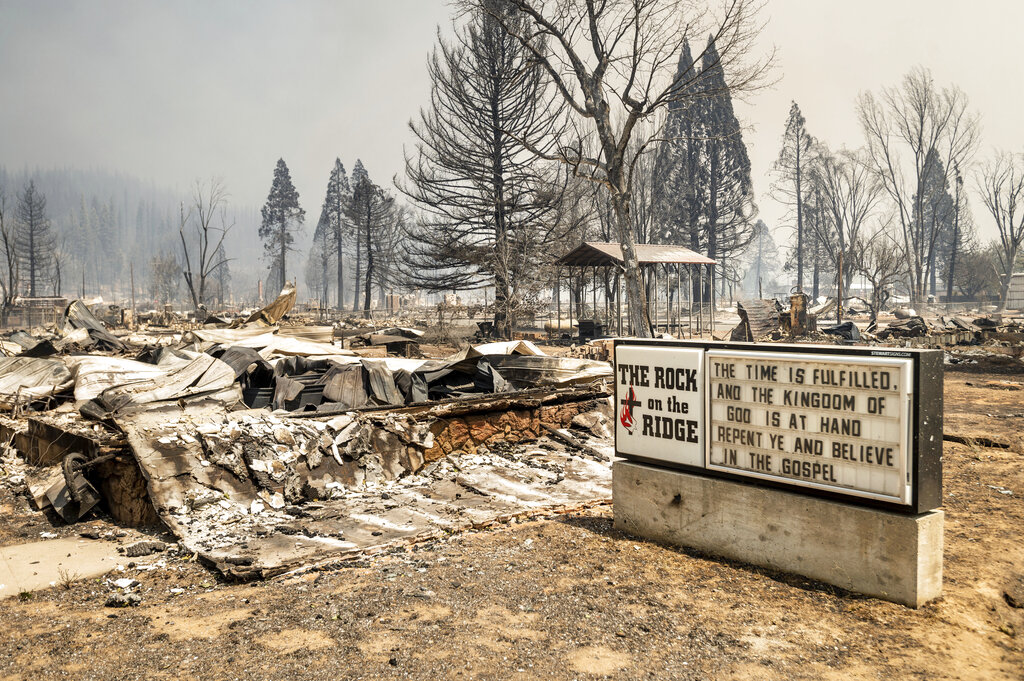


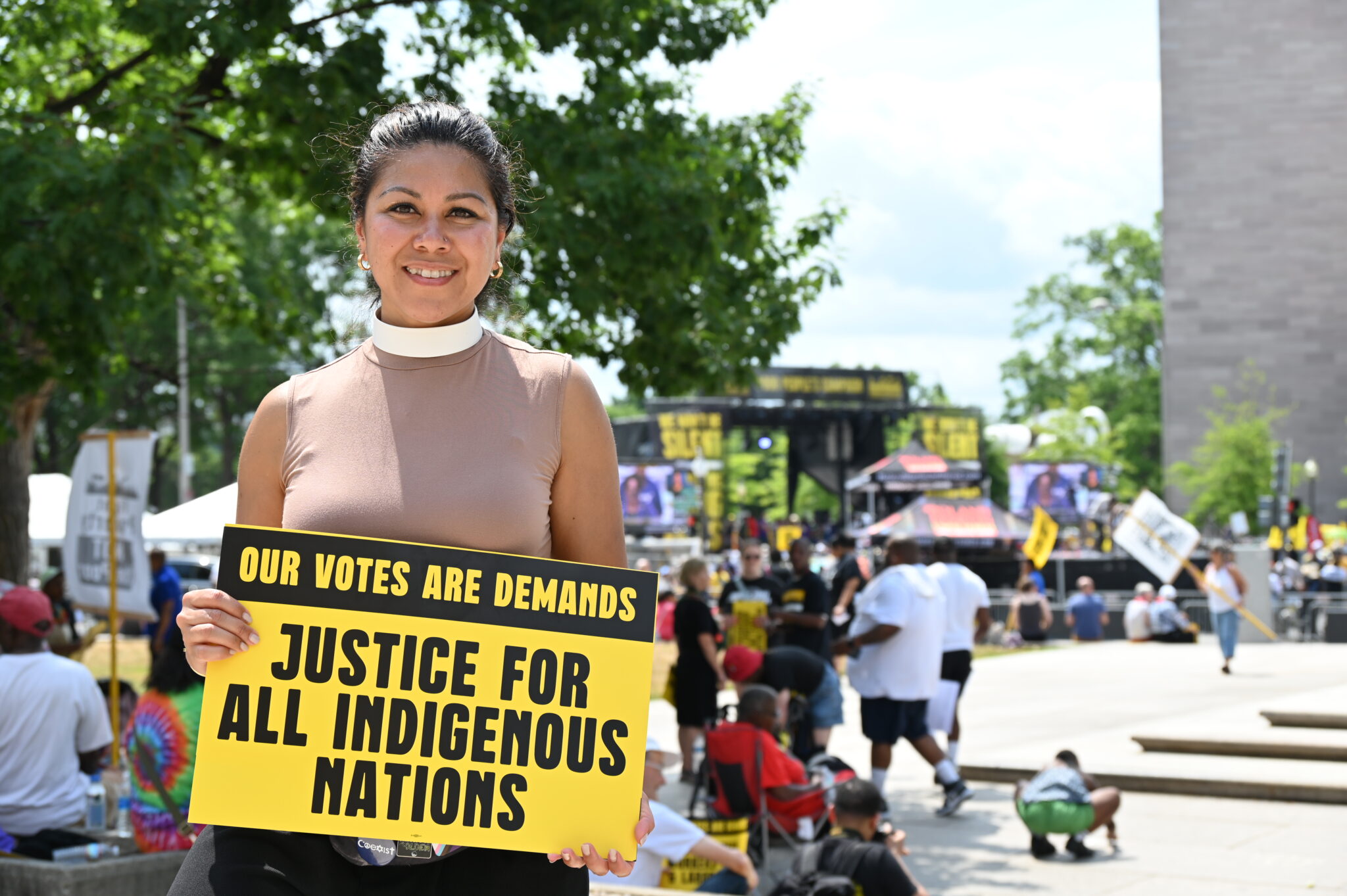
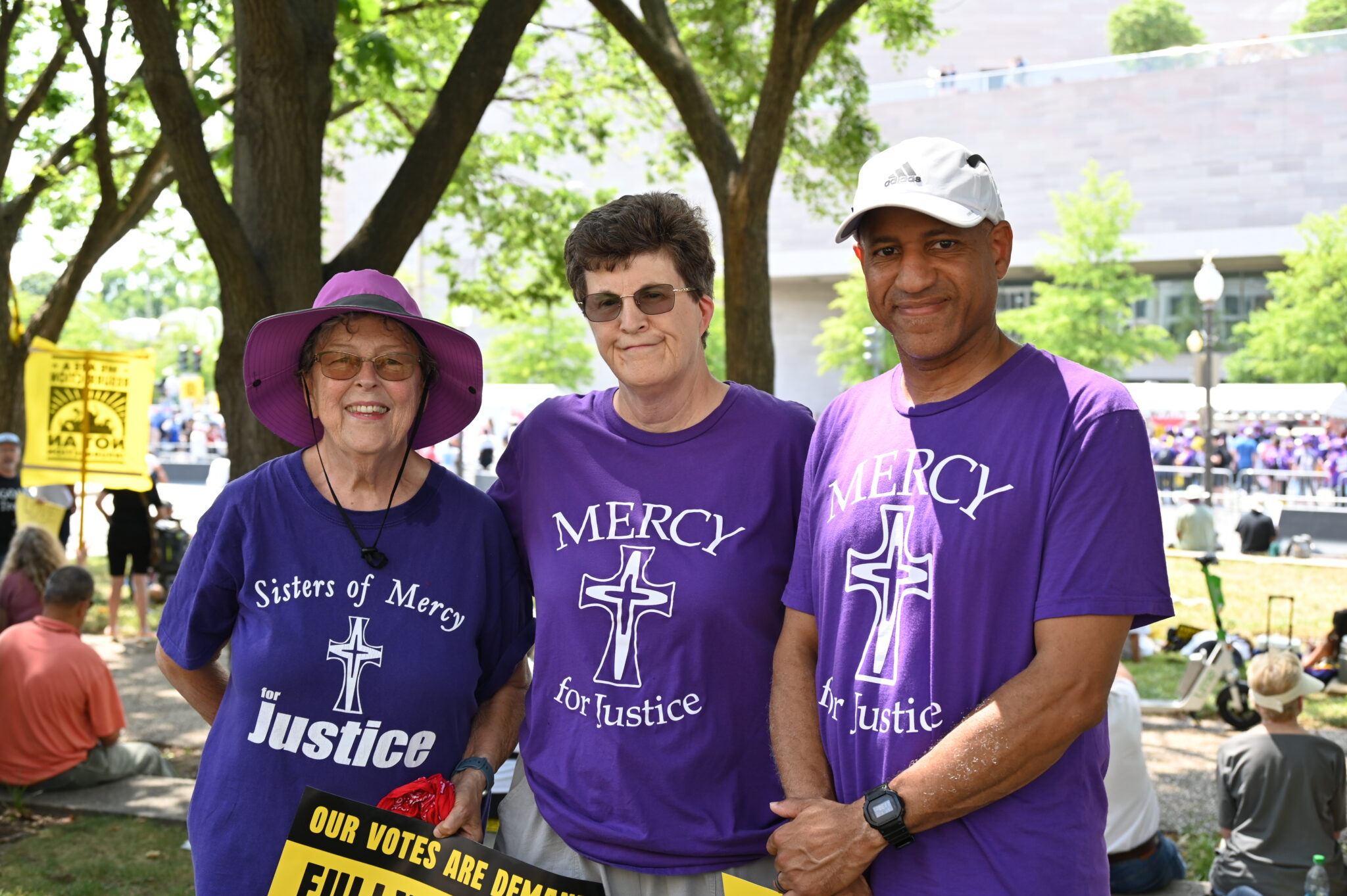
 “Voting is in our job description,” said Berthoud, who hopes to hand out more cookies this November.
 “It’s strange as an Arizonan, because we’re just not used to it,” said Caleb Campbell, a pastor at Desert Springs Bible Church and author of
  A former pastor turned political activist, Rebandt said many Michigan evangelicals didn’t vote in 2022, when a constitutional amendment protecting abortion rights was on the ballot.