Tony Evans’ next chapter, undisclosed ‘sin’ and new book

Dallas megachurch founder Tony Evans has lived a mostly private life for more than a year, after announcing an undisclosed “sin” caused him to step away from the prominent pulpit where he preached for almost five decades.

His church, Oak Cliff Bible Fellowship, announced Sunday, Oct. 5, that he completed a restoration process but is not returning to its leadership.

However, Evans, 76, is working on new public-facing projects, mostly through his ministry The Urban Alternative.

His latest book, Unleashed: Releasing God’s Glorious Kingdom in and Through You, is set to be released by Thomas Nelson Publishers on Oct. 28.

He’s also scheduling speaking engagements at churches and conferences after his first major address in more than a year at a conservative Christian summit in Des Moines, Iowa, in July.

The elder board of his predominantly Black nondenominational church also announced his son, Jonathan Evans, has been appointed an elder and is expected to be installed officially as lead pastor.

In an interview with Religion News Service days before his church’s “Restoration Sunday,” the elder Evans said he has faced challenges with people not accepting his marriage to his second wife, Carla Evans, after the death of Lois Evans, to whom he was married for 49 years.

He also said there have been other personal matters, which he chose not to discuss in the interview, that he has grappled with as his son is gaining more church responsibilities.

When he’s in town, Evans now sits at the front of the church with his family, and he said he’s supportive of Jonathan Evans’ leadership and impressed by his preaching.

In the interview, which has been edited for length and clarity, Evans talked about his new book, why he left his church’s leadership, the next phase of his life and his thoughts about eternity.

You have previously written books on your beliefs about what you call the “kingdom power” of God. How do you sum up those convictions, and how are you approaching that topic differently this time?

In the book Unleashed, I’m trying to focus on taking the concept of the kingdom and releasing it in and through your life.

Many Christians don’t have a kingdom worldview. They’ve accepted Christ. They’re on their way to heaven. But this rule of God on the way there for them on Earth is often missing. And so, we’re trying to go deeper in seeing it being practically activated in your life.

Your book discusses choices and standards you think Christians should embrace, and you seem to have made a choice for yourself about standards when you stepped down from pastoral leadership at Oak Cliff Bible Fellowship last year.

Can you share what the undisclosed sin was that prompted that decision, and if your healing and restoration process is continuing?

There was a decision made as I moved into a new relationship. My wife passed away in 2019, and I remarried (four) years later, and there was such consternation around that, and people who were not as excited about it (laughs). And we were already in transition with my son (in leading the church).

So, we just said this would be the best time to go ahead and make that transition, so that all the consternation around it wouldn’t interfere with that process. There was some underlying things, but that was the decision that was made as we moved forward.

And who made that decision—you or the church?

A combination. It was a shared one.

You used the word “sin” in your statement, and now you’re using the word “consternation.” Can you explain what you mean?

There just was some personal matters that we’re not free to go into, but some personal matters that precipitated that decision.

Anything more you can say? That’s a little unclear.

I know, but because the church wanted to just keep it within the bounds of the church, that’s why we’re honoring that.

Your son is now preaching regularly at Oak Cliff Bible Fellowship. How has that transition gone? Are you solely a member there, or are you involved in the church in other ways now?

I am the founding pastor, and my goal is to support him in every way. It has freed me up to do some of the national events that we are doing.

We’re doing a new podcast that we’re taping now. We also (are producing) an “Unbound” documentary series showing how the Bible moved throughout history. So, it’s created a freedom that I’ve never had before (laughs).

How soon do you think you’ll be back in the pulpit preaching?

We have some meetings coming up to discuss the plan for that, because we are trying to not let his movement into this new arena be overshadowed by my 48 years. So, it’s a timing thing, and we haven’t gotten specific yet, but we’re working toward that.

In your son’s sermon on Sept. 28, he said he initially complained to God about this season that Oak Cliff Bible Fellowship began when you stepped away, but said he realized he should be grateful for your decades-long ministry and God’s faithfulness in it. What has it been like watching his sermons and seeing him lead?

He’s blowing my mind, actually. He’s got this—it’s an old term—but this “New Jack City” thing (laughs), the media thing and this new generation thing, but he is solidly expositional in the word. So, I am loving the exposition. I’m loving the relevancy.

This younger generation of preachers, they tend to be much more casual, much more relaxed. This is a new world that I don’t fully get, but I can appreciate the fact that we want to reach it in a relevant way.

When you say “media,” what do you mean?

I’m certainly meaning his use of social media, but media in the service—video clips and staging and props and all that.

You note in your book that when people have mountains, so to speak, or difficulties, they tend to talk to other people about their problems rather than talking to God about them—or to the mountain. What’s an example of when you spoke to a mountain, maybe especially in the last year or so?

During this year, we have had to address some major issues with regard to our projects, our funding. We’re having to raise $9 million to do all that we’re doing around the world. And so, we had to speak to God about being our source, but we also had to speak to the source. We had one donor who unexpectedly gave us a million dollars.

Did the difficulty of fundraising have anything to do with the fact that you stepped away?

No, it has had to do with the need of the moment. It’s a couple of projects. One is “Unbound,” where we’re tracing from the medieval age through the Renaissance to the Reformation to the Enlightenment to the modern times how God has moved his word along.

When we take these trips to the different countries with these events, “Unbound” is showing how God used the social, political, economic and personality dynamics to move his word along.

When you spoke in July to the Family Leadership Summit in Iowa, you told them, “You’re not first Democrat, you’re not first Republican. You are first of all, a representative of another king and another kingdom, and everything else is second to that.”

In a time when politics are often dividing the church, are you concerned that evangelical Christians are often described as following their party more than their faith?

That’s a major concern, because what we’ve done is turned politics into an idol, and anything idolatrous is going to be rejected by God.

God is involved in politics all through Scripture, but he’s involved as God. He’s not riding the backs of donkeys or elephants. Neither can Christians be riding the backs of donkeys or elephants.

So absolutely, Christians should be engaged in politics. We should bring God’s point of view to politics, but we should never believe we’re going to be delivered or saved by politics.

Was there something you learned about yourself or that you’re taking forward now that this restoration process has concluded?

Through this year, there have been a number of losses of people; some of our leaders who have passed away. And a dear part of our ministry, one of our board members who I was very close to, passed away from cancer.

I think I’ve gone deeper in thinking about eternity. Always thought about it, but deeper in that vein. So, whatever life I have left, I want to maximize at the highest possible level for God’s kingdom and for eternity.
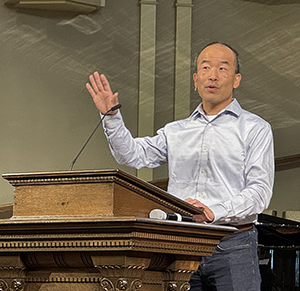


Christians called to missional—not comfortable—lives

Christ calls his followers to missional lives, not lives of comfort and ease, speakers emphasized at the “Beyond Us … From Neighborhoods to Nations” Missions Conference at First Baptist Church in Waco.

Waco-area churches sponsored the conference in collaboration with Baylor University’s Truett Theological Seminary and Baylor Spiritual Life.

“There’s no easy way to be about the Father’s business,” said Christine Caine, author, evangelist and founder of the A21 campaign to fight human trafficking.

“To me, there is nothing more important than taking the gospel of Jesus Christ into all the world.”

Too many Christians suffer from “passion deficit disorder,” she said, offering her prayer that God will ignite a passion within the church “for the thing that God’s heart beats for, which is a lost and a broken world.”

“Passion is the fuel that keeps us going,” she said.

Caine grew up in poverty as the adopted child of a Greek immigrant couple in Australia. As a survivor of long-term sexual abuse, she spoke about how God redeemed her when she came to faith in Christ.

“When I learned to make what Jesus did for me at Calvary bigger than what anyone had done to me who had abused me, it changed my whole life,” she said. “Why would I not want a lost and broken world to know that?”

‘Willing to be interrupted and inconvenienced’

In 2008, she and her husband Nick founded A21 with a goal of abolishing modern-day slavery—human trafficking—in the 21st century. The organization works in 19 locations in 14 countries, seeking to reach, rescue, recover and restore trafficking victims.

Like the priest and the Levite in the parable of the Good Samaritan, many Christians too often pass by the wounded because they are busy and preoccupied, Caine said.

Instead, followers of Jesus are to be like the Samaritan who was “willing to be interrupted and inconvenienced” to care for someone who was broken and hurting, she said.

“The church is not about the Father’s business because we are not willing to be interrupted or inconvenienced,” she said.

When God’s people move beyond “little Christian ‘bless me’ clubs” and commit to be his witnesses to a lost and broken world, God will “do something unlike anything we’ve ever seen,” Caine said.

Reawakened love for the lost

“We need a reawakening in the church of what our mission is—a love for the lost,” she said.

While Jesus told his followers to be “in the world but not of it,” too many Christians today are “of the world but not in it,” Caine said.

Jesus called on his disciples to be salt and light—catalytic agents that bring about change, she emphasized.

“You can’t change a world you’re not in, and you can’t reach lost people who you don’t have close proximity to. And if you’re of it—the same substance as it—you won’t bring about change,” she said.

Christians need God to help them see the world as he sees it, Caine asserted.

“It’s so easy to ignore suffering when it is nameless and faceless and it’s just a statistic. God doesn’t make numbers. He makes people. … God sees people as people,” she said.

“We talk about the poor, the lost, the marginalized and the disenfranchised as if they are just statistics. They are people created in the image of God, and they are the ones to whom we’re sent to be salt and light.”

‘God doesn’t give comfortable callings’

Tom Lin, president and CEO of InterVarsity Christian Fellowship, described how responding to God’s call meant abandoning the dreams his parents had for him.

“God doesn’t give comfortable callings,” Lin said.

As the child of immigrants, Lin said he was raised to pursue the American dream of comfort and security.

After Lin earned his undergraduate degree in economics from Harvard University, his parents were devastated when he told them he was following God’s call to pioneer missions in Mongolia.

“My parents came from poverty in Asia so I wouldn’t have to live in poverty in Asia,” he said.

From Genesis to Revelation, God’s plan has been for his people to “put feet to their faith” and be a blessing to all nations, Lin asserted.

“Each of us has a purpose, and it is to be bless the nations. This is not an optional activity,” he said. “I often tell college students, ‘This is not like extra credit.’”

In a time of unprecedented need in the world, Christians have unprecedented opportunities to bless the nations, but obedience to God’s call demands defying the dominant culture, Lin insisted.

“Culture teaches us to do everything we can to bless ourselves—to bless our own Christian bubble, our own Christian churches, and to avoid suffering,” he said.

“God’s purpose for his people is to bless the nations, and it often requires leaving comfort, he said. But when God’s people obey his call, he added, “We see God’s faithfulness.”

Christ gave the Great Commission to the whole church

Obedience to God’s call means recognizing Jesus gave his Great Commission—making disciples of all nations—to the whole church, not the select few, said Bob Roberts, founder of GlocalNet and co-founder of the Multi-Faith Neighbors Network.

While God calls some Christians to vocational service as cross-cultural missionaries, God also calls every follower of Jesus to use his or her skills, talents, gifts and areas of expertise for kingdom purposes, Roberts said.
Christians earn the right to spread the gospel by going through “the front door,” as welcomed guests in other countries who contribute to society rather than operating secretively or deceptively, he said.

Countries that may be closed to traditional missionaries eagerly welcome Christians who are “bringing value” to their people through their vocations and contributing to “human flourishing,” he said.

Christians with experience in education, health care, business and agriculture can use those abilities to advance the kingdom of God and bring wholeness as God desires, Roberts said.

“You don’t have to take the culture over. You just have to be salt and light in the culture,” he said. “I don’t want Christian nationalism. I want Holy Spirit presence.”

For example, when Roberts was pastor of Northwood Church in Keller, the congregation established a relationship with Hanoi about 30 years ago.

That ongoing relationship led to the opportunity for educators in the church to develop a special-education curriculum for the entire nation of Vietnam.

“We tend to do missions to people. We need to do missions with people,” Roberts said.

‘God always pushes us beyond our boundaries’

Love for God, love for others and Christ’s command to make disciples motivates Christians to move outside the narrow confines of what is comfortable and familiar, said Julio Guarneri, executive director of the Baptist General Convention of Texas.

“God always pushes us beyond our own boundaries. If you have been transformed by the gospel, you cannot stay in the same place. … He always invites us to go beyond ourselves,” Guarneri said.

Christians find their motivation for missional living in the cross of Christ, he said.

“We are not motivated by need or by guilt,” Guarneri said. “We are motivated by the love we see at the cross.”

The call of God compels his people to go beyond their preconceived ideas and gain a new perspective, he said. Even after Christ’s resurrection, his disciples still did not understand what Jesus had been teaching about the kingdom of God. Before his ascension, they asked Christ when he would “restore the kingdom to Israel.”

“They thought the kingdom was about making Israel great again. It’s not about national greatness but about a global witness,” Guarneri said.

Christ called the provincial disciples is to become “cross-cultural ambassadors of God’s love,” he said.

God calls his people to the ministry of reconciliation, Guarneri said. Sin alienates people from God and each other, but God’s grace reconciles.

“We have been deputized as agents of reconciliation,” Guarneri said.


Nigerian official disputes reports of anti-Christian violence

A high-ranking Nigerian official dismissed reports by international human rights organizations about widespread violence against Christians in his country as “not supported by the facts on the ground,” but some Nigerian Christian leaders disagreed.

Past and present members of the U.S. Commission on International Religious Freedom—along with multiple human rights groups—have called Nigeria “the most dangerous country in the world for Christians.”

However, in an Oct. 6 interview with the Baptist Standard via Zoom, Mohammed Idris Malagi, minister of information and national orientation for Nigeria, insisted Christians are not targeted in his country—except by “violent extremists,” whom the government opposes.

 “It is sad that this has been characterized as a religious conflict. We don’t believe that it is. It never has been a religious conflict. It actually is an extremist conflict,” he said.

Disputes accuracy of reported numbers

Malagi dismissed as inaccurate a report by the International Society for Civil Liberties and Rule of Law that in the first seven months of this year 7,087 Christians were killed in Nigeria and 7,800 Christians were abducted.

Based on the information it accumulated from varied sources, the group reported 30 Christians a day killed and 35 a day kidnapped during a 220-day period.

“The statistics you have reeled out are not supported by facts on the ground,” Malagi said. “Yes, we have to understand there actually is violence in Nigeria perpetrated by some extremists, targeted at both Muslims and Christians in our country. Nigeria strongly condemns that and fights that with all its available resources.”

Malagi denied that more than 18,000 churches have been burned in Nigeria since 2009, as multiple sources reported.

‘Making sure attacks like this don’t happen again’

Likewise, he dismissed as incorrect a report by Amnesty International that—in the two years since Nigeria’s president assumed his office—10,217 individuals have been killed in Benue, Edo, Katsina, Kebbi, Plateau, Sokoto and Zamfara States, with more than half of those killings (6,896) occurring in Benue State.

“We have seen some of these numbers flying around here and there, including the ones from Amnesty International, but let me say we still dispute these numbers,” he said.

When asked if the government had a report of its own, documenting when and where violence is occurring and to what extent it is happening, he said it’s a complicated situation, and reporting is “a work in progress.”

“What’s more important to us is making sure that attacks like this do not happen again,” he said. “We’re calling on our international partners to join hands with us to ensure that Nigeria returns to normalcy.”

‘Numbers may differ, but the pain is real’

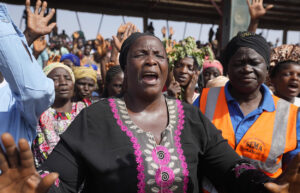
Victims of a gunmen attack pray for peace at the internal displaced camp in Bokkos, north central Nigeria, Wednesday, Dec. 27, 2023.(AP Photo/Sunday Alamba)

Joseph John Hayab, chairman of the Christian Association of Nigeria in the northern states and Federal Capitol Territory, said any discussion of religious persecution in Nigeria “must be approached with honesty, empathy and a commitment to truth.”

“While there may be variations in the statistics presented by different organizations, the reality remains that many Christians in parts of the country continue to face harassment, denial of opportunities, and targeted attacks because of their faith. These experiences cannot be ignored, even as we continue to hope and work for a more just and peaceful nation,” Hayab said.

The government should acknowledge the reality of suffering, he emphasized.

“The numbers may differ, but the pain is real. What matters most is not the figures, but the human lives lost, the families displaced, and the communities living in fear,” said Hayab, country director for the Global Peace Foundation-Nigeria.

“These are human and moral realities that deserve the government’s honest attention and collective national empathy.”

‘Act decisively to protect every citizen’

Archbishop Daniel Okoh, president of the Christian Association of Nigeria, issued a public statement Oct. 8 affirming many Christian communities in parts of Nigeria “have suffered severe attacks, loss of life, and the destruction of places of worship.”

“These realities are painful reminders of the urgent need for government and security agencies to act decisively to protect every citizen,” Okoh stated.

The Christian Association has “established mechanisms for recording incidents of religiously motivated killings, engaged with international partners, written to the International Criminal Court in the Hague, and hosted global Christian organizations” to raise awareness, he noted.

“Our concern remains that these cries for justice and protection are too often met with delay or denial,” Okoh stated.

Middle Belt an ‘epicenter of attacks’

Gideon Para-Mallam, a pastor and peace advocate, asserted, “Nigeria practices the undeclared policy of denial when it comes to the persecution of Christians in the country.”

“The Middle Belt has become the epicenter of attacks that disproportionately target only Christian farming communities,” Para-Mallam said.

“Attackers often come in droves with military-grade weapons to raid these villages at night destroying homes and churches. Many pastors are targeted and killed. Farmlands are destroyed, and survivors are forced to flee.”

Malagi insisted the violence in the Middle Belt is “largely due to competition for resources, for land, especially between farmers and herders.”

“Criminal elements” and “violent extremists” are mostly responsible, he said, and it is “not a religious conflict per se.”

Para-Mallam offered a different perspective, asking, “If it were a farmer-herder class, why is it that only the farmers who are often of a particular religion—Christianity—get killed in such high numbers?”

‘Nigeria will continue to fight extremists’

The government in Nigeria is committed to ridding the country of extremist violence, Malagi said.

“Nigeria will continue to fight extremists that perpetrate violence toward both Christians and Muslims,” he said.

“We agree completely that Muslims and Christians and people of all faiths in this country have been attacked, and many of them have been killed. The Nigerian authorities are not taking this kindly. … A number of measures have been taken.”

Nigeria is making progress in stopping violence perpetrated by Boko Haram, the Islamic State-West Africa Province and other radical jihadists, he said.

Nigeria’s federal government has taken significant steps to protect citizens by enhancing the military presence in the Middle Belt, Malagi said.

The government also is engaged in peacemaking and long-term reconciliation initiatives in the region, as well as promoting interfaith dialogue, he added.

‘More needs to be done’

Hayab commended the federal government for progress made in the past two years, but he called on the government to do more.

“It is important to acknowledge that the current administration has shown some improvement compared to the previous government, particularly in its efforts to engage faith communities and promote national unity. This progress is commendable,” he said.

“However, more needs to be done to guarantee genuine freedom of religion as enshrined in the Nigerian Constitution. True democracy can only flourish when every citizen, regardless of faith, can serve God freely without fear, intimidation or discrimination.”

When questioned about the sophisticated, military-grade weaponry used by militant herdsmen in the Middle Belt, Malagi said the government believes they are coming “from outside our borders.” Stopping the flow of arms will require “the cooperation of our neighbors and the international community,” he said.

“We are taking steps to ensure that we mitigate that significantly so that we can provide security for the lives and property of our people,” Malagi said.

State governments and the federal government are working collaboratively in law enforcement to rid the country of criminal elements and extremists, he said.

Okoh acknowledged with appreciation the government’s efforts to respond to Nigeria’s security challenges, but he urged the authorities to “redouble” efforts to provide “equitable protection for all.”

Secular state or Sharia law?

Malagi called Nigeria a “very secular state” and “a country governed by laws,” where the religious freedom of all its people is guaranteed in the constitution.

“Every member of our society is free to practice his or her religion,” he said.

When asked whether the enforcement of blasphemy laws and Sharia law in 12 northern Nigerian states violate the country’s constitution and Article 18 of the Universal Declaration of Human Rights, he insisted Sharia applies only to the Muslim population—not others.

The “Nigerian Constitution is supreme,” and it supersedes any regional laws, he said.

Hayab disagreed, saying, “The continued misuse of Sharia and blasphemy laws in some northern states remains a serious concern.”

“In the Christian faith, salvation is instantaneous. Therefore, anyone who embraces Christianity should not be subjected to Sharia law,” he said.

“Sadly, there are still cases where Christian converts are held to ransom under such laws, denying them freedom of faith. This practice amounts to persecution and violates both the spirit and the letter of Nigeria’s constitutional guarantees.”

In states with Sharia law, churches find it “almost impossible” to acquire land, and renting buildings for Christian worship is “a major challenge,” Para-Mallam said.

‘Tools of religious and political intimidation’

More severe persecution of Christians arises from the imposition of blasphemy laws, he added.

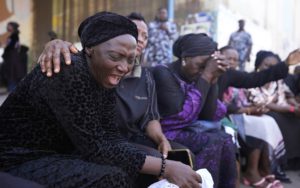
Women react under the bridge during a march in solidarity with the victims of the Christmas Eve 2023 attack, in Jos, Nigeria, Saturday, Jan. 6, 2024. (AP File Photo/Sunday Alamba)

“Blasphemy laws have become tools of religious and political intimidation and extreme persecution, as anyone accused of blasphemy may end up being lynched without fair hearing and trial,” Para-Mallam said, noting perpetrators of mob violence seldom are prosecuted.

“On paper, Sharia law is supposed to be for Muslims alone. But it’s not practicably so. We have it on record many Christians have been dragged to Sharia courts and have Sharia laws applied to them.”

In spite of the well-documented attacks on Christians on Christmas Eve in 2020, 2022 and 2023, Malagi rejected the idea that Christians are targeted, except by some extremists who also have attacked Muslim gatherings and mosques.

“Generally, Christians are not living in fear in Nigeria,” he said.

Christian casualties outnumber attacks on Muslims

Hayab agreed both terrorists and bandits have killed some Muslims and attacked worshippers in mosques, but Christian casualties remain far greater.

“While it is true that some Muslims who reject extremist ideologies have also suffered attacks, it must be acknowledged that the Christian community bears a heavier share of these incidents,” he said.

“As a nation, we must rise above these divisions and work together to promote understanding, justice, and mutual respect.”

Malagi acknowledged the criminal element and that extremists “want to exploit religious differences,” but “Muslims and Christians largely live side-by-side in harmony” in Nigeria.

“We want Christians in the United States—and, indeed, Christians all over the world—to know that Nigeria’s situation is a very complex one,” he said. “It is not driven by any systematic religious persecution of Christians.”

‘Nigeria belongs to us all’

Hayab urged the government to do more to protect all its citizens from persecution and to ensure religious freedom.

“I have called on the federal government several times to continue strengthening its security and reconciliation initiatives and to ensure that no Nigerian is denied freedom of worship or equal opportunity on the basis of religion, and we will continue to do so,” Hayab said.

“Nigeria belongs to us all, and we must join hands to build a nation where peace, truth and fairness define our coexistence, and where every citizen can freely serve God without restriction.”

Okoh offered a similar call and voiced a similar hope.

“Nigeria’s healing will not come from denial or blame, but from courage: the courage to face our collective failures, to grieve together, and to rebuild trust within our communities,” he stated.

“Only then can our nation rise from its wounds and embrace a future of genuine peace.”


On the Move: Price

Dylan Price has resigned as pastor of Independence Baptist Church in Independence, where he served four years. He also managed the Texas Baptist History Museum in Independence.


Faith-based protesters say ICE threatens religious freedom

CHICAGO (RNS)—Pastor David Black stood in front of a Chicago-area U.S. Immigration and Customs Enforcement facility and spread his arms wide. Adorned in all black and wearing a clerical collar, he looked up at a group of masked, heavily armed ICE agents on the roof and began to pray.

“I invited them to repentance,” said Black, pastor of the First Presbyterian Church of Chicago. “I basically offered an altar call. I invited them to come and receive that salvation, and be part of the kingdom that is coming.”

But when Black began to lower his arms a few seconds later, the agents responded to his spiritual plea by firing pepper balls, or chemical agents that cause eye irritation and respiratory distress, video footage shows.

One struck Black in the head, exploding into a puff of white pepper smoke and forcing him to his knees. Fellow demonstrators rushed to his aid, and as the pastor rubbed his face in pain, the agents continued to fire.

“We could hear them laughing,” Black said.

Demonstrators confront ICE; agents respond with force

It was one of several dramatic and violent scenes that unfolded in recent weeks near an ICE detention facility in Broadview, Ill.

About 12 miles from downtown Chicago, the suburban site has seen scores of demonstrators repeatedly confront ICE agents—sometimes jeering at agents or using acts of civil disobedience to block the entrance to the facility as part of a groundswell of protests against President Donald Trump’s ongoing immigration crackdown in the city.

The agents, mostly masked, have often responded with force, arresting demonstrators, tossing gas canisters, firing nonlethal rounds at activists and journalists and sometimes throwing protesters—including at least one local Democratic congressional candidate—to the ground.

Despite the potential danger, religious leaders and faith activists have been a visible presence at the protests, some waving signs with slogans such as “Love thy neighbor” and “Who would Jesus deport?”

Many argue they are compelled by their religious beliefs to advocate for immigrants, but as officers continue to respond with violence, some claim their religious freedom is increasingly at risk—even, they say, as they pray for the souls of ICE agents.

“One of the chants that has become ubiquitous at these protests at Broadview is, ‘Love your neighbor, love your God, save your soul and quit your job,’” Black said. “Everybody chants that.”

Praying for immigrants

Hannah Kardon, a United Methodist pastor who leads United Church of Rogers Park in Chicago, has also protested at the Broadview facility on several occasions.

She, like Black, said she has been shot multiple times with pepper bullets, including while she was praying with her eyes closed and hands lifted, wearing a clerical collar and stole. She said she often prays for the ICE agents, but especially for the immigrants detained inside.

“I am praying for all of the people inside to be returned to their communities,” she said. “These are our friends, our family, our cousins, our uncles. These are our community members, and they are being stolen.”

At least once, Kardon said, agents fired a pepper ball at her without warning, leaving her with a bruise on her abdomen that has lasted for weeks.

“Every time we have been attacked with pepper bullets or tear gas or pepper spray that I have been present, it has felt like it came from anger that we were there, and not from any determined safety need or protocol,” she said. “They are unhinged.”

Faith-based pushback to deportation

The pastors’ efforts are part of rising faith-based pushback to the Trump administration as the president seeks to implement plans for mass deportation of immigrants. Prominent religious leaders—including two popes—have criticized Trump’s policies.

Clergy were a fixture at protests in Los Angeles and Washington, D.C., after the president flooded the cities with federal agents and tasked National Guard troops with deporting immigrants and combating what he claimed was rising crime, a point of heated dispute.

Churches with immigrant-heavy populations have seen attendance drop, and others have had direct encounters with ICE. Federal agents have conducted immigration enforcement near or on the grounds of U.S. churches at least 10 times this year, prompting one California pastor to confront apparent federal agents as they apprehended people in her church parking lot in June.

Clergy sign on to lawsuit

Dozens of faith groups and denominations have also filed lawsuits challenging Trump’s various immigration policies, and the treatment of religious demonstrators at the Chicago facility has become a legal flashpoint.

Black is listed as a plaintiff in a lawsuit filed this week against Department of Homeland Security Secretary Kristi Noem alleging violations of the First and Fourth Amendments. Although most of the plaintiffs are journalists, Black is named as one of multiple clergy and faith-based demonstrators who, lawyers argue, have fallen victim to violence that violates the Religious Freedom Restoration Act.

The lawsuit accuses ICE agents at the facility of enacting a “policy, pattern, and practice” of “targeting Rev. Black and other similarly situated Religious Exercise subclass members with violence.” The result, the complaint alleges, “substantially burdens their exercise of religion.”

Speaking to RNS the same day the lawsuit was filed, Black said his “freedom to minister Christianity and to proclaim the good news in the United States of America is very much being infringed and threatened.”

He also said he still suffers from respiratory issues weeks after agents shot him with pepper balls, an act he framed as “retaliation of my federal government (against) my acts of ministry.”

“I absolutely feel that my First Amendment rights have been infringed, and anticipate that there is a plan to do so more,” he said.

‘It’s fundamentally wrong’

Kardon agreed, saying she believes her religious freedom is one of several rights that have been infringed upon by agents at Broadview.

Even so, Kardon said she is determined to continue protesting and plans to participate in an ecumenical Communion service outside the facility. Her desire to advocate for immigrants, she said, is rooted in “stuff that God put in every single one of us.”

“We’re a faith of immigrants. Jesus was an immigrant,” she said. “But to me, this is basic created-being stuff. When you see what is happening here, your whole body and heart resists it, because it’s fundamentally wrong.”

DHS did not respond to questions about the new lawsuit, nor did officials directly respond to questions about the incident in which Black was shot with pepper balls.

DHS official say ‘rioters endanger’ others

However, DHS Assistant Secretary Tricia McLaughlin sent a statement calling the protesters “rioters” and accusing them of assaulting law enforcement by throwing “tear gas cans, rocks, bottles, and fireworks” at officers.

She added, “these rioters endanger the safety of our brave law enforcement officers and the illegal aliens inside the facility.”

Black and Kardon reacted with frustration to the agency’s claims and characterizations, dismissing the idea that protesters like themselves could be considered dangerous.

“I’m a mom of two who bakes stuff and wears rainbow glasses,” Kardon said. “No one in their life has ever been scared of me.”

But DHS continued its negative characterization of protesters on Oct. 3, when Noem visited the Broadview facility.

In a speech to agents recorded by activist Benny Johnson, the secretary argued the protesters outside the facility were “advocating for violence against the American people” and were “victimizing people every day by the way that they’re talking, speaking, who they’re affiliated with, (and) who they’re funded (by).”

In his post containing the video, which was retweeted by the official DHS X account, Johnson said that “left-wing extremists” had surrounded the ICE facility but that “federal agents crushed the threat immediately.”

Religious activists rejected the claims and dismissed the idea that they are funded by anyone.

“The idea that we have funders is ludicrous,” Black said in a text message.

Homeland Security launches faith-based campaign

DHS has invoked faith to promote its actions. The agency has produced promotional videos that overlay Scripture on top of images of ICE agents conducting raids.

In a new video with religious themes, as the song “Revival” by recording artist Zach Bryan plays, footage rolls of a recent ICE raid on a Chicago apartment building. The video then shifts to images of federal agents and local police pushing back protesters in front of the Broadview facility.

Underneath the video, which ends with protesters—not people detained in an immigration enforcement raid—sitting with their hands bound, DHS responded with another post: a link to sign up to join ICE.

Quincy Worthington, another Presbyterian minister in the northern Chicago suburbs who has participated in the Broadview protests, called the DHS videos “horribly misguided.”

“It’s an affront to the gospel, plain and simple,” Worthington said.

Worthington said he, too, has endured pepper bullets and tear gas while protesting at the facility.

At the protests, he tends to spend his time in the crowd offering care to fellow participants. Sometimes that care is physical, such as helping people wash tear gas from their eyes. Other times he offers spiritual care, such as when a woman at the protest suddenly embraced him before bursting into tears.

“She was just so relieved that a member of the clergy was there, because it showed her that God hadn’t abandoned them,” Worthington said. “If just my presence can be the presence of Christ to someone, who am I to say ‘no’ to that?”


Franklin Graham quits financial accountability group

(RNS)—Franklin Graham, the president and CEO of two of the largest Christian ministries in the country, has quit his organizations’ membership in a financial accountability group that sets standards for evangelical nonprofits.

Graham, who leads Samaritan’s Purse and the Billy Graham Evangelistic Association, withdrew from the Evangelical Council for Financial Accountability over new standards the group had set for “leader care.”

The ECFA, which requires member nonprofits to have audited financial statements and to make those public, among other things, recently announced it was adding leadership integrity requirements to prevent the kind of abuse and scandals that have rocked so many Christian leadership ranks.

Just in the past year, Texas megachurch founder Robert Morris pleaded guilty to child abuse, Dallas megachurch pastor Tony Evans stepped back from leading his church due to undisclosed “sin,” and the Church of England’s Archbishop of Canterbury Justin Welby resigned over allegations that he failed to immediately report child abuse.

The new standard requires all ECFA member organizations to develop a care plan for their senior leader, one that would include regular communication with a board-led spiritual team and dedicated time for rest, retreats and physicals.

Outside ECFA’s area of expertise

In a letter to the ECFA’s president this past summer, Graham stated the new leader standards “puts ECFA into the role of trying to be the moral police of the evangelical world.”

“The Leader Care standard,” Graham wrote, “deals with personal spiritual maturity and behavior matters clearly outside the scope of ECFA’s expertise. While ECFA has proven to have expertise in matters of financial practices of nonprofit organizations, it does not offer its members expertise in developing ‘care plans’ for leaders.”

The withdrawal of Samaritan’s Purse and the Billy Graham Evangelistic Association represents the end of an era for the Graham family. Franklin Graham’s father, the late evangelist Billy Graham, was instrumental in founding the ECFA alongside the U.S. branch of World Vision, back in 1979.

The ECFA provides accreditation, or a seal of approval, to those organizations that adhere to its Seven Standards of Responsible Stewardship.

Those standards—maintaining a board with a majority of independent members, not compensating fundraisers on a percentage of money raised—are sought after by many of the leading Christian nonprofits—2,700 in total.

Members include the Salvation Army, the American Association of Christian Schools, Cru, Young Life and a host of large megachurches.

Standards endorsed by NEA and Christian colleges

The new “leader care” standards were endorsed by the presidents of the National Association of Evangelicals and the Council for Christian Colleges and Universities in addition to a raft of other nonprofit organizations and churches.

They will become a requirement for accreditation beginning Jan. 1, 2027.

“While we are disappointed that the leaders of BGEA and Samaritan’s Purse have decided to withdraw from ECFA, we honor their legacy,” ECFA President and CEO Michael Martin said in a statement. “We wish them well as they continue to pursue their missions.”

Neither Martin nor Graham was available for interviews.

Samaritan’s Purse, the humanitarian disaster relief organization based in Boone, N.C., posted net assets of $1.4 billion in a publicly available audit last year.

The BGEA no longer files an IRS Form 990, a public statement of its financial information, since it changed its tax status from a nonprofit to an “association of churches” in 2016. According to the MinistryWatch database, the BGEA, based in Charlotte, N.C., had annual revenue exceeding $224 million.

Mark DeMoss, a former PR executive, now retired, who represented Franklin Graham in the past, wrote an independent analysis of the new standards for the president of the ECFA last year, concluding the leader care standard will not achieve its desired result.

DeMoss said he “wholeheartedly” agreed a leader’s integrity is vital to an organization’s trustworthiness. But he cautioned the compliance standard was perfunctory and would not prevent moral failings among ministry leaders.

“The introduction of this Standard will set an expectation that can never be met,” DeMoss wrote. “No standard, particularly one as decidedly vague as this one, can prevent bad behavior.”

Theologian Scot McKnight, who has written about leadership, said he favored leadership standards in theory but said a care team should consist of trained spiritual directors.

“Evaluation of a living, spiritual dynamic needs to be done by a trained spiritual director, not board members who are often chosen by the senior leader and are often mesmerized by the senior leader,” McKnight wrote in an email.

Jake Lapp, vice president of member accountability, said in an email the ECFA’s 2025 membership retention rate is 97 percent, and 140 nonprofits and churches have submitted new applications for ECFA membership so far this year.


Around the State: Celebrating a 100-year-old sanctuary

First Baptist Church of San Antonio’s Sanctuary Centennial celebration will be Sunday, Oct. 26. Events will include special worship services, historical displays, music and community fellowship marking 100 years of worship in one of San Antonio’s enduring symbols of faith and community. Completed in 1925 at a cost of $267,000, First Baptist San Antonio’s sanctuary was hailed by the San Antonio Express at its dedication as “one of the finest in Texas.” Billy Graham preached there in 1946, and President Harry Truman visited in 1948.

Students at Houston Christian University participated in the university’s Fall Ignite Spiritual Renewal Week with the theme “Fully Satisfied.” The campus community heard messages from pastor Jarrett Stephens and other leaders from Champion Forest Baptist Church college and young adult ministry. More than 70 students reported first-time decisions to follow Christ, several dozen others requested to meet with someone to talk about their spiritual questions.

The Wayland Baptist University Don A. Williams School of Education is opening new doors for individuals who want to enter the teaching profession through innovative fast-track pathways. The Alternative Certification Teacher Program provides a one-year route to teacher certification. Candidates complete 50 hours of classroom observation, online coursework and supervised teaching experiences while working under an intern certificate. The program is structured in modules and can be completed entirely online, making it accessible across the state. Interested candidates can learn more about Wayland’s teacher pathways by visiting wbu.edu or contacting the School of Education directly.

The University of Mary Hardin-Baylor College of Visual and Performing Arts welcomes guest artist Minji Kang-Watrous, whose art is now on display in the gallery, for an artist talk on Thursday, Oct. 9, at 11 a.m. in the Baugh Center for the Visual Arts. She is a self-taught hanji artist who has developed her own unique style, and her art is a modern interpretation of traditional Korean art passed down from her mother. The simplicity of her compositions and the integration of textures create exclusive and compelling art. The artist talk is free, but seating is limited and tickets are required. Call 254-295-4294 to reserve your spot.

Howard Payne University Student Speaker Bureau speech and debate team competed in their season opener at the Mendoza Debates, held at Lee College in Baytown, finishing with significant honors. Earning significant honors for the team were Solomon Sabo, Rylie Burden, Katelyn Sims and Chloe Jones.


Conclave attendees urged ‘never get over the gospel’

ARLINGTON—More than 640 leaders and volunteers for children, teen and young adult ministry gathered Oct. 6 and 7 at First Baptist Church in Arlington to worship and learn how to reach current and future generations for Christ and the church.

Shane Pruitt, national next gen director for the North American Mission Board, spoke during the first general session on lessons he learned in his 20 years of ministry.

Always focus on the depth of ministry, never stop being a servant, get good friends, know fruit always surprises, learn to say “no” and let the thorns lead to the throne, Pruitt urged.

“Never get over the power of the gospel in your life … If God can save you, God can save anyone,” Pruitt said. “Because Jesus lives … that’s why we get to do what we do.”

Pruitt addressed the importance of maintaining character and integrity in ministry and building relationships with family and friends.

The solution is the discipline of prayer and staying close to Jesus, he said.

“Focus on the depth of your ministry and let the Lord focus on the width and platform of it—

spiritual discipline, praying and staying at the feet of Jesus,” Pruitt said.

Pruitt added ministry is about serving, and comparisons can be a snare for anyone in ministry.

“Ministry is not a calling to stardom. It is a calling to servanthood. God’s love for you is not dependent on your size of ministry,” Pruitt said.

Bobby Contreras, pastor of Alamo Heights Baptist Church, preached from Proverbs 6:6-8 during a general session, emphasizing the need to reflect Jesus to point others to him.

“Do we truly live in his goodness when storms come? At times, I don’t because his goodness seems so far away in times I deem as bad, broken or hurting. So, will we store up? It is time to store up. It does us no good to store up if we don’t share it,” Contreras said.

NextGen conversations and AI

The trend of young adult Gen Z and Millennials attending church is going up, David Kinnaman, CEO of Barna Group, said during a general session.

Barna group confirmed “the average was close to one weekend per month. Those rates are up nearly one extra weekend a month, nearly double the rates of just five years ago.”

“This generation is open to Jesus,” Kinnaman said, adding Gen Alpha will be the generation known by the rise of AI.

“This generation, our generation, is going to be taking these deep questions to a new place, a new kind of median response to all humans,” he continued.

“And remember that the way these large language models are built, they are not built on any kind of Christian context. They are doing their very best to take the averages of all these complex pieces of information and spit out something that a human being can read and understand.”

Practical use of AI—such as ChatGPT—for everyday ministry work consists of cross-referencing of biblical texts, biblical language assistance and summarization of books and research material, Katie Frugé, director for Texas Baptists’ Center of Cultural Engagement, said during a pastors track on artificial intelligence and ethical challenges.

Regarding ethical considerations, Fruge said AI is not neutral and can be manipulated.

“Just utilize the current ‘gold standard’ programs that integrate AI into the system. Think machine learning, not content generation,” Frugé said, adding AI should be utilized as a resource to support, not replace, what pastors already are doing.

“More Gen Z and Millennials say and feel more like themselves online than offline,” Trent Brent of Next Gen Catalyst said during a breakout session on the latest generation trends. “Online matters,” he added.

Breakout sessions highlight resilience and inclusion

Shelly Melia, associate dean of the Graduate School of Ministry at Dallas Baptist University, talked about building resilience in children.

Using a fishing analogy from childhood fishing trips, Melia addressed the many hooks that can keep a child from recovering from challenges and failures in life, such as fear, anxiety, family dysfunction and a lack of necessities like food and shelter.

“Resilience is not a fixed trait. … It is not always unique to children,” Melia said.

Building resilience requires action and not being passive toward issues causing distress, she said.

Laura Roodenburg, ministry relations manager for Joni & Friends, emphasized the importance of relationship building and taking small, immediate steps toward inclusion for people with disabilities.

“Not every barrier is physical. For some it is sensory overload,” she said.

“Imagine how hard church is when those lights flicker, the sound is painfully loud, or a bulletin is cluttered with fine print. Noise-reducing headphones, a printed order of service, a simple visual chart for kids—those can make all the difference between a meltdown and a worship,” Roodenburg said.

Within 90 days, a church can take subtle steps toward making itself more accessible by adjusting Bible study locations, integrating seating, and employing accessibility webpages, ramps, lifts, interpreters and sensory supports, Roodenburg said.


Deportation flight to Iran included Christians at risk

(RNS)—The Trump administration’s deportation of more than a hundred Iranians held in ICE custody on a flight that touched down in Tehran on Sept. 29 includes Christian converts and other religious minorities who may face harsh penalties for their religious beliefs upon return to the Islamic Republic, advocates warned.

“Among those deported were four women and a 72-year-old man who had lived in the United States for nearly 50 years,” said Pastor Ara Torosian in a Facebook post after the flight, in an account attributed to an anonymous witness on the flight.

The Iranian-born evangelical Christian pastor has been protesting the detainment of several of his congregants for months.

“The group included an estimated 15 Iranian Christian converts, along with political and ethnic asylum seekers,” Torosian wrote.

In July, Torosian held a hunger strike outside the White House, advocating for the rights of an estimated 200 Iranian Christians held in ICE custody.

The account Torosian posted on Facebook was corroborated in part by Ali Herischi, an immigration lawyer in Maryland, who explained that two of his clients were on the flight, including a convert to Christianity whose name he declined to reveal to protect her safety in Iran.

The Christian woman’s husband has been released, Herischi said, splitting the family. The New York Times has also reported Iranian officials were told of the flight’s impending arrival, though the number of passengers differed.

Iran in Top 10 on Open Doors watchlist

Though they account for less than 1 percent of the country’s population, Christians represent Iran’s largest religious minority. According to a January report by Open Doors, a watchdog organization that tracks persecution of Christian’s worldwide, Iran ranked in the top 10 on their 2025 watchlist, just ahead of Afghanistan and not far behind North Korea and Yemen.

While some protection is afforded to churches with a longstanding history in Iran, such as the Armenian Apostolic Church, Assyrian Church of the East and Chaldean and Aramean churches, Protestant and evangelical Christian groups have no such protections.

Christian worship in Farsi—as opposed to Armenian or Syriac Aramaic—is outlawed, and proselytizing and conversion are punishable by fines, corporal punishment, jail time or, potentially, the death penalty under Iranian law.

“The unrecognized converts from Islam to Christianity bear the brunt of religious freedom violations, carried out by the government in particular and to a lesser extent by society and the converts’ families,” noted Open Doors’ report.

“The government sees these Iranian Christians as an attempt by Western countries to undermine Islam and the Islamic regime of Iran. Both leaders and ordinary members of Christian convert groups have been arrested, been prosecuted and received long prison sentences for ‘crimes against national security.’”

Many sought asylum in United States

In recent years, there has been an increase of Iranian nationals entering the United States through the southern border, with many appealing for asylum status. Under the Biden administration, asylum seekers used a cellphone app, CBP One, to streamline their claims, but they have been systematically cancelled or ignored under the Trump administration.

Torosian’s Facebook post noted several of the deportees were in the final stages of immigration court and already had received pre-approval before their deportation.

Torosian’s report added many of those deported, who had been held in Louisiana, were told that they were being moved to another detention facility in the U.S. before being herded onto a plane that made its way to Puerto Rico, Qatar and finally Iran. The lawyer said he has been unable to contact his client since her deportation.

According to Associated Press, the flight was the result of a rare deal struck between the Trump administration and the Islamic Republic, even as the United States continues to push sanctions on Iran and bombed its nuclear facilities just months ago.

“There was no (pre-existing) deal between Iran and the U.S. to accept deportees from the U.S., and we didn’t know this deal existed,” Herischi told Religion News Service. “Unfortunately, prior to this agreement, neither Iran nor the U.S. informed the public about it.”

High anxiety among Iranians in United States

Herischi said the news of the flight has raised anxiety among Iranians and Iranian Americans in the United States.

“We are devastated, because this is only going to increase. It’s opened the door for a huge number of deportations from the Iranian community, for those who are here for years.”

Torosian’s source maintained in his Facebook report that the converts faced harsh treatment upon arrival in Iran.

“When the plane landed in Tehran, Iranian state media was already waiting. Refugees were lined up, searched, and their belongings seized. Particularly alarming was the targeting of 10-15 Christian converts, who were forced to display their Bibles and crosses on camera while being interrogated,” read the Facebook report.

“They were then separated into individual rooms where they were coerced into making video confessions, statements discrediting their conversions, claiming they were misled by pastors, and admitting they had sought Christianity merely to gain asylum.

“These staged confessions are expected to be broadcast soon by Iranian state television as part of propaganda against both Christianity and the United States,” read the Facebook post.

But they may face more dangers, the lawyer said, due to how the United States handles deportations. Deportees’ possessions, said Herischi, are normally in the custody of the U.S. government and are sent ahead of the deportees to their destination.

In this case, that means all their court documents, including case files detailing their asylum claims, would have been handed over directly to the Iranian government.

“So in those packages, there may be a copy of their files, all sorts of documents that they had to support their immigration case. So that’s very dangerous, and there may also be Bibles,” Herischi said.

“Based on how much information [Iran] has about their immigration process and what they have been provided, they can charge them with allegations of working with a foreign government, working against national security and apostasy claims, which can be up to execution—capital punishment.”

The deportations come just months after Republican lawmakers passed a joint resolution condemning the treatment of Christians in Muslim-majority countries such as Iran.

“This is going to really normalize the human rights situation in Iran, and basically ignores the reality of what’s going on in Iran and those who are applying for asylum—especially for political and religious crimes,” Herischi said.

Torosian’s report accused the administration of delivering “elderly residents, women, and recognized asylum seekers into the hands of a regime known for religious persecution and political imprisonment,” calling the action “not only inhumane but also a grave betrayal of America’s longstanding commitment to protect the persecuted.

“The world must pay attention. These refugees are not numbers. They are fathers, mothers, believers and survivors. Their forced return to Iran places them at extreme risk of imprisonment, torture, and even death. Silence in the face of this injustice is complicity,” the anonymous source said.


Tony Evans will not return to lead Dallas megachurch

(RNS)—Dallas megachurch founder Tony Evans, who stepped back from leading his church due to an undisclosed “sin” he announced last year, will not return as pastor of Oak Cliff Bible Fellowship.

Evans apologized to his congregation and his family on Oct. 5, after the elder board of Oak Cliff Bible Fellowship announced the pastor had completed a “restoration process” and will not return to lead the church.

“To the flock, to the congregation, for the consternation I may have caused you with questions and wondering and uncertainty, I’m sorry,” he said as he sat on the church’s stage during a worship service and answered questions from his son, Jonathan Evans, who has been preaching regularly at the church.

“I apologize sincerely for any instability that this season has caused you because you are my treasure.”

Evans, who abruptly announced he was “stepping away” in June 2024, is the first African American to have both a study Bible and a full-Bible commentary bearing his name. In addition to his church, he founded the Christian Bible teaching ministry The Urban Alternative, which continues to air his messages on radio outlets worldwide.

Nature of sin not disclosed

During the “Restoration Sunday” service, which lasted an hour and 40 minutes, neither Evans nor Chris Wheel, associate pastor of outreach, disclosed the sin Evans described in June 2024 as requiring “the same biblical standard of repentance and restoration” he had applied to other people.

“While I have committed no crime, I did not use righteous judgment in my actions,” Evans, now 76, said at the time. “In light of this, I am stepping away from my pastoral duties and am submitting to a healing and restoration process established by the elders.”

Some churches offer or demand a restoration process of their leaders to overcome what they consider a violation of the Bible.

During the worship service at the nondenominational, predominantly Black church, Wheel said Evans’ “discipline and restoration process” included counseling with professionals outside the church’s staff, “evidence of genuine repentance and godly sorrow” and pastoral mentoring.

Citing the Bible’s epistle to the Galatians’ guidance about restoring a sinful person, Wheel said: “In keeping with this biblical framework, the elder board exercised deliberate and prayerful discretion regarding the timing, the manner of disclosing specific details throughout the restoration process.”

“This was not done to conceal wrongdoing, but rather to uphold the integrity of the process, to protect the dignity of all involved, and prevent unnecessary speculation or sensationalism,” he said, adding that Evans “fully submitted” to the restoration process.

Wheel said Evans also took a 12-month absence from pulpit ministry to “focus on personal growth.”

“In alignment with biblical principles and unanimous affirmation of the elder board, Dr. Evans has successfully completed this restoration journey,” Wheel said.

Jonathan Evans likely next pastor of church

As the congregation applauded and cheered, Evans entered the stage.

“While he will not be returning in a staff nor leadership role at OCBF, we joyfully look forward to seeing how God uses Dr. Evans’ gifts and calling to proclaim the truth of Scripture with clarity and conviction for the strengthening of the body of Christ,” Wheel said.

Evans made a major public appearance shortly after his yearlong absence concluded, speaking at the July summit of The Family Leader, a Christian organization known for its conservative evangelical stances, in Des Moines, Iowa.

Wheel said more details about the future plans for the church will be announced at a “Vision Sunday” service, set for Oct. 12.

“Key steps include Jonathan Evans has been appointed as an elder,” he said. “Our expectation is that he will formally be installed as the lead pastor of Oak Cliff Bible Fellowship.”

As soon as Wheel concluded speaking, Jonathan Evans led the congregation in a brief Communion service.

“Somebody celebrate our Lord for restoration, forgiveness and reconciliation,” Jonathan Evans said.

‘Hardest part was disappointing the Lord’

The service then pivoted to him sitting with his father for a 20-minute discussion in which the two men expressed their pride in each other, and the elder Evans thanked the church, his family and friends for their endurance and described the “bittersweet” period that had just concluded. He said those days often were filled with depression, loneliness and tears.

“It’s certainly bitter when you’ve done something for 48 years every day, every week, and then you’re no longer doing it—and it’s your fault,” Evans said. “I had to search for God, but not for a sermon.”

Asked about the hardest part of the yearlong process, Evans said, “The most important and hardest was disappointing the Lord, who had given me so much and in such a unique way.”

He said he particularly was thankful for the support of his wife, the former Carla Crummie, whom he married in December 2023, after Lois Evans, his first wife of 49 years, died in 2019.

“The way we came together was shared loss,” he said. “Our mates died a few days apart as she and her late husband were on their way to my wife’s funeral.”

Evans said he was concerned about “many things that were not true being said” on social media.

“The way they beat up on my wife who knew nothing about any of this, and then the way they came after my children and then came after the Lord,” he said. “And I was the reason why all of that was happening, on a worldwide scale.”

Speaking directly to the congregation, he said, “For anything that has hurt you from me, I’m sorry, but I’m so glad I have you and you have me.”


Beautiful Hope Ministries aids trafficking survivors

University of Mary Hardin-Baylor sophomore Hannah Balkenbush knows exactly where her hope lies—in Jesus Christ. That conviction is the driving force behind Beautiful Hope Ministries, a nonprofit she founded in 2021 to raise awareness about human trafficking and to offer Christ-centered restoration to survivors.

The seeds of Balkenbush’s mission were planted during her freshman year of high school when she partnered with Unbound Now, an anti-trafficking ministry. Her first event—a benefit concert at her church—raised $12,000.

That early success led to even greater impact. In 2023, she organized a gala that raised $75,000 to support the rescue of more than 100 children.

“I decided long-term that I didn’t just want to fundraise—I wanted to do the work myself,” Balkenbush said.

In 2022, she officially launched Beautiful Hope Ministries, which since has become a 501(c)(3) nonprofit organization.

Support and restore survivors in Jesus’ name

At the heart of Beautiful Hope Ministries is a simple but profound belief—without Jesus, there is no hope.

“Our mission is to support and restore survivors of trafficking and poverty in Jesus’ name,” Balkenbush said. “Outside of Christ, there is no lasting hope.”

Balkenbush’s passion for ministry has taken her across the globe—from the impoverished neighborhoods of Honduras to the streets of Paris and Warsaw.

In Honduras, she met villagers who had gone without water for eight days. When she asked how they were surviving, her translator replied, “They live off the breath of God.”

To date, Hannah has raised more than $120,000 for anti-trafficking efforts, helping rescue hundreds of children.

In addition, Hannah was invited to Paris ahead of the 2024 Olympics, where she met with an ambassador from the International Olympic Committee, France’s Minister of the Interior, and undercover agents from the U.S. Embassy.

Together, they worked to establish the French National Human Trafficking Hotline in preparation for the expected surge in trafficking during the games.

“If a girl doesn’t find her worth in Christ, she’ll look for it elsewhere,” Balkenbush said. “When she goes searching for things other than Christ, she is going to find darkness.”

Developed a Care Closet to provide essentials

As a freshman at UMHB, Balkenbush started developing a Care Closet with Beautiful Hope Ministries to provide essentials for children and young people in need. She’s also researching nonprofits in Belton and Temple to find ways Beautiful Hope can help fill unmet needs locally.

Long term, her goal is to build orphanages and safe houses around the world, “specifically in the 10/40 Window, because that is where the majority of the unreached people groups in the world are,” she said.

The 10/40 Window is the rectangular area of North Africa, the Middle East and Asia approximately between 10 degrees north and 40 degrees north latitude.

Even though she knows there are numerous steps to get to that point, Balkenbush has faith and is patiently waiting on the Lord, knowing that is what he calls his children to do.

“God can do the impossible even through suffering and brokenness,” she said.


Abortion opponents denounce drug entering market

NASHVILLE (BP)—Pro-life advocates protested the U.S. Food & Drug Administration’s approval of another generic abortion drug.

Produced by Evita Solutions, the drug named ANDA received approval Sept. 30 as a generic to Mifeprex, which was approved in 2000.

The drugs are designed to end pregnancies through 10 weeks’ gestation. They prevent the fetus from being able to attach to the uterine wall while preparing the uterus for contractions that typically come about by combining another pill, misoprostol, that induces strong cramps. Mifepristone, the first generic of Mifeprex, received FDA approval in 2019.

‘Dangerous, life-taking drug’

Ethics & Religious Liberty Commission Interim President Gary Hollingsworth said the act “should weigh heavy on the hearts of Southern Baptists, who boldly and bravely speak the truth of God as the creator and giver of life.”

“We affirm that life is a sacred gift, not a commodity to be regulated or discarded,” Hollingsworth added. “In response, the ERLC is sending a letter to [Health and Human Services] and the FDA, urging them to take action with the ultimate goal of removing this dangerous, life-taking drug from the market for good.”

A report issued in the spring by a watchdog group called attention to the rate of “serious adverse reactions” to mifepristone, namely that it can be as high as 22 times more than that claimed by the drug’s maker.

The Ethics & Public Policy Center said it found 10.93 percent of women who used mifepristone experienced sepsis, infection, hemorrhaging and similar effects within 45 days, as opposed to the less-than-.5 percent previously reported.

‘Fanning the flames of the culture of death’

At the June annual meeting in Dallas, Southern Baptists passed a resolution condemning “the moral evils and medical dangers” of abortifacients.

“As we made clear in [that] resolution … Southern Baptists want this dangerous drug taken off the market altogether,” said Miles Mullin, ERLC executive vice president.

“Unfortunately, this decision by the FDA moves in the other direction, expanding its availability and fanning the flames of the culture of death that still persists in our country over three years since the Dobbs decision.

“The FDA needs to reverse this decision, otherwise, all the good work done to overturn Roe will come to naught as more and more women are harmed and more and more babies die.”

‘Grave misstep by the FDA’

ERLC Senior Policy Manager Katy Roberts urged the FDA to fulfill its “explicit, self-reported responsibility to promote and protect our health.”

“Their decision to approve generic mifepristone completely circumvents this responsibility. The chemical abortion pill is in no way ‘safe’ or ‘effective’—for women, or for the preborn. Taking this pill results in abnormally high rates of adverse physical events for women, leaves a lasting mental, emotional and spiritual toll and robs innocent children of the right to life. Approving this drug is a grave misstep by the FDA.”

Secretary of Health Robert F. Kennedy Jr. commented on social media, saying federal law requires FDA approval “when an application proves the generic is identical to the brand-name drug.”

He pledged to “review all the evidence—including real-world outcomes—on the safety of this drug.” Kennedy added that recent studies have indicated “serious risks when mifepristone is used without proper medical oversight.”

Call to reverse the decision

Former Vice President Mike Pence called the approval “a complete betrayal of the pro-life movement that elected President Trump.”

“Earlier this year, I opposed RFK’s nomination because he was unfit for the role and particularly over the concern that he would expand access to abortion, as he has done today,” added Pence, who called on Trump to “immediately reverse this decision.”

The Guttmacher Institute reported in 2023 that chemical abortion accounted for 63 percent of all U.S. abortions.

“Let us continue to pray,” Hollingsworth said, “for our leaders, for our nation, for mothers and fathers facing unexpected pregnancies, and for a renewed culture of life that cherishes every person as made in the image of God.”