‘The Chosen’ convention brings thousands to Dallas
October 23, 2023
DALLAS (RNS)—More than 3,500 fans attended The Chosen Insiders Conference in Dallas recently to celebrate “The Chosen,” the popular film series about the life of Jesus and his followers in first-century Israel under Roman oppression.
“ChosenCon,” a two-day conference, gathered fans from around the world, some as far as Australia and South Korea, to meet with the cast and crew, including actor Jonathan Roumie, who stars as Jesus.
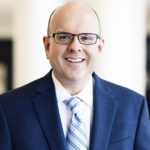
Dallas Jenkins
“It was overwhelming and beautiful to see over 3,000 people in one room cheering and laughing and celebrating our show. But even better were the countless stories of impact viewers were able to tell us personally,” Dallas Jenkins, the show’s creator, told Religion News Service.
Thomas Mathew Rodre, 72, from Brick, N.J., said he came to the conference because he had a spiritual conversion after he watched the first episode eight months ago.
“This scene, where Jonathan Roumie, who plays Jesus, redeemed Mary Magdalene, had such a spiritual impact on me. I accepted Jesus Christ as my Savior right then and there and became born again,” Rodre said.
Rodre gives credit to Jenkins for following God in choosing to make “The Chosen.”
“Jesus is using ‘The Chosen’ as an instrument through Dallas Jenkins—and his acceptance of the role and responsibility—to reach millions of people to bring the good news to millions of people worldwide. And it’s having that effect,” Rodre said.
Fourth season due to release in theaters
At the Dallas event, Jenkins announced the show’s fourth season will be released exclusively in theaters, starting in February. After the full-season run in theaters concludes, the show will debut across streaming platforms.
“The Chosen,” which has 10 million followers across social media platforms, previously first released its episodes on a free streaming app, adding some special showings in theaters as it grew in popularity. In November 2022, the show released the first two episodes of Season 3 in theaters and grossed $8.75 million in sales on opening weekend, debuting at No. 3 in the box office.
Season 4 has been challenging, Jenkins told fans at ChosenCon, attributing the difficulty to spiritual attacks.
“This whole season was a slog from Day 1. I don’t know why,” Jenkins said. “I think we’ve noticed that as the show has grown, so has the difficulty in … attacks from the enemy. And so, during Season 4, it seemed like we just couldn’t ever escape.”
A theme throughout the conference was the show’s choice to humanize Jesus and his followers, particularly the women in his life.
“Naming women that were there and in the Bible, but honoring their stories and giving them names, they are real people too, that Jesus honored. I don’t know, I just think it’s special, said Susan Reeves, 51, a conference volunteer from Dallas who has played a background extra for the show.
Naming the women
The convention organized a live podcast taping in which female actors from “The Chosen” discussed their roles. The discussion was moderated by Annie F. Downs, a podcast host and New York Times bestselling author, and Amanda Jenkins, creator of the show’s ancillary content and Dallas Jenkins’ wife.
During the taping, Downs thanked the creators of the show for giving names to the women in Jesus’ life.
“I just think it is one of the gifts they’ve given us—giving me all the characters’ names—making her Fatima and not just the woman at the well has done something for me,” Downs told attendees.
The actresses—Vanessa Benavente, who plays Mother Mary; Yasmine Al-Bustami, who plays Ramah; Amber Shana Williams, who plays Tamar; and Vanessa DeSilvio, who plays Photina—discussed how they each were chosen for their roles, most crediting Amanda Jenkins, and what it was like preparing to play the biblical characters.
ChosenCon featured a number of well-known Christian musicians, including nine-time Grammy-nominated songwriter Matt Maher, Dan Haseltine of Jars of Clay and Ruby Amanfu.
Other mainstage speakers included Christian pastors and academics such as Levi Lusko, lead pastor at Fresh Life Church, and Douglas S. Huffman, the official biblical consultant for the show. Breakout sessions featured Christian YouTubers and TikTok influencers, including Ally Yost and Jacob Peterson.
The show plans to release the previous three seasons of the series in more than 50 languages by the end of 2023, with an ultimate goal of 600 languages, according to show officials, which would make it the most translated film series in the world.
Christians seeking shelter in church killed in Gaza
October 23, 2023
Early reports indicate an overnight explosion at St. Porphyrius Greek Orthodox Church in Gaza City killed at least 40 people—including 19 Christians—who were seeking shelter from bomb blasts, International Christian Concern reported Oct. 20.
About 500 people—including members of Gaza’s Christian minority—had been sheltering in the church since Israel began airstrikes on Gaza in response to the Oct. 7 Hamas attack on Israel.
Israeli military said a portion of the church building was damaged in a strike on a militant command and control center that was used in carrying out attacks on Israel, and it was reviewing the incident, Reuters reported.
The Orthodox Patriarchate of Jerusalem said the church was hit by an Israeli airstrike, and it issued a statement expressing its “strongest condemnation” of the action.
“The Patriarchate emphasizes that targeting churches and their institutions, along with the shelters they provide to protect innocent citizens, especially children and women who have lost their homes due to Israeli airstrikes on residential areas over the past thirteen days, constitutes a war crime that cannot be ignored,” the statement said.
“Despite the evident targeting of the facilities and shelters of the Orthodox Patriarchate of Jerusalem and other churches—including the Episcopal Church of Jerusalem Hospital, other schools, and social institutions—the Patriarchate, along with the other churches, remain committed to fulfilling its religious and moral duty in providing assistance, support, and refuge to those in need, amidst continuous Israeli demands to evacuate these institutions of civilians and the pressures exerted on the churches in this regard.
“The Patriarchate stresses that it will not abandon its religious and humanitarian duty, rooted in its Christian values, to provide all that is necessary in times of war and peace alike.”
‘Squeezed between two hammers’
Prior to the explosion, International Christian Concern officials had expressed little confidence in the safety of individuals seeking shelter in Gazan churches. In addition to St. Porphyrios Greek Orthodox Church, civilians also sheltered at the Holy Family Roman Catholic Church. None were known to be sheltering at Gaza Baptist Church.
“There’s a very high likelihood of the Christian places getting hit as the conflict continues, in some way, whether it be politicized or not,” Joseph Daniel, ICC’s regional manager for the Middle East and North Africa, told Baptist Press Oct. 18.
“I have very little confidence (of the Christians’ safety) and a lot of fear that something like this would happen. That, just like it happened at the hospital, that a church or that Christians would be affected. And regardless of where the political blame is laid, it doesn’t do any help for those Christians who are suffering.”
Daniel urged Christians to pray for fellow believers in Gaza.
“For Palestinian Christians in general, but really Gazans, they’re being squeezed between two hammers politically and socially in their everyday reality,” Daniel said.
“Really only a miracle of God, our prayers and a quick de-escalation, some kind of peace agreement are really the only things I think would be constructive in helping this very small and already beleaguered Christian community in Gaza. They really need our prayers.”
With reporting by Diana Chandler of Baptist Press.
EDITOR’S NOTE: While the Israel Defense Forces acknowledged a strike targeting a Hamas control center caused damage to the church, “It is important to clarify that the church was not the target of the strike.”
Residency program focuses on calling out the called
October 23, 2023
BURLESON—For the past six years, First Baptist Church in Burleson has helped the next generation to discern God’s call and provided space for them to grow in ministry.
“Our church feels challenged to call out the called. That is my heart,” said Pastor Ronny Marriott, president of the Baptist General Convention of Texas.
Marriott estimates 20 to 30 young ministers, most under age 35, have completed the two-year residency program since it began.
Members of First Baptist Church in Burleson are wlecomed by Director of Student Discipleship Justin Harvey (2nd from right), a former student resident at the church, along with (left to right) Corban Parker, family resident; Abigail Wetherbee, student resident; and Joshua Jackson, student resident.
“We keep hearing time and time again about the shortage of ministers,” Marriott said. “So many churches are in need of pastors. If the size of the need continues to grow, we’ll be losing churches. But God is still calling people into ministry, and we feel called to equip them.”
The church offers two tracks—pastors in residence, for those who feel called to senior, youth, children’s or other pastoral positions; and artists in residence, for those interested in serving as worship pastors, production leaders, instrumentalists or other creative roles.
Program residents are mentored and study leadership while also putting their skills to use. They take an active role in preaching, performing pastoral duties, leading worship and assisting in other areas.
“We utilize our residents a lot on Sunday morning. They’re on stage. They’re helping run things. They’re putting in those reps, doing frontline ministry,” Marriott said.
“It’s also a part of our mission statement to be a regional equipping church. We currently foster two local churches, and our residents gain lots of experience here too. We are also helping support several other churches through pulpit supply and shared training opportunities. It’s a blessing for these smaller churches to have help from our resident staff.”
“The community is great,” said current resident Timothy Edmond. “First Burleson is really encouraging and committed to developing your ministry skills. It’s great working with members and putting to use the things you’ve studied.
“Also, you’re working with other ministers that have many years of experience. Their willingness to come alongside you and to pass down all that knowledge they have is a blessing.”
Edmond completed the program first as an undergraduate student and has returned to serve a second time during his doctoral studies.
“This program is especially good for those of us in school or working another part-time or full-time job,” Edmond said. “It’s a great opportunity to put into practice what you’re studying.”
Residents typically work part-time and receive a stipend, but many go above and beyond what is required.
“I can’t tell you how great these residents are,” Marriott said. “They work so hard because they are called.
“It’s a blessing for them, but it is also a blessing for our church. We help them avoid pitfalls. We are a safe space for them to fail, but fail small and learn from those mistakes, so they will be better equipped when they go on to lead in other churches.”
Two transformed lives intersect at Texas Death Chamber
October 23, 2023
LIVINGSTON—If Texas Death Row inmate William Keith Speer is executed as scheduled Oct. 26, two men whose lives have been transformed by God will be present—one on the death chamber gurney and one in the adjacent viewing area.
Will Speer, an inmate on Texas Death Row, was baptized in June 2022. He became inmate coordinator of the faith-based program at the Allan B. Polunsky Unit, a maximum-security facility near Livingston. He is scheduled to be executed on Oct. 26. (Courtesy Photo)
Speer is a convicted two-time killer who committed his life to Christ while in prison and was baptized in June 2022 after spending six months in the faith-based program at the Allan B. Polunsky Unit, a maximum-security facility near Livingston. Later, he was selected as inmate coordinator for the program and has mentored fellow prisoners on Death Row.
J.C. Collins is the son of the first man Speer shot and killed, Jerry Lee Collins. He wants to be at the execution—not to satisfy a desire for vengeance but to pray for a man he has forgiven.
“I will be there on the day of his execution, but not for the reasons people think. I will listen to his last words. And then I’ll bow my head, close my eyes and say my own prayers for him,” Collins told the Baptist Standard. “I will keep my eyes closed until it’s over. I don’t want to see him die.”
If Speer’s execution is delayed beyond Nov. 1, he will have spent 32 years in prison. First, while still a minor, he was tried as an adult and given a life sentence for the shooting death of Collins.
Later, he received a death sentence for the strangulation killing of a fellow inmate, Gary L. Dickerson, when they were at the Telford Unit in Bowie County.
“I know what I took from them,” Speer said in an interview with the Baptist Standard. “I know what I robbed from them and their families. I understand, because I’ve been there. The stepfather who abused me killed my mother. I know what it feels like.
“I can’t restore what I took away from them. But maybe I can give back some other way. By working with men who were broken like I was, I can give hope. I can’t bring back the lives I took, but I can restore hope where it has been taken away, and I can give God all the glory.”
Victim’s sister asks for commuted sentence
Dickerson’s sister, Sammie Gail Martin, submitted a letter to the Texas Board of Pardons and Paroles asking the board and Gov. Greg Abbott to commute Speer’s sentence to a life in prison rather than execution.
“I have learned a lot about Mr. Speers [sic] in the past month and in my heart, I feel that he is not only remorseful for his actions but has been doing good work for others and has something left to offer the world,” Martin wrote.
As inmate coordinator of the faith-based program—the so-called “God Pod”—on Death Row at the Polunsky Unit, Speer is mentoring other inmates. The 18 inmates in the program spend up to 18 months in an area separate from the general inmate population where they can participate in curriculum focused on spiritual growth and personal improvement.
“Mr. Speer has carried out a true life of faith in prison,” said Amy Fly, Speer’s attorney. “He ministers to others and carries a message of hope and healing. If he is allowed to live the rest of his natural life in prison, he plans to join the Field Ministry Program, where his message can reach even more incarcerated people who were just as lost as he once was.”
Field ministers are inmates who have completed a Bachelor of Arts in biblical studies degree program offered to men through the TDCJ Memorial Unit—formerly known as the Darrington Unit—and to women through the Hobby Unit in Falls County. They receive certification as field ministers after receiving specialized training from the Heart of Texas Foundation Field Ministers Academy.
Petition for clemency filed
Maureen Franco, federal public defender for the Western District of Texas, and Donna F. Coltharp, assistant federal public defender, filed a petition for clemency Oct. 5 with the Texas Board of Pardons and Paroles. They requested either Speer’s death sentence be commuted to a lesser penalty or that he be granted a 180-day reprieve for an interview and hearing to demonstrate repentance for past acts.
“Will is not the same person he was when he committed the crime that sent him to Death Row or the crime that sent him to prison at age 16,” the petition for clemency stated. “After intensive self-reflection and painful reckoning, Will profoundly regrets the choices he made, and the actions he took, that resulted in the deaths of Jerry Collins and Gary Dickerson.
“More significantly, he takes ownership of those failures, seeking both to atone for them and to help other incarcerated men in their own journeys of remorse, rehabilitation and redemption.”
A 180-day reprieve would enable Speer to continue mentoring other inmates in the faith- based program. After being selected by the field ministers and chaplain as coordinator, Speer began leading 13 inmates through curriculum last December.
“If Will is executed on October 26, he will have mentored the men for 10 months,” the clemency petition stated. “A reprieve of 180 days will enable him to see them through the centerpiece components of Bridges to Life and Overcomers.
“The thirteen men who elected Will to lead them on their journey in the Faith Based Program need those additional six months. These men count on Will and lean on him, as they go through the difficult process of confronting, and correcting, their worst mistakes.”
‘Change happens here’
Speer’s greatest joy is helping his fellow prisoners work through curriculum that helped change his life and encouraging them to grow closer to God.
The Allan B. Polunsky Unit is a maximum-security facility near Livingston that houses Texas Death Row. (Photo / Ken Camp)
“As they go through the classes, I’m able to share my experiences and share things that can help them,” he said. “Change happens here.”
Speer currently is on death watch—under 24-hour-a-day surveillance with a camera in his cell. However, the prison has made special provision by allowing him to record a gospel program in his cell that is broadcast each Friday at 3 p.m. on the low-power prison radio station.
“I talk about my life experiences to give hope. So, even from No. 4 cell on death watch, I’m still able to reach out,” he said.
The petition for clemency stated Speer was subjected to physical, emotional and sexual abuse as a child, as well as neglect and bullying and an environment permeated by substance abuse.
“My father introduced me to marijuana, to cocaine, to methamphetamine,” Speer said. “When people are living an insane life, they do insane things.”
He recalled being punished for wetting the bed by being forced to stand in a corner with his urine-soaked underwear on his head for an extended time.
“I grew up believing so many lies,” Speer said. “I was told I was stupid. I was told I’d never amount to anything. I was told I would always be a failure.”
The petition for clemency linked both murders Speer committed to his history of abuse. In the first instance, a young man with money and influence allegedly convinced Speer to murder Collins, in part by claiming Collins was guilty of child abuse. His murder of Dickerson at the Telford Unit followed Speer’s extensive abuse as an inmate.
“As his need to belong had always led him to do, he sought to join a gang of men he believed were stronger than him and would protect him,” the petition stated. “To gain membership in the gang, he killed prisoner Gary Dickerson.”
However, after entering the faith-based program at the Polunsky Unit, Speer bears little resemblance to the person who killed two men, the petition asserted, saying Speer today “is not someone who is influenced by others toward violent ends, but someone who intervenes to stop violence and make prisons safer.”
The same day the clemency petition was filed, a dozen evangelicals also sent a letter to the board and Abbott, requesting clemency for Speer. Those who signed the letter include Stephen Reeves, executive director of Fellowship Southwest; Paul Basden, co-senior pastor of Preston Trail Community Church in Frisco; and Fisher Humphreys, professor emeritus at Samford University.
“Christianity teaches that we are not defined only by our actions but rather by being made in God’s image and, for Christians, being sons and daughters of God. This means all life is sacred, from our beginning through our natural death. We ask that you honor this Christian culture of life and grant clemency to Will Speer,” the letter stated.
A change of heart
For decades, Collins wanted Speer executed, but he had a change of heart growing out of a personal health crisis.
“As much as I thought I wanted for him to be executed, it’s hard to sit here and say that’s what I want,” he said.
Collins spent more than 30 years in what he calls a “self-imposed prison” of anger toward Speer until a cancer diagnosis last year forced him to his knees in prayer, where he found the grace to forgive Speer and let go of bitterness.
“I had to forgive. It was the only way I could move on—the only way I could grow as a husband and a father,” he said.
Ironically, Speer came to the same conclusion about the importance of forgiveness at about the same time.
“I first had to learn how to forgive myself” for making bad choices that led to tragic consequences, he noted. “Then that opened the door for me to forgive others who harmed me.”
Collins and Speer grew up in the same neighborhood and had friends in common.
“I don’t know if he remembers it, but the first time we met was when a couple of guys tried to jump him to take his bike, and I stepped in and went to his defense,” Collins said of Speer.
‘Forgiveness is a process’
Collins acknowledges conflicting—sometimes contradictory—feelings toward Speer in the past three decades.
“I’m thankful he’s apparently found God. My God is a forgiving God. I’ve just had a hard time with my earthly mind coming to terms with my spiritual mind,” he admitted.
When Speer murdered Collins’ father, it drastically affected the victim’s family.
“One rock tossed in a lake can send out ripples a long way. Thirty-two years later, the ripples of what happened that night are still traveling,” Collins said. “I still suffer from PTSD. I’m the one who found my father” after Speer shot him.
Collins said God has released him from a burden of bitterness toward Speer, but he in no way minimizes Speer’s crimes. He simply acknowledges God’s forgiveness.
“The things he did were reprehensible. … But I’m not taking anything away from the good work he’s doing for the Lord. There’s no such thing as too-little, too-late for God,” he said.
As a Christian, Collins said he knew he should forgive Speer. In fact, he tried—repeatedly.
“I forgave that man a long time ago, but I kept taking it back,” he said.
Speer understand that, as well, both in terms of accepting God’s forgiveness and extending forgiveness to others.
“Forgiveness is a process,” he said.
‘My own self-imposed prison’
At times, Collins said, he wanted nothing more than to see Speer executed. Other times, he felt some measure of sympathy for him.
“The State of Texas took a child who killed and turned him into a killer. I don’t know if it’s all his fault,” Collins said.
“My whole family told his family we thought he was manipulated, and we would not oppose his parole. But then he committed another murder. He would have been out on parole by now, but he squandered the opportunity.”
When Collins was diagnosed with cancer last year and faced the prospect of his own death, he finally let go of his bitterness toward Speer and asked God to take away the anger that shaped his life for three decades.
“For a very long time, I allowed my father’s death to define me. I was a victim,” Collins said.
“I had a lot of pride. I had to learn humility. I’m different—less vindictive, less angry. … I cannot allow other people to have power over who I am and what I am.”
“I was in my own self-imposed prison for years, but I don’t have to be any more. God took it from me.”
During Speer’s remaining time—however long that may be—he said he wants to use it to encourage other inmates in their spiritual growth and to let others know about a peace that transcends circumstances.
“I pray God will continue to use me. But the fact is that God already has used me,” Speer said. “If God doesn’t do another thing for me, he’s already done enough.”
Anglicans mourn loss after hospital hit in Gaza
October 23, 2023
LONDON (RNS)—Archbishop of Canterbury Justin Welby described reports of hundreds of deaths after an attack on an Anglican hospital in Gaza on Oct. 17 as “appalling and devastating.”
The archbishop spoke as news emerged of the rocket attack on al-Ahli Hospital in Gaza, run by the Episcopal Diocese of Jerusalem and managed at one point by the Southern Baptist Convention’s Foreign Mission Board personnel, that has left as many as 500 people dead and others injured, according to multiple reports.
“This is an appalling and devastating loss of innocent lives,” said Welby, the spiritual leader of the Anglican Communion and primate of the Church of England.
The Associated Press confirmed that video footage showed fire engulfing the hospital and bodies scattered across the grounds, including those of children.
The hospital building not only was being used by medics and patients, but also was packed with Palestinians seeking shelter after evacuation orders from Israel.
The rocket attack follows 10 days of conflict between Israel and Hamas after the Oct. 7 assault by Hamas militants on Jewish settlements, in which 1,400 Israelis died and 200 people were taken hostage.
Palestinian officials reported at least 2,800 Palestinians have been killed and 10,000 others have been wounded in the days since.
Welby spoke out after first reports emerged that the hospital had been hit by an Israeli rocket, according to Palestinian officials. The Israeli military has denied the strike was theirs, accusing a Palestinian militant group of launching a rocket that malfunctioned and hit the hospital. Neither report has been verified.
Southern Baptists formerly managed hospital
The hospital was established in the 1880s by the Church of England’s Church Mission Society. The SBC Foreign Mission Board and its medical mission managed the hospital from 1954 to 1982, at which point the Anglican Church resumed control.
The hospital attack raised tensions even further in Israel and Gaza, creating complications for visiting U.S. President Joe Biden. Palestinian Authority President Mahmoud Abbas has said he is canceling his meeting with Biden following the hospital strike.
Among the first to denounce the attack was Richard Sewell, dean of the Anglican St. George’s College, in Jerusalem.
“Disaster: our hospital, Ahli Arab hospital has taken a direct hit from an Israeli missile,” he posted on X, formerly Twitter.
“This is deliberate killing of vulnerable civilians. The bombs must stop now. There can be no possible justification for this.”
Welby previously urged the Israelis reverse their demand for hospitals in Gaza to be evacuated.
“The seriously ill and injured patients at the Anglican-run Ahli Hospital—and other healthcare facilities in northern Gaza—cannot be safely evacuated,” he warned in a statement on Sunday. “They are running low on medical supplies. They are facing catastrophe.
“I appeal for the evacuation order on hospitals in northern Gaza to be reversed—and for health facilities, health workers, patients and civilians to be protected,” he said.
In the days since the conflict began, American Episcopal leaders had been encouraging people to donate to the work of al-Alhi Hospital through the American Friends of the Diocese of Jerusalem.
In an Oct. 15 statement, bishops of the Diocese of New York praised the work of the hospital and of the Episcopal Diocese of Jerusalem, as without “a political agenda” and in service to “Christian, Jew and Muslim alike through hospitals and schools and shelters, and at no cost.”
This is the second time in four days the hospital has been hit. On Saturday, the Diagnostic Cancer Treatment Center of the hospital was hit by an Israeli rocket. Two upper floors of the center, which houses the ultrasound and mammography wards, were severely damaged. Four hospital staff members were injured in that blast and are receiving treatment for their wounds.
“The Diagnostic Centre is the Crown Jewel of Ahli Hospital, providing cancer diagnosis as a prelude to various treatment options both at Ahli and in other facilities,” the Anglican archbishop of Jerusalem, Archbishop Hosam Naoum, told the Anglican Communion News Service at the time.
“Next month, we were due to open a new chemotherapy centre there in partnership with Augusta Victoria Hospital on the Mount of Olives—a principal reason for our visit to the hospital last week.”
Greenway threatens seminary with $5 million lawsuit
October 23, 2023
FORT WORTH—Adam Greenway, former president of Southwestern Baptist Theological Seminary, sent a demand letter threatening a $5 million lawsuit.
According to The Tennessean, a Sept. 25 letter to Southwestern Seminary sent by Greenway attorney Andrew Jones claims financial disclosures issued from the seminary humiliated the former president and harmed his job prospects.
Jonathan Richard, chair of the seminary’s trustee board, called the letter “incredibly disappointing” in light of efforts to work toward “an amicable resolution” following Greenway’s departure a year ago from Southwestern Seminary, “especially given [Greenway’s] professed love for this institution.”
Adam Greenway
“Over the past year, we have continued to pray for Dr. Greenway’s spiritual, mental and emotional well-being as we have worked towards an amicable resolution, which we had every reason to believe had been achieved with the agreement signed in February of this year,” Richard said in a public statement.
“As stewards of precious institutional resources, we cannot in good conscience capitulate to his absurd demand for $5 million. Our focus remains on confronting the financial challenges facing Southwestern, which would only be compounded by agreeing to his demand.”
Southwestern announced Greenway’s resignation on Sept. 23, 2022, a day after the board’s executive committee and the seminary administration held an all-day meeting. The seminary ultimately created a task force to investigate the financial position of the entity and Greenway’s impact.
A member of that task force brought forward concerns related to Southwestern’s financial standing, resulting in a May 30 special-called board meeting that included an extended response days later. On June 7, the board released a “summary of findings” over Greenway’s spending while in office.
Efforts by BP to contact Greenway and his attorney for further comment were unsuccessful. The Baptist Standard also contacted Greenway for comment but did not receive a response.
Greenway became president at Southwestern in 2019. He and the seminary reached a confidential settlement agreement in February that—the Tennessean reported—included a stipulation of neither party disparaging the other. A statement regarding the agreement was emailed to Baptist Press at the time but not published.
“Baptist Press received a statement from the seminary concerning Dr. Greenway on Feb. 28, 2023,” said Brandon Porter, associate vice president for convention news at the SBC Executive Committee.
“We reached out to both sides to get context and comment. Both sides declined to provide either. BP editors chose not to publish the statement or a story about it without context or comments.”
The seminary’s publication of its summary of findings cast Greenway in a negative light and essentially broke that agreement, Greenway’s attorney said in the Tennessean article.
“The framing of these expenditures as unauthorized and lavish personal gain undertaken by Dr. Greenway is an assertion of financial impropriety on par with embezzlement,” Jones said.
Expenditures were “grossly inflated and false,” he added. That included reports of an espresso machine valued at more than $11,000, which became the subject of online jokes. The actual cost of the machine, Jones said, is $5,952.67.
Southwestern Seminary “has fully complied with its obligations under the Settlement Agreement and will continue to do so,” said the seminary’s attorney, Michael D. Anderson, in a response letter to Jones dated Oct. 11. “The matters raised in your letter do not constitute a breach of the Settlement Agreement, regardless of how you characterize them.”
Anderson cited Greenway’s request in April for the seminary to fulfill “its promise of transparency to Southern Baptists by releasing the full trustee investigative report including all related findings, without edit or redaction.” Greenway’s statement was released on X, formerly Twitter.
“The fact that Dr. Greenway does not like the results of that financial review and the public disclosure of it (which he demanded) does not make the results of the financial review false or in any way defamatory,” Anderson said.
Around the State: ETBU presents servant leadership awards
October 23, 2023
East Texas Baptist University awarded the Bob and Gayle Riley Servant Leadership Award to seniors Avery Abshierand Abraham Contreras. Each year, ETBU presents the award to two upperclassman students who are nominated by their peers, faculty and staff in recognition of their commitment to the Christ-centered model of servanthood. Abshier, a Christian ministry major, has served as a resident assistant, Tiger Camp leader, Baptist Student Ministry Kid’s Club leadership team member, Christian Association of Student Leaders planning committee participant, and Sunday School leader at Mobberly Baptist Church in Longview. Contreras, a Christian ministry and mental health major, has served as a BSM Leader, resident assistant, Tiger Camp co-leader and CASL co-leader. He is a youth apprentice for Mobberly Baptist Church in Longview and a behavioral analyst intern at Community Healthcore
Raymond Harris
Dallas Baptist University appointed Raymond H. Harris as senior fellow of entrepreneurship for the Institute for Global Engagement, a nonpartisan Christian think tank dedicated to addressing issues in the public square. Harris is the founder of one of the largest architectural firms specializing in corporate architecture. He is the author of The Anatomy of a Successful Firm, The Heart of Business and Business by Design. He is also an executive producer for numerous movies distributed by Sony Pictures and Lions Gate Entertainment and an executive producer for a music company label.
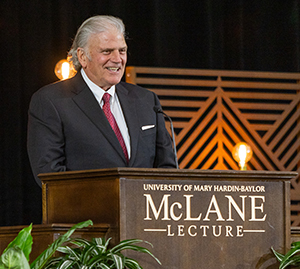
Franklin Graham, president and CEO of the Samaritan’s Purse relief organization and the Billy Graham Evangelistic Association, delivered the McLane Lecture at the University of Mary Hardin-Baylor (UMHB Photo)
Franklin Graham, president and CEO of the Samaritan’s Purse relief organization and the Billy Graham Evangelistic Association, delivered the McLane Lecture at the University of Mary Hardin-Baylor on Oct. 11. “We’re all on a journey called life. You only have one shot at life. You don’t want to miss it. You don’t want to mess around. You want to get it right,” Graham told a crowd of more than 2,500. “Make your life count.” Graham challenged students, faculty and guests to apply Proverbs 3:5-6. “You have to trust the Lord. Acknowledge him. And then, start moving,” he urged. Graham was the featured speaker for the 19th McLane Lecture, sponsored by Elizabeth and Drayton McLane Jr.
The Hispanic Higher Education consortium is sponsoring a college fair at the east campus of Del Sol Church in El Paso from 3 p.m. to 8 p.m. on Oct. 22. Representatives from eight universities affiliated with the Baptist General Convention of Texas will be present, awarding up to $24,000 in scholarships in $2,000 increments to prospective students in attendance.
Areli Estrada-Lopez
Haylie Stum
Two East Texas Baptist University students were named as recipients of scholarships granted in partnership with the national Council of Independent Colleges and the Independent Colleges and Universities of Texas. Haylie Stum, an undergraduate student from Cypress majoring in Sports Communications, was chosen to receive the CIC/UPS Scholarship. She was named the Texas Association of Journalism Educators Journalist of the Year in 2023. Areli Estrada-Lopez, a junior business administration major from Marshall, was selected to receive a PACCAR Scholarship provided by the ICUT Foundation. “Year after year, these scholarships leave an indelible mark on the lives of deserving students,” said ETBU President J. Blair Blackburn. “Aligned with ETBU’s mission to offer students an accessible path to Christian education, we are equipping and empowering students to prepare for God’s calling on their lives.”
Anniversary
170th for First Baptist Church in Plano on Oct. 22. Craig Curry is pastor.
140th for Primera Iglesia Bautista in Laredo. Dorso Maciel is pastor.
Online worshippers lead in Bible reading frequency
October 23, 2023
PHILADELPHIA (BP)—Bible users who worship God online are most likely to read the Bible at least weekly apart from church service, the American Bible Society said in the latest installment of its 2023 State of the Bible report.
Among online worshippers, 74 percent read the Bible at least weekly, whether they worship solely online or online and in person. Of in-person-only worshippers, 32 percent read the Bible at least weekly, the American Bible Society stated.
“This might seem surprising to those who see online church as a lesser experience, used by people who are less committed spiritually,” the society said in the report’s seventh chapter, focused on Bible use and technology. “We suspect that these numbers speak to the personal nature of online attendance.”
Online attendance, often done alone or with immediate family, “can be more about hearing about God and from God,” the Bible society speculated. “It’s personal, as Bible reading often is.”
The findings are among the results of an 18-minute survey conducted in January among a representative sample of adults 18 and older within the 50 states and the District of Columbia. Percentages are based on 2,761 responses.
The release delved into how many people read the Bible at least weekly outside of normal church services and certain descriptive characteristics concerning them.
Among the top findings:
25 percent of American adults use the Bible at least weekly, amounting to about 65 million people.
More than half of evangelicals, 53 percent, report reading the Bible weekly, compared to 21 percent of Catholics who do so.
Black Americans far surpass others in reading the Bible at least weekly, with 38 percent reporting so, compared to 23 percent among all other ethnic groups combined. Nearly one in five Blacks (19 percent) read the Bible daily, outpacing all other groups combined, which numbered 8 percent.
Curiosity about Scripture doesn’t necessarily drive Scripture reading, the Bible society found. About 39 million U.S. adults say they are extremely curious about Scripture, but they don’t read it at least weekly. More than half of Americans—52 percent—wish they read Scripture more, but only 14 percent increased their Bible reading in the past year.
Among the top impediments to reading Scripture more frequently were a lack of time (26 percent), a lack of excitement (15 percent), not knowing where to start (17 percent), and difficulty in relating to the language (15 percent).
Among other findings:
The popularity of digital Scripture sources is about the same as in 2022. Just under 70 percent of Bible users read a printed Bible at least monthly, 50 percent read a digital Bible app at least monthly, and 48 percent read Scripture through internet searches at the same frequency.
Elders continue to favor printed Bibles at 87 percent, while 46 percent of Boomers are most likely to watch a Bible program on video.
Bible apps and podcasts are most popular among Millennials, 42 percent, and Gen X, 39 percent; with digital Bibles and online Bible reading plans also most popular among those generations.
Gen Z is most likely to access Scripture through internet searches.
The State of the Bible annually looks at the Bible, faith and the church in America. The American Bible Society collaborated with the University of Chicago’s National Opinion Research Center in designing the study conducted online and via telephone to NORC’s AmeriSpeak Panel.
Previous chapters of the 2023 study revealed various aspects of how Scripture engagement impacts daily life. Future chapters will offer new insights on how the Bible affects philanthropic habits and summarize highlights from 2023 research.
A third of Asian Americans say religion is very important
October 23, 2023
WASHINGTON (RNS)—More Asian Americans identify as atheist, agnostic or nonreligious than before, according to a survey by Pew Research Center.
But 40 percent of those Pew surveyed, who included Americans of Chinese, Filipino, Indian, Japanese, Korean and Vietnamese backgrounds, said they feel close to a religion for reasons aside from religion, such as family or cultural ties.
Pew’s survey, which studied over 7,000 participants over the course of a year, found that Asian Americans are part of the ongoing trend of Americans who don’t follow any religion, often referred to as “nones.” Today, 32 percent of Asian Americans are religiously unaffiliated, compared with 26 percent in 2012.
Asian Americans as a whole are mostly Christian (34 percent), especially Korean (59 percent) or Filipino Americans (74 percent), who are evenly split between Protestantism and Catholicism (16 percent and 17 percent). Born-again or evangelical Protestants make up 10 percent of Asian Americans.
However, Asian Americans who identify as Christians have shown the sharpest declines in affiliation with religious institutions since 2012, dropping by 8 percentage points.
More than half (56 percent) of Chinese Americans and close to half (47 percent) of Japanese Americans said they are not affiliated with any religion, comprising the largest groups of religious nones. They are also the groups least likely to consider religion very important.
Buddhists and Hindus, both at 11 percent, were the next largest faith groups. Vietnamese Americans are the most likely of the Asian origin groups to identify as Buddhist (37 percent), and Indian Americans are far more likely than the other groups to be Hindu (48 percent).
The survey’s findings reflected a complex understanding of religiosity in many Asian American cultures, in which religious identity can mean more than just adhering to a set of beliefs. In particular, daily life in Asian countries can be infused with practices associated with Buddhism, Hinduism, Daoism, Shintoism and Confucianism, even among those who do not identify as religious.
One Vietnamese Buddhist told the researchers, “Confucianism and Daoism is part of my culture. However, for me, it’s a school of philosophy. I do not identify myself as being a Daoist or Confucian.”
While only 11 percent of Asian American adults say their religion is Buddhism, for example, 21 percent feel close to Buddhism for other reasons.
Religiously unaffiliated Indian Americans report this phenomenon at much higher rates than nones of other Asian origin groups, saying they feel close to Hinduism for reasons aside from religion.
Reported affinity toward more than one religion
Many Asian Americans also reported feeling an affinity toward more than just one religion, the survey found. Four in 10 Asian American adults expressed a cultural connection to one or more groups that they do not claim as a religious identity, but still feel close to.
One Hindu participant expressed a connection to Buddhism “because some of the practices of Buddhists, they are very much similar” to Hindu practices.
The survey found 18 percent of Asian Americans do not identify religiously as Christian, yet say they feel close to Christianity aside from religion, including, for example, the American celebration of Christmas.
“My whole life I was exposed to Christmas and all this stuff. Even though I don’t believe in it, we had to give gifts … so it was always part of our culture, even though we don’t believe in it,” said one non-Christian Indian participant who grew up in the United States.
On the whole, Asian Americans are slightly less likely than Americans as a whole to say religion is very important in their lives, the survey says.
Asian American Muslims (60 percent) and Christians (54 percent) are much more likely to feel that religion is very important in their lives than are Asian American Hindus (33 percent) and Buddhists (31 percent), and also are the likeliest to say they attend religious services or visit a temple, shrine or other religious space at least monthly.
Regular religious attendance is more common among Korean and Filipino Americans than among Vietnamese, Japanese or Chinese Americans. And as a whole, Asian Americans born in a country other than the United States are far more likely than those born here to say they attend religious services at least monthly (32 percent versus 21 percent).
Twenty-one percent of all Asian Americans surveyed said they attend services at least weekly.
Worship trends vary among traditions, but 36 percent of Asian Americans say they have an altar, shrine or religious symbol that they use for home worship. Of those who do, many identify as Buddhist or Hindu.
But worshipping at home is also fairly common among Catholic Filipino Americans, with 66 percent of them saying they have an altar at home.
As many Asian Americans expressed a dual-belonging with more than one religion, 30 percent of Asian Americans said all or most of their friends have the same religion they do. Seventy-seven percent of Asian Americans say they would be comfortable if a family member married outside of their faith.
TBM helps medical personnel serve in Israel
October 23, 2023
Texas Baptist Men provided $150,000 to transport medical professionals from the United States to Israel to help treat people affected by the ongoing war.
“Doctors, nurses and paramedics are on their way to help as volunteers in Israel,” said John-Travis Smith, TBM associate executive director who coordinates TBM ministry in Israel. “So many people are suffering as a result of the violence in Israel. TBM is helping the people in any way we can.
Volunteers with Israel’s Emergency Volunteer Project prepare meals Monday, Oct. 9, for people suffering in the aftermath of the Hamas attack on Israel. The EVP volunteers are using food trailers designed and purchased by Texas Baptist Men. (Courtesy Photo)
“We had set up disaster relief equipment there in advance of any type of need. Now, our trained volunteers are providing meals for those in need. Getting medical professionals to the scene is just another way we can help the people.”
From a secure location, an 18-member TBM volunteer team has been providing food in Israel for more than a week. Roughly half of them are set to return this week, with another group of volunteers ready to take their place, Smith said.
Volunteers are coming from across the country and beyond to join the effort, including Baptists on Mission, Church Forward and Hungarian Baptist Aid.
“Our volunteers are stepping up to serve,” he said. “They’re meeting the needs of people who have been impacted by the war. Many of these people have lost their homes. Their neighborhoods have been hit hard. TBM volunteers are reaching out with the compassion of Christ to southern Israel during these difficult times.”
Russian forces occupy seventh Baptist church in Ukraine
October 23, 2023
Russian occupying forces seized another Baptist church in Ukraine, and a military court in Russia imprisoned a Baptist who refused to fight in Ukraine on religious grounds, Forum 18 News reported.
Forum 18, an Oslo-based partner of the Norwegian Helsinki Committee, reported Russian military closed and seized a Baptist Union church in the Zaporizhzia Region of southeastern Ukraine.
The Zaporizhzia Region church is the seventh Baptist Union church confiscated in territory captured since Russia’s February 2022 full-scale invasion of Ukraine. The other six churches seized previously by Russian occupying forces are in Ukraine’s Donetsk Region.
Voice of the Martyrs reported Russian authorities claimed a mine had been planted at the Zaporizhzia Region Baptist church.
Forum 18 quoted Artyom Sharlay of Russian’s Religious Organizations Department as asserting “law-abiding” faith communities “face no restrictions, but those that break the law are banned.”
In addition to the Baptist Union church, Russian occupying forces also forcibly closed an Orthodox Church of Ukraine parish in Basab and a Roman Catholic church in Skadovsk.
Russia jails conscientious objectors
Meanwhile in Russia, Baptist Vyacheslav Reznichenko began a two-and-a-half-year prison term at a prison colony-settlement because he refused to participate in the military occupation of Ukraine, Forum 18 reported.
Reznichenko, a reservist in Vladivostok, was called up in September 2022. He reportedly told his commanders twice he refused to use weapons against another person, based on his religious convictions.
He was denied the option to perform alternative civilian service or act in an unarmed role in the army, although that right constitutionally is granted to conscientious objectors.
Forum 18 reported Reznichenko is one of four men jailed by Russian military courts for refusing to fight in Ukraine on religious grounds. Two already serving sentences in penal colony-settlements are Dmitry Vasilets, a Buddhist, andAndrey Kapatsyna, a Pentecostal Christian.
Another Pentecostal, Maksim Makushin, was sentenced Sept. 28 to two years and eight months. He is appealing his case.
Is religion good for you? It’s complicated, Gallup says
October 23, 2023
\WASHINGTON (RNS)—A new report from Gallup finds religious people around the world report being more positive, have more social support, and are more involved in their communities than those who are not religious.
The study, based on 10 years of data, also finds the well-being of religious people varies from country to country and is often hard to measure. Even if researchers find that religion is good for you, people who are not religious may not care about its benefits or want anything to do with it.
“Gallup World Poll data from 2012-2022 find, on a number of well-being measures, that people who are religious have better well-being than people who are not,” according to the report, published last week.
Data about nine aspects of life
The study included data about nine aspects of people’s lives, from their positive interactions with others and their social life to their civic engagement and physical health. Each of the nine indexes included a score of 0 to 100, based on answers to a series of questions.
For the positive experience index, respondents were asked questions such as “Did you smile or laugh today?” and “Were you treated with respect?”
For civic engagement, they were asked questions about whether they gave to charity or helped a stranger.
The physical health index asked if they had health issues that kept them from doing things people their age usually do and whether they were in physical pain.
For community basics, they were asked about housing and infrastructure.
Religious people scored higher on five of Gallup’s indexes: social life (77.6 compared with 73.7 for nonreligious people), positive experience (69 to 65), community basics (59.7 to 55.6), optimism (49.4 to 48.4) and civic engagement (35.8 to 31).
They scored about the same as nonreligious people in two indexes: a “life evaluation” of whether they were thriving or suffering and their local economic confidence.
Religious people scored lower on two indexes: negative experience and physical health.
The differences between religious and nonreligious people were most prominent in highly religious countries.
Researchers noted that even small differences can have a significant impact on a global scale.
“Each one-point difference in index scores between religious and nonreligious people represents an effect for an estimated 40 million adults worldwide,” the report stated.
“For example, the four-point difference between religious and nonreligious people on the Positive Experience Index means that an estimated 160 million more adults worldwide have positive experiences than would be the case if those adults were not religious.”
Interest and involvement in religion declining
The report suggests religion and spirituality could be a possible asset in dealing with the mental health crisis in many countries. However, they noted, the number of people interested in or involved in religion is declining.
For the report, Gallup partnered with the Radiant Foundation, which promotes a positive view of religion and spirituality and is associated with The Church of Jesus Christ of Latter-day Saints.
Jeff Jones, Gallup poll senior editor, said measuring the impact of religion and spirituality on wellness is complicated, especially as people become less religious and the way they practice spirituality evolves.
“With the changing nature of religious landscapes and spiritual practice, it can make quantitative measurement amid the changes challenging, as the traditional forms of spirituality—namely, attending formal religious services, are becoming less common and people are seeking other ways to fulfill their spiritual needs,” Jones said in an email.
The report, which also includes quotes from experts and a review of past research on the connection between wellness and religion, notes that even as researchers become more aware of the positive outcomes of religion, people are less interested in religion around the world.
While they have no polling data on the decline of religion, the report suggests several causes for that decline, including growing polarization that pits religious and nonreligious people against each other. Nonreligious people at times see religious people as a threat. Religious people, especially from larger faith groups, can wield their power in ways that others see as harmful.
“Religious groups and individuals—particularly from the dominant religious group in a society—who are hostile to other religious groups may promote a cultural context that is harmful to the well-being of those outside the group,” the report states.
“Resentment toward the dominant group may also tune people out to their messages, both those that are harmful (out‑group animosity) but also that are helpful (serving others).”