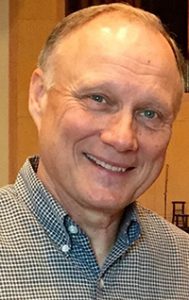
Henry Stovall, longtime Baptist pastor, died June 11 in Bryan. He was 77. He was born Nov. 10, 1947, in Ennis to Burrow “Bill” and Evelyn Downey Stovall. After graduating from Ennis High School, he earned his undergraduate degree from Baylor University and his master’s degree in religious education from Baptist Missionary Association Theological Seminary in Jacksonville. Through the years, he served churches in Tenaha, Greenville, Anson, Palmer, Snook and Leona. He was pastor of Trinity Baptist Church in Bryan for 24 and a half years. When he retired in 2018, Trinity Baptist named him pastor emeritus. He was preceded in death by a daughter, Stephanie Stovall Hejl; a brother, Carl William Stovall; and sisters, Catherine Anne Stovall and Sally Stovall Rizzo. Survivors include his wife of 57 years, Karen Stovall; daughters Cari Stovall and Krista Weller; four grandchildren; one great-grandson; and a twin sister, Mary Stovall Maldonado.
Katrina reshaped New Orleans churches, leaders say
August 29, 2025
NEW ORLEANS (BP)—The church doors would remain open, Pastor David Crosby decided after the levees failed New Orleans in Hurricane Katrina.
David Crosby
Someone from the Midwest sent a huge generator to First Baptist Church of New Orleans, Crosby’s pastorate at the time, enabling the church to reopen as soon as the law allowed.
Near constant news coverage flashed scenes of bodies floating atop floodwaters, hungry babies crying, families handling the dead bodies of their loved ones with whatever dignity the chaos allowed.
Water still lingered in whole neighborhoods as First Baptist began helping with relief efforts in October 2005, aided by the generator and thousands of volunteers who rushed to help.
“All the churches had to turn outward, toward the community, during the recovery,” Crosby told Baptist Press 20 years after the storm.
“Katrina washed us out of our pews and into our communities. Nobody locked any doors for four months in all of the flood zone. What was the point?”
More diverse, more united
As Southern Baptist churches in Metro New Orleans commemorate Katrina, they’ll do so with a New Orleans Baptist Association of churches that is more diverse and more united than it was when the waters dirtied the city, leaders told Baptist Press.
Churches outside the levee protection system were washed away and never reopened, but other churches were planted in areas where population returned, and several churches that were not Southern Baptist have joined the fellowship, said Jack Hunter, executive director of New Orleans Baptist Association.
“The aftermath of Katrina had a way of reshaping the association, not just in terms of its composition, though that’s true,” said Hunter, a member of First Baptist Church of New Orleans who began leading the local assocation five years after the storm.
“Our association is more African American now than it was pre-Katrina. It’s more Hispanic now than it was pre-Katrina. And it’s that way because our embrace has widened and our community has become richer.
“And I think in many ways, we look more like the church. And there’s a high appreciation for that among our churches. We’re a diverse association. But we feel a great unity in our diversity.”
Working across denominational lines
Southern Baptists embraced multidenominational cooperation in recovery, Dennis Watson, senior pastor of Celebration Church said.
“Two months after Katrina, I called together the pastors of our city. A lot of pastors still had not returned because their homes have been destroyed, campuses have been destroyed.” Watson said.
“But we had 120 pastors return, and we formed the Greater New Orleans Pastors Coalition and we began to work together across denomination lines, racial lines, community lines. … For those first five years after Katrina, we had sometimes close to 300 pastors and churches working together to serve the people in the communities around us in some capacity.”
During recovery in 2005, Watson distributed loads of goods to those in need, spending the millions of dollars he received in donations on relief efforts because he thought he wouldn’t be able to rebuild Celebration. The $1.5 million the church had in flood insurance wouldn’t cover the $16.5 million repair bill.
“And so we really just started giving away the monies that were coming in,” Watson said. “We were feeding about 5,000 people a day hot meals. And a thousand people a day were coming to receive food, water, medical supplies, baby supplies. … Whatever people sent us from the nation, we gave out and distributed.”
A smaller, second Metairie location the church acquired only weeks before the storm—the former Crescent City Baptist Church—had less flooding, accommodating worship for the quarter of Celebration’s members who were able to return in the months following Katrina.
Shepherding a scattered flock
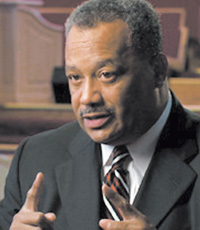
Franklin Avenue Baptist Church sat under 9 feet of water before Pastor Fred Luter was able to survey the damage. The campus was damaged beyond occupation.
Fred Luter
Luter called his friend Crosby for a meeting venue to accommodate worship for Franklin Avenue members who began returning to the city in October. Luter held worship at First Baptist for nearly three years after the storm, while also shepherding members who scattered across the U.S. for safety under the mandatory evacuation.
Remembering Katrina is always difficult for Luter. Days before this year’s anniversary, he was praying with a local business owner who had an entire wall of photos of his business destroyed under Katrina’s waters.
“When you see things like that, your mind just goes back and reflects on how bad that really was. So, you always think about all the things that you went through, how you had to evacuate and lost so many people, so many people who relocated to other cities and they’re now there and not ever coming back,” Luter said. “They come back to visit, but that’s about it.”
But Luter appreciates the city’s resilience.
“To be able to build back—what we’ve done, that’s been a blessing,” he said.
Marking the 20th anniversary
The three pastors—Luter, Crosby and Watson—planned to gather with the greater Southern Baptist family in a Hurricane Katrina 20th anniversary service Aug. 29 at First Baptist New Orleans, hosted by Senior Pastor Chad Gilbert.
Crosby retired from the church in 2018. In retirement, he serves First Baptist Church of Goldthwaite as pastor on a part-time basis.
Hunter and other New Orleans Baptist pastors will attend the service, including many pastors of the 18 Hispanic churches and 41 African American churches that are now among the local association’s approximately 130 congregations.
By the numbers, the association has just as many congregations as it had before Katrina, according to then-Director of Missions Joe McKeever, who tallied 135 churches and missions, or 140 including the Plaquemines Baptist Association that merged with New Orleans Baptist Association after the storm.
Just two years after Katrina, New Orleans Baptist congregations had dropped to 82 churches and missions, McKeever wrote in the association’s 2005-2007 annual directory.
“The fellowship between our ministers has been forever changed,” McKeever wrote in the annual.
“Pre-Katrina, we had a Spanish fellowship of pastors, the African American pastors pretty much did their own thing, the Anglos tried unsuccessfully to involve everyone, and the Asian pastors were fairly well isolated.
“No more,” McKeever wrote. “These days, our weekly ministers’ meetings welcome everyone. … Pastors have learned each other’s names and lasting bonds of friendship have been formed.”
Embraced the Honduran community
Those relationships have endured and grown, said Hunter, who gives much credit to Luter, Crosby and Watson for helping rebuild the church community after the storm.
He credits in part Luter’s graciousness for the association’s success in drawing African American pastors, and notes the association embraced the Honduran community that swelled in helping Metro New Orleans rebuild after the storm. Of the 18 Hispanic churches in the association, 15 are majority Honduran.
Metro New Orleans became a hub for Hondurans after the storm. As recently as 2023, Hondurans comprised 29 percent of Hispanics in Metro New Orleans, the U.S. Census Bureau reported, compared to 2 percent of Hispanics nationwide, the Data Research Center reported, based on U.S. Census numbers.
Churches in the New Orleans Baptist Association shared the gospel with the new population.
“We want to be strategic, planting the churches where the need is,” said Geovany Gomez, pastor of Iglesia Bautista La Viña in the New Orleans suburb of Kenner, the association’s church health strategist, who is of Honduran descent.
When Katrina struck, Gomez’s pastorate was one of two dozen language mission congregations in the association embracing not only Spanish but Asian Indian, Haitian, Indian, Korean, Middle Eastern, Filipino and Deaf groups.
Many of the language missions were discontinued after Katrina but others are now churches, including Gomez’s pastorate that has since planted two majority-Honduran churches of its own, namely Iglesia Bautista Bethel in Kenner and Iglesia Bautista La Viña in Westwego.
Going where the people are
New Orleans Baptist churches have followed the population, Hunter said, serving people where redevelopment has given them opportunity to live. Many former home lots are now green spaces, and much of the Lower Ninth Ward remains undeveloped, leaving no need for churches in parts of the city. Dozens of churches no longer exist.
“There are a few churches we have that were maybe stronger pre-Katrina than they are now, but we have a lot of churches that are stronger now than they were pre-Katrina,” he said. “But there are 50 congregations that we have, by my count, that we did not have pre-Katrina.”
Some of the 50 new congregations are church plants, but Hunter estimates most are pre-existing churches that joined the local assocation, or churches that began after the storm.
Celebration Church, for instance, not only rebuilt at its Airline Drive location, but has seven additional locations that are thriving. In the past two months, the Celebration network has baptized about 300 people, Watson said.
“We actually gave away the first several million dollars that came to us, because we didn’t think we could rebuild our Airline campus. So, we just invested it in helping the people of communities around us,” Watson said.
“But the more we gave away, the more the Lord blessed us with. And so at five years after Katrina, we were able to rebuild our campus on Airline Drive and to continue launching campuses.”
‘Discovered the joy and value of helping each other’
First Baptist continues as a majority Anglo yet ethnically diverse congregation, enriched by the relationships forged during the time Franklin Avenue worshiped there, Crosby told Baptist Press.
“When you have a flood, you have a fire that affects the community and people work together. They set aside their differences, prejudices and preconceptions about others and they work together,” Crosby said. “And that happened in our community.
“The world seemed chaotic, unmanageable, in the aftermath of the storm. Thousands of people left in great waves of depopulation, many of them simply unable to see a way forward,” Crosby said. “We were forced into awareness of one another. We rediscovered the value and joy of helping each other. We experienced the loss of all things, so to speak, and found true joy and riches in our relationships with one another and with God.”
Crosby nominated Luter for SBC president in 2012, a position Luter held two terms. He remains the only African American to have held the post.
Major changes for Franklin Avenue
Luter’s church renovated its campus at 2515 Franklin Ave. before rebuilding and relocating to New Orleans East in December 2018.
A location launched in Baton Rouge to serve more than 600 Franklin Avenue members who moved there after Katrina continues as United Believers Baptist Church, averaging 122 in Sunday worship, according to the 2024 Annual Church Profile.
Houston’s Franklin Avenue Baptist Church, launched to serve members who relocated to Houston, also continues, Luter said. The congregation averaged 425 members in Sunday morning worship when it last completed an ACP in 2017.
The original Franklin Avenue location now houses Rock of Ages Baptist Church, a non-Southern Baptist congregation acquiring the property on a lease-to-buy agreement. So many churches lost members, Luter said, the property sat vacant for years, with no one able to purchase it.
Luter helped plan a month of activities commemorating Katrina as a member of New Orleans Mayor LaToya Cantrell’s K20 Advisory Commission. On the calendar are various interfaith events among others embracing the New Orleans community.
“One of the things I’ve learned is that we no longer can be complacent if a hurricane is in the Gulf coming towards New Orleans, or Mississippi or Alabama,” Luter said. “We did it for years, just knowing that the hurricane would pass and we might be without electricity or lights for a while. But we’d never flooded like it did with Katrina.”
The National Weather Service attributed 1,833 deaths to Katrina, as well as $108 billion in damage, amounting to $200 billion when adjusted for inflation.
“So one of the lessons we’ve learned, and I’ve learned, is don’t take hurricanes lightly,” Luter said. “If it comes near us, if it gets up to a Category 3, then you do need to seriously consider evacuating—because so many people lost their lives.”
Baptist missions leader Keith Parks dies at 97
August 29, 2025
R. Keith Parks, international missions leader of both the Southern Baptist Convention and the Cooperative Baptist Fellowship, died Aug. 26. He was 97.
Parks spent 45 years in international missions, serving as ninth president of the SBC Foreign Mission Board—now International Mission Board—from 1980 to 1992.
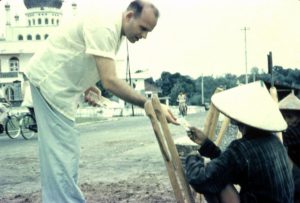
Keith Parks is pictured on the mission field in Indonesia. (IMB File Photo)
He and his wife, Helen Jean, were missionaries to Indonesia for 14 years before he joined the Foreign Mission Board home office staff, where he served in several administrative roles.
He went on to become the first coordinator of CBF Global Missions, serving in that role from 1993 to 1999.
When asked by the Baptist Standard in 2018 his favorite aspect of ministry, Parks responded: “Relating to and working with missionaries and local Christians all around the world. ‘Missionary’ is still my dominant DNA.”
Remembering the legacy of Keith Parks
IMB President Paul Chitwood expressed his gratitude for Parks’ legacy.
“We celebrate that Keith Parks and his wife gave decades of their lives to serving Southern Baptists in our cooperative mission work to get the gospel to the nations,” Chitwood said.
“While Keith served as president during a complicated time in Southern Baptist life, his intentional focus on taking the gospel to the unengaged is a lasting legacy that still marks IMB strategy to this day. I am grateful for that legacy.”
Todd Lafferty, IMB executive vice president and chief operating officer, also served on the mission field in Indonesia, in addition to other countries, before joining the U.S. staff. Lafferty said: “Keith Parks’ visionary and strategic leadership led us from familiar mission stations to unmarked roads in the missionary task to reach the least reached. His legacy lives on as we continue to seek to reach the remaining unengaged, unreached peoples in the world today.”
CBF Executive Director Paul Baxley similarly reflected on Parks’ legacy and contributions to the CBF Global Missions.
“Dr. Keith Parks was deeply committed to the global mission of Jesus Christ throughout his life,” Baxley said. “He provided visionary and transformational leadership in the establishment of CBF Global Missions. His experience, missiology and strategic clarity laid a strong foundation for our Fellowship’s participation in Global Missions.”
“Dr. Parks was deeply respected not only by our Fellowship at large, but also by our first generation of field personnel who were touched by his leadership, integrity and vision
“Our Cooperative Baptist Fellowship family joins me in offering prayers of gratitude for his life, leadership and personal participation in inviting people to faith in Jesus Christ and his mission of transforming love in the world.”
Field personnel recall Parks’ personal care
Jim Smith, retired field personnel and CBF Global Missions staff leader, remembered Parks as “sharp, friendly and unafraid to operate from the edges.”
“His vision for reaching the most unreached and most neglected around the globe made a difference in global missions. He visited works in a multitude of circumstances where he spoke very little and listened a lot,” he said.
Smith also fondly recalled Parks’ ministry at a person level.
“He called my mother just before she was operated on for spinal surgery. They actually waited to take her into the operation so he could pray for her. He never stopped learning and loving others,” Smith said.
Nell Green, retired CBF field personnel, likewise appreciated Parks’ care for the families of missions personnel.
“Dr. Keith Parks was our mentor, an inspiring leader, but simply ‘Uncle Keith’ to our children. He said once, ‘God does not call without a knowledge of your children.’ That helped us through some difficult times as we raised children overseas,” Green said.
Both Keith and Helen Jean Parks considered field personnel as family, she added.
“Keith was always ready to think through a problem with you. Helen Jean would drop everything and take time to pray with you,” Green said. “They were caring, thoughtful leaders ready to invest themselves personally in the lives of those sent out.”
‘Passionate about reaching the unreached’
Karen Morrow, retired CBF field personnel, called Parks “one of my heroes of the faith, who embodied the Christian mission to reach the nations with the gospel message.”
“He was passionate about reaching the unreached and those with limited access to the gospel and established CBF Global Missions to that end,” she said.
Keith and Helen Jane Parks’ participation in a prayerwalk she led in Turkey was “one of the highlights of my ministry,” Morrow said. She recalled Parks overlooking the city of Antioch “with tears in his eyes,” reflecting on how Christians there sent out Paul and Barnabas as the first gospel missionaries and praying “with gratitude for all God had done.”
“Because of Keith’s life, service and leadership, countless people around the globe have come to have a personal relationship with Christ,” Morrow said.
Parks, a native of Memphis in the Texas Panhandle, got his first taste of international missions as a student summer missionary to Colombia’s San Andrés Island.
Thirty years later, when Toby Druin of the Baptist Standard asked the newly named president of the Foreign Mission Board to describe himself, Parks responded, “I am a missionary.” That remained his identity until the end.
An era of new dangers and opportunities
“Parks’ leadership thrust the IMB into an unprecedented era of effectiveness toward fulfilling the Great Commission,” said Jerry Rankin, who succeeded Parks as the mission board president.
Keith Parks addresses Foreign Mission Board trustees at one of their meetings during his time as the agency’s president. (IMB File Photo)
“Missionary deployment around the world exploded under Parks’ predecessor, Dr. Baker James Cauthen,” Rankin said. “But Parks looked beyond successful growth to see that part of the world still unreached and closed to missionary presence.”
Parks’ time as Foreign Mission Board president coincided with world-changing events that brought new dangers—and opportunities—for Christian missionaries: the rapid spread of HIV/AIDS, growing numbers of terrorist attacks and assassinations, the end of apartheid in South Africa, the fall of the Berlin Wall, the Tiananmen Square protests, the dissolution of the Soviet Union and the proliferation of new technologies and birth of the internet.
Parks’ leadership was a match for the times. Southern Baptists in 1976 had adopted a goal of preaching the gospel to everyone in the world by the end of the century. It fell to Parks to determine what it would take to reach that goal.
The goal has yet to be reached, but research into what it would take yielded “crushing statistical evidence that without an enlarged vision of the world, Southern Baptists would never contribute their full share to global evangelization,” wrote Leland Webb, editor of the FMB’s TheCommission magazine at Parks’ retirement.
What the research revealed was more than 6,000 unreached peoples, ethnolinguistic groups who lived with few, if any, Christians among them, had little or no access to Scripture and did not welcome missionaries. The 1.9 billion people in those groups likely never would hear the name of Jesus.
‘New strategies to reach the unreached’
“Keith Parks was a missiologist par excellence,” Clyde Meador—who worked with four mission board presidents—once said of Parks. “He would do what he saw as right whether it was popular or not.”
Meador filled several key roles, including executive vice president, at the IMB before his death in 2024.
What Parks did was urge missionaries to develop daring new strategies to reach the unreached. This gave birth in 1985 to Cooperative Services International, which assigned teachers, doctors, businessmen and humanitarian workers to countries closed to traditional missionaries.
Later, the nonresidential missionary program was born for missionaries to develop creative ways to reach unreached people they could not live among.
“Parks’ vision positioned Southern Baptists to respond to the fall of the Soviet Union and laid the groundwork for changes that followed his tenure to focus on people groups instead of countries and engaging the unreached,” Rankin said.
Parks also challenged Southern Baptists to consider countries where missionaries had long worked as partners in reaching the world. On his last overseas trip as FMB president, to participate in a meeting of Baptist leaders from across the Americas, Parks challenged participants to begin sending their own missionaries as partners in God’s mission.
“Too many Christians in this world are convinced their responsibility is only to the people of their culture and language,” Parks said.
“We’ll never reach the world for Christ if we restrict ourselves to our own language and culture. Local interest always wins when culture dominates Christianity. Global interest wins when Christianity dominates culture.”
Native Texan and faithful missionary
After serving as pastor of Red Springs Baptist Church in Seymour, and as an instructor in Bible at Hardin-Simmons University in Abilene, Parks and his wife, the former Helen Jean Bond, were appointed in 1954 as career missionaries to Indonesia, where they served until 1968.
There he served at the Baptist Theological Seminary of Indonesia in Semarang, Java. He also did evangelistic work in Semarang, was mission treasurer in Jakarta and spent a furlough as an associate secretary in the missionary personnel department at the FMB’s home office in Richmond, Va.
Parks joined the home office staff in 1968, leading work in Southeast Asia from 1968 to 1975; directing the mission support division from 1975 to 1979; serving as executive director-elect, September through December 1979; and executive director (title changed to president in May 1980) from Jan. 1, 1980, to Oct. 31, 1992.
Parks earned the Bachelor of Arts degree from North Texas State College (now University of North Texas) in Denton, and the Bachelor of Divinity and Doctor of Theology degrees from Southwestern Baptist Theological Seminary in Fort Worth.
The Parks joined First Baptist Church in Richardson in 2000, where they taught the International Bible Class.
His wife of 69 years, Helen Jean, and their daughter, Eloise, both died in 2021.
He survived by: son Randall and his wife Nancy; son Kent and his wife Erika; son Stanley and his wife Kay; grandchildren and great-grandchildren.
Parks was the author of Crosscurrents (Convention Press, 1966), World in View, A.D. 2000 Series (New Hope Press, 1987) and numerous articles and columns. He is the subject of Keith Parks: Breaking Barriers & Opening Frontiers, a biography by Gary Baldridge.
Compiled by Managing Editor Ken Camp from information provided byMary Jane Welch of the International Mission Board and Aaron Weaver of the Cooperative Baptist Fellowship.
On the Move: Dorrell, Ritsema
August 29, 2025
Josh Dorrell to Coastal Community Church in Galveston as pastor. He previously served at Galveston Urban Ministries, where he was founding executive director.
David Ritsema to B.H. Carroll Theological Seminary as assistant dean, effective Sept. 1. Ritsema currently serves as pastor of First Baptist Church in Waxahachie.
Global Baptist leaders honored in Ukraine
August 29, 2025
At Ukraine’s National Independence Day celebration in Kyiv, President Volodymyr Zelensky conferred Order of Honor medals on two global Baptist leaders to recognize Baptist contributions toward providing hope and aid to the people of Ukraine.
Baptist World Alliance General Secretary Elijah Brown and European Baptist Federation General Secretary Alan Donaldson display the medals presented by President Volodymyr Zelensky. (Photo Courtesy of BWA)
During a ceremony marking the 34th anniversary of when Ukraine regained its independence, Zelensky awarded Elijah Brown, general secretary of the Baptist World Alliance, the Order of Prince Yaroslav the Wise medal. He presented an Order of Merit medal to Alan Donaldson, general secretary of the European Baptist Federation.
“It was a humbling experience to attend the ceremony and receive this honor on behalf of the Baptist World Alliance. This recognition is a reflection of the tireless dedication and courageous service of Ukrainian Baptists on the front lines, as well as the unwavering support of the entire global Baptist family,” Brown said.
“To receive such an honor in the midst of war is also a poignant reminder that much remains to be done. May we all continue to work together for lasting and just peace in Ukraine and around the world.”
Brown was the first leader of a worldwide Christian fellowship to visit Ukraine in the immediate aftermath of the full-scale Russian invasion of the nation on Feb. 24, 2022.
He met with leaders of the All-Ukrainian Union of Evangelical Baptist Churches—the country’s largest Protestant group, with more than 2,000 congregations.
Baptists instrumental in humanitarian aid
As soon as the escalated invasion began, Baptists in Ukraine mobilized churches along evacuation routes to provide food, rest and respite care for internally displaced people journeying from east to west.
Ukrainian Baptists also established “centers of hope” at churches in the nation’s western regions to shelter displaced individuals and families.
With BWA support, the European Baptist Federation coordinated humanitarian relief. The first truckload of humanitarian supplies left Hungary on the day the full-scale invasion began.
BWA reported “the global Baptist family has collectively helped more than 2 million people,” including with temporary shelter, food, medical care, psychosocial support, summer camps for children and mobile serving people near the front lines. Direct BWAid investment totaled more than $4.8 million.
In addition, BWA provided 10,000 Bibles and pastoral support, as well as advocating for strengthened religious freedom protection and support for persecuted people of faith.
Emphasis on prayer for a just peace
The ceremony in Sophia Square took place on the day Ukrainian Baptists and other religious groups urged people of faith internationally to pray for their nation.
“In this time of trials, we need not only political and humanitarian support, but also spiritual solidarity—through prayers, compassion and fraternal participation.” Valerii Antoniuk, president of the Baptist Union of Ukraine and chair of the All-Ukrainian Council of Churches and Religious Organizations, wrote in an online letter.
Elijah Brown, general secretary of the Baptist World Alliance, addresses the Ukrainian National Prayer Breakfast.
Independence Day ceremonies continued at the Ukrainian National Prayer Breakfast at the Mystetski Arsenal in Kyiv. Brown and Donaldson were among 350 foreign guests from 50 nations who attended.
Donaldson described Ukraine as “a nation of beauty and brokenness—a nation that is fighting for many freedoms.”
“Among its diminishing population are many people of Christian faith who are seeking understanding of their circumstances and direction for how to live, speak and share hope,” Donaldson said.
“Many are grieving the loss of loved ones through displacement, abduction or the loss of life. We meet victims of torture who testify to the destruction of places of worship and the systemic violence experienced by believers in the occupied territories.”
He described the Ukrainian National Prayer Breakfast as “a moment in history where these stories were acknowledged, recorded and grieved—where prayer was offered by people of all ages and a variety of nations who seek to stand in solidarity with Ukraine’s desire to live in freedom.”
With information provided by Merritt Johnston of BWA.
MedAdvance highlights importance of health care missions
August 29, 2025
RALEIGH, N.C.—Health care missions provide access to millions of people who’ve never heard of the Great Physician, and health care professionals play a crucial role in prescribing treatment for both physical and spiritual needs.
These were some of the messages attendees of MedAdvance heard. The conference was designed to inform, mobilize and connect health care professionals and students with International Mission Board missionaries serving in medical missions roles.
Held yearly since 2007, MedAdvance 2025 met in Raleigh, N.C., from Aug. 21-23 at Providence Church.
More than 300 people, including 47 health care students, attended. Participants included an endodontist, nurses, physician assistants, an OBGYN, general practitioners, nurses who are members of a chapter of the Filipino Woman’s Missionary Union and a church volunteer coordinator.
Some MedAdvance participants, like a physician assistant and her family who are preparing to move to West Africa and a nurse who is pursuing work among the Deaf, are currently in the process of serving with the IMB. Others, like the group of Filipino nurses, were exploring ways to serve. Others were looking to get involved through prayer and giving.
Dr. Tom Hicks speaks with a health care professional at MedAdvance 2025, which met in Raleigh, N.C. Hicks said many people come to MedAdvance because the Lord is calling them in some way, whether it is short-term, mid-term, long-term. “We’re always looking for ways that we can help fill those requests,” he said. (IMB Photo)
Tom Hicks, IMB director of global health strategies, said he’s seeing a movement of greater understanding among Southern Baptists of how the IMB is involved in health care missions.
Hicks’ prayer was that attendees would see how they can participate in healthcare missions, whether that’s praying more effectively, giving specifically and strategically or going. The many commitment cards placed on two maps of the world at the end of MedAdvance were evidence this prayer was answered.
IMB President Paul Chitwood told participants via video that 12 percent of the IMB’s missionary workforce have a medical background. IMB missionaries are touching the lives of 50,000 people through healthcare ministries every year.
MedAdvance attendees participated in an affinity marathon, where they heard about the health care ministries of missionaries from the IMB’s eight regions of service, including global Deaf ministry.
Health care ministries included art therapy for trauma survivors in Europe, training national medical workers in Sub-Saharan Africa, disease prevention in the Americas and pre- and post-natal care in the Asia-Pacific Rim.
The affinity marathon allowed conference attendees to learn about short- and long-term opportunities to serve.
Health care professionals attended breakout sessions on topics such as how to be a health care volunteer, engaging Hinduism and Islam, fitness and wellness strategies and how to address human needs in your community.
Veteran missionary doctor discusses strategies
In two packed sessions, Dr. Rebekah Naylor spoke on the core missionary task as it relates to health care missions. Naylor served 50 years with the IMB at Bangalore Baptist Hospital in India as a surgeon, chief of medical staff, administrator and medical superintendent.
Naylor walked MedAdvance participants through the ABCs (and DEs) of health care strategies: access, behind closed doors, caring for needs, disciple-making and empowering the church. Each of these connects with components of the core missionary task: entry, evangelism, disciple-making, leadership development, church formation and exit to partnership.
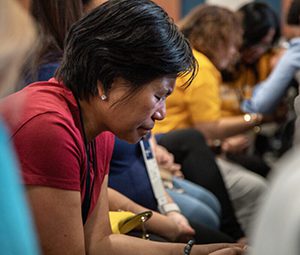
Rowena Mante prays during a guided prayer time during MedAdvance 2025. Mante is a nurse originally from the Philippines. She partnered with IMB missionaries in the Philippines while she lived there. She lives in Winston-Salem, N.C., and is a member of the Triad Journey Church, which is a predominantly Filipino church. She is a member of the Filipino Woman’s Missionary Union and the Baptist Nursing Fellowship. (IMB Photo)
MedAdvance participants also learned about the Dr. Naylor Preach and Heal fund, which provides money for the health care ministries of IMB missionaries. Donations provide resources and services like ultrasound machines in the Asia-Pacific Rim, repairs for a gym in Thailand where IMB missionaries started a church and trauma-informed coloring books for refugee children.
Victor Hou, IMB associate vice president of global advance, reported from 2000 to 2100, the global population is projected to exceed the number of people who lived in the previous 600 years. An estimated 24.9 billion people will live, breathe and die in 100 years.
“Much of the credit goes to those of you who are health care professionals,” Hou said. “Because of your skills, because of the advances of medical technologies, because of the training and what you’re able to bring, we’ve seen lives extended. We’ve seen longevity in lifespan, and we are better at treating diseases and keeping people healthier.”
However, there is no earthly cure for the diagnosis every human receives at birth.
“Why has God placed us in this generation, in this era, in this time when we see the greatest number of people on earth and unprecedented human growth?” Hou asked.
“God has given all of us and the church this opportunity to steward his gospel to the greatest number of people who have ever walked the face of the earth.”
‘We are going to make disciples’
April Bunn, the IMB’s prayer office director, led participants through three prayer sessions. She reported 166,338 people die daily having never heard the name of Jesus.
Dr. Joel Vaughan spoke during two sessions. Vaughan is an internal medicine and pediatrics physician and served for 10 years with the IMB. He now practices medicine for a Duke Health primary care clinic in Raleigh.
Dr. Joel Vaughan speaks to gathered medical professionals, students and IMB personnel as part of MedAdvance 2025. Twenty-two years ago, sitting in this same sanctuary, the trajectory of Vaughan’s life changed. Vaughan, an internal medicine and pediatrics physician, served with the IMB for 10 years. He now practices medicine for a Duke Health primary care clinic in Raleigh, N.C. (IMB Photo)
“When we go, we’re not going principally to treat diabetes or rehab a bad contracture or remove a gallbladder. We’re going to make disciples,” Vaughan said.
Vaughan’s journey to the mission field began at Providence, just a few feet from where he stood.
As a 22-year-old, he sat in the sanctuary and petitioned the Lord to show him what he should do after graduating. After pleading for weeks, God answered through someone who read John 14:6, “I am the Way, and the Truth and the Life, no one comes to the Father except through me.”
Vaughan suggested that some in the room were in a similar situation this weekend.
“Jesus shows the way as we walk with him, as we follow him, as we’re willing to do whatever he asks us to do,” Vaughan said. “He’s going to use who you are, what you have and your skills.”
Todd Lafferty, the IMB’s executive vice president, was the key speaker during the evening sessions.
“Some of you might be sensing [God] wants you to go full time,” Lafferty said. “Now is the time to use your health care skills and combine that with the need on the field to reach people that wouldn’t otherwise be reached.
“You have a unique opportunity in the mission in our day to get to the places where most people can’t because of the skills that you have.”
Dr. Nora Chiu, an OBGYN from Houston, attended MedAdvance last year and felt the Lord leading her to use her medical skills on the mission field. She began the application process with the IMB and came to this year’s MedAdvance to confirm her calling.
“I would have never imagined using medicine to do missions,” Chiu said. “There are so many needs I didn’t realize.”
Attending this year’s MedAdvance helped confirm her call.
During the closing session, attendees were encouraged to make a commitment to partner by marking a commitment card. According to early reports, 70 committed to pray, 49 were interested in short-term trips, 12 indicated interest in mobilizing for health care missions and 35 committed to pursuing mid- or long-term service.
Around the State: Wayland students volunteer after Central Texas floods
August 29, 2025
When floodwaters surged through Central Texas during the Fourth of July weekend, two nursing students from Wayland Baptist University’s Ben and Bertha Mieth School of Nursing in San Antonio didn’t hesitate to act. Valerie Hedenland and Elizabeth Santos, both enrolled in Wayland’s Licensed Vocational Nursing to Bachelor of Science in Nursing program, volunteered their time and medical expertise to assist with search and recovery efforts in Leander, one of the hardest-hit areas. The two, both military veterans and close friends, responded through Intrepid Care, a veteran-run nonprofit that mobilized quickly to support first responders on the ground.
Wayland Baptist University students arrived on campus for Koinonia, the university’s four-day welcome celebration held Aug. 15 to 18. Koinonia is a New Testament Greek word meaning fellowship, community, and shared purpose. Designed to help new and returning students connect with each other, faculty and staff, Koinonia blends Wayland traditions with plenty of opportunities for fun.
Buckner International is kicking off a Fall Farm Fest on Sept. 13 from 11 a.m. to 1:30 p.m. at the Buckner Family Hope Center at Oak Cliff. The celebration offers a safe way for neighbors to come together and enjoy games, children’s activities, food and raffles. The event will raise awareness about Buckner services as well as community resources for family health and other support services.
Buckner Children and Family Services has announced two promotions and addition its staff. Andi Harrison, who served for 13 years as regional director of foster care for Buckner, was promoted to senior director for domestic foster care and adoption. Monocra Burroughs was named executive director of Buckner Children and Family ServicesinHouston. Burroughs has served Buckner Children and Family Services in Beaumont more than 26 years as a foster care case manager, foster care and adoption supervisor, program director, and most recently as the interim executive director. Christie Moreno was namedexecutive director of Buckner Children and Family Services in Lubbock. Moreno joins Buckner with mote than15 years of nonprofit experience in ministry, education, children and family services.
Dallas Baptist University baseball accepted an invitation to join the Pac-12 Conference as an affiliate member on July 1, 2026, with the Patriots’ inaugural Pac-12 season set for 2027. In spring 2027, DBU will compete alongside six established programs, a group that includes national champions Oregon State and Fresno State, as well as Washington State, Gonzaga, San Diego State and Texas State University.
The University of Mary Hardin-Baylor celebrated the beginning of the school year and welcomed more than 700 new freshmen to campus during its 180th fall convocation Aug. 13. The student body consists of 2,779 undergraduate and 497 graduate students attending classes at UMHB, for a total fall enrollment of nearly 3,300. This year, UMHB is offering an elementary classroom music class designed specifically for homeschooled first-, second- and third-graders this fall. Beginning Sept. 12, the class will meet once a week for 10 weeks. Each class will include 30 minutes of activities, games, and study aimed at learning basic music concepts. Experienced classroom music teachers will lead the class, and UMHB music education majors will assist in instruction and activities.
Hardin-Simmons University held its fall convocation Aug. 26 where keynote speaker Neal Jeffrey shared words of encouragement. Once an All-American quarterback at Baylor University and an NFL draft pick with the San Diego Chargers, Jeffrey presented his personal story of perseverance and faith. Overcoming a stuttering impediment, he embraced the way God made him and found his calling as a public speaker sharing the gospel.
Anthony King, a professor at Wayland Baptist University, is returning to restart the university’s instrumental music program, stepping back into a position he had to leave in December 2020, when the program was canceled. He first joined Wayland in 2012 as an adjunct instructor and became full-time in 2013 while finishing his doctorate at Texas Tech University. King played with the Disney World Band while earning a five-year Bachelor of Music Education degree from University of Central Florida. He first joined Wayland in 2012 as an adjunct instructor and became full-time in 2013 while finishing his doctorate at Texas Tech.
The Marsh Institute for Chaplains and the Digital Theological Library announced a strategic partnership to translate The Heart of a Chaplain: Exploring Essentials for Ministry, 2nd Edition, into multiple languages. This initiative brings together the Marsh Institute’s experience in chaplaincy formation and DTL’s cutting-edge digital infrastructure, multilingual publishing capacity and global accessibility platforms, according to Jim Browning, director of the Marsh Institute.
Russian Baptists continue to meet after building sealed
August 29, 2025
The Russian Supreme Court in Moscow is scheduled Aug. 28 to hear the appeal of an unregistered Baptist church in Kurganinsk whose building was sealed by government officials in May.
In response to a court order issued last October, bailiffs sealed the building on May 16 and denied members access to the Council of Churches Baptist “house of prayer” unless the church submitted to state registration.
However, three months after authorities sealed the building, Baptists continue to meet outside their facility to pray and worship, an Oslo-based news service focused on international human rights and religious freedom reported.
Forum 18 quoted a Baptist in Kurganinsk who “witnessed church members young and old praying on their knees, right on the pavement” outside the building.
Judge Vitaly Yakonov asserted religious activities by the Council of Churches Baptist community in Kurganinsk created “a threat to the security of public interests, national security [and] public order, as well as the rights and interests of an undefined circle of persons involved in the activities of the group through illegal missionary activity,” Forum 18 reported.
Pastor Aleksandr Chmykh unsuccessfully appealed the October judicial ruling both in regional court in November and at the 4th Cessational Court in Krasnodar in May.
Baptists in Kurganinsk continued to meet for worship services and other gatherings, prompting bailiffs to fine the pastor 50,000 rubles for failing to fulfill the court’s demands.
Courts impose prohibitions on religious activity
Russian courts have imposed similar prohibitions on several other Council of Churches Baptist communities, and prosecutors are seeking to bar religious gatherings by at least three other congregations, according to Forum 18.
In the last 20 months, five unregistered Baptist churches in Russia—mostly in the Krasnodar region—have faced lawsuits or had their activities prohibited by authorities, the news service reported.
Council of Churches Baptists formed in the 1960s in opposition to Soviet religious restrictions, such as government regulation of sermon content, pastoral appointments and religious instruction of children.
Since the collapse of the Soviet Union, Council of Churches Baptist—numbering about 2,500 congregations—have asserted the Russian Constitution, the 1997 Religion Law and international human rights law provide them the right to meet for worship without government involvement and state registration.
Council of Churches Baptist congregations often meet in private homes—or houses of prayer—on private land.
Alleged ‘illegal missionary activities’
The U.S. Commission on International Religious Freedom cited the government’s closing of the Baptist house of prayer in Kurganinsk for alleged “illegal missionary activities” in its July report, “Russia’s Persecution of Religious Groups and FoRB Actors.”
Russian authorities continue to perpetrate “particularly severe violations of religious freedom against a range of religious groups and freedom of religion or belief actors,” the commission report said. Violations cited include closing houses of worship, as well as assaulting, arresting and even torturing religious leaders.
Russian courts in 2024 considered 431 cases of religion law violations—many related to alleged “illegal missionary activities”—resulting in fines totaling more than 4.7 million rubles (more than $58,000), the report said.
Since 2017, the U.S. Commission on International Religious Freedom has recommended Russia be named a Country of Particular Concern for engaging in “systematic, ongoing and egregious” religious freedom violations. The U.S. Department of State designated Russia as a Country of Particular Concern in 2021, 2022 and 2023.
In its latest annual report, the commission not only urged the State Department to continue to designate Russia as a Country of Particular Concern, but also impose targeted sanctions on Russian government agencies and officials responsible for religious freedom violations.
Gallup poll reveals Americans’ views on moral issues
August 29, 2025
NASHVILLE (BP)—Americans don’t see much wrong with using birth control or getting a divorce, but few support extramarital affairs or human cloning.
The latest poll results from Gallup spell out what activities U.S. adults view as morally acceptable and which ones are seen as immoral.
Most Americans believe birth control (90 percent), divorce (75 percent), sex between an unmarried man and woman (68 percent), having a baby outside of marriage (67 percent), gay or lesbian relations (64 percent), gambling (63 percent), human embryonic stem cell research (63 percent), buying or wearing animal fur clothing (61 percent), the death penalty (56 percent), and doctor-assisted suicide (53 percent) are morally acceptable.
U.S. adults are more divided on abortion (49 percent morally acceptable versus 40 percent morally wrong) and medical testing on animals (47 percent morally acceptable versus 47 percent morally wrong).
Fewer Americans say sex between teenagers (41 percent), changing one’s gender (40 percent), pornography (35 percent), cloning animals (34 percent), polygamy (21 percent), suicide (21 percent), cloning humans (8 percent), and married men and women having an affair (8 percent) are morally acceptable choices.
Generally more permissive
The moral views of Americans are not static, however. Many have shifted over the more than 20 years Gallup has conducted this poll. Mostly, Americans have grown more permissive.
Only medical testing on animals has seen a sustained, significant decline in the percentage of adults who view it as morally acceptable. In 2001, 65 percent of Americans said it was morally acceptable. Now, just 47 percent support it.
The percentage of those who view the death penalty as morally acceptable also has dropped, but the dip has been smaller and less sustained over the past three decades—63 percent in 2001 to 56 percent in 2025.
Support for changing one’s gender also fell this year, but it only has been asked in the past four years. In 2021, 46 percent believed it was morally acceptable. In 2025, 40 percent still agree. A 2016 Lifeway Research study of Americans found only 35 percent believed it was morally wrong for an individual to identify with a gender different than the sex they were born.
A 2021 Lifeway Research study of U.S. Protestant pastors found 72 percent say it’s morally wrong to identify with a gender different from your birth sex, and 77 percent say it’s morally wrong to change the gender you were born with through surgery or taking hormones.
On the other hand, Gallup found numerous activities have become more socially acceptable in America since 2001, including divorce (59 percent to 75 percent), sex between an unmarried man and woman (53 percent to 68 percent), gay or lesbian relations (40 percent to 64 percent), and suicide (13 percent to 21 percent).
Other activities were first asked about more recently, but they have also seen growth. Since 2002, support for both having a baby outside of marriage (45 percent in 2002 to 67 percent in 2025) and medical research using stem cells obtained from human embryos (52 percent in 2002 to 63 percent in 2005) has increased.
The percentage of Americans who believe polygamy is morally acceptable has tripled since 2003—from 7 percent to 21 percent. More people are also accepting of sex between teenagers (32 percent in 2013 to 41 percent in 2025).
Some approval ratings remain stable
Other activities have had more stable levels of approval since Gallup first asked. Since 2012, birth control has only wavered plus or minus two points from 90 percent.
Buying and wearing clothing made from animal fur has stayed near 60 percent. Gambling has stayed mostly in the 60s. Support for the death penalty has been around 60 percent.
Approval of doctor-assisted suicide has stayed around 50 percent. Those who approve of pornography have hovered somewhere around 30 percent to 40 percent.
The percentage who support cloning animals has stayed mostly in the 30s, while cloning humans and married men and women having an affair have hovered around 10 percent.
Abortion has been more volatile than the other issues. Those who find it morally acceptable have stayed mostly in the 40s, but it has fluctuated from anywhere between 36 percent and 54 percent over the past two decades.
Generational differences noted
Younger adults, ages 18-34, are often more permissive than their elders. Around 3 in 10 (31 percent) say polygamy is acceptable, compared to 10 percent of those 55 and older.
Most (55 percent) are OK with changing one’s gender, while just 35 percent of older Americans support the practice.
Americans under 35 also are more supportive of gay or lesbian relations, abortion, sex between an unmarried man and woman, sex between teenagers, pornography, buying or wearing animal fur clothing, cloning animals, cloning humans, having a baby outside of marriage, divorce, suicide, gambling, doctor-assisted suicide and the death penalty.
Meanwhile, they are less in favor than those 55 and older of human embryonic stem cell research, birth control, married men and women having an affair, and medical testing on animals.
Water Impact ministry sees God move in Peru
August 29, 2025
Texans on Mission is not only bringing fresh water and good hygiene practices to people in the Andes Mountains of Peru, but also bringing the gospel, with 46 professions of faith recorded during an August mission trip.
“We have moved our efforts in Peru from the Amazon River basin to the mountains because of various logistical challenges that surfaced along the river,” said Mitch Chapman, director of Texans on Mission Water Impact. “Now we are seeing God really move through our work.”
Texans on Mission volunteers serve on a Water Impact trip to Peru, where they brought fresh water, good hygiene practices and the gospel to people in the Andes Mountains. (Texans on Mission Photo)
Texans on Mission drilling efforts in Peru have produced one successful well in the Andes, and the August team began work on a second well for another community with residents scattered throughout the mountainside.
The dry season lasts six to eight months in the Andes. Springs dry up, and pond water becomes “nasty,” said Julio Campos of Gateway Church in Justin, one of the Texas leaders in the work in Peru.
“The pond water is all they have to drink unless they walk or get to other water sources, in some cases two to four hours down the mountain and back during the dry season.”
Water Impact identified increasing opportunities in the area and began working in the region in January, but the mountains create challenges.
The mountain faces are, in places, “sheer straight up and very close to each other,” requiring multiple roadway “switchbacks all the way up the mountains,” Campos said.
Still, the first Texans on Mission well struck water at 80 meters in Capulipampa.
The August mission team divided into two groups—one to drill a new well in Llimbe and the other heading to Capulipampa to do evangelistic work.
Women receptive to the gospel
The evangelism team had planned to work with children—telling Bible stories, distributing Gold-to-Gold gospel bracelets, playing games and singing. It turned out the women of the community were open to learning through Bible study, which diverted some of the team’s efforts.
Delia Lozuk of Alice, former missionary to Venezuela, teaches a Bible study to women in the Andes Mountains of Peru during a Texans on Mission Water Impact trip. (Texans on Mission Photo)
Team member Delia Lozuk of Alice “ministers like no one I’ve ever seen,” Campos said. “Ministry to women is her forte.”
On the first day, 10 to 15 mothers brought their children to be part of the activities, Campos said. By the end of the day, Lozuk “got a Bible study going on” with even more women.
Team member Rhonda Dodson said about 40 women ended up participating in the two days of Bible study led by Lozuk, and 30 of them eventually made professions of faith in Christ.
Paul Lozuk of Alice, a former missionary to Venezuela, uses a Gold-to-Gold gospel bracelet to present the Christian plan of salvation to a young man in Peru during a Texans on Mission Water Impact trip. (Texans on Mission Photo)
She and her husband Paul are former missionaries to Venezuela, and both speak Spanish.
“My wife Delia has an extraordinary anointing with women,” and especially with “these people that are descendants of the Inca,” Paul Lozuk said.
He explained people living in the Andes are a distinctive group.
“They are short of stature and extremely strong,” walking long distances at high altitude, he said. They also dress in traditional clothing, and “the women don’t talk too much to the men, especially foreigners,” he added.
The cultural preference for women to communicate with other women opened the door for ministry in the Andes.
Making Bibles available
“One thing I understand,” Delia Lozuk said. “There is no doubt that these people from Peru really do need Jesus as their Lord and Savior, and most do not have a Bible.”
Local pastor Alex Miranda had boxes of New Testaments, so the team handed them out. “He had enough for every single person, every woman,” she said, and copies of the complete Bible were ordered for distribution.
“The people were very hungry for the word” of God, said Dodson, a Texans on Mission Water Impact employee who was on her first mission trip. “When we were in Capulipampa, the ladies’ request was for Bibles. So, of course, we’re going to get them Bibles.”
The Bible studies took on the form of a conversation, Delia Lozuk said. The women living in the Andes were “hungry for something, and I asked them, in the middle of just having small conversations, about the Bible, about the word of God. I was trying to put everything I could in there so they could get a little bit of a taste of what I was trying to say.”
A ‘God-appointed time’
She saw the trip to Peru as being a “God-appointed time for me. … I didn’t know I was going to minister to women.” She went only as an interpreter, but “something happened the first day” as more and more women gathered.
“Women are very hungry, but we don’t know, because they don’t speak with the men for some reason,” she said. “They’ve heard about a Savior, but they don’t know the Bible.
“I’m thinking, ‘What the heck are you doing, Delia?’ But it’s not my show; it’s God’s show.” So she did another unexpected thing; she gave the women homework—Scripture to read so they can discuss it together sometime in the future.
With an expectation of a return trip, Lozuk promised to “literally give them a little nugget about every single book in the Bible” to whet their appetite for additional Bible study.
Six of the women attending the meetings stood up with excitement when asked if anyone had given their lives to Christ. By the end of the two days, all of the others had professed faith in Christ.
‘God just took control’
“It was my impression that God set all this up,” and the team “just walked into it,” Delia Lozuk said. “God just took control, and that’s really what happened. … God did this through us.”
The drilling of the second well and the evangelistic outreach did not occur in a vacuum of ease. Campos said he asked in his daily devotionals with the team for “God to show up.”
When luggage and a passport were lost, the group prayed. No matter the difficulty, Campos said the theme of the trip became, “just ask”—ask God for help. And each time, the prayers were answered.
With the success of the well drilling and the women’s ministry, Campos said the mission trip “went fantastic.”
Chapman said: “The well we drilled in Capulipampa laid the foundation for all that happened evangelistically on the trip. And now, with the second well in Llimbe, we are continuing to pursue our vision of bringing clean, sustainable water to as many people as possible while sharing the gospel of Jesus Christ to people in need of both.”
Discipleship a priority without a plan for many churches
August 29, 2025
BRENTWOOD, Tenn.—Pastors have a lot of thoughts about discipleship, but they aren’t sure it’s happening in their churches.
In the first part of the State of Discipleship study from Lifeway Research, U.S. Protestant pastors shared their understanding of what discipleship means and how it best occurs.
“Making disciples was the Great Commission Jesus gave his followers before he returned to heaven,” said Scott McConnell, executive director of Lifeway Research.
“This biblical priority warrants that church leaders regularly take a careful look in a mirror to see the state of discipleship in their congregations. This study provides a view of the state of discipleship across all Protestant churches in the U.S.”
In general, pastors have a vague satisfaction with the discipleship happening at their churches but no real way of determining if that is valid. Half (52 percent) are satisfied with discipleship and spiritual formation in their churches, but only 8 percent strongly agree.
Similarly, 52 percent have an intentional plan for discipling individuals in their congregations and encouraging their spiritual growth.
Additionally, 7 in 10 (71 percent) believe there are ways to measure discipleship in a congregation. Despite their current satisfaction and belief in measurements, however, just 30 percent say their churches have specific methods for measuring discipleship, including only 5 percent who strongly agree.
Pastors identify key concepts
When asked about discipleship, pastors volunteered varying key concepts. They’re most likely to say spiritual growth or discipline (12 percent) and Bible study and reading or Scripture memorization (10 percent) are components of discipleship.
Some point to mentoring or meeting one on one (7 percent), teaching/training (6 percent), prayer (6 percent), making disciples (5 percent) and groups (5 percent).
One in 25 pastors mention relationships (4 percent), accountability (4 percent), obedience or following Jesus (4 percent), equipping believers (4 percent), sanctification or becoming more Christlike (4 percent) and community (4 percent). Slightly fewer say discipleship involves time (3 percent) and serving (3 percent).
Other aspects of discipleship specified by pastors include Bible knowledge or literacy (2 percent), evangelism or outreach (2 percent), application (2 percent), maturity (2 percent), leadership (2 percent) and commitment (2 percent).
Fewer say doctrine (1 percent), Great Commission (1 percent), intentionality (1 percent), multiplication (1 percent), the gospel (1 percent), strengthening or iron sharpening iron (less than 1 percent) or fellowship (less than 1 percent). Additionally, 1 percent of U.S. Protestant pastors say they don’t know.
“In one sense, discipleship simply brings intentionality to following Jesus Christ, but it quickly becomes complex when we consider the many ways we need to walk in obedience and how to encourage these in a local church,” McConnell said.
“The variety of ways that pastors describe key elements of discipleship illustrates there are multiple paths but also highlights the need for a framework for thinking through how a church is approaching discipleship.”
Different priorities
With pastors having many of those components of discipleship in their minds, it’s no wonder they often have different priorities and plans for spiritual growth among the people in their congregations.
Pastors are split on what best describes the first priority of activities included in their church’s plan for discipling people. Almost half (46 percent) say they are more focused on biblical knowledge, while 38 percent focus on relationship and encouragement. Fewer say their plan prioritizes equipping and “how-to” (9 percent) or experience and service (5 percent).
Around 9 in 10 Protestant pastors (89 percent) say they use sermons during the weekly worship service as at least one approach to discipleship and encourage the spiritual development of adults in their congregations.
Most churches also use adult Sunday School classes (69 percent), adult small group Bible studies (62 percent), women’s groups or classes (57 percent) and pastor-led teaching times like Sunday or Wednesday evenings (54 percent).
Fewer point to men’s groups or classes (45 percent), study groups or classes for all adults (42 percent) or mentoring or coaching relationships (31 percent). Around 1 in 7 (14 percent) specifically use accountability groups.
A third of pastors (33 percent) say the weekly sermon is the most important for their adult discipleship ministry. Almost 1 in 6 say adult small group Bible study (18 percent) or adult Sunday School (18 percent) is top priority for their congregations.
One in 10 (10 percent) highlights the pastor-led teaching times outside of Sunday morning. Fewer mention mentoring (7 percent), study groups for all adults (6 percent), accountability groups (2 percent), men’s groups (2 percent) or women’s groups (1 percent).
“Ninety-nine percent of churches have at least one approach they use to disciple adults in their congregation, and on average, churches use more than four methods,” McConnell said.
“Discipleship is clearly important to churches. Pastors are not saying they’re trusting a program, but they recognize they must have systems to encourage spiritual development.”
Decentralized approach
Among churches that have a discipleship plan, it might not be unified throughout their ministries to men, women, students, children and other groups.
Pastors with a plan are split between having each ministry develop its own plan for discipling individuals (50 percent) and having a single discipleship plan that all ministries take part in (45 percent). Another 5 percent aren’t sure.
Not every church has targeted discipleship programs for various groups within the congregation. Two in 3 pastors (66 percent) say their churches have a specific program for the spiritual growth of women. Slightly fewer (61 percent) say the same about men.
Most churches have targeted discipleship programs for middle and high school students (57 percent) and elementary age children (57 percent). Around a third target young adults (36 percent) and preschoolers (34 percent) with discipleship programs.
One in 5 (21 percent) do so for college-age adults. Almost 1 in 7 (14 percent) say they don’t have targeted spiritual growth programs for any of these groups.
“Among all Protestant churches, more than a quarter have decentralized discipleship plans for ministries, less than a quarter have a single discipleship plan for their whole church, and around half do not have an intentional discipleship plan,” McConnell said.
“Healthy churches have a plan for discipleship. Clearly, the first step for encouraging spiritual development is developing an intentional plan to do so. And the elements and scope of those plans can vary greatly.”
Importance of relationships
However churches seek to help their people grow spiritually, pastors believe that growth will happen best with other people involved. Almost all (95 percent) say discipleship is not completed in a program but in a relationship.
Most believe that disciple-making relationships must include physical presence. Only 22 percent believe discipleship can be as effective virtually as in-person, while 3 in 4 (75 percent) disagree.
With that, 7 in 10 U.S. Protestant pastors believe discipleship is best accomplished one-on-one or in groups among no more than five people. Specifically, 2 in 5 (40 percent) say it’s best in small groups of two to five believers, while 29 percent place the emphasis on one believer discipling another one-on-one. Another 17 percent say discipleship is best accomplished in small groups of six to 25 believers.
Few say the right number for discipleship is an individual believer on their own (2 percent) or in a large group of more than 25 (1 percent). One in 10 (11 percent) aren’t sure.
“There is a clear discrepancy in the discipleship thinking of many pastors,” McConnell said. “Seven in 10 say discipleship is most effective with close relationships, but a third say their large group sermons are the top discipling ministry of their church.
“While preaching is definitely a biblical activity required of pastors that can encourage sound doctrine and unity, good discipleship requires just as much intentionality in relational approaches to discipleship.”
The survey of 2,620 Protestant pastors was conducted Sept. 10-30, 2024. Analysts weighted the results by region, church size, and denominational category to reflect the population more accurately. The completed sample is 2,620 surveys, providing 95 percent confidence the sampling error does not exceed plus or minus 2.05 percent. Margins of error are higher in sub-groups.
Pastors at conference address racism in their churches
August 29, 2025
NORCROSS, Ga. (RNS)—As Josh Clemons, the executive director of OneRace, an anti-racist Christian organization, kicked off its racial reconciliation conference, he compared efforts to clean the church from the sin of racism to an ancient Japanese art practice, kintsugi.
The centuries-old method consists of mending broken pottery by welding pieces with liquid gold. Once repaired, the new ceramics are embellished by shining golden cracks, proudly displaying what once were flaws.
Similarly, congregations that reckon with racial divides and engage in bold efforts to dismantle racism in the church end up embellished and more unified, he explained.
Josh Clemons (Courtesy Photo)
“Our racial past is marred and scarred,” Clemons told Religion News Service. “It’s steeped in racism and ethnocentrism and cultural divide. The church is often on the wrong side of that conversation. We believe that the church should show up credibly in these conversations.”
The Aug. 14 conference, themed “Change the story, redeeming race, reconciliation and the mission of the church,” invited faith leaders to engage in discussions on race from a gospel-centric perspective.
Five years after George Floyd’s murder at the hands of a Minnesota police officer, which shocked the country and prompted a racial reckoning in American society and the church, much of the conference’s discussions noted how the momentum spurred in 2020 progressively has faded.
In total, 402 faith leaders, from 18 states, attended the event hosted at Norcross’ Victory Church, a megachurch 20 miles north of Atlanta. According to OneRace’s data, 42 percent of participants were white, 42 percent Black, 5 percent Asian and 5 percent Latino.
In panels and small group sessions, guest speakers, including Christianity Today COO Nicole Martin and National Association of Evangelicals President Walter Kim, discussed topics ranging from ways to clear theology from racist bias to the challenges that come with leading multiethnic congregations.
‘Speak less to foolishness’
The political context—as the Trump administration rolls back diversity, equity and inclusion commitments and undermines efforts to teach Black history—was front and center in discussions.
As race-related issues become increasingly polarizing, Clemons urged attendees to remain steeped in the work of racial reconciliation and “speak less to foolishness and more to the faithfuls.”
Reminiscing over the support he received from white congregants after Floyd’s murder, Pastor Albert Tate of Fellowship Monrovia in California noted how few voices mounted to denounce current blows at DEI and the erasure attempts of Black history.
“As a Black man, my tears weren’t ignored,” he said of the general reaction to Floyd’s killing. “I didn’t have my white siblings in the Facebook comment section questioning whether it was wrong. We all knew it was wrong. What’s hurtful and discouraging is the silence of my white siblings watching the dismantling and not saying anything.”
Still, nearly 10 years after OneRace’s creation and despite the political shifts affecting its efforts, the organization remains dedicated in its attempts to absolve congregations from the sin of racism. The group’s priority, explained the 37-year-old director, is to remain helpful to those still passionate about the cause.
“Are the folks as loud as they once were? Are there as many? No. Have we seen a falling away? Yes. Is that challenging? Yes. But that isn’t a reason for retreating,” Clemons said.
Clemons led the attendees in prayer. Seated around tables in the church’s main chapel, participants bowed their heads as he encouraged them to listen with open hearts and minds.
Call to conduct courageous conversations
The first panel, about the “11 o’clock hour” still being the most segregated hour in America, a reference to Martin Luther King Jr.’s 1960 speech on segregated churches, featured Pastor Lee Jenkins of Eagles Nest Church in Roswell, Georgia; former Fellowship Bible Church Pastor Crawford Loritts, also of Roswell; and World Relief’s Liliana Reza, as well as Martin of Christianity Today and the NEA’s Kim. All shared insights on how racism shows up in theology but also in church life.
As he shared closing remarks, Jenkins, who leads a nondenominational Black church, urged attendees to beware of any theology “that still preaches difference, separation and anxiety.”
Another panel touched on the consequences of initiating discussions about race in churches. Drawing on their own experience, speakers encouraged attendees to become comfortable with ruffling feathers when engaging in racial reconciliation efforts from the pulpit.
OneRace aims to engage faith leaders in such discussions throughout the year. Created amid the 2016 anti-racism protests, the organization seeks to train “reconcilers” or faith leaders trained on race-related issues in their ministry.
The training events, meant for faith leaders and local churches, cover the history of racism in the U.S., the role the church has played in enforcing white supremacy and how to improve racial equity and identify solutions to rid churches of racist bias.
One training, Reconciliation 301, invites participants to reflect on their own racist behaviors. The “Southern Justice experience” takes faith leaders to Alabama’s historic sites. After visiting Selma’s Edmund Pettus Bridge, where peaceful activists demanding civil rights were beaten in 1965, the training cohorts go to Birmingham’s 16th Street Baptist Church, where four Black girls died in a bombing orchestrated by Ku Klux Klan members in 1963.
And starting this year, OneRace added another training to its offerings. In partnership with World Relief, the “Southern Border Experience: San Diego & Tijuana” takes faith leaders to the U.S.-Mexico border to observe border issues and meet activists advocating for migrants’ rights.
Speakers address reality of fatigue
The conference also served as an occasion for faith leaders to discuss the fatigue that comes with tackling race-related issues in their congregations.
Dennis Rouse, the 67-year-old founding pastor of Victory Church, formerly Victory World Church, a nondenominational megachurch with multiple Georgia locations, shared candidly about losing touch with white Christian friends when he established the multiethnic congregation in the 1990s. Still, the desire to create a truly unified church surpassed those challenges.
“If you’re going to be a true Christian, you can’t hold prejudice in your heart against another people,” he said before urging leaders to rely on God when feeling discouraged by the work.
Similarly, Loritts, who became pastor of Fellowship Bible Church in 2005, when the congregation was majority white, reflected on the fatigue that comes with being perceived as a “token” and “sellout,” as the Black pastor of a white congregation.
Though multicultural congregations embody the unifying message of the gospel, Christians shouldn’t fixate on multiethnic congregations as a “strategy” or a “brand,” he said.
“I didn’t come to Fellowship as a racial experiment,” Loritts said. “I came to do the Lord’s work.”
The speakers also noted the importance of multiethnic churches representing the congregations’ diversity in leadership, pastoral staff and worship teams.
Not about taking sides politically
At the core of OneRace’s approach to racial reconciliation is rejecting political etiquette, which many speakers drew attention to throughout the day. Though the movement centers racial justice, it is adamant about not taking sides politically.
Derwin Gray, founding pastor of Transformation Church in Indian Land, South Carolina, and author of the 2022 book “How to Heal Our Racial Divide,” urged leaders to preach boldly on issues—even if it means antagonizing “Democrats and MAGA.”
The AND Campaign, a nonpartisan civic organization that invites Christians to transcend partisan polarization, is a OneRace partner and sent representatives to the conference. AND Campaign Director Justin Giboney said from the stage that racism has wrongfully become politically polarizing for Christians.
“The race debate in much of the church has become a battle between those blind to the sin of racism and those who believe racism and sexism are the only sins,” he said.
Kim, of the NEA, told RNS that racism is not a political issue but a sin that “breaks the heart of Jesus” and that it has been a challenge for the church for millennia.
The conference also drew attention to similarities between how the church has handled racism and how it handles anti-immigrant hatred.
Reza, director of U.S./Mexico border engagement for World Relief, a Christian humanitarian organization, urged attendees not to turn a blind eye to the fate of Latino Christian communities impacted by the federal government’s crackdown on immigration.
Noting the hurt racism has caused Black Christian communities mirrors the experiences of Latino Christians who feel abandoned by fellow Christians now, Reza implored attendees to stand in support of those communities.
“We, I, need you all to be the church,” said Reza, as she shed tears. “Black brothers and sisters, do not turn a blind eye.”