Julio Guarneri nominee for reelection as BGCT president

Julio Guarneri, incumbent president of the Baptist General Convention of Texas and lead pastor of Calvary Baptist Church in McAllen, will be nominated for a second one-year term as Texas Baptists’ president.

Michael Evans, senior pastor of Bethlehem Baptist Church in Mansfield and a former BGCT president, will nominate Guarneri at Texas Baptists’ Family Gathering, July 16-18 in McAllen.

“In times of transition, we need the kind of steady leadership that Julio Guarneri provides,” said Evans. “We need a praying man of God leading the convention at a time like this.”

A search committee currently is accepting nominations for the next executive director of the BGCT. David Hardage retired at the end of last year after more than a decade in that role.

Evans praised Guarneri as a man of “honesty and integrity” who can provide consistency and stability during a period of change, Evans noted.

“Julio Guarneri has a steady and calming spirit that makes people around him feel comfortable,” Evans said.

“He doesn’t hesitate to speak his mind and his heart to help you know where he stands. At the same time, he is conscientious and respectful of other people’s opinions. He listens well to others and allows God to lead.”

Guarneri—who served two years as first vice president before his election as BGCT president last November—acknowledged the search for a new executive director was a factor in his decision to allow his nomination for a second presidential term.

“Continuity is good during a year of transition in our executive leadership,” he said.

Beyond that, since this year’s annual meeting falls in mid-summer to accommodate the once-every-five-years Family Gathering schedule, Guarneri’s first term as president will last only eight months rather than a full year.

“There are things that I think are important to continue,” he said, pointing particularly to the challenge of responding to changing demographics in Texas.

He specifically emphasized Texas Baptists’ GC2 focus on fulfilling the Great Commission and Great Commandment Christ gave to his followers.

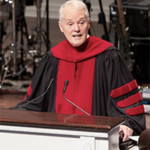
Julio Guarneri (right), president of the Baptist General Convention of Texas, urges the BGCT Executive Board to lead their churches in seven weeks of prayer from Easter to Pentecost. (Photo / Ken Camp)

While churches generally understand their role in sharing the gospel and showing love in Christ’s name, he said, Texas Baptists can continue to grow in their understanding of how the convention  and the institutions they support work cooperatively to achieve those goals.

Guarneri has called on Texas Baptists to “practice Pentecost” and join in seven weeks of prayer. Specifically, from Easter to Pentecost Sunday on May 28, he is urging Texas Baptists to follow the example Jesus set in the Model Prayer, by praying “your kingdom come.”

“We cooperate together as a convention because we are about the business of the kingdom,” he said.

Guarneri has served Calvary Baptist Church in McAllen—a multicultural congregation in the Rio Grande Valley—since 2010. Previously, he was pastor of Iglesia Bautista Getsemani in Fort Worth.

He also served on staff at Segunda Iglesia Bautista in Corpus Christi, was founding pastor of Shalom Baptist Mission in Corpus Christi, and was pastor of Primera Iglesia Bautista in Taft.

He was born in Mexico but graduated from high school in South Texas and earned an undergraduate degree from Texas A&I University in Kingsville. He also holds a Master of Arts in Religious Education degree from Southwestern Baptist Theological Seminary and a Ph.D. in leadership studies from Dallas Baptist University.

Guarneri chairs the board of Buckner International.

He and his wife Monica have four children—Josh, Rachel, Mia and Stevan—and two grandchildren—Daniel and Antares.


Fifth Circuit keeps abortion pill available but limits access

NEW ORLEANS (BP)—A federal appeals court has blocked a nationwide injunction suspending the two-decade-old approval of the abortion pill but prohibits its distribution by mail and places other limits on its access.

In an opinion issued late April 12, a three-judge panel of the Fifth Circuit Court of Appeals in New Orleans halted a federal judge’s April 7 stay of the FDA’s 2000 approval of mifepristone, the first drug in a two-step process commonly referred to as medical or chemical abortion.

The panel, however, upheld for now the lower court’s prohibition of a series of FDA actions beginning in 2016 that pro-life advocates said reduced safeguards for women’s health.

U.S. Attorney General Merrick Garland announced April 13 the Department of Justice would appeal the ruling to the Supreme Court.

Reaction to ruling

Southern Baptist public policy specialist Hannah Daniel said the ruling “puts important safety precautions back in place for vulnerable women and saves more preborn lives.”

“Chemical abortion drugs not only end the life of a precious child but also put the health, safety and welfare of women at serious risk,” said Daniel, policy manager for the Ethics & Religious Liberty Commission.

“Though this case is far from over, this is a moment worth celebrating as women will be better protected from the predatory abortion industry and more lives will be saved.

“The ERLC will be closely monitoring this case as it continues to develop rapidly and remains committed to building a culture of life that cares for both women and their children.”

Erin Hawley, senior counsel for Alliance Defending Freedom, said the FDA “put politics ahead of the health of women and girls when it impermissibly failed to study how dangerous the chemical abortion drug regimen is and when it unlawfully removed every meaningful safeguard that it previously implemented.”

She described the Fifth Circuit ruling as “a significant victory for the doctors we represent, women’s health, and every American who deserves an accountable federal government acting within the bounds of the law.”

ADF represents the pro-life doctors and medical associations that brought the lawsuit.

The leader of the Planned Parenthood Federation of America said she was “furious” with the decision.

“This baseless case is a politically motivated attack to further restrict access to abortion that will place care out of reach for patients—and we will not stand for it,” federation President Alexis McGill Johnson said.

Jennifer Dalven, director of the American Civil Liberties Union Reproductive Freedom Project, called the ruling “a loss, both for people who need abortion care and for all Americans who may need access to critical life-saving drugs.”

“Make no mistake about it: Unless the Supreme Court steps in, this decision will prevent many people from getting abortion care and force them to remain pregnant against their will. And the implications of this decision go far beyond abortion and have the potential to deny people access to other critical, life-saving drugs,” Dalven said.

“Everyone should be deeply concerned about the effect this decision will have on their health and lives and those of their loved ones.”

Amarillo judge cited safety concerns

In granting a stay April 7, Federal Judge Matthew Kacsmaryk of Amarillo said the FDA failed to address mifepristone’s safety issues “based on plainly unsound reasoning and studies that did not support its conclusions.”

He delayed his stay’s implementation for seven days to permit the Biden administration time to pursue “emergency relief” from the Fifth Circuit Court. On April 10, the Department of Justice urged the court to block the federal judge’s order while the lawsuit is under consideration.

The Fifth Circuit panel found the statute of limitations had expired regarding the pro-life challenge to the FDA’s approval of mifepristone in 2000.

Yet, it rejected the request by the FDA and Danco Laboratories, which manufactures and distributes mifepristone in the United States, to block Kacsmaryk’s prohibition on actions taken by the federal agency in 2016 and thereafter.

Impact of appeals court decision

As a result, the Fifth Circuit decision includes the following effects for now:

  • Mifepristone’s use is returned to the first seven weeks of a preborn child’s gestation instead of the 10-week limit the FDA instituted in 2016.
  • In-person visits required with a physician are restored to three after they were decreased to one in 2016.
  • Only doctors may prescribe and administer the abortion pill in contrast to a 2016 change.
  • Women must appear in person to receive mifepristone, ending a 2021 FDA decision permanently allowing the drug to be dispensed by mail.

In January of this year, the FDA announced retail pharmacies would be able to carry and dispense mifepristone for the first time. The decision was another in a series of actions taken by President Biden and his administration in an effort to minimize the effect of the Supreme Court’s reversal of the 1973 Roe v. Wade ruling. In June 2022, the high court returned abortion policy to the states by overturning Roe, which legalized abortion throughout the country.

About 32,000 fewer abortions were reported in the six months after the Supreme Court’s June opinion in contrast to the period before the decision, according to a study issued April 11 by the Society of Family Planning.

Pro-life medical associations challenged approval of mifepristone in a 2002 citizen petition, but the FDA waited until 2016 before denying it. When pro-life organizations submitted another petition in 2019 to contest changes made in 2016 that weakened requirements for the drug’s use, the FDA failed to respond until it again issued a denial more than two years later.

The FDA “stonewalled judicial review—until now,” Kacsmaryk wrote.

On the same day as Kacsmaryk’s ruling, a federal judge in Washington state issued a conflicting decision. Thomas Rice of  Spokane ordered the “status quo” should remain in effect regarding mifepristone’s availability.

Rice’s ruling applied to the District of Columbia and 17 states: Arizona; Colorado; Connecticut; Delaware; Hawaii; Illinois; Maine; Maryland; Michigan; Minnesota; Nevada; New Mexico; Oregon; Pennsylvania; Rhode Island; Vermont; and Washington.

How the drug works

Mifepristone, often known as RU 486 and authorized by the FDA under President Clinton, causes the lining of the uterus to release the embryonic child, resulting in his or her death. Misoprostol, a drug approved by the FDA to treat ulcers, is typically taken one to two days later and causes the uterus to contract, expelling the body.

Medical/chemical procedures as a percentage of all abortions have increased dramatically the last two decades. They rose between 2001 and 2020 from 5 percent of all abortions to 53 percent, the Guttmacher Institute reported in December.

The FDA spent four years considering the application for mifepristone’s distribution in this country and says the drug is safe for women to use.

The Charlotte Lozier Institute, however, reported in 2021 a new study it conducted found “chemical abortion is consistently and progressively associated with more postabortion [emergency room] visit morbidity than surgical abortion.”

An analysis of Medicaid claims information from 17 states that pay for abortions showed the “rate of abortion related ER visits following a chemical abortion increased 507%” between 2002 and 2015, according to CLI, a pro-life, research organization.

The case is Alliance for Hippocratic Medicine v. FDA.

Brandon Porter, associate vice president for convention news at the SBC Executive Committee, and Managing Editor Ken Camp contributed to this report.


US-born Latinos more likely to be ‘nones’ than Catholic


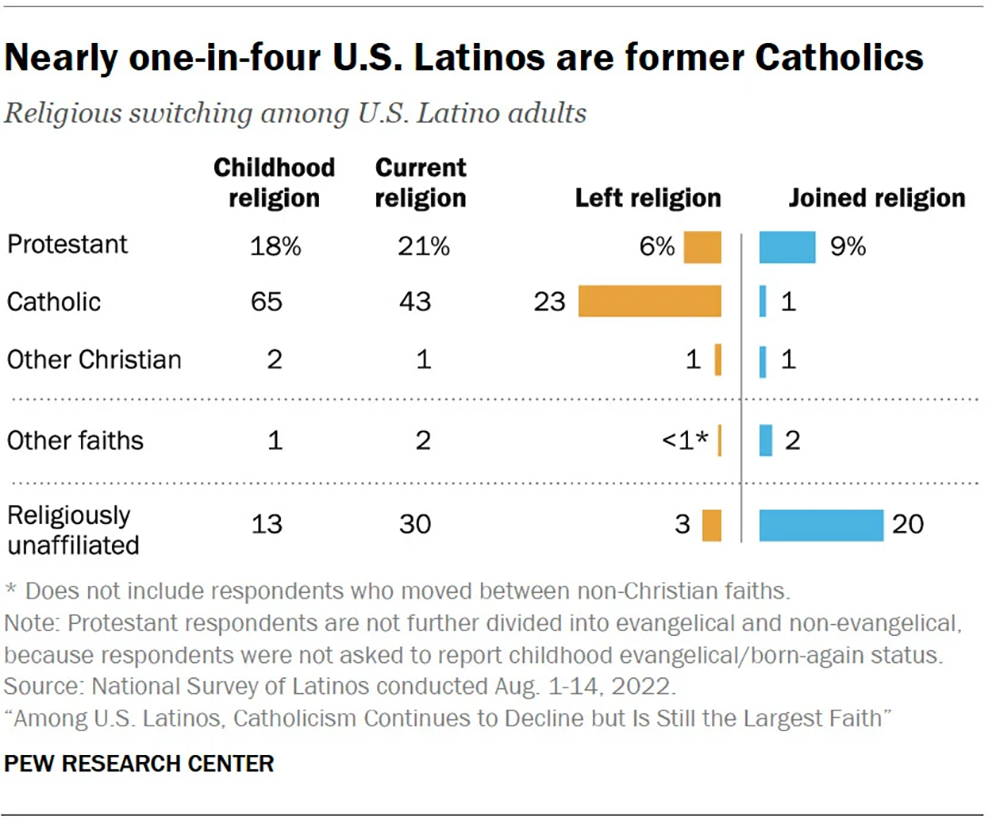
WASHINGTON (RNS)—While Catholicism continues to lose more Latinos than any other religious group, it still remains the largest faith of U.S. Hispanic adults, even as an increasing number identify as religiously unaffiliated, a new Pew Research Center survey found.

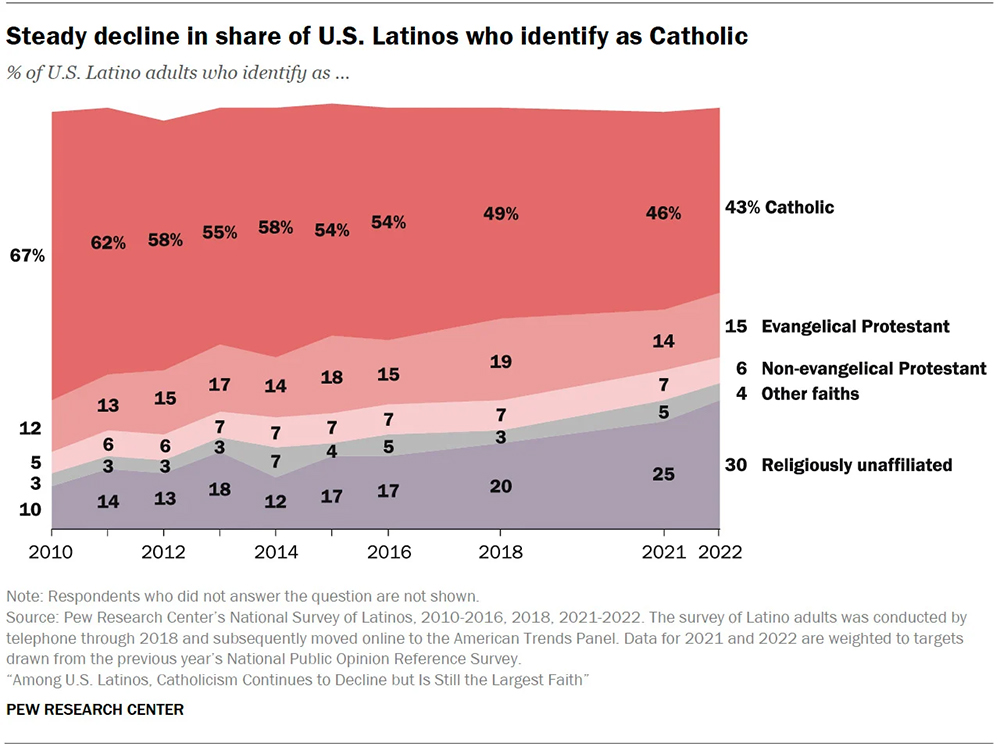
Former Catholics have cited the clergy sexual abuse scandal, a lack of LGBTQ inclusivity and the rule that women can’t be priests as reasons for leaving the church, with Pew finding the share of Latinos identifying as Catholic dropping from 67 percent in 2010 to 43 percent in 2022.

The Pew survey, which released its report April 13, surveyed 3,029 U.S. Latino adults in August last year and asked respondents about their religious upbringing to learn “how that compares with their current religious identity.”

Among the 65 percent who said they were raised Catholic, 23 percent said they no longer identified as such.

“They’ve left the Catholic church, but they now identify with some other faith or no faith at all. That’s a pretty steep decline,” Pew researcher Besheer Mohamed told Religion News Service.

Still, Latinos remain about twice as likely as U.S. adults overall to identify as Catholic, and considerably less likely to be Protestant. Meanwhile, the share of Latinos who say they are atheist, agnostic or “nothing in particular” stands at 30 percent, up from 10 percent in 2010 and from 18 percent a decade ago in 2013, according to Pew.

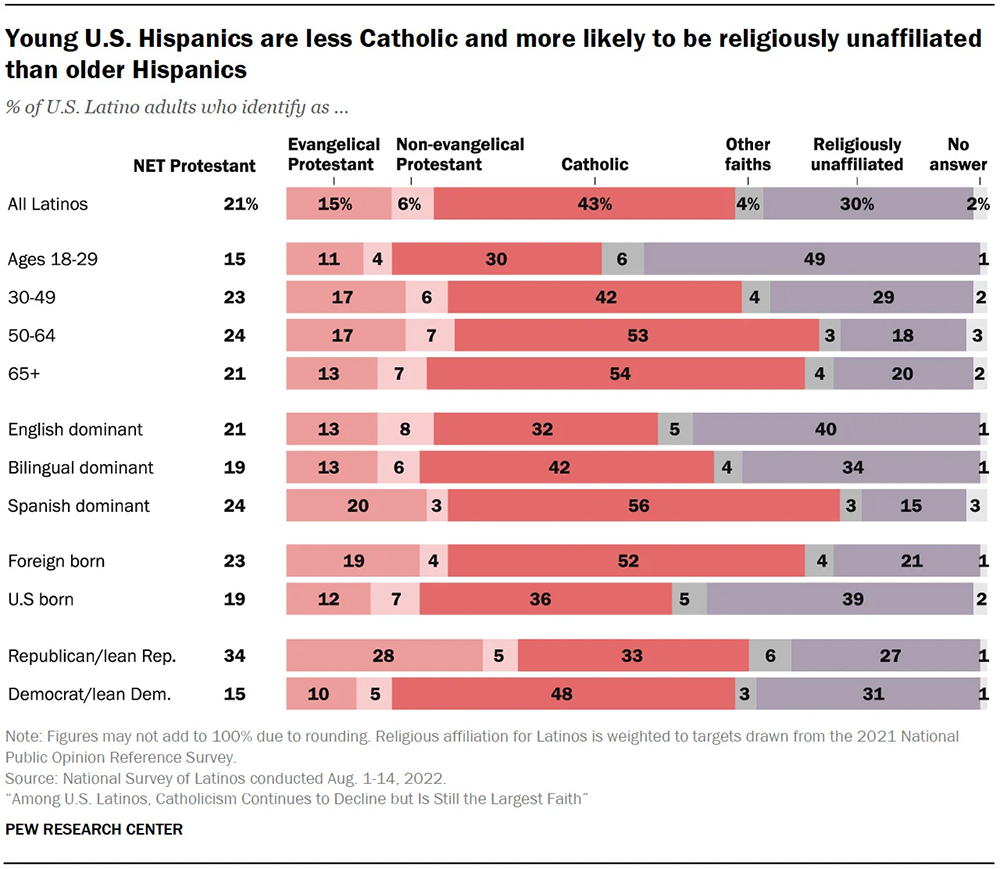
Additionally, U.S.-born Latinos are less likely to be Catholic (36 percent) and more likely to be unaffiliated (39 percent) than older Hispanics and those born outside America.

The number of religiously unaffiliated Latinos is on the rise, but as Mohamed noted, overall “it’s still a minority,” considering the 70 percent who continue to identify with a religion. Beyond that, even the unaffiliated are not “completely secular,” Mohamed said.

The Pew study found a substantial minority (29 percent) of Latinos who don’t have a religion continue to pray at least weekly.

Protestants are the second-largest faith group after Catholics, accounting for 21 percent of Hispanic adults, a share Pew reports has been relatively stable since 2010. During this time, Latino Protestants have been more likely to identify as evangelical or born-again (15 percent) than to say they are not (6 percent), according to Pew.

Religion has been referred to as the “largest demographic divider among Hispanic Americans,” according to a 2020 analysis from the Public Religion Research Institute, which found Latino Protestants are more conservative, Republican and supportive of former President Donald Trump than Latinos who are Catholic or religiously unaffiliated.

With U.S. Latinos regarded as the fastest-growing racial and ethnic group, Republicans, conservative pastors and right-wing organizations have centered faith in their outreach to Latino voters, particularly those who identify as evangelical.

Pew found 28 percent of Latino Republicans say they’re evangelical Protestants, compared with the 10 percent of Latino Democrats who say the same. Latino immigrants also are more likely than U.S.-born Latinos to be evangelical (19 percent vs. 12 percent). Evangelicalism was found to be particularly widespread among Latinos with Central American origins.

In the survey, about 31 percent of Central Americans identified as evangelical Protestants, a higher share than among Puerto Ricans (15 percent) and Mexicans (12 percent).

When looking at Latino evangelical Protestants, half identified with the Republican Party or said they were independents who lean toward the GOP, with 44 percent identifying as Democrats or Democratic-leaning independents.

Among Latino Catholics, in contrast, 21 percent said they were Republicans, while 72 percent identified as Democrats. Religiously unaffiliated Latinos are also heavily Democratic (66 percent Democratic vs. 24 percent Republican), according to Pew.

Jonathan Calvillo, an assistant professor of Latinx studies at Emory’s Candler School of Theology, previously told RNS that “religious nones will likely support more progressive political positions, while evangelicals will lean more conservatively.”

Calvillo noted even as Latino Protestants don’t always lean Republican, the voices that speak for them are often more conservative, leaving him to wonder: “To what extent are Latino Protestants being pushed in this direction?”


La voz en español de Adrián Rogers: “intérprete y comunicador dotado”

TAMARAC, Florida (BP) — Lenin de Janon, la voz de Adrián Rogers en el mundo de habla hispana, falleció el 12 de marzo a la edad de 89 años. Nacido en Ecuador, de Janon pronunció durante 26 años los sermones en español desde la emisión de Rogers, Love Worth Finding.

Rogers, que falleció en noviembre de 2005 a los 74 años, fue tres veces presidente de la Convención Bautista del Sur y pastor de la Bellevue Baptist Church del área de Memphis desde 1972 hasta la primavera de 2005.

La voz de de Janon en EL AMOR QUE VALE (EAQV) se escucha en emisoras de radio de numerosos países y en una floreciente audiencia internacional a través de su aplicación, la internet y las redes sociales.

Un oyente de Perú -entre las 7,000 reacciones en Facebook, 1,200 comentarios y 1,900 veces compartido, a su muerte – expresó su gratitud a Dios por Rogers y de Janon “por ser los motivadores y empujadores para tomar grandes decisiones en mi vida espiritual”.

Desde Venezuela, un oyente describió la transmisión en español como “¡muy nutritiva, se entiende muy bien y su estilo de enseñanza es muy especial, y por eso creo que no habrá otra igual! Las enseñanzas del Dr. Adrián Rogers con la voz del Pastor Lenin son únicas e inigualables!”.

Por su parte, un ex misionero de la Junta Misionera Internacional contó que utilizó los sermones de EAQV en clases de predicación expositiva para estudiantes de seminario en la Ciudad de México.

De Janon sirvió 33 años como misionero en el ministerio internacional de radio HCJB, con sede en Ecuador, durante los cuales comenzó a locutar los sermones de Rogers a finales de los años noventa. Además, había sido pastor de la Iglesia Tabernáculo de la Fe en Quito durante 27 años cuando se trasladó a Memphis, Tennessee, donde tiene su sede Love Worth Finding.

Como misionero de HCJB, de Janon viajó por todo Ecuador y el resto de Latinoamérica para realizar campañas de evangelización, reuniones de iglesias, conferencias de pastores y matrimonios, formación de líderes y plantación y construcción de iglesias. A de Janon también le gustaba pintar al óleo y, como entusiasta de los deportes, estaba relacionado con los equipos de fútbol profesional ecuatorianos como comentarista radiofónico y locutor de estadios, incluso siendo pastor.

Años antes, de Janon vagaba deprimido por las calles de Quito después de que una novia rompiera su relación y él se automutilaba el brazo con una navaja. Joven comunista que seguía los pasos de su padre, de Janon había recibido el nombre del dictador ruso Vladimir Lenin. Sin embargo, en sus horas de crisis personal, captó su atención un artista que charlaba mientras realizaba un colorido dibujo con tiza y utilizaba luz ultravioleta en el santuario de una iglesia a oscuras. De Janon se acercó al artista y aprendió que era un misionero del HCJB, un encuentro que despertó su interés por la Biblia. Un año después, se bautizó en la misma iglesia.

David Rogers, hijo de Adrián Rogers, y su familia eran misioneros de la Junta de Misiones Internacionales en España cuando supo que los ministerios Love Worth Finding se estaban asociando con HCJB para producir EL AMOR QUE VALE en español.

“Primero se lo oí decir a mi padre, y más tarde pude escuchar con mis propios oídos y ver con mis propios ojos el talento de Lenin como intérprete y comunicador”, relató Rogers. “En años posteriores, pude conocer a Lenin en persona en las instalaciones de Love Worth Finding en Memphis y beneficiarme de su experiencia lingüística cuando busqué su consejo en algunos proyectos ministeriales en los que estábamos trabajando en España”.

Tras regresar a Estados Unidos en 2007, David Rogers viajó a varios países de Latinoamérica para presentar el curso de su padre, “Lo que todo pastor debe saber”, que de Janon había ayudado a doblar al español.

“Una y otra vez, me encontré con pastores de habla hispana que sabían y amaban la predicación de mi padre en la voz de Lenin de Janon”, dijo Rogers. “Algunos de ellos ya conocían y apreciaban a Lenin y su obra. Pero debido al perfecto doblaje y al impecable trabajo de interpretación de Lenin, varios de ellos se sorprendieron al aprender que mi padre no hablaba español y que no era realmente su voz la que estaban acostumbrados a escuchar en el programa EL AMOR QUE VALE.”

Rogers, ahora director de atención espiritual de un ministerio de asistencia sanitaria en Nashville, y su esposa Kelly también sirvieron junto a de Janon y su esposa Nellie en un nuevo ministerio en español en Faith Baptist Church en Bartlett, Tennessee. “Nos beneficiamos de la perspicaz enseñanza bíblica de Lenin y observamos el cálido ministerio de cuidado pastoral de él y su esposa Nelli”, dijo Rogers.

Maritza Isabel, directora del programa de lenguas extranjeras de Love Worth Finding, que trabajó con de Janon a lo largo de los años, dijo que el ministerio no buscaba “un locutor” para transmitir los sermones de Adrián Rogers. “Queríamos un pastor”, dijo, “porque creíamos que sólo alguien con el llamado a ser pastor, el llamado a compartir el Evangelio, a compartir la verdad de Dios tendría la pasión para hacerlo bien”.

Con la tecnología actual, la emisión en español “no tiene fronteras”, dijo Isabel, y llega a regiones remotas a través de rudimentarios teléfonos móviles. También señaló casos de EAQV que se utilizan para aprender español. “No sólo están aprendiendo el idioma correctamente”, dijo, “sino que están aprendiendo principios bíblicos en el vocabulario evangélico”.

Los viajes de de Janon en nombre del alcance en español de Love Worth Finding llevaron un llamamiento a toda América Latina, dijo Isabel. En una conferencia de prensa en la capital hondureña de Tegucigalpa, un joven pastor le invitó a hablar una noche en su pequeña iglesia, lo que provocó un atasco de coches que se dirigían al lugar.

“La gente se acercó para saludarle”, cuenta Isabel. “El servicio se prolongó hasta medianoche porque no queríamos rechazar a la gente. Querían tomarse una foto con él, querían darle las gracias”.

A pesar de llevar el nombre de “un dictador que destruyó la vida”, dijo Isabel, “Dios eligió el nombre de Lenin y lo convirtió en un nombre que hoy es apreciado y está relacionado con la palabra de vida”.

Además de su esposa -descrita por Isabel como “una fiel voluntaria de oración” para el ministerio-, a de Janon le sobreviven tres hijos, Eddie, Melanie y Mike, y cuatro nietos.

Por Art Toalston, publicado el 7 de abril, 2023, en
https://www.baptistpress.com/resource-library/espanol/la-voz-en-espanol-de-adrian-rogers-interprete-y-comunicador-dotado/


La ley de inmigración afecta a los ministerios de las iglesias, según los pastores

TALLAHASSEE, Fla. (BP) – Un proyecto de ley sobre inmigración que avanza en la asamblea legislativa de Florida atentaría contra la libertad religiosa de las iglesias para atender a los inmigrantes en ese estado, afirman pastores y otros líderes evangélicos.

El proyecto de ley 1718 del Senado, presentado por el senador republicano Blaise Ingoglia, acusaría a las iglesias de un delito grave de clase tres de contrabando si proporcionan transporte a inmigrantes indocumentados, ya sea a sabiendas o no de la situación de los mismos.

En un seminario web organizado el 30 de marzo por la Mesa Evangélica de Inmigración y World Relief, Gary Shultz Jr, pastor principal de la First Baptist Church de Tallahassee; Jody Ray, pastor de misiones de la Chets Creek Church en Jacksonville; y José Vega, ministro de Chets Creek para los internacionales, todos dijeron que el proyecto de ley afectaría negativamente sus ministerios a los inmigrantes, incluidos los alcances benignos como llevar a los miembros de la comunidad a un servicio de culto o comidas.

El proyecto de ley afecta negativamente al corazón mismo de la identidad de Chets Creek como iglesia, dijo Ray.

“Justo dentro de un mes vamos a poner la primera piedra de un edificio multimillonario cuyo único propósito es el ministerio de compasión hacia los refugiados y la población inmigrante aquí en Jacksonville”, dijo, “Así que el ministerio a los inmigrantes es realmente el núcleo de lo que es la Chets Creek Church”.

“Y cualquier ley que obstaculice nuestra capacidad de atender a los necesitados sería una violación de nuestra libertad religiosa, la capacidad de llevar a cabo nuestra llamada misional. Así que el proyecto de ley 1718 del Senado tiene el potencial de obstaculizar eso y como una iglesia aquí en Jacksonville, obstaculizar la pieza central de lo que hacemos”.

Además de su culto dominical en inglés, Chets Creek celebra cultos dominicales en español, birmano, la lengua jemer de Camboya, portugués y la lengua africana kinyarwanda, explica Ray. La iglesia imparte clases de ciudadanía y de inglés como segunda lengua.

Los participantes en el seminario web pidieron al gobernador de Florida, Ron DeSantis, y a la Legislatura de Florida que se opongan al proyecto de ley o lo modifiquen para proteger los ministerios eclesiásticos de la responsabilidad. Su petición es pastoral y no partidista, dijeron los líderes, y expresaron su esperanza de que la violación del proyecto de ley de la libertad religiosa sea un descuido.

El proyecto de ley 1718 del Senado tipifica como delito, en virtud del artículo 787. 07 de los Estatutos de Florida, para incluir a cualquiera que “transporte a o dentro de este estado a un individuo que la persona sabe, o razonablemente debería saber, que ha entrado a los Estados Unidos violando la ley y no ha sido inspeccionado por el Gobierno Federal desde su entrada ilegal desde otro país; y oculta, alberga o protege de la detección, o intenta ocultar, albergar o proteger de la detección, en cualquier lugar dentro de este estado, incluida cualquier estructura temporal o permanente o a través de cualquier medio de transporte, a una persona que la persona sabe, o razonablemente debería saber, que ha entrado a los Estados Unidos violando la ley y no ha sido inspeccionada por el Gobierno Federal desde su entrada ilegal desde otro país”.

Schultz mencionó los ministerios de First Tallahassee para las personas sin hogar, los refugiados, los embarazos en crisis, los supervivientes del tráfico sexual y las personas que pueden recibir clases de inglés como segunda lengua.

“En todo eso estamos tratando de hacer lo que Jesús nos manda hacer, que es hacer discípulos de todas las naciones, para ministrar a las personas que necesitan escuchar el Evangelio, que Dios ha traído a nuestra puerta y a nuestra comunidad. También estamos tratando de hacer lo que Jesús nos mandó hacer y amar a nuestro prójimo como a nosotros mismos”, dijo Schultz. “Este proyecto de ley en particular plantea algunas implicaciones preocupantes de lo que podríamos tener que hacer y no ser capaces de hacer en el cumplimiento de esos mandamientos bíblicos.

“Y de ninguna manera yo, como pastor, querría tener que decir a mi personal pastoral, a nuestros diáconos o a los miembros de nuestra iglesia que podría haber ramificaciones legales por ministrar o transportar a personas necesitadas. Y estamos llamados a amar a la gente no sólo con el Evangelio, espiritualmente, sino también físicamente, y a ayudar con cuestiones como el transporte, la asistencia sanitaria, la ayuda financiera y otras cosas que podrían ser cuestionadas por este proyecto de ley.

Además de pastores bautistas del sur, participaron en el seminario Dale Schaeffer, superintendente del distrito de Florida de la Iglesia del Nazareno; Steve Gregg, pastor asociado de Creekside Community Church, una congregación de la Evangelical Free Church of America (Iglesia Evangélica Libre de EE.UU.) en Gainesville; Gabriel Salguero, pastor de The Gathering Place, una congregación de las Asambleas de Dios en Orlando, y presidente de la Coalición Nacional Evangélica Latina.

El Presidente y Director General de World Relief, Myal Greene, moderó la mesa redonda, destacando entre los muchos socios de World Relief a la Comisión de Libertad Religiosa y Ética de la Convención Bautista del Sur.

“Como organización guiada por los principios de las Escrituras”, dijo Greene, “estamos comprometidos tanto a servir como a acoger a los inmigrantes, incluidos los que no tienen estatus legal y que a menudo se encuentran entre los más vulnerables, respetando simultáneamente la ley y el papel de las autoridades gobernantes que las Escrituras nos dicen que Dios ha establecido para mantener el orden”.

Los pastores afirman que, si el proyecto se convierte en ley, seguirán ejerciendo su ministerio con ciertas salvaguardias, ninguna de las cuales los protegería de la ley.

“Ciertamente tendríamos que considerar y tendríamos que comunicar”, dijo Schultz, “las posibles ramificaciones legales de este proyecto de ley. Mi esperanza es que sigamos haciendo lo que estamos haciendo para atender a todas esas poblaciones”.

Salguero estuvo de acuerdo.

“Vamos a seguir haciendo lo que Cristo nos llamó a hacer”, dijo Salguero. “Somos la Iglesia, y nuestro compromiso moral y pastoral es ser Sus manos y Sus pies. Pero tendríamos que comunicar claramente las posibles ramificaciones legales a todos esos voluntarios y personas del ministerio”.

La oficina de DeSantis se ha hecho consciente de las objeciones al proyecto de ley, dijo Salguero, pero nadie en la llamada dijo que había hablado con el gobernador directamente sobre la legislación. El proyecto de ley se encuentra todavía en comisión, según el sitio web de la Legislatura.

La oficina de DeSantis no respondió a la solicitud de información de Baptist Press antes de la fecha límite.

Publicado el 7 de abril, 2023, en 
https://www.baptistpress.com/resource-library/espanol/la-ley-de-inmigracion-afecta-a-los-ministerios-de-las-iglesias-segun-los-pastores/


Surveyed Christians hold conflicting views on payday loans

BRENTWOOD, Tenn.—Three-fourths of surveyed Christians oppose predatory lending, but one-third have obtained payday loans and see them as “helpful” and “useful.”

Self-identified Christians living in 27 states without meaningful regulations on those types of small, short-term unsecured loans often have a complicated relationship with payday advances and the lenders who offer them, according to a Lifeway Research study sponsored by Faith for Just Lending.
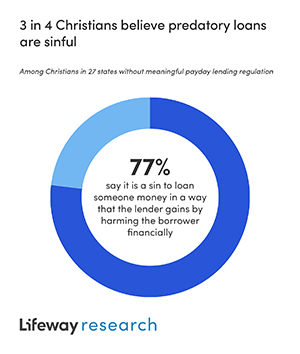
More than 3 in 4 surveyed Christians—77 percent—believe it is a sin to loan money in a way that the lender gains by harming the borrower financially, and most describe payday loans as expensive.

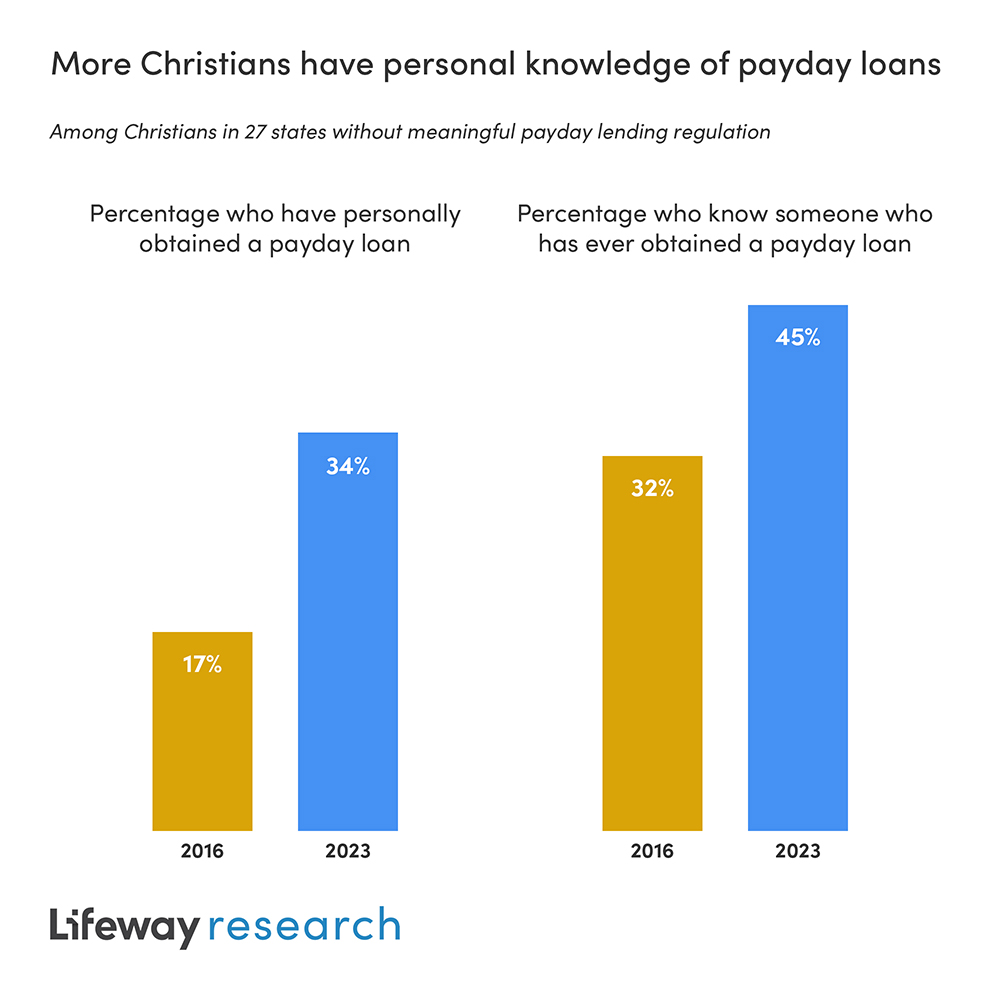
Even so, 34 percent have obtained a payday loan themselves, and a growing number see such loans as helpful.

Most want some type of government intervention and church involvement around these issues.

“The proliferation of retail payday lending establishments has increased the first-hand knowledge many Christians have of these financial institutions,” said Scott McConnell, executive director of Lifeway Research.

“The majority of Christians in states with few regulations on payday lending want more regulations that protect borrowers.”

For Christians living in a state without significant regulations on payday lending, 34 percent have obtained that type of loan for themselves—double the 17 percent who said so in a similar 2016 Lifeway Research study. Additionally, 45 percent say they personally know someone who has gotten a payday loan, up from 32 percent in 2016.

How are payday loans perceived?

When asked to choose which words apply to payday loans, most (57 percent) say “expensive.” More than 3 in 10 say “harmful” (32 percent) and “predatory” (31 percent). Another 10 percent say “immoral.”

However, a growing number use positive terms. More than 1 in 3 say such loans are “helpful” (37 percent) and “useful” (35 percent), while 16 percent say “timely.” Those percentages are all more than double what they were in 2016, when 16 percent described them as “helpful,” 17 percent “useful” and 7 percent “timely.”

“Short-term financing is a real need for many Americans, so you expect to see a growing number of customers who appreciate the payday lending service. Yet, many describe payday loans with language that sounds more like warnings than endorsements,” McConnell said.

When asked directly, 77 percent of Christians in states with few regulations believe it is a sin to loan someone money in a way that the lender gains by harming the borrower financially. Less than 1 in 4 disagree (23 percent).

Christians are most likely to say their knowledge about fair lending practices comes from personal experience with their own loans (25 percent). Fewer say friends and family (18 percent), the Bible (10 percent), articles and news stories (9 percent) or their local church (3 percent) has influenced their thinking on the subject.

Hardly any say they’ve learned about payday loans from the positions of elected officials (1 percent), national Christian leaders (1 percent) or teachers or professors (1 percent).

One in 5 Christians in states where payday lending is less regulated (20 percent) haven’t thought about what lending practices are fair.
Regardless of their knowledge or experience, most Christians underestimate the percentage of payday loans that are rolled over into a new loan with additional fees after the first two-week period. According to a Consumer Financial Protection Bureau report, 82 percent of these loans are renewed within 14 days.

Only 9 percent of Christians in states where payday loans are legal believe rollover rates are between 81 percent to 100 percent. Most (56 percent) believe 40 percent of the loans or less roll over, including 38 percent who say it’s 20 percent or less. More than 1 in 5 (22 percent) estimate 10 percent or less are renewed.

Support for more government regulation

Christians in states without regulation seem supportive of increased government involvement in the industry. Close to 2 in 3 (63 percent) say 36 percent or less should be set as the maximum reasonable annual percentage rate of a loan, with 39 percent saying it should not go above 12 percent. Only 7 percent believe there should be no maximum reasonable APR.

More than 3 in 4 (78 percent) believe laws or regulations should protect borrowers from lending practices that create loans that can’t realistically be repaid without additional loans.

Specifically, 84 percent say laws or regulations should prohibit lending at “excessive interest rates.” Fewer than 1 in 10 (8 percent) say no to either proposal.

More than 9 in 10 (94 percent) agree that lenders should take into account the borrower’s income and expenses and only extend loans at “reasonable interest rates” based on ability to repay within the original loan period.

“Christians expect far more regulations that protect borrowers than exist in these states,” McConnell said. “The Bible does not define at what rate excessive interest begins, but it does forbid it. So, it is not surprising that most Christians want to eliminate excessive interest rates.”

How should the church be involved?

While Christians in states where payday lending exists with little to no regulation want legal responses to the industry, most also expect the church to be involved in addressing the issue.

Nine in 10 (89 percent) believe churches should teach and model responsible stewardship and offer help to neighbors in times of crisis, up from 83 percent who said so in 2016.

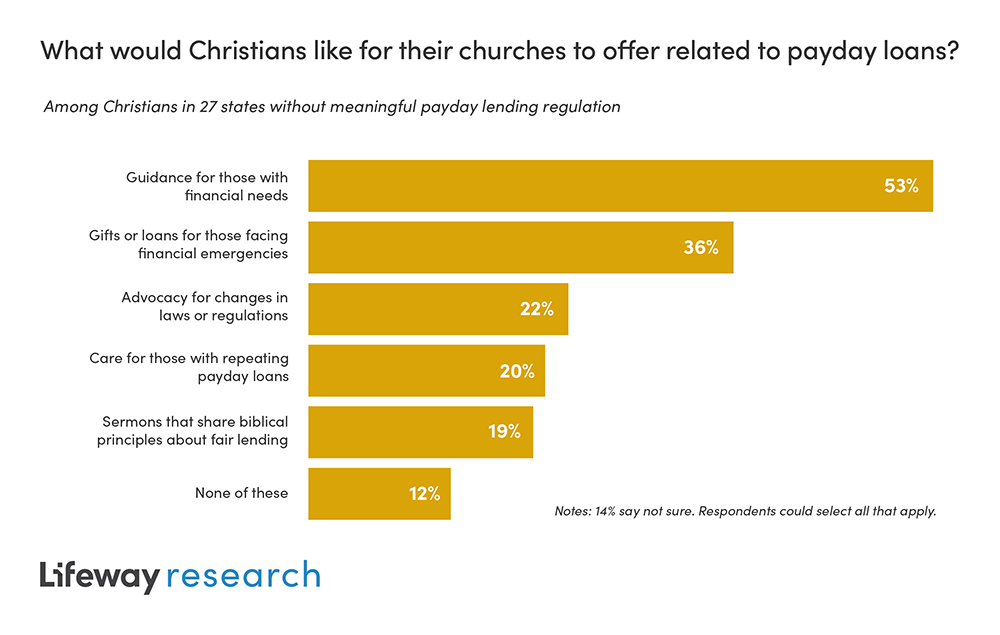
When asked what they’d like to see their church offer related to payday loans, most (53 percent) point to guidance for those with financial needs. More than a third (36 percent) would like to see their church provide gifts or loans for those facing financial emergencies. Around 1 in 5 want their congregation to advocate for changes in laws or regulations (22 percent), care for those with repeating payday loans (20 percent) or deliver sermons that share biblical principles on fair lending (19 percent).

Around 1 in 10 (11 percent) say their local church offers guidance or assistance related to payday loans. Around 2 in 5 (39 percent) say their church doesn’t provide those. Half (50 percent) aren’t sure.

Compared to 2016, more Christians say they know whether their church is helping or not. Those who say their congregation provides assistance increased from 6 percent, while those who say their church does not offer help rose from 34 percent. The percentage who say they aren’t sure fell from 61 percent seven years ago.

Still, Christians in states with little to no regulation on payday lending say they’re looking to their church to provide some guidance and help on the issue, but McConnell said many aren’t finding it.

“Most churches are silent on payday loans at times when Christians desire advice and emergency help,” he said.
The online survey of Americans in Alabama, Alaska, California, Florida, Hawaii, Idaho, Indiana, Iowa, Kansas, Kentucky, Louisiana, Michigan, Minnesota, Mississippi, Missouri, Nebraska, Nevada, New Mexico, Ohio, Oklahoma, Rhode Island, South Carolina, Tennessee, Texas, Utah, Wisconsin and Wyoming was conducted Feb. 22-27, using a demographically balanced sample.

The completed sample is 1,000 surveys. The sample provides 95 percent confidence the sampling error does not exceed plus or minus 3.3 percent. Margins of error are higher in sub-groups.
Obituary: Ide P. Trotter

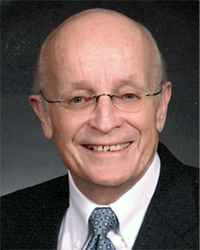
Ide P. Trotter, Baptist layman and a former dean and professor of finance at Dallas Baptist University, died April 4. He was 90. He was born Oct. 27, 1932, in Colombia, Mo., to Ide P. Trotter Sr. and Lena Ann Breeze Trotter. His family moved to the College Station area when his father became head of the Department of Agronomy at Texas A&M University, and he made a profession of faith in Christ at age 9 at First Baptist Church in Bryan. After graduating from Stephen F. Austin High School in Bryan, he enrolled at Texas A&M, where he began attending the campus chapter of InterVarsity Christian Fellowship. As a senior, he was chaplain of the Corps of Cadets and president of the Student Senate. He graduated as valedictorian of his class with both a commission as a 2nd Lieutenant in the U.S. Army and a National Science Foundation Fellowship to attend Princeton University, where he earned his doctorate. He completed his military service in the Chemical Corps School at Ft. McClellan in Alabama and worked for Humble Oil and Refining Company. While working in Baytown, he and his wife Luella taught a Sunday school class at First Baptist Church of Baytown. While he worked on a one-year assignment with Esso Research and Engineering Co. in New Jersey, his family was involved in helping a mission church established by Madison Baptist Church. His work in management at Humble Oil—and later Exxon—took him and his family first to Houston and then to Millings, Mont., and Stamford, Conn., where he was chairman of deacons at Greenwich Baptist Church. While in Tokyo, Japan, and he and his wife taught a Bible class for couples at Tokyo Baptist Church. While they were in Brussels, Belgium, he was chair of deacons at International Baptist Church. After completing his career at Exxon in 1986, he became dean of the College of Management and Free Enterprise and professor of finance at Dallas Baptist University, where he served until 1990. He served as a deacon and Sunday school department director at First Baptist Church in Dallas and as chair of the Dallas Life Foundation homeless shelter. He founded Trotter Capital Management, and he served as a spokesman for Texans for Better Science Education. He was also instrumental in helping establish the Trotter Prize and Endowed Lecture Series at Texas A&M University. He was preceded in death by his wife Luella. He is survived by daughter Ruth Penick and her husband Jim; daughter Reni Pratt and her husband Randall; daughter Cathy Trotter Wilson and her husband Kevin; 13 grandchildren; and his brother Ben.




Around the State: Nacogdoches church worships at coliseum

When First Baptist Church in Nacogdoches invited the entire community to its Easter Sunday morning worship service at Stephen F. Austin State University’s William R. Johnson Coliseum, the event drew about 1,700 worshippers, including more than 900 guests. (Facebook Photo FBC Nacogdoches)

When First Baptist Church in Nacogdoches invited the entire community to its Easter Sunday morning worship service at Stephen F. Austin State University’s William R. Johnson Coliseum, the event drew about 1,700 worshippers, including more than 900 guests. An 85-voice choir, 35-piece orchestra and large contemporary band led musical worship. Pastor Noel Dear preached on “Jesus and the Olive Press,” based on the experience of Jesus in Gethsemane. The church provided Spanish translation accessible via smartphones. Worship Pastor Tom Webster noted the church received significant support from faculty, staff and administration at the university. Church members who were involved in logistics and preparation for the service particularly had opportunities to “get to know and befriend” members of the support services, campus security, plant operations and custodial staff, he said. “Three members of the custodial staff who were scheduled to work the event showed up Sunday, dressed in their Easter clothes to worship along with their families. Then they cleaned up after the service, still dressed up in their Easter clothes, with their children helping,” Webster said. During the worship service, more than 50 church members served as section leaders to identify and greet guests, who were encouraged to provide contact information by completing “connect cards” or using a QR code that allowed them to text their information. “For us, now the work of Easter really begins. We made so many new friends and met so many prospects,” Webster said. “Now, the real excitement of Easter begins as we go out to contact them.”

“Come Home” was the theme of the 24th annual spring revival at the University of Mary Hardin-Baylor. (UMHB Photo)

“Come Home” was the theme of the 24th annual spring revival at the University of Mary Hardin-Baylor. Dale Wallaceof Waco, college community director at Harris Creek Baptist Church in Waco, was the featured speaker. The Worship Initiative, featuring Davy Flowers, John Marc Kohl and Aaron Williams, led worship for the event March 27 to 29. “Revival 2023 presented our campus community with a focused opportunity to engage with the gospel message in a fresh way,” said Jason Palmer, dean of spiritual life and university chaplain. “Many students demonstrated a hunger for truth and responded with confession and repentance. We are already seeing spiritual fruit from our time together.”

Madison Lewis, a senior at Hardin-Simmons University, is the recipient of the 2023 Altom Christian Service Award. She is the daughter of Greg and Jill Lewis. (HSU Photo)

Madison Lewis, a senior at Hardin-Simmons University, is the recipient of the 2023 Altom Christian Service Award. She is the daughter of Greg and Jill Lewis. Her father is pastor of  First Baptist Church of Goldthwaite, and her mother is a third-grade math teacher. Madison is a student worker in visual media and university marketing and serves in a variety of roles on campus, including as a Baptist Student Ministry ministry team leader.  She is a T.B. Maston Scholar pursuing a double major in strategic communication and Christian studies. Upon graduation in December, she hopes to work in photography or videography with a nonprofit organization.

East Texas Baptist University honored Jason Bell and his family April 1 with the dedication of Jason Bell Park at Taylor Field, home to the ETBU Tiger softball team. (ETBU Photo)

East Texas Baptist University honored Jason Bell and his family April 1 with the dedication of Jason Bell Park at Taylor Field, home to the ETBU Tiger softball team. Jason Bell is the owner of Symmetry Sports Construction and has been “a valuable partner in building athletic facilities at ETBU,” President J. Blair Blackburn said. “We are grateful to celebrate the generosity and leadership of Jason Bell, Becca Bell and their children. ETBU has been blessed to have Jason as a part of our board of trustees, where he has also served on the executive leadership committee.”

Wayland Baptist University marked 25 years of offering online classes. Wayland was a pioneer in online education when it began offering computer-based instruction in 1998. “Our commitment to providing a flexible and convenient education to our students remains as strong as ever, as demonstrated by our new online degree programs, and we look forward to continuing to serve our community for many years to come,” said David Bishop, vice president of external campuses.

Literacy Connexus will offer free online English-as-a-Second-Language training for churches from 8:30 a.m. to 2:30 p.m. on April 22 in partnership with Literacy Texas. Topics will include training for new volunteers, as well as immigration and student placement. Since the COVID pandemic, Literacy Connexus has developed hybrid training for volunteers, which include both online and in-person instruction. The April 22 event provides a first step for new teachers, as well as updates for experienced teachers. For more information, click here.

Anniversary

DBU Chancellor Gary Cook

35 years for Gary Cook at Dallas Baptist University. He was president of the university 28 years, and he continues to serve as chancellor. DBU awarded him an honorary Doctor of Divinity degree at its spring convocation April 5.


On the Move: Davis

Cory Davis to First Baptist Church in Floydada as associate pastor of students and discipleship. He served previously in youth ministry at churches in Longview, Wheeler, Texarkana, White Oak and Kilgore. He most recently worked with Mercy Ships International in Lindale.


There’s a reason most hit worship songs sound similar

WASHINGTON (RNS)—On Easter Sunday, the worship band at Bethel Community Church in Redding, Calif., opened the service with “This Is Amazing Grace,” a 2012 hit that has remained one of the most popular worship songs of the past decade.

Chances are thousands of other churches around the country also sang that song—or one very similar to it.

A new study found Bethel and a handful of other megachurches have cornered the market on worship music in recent years, churning out hit after hit and dominating the worship charts.

The study looked at 38 songs that made the Top 25 lists for CCLI and PraiseCharts, which track what songs are played in churches, and found almost all had originated from one of four megachurches.

All the songs in the study—which ranged from “Our God” and “God Is Able” to “The Blessing”—debuted on those charts between 2010 and 2020.

Influence of a few megachurches

Of the songs in the study, 36 had ties to a group of four churches: Bethel; Hillsong, a megachurch headquartered in Australia; Passion City Church in Atlanta, which runs a popular youth conference that fills stadiums; and Elevation, a North Carolina congregation with ties to the Southern Baptist Convention.

“If you have ever felt like most worship music sounds the same,” the study’s authors wrote, “it may be because the worship music you are most likely to hear in many churches is written by just a handful of songwriters from a handful of churches.”

The research team, made up of two worship leaders and three academics who study worship music, made some initial findings public April 11. More details from the study likely will be released in the coming weeks.

Elias Dummer, a worship leader and recording artist, said he and his colleagues have been watching changes in worship music over the past decade. They wanted to know how worship songs become popular among churches, he said.

They also wanted to know how the business of producing and marketing songs is shaping the worship life of local churches.

Streaming services fuel popularity

Dummer said many worship leaders believe the best songs become the most popular in churches. They also believe those songs become popular because they work—people respond to them during worship services and want to sing them over and over.

But that’s not exactly true. Dummer and his colleagues found many of the more recent hit songs were released as singles on Spotify and other streaming services, which helps fuel their popularity.

“There are actual mechanisms by which songs become the most significant,” he said. “It’s not just whatever songs the Holy Spirit blesses that make it to the top of the charts.”

For their study, researchers compared popular worship songs written before 2010 with those written from 2010 to 2020. Those earlier songs were often associated with individual worship leaders such as Chris Tomlin and Matt Redman, rather than with churches, and came from a variety of sources.

But beginning in 2010, the most popular new songs began to come from megachurch worship bands, and the most popular worship artists began affiliating with those churches.

Of the 38 songs in the study, 22 initially were released by the four megachurches, with another eight songs released by artists affiliated with those churches. Six more were either collaborations between artists from those churches or cover songs performed by those churches.

Shannan Baker, a postdoctoral fellow at Baylor University, said the megachurch worship teams in the study also popularized songs from other artists, such as “Way Maker,” a song written by Sinach, a well-known Nigerian musician, as well as “Great Are You Lord” and “Tremble.”

“These bigger churches, even if they weren’t involved in making the songs, platformed them,” she said.

Reflect charismatic tradition

Adam Perez, assistant professor of worship studies at Belmont University in Nashville, Tennessee, said the four most influential megachurches all come from the charismatic tradition of Protestant churches.

All of them, he said, have a spirituality that believes God becomes present in a “meaningful and powerful way” when the congregation sings a particular style of worship song.

Those songs become one of the primary ways of connecting with God, rather than prayer or sacraments or other rituals. Because of their market success, these churches have changed the spiritual practices and sometimes even the theology of congregations from many traditions.

“The industry itself becomes this invisible hand,” he said. “We don’t name the theology of praise and worship. We just assume it. And we use this kind of song repertoire to reinforce it.”

The study did not look specifically at the lyrics of the most popular songs. Baker did say she’s looking at those lyrics for a different project and found a few trends. For example, she said, few of the most popular songs talk about the cross or salvation.

“A lot of it is, what is God doing for me now? And what has God promised to do for me in the future?” she said.

Baker said that in the past, artists or publishers would put out a songbook or recordings of new worship songs, and then churches would pick out the songs in those collections that best fit their context. Now, she and other researchers wonder if these megachurches are driving which songs are used in worship.

The study is based on data about popular worship songs obtained by Mike Tapper, a religion professor at Southern Wesleyan University. Tapper and his colleague Marc Jolicoeur, a worship pastor from New Brunswick, Canada, worked on a previous study about how quickly hit worship songs appear and then disappear.

Theology and scandal have little impact

Jolicoeur said any concerns about the theology of the four megachurches, or the recent troubles at Hillsong, which has had several pastors resign in scandal, don’t seem to affect the demand for their music.

The popularity of megachurch worship songs doesn’t surprise Leah Payne, professor of American religious history at Portland Seminary in Oregon. Payne, who studies the Christian music business, said it likely reflects broader worship patterns.

While most churches in the United States are small, most Christians worship at large churches. The 2020 Faith Communities Today survey found that about 70 percent of worshippers attend the top 10 percent of churches.

“The fact that the worship music of megachurches has a bigger share of the worship market corresponds to the practice of worshippers,” said Payne.

Payne doubts that scandals at churches such as Hillsong will affect the popularity of their music—because people have a relationship with the songs, not with church leaders.

Payne said worship bands at the most popular megachurches have a knack for creating great pop songs. And they know how to connect with mass audiences—both in person and through streaming services.

“They can go toe-to-toe with some of the biggest acts in music,” she said.


Denton worship leader wants students to know Christ

DENTON—When Daniel Bertrand leads worship for student events, he wants young people to do more than enjoy the experience. He wants them to learn about the meaning of worship and embracing worship as a lifestyle.

 “My desire is that others would experience the joy of Christ through an authentic time of worship and that the gospel is proclaimed,” Bertrand said. “Music has a special way of drawing us near to the Lord, uniting us together in Christ and reminding us of his truths as we sing.

“My heart in that is that we would know Christ and make him known. If that’s all that is taken away from an event, then it’s all worth it.”

When he was in seventh grade, Bertrand began leading worship for his youth group at First Baptist Church in Early. At that time, Bertrand had no idea what he thought was simply a “cool opportunity” would begin paving the way and shaping his heart to enter full-time ministry after graduating from Hardin-Simmons University in Abilene.

Daniel Bertrand

 “I was blessed to grow up in a strong Christian home,” Bertrand said. “My parents always served the church in various ways. I was the kid who was at church any time the doors were open, and the Lord saved me at any early age.

“In seventh grade, my youth pastor Joe Baucom asked if I would lead worship for the youth group. I thought it was simply something I should do because that’s what ‘good kids’ do. Plus, I loved music and thought it was cool.

 “Little did I know that in doing that throughout the next few years the Lord was cultivating my heart for how he would use me for his glory.”

When he was in junior high school, Bertrand surrendered his life to Christian ministry. By the time he was in high school, he said, “It became clear what the Lord called me to do.”

“Since then, I have been blessed to have the opportunity to lead worship for various events,” he said. “It really began by leading worship for a weekly service for college students at South Side Baptist Church in Abilene. During that time, I developed a band, and we were blessed to be a part of seeing God choose to grow that ministry exponentially.”

Worship brings ‘encouragement, admonishment and joy’

Today, as he leads worship for events around the state, Bertrand desires to remind students and young adults about the purpose and priority of singing songs to God with reverence and adoration.

 “Our songs of worship must always point us back to the truths of his word and the glory of who Jesus Christ is and what he has done,” Bertrand said.

 “There is nothing sweeter than worshipping the Lord together. I personally believe music is a gift that allows us to do so in a unique and beautiful way. It stirs our affections to the Lord, as his word dwells within us richly—bringing encouragement, admonishment and joy.”

Bertrand’s theme verse for his music ministry is Colossians 3:16, which states, “Let the word of Christ dwell in you richly, teaching and admonishing one another in all wisdom, singing psalms and hymns and spiritual songs, with thankfulness in your hearts to God.”

In addition to serving as the pastor of worship and discipleship at Redeemer Church in Denton, Bertrand travels around the state leading worship for Disciple Now weekends, youth retreats and summer camps.

 “God has been so good and gracious to provide opportunities, and it is a joy to partner with other churches and ministries as we serve the Lord together,” Bertrand said. “Voices resounding together as one, ringing out and singing truths of who our God is and what he has done for us.

“It’s a great reminder for us every time we lead worship, and each opportunity is one I don’t want to miss. When we worship together, we are united in Christ. It’s a glorious picture and a taste of eternity.”

Allow the Holy Spirit to lead

Most recently, Bertrand said, God has been teaching him about pursuing joy in him.

“No matter the circumstances, we can experience joy in Christ. He is good, and he is faithful. Life gets crazy, and it’s easy to shift focus. It’s easy to let other things distract you from pursuing the Lord, but Christ is our treasure, our hope eternal. When we pursue him, we find that he is our joy,” he said.

“When our world is heavy, we need the reminder of what Christ has done. We need to remember that who Jesus is never changes. Jesus is better. My desire is to sing and proclaim truth so that we may continually respond to the goodness and faithfulness of God remembering the work that has been done for us in and through Jesus Christ.”

Bertrand said his desire is to step out of the way during the worship service and allow the Holy Spirit to lead.

“There are so many things I could share of how the Lord has moved through different events,” Bertrand noted. “The Spirit does a work as he chooses, and we are blessed with the invitation to participate in that. It’s easy to try to manufacture things to happen, but when we can simply get out of the way and let God do what God does, those are the most meaningful experiences.”

Bertrand recalled an experience at a camp a few years ago.

“The service was winding down, but the plan was to have a simple call for students to take communion as we ended. Tables were set up around the room, and as students began to go and partake in communion, the Spirit poured out,” he said.

 “For about an hour, we just kept playing songs, completely unplanned, as hundreds of students responded and worshipped the Lord together. It was a beautiful moment. In each and every opportunity that I am given to lead worship, I want people to know Christ and make him known.”


Walker knows the transformative power of church camp

CEDAR HILL—Eddie Walker believes camp ministry can be a transformative experience  for children and youth as they begin their walk with Christ.

That was the case in his life. And Walker has devoted much of his career to making it meaningful for others.

His experience includes service as a summer staff member, a worship leader, founder of a camp and now as executive director of Mount Lebanon Camp and Retreat Center in Cedar Hill—where he came to faith in Christ.

Growing up in nearby Duncanville, Walker attended camp at Mount Lebanon as a junior high school student at the invitation of a friend.

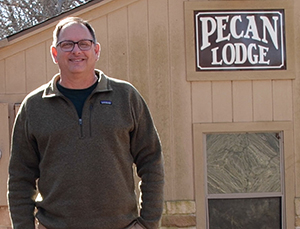
Eddie Walker, executive director of Mount Lebanon Camp and Retreat Center, stands outside Pecan Lodge, where—as a 15-year-old camper—he told his youth group he felt called to vocational ministry. (Courtesy Photo)

“I went to have fun, ride horses and swim, but I heard the gospel in an age-appropriate way that I could understand and came to Christ then and there,” he said.

A few years later at age 15, Walker responded to the call to ministry and began a deeper involvement in camp ministry.

Returning to Mt. Lebanon in college, he served on summer staff and eventually joined the worship team.

“I grew up playing bluegrass and gospel music,” he said. “When I came back on summer staff, they let me help my first year and then asked me to start leading.”

As a worship leader, Walker saw his own faith journey played out in the lives of young campers.

“I got to see thousands of kids repeat my story where they came to Christ, got plugged into a church home, and made lifelong friends” he said.

‘Good to come full circle’

Walker led worship and handled media for camps before he moved to Rockwall, where he served 12 years on staff at Lake Pointe Church as a worship leader and communications director.

Eventually, he and his family built their own church camp from the ground up in nearby Royse City.

“My dad was a contractor,” Walker said. “He taught me to buy and rent properties and fix them up.”

Walker’s experience taking care of facilities and running media, along with a lifetime in ministry, came together when he developed and directed Sabine Creek Ranch.

Walker and his family ran the camp 17 years, before he moved to Dallas Baptist University to teach a camp degree program in 2014.

From firsthand experience as a camper, staff member and camp director to his time in higher education, Walker has witnessed and understands the impact camp ministry has on the lives of students.

Returning to Mount Lebanon as executive director in the spring of 2022, Walker hopes to continue in leading children and students toward a relationship to Christ through fun, educational and transformational experiences at church camp.

“It’s good to come full circle” he said.

‘One of the best evangelistic tools we have’

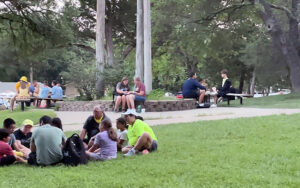
Young campers at Mount Lebanon receive spiritual counsel on the lawn. (Courtesy Photo)

Camps offer families the opportunity to expose their children to the gospel in a fun and understandable way, Walker noted. When many Christians share their testimonies, they often begin at church camp, he observed.

“I do this because it is effective,” Walker said. Camp ministry is “one of the best evangelistic tools that we have.”

Nationally, the Christian Camp and Conference Association 2020 Compass Survey revealed 10 to 15 percent of the 215 responding camps’ overnight camp attendance made faith commitments.

Nearly 9 out of 10 camp encourage faith commitments or recommitments to Christ in their programs, but only 39 percent keep track of those decisions. So, the actual number undoubtedly is greater.

Last year, of the 7,509 summer campers at Mount Lebanon, 327 made recorded professions of faith in Christ, 34 responded to a call to vocational ministry, 76 made a commitment to be baptized, and many others rededicated their lives to Christ.

“We are in a season of rapid growth, anticipating our 2023 summer camp attendance being up almost 25 percent this summer over last year, and an additional 20 percent up for 2024,” Walker said.

Thirty encampments are related to Texas Baptists and supported by associations of churches around the state.

Walker sees “a lot of positive benefits” for a child or teenager who attends a church camp

Camps offer an environment “away from distractions, technology and sometimes really tough family situations,” Walker said, describing them as a place where young people can “look at the stars and consider bigger questions.”

Rose Comstive, a student at East Texas Baptist University, is serving as an intern with the Baptist Standard.