How does a church get ousted from the SBC?

WASHINGTON (RNS)—Southern Baptists long have disagreed over many things—from the role of women in the church and which Bible translation is best to debates over Calvinism and whether people who were baptized in a non-Baptist church can join a Baptist congregation.

Despite disagreements, affiliating with the Southern Baptist Convention historically has been relatively easy for churches. And getting kicked out was difficult.
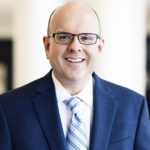
Adam Greenway

“In Southern Baptist life, basically you are deemed in until you have proven that you are out,” said Adam Greenway, former president of Southwestern Baptist Theological Seminary.

The issue of who gets to be a Southern Baptist made international headlines after the SBC Executive Committee voted to oust one of the nation’s largest and best-known churches for having a woman preaching pastor.

On Feb. 21, Saddleback Church in Lake Forest, Calif., was “deemed not to be in friendly cooperation” with the SBC for having Stacie Woods—wife of senior pastor Andy Woods—as a regular preacher.
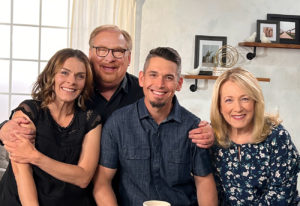
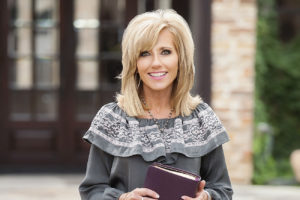
Rick Warren (second from left) with (left to right) Stacie Wood, Andy Wood and Kay Warren. (Photo courtesy of A. Larry Ross)

Her role conflicts with a section of the denomination’s statement of faith, the 2000 version of the Baptist Faith and Message, which restricts the office of pastor to men. Saddleback previously had been reported to the SBC’s credentials committee, which reviews the status of churches, for ordaining several longtime women staffers in 2021.

Four other churches also were removed for having women pastors, including New Faith Mission Ministry in Griffin, Ga., whose pastor has since claimed the church was not part of the SBC.

Those congregations were the first to be expelled from the SBC on a national level for having women pastors since the ban on women pastors was instituted more than two decades ago.

More likely at state or associational level

Churches have been removed in the past from Baptist state conventions or local associations for having women pastors. In 2009, the Georgia Baptist Convention disfellowshipped First Baptist Church of Decatur for hiring a woman pastor, then followed up in 2010 by kicking out Druid Hills Baptist Church for the same reason.

In 2015, a Tennessee Baptist local association removed Greater Tabernacle Missionary Baptist Church in Lawrenceburg for having a woman pastor.

Greenway said disputes over the status of churches are more common at the local or state level, because people in those settings are more likely to know what other churches are doing. With more than 40,000 churches, that’s less likely at the national level of the SBC.

Local or regional groups often have different rules for how closely churches have to follow their doctrines. Some require churches to completely agree with the Baptist Faith and Message. Some use other statements of faith.

At the SBC level, the rules have been more flexible. Founded in 1845, the denomination didn’t have an official statement of faith until 1925. That same year, the SBC started the Cooperative Program, which pools money from churches to fund missions, seminaries and other ministries around the country.

Bart Barber

“That’s not an accident,” said Bart Barber, current SBC president and pastor of First Baptist Church in Farmersville, who has spent years studying SBC polity. Before 1925, local churches that identified as Baptist funded individual SBC institutions and causes.

Once they pooled their money, a more detailed statement of faith was needed.

“There needed to be more trust,” he said.

The disputes over churches often play out at annual meetings, when one church tries to block another from participating. And the issues involved have varied widely.

In 1977, the California state convention rejected messengers from a Fresno church that practiced alien immersion and “open Communion” and debated those issues for years. So did Baptists in Kentucky and Arkansas.

California Baptists also refused to recognize a church in Corona in 1980 after it dropped the word “Baptist” from its name and a church in 1993 that had a woman pastor.

Cutting ties at the SBC level picks up steam

Those state and local meetings were often smaller, making it easier for the question of kicking out a church to get on the agenda. That is harder at national SBC meetings, which have at times drawn tens of thousands of messengers.

By the 1990s, however, fights over kicking out churches had gone national, largely over the place of LGBTQ people in the church. In 1992, the Baptist Faith and Message was changed to bar churches that affirmed LGBTQ members and clergy. Those changes happened in the wake of the so-called Conservative Resurgence when more moderate Baptists began to leave.

Those changes led to a series of churches being removed for being affirming, beginning with Pullen Memorial Baptist Church and Olin T. Binkley Memorial Baptist in North Carolina. Both were voted out at the SBC’s annual meeting.

Though the language of having only male pastors was added to the Baptist Faith and Message in 2000, Southern Baptists repeatedly resisted calls to add language to the denomination’s constitution to bar churches with women pastors.

Changes in the SBC constitution

However, in 2014, the denomination’s constitution was amended to include only churches with “a faith and practice which closely identifies” with the Baptist Faith and Message. That 2014 rule change opened the door for more churches to be removed from the SBC, including for issues like racism and mishandling sexual abuse.

As part of additional rules passed in 2019 to name those issues, the credentials committee was given the job of deciding whether or not a church is in “friendly cooperation” with the denomination.

At the 2018 annual meeting, messengers expelled Raleigh White Baptist Church in Georgia for discriminating against a Black church that shared their building. Two years later, Ranchland Heights Baptist Church was disfellowshipped for employing a registered sex offender as pastor.

The push to disfellowship churches with women pastors—that have women preaching in them—gained momentum in 2019 after former Southern Baptist Bible teacher Beth Moore tweeted about speaking in a church on Mother’s Day.
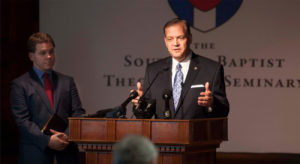
Al Mohler, president of Southern Baptist Theological Seminary in Louisville, Ky., speaks with the press. (Photo / Emil Handke, courtesy of Southern Baptist Theological Seminary / Via RNS)

That led to outrage by SBC leaders like seminary President Al Mohler, who had helped draft the Baptist Faith and Message changes two decades earlier. The debate was intensified by the country’s increased polarization, which has eroded much of the trust that made the SBC’s work possible in the past.

Things came to a head in May 2021 after former Saddleback senior pastor and bestselling author Rick Warren announced that the church had ordained several women as pastors. Not long afterward, a messenger at the 2021 SBC meeting called for the church to be investigated.

Who is a pastor?

Kicking out Saddleback was not a simple matter.

Some Southern Baptists, like Mohler, say no woman can have the title of pastor. Others say that only the senior pastor role is limited to men alone, while other women on a church staff could be referred to as pastors.

This disagreement left the credentials committee in a pickle, since they did not know exactly how the beliefs about pastors should be applied. At the 2022 SBC meeting in Anaheim, Calif., Linda Cooper, chair of the credentials committee, asked messengers to form a study group to look at how local churches use the term “pastor.”

That request led to heated debate, with Mohler insisting Southern Baptists know exactly what the word “pastor” means, while Greenway supported the idea of a study group, saying it should be expanded to look at how closely churches need to follow the SBC statement of faith.

For example, Greenway, a former seminary president, said in a recent interview the Baptist Faith and Message states the Lord’s Supper should be limited to church members. But few churches, he said, follow that rule strictly.

“That might be the ‘most not observed’ article in the Baptist Faith and Message,” he said.

In an interview and on social media, Greenway disagreed with the Saddleback vote, saying it put too much power in one interpretation of the Baptist Faith and Message.

Giving churches a say in the matter

Barber said voting Saddleback out was the only way for local church messengers to have a say in the matter.

SBC rules allow two options for challenging a church’s status. If a messenger does so at an annual meeting, the credentials committee can either rule immediately or take time to look into the matter, Barber said. If they decide against an immediate ruling, then the committee makes a recommendation to the Executive Committee.

If anyone disagrees with the recommendation, they can start the process over again.

Now that the Executive Committee has voted out Saddleback, they or another of the other disfellowshipped churches can appeal to the upcoming annual meeting this June in New Orleans. Saddleback is expected to appeal, setting up a vote on the issue.

“In June, we will find out what the messengers feel about Saddleback having a woman pastor as part of the regular preaching team,” Barber said.


Texas-made water filter operating in Turkey

EDITOR’S NOTE: Some information in this story is kept intentionally vague for security reasons and to promote the effectiveness of the work being done.

A Texas Baptist Men-led team in Turkey has set up the first of two water filter systems shipped from Texas to the earthquake-ravaged area this past week.

A Texas Baptist Men-led team in Turkey sets up the first of two water filter systems shipped from Texas to the earthquake-ravaged area. (TBM Photo)

The second will be on line soon, and supplies to build eight more systems are being shipped from Istanbul, Turkey.

TBM’s water specialist and four Missouri Disaster Relief leaders arrived in Turkey on Feb. 24. They are housed almost three hours away from the quake epicenter and have experienced some aftershocks, but all is going well, the TBM representative said.

“This is by far the worst disaster I have ever seen, and I went to New Orleans after Hurricane Katrina. This destruction far exceeds any of that,” the water specialist said.

“Overall, the need is great, but the United Nations, Turkish and other relief organizations have done a good job of handling the situation, removing bodies in a manner that honors people’s privacy. … The things that need addressing right now are clean water, hygiene and trash removal.”

The team installed the first filter in a community center being used as a shelter where about 800 people can eat, take showers, and obtain medical care and medicine. They expect to install the second Texas-built filter on Feb. 27,  while awaiting shipment of the supplies from Istanbul.

TBM Executive Director Mickey Lenamon asked Texas Baptists to pray for this “critical, life-saving ministry in a devastated area.”

Lenamon specifically requested prayer:

  • For the Turkish people. “This situation has rocked them to the core. May they sense the comfort and presence of the Lord.”
  • For supplies. “The team has ordered pieces for eight more filters. Please pray the items arrive from Istanbul quickly and the team gets clearance to install them in the areas of most need.”
  • For safety. “One aftershock already has occurred while the team was on the ground. Pray for protection for the Turkish people, as well as the volunteer team.”

TBM’s water specialist reported the team’s work has been productive, even though the plumbing fittings used in Turkey are different from those in Texas.

“We ran around to hardware stores finding what we needed,” he said.

Already, some Turkish people have been trained in how to set up the filtration system, and more are to be trained in the coming week, including some from Syria.

The damage in Turkey has given the TBM water specialist his first personal experience of earthquake damage.

“The destruction is a little more isolated than I expected,” he said. “All of the buildings in a four-block area might be flattened, but then you go several blocks where the buildings did not collapse. Then, you come upon another devastated area.

“The frequency of the shockwaves affects the amount of damage, and frequency happens in waves. … It doesn’t get every building… You’ll have clusters of buildings that fell in the quake.”

The team is not explicitly sharing its faith, but they are working with in-country Christian groups.

“Most of our contacts are known to be part of a Christian group. So, others understand that our faith motivates our care for them.”


Regents approve Baylor Benefit program

Baylor University regents at their February board meeting approved the Baylor Benefit program to assist financially disadvantaged students and heard a positive report related to the university’s Faith and Character Study.

The Baylor Benefit program will cover full tuition costs for students from families with an annual household income of less than $50,000.

The university expects the program to increase both the retention rate and graduation rate for some of its students with the greatest financial need, as well as minimizing their student loan debt, President Linda Livingstone said.

At the same time, due to inflation that has led to rising costs for utilities and construction—and the need to retain top faculty by providing proper compensation—regents approved a 6 percent tuition cost increase for the upcoming 2023-24 academic year, Livingstone reported.

“Although we know Baylor is unique in higher education in many ways, we are feeling the widespread impact of inflation like everyone else,” she said.

Even with the increase in the tuition “sticker price,” Baylor will continue to have the lowest tuition in its peer group of national private universities.

Growth in faith and character

Mark Rountree, chair of the Baylor board of regents, reported initial findings from the first cohort of students in the longitudinal Faith and Character Study that seeks to “measure the specific ways in which Baylor University and the Baylor experience shapes the lives of our students.”

Having completed the first four years of the study, Rountree noted, faculty researchers have data to “measure things that are really hard to measure—‘How does Baylor make a difference in the faith development of the students entrusted to us, and how does a Baylor experience manifest itself in shaped character?’”

“We heard a remarkable report out of the findings of that study, which validated objectively what I think we all believe subjectively. That is, Baylor and the Baylor experience makes a transformative difference in the lives of our students,” Rountree said.

The study will track the long-term impact of a Baylor education on students’ faith and character from the time they enter the university until they graduate, as well as 10 years after graduation.

Livingstone noted even before the first phase of the study was complete, preliminary findings already shaped two areas of campus religious life.

First, in part growing out of changes implemented during the COVID pandemic, Baylor reshaped its chapel experience.

“We knew one big chapel did not meet the diverse spiritual needs of our student body,” Livingstone said.

Now, the university provides 48 chapel offerings. Some are tied to academic disciplines, others are directed to student athletes, some are specifically for veterans, and others offer a variety of experiences in prayer and worship.

“They do a much better job of meeting students where they are spiritually and helping them grow from there,” Livingstone said.

Other early findings linked both spiritual growth and academic success to student engagement in a local church, she noted. As a result, Baylor created a position in its office of spiritual life to enhance student connections to local congregations.

“We know our students of color on campus are less engaged in local churches than our majority white students, and we want them to be engaged—both for their spiritual development and because it impacts their success academically and their ability to graduate,” she said. “So, we are working hard on diversifying our connections with churches.”

Other business

Rountree also noted Baylor University and the Baptist General Convention of Texas reviewed their special relationship agreement and agreed to renew it for the next 10 years without any revisions.

“That agreement memorializes the ways we will partner together along mission lines, governance lines and otherwise to do far more together than each of us could do individually,” he said.

Student regent JD McDonald, who is working on a Master of Divinity degree at Truett Theological Seminary, was appointed to a second term on the board and will serve as a voting regent next year. Xavier Dawes, a sophomore electrical and computer engineering major from Wylie, was appointed as a first-term, non-voting student regent.

Lesley McAllister, a professor in the School of Music, was appointed to a three-year term as faculty regent.

The board also received the three finalist candidates who will participate in the alumni-elected regent process. The candidates will be publicly announced in early April, with the election process through an independent third party scheduled May 1-11.

The results of the election of the alumni-elected regent will be announced following the board’s next regular meeting in late May.


DBU launches Ministry Fellowship Program

The Graduate School of Ministry at Dallas Baptist University has launched a Ministry Fellowship Program offering fully accredited classes for participants in residency programs at partnering churches.

(Photo by Shannon Faulk)

Residents who complete required courses in a specific area of study earn an advanced certificate from DBU that enables them to transfer courses directly toward a master’s degree in the student’s respective field of ministry.

Areas of specialization include children’s ministry leadership, Christian counseling, education ministry leadership, family ministry leadership, global leadership, special needs children’s ministry, theological studies and worship studies.

“The Ministry Fellowship Program was developed out of DBU’s desire to be a kingdom resource to churches who either already have a residency or internship program or are in the process of developing one,” said program director Shelly Melia, associate dean of DBU’s Graduate School of Ministry.

“Previous church staffing models relied on ministers attending seminary prior to serving in a local church. However, a growing number of new ministers often serve in a church without any formal theological training. The Ministry Fellowship Program is designed to provide theological education alongside the valuable practical experience a resident is getting while serving inside the local church.”

Through a private donation, DBU can partner with a local church to provide an advanced certificate in ministry to the church’s resident or intern at no tuition cost to the student.

“This partnership has been a great blessing at just the right time as we are building a younger team with very gifted residents and ministers,” said Isai Cazares, discipleship pastor at Northwood Church, a Baptist General Convention of Texas-affiliated congregation in Keller.

“This program has facilitated our intentional development of these young leaders but also has elevated their sense of the experience of being on the Northwood team. It communicates clearly to our students that we care about them and their ongoing professional development.”

Becoming a partner of the program “was a no-brainer opportunity for us, especially when we learned how easy the process to get started and onboard a new student was,” Cazares added.

“We were motivated by this partnership because we knew the quality education students at DBU receive. Because of the list of learning focuses, the Ministry Fellowship Program is able to aid in providing the specialized learning and tools needed to further equip our interns, residents and young staff,” he said.

“It allows us as a ministry staff to focus more on providing the opportunities and environment for them to gain hands-on ministry experience and ensure they are healthy disciples.”

Dan Gibson, vice president for graduate affairs, expressed excitement about the opportunity to partner with churches through the program.

“The Ministry Fellowship Program equips ministers in their respective fields of calling, while also being a kingdom resource to their church and congregations. We are incredibly grateful for the generosity of our partners to make this endeavor a reality,” Gibson said.

In addition to Northwood Church, other participating congregations include The Heights Church in Richardson, Cornerstone Baptist Church in Dallas, Oak View Baptist Church in Irving, Longbranch Community Baptist Church in Midlothian, Fielder Church in Arlington and Valley Ranch Baptist Church in Coppell.

Other Texas churches participating are El Buen Pastor Church in Fort Worth, Community Life Church in Forney, Northwest Bible Church in Dallas, Champion Forest Church in Houston, Cross Creek Church in Colleyville, Igreja Batista Brasileira in Bedford, Stonegate Church in Midlothian, Rush Creek Church in Arlington and The Avenue Church in Waxahachie.

Two out-of-state congregations also are participants in the program—King’s Covenant Church in Bridgewater, N.J., and Primera Iglesia Bautista in Pompano Beach, Fla.

Based on reporting by Dallas Baptist University’s communcations office.


Obituary: Larry K. Vowell

Larry K. Vowell of Trophy Club, who served in ministry more than five decades, died  Feb. 21. He was 78. He was born in Fort Worth on Aug. 25, 1944. He earned an undergraduate degree from Texas Wesleyan University and a master’s degree from Southwestern Baptist Theological Seminary. He met Brenda Colyer at church, and their faith played an important role in their relationship as they dated and eventually married on June 25, 1965. Larry’s 50-plus years in Christian ministry began as a music, education and youth minister at Southside Baptist Church in Irving while he was still in college. He later served Northway Baptist Church in Dallas, Mobberly Baptist Church in Longview, Columbus Avenue Baptist Church in Waco and First Baptist Church in Grapevine. He also served in the Waco Baptist and Collin Baptist associations and with the Baptist General Convention of Texas. He was an avid golfer and Dr. Pepper memorabilia collector who loved to travel and made several trips to the Holy Land. He is survived by his wife of 57 years Brenda; daughter Laura Lavender and husband Greg of Dallas; daughter Julie Adkins and husband Doug of Trophy Club; five grandchildren; and a brother, Tommy. A celebration of life service is scheduled at 3 p.m. on Feb. 25 at Bluebonnet Hills Funeral Home in Colleyville. In lieu of flowers, donations are requested either to Mission Dignity for retired Southern Baptist ministers, workers and their widows in critical financial need at https://www.guidestone.org/Mission-Dignity or to International Commission at https://internationalcommission.org/give/.


Exhausting but energizing year for Ukrainian-born minister

Pastor Leonid Regheta had planned to enjoy a sabbatical last year. The Russian invasion of Ukraine turned the past 12 months into anything but sabbath rest.

Regheta is the Ukrainian-born pastor of River of Life Church-Dallas, a Baptist General Convention of Texas-affiliated congregation in Plano, and Eastern European missions director for Hope International Ministries.

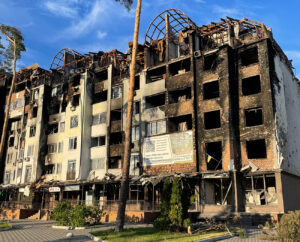
Leonid Regheta witnessed this war-damaged building in Irpin during a summer 2022 trip to Ukraine. (Photo courtesy of Leonid Regheta)

The Russian army launched its attacks on Ukraine Feb. 24, 2022. Within 24 hours, Regheta was fielding phone calls, texts and emails. He began mobilizing ministry partners to provide emergency relief and humanitarian aid to help displaced Ukrainians.

“It has been an incredibly tough year,” he acknowledged, noting he began experiencing high blood pressure for the first time in his life. “I got very little sleep for the first few months.”

Regheta has some family members who have remained in Ukraine the past year, some who relocated temporarily to Poland before returning to Ukraine, and some who moved permanently to Germany. He also has relatives serving with the Ukrainian military on the front lines, and one cousin sustained serious shrapnel wounds.

“It’s been an extremely difficult year,” he said.

‘God has used his people’

Ukrainian children enjoy a summer camp for young refugees organized and led by Hope International Ministries in 2022. (Photo courtesy of Leonid Regheta)

Nevertheless, Regheta was energized and encouraged by the support of the BGCT and several Texas Baptist churches.

“God has used his people,” he said.

The Texas Baptist Hunger Offering provided ongoing financial assistance, and Texas Baptist Men supported ministry to refugees in Poland, he noted.

Regheta particularly expressed appreciation to David Hardage, who retired as BGCT executive director last December.

“Top leaders at the BGCT prayed with us, putting their arms around us to embrace us. It was meaningful,” he said.

In the eyes of Texas Baptist churches, Hardage’s “unwavering support” gave credibility to the ministry to people in Ukraine, to displaced Ukrainians in Europe and to refugees resettling in Texas, he noted.

“Churches realized they have a partner in us,” Regheta said. “We are doing kingdom work together.”

Both River of Life Church and Hope International Ministries benefitted. Regheta pointed to support from First Baptist Church in Garland, Park Cities Baptist Church in Dallas, Crosspointe Church in Plano and Lake Pointe Church in Rockwall.

“We raised $10,000 to provide wood-burning stoves and generators” to Ukraine, he noted.

Adam Edgerly (left) with Covenant World Relief and Development, Leonid Regheta and Paul Minakov of Hope International Ministries talk with a local YWAM coordinator as they visit a refugee outreach center in Romania. (Courtesy of Leonid Regheta)

The Faith in Action program at Baylor Scott & White Health provided furniture for Ukrainian families resettling in North Texas, and the donation center at Hunters Glen Baptist Church in Plano supplied furniture and a variety of household items.

Brookhaven Church in McKinney offered grocery store gift cards to refugee families, and First Baptist Church in McKinney welcomed several Ukrainian families into its English-as-a-Second-Language program.

“The biggest need now is trauma counseling for women who have been living apart from their husbands and fathers for a year,” Regheta said. “The family separation is traumatic.”

Hope International Ministries has developed trauma-informed materials to guide ministry, and they are working with a Christian counselor ministering to refugees in Poland. The ministry also works with refugees in Germany, Latvia and Romania.

This week, Regheta travels to Eastern Europe to help plan a retreat for churches that are ministering to refugees—and to deliver scarves and mittens knitted by women at First Baptist Church in Garland. He has traveled to Ukraine two times since the war began a year ago.

“We hope to work in 10 countries,” he said.

Regheta asked Texas Baptists to pray for a just end to the war in Ukraine, for displaced Ukrainians, for the health and stamina of those who are ministering to them, and for refugees from Ukraine who are resettling in other nations.

“The needs will still be there, even after the war is over,” he said.


Beth Moore describes her ‘knotted-up life’ in memoir

WASHINGTON (RNS)—There’s a downside to going someplace where everyone knows your name. Author and Bible teacher Beth Moore discovered that reality in the months after making a public break with the Southern Baptist Convention, which had been her spiritual home since childhood.

Whenever she and her husband, Keith, would visit a new church, the results were the same. People were welcoming. But they knew who she was—and would probably prefer if she went elsewhere.

Beth Moore is founder of Living Proof Ministries in Houston. (Courtesy Photo)

Once the very model of the modern evangelical woman, she was now a reminder of the denomination’s controversies surrounding Donald Trump, sexism, racism and the mistreatment of sexual abuse survivors.

When Moore no longer could remain silent about such things, she became too much trouble to have around—even in church.

“I was a loaded presence,” she told RNS in a recent interview.

‘The power of a welcome’

In her recently released memoir, All My Knotted-Up Life, Moore recounts how the couple ended up at an Anglican church in Houston.

Their initial visit occurred largely at the suggestion of Keith Moore, who’d grown up Catholic and felt more at home in a liturgical tradition.

When they walked in, the rector greeted them and asked their names.

When she told him who she was, the rector brightened up.

“Oh,” he said, with a smile, “Like Beth Moore.”

Having no idea who he was talking to, he added: “Come right in. We’re glad to have you.”

After the service, a handful of women who had gone through one of Moore’s best-selling Bible studies, gathered around her. They knew who she was and wanted Moore to know she was safe in that place and that there was plenty of room for her in the community.

“Can I simply ask if you’re OK?” Moore recalls one of the women saying.

In that moment of kindness, Moore said she felt seen and at home in the small congregation, which became her new church. She could just be herself, not defined by the controversies she’d been through.

“Never underestimate the power of a welcome,” she said.

Chaos at home, refuge at church

The kindness of ordinary church people has long sustained Moore—providing a refuge and believing in her, even when she did not believe in herself.

Beth Moore addresses attendees at the summit on sexual abuse and misconduct at Wheaton College on Dec. 13, 2018. (RNS photo by Emily McFarlan Miller)

Raised by an abusive father and a mother who struggled with mental illness, Moore has long said that church was a safe haven from the chaos of her home life. In her new memoir, Moore gives a glimpse into that troubled childhood and the faith—and people—who rescued her.

Displaying the skills that made her a bestselling author, Moore tells her story with grace and humor and with charity toward the family that raised her, despite their many flaws and the pain they all experienced.

Moore introduces her late mother, a lifelong chain smoker, with: “I was raised by a cloudy pillar by day and a lighter by night.”

She sums up her late father’s abusive behavior in a simple but poignant sentence: “No kind of good dad does what my dad did to me.”

Confronting father’s infidelity

Moore also tells the story of how she and her sister Gay saved their parents’ marriage when their whole world was falling apart. Moore’s mother had long suspected her father of infidelity. He had always denied it and claimed Moore’s mother, who suffered from severe depression, was crazy and unstable.

Then Gay found a love letter from her dad’s mistress taped to the underside of a drawer in his desk. The two girls sprang into action, calling their father’s lover and telling her to stay away.

It was an act of desperation, Moore told Religion News Service, born out of fear the family would break apart and they’d be left homeless.

“More than anything it was a way to exercise what little power we had,” Moore said, who dedicated her memoir to her husband and siblings, including Gay and her older brother Wayne, a retired composer who died two weeks before the memoir was due to be published.

That call, which Moore credits to her “fearless” sister Gay, changed the course of the family’s life. Knowing the truth about her father’s infidelity gave her mom confidence after doubting herself for years.

Moore said her mother’s story resonates with people who have experienced abuse in church—or know that something is not right in their congregation—and have faced opposition. In many cases, their suspicions were correct, she said.

“But they were told they were unspiritual—that they were trying to destroy (the church),” she said. “It’s what we know now as gaslighting.”

Giving thanks to mentors

One of the most gracious parts of her memoir comes when Moore gives thanks to two of her mentors. The first was Marge Caldwell, a legendary women’s Bible teacher and speaker. Caldwell met her when Moore was first starting out, giving devotions while also teaching an aerobics class at First Baptist Church in Houston.

Caldwell said God was going to raise Moore up to teach the Bible and have an influential ministry. For years, Moore said, Caldwell attended her classes, even though her style was very different from her mentor.

“I would read the expression on her face—wondering, ‘How on earth did this happen?’” Moore said, laughing at the memory. “I knew she loved me so much.”

The other mentor was Buddy Walters, a former college football player who taught no-nonsense, in-depth Bible studies in Texas for years and who instilled in Moore a love for biblical scholarship.

When she met Walter, Moore was filling in for a women’s Bible study teacher at her church who had gone on maternity leave. Under Walter’s tutelage, what started as a temporary assignment became a lifelong passion for Moore.

“I don’t think he would have picked me as a student,” she said. “It just was that I could not get enough.”

Opening up about struggles

In the memoir, Moore, who historically has been very private about her family life, also opens up about the struggles she and her husband have faced. In the past, Moore had made comments about getting married young, and that they had struggled, but gave few details.

With Keith’s permission, she shared more in this memoir, in particular about a family crisis that was going on behind the scenes as her public ministry imploded.

In 2014, two years before his wife clashed with Southern Baptist leaders over Donald Trump, Keith had been saltwater fishing, near the border of Texas and Louisiana.

While hauling in a redfish—also known as a red drum—Keith cut his hand on the fish’s spine. What seemed like a minor injury led to a life-threatening infection. As part of his treatment, Keith had to go off all other medications, including ones he had taken to manage mental illness and PTSD from a traumatic childhood accident in which his younger brother was killed.

That sent him into a tailspin that lasted for years—one the couple kept private until now. They decided to disclose it in the memoir, she said, because discussing mental illness remains taboo in churches.

“It’s such a common challenge and a crisis and yet we are all scared to talk about it,” Moore said. “We asked each other, ‘What do we have to lose at this point?’”

Despite the challenges of the past few years, Moore said, she has not given up on the church, because it had for so long been her refuge.

She knows other people have different experiences and have suffered abuse or mistreatment at the hands of fellow Christians, something she remains all too aware of.

Yet, she can’t let go.

“I can’t answer how it was that even as a child, I was able to discern the difference between the Jesus who is trustworthy with children, and my churchgoing, prancing-around father who was not,” she said.

“There were enough people that loved me well, and in a trustworthy way, that it just won out. I can’t imagine not having a community of faith. That was too important to me to let any crisis take it away.”


Most see more than monthly attendance as standard

NASHVILLE, Tenn.—Want to be considered a regular at a local church by those behind the pulpit and in the pews? Try showing up in person at least a couple times a month.

A Lifeway Research study finds a majority of both U.S. Protestant pastors and churchgoers consider someone to be a regular church attender if they attend twice a month or more. Most also say that’s based on how often they attend a worship service, not other church activities.

“There has likely never been unanimity on what qualifies someone as a regular churchgoer,” said Scott McConnell, executive director of Lifeway Research. “But the question piqued our interest recently as we have heard church leaders speculating that churchgoers are attending less often and that their mindset of who is a regular attender may be changing.”

Church attendance has decreased in the United States, according to studies from multiple research organizations. Those trends were already pointing downward prior to the COVID-19 pandemic, which only accelerated the churchgoing declines for many. Last fall, Lifeway Research found the average church is currently at 85 percent of their pre-pandemic attendance levels.

What does it mean to be a regular churchgoer?

Emerging from a period when most U.S. Protestant churches paused physical worship services for a time, pastors and church attendees are now considering what it means to be a regular churchgoer.

For U.S. Protestant pastors to consider someone in their congregation a regular churchgoer, 3 in 5 expect attendance at least twice a month, while 1 in 10 include those who attend less than monthly.

Pastors who define regular attendance as less than monthly include those who attend at least once a year (2 percent), two or three times a year (2 percent), four or five times a year (2 percent) or six to 10 times a year (4 percent).

Around a quarter (24 percent) see those who attend once a month as regular, while a plurality (30 percent) places the threshold at twice a month.

Others have a higher standard for a regular churchgoer. Around 1 in 7 (15 percent) say three times a month, and 13 percent say weekly. For 3 percent of pastors, only those who attend more than once a week qualify as a regular attender at their church. Another 3 percent aren’t sure.

 “There are practical implications to how often someone attends church,” said McConnell. “Those attending a few times a year are there enough to be known. Whereas those attending weekly likely have deeper relationships and can be counted on to serve. Those at church half the time can only serve if some rotation system is in place.”

Demographic and geographic differences

The oldest pastors are most likely to have the highest threshold, as 22 percent of pastors 65 and older say a regular churchgoer attends weekly or more. African American (36 percent) and Hispanic pastors (25 percent) are more likely than white pastors (14 percent) to say at least weekly attendance is the standard for a regular church attender.

Those in the South (20 percent) are more likely than pastors in the Northeast (12 percent) or Midwest (11 percent) to say only those who attend weekly or more are regular churchgoers.

Denominationally, Pentecostal (26 percent), Restorationist Movement (26 percent) and Baptist pastors (23 percent) are more likely than Methodist (11 percent), Lutheran (4 percent) and Presbyterian/Reformed pastors (4 percent) to consider only those who attend weekly or more as a regular attender in their congregation.

On the other end of the spectrum, mainline pastors (30 percent) are more likely than their evangelical counterparts (20 percent) to include those who attend once a month among regular churchgoers.

Additionally, pastors at small and normative-sized churches are among the most likely to believe monthly attendance makes someone a regular attender. Around a quarter of those at churches with less than 50 people (27 percent) and those at congregations of 50 to 99 (27 percent) say someone who attends once a month is a regular churchgoer.

Worship attendance or other involvement?

When thinking about what exactly someone must attend to be considered an attender, most pastors look to church services rather than other activities.

Six in 10 U.S. Protestant pastors (61 percent) say they base their idea of a regular churchgoer on how often someone attends a church service. Less than 2 in 5 pastors (37 percent) consider strictly in-person attendance, while around 1 in 4 (24 percent) also factor in online attendance.

A third (33 percent) look at how often they attend any church activity, with 9 percent pointing to in-person attendance and 24 percent basing it on physical or online involvement. Few (6 percent) say they aren’t sure.

Younger pastors, those 18-44, are among the most likely to base their churchgoer definition on attending church services in person (42 percent) and among the least likely to include online worship service attendance (17 percent). Evangelical pastors (45 percent) are also more likely than mainline pastors (25 percent) to point to physically attending church services.

Churchgoers themselves are likely to place the standard of regular church attendance near their own frequency. In a study of those who attend church at least once a month, 86 percent say a regular churchgoer is someone who attends once a month or more.

Specifically, 60 percent of respondents attend weekly or more, and 68 percent of those who attend weekly or more consider someone to be a regular churchgoer if they attend with the same regularity.

The more frequently a churchgoer attends services the more likely they are to place a higher threshold for being considered a regular church attender.

Yet, even among those who attend less than weekly, a large portion identify weekly or more as the standard for a regular attendee. More than 2 in 5 of those who attend one time a month (47 percent), two times a month (41 percent) or three times a month (48 percent) point to the weekly or more standard.

“The study of churchgoers only provides insights from those attending each month, but there seems to be a consensus among that group that a regular churchgoer should be involved in the life of a congregation more often than not,” McConnell said. “Pastors’ perceptions of a regular churchgoer often appear broader, while those in the pew lean closer to a weekly standard.”

Hispanic (21 percent) and African American churchgoers (20 percent) are around twice as likely as white churchgoers (11 percent) to say being a regular churchgoer requires attending more than once a week. Churchgoers with evangelical beliefs (55 percent) are more likely than those without evangelical beliefs (38 percent) to say the standard is weekly attendance.

Similarly to pastors, churchgoers are more likely to connect being a regular church attender with attending church services rather than other activities. Most (57 percent) use the church service as their basis, including 29 percent who focus exclusively on in-person attendance and 28 percent who include attending services online.

Around a third (34 percent) focus on any type of church activity, with 14 percent pointing to only in-person attendance and 20 percent including online attendance. Around 1 in 10 (9 percent) aren’t sure.

Churchgoers with evangelical beliefs (33 percent) are more likely than those without (26 percent) to base regular churchgoing on how often someone attends church services in person.

The phone survey of Protestant pastors was conducted Sept. 6-30, 2022. Each interview was completed by the senior or sole pastor or a minister at the church. Analysts weighted responses by region and church size to reflect the population more accurately. The completed sample is 1,000 surveys, providing 95 percent confidence the sampling error does not exceed plus or minus 3.2 percent. Margins of error are higher in sub-groups.

The online survey of American Protestant churchgoers was conducted Sept. 19-29, 2022, using a national pre-recruited panel. The completed sample is 1,002 surveys, providing 95 percent confidence the sampling error from the panel does not exceed plus or minus 3.3 percent.


TBM supplies blankets to displaced Syrians

DALLAS—People in Syria displaced by recent earthquakes need blankets. Now, 10,000 blankets are on the way, thanks to efforts by Texas Baptist Men, in cooperation with key partners in the United States and Syria.

“The suffering is great in Syria, and this week God opened a door for TBM to help respond to that need,” TBM Executive Director Mickey Lenamon said. “We are not at liberty to go into details, but TBM quickly secured 10,000 blankets and started them on the trek to Syria.

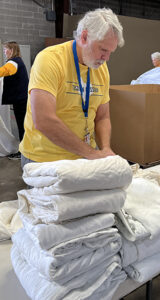
Volunteer Bill Davis helps fold and package blankets for shipment to Syria. (TBM Photo)

“We are working with trusted international partners and are confident that this shipment will get directly to people in need. We do need help in defraying the expenses involved, but friends of TBM have always been faithful in stepping up to meet needs.”

It costs about $10 to purchase and ship each blanket, and TBM has made it possible for people to support the project at tbmtx.org/syria.

The first shipment of 10,000 blankets is being called Phase 1. TBM now is preparing for a second shipment—Phase 2. Buckner International and Baylor Scott & White Health’s Faith In Action initiative gave the second phase a boost by providing 3,800 blankets.

Many of those donated blankets needed to be folded and packed for shipment. So, 33 TBM volunteers responded this week to do the folding and packing.

“We had a great turnout of volunteers on a very short notice,” said David Wells, state director of TBM disaster relief. “They jumped right in Tuesday afternoon and got the job done in much less time than anticipated.”

Wells noted TBM is not accepting donations of blankets from individuals.

“The need is urgent, and the shipping opportunity is available right now,” Wells said. “This is why we are buying most of the blankets and handling the two large institutional donations.”


CLC consultant testifies against Texas Lottery budget

AUSTIN—Texas lawmakers recognize Rob Kohler as a steadfast gambling opponent who often has testified before legislative committees in the past two decades. But Kohler never testified in opposition to the Texas Lottery’s budget—until last week.

Kohler, a consultant with Texas Baptists’ Christian Life Commission, testified before the Senate Finance Committee.

He opposed the budget because the Texas Lottery Commission changed its rules during the COVID-19 pandemic to allow lottery ticket sales by phone via the internet using third-party companies rather than appearing in person at a licensed retailer.

“In many instances, these are offshore gambling companies,” Kohler told the committee. “What it used to mean to play the lottery has changed. From 1992 when we first started until August 2022, it was a face-to-face interaction.”

In fact, the Texas Administrative Code stipulates that a lottery player must be “physically present” at a licensed terminal location. The statute specifically prohibits the sale of lottery tickets “by mail, phone, fax, or other similar method of communication.”

However, in summer 2020, the Texas Lottery Commission “went through a rulemaking process that in essence changed what it means to sell lottery tickets in this state,” Kohler said.

The Texas Lottery changed the rules to delete the “present at the terminal” language and to make possible selling instant scratch-off game tickets by phone. The commission also changed a rule that said a retailer “shall not accept telephone or mail-in requests to issue a ticket.”

“We strongly believe you have the authority to change these things. We respect the process, and we think it should be done in the open by the people that are elected by the citizens of this state—not state agency staff,” Kohler told the Senate committee.

In discussion following Kohler’s testimony, some senators on the committee noted concern about the addictive nature of lottery ticket sales over the phone, as well as opposition to the process by which rules were changed.


Around the State: Baylor plans Monument to the Unknown Enslaved

The design of the “Monument to the Unknown Enslaved” at Baylor University is inspired by the limestone used on the original Baylor campus in Independence—likely built at least in part by enslaved people. (Baylor University)

Baylor University released a detailed rendering of an addition to Founders Mall called the “Monument to the Unknown Enslaved.” The design is inspired by the limestone used on the original Baylor campus in Independence—likely built at least in part by enslaved people. A limestone wall will form the monument’s outer ring, made of stacked stones with intentional voids between, meant to represent both the unknown enslaved and gaps in Baylor’s history. The smaller, inner ring of the monument will feature a ground-level map of eastern Central Texas, with shaded areas on the map indicating the enslaved population density, circa 1860. The amphitheater-style Resonance Garden between Draper Hall and the monument will allow students and other visitors to reflect on the information presented in other areas of the monument through engravings and QR codes. The additions to Founders Mall are being created by the Sasaki architectural firm with input from Baylor’s campus experience project team and student representatives. It grew out of a report and recommendations to Baylor’s board of regents from the Commission on Historic Campus Representation at Baylor.

East Texas Baptist University’s School of Education received full accreditation and commendations from the State Board for Educator Certification. (ETBU Photo)

East Texas Baptist University’s School of Education received full accreditation and commendations from the State Board for Educator Certification, which oversees all aspects of public school educators’ preparation, certification and standards of conduct. ETBU’s School of Education is one of only 75 fully accredited educator preparation programs in Texas. “East Texas Baptist University has long been known for excellence in educator preparation. The results of our accreditation are a reflection of many years of student-centered leadership and our current commitment to maintaining that level of excellence,” Dean Amber Daub said. ETBU received “Rigorous and Robust Preparation” commendation for its first-test pass rate in English Language Arts and Reading on the Accountability System for Educator Preparation annual performance standards. With numerous ETBU alumni employed in rural schools, the School of Education also received the commendation for “Preparing the Educators Texas Needs.”

Collin Baptist Association sold its building to Cottonwood Creek Church in Allen. Pictured at the signing of legal documents are (left to right) Leigha Henslee, daughter of the associational director of missions; Matt Henslee, associational missionary; Scott Sanford, executive pastor of Cottonwood Creek Church; Joe Patton, associate associational missionary; Duane Bechtold, director Collin Baptist Men; Gary Smith, trustee of Collin Baptist Association; David Wideman, Davco Development; Jemar Bahinting, associational office manager; Kaydence Henslee; daughter the director of missions; and Ed Spivey, trustee for Collin Baptist Association. (Collin Baptist Association Photo)

Collin Baptist Association sold its building to Cottonwood Creek Church in Allen. “We are grateful for the opportunity to purchase this building and use it to further our mission of reaching people with the gospel,” said Scott Sanford, executive pastor of Cottonwood Creek Church. “We look forward to seeing all God does in and through this partnership.” Proceeds from the sale of the property will enhance Collin Baptist Association’s ability to help plant churches, strengthen existing churches and encourage ministers. “We are thrilled to be able to sell our building to Cottonwood Creek Church,” said Matt Henslee, associational missionary. “Their passion for doing whatever it takes to reach people with the gospel and commitment to excellence and glorifying God in all they do makes this a no-brainer. We are confident this building will continue to be a beacon of hope and a center of gospel-centered ministry under their leadership. We are overjoyed that it’ll stay in the family of Collin Baptist Association.” The association will rent office space at 7300 TX-121, Suite 300, McKinney, TX 75070.


TBM disaster relief teams continue ice storm response

Hurricanes typically are named. Most other disasters are not. But due to its devastating impact, February’s Texas ice storm received a name—Mara.

Since the winter storm, TBM has received 335 requests for help. Of those, 254 projects have been completed, and 81 remain to be processed. Almost all of the jobs required the work of chainsaw crews. (TBM Photo)

Winter Storm Mara no longer is in the news, but Texas Baptist Men disaster relief chainsaw volunteers still are active more than three weeks after the ice storm and expect to wrap up this week.

Since the storm, TBM has received 335 requests for help as of Feb. 20. Of those, 254 projects have been completed, and 81 remain to be processed. Almost all of the jobs required the work of chainsaw crews. To date, TBM disaster relief workers have given 8,727 total volunteer hours.

“We expect the work to continue through the week,” said David Wells, director of TBM disaster relief. “That’s a month’s worth of work, and our volunteers are responding extremely well. The devastation is really widespread and extensive.”

Volunteers from Waco Regional Baptist Association were among those responding to the damage in Temple, where resident Alexis Weldin told KXXV News, “I’ve never seen it where tree limbs were just snapping off, just breaking and slamming down to the ground.”

She expressed special appreciation for TBM Disaster Relief volunteers, saying, “It takes a giant burden off of you to have that resource out there to come and help.”

Three TBM chainsaw teams remained active in the field Feb. 20, plus several teams responding in their local areas.

All work is being coordinated by an Incident Management Team at TBM headquarters in Dallas and by site coordinators at Temple and Austin. Assessors have completed their work and returned to their home locations.

Volunteers provide trained labor, but safely removing downed trees and limbs requires heavy-duty equipment, Wells said.

Heavy equipment operators supported the chainsaw crews’ work with three man-lifts and two skid steers. Two feeding teams and two shower and laundry units also supported other TBM disaster relief volunteers.

“TBM Disaster Relief is built on volunteer service and the funds to support their work in the field,” he said. “It takes a lot, and TBM’s volunteers and supporters give a lot.”

To donate financially to TBM disaster relief, click here or mail checks to Texas Baptist Men, 5351 Catron Drive, Dallas, TX 75227.