Obituary: Karl Bozeman

Karl Bozeman of Garland, longtime minister and denominational worker, died Jan. 5 in Garland. He was 96. He was born Dec. 18, 1926, to Jesse and Lillie Bozeman in a small farmhouse in Longstreet, La., about 35 miles south of Shreveport. After he graduated from high school at age 17, he moved to Lufkin, where he worked the next 17 years for a foundry and machine company as a warehouse supervisor, interrupted only by two years of service in the U.S. Army from 1943 to 1945. He and Joreen Hayes married Aug. 18, 1951, in the parlor of First Baptist Church in Lufkin. In 1957, he was asked to teach at Glorieta Baptist Conference Center in New Mexico. As a result of that experience, he began to feel God’s call to full-time Christian vocational service. He had a heart for children, especially preschoolers. So, at age 31, he began preparing to serve God through early childhood education. While continuing to work full time and spending as much time as possible with his family, he earned an undergraduate degree from North Texas State University, a Master of Religious Education degree from Southwestern Baptist Theological Seminary and Master of Education degree from the University of Texas at Tyler. After serving as part-time educational director for Denman Avenue Baptist Church in Lufkin, he became director of elementary and kindergarten ministry at First Baptist Church Walnut Hill in Dallas. He went on to serve as director of preschool and children’s ministry at Northrich Baptist Church in Richardson before joining the staff of the Baptist General Convention of Texas as consultant for preschool and children in the Sunday School Department. After Tropical Storm Amelia hit in the summer of 1978, he was given an additional assignment as coordinator of temporary emergency child care for the BGCT. He designed, equipped and furnished the first temporary emergency child care trailer. Over the next 24 years, he assisted with 23 disasters, ministering to families and their children. The Southern Baptist Convention’s Brotherhood Commission published his guide to developing an emergency child care system to help others provide free child care in the aftermath of major disasters. His final full-time ministry position was as director of Royal Ambassadors and editor of Crusader/Royal Ambassador materials with the Brotherhood Commission in Memphis, Tenn. He retired as the national SBC Royal Ambassador director in 1992. In retirement, he served as Brotherhood director and director of senior adult Sunday school at Mimosa Lane Baptist Church in Garland. In his final years, he was a member of South Garland Baptist Church, where a memorial service is scheduled at 2 p.m. on Jan. 13. He was preceded in death by his wife, Joreen Hayes Bozeman; brothers Conway Bozeman, C.R. Bozeman and Melvin Bozeman; and sisters Merva Sinclair, Margaret Helton and YV Bozeman. He is survived by daughter Karen Gray and husband Gary; daughter Brenda Hass and husband Artie; five grandchildren; and 12 great-grandchildren. Memorial gifts can be made to Texas Baptist Men Disaster Relief.


North American Baptist Fellowship installs new officers

The North American Baptist Fellowship installed Emmett Dunn to a three-year term as president Jan. 10 during an online meeting of the fellowship’s executive committee.

Dunn is the executive secretary-treasurer of Lott Carey, a historically African American missions organization. He was elected by the fellowship at its annual meeting in Falls Church, Va., in October.

He succeeds Samuel C. Tolbert Jr., pastor of Greater St. Mary Missionary Baptist Church in Lake Charles, La., president of the National Baptist Convention of America International, Inc., and vice president of the Baptist World Alliance.

Craig Christina

As part of the leadership transition in the regional fellowship, Craig Christina, acting executive director of the Baptist General Convention of Texas, now is one of two vice presidents.

Trisha Miller-Manarin, executive director/minister of the District of Columbia Baptist Convention, also will serve as a vice president.

TaNikka Sheppard, past president of BWA Women, assumes the dual role of treasurer and assistant general secretary.

Jeremy Bell, executive minister for Canadian Baptists of Western Canada, continues as general secretary of the regional fellowship.

The North American Baptist Fellowship—a regional body in the BWA—represents 22 Baptist conventions, unions and missions societies in the United States and Canada. Its member organizations include close to 20 million members of 55,000 congregations.


Israel excavates ancient Pool of Siloam site

JERUSALEM (BP)—Assyria’s King Sennacherib was planning to capture Judah. Somehow, King Hezekiah had workers dig a tunnel through solid rock and divert Judah’s water supply to the Pool of Siloam, hiding it from the enemy.

That was 2,700 years ago.

Clues to how the work was done, as well as biblical evidence from Jesus’ Judean ministry, might be unearthed as Israel excavates the full Pool of Siloam that has fascinated archeologists more than 150 years.

Baptist seminary professor viewed site

New Orleans Baptist Theological Seminary professor Jim Parker viewed the excavation site and tunnel while on an instructional tour of Jerusalem.

“It’s still a great mystery how they did it,” said Parker, professor of biblical interpretation and executive director of the seminary’s Michael and Sara Moskau Institute of Archeology. Hezekiah “was able to protect and defend the water system.”

The work is referenced but not detailed in 2 Kings 20:20, which indicates the details are written in “The History of the Kings of Judah,” an extrabiblical book.

“We don’t know that there were written sources that went forward that went into the (biblical) canon,” Parker said. “It seems like there was another set of writings where they kept up with all of the details of what the king did and everything. But today, we don’t have those. Those are lost.”

Excavation of the full pool, believed to be about one acre in size, will be valuable in affirming Scripture, Parker said.

“It affirms the biblical fact that this pool existed, and the tunnel existed, and it operated together,” he said. “It also gives an idea into some of the rituals of the temple.”

Site holds ancient significance

The Pool of Siloam is where Israelites washed to purify themselves spiritually before entering the temple. John’s Gospel reports Jesus healed a blind man at the pool.

The site of the pool was discovered in 2005 when workers unearthed steps to the pool while repairing a sewage line, but only a small portion of the site has been excavated. The pool was the reservoir for the waters of Gihon Spring, which were diverted through Hezekiah’s tunnel.

“This was all pure water,” Parker said. “And coming out of a spring, it’s called living water. Water that’s moving, by nature, it’s called living water.”

The Israel Antiquities Authority, the Israel National Parks Authority and the City of David Foundation announced in December 2022 the beginning of the full excavation of the pool.

“The Pool of Siloam, located in the southern portion of the City of David and within the area of the Jerusalem Walls National Park, is an archeological and historical site of national and international significance,” the groups said in a press release.

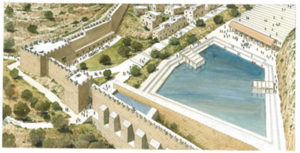
Rendering of the Pool of Siloam, Second Temple period. (Shalom Kveller, City of David Archives)

“Due to its location and importance, the Pool of Siloam was renovated and expanded some 2,000 years ago at the end of the Second Temple period. It is believed that the pool was used during this time as a ritual bath by millions of pilgrims who converged at the Pool of Siloam before ascending through the City of David to the Temple.”

Scholars have theorized how Hezekiah dug the tunnel to divert the spring, Parker said.

“They dug it from both ends. We think it’s something over a year, it could be as much as two years as they were digging through solid rock. It’s still a great mystery how they did it, and how they were able to meet each other,” he said. “It’s almost 1,700 feet long. So, they dig and meet somewhere about halfway.

“There’s actually an inscription inside the tunnel that they met there. When you’re in the tunnel looking, you can see the tool marks on the rock and you can tell which ones were coming from which direction, the way they dug,” Parker said. “So it’s a very interesting thing to see.”

Will be open to tourists

Israeli authorities did not provide a timeline of the excavation but said tourists will be able to view the work, and they said the pool would be accessible by tourists in “the coming months.”

Parker is hopeful the excavation will unearth additional artifacts supporting Scripture.

“Once we have it fully uncovered, we’ll be able to measure and see everything, so we’ll understand the process fully,” he said. “Many times, we find things like that that would point us to another discovery or another truth,” such as coins, pottery and other artifacts.

“You never know what you’re going to find, … all of these things that will be important to the additional understanding of the word (of God).”

The excavation will afford a valuable teaching tool.

“As we teach, we’ll take the Bible verses that bring all of this together, and then we’ll have a visual element just in front of us, and a very large one that we can show and discuss and understand,” he said.

The excavation can also provide clues to other miracles Jesus performed at pools of water, such as healing the man at the Pool of Bethesda who had been paralyzed 38 years.

“That’s also a place with a water feature that Jesus went to and did a miracle. That will help us understand, too, how that looked,” he said. “The same period of time, probably the same (type of) construction. That had five porticos in it. This is going to have just this one large pool.”


Obituary: Louis Palmer McCown

Louis Palmer McCown, longtime collegiate minister and later minister to senior adults, died Dec. 25 in Midland. He was 83. He was born in Hillsboro to Erma LaVerne and Walter Hooper McCown on March 16, 1939. After his graduation from Littlefield High School, he went to Hardin-Simmons University, where he earned his undergraduate degree in Bible and history. While in college, he was pastor of a church in Guthrie. He later earned a Master of Divinity degree from Southwestern Baptist Theological Seminary. He married Patricia Jean Jones on June 2, 1961, in Dallas. McCown worked as a Baptist Student Union director for the Baptist General Convention of Texas at Sul Ross State University in Alpine, South Plains College in Levelland, the University of Mary-Hardin Baylor in Belton and Hardin-Simmons University in Abilene. During a four-year hiatus from college ministry in the early 1970s, he was minister of youth and adult education at Columbia Baptist Church in Falls Church, Va. After retiring from student work in 2001, he served as interim music minister and pastor for various churches in the Abilene area. In 2006, he became minister to senior adults at First Baptist Church in Abilene, where he served until his second retirement in 2016. For more than 40 years, McCown sang in the choir at First Baptist Church in Abilene, and he was part of the church’s men’s ensemble. In retirement, he enjoyed singing with the Celebration Singers civic group. He served on the board of development at Hardin-Simmons University and, at one point, was president of the Texas Baptist Student Summer Missions Committee. Palmer was named a distinguished alumnus by Logsdon School of Theology at HSU and received the Altom Christian Service Award from HSU. He is survived by his wife of 61 and a half years Patsy McCown; daughter Stephanie Markgraf and husband Jim; son Michael McCown and wife Barb; two grandsons;  and sister Sue Thomas. Memorial gifts can be made to Texas Baptist Student Missions or to the music ministry at First Baptist Church in Abilene.


Mixed response from faith leaders to border policy changes

President Joe Biden’s visit to El Paso—his first trip to the U.S.-Mexico border since he took office—came three days after he announced changes in immigration and asylum policies, which some faith leaders greeted with mixed reviews.

During his Jan. 8 four-hour tour of El Paso, Biden visited the Bridge of the Americas port of entry that connects El Paso and Ciudad Juarez and went to the El Paso County Migrant Services Center.

At the El Paso airport, he also spoke briefly with Gov. Greg Abbott, who hand-delivered a letter to Biden that pointedly called on the president to take a stricter approach to border security.

Biden visited El Paso on his way to Mexico City, where he was scheduled to meet with Mexican President Andrés Manuel López Obrador and Canadian Prime Minister Justin Trudeau for the North American Leaders’ Summit.

Biden announces policy revisions

On Jan. 5, Biden had announced his administration is expanding the humanitarian parole process already in effect for Venezuela and Ukraine to allow up to 30,000 nationals per month from Nicaragua, Haiti and Cuba.

Anyone seeking humanitarian parole must have a sponsor in the United States and pass a vetting process, including background checks. Individuals in the program can live in the United States up to two years and receive work authorization.

The president said the United States will welcome up to 20,000 refugees from Latin American and Caribbean countries in fiscal years 2023 and 2024.

At the same time the United States will expand the humanitarian parole program, it also will expand its use of Title 42 expulsions.

Biden said individuals who attempt to enter the United States without permission and do not have a legal right to remain will be subject to expedited removal to their country of origin and to a five-year ban on reentry.

He also announced the creation of an online portal—available on a mobile app—to allow noncitizens in Central America and Mexico to schedule an appointment to present themselves for inspection and initiate a protection claim.

An accompanying rule would permanently bar anyone from seeking asylum if they appear at a port of entry without first applying for asylum in a third country before reaching the United States.

At the same time he unveiled the immigration and border security changes, Biden also announced the United States will provide close to $23 million in additional humanitarian assistance to Mexico and Central America. He also said his administration plans to increase funding to border cities and cities receiving an influx of migrants.

Muted praise, deep disappointment

Stephen Reeves, executive director of Fellowship Southwest, expressed general disappointment regarding the policy changes.

Stephen Reeves

“While we appreciate the administration’s efforts to streamline the asylum process and allow more migrants from certain countries, it is deeply disappointing to see a continued limiting of access to a legal, fair and timely asylum process for the poorest and most vulnerable. It is doubtful that the migrants served in Fellowship Southwest’s border network will benefit from these changes,” Reeves said.

“Undoubtedly, the types of reforms and resources necessary to overhaul our broken system can only be done through bipartisan cooperation in Congress. It is a tragedy that we continue to treat global migration as a political football and not as the humanitarian crisis it is.

“Our country has the resources to alleviate suffering but not the political will. The administration’s new policy will continue to force the care and protection of thousands of migrants on to the compassionate but under-resourced Mexican border towns, ministries and pastors, and ensure a continued supply of victims for cartel violence and exploitation.”

Jenny Yang, vice president for advocacy and policy at World Relief, offered cautious praise for some aspects of the policy changes, along with criticism of others.

Jenny Yang

“We certainly acknowledge that not every individual who arrives at the border will qualify to be granted asylum under U.S. law, but we must respect our nation’s moral and legal obligations to ensure due process for those seeking protection from persecution,” Yang said.

“We are encouraged by the expansion of legal avenues for those who have fled countries where people are enduring incredible hardship.

“However, such processes should not be paired with new restrictions on asylum for those with no other avenue for protection under current U.S. law but for reaching the U.S. border to seek asylum. We urge President Biden to work with Congress to develop a pathway forward that both protects our nation’s borders and respects the dignity and value of all human life, especially those who are vulnerable.”

‘Significant concerns’ voiced

Similarly, Jennie Murray, president and CEO of the National Immigration Forum, applauded some of Biden’s announcements while voicing serious concern about others.

“Increasing the use of humanitarian parole will help contribute to a more orderly process at the border, as will expanded legal alternatives for those seeking humanitarian protection. We also are glad to see more resources and personnel being put in place to improve border processing,” Murray said.

“We have significant concerns as well. The proposed rulemaking that would implement a transit ban for many traveling through third countries is extremely problematic, as is the continued reliance on Title 42. People of limited means will continue to have difficulty accessing humanitarian parole, as has been the case for Venezuelans. We also hope the administration will consider increasing the cap on humanitarian parole visas if circumstances warrant it.

“Ultimately, the president and Congress still need to work together to adopt much-needed immigration reforms—including, but not limited to, the border—to solve the challenges we face.”

Mary J. Novak, executive director of NETWORK Lobby for Catholic Social Justice, offered tempered praise for some of Biden’s announced policy changes, along with expression of disappointment regarding others.

“We welcome President Biden’s words about ending prejudice against immigrants and his support for the organizations and border communities serving immigrants. However, we are deeply disappointed that the Biden administration continues to choose failed border policies over just, humane policies that welcome our neighbors seeking safety,” Novak said.

“It is unacceptable to pair what is in effect an asylum ban with a limited, inadequate, stop-gap measure like humanitarian parole. People have the right to seek asylum, regardless of their nationality. As people of faith, we are called to love our neighbor without distinction. Following today’s disappointing announcement of more expedited removals and a third-country transit ban, we commit to renewed advocacy for border policies that affirm every person’s inherent worth and dignity and uphold their human rights.”

‘Misguided and cruel’

Enhanced enforcement will restrict the legal rights of migrants facing danger to seek asylum in the United States, said Pedro Rios, director of the U.S.-Mexico border program for the American Friends Service Committee.

 “The administration is expanding the use of Title 42, which is an archaic public health order that empowers Border Patrol agents to expel migrants without recognizing their right to seek asylum under U.S. and international law, and further expedite their removal,” Rios said.

“We strongly believe that an enforcement approach in response to people seeking safety is misguided and cruel, and will only exacerbate the precarious conditions that endanger the lives of those seeking safe harbor. We urge the Biden administration to re-prioritize its approach by centering policies on the human rights of migrants seeking asylum in the United States.”

Dylan Corbett, executive director of Hope Border Institute, was even more pointed in criticizing the Biden policy announcements.

“The expansion of Title 42 to include Cubans, Haitians, and Nicaraguans is a broken promise,” Corbett said. “Rather than putting our country on a sure path to fully restoring asylum at the border, these new actions by the Biden administration entrench a dangerous, ineffective and inhumane policy where those in need of protection at the border are summarily expelled.

“The poor and vulnerable at our nation’s doorstep deserve more. Border communities will continue to work hard to pick up the broken pieces of our nation’s immigration system and show that our future lies not with expulsion and deportation, but with humanity and hope.”


Sexual abuse hotline confidentiality clarified

NASHVILLE (BP)—The Southern Baptist Convention Abuse Reform Implementation Task Force, the SBC Executive Committee and Guidepost Solutions issued statements dealing with allegations of breaches of confidentiality within the SBC sexual abuse hotline.

Southern Baptist Convention President Ed Litton told the SBC Executive Committee the convention must address the “stains” of sexual abuse and racism. (BP Photo)

The SBC Executive Committee established the hotline in May 2022 to receive reports of abuse that happens in or is connected to Southern Baptist churches.

“The hotline was established to ensure survivors, and/or their reporting friends and relatives, had a trauma-informed team and resource to report abuse,” reads a Jan. 9 statement from the implementation task force.

The statement adds that the hotline was a “stop-gap measure” created in the wake of the May 2022 release of Guidepost’s report on its investigation into the SBC Executive Committee’s handling of abuse claims.

Intended as ‘fully confidential and protected place’

The hotline was intended to provide a “fully confidential and protected place to report abuse while more permanent measures were instituted by the Executive Committee,” the statement says.

The Sexual Abuse Task Force, appointed by then-SBC President Ed Litton in July 2021, released its own report and recommendations to messengers at the 2022 SBC annual meeting, based on the Guidepost report. It also worked with the Executive Committee to create the hotline, selecting Guidepost as the third-party operator.

Bart Barber, pastor of First Baptist Church in Farmersville, speaks during the Southern Baptist Convention annual meeting at the Anaheim Convention Center in Anaheim, Calif. Barber was elected president. (Photo by Justin L. Stewart/Religion News Service)

One of the recommendations approved by messengers was the creation of the Abuse Reform Implementation Task Force, whose members were appointed by current SBC President Bart Barber last August.

It is tasked with implementing the reforms approved by messengers and is working toward long-term reforms for preventing, reporting and handling sexual abuse as well as caring for survivors.

The implementation task force stated victims’ advocate Rachael Denhollander has helped specific survivors on only two occasions, each at the survivor’s request.

“Calls that come into the hotline are received exclusively by Guidepost and seen only by their staff,” the implementation task force statement says. “This is guaranteed in the contract which the Executive Committee executed with Guidepost.”

A few exceptions noted

The statement lists a handful of exceptions: if mandatory reporting is triggered; if information is shared that is deemed pertinent to the Department of Justice’s ongoing investigation of the SBC; or if the information is pursuant to a lawful subpoena.

The group says survivors are also given the option to have their information shared with the SBC Credentials Committee. If this occurs, “Survivors are fully informed at every step of the process and no action is taken without their knowledge or consent,” the statement says.

In an FAQ posted by Guidepost on Jan. 9, the group writes: “A small number of trauma-informed Guidepost team members receive hotline emails/calls and engage with reporters. Once Guidepost receives a report through the hotline, one of our trauma-informed team members contacts and speaks to the reporter to gather additional information relative to the allegation.”

The group adds: “All calls/emails are handled exclusively by Guidepost team members.”

Guidepost says it refers all “relevant” reports to the SBC Credentials Committee “for their consideration and whatever action they deem appropriate,” but adds it “does not provide identifying information about the individual who reports the information to the Credentials Committee, unless specifically approved and directed to do so by the reporter.”

The Credentials Committee is a standing SBC committee tasked with determining whether or not a church is in friendly cooperation with the SBC. Mishandling abuse claims is one reason among others that a church may be recommended by the Credentials Committee to be disfellowshipped.

In a joint statement to Baptist Press, SBC Executive Committee Interim President/CEO Willie McLaurin and Executive Committee Chairman Jared Wellman said, “The SBC Executive Committee does not receive confidential survivor information from Guidepost nor does it seek access to such sensitive information.”

Role of Denhollander questioned

Rachael Denhollander speaks during the Presidents Conference of the Council for Christian Colleges and Universities in Washington. (RNS photo by Adelle M. Banks)

Over the weekend, abuse survivor and survivors’ advocate Christa Brown called into question fellow survivor Rachael Denhollander’s role as adviser to the implementation task force.

Brown posted screen shots on social media that appear to show text messages from Denhollander, who is also an attorney, talking about helping survivors who call the hotline.

The implementation task force confirmed that in an effort to provide support for survivors, on occasion, information may be passed on to another party, always at the survivor’s request.

The group’s statement explains: “Concerns were expressed to the previous task force that newly reporting survivors not be left unsupported, and that they have access to communication measures and support if needed.

“This request was made by survivors to the previous task force, and task force leadership was aware that many survivors may not wish to engage directly with an SBC pastor. They determined it was wise to provide an additional route for communication, updates, and support if so desired.

“However, the avenues for communication were made available with the full knowledge and consent of all parties involved, including and especially, survivors who requested additional support. Out of all the calls that came in, only two resulted in Guidepost contacting Rachael Denhollander for potential connection to resources. …

“All information that is provided to the hotline goes directly to, and stays with, the team at Guidepost. Every contact to the hotline is confidential and protected.”

The implementation task force says it has worked to ensure no conflicts of interest among task force members or consultants.

“Importantly, every individual involved with the previous task force and current [implementation task force] was thoroughly vetted to ensure that no conflicts of interest were present, and significant protections were put in place for the structure of the investigation and hotline, to ensure full survivor confidentiality as well as transparency for all who chose to provide information,” the group’s statement says.

In email correspondence, Marshall Blalock, chairman of the implementation task force, said no consultants have been paid for their work with either task force to this point.

The statement includes specific clarification of Denhollander’s role with the group, saying she “serves as an advisor due to her expertise in crisis response, trauma, abuse dynamics and sexual abuse reforms. She does not serve as counsel.”

The statement adds neither the implementation task force nor Denhollander “have access to confidential survivor information or the information provided to Guidepost through the hotline, nor do any of these parties have any right, contractually or otherwise, to access such information.”


Baptists assaulted in indigenous community in Mexico

A Baptist woman in Mexico remains hospitalized in serious condition after being tied to a tree and beaten before Christmas.

Her pastor at Great Commission Baptist Church in Rancho Nuevo also was assaulted when he tried to intervene and was detained two hours by local authorities.

No arrests were made, even though complaints were filed with the Hidalgo State Human Rights Commission and the Hidalgo State Prosecutor’s Office.

‘Not an isolated incident’

Officials with Christian Solidarity Worldwide, a United Kingdom-based human rights organization, noted Rancho Nuevo—an indigenous Nahuatl-speaking community in Hidalgo State—has a documented history of violating the religious freedom of minority faith groups.

“This was not an isolated incident,” said Anna-Lee Stangl, joint head of advocacy for CSW. “The situation in her village, Rancho Nuevo, has been ongoing since 2015. Religious minority children in Rancho Nuevo have been blocked from attending school since 2018.

“CSW has documented 20 other similar cases in the state of Hidalgo and about 100 in different states across the country.”

Maria Concepcion Hernández Hernández was attacked Dec. 21 after she visited a plot of land she owns because a neighbor asked her to remove two trees. Since 2015, local authorities in Rancho Nuevo have prohibited Baptists from accessing or using their own land to cultivate crops.

A half dozen Roman Catholic men allegedly participated in the assault. CSW reported the local Catholic church rang its bells immediately prior to the attack—at a time when they typically are silent.

When Pastor Regelio Hernández Baltazar tried to stop the attack, he was assaulted and detained by local leaders who demanded he hand over the deeds to plots of land owned by his church members. When he refused, the authorities threatened to take the deeds by force and seize the property.

Governed under Law of Uses and Customs

Rancho Nuevo is governed under Mexico’s Law of Uses and Customs, which recognizes the right of indigenous communities to maintain their cultural and traditional local governance.

The law stipulates local authorities must govern in line with rights guaranteed in the Mexican constitution and international conventions. In practice, however, the state and federal government does little to protect minority rights in those areas, Stangl said.

“In Hidalgo, over the past six years and under the previous governor, the state government insisted that there were no cases of religious intolerance in the state, and we have documented cases where government officials responsible for protecting freedom of religion or belief pressured members of religious minorities to comply with the demands of the religious majority,” she said.

Elijah Brown

Elijah Brown, general secretary and CEO of the Baptist World Alliance, called for prayer.

“As we enter into this new year, we are reminded again that many around the world, including Baptists, face daily challenges as they live out their faith,” Brown said.

“Even as the BWA stands together with the Mexican Baptist Convention in providing support for this church and family, let us pray for the full recovery of Sister Maria, and renew our commitment to live in all circumstances with bold humility our faith in Jesus Christ.”

Maria Concepcion was listed in critical condition for two weeks, but her condition improved this past weekend.

“She was moved out of ICU and is able to receive visitors. She has also stopped vomiting blood and has been able to ingest some soft food. Her family and church community attribute this to all the prayer on her behalf and have asked people to continue to pray for her,” Stangl said.

“Aside from the improvement in Maria Concepcion’s condition, there have been no new developments in the case, and the Baptists in Rancho Nuevo remain in a very precarious situation, with ongoing threats of mass forced displacement.”

Report documents plight of women

(CSW Report)

Last March, CSW published a report, “Let her be heard: The untold stories of indigenous minority women in Mexico.” It focused on interviews and focus group discussions with indigenous women from religious minorities in the states of Hidalgo, Chiapas, Guerrero, Jalisco and Oaxaca.

 “Many local authorities of communities functioning under the Law of Uses and Customs mandate community uniformity in terms of religious practice and belief, compelling all members to participate in the religious activities of the majority or face punishment,” the report states.

Interviewed women reported religiously motivated attacks on property, gender-based violence and denial of access to basic services, including prenatal healthcare services.

CSW holds responsible authorities in the Hidalgo State, as well as local individuals directly involved in the assault on Maria Concepcion.

“We call on Governor Julio Ramón Menchaca Salazar to ensure that his administration takes swift action to bring to justice those responsible for this brutal attack and the ongoing threats against members of the religious minority in Rancho Nuevo,” Stangl said.

“We urge Governor Menchaca Salazar to work closely with the state human rights commission and federal religious affairs officials to put in place policies that recognize the existence of serious [freedom of religion or belief] violations in Hidalgo and develop effective and timely ways to address them in accordance with Mexico’s legal protections for human rights.”


Stewart named COO and ministries director of BWA

Jenny Stewart of Australia/United Kingdom has joined the Baptist World Alliance executive leadership as its first director of ministries and chief operating officer.

Working closely with the BWA general secretary/CEO, this new position will provide leadership to the five BWA ministry areas—worship, fellowship and unity; mission and evangelism; aid, relief and community development; religious freedom, human rights and justice; and transformational leadership and theological reflection.

The role will be responsible for collaborating together with each ministry’s personnel regarding strategy and finances, ensuring alignment with the BWA’s overall mission for meaningful impact.

“We are blessed to welcome Jenny Stewart to the BWA team and look forward to how the Lord will use her gifts and experience to further God’s global mission,” said BWA General Secretary Elijah Brown.

Stewart’s appointment, with a start date pending obtaining the necessary work visa, was announced last July at the BWA Executive Committee meeting preceding the annual gathering in Birmingham, Ala. She also was included in a special BWA General Council commissioning prayer time.

Having successfully obtained her work visa, she has relocated and began serving at the BWA offices in Falls Church, Va., effective Jan. 1.

Stewart comes to the position with wide-ranging experience in finance, communications, event coordination and nonprofit management. With a financial and accounting management background, she has served several ministries in her career.

From 2002 to 2010 she was the events manager and communications and publications manager for the Baptist Union of Great Britain, followed by her role as the operations director for Scripture Union International from 2010 to 2019.

Stewart has been active in the ministry of the BWA since 1998 when she attended her first BWA meeting, the International Worship Conference held in Berlin.

“It was an incredibly challenging and blessed experience as the Baptist family from around the world came together and shared their worship traditions with each other—new and old. We all had so much to learn,” Stewart said. “It certainly encouraged me to continue my BWA involvement, as I could see how much more we could impact the world for Christ by working together and learning from each other.”

She was a key leader in the planning of the centennial Baptist World Congress held in Birmingham, England, in 2005, and she has served in a contract role as special projects coordinator for the BWA since 2020.

As coordinator, Stewart worked with the general secretary on projects including governance, membership and department reviews; development of an updated human resources policy and manual; and assistance with transitioning the 2020 Congress from an in-person to virtual event. Before her recent contract role, Stewart also served extensively on BWA committees.

 “It is a great honor for me to accept the appointment to the role of director of ministries/chief operating officer for the BWA,” Stewart said.

“I am grateful for the gifts and experiences God has given me over the years, and I see them all coming together in this role. I look forward to using them as I play my part in supporting General Secretary Elijah Brown, as well as facilitating both individuals and the various BWA groups to be well connected and to flourish in their ministry as we continue to grow and explore new ways to achieve our mission together.”


Who are the Christian nationalists?

WASHINGTON (RNS)—“Christian nationalist” once summoned images of fiery extremists—stark racists concerned with keeping immigrants out of the United States or politicians who argued that the Ten Commandments ought to coexist in law with the Constitution.

Then came Jan. 6, and suddenly the term became a culture-war acid test: One member of Congress began selling “Proud Christian Nationalist” T-shirts, while Pastor Robert Jeffress of First Baptist Church in Dallas said if opposing abortion, transgender rights and illegal immigration made him a Christian nationalist, “count me in.”

For the record, sociologists Andrew Whitehead and Samuel L. Perry describe Christian nationalism as “a cultural framework that blurs distinctions between Christian identity and American identity, viewing the two as closely related and seeking to enhance and preserve their union.”

But not everyone who meets the definition claims the moniker “Christian nationalist,” and some who do are only barely recognizable as traditional Christians.

Here are six loose networks of faith leaders and followers who fit some part of the definition:

1. God-and-country conservatives

These largely unorganized faithful Americans are in many cases friends, family and neighbors who hold dear a vision of the country rooted in nostalgia for a past that is more aspirational than historical.

A recent Pew Research Center survey captured many of this group in the 45 percent of Americans who believe America should be a Christian nation, including 81 percent of white evangelicals, 67 percent of Black Protestants and 54 percent of nonevangelical Protestants. Almost half of Catholics (47 percent) also fall into this group, though Hispanic Catholics (36 percent) are less likely to do so than white Catholics (56 percent).

Only 16 percent of Jews think America should be a Christian nation, along with 17 percent of the unaffiliated and 7 percent of atheists and agnostics.

However, Pew found half of Americans (52 percent) said the federal government should never name any religion as the country’s official faith. Only 24 percent said the government should make Christianity America’s official religion.

2. Religious Right’s old guard

Tony Perkins

This subset of evangelical Christian culture warriors runs the gamut from Tony Perkins, head of the Family Research Council, a Christian political lobbying organization, to Al Mohler, president of Southern Baptist Theological Seminary, to Texas activist David Barton, who has long rejected the notion of the separation of church and state.

Mostly concerned with pushing anti-abortion and “family values” legislation, they advocate for a Christian influence in our existing politics.

While their heyday came under the Reagan administration, they can claim a new generation in such politicians as Pennsylvania gubernatorial candidate Doug Mastriano and Colorado’s U.S. Rep. Lauren Boebert.

3. MAGA/QAnon

Tennessee Pastor Greg Locke speaks at an event as part of the ReAwaken America Tour. (Screen grab via RNS)

This summer Gen. Michael Flynn and Tennessee pastor Greg Locke drew large crowds as headliners for the “ReAwaken America Tour,” events that were part political rallies, part revival meetings.

Though this movement grew out of “Stop the Steal” Trumpism, the tour featured figures such as Sean Feucht, a worship leader who came to prominence during the COVID-19 pandemic for his opposition to church closures, and often fused Christian nationalism with conspiracy theories about COVID-19 vaccines and globalism. Among their supporters are devotees of QAnon, who often claim the world is run by a secret cabal of Satan-worshipping pedophile Democrats.

4. The extremely online

Booted off of most social media platforms, the online wing of Christian nationalism seemed to have sunk into its own digital world until one of its leaders, the “America First” digital-only talk-show host Nick Fuentes, showed up with Kanye West at Donald Trump’s dinner table.

Known to spout antisemitic and white supremacist rhetoric, these internet-based nationalists also include such figures as Andrew Torba, head of alternative social media website Gab who was briefly connected to Mastriano’s gubernatorial campaign. Torba recently published a book approving of Christian nationalism.

5. Trump prophets

If Trump’s 2024 reelection bid gains steam, you’ll likely be hearing from this mix of prosperity-gospel proponents and self-proclaimed prophets who believe Trump was ordained by God to be president.

Among the better known are Lance Wallnau, who predicted Trump’s 2016 election when the former president was still a long shot; South Carolina preacher Mark Burns; California megachurch pastor Che Ahn; and Mario Bramnick of New Wine Ministries Church in Cooper City, Fla.

Some of this group overlaps with the New Apostolic Reformation, a network of preachers who believe church leaders have been given spiritual authority over Christian nations and seek to develop ties with leaders abroad.

While allegiance to Trump has become a point of debate in the New Apostolic Reformation community, and some members have disavowed Christian nationalism, others, such as South Carolina pastor Dutch Sheets, who reportedly visited the White House hours before the attack on the Capitol, have stood by their prophecies.

The belief that the 2020 election results could be overturned by prayer and spiritual warfare connects the above with conservative commentators such as Michele Bachmann and Eric Metaxas. The latter, a former Trump critic, headlined a Jericho March event in the lead-up to the insurrection, emceeing an assembly that included addresses from conspiracy theorist Alex Jones, Flynn and Stewart Rhodes, founder of the far-right militia group Oath Keepers.

6. Patriots and theocrats

Since Jan. 6, members of the chauvinist group Proud Boys, which only began displaying Christian nationalist tendencies in the lead-up to the insurrection, have increasingly added prayer and other religious expressions to their ethic of patriotism and hypermasculinity.

In Idaho, there are signs that some members of the Patriot Front who were arrested in June for allegedly planning to riot at a Coeur d’Alene Pride event have shown connections to pastor and former Washington state lawmaker Matt Shea, a right-wing firebrand who has touted a document titled “Biblical Basis for War.”

Religion News Service national correspondent Jack Jenkins contributed to this report.


Truett program helps churches prepare for the future

WACO—Dustin Benac believes the church has a future, and he wants to help congregations get ready for it.

As director and cofounder of the Program for the Future Church at Baylor University’s Truett Theological Seminary, Benac seeks to help congregational leaders begin preparation now for the next steps they need to take in ministry.

“We are unapologetically pro-church,” Benac said. “And I say ‘we’ intentionally. This is collaborative work.”

A collaborative approach that values partnerships and seeks ways to “join in what God is already doing to mend a fractured world” is one of the core values of the Program for the Future Church, he noted.

Benac identified four other guiding values:

  • Conjunctive imagination—Looking for “and” approaches to challenges that seem to lend themselves to “either/or” responses.
  • Convening—Gathering church leaders, community leaders and thought leaders for “catalytic conversations.”
  • Context—Recognizing the “local wisdom of faith communities” as the program seeks to conduct its research and develop resources.
  • Creative—Fostering imagination, encouraging innovation and sharing best practices.

Benac readily acknowledges the challenges churches face—particularly in light of a global pandemic, political division and economic uncertainty.

“However, there also is the opportunity for innovation, creativity and the ongoing work of the Spirit,” he said.

Helping churches become adaptive

Benac, author of Adaptive Church: Collaboration and Community in a Changing World, hopes the Program for the Future Church helps congregations and their leaders become less reactive and more adaptive.

“The reactive approach looks at circumstances as problems to be solved. It’s about crisis management and alleviating the immediate pain,” he explained.

“The adaptive church takes a more thoughtful and creative response. It sees a challenge as an opportunity for creative possibility.”

An adaptive church draws on the resources and wisdom of the larger Christian tradition—not just its own experience—and reaches out in partnerships to the larger community of faith, he noted.

But it also intimately knows its local context and shapes its ministries to fit that context, he added.

“Ministry is place-based,” Benac said. “The adaptive church takes the time to listen. It takes risks, recognizing the reality of failure. But it is guided by hope.”

The book grew out of Benac’s research of churches in the Pacific Northwest—an area characterized by creative and resilient religious entrepreneurship in the midst of a largely secular society.

“The church there might be seen as occupying a marginal position socially, but it is vital in terms of creativity and innovation. It’s operating on the margins of society, but there is energy on the edges,” he said.

A focus on nurturing creative, collaborative and resilient church leaders is one of the pillars of the Program for the Future Church, he noted.

Other pillars are:

  • Youth and emerging adults—Understand the culture and context of the next generation, while helping explore their questions and ideas.
  • Pedagogy—Nurture best practices in teaching and learning and help ministry leaders develop learning communities that are creative, participatory, story-driven, dialogical and holistic.
  • Lived Experience—Foster “sacred space, faithful presence and compassionate witness in relation to the lived experience of people of faith,” paying particular attention to the intersection of mental and spiritual health.

Baylor University’s Truett Theological Seminary (Baylor University Photo)

Truett announced the Program for the Future Church’s launch in July 2021. A little more than a year ago, Baylor received a $1 million grant from the Lilly Endowment to help the program build its infrastructure and accelerate its work.

In addition to spending several months listening to church leaders and soliciting their ideas, the Program for the Future Church has begun to develop resources.

Where to Start: A Guide for Faith Leaders on Shifting Ground is available as a free downloadable PDF document with links to additional resources. The Program for the Future Church developed the guide in partnership with the Lake Institute on Faith & Giving, Vandersall Collective and RootedGood.

To regularly receive a free newsletter and other updates from the Program for the Future Church, click here and complete the online form.

Benac will talk about “Pioneering Practices for an Adaptive Church” in a free Jan. 18 webinar sponsored by the Christian Missions Society. To register, click here.


More Americans stay away from church since pandemic

WASHINGTON (RNS)—At the beginning of the COVID-19 pandemic, nearly every congregation in the United States shut down, at least for a while. For some Americans, that was the push they needed to never come back to church.

A new report, which looked at in-person worship attendance patterns before the beginning of the pandemic and in 2022, found a third of those surveyed never attend worship services. That’s up from 25 percent before the start of the pandemic.

The pandemic likely led people who already had loose ties to congregations to leave, said Dan Cox, one of the authors of the new study and a senior fellow in polling and public opinion at the American Enterprise Institute.

These were the folks that were more on the fringes to begin with,” said Cox. “They didn’t need much of a push or a nudge, to just be done completely.”

As part of the 2022 American Religious Benchmark Survey, researchers from the American Enterprise Institute and NORC at the University of Chicago asked 9,425 Americans about their religious identity and worship attendance. Those surveyed had answered the same questions between 2018 and early 2020.

Researchers then compared answers from between 2018 and 2020 to answers from 2022 to understand how attendance patterns changed during the COVID-19 pandemic.

“We are looking at the attendance patterns and religious identity of the exact same people at two different time periods,” said Cox.

The new study focused on attendance at in-person services versus online services. While some people—including the immunocompromised and their families—may still be attending digital services, measuring online engagement is “messier,” said Cox, and very different from in-person involvement. For example, he said, tuning in to a service for a few minutes is much different than going to a service in person.

Young adults particularly likely to skip church

The report also noted the decline in attendance most affected groups that had already started to show a decline before the pandemic—particularly among younger adults, who were already lagging before the pandemic and showed the steepest drop-off since.

Liberal Americans (46 percent), those who have never married (44 percent) and those under 30 (43 percent) are most likely to skip worship service altogether and saw the largest declines in attendance rates.

By contrast, conservatives (20 percent), those over 65 (23 percent) or those who are married (28 percent) are less likely to say they never attend services and saw less drop-off.

One in 4 Americans (24 percent ) said in 2022 that they attend regularly—which includes those who attend nearly every week or more often. Another 8 percent attend at least once a month—for a total of 32 percent who attend regularly or occasionally. That was down slightly from a total of 36 percent in 2020.

In 2022, just over a third (36 percent) said they attend at least once a year. Another third (33 percent) said they never attend—up from 25 percent in 2020.

Cox said generational shifts and the broader polarization in society likely played a role in the attendance decline.

Younger Americans are less likely in general to identify as religious or attend services—the 2021 General Social Survey found that 41.5 percent of Americans between 18 and 29 said they never attend services, with 20.6 percent saying they attend more than once a month.

Political differences come to light

New political battlefronts also opened up during the pandemic, with vaccines and masks becoming points of contention and markers of political identity rather than public health interventions.

Conservative churches were likely to reopen sooner than more liberal congregations—making it easier for people to attend those churches in person.

The change in attendance patterns did not affect every group equally.

More than half of Latter-day Saints (72 percent) and white evangelicals (53 percent) said they attended service regularly in 2022, about the same rate as before the pandemic.

Other groups saw little drop-off in regular attenders as well, including Black Protestants (36 percent), white Catholics (30 percent), Hispanic Catholics (23 percent), white mainliners (17 percent) and Jews (10 percent), all reporting similar regular attendance rates in 2022 as before the pandemic.

The survey did show, however, that in most faith groups, the infrequent attenders were the largest group. That includes about half of white Catholics (46 percent), Hispanic Catholics (47 percent), white mainliners (51 percent) and Jews (54 percent).

Black Protestant regular attenders (36 percent) and infrequent attenders (35 percent) were about the same size.

Some hope in a dismal report

Cox found some hopeful news in the report, in that people have not given up their religious identity for the most part, even if they don’t attend. That gives religious leaders a chance to reconnect with larger numbers of people who still identify with religious traditions but don’t participate.

“These are the people who haven’t completely separated,” he said, so there is still a chance to reengage with them.

The folks who rarely attend services are also most at risk of disappearing completely. If that happens, churches and denominations would be in big trouble, said Cox.

“There are millions of people in that category,” he said. “If they go, I think it’s going to cripple a lot of a lot of denominations, and a lot of congregations are going to have to fold.”

Cox also worried about an increase in what he called “religious polarization,” between people who are active in religious congregations and those who have no involvement at all.

“We’re going to quickly come to a place where a good chunk of the country is not only going to have different views about religion, and different religious experiences, they’re not going to be able to relate to each other in any real way,” he said.

Reconnecting won’t be easy

Reengaging with people who have loose ties to churches will not be easy, said author and scholar Diana Butler Bass, who studies the changing religious landscape. Some people may prefer to attend services or engage spiritual practices online. Others have family challenges and aren’t able to attend.

And disputes over theology and liturgy can make it difficult to be part of a church.

Then there’s the human element.

Even before the pandemic, Americans were experiencing a loneliness crisis, with fewer spending time with friends or participating in social and civic activities. Many have lost the habits and skills of making friends and creating community, said Bass.

“Churches haven’t really figured that out,” she said. “They often say they are friendly but aren’t really—and lack ways of speaking about friendship theologically and developing friendship as a genuine practice of community.”

Many churches are struggling

The decline in attendance overall comes at a time when many congregations are struggling. The median congregation size in the United States dropped from 137 people in 2000 to 65 as of 2020, according to the Faith Communities Today study. Those Americans who do attend services often go to large congregations, leaving many smaller local churches and houses of worship in difficult straits.

Most congregations have seen attendance decline by about a quarter during the pandemic, said Scott Thumma, director of the Hartford Institute for Religion Research at Hartford International University.

That decline has hit smaller churches particularly hard. Most churches, he said, have fewer than 100 people. If 25 people are missing from those churches, that has a huge impact.

During the early days of the pandemic, Thumma said, churches innovated because they had to in order to survive. Now that the crisis of the pandemic has ebbed, they need to make long-term adaptations.

“What happened in the pandemic is that all of us were huddling in the basement, while a tornado was going over our heads,” he said. “Now everyone has come out of the basement and everything is completely different. Now we have to be intentionally creative.”

Churches also need to remind people of the importance of gathering together and to invite people to get involved in community outreach and other acts of service, said Thumma, such as volunteering for a food pantry or other ministry.

“Everything has to be hyper-intentional now,” he said.

While things are difficult, focusing on the future works better than just looking at things that are going wrong, said Thumma, who often consults with congregations and is the principal investigator in the long-term study Exploring the Pandemic Impact on Congregations.

“The focus should be, how can we become a better church—rather than, how do we re-create what we used to have?”

Ahead of the Trend is a collaborative effort between Religion News Service and the Association of Religion Data Archives made possible through the support of the John Templeton Foundation.


European Baptists pray for peace in Ukraine

Even before Vladimir Putin ordered Russian troops to observe a 36-hour ceasefire for Orthodox Christmas, the European Baptist Federation and Ukrainian Baptists planned a Christmas Eve prayer vigil for peace.

The EBF invited Baptists worldwide to join in the Jan. 6 prayer vigil via Zoom. EBF President Stefan Gisiger was scheduled to host the Christmas Eve event, featuring music from Irpin Bible Church, where Igor Bandura, senior vice president of the Baptist Union of Ukraine, is pastor.

Orthodox Christians, who follow the Julian calendar rather than the Gregorian calendar, typically celebrate Christmas on Jan. 7, as do others in predominantly Orthodox countries.

While some Christians in the Orthodox Church of Ukraine observed a Christmas feast on Dec. 25 this season—in part to distinguish themselves from the Russian Orthodox church—many in the nation planned to observe traditional Christmas on Jan. 7 or recognize both Christmas observances.

Ukrainian Baptists continue ministry

In the same update in which the EBF announced the Jan. 6 prayer vigil for peace, the federation reported “continued shelling, even during Western Christmas Eve and New Year’s Eve,” along with frequent energy blackouts across the country. Even so, Ukrainian Baptists continue to provide care for people in need.

The EBF update quoted a Ukrainian Baptist leader: “Churches of Ukrainians continue to minister with greater zeal and courage despite the difficult life circumstances. We are convinced that the snowdrifts, worsening or absence of mobile communication, Internet and electricity are not solid obstacles for the ministry to God and people.”

The Ukrainian Baptist said “missiles and drones have damaged several hundreds of vital infrastructure objects.” Churches and individuals are trying to save electricity whenever possible, when it is available in short-term limited cycles, he reported.

“Power plants, enterprises, and residential buildings were hit. But we are still alive and can work with incredible gratefulness to the Lord for every day we have,” he wrote. “[God] still sits on his throne, and all the leadership, power and further history’s writing belong to him. He will not let Ukrainian people go through trials beyond our strength, so we entrust our current difficulties to him.”

The Baptist Union of Ukraine is providing workshops, training and “time of reflection” not only for pastors, but also for military chaplains, the EBF update noted.

“Outside of Ukraine, they are working with pastors and leaders who have had to flee who are now ministering to displaced peoples across Europe and Central Asia,” EBF reported.

Offer heat and hope in cold winter

Ukrainian Baptists declared they want to see every Baptist church in the country become a “center of heat and hope” during the brutal winter. So far, the Baptist Union of Ukraine has distributed 229 generators to churches and also are providing financial assistance to help them pay utility bills.

The damage to infrastructure is most severe in the recently liberated Kherson region, but churches there are using their limited resources to provide food and heat to affected neighbors.

“These people turn to the church for help,” one pastor wrote, as reported by EBF. “We try to feed them with what we have at the church. Their needs are huge, but we don’t have enough workers to minister to them.”

Baptists in Germany, Romania, Hungary and Poland continue to send aid to churches in Ukraine, and churches in Moldova, Romania and Poland are operating centers to house Ukrainian refugees throughout the winter.

EBF noted Baptists in Belarus established a network of safe stopover sites for refugees traveling through their country and are distributing information to protect refugees from human traffickers.

Baptists in Georgia also are seeking to care for displaced Ukrainians in their country.

“Baptist partners in the region will continue to be crucial in delivering aid as resources within Ukraine continue to diminish,” the EBF update stated.