Obituary: Roberta Stripling

Marion Roberta Donnell Stripling, former schoolteacher and partner in ministry, died Aug. 9 in Waco. She was 87. She was born Feb. 18, 1938, in Kermit to Robert and Marion Donnell. She spent her formative years in Midland, where she graduated from high school in 1956. In 1958, while attending Baylor University, she met Paul Stripling. They married in June 1960, just a few weeks after she received her degree in elementary education from Baylor. She taught in the Fort Worth public schools during the early years of their marriage. She and her husband served together throughout his pastorates in White Oak, Joshua, Ennis, Pasadena and Dallas. In 1982, the Striplings moved to Waco, where Paul served as the executive director of Waco Baptist Association for three decades. During this time, Roberta played a leading role in numerous associational ministries, including in the senior adult council and Woman’s Missionary Union.  She also enjoyed her work at Baylor University in numerous administrative support roles, including as a proofreader in the printing office. She often was the featured speaker at women’s conferences and retreats. She also wrote a cookbook, The Unaware Angel: A Ministry From Your Kitchen, featuring recipes within the context of Christian hospitality. She was preceded in death by her husband Paul and a sister, Billie Franklin. She is survived by daughter Paula Jewell and her husband, Kirk; daughter Mary Nelson and her husband, Alan; and four grandchildren. A celebration of life service will be held at 2 p.m. on Aug. 16 at Grace Gardens Funeral Home in Waco. Visitation with the family will be prior to the service beginning at 1 p.m. Memorial gifts may be made to the Roberta Stripling Endowed Scholarship at Dallas Baptist University.


Americans’ trust in the church rebounds slightly

While most Americans remain distrustful of the church, a growing number say they have confidence in the institution. Currently, 36 percent say they trust the church, according to Gallup’s annual tracking poll.

For the past three years, the percentage of U.S. adults who said they had a great deal or quite a lot of confidence in the church or organized religion has hovered near record lows. In 2022, trust fell to 31 percent of Americans and has been at 32 percent the last two years.

For the first time since 2020, however, the church has experienced a significant jump in trust. In 2025, 36 percent say they have a great deal or quite a lot of confidence in the church as an institution. The church was last that high in 2021 (37 percent).

Gallup began tracking U.S. adults’ confidence in the church as an institution in 1973. In 1975, 68 percent expressed a great deal or quite a lot of confidence in the church.

After a downward trend, the church experienced a boost of confidence in 2001, as did most other national institutions after the Sept. 11 terrorist attacks. The church rebounded to 60 percent for the first time since 1987. That year marked the last time at least 3 in 5 Americans had confidence in the church.

More than half of U.S. adults (52 percent) said they had a great deal or quite a lot of confidence in the church as an institution in 2019, the last year a majority held that belief. In 2018, confidence levels fell below 40 percent for the first time.

They edged above that mark in 2020, only to drop back below in 2021 and even further in 2022. Despite the 1-point increase in 2023 and the steady percentage in 2024, those years still marked the second-lowest percentages ever.

Political differences

The increase since last year was driven primarily by a jump among Republicans. Compared to 2024, Republicans’ trust in the church increased by 15 points, from 49 percent to 64 percent this year.

With the election of President Donald Trump, Republicans grew in their trust of every institution measured in 2024 and 2025, except for the Supreme Court, which remained statistically flat by falling 1 percentage point.

Trust of the church among political independents grew by 2 percentage points—28 percent to 30 percent. Democrats’ confidence in the church hovered around 1 in 5, falling 1 point to 21 percent.

As churchgoers increasingly say they prefer to be part of a congregation that shares their politics and non-Republicans are most likely to never attend church, congregations may grow politically segregated and struggle to reach those who aren’t GOP voters.

Demographic distinctions

In addition to Democrats and independents, other demographics also report lower levels of confidence in the church.

Black (31 percent) and Hispanic Americans (33 percent) are less likely than white Americans (37 percent) to express a great deal or quite a lot of trust in the church or organized religion. Last year, however, just 30 percent of all non-white Americans said they trusted the church. Many groups that have previously had low levels of trust in the church grew in their confidence in 2025.

While Americans 55 and older are the most likely to express high trust in the church, all age demographics increased in their confidence. Older Americans grew from 39 percent to 42 percent, those 38 to 54 increased from 28 percent to 31 percent, and young adults had the highest jump, moving from 26 percent to 32 percent.

Other segments that saw increases since last year are those who attended some college but didn’t graduate (25 percent to 36 percent), those with annual household income of $50,000 or less (31 percent to 39 percent), and those with household incomes more than $100,000 (29 percent to 36 percent).

Also, men stayed statistically the same (36 percent in 2024 and 37 percent in 2025), but women jumped from 28 percent to 36 percent.

Church in second tier of trusted institutions

In the most recent findings, only three institutions—small businesses (70 percent), the military (62 percent) and science (61 percent)—have the trust of a majority of Americans. The church is among the next tier, including the police (45 percent), higher education (42 percent), the medical system (32 percent), the presidency (30 percent) and banks (30 percent).

Fewer Americans say they trust the public schools (29 percent), the Supreme Court (27 percent), large tech companies (24 percent), newspapers (17 percent), the criminal justice system (17 percent) or big business (15 percent). The least trusted institutions are television news (11 percent) and Congress (10 percent).

In general, Americans have grown less trusting of institutions. The increases in confidence among Republicans have been largely offset by declines among Democrats.

“The significant party shifts in confidence this year largely cancel each other out in the aggregate, and thus, Americans’ confidence in most institutions is unchanged or statistically similar to last year,” according to Gallup.

For example, while confidence in the presidency grew 73 points among Republicans since last year, trust in the institution fell 58 points among Democrats. Overall, trust in the presidency grew slightly from 26 percent in 2024 to 30 percent in 2025.

“While the loss of faith in key U.S. institutions may be hard to ever recover among political independents, partisans’ confidence is easily restored when their political party controls the institution. The flip side, of course, is that the confidence of the other party’s supporters declines when their party loses power,” wrote Megan Brenan in Gallup’s report.

“This suggests that confidence in U.S. institutions may be less about how well the institution performs its societal functions and more about who has the power to influence what the institution can do.”

The public’s average confidence level in the 14 institutions rated each year by Gallup since 1993 remains near historic lows. On average, 28 percent of U.S. adults currently have high levels of trust in those institutions, the same as 2024.


World Vision wins discrimination case in appeals court

(RNS)—A federal appellate court ruled in favor of World Vision, a global Christian relief and development organization, saying it was justified in revoking employment of a customer service representative after it learned the candidate was in a same-sex marriage.

The ruling, filed Aug. 5 in the U.S. Court of Appeals for the Ninth Circuit, overturned an earlier decision by a lower court where Aubry McMahon filed a lawsuit arguing World Vision had discriminated against her marital status, sex and sexual orientation.

Initially, the district court ruled in World Vision’s favor, finding the doctrine of church autonomy “foreclose(d) judicial inquiry into World Vision’s religiously motivated personnel decision.”

But the lower court reversed its ruling after McMahon sought reconsideration and determined it could use “neutral principles of law” to conclude the case and not entangle itself in religion. That court also rejected World Vision’s other defenses, including ministerial exception.

Employee performs ‘key religious functions’

But World Vision, which is known for connecting sponsors with children in need around the world, argued to the 9th Circuit that customer service representatives play a significant role in the ministry’s voice, and the higher court reversed the lower court’s decision.

Writing for a three-judge panel, Judge Richard C. Tallman said, “The district court erred by viewing the CSR’s responsibilities in the abstract, isolated from World Vision’s central mission.”

He added, “We now hold that the ministerial exception bars McMahon’s employment discrimination claims because the record shows that CSRs perform key religious functions central to World Vision’s mission.”

Customer service representatives pray with supporters and donors over the phone and are “responsible for teaching curious donors about World Vision’s Christian faith and mission,” Tallman wrote.

McMahon, an openly gay Christian in a same-sex marriage, became pregnant in mid-June 2020, via a sperm donor, and gave birth in March 2021, the court said. While pregnant, McMahon saw a listing for a remote CSR position on a jobs website.

In an interview after applying, according to court records, she was asked if she would follow the organization’s conduct standards and replied, “I’m aligned, yes!”

After being offered the job in early January 2021, McMahon followed up with a request for time off around the arrival of the baby she and her wife were expecting. World Vision then rescinded the job offer days later due to McMahon’s “inability” to follow its standards concerning marriage.

Reactions to the ruling

The acting head of the Ethics and Religious Liberty Commission of the Southern Baptist Convention, which filed a friend-of-the-court brief in the appeals court, welcomed the decision.

“Religious organizations must be able to hire employees who share their doctrinal commitments, including how their faith is practiced,” said Miles Mullin, the ERLC’s acting president. “Otherwise, those commitments mean nothing, and the very nature of the organization is undermined.”

Americans United for Separation of Church and State, which also filed an amicus brief in the case, said the decision could be detrimental for church-state separation.

“This case is part of a dangerous trend,” Rachel Laser, Americans United for Separation of Church and State president and CEO, told Religion News Service in a statement.

“A network of conservative legal activists and religious organizations is urging courts to expand a narrow, commonsense rule—meant to allow houses of worship to select clergy according to their faith traditions—into a broad license to discriminate and circumvent civil rights laws. If we want to protect workers from discrimination, we need a national recommitment to the separation of church and state.”

Broad ministerial exception

The appeals court said customer service representatives at World Vision have “vital religious duties,” citing a 2020 Supreme Court ruling in Our Lady of Guadalupe School v. Morrissey-Berru.

In that case, the high court carved out a broad ministerial exception to workplace discrimination rules that allows religious schools to include lay teachers as among those subject to exemption from civil rights laws.

The appellate court noted neither party in the World Vision case disputed the religious nature of the charity.

Tallman wrote the organization has an employee guidebook called the “Orange Book: Living Out Our Values” that discusses the ministry’s focus on prayer as well as “Standards of Conduct” that prohibit, among other things, “sexual conduct outside the Biblical covenant of marriage between a man and a woman.” Employment eligibility includes adhering to those standards.

The court rejected McMahon’s arguments that religious elements of the role were optional or equally applied to all World Vision staffers. Its ruling cited testimony and recordings of customer service calls that demonstrated the religious nature of the CSR job.

“In one call, a CSR and a current donor discuss how COVID-19 has impacted a 15-year-old in Zimbabwe that the donor has sponsored for the past nine years before praying together for the donor’s family during the pandemic,” Tallman wrote.

In another instance, after a discussion about clean water and sponsored children, a donor asked “the CSR to pray for his brother, who is ‘close to meeting God,’ and the donor puts the call on speakerphone so his wife can pray with the donor and the representative.”

Tallman noted a ministerial exception may not apply to all World Vision employees.

“Secretaries, accountants and custodians at World Vision, despite having the same religious obligations to attend chapel and bear witness to Jesus Christ, would not qualify for the ministerial exception because, unlike CSRs, they are not charged with conveying the organization’s message to its donors—a role ‘vital’ to World Vision’s central mission,” he wrote.

In 2014, World Vision announced a short-lived policy that permitted employees to be in a same-sex marriage. Within 48 hours, after supporters threatened to pull donations, it reversed that policy.


Around the State: University of Mary-Hardin Baylor students start year with service

University of Mary Hardin-Baylor students participated in Love CTX as part of Welcome Week on Aug. 9. For the sixth year, UMHB’s Love CTX event supported One More Child, providing Christ-centered services to vulnerable children and struggling families. Nearly 450 UMHB students packed 28,000 meals and wrote notes for Belton schoolchildren. The local H-E-B in Belton donated all food items for the meals, totaling more than $16,000 in-kind donations.

East Texas Baptist University announces the opening of the William B. Dean, M.D. Center for Language and Literacy Development, a no-cost clinic offering speech-language pathology services to the East Texas community. Located at Synergy Park in downtown Marshall, the clinic will begin serving clients Aug. 25, providing care for individuals of all ages with communication, language-literacy, speech and cognitive challenges. Appointments will be available Monday through Thursday afternoons and Friday mornings at the Dean Center housed in Synergy Park. The clinic will offer no-cost evaluation and treatment for written expression, reading comprehension, autism, social interaction skills, executive functioning difficulties, stuttering and other needs.

Hardin-Simmons University has launched phase one of its Equine Assisted Services, incorporating hippotherapy, to expand therapeutic services for adults and children in the Big Country while providing experiential learning through community service. Hippotherapy integrates the movement of horses into physical and speech therapy sessions, enhancing HSU’s mission of faith, service and academic excellence. While services are currently free, donations are encouraged to maintain its facilities and care for its horses. HSU also is expanding its clinical mental health counseling, communication sciences and disorders and speech-language pathology programs.

A group of Texas Panhandle and South Plains educators have returned from a month-long immersion in

Wayland Baptist University educators in Costa Rica. (Wayland Photo)

Costa Rica. The summer trip was the centerpiece of a $103,754 Fulbright-Hays Group Projects Abroad grant awarded to Wayland Baptist University in 2024 by the J. William Fulbright Foreign Scholarship Board and the U.S. Department of Education. Led by Joshua Mora, Joachim Endowed Professor of Spanish, the program provided 12 pre-service and in-service teachers from rural school districts an intensive training experience in both ESL strategies and Latin American cultural studies. In addition to classroom instruction and school visits, participants immersed themselves in Costa Rican life through daily meals prepared by local hosts, fresh native fruits, and cultural excursions throughout the region. Each participant received a certificate acknowledging completion of the Fulbright-Hays study tour.

Houston Christian University will launch an online Master of Science in Artificial Intelligence degree this fall through its College of Science and Engineering. The 33-credit graduate program is designed for students with technical backgrounds and provides advanced training in areas such as machine learning, neural networks, robotics and natural language processing. The institution also received a $150,000 grant from the Texas Higher Education Coordinating Board to help the nursing school implement an Individual Simulation Competency Evaluation Program to address the shortage of RNs and qualified faculty through an innovative approach to nursing education, recruitment and retention.

Hardin-Simmons University students Jake Atherton, Andrew Bin, Luke Jun and Tyler Merchant were recognized as All-American Scholars by the Golf Coaches Association of America in August.


Richardson marriage ministry delivers community impact

First Baptist Church of Richardson went without a marriage ministry several years. In 2024, Pastor Ronny Marriott decided it was time to make a change.

First Baptist is working in partnership with nonprofit Communio, a ministry that “trains and equips churches to share the gospel through the renewal of healthy relationships, marriages, and the family.”

While at First Baptist Church of Burleson, Marriott had the privilege of working with the nonprofit before and during COVID-19.

Marriott said the partnership with the nonprofit started just before the COVID-19 pandemic in an effort to come up with strategies to meet the needs of the community.

“Their focus is on helping marriages that are in trouble. So. they are really about strengthening marriage in churches and the community,” said Marriott, president of the Baptist General Convention of Texas.

“They have had success doing that in other states. So, we were approached to be a pilot church in our area, and they provided grant money to help us launch this. With direct marketing, they were able to help us pinpoint marriages struggling in our community.”

When COVID-19 hit, Communio assisted the church with meeting digital needs and event hosting for engagement.

“We did virtual date nights. You could sign up and have cooking segments. We had comedians. We couldn’t go out or go to restaurants,” Marriott said.

When the pandemic ended, the church hosted date nights on Wednesday nights and taught line dancing.

Members of First Baptist Church Richardson gathered together for a marriage event. (Photo / FBC Richardson)

“One night, we even did a murder mystery night,” Marriott said.

“So, our goal was to get people on campus to go, ‘OK, these guys can have fun.’ We hit them with a sermon. We did a little bit. Our thing was, ‘Hey, we do this because God loves you, and so do we, and we would love to have you join us for Sunday worship.’”

Marriott hopes that engagement with First Baptist Church Richardson and Communio will assist in decreasing divorce and family violence rates.

A missional church

First Baptist Church of Richardson is more than 160 years old. Marriott said that a church of this age comes with its challenges.

“Churches of that longevity can struggle to become institutionalized and over-programmed. So, trying to move us to be a more mission-minded church,” Marriott said.

Support from Communio helped the church host events like the one during Christmas and Easter events in 2024 and 2025.

“We did a big thing at Christmas. We do a big musical and a snow day for families and kids. We had bounce houses and fake snow,” Marriott said. “Saturday during Easter weekend we had an ‘EGG-stravaganza.’”

The church’s Christmas musical, Carols, attracted 200 more attendees than the previous year due to efforts to distribute a record-breaking 6,000 door hangers, connect with neighbors and build a presence in the community.

After the Easter weekend event, more than 1,000 people showed up, including many who were not church members.

The Communio strategy for the church is to connect with families at least seven times. The same families brought their children to events at First Baptist in Richardson, which led to more families, friends and loved ones showing up.

A couple connecting during a marriage event. (Photo / FBC Richardson)

The relationship building that took place would often lead to attending Sunday morning worship and consideration for membership.

“We just want to get them on our campus. And it gives us a database of prospects, and it gives us a chance to reach out,” Marriott said.

The events serve as an opportunity for the congregation to reach out to guests and invite them to classes on topics related to support for personal matters like finance and familial issues.

“Everything we do, inviting these couples, connects to something else. If they are on campus and they meet our people, they find this is a safe place to be,” Marriott said.

Reflecting on one year in Richardson

Marriott celebrated one year as pastor in Richardson on Aug. 4. At age 60, his years of experience taught him that time and patience is essential when leading a church through change.

“When I was in seminary, they really encouraged you, when you go to a new church, spend the first year building relationships and don’t make any changes,” Marriott said.

“I was at my second church to pastor, and I had a deacon come to me a month in and say: ‘You know, I’m sure they probably told you that you need to ease in, but we’ve been waiting for you for two years. We want you to go.’ So, I changed my philosophy. Take advantage of that honeymoon. Just don’t do anything crazy.”

Marriott did a listening tour with small groups within the congregation to gauge the hopes and dreams of the members. He led by example with a wife who is eager to relate to the members.

“My wife is very extroverted, so we do a lot of stuff as a couple. She’s out greeting people every Sunday just to get to know them, open up our home, that kind of thing. So, we try to build on those relationships as we get down the road,” Marriott added.

As Marriott continued meeting with the congregation, he was asked about the vision of the church.

“When God tells us, we will know that. But let’s discover that together. And I find out by asking a lot of questions: Why do we do this? Is there a better way to do it? And what do we need to stop doing?” Marriott said.


Eastland pastor Kevin Burrow nominee for BGCT president

Kevin Burrow, senior pastor of First Baptist Church in Eastland, will be nominated for president of the Baptist General Convention of Texas at Texas Baptists’ annual meeting, Nov. 16-18 in Abilene.

Shawn Brewer, pastor of First Baptist Church in Paradise, announced his intention to nominate Burrow, praising him as a “man of prayer.”

Burrow is “a Texas Baptist through and through,” said Brewer, who preceded him as pastor at First Baptist in Eastland.

“He has developed a real heart for prayer, particularly corporate prayer. He recognizes prayer is a major need in our churches today,” said Brewer, a regional director for the 6:4 Fellowship. The group, which takes its name from Acts 6:4, is a network of pastors who commit to prayer and the word of God.

Meeting weekly for an hour of prayer

Since January 2024, First Baptist in Eastland has met each Sunday at 7 p.m. to spend an hour in corporate prayer—even on Super Bowl Sunday, Burrow noted.

“It has changed the DNA of our church. … It has become the most important hour of my week,” he said.

Seeing what God has done in his church when it gave priority to prayer, he hopes to share that story with Texas Baptists.

“I know Texas Baptists’ leadership already are people of prayer,” he said. “I’d like to see us do even more to help churches become praying churches and pastors become praying pastors.”

The prayers of God’s people became intensely personal last August, when Burrow’s wife Ashley went into cardiac arrest. Today, she is “alive and well,” he said.

“She endured 90 minutes of CPR,” Burrow said. “There were many of our Texas Baptist people around the state who prayed for her. We walked together through that experience as a family and as a church family.”

As they have gathered to pray, members of First Baptist in Eastland have seen relationships mended, families reconciled and friends receive the salvation Christ offers, Burrow said.

The church prayed for local schools, particularly in regard to an anticipated teacher shortage. The district is beginning the new school year having filled all open faculty positions, he noted.

However, he added, at least half of every prayer gathering is spent in adoration, confession and thanksgiving before requests are voiced to God, Burrow said.

“We are seeking God’s face before seeking God’s hand,” he said.

Alum of Wayland and Truett

Burrow grew up in Tulia and received his undergraduate degree from Wayland Baptist University. He earned both a Master of Divinity degree and a Doctor of Ministry degree from Baylor University’s Truett Theological Seminary.

He was college pastor of Emmanuel Baptist Church in Pullman, Wash., beginning in 2014, until First Baptist Church in Eastland called him as senior pastor in March 2018.

Burrow was vice moderator for Tri-County Baptist Association, and he has served on Texas Baptists’ resolutions committee and the BGCT Committee on Nominations for Boards of Affiliated Ministries.

He and his wife Ashley have four children—Jaxton, Karis, Truett and Colette.

Debbie Potter, incumbent first vice president of the BGCT and children’s pastor at Trinity Baptist Church in San Antonio, already was announced in April as a nominee for Texas Baptists’ president.

Also previously announced are Joseph Adams from First Baptist Church in Hughes Springs as a nominee for first vice president and Ariel Martinez from Del Sol Church in El Pastor as a nominee for second vice president.


Dockery notes seminary’s ‘new place of stability’

FORT WORTH (BP)— Southwestern Baptist Theological Seminary President David S. Dockery told faculty and staff the seminary has experienced a “turnaround” and is in “a place of stability and health” at the start of a new academic year.

Dockery voiced gratitude for God’s faithfulness over recent years and expressed reliance on God’s blessings in the future.

“I am incredibly excited as we enter this new year,” Dockery said of the measurable improvements made over the past three years.

“We have a new place of stability in terms of continuity of people, financial stability, enrollment markers, faithfulness from our donor base. … God has blessed us during these three years.”

Third straight year of measurable improvement

Dockery said the 2024-25 academic year was the third straight year of increases in both the nonduplicating annual headcount enrollment and credit hours taught.

Enrollment increased from 3,403 to 3,656 while credit hours increased from 33,253 to 36,284. This was the first time since 2014-2016 to have three consecutive years of increases in those areas, he said.

Southwestern also continued to make measurable steps toward institutional and financial stability. This past year, Dockery observed the seminary has seen additional improvements to its operational and financial positions, noting a $9 million operational turnaround over three years and a third year of reaching the institution’s goals for unrestricted giving.

“These three years have strong markers in enrollment and financial management and unrestricted giving, and in that sense, I think these things point to a genuine turnaround, particularly financial,” Dockery said.

“We are at a place of stability and health as we enter this new year that Southwestern has not seen in a long time. We haven’t arrived, we still have work to do, but we’re in such a different place than was the case in 2022. … God has been so good to us, and I hope that you will not let it go by without thanking the Lord for his providential care for us.”

Dockery said the institution will continue to address the sanctions from the Southern Association of Colleges and Schools Commission on Colleges, which this summer noted the seminary had made considerable progress but still needed to focus on three particular areas.

‘A renewed sense of hopefulness’

He also pointed out other achievements including the revised Master of Divinity degree program, the recently launched Equip the Called platform, and the publishing of Shapers of the Southwestern Theological Tradition and other faculty publications.

Dockery also spotlighted national and international mission trips, as well as new partnerships with the Prestonwood Pregnancy Center, Logos Bible Software and a gap-year program with Turning Point Academy.

“We enter this new year with a renewed hopefulness, a lot of good things happening,” Dockery said.

When he voiced commitment to pursue the seminary’s core values of being grace filled, Christ centered, scripturally grounded, confessionally guided, student focused and globally engaged, faculty and staff joined in reciting the seminary’s mission statement.

He underscored the previously announced theme verse for the 2024-2025 academic year, Matthew 6:33: “But seek first the kingdom of God and his righteousness, and all these things will be provided for you.”

During the annual gathering, the seminary also recognized faculty and staff celebrating significant service anniversaries this past year, including 15 years for Adam Dodd and Brian Rolfe, and 25 years for Jamie Knight.

Jimbob Brown, director of audio-visual productions, Stephanie Litton, director of Student Success and International Student Services, and Brian Rolfe, data architect in Campus Technology, were named the three staff members of the year.


Faith leaders issue global appeal to pray for Ukraine

Ukrainian Baptists are joining with other religious groups in asking people of faith globally to pray for Ukraine on Aug. 24.

Valerii Antoniuk, president of the Baptist Union of Ukraine, issued the international appeal as chair of the All-Ukrainian Council of Churches and Religious Organizations.

“Millions of people in Ukraine continue to suffer today from the war caused by the armed aggression of the Russian Federation,” Antoniuk wrote in an online letter.

“In this time of trials, we need not only political and humanitarian support, but also spiritual solidarity—through prayers, compassion and fraternal participation.”

Pray for religious freedom

The date was selected because it marks the 34th anniversary of when Ukraine marked its freedom from Soviet domination and regained its freedom, said Ivan Kunderenko, head of the Baptist Union of Ukraine’s apologetics department.

“As Ukrainians, we have democracy in our blood,” Kunderenko said, noting Ukraine was a sovereign nation long before it was part of the Soviet Union.

Since Ukrainian Independence Day falls on a Sunday this year, Ukrainian faith leaders saw it as an opportunity to involve the global church in interceding for the people of Ukraine and praying for a just and lasting peace, Kunderenko said.

The prayer initiative culminates the next morning with the National Prayer Breakfast in Kyiv, an event sponsored by the Office of the President of Ukraine.

For Kunderenko, that means a future in which Ukrainians maintain their heritage and unique identity as a people, and a future in which their right to exercise their faith freely is protected.

“In Russian-occupied territory, religious freedom is gone,” he said.

Pray for God to strengthen hope

Igor Bandura, vice president of the Evangelical Baptist Union of Ukraine, tells a North Texas crowd in 2024: “We need your help. We need your prayers.” (File Photo / Ken Camp)

When asked how Texas Baptists could pray specifically for fellow Baptists in Ukraine, Igor Bandura, vice president of the Baptist Union of Ukraine, he asked for prayer “to support our resilient witness for peace.”

“We want to see Ukrainian Baptists, with thousands of churches, remain a beacon of revival, baptizing many despite war,” he said.

Bandura mentioned three specific requests:

  • Hope amid suffering. “Pray for Ukrainian Baptists facing war, displacement and loss. With millions affected, pray God strengthens their hope to continue ministries like providing food and spiritual care despite exhaustion.”
  • Faith under persecution. “Pray for Ukrainian Baptists enduring persecution including church closures in occupied areas. Ask for steadfast faith to minister boldly and share the gospel with love.”
  • Peace amid nuclear tensions. “With fears of nuclear escalation rising, pray for Ukrainian Baptists to find peace in Christ. Ask for wisdom for leaders to prevent catastrophe, ensuring a future peace.

Pray for the children of Ukraine

In the past decade, Save Ukraine has rescued and returned to Ukraine about 700 children who had been deported forcibly to Russia and Russian-controlled territories. (Photo courtesy of Save Ukraine)

The Ukrainian government has identified about 20,000 children who have been deported forcibly to Russia. Save Ukraine, a ministry led by Mykola Kuleba, seeks to rescue abducted children and return them to their families, as well as evacuate vulnerable people from combat zones.

“The Global Day of Prayer for Ukraine on Aug. 24 comes at a critical moment,” Kuleba said. He pointed to the abduction and forced relocation of Ukrainian children “one of the most painful and urgent tragedies of this war.”

When asked how Texas Baptists could pray specifically for Ukraine’s children, Mykola identified three requests:

  • The rescue and return of abducted children. “Pray that God opens the doors for more children to come home, softens the hearts of those holding them, and protects the teams working to bring them back safely.”
  • The emotional healing of children affected by war. “Many of these children—whether abducted, orphaned or displaced—are carrying invisible wounds. Pray for trauma to be met with grace, for hope to be restored, and for caregivers to have wisdom and endurance.”
  • Justice and accountability. “Pray that the world does not turn away from this suffering, but continues to shine a light on these crimes and seeks lasting justice for the children and families affected—to prevent such atrocities in future wars, and to ensure that children are never again used as weapons of war.”

Give thanks for answered prayers

Russian troops destroyed the library of Tavriski Christian Institute in Kherson, Ukraine. However, the school is committed to continuing its mission. (Courtesy Photo)

More than 700 sacred sites in Ukraine—churches of various denominations and other religious buildings—have been destroyed or seriously damaged by military actions.

Nearly one year ago, bomb blasts devastated the Kherson campus of Tavriski Christian Institute and destroyed its theological library.

However, Valentyn Syniy, president of the institute, reported an answer to prayer.

“We are planning to open a new library on Aug. 29-30. These dates were not chosen by chance, since they coincide with the third anniversary of the destruction of our old library,” Syniy said.

“By God’s grace, we were able to partially restore it in Kyiv, after the destruction of the premises in Kherson. We thank God in prayer for his mercy and help in this difficult time.”

Prayer for continuing needs, new opportunities

When Christians pray for Ukraine on Aug. 24, Syniy asked that they keep the institute’s continuing needs in mind.

“Please continue to pray for librarians who will come from the U.S.A. and Europe, who will begin the work of cataloging new books this summer, and that in 2026 we will find two or three librarians who would be willing to join us and help continue this work,” he said.

“We have also signed a contract to purchase a building for our new training center. Although smaller, it is located in a safer area of Kyiv. Our goal is to raise the necessary funds over the next eight years to fully pay for the purchase of this building.”

Siniy also reported the institute is launching a chaplain training program in partnership with the Baptist Union of Ukraine.

“This will be the first state chaplain training program, and we ask you to pray for the first group of students who will soon begin training,” he said.


Doubter finds way back to faith after deconstruction

Kara Griffis recalled how, as a university student in the late 1990s studying religion and history, she began to experience “contagious doubts” about her faith.

“Up until that time, I had never questioned anything I had been taught in church,” Griffis said. “As I learned more about those topics, for the first time in my life, I had questions I could not answer with a Christianese mantra or Bible verse.

“I began to question if big, confusing and important doctrines were true or just decided by Catholic priests during councils. One question turned into another, and they multiplied quickly.”

She said she grew frightened when she began to question Jesus.

“I remember when I first really started questioning if Jesus really was who he says he was, and I got genuinely afraid,” Griffis said. “I remember in class one time I asked my professor, [who] was talking about what makes somebody an orthodox Christian, and he listed the essential doctrines, and the Trinity was in there.

“And I remember raising my hand and saying, ‘So if you don’t believe in the Trinity, then you’re not a Christian,’ and he stopped and addressed it. … That’s when I got worried about my salvation.”

Griffis said as her doubt snowballed, becoming bigger, she came to a point where she decided, “I can’t believe this anymore.”

‘A long, slow process’ of rebuilding faith

However, she said, “Eventually, after a long and slow process, God restored my faith.”

“Over a really slow amount of time, probably 10 or 15 years, I just reluctantly would take small steps forward. And I mean God was really patient with me, because I would take some steps forward and some steps back,” she said.

“I think that would put up a lot of like kind of walls in me about God, [but] I would surrender a little bit at a time. God restored my faith … and when I started going to the church I’m at right now, I feel like the kind of dominoes started falling into place as far as getting better discipleship and getting [a] better understanding about who God is.”

When Griffis attended the [un]Apologetic Evangelism Conference—an event designed to help individuals strengthen their faith and learn how to engage others with the gospel—it was a “full circle moment” for her, as she was equipped with tools to defend the faith she once doubted.

In February, the conference welcomed Tim Barnett, apologist and speaker with Stand to Reason, and Alisa Childers, an apologist, blogger, speaker and author, who discussed doubt and faith deconstruction.

Griffis said she has been “drawn to apologetics for a few years,” so for about a year, she followed Barnett’s “Red Pen Logic” page on TikTok, where Barnett “applie[s] the red pen” to bad theological thinking. Barnett discussed his book The Deconstruction of Christianity, which he co-wrote with Childers.

“I immediately bought it and read it, and I have passed it along to several friends,” Griffis said.

‘I’m not the only person’

While reading The Deconstruction of Christianity, Griffis said she related to Childers’ testimony of deconstruction. Griffis began following Childers on social media, too, as well as reading her books and listening to her podcast.

“When I [deconstructed], I didn’t call it deconstruction, because it wasn’t a movement. … Everyone I had grown up with was a Christian, and I couldn’t relate to anyone, [and] no one could relate to me,” Griffis said.

“I don’t really know anyone who deconstructed and then came back to historical, biblical Christianity. So Alisa’s story really drew me in in that regard because I don’t know that she ever fully lost her faith, but she started going, I think, in that direction, and then ended up back in truth. So that really made me feel like, ‘Oh, I’m not the only person.’”

So when Childers announced on social media that she would be a keynote speaker at [un]Apologetic Conference alongside Barnett, Griffis registered.

‘Don’t suppress your doubts’

At the conference, Childers presented her testimony, and Barnett followed by teaching attendees how to doubt in a healthy way. He used John the Baptist as an example.

“[Barnett] talked about John the Baptist and how he doubted out loud, and he doubted with others, … [because doubt] snowballs and it kind of gets out of control before anybody is aware of it. So, [he said], ‘Don’t suppress your doubts,’” Griffis said. “[Barnett] said doubts left ignored or unanswered are deadly, and I find that is true for me.”

Griffis said because she didn’t have a solid understanding of “who God is [and] what the gospel is about” before deconstructing. She still struggles with doubt and has “lots of questions,” but her pastor and small-group leader have welcomed those questions. She said that has made a difference in her faith today.

“I will always struggle with understanding some things and having doubts creep in. But I think what’s different is I used to have this almost tortured approach to it, where if I didn’t have an answer for something, I couldn’t move on,” explained Griffis.

“Now. if I don’t have an answer, I still want to answer, but if something doesn’t make sense to me or I can’t really quite wrap my head around it, I think I just have more trust in God that I don’t have to understand it [right away]. … But it doesn’t stop me in my tracks and derail me into a million other doubts and questions.”

Seek answers in a safe place

Griffis said this is partly due to “being able to ask questions to people that I trust” and receive genuine answers.

The second point mentioned at the conference that has impacted her is to “find a safe place with others … and then seek answers.”

“[Childers] listed all these things, ‘What do I know? Truth exists. God is real. The Bible is reliable.’ … and then that Jesus can handle your doubts too,” Griffis said.

At the conference, Barnett encouraged attendees by saying: “[God’s] big enough to handle [doubts and questions]. You don’t have to hide it or stuff it away… [because] doubts are normal, and they actually can be valuable.”

Griffis said she “started doubting [her] doubts” when she found a safe place with her friends.

“I had initially a lot of euphoria about getting out of religion. It felt really freeing, and I’ve never been bitter… It was hard for me to buy into this idea that [God] doesn’t care about anything [and] he doesn’t care about us. … [So,] I kind of started doubting my doubts,” Griffis said.

“Then, I had some friends that would talk to me and try to … gently bring me back in or throw a life jacket out to me … [and] spoke a lot of truth to me, and were really patient about it.”

Restoring faith is ‘God’s work’

Griffis said her friends “didn’t shy away” from her as she expressed doubt and lack of faith, but “treated me like I was still their friend, like there wasn’t anything different.”

She said this taught her that it’s “the work of God” that restores people’s faith.

“Nobody can talk someone back to their faith … because if so, I would have already been back to believing [in Jesus] like two years later or something, but it was really like the work of God in me,” Griffis said.

Her friends were “patient, loving and kind,” she said. They were “gentle and faithful,” modeling a Christlike attitude, “that has been what I’ve seen a lot of the church not do well in my life,” Griffis said. “When I’ve seen it done well, it’s transformational.”

The final point Griffis took from the conference was to seek answers because “the other side of doubt is when you can have a really authentic faith.” She said she has seen this in her own life.

“The other side of doubt is authentic, grounded, rooted faith as opposed to inherited, shallow, regurgitating, platitudes type of religious tradition,” Griffis said.

“I’ve heard people say before that doubts are good for you, but I never had it explained to me [before this conference]. But [by] working through [doubts], you build your own faith. It strengthens your relationship with God, and it helps you make it an authentic thing to you.”

Speak the truth in love

Griffis said learning about apologetics has equipped her with truths that combat unbiblical claims and helped her understand and be rooted in her faith.

“I wish I was that person that could just have big faith without seeing or without [fully understanding], but I’m just not,” she said. “Being able to have grounded truth to understand and to see historically and all this evidence and [the] consistency [of it] is very reaffirming for me.

“It’s nice to have it be something authentically, truly mine, and be able to really believe it, and not halfway believe it and kind of think it’s not true in the back of my mind, but really, truly believe it.”

Griffis said her “spiritual health has accelerated,” and people have noticed.

“It’s interesting because in the last few years, I cannot tell you how many times people have been like, ‘You seem happier.’ The amount of peace and like genuine joy that [I’m experiencing]—it’s obvious to people around me that something is different,” Griffis said.

“Even people who don’t believe the same way as me, they can’t really deny it. There’s no denying it. I’ve had multiple people tell me that, and I’ve said to them, ‘It’s basically just Jesus.”

She encouraged family and friends of someone who is considering or currently deconstructing their faith to speak truth in love and demonstrate the fruit of the Spirit.

 “Never shy away from truth, but always say it with gentleness and love. … [The] work has to be done from God,” Griffis said.

“You’re never going to be able to talk your [loved one] into anything or out of anything, but it’s God’s work to do in them. So, I think our job is to love and speak truth and be the best representative of Jesus that we can … just modeling and being with people, [allowing them] to see that peace that you really have [in Christ].”



Lawmaker calls redistricting exodus an act of faith

(RNS)—Rep. James Talarico, a seminarian who has joined dozens of other Democratic state legislators in leaving Texas to oppose mid-decade redistricting efforts, said he views their protests as an act of faith, reflecting both his personal beliefs and his faith in democracy.

Talarico, a student at Austin Presbyterian Theological Seminary in Texas, discussed the protest in an Aug. 5 webinar Tuesday co-sponsored by the Center for American Progress Action Fund and Interfaith Alliance.

“Democracy is a lot more than just a constitution. It’s a covenant,” he said in speaking against the redistricting plan, which Republicans are pursuing in hopes of helping their party retain control of the U.S. House in the midterms.

“Donald Trump and (Gov.) Greg Abbott and my Republican colleagues back in Texas are attempting to break that sacred promise with every suppressed vote, with every gerrymandered district.”

Rep. James Talarico (right) participates in an Aug. 5 webinar with Guthrie Graves-Fitzsimmons, vice president of the Interfaith Alliance. (Screen capture image)

Talarico spoke to the webinar, which was planned before the protest began, from a nondescript conference room in an Illinois hotel and did not share his exact location due to what he called “security concerns.”

The state representative told Guthrie Graves-Fitzsimmons, a senior fellow of the fund and a vice president of the Interfaith Alliance, he was asked to lead his colleagues in an interfaith prayer before boarding a plane departing Texas to begin their protests.

“We don’t just have Christians in our caucus. We have Jews and Muslims. We have atheists and agnostics,” he said. “But we joined together hand in hand and said a prayer to the power of love and its ability to give us strength and peace and comfort as we embark on this journey on behalf of our constituents and the people of Texas.”

Talarico, the grandson of a Baptist minister in South Texas, said he hopes their prayers will help the protesting lawmakers to withstand reactions from Texas and nationwide.

Governor blasts ‘derelict Democrats’

Att. Gen. Ken Paxton issued a statement Aug. 5 ordering the Democratic legislators to return to the House by the end of the week, saying, “If you don’t show up to work, you get fired.”

Similarly, Abbott posted on social media: “House Democrats fled Texas and their duty to the people who elected them. Hardworking Texans would be fired if they didn’t show up for their jobs. These derelict Democrats should face the same consequences.”

Asked how he would respond to majority Democrat states redistricting to counter the proposed shift in Texas, Talarico said it is a “tricky, strategic and moral question about how blue states should respond to this type of cheating.”

He noted that redistricting typically occurs at the start of each decade to align the population with new Census statistics for fair political representation. Talarico said it is wrong for either Republicans or Democrats to seek to draw district lines that protect their political parties, and he said doing so can negatively affect progress on education, housing and health care.

“But what’s happening in Texas right now is at a whole ’nother level, because they are attempting to redraw those Texas maps in the middle of the decade, because Donald Trump has requested that they give him five more seats in Congress,” Talarico said.

“It’s a little reminiscent of when the president called the Georgia secretary of state and asked him to give him 11,000 votes. Thankfully, Georgia Republicans said, ‘No, sir.’ Texas Republicans said, ‘How about Thursday?’”

Talarico said the “deeply racist” redistricting plan is “breaking apart minority-majority districts,” and would diminish the voting power of people in communities of color.

‘Not a decision we made lightly’

The state GOP legislators’ action prompted their Democratic counterparts to take the unusual action of leaving the state to try to prevent or delay the plans. He likewise said other states’ Democratic leaders may need to take unusual actions of their own.

“My hope is that by threatening retaliation, by maybe even, in some cases, moving forward with retaliation, with blue state power grabs, that that can convince my Texas Republican colleagues and maybe even the president to walk back from the brink,” he said, “not because they feel it’s morally right, but because they’re worried that they’re going to end up losing more seats as a result of this mutually assured destruction. That is my prayer.”

Asked about what acts of faith he is taking while he is out of state, Talarico said he is opening and closing each day in prayer.

“We are facing personal and financial, political and legal consequences, which we knew when we walked into this,” he said, noting that he and his fellow legislators get paid $600 a month and have left behind obligations such as day jobs, young children and aging parents. “It was not a decision we made lightly.”

Talarico added dozens of legislators also are contemplating attending a church’s worship service together on Sunday.

“I think we’re still trying to figure out where that will be and what that will look like,” Talarico said, noting that it could be a logistical challenge for any church that might be selected.

“We don’t want to be a nuisance. But we do want to make sure that we’re engaged in the spiritual aspect of the struggle, because it’s not just a political struggle, it is a spiritual struggle. And we need to shield ourselves and be ready for the fight ahead.”

Talarico has been outspoken in his criticism of Christian nationalism and a recently passed bill mandating the posting of the Ten Commandments in Texas public school classrooms.


Membership declines but some churchgoers double-up

(RNS)—After Becky Hope left the evangelical church she had been attending in Portland, Ore., four years ago, she began watching online services at an ecumenical church in New York City—just for a little while, she figured, until she found something closer to home.

But after a few months, Hope, 40, found the digital experience was as fulfilling as any she had, especially after the church—Good Shepherd New York—began a small group for people watching online from the Pacific Northwest.

“I just fully fell in love and found a community within the digital space, which was not expected,” said Hope, describing Good Shepherd as a place where she felt “seen and known.”

Even so, Hope, an educator who was raised Catholic, missed receiving the Eucharist. For that, she began attending Trinity Episcopal Cathedral in downtown Portland in person every Sunday, as well.

“It really matters to me to be physically partaking in Eucharist with people sitting next to people,” she said.

For Hope, participating in multiple churches neatly fills her needs. And it is increasingly common for others, too.

Rising numbers participate in multiple churches

A recent survey conducted by the Hartford Institute for Religion Research found nearly half of American churchgoers—46 percent—attend church services in multiple locations in person and/or online.

The survey of 24,000 churchgoers found increased online access as a result of the coronavirus pandemic may have driven up multiple church attendance. But the survey also shows most people who attend multiple services do so both in person and online.

“I do think for some people the behavior has changed because of the pandemic,” said Scott Thumma, the lead researcher for the Exploring the Pandemic Impact on Congregations survey.

But, he said, it’s possible it began even before the pandemic. No earlier nationally representative data exists as a comparison.

Clearly, COVID-19 allowed worshippers to church-hop from the comfort of their couch, revealing a far greater variety of services. It made them savvier about finding other options, whether online or in person.

Young people more likely to seek out multiple churches

The younger the churchgoer, the more likely they were to seek out multiple church homes. The survey found that 63 percent of churchgoers aged 18 to 34 said they attend multiple churches, and that percentage drops the older the churchgoer is. Only 34 percent of churchgoers older than 65 participate in multiple church services.

That aligns with the collapse of loyalty to religious institutions and institutions generally. Younger people in particular are unlikely to stick with one church, one denomination or even one faith their entire lives.

That doesn’t mean their religious impulse has vanished. Younger people still search for ultimate meaning and transcendence. But they may feel less burdened by tradition or expectations to stick with one church.

Black churchgoers, the survey found, are especially open to attending multiple churches, with 75 percent of African Americans saying they attend multiple churches.

Bronze Adams (Courtesy Photo)

Bronze Adams, a 35-year-old African American graduate school student, attends two predominantly Black churches in the Washington, D.C., area. She likes the variety, she said, and appreciates different things about each church.

“At First Baptist, I know I’m going to get a great word,” she said. “The message is going to be direct. It’s going to be clear. There’s going to be four points. And then at Union, the same thing, but sometimes the topics are more relatable, might be a little more current.”

Her attendance has been a mix of in-person and online worship, but lately it’s mostly been online because of work, school and motherhood. She is caring for her 5-month-old baby.

So most Sundays, Adams starts out at 8 a.m. watching First Baptist Church of Glenarden International, a megachurch in Upper Marlboro, Md. At 10:15 a.m., she then tunes into services at Union Church, a multisite church based outside Baltimore.

“While the service is going on, I’ll have a pen and paper, I’ll just jot down what the pastor is preaching on and take a little shorthand, some notes, to refer back to for later,” Adams said.

“I’m definitely singing, standing up, even at home, hands up, worshipping. And then my Bible is on my phone. I do have a physical Bible, though, but I do read from my phone.”

Checking out services online before attending

Michael Woolf, senior minister of Lake Street Church of Evanston, Ill., a congregation affiliated with the American Baptist Churches USA, said most people who consider joining his church have watched several of the services online before ever attending in person.

“People are better consumers than they used to be, as far as being able to understand keywords and how churches position themselves, what they talk about on the website, what they talk about in service,” he said.

More recently, church members will—sometimes sheepishly—admit they attend elsewhere and explain why.

“They’ll say, ‘This church does this well, that church does that well, and we’re going to put them together to make the more fulsome religious experience we want,’” Woolf said.

The 35-year-old pastor said competition for church attendance is so stiff, he’s happy to have people at any level—even if it’s only 10 percent of their churchgoing habits. He’s recently added eight new members to the congregation’s 250. With membership, participants get to vote at church meetings and serve on church boards.

In some more conservative evangelical churches, an exclusive membership to one church is still highly valued as commitment to a “covenant community,” one that holds members accountable to one another.

Changing expectations regarding church members

But increasingly, large churches, and especially megachurches, have relaxed those expectations.

Jack Landis and his wife, June, both served as missionaries for Child Evangelism Fellowship of Chester County, Penn. Now retired and living in Carlisle, Penn., they attend two churches in person: Carlisle Evangelical Free Church, a large church with three campuses, and Community Christian Fellowship, a small church June attended as a child.

They appreciate the contemporary style of Carlisle, but they want to stay connected to family members and friends at Community Christian.

“We spent 27 years traveling from church to church to church and loved it. So this was not like an adjustment for us to go to two churches at one time,” Jack Landis said.

He wanted to be up-front about it, though, so he approached the lead pastor of the larger church to explain that he and his wife were also participating in another church.

“Before I even got to really say much, he said, ‘Well, you don’t have to join to serve,’” Landis recalled his pastor saying. “I said, ‘That was my next question.’ He got it out before I even asked it.”

For many retirees who have recently moved, attending a new church and an old church is common, pastors said.

‘We kind of get a double dose on Sundays’

Cindy and David Jackson raised their three children in the Dallas suburb of Bedford, where they attended Martin United Methodist Church. When two of their children moved to North Carolina, for work and school, Cindy and David followed.

Cindy and David Jackson at The Peak Church in Apex, N.C.. (RNS photo by Yonat Shimron)

The retired couple attend the early worship service at The Peak Church, a United Methodist congregation in Apex, N.C., in person. Afterward they go home, log onto Zoom and participate — and take turns teaching — their old Sunday school class back in Texas. The Sunday school class began meeting online during COVID-19 and hasn’t stopped since.

“We kind of get a double dose on Sundays,” said Cindy Jackson, a 74-year-old retired speech pathologist.

There are, of course, drawbacks when online participation is the main source of community. When Hope moved to a different house in Portland, she recognized that members of her New York City church wouldn’t be there to help her.

“I think there is something lost in that,” she said. “But I think we find it in new ways.

“For example, she said, the Pacific Northwest members have a WhatsApp group chat where members will text “grace and peace” to each other during the part of the service where in-person attenders greet one another.

“A lot has changed,” she said. “There’s a psalm that says, ‘Sing to the Lord a new song,’ and it feels like God is singing a new song.”


Ray Gann mastered mass feeding but found more

WHITESBORO—After 20 years with Texans on Mission’s state mass feeding unit, Ray Gann, 71, has retired as the unit’s leader.

Gann tried again this year to deploy as the unit’s leader—or “blue cap” as on-site leaders are known, setting them apart from the “yellow cap” volunteer workers—but realized he no longer could spare the time away from home.

Gary Finley is the current Blue Cap for the unit, and he said Gann “was around when this unit was transitioning from pots and burners to tilt skillets to become the efficient unit we have today.”

Gann, a member of First Baptist Church in Whitesboro, didn’t want to do mass feeding when state disaster relief leaders first assigned him to the team in 2005.

He recently had returned from working in Mexico after Hurricane Emily and made close friends on that first deployment.

When Hurricane Katrina hit New Orleans in August 2005, “I thought I was going to go … with the same group of people that we went into Mexico with,” Gann said.

Leaders of Texans on Mission—then known as Texas Baptist Men—“looked at me, saw a young guy that was healthy and said, ‘No, you’re going with these guys over here, the state feeding unit.’”

Four hurricanes in one year

In Gann’s first year as a yellow cap volunteer, he served after four hurricanes—Emily, Katrina, Rita and Wilma.

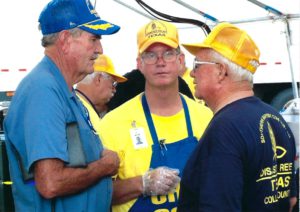
Disaster relief workers (left to right) Travis Maynard, Ray Gann and Albert Fuller discuss the feeding operation in Clear Lake after Hurricane Ike hit Galveston in 2008. Gann said this photo shows a confused yellow cap (himself) with two blue caps, even though Fuller functioned as a yellow cap on this deployment. Gann said Maynard got him involved in disaster relief, and Fuller taught Gann how to do the work. (Texans on Mission Photo)

Eventually, he became a “line chief,” directing the work of a specific component of the unit. Next, he advanced to “chief cook,” overseeing the entire cooking process. About 13 years ago, Gann became the unit’s blue cap.

Gann made his mark early.

“Many of the recipes that are used throughout the nation were developed and perfected by Ray Gann,” Finley said.

Mass feeding is unlike home or restaurant cooking. The Texans on Mission state unit can prepare, cook and package 10,000 meals for lunch and 10,000 more for dinner. That volume involves ordering the needed food in the correct quantity.

It’s done not only with the full quantity in mind, but with the cooking machines and transporting containers in mind, as well.

Do the math

In short, it takes math. And Gann did the math that produced the recipes for mass feeding.

The food cooked by the mass feeding unit is transported to disaster victims and volunteers in insulated containers—Cambros—that keep the food warm and sealed.

Gann used pitchers of water to determine that each Cambro held nine gallons. “And then I began to write recipes about how to fill up a Cambro,” he said.

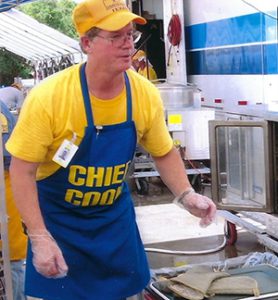
Ray Gann served as chief cook on the feeding unit in 2008 when Hurricane Dolly hit. (Texans on Mission Photo)

The math work continues in determining how much food to order and how many Cambros will be needed to deliver the needed meals. The math is important, because the process involves lots of food that costs lots of money.

“Twenty thousand meals a day at $3.25 per meal is $65,000 a day,” Gann said.

But mass feeding is more than math.

It takes “35 to 40 really hardy people working to run the whole thing,” Gann said. And working with the yellow caps became the center of Gann’s role as blue cap.

“The worst kind of blue cap in the world is a blue cap who is so involved in the process he doesn’t pay any attention to his people,” Gann said. “He’s worried about production, those numbers, what reports look like.”

‘Being a servant leader’

But as a leader grows spiritually, he looks to the “bigger picture” and sees “God’s involved in people.”

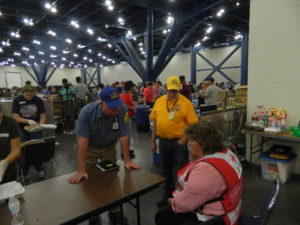
Ray Gann, on-site coordinator for the Texas Baptist Men disaster relief volunteers at Houston’s George R. Brown Convention Center, consults with an American Red Cross official immediately following Hurricane Harvey. (Photo / Ken Camp)

“I started out doing disasters thinking I was going to save the world, you know. I’m going to go cook for all these people,” Gann said.

“But the bigger picture is that God’s working on changing us, and as a blue cap I learned what being a servant leader is because that’s what a blue cap is.

“What we do is make sure that the yellow caps are successful. One of the things that I learned was my ministry was not the meals that I was cooking and sending out. It was the people I was working with. My ministry was my volunteers.”

You can hear Gann’s commitment to yellow caps in the words of his successor as blue cap for the state feeding unit.

“Ray took me under his wing in 2013 because he knew that, as with all of us, this day [retirement] would someday come,” Finley said. “He always tried to help newcomers understand the art of mass feeding.

“He knew that ministry should never be dependent upon one person, so he took every opportunity to share his knowledge with others.

“His encouragement and innovation will be sorely missed.”

Learned to be led by the Holy Spirit

Gann said he understood early that God had called him to serve his kingdom through Texans on Mission.

“By the school of hard knocks, I learned that I had to be led by the Spirit and not by my flesh, that this lifetime is the only time we get to operate in faith. And to the degree we learn to trust God and walk by faith in him has eternal consequences,” he said.

His “life verse” is Hebrews 11:6. It says: “And without faith it is impossible to please God, because anyone who comes to him must believe that he exists and that he rewards those who earnestly seek him” (NIV).

It’s easy to fall into the trap of thinking, “We are all going to go out and cook all this food, and God is going to be pleased with us,” Gann said.

“But you can’t do it in your own strength and energy. You have to operate in faith, and faith in this case is not my faith for salvation. This is the faith to get through the day, faith to trust that he’s going to fix the problem that’s insurmountable.”

In retiring as blue cap, Gann thinks about the future.

“The word of God teaches that one day we will come to face Jesus Christ to be judged for rewards based on what we did by faith in him,” he said. “I believe that at that moment of receiving our reward from Jesus Christ, I will realize, to my regret, that I could have done more for his glory.

“This is what has motivated me over recent years and still does. Now that circumstances of life have caused me to retire from active deployment, … the question of ‘what more’ is God calling me into is on my mind now, and I know that he has more for me.

“This is the challenge that God the Father lays down before all of us. What has he called you to be involved in, and will you answer his call to do more in Christ Jesus, for his glory, because it matters more than we realize here on this side of eternity.”