BGCT hears task force report, elects officers

WACO—Messengers to the Baptist General Convention of Texas annual meeting heard a report from a task force created to enhance Gen Z and Millennial engagement in Texas Baptist life.

During the first business session of the Nov.13-15 meeting, messengers also elected as officers three pastors of churches in McAllen, Garland and Burleson, and they approved a $35.5 million Texas budget for 2023.

Chris McLain, pastor of First Baptist Church in Bandera, presented the report from the Gen Z/Millennial Task Force, created in a response to a motion he made at the 2021 BGCT annual meeting in Galveston.

“The task force conversations, both online and in person, have uncovered opportunities to enhance our connections to emerging adults and explored ways to intentionally incorporate emerging adults into the story God is writing through Texas Baptists,” McLain said.

He pointed to four themes that grew out of the task force discussions:

  • Invite emerging adults to the table.

In addition to providing venues and occasions where emerging adults can voice their thoughts, the task force also called on the BGCT to demonstrate “intentionality in including emerging adults in the work of our committees, board and leadership teams.”

“In the same line of thought, we want to make sure the goal of developing our emerging adults is at the forefront of all our leadership initiatives,” McLain continued, reading from the task force report.

“Providing emerging adults opportunities to express their passions, giftedness, struggles and situations by engaging them with seasoned leaders will benefit Texas Baptists by passing along generational wisdom and institutional knowledge. These intentional engagements will strengthen emerging adults in their ministries and safeguard the future of Texas Baptists.”

  • Share the story.

Texas Baptists need to be in the communications spaces emerging adults occupy, such as short-form online videos. “We aspire to share our story in compelling ways that differentiate our message through authenticity, honesty and sympathy,” McLain said.

The task force also challenged Texas Baptists not only to provide places for dialogue with emerging adults at events such as the BGCT annual meeting, but also “start conversations with emerging adults that live on after the meeting is over.”

“We seek means and methods to turn our times of information sharing into lasting conversations that keep us connected,” McLain said.

  • Organizational innovation.

The BGCT “is like an aircraft carrier in that it takes a long time to turn, but we must also be nimble to follow the Spirit’s leading. In a changing world, and with the challenge of growing generational differences, we need to reflect upon the structures, purposes and processes of our institutional forms to ensure we are headed where God is leading us,” McLain said, quoting the task force report.

The task force particularly pointed out the need to provide resources to emerging adults serving as leaders of small churches “with the hope of making a meaningful impact in the beginning stages of their ministries that will pay lifelong dividends for our state.”

  • Spiritual growth.

Recognize emerging adults are skilled at navigating difficult cultural issues.

“They can help us avoid the rhetoric of condemnation while maintaining strong biblical convictions,” McLain said. “As our state grows and changes, engaging with and resourcing emerging adults to follow their unique callings will both revitalize established congregations and plant the next generation of Texas Baptists churches.”

The task force also encouraged Texas Baptist churches to become extended family to emerging adults, offering them “not just an invitation to church but to Sunday dinner.”

Ministerial residency program

The Gen Z/ Millennial Task Force recommended Texas Baptists create another task force to study the viability of a BGCT ministerial residency program to help emerging adults grow as they work alongside “seasoned pastors in both rural and urban settings.”

Scotty Swingler, associate pastor of students at Sugar Land Baptist Church near Houston, introduced a motion on behalf of the task force calling on the chair of the BGCT Executive Board to “appoint a task force to explore the creation of a residency program whereby young ministers are mentored and trained by established ministers.”

“The task force will have a budget of $10,000 to cover its expenses,” Swingler continued. “The task force will present their recommendations in a timely manner to the new executive director, Executive Board and the messengers of the convention no later than the 2024 annual meeting in Waco.”

The motion will be discussed and voted on during the second business session on Tuesday, Nov. 15.

McLain also reported other recommendations from the Gen Z/Millennial Task Force:

  • Hold listening sessions around the state to hear from emerging adults.
  • Supplement the work of Texas Baptists’ communications department, providing platforms for emerging adults to share their stories.
  • Keep track of the number of emerging adults at this year’s annual meeting and aim to double that number at the next meeting.
  • Launch a monthlong, statewide initiative to encourage and equip churches to invite emerging adults to engage in congregational family life.

Officers elected, budget approved
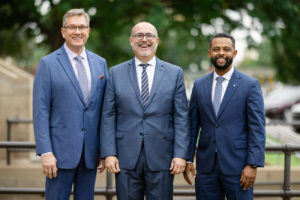
Texas Baptists elected as president Julio Guarneri (center), lead pastor of Calvary Baptist Church in McAllen. Messengers also elected as first vice president Nebiye Kelile (right), pastor of both Pathway Church and Orchard Hills Baptist Church in Garland, and as second vice president Ronny Marriott (left), pastor of First Baptist Church in Burleson. (BGCT Photo)

In other business, Texas Baptists elected as president Julio Guarneri, lead pastor of Calvary Baptist Church in McAllen. Guarneri has served this past year as first vice president. Messengers also elected as first vice president Nebiye Kelile, pastor of both Pathway Church and Orchard Hills Baptist Church in Garland, and as second vice president Ronny Marriott, pastor of First Baptist Church in Burleson.

Messengers approved a $35,459,500 total Texas budget for 2023, a 2.5 percent increase over the 2022 budget, as recommended by the BGCT Executive Board. It projects a $33.9 million net Texas budget—based on Cooperative Program giving and investment income—for 2023. It depends on $27.25 million in Texas Cooperative Program receipts from churches.

The 2023 budget anticipates about $6.65 million in investment income, up from $5.4 million anticipated for 2022. It also projects about $1.77 million in additional revenue from conference and booth fees, product sales and other sources.

Undesignated receipts from affiliated churches will continue to be divided 79 percent for the BGCT and 21 percent for worldwide causes.

An anticipated $1 million in worldwide missions initiatives and partnerships will be allocated in the same manner as the previous year: $340,000 for missions mobilization, $200,000 for River Ministry and Mexico missions, $100,000 for Texas Partnerships, $55,000 for the Baptist World Alliance, $5,000 for the North American Baptist Fellowship, $50,000 for intercultural international initiatives, $200,000 for Go Now Missions, $20,000 for the Hispanic Education Task Force and $30,000 for chaplaincy.

Messengers also approved a special relationship agreement with Denison Ministries, cofounded by Jim Denison, former pastor of Park Cities Baptist Church in Dallas. Denison will be designated as theologian-in-residence for Texas Baptists. Texas Baptists and Denison Ministries will work cooperatively on ministry projects such as training events and conferences.

Editor’s Note: After the article originally was posted, the section on the Ministerial Residency Program was edited to reflect more clearly the distinctions between the recommendation as it appeared in the task force report and the motion as it was presented to the annual meeting.



Messengers urged to believe God, invest in church planting

WACO—A bivocational church planter urged Texas Baptists to “believe God,” not simply “believe in God.”

“There is a big difference between believing in God and believing God,” said Tony Canady, pastor of Triumphal Christian Fellowship, a multicultural and multigenerational church in Waxahachie.

“Are you going to remain unwavering, steadfast, immoveable, always abounding in the work of God? Are you going to actually believe God?”

Canady addressed messengers at the first worship celebration of the 2022 Baptist General Convention of Texas annual meeting on Nov. 14.

He brought a message from Numbers 14:20-24 about how to remain unwavering, reminding Texas Baptists to focus on God’s word rather than what they see and to trust in God’s heart for his church.

“Set your heart on obedience to the Lord, because when you do that … the chaos around you will no longer affect you,” he said. “Don’t just believe in God. Believe what God says. He has already promised you he would do it.”

Tom Howe, director of Texas Baptists’ church starting and replanting, emphasized Texas’ projected population growth and the importance of church planting.

By 2030, the population in Texas is expected to grow by 5.2 million people—adding to the already 15 million people who have no church affiliation in the state. If every Texas Baptists church that currently exists grew by 200 people over that time period, they would reach only 5 percent of those people, Howe said.

“We need church planters, but even more importantly, we need church sponsors,” Howe said. “Our system at Texas Baptists’ church starting is built on sponsor churches that help work with us as a convention and also with the associations across the state to start churches, and we need more.”

Howe then invited church planters in the audience to join him at the foot of the stage for a time of prayer. Pastor Joseph Adams of First Baptist Church in Hughes Springs prayed a blessing over the gathering of church planters.


UMHB football player honors brother’s recovery

BELTON (BP)—Brock Stricklin didn’t know a brain tumor was causing the headaches wracking him in early 2019.

The high school sophomore was young and healthy, or so he thought. When his dad, Cory, took him to the hospital and they received the diagnosis, doctors scheduled immediate surgery.

The procedure was a success, but a long recovery process followed.

Brock embraced the challenge. If a therapist asked him to do 10 reps of an exercise, he did one more. It was his way of showing his determination to get home, not to mention matching his football jersey number—11.

Rehab started with the basics. Cory Stricklin told a reporter his son had to relearn “how to breathe, make a noise, do anything. Eat, walk, talk, all that stuff.”

‘My heart dropped’

Jerry Cephus, who had been living with the Stricklins for years and considers Brock his brother, was also at the hospital that day.

Cory and Brock Stricklin flank Jerry Cephus after a UMHB game. Jerry and Brock played football together into high school before Brock was diagnosed with a brain tumor. (Photo courtesy of UMHB Athletics)

“Dad texted me that they decided to take Brock to the hospital,” he said. “He had been complaining that his head hurt.”

When news about the tumor came, he said, “My heart dropped.”

Cephus left football practice and went straight to Baylor Scott & White McLane Children’s Medical Center in Temple, where Brock was to undergo surgery. He stayed throughout the night, snatching doses of sleep from a hospital chair and refusing to leave until 6 a.m. when Brock was in recovery.

Cephus, who maintains a good relationship with his birth family, came to live with the Stricklins when he was in the fourth grade. He and Brock were the same age and already a lot alike.

“We grew really close,” he said of the years that followed. “Playing football, basketball, baseball. We’d stay up late playing video games. Pretty much, we did everything together.”

Those interests grew into competition.

“Oh man, we’d race for the front seat of the car. See who could get to the next level of a video game. Wrestle in the living room for hours until someone got tired,” Cephus said. “We pushed each other to get better.”

Being two competitive boys, things got broken. Cephus isn’t sure how many windows had to be replaced in the Stricklin home. One day, the two thought it a good idea to bring the TV from Jerry’s room into the living room, putting it beside the family TV for them to compete in a video game.

“We started wrestling and someone got thrown into the TV,” he said.

In their youth football days, both played for the Round Rock Outlaws, Cephus as a dual-threat quarterback and Stricklin at receiver.

‘One more’

Cephus adopted his brother’s “one more” mantra on the football field. His work ethic and athletic talent led him to the University of Mary Hardin-Baylor, where he plays wide receiver, his brother’s old position, for the Crusaders.

When he made the varsity squad as a sophomore this year, Cephus also got a surprise when they handed him jersey number 11.

“[It’s] probably the most exciting phone call he’s given me the whole time he’s been at college, you know,” Cory Stricklin said. “He said, ‘Dad I got the number!’ because it meant a lot to him.”

Cephus continues to add a rep in workouts. He runs one more route in practice.

That work has led to 12 receptions on the season for 150 yards and a touchdown with the 8-1 Crusaders.

The defending Division III champions, the Crusaders are going for the fourth national title since 2016.

No team or individual gets to that level without the drive to finish the drill or make the extra rep. It’s a truth Cephus knows firsthand.

“Right now, I’m just a role player, but I want to be the best I can be,” he said. “I want to push myself to do my best.”


Apologists urge former Ravi Zacharias leaders to repent

HOUSTON (BP)—A statement released Nov. 9 by a group of Christian apologists says three former members of Ravi Zacharias’ inner circle “are not fit to be in ministry and leadership positions” because of their response to the late apologist’s sexual misconduct.

The “Statement Regarding RZIM Senior Leadership Team Members Michael Ramsden, Sarah (Davis) Phillips and Abdu Murray” says the three former executives of Ravi Zacharias International Ministries “have not displayed a godly sorrow nor demonstrated the fruit consistent with repentance for their actions,” nor have they “specifically owned their actions or expressed remorse to those they hurt.”

For that reason, the apologists say, “We will not partner with them or endorse their work until the fruit consistent with genuine repentance is evident in their lives.”

The statement was released at risenjesus.com, the apologetics ministry website of Mike Licona, an associate professor of theology at Houston Christian University, formerly Houston Baptist University. Licona and his wife, Debbie, are co-signers of the statement.

Other signers are Paul Copan, professor of philosophy and ethics at Palm Beach Atlantic University; William Lane Craig, professor of philosophy at Houston Christian University and research professor of philosophy at Biola University’s Talbot School of Theology; and Sean McDowell, associate professor in the Christian apologetics program at Biola University’s Talbot School of Theology and co-host of the Think Biblically podcast.

The statement summarizes the “types of abuse and deception that were representative of RZIM’s organizational culture,” including harassment of several employees who raised questions when allegations about Zacharias’ sexual misconduct surfaced.

Two investigations determined the veracity of the allegations against Zacharias, who died in May 2020. The first by Atlanta law firm Miller and Martin confirmed the sexual misconduct. The second by Guidepost Solutions found RZIM leaders overlooked Zacharias’ misconduct for years and used ministry funds to try to cover up the accusations and discredit his accusers.

Because there is no apologetics governing board, the co-signers of the statement say they felt a “spiritual and moral obligation” to make an inquiry into the evidence surrounding the Zacharias situation and the mistreatment of former RZIM employees by the named individuals, all of whom have either moved on to other apologetics ministries or expressed their intent to do so.

The inquiry involved about 1,000 hours of research and interviews of 25 people, along with a review of “copious amounts of supporting documentation” and consultation with experts of abuse and institutional response to abuse, according to the statement.

As a result of their investigation, the apologists call on Ramsden, Murray and Phillips to “seek counseling with someone skilled in the area of spiritual abuse, and move forward in genuine repentance.”

Murray, former senior vice president of RZIM, currently is connected to Embrace the Truth, an apologetics website. Christianity Today reported in 2021 that Phillips, a daughter of Zacharias who served RZIM as CEO under the name Sarah Davis (she has since remarried) was forming a new apologetics ministry called Encounter. It is unclear whether Ramsden, who served as president of RZIM, currently is connected to any ministry organization.

If you are or have been a victim of sexual abuse or suspect sexual abuse by a pastor, staff member or member of a Southern Baptist church or entity, please reach out for help at 202-864-5578 or SBChotline@guidepostsolutions.com. All calls are confidential.

Carrie Brown McWhorter is content editor for The Alabama Baptist.


Phoenix pastor a missionary to Christian nationalists

PHOENIX, Ariz. (RNS)—Phoenix pastor Caleb Campbell has a theory about the growing number of Americans who are labeled as Christian nationalists.

Most would rather go to Cracker Barrel than storm the Capitol.

Many see themselves as good Christians who love their country. But somewhere along the way, they began to think being a good American and being a Christian were one and the same.

Caleb Campbell

“Their whole life has been the intermingling of their American civil religion and their Christian religion,” said Campbell, pastor of Desert Springs Bible Church and a self-described missionary to Christian nationalists.

To help his fellow Christians make a clearer distinction between their faith and their identity as Americans, Campbell founded a group called Disarming Leviathan. He spent the last year reading Christian nationalist books and attending events like Turning Point USA’s monthly Freedom Night in America, held at a Phoenix megachurch.

He also signed up to teach a “biblical citizenship class” run by Patriot Academy, founded by Rick Green, a former Texas state legislator turned Christian “Constitution coach.” The class mixes details about America’s founding and the Constitution with Bible verses and conservative politics.

God-and-country patriotism remains popular in the United States, according to a recent report from Pew Research. Nearly half of Americans (45 percent) believe America should be a Christian country, including 78 percent of white evangelicals and 62 percent of Black Protestants.

Fear religion losing influence

Though few want the U.S. government to adopt Christianity as the country’s official religion, according to Pew, many Americans fear religion is losing influence in the culture.

That fear, says Campbell, has led a growing number of his fellow believers to embrace a more extreme form of God-and-country patriotism, one more focused on winning the culture war than following Jesus.

Campbell expected many of the people in Christian nationalist settings he met to be angry political partisans. Instead, most were good-hearted people who thought they were doing the right thing for God.

“That was an aha moment,” he said.

At the time, Campbell had been focused on arguing with Christian nationalists, trying to convince them their ideology—popularized by politicians, pastors and online activists—is incompatible with the teachings of Jesus.

Misguided and fearful

But that approach did not work. He began to think of them as “Aunt Betty”—a loved one who is misguided and fearful.

“Aunt Betty is watching a whole generation of Americans deconstruct their American civic religion, and it’s freaking her out,” he said.

Campbell decided instead to approach Christian nationalists as a missionary, “leading with kindness and generosity.” What Christian nationalists needed, he decided, was conversion, not confrontation.

“I started thinking, how do I actually bring Jesus into this person’s life, because they’re being sold a version of Jesus that is not accurate biblically and is going to end up disappointing them,” he said.

He particularly is concerned about what he called “seeker-sensitive Christian nationalism” that seeks to attract new churchgoers through worship services that praise Jesus and “own the libs” at the same time.

“It’s a brilliant church-growth strategy,” Campbell said.

“I’ve been at this for long enough to know if I got a car dealership-size American flag, put it in front of my building and did a ‘why biblical justice is not social justice’ sermon series, I could get 1,000 people,” he said.

Christian nationalism fuels anger

Rather than helping people deal with their anxieties about cultural change or focusing on people’s faith, Campbell argues, this strategy fuels anger by giving believers someone to blame for their problems.

This kind of seeker-sensitive Christian nationalism has been on display over the past year at Freedom Night in America, a monthly revival and political rally hosted by Charlie Kirk, head of Turning Point USA, at Dream City, a Phoenix megachurch not far from Campbell’s congregation.

Freedom Night services, which are streamed by both Dream City and Turning Point, have featured Kirk and conservative figures like writer Eric Metaxas, “Fox and Friends” host Pete Hegseth and John Cooper, lead singer of the Christian band Skillet.

The events look like a typical megachurch service, beginning with a few worship songs, followed by some announcements, an offering, and even an altar call. But instead of a sermon, there’s a talk by Kirk, who often is joined by a guest.

At the Freedom Night in October, Dream City pastor Luke Barnett took to the stage as the band finished their set, repeating the last line of an old-school worship tune, singing, “You alone are my heart’s desire, and I long to worship you.” Barnett then introduced Kirk that night as a religious teacher rather than a conservative activist.

“If there’s anyone who I believe that God has raised up in America, to share about life inside the kingdom, and what it looks like, what it can look like to our nation today, it’s our guest tonight, Charlie Kirk,” he said.

‘Demand the welfare of the nation’

As Kirk began, he quoted Jeremiah 29:27, a popular Bible verse, giving it a new twist. The verse, addressed to the people of Israel during their captivity in Babylon, is often translated as, “seek the welfare of the city where I sent you into exile,” followed by a command to pray. For Kirk, the verse became a call to political action.

“Demand the welfare of the nation that you are in because your welfare is tied to your nation’s welfare,” he told attendees.

Joanna Kline, assistant professor of Old Testament at Gordon College in Massachusetts, questioned the accuracy of Kirk’s translation. For one thing, it leaves out the command to pray. It also missed the original context of the verse, which was intended to tell the Israelites that they’d be in exile for decades. That group of people also had no power to make demands.

“Who would they make demands to?” she said.

A spokesman for Turning Point USA said Kirk sees himself as a lay Christian trying to do his part, rather than a pastor or religious leader. In that role, Kirk is trying to get his fellow Christians involved in shaping the broader culture.

That’s very different than Christian nationalism, the Turning Point spokesman said, and has long been a Christian practice.

The spokesman also said Kirk was concerned about the pandemic shutdowns that affected many churches and, in Kirk’s mind, interfered with the right to worship. That showed him the need for political involvement by churches, because even if churches stay clear of politics, government officials don’t leave churches alone.

“His main point is that churches should preach the gospel,” the spokesman said. “His second point is to make sure that churches are able to do this.”

Author Victor Marx, who spoke at a Freedom Night in April, said holding an event to discuss politics at a church on a Wednesday night was much different from holding a discussion of politics on a Sunday morning.

A friend of Kirk’s who has also spoken at a Turning Point USA event for pastors earlier this year as well as other conservative gatherings, Marx rejected the label of being a Christian nationalist.

Personal reason for concern

“To say that our country needs to be run at every position by Christians—that is not what I believe,” he said.

For Campbell, his concerns about Christian nationalism have a personal side.

A former skinhead, Campbell first showed up at Desert Springs Bible Church in his early 20s, when he was invited to play drums in the band. The friendship and welcome he found at the church changed his life, he said, and he abandoned the hate he’d felt as a young person.

He eventually joined the church staff and in 2015 became senior pastor. At the time, the church was mostly white and did not reflect the diversity of its community. Campbell began working to change that—building close ties with Black and Hispanic churches and working on issues like immigration.

Things went well at first. But Donald Trump’s election in 2016 and the accompanying MAGA Christianity began to split his church. People he’d known for decades left to find a congregation that better fit their politics. Some of them ended up going to Freedom Night at Dream City, which led him to attend one of the services there and made him aware of the growth of Christian nationalism.

Campbell wants to help people like his former church members find a better way to live their faith. Currently, he is working on a book project modeled after the Alpha program—a popular evangelistic method centered on kindness, hospitality and conversation.

“This is the Alpha program for Christian nationalists,” he said.

Dennae Pierre, a Phoenix pastor and executive director of the Surge Network, which helps churches from different ethnic backgrounds, believes Campbell is on to something.

Pierre has worked closely with Campbell in the past and watched him lead his congregation through a difficult transition. Though many church members have left, she said, Campbell’s congregation also attracted new people who felt ostracized by the fusion of faith and politics in other churches.

She, too, thinks conversion rather than confrontation will help people find something better than Christian nationalism.

“When we think about Christian nationalism, I think there needs to be an intentional discipleship process, to dismantle what is unhealthy and to rebuild people with a more gospel-centered vision of what it means to be a Christian,” she said.

This story was produced under a grant from the Stiefel Freethought Foundation.


HSU trustees grant president three-year extension

ABILENE—The Hardin-Simmons University board of trustees has offered to extend by three years the contract of President Eric Bruntmyer, who in recent weeks received votes of no-confidence from the school’s faculty.

“The board has full confidence in President Bruntmyer and believes HSU’s future is bright under his leadership,” said Rick Strange, chairman of the HSU board. According to the Nov. 11 announcement, trustees will extend Bruntmyer’s contract an additional three years beginning Jan. 1, 2023.

In contrast, the HSU faculty council less than three weeks ago cited “serious concerns over the health and future of the university under the current administration and requested the HSU board of trustees begin the replacement process for the university’s top leader.”

‘Navigated significant challenges’

In announcing Bruntmyer’s three-year contract extension, Strange noted the university has “navigated significant challenges during this time, including multiple program closures that were difficult on those affected, as well as the COVID-19 pandemic.”

“Over the last few years, the board has assigned President Bruntmyer with several difficult tasks, often resulting in him taking criticism that would be better directed at us. On those occasions, I have personally witnessed his willingness to accept responsibility based on his selfless dedication to the university,” Strange stated.

Four years ago, the HSU board voted to close Logsdon Seminary extension campuses in Coppell, Lubbock, Corpus Christi and McAllen, as well as discontinue nine undergraduate program majors and four graduate programs.

Eric Bruntmyer, president of Hardin-Simmons University, addressed the Baptist General Convention of Texas Executive Board. (Photo / Ken Camp)

Then on Feb. 7, 2020, trustees voted to close Logsdon Seminary and its programs. Ten days later, Bruntmyer told the Baptist General Convention of Texas Executive Board the university made the decision to shut down the seminary and direct endowment earnings to undergraduate programs in the Logsdon School of Theology because the university could not afford to “keep two financially weak programs going.”

Strange stated HSU has “experienced many positive improvements” during Bruntmyer’s time as president the past six and a half years.

Among other achievements, he pointed to “overall increased financial stability” as indicated by “improved banking relationships” and growth in the university’s endowment and quasi-endowment; “new and renewed program accreditations” and new degree offerings in mechanical engineering, digital media and other areas; physical improvements such as the restoration and repurposing of Abilene Hall, refurbishing residence halls, improving student dining facilities and remodeling the physicians assistants program building; and “refining of processes that evaluate program performance and assure student success.”

Controversial actions

He also cited as “positive improvements” two items that have generated considerable controversy—a “recently adopted statement of faith to guide and direct every aspect of the university” and “an independent, on-campus nursing program starting in 2025.”

At its May 18 meeting, the HSU board of trustees adopted a statement of faith that affirms historic orthodox Christian doctrines about the Triune God, Jesus Christ, the Bible, humanity, salvation and the church. It also specifically rejects transgenderism and same-sex marriage.

The board approved a slightly revised version of the faith statement on Nov. 3. It still says, “We believe that God created the human race with two genetic sexes, male and female.” It also states: “We believe that marriage has been established by God to be a life-long, covenant relationship between one genetic male and one genetic female. We also believe that sexual activity is intended by God to be expressed solely in the context of a loving marriage between one genetic male and one genetic female.”

Regarding the nursing program, the HSU board previously expressed its desire either for Hardin-Simmons to acquire full ownership of the Patty Hanks School of Nursing or start its own program.

More than four decades ago, HSU, McMurry University and Abilene Christian University created the Abilene Intercollegiate School of Nursing as a nonprofit corporation. Nearly 20 years ago, the nursing school became an unincorporated association, and the three universities entered into a consortium agreement. ACU withdrew from the consortium in 2012.

This summer, McMurry University filed a more than $1 million lawsuit against HSU in Taylor County’s District Court, claiming a breach of contract regarding the Patty Hanks Shelton School of Nursing.

‘A foundation for success’

Strange concluded the Nov. 11 announcement regarding Bruntmyer’s contract extension with additional words of appreciation.

“We know President Bruntmyer does not serve alone. We acknowledge the contributions of our dedicated administration, faculty and staff who faithfully serve every day to educate and disciple our students. We also appreciate the president’s wife Elise and their children for their sacrificial support of him as HSU president,” Strange stated.

 “And of great importance, we thank the countless supporters and alumni who contribute sacrificially to the university in order to advance our overarching goal of providing an education enlightened by Christian faith and values, equipping future generations of Christian leaders for service.

“Thanks to President Bruntmyer and all who collectively support HSU, we have positioned the university on a foundation for success. A building’s foundation is the least visible part of its construction and often doesn’t fully foreshadow the structure to come, but it remains the most important component because nothing else can exceed the foundation. Built on a strong foundation, the board looks forward to continue working with President Bruntmyer as together we move HSU into the future God has planned for us.”

The Baptist Standard attempted to contact HSU Faculty President Jennifer Eames for a response. If additional information is received, this article will be updated.


Obituary: Lynda Ballou

Lynda Ballou, longtime teacher and children’s ministry volunteer at First Baptist Church in Arlington, died Oct. 24 after a prolonged illness. She was 80. She was born Oct. 19, 1942, in Three Rivers. While at the University of Corpus Christi preparing for her long career as a schoolteacher, she met her husband of 57 years, Jack Ballou, who later served as comptroller for the Baptist General Convention of Texas. She was a member of First Baptist Arlington most of her adult life, serving in various missions activities and in the children’s ministry. She was a certified Master Gardener. For many years, the highlight of her summer was Camp Lynda, a special week spent with her grandchildren. She is survived by her husband Jack Ballou; son Jason Ballou and wife Lorena; daughter Judith Anhuth and husband Michael; eight grandchildren; one-great granddaughter; a brother Bubba Stewart; and a sister Judith Lee.


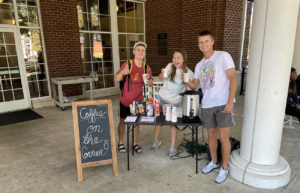
Llano pastor teaches Koinonia Karate

LLANO—Most Christians familiar with the New Testament Greek word “koinonia” think of it only in terms of fellowship and communion.

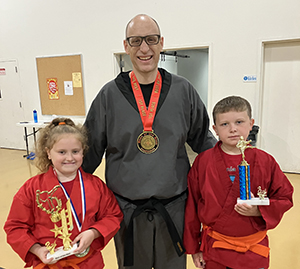
Matt Richard, pastor of First Baptist Church in Llano, believes he can incorporate Christian principles such as self-control into martial arts instruction as he teaches a Koinonia Karate class to children in the church gym. (Photo / Ken Camp)

But it also can mean “shared gifts,” and that’s how Pastor Matt Richard views the karate classes he teaches two nights a week in the gymnasium of First Baptist Church in Llano.

Richard uses his giftedness in the martial arts to connect with his community and teach character-building lessons, particularly—but not exclusively—to children.

“There’s not any preaching or Bible study,” Richard explained, but he does see biblical applications to the discipline he is teaching.

“Students learn self-control, and that’s a fruit of the Spirit. It’s not hard to make the spiritual connections,” he said.

Richard began studying karate as a preschooler in Nederland. Born prematurely at only 2 lbs., his parents wanted to involve him in an activity that would help him overcome early developmental issues with physical coordination.

Instructor Mike Maxwell bent the rules a bit to allow 3-year-old Matt to begin lessons in the 5-and-under class at the Fight Dragons Karate School. At age 11, Matt earned his black belt in karate.

“I was obsessed with it for a while,” Richard acknowledged, frequently taking part in competitive breaking tournaments.

After he became a Christian at age 15, he began to wonder how he might merge his martial arts skills and his newfound commitment to Christ.

“I thought I might be able to do something evangelistically, but I never did,” he said.

Richard continued to keep his karate skills sharp as a student at East Texas Baptist University. When he pursued studies at Baylor University’s Truett Seminary, he regularly sparred with another student in the recreation center at Columbus Avenue Baptist Church in Waco.

‘Keep it accessible and affordable’

Matt Richard, pastor of First Baptist Church in Llano, teaches martial arts skills and life principles to students in a Koinonia Karate class in the church gym. (Photo / Ken Camp)

After First Baptist Church in Llano called him as pastor three years ago, he learned there were no martial arts classes available in town.

“Llano is the county seat, but it’s still kind of isolated here,” Richard said.

He wanted to offer a karate class for his own son, and he saw an opportunity for outreach and community ministry. The church’s missions committee agreed to provide up to $1,000 to launch the Koinonia Karate program, charging students a relatively minimal fee.

“We try to keep it accessible and affordable,” Richard explained. “It’s a ministry of the church. It’s not about making money.”

Pastor Matt Richard of First Baptist Church in Llano demonstrates proper stance and technique to students during a Koinonia Karate class in the church gym. (Photo / Ken Camp)

Richard limits lessons to two nights a week to preserve evenings at home with wife Michelle and their 11-year-old daughter and 8-year-old son.

“I’m looking for balance and making time for my family,” he said.

Unlike some martial arts schools that require students or their parents to enter into a long-term contract, Koinonia Karate takes a more relaxed approach.

“There’s no pressure. I tell students, ‘Try it out and see if it’s a good fit for you,’” Richard said. In fact, his own son did not choose to continue taking karate and decided to pursue other interests.

Teaching Christian principles

Pastor Matt Richard teaches proper martial arts techniques while also teaching lessons on Christian principles such as respect, humility, perseverance and self-control. (Photo / Ken Camp)

Koinonia Karate classes open to children age 6 and older have proven popular, and Richard also teaches a few teenaged and adult students who participate in a second class he offers.

Richard recognizes some Christians view the martial arts with suspicion, either because of connections to Eastern religions or because they are seen as promoting violence.

In terms of the Buddhist and Taoist influence on karate, Richard teaches only those principles consistent with Christianity, such as respect, humility, perseverance and self-control.

“Koinonia Karate is based on my own ethos” as a follower of Christ, not ancient roots in a non-Christian religion, he noted.

“It’s about coordinating the body and mind. It can be a Christian concept if you choose to make it that,” he said.

As he teaches karate techniques, Richard emphasizes to students the importance of avoiding physical conflict—never initiating violence or using martials arts to get revenge.

The Koinonia Karate program at First Baptist Church in Llano competed Oct. 22 at The Best of the Best Championships in Austin, a tournament associated with the Amateur Organization of Karate league circuit. It was the first time Koinonia Karate participants engaged in competition. Two beginner students placed— Norah McCormick (left), second place in point-sparring; and CJ Ares (right), third place in point-sparring. Pastor Matt Richard, Koinonia Karate instructor, won first place in point sparring. (Courtesy Photo)

“Karate is all about self-defense. The goal is to never hurt anybody. It’s only to protect yourself or someone else, and it should only be used as a last measure,” he said.

The classes attract “a healthy mix” of church members and non-members, but the majority of students are from families who are not already part of the church, Richard noted.

Students in the Koinonia Karate classes and their parents are notified about children’s activities at First Baptist Church such as Vacation Bible School and a fall festival, and they are invited to participate.

“So far, one family has connected to the church through this ministry,” he said.

The karate classes represent just one way Richard seeks to connect to his community. He writes a column for the local newspaper, leads the town’s ministerial alliance and also has been involved with a children’s soccer league.

“That’s an advantage to being in a place like Llano,” he said. “You’re not just pastor of the church. In time, you get to pastor a community.”

This article originally appeared in the fall 2022 issue of CommonCall magazine.


Scripture-engaged give more, gain greater hope

PHILADELPHIA (BP)—Scripture-engaged Americans give more to churches and charities than others, reaping more hope and purpose through the process, the American Bible Society said in its 2022 State of the Bible report.

Americans considered Scripture-engaged gave $145 billion to charity in 2021, including church tithes and offering, or $2,907 per household, the report said, compared to $924 per household among those described as Bible disengaged.

“People who give the most to charity flourish more and have more hope and purpose,” the American Bible Society stated Nov. 10 in releasing the latest chapter of the 2022 State of the Bible.

“Our data reveal a substantial correlation between charitable giving and our measures of human flourishing and hope. One of the six aspects of the Human Flourishing Index, ‘Meaning and Purpose,’ has an especially strong connection.”

The American Bible Society determines Scripture engagement based on a set of questions gauging how often a person reads the Bible and how Scripture impacts their choices.

“These people seem to follow the guidance of James 1:22 (NIV): ‘Do not merely listen to the word.… Do what it says,’” the report stated.

“The Bible teaches us to give, so it’s no surprise to find high levels of giving among people who read and follow Scripture. But there’s more to it than simple obedience. Transformation is at the heart of the biblical message. We receive grace, and so we show grace. We love because God first loved us.

“When we encounter a loving and giving God in the Bible on a regular basis, it only makes sense that we become more loving and giving in response.”

Does giving reap hope and flourishing, or do hope and flourishing spur generosity?

“Perhaps both are true,” the report states. “These findings might suggest that people find a sense of meaning by giving to a worthy cause. Or perhaps people give to support causes that fit the purpose they already have. Taken together, these correlations indicate that people live well when they give well, and vice versa.”

Generational trends

Scripture-engaged people give most of their charity to churches, giving 13 times as much as the Bible disengaged, but also outpace the Bible disengaged in giving to non-church charities. The Scripture engaged gave 62 percent more than the Bible disengaged to non-church charities, the report found.

The elderly, those 76 and older, gave to charity more often than younger generations in 2021. Half the members of Generation Z, ages 18-25, contribute to charity, compared to 84 percent of the elderly.

“We can attribute this pattern partly to economics. Many Gen Z adults aren’t earning their own money yet, or they’re at the bottom of the pay scale,” the report stated.

“But Gen X currently has the highest income of any group, and yet they are less likely to give than the two older generations. Is this a matter of disposable income, or is there a cultural commitment to philanthropy that’s stronger in the older groups?”

Those who were ages 42-57 in 2021 were included in Gen X.

Among other findings, people tend to give more to charities in their local communities than internationally, the report said.

American Bible Society researchers collaborated with the University of Chicago’s National Opinion Research Center to survey a nationally representative group of American adults on topics related to the Bible, faith and the church. The study conducted online via telephone produced 2,598 responses from a representative sample of adults 18 and older in all 50 states and Washington D.C.


College ministry moves into a post-pandemic world

When COVID-19 caused global shutdowns in spring 2020, Baptist Student Ministries on university campuses had to adapt quickly to discipling students remotely. And they still are discovering what campus ministry looks like as society emerges from a global pandemic.

“At that point [in the middle of the spring 2020 semester], they all became online students,” said David Griffin, BSM director at East Texas Baptist University.

“It was a difficult road to navigate, and they were really preoccupied with being back at home and trying to finish their coursework. … But at the same time, we knew God was in control.”

In many cases, students left for spring break and didn’t return to school until the fall semester.

“Being able to go ahead and do our spring break mission trips was a real blessing, not just getting to do the trip, but also the community it fostered, and it helped us move into the next year,” said Joel Bratcher, BSM director at Texas A&M University.

“Had COVID started in September or October it would have really been rough,” he continued. “But because the groups had already formed, we were able to pretty much maintain them, and then we were able to select leadership for the next year. We had to do it all on Zoom, but because of the relationships being there, that really helped us a lot.”

BSM serves both at state universities and private schools, including universities affiliated with the Baptist General Convention of Texas. The way BSM is incorporated into the university varies by location. At private universities, the organization typically relates to the spiritual life or student life office.

“Different Baptist schools are very different contexts. … Each has its own way of doing things—the way they’ve structured their student life areas [and] incorporated the BSM. There’s a lot of contextualization to BSM ministry, no matter where you are,” said Daniel McAfee, BSM director at the University of Mary Hardin-Baylor.

Adapting to maintain contact

Across the board, COVID changed the way students interacted with one another. Despite the efforts of campus and ministry leadership, student engagement levels reflected that change.

“Their schedule had completely changed. So, when they used to be free on Tuesday nights … they were no longer free on Tuesday nights when they went home. The pace of life changed for them,” Griffin said.

To ensure public safety, everyday life became dramatically different, and that included the varied ways students connected with others. BSM groups had to adapt expectations and methods to maintain contact with students.

“The numbers did go down, but I would still say there was a fair amount of engagement,” McAfee said. “We just kept going. … I think [students] enjoyed the connection point to be able to participate weekly.”

When universities reopened in fall 2020, BSM was able to reconnect with students in new ways. Griffin described how ETBU approached the new semester.

 “When we came back, we really tried to carry on quite normally, and we offered a lot of the same sorts of things that we were doing before the lockdown, but at limited capacity,” Griffin said. “Masks, of course, changed our interactions. … And I do think it was harder to connect with freshmen in that year.”

‘We needed to engage more intentionally’

As restrictions gradually lifted in the spring and the following semester, BSM leaders recognized the importance of reaching students who had not connected as much as others due to the lockdown.

Like their peers around the state, BSM participants at East Texas Baptist University have found ways to reconnect with the general student population after the COVID pandemic. (ETBU Photo)

“Coming back, we needed to engage more intentionally” and reintroduce BSM, Griffin explained.

Some students “may not have heard of BSM and what we do, because we may not have had as much interaction as we would have wanted in the COVID year,” he said.

At Texas A&M, leaders and small groups of BSM student volunteers responded to the changes brought on by COVID by addressing the issues they saw in their peers, Bratcher said.

“Some of our students have had to deal with personal health issues directly related to COVID or their family members have, too,” he said.

“I think that the pandemic helped us realize how much people really do need each other and that real relationships and community is huge for all people, and that’s especially true for students.”

Lessons learned

When McAfee reflected on the lessons his BSM learned from the pandemic, he mentioned community, but he also emphasized a shift in perspective and a need to surrender to God.

“I would say that the pandemic served as a reminder that we do not control nearly as much as we think we control, or even that we would want to control in this life,” McAfee said.

At Texas A&M, Bratcher said, the chaos brought about by COVID reminded him why it’s important for students to have a well-established faith.

“It reinforced my commitment to trying to do good discipleship with our students and teaching them to be servants and to be willing to put their needs second to other people,” he said.

Griffin also stressed the importance of establishing a faith foundation, and he reemphasized the mission of BSM.

“We are trying to reach anyone and everyone,” he said.

In a world still recovering from such a dramatic shift, it’s impossible to know where anything is headed next, BSM leaders acknowledged. However, the flexibility and resiliency of campus ministry organizations offers a light as they move forward.

“Yes, we’re coming out of the pandemic, but because we’re still so close to it in a historical way … we don’t know where society is, where college students really are,” McAfee said.

But he sees hope for the future.

“We’ve started noticing some differences … even if we can’t quite put our fingers exactly on what they are. We’re just seeing some positive things this semester, and that has been encouraging,” McAfree said.

Ministry among university students is more than offering “right inputs” to produce “right outputs,” he observed.

“That’s just not the way God works,” McAfee said. “It’s really up to him to capture people’s hearts, imaginations … to help them to know that they’re loved and that he has a plan and purpose for them.”


On the Move: Bahlmann

Clarence Bahlmann to Leesville Baptist Church, southwest of Gonzales, as bivocational pastor, effective Nov. 13. He and his wife Kathy are employed by the Nixon-Smiley Consolidated Independent School District, where he is a vocational agriculture teacher.


Around the State: HPU observes Stinger Spectacular

Members of Howard Payne University’s 2022 Homecoming Court are (from left) Homecoming Princess Megan Froese, Homecoming Prince Cyah Daniel, Homecoming Queen Zoe Sprayberry and Homecoming King Jessie Paris. (HPU Photo)

The Stinger Spectacular at Howard Payne University, Oct. 14-15, combined homecoming festivities, a family weekend and Yellow Jacket Preview. About 800 participants joined in the HPU family picnic, which featured music by Stephen Cox, Stacy Nash and Cody Hutcheson. The Golden Graduate Luncheon celebrated the class of 1972. During halftime at the Yellow Jacket football team’s 48-17 victory over Southwestern University, the 2022 homecoming court was announced. Jessie Paris, a history major and education minor from Splendora, was named homecoming king, and Zoe Sprayberry, a math education and Christian education major from Bonham, was named homecoming queen. Homecoming Prince and Princess honors went to Cyah Daniel, a political/global studies and Guy D. Newman Honors Academy major from Doha, Qatar, and Megan Froese, a middle school education major from Rising Star. Alumni honored at halftime were Mede Nix, distinguished alumna; Elizabeth (Santos) Garcia, coming home queen; Stephen Cox, outstanding young graduate; Bobbie Price, grand marshal; Pat Hardy, Medal of Service; and Pastor Roland Johnson, José Rivas Distinguished Service Award. Bertha (Rey) Valley was honored posthumously with a Medal of Service. The next HPU Stinger Spectacular is scheduled Oct. 13-14, 2023.

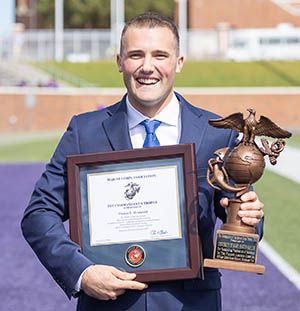
Thomas Henderson of Keller, a senior Christian studies major at the University of Mary Hardin-Baylor, received the U.S. Marine Corps Commandant Trophy for outstanding leadership and superior accomplishments.

Thomas Henderson of Keller, a senior Christian studies major at the University of Mary Hardin-Baylor, received the U.S. Marine Corps Commandant Trophy for outstanding leadership and superior accomplishments. Henderson, the son of Jerry and Penny Henderson, is Student Foundation president and serves in various ministry roles in the community. Last year, Henderson was selected for the Platoon Leaders Class Program, an undergraduate commissioning program that allows full-time enrolled college students to pursue a commission in the U.S. Marine Corps without interrupting the academic school year. He attended Officer Candidates School the past two summers in Quantico, Va., where he finished first among 224 graduating candidates from Lima Company and was selected as the honor graduate. Out of the hundreds of candidates from across the country trained at OCS this summer, Henderson is one of seven recognized with The Commandant’s Trophy.

East Texas Baptist University’s Kinesiology Department hosted its annual Field Day for more than 300 Pre-K students from Marshall Early Childhood Center on Oct. 31. ETBU Kinesiology students led the attendees in various physical activities, ranging from parachute play and tricycle riding to obstacle course running. (ETBU Photo)

East Texas Baptist University’s kinesiology department hosted its annual field day Oct. 31 for more than 300 pre-K students from Marshall Early Childhood Center. Kinesiology students led various physical activities, ranging from parachute play and tricycle riding to obstacle course running. Students in ETBU’s “Teaching Elementary Physical Education” course were provided an opportunity to apply course content, practice their learned content in practical situations, strengthen their servant leadership skills, and build relationships with children and families in the local community. Students spent time building lesson plans specifically for the age range of children that attend the event.

During Dallas Baptist University homecoming on Nov. 19, Gus Reyes will be named as 2022 Honorary Alumnus. The status is awarded to individuals who demonstrate a commitment to Christian servant leadership and values reflective of the mission and vision of DBU. Reyes is director of Hispanic partnerships at DBU. Previously, Reyes led the National Hispanic Leadership Conference’s annual education summit involving more than 20 Christian colleges, and he served the Baptist General Convention of Texas as director of the Christian Life Commission. He also worked in other roles with the BGCT, including service with the Hispanic Education Initiative, affinity ministries, congregational relationships, the service center and in ethnic evangelism. For three years, he was bivocational pastor of First Mexican Baptist Church in Dallas. He serves on the board of directors of the Baptist Spanish Publishing House. He holds degrees from the University of Texas, Angelo State University and Southwestern Baptist Theological Seminary.
At their quarterly meeting, Baylor University regents heard a year-end financial report highlighted by total assets growing to $3.9 billion, operating revenues totaling $925.1 million and operating expenses reported at $836.5 million. Regents learned Fitch Ratings, a global leader in credit ratings and research, upgraded Baylor’s long-term bond ratings. The ratings agency attributed the upgrade to “Baylor’s strong financial and liquidity position, via solid cash flow trends and better-than-budget results in recent fiscal years through fiscal 2022.” The ratings agency also noted the impact of the university’s strong student demand profile, successful fund-raising with Baylor surpassing its initial $1.1 billion Give Light campaign goal last February, and its positive endowment performance. At their meeting, regents approved $78.6 million for Phase 2 construction of the Fudge Football Development Center. The facility will house the day-to-day operations for Baylor football coaches and support staff. The total project budget, including Phase 1 design and early construction work that began over the summer, is $89.6 million. The facility is expected to be completed during spring 2024.

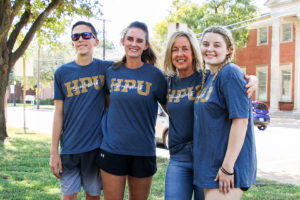
A four-member group from Howard Payne University participated in a poverty simulation in Waco. From left to right are Aidan Oplotnik, son of Professor Shantel Oplotnik; Shantel Oplotnik, assistant professor of social work and director of field education at HPU; Stephanie Russell, a sophomore from San Saba; and Jessica Phariss, a junior from Brownwood.

Shantel Oplotnik, assistant professor of social work and director of field education at Howard Payne University, led a group who participated in a poverty simulation sponsored by Mission Waco. Joining in the poverty simulation were her son, Aidan Oplotnik; Stephanie Russell, an HPU sophomore from San Saba; and Jessica Phariss, an HPU junior from Brownwood. The three-day experience offered participants the opportunity to see the world through a different lens, by walking in the shoes of the impoverished. It marked Howard Payne University’s 11th year participating in Mission Waco’s poverty simulation. Oplotnik first participated in the simulation in 2019 when she was a student at HPU.

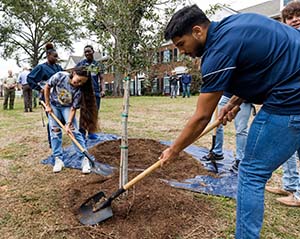
East Texas Baptist University faculty, staff and students gathered on the campus to plant trees and contribute to the beautification of campus on the official Texas State Arbor Day. ETBU utilizes Arbor Day to provide a unique opportunity for students to get involved in the tree planting process each year. (ETBU Photo)

East Texas Baptist University faculty, staff and students gathered on the university grounds to plant trees and contribute to the beautification of campus on Texas Arbor Day. Students planted three live oak trees in front of University Park Row Houses on ETBU’s campus. While National Arbor Day occurs in late April, Texas Arbor Day occurs on the first Friday in November due to the cooler temperatures.

The McLane College of Business at the University of Mary Hardin-Baylor hosted its second graduate residency day Oct. 22. The event gave online degree candidates a chance to experience campus life and in-person learning. During the event, students engaged in academic breakout sessions and networking and received updates from faculty. Participants also heard from guest speaker Randy’L Teton, a Shoshone-Bannock tribal member who was the model for the Sacagawea dollar coin. She talked about lessons she learned as a motivational speaker, educator, tribal spokesperson and mother.