Beautiful Hope Ministries aids trafficking survivors

University of Mary Hardin-Baylor sophomore Hannah Balkenbush knows exactly where her hope lies—in Jesus Christ. That conviction is the driving force behind Beautiful Hope Ministries, a nonprofit she founded in 2021 to raise awareness about human trafficking and to offer Christ-centered restoration to survivors.

The seeds of Balkenbush’s mission were planted during her freshman year of high school when she partnered with Unbound Now, an anti-trafficking ministry. Her first event—a benefit concert at her church—raised $12,000.

That early success led to even greater impact. In 2023, she organized a gala that raised $75,000 to support the rescue of more than 100 children.

“I decided long-term that I didn’t just want to fundraise—I wanted to do the work myself,” Balkenbush said.

In 2022, she officially launched Beautiful Hope Ministries, which since has become a 501(c)(3) nonprofit organization.

Support and restore survivors in Jesus’ name

At the heart of Beautiful Hope Ministries is a simple but profound belief—without Jesus, there is no hope.

“Our mission is to support and restore survivors of trafficking and poverty in Jesus’ name,” Balkenbush said. “Outside of Christ, there is no lasting hope.”

Balkenbush’s passion for ministry has taken her across the globe—from the impoverished neighborhoods of Honduras to the streets of Paris and Warsaw.

In Honduras, she met villagers who had gone without water for eight days. When she asked how they were surviving, her translator replied, “They live off the breath of God.”

To date, Hannah has raised more than $120,000 for anti-trafficking efforts, helping rescue hundreds of children.

In addition, Hannah was invited to Paris ahead of the 2024 Olympics, where she met with an ambassador from the International Olympic Committee, France’s Minister of the Interior, and undercover agents from the U.S. Embassy.

Together, they worked to establish the French National Human Trafficking Hotline in preparation for the expected surge in trafficking during the games.

“If a girl doesn’t find her worth in Christ, she’ll look for it elsewhere,” Balkenbush said. “When she goes searching for things other than Christ, she is going to find darkness.”

Developed a Care Closet to provide essentials

As a freshman at UMHB, Balkenbush started developing a Care Closet with Beautiful Hope Ministries to provide essentials for children and young people in need. She’s also researching nonprofits in Belton and Temple to find ways Beautiful Hope can help fill unmet needs locally.

Long term, her goal is to build orphanages and safe houses around the world, “specifically in the 10/40 Window, because that is where the majority of the unreached people groups in the world are,” she said.

The 10/40 Window is the rectangular area of North Africa, the Middle East and Asia approximately between 10 degrees north and 40 degrees north latitude.

Even though she knows there are numerous steps to get to that point, Balkenbush has faith and is patiently waiting on the Lord, knowing that is what he calls his children to do.

“God can do the impossible even through suffering and brokenness,” she said.


Abortion opponents denounce drug entering market

NASHVILLE (BP)—Pro-life advocates protested the U.S. Food & Drug Administration’s approval of another generic abortion drug.

Produced by Evita Solutions, the drug named ANDA received approval Sept. 30 as a generic to Mifeprex, which was approved in 2000.

The drugs are designed to end pregnancies through 10 weeks’ gestation. They prevent the fetus from being able to attach to the uterine wall while preparing the uterus for contractions that typically come about by combining another pill, misoprostol, that induces strong cramps. Mifepristone, the first generic of Mifeprex, received FDA approval in 2019.

‘Dangerous, life-taking drug’

Ethics & Religious Liberty Commission Interim President Gary Hollingsworth said the act “should weigh heavy on the hearts of Southern Baptists, who boldly and bravely speak the truth of God as the creator and giver of life.”

“We affirm that life is a sacred gift, not a commodity to be regulated or discarded,” Hollingsworth added. “In response, the ERLC is sending a letter to [Health and Human Services] and the FDA, urging them to take action with the ultimate goal of removing this dangerous, life-taking drug from the market for good.”

A report issued in the spring by a watchdog group called attention to the rate of “serious adverse reactions” to mifepristone, namely that it can be as high as 22 times more than that claimed by the drug’s maker.

The Ethics & Public Policy Center said it found 10.93 percent of women who used mifepristone experienced sepsis, infection, hemorrhaging and similar effects within 45 days, as opposed to the less-than-.5 percent previously reported.

‘Fanning the flames of the culture of death’

At the June annual meeting in Dallas, Southern Baptists passed a resolution condemning “the moral evils and medical dangers” of abortifacients.

“As we made clear in [that] resolution … Southern Baptists want this dangerous drug taken off the market altogether,” said Miles Mullin, ERLC executive vice president.

“Unfortunately, this decision by the FDA moves in the other direction, expanding its availability and fanning the flames of the culture of death that still persists in our country over three years since the Dobbs decision.

“The FDA needs to reverse this decision, otherwise, all the good work done to overturn Roe will come to naught as more and more women are harmed and more and more babies die.”

‘Grave misstep by the FDA’

ERLC Senior Policy Manager Katy Roberts urged the FDA to fulfill its “explicit, self-reported responsibility to promote and protect our health.”

“Their decision to approve generic mifepristone completely circumvents this responsibility. The chemical abortion pill is in no way ‘safe’ or ‘effective’—for women, or for the preborn. Taking this pill results in abnormally high rates of adverse physical events for women, leaves a lasting mental, emotional and spiritual toll and robs innocent children of the right to life. Approving this drug is a grave misstep by the FDA.”

Secretary of Health Robert F. Kennedy Jr. commented on social media, saying federal law requires FDA approval “when an application proves the generic is identical to the brand-name drug.”

He pledged to “review all the evidence—including real-world outcomes—on the safety of this drug.” Kennedy added that recent studies have indicated “serious risks when mifepristone is used without proper medical oversight.”

Call to reverse the decision

Former Vice President Mike Pence called the approval “a complete betrayal of the pro-life movement that elected President Trump.”

“Earlier this year, I opposed RFK’s nomination because he was unfit for the role and particularly over the concern that he would expand access to abortion, as he has done today,” added Pence, who called on Trump to “immediately reverse this decision.”

The Guttmacher Institute reported in 2023 that chemical abortion accounted for 63 percent of all U.S. abortions.

“Let us continue to pray,” Hollingsworth said, “for our leaders, for our nation, for mothers and fathers facing unexpected pregnancies, and for a renewed culture of life that cherishes every person as made in the image of God.”


Study: Religion declining worldwide in predictable pattern

(RNS)—When it comes to going to church, a generational pattern is playing out in many households around the world.

Grandparents never miss Sunday service. Parents attend only on holidays. Children, who describe themselves as “spiritual but not religious,” rarely attend at all as adults.

A new study, published in August in the journal Nature Communications and conducted by researchers at the University of Lausanne, Oxford University and the Pew Research Center, sought to explain the ebbing of religiosity across generations.

Drawing on data from Pew, the World Values Survey and the European Values Study, the authors looked at secularization and religious change across more than 100 countries and major religious traditions.

“We hope this article is useful as a kind of grand narrative about what’s going on in the world, a model of how to see global religious change,” Conrad Hackett, one of the authors, told Religion News Service.

Sequence of decline across generations

The researchers describe a sequence in how religious life tends to decline across generations. First, participation in worship services drops. Next, people report that religion becomes less important in their lives. Finally, formal religious affiliation declines. They refer to this as the Participation–Importance–Belonging, or P-I-B, sequence.

“We’re capturing a story about institutional forms of religion. It’s an interesting measure, because it’s not about a specific belief, but their assessment of how much religion is shaping their decisions in their everyday life,” Hackett said.

According to the study, countries around the world can be placed at different points along this secular transition.

In much of Africa, religion remains a central part of daily life, with high levels of participation.

Countries across the Americas, Asia and Oceania often fall in the middle range, where public participation and personal importance are already slipping, though formal belonging has not yet declined to the same extent. The United States is also in this middle range, with gaps showing up across all three measures.

Europe stands out as being the furthest along this path: The European countries included in the study are in either the middle or later stages of the P-I-B sequence—with both historical trends and current data supporting this trajectory.

Generational gaps across religious traditions

The secular transition shows up across countries with Christian, Buddhist, Hindu and Muslim majorities. Although fewer Buddhist- and Hindu-majority countries are included in the data, early signs of the P-I-B sequence can still be observed in those contexts as well.

“We had questions that were tailored to the way people participate in religion in different traditions and parts of the world,” Hackett said. For example, in East Asia, people usually don’t go to a place of worship on a weekly basis.

“However, when we look at other kinds of belonging or participation, we still see generational gaps,” he said.

In Muslim-majority countries, the pattern appears to stall after the first two stages: Participation and importance may be dropping slightly, but people largely continue to identify with their religion.

The P-I-B sequence is most clearly visible in traditionally Christian countries, about which researchers had the most data among countries spanning the full range of the secular transition.

The authors, however, caution the study covers only a few decades and, in many regions, secularization is still in its early stages. They also note exceptions to the trend, including post-communist countries in Eastern Europe and Israel, where patterns of religious change diverge from the typical trajectory.

Part of a larger intellectual tradition

David Voas, a quantitative social scientist who developed the original secular transition theory, said the study helps to build a big-picture framework that explains global patterns.

“To me, as somebody who is interested in religious change internationally, this is a global phenomenon that cries out for some kind of general analysis and explanation,” he told RNS. 

Like the authors of the new study, Voas sees secularization as a component of modernization, which also includes the transition from agrarian to industrial and post-industrial societies.

“When you look at the global situation and see that decline is happening around the world—it’s not restricted to just Christian countries; it’s been going on everywhere for a very long time—you realize this is not just something that is going to change because there’s a political or cultural shift in one or two places,” he said.

While other scholars focus on what is happening in individual contexts, Voas argued it is equally important to study the bigger picture.

“It’s clear that religious decline is happening,” he said. “It’s not so clear why.”

More privatized expressions of faith

Harvard Divinity School professor Gina Zurlo, who studies Christianity around the world, said the P-I-B model has a familiar ring for modern Christians in the West.

“Attending religious services and engaging in other public practices is a commitment,” Zurlo said. “It requires time, energy, money, travel, leaving the house, gathering your kids, looking presentable, whatever. If you’re questioning faith in any way at all, why put in so much effort?”

But Zurlo suggested the result may be not necessarily a decline as much as making religion a more private affair.

“Our hyper-individualistic society has essentially granted people permission to be religious in their own way. They can pray, believe in God, read Scripture and engage in other spiritual practices completely on their own—without ever stepping foot in a house of worship—and still be considered a religious person.”

Other scholars also noted the story of religious adherence is more complex, pointing to cycles of change, cultural differences and new forms of spirituality that surveys and one global model may not capture.

No straight line trajectory toward secularization

Landon Schnabel, a professor at Cornell University who studies social change, inequality and religion, praised the study’s P-I-B model as “an important framework for understanding recent trends based on available survey data” but said it may not represent “longer-range cycles of religious change.”

Schnabel argued religious life doesn’t follow a straight line toward secularization.

“We see it as a pendulum swinging between institutions and individuals, conformity and rebellion, building up and tearing down, and structure and spirit,” he said.

He also points out people may be returning to forms of religion that aren’t contained in formal institutions.

“For most of our species’ existence, spiritual practices were more localized, fluid and integrated into daily cultural life,” he explained. “Spiritual practices were embedded within the religion of particular peoples and places.”

What looks like a decline, he suggested, may be a return to spiritual engagement that is “more personalized, syncretic and centered on individual authority rather than institutional power.”

Consider Africa and Latin America

Kyama Mugambi, a world Christianity professor at Yale Divinity School, warned against analyzing demographic data through a Western lens. Regions such as Africa and Latin America show different patterns of religious change, he said.

“Secularization, as construed in the study, is largely a Western construct,” Mugambi said. “Though it affects societies around the world, secularization will inevitably take different forms, shaped by the social, cultural and intellectual histories of the places it encounters.”

We should be cautious, Zurlo said, in assuming the end of religion everywhere in the world.

“The world is a furiously religious place and, in my estimation, it will continue to be for a long time,” she said. “Religion changes constantly as societies modernize, technology advances, women gain more decision-making power, and as people reinvent what it means to be religious in their specific time and place.”

While scholars debate whether modernization leads to secularization and religious decline, or simply to new forms of religiosity, there is broad agreement change is underway. The question is not if religion is shifting, but how to understand it.

For religious communities, the study may serve as a reminder they are not alone in seeing fewer people in the pews or less interest among younger generations. Whether those trends signal lasting decline or emerging forms of faith, the findings suggest religious life everywhere is being reshaped in ways demanding attention.


List highlights global lack of access to the Bible

Somalia tops the list of countries where access to the Bible is blocked by law, actions of religious extremists or acts by other nonstate actors, the Bible Access Initiative announced Oct. 2.

“Bible access in Somalia is not just limited; it is outlawed,” a profile of the nation produced by the Bible Access Initiative stated. “Under a strict interpretation of Sharia law, it is illegal to print, import, store, or distribute Bibles.”

The analysis notes local Christians in Somalia “face life-threatening consequences for possessing Christian materials, and Bible access is considered unsafe and severely restricted across the country.”

In addition to legal restrictions, since more than 70 percent of the population in Somalia lives in poverty and suffers from widespread food insecurity, “basic needs often eclipse the possibility of purchasing a Bible—even if it were possible.”

Rounding out the Top 10 countries on the initiative’s restricted Bible Access List are Afghanistan, Yemen, North Korea, Mauritania, Eritrea, Libya, Algeria, Iran and Turkmenistan.

‘Stark reality of the lack of Bible access’

 “A modern famine persists—not due to apathy, but because of barriers that prevent people from accessing the Bible,” said Wybo Nicolai, co-creator of the Bible Access List.

“These barriers differ in form, but the result is the same—millions cut off from God’s word. Many have never seen a Bible in their language, format they prefer, or price range they can afford, or have no way to safely obtain one.”

The Bible Access Initiative—a collaborative of global Bible agencies and mission partners—developed its list to highlight “the stark reality of the lack of Bible access for an estimated 100 million Christians around the globe,” the initiative stated in announcing its report.

Open Doors International and the Digital Bible Society founded the Bible Access Initiative, which counts among its partners Frontlines International, Bible League International, Biblica, Bible League Canada and OneHope.

“While the Bible Access Initiative believes every individual on Earth has an inherent right to access God’s word and to own a copy of the Bible if they so desire, the Bible Access List proves that unfettered access to the Bible is not a universal standard,” said Ken Bitgood, founder and CEO of the Digital Bible Society.

Shortage of Bibles in many countries

The initial assessment, which the group plans to issue annually, focuses on 88 countries, showing where access to the Bible is most restricted and where its shortage is greatest.

The Democratic Republic of Congo ranked No. 1 on the initiative’s Bible shortage list, which spotlights countries where Christians want a Bible but do not have access to one. Other countries in the top 5 of the Bible shortage list are Nigeria, Ethiopia, India and China.

The Bible Access Initiative compiled the data for its Bible Access List by integrating quantitative data analysis, survey research and qualitative validation review with experts and in-country sources.

Primary research included global surveys, expert interviews and field observations. Data analysis was drawn from world Christian databases, Open Doors’ World Watch List, World Bank indicators and Bible translation repositories.

The data considered barriers to access due to religious persecution, political oppression, socioeconomic challenges, church context dynamics and displacement due to conflict.

In addition to the Bible Restrictions List and the Bible Shortage List, the initiative also produced detailed country profiles providing context for lack of Bible access and shortages.

“One size doesn’t fit all when it comes to solving the issues of Bible access globally,” said Jaap van Bezooijen, who oversaw research and systems development for the Bible Access List.

“Our mission with the Bible Access List is to provide a clear, reliable global picture so the church can respond strategically.”


David Barton to advise Texas State Board of Education

David Barton, a conservative Christian activist who considers the separation of church and state a myth, will serve as an “expert content adviser” to the Texas State Board of Education when it develops new state standards for teaching social studies.

Republican activist David Barton, from Aledo, speaks before testifying to a meeting of the State Board of Education where it began hearings on a new social studies curriculum Sept. 17, 2009, in Austin, Texas. (AP File Photo/Harry Cabluck)

Barton is founding president of WallBuilders, an Aledo-based organization devoted to teaching what it calls “the true story of America and our Biblical foundation,” according to the group’s website.

Two members of the board—Julie Pickren of Pearland and Brandon Hall of Aledo—announced Barton as their choice to serve in the advisory role. Barton, a former vice chair of the Republican Party of Texas, served in a similar role in 2010 when the board revised social studies state standards.

 “I am excited for the State of Texas to retain the expertise of someone I believe to be the foremost American historian of our day,” Hall posted on Facebook. He pointed to Barton’s appointment as the fulfillment of a campaign promise he made.

Barton holds an undergraduate degree in religious education from Oral Roberts University. While WallBuilders describes him as an “expert in historical and constitutional issues,” Barton holds no formal educational credentials in either history or constitutional law.

Book withdrawn by publisher

In the press release announcing Barton’s appointment, Pickren and Hall referred to him as “a recognized author of numerous works on American history and a highly sought after speaker and lecturer.”

In 2012, Christian publisher Thomas Nelson withdrew one of Barton’s books, The Jefferson Lies: Exposing the Myths You’ve Always Believed About Thomas Jefferson, because the publisher had “lost confidence” in the book’s historical details.

WND Books, a publishing house related to the far-right media outlet formerly known as WorldNetDaily, released a revised version of the book in 2016.

Pickren and Hall said they look forward to working with Barton and other advisers “to craft standards that will equip the next generation of students to become well-educated, proud Texans and patriotic Americans.”

‘Propensity to misquote, misinterpret or manufacture quotations’

Baptist historian Mike Williams acknowledged Barton “deserves some credit for trying to answer progressive secularists” who have downplayed the role of faith in U.S. history and who “lampooned evangelicals as redneck fundamentalists from the backwoods of the Deep South.”

“Unfortunately, he ignores the truth about Christianity and religion in colonial America: Religious faith was far more diverse in its origins than just the Puritans and those he incorrectly identifies as evangelicals among the founders,” said Williams, a recently retired professor of history.

“He forgets or never learned something I stress to students from freshman history to graduate courses—context, context, context. His propensity to misquote, misinterpret or manufacture quotations causes most of what he writes to be ignored by legitimate evangelical historians, political scientists and theologians.

“Such inaccuracies hurt historians who are clearly Christian from being respected in broader academic circles and makes them work harder to prove their ideas are valid. His writings seem to confirm to non-Christians that Christians are all lying hypocrites who ‘can’t handle the truth.’”

If the State Board of Education considers Barton an expert adviser, Williams suggested the board also include legitimate historians and political scientists “as a counterweight to what might be considered ‘fake history.’”

Promoting a ‘false narrative’

Amanda Tyler

Amanda Tyler, executive director of the Baptist Joint Committee for Religious Liberty, also critiqued Barton for promoting a “false narrative” about U.S. history.

“For decades, David Barton has consistently pushed the false narrative that America was founded as a Christian nation, legally and historically. It is deeply concerning that he will be advising the State Board of Education on social studies standards in Texas,” Tyler said.

“The ‘Christian nation’ mythology is easily rebutted by reference to constitutional text and history. We should be preparing Texas students to live in an increasingly pluralistic country by teaching them accurate history, not a cherry-picked, false narrative that furthers theocratic interests.”

John Litzler, public policy director for Texas Baptists’ Christian Life Commission, also noted “serious concerns” raised about Barton’s “version of the historical record of the United States and the veracity of several of his claims.”

Separation of church and state ‘neither a myth nor a modern invention’

Texas Baptists particularly should be concerned about Barton’s statements denying the separation of church and state, Litzler said.

John Litzler

“Separation of church and state is neither a myth nor a modern invention. Baptist ministers like John Leland and Isaac Backus were instrumental in ensuring both the establishment and free exercise clauses of the First Amendment were included in our nation’s Bill of Rights,” Litzler said.

He noted Thomas Jefferson wrote his famous words about a “wall of separation between church and state” in direct response to the Danbury Baptist Association in Connecticut, whose religious liberties were being infringed upon by the government-established church in their state.

“From our earliest days, Baptists have been pioneers in including separation as a key element of religious freedom in our articles of faith. Every version of the Baptist Faith and Message contains the simple statement that, ‘Church and state should be separate.’ This belief is a hallmark of the Baptist faith,” Litzler said.

He echoed Williams’ call for the State Board of Education to listen to other content advisers who might “provide a differing view from Barton’s on this issue to bring balance to the process and help give voice to the millions of Baptists in Texas as the SBOE develops their new social studies agenda.”

“We thank the SBOE for their diligent and important work, while also urging them to seek input from Baptists and others on key issues of religious liberty and the history of the American church,” Litzler said.

‘Truth is unkillable’

Truth—including a true account of American history and the separation of church and state—is strong enough to stand on its own merits without embellishment, Williams asserted.

“Unvarnished truth about U.S. history, including religious history and Christianity, and vital ideas on religious liberty and separation of church and state, can stand on their own. They do not need to be propped up by rewriting history to fit with current political agendas,” he said.

Williams quoted Anabaptist Reformation theologian Baltasar Hubmaier, who often signed his theological treatises, “Truth is unkillable.”

“When American history is taught, it should be the ‘whole truth and nothing but the truth,’” Williams said, “not a fictionalized enhanced version of it that makes heroes from history into 21st century Bartonites. The truth sometimes hurts, but it must be told.”


Deacon with a disability serves Lubbock church

Victor Reta, a member of Bacon Heights Baptist Church in Lubbock, lives with “very severe” aphasia, a language disability that affects one’s ability to speak and understand what others say. Even so, he serves in several capacities on Sunday mornings despite his disability.

“He loves [Bacon Heights],” said his mother, Rosie Rodriguez. “He’s always around. I don’t think there’s one person in the whole church that doesn’t know his name.”

In 2017, Bacon Heights’ previous pastor approached Rodriguez with a desire to honor her son, who is “always helping,” “always opening doors,” “always smiling,” and is an active participant in the congregation and the church’s special needs ministry.

‘God working in him’

“Our pastor came, and he said the deacons want to do something for Victor. … I thought, ‘OK, they want to give him some chocolate, coupons or something [else],’” she said.

Instead, the pastor told her, “The deacons have talked and they voted, and they would like to ordain him as a deacon.”

Rodriguez said Reta’s desire to serve “came on its own,” so showing up to serve has “started growing him and blessing him in ways that we were not aware [of].” She said through the years, he has “gotten so many recognitions at church [and] at work” for his service.

“I call him our Forrest Gump because all he does is show up, and he’s Victor. He just does what Victor does. But then all these other blessings come his way without him even asking or knowing about it,” Rodriguez said.

“God has really used him and we’re really proud of him, but we know that it’s God working in him.”

Serves in a variety of roles

Deacon Victor Reta helps collect the offering at Bacon Heights Baptist Church in Lubbock. (Courtesy Photo)

As a deacon, Reta serves as a greeter and takes up the offering at the end of Sunday service, helps new members and guests get to the right places, and even helps out in Bacon Heights’ special needs ministry Sunday school class.

He also volunteers during the week, helping his best friend and church facilities manager John Kjosa with building upkeep.

Kjosa participated in Reta’s deacon ordination ceremony by washing his feet, “which [was] such a special thing for [him].”

Bacon Heights Lead Pastor Sammy Elliott, who joined the church staff in 2021, said, “an exciting thing in the life of Bacon Heights is their emphasis and strategy of loving well … [and] that shows up in so many ways, [especially] with special friends.”

The special needs ministry hosts a Sunday school class called “Aspire,” which gives special friends “learning opportunities and activities” during both service hours.

Once a month, the special needs ministry also hosts “First Fridays,” a worship service specifically for special friends.

“One of our pillars of our vision and mission is that we love as Jesus loved. And that’s easy to see on paper, but we see that play out and fleshed out in all of our ministries, but especially our special friends ministries,” Elliott said.

‘Here’s what I can bring’

Elliott said Reta “provides a light for us to follow” in serving in the church.

“When you see somebody like Victor serve, it removes excuses,” Elliott said.

Elliott said “[Victor’s] willingness to say, ‘Here’s what I can bring,’” encourages the congregation to do the same.

“When he’s up here, that’s his offering to God … with that mindset [and] heart behind what he does, how can it not be encouraging to others to say, ‘Here’s what I can bring,’” Elliott said.

In addition to serving as a deacon, Reta also has participated as a camper for 25 years at Texas Baptists’ Special Friends Retreat, an event for individuals aged 12 and older with cognitive or intellectual disabilities.

Reta said going to retreat every year reminds him of how deeply Jesus loves him. His favorite part of the weekend, he said, is getting to worship with his friends.

The first of four Special Friends Retreats is scheduled Oct. 3-4 at Mt. Lebanon Baptist Camp and Conference Center in Cedar Hill. A Special Friend Retreat is scheduled for four weekends at locations around the state, including at Bacon Heights on Dec. 6. 


Around the State: Baylor and Texas Baptists break ground on BSM building

Baylor University and Texas Baptists representatives held a groundbreaking ceremony for a new Baptist Student Ministry building that will be built on the corner of South Fourth Street and Daughtrey Avenue in Waco. “[The new building is] going to benefit our students, contribute to their spiritual growth and prepare them to be effective Christ-followers while they’re at Baylor and then long beyond that as they go out into the world,” said Baylor President Linda Livingstone.

Fellowship Southwest, a regional ministry launched by the Cooperative Baptist Fellowship in 2017, has rebranded as FaithWorks to reflect its expanded scope both geographically and denominationally. The organization, incorporated as an independent nonprofit in 2021, takes its new name from James 2:14. The name FaithWorks, leaders said, removes any geographical constraint and clarifies they are action-oriented and faith-based.

Dallas Baptist University will host its second Global Religious Freedom Gathering Oct. 20 and 21. Pastors from Texas and advocacy experts from around the world will share their motivation as Christians to advocate for people around the world. Representatives of persecuted Christians from Turkey, Nigeria, Pakistan and Afghanistan will provide insight on suffering taking place due to religious beliefs.

Houston Christian University board of trustees voted Sept. 16 to approve the repurchase of University Place, a residential complex adjacent to its main campus. The repurchase is set to take effect in or about July 2026, under the terms of a right of repurchase agreement with Memorial Hermann Health System.

A reception at Wayland Baptist University for painter Zhuocai Ouyang, celebrating the opening of Tranquility and Being as the newest exhibit at Abraham Art Gallery, is set for 2 p.m. to 4 p.m., Saturday, Oct. 4. The reception will be held in the gallery with refreshments served in the atrium. The exhibit includes his original paintings and will be open to the public through Dec. 5. The gallery is located on the lower level of the J.E. and L.E. Mabee Learning Resources Center on Wayland’s Plainview campus.

Howard Payne University will host the inaugural James Shields Speaker Series in spiritual formation on Oct. 21 and 22. This series, named for the former professor of Christian Studies, will be centered on the theme of spiritual formation. The lectures will be held on Tuesday, Oct. 21, at 7 p.m. in the Richard and Wanda Jackson Conference Room of the Paul and Jane Meyer Faith and Life Leadership Center and Wednesday, Oct. 22, at 10 a.m. during HPU’s chapel service in Mims Auditorium.

The Texas Tech Baptist Student Ministry will celebrate 100 years of ministering to Texas Tech on Oct. 3 and 4 in Lubbock. Texas Tech University first opened its doors to students in October 1925 with an enrollment of just over 1,000 students. Texas Tech BSM was organized that same month and has been a vital student ministry ever since. It is the oldest continuous religious student organization on the Texas Tech campus. The anniversary celebration will include a Friday night fellowship and a luncheon program on Saturday.

Wayland Baptist University has been selected to be featured in an upcoming episode of Empowered, hosted by Meg Ryan, a nationally broadcast Public Television program that showcases institutions and individuals blending relevant academics with value-driven learning. A production crew will be on campus Wednesday, Oct. 8, to film major portions of the show. The feature will highlight Wayland’s approach to education—integrating relevant academics with Christian values, guiding students toward lives of purpose and service and fostering a sense of community that sets it apart from secular universities.

Hendrick Hospice Care, a service of Hendrick Health, offers two bereavement programs in Abilene, serving children and teens grieving from the death of a loved one. The weeklong summer camp, Camp Courage, gives kids a chance to grieve through activities such as yoga, breathing exercises, outdoor carnival games and a visit to the Abilene Zoo. Club Courage, the precursor to the summer camp program, is a support group offered twice a year for children and teens. Volunteers are trained to lead children in small groups based on age and to engage them in exercises, grief education and ways to express themselves. The group meets one evening a week for six weeks.


Support of Israel steady but generational shift likely

PRESCOTT VALLEY, Ariz. (BP)—Evangelicals in the United States are as supportive of Israel as they were four years ago, Infinity Concepts and Grey Matter found in their latest poll, but findings point to a possible generational shift.

The 49 percent of evangelicals who view Jews as God’s chosen people remains statistically unchanged from the 51 percent who said the same in 2021, said Ron Sellers, president of Grey Matter Research Consulting.

“Even with all of the various things and how much this has been in the news and how much people have spoken out against Israel and its actions, and for Israel, and all the anti-Semitic situations that have gone on worldwide, evangelical attitudes have been 100 percent constant, which truly was amazing and I think heartening,” Sellers said.

More spiritual than political

Evangelical support of Israel is more spiritual than political, researchers found, with 74 percent of evangelicals prioritizing spiritual support of the nation and people, compared to 60 percent who prioritized political support.

“It’s nice to see beliefs that don’t change with the news cycle,” Sellers said. “It’s nice to feel that important religious beliefs, whether you agree with them or hold those same beliefs or not, are not affected by who’s president, what’s … on CNN or Fox News or MSNBC, that the beliefs are staying constant.

“And I think that’s an incredibly important thing for evangelicals, and for evangelical leaders to note that their people are not just swaying with the wind.”

Difference among young evangelicals

A generational subset of the poll of 1,008 evangelical Protestants found 29 percent of evangelicals under age 35 believe Jews are God’s chosen people, and that cohort is more likely to embrace a replacement theology or express uncertainty.

“The difference between younger people and older people in the evangelical community is definitely statistically valid, statistically relevant,” Sellers said.

“In every way, younger evangelicals are less engaged with Israel, less supportive of Israel, less likely to see the Jews as God’s chosen people. And if those attitudes don’t change as they get older, long term, we’re looking at a very different environment on how Israel and the Jewish people are thought of within evangelical circles.”

When younger evangelicals don’t see Jews as God’s chosen people, they are less likely to prioritize Israel in their own spiritual lives, Sellers said.

“And we’ve seen other studies that look at this from a political perspective or a social perspective that show the same thing, that younger people are less likely to be supportive of Israel politically,” he said.

Avoid stereotypes

But evangelicals are not monolithic in their interpretation of what it means, in practical terms, for Israel to be God’s chosen people. Sellers cautions against stereotypes.

“There is a stereotype that evangelicals all are conservative, all are Republican, all voted for Trump, all support Israel, etc., and that’s absolutely not the truth,” Sellers said.

“Israel and the Jewish people are more likely than not to find support among evangelicals, but there are significant subsets who either are not supportive of Israel and the Jewish people, or they are generally supportive.”

However, he said, “They take pains to point out that that does not mean that that’s just a blanket support of anything that Israel might do militarily or politically,” although the poll at hand did not delve into political beliefs. “So, it’s not a cut-and-dried issue for many people.”

Blessing Israel and the Jewish people

Leaders can use the findings to understand that more evangelicals want to focus on a spiritual relationship with Israel, rather than political.

“A lot of times, what it means is placing a special emphasis on blessing Israel and the Jewish people,” Sellers said.

Evangelicals might practice their support in any number of ways, he said, perhaps praying for the peace of Jerusalem, opposing antisemitism, helping the Israeli Defense Forces defend its citizens, teaching Jewish people about the gospel, providing humanitarian relief, helping Holocaust survivors or engaging in other outreaches.

Looking at the numbers

By the numbers, 65 percent of evangelicals said they are interested in what the Bible teaches about Israel, 55 percent voiced interest in Bible prophecy, and 44 percent said they wanted to learn about the Jewish roots of Christianity.

Far fewer, 30 percent to 41 percent, voiced interest in how Israel is treated by the U.S. media, or the political relationship between Israel and the United States.

An overview of the findings of the study, “Crossroads of Belief: Evangelicals and the Jewish People,” is available here. The 2021 report, “The Jewish Connection: Evangelicals and Israel,” is available here.


Chinese religious leaders face severe persecution

Whether they lead independent or state-sanctioned worshipping communities, religious leaders in China who do not adhere to Chinese Communist Party ideology and submit to intrusive state control face severe persecution, a new report from the U.S. Commission on International Religious Freedom states.

 “Chinese authorities attempt to exert total control over religion through an extensive, complicated web of laws, regulations, and policies that the CCP and various government agencies enforce,” according to a recently released factsheet from the commission, “China’s Persecution of Religious Leaders.”

Religious leaders who resist state control face a wide range of punishment—from surveillance and fines to retribution against family members, imprisonment, forced labor and torture, the report states.

Forced adherence to ‘sinicization’ policy

The Chinese government officially recognizes Buddhism, Catholicism, Islam, Protestantism and Taoism as religions and operates seven state-controlled organizations to manage their affairs.

Religious communities from the recognized religions are required to register with the state, and their leaders must support the Chinese Communist Party leadership and “sinicization” policy.

The policy requires state-sanctioned religions to conform their beliefs, activities, expression, attire, leadership, language and houses of worship to government ideology.

“The objective of this policy is to transform religious sites and communities into extensions of the CCP, eliminate non-CCP influences—which the government often disparages as “foreign”—and forcibly assimilate ethnic minorities,” the factsheet states.

“The government’s approach to enforcing sinicization has resulted in particularly severe violations of religious freedom, including against religious leaders.”

The government has ordered Protestant state-sanctioned churches in China to remove crosses from their buildings and display Chinese Communist Party slogans. The state also has demanded ministers preach communist ideology.

Pastors accused of ‘dubious financial crimes’

Protestant churches that refuse to register—including house churches—face even greater persecution, the commission factsheet notes.

“Law enforcement routinely targets unrecognized house church Protestant pastors and other senior-ranking church members on dubious financial crimes tied to their communities’ collection of donations or selling of religious goods,” the factsheet reports.

Elder Zhang Chunlei, leader of a Protestant church in China’s Gyizhou Province, received a five-year prison sentence July 24, 2024, for charges of fraud and inciting subversion. (Facebook/Zhang Chunlei via CSW)

In January, a district court sentenced a pastor, two deacons and two other leaders of the Shengjia Church in Guangdong Province to terms ranging from one year and two months to two years in prison for “illegal business operations”—reportedly printing and selling religious literature.

A house church pastor in Anhui Province, Wan Changchun, was sentenced to five years in prison in March. He was detained nearly two years earlier. In 2018, he signed a letter criticizing Chinese treatment of Christians.

Authorities in Shanxi Province sentenced about a dozen house church members to prison on fraud charges, including Pastor Yang Rongli, who received a 15-year sentence.

Authorities use ‘anti-cult’ provision to target churches

Government authorities also have used the “anti-cult” provision in China’s Criminal Code to target Protestant house churches, the factsheet reports.

In May, local authorities in Shaanxi Province detained 10 religious leaders from the Zion’s Light house church, including Pastor Gao Quanfu, on cult charges. Gao reportedly signed onto the same 2018 letter Wan Changchun signed, denouncing the government’s treatment of Christian communities.

In June, law enforcement detained on cult charges the pastor of the Shenyang Youth Fellowship in Liaoning Province, allegedly physically assaulting and abusing him in custody to elicit a false confession, the commission factsheet states.

“Chinese authorities target underground Catholic religious leaders for refusing to join the state-controlled Catholic religious organizations. Underground Catholics do not recognize the spiritual authority of government-backed religious clergy and instead view the Vatican as the sole legitimator of spiritual authority, which the CCP views as a threat,” the factsheet states.

“While the Vatican and China signed an undisclosed agreement in 2018 reportedly to cooperate on the appointment of bishops in the country, the Chinese government has unilaterally installed CCP-aligned bishops without the Vatican’s consultation and approval.”

Ethnic religious minorities face most severe persecution

Ethnic religious minorities face particularly severe persecution under China’s sinicization policy, the report notes.

MuslimsPraying
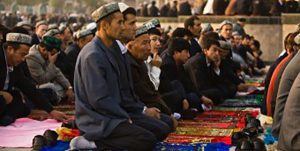
Uyghur Muslims worshipping in Xinjiang Province, China. (File Photo from 21Wilberforce)

“Law enforcement has targeted Uyghur and other Turkic religious leaders because of their roles as transmitters of local religion, language, and culture, thus threatening the government’s goal to sinicize Islam and forcibly assimilate the population in Xinjiang,” the factsheet states.

“Chinese authorities have committed genocide and crimes against humanity against predominately Muslim Uyghurs and other Turkic ethnic groups in Xinjiang under the guise of combating ‘religious extremism, terrorism, and separatism.’”

Likewise, the Chinese government has targeted Tibetan Buddhists for their role in preserving Tibetan culture, language and religion.

“China has ruthlessly repressed its Tibetan Buddhist religious communities for their devoutness to the Dalai Lama, whom the government views as a political threat but the vast majority of Tibetan Buddhists recognize as the true leader of Tibetan Buddhism,” the factsheet states.

In its latest report, the U.S. Commission on International Religious Freedom again recommended the U.S. Department of State redesignate China as a Country of Particular Concern for engaging in systemic, ongoing and egregious violations of religious freedom.


Ukrainians and Russians minister and worship together

“All the pain, all of the differences, all the different cultures, different approaches, and the language, all of that is there, but the love of Jesus kind of unites us in such a special way,” Pastor Victor Akhterov said, describing how Russians and Ukrainians worship together in his church.

Akhterov, speaking to attendees of a Wednesday evening Bible study at First Baptist Church in Plano, Sept. 24, is a pastor of River of Life Dallas-Church, serving alongside Pastor Leonid Regheta and Pastor Vasily Dmitrievsky. All three are bivocational.

Akhterov and Regheta were born and raised in Ukraine. Dmitrievsky was born and raised in Russia. Together, they serve a church composed of Ukrainians, Russians, and people from across the former Soviet Union and elsewhere.

When the Dallas Morning News showed up at one of the church’s events after Russia’s full-scale invasion of Ukraine began in February 2022, reporters asked how Ukrainians and Russians could coexist in the same church.

“Probably because we are building bridges, not borders,” Regheta told them, referring to the posture of his church since its beginning.

‘An accidental church plant’

Regheta described River of Life Dallas-Church as “an accidental church plant.”

“I didn’t mean to plant the church. I didn’t plan to plant the church when I came to the Plano area. That was not part of my plan, my life. In fact, I resisted that. I protested that, and I call it an accidental church plant,” Regheta said.

Regheta and his wife were missionaries in Russia but were kicked out along with their four children when “Putin started making things more difficult for evangelical churches,” especially missionaries from America, which the Regheta’s were at that time, he recounted.

The Reghetas ended up in North Texas at the encouragement of his two sisters. Once settled and part of a Ukrainian community there, they were invited to a birthday party, which led to another larger gathering, followed by another even larger gathering.

Seeing what was happening, Regheta and his friends wondered if God was telling them they needed to do something with all these people coming together. Regheta thought the people needed to hear about Jesus but not from him since he was busy with his mission work.

Eventually, the Holy Spirit made it clear to the Reghetas they were to be the ones to start a church for this gathering.

One of the problems they faced was what kind of church to be. The gathering seemed to be equal parts Baptist, Pentecostal and “who knows what—including non-Christians,” he said.

“God, what kind of church are we supposed to have, and what does that mean? Could you make it a little more clear by sending more people of a particular denomination?” Regheta said.

Then people from Moldova, Uzbekistan, Russia and elsewhere joined the gathering in the backyard of someone’s house north of Frisco.

As the number of people continued to grow and the weather turned colder, they looked for another place to meet. A contact at the Baptist General Convention of Texas connected them to Hunters Glen Baptist Church in Plano, where River of Life-Dallas Church has met for the last 15 years.

Facing unique challenges

New challenges arose for River of Life-Dallas Church following Russia’s full-scale invasion of Ukraine in 2022. The ethnic, linguistic and national complexities of the war there found expression in the church here.

For example, some Russian families left the church in protest of the church’s support for Ukraine.

At the same time, some Ukrainians will not attend the church because the three pastors preach in Russian, which they consider “the language of the aggressor … the enemy,” Regheta explained.

Other Ukrainians carry the pain of a loved one killed in the war and are not ready to hear Russian spoken, he added.

Akhterov pointed to positive things happening in the church, citing individual Russian and Ukrainian members he sees worshipping together.

While all the pain and differences are present, “the love of Jesus kind of unites us in such a special way,” he said.

The three pastors are not new to such challenges, however. They’ve known them their entire lives.

Being a Christian in the U.S.S.R.

Leo’s story

Regheta, “a fourth-generation underground-church Christian,” said he feels he is an answer to prayers for the persecuted church and encouraged attendees to continue praying.

Growing up, Regheta and more than 150 to 200 other Christians crammed into someone’s home for worship, which was very hard to hide from neighbors informing the KGB. To avoid detection, they gathered for Sunday morning worship at 5 a.m. or after dark.

In second grade, his school teacher stood him and his cousin in front of their class and said they were stupid for believing God exists and that they would never get top grades.

Through those times, “what kept me in the church, what kept me grounded and it kept the faith in me—not just have it somewhere deep inside, but have it grow—is one simple thing, but it’s a profound thing, and that was the reality of God’s presence,” Regheta said.

When they were sick, they prayed and were healed, “and that was God being real. We had an issue and God helped us, and that was God being real. God showed himself. God manifested himself. So, I grew up with that reality of God’s presence, and it didn’t matter what my teacher was telling me or threatening to give me,” he continued.

Regheta’s family came to the United States as religious refugees in 1989.

Victor’s story

Akhterov, an ethnic Russian, had a different view of Soviet religious persecution growing up in the underground church in the eastern part of Ukraine.

“It’s actual fun. It’s not bad. … As a teenager, you’re hiding, you’re running from the police. You go to the forest to have your meeting, and you can do stuff in the forest. … The police come to the forest, and you are on the outlook, and you tell people to run, and they run. … You never rebel, you have so much fun being in church,” Akhterov said.

His father was imprisoned in Siberia twice for his faith, Akhterov then said. While in prison, his father led other prisoners to Christ. During one of Akhterov’s visits to Siberia, his father told his son he would preach the gospel to thousands of people someday.

His father’s words came true seven years later in 1992, as 22-year-old Akhterov was preaching over the radio to people across the former Soviet Union. His radio ministry continues today through Far East Broadcasting Company.

Vasily’s story

Dmitrievsky grew up believing “the church and religion is only for weak, uneducated and old people.” When his grandfather died, he started thinking about death for the first time, and death scared him.

In 1990, he went to Estonia on vacation and heard people singing songs in English about death. While Dmitrievsky was frightened of death, the people singing about it were not afraid of it.

As he continued to listen, he realized “they were singing about [the] death of Christ. They were Christians.” He was attracted to their message and wanted to know what they had that he didn’t. The singing group led him to Christ and gave him a Bible.

Dmitrievsky wanted to go to church in Penza, Russia, where he lived, “but there was no church around.” Though alone as a Christian back home, his new friends in Estonia helped him grow in his knowledge about the Bible and being a Christian. As he grew, he knew he wanted to serve God somehow.

In 1992, the first group of North American Christians came to Penza to do evangelism. From them, Dmitrievsky learned about sharing the gospel and prayer and realized he was being called to full-time ministry. He has been ministering ever since.

Ongoing ministry in Ukraine and beyond

Through World Outreach Ministries, Dmitrievsky meets practical needs of people from across the former Soviet Union now living elsewhere in Europe.

“They come to get glasses, but we also share Jesus with them, because Jesus is the one who makes bridges. He unites the people and gives them hope and love,” he said.

Regheta and Akhterov travel to Ukraine on a regular basis. As a result, “it’s useful to have three of us [pastors], so at least one of us can cover any particular Sunday,” Regheta said.

Regheta coordinates relief efforts inside Ukraine and with refugees throughout Europe through Hope International Ministries, of which he is board chair and director of mission projects.

Hope International Ministries provides summer camps for children and teenagers in 11 countries in Europe, trauma healing retreats throughout Europe to those affected by the war, and leadership training for new church members in Ukraine.

Akhterov, who continues his radio ministry in Ukraine, said when the war started, his people met and decided: “We’re not going to be the radio of sorrow. We’re going to be going through the same stuff that everybody is going through, but we’re going to be the radio of hope that can only be found in Jesus Christ.”

The radio ministry’s station in Petrovsk, “where the battle is the fiercest right now,” was hit by a bomb, causing the broadcast to stop, Akhterov said. “A few weeks later,” he continued, a young soldier brought the transmitter to their office elsewhere in Ukraine.

Asking where the soldier got it, Akhterov was stunned by the soldier’s answer, because “Petrovsk is just being bombed relentlessly.”

“You went to the tower under fire to get this piece of metal?” Akhterov asked him.

“No, no, no, friends,” the soldier responded. “This is not a piece of metal to me, because I was fighting there, and I started listening to your station, and I discovered who Jesus is, and I could not stop listening, because this was my lifeline to him.”

Wanting to do something for God, Akhterov continued, the soldier went to the tower, under fire, retrieved the transmitter and carried it to Akhterov.

To learn more about the ministries mentioned in this report, visit River of Life Dallas-Church, Hope International Ministries, Far East Broadcasting Company, and World Outreach Ministries.

Serving God Under Siege by Valentyn Syniy offers another account of ministry in Ukraine during the ongoing war with Russia.



Bill would sanction Nigeria for religious freedom violations

WASHINGTON (BP)—A new congressional bill would require the United States to designate Nigeria a Country of Particular Concern, indicating egregious, systemic and ongoing religious freedom violations in the deadliest country for Christians.

The Nigeria Religious Freedom Accountability Act of 2025, introduced by U.S. Sen. Ted Cruz, R-TX, echoes a longstanding call by many religious freedom organizations including the bipartisan U.S. Commission on International Religious Freedom and the Southern Baptist Ethics & Religious Liberty Commission.

While more Christians are killed for their faith in Nigeria than anywhere else in the world, the U.S. State Department removed Nigeria from the list of CPCs in 2021, after levying the designation for the first time in 2020. The CPC designation carries a host of U.S. sanctions against the nation, including financial restrictions.

ERLC Senior Policy Manager Katy Roberts welcomed the bill.

“Targeted violence against Christians in Nigeria has only intensified since the Biden administration made the determination to remove Nigeria’s CPC designation in 2021,” Roberts told Baptist Press.

“Sen. Cruz’s bill rightly highlights something that the ERLC has consistently articulated: It is past time to reverse this erroneous decision.”

Roberts encouraged the United States to defend those persecuted for their faith.

“When our brothers and sisters in Christ run the risk of losing their lives on account of their faith, we should quickly come to their defense,” Roberts said.

“Believers in Jesus Christ should abhor what is evil, hold fast to what is good, seeking to do justice and righteousness. Restoring Nigeria’s CPC designation would be a clear return to these principles.”

‘Abhorrent violence in Nigeria’s Middle Belt’

The U.S. State Department has not named CPCs since 2023, when Nigeria was omitted. Consistently since 2009, the U.S. Commission on International Religious Freedom has asked the State Department to designate Nigeria a CPC, including several requests this year.

 “The abhorrent violence in Nigeria’s Middle Belt and the systematic, ongoing, and egregious attacks throughout Nigeria against Christians and Muslims are indications that government prevention efforts are failing and not protecting vulnerable religious communities,” U.S. Commission on International Religious Freedom Chair Vicky Hartzler said in June.

“U.S. government foreign assistance to Nigeria should efficiently and effectively support efforts to protect religious freedom.”

On Sept. 9, the U.S. Senate referred the 2025 bill to the Foreign Relations Committee after two readings.

The bill targets for sanctions Nigerian federal authorities, state governors, judges, law enforcement officials and certain others who have promoted, enacted, or maintained Nigerian blasphemy laws, and/or tolerated religiously motivated violence by non-state actors including foreign terrorists.

The bill levies sanctions for actions committed retroactively within 10 years prior to the act’s passage, and includes the designation of Boko Haram and ISIS-West Africa as Entities of Particular Concern.

Increased violence against Christians

Violence against Christians in Nigeria has mounted in recent months, particularly acts of violence by Fulani militants in the nation’s Middle Belt, although Fulani are predominantly Muslims who do not hold extremist views.

In the first seven months of 2025, Islamist groups killed 7,087 Christians and abducted 7,800 others because of their faith, the International Society for Civil Liberties and Rule of Law, or Intersociety, said in a new report.

The Intersociety numbers mark a sharp increase from previous reports. By comparison Open Doors, in its 2025 World Watch List of countries where Christians are most persecuted, tabulated 3,100 killings of Christians in Nigeria in all of 2024, ranking the country 7th on its list.

Nigerians and members of the international community have long accused Nigerian law enforcement and national security of not intervening to stop militant and terrorist attacks against Christians and other civilians. Many have called on the international community to exert pressure on Nigeria to uphold international religious freedom laws.

“The international community must recognize that the violence that (has) been unfolding in Nigeria’s Middle Belt for over a decade now bears all the hallmarks of an atrocity crime,” said Scot Bower, U.K. CEO of Christian Solidarity Worldwide.

Nationwide, about 62,000 Christians have been killed for their faith in Nigeria since the year 2000, according to Genocide Watch.


Last pastor forced out of war-torn Sudanese city

(RNS)—A priest of the Anglican Church of Sudan who stayed in El-Fasher, the besieged capital of North Darfur, to serve Christians remaining there is homeless after paramilitary violence forced him out of his church.

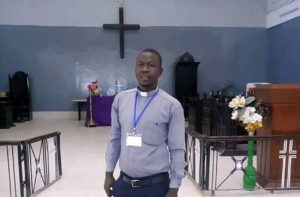
Pastor Daramali Abudigin assisted 130 to 150 families from different Christian denominations in El-Fasher after all other clerics fled the intensified fighting, but he eventually had to escape, as well. (Courtesy Photo via RNS)

Daramali Abudigin, 44, kept his St. Mathew Episcopal church open, even as bombs, stray bullets and hunger killed members of his flock. Recently, he found himself assisting 130 to 150 families from different Christian denominations in the city after all other clerics fled the intensified fighting, he said.

But on Sept. 16, the priest was also forced to flee his church as an attack by armed militiamen from Rapid Support Forces killed two people and badly injured several others. In May, another attack on the church left five people dead.

“We are out of the church. We are now homeless,” Abudigin told RNS in a WhatsApp call Sept. 23.

“We are now living in an open and empty space in the Abu Shouk area, with no house or any form of shelter. We have no place to go.”

At a temporary settlement

The priest is with 45 others—17 children, 17 women and 11 men—at a temporary settlement on the outskirts of El-Fasher. He said he has been unable to assemble the people for prayers or services.

“For two days, we have been drinking water only to stay alive,” said the priest, who is the father of three boys and originally from the Nuba Mountains in South Kordofan, Sudan.

His wife and sons have been in El-Obeid, the capital of North Kordofan state, since the Sudanese Armed Forces, the country’s military, ended another siege of the city by the paramilitary group last year.

Yet, the situation in El-Obeid remains precarious as another battle for control of the “strategic city” could break out at any time, he said.

Abudigin said his greatest concern is for the women and children now living out in the open—without food and shelter—even as heavy rains pound the region every day.

“I fear they can be killed in the crossfire or random shooting,” said the priest, who has kept his phone on to communicate with the outside world. He has been recharging its battery through solar panel power.

City under blockade since April 2024

El-Fasher, the capital of North Darfur, one of the five states in the Darfur region, has been under a blockade by Rapid Support Forces since April last year. The group imposed the blockade after local militia declared allegiance to the Sudanese Armed Forces.

The army and the paramilitary have fought for control of the country since April 2023. ​In March, the battle shifted to Darfur, the paramilitary’s base in the west of the country, after the army pushed Rapid Support Forces out of Sudan’s capital, Khartoum, and its surrounding areas.

On Sept. 19, a Rapid Support Forces drone strike killed 85 people worshipping in a mosque in El-Fasher. The strike hit the mosque and nearby homes, killing at least 11 children and injuring many more, according to the United Nations.

“For more than 500 days, children in El-Fasher have endured a relentless siege by the Rapid Support Forces,” said Catherine Russell, executive director of the United Nations Children’s Fund, in a Sept. 21 statement. “The children are trapped by violence with little access to food, clean water and health care, and forced to witness horrors no child should ever see.”

At least tens of thousands killed

As fighting makes most areas unreachable and warring factions block access, estimates of the death toll in the more than two-year war have varied. Conservative estimates say tens of thousands have been killed, while some agencies place the figure at more than 150,000 dead.

The war has displaced nearly 12 million people in Sudan, and about 4 million have entered neighboring countries as refugees, according to the U.N. A cholera outbreak exacerbated an already dire situation in regions like Darfur, where a famine was declared in refugee camps near El-Fasher last year.

Faith leaders, diplomats and peace activists have stressed that dialogue could end the war, largely viewed as reckless and unnecessary.

“The suffering of the Sudanese people compels urgent, united action from Africa’s religious leaders,” said Francis Kuria Kagema, general secretary of the African Council of Religious Leaders, in a declaration from Nairobi.

The council promised to engage the key principals of the conflict, Sudan army chief Abdel Fattah al-Burhan and Rapid Support Forces head Mohamed Hamdan Dagalo, known as Hemedti, with the goal of moving toward peace.

On Sept. 12, foreign ministers from the United States, Egypt, Saudi Arabia and the United Arab Emirates called for a three-month humanitarian truce to enable aid to reach all parts of the country. They are seeking a permanent ceasefire to follow, and a nine-month transition process toward a civilian government in Sudan.

“We keep hoping things will get better, at least, so that the people can get food, shelter and medicines,” Abudigin said.