Student ministry leaders point to youth mental health crisis

ROCKWALL (BP)—Lauren Coats has seen firsthand the impact of a growing mental health crisis among young people.

The number of calls from parents of teens and children looking for help to her three counseling centers has nearly doubled in less than two years.

Lauren Coats, a pastor’s wife, founded Rockwall Counseling and Wellness about a decade ago.

“During COVID, I’ve hired probably six therapists that work exclusively with children and teens because of the need and the demand—and they stay full,” said Coats, a pastor’s wife who started Rockwall Counseling and Wellness nearly a decade ago.

Coats’ experience in the Dallas area echoes a national trend U.S. Surgeon General Vivek Murthy noted in a recent advisory on a youth mental health crisis. The advisory describes a crisis that predates COVID-19 shutdowns and has manifested itself in “an alarming number of young people [struggling] with feelings of helplessness, depression, and thoughts of suicide,” according to Murthy in a release by the U.S. Department of Health and Human Services.

The report then notes the altered school, home and community experiences of youth caused by the COVID-19 pandemic worsened the problem.

Not just related to the pandemic

Richard Ross, a professor of student ministry at Southwestern Baptist Theological Seminary, says the mental health issues facing America’s youth won’t go away when COVID-19 does. Much of it, he believes, relates to the cultural collapse youth are experiencing right now.

Richard Ross

“Any time a culture collapses, there will be pain and harm in people’s lives,” said Ross, who has been involved in youth ministry more than 50 years. “Sadly, the first people to experience that pain and injury will be the most vulnerable—the children and teenagers. Ultimately, the young are at risk because the majority in the U.S. have turned their backs on God.

“Those who care for the young will need to join the Great Physician to keep children and teenagers from experiencing harm even after the pandemic.”

Ross said he teaches young pastors at Southwestern Seminary to engage hurting teenagers in three ways. First, ensure they have a personal relationship with Jesus.

“Teenagers most need heart transplants to move from drowning in crisis to flourishing,” Ross said. “And Jesus is the only one who can perform such transplants. Meeting Jesus is the beginning of transformation.”

Ross also encourages youth ministers to develop a list of biblically faithful counselors to whom they can refer students. He also tells youth ministers to prioritize the formation of “warm, strong heart connections” between teens and parents, teens and mentors, and teens and spiritually healthy congregation members.

“Teenagers isolated and cut off from the significant adults in their lives are always at risk,” Ross said. “Teenagers who live with solid heart connections with significant adults can weather almost any storm in life.”

Be ready to respond

Shane Pruitt, who serves as the national next gen director with Southern Baptists’ North American Mission Board, says he urges youth leaders to have responses ready for youth mental health needs. Like Ross, he recommends youth pastors have Christian counselors they can recommend to students.

But he also tells youth pastors to include gospel-centered, biblical help for mental health issues within their discipleship process. He notes there is a lot of unhelpful mental health self-diagnosis taking place among youth right now.

“We don’t need 15-year-olds diagnosing other 15-year-olds with depression and anxiety,” Pruitt said. “I think we just got to have an answer to those things. If the church largely remained silent on mental health, and the culture screams it, then a whole generation only hears one worldview.”

Pruitt encourages youth ministers to involve parents, too. That means equipping and educating them on mental health issues. It also means bringing parents into conversations they’re having with young people who are struggling.

Be alert to warning signs

Coats tells parents and church leaders to keep an eye on youth who are isolating themselves and showing significant personality changes. It’s normal, she says, for teenagers to be moody, but major changes in personality and no longer wanting to interact in person with others are warning signs.

“Obviously, self-harm is another thing parents report all the time to me. They notice first their teenagers were cutting themselves,” Coats said. “But when we really start digging into it, there’s also isolation and personality changes that they haven’t really picked up on, or they thought maybe were normal.”

Coats recommends that youth leaders and parents bring mental health professionals into the situation as early as possible.

“The sooner a kid or a teenager can start to speak with a counselor the better,” Coats said. “Right now, in my incoming calls, people are saying they’ve noticed issues with their kids for six months at this point. That’s really a long time to wait to get your kiddo help.

“If we had a child that we thought had an ear infection or strep throat, we would call the doctor right away. If we have a kid experiencing anxiety, or depression, or some other mental-health issue, I think calling right away is important.”

Pruitt said he hopes these mental health challenges facing teenagers will open the church’s eyes to the urgency of sharing the gospel with young people. He says he has seen more professions of faith in Christ at youth events where he has preached this year than in the last three to four years combined.

“You kind of saw it with Millennials, but especially with Gen Z. They’ve really been told this self-help nonsense, to look inward for happiness, hope and peace,” Pruitt said. “We know, you have to look outward first, before you can have that on the inside. We need to look outward to Jesus.

“We need the Holy Spirit and to be born again. [The youth] are trying to find it within themselves. I think they realize quickly, it’s not in there. So, they start looking for something beyond themselves.”



Around the State: Collection dedicated at Wayland-San Antonio

Wayland Baptist University recently dedicated the Richard Hughes II Biblical Studies Collection at its San Antonio campus. The study space and dedicated research materials offer ministry students easy access to research material, spaces for collaborative learning and individual quiet study, computer and media resources, and access to electronic databases. The Richard Hughes Biblical Studies Collection was made possible through the primary gift of Michelle and Tracy Taylor, along with supporting gifts from family and friends, in memory of Richard Hughes, Michelle Taylor’s son, who died in a car wreck Christmas Day 2018.

Dallas Baptist University presented an honorary Doctorate of Humanities degree to Gail Linam (center), pictured with her husband Dennis (left) and DBU President Adam C. Wright. (DBU Photo)

Dallas Baptist University presented an honorary Doctorate of Humanities degree to Gail Linam, who has served in various academic administrative capacities at the university more than 30 years. Linam, currently academic dean and institutional accreditation liaison, led DBU through three of its last 10-year accreditation reviews by the Southern Association of Colleges and Schools Commission on Colleges, and she helped establish the Center for Mentoring. Other roles in which she has served at DBU include provost, vice president for undergraduate affairs, dean of the College of Education and executive director of the Women’s Auxiliary Board. She is a graduate of Baylor University and Southwestern Baptist Theological Seminary. She and her husband Dennis, a former vice president at DBU, have three children and one grandson. They are members of First Baptist Church in Arlington.

Kari Dingler

The Howard Payne University Women’s Club has scheduled its annual Yellow Rose Scholarship Luncheon for April 7 on the HPU campus. Kari Dingler of Midland will be the keynote speaker at the event. After receiving her Bachelor of Music degree from HPU in 1985, Dingler taught elementary music, led a select children’s choir and presented musicals for her church. She has served as pianist and worship leader more than three decades. She is involved with Court Appointed Special Advocates, serves on the board of High Sky Children’s Ranch and is a founding member of You Can Free Us India. The recipients of the Yellow Rose Award and Yellow Rose Scholarship will be recognized at the luncheon. Table sponsorships will be available for purchase Jan. 10.

The five ministry centers within the Baptist General Convention of Texas recently released a statistical summary for 2021. Through virtual and in-person consultations, events and meetings, the Center for Church Health trained more than 20,000 individuals. The Center for Missional Engagement worked with more than 100 new churches that recorded 7,769 professions of faith in Christ. Texas Baptists’ area representatives within the Center for Ministerial Health made more than 13,000 contacts, and the center contributed $30,000 toward the counseling needs of ministers and their families. Within the Center for Cultural Engagement and the Christian Life Commission, the Texas Baptist Hunger Offering enabled ministries to serve more than 21.7 million meals. The Center for Collegiate Ministry reported Baptist Student Ministries made an impact on the lives of more than 62,000 students, including 282 who made professions of faith in Christ.


Obituary: Pat Luttrell

Patsy Lynn Luttrell, longtime consultant with Woman’s Missionary Union of Texas, died Dec. 12 in Vernon. She was 76. She was born in Vernon on Dec. 29, 1944, to Ed and Maureen Luttrell. After graduating from Vernon High School, she attended Hardin-Simmons University, where she earned an undergraduate degree in 1967. As a student, she served as youth director at First Baptist Church in Vernon and also served Dallas Baptist Association as a recreation director at Mount Lebanon Baptist Encampment. She taught speech from 1967 to 1975 at Grand Prairie High School before returning to Hardin-Simmons University to serve as an admissions counselor. She joined the Texas WMU staff in 1983 as the Baptist Young Women/Baptist Women consultant. She retired from Texas WMU in 1999, but she answered God’s call to come out of retirement and served as an employee of Texas Baptist Men until 2005. She returned to Vernon, where she volunteered with Meals on Wheels and Hospice of Vernon. She was actively involved in the ministries of First Baptist Church of Vernon, where she was a vital part of the Baptist Women, taught a women’s Sunday School class for years, volunteered for the card ministry and served on multiple committees. She is survived by her two nephews, Chan Baker and Clay Baker, multiple cousins and a host of friends. A celebration of life service is scheduled at 2 p.m. on Jan. 15, 2022, at First Baptist Church in Vernon.


‘Mary Did You Know’ writer good-natured over controversy

NASHVILLE (RNS)—For Mark Lowry, almost every day is Christmas.

Mark Lowry wrote “Mary, Did You Know?” with Buddy Greene in 1991.

Whenever the storyteller and singer takes the stage for a concert, he always closes the show with the same song—“Mary Did You Know?”—no matter what time of year it is.

“When you have one hit, you better end with it,” Lowry said in a recent phone interview.

Lowry co-wrote “Mary Did You Know?” with Buddy Greene, a well-respected songwriter and instrumentalist, in 1991, while both were on tour with famed gospel singers Bill and Gloria Gaither.

Recorded first by Christian singer Michael English, the song has become a modern Christmas staple, covered by some of the biggest names in the business: Dolly Parton, Kenny Rogers and Wynonna Judd, Kathy Mattea, Mary J. Blige, Clay Aiken, Carrie Underwood and the a cappella vocal group Pentatonix.

How it all began

The idea for the song dates back to conversations the 63-year-old had with his mother about Jesus and Mary. Most revolved around the question: What was it like to raise the son of God?

“Literally, what was it like teaching the word of God to talk,” he said. “What was it like to give him a haircut? Did she ever walk into his room and say, ‘Clean this mess up?’”

He added that most of the questions he had did not make their way into the song—only the ones that rhymed made it.

Those conversations also touched on spiritual topics, like the mystery of the incarnation, said Lowry. They eventually inspired a series of short monologues Lowry wrote in 1984 for a Christmas concert at Thomas Road Baptist Church in Lynchburg, Va., then led by Jerry Falwell. Those monologues were the glue that held the show together, serving as a transition from one Christmas song to another.

They stuck with Lowry, who thought they might work for a song if he could find the right music. Several musicians tried to come up with melodies, but none fit, said Lowry.

Then, while on tour with the Gaithers, he showed the lyrics to Greene and asked him to have a go. Greene took them home and started working on some music.

Lowry recalls that Greene, who could not be reached, had spent a day listening to Christmas carols written in minor keys, like “What Child is This?” and “We Three Kings” before composing the melody for “Mary Did You Know?”

“It was beautiful,” he said. “It was haunting, and it made the song work. It didn’t take away from the message. It elevated the message.”

While writing lyrics, Lowry said he imagined himself as an overly enthusiastic angel who showed up at the manger during the Christmas story and was filled with questions. He used the phrase, “Did you know” to express that enthusiasm—as if the angel was bubbling over with joy for what the birth of Jesus meant. The questions in the song are the questions Lowry would have asked if he had been there.

Assused of ‘theological mansplaining’

But that phrase has gotten Lowry in trouble in recent years—seen as a kind of theological mansplaining.

“Listeners have complained that, yes, Mary knew that she was going to bear the Messiah, the promised salvation of Israel, and that, therefore, the rhetorical question upon which the song rests is either redundant or condescending,” author Joy Clarkson, host of the “Speaking with Joy” podcast, wrote in a 2018 article entitled, “Yes, Mary Knew.”

That phrase has also inspired a series of sarcastic social media posts. “Mary did you know … that there’s a boy on his way to gift your newborn with a drum solo,” tweeted author and pastor Courtney Ellis. “Mary did you know we’ve been trying to reach you about your extended warranty,” tweeted Texas attorney Robert Callahan II. There’s even a satire of the song, “Mary Freaking Knew.”

Lowry is pretty good-natured about the criticism of the song. He’s quick to admit it has shortcomings, which he thinks are more evident to his fellow Christians who are more familiar with theology than the average person who hears the song. The last thing he wanted to do was to insult Mary or anger his fellow believers.

“I never meant for it to start a war or irritate people,” he said. “I definitely didn’t want that.”

That response fits Lowry’s character. He’s long used humor to help his fellow evangelicals lighten up, preferring laughter to a fight any day.

Still, he’s grateful for what he called the “miracle of the song.” Lowry, who has never been married, views his songs as his children. None of them, he said, has grown and had a life of their own the way “Mary Did You Know” has.

Most of all, he hopes the song will point people to the story of the baby Jesus and what his arrival would mean.

“I hope the song makes people think about the baby Jesus,” he said. “I hope it sends them running to Luke 1 to find out what Mary knew.”


Kansas camel escapes Nativity scene

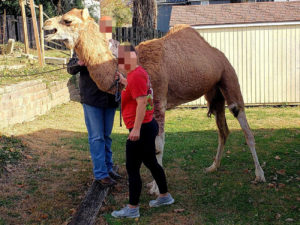
BONNER SPRINGS, Kan. (RNS)—A camel sent police scrambling in a Kansas City suburb. The dromedary in question escaped a Nativity scene in Bonner Springs, Kan.

The incident is the latest chapter in the colorful and often chaotic history of camels in the United States.

The animal was part of a drive-thru Nativity scene at the National Agricultural Center and Hall of Fame when its halter broke. Chased soon after on foot, the camel managed to avoid its pursuers.

A camel used for a Nativity scene in Bonner Springs, Kansas, spent several days on the run before being captured. (Photo courtesy of Bonner Springs Police Dept.)

The next day the animal traversed parts of the K-7 Highway, and despite being spotted by many motorists, it again eluded capture. Images and videos of the animal soon went viral. Police officials suggested on Facebook that the situation could “only be described as a scene out of another cop movie.”

At one point, Bonner Springs Police Department pursued the camel on golf carts after it strayed onto a golf course. The camel visited several neighborhoods before being cornered and lassoed by an animal control officer. Its owner then arrived to take possession of the nomadic creature.

“The camel was reunited with its owners and will go back to doing camel things,” the Bonner Springs Police Department said in a statement posted on Facebook.

This isn’t the first time Kansas police officers have had to respond to an escaped camel over the holiday season. In December 2019, police in Goddard, Kan., reported a traveling animal trio consisting of a camel, a cow and a donkey. Shortly thereafter the camel was reunited with its owners, but not before viral photo comparisons to a real-life Nativity scene.

Similar incidents have not always ended so tamely. In 1997, a camel that escaped mid-performance from a Kent Island, Md., Nativity pageant was struck and killed by a passing automobile.

A 2010 dress rehearsal for a Nativity play at First Baptist Church in West Palm Beach went awry when a camel slipped and went crashing into the congregation. Neither the camel nor the actor portraying one of the magi was injured in the fall, though the camel, known as Lula Bell, was withdrawn from the actual performance “for safety reasons.”

Animal rights groups long have complained of the use of live animals in Nativity scenes. Due to their size, camels have drawn particular concern. A two-humped Bactrian camel can weigh more than 2,000 pounds.

“Camels aren’t even fully mature until 7 years of age,” said PETA in a 2020 statement condemning the use of all live animals in Nativity scenes. “But many are forced into performances well before that. In nature, these gentle, social animals, who softly blow in one another’s faces to say hello, would be traveling with their family herds.”


Obituary: W.T. Smart

W.T. Smart, a Texas Baptist Men disaster relief volunteer, died Dec. 17 in Lindale. He was 70. He was born Sept. 5, 1951, in Gilmer to Joe Lewis and Hazel Stella (Stiner) Smart. He lived in Lindale for 50 years, where he was a member of First Baptist Church. He was the retired owner/operator of S&S Truck and Tractor in Swan. In addition to his volunteer service through TBM, he was involved in the Lindale Rural Water Board, the Mineola Community Bank Board and the Smith County Sherriff’s Advisory Board. He enjoyed fishing, traveling, attending auctions, morning coffee with his friends and spending time with his family. He was preceded in death by sisters, Ruby Weed and Betty Truett and brothers, Joe and Borden Smart. He is survived by his wife of 40 years, Connie Smart of Lindale; daughter Audrey Renee Sanders and husband Ben of Lindale; daughter Whitney Morgan Bray and husband Jared of Lindale; four grandchildren; sisters Delores Prickett, Sherrie Ledesma, Wilma Burgess and Blanche Mize; and brother Troy Smart.


Preemptive Love Coalition accused of misleading donors

WASHINGTON (RNS)—After several former employees of Preemptive Love Coalition accused co-founders Jeremy and Jessica Courtney of misleading donors and abusing staff, the board of directors of the popular international aid group has hired the investigative firm Guidepost Solutions to look into the allegations.

Founded by the Courtneys in 2008, Preemptive Love raises millions of dollars each year for relief work in several countries including Iraq, Syria and Mexico.

On Dec. 16, Preemptive Love’s former communications director, Ben Irwin, published an article on the online platform Medium that accuses the Courtneys of verbally and psychologically abusing staff and running the organization “like a cult” by demanding absolute loyalty and punishing dissent.

The next day, Preemptive Love’s board published an open letter saying they received “serious complaints” from a number of former employees about the Courtneys involving “race, gender and power dynamics.” The complaints, which came in the form of a letter sent in August and signed by more than two dozen former employees, led the board to launch the investigation.

Founders placed on leave of absence

According to the board’s letter, the Courtneys will take a leave of absence during the investigation, but the board allowed them to retain “a small number of carve-outs for which Jeremy and Jessica could remain partially engaged with their duties.” The Courtneys have been removed from direct management and financial decisions.

Jeremy Courtney, founder of Preemptive Love

The Courtneys are former missionaries who have kept close ties with Christian donors and leaders. Irwin wrote that, while many think Preemptive Love is a Christian charity, it is technically not religously affiliated.

Jeremy Courtney, who grew up in Leander as the grandson of a Baptist minister, attended Howard Payne University and earned his Master of Divinity degree from Baylor University’s Truett Theological Seminary.

In his Medium article, Irwin accused the Courtneys of deceptive messaging aimed at donors. He included a picture of a since-removed Instagram post from August in which Preemptive Love used the Haitian earthquake to solicit donations, despite having no programming in Haiti.

Irwin also claimed that Jeremy Courtney edited video footage to make it appear that he was caught in an airstrike in Mosul, Iraq, in 2017. Irwin alleged that while Courtney was present in the city at the time, the explosion effects were added post-production to exaggerate his proximity to danger.

Allegations of questionable spending

Irwin also claimed he observed questionable spending practices. Early in the pandemic, according to Irwin, Jeremy publicly announced waiving his $165,000 a year salary to preserve staff and programming, only to reinstate his pay months later. Irwin also wrote that in 2021, Preemptive Love spent $208,000 to send packages with “designer-quality” shirts to thousands of monthly donors while seeming to mislead staff about how they were paid for.

Irwin, who worked for Preemptive Love six years, resigned on July 26, the same day he filed a whistleblower complaint to the board.

Following Irwin’s post on Medium, former employee Audrey White recently posted on Twitter asking the public to hold the Courtneys and the board accountable for abuse of power and exploitation of vulnerable people. “I saw them humiliate the refugees they claimed to be empowering, abuse and bully the local (Iraqi) female staff while preaching about ‘loving anyway’ online,” White wrote.

Former Preemptive Love writer Courtney Christenson also wrote an open letter to the Courtneys, which she posted online. “I cannot sit by and watch you preach peace while you bully, gaslight, and abuse the peacemakers on your team until they give up and quit,” Christenson wrote.

The board is currently awaiting the results of the investigation and expects them “very soon,” according to their letter.

“No matter what we learn, the board is committed to making all necessary decisions, no matter how difficult, to rectify any past missteps, renew our commitment to care for every team member, and ensure that PLC becomes a healthier organization,” they wrote.

Irwin thinks that the Courtneys need to step down if the organization is to be a true force for good.

“Before I left, I said there was only one way forward, and that was facing rather than trying to bury the harm that was caused, or gaslighting the people you’ve hurt,” Irwin told RNS. “There is still only one way forward. ‘Love anyway’ is a powerful vision. But it does not eliminate the need for accountability and justice.”


Peace on Earth elusive for believers in Myanmar

As Christians around the world remember the birth of the Prince of Peace, believers in Myanmar continue to suffer from violence perpetrated by their nation’s military.

Since the Tatmadaw military seized control of the country in a February coup, 1,348 people have been killed and more than 11,000 arrested, according to the Thailand-based Assistance Association for Political Prisoners. Increasingly, troops have burned churches and homes.

In addition to ongoing attacks on Rohingya Muslims, much—but not all—of the killing and burning by military troops is directed toward the Chin people, a predominantly Christian ethnic group in Myanmar, also known as Burma.

‘Seems to be getting worse and worse’

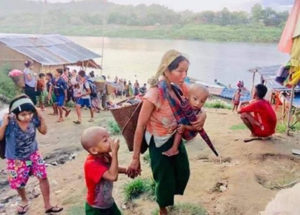
Many internally displaced people are seeking refuge in the jungles away from population centers. Others have fled into neighboring countries, including Thailand, Laos and India.

Among those who left their homes in Myanmar are the 86-year-old mother and younger sister of Thong Kho Lun, pastor of Greater Houston Burmese Christian Fellowship.

“My mom’s home was near a military camp. She couldn’t sleep. She was so fearful. So, my baby sister and her family moved with her to India nine months ago,” Thong said. In February, he plans to travel to India to visit his family who relocated there.

While his immediate family is in a safe place where his mother can receive medical care, Thong maintains close contact with churches in Myanmar. None of the reports they provide are encouraging.

“Every day, we hear a lot of bad news—heartbreaking news,” he said. “Instead of protecting the people, the Burmese military is killing people every day, burning villages and arresting people.

“Christians are being targeted. They are burning churches and killing pastors. … It just seems to be getting worse and worse.”

Escalating violence toward Chin

Salai Ngwe Kyar, a pastor in the village of Thet Kei Taung and a student at the Asho Chin Baptist Seminary in Pyay Township, died Dec. 8 from injuries sustained during a military interrogation in Magway Region, according to Myanmar Now, an independent news service.

The 26-year-old minister was arrested while traveling to Saw Township on Dec. 6 and detained on suspicion of links to the People’s Defense Force. Myanmar Now reported he first was taken to a local police station but then moved to the No. 20 Defense Equipment Industry factory for enhanced interrogation. He died at Magway General Hospital.

The Chindwin news agency reported Om Kee, a Church of Christ pastor from the Oakphu ward in Kanpetlet in Chin state, was arrested Dec. 11. His body was discovered Dec. 13 with a bullet wound to his head. The Chin Human Rights Organization said he was arrested and killed by Tatmadaw troops while returning from a visit to his grandmother.

The Chindwin reported several church buildings in the southern part of Chin state—including the property of Kanpetiet Baptist Church, Emmanuel Baptist Church and Gospel Baptist Church—were severely damaged by bombs on Dec. 13 and then looted by military. Tatmadaw troops also reportedly planted landmines to deter people who fled from returning.

Earlier in December, Tatmadaw troops torched the United Pentecostal Church in Thantlang and also burned at least 18 other buildings in the town, the Chin Human Rights Organization reported.

Baptists among casualties

Pastor Cung Biak Hum was shot dead in the Chin state of Myanmar. (Facebook Photo / Asia Pacific Baptists)

The latest escalation in violence comes less than three months after the Tatmadaw shot and killed Cung Biak Hum, a Baptist minister in Thantlang who was helping a member of his church extinguish a fire after the man’s home was set ablaze during military attacks.

On Dec. 10, Baptist World Alliance United National Representative Scott Stearman, BWAid Director Marsha Scipio and leaders from the American Baptist Churches USA met with U.N. leaders to talk about ways to pursue peace in Myanmar.

“Our Baptist World Alliance team continues to work hard to support many in Myanmar who face the reality of an ongoing military coup,” BWA General Secretary Elijah Brown wrote in a Dec. 11 Facebook post.

Since February, BWA supported 200 pastors to help them remain in Myanmar to minister to their people, supplied oxygen concentrators to medical clinics in refugee camps along the Thai-Myanmar border, and provided food and emergency tarp shelters to displaced people hiding in the Burmese jungles.

Early on, BWA also supported the launch of the Red Ribbon Charity Clinic to provide medical care for people injured in the Civil Disobedience Movement protests.

Humanitarian aid and prayers for peace

Greater Houston Burmese Christian Fellowship, a mission of Tallowood Baptist Church in Houston, has a history of meeting needs in Myanmar. Six years ago, when monsoons caused widespread flooding, the church worked with ministry partners and humanitarian relief groups to deliver 32 tons of rice to people displaced by floods and mudslides.

Through the work of indigenous church planters and in partnership with the Karen Baptist Convention and other regional Baptist groups, Greater Houston Burmese Christian Fellowship has continued its ministry to internally displaced people and refugees in Myanmar, even when COVID-19 prohibited international travel. (Photo courtesy of Greater Houston Burmese Christian Fellowship)

Thong and members of his church journeyed to Myanmar several times on mission trips, but between the COVID-19 pandemic and the military coup, they have been unable to be physically present with the people there the last two years. However, the congregation has continued its ministry in Myanmar through indigenous church planters there it helps support.

Earlier this month, the church joined with eight other congregations to sponsor a Burmese cultural fair in Houston. The event raised $10,000 for humanitarian relief in Myanmar.

“Every Wednesday night, we have a prayer meeting for Myanmar. Sometimes, we organize churches internationally to gather on Zoom for prayer meetings,” Thong said.

In a Dec. 20 Facebook post, the regional Asia Pacific Baptist Federation asked for Christians globally to pray for peace in Myanmar: “As we enter the week of Christmas and prepare for Christmas services [and] celebrations, may we take a moment to remember our brothers and sisters in Myanmar who continue to suffer from the brutalities of Myanmar military. Surely they do not deserve this! Would you say a prayer for God to intervene and rescue them from more pain and tragedy?”


Worship leader connects young worshippers to timeless truths

For the past 20 years, worship leader Joshua Bryan has been connecting with audiences of all ages and walks of life as he shares the message behind his music.

Joshua Bryan

“I’ve been fortunate to play a small part at a variety of events, and I’ve played at pretty much any church event you could think of,” Bryan said. “My favorite events are summer camps and multi-day events. Not only are they a blast to be part of, but it gives a chance to develop a relationship with the audience. I truly believe that leads to deeper times of worship when you can get to know the audience and connect with them.

“Most of the events I’m a part of are evangelistic in nature, so my hope is to see people put their faith in Christ. I pray something very similar to this over each event: ‘Lord, we ask that your Holy Spirit fall upon this place. We pray for conviction, repentance, healing, freedom and salvation. Lord, make yourself known in this place.’”

When Bryan leads worship at student events, he wants young people to do more than enjoy the experience. He wants them to learn about the meaning of worship and embrace worship as a lifestyle.

Student ministry is especially important to Bryan, who began leading worship with the youth praise team at First Baptist Church in Sour Lake when he was 16 years old.

“I actually started out playing drums and percussion in the concert band at my middle school,” Bryan said. “I didn’t start playing guitar, my primary instrument, until my 16th birthday.

Around the same time, I had started attending and playing drums for the youth services at First Baptist Church in Sour Lake. Eventually I picked up an acoustic guitar, borrowed the youth pastor’s songbook, and taught myself how to play those songs.”

Enjoys interaction with students

While leading worship for events, Bryan and his band enjoy interacting with students off stage—playing games with them, joining at meals and praying for them when the opportunity arises.

“Fun fact, the band has led worship at preteen camps more than any other event to date. We love the energy when you have over a thousand kids screaming at the top of their lungs. There is nothing else like it,” he said. “We also love leading at student events. So much healing takes place, and I’m always amazed by it.”

Many times, Bryan receives notes of encouragement and personal testimonies that allow him to follow up with the people he meets at events.

“Every year I end up with a dozen or so handwritten notes letting me know about salvation or some type of freedom that happened during the event, which is so special to receive those notes following the event,” Bryan said.

“One summer, there was a young man named Hunter, who really left an impression on me. Hunter utilized a powered wheelchair, and he let me know on day one that the only reason he came to camp was because he was promised a trip to another camp with attractions that could accommodate his chair.

“Fast-forward two days, Hunter is raising his hands in worship and loving every minute of it. At the end of that camp, he told me how amazing the experience was for him.”

Connect audience to Christ’s love

By sharing songs about his own life experiences, Bryan hopes to relate to audiences and connect them to Christ’s unfailing love.

“My songwriting process really depends on my season of life,” Bryan noted. “Sometimes I dig deep into the word [of God] and put the Scripture to music. Other times I just sing out whatever is on my heart repeatedly, and then try to refine it. Right now, writing has been reflective of my family. I’ve been jotting down melodies that my wife and I sing over our children. I love trying to make them smile with a song.”

During his travels, Bryan has led worship for Disciple Now Weekends, church services, retreats, youth and preteen camps around the state. Next summer, his band will lead worship at preteen camp at Mount Lebanon Baptist Camp in Cedar Hill, June 13-17.

Over the next year, Bryan hopes to create an album filled with his original songs and possibly release an EP geared towards children’s ministry.

“At each event, we try to break down barriers quickly so ministry can happen. We try to take every opportunity to get to know students. We want to know what they are learning and what their lives are like. We want to show them love, whether we are on or off the platform,” he said.

“The goal of the Joshua Bryan Band is to build relationships and take the students to a deeper level in their worship with the Lord. It’s a privilege to provide a vehicle to help these students reach new places in their relationship with Jesus.”


China sanctioned for Uyghur Muslim persecution

WASHINGTON (RNS)—The Biden administration is getting tough on China for persecuting Uyghur Muslims in the country’s western province of Xinjiang.

On Dec. 16, the Department of Commerce imposed new sanctions on several Chinese biotech and surveillance companies by barring those companies from trading or exchanging products with the United States.

Also, Congress passed a bill barring imports from China’s Xinjiang region unless businesses can prove they were produced without forced labor.

Included on the list of companies the United States may not trade with is China’s Academy of Military Medical Sciences and its 11 research institutes. The United States particularly is concerned China is developing biometric surveillance and tracking of Uyghurs using drones and facial recognition software.

“The scientific pursuit of biotechnology and medical innovation can save lives. Unfortunately, the PRC (People’s Republic of China) is choosing to use these technologies to pursue control over its people and its repression of members of ethnic and religious minority groups,” Commerce Secretary Gina Raimondo said.

“We cannot allow U.S. commodities, technologies, and software that support medical science and biotechnical innovation to be diverted toward uses contrary to U.S. national security.”

Previously, the White House announced a diplomatic boycott of the upcoming Winter Olympics in Beijing, citing China’s “egregious human rights abuses and atrocities in Xinjiang.” Athletes will be allowed to compete, but no U.S. dignitaries will attend.

Earlier this year, the Biden administration ­declared China’s treatment of ­Uyghur Muslims a genocide in an annual human rights report.

Uyghur Muslims in the Xinjiang region have been imprisoned in camps, coerced to have abortions, raped, tortured and otherwise denied the freedom to practice their faith, according to multiple accounts from journalists and human rights groups. China denies abuses in Xinjiang.

U.S. policy already bars exports to China of technology with military applications and also forbids investment in some companies the government says support China’s military.


Hussain confirmed as global religious freedom ambassador

By an 85-5 vote, the U.S. Senate on Dec. 16 approved Rashad Hussain as the U.S. ambassador-at-large for international religious freedom.

Hussain, most recently the director for partnerships and global engagement at the U.S. National Security Council, is the first Muslim to serve in the religious freedom post.

He served previously as U.S. Special Envoy to the Organization of Islamic Cooperation and U.S. Special Envoy for strategic counterterrorism communications, and he was senior counsel at the Department of Justice’s National Security Division.

Ambassador-at-large for International Religious Freedom Sam Brownback delivers closing remarks at the 2018 Ministerial to Advance Religious Freedom at the U.S. Department of State in Washington, on July 26, 2018. (Photo by State Department/Public Domain)

Hussain succeeds Sam Brownback, who had called on the Senate to confirm Hussain as ambassador-at-large for international religious freedom.

“Religious persecution is rampant around the world, and the international community looks to the United States for leadership that can make a difference,” Brownback said. “That’s why I’m glad Rashad Hussain has been confirmed by a bipartisan Senate majority.”

Leaders of the U.S. Commission on International Religious Freedom voiced support for Hussain and appreciation for his Senate confirmation.

“We are gratified that the administration and Congress have prioritized appointing and confirming Rashad Hussain to this essential position,” said Nadine Maenza, chair of the commission.

“The right to freedom of religion or belief is under sustained threat globally. The ambassador-at-large serves a vital role in leading the U.S. government’s efforts to protect this fundamental right. With his years of knowledge and experience, Ambassador Hussain is well placed to advance the U.S. government’s promotion of international religious freedom.”

Widespread support from religious freedom advocates

Elijah Brown, general secretary of the Baptist World Alliance, tweeted his congratulations to Hussain, adding the BWA “looks forward to working with you to stand on behalf of religious freedom for all people in all places.”

Randel Everett 150
Randel Everett

Randel Everett, founding president of the 21Wilberforce human rights organization, commended the confirmation as a vital step for religious freedom.

“With the rising challenges to religious freedom confronting the world, this confirmation came not a moment too soon. 21Wilberforce looks forward to collaborating with Ambassador Hussain on the work of challenging oppression and standing with the persecuted,” said Everett, former executive director of the Baptist General Convention of Texas.

Brent Leatherwood at the Southern Baptist Convention’s Ethics & Religious Liberty Commission tweeted his congratulations to Hussain, saying his organization “is eager to work with him, and we will be praying for his success.”

“Religious freedom is a fundamental right, and it is under assault around the globe,” Leatherwood added.

Tom Farr, president of the Religious Freedom Institute in Washington, D.C., applauded Hussain’s confirmation by the Senate.

“This is a critically important position in American foreign policy, and Rashad Hussain is eminently qualified to fill it,” Farr said.

“My colleagues and I look forward to working with Ambassador Hussain as he takes on the enormous challenges now set before him. We are in the midst of a global crisis of religious freedom, and the United States must continue to be a leader in addressing it.”

Christian Solidarity Worldwide, a United Kingdom-based organization that advocates for freedom of conscience globally, issued a statement saying Hussain has “a proven track record of standing up for the right of freedom of religion or belief, particularly in combatting anti-Semitism and hostility towards Christians and other religious minorities in countries around the world.”

“Mr. Hussain’s confirmation is welcome news at a time when challenges to the enjoyment of the right to freedom of religion or belief remain acute,” said Mervyn Thomas, CSW founder.


Baylor achieves top status as a research university

WACO—Baylor University was named a Research 1 university by the Carnegie Classification of Institutions of Higher Education.

That designation means Baylor joined the nation’s top research institutions as a doctoral university with “very high research activity.”

Baylor joins fellow Carnegie R1 institutions in Texas in UT-Austin, UT-Dallas, UT-Arlington, UT-El Paso, UT-San Antonio, Texas A&M University, Texas Tech University, University of Houston, University of North Texas and fellow private institution Rice University.

‘Distinctive Christian voice and mission’

Linda Livingstone is the 15th president of Baylor University and the first woman to lead the school, founded by Texas Baptists in 1845. (Photo/Baylor Marketing and Communications)

“Our R1 aspirations have represented an incredible opportunity—one given to us by God—to do what very few, if any, universities have achieved: maintaining our foundational Christian mission while reaching R1 status as a top-tier research university,” Baylor President Linda A. Livingstone said in her weekly Presidential Perspective email.

“Through the dedicated work of our faculty and staff and our academic and research leadership, we have made remarkable progress since 2018 on our Illuminate strategic plan, which provided the framework to build on Baylor’s historic strengths and strategically invest in new areas of research and service.

“Through top-tier research, scholarship and external funding support, R1 universities—that now include Baylor University—bring their voice to bear in addressing our world’s most significant challenges. And as a Christian research university, Baylor infuses the quest for solutions, at the highest levels, with the university’s distinct Christian voice and mission.”

Carnegie reclassifies institutions every three years. R1 universities meet benchmarks across 10 indicators, including research expenditures, research doctorates awarded and number of research staff in science and engineering fields. The latest classification is under a six-week public review before becoming official by the end of January 2022.

In August 2019, Baylor University officially announced plans to pursue Research 1/Tier 1 recognition by building on Illuminate, which launched in 2018 and accelerated the quest toward preeminence as a Christian research university. The university had anticipated reaching R1 status by 2024.

‘It’s to the glory of God that we do this’

“This is a moment of exuberant joy for Baylor University. It has been a labor of love for so many people,” said Baylor Provost Nancy Brickhouse. “As we look ahead to the future, achieving R1 designation will make it easier for us to continue our growth in recruiting world class faculty, graduate and undergraduate students and to attract people who are serious about research and want to be at a place with a compelling Christian mission like Baylor.

“It’s to the glory of God that we do this, and we now get to double down further in pursuit of the impact we hope to have as a Christian research university.”

Kevin Chambliss, Baylor vice provost for research, called achievement of R1 designation “a collective effort” that involved “many people over many years.”

“Our administration, faculty, staff, deans and more have rallied around this vision and done the work to make it happen. It’s an incredible time to be here at Baylor University, and we’re poised even more definitively for growth in the years ahead because of all that has been implemented to make R1 recognition a reality,” Chambliss said.

Consistent with Illuminate strategic plan

The Illuminate strategic plan is built upon the foundation of Four Pillars, where Baylor will be a community recognized for its “unambiguously Christian educational environment; transformational undergraduate education; research and scholarship marked by quality, impact and visibility; and nationally recognized programs in human performance through the arts and athletics.”

“As we have traversed this journey to R1, our commitment to excellence university-wide has grown even stronger,” Livingstone said. “That commitment remains evident in our transformational undergraduate education, in providing impactful services to students that support them academically, spiritually, personally and in their future careers, and in achieving at the highest levels of human performance in the arts and athletics as we prepare students for worldwide leadership and service.”

In July, Brickhouse and Chambliss updated the Baylor board of regents on progress on Illuminate and R1 goals, including:

  • Increased research doctorates from 110 in 2016-2017 to 167 in 2020-2021.
  • Growth in research expenditures from $29.4 million in 2017 to $47 million in 2021, with external research expenditures currently growing at 28 percent.
  • Increased awarded research dollars from around $11 million in 2017 to more than $27 million so far in 2021.
  • Increased research staff from 47 in fall 2016 to 68 in fall 2020.

Additional R1-related progress over the past year included:

  • Procuring a $43.4 million research grant for the Global Flourishing Study, the largest single funded research project in Baylor history and the largest initiative of its kind to investigate the factors that influence human flourishing.
  • Four professors winning highly competitive National Science Foundation CAREER grants in 2020, the most ever in a single year at Baylor.
  • Welcoming two endowed faculty chairs in the School of Engineering and Computer Science to provide leadership to Illuminate’s data sciences and material science initiatives.
  • Completing the Baylor Academic Challenge, now known as the Foster Academic Challenge, a dollar-for-dollar matching program that generated significant support from alumni and donors to establish 14 new endowed faculty chairs and significantly advance the aspirations of Illuminate.

In November, the Baylor board of regents affirmed the framework for the next five years of Illuminate, including hiring 100 new faculty over this time, further accelerating the university’s academic enterprise.

“I want to personally thank our board of regents, who supported Baylor’s institutional aspirations with the approval of Illuminate four years ago and for their most recent reaffirmation of our R1 goals through Illuminate Forward for 2022-27. I am also deeply appreciative of the ongoing support of the Baylor Family through our Give Light campaign on behalf of our faculty, students and campus overall,” Livingstone said.