Commission spotlights religious freedom threats in Nigeria

Violent attacks targeting religious communities continue in Nigeria, and the Nigerian government’s enforcement of blasphemy laws significantly restricts religious freedom, a new report from the U.S. Commission on International Religious Freedom states.

 “Attacks targeting religious communities remain a major and ongoing threat to religious freedom in Nigeria and are increasing in frequency,” the commission’s July update on Nigeria states.

The Nigerian government “is often slow to react to violent attacks by Fulani herdsmen, bandit gangs, or insurgents” such as JAS/Boko Haram and the Islamic State West Africa Province, the report asserts.

“This violence severely restricts religious practice and observance by Christians, Muslims, and traditional religious communities across many Nigerian states in the Middle Belt and in the northeast,” the commission report states.

“Perpetrators of the violence have attacked religious sites including churches and mosques, kidnapped or killed religious leaders, and—in some cases—used violence or threats of violence against religious communities while demanding so-called taxes, invoking Shari’a law as justification.”

The commission reports multiple attacks with fatalities in Benue and Plateau states, particularly highlighting the slaughter of 200 people in June—including internally displaced persons sheltered in a Catholic mission.

The report points out armed Fulani herdsman also are spreading to the south, with 55 herder groups active in the region. That, in turn, is leading to increased internal displacement.

“While the south historically has experienced relatively peaceful coexistence between religious groups, this new presence carries a risk of increased instability,” the report states.

“Furthermore, the significant number of Christians killed in the attacks exacerbates the community’s fear that its members will be violently targeted over their faith.”

Blasphemy laws used to restrict religious freedom

The report also highlights how the Nigerian government uses blasphemy laws to restrict religious freedom.

Although Nigeria’s 1999 constitution stipulates federal and state governments cannot adopt an official religion, the nation’s federal penal code criminalizes actions or statements a person could consider “as a public insult on their religion,” the report notes.

“The constitution also grants state governments the authority to adjudicate criminal and noncriminal proceedings through Shari’a courts,” the report states.

Twelve states in northern Nigeria use Shari’a-based law to criminalize blasphemy, allowing stoning, caning and amputation for a variety of offenses, the commission reports.

The commission issued its update on Nigeria one week prior to the day Texas Baptists have been urged to devote to “Prayer for the Persecuted in Nigeria.”

Leaders of the Center for Global Religious Freedom at Dallas Baptist University, Texas Baptists’ Christian Life Commission and the Baptist World Alliance encouraged Texas Baptists to dedicate time during worship service on July 27—or the first available date in the future—to pray for victims of religious persecution in Nigeria.

In addition to praying, they also are urging Texas Baptists and other concerned Christians to sign an online letter to Secretary of State Marco Rubio, calling for the U.S. Department of State to designate Nigeria as a Country of Particular Concern.

The CPC designation is reserved for nations that commit or permit systemic, ongoing and egregious violations of religious freedom. Both in its annual report and its July update, the U.S. Commission on International Religious Freedom reiterated its recommendation that Nigeria be designed as a CPC.


Around the World: BWA presents Human Rights Award

At the Baptist World Congress in Brisbane, the Baptist World Alliance presented its Human Rights Award to Sano Vamuzo of Nagaland, India. The award recognizes a lifetime of achievement to an individual who has shown significant accomplishments in global advocacy for human rights and the pursuit of social justice and peace. Vamuzo has dedicated more than four decades to promoting justice, gender equity and reconciliation. “This recognition strengthens our resolve to walk with the unheard, speak peace where there is pain, and build bridges where there are walls,” Vamuzo said. She is a founding member and the first president of the Naga Mothers’ Association, the first voluntary women’s organization for all Naga women. In that role, she led the association in confronting social evils, advocating for the welfare of youth, and raising the visibility of women in public life. Vamuzo served as the first chairperson of the Nagaland State Commission for Women for two terms, where she worked to ensure the protection and advancement of women’s rights across the state. Her service was recognized nationally when she was awarded the Padma Shri in 2024—one of India’s highest civilian honors—for her contributions to social work.

Julio Guarneri

At the annual meeting of the Baptist Convention of Tanzania, Baptist General Convention of Texas Executive Director Julio Guarneri signed a memorandum of understanding with Tanzania Baptists, committing to collaborate with six MAP (Missionary Adoption Program) missionaries, with a goal of adding four additional missionaries in one year. MAP connects Texas Baptist churches to indigenous missionaries outside the United States who serve under Baptist entities, associations or conventions. In his “Texas Baptists Weekly” e-mail, Guarneri noted the six MAP missionaries “are starting churches with great diligence and often with great personal sacrifice.” Guarneri and other Texas Baptists who traveled to Tanzania met with the four potential MAP missionaries. “These church starters are passionate and ready to do Great Commission, Great Commandment work,” Guarneri wrote.

Elijah Brown

Baptist World Alliance leaders called for all parties involved in the most-recent armed conflict in southern Syria “to immediately cease hostilities, exercise restraint, and work toward de-escalation and peace.” BWA General Secretary Elijah Brown noted in a July 20 social media post families living in Sweida who are affiliated with Baptist churches have been affected directly by the conflict between the Druze community and Bedouin tribes. “We pray for the protection of innocent civilians and affirm the dignity and right for every person to live in safety,” Brown wrote. “We pray for those who have been impacted, for the churches as they minister, and for love to prevail over violence, hope over fear, and life over death.”

Katie Frugé

Texas Baptists’ Christian Life Commission director Katie Frugé participated in a panel with 21WilberForce President Wisam al-Saliby and BWA General Secretary Elijah Brown in a Baptist World Congress breakout session on technology, faith and human rights. Frugé discussed ethical considerations of artificial intelligence, urging tech users not to lose sight of the importance of humanity in considering ethical uses of AI. Al-Saliby explained ways technology is being used around the world to dehumanize people, including AI being used to make decisions about who to target in a war-torn region, or large-scale surveillance that invades privacy or treats people like data. Brown noted a number of tech sector leaders think they can save the world through technology. But with technology, possibility also comes peril—if transhumanism erodes what it means to be human. Brown urged BWA participants to reaffirm the imago dei—the image of God—in humanity and seek wisdom in how technology continues to be developed and intertwine with life.


Johnnie Moore defends embattled Gaza aid group

(RNS)—Johnnie Moore, the evangelical Christian who chairs the Gaza Humanitarian Foundation, defended the workings of his controversial food distribution system to a friendly audience in a July 22 Zoom call.

During the one-hour call, presented by the American Jewish Congress and the World Zionist Organization, Moore described the foundation’s work as “unbelievably effective.”

He said the group is getting meals to about 800,000 people in Gaza, or nearly half its population, while working in an active war zone and facing an onslaught of disinformation.

“We work around the clock in order to ensure safety and effectiveness, to be as principled as we possibly can be,” he said. “We are dedicated to the humanitarian principles of humanity and of impartiality, of independence and of neutrality.”

More than 1,000 killed trying to access food

He did not mention the foundation is a private Israel-supported and U.S.-backed group, whose distribution sites are guarded by private American contractors and, on the outskirts, by Israeli soldiers who have repeatedly opened fire daily on people approaching the food aid sites.

Since the Gaza Humanitarian Foundation began operating in May, 1,054 people have been killed trying to get food—766 of them in the vicinity of GHF sites and 288 near United Nations and other humanitarian organizations’ aid convoys, a U.N. human rights office spokesman said. The recent bloodshed has led to increasing outrage across the world.

Twenty-one European countries plus Canada and Australia issued a joint statement July 21 condemning “the drip feeding of aid and the inhumane killing of civilians, including children, seeking to meet their most basic needs of water and food” in Gaza.

“The Israeli government’s aid delivery model is dangerous, fuels instability and deprives Gazans of human dignity,” the statement said.

Moore, who may be best known for serving on President Donald Trump’s evangelical advisory board during the first Trump administration, said no one has been shot inside the distribution sites.

Moore attributes violence to Hamas

He acknowledged some were killed near the sites but disputed the figures, saying they were given to the media by Hamas. The numbers come from the Gaza Health Ministry.

“We do not deny that there have been civilians that have been killed trying to seek aid in the Gaza Strip while we’ve been operating,” Moore said. “By the way, the IDF doesn’t deny that they are responsible for some of that, and Hamas, by the way, does deny that they’re responsible for it.

“The fact is, Hamas has intentionally harmed Gazans in order to allege that it was the IDF or that it was GHF in order to disincentivize people from coming to our aid distribution site.”

Assaf Weiss, vice president of the American Jewish Congress, raised the question. Weiss is a former chief of staff for the speaker of the Knesset. The congress is an association of American Jews organized to defend Jewish and Israeli interests and committed to “an improved understanding of Israel,” according to its website.

Throughout the Zoom session, there were repeated calls for the return of some 50 Israeli hostages, some alive, some dead, still in Hamas captivity.

Moore was not asked about the Gaza Humanitarian Foundation’s funding source, which remains shrouded, though in late June, the Trump administration said it would supply $30 million to GHF operations. The Israeli government has publicly denied paying for it, though it is intimately involved in the operation.

A July 21 Washington Post story identified several private U.S. donors, including the Chicago-based private equity firm McNally Capital, which specializes in acquiring aerospace, defense and technology companies.

Moore did not mention the GHF’s own American security contractors.

Foundation designed to avoid diversion of aid

The Gaza Humanitarian Foundation operates four aid distribution sites, three of which are in militarized zones in the far south of Gaza and another in a militarized zone in central Gaza. Moore said he would like to expand to eight distribution sites.

Previously, the U.N. distributed aid through a coordinated delivery system with around 400 locations across Gaza, many controlled by Hamas.

Moore said the Gaza Humanitarian Foundation was founded to prevent Hamas from stealing, stockpiling and selling the aid, for which Israel blames the U.N.

“GHF was designed from the very beginning to avoid the problem of the mass diversion of aid,” he said. “Unfortunately, our challenge is compounded by the fact that the United Nations, from really the top of the organization, and other NGOs are not getting their own aid where it needs to go.”

He said he has pleaded and begged the U.N. to help it carry out its mission.

“Just earlier today, about an hour and a half ago, I wrote another letter to the head of OCHA (the U.N.’s Office for the Coordination of Humanitarian Affairs), Tom Fletcher, who’s the head humanitarian official in the United Nations,” Moore said.

“I wrote to him again, and I expressed our alarm that there is all this U.N. aid that is sitting inside the Gaza Strip. There’s U.N. flour there that’s about to expire—the medical supplies that either have expired or are about to expire. Thousands upon thousands of pallets sitting in the Gaza Strip.”

‘Politics … prevailing over the needs of these people’

Israel has mostly blocked the work of various U.N. agencies. In January, it banned the main U.N. agency for Palestinian refugees, the United Nations Relief and Works Agency, from operating in the country, alleging some of its employees were involved in the Oct. 7, 2023, Hamas attack on Israel that started the war. On July 21, Israel refused to renew the visa of a senior U.N. official in the OCHA office.

Other humanitarian groups have declined to work with the Gaza Humanitarian Foundation, saying they have concerns about its model of aid. No faith-based humanitarian group has yet to join forces with the GHF.

“The whole international system declines to work with us because of politics,” Moore said. “Despite everything that they say about being concerned about the needs on the ground, it is politics that is prevailing over the needs of these people.”

He did not deny starvation is a fact in Gaza. The World Food Program has said the population of Gaza was at the brink of famine.

“The situation is real, and the world needs to respond to it,” he said.

“I’m a Christian, an evangelical Christian. There’s nothing more Christian than feeding people.”


Around the State: Wayland San Antonio nursing school receives grant

Thanks to a $100,000 grant from the Baptist Health Foundation of San Antonio, the Ben and Bertha Mieth School of Nursing at Wayland Baptist University has completed significant upgrades to create a state-of-the-art simulation lab at the university’s San Antonio campus in Live Oak. The new technology is now operational, equipping nursing students with advanced tools to sharpen clinical skills and prepare for the evolving demands of the healthcare workforce. The grant funded the addition of a virtual reality-based simulation environment designed to immerse students in a variety of patient-care scenarios, ranging from routine interactions to high-acuity emergencies. The Mieth School of Nursing serves a diverse student population, many of whom are first-generation college students and Pell Grant recipients. With the simulation lab now fully operational, these students can gain critical hands-on experience in a safe, supportive and technologically advanced setting.

A team of archaeologists, led by Baylor University’s Davide Zori, San Giuliano Archaeological Research Project principal investigator, has uncovered a rare, intact Etruscan chamber tomb in central Italy—a discovery hailed as one of the most significant finds in recent decades for understanding the ancient pre-Roman civilization. The sealed chamber tomb at San Giuliano—a site located approximately 70 kilometers northwest of Rome—dates back 2,600 years, according to Zori, who also serves as associate professor of history and archaeology in the Baylor Interdisciplinary Core in the Honors College. Inside the undisturbed tomb, the remains of four individuals lay on carved stone beds surrounded by more than 100 remarkably well-preserved grave goods, including ceramic vases, iron weapons, bronze ornaments and delicate silver hair spools. Preliminary analysis of the tomb objects suggests the buried individuals might be two male-female pairs, but further conclusions await anthropological, isotopic and genetic study of the remains.

Houston Christian University announced the launch of the Master of Science in Human Resources Management—People Analytics degree program in the Archie W. Dunham College of Business beginning this fall. (HCU Photo)

Houston Christian University announced the launch of the Master of Science in Human Resources Management—People Analytics degree program in the Archie W. Dunham College of Business beginning this fall. This STEM-designated program blends traditional human resources leadership with advanced data analytics.  Students will have the option of enrolling in a fully online or residential/hybrid format. Designed for working professionals, the fully online format offers flexibility, requiring no campus visits and providing access to virtual networking, faculty engagement and hands-on learning opportunities. Students can enroll in courses across multiple terms throughout the year, allowing for customized pacing while balancing professional commitments. The residential program’s hybrid approach is a 60 percent classroom and 40 percent online for each class.  The residential hybrid approach provides students the advantages of an in-person educational experience while allowing maximum flexibility.

Print and digital materials for the Week of Prayer for Texas Missions—scheduled for Sept. 14-21 this year—can be ordered at iamtexasmissions.org/order. Materials also may be ordered by phone at (214) 828-5150 or by email at wmutx@texasbaptists.org. The Week of Prayer for Texas Missions is a time for churches and individuals to pray for more than 70 Texas Baptists ministries and missionaries dedicated to serving and sharing the gospel across the state.This year, WMU of Texas’ Mary Hill Davis Offering goal is $3.5 million to support these mission efforts. To learn more, visit iamtexasmissions.org/allocations.

Anniversary

Bob Ray has served 60 years as pastor of Fairy Baptist Church in Hico. The congregation will celebrate Aug. 31, with a 4 p.m. worship service followed by a reception in the fellowship hall.


Obituary: Robert Leslie Richardson

Robert Leslie Richardson, a Texas Baptist minister, died May 9. He was 90. He was born Jan. 11,1935, to Leslie and Thelma Richardson. He studied at Baylor University. Richardson most recently was executive pastor of Georgetown Baptist Church in Pottsboro. He was preceded in death by sister Bonnie Lee Smart. He is survived by his wife of 70 years, Ann Childers Richardson; son Larry Richardson and his wife Brenda; son Ricky Richardson and his wife Paula; daughter Kathy Jones and her husband Nick; eight grandchildren; and 17 great-grandchildren.


Community volunteers multiply Texans on Mission ministry

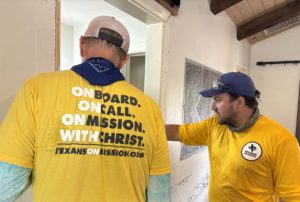
HUNT—Things can change quickly in disaster relief. Because of this, Texans on Mission trains its volunteers to be flexible—to expect the unexpected.

So when 13 new volunteers showed up to serve in Hunt, the Texans on Mission flood recovery team from Marble Falls welcomed them aboard, and the new recruits went to work.

Evan Everett, leader of the Texans on Mission Marble Falls unit, gives direction to a volunteer. (Texans on Mission Photo)

“We started out with eight of us total, and we ended up with 21,” said Evan Everett, leader of the Texans on Mission Marble Falls unit. “It was pretty neat, though, because a lot of the volunteers … that came later, probably about half of them were not believers.”

The reinforcements are called “day volunteers.” They are not trained in disaster relief, but when paired with trained Texans on Mission volunteers, they provide extra hands for the work.

On Saturday, July 19, those extra workers also had the opportunity to hear about having a relationship with Christ.

“We had the opportunity to be able to just share with them about Christ,” Everett said. “Some of them were Hindu. Some of them were searching (spiritually).”

But the Marble Falls team worked side-by-side with new arrivals and shared their motivation for working—to serve people in Christ’s name.

God provides people with the right skills

Paul Henry, Texans on Mission incident commander, saw God at work in bringing the unexpected day volunteers.

“God brought people with skills and talents that they (the Marble Falls team) needed in that particular job that they were doing,” Henry said.

And God also brought “the opportunity to share the gospel” within the workers and not just with the homeowners.

The extra workers allowed the team to complete the mud-out work faster and opened the door for more service in the large home on the north fork of the Guadalupe River, upstream and west from Kerrville.

The homeowners already had secured materials to begin the rebuilding process and asked the Texans on Mission volunteers if they could help, Everett said.

“And so, we made quick work of the basement, and made quick work of the rebuild. And a lot of the rest of our day was just getting stuff back inside that was outside,” he said. “It just ended up that it was great that we had them.”

The homeowners needed help sorting through items that had been removed from the house—some being kept and some being discarded. The volunteers went through everything, and the homeowners directed the items to the proper place.

“If we hadn’t had the volunteers, we wouldn’t have been able to do that in a timely fashion,” Everett said. “It would have taken a long time.”

Day volunteers’ presence offers ministry opportunity

Trained Texans on Mission volunteers “provided the leadership and the expertise to allow the whole team to go in and do serious mud-outs,” Henry said. “They can cut the sheetrock, get the insulation out, get the floor up, they can power wash, they can spray, they can do the whole job, and they can work with large numbers.”

The day volunteers provided “an incredible amount of manpower,” Henry said, but there are limitations. For instance, some of the people who joined the Marble Falls group had physical limitations. “That’s why we had some of them in the kitchen washing dishes, because that was something they could do.”

Others in the group brought needed skills.

“These volunteers bring skills like contractors, they’re landscapers,” Henry said.

They also brought resources to the Hunt site, including a dump trailer the entire team loaded with limbs.

The fact that some of the day volunteers in Hunt were not Christians provided a special opportunity. Henry called it a “built-in ministry where they’re working side-by-side with people they can share the gospel and live the testimony out before them.”


Strong reactions to Baylor grant decision continue

Baylor University’s announced receipt of a grant for the study of “disenfranchisement and exclusion of LGBTQIA+ individuals and women” in the churches and its subsequent decision to return the grant continue to prompt strong reactions.

Less than a week after more than 60 church leaders endorsed an open letter of support for Baylor’s decision to rescind the grant, a group of 25 pastors produced their own open letter similarly expressing support for “the wise return of the Baugh grant.”

That second letter—sent to the Baptist Standard by John Durham, pastor of Highland Baptist Church in Waco—was published online July 18.

Four ministers who endorsed the previous letter—Durham, Jeff Warren from Park Cities Baptist Church in Dallas, Jim Heiligman from First Baptist Church in Bryan and Chris Johnson from First Baptist Church in San Antonio—signed it, along with 21 others.

“We fully agree that any grant that advocates for perspectives on human sexuality that are counter to biblical sexual ethics should be declined or returned. Right decisions are usually easy; righteous decisions are usually costly,” the brief letter states.

“We applaud this decision that Baylor has made and stand beside President [Linda] Livingstone’s leadership and wisdom in this matter.”

Public pastoral letter posted online

The same day that letter was posted online, Mary Alice Birdwhistell, pastor of Faith Baptist Church in Georgetown, Ky., contacted the Baptist Standard to announce a “public pastoral letter” to Baylor.

That online letter opposed the university’s decision to “return the renewal of an existing grant from the Eula Mae and John Baugh Foundation that would have funded research on trauma-informed practices for people marginalized by the church, including LGBTQIA+ individuals and women.”

Birdwhistell stated the initial group who signed the letter represented more than 100 “pastors and faith leaders from across the country with ties to Baylor University.” Of the pastors in that group, 90 percent are Baylor alumni, she wrote.

By Tuesday morning, July 22, the number of individuals who signed the online letter topped 350.

‘Research like this is urgently needed’

“While another group of pastors praised Baylor for its commitment to ‘hold together theological conviction and compassionate presence,’ we firmly believe denying funding for this research exhibits indifference and disregard for the well-being of LGBTQ+ individuals and women in our congregations,” the public pastoral letter states.

“In addition, one of the most significant questions facing the Church today is how we engage LGBTQ+ people, a question that is tearing apart congregations and denominations worldwide. Research like this is urgently needed now more than ever before.”

The letter indicates those endorsing it represent “a wide array of theological, denominational, and political backgrounds,” but they “share a commitment to the spiritual care of our communities, which include LGBTQ+ individuals.”

“Over the years, we have witnessed the deep hurt, shame, condemnation, and exclusion this community has faced at the hands of the Church,” the letter states.

‘Heartbreak and hope’

The letter cites the need for “robust research” on the harm caused by religious rejection. It notes a 2020 study in Psychology of Religion and Spirituality indicating “LGBTQ+ individuals who experienced religious-based rejection were six times more likely to report high levels of depression and suicidal ideation.”

The problem particularly is acute among youth, the letter states. It points to a 2023 survey by The Trevor Project that revealed 4 out of 10 LGBTQ+ youth “seriously considered suicide in the past year, with many citing religious rejection as a key factor.”

“Our pastoral experience compels us to speak from the depths of both heartbreak and hope. We have received late-night calls from our LGBTQ+ congregants at risk of suicide, and we have officiated their funerals. We have wept with them as they shared stories of exclusion and debilitating shame,” the letter states.

“Yet, we have also witnessed their courage, fortitude, and deep faithfulness, even as we have seen the toll on their mental, physical, and emotional well-being. We have also celebrated with LGBTQ+ congregants as they have found healing and discovered their God-given gifts, witnessed their profound contributions to our faith communities, and marveled at the unique ways they reflect the image of God.”

Real lives at stake

The letter concludes with an appeal to “consider not just the institutional policies of this decision, but the real lives at stake in the Church and the world.”

“When the Church becomes complicit in the very systems that cause trauma, we cease to be the Body of Christ and become instead an instrument of harm,” the letter states. “Maya Angelou once said, ‘Do the best you can until you know better. Then when you know better, do better.’

“We have known better for quite some time. It is past time for the Church to do better. And it is past time for Baylor to do better, too. We urge you to lead with courage and compassion.”

Respond with curiosity, rather than fear

Birdwhistell noted she collaborated on the letter with Aurelia Dávila Pratt from Peace of Christ Church in Round Rock and Carol McEntyre from First Baptist Church in Greenville, S.C.

Pratt told the Baptist Standard they “felt compelled” to write the letter after the group of more than 60 church leaders publicly voiced support for Baylor’s decision to return the grant.

“A lot of us—maybe a lot more of us—see the decision differently,” she said.

As an alum of both Baylor’s Truett Theological Seminary and the Diana R. Garland School of Social Work, Pratt voiced hope the university will set an example by “instead of reacting with fear, responding with curiosity.”

‘Critically urgent’ need

She called Baylor’s decision a “troubling precedent to set” and expressed her desire for both Baylor and churches to show “concern for real people” and their pain.

McEntyre, also a graduate of both Truett Seminary and the Garland School of Social Work, expressed a similar desire in a Facebook post.

“As a pastor, I’ve listened to countless painful stories of LGBTQIA+ individuals excluded and shamed by the Church. I have seen the profound harm this causes,” she wrote.

“That’s why I was so deeply disappointed by Baylor University’s decision to return the renewal of a grant from the Baugh Foundation. This funding would have supported vital research into trauma-informed practices for people marginalized by the Church—including LGBTQIA+ individuals and women.

“This research was about healing, about responding with Christ-like compassion to those who have been hurt in the name of faith. It’s not just needed, it’s critically urgent.”

Baylor stands by its Statement on Human Sexuality

When given the opportunity to comment, Baylor University provided the following statement: “It is Baylor’s longstanding practice not to respond to online petitions or open letters. We always appreciate the different viewpoints represented across the 150,000-plus members of the Baylor Family—students, faculty, staff and alumni—as well as from others on issues of importance.”

The university offered clarification regarding whether the recent rescinded grant was a renewal or a new award.

“The Diana R. Garland School of Social Work had received research funding from the Baugh Foundation in the past, but the recently rescinded grant was not a renewal of an existing award,” the university spokesperson said.

“The previous Baugh-funded research focused on churches and institutions, and the recently rescinded grant was meant to build on earlier research findings.”

The university also reiterated a statement made in the July 9 public statement from President Linda Livingstone: “Baylor also continues to strongly uphold the principle of academic freedom. As we reviewed the details and process surrounding this grant, our concerns did not center on the research itself, but rather on the activities that followed as part of the grant.

“Specifically, the work extended into advocacy for perspectives on human sexuality that are inconsistent with Baylor’s institutional policies, including our Statement on Human Sexuality.”

CORRECTION: Date corrected for 2023 Trevor Project survey.


Scheffler finds fulfillment in faith and family

PORTRUSH, United Kingdom (BP)—Success and Scottie Scheffler have become practically synonymous lately. Yet, it’s the world’s top-ranked golfer’s comments on what constitutes true meaning—and, more to the point, what doesn’t—that keeps grabbing attention.

Sheffler, a graduate of Highland Park High School and the University of Texas, cruised to a four-stroke win in The Open Championship with a 17-under performance.

The 29-year-old joins Tiger Woods, Jack Nicklaus and Gary Player as the only golfers to win The Masters, PGA Championship and The Open before turning 30.

He played with little pressure as the world’s No. 1. Perhaps because, as he told reporters on July 15, it’s just another tournament.

“If I win, it’s going to be awesome for about two minutes, and then we’re going to get to the next week and it’s going to be like: ‘Hey, you won two majors this year. How important is for you to win the FedEx Cup playoffs?” he said on July 15 of next month’s tournament in Memphis. “And just like that, we’re back here again.”

‘The highs are ephemeral’

Scheffler was clear in that pre-tournament press conference as well as the one July 20 that featured the Claret Jug to his side: He gets a tremendous amount of joy and satisfaction out of the sport. He has played literally since he was a toddler. However, it’s not where he gets his fulfillment.

George Schroeder—now pastor of First Baptist Church in Fairfield, spent nearly 30 years in sports media. That included stints as senior writer at USA Today and nine Associated Press Editor awards covering national college sports.

In his experience, it’s rare for athletes to have such moments, he said. Those admissions on the fleeting happiness with a win usually come in private conversations.

“The highs are ephemeral. And they’re not nearly as important as they—and we—so often make them out to be,” Schroeder said.

The overwhelming majority of the July 15 press conference addressed the course at Royal Portrush Golf Club in Northern Ireland and the upcoming tournament. The last questioner, however, asked Scheffler to comment on the longest he has celebrated something or to describe his most crushing loss.

Known for his Christian testimony, Scheffler’s thoughts came with a heavy tone out of Ecclesiastes and covered the final five minutes of the press conference.

“I love putting in the work. I love being able to practice. … I love the challenge. I love being able to play this game for a living. It’s one of the greatest joys of my life,” he said. “But does it fill the deepest wants and desires of my heart? Absolutely not.”

‘Family is my priority’

That comment brought an off-mic question: “What do you find fulfilling?”

Scheffler reaffirmed his love for playing golf and competing, but also the love of being a father and taking care of his wife and son, of being able to provide for them.

“Family is my priority,” he said. “If golf ever started affecting my home life … that’s going to be the last day I play out here for a living.”

A priority on faith has always been part of Scheffler’s career. Earlier in last week’s press conference he was asked about the books, particularly those on golf, he was currently reading. There’s a devotional he reads on his iPad, he said, alongside another “spiritual” book that’s “definitely not” about golf. Then there is his Bible.

On Sunday, he said again how his “greatest priorities” are faith and family.

“Golf is third. I’ve said it for a long time. Golf is not how I identify myself,” he said.

Scheffler’s message on the importance of family caught Nike’s eye, as shown in an ad that offered another definition of winning.

“It’s so refreshing that he values his family and specifically spoke of his desire to be a good father more than any and every success in golf,” Schroeder said.

“He clearly loves golf and winning. But having been to the top of the mountain, he’s recognized how unfulfilling that actually is, and how it pales in comparison to the joys of life with Christ, and as he talked about, life with his family.”

A way to bring glory to God

Schroeder went on to describe Scheffler’s self-evaluation in real time in front of reporters “a good, clean fight to have with oneself,” and one we should never back down from.

“Do I prize something else more than the treasure of Jesus? It’s like the parable Jesus told in Matthew 13. He has found a treasure in a field and he’d be willing to sell everything he’s achieved—the Claret Jug, green jacket, the No. 1 ranking—to have that treasure.”

Scheffler’s comments on enjoying the work he puts in every day also leaves something for believers to examine.

“It’s not drudgery for him, but a joy,” said Schroeder, who referenced Tim Keller’s book Every Good Endeavor, which connected practice, or work, to worship.

“It’s not compartmentalized away from his faith. It’s a way to bring glory to God,” he said. “I’m not talking about thanking and praising God when he wins a tournament, though he does, but more about seeing every day as a way to bring glory to God by striving for excellence in his work. We can and should do the same.”

As someone who has written about or commented on college sports most of his life, Schroeder has an eye on the high stakes leveled at athletes as young as 17 in the era of Name, Image and Likeness. The pressure has never been higher. Statements like Scheffler’s on what really matters are important for athletes, and fans, to remember.

“We so often see athletes as two-dimensional. Even those who don’t have Scheffler’s foundation of faith in Christ, or who haven’t achieved his level of success, struggle with recognition that even the highest level of achievement does not provide ultimate fulfillment,” he said. “Sadly, many know nothing beyond sports, or winning – and so they keep chasing those highs.

“As fans we need to recognize that our heroes are human. We’re so often so invested in our teams that we lose sight of that—or never see it to begin with. Win or lose, they’re quite often going through the same struggles as we are.

“If we see them through that lens—as people—we probably won’t direct so much adulation toward them when they win big, or vitriol when they don’t meet our expectations.”


Texans on Mission give grieving parents baskets of blessing

One searcher after the flood in Kerr County came across personal items with the names of four children on them. Those items are being returned to those families with a special touch from Texans on Mission volunteers.

Lacy Daves, a volunteer from Kingsland Baptist Church in Katy, deployed to Kerrville as part of the Texans on Mission response to the devastating July 4 flood which has claimed at least 135 lives.

“My neighbor (in Houston) had a connection here in Kerrville who was out doing search and rescue,” Daves said. “He found some of the belongings of campers who did not make it. He picked up some of their personal items and sent a picture of the names.”

Daves made more connections as she deployed with a flood recovery team the week of July 15. She was determined to “bring these things home if the families would like to have any of the belongings back,” she said.

“Some of the ladies here knew what I was going to be doing and wanted to make it even more special,” Daves said.

Jeannie Stover, a volunteer from Taylor’s Valley Baptist Church in Temple, had made blankets for survivors of the flood, and the group had been praying God would use the blankets to help comfort someone. Then they heard about the effort of returning the children’s items.

Blankets, Bibles and recovered keepsakes

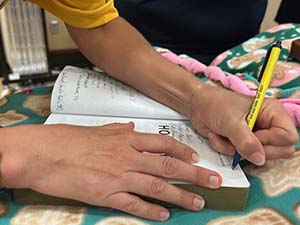
The recovered items, a blanket and a Bible signed by Texans on Mission volunteers were packaged into baskets for delivery to the children’s parents.

Texans on Mission volunteers sign Bibles they presented to heartbroken families in the Texas Hill Country. (Texans on Mission Photo by Russ Dilday)

Daves and Stover were joined in the effort by Fred Stover (Jeannie’s husband) and Gayle Romans of First Baptist Church in Farmersville. The Stovers were part of a shower/laundry unit, and Romans deployed as on-site coordinator of the Texans on Mission incident management team in Kerrville.

With the help of other volunteers, the four put together the baskets and prayed over the contents, which will be sent to the children’s parents.

“Our prayer would be that God would give them comfort and assurance and they would feel the love and the covering of Jesus as we do this for them,” Jeannie Stover said. “It comes from the bottom of our hearts.”

Fred Stover felt a deep connection to the grieving parents.

“I lost a son a little over a year ago. So, my heart feels the grief that these parents are feeling,” he said. “And when this was brought up, the girls said to me, ‘We need to get some Bibles and get them signed.’ So, I went and got the Bibles.”

He then involved the staff of Kerrville’s Trinity Baptist Church in the effort.

“I’ve gone through the entire church, the pastoral staff has prayed over these Bibles and these blankets, and we have gotten signatures from everyone,” Stover said.

Romans summed up the team’s desire for the message of the baskets by pointing to Scripture. “In Romans 15:13, it says, ‘May the God of hope fill you with all the joy and peace that you trust in him so that you may overflow with the hope by the power of the Holy Spirit.’”


Duo desires to help shape lives with Scripture songs

CEDAR HILL—While leading worship for children’s camps such as Mt. Lebanon Baptist Encampment in Cedar Hill, the husband-and-wife worship duo Dave and Jess Ray—otherwise known as “Doorpost Songs”—seek to influence the rising generation by developing Scripture-based songs and resources to help children easily remember key passages.

Their name is based on Deuteronomy 6, and their primary desire is to help families become rooted in Scripture through the songs they sing and teach their children. As the parents of three children, this is especially close to their hearts.

“Hearing the words of Scripture in the voices of children will never get old,” Dave Ray said. “What an incredible blessing to help create those moments.

“Doorpost Songs began almost by accident. At the first church we served, our children’s minister asked me to write a song for their fall memory verse. I wrote the song and actually liked it, and then I realized that we could do more.”

Ray wrote enough Scripture-based songs for an album, and then he gathered a group of instrumentalists to record the tracks and a children’s choir to sing them.

Fulfilling a sacred command

“Once the album was complete, we needed something to call it,” he said. “Because the focus was Scripture and family, we were immediately drawn to Deuteronomy 6: ‘And these words that I command you today shall be on your heart. You shall teach them diligently to your children. … You shall write them on the doorposts of your house and on your gates.’

“Ultimately, the purpose of these songs is to help God’s word become a part of our family life. It’s a way of fulfilling this sacred command.”

Dave and Jess Ray both have fond memories of growing up in church and crafting their musical skills at an early age.

Jess Ray played bluegrass and gospel music with her family, while also singing while playing the piano, mandolin and cello.

Dave Ray began learning to play the piano as a child, along with singing, and then he started playing the guitar at age 13.

Today, the duo leads worship for a variety of conferences, camps and family worship events around the country.

“We love getting to partner with churches to create fun worship nights that bring the whole family together,” Dave Ray said. “So often, each age group is separated on Sundays, and when we come together, not only can it be incredibly fun but also incredibly meaningful both for parents and kids.

“We also want kids and families to have a deeper love for God’s word. For many of us, God’s word is an afterthought when it should be our lifeblood.”

Encouraging parents to be spiritual leaders

The Rays want to encourage parents to fulfill their role as spiritual leaders.

“It’s not an easy role, but it’s such an important calling,” Dave Ray said. “We can trust that as we seek to faithfully live out God’s calling, he’ll be with us every step of the way.”

The inspiration for their songwriting process comes directly from reading Scripture passages and putting them to music. However, they admit it can sometimes be a challenging task.

“Most of the Bible was not written to be a song,” Dave Ray said. “It doesn’t have rhyme or meter or symmetry. Even the poetry in Scripture is different from the kind of poetry we use.

“So, a big part of the process is just sitting with a bunch of different verses and testing them musically: ‘Can we find a melody that fits the syllables? Are there rhyming words that we can figure out how to pair? And most importantly, will a kid love singing this?’”

Their ultimate goal is to create songs filled with rich, biblical truths that will help shape young hearts and minds with the gospel.

“Teaching our kids to be worshippers is one of our most important tasks,” Dave Ray said. “We spend so much time trying to get our kids to obey God and much less time teaching them to love God. But love for God is where true obedience comes from. If our kids are going to love God deeply, they must learn to be worshippers.”


Kenyans adapt as churches are destroyed by flooding

BUDALANG’I, Kenya (RNS)—Every Sunday morning, Pastor Pascal Ogutu walks barefoot across the cracked mud of what was once the foundation of his church.

He passes submerged gravestones and the sagging roof of the altar, now half-buried in water and overgrown reeds.

“This used to be holy ground,” he said softly, gazing across the shimmering expanse where Lake Victoria has swallowed not only farmland and homes but faith sanctuaries, like his Free Pentecostal Fellowship in Kenya.

In the flood-prone plains of Budalang’i in western Kenya, dozens of churches—some more than 50 years old—have been submerged or structurally weakened due to rising water levels and unpredictable rainfall.

Scientists attribute the changes to climate shifts intensifying across the Lake Victoria basin, one of Africa’s most populous and ecologically fragile regions.

“The water does not just take land,” said Ogutu, of the Free Pentecostal Fellowship in Kenya, whose tin-roofed sanctuary collapsed last November after months of flooding. “It takes our memory. It takes our worship. It takes the place we felt closest to God.”

Floods more frequent and destructive

Budalang’i, a rural constituency in Busia County near the Uganda border, sits along a natural floodplain where the lake’s waters spill out during seasonal rains. But residents say the floods have become more frequent, intense and destructive.

In the past five years, the lake’s water levels have risen by more than 2 meters, or just over 2 yards, according to Kenya’s Water Resources Authority.

This backflow, combined with erratic rainfall and clogged drainage from nearby rivers, has displaced thousands of families and inundated schools, churches and cemeteries.

Scientists say the region’s flooding crisis is a visible symptom of broader climate disruptions, some of which are caused by global warming.

“Lake Victoria is a giant climate mirror,” said Godfrey Khamala, a climate specialist who leads the flood victims committee in Maumau Village, Budalang’i.

“What’s happening here is a direct result of regional warming, changing rainfall patterns and human-driven land degradation.”

Deforestation in upstream areas, coupled with poor urban planning and unregulated development, has worsened sedimentation and reduced the land’s ability to absorb rainwater, he said.

‘Casualties of a system under stress’

At the same time, climate change has intensified the Indian Ocean Dipole, a weather pattern that brings extreme rainfall to East Africa.

“These churches are casualties of a system under stress,” Khamala said. “But their loss also reveals how deeply intertwined environment and community life are.”

As a result, faith leaders are speaking out about climate justice. In April, a coalition of churches in Busia organized an interdenominational prayer walk calling for action to protect the lake and relocate vulnerable communities.

“We are stewards of creation, not just victims of it,” said Pastor Moses Okello of Assemblies of Pentecostal Churches in western Kenya. “We cannot preach hope while ignoring the rising waters around our feet.”

The Church of Christ, a concrete structure with wooden pews and stained-glass windows in Budalang’i, now sits half-sunken in marshland. Its bell tower is partly still visible from a distance.

“We had baptisms here. We buried our elders here. This was our sanctuary,” said Mary Anyango, 58, a longtime congregant who now worships with her neighbors under a mango tree. “Now, it feels like God is further away.”

Resilient churches find ways to adapt

Like Anyango, across the region, churches and congregants are adapting in creative and resilient ways. Services have been held in classrooms, tents, market stalls and even boats.

Pastors have converted living rooms into altars, where worshippers sit on mats or plastic chairs as chickens cluck in the background.

One Sunday in June, more than 80 people gathered under a thatched shelter in Bunyala village, also in Busia County, to pray and sing.

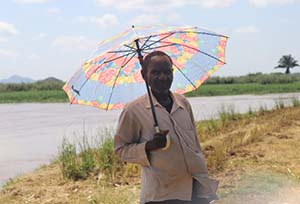
Pastor John Musumba in Kenya near Lake Victoria. (Photo by Tonny Onyulo)

“This is what church means now—people, not buildings,” said Pastor John Musumba, who leads a Pentecostal community that lost its church to flooding in 2022. “The gospel doesn’t need walls. It needs hearts.”

Still, religious leaders say attendance has dropped. Some elderly members have stopped coming to church entirely, fearing the floods or unable to walk through the mud. Tithes have declined, and efforts to rebuild are stalled by poverty and uncertainty, they said.

For many congregations, efforts to rebuild have been slow or symbolic. Some have erected temporary churches on higher ground with salvaged wood and tarpaulin. Others are fundraising to purchase plots farther away from the flood zone, but many cannot afford to do so.

“We are competing with families who need land for shelter,” said catechist Vincent Okumu, who coordinates emergency aid for displaced families with a local ecumenical relief committee. “Everyone is trying to move uphill. There is not enough space.”

‘This is not just about Kenya’

But faith remains a source of strength and solidarity. Congregants said the loss of physical buildings has not shaken their belief in divine presence, but in some cases has deepened it.

“In this crisis, we have learned that God is not confined to concrete,” said Patrick Okumu, a lay local preacher who now holds weekly Bible studies under a baobab tree. “He is with us in the mud, in the storm, in the rebuilding.”

Still, many hope the outside world will act.

“This is not just about Kenya,” Khamala said. “This is about how climate change is eroding not only coastlines and crops, but culture, heritage and spiritual life. These churches are the canaries in the coal mine.”

Back at the waterlogged remains of Free Pentecostal Fellowship in Kenya on a recent Sunday, Ogutu led his congregation in a song of lamentation.

“Lord, do not pass us by, even when the waters rise,” they sang in Luhya, as children clapped along and elders wiped away tears.


Texas Baptists urged to pray for the persecuted in Nigeria

The Center for Global Religious Freedom at Dallas Baptist University, Texas Baptists’ Christian Life Commission and the Baptist World Alliance have issued a call to prayer for victims of religious persecution in Nigeria.

Leaders at the DBU Center for Global Religious Freedom, the CLC and BWA are urging Texas Baptists to dedicate time during worship services on July 27—or another date in the near future—to pray for persecuted believers in Nigeria.

They also are encouraging concerned Christians to sign an online letter to Secretary of State Marco Rubio, calling for the U.S. Department of State to designate Nigeria as a Country of Particular Concern.

The CPC designation is reserved for nations that commit or permit systemic, ongoing and egregious violations of religious freedom. Several global experts and advocates for international religious freedom have deemed Nigeria one of the most dangerous nations in the world for Christians.

“Due to the ongoing and particularly severe religious freedom violations occurring throughout the country, especially in its northern states, the Trump Administration should redesignate Nigeria as a CPC and take immediate action to engage with the Nigerian government to confront this growing violence,” the letter to Rubio states.

“From April to June, violent attacks by nomadic Muslim Fulani militants on Christian farmers in Benue and Plateau states claimed more than 150 lives, displacing many more.”

Baptist pastor killed this month

In a July 12 video interview with BWA General Secretary Elijah Brown at the Baptist World Congress in Brisbane, Nigerian Baptist Convention President Israel Akanji said, “While we have been here in the past one week, one of our pastors was killed by terrorists who attacked his church.”

Christian Solidarity Worldwide identified the pastor as Emannuel Na’allah of the Bege Baptist Church in the Yari Bori community of the Kafur Local Government Area of Nigeria’s Katsina State.

During the July 7 attack, another church leader also was killed, and Maryam Ezekiel, wife of the local Redeemed Church of God pastor, was abducted and remains in captivity.

Eight days later, more than 30 people in the Bindi community Riyom Local Government Area in Nigeria’s Plateau State were killed by heavily armed militia, CSW reported. Davou Musa, the local Christ of Christ in Nations pastor, reportedly lost nine family members in the attack.

In the video interview, Akanji also noted more than 200 individuals—most of whom were Christians—were killed in mid-June in Benue State.

When asked how Texas Baptist can pray for Christians in Nigeria, Akanji responded: “The prayer is that we should not lose our hope in God.

“We have the faith that in spite of the persecution, the church of God will continue to grow. Please pray that our hope will be sustained.”