ERLC brief urges court to rehear ministerial exception case

WASHINGTON (BP)—The Southern Baptist Convention’s religious freedom entity and other faith organizations urged a federal appeals court to reconsider its application of the “ministerial exception” rulings by the U.S. Supreme Court in cases involving employment decisions by churches and other religious institutions.

The Ethics & Religious Liberty Commission was among the groups that filed a friend-of-the-court brief Oct. 13 that called on the entire Seventh Circuit Court of Appeals in Chicago to rehear a case in which a three-judge panel ruled in favor of a music director who was fired by a Catholic church.

The brief asserted the 2-1 decision by the appeals court panel “mandates extraordinary secular interference with core ecclesiastical judgments.”

In their brief, the ERLC and the other signers contended the Seventh Circuit panel’s opinion offers a “cramped conception of the ministerial exception” that the Supreme Court “has expressly rejected.”

The high court doctrine expressed in a 2012 ruling and reaffirmed in a decision this July applies to certain employees “because their job entails exemplifying their faith and performing core religious duties,” according to the brief.

“Judicial scrutiny of the employment relationship between a religious group and its ministers inevitably invites unconstitutional interference with religious groups’ self-governance, no matter what kind of employment claim is involved.”

Former employee claimed hostile work environment

The Seventh Circuit panel’s Aug. 31 decision involved a hostile work environment claim by Sandor Demkovich, who was hired in 2012 as the music director at St. Andrew the Apostle Parish, a Catholic church in Calumet City, Ill., and fired in 2014.

Demkovich, who had been in a same-sex relationship more than a decade, was overweight and had diabetes and an array of physical conditions known as metabolic syndrome, the court opinion reported. He said his supervisor at the church “subjected him to a hostile work environment based on his sexual orientation and his disabilities,” according to the opinion.

When Demkovich married his long-time male partner, the supervisor called for the music director’s resignation because the union violated Catholic doctrine. When he refused to resign, the supervisor fired Demkovich.

In its opinion, the Seventh Circuit panel said the fact Demkovich’s complaint regarded his treatment and not his firing means the Supreme Court’s 2012 Hosanna-Tabor Evangelical Lutheran Church and School v. EEOC decision does not cover his case.

The high court ruled unanimously in the Hosanna-Tabor opinion a “ministerial exception” exists that enables churches and other religious institutions to hire and fire based on their beliefs.

In explaining its ruling, the panel said the First Amendment clause guaranteeing the free exercise of religion “does not bar all hostile environment claims by ministerial employees.”

The panel described the threat of “procedural entanglement in such cases is modest because religious organizations have no generalized claim to immunity from litigation or regulation.”

It also acknowledged “some risk of substantive entanglement” in cases involving claims of hostile work environments, “but that risk does not appear so severe that all such claims must be dismissed.”

Brief argues against ‘judicial second-guessing’

The brief filed by the ERLC and others asserted, however, workplace hostility claims attract particularly severe interference by the government in spiritual issues. Such claims “place the entire employment relationship under a judicial microscope,” according to the brief.

The Seventh Circuit panel also misunderstood the “ministerial exception” to require “a claim-by-claim inquiry into whether religious groups need leeway over particular types of employment actions to fulfill their ecclesiastical missions,” the brief said. “The Supreme Court instead treats the exception as prohibiting interference in the whole employment relationship between religious groups and their ministers.

“Because judicial second-guessing of religious groups’ hiring and firing decisions necessarily intrudes upon matters of internal church governance, judicial second-guessing of other facets of the employment relationship—including informal communications—necessarily raises similar concerns,” according to the brief.

In addition to the ERLC, organizations signing onto the brief were the Assemblies of God (USA), Church of God in Christ, General Conference of Seventh-day Adventists, Jewish Coalition for Religious Liberty, Church of Jesus Christ of Latter-day Saints and the International Society for Krishna Consciousness.

The Supreme Court reiterated its support for a “ministerial exception” in July with a 7-2 decision in Our Lady of Guadalupe School v. Morrissey-Berru. Both the Hosanna-Tabor and Our Lady of Guadalupe School cases involved the firing of teachers. The ERLC signed onto briefs in support of a “ministerial exception” in both cases when they were before the Supreme Court.

The ERLC and the other signers also asked the Seventh Circuit Court to grant its motion to file the brief. Demkovich did not consent to its filing.



Baylor Student Senate calls for LGBTQ policy changes

WACO—Baylor University’s Student Senate passed a resolution calling on the school to reinterpret its statement on human sexuality and add a nondiscrimination clause to its policies for student organizations.

“Student Government recommends that Baylor University formally and publicly announce the ability for LGBTQ+ groups to be recognized as fully chartered student organizations,” the “No Crying on Sundays” resolution stated.

The resolution passed 30-15 with one abstention. Decision-making authority with respect to the issue rests with the university administration and its board of regents.

Student Senate debates resolution

Two sophomores on the Student Senate—Addison Knight from Boerne and Veronica Penales from Shreveport, La.—were co-authors of the resolution.

“Senator Knight and I wrote this bill, not with the intent to change the identity of Baylor as a Baptist university, but rather with the desire to have Baylor leadership realize the need for Baylor to reinterpret its human sexuality statement so that it is no longer antithetical to Baylor’s overall mission statement and commitment to diversity and inclusivity, but we cannot achieve our goal of ending the discrimination of these individuals on this campus without the help of Student Senate,” Penales told the Baylor Lariat student newspaper.

Other student senators registered their dissent, saying the resolution could strain relations between the Student Senate and Baylor’s board of regents. They also said it could be an affront to the Baptist General Convention of Texas, which elects 25 percent of the board and provides financial support for the university.

“Baylor has been and will continue to be a place where people of all different races, religions, sexualities and creeds can come together under the love of our Lord and Savior Jesus Christ. Baylor’s Baptist commitment holds dearly to the university’s mission. Let’s not abandon that by sending a dead-on-arrival bill up to administration without engaging with them first,” said Tate Korpi, a junior from New Braunfels. “Let’s work together and foster civil discourse with decision-makers to move forward on this issue. This is a problem. This just wasn’t the answer.”

The Waco Tribune-Herald reported Oct. 24 that Gamma Alpha Upsilon, Baylor’s unofficial LGBTQ student group, reapplied for official status as a recognized student organization. The group—previously known as the Sexuality Identity Forum—has applied for a charter multiple times in the past decade, and the university has declined its request.

Knight and Penales, along with several other students, launched a petition that asks Baylor to recognize Gamma Alpha Upsilon, reinterpret its statement on human sexuality, amend its policy on student organizations and “apologize to the current students and alumni who have been excluded from the full rights and benefits of Baylor life as a result of their sexual orientation or gender identity.”

Reconsideration of policy ‘not on the table’

Baylor University’s statement on human sexuality, last revised in 2009, reads in part: “The university affirms the biblical understanding of sexuality as a gift from God. Christian churches across the ages and around the world have affirmed purity in singleness and fidelity in marriage between a man and a woman as the biblical norm. Temptations to deviate from this norm include both heterosexual sex outside of marriage and homosexual behavior. It is thus expected that Baylor students will not participate in advocacy groups which promote understandings of sexuality that are contrary to biblical teaching.”

Baylor’s policy on sexual conduct, as updated in May 2015, states: “Baylor will be guided by the biblical understanding that human sexuality is a gift from God and that physical sexual intimacy is to be expressed in the context of marital fidelity. Thus, it is expected that Baylor students, faculty and staff will engage in behaviors consistent with this understanding of human sexuality.”

In a recent phone interview with the Baptist Standard, Baylor President Linda Livingstone underscored both the university’s commitment to being a caring community for all its students, as well as its steadfast commitment to its Christian mission.

Baylor University has no plans to revise its policies on human sexuality or student groups, she said, adding that the matter is “not on the table.”

She emphasized Baylor’s desire to create a climate where all its students can thrive, including those who identify as LGBTQ.

“It’s a challenging space to navigate as a Christian institution,” she said.


Legacy Award recipients Lowrie and Dooley recognized

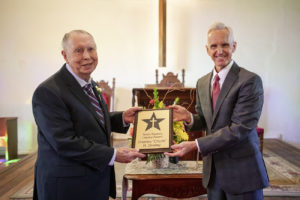
INDEPENDENCE—D.L. Lowrie, pastor emeritus of First Baptist Church in Lubbock, and Charles R. “Chuck” Dooley, former church planter, received Texas Baptists’ Legacy Award at the historic Independence Baptist Church.

The award recipients were chosen by a selection committee for their lifelong commitment to Christian service throughout their work and ministry.

Due to COVID-19 precautions, the two were honored in separate services with family and close friends in attendance on Oct. 11.

Integrity of heart

Prior to the award presentations, David Hardage, executive director of the Baptist General Convention of Texas, preached a sermon from Psalm 78:72 on integrity of heart.

“It’s always been important to be shepherds who have integrity of heart,” Hardage said, adding Christians should be constant in their actions and words on Sundays and weekdays, in church and in the world. God calls Christians to be consistent and have integrity in their work, he said.

“It is not our purpose to impress people with the skillful work that we do as ministers, it is our purpose to please God in who we are and what we do,” he said.

Hardage thanked Dooley and Lowrie for being examples of working with integrity of heart.

“We always try to be very intentional about understanding two things on Legacy Day. We try to be intentional in recognizing that this is the Lord’s day and the Lord’s house, and our first objective is to glorify him,” Hardage said.

“But we also understand that today we have gathered to recognize two individuals in Texas Baptist life who have made a tremendous impact and have established a wonderful legacy for all of us for the years ahead.”

Serving the church ‘highest calling’ to Lowrie

Lowrie was a pastor, convention leader and teacher during his more than 60 years of ministry. He has spoken at evangelical events around the world and written articles for a variety of Christian publications.

D.L. Lowrie and his wife Alice are pictured with the Texas Baptist Legacy Award.

In addition to serving eight churches as pastor, Lowrie also was BGCT president in 1981-83 and held a variety of positions in denominational service.

Lowrie’s oldest son David talked about his father’s legacy and the important contributions he has made to Texas Baptists and the people who know him.

“The church was always his highest calling. He understood that the greatest position any Texas Baptist can hold is to be the pastor of a local church,” said David Lowrie, pastor of First Baptist Church of Decatur.

“And he did all those things because he understood that the work of the BGCT is not the work of the convention. It’s churches pulling together for a greater cause and being the kingdom of God. And so as a pastor, he gave himself to the work. It’s my prayer that the next generation of pastors will understand that we do far better when we are together and will follow the example that has been set for them.”

He also praised his father for making a positive impact on so many individuals.

“When we think about his legacy, without doubt one of the greatest gifts Dr. Lowrie will leave is his influence on other peoples’ lives,” he said.

‘Giving your best to the Lord and his people’

Likewise, Dooley was recognized for his lifetime of service to God and to Texas Baptists. His ministry spans over five decades and includes six full-time pastorates, 23 intentional interim pastorates, 10 years of ministry with the North American Mission Board and 21 years as a church planter with Texas Baptists.

David Hardage (right), executive director of the Baptist General Convention of Texas, presents Charles Dooley with the Legacy Award.

He is the founding pastor of Alamo Heights Baptist Church, formerly Westside, in Port Lavaca; Fellowship of Champions in Spring; Sawdust Road Baptist Church in The Woodlands; and West Conroe Baptist Church.

Debra McCammon, one of Dooley’s daughters, shared about the impact he has had on those around him.

“As we grew in our personal relationship with the Lord, my dad led us by his faithful example and consistent lifestyle. He was always the same man at church as he was at home,” she explained. “He taught me the importance of keeping your word, working hard, serving the Lord with a humble and joyful spirit, but most of all about always giving your best to the Lord and his people. He taught me to trust the Lord to lead me through the tough times as well as the good times.”

Dooley felt God’s call to the preaching ministry at age 16, and he preached his first sermon soon after at Trinity Baptist Church in San Antonio. After he retired from the BGCT, he remained active, serving as an interim pastor of eight churches and serving in leadership positions at River Pointe Baptist Church in Conroe, which he helped plant.

“We are so very proud of all he’s accomplished for the Lord and for the way he has continued to lead his family by example to serve the Lord,” McCammon concluded.

To nominate recipients for the 2021 Texas Baptists Legacy Award, email Becky Brown at becky.brown@texasbaptists.org


Baylor panel: Political difference among Christians not so bad

Christians who read the same Bible often hold drastically different political positions—and that’s not necessarily a bad thing, according to two experts in church-state relations.

Melissa Rogers of the Brookings Institution, former general counsel for the Baptist Joint Committee for Religious Liberty, and Kelly Shackelford, president and CEO of the First Liberty Institute, participated in an online panel discussion on the subject “Render Unto Caesar: How should faith inform politics?”

Malcolm Foley, special adviser to the president for equity and campus engagement at Baylor University, moderated the discussion. Baylor in Washington sponsored the webinar in partnership with Baylor’s Institute for Faith and Learning, Faith Angle Forum and Washington College’s Institute for Religion, Politics and Culture.

Diverse views a ‘source of great richness’

“Sometimes we will find somewhat different ways from our Bibles to the ballot box,” said Rogers, who was director of the White House Office of Faith-based and Neighborhood Initiatives during the Obama administration.

Malcolm Foley (left) of Baylor University moderates an online panel discussion featuring Melissa Rogers of the Brookings Institution and Kelly Shackelford of the First Liberty Institute. (Screen Capture)

She called politically diverse opinions among Christians “a source of great richness.” It offers fellow believers opportunities to learn from each other and “test our ideas”—provided Christians are willing to exercise humility, she noted.

Rogers quoted the late Barbara Jordan, member of the U.S. House of Representatives from Texas, who said, “You would do well to pursue your causes with vigor, while remembering that you are a servant of God, not a spokesperson for God … and remembering that God might well choose to bless an opposing point of view for reasons that have not been revealed to you.”

Shackelford noted he and Rogers sometimes have filed briefs before the U.S. Supreme Court arguing opposing positions on certain church-state issues, but they share a common goal.

“We want there to be the most religious freedom possible for people in this country. We just think we get there in different ways,” he said.

Christians may come to varied political views based on different beliefs about the nature of Scripture and how they apply the Bible, he added.

When it comes to choosing elected officials, Shackelford said, two issues factor into decision-making—selecting someone who can bring about desired policy results and evaluating a candidate’s character.

Christian citizenship a stewardship issue

Jesus was political in the sense that he stood for justice, seeking to release people from bondage, Rogers said.

“Jesus was a proponent of justice, in my view,” she said.

Kelly Shackelford

Because American Christians live in a constitutional republic governed according to democratic principles, they have a stewardship responsibility to be involved in politics, Shackelford asserted.

Christians have a calling “to represent Christ in every area of society, and that includes in the voting booth … representing biblical values that bless everyone.” he said.

God created three human institutions—the family, the church and government, he explained. If Christians are not involved in politics and government, others who do not hold to biblical values will fill that space, Shackelford said.

“Christians should be involved in politics and bring their values and their biblical understanding to make a difference in government and, therefore, in other people’s lives,” he said.

Influence happens within political parties

Rogers and Shackelford agreed the most effective way Christians can influence public policy is by becoming involved with a political party that “approximates” their values and beliefs.

Melissa Rogers

“Being involved in a party doesn’t mean you agree with everything that party says or all that the party’s leadership is embracing at a particular point in time, but it means you are going to situate yourself in a particular conversation and try to influence that conversation,” Rogers said.

Affiliation with a political party does not mean blind allegiance to it, she stressed. For instance, Christians within a political party may choose to vote for a candidate from another party in a particular election cycle based on issues of character or record in office, she added.

“Certainly, there is a long and rich history of people challenging their party from within, and I think that’s a healthy thing,” she said.

Any association—whether in a church or a political party—is not built upon total agreement on all matters, but rather on the desire to associate based on those important principles individuals hold in common, Shackelford said.

What are ‘deal-breakers’ for Christians?

When asked about “deal-breakers” that would prevent a Christian from affiliating with a particular candidate or party, Rogers mentioned “dehumanization of people,” “inciting violence” and “supporting racism” as actions that would fit that category for her.

On some polarizing issues, such as abortion, she suggested looking for areas of common ground and shared goals.

“To me, the important question is, ‘What are we doing to reduce the number of abortions?’” she said.

Shackelford, on the other hand, said some issues constitute such a “grave evil” that Christians cannot in good conscience associate with a political party that supports them. For a significant number of American Christians, abortion fits into that category, he said.

“There are issues like that,” he said. “I don’t think there are that many.”

Church as the ‘conscience of the state’

The institutional separation of church and state is “a biblical concept when you apply it correctly,” Shackelford asserted. However, he insisted, it does not require the separation of religious values from government, nor does it require the erasure of biblical symbols from public areas.

Rogers agreed religious people have every right to bring their values into the public square and engage government. Institutional separation of church and state means churches and government have “meaningful independence” from each other, and the church has freedom to act as the “conscience of the state,” she added.

However, she expressed concern about giving government a “blank check” to misuse religious symbols to advance its own agenda.

“We need to be careful about governmental appropriation of religious symbols and religious messages,” she said.

Stand up for religious minorities

Rogers and Shackelford found common ground in affirming the rights of religious minorities—particularly globally, where the free exercise of religion can be a matter of life or death, as in the case of Uighur Muslims in China.

“We should care because we want to protect the God-given religious liberty rights of everyone, and we want everyone to be free from such horrific governmental coercion,” Rogers said.

Concern for minority religions must extend to groups within the United States, she added.

“As Baptists, we were a despised minority in many places during the founding era of this country, and we should never forget that,” she said.

Shackelford likewise emphasized the importance of standing for the freedom of American religious minorities.

“If you are not willing to stand with the smallest minorities, then that’s where the freedom will be taken away. And once that precedent is set, it will be applied to you in the future,” he said.

Civility essential

The two panelists also agreed on the importance of civil discourse and the free exchange of ideas.

“We won’t agree on everything. That is completely clear. But we don’t have to be as divided as we are,” Rogers said.

In light of the increasing polarization in the United States, Rogers encouraged Christians to be intentional about engaging with people who represent different ethnic and racial groups to gain new perspectives—“to break out of our bubbles.”

“Increasingly, we have people living with, working with and maybe even worshipping only with people who see the world the same way they do,” she said.

The United States “suffers greatly” when citizens cannot engage in the marketplace of ideas in civil ways, Shackelford said.

“We will lose the country if we lose civility with one another,” he said.


Obituary: Katherine Dawn Holster

Katherine Dawn Holster of Levelland, educator and pastor’s wife, died Sept. 29. She was 63. She was born in Tucumcari, N.M., on Nov. 23, 1956, to H. Don and Joan Smith. She graduated from Robertson High School in Las Vegas, N.M., in 1974. She attended college at West Texas State University and graduated magna cum laude in 1978 with a Bachelor of Science degree and a certificate in secondary education. She married Michael Holster on July 29, 1978, in Canyon. She served faithfully as the wife of a minister as her husband served churches in Hobbs, O’Donnell, Slaton, Memphis, Floydada and Midland, and for the past 17 years, Second Baptist Church Levelland. Holster was devoted to making disciples and to teaching the Bible, serving as Sunday school teacher, Vacation Bible School leader and Bible Drill instructor. She baked countless casseroles and loaves of bread to serve those in need. She was an educator and a life-long learner who believed math is the foundation for problem-solving and critical thinking. She taught in the Amarillo, Tulia, Floydada, Stanton, Greenwood and Levelland school districts. Holster obtained her master’s degree in education from Wayland Baptist University in 2006, and she served on faculty in the mathematics department at South Plains College for 14 years, retiring in 2017. She loved reading, baking, going on nature walks and making crafts with her grandchildren. She was preceded in death by a sister, Della Boley. She is survived by her husband of 42 years, Michael Holster; son, Scot Holster and wife Mindy Michelle of Abilene; son, Sean Holster and wife Mindy Alaine of Brenham; five grandchildren; mother, Joan Smith of Levelland; sister, Donna Hinders of Los Lunas, N.M.; and brother, Robert Smith of Okmulgee Okla. In lieu of flowers, donations may be made to the lighting fund at Second Baptist Church, Levelland, South Plains College Scholarship Foundation, or to the charity of choice.

Hearing set for Riley Foundation lawsuit

FORT WORTH (BP)—A temporary injunction hearing in a lawsuit filed by Southwestern Baptist Theological Seminary and Baylor University against a charitable foundation is scheduled for Dec. 2 after a judge granted the plaintiffs’ motion for expedited discovery.

Additionally, two Southwestern trustees have been suspended in connection with their involvement with the charitable foundation.

(Baylor University Photo)

In the suit, filed Sept. 8 in a Tarrant County district court, Southwestern and Baylor allege some members of the board of the Harold E. Riley Foundation, which was set up solely to benefit the schools, led a “secret coup” in an “attempt to seize control of the Foundation and its assets”— altering the foundation’s purpose, stripping the schools of their rights and status as beneficiaries and misappropriating assets worth millions.

Defendants include the Riley Foundation and Mike Hughes, the foundation’s president. The office of the Texas attorney general, which has oversight authority of charitable organizations, has been observing the proceedings in the lawsuit, including hearings, with the option to become an official party.

Two trustees suspended for ‘misconduct’

Two Riley Foundation trustees—Charles Hott and Thomas Pulley—also are members of Southwestern’s board of trustees and have been suspended from the seminary board by its officers because of “trustee misconduct.”

During a regularly scheduled meeting Oct. 19, Southwestern’s board of trustees affirmed the officers’ decision, calling it “consistent with the seminary’s governing documents and parliamentary authority and not inconsistent with the Southern Baptist Convention’s governing documents.” The trustees also affirmed and expressed “full support” for the seminary’s action in filing the lawsuit.

Pulley, a banker from Colleyville, did not respond to a voicemail. Hott, who serves as chief investment officer for the Riley Foundation, told Baptist Press in a text message: “I was denied the ability to tell the whole Board of Trustees the truth. One must ask what the 3 officers are so afraid of?”

When the lawsuit was filed, Hott denied any wrongdoing, telling Baptist Press “virtually every allegation in the complaint by Southwestern and Baylor are completely false, without merit.”

Governing documents changed

The lawsuit stems from an alleged meeting in June 2018 at which the schools claim Riley Foundation trustees improperly restructured the foundation’s governing documents.

August Boto

The lawsuit also claims the Riley Foundation board is attempting to “seize control” of the board of directors of Citizens Inc., a publicly held insurance company whose stock forms the primary asset of the foundation.

The Riley Foundation filed suit Sept. 2 to force Citizens to seat five directors, including Riley Foundation trustees Augie Boto, Hott and Hughes. The attempt to seat directors of Citizens initially included former Southwestern President Paige Patterson.

According to the Riley Foundation’s complaint, Patterson resigned from the attempt to be seated on the Citizens board Sept. 1. According to the schools’ lawsuit, positions on the Citizens board of directors are compensated annually in excess of $100,000.

Hughes is a former Southwestern vice president under Patterson. Boto is the former executive vice president of the SBC Executive Committee. He served as its interim president from 2018-19.

Established with seminary and Baylor as sole beneficiaries

Harold Riley, who died in 2017, was a major donor both to Southwestern Seminary and Baylor. He set up the charitable foundation in 2002. It is funded with shares from Citizens Inc., the Texas-based insurance company he founded in 1969. Citizens, which is publicly traded on the New York Stock Exchange, is valued at more than $300 million.

The Riley Foundation was set up with Southwestern and Baylor as sole beneficiaries. Each school was granted three members on the foundation’s board, giving the schools’ combined representation a majority of the 11-member board.

Upon Riley’s death, assets including more than 1 million shares of Citizens were transferred to the foundation. According to the foundation’s 2018 tax documents, payouts to the two schools that year totaled $298,800.

In a meeting in June 2018, the board was downsized and the schools’ right to appoint board members was eliminated. The foundation’s tax status was changed from a public charity to a private foundation. The lawsuit alleges that the meeting was conducted illegally—without a quorum and without input from either school.

‘Self-appointed rogue leadership’

When the suit was filed in September, Southwestern President Adam W. Greenway, who succeeded Patterson, described the Riley Foundation board members involved in the restructuring as “self-appointed rogue leadership,” saying Southwestern believes the foundation board members “are attempting to undermine and overturn Mr. Riley’s expressed directives and are in violation of their fiduciary duties.”

Baylor President Linda Livingstone described the lawsuit as “necessary to return Mr. Riley’s gift to his original donative intent.”

Boto told Baptist Press in September the lawsuit’s claims were “absurd,” adding the “entire (foundation) board is committed to supporting the ongoing work of both (Southwestern and Baylor) for as long as possible, as well as possible. That was what Harold Riley wanted. We’ll stay true to that assignment.”

Relieve schools of ‘burden’ to appoint trustees

In a response opposing the plaintiffs’ motion for expedited discovery, the defendants asserted a quorum for a meeting June 11, 2018, when the restructuring occurred, and that the changes “did not alter (the foundation’s) purpose in any way, as it continues to operate exclusively for Baylor and Southwestern, who are and will continue to be the exclusive recipients of the Foundation’s charitable grants.”

The response included letters sent to Southwestern Interim President Jeffrey Bingham and Livingstone, Baylor’s president—sent in July and August 2018, respectively—in which Hughes wrote that the foundation’s board had determined the board was “too large to act efficiently and effectively” and that the original requirement that Southwestern and Baylor appoint three foundation board members each “is not necessarily in the best interests of Baylor and Southwestern.”

Hughes wrote that the Riley Foundation board had reduced its size from 11 to a maximum of five and removed “the burden on Baylor and Southwestern to maintain the appointment of certain members of the Foundation’s Board of Trustees.”

Hott, Pulley and Hughes remained on the foundation board when it was reduced to five, as did Hance Dilbeck, executive director of the Baptist General Convention of Oklahoma. Dilbeck, who resigned from the board in the summer of 2020, declined comment to Baptist Press.

In response to Southwestern trustees’ Oct. 19 affirmation of the seminary’s action in filing the lawsuit, Greenway said: “While we continue to pray and hope for a just resolution of this difficult matter, we are determined to honor the clearly stated intent of Mr. Riley in establishing the foundation that bears his name exclusively to support two educational institutions that were near and dear to his heart.”


Around the State: Associations help each other and camp

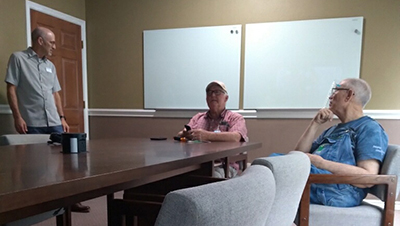
After completing a major remodeling project, (left to right) Southwest Metroplex Baptist Association Director of Missions Scott Whitson, volunteer Boots Hubbard and Paluxy Baptist Association Director of Missions Glenn Ward visit in the newly renovated conference room at the associational office building in Cleburne. (Courtesy Photo)

Volunteer builders from Paluxy Baptist Association recently renovated the conference room at the offices of Southwest Metroplex Baptist Association. Glenn Ward, director of missions for Paluxy Baptist Association, talked with Scott Whitson, director of Southwest Metroplex Baptist Association, when they were attending a Latham Springs Baptist Encampment board meeting. Ward told Whitson the volunteer builders from his association had helped three small-membership churches renovate and upgrade their buildings. Whitson mentioned his associational office’s conference room needed work, and the volunteer builders from the neighboring association responded. They removed a popcorn ceiling, installed new LED lighting, installed electrical outlets and computer ports in the conference room table, removed an old wall-mounted television and installed a new flat-screen TV, as well as hanging drywall and painting. “It gives us such joy and blessing doing something to help others,” Ward said.

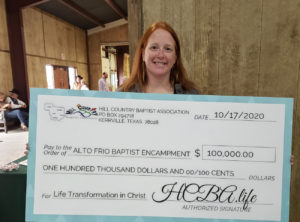
Hill Country Baptist Association presented a $100,000 check to Alto Frio Baptist Encampment.

Hill Country Baptist Association presented a $100,000 check to Alto Frio Baptist Encampment. The camp continued to operate this year at reduced capacity due to the COVID-19 pandemic, and that resulted in significant loss in anticipated revenue. “When our finance committee began working our associational budget for 2021, the top issue we discussed and the question asked was, ‘What can do we do to help Alto Frio?” said Robert Wheat, associational director of missions. Several years ago, the association received money from the sale of church property, and those funds were placed in an investment account. After praying about the matter, the finance committee agreed to liquidate the account and donate $100,000 to Alto Frio, designating the gift for “life transformation in Christ.” Rusty Brandon is executive director at Alto Frio.

Howard Payne University will host a Micah 6:8 Conference sponsored by the Texas Baptist Christian Life Commission on Oct. 26-27. In-person attendance will be limited to HPU students, faculty and staff, as well as residents of the Brownwood area. Social distancing and masks will be required, and attendees will be screened. Other registrants can view the event via a livestream link. The conference will explore how the COVID-19 pandemic has affected social justice issues, including access to health care, heightened food insecurity, as well as examining ways critical needs can be met. Speakers include Katie Frugé, director of hunger and care ministries for the CLC; Chaplain Mark Grace, chief of mission and ministry for Baylor Scott & White; Kathryn Freeman, a writer and advocate; Jeremy Everett, founder and executive director of the Baylor Collaborative on Hunger and Poverty; and Michael A. Evans Jr., CLC director of public policy. The conference is offered at no cost to participants, but advance registration is required. Click here to register or to find additional conference information.
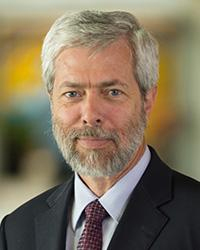
Gordon T. Smith, president of Ambrose University and Seminary in Calgary, Canada, is the keynote speaker for the B.H. Carroll Theological Institute’s Frank and Pauline Patterson Fall Colloquy. All of the sessions Nov. 9-10 will be conducted via Zoom videoconferencing due to the COVID-19 pandemic. Smith is the author of 16 books on the Holy Spirit, ministerial leadership, and Christian spirituality in a secular age, including the soon-to-be-released Come Holy Spirit Come: The Spirit in Creation, the Church and the Christian. “The Times, They Are A-Changin’” is the colloquy theme. In the first session, Smith will address the secular age and the problems and opportunities presented to Christians. The second session will feature a presentation on sustaining the scholarly vocation in changing times. The third session will address the Christian’s necessary hopefulness in a time of change. Also at the fall colloquy, Margie Clayton, the latest Ph.D. graduate of B.H. Carroll Theological Institute, will present her doctoral dissertation. There is no cost for online participants. To register, click here.

Baylor University announced a $30 million gift commitment from Dan and Jenni Hord of Midland. Through the Hord Scholarship Challenge, they are encouraging the collective Baylor Family to match their giving to the university by supporting merit-based scholarships to help deserving students bridge the gap between merit- and need-based financial aid and unmet financial need. Currently, more than 90 percent of Baylor undergraduate students receive some form of financial aid, whether from scholarship support, federal loans or private grants. Gifts to scholarships through such initiatives as the Hord Scholarship Challenge will empower the university to attract and retain students who have received merit awards from Baylor based on their success through high school rankings and standardized testing, yet still have unmet and inhibiting financial need.

In a recent meeting in the office of J.W. “Jack” MacGorman on the campus of Southwestern Seminary, daughter Linda MacGorman and President Adam W. Greenway hold a New Testament from the library of the former long-time New Testament professor that he has donated to the seminary among thousands of other titles, sermons, files and other materials.

J.W. “Jack” MacGorman, long-time professor of New Testament at Southwestern Baptist Theological Seminary, is donating his personal library to the seminary. The donation includes thousands of titles from MacGorman’s time as a student and faculty member, as well as many titles from his father, also a minister. Additionally, MacGorman is donating many of his files, notes and records from classes and sermons dating back to the 1940s. MacGorman, who will celebrate his 100th birthday in December, devoted his career to the teaching and training of students. “Dr. MacGorman is an incredible treasure of Gospel faithfulness who gave more than five decades in service to Southwestern Seminary,” President Adam W. Greenway said. “That he would now honor this institution with his library, papers and other valuable items is even more evidence still of the blessing he has been to the seminary.”

East Texas Baptist University received a $20,000 donation from the Rotary Club of Marshall to apply toward the renovation of the 8th floor of the historic Marshall Grand. (ETBU Photo)

East Texas Baptist University received a $20,000 donation from the Rotary Club of Marshall to apply toward the renovation of the 8th floor of the historic Marshall Grand in downtown Marshall. ETBU has begun renovating the 8th floor into the Grand Hall, an open ballroom-type facility that can accommodate up to 280 guests in banquet-style seating or 400 theater-style seats. After Marshall Grand was given to the university in 2013, ETBU raised more $4 million to renovate the historic building with significant contributions from the Andersen Foundation, Moody Foundation, Meadows Foundation, and J.E. and L.E. Mabee Foundation. The School of Nursing Campaign also garnered support from foundations across the state, including the Rosa May Griffin Foundation, the T. J. and LaVerne Plunkett Foundation, and the Wece and Martha Johnson Foundation. While donor support provided the means to complete the academic spaces, three floors of the Marshall Grand remain unfinished, as the university continues to raise funds and make decisions on how to utilize the additional spaces.

Oza Jones Jr. has been named director of African American ministries for the Baptist General Convention of Texas. Jones served most recently as African American evangelism and church revitalization specialist on Texas Baptists’ Great Commission Team. He previously served churches in Grand Prairie and Arlington.

The Baptist History & Heritage Society honored church historian Karen Bullock of the B.H. Carroll Theological Institute with a Festschrift for her contributions to research and teaching in Baptist studies and for her service to Baptist causes globally. A Festschrift, German for “celebration writing,” has been a tradition in scholarly circles more than 120 years. Members of the academic community are invited to provide an article in an area of interest to the honoree. The articles then are compiled in a single issue of a scholarly journal. The Spring 2020 issue of Baptist History & Heritage features articles written by Bullock’s former students, colleagues and friends. Prior to joining the B. H. Carroll Theological Institute, Bullock taught at Dallas Baptist University and Southwestern Baptist Theological Seminary. She has served as chair of the heritage, identity and religious freedom commissions of the Baptist World Alliance.

Howard Payne University recently hosted alumni, students, personnel, board members and friends at the HPU Fall Family Reunion on Saturday, Oct. 10. The reunion featured Cobbler on the Campus and music from Taylor Castleberry, a 2013 HPU graduate. The festivities also included inter-squad scrimmages hosted by HPU’s softball and baseball teams. The HPU Spring Family Reunion is scheduled Feb. 20, 2021. The spring event will feature a tailgate celebration with music by Austin Upchurch and his band prior to the HPU football game against McMurry University at Gordon Wood Stadium.


Few churches back to attendance levels before pandemic

NASHVILLE, Tenn.—The vast majority of U.S. Protestant churches say they are holding in-person services, but churchgoers have yet to attend in the numbers they did before the coronavirus pandemic struck.

According to the latest survey from LifeWay Research, 87 percent of Protestant pastors in the United States say their church met in person in September, while 13 percent did not hold physical gatherings.

Since the beginning of March, LifeWay Research has been tracking how COVID-19 is affecting churches. While few Protestant churches gathered physically in April, most began meeting in person again by May with more than 7 in 10 pastors saying they did so in July.

“More and more churches across the U.S. have found ways to meet again, but things are not back to normal,” said Scott McConnell, executive director of LifeWay Research.

“The impact of regulations, caution and hardships mean more than 1 in 10 churches are still not meeting in person for any type of worship service. Churches are living organisms, and when more than a third of their members are missing, they are not whole.”

Keeping crowds a manageable size?  No problem.

A majority of African American Protestant pastors (60 percent) say their congregations did not meet in person last month.

Mainline pastors (31 percent) are more likely than evangelical pastors (7 percent) to say they did not physically gather in September. Denominationally, Methodists (22 percent) and Presbyterian/Reformed (23 percent) are more likely to say they did not meet in person than Lutherans (12 percent), pastors in the Restorationist movement (10 percent) or Baptists (9 percent).

Social distancing may be easier in churches, as most pastors say their congregation has less than 70 percent of pre-COVID crowds.

One in 10 churches (9 percent) say their attendance in September was less than 30 percent of what it was in February before the pandemic spread to the United States. Another 20 percent say attendance was between 30 percent and less than 50 percent of what it was.

A third of pastors (34 percent) say it has reached 50 percent to less than 70 percent of previous levels. For 1 in 5 (21 percent) attendance is between 70 percent to less than 90 percent.

Not what it used to be

Few pastors say attendance is close to what it was earlier in the year. One in 10 pastors (11 percent) say September’s attendance was 90 percent to 100 percent of February’s, while 4 percent say their current attendance is more than what it was pre-COVID.

“In most churches, there is definitely room to spread out,” said McConnell. “It would not be surprising for 30 percent or more of a congregation to be in a ‘high-risk’ group needing to continue to take precautions. Since some at-risk members are attending, it only highlights further that there are also churchgoers who have resumed other activities without returning to church.”

Prior to the pandemic, 45 percent of pastors say their typical weekend worship service attendance was less than 100. Now, almost 3 in 4 pastors (72 percent) find themselves with a worship service crowd below triple digits.

In February, 20 percent of Protestant churches had crowds topping 250 people. In September, only 6 percent drew attendance levels that high.

Pastors of churches that were drawing more than 250 in February are the most likely to say their current attendance is less than 30 percent of what it was earlier this year.

“Since many large churches are not used to functioning with so few people, they may need to reconnect with small churches in their area for ideas. Churches of all sizes have much more in common this year and likely can be learning from each other,” McConnell said.

Lasting changes

Many pastors may not know the extent to which the pandemic has altered their church for months or years to come, but some say it has already brought long-term changes.

The most common shift pastors had to make due to COVID-19 was delaying a large planned capital expense, with 12 percent of pastors saying they had to put off a construction project or similar expenditure.

Some churches (8 percent) say they were forced to delete a ministry. Overall, 2 percent of pastors say they cut their outreach ministry, 2 percent got rid of their children’s ministry, 2 percent stopped Sunday school or small groups, 1 percent ended student ministry, and 1 percent deleted other service times like Wednesday and Sunday nights.

Church staff were impacted at some congregations, as 6 percent of pastors say their church reduced the pay or benefits for staff members, and 6 percent say they were forced to delete a staff position. African American pastors are the most likely to say they had to cut staff pay or benefits (21 percent) and delete positions (18 percent).

Another 6 percent of pastors say they reduced giving levels to their denomination, while 5 percent stopped supporting a missionary or outside ministry.

Still, almost 3 in 4 Protestant pastors (73 percent) say their congregation has avoided any of these long-term issues to this point.

“Most churches have not had to make drastic cuts to their ministry to this point, but the effects of the pandemic are also not over,” McConnell said. “From pastors’ perspectives, some of the suspended ministry activities already feel long term even if they hope to resume those activities soon.”

The survey of 1,007 Protestant pastors was conducted Sept. 2–Oct. 1, 2020, using both phone and online interviews. For phone interviews, the calling list was a stratified random sample, drawn from a list of all Protestant churches. Quotas were used for church size. For online interviews, invitations were emailed to the LifeWay Research Pastor Panel followed by three reminders. This probability sample of Protestant churches was created by phone recruiting by LifeWay Research using random samples selected from all Protestant churches. Pastors who agree to be contacted by email for future surveys make up this LifeWay Research Pastor Panel.

Each survey was completed by the senior or sole pastor or a minister at the church. Analysts weighted responses by region and church size to reflect the population more accurately. The completed sample is 1,007 surveys (502 by phone, 505 online). The sample provides 95 percent confidence the sampling error does not exceed plus or minus 3.4 percent. This margin of error accounts for the effect of weighting. Margins of error are higher in sub-groups.


White evangelicals outliers on every issue of concern to voters

WASHINGTON (RNS)—As they head to the polls, nearly all religious Americans say the coronavirus is the most critical issue facing the country, a new study shows. But there’s one notable exception: white evangelicals.

Only 35 percent of white evangelicals said the coronavirus is of critical concern, the 11th annual American Values Survey conducted by PRRI, released Oct. 19, shows. Among this group, abortion and terrorism top the list of critical concerns. No other religious group identified abortion among its top three concerns.

On this and other issues, white evangelicals are outliers among U.S. religious groups.

“White evangelical Protestants do seem to be out on a limb on their policy views and views of Trump,” said Natalie Jackson, PRRI’s director of research.

“It’s more a fact of other types of Christians—mainline Protestants and Catholics—shifting away toward a more centrist outlook and increasingly leaving white evangelicals out on their own as the one religious group that very much supports Trump and is locked in with their party ID.”

Most white evangelicals still support Trump

The study, conducted in September among 2,538 U.S. adults, shows that overall, 35 percent of Americans approve of how President Donald Trump has handled the coronavirus pandemic, while 65 percent disapprove.

Evangelicals (from left) Ronnie Floyd, Rodney Howard-Browne, Adonica Howard-Browne, Johnnie Moore and Paula White stand behind President Trump during a July 10, 2017, meeting in the White House. (RNS Photo / Courtesy of Johnnie Moore)

But white evangelicals approve of the job Trump is doing at a rate of 76 percent, as compared to 52 percent of white mainline Protestants and 49 percent of white Catholics.

Heading into the 2020 election, their support for the president remains steadfast.

Majorities of every other religious group say the president has damaged the dignity of the office of president. But only 36 percent of white evangelicals believe that. And among white evangelicals who identify as Republicans, only 20 percent say he’s damaged the dignity of the office.

White evangelicals are also the only major religious group to say the country is moving in the right direction, with 59 percent agreeing. By comparison, only 40 percent of white mainline Protestants, 39 percent of white Catholics, 40 percent of Hispanic Protestants and 28 percent of Hispanic Catholics said the country is headed in the right direction.

That assessment drops even further among non-Christian and unaffiliated Americans. Only 24 percent of non-Christian religious Americans and 18 percent of religiously unaffiliated Americans say the country is headed in the right direction.

The one area where religious groups appeared to agree was regarding Trump’s behavior in comparison with his predecessors. A majority of white evangelicals (55 percent) said they wish Trump behaved more like his predecessors, compared to 66 percent each of white mainline Protestants and white Catholics, and 67 percent of Hispanic Protestants. Seventy-one percent of Hispanic Catholics and non-Christian religious Americans wished Trump’s behavior was more in line with his predecessors.

American exceptionalism

On other issues, such as whether God has granted the U.S. a special role in history, the divisions surfaced once again: A strong majority (71 percent) of white evangelicals said the U.S. plays a special role—more than any other religious group. Only 35 percent of white Catholics, 32 percent of white mainline Protestants, and 15 percent of religiously unaffiliated Americans agree with the statement about the special role of the United States.

But even among evangelicals, there was a notable decline in support for the statement from four years ago, when 82 percent of white evangelicals said the same.

The survey also found there were no religious groups in which a majority agreed the United States sets a good moral example for the world. Only 33 percent of white Catholics, 29 percent of white mainline Protestants and 28 percent of white evangelicals agreed. Black Protestants (14 percent) and religiously unaffiliated Americans (10 percent) were even less likely to agree America sets a good moral example.

The margin of error for the survey was plus or minus 2.6 percentage points at the 95 percent level of confidence.


Young ministers join together for growth and encouragement

Young ministers long for community—not just to hang out, but to grow. To meet that need, a group of young ministers formed The Pastor’s Common in September 2019.

The Pastor’s Common exists to strengthen the church by creating space for pastors to build community, to grow morally and intellectually, to be resourced and to be heard. It now has more than 150 members.

The Truett Church Network recently featured three members of The Pastor’s Common—David Miranda, Nataly Mora and Evan Duncan—in a Pastor’s Round Table discussion hosted virtually by Matt Homeyer, assistant dean for external affairs at Baylor University’s Truett Theological Seminary and director of the Truett Church Network.

Miranda, one of the founders of The Pastor’s Common, is the director of Missionary Adoption Program and urban ministries for Texas Baptists. He is from Sulphur Springs and is a graduate of Dallas Baptist University.

Mora is the associate pastor of community and Spanish ministries at Park Lake Drive Baptist Church in Waco. She is a native Texan, a daughter of immigrants, a graduate of DBU and a current student at Truett Seminary. Miranda and Mora planted a church together in Dallas’ West End while attending DBU.

Duncan is teaching and communication pastor at First Baptist Church in Temple. Originally from western Pennsylvania, his stepfather was in the U.S. Army and was stationed “all over the world.” Duncan is a graduate of the University of Mary-Hardin Baylor and Truett Seminary.

Intergenerational learning

Homeyer, 39, identifies himself in a “bridge generation” between older and younger ministers. He is interested not just in what younger ministers can learn from older ministers, but also what older ministers can learn from younger ministers.

Regarding COVID-19, the most pressing current issue, Homeyer asked where Mora, Miranda and Duncan see challenge and “kingdom opportunity.”

Maintaining Park Lake Drive’s multi-generational and multiethnic identity while meeting online has been challenging, Mora said. But since the church’s diversity is ingrained—and not simply an idea or an aspiration—maintaining the church’s identity has been easier, she noted. She cited the example of a Spanish-speaking church member who made sure a senior adult woman was getting food.

Taking church online has made it easier for people to self-select different spaces, which usually are smaller and less diverse groups than when people met in person, Duncan said. Connections can’t be taken for granted during the pandemic in the way they were when people could meet in person. The benefit of virtual connections, then, is the opportunity for people to have deeper and more intentional connections than they may have had in person, he noted.

Hope for the future

Many express pessimism about the future of the American church, but Homeyer wanted to know what gives these young ministers hope as they look into the church’s future.

Duncan was quick to express how proud he is of Gen Z—those born between 1995 and 2010—who he sees leading in ministry and teaching and as incredible communicators. They are not confined or threatened by denominational boundaries, he also noted.

Also, he sees growth in spiritual practice—faith as “a thing we do” instead of something purely internal.

Mora and Miranda agreed Millenials—those born between 1981 and 1995—like “doing things in community.” Citing Emil Brunner’s Dogmatics, in which he asserts the church is a community and not a thing, Mora said Millenials tend to question institutions, preferring community and fellowship.

Frustration with the church

“Where do you grow frustrated with the church now?” Homeyer asked.

Pointing to the “sacred place” the church occupies to advocate, educate and be a good neighbor in its community, Mora lamented that the church doesn’t “step into that space often enough.”

The church frequently gets “bogged down” in problems instead of proclaiming the gospel and meeting needs, Duncan said. Young ministers know change happens slowly in the church. “But does it have to be this slow?” he asked.

Miranda is most frustrated with “moral inconsistencies” in the church and noted atheists have asked him why the church does things they see as moral equivocation. The world “is eager for us to be who we say we are,” Miranda stated.

Support from the church

In a desire for community, young ministers long to fellowship and be discipled. To achieve both, Miranda and a group of young ministers formed The Pastor’s Common for ministers in their 20s and 30s.

Young ministers also long for mentoring from seasoned ministers, Miranda added.

In response to what support young ministers need, Mora pointed to the need to encourage women called into ministry and gifted to preach and pastor.

She also counseled mentors not to put mentees in a box or to remake them in the mentor’s image. Instead, look at young ministers’ gifts and give them opportunities to use them, and “maybe even to fail. We grow from failure; we grow from those experiences, as well,” Mora added.

“Utilize our creativity,” Miranda said.

Duncan mentioned Growing Young by the Fuller Youth Institute, a resource for churches wanting to engage younger generations.

Joe Loughlin, senior pastor of First Baptist Church in Temple, not only entrusts Duncan with leadership—including preaching nearly every Sunday in either the classic or modern worship services—but also wants to learn from Duncan. In turn, Duncan wants to “give those keys away” to Gen Z students.

To those younger than them

Despite younger generations’ questioning of institutions, Miranda, Mora and Duncan are on staff at three institutions.

As “insiders” who are part of institutions, Homeyer asked what encouragement or challenge they would give to those younger than them.

The younger generation values the “work that has been laid before us,” Miranda said. “We are standing on shoulders of people way ahead of us,” he added.

Mentioning Bill Arnold, founding and recently retired president of the Texas Baptist Missions Foundation, Miranda was impressed by a picture of Arnold raising money for the Texas Baptist missions when he was Miranda’s age.

“Your calling is not dependent on … the permission or whatever of other folks,” Duncan asserted. “I mean, your calling is a calling from God, and so, run with that, and do it, and when you see things that you wish were being done that aren’t being done, do those things,” he continued.

With all the transitions taking place, “the thing that you desire probably doesn’t exist,” Duncan said.

“Don’t wait for somebody to create that for you,” he urged. Instead, “if you’re called to it … just create it. And if you fail, OK. It already wasn’t there. So … give it a try,” Duncan said.

Ministers who want to connect with The Pastor’s Common can email David Miranda at david.miranda@txb.org or follow the group on Facebook at www.facebook.com/thepastorscommon.

The Pastor’s Common also has created a web series titled “20 Things We Learned in 2020” that is available on Facebook and will culminate on Nov. 15.


Texas Baptists gather online for annual meeting

For the first time, Texas Baptists will gather online for their annual meeting, Nov. 16-17, in response to the COVID-19 pandemic.

The 135th annual Baptist General Convention of Texas annual meeting will emphasize the call to live “Compelled” to fulfill Christ’s Great Commission and Great Commandment.

During the online meeting, Texas Baptists will celebrate mission work made possible through partnerships across Texas, the country and around the world.

“In the midst of this pandemic, Texas Baptists have locked arms, leaned into the challenge and ministered effectively,” Executive Director David Hardage said. “At our upcoming online annual meeting, Nov. 16-17, we will celebrate all that God has accomplished through our cooperative ministry efforts in the midst of difficult times.”

Participating online

On Nov. 16 from 6 p.m. to 8 p.m., church-elected messengers will participate in the annual meeting business session to elect officers and vote on the 2020 proposed budget, nominations for affiliated boards and ministries and consider resolutions.

Messengers must register by Nov. 13 to participate in the meeting. Meeting organizers encourage Texas Baptist-affiliated churches to register their maximum number of messengers so that their church’s voice can be heard during the meeting. For more information about messenger registration and business items, click here.

All Texas Baptists—messengers and visitors alike—are invited to join the online celebration session on Nov. 17 from 6 p.m. to 8 p.m.

The service will include worship, an executive director’s update from Hardage, a sermon from BGCT President Michael Evans, pastor of Bethlehem Baptist Church in Mansfield, and updates about ministries made possible through Cooperative Program giving. No registration is required. Visitors can join the session by clicking here or going to the Texas Baptists’ Facebook Live page.

Prior to the annual meeting, the Texas Baptists en Español and the African American Fellowship worship rallies will be held at 7 p.m. Nov. 15. A new rally for young adults, Devoted Young Adult Virtual Gathering: 20 Things We Learned in 2020, also is scheduled at 7 p.m. To register or find more rally information, click here.

Leading up to the Annual Meeting, a series of live workshops are being hosted each Tuesday at 2 p.m. over Zoom. Workshops began Sept. 8 and will continue through Nov. 17. These workshops cover topics including evangelism, student missions, the Great Commission and more. The workshops are also being recorded, and are available here.

For more information about Texas Baptists’ annual meeting, messenger registration and the celebration service, click here.


Masks reduce spread of virus but make sermons tough

WASHINGTON (RNS)—Pastor Timothy Filston of First Presbyterian Church in Thomasville, Ga., had a request for his mask-wearing congregation during a recent sermon.

“Give me all you can through your eyebrows,” Filston said.

The church has begun meeting again in person for worship, and congregation members are required to wear masks during services. Masks help prevent the spread of COVID-19, but they make it hard for a preacher like Filston to read the room. He has trouble discerning whether the congregation is paying attention or nodding off during his sermon.

All he sees is a crowd of blank faces. Eyebrows are the only clue he’s got.

Preachers like Filston have had to adapt quickly during the coronavirus pandemic. Many moved from preaching in person to speaking to their congregations online after most congregations shut down in-person services during the early days of the pandemic.

Is the message getting through?

As congregations reopen, often with social distancing and masks, preachers faced new challenges, said Jim Hudnut-Beumler, professor of American religious history at Vanderbilt Divinity School in Nashville.

Hudnut-Beumler, an ordained Presbyterian minister who often guest preaches, said preaching is more of a conversation with the congregation than a lecture. A preacher tries to bring “a word of gospel to our people,” he said.

But it’s not always clear if the message gets through.

“There are always two sermons in the room,” he said. “The one the preacher thinks she’s preaching. And the one the congregation member takes away.”

Because of that, he said, it’s important for the preacher to be in tune with their congregation and to see how they respond. He often follows advice he got while in seminary: pick out one face in the pews, talk to them, then move your focus to another person.

That’s difficult to do when preaching online, he said, especially if the sermon is prerecorded. Looking into a camera, he said, “you get absolutely nothing back.”

Preaching to a live congregation is better, but masks complicate things because they can hide feedback from the congregation. As a result, he said, preachers have to be even more attentive to their congregations during the sermon.

Dan Whitmarsh, pastor of Lakebay Community Church in Lakebay, Wash., said he found preaching online easier than preaching to a masked congregation. His congregation, which drew about 65 to worship before the pandemic, used Zoom for online services.

Because of that, everyone’s face was visible, and their reactions were easier to see. Plus, he said, you never knew what might happen.

“You are having church and then all of a sudden, Doug’s dog jumps up on his lap,” he said, “and everyone laughs.”

While the church was meeting online, Whitmarsh would also hang around and chat with people after the service, where he’d get a sense of how they were doing and how the sermon affected them.

Looking for signs

When the church began meeting in person, Whitmarsh decided he’d wear a mask while preaching to set a good example for the congregation. Worshippers also are masked during services. It’s part of his job as a pastor, he said, to care for his congregation’s well-being.

Valerie Hines worships during services at Cornerstone Baptist Church in Arlington, on June 7. After weeks without in-person services due to the coronavirus pandemic, the church opened for worshippers to attend services. (AP Photo/LM Otero)

“I don’t want my people to die,” he said. “And I don’t want to end up on the news.”

The masks make it harder for him to tell if the sermon is hitting home. Whitmarsh usually writes out the entire sermon ahead of time. He also comes up with some additional stories to use as examples in case his main point isn’t connecting.

While he preaches, he watches the congregation for signs they are tracking with the sermon. Sometimes he will prompt them to repeat a point he’d made or to ask questions. Or he may shelve one of the minor points he wanted to make, instead spending time reinforcing the main point.

For him, sermons are about relationships, not just communicating information.

“It’s not just Pastor Dan with today’s wisdom that I am going to dispense to you,” he said. “It’s incarnation, all around the room. I am bringing something to you. You are bringing something to me.”

Not ideal, but ‘what we can do for now’

At Audubon Park Covenant Church in Orlando, Fla., the small congregation has been holding outdoor services in the side yard of the church property in recent weeks. The congregation sits in the shade of a live oak tree, while Pastor Sarah Robinson coordinates the service from a small stage, switching between the congregation in front of her and those watching the service streamed online.

About a dozen older members, who wear masks, come to the in-person service, Robinson said. Younger members usually join online. Robinson, who wears a mask while preaching, is careful not to walk around too much during the service. Otherwise, she’ll walk off camera and people online can’t see her.

“It’s less than ideal, but it’s what we can do for now,” she said.

Even before the pandemic, her sermons were interactive. Now they are even more so. At the end of the sermon, Robinson does a five-minute question-and-answer session, with feedback from both in-person and online worshippers.

“I’ve never preached from behind a pulpit,” she said. “I always come down in the midst of the congregation.”

Even meeting in person, things are not like before. There’s no coffee hour. And while people pass the peace, they greet one another from a distance. Robinson keeps an eye on the chatter online and sometimes will read out what people have posted.

Still, she said, people are grateful to be able to come to church. It’s important to them to be together and to keep on with the church’s mission, no matter what challenges they face.

“We’ll keep doing our best,” she said.

For the foreseeable future, she said the church will continue to meet outside.

“I mean, we live in Florida,” she said. “So, it is only going to get easier for us.”