FLOWER MOUND (BP)—The Village Church asserted it is not liable for damages suffered by a woman who alleges she was sexually abused at age 11 by a youth pastor who served the church at the time.
The Flower Mound church also challenges the plaintiff’s claim of more than $1 million in damages, citing provisions in the Texas Civil Practices and Remedies Code, as well as the Texas Charitable Immunity Act.
The Village Church filed its legal response Aug. 23 in Dallas County Court.
The plaintiff, identified in the lawsuit as Jane Doe One, accuses The Village Church of negligently breaching its duty to care for her and failing to “implement reasonable policies and procedures to detect and prevent” sexual abuse,” as well as failing “to adhere to the policies and procedures it had in place at the time” to prevent the alleged abuse.
The alleged perpetrator Matthew Tonne has a Sept. 4 trial date in Dallas County District Court on a related charge of indecent contact with a child. Tonne has been out of jail on a $25,000 bond since Jan. 9, and his initial court date of Jan. 29 has been rescheduled 12 times, according to court documents.
If the charges the plaintiff alleges are proven to have occurred, The Village Church said Aug. 23, then the church is not liable for “the intentional criminal acts of its employee” because those acts would be outside of the course and scope of his employment.
The church also cited both the U.S. Constitution and the Texas in arguing against exemplary or punitive damages.
Represented by Middlebrook and Goodspeed, the church urged the court to dismiss the lawsuit.
CommonCall: Caregivers need care after a disaster
August 26, 2019
CORPUS CHRISTI—If Hurricane Harvey had hit Corpus Christi directly as a Category 4 storm, First Baptist Church—both the people and the building where they worship—could have been devastated.
Instead, the storm unleashed its fury on communities north of the city—Rockport, Fulton, Aransas Pass, Port Aransas and Refugio.
“We could have been right in the midst of it,” Senior Pastor Brian Hill said. “Instead, we were spared—for whatever reason. So, our job became doing what we could to support others.”
Volunteers from the congregation helped their neighbors to the northeast clear debris. The church received and distributed donated supplies. First Baptist School allowed the children of church staff in affected communities to attend classes at no cost until local schools reopened.
Not long after the hurricane, a layperson at First Baptist asked Hill about Proyecto Fortaleza/The Strengthening Project—a marriage enrichment and spiritual formation retreat offered for pastors in Juarez, Mexico. He had been involved with The Strengthening Project since its beginning, and he served on its board of directors.
“She asked me, ‘Don’t you think pastors here could use that?’” Hill recalled.
Ministry of hospitality
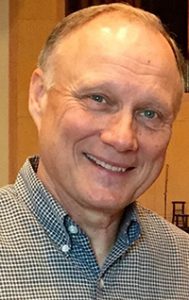
David Crosby
About that same time, he received a resource from Ron Cook, who directed the Center for Ministry Effectiveness at Baylor University’s Truett Theological Seminary. Cook forwarded to Hill a paper by David Crosby, who was pastor of First Baptist Church in New Orleans when Hurricane Katrina hit.
Crosby described the church’s “ministry of hospitality,” as it housed and fed American Red Cross volunteers in the weeks immediately after the hurricane and visiting volunteer groups for about a year thereafter.
Hill contacted Crosby, telling him about a proposed retreat in Corpus Christi for ministers and their spouses who served in Coastal Bend communities affected by Hurricane Harvey.
“He told me, ‘If I could have done it after Katrina, you don’t know what it would have meant,’” Hill recalled.
He asked Crosby how soon after the hurricane he would have “allowed himself to go” to a retreat away from New Orleans, and the pair agreed six weeks to two months would be the best time.
First time ‘across the bridge’ since the storm
So, Hill contacted a hotel on the bay that agreed to offer discounted guest rooms and a meeting room at no cost for the retreat. The Baptist General Convention of Texas provided some funding, along with money raised by Corpus Christi’s mayor.
Twenty-two couples attended the retreat in late October 2017. Jana Pinson, executive director of Pregnancy Center of the Coastal Bend, asked Hill if she could provide gift baskets for each couple, which were placed in their rooms before they arrived.
“Couples came to dinner that night in tears. They were so touched by the love they felt,” Hill said.
The first night, a Christian comedian provided dinner entertainment. The next day, Crosby spoke to the ministers and their spouses.
“He explained a lot of what they were going through and told them what to expect in the future,” Hill said. “He had 10 years to put it into perspective.”
For many of the ministers who attended the retreat, it marked the first time they had “been across the bridge” spanning the bay since Hurricane Harvey, he noted.
“They had not left the field a single day for two months,” Hill said. “Some had not eaten a meal at a table alone with their spouse since the hurricane hit.”
‘Do not waste your hurricane’
Scott Jones, pastor of First Baptist Church in Rockport, attended the Strengthening Project retreat in Corpus Christi with his wife Kim and other ministerial staff and spouses from his congregation. (Photo / Ken Camp)
Scott Jones, pastor of First Baptist Church in Rockport, attended the retreat with his wife, Kim, and the other ministerial staff and spouses from his church.
“It got us out of the disaster recovery zone for a little while. It allowed us to relax for a bit and just spend some time with our spouses,” he said.
Nearly two years later, Jones reflected on Crosby’s presentation.
“He contributed to my understanding of what God could do in the midst of a disaster. Something he said stuck with me: ‘Do not waste your hurricane,’” Jones said.
Kevin Muilenburg, pastor of Coastal Oaks Baptist Church in Rockport, attended with his wife, Kelley.
“Just to get away for a little while meant a lot,” he said. “Living with the disaster was kind of like a perpetual youth camp. You’re out of your routine. You stay up late and sleep in an uncomfortable bed. Your feet hurt. Your back hurts. You don’t eat right. But the difference is that Friday never gets here.”
Change in demeanor
Hill observed a noticeable difference in demeanor of the ministerial couples when they arrived and when they left the retreat.
“The longer they were together, the more they relaxed around each other,” he said. “You could hear them laughing together. Some were crying together.”
One year after the first retreat, Hill and The Strengthening Project offered a follow-up retreat that drew 15 couples. Scott Floyd with the B.H. Carroll Theological Institute, a licensed professional counselor and licensed marriage and family therapist, spoke on ministry in times of crisis.
“He talked about how to deal with people in crisis and how to know when you are in crisis yourself,” Hill said.
All of the ministers who participated received copies of Floyd’s books.
“We wanted to give them tools to help people,” Hill said.
Read more articles like this in CommonCall magazine. CommonCall explores issues important to Christians and features inspiring stories about disciples of Jesus living out their faith. An annual subscription is only $24 and comes with two free subscriptions to the Baptist Standard. To subscribe to CommonCall, click here.
CommonCall: Strengthen ministry by strengthening marriage
August 26, 2019
JUAREZ, Mexico—An initiative to strengthen ministers and their families in Juarez grew out of longstanding relationships a campus minister in Levelland developed with pastors in the Mexican border city.
Throughout the four decades Arlano Funderburk served as director of Baptist Student Ministries at South Plains College, he traveled to Mexico early each year to locate sites and make plans for a weeklong summer mission trip for students.
In 2006, he learned about two pastors in Juarez who recently had sustained fatal heart attacks.
“One of them happened while he was preaching on Sunday,” Funderburk said.
Most of the pastors in the area served bivocationally. Because many lacked health insurance, they avoided trips to the doctor unless they needed urgent care.
So, Funderburk proposed offering physical exams for the pastors and their spouses. With preventive care, he hoped pastors could then get ahead of a difficult situation before a condition turned fatal. As a follow-up, he invited the ministers and their spouses to a retreat.
Retreat benefits churches ministers serve
Arlano Funderburk
Proyecto Fortaleza/The Strengthening Project—an annual retreat for couples in ministry—took shape. The annual retreats focus on spiritual development and marriage enrichment.
“If we could strengthen the marriage, then I felt like we could also make a strong contribution to their churches as well,” Funderburk said.
The retreat not only benefits the 40 couples or so who participate, he noted. It also affects the lives of nearly 2,000 church members in the congregations those ministers and spouses serve.
For 13 years—even during the period of drug-cartel violence that briefly earned Juarez the title “murder capital of the world”—the retreats continued without interruption, he noted.
“And the response has been wonderful,” he added.
‘They chose to stay’
Brian Hill initially became involved with the Strengthening Project about 10 years ago, when he served churches in Littlefield and Levelland. Hill now is pastor of First Baptist Church in Corpus Christi and president of the Strengthening Project board of directors.
The Strengthening Project retreat allows pastors and spouses to engage in worship, spiritual development and marriage enrichment. (Photo courtesy of Arlano Funderburk)
Hill pointed to the impact violence in Juarez had on ministry there a decade ago. Many of the churches in the United States that had partnered with congregations in Juarez cancelled mission trips, and some ceased to provide ongoing financial support.
When congregations in metropolitan Juarez suffered, churches in towns surrounding the metropolitan area also paid the price, since it meant diminished resources for the Northern Chihuahua Regional Baptist Association, he added.
“I saw this as an opportunity not only to minister to pastors but to all of those who somewhat felt abandoned and alone,” Hill said. “They could’ve left, they could’ve gone into the interior away from the border and the violence, but they chose to stay. This is something that really humbles me, to think that I can be a part of helping with that.”
Ten years ago, the Strengthening Project offered a one-day retreat. It grew into a three-day experience.
For ministers and their spouses to attend the Strengthening Project retreat, they often must plan months in advance. Since most serve bivocationally, participation in the retreat means scheduling time off from secular employment—often without pay.
Open eyes to new ideas
Their willingness to plan ahead and make necessary adjustments shows how much they need what the retreat offers, Funderburk noted.
The Strengthening Project not only offers pastors and their spouses rest and fellowship, but also opens their eyes to new ministry ideas, he said.
“I’ve heard many stories about new ministries that churches provide because of the vision they have gotten here,” Funderburk said. He pointed specifically to churches that developed ministries to care for widows and children who were victims of violence.
Couples in ministry whose marriages suffered due to the pressures they faced also found new hope. Even some marriages that were on the brink of divorce flourished again after couples attended the retreat, Funderburk noted.
The Strengthening Project fills a void. While pastors may have the benefit of occasionally attending some conferences and training events, there is little or nothing offered otherwise for spouses and couples ministry, Hill observed.
‘It is God’s gift’
The retreat can be costly, and the Strengthening Project operates as a not-for-profit organization on a tight budget. Often, the organization does not receive the funds it needs until after the retreat concludes and the bills come due, Funderburk noted.
However, the cost the organization pays pales in comparison to the price the ministers and their families pay, day in and day out, serving in a difficult place, Funderburk said. Following Jesus in Juarez comes at a price unfamiliar to most Christians in the United States, he noted.
The pressures they face can make them lose sight of their calling, but the Strengthening Project helps them find the focus they need, Hill said.
Serving alongside Funderburk and Hill on the Strengthening Project board are Dave Job, a retired pastor; Raquel Contreras, general director and publisher of Editorial Mundo Hispano/Baptist Spanish Publishing House, who serves as the organization’s secretary; and Zoricelis Davila, a Christian counselor and psychotherapist in Fort Worth, who serves as treasurer. Both Contreras and Davila also teach and facilitate sessions at the retreat.
“We do this and continue to do it because the value that we see in it,” Funderburk said. “We feel it is God’s gift, and we are just thankful to get to be a part, but he provides for this. And because we have seen what he is doing and what he has done, we are convinced this is worth our lives and the investment.”
Read more articles like this in CommonCall magazine. CommonCall explores issues important to Christians and features inspiring stories about disciples of Jesus living out their faith. An annual subscription is only $24 and comes with two free subscriptions to the Baptist Standard. To subscribe to CommonCall, click here.
TBM delivers water to wildfire first responders
August 26, 2019
Texas Baptist Men volunteers are delivering a tractor-trailer load of water to firefighters working around the clock as they battle the more than 8,000-acre Copper Breaks Fire near Quanah.
The delivery is in response to a request from Texas Emergency Management. It will help keep first responders hydrated as they fight the blaze that at one point engrossed 12,000 acres northwest of Copper Breaks State Park.
TBM is picking up the water from the Salvation Army in Arlington and taking it to Hardeman County. The firefighters have the wildfire 50 percent contained, according to the latest reports on Aug. 20.
“Firefighters are working around the clock to put out this fire,” TBM Disaster Relief Director Dwain Carter said. “We’re extremely proud of those who put their lives on the line to protect the rest of us and happy to support them in any way we can.”
The fire began Friday morning, Aug. 16, and firefighters have been battling it since then. The Texas A&M Forest Service brought in bulldozers and helicopters in an effort to relieve responders.
About a week earlier, TBM sent a trailer loaded with water, clothes, hygiene products and other supplies to a Laredo church that is ministering to asylum-seeking immigrant families.
Hardin-Simmons alum fulfills missionary calling as coach
August 26, 2019
PLANO—Early in life, Rusty Oglesby felt God’s calling to become a missionary. After his experiences as a student athlete at Hardin-Simmons University, he became convinced his mission is to shape young lives as a coach.
Today, Oglesby not only is a football and soccer coach and teacher at John Paul II High School in Plano, but also general manager of a semi-professional soccer team, the Denton Diablos.
Oglesby was a tri-sport athlete at Abilene High School before registering at Hardin-Simmons. He attended HSU from 1993 to 1997, graduating with a Bachelor of Arts degree.
At Hardin-Simmons, he played football under Coach Jimmie Keeling four seasons. He also worked on HVAC maintenance on campus, attended college worship services at University Baptist Church and was involved with youth programs through Calvary Baptist Church, where his father preached.
Freshman All American at HSU
Rusty Oglesby kicked off the first football game in the newly constructed Shelton Stadium at Hardin-Simmons University in 1993. (HSU Archival Photo)
During his first football season at HSU, Oglesby kicked off the first game in newly constructed Shelton Stadium.
“Of course, we won the conference championship in 1993, but 100 other guys did that. I am the only one who will ever get to be the first to touch the ball in the first game at Shelton Stadium,” Oglesby said. That same year, he was named HSU’s only freshman All American.
Oglesby now is the varsity boys’ soccer head coach and the varsity football offensive coordinator at John Paul II High School, where he also teaches personal finance. For the last five years, he also has worked as a certified real estate agent in the Dallas-Fort Worth area.
Rusty Oglesby is general manager of the semi-professional Denton Diablos soccer team. He is pictured with Tobias Lopez, general manager of the Fort Worth Vaqueros. Both are Hardin-Simmons University alumni. (Photo courtesy of Rusty Oglesby via HSU)
His role with the Diablos is more of a weekend gig, he explained, which comes to a head during the summer months when the soccer season kicks off.
Oglesby has served as general manager of the Denton Diablos since the club’s inception and “was an integral part of our inaugural season’s success,” co-owner Damon Gochneaur noted.
Coaching as a calling
Oglesby views coaching as a calling.
“From a young age, I knew I was called to be a missionary. I thought, after going to HSU and playing football for Coach Keeling, there was no better mission than being a high school coach,” Oglesby said.
Oglesby coached at four high schools before arriving at John Paul II in 2017. Over the years, he has led his soccer teams to the 2010 UIL State Championship, the 2014 State Semifinals and the 2016 State Finals, and he was named United Soccer Coaches State Coach of the Year in 2016.
Coach Rusty Oglesby and his wife Cory are pictured with daughter Chassiti and son Cutter. (Photo courtesy of Rusty Oglesby via HSU)
He also racked up a long list of awards in his time as a coach, including the Texas Association of Soccer Coaches Region 2 Coach of the Year in 2010, 2014 and 2016, as well as District Coach of the Year eight times between 2000 and 2016.
Oglesby remains busy outside of work as the father to two adult children and a baby due late this year. Each day, he said, he asks himself, “What can I do to better myself, to better my family, and leave a legacy for my kids?”
He remains motivated by “knowing that we are called to be fishers of men and we are called to be leaders,” he said.
“Hardin-Simmons gave me the opportunity to hone that skill,” he added.
Around the State: NFL chaplain addresses UMHB faculty and staff
August 26, 2019
Johnny Shelton, chaplain for the Baltimore Ravens football team and founder of Attitudes In Motion, was guest speaker at the University of Mary Hardin-Baylor University Assembly on Aug. 20. UMHB’s University Assembly is an annual gathering of faculty and staff held on the eve of each year’s Move-in Day and Welcome Week. “I came all the way from Baltimore to, No. 1, remind you of the great job that you’re doing and, No. 2, thank you for answering the call,” Shelton said. “The challenge and the charge is to fulfill your ministry. God sent these children to you so that you could speak life into them.” Shelton, a graduate of Southeast Missouri State University, was team chaplain for the Virginia Tech football team before joining the Ravens in 2013.
Great Value Colleges ranked Baptist University of the Américas in San Antonio among the top one-third of its 100 most affordable small colleges west of the Mississippi and No. 1 in Texas. BUA ranked No. 31 in the overall listing of small colleges in the western United States. The organization made its selections and rankings based on location, student population and net price. Abraham Jaquez is president of BUA.
Hardin-Simmons University opened its new College of Health Professions on Aug. 15. While existing degree programs in several health profession fields will remain in the same physical locations, housing all the programs in one college allows for “engagement in interprofessional education and servant leadership activities,” said Janelle O’Connell, dean of the college.
Churches train armed members in wake of mass shootings
August 26, 2019
HASLET (AP)—Acrid gun smoke clouded the sunny entrance of a North Texas church on a recent Sunday. Seven men wearing heavy vests and carrying pistols loaded with blanks ran toward the sound of the shots, stopping at the end of a long hallway. As one peeked into the foyer, the “bad guy” raised the muzzle of an AR-15, took aim and squeezed the trigger.
The simulated gunfight at the church in Haslet, north of Fort Worth, was part of a niche industry that trains civilians to protect their churches using the techniques and equipment of law enforcement.
Rather than a bullet, the rifle fired a laser that hit Stephen Hatherley’s vest, triggering an electric shock the 60-year-old Navy veteran later described as a “tingle.”
Churches seek to secure sacred spaces
Shootings this month killed more than 30 people at an El Paso Walmart and Dayton, Ohio entertainment district. But gunmen have also targeted houses of worship in recent years, including a Texas church in rural Sutherland Springs, where more than two dozen people were shot dead in 2017.
The anxiety of one mass shooting after another has led some churches to start training armed worshippers. Not all security experts support this approach, but it has gained momentum as congregations across the country grapple with how to secure spaces where welcoming strangers is a religious practice.
“Ten years ago, this industry was not a thing,” said David Riggall, a Texas police officer whose company trains churchgoers to volunteer as security guards. “I mean, sanctuary means a safe place.”
In 1993, Doug Walker said security wasn’t at the fore of his mind when, as a recent Baptist seminary graduate, he founded Fellowship of the Parks church in Fort Worth. But six years later, after a gunman killed seven people and took his own life at another church nearby, the pastor said his thinking changed.
Today, the interdenominational church has four campuses and 3,000 worshippers on an average Sunday, Walker said. It has increased security as it has grown, asking off-duty police to carry weapons at church events.
It recently hired Riggall’s company, Sheepdog Defense Group, to train volunteers in first aid, threat assessment, de-escalation techniques, using a gun and tactical skills, such as clearing rooms during an active shooting.
Mass shootings prompt churches to train volunteers
Walker, 51, said there wasn’t a single event that prompted his church to decide its guards needed more training. But Riggall said that after mass shootings, congregations reach out.
“Every time the news comes on and there’s another shooting in a school or church or something like that, the phone starts ringing,” Riggall said.
The 46-year-old police officer said he and a colleague had the idea for the company after the 2012 mass shooting at an elementary school in Newtown, Conn. They started conducting firearms training exercises with parents and, after Riggall became certified under Texas law to train security guards, transitioned to churches.
The company incorporates Christian teachings into its courses. More than 90 people at 18 churches have completed the 70 hours of initial training and become state-licensed guards through its program, Riggall said. The so-called sheepdogs are insured and technically employed by the company. But they volunteer providing security at their own churches, which in turn pay Riggall.
On a Sunday last month, Brett Faulkner stood with an AR-15 in hand and his back to the cross in the sanctuary of Fellowship of the Parks campus in Haslet. He pointed the rifle at a young woman’s back and yelled at the armed men advancing into the room: “I’m going to kill this woman. It’s going to happen right now.”
Faulkner, a 46-year-old information technology worker, already completed a Sheepdog session but came to another church’s to play the bad guy and keep his skills sharp.
“It really just comes down to caring about the people in that building,” Faulkner said of choosing to guard his small Baptist church.
What is the right balance?
Faulkner said his congregation re-evaluated its security after recent mass shootings and went with Riggall’s company as a cost-effective option.
“This is a good balance between the cost of paying professionals and relying on untrained volunteers,” he said.
Security professionals differ on what balance is right.
After 11 worshippers were shot dead during Shabbat morning services at a synagogue in Pittsburgh, the city’s Jewish community has added layers of defenses.
Since that October attack, congregations that once felt guns were unnecessary or inappropriate have welcomed armed security, said Brad Orsini, security director for The Jewish Federation of Greater Pittsburgh. But arming worshippers is not an approach the former FBI agent recommends.
“Carrying a firearm is an awesome responsibility,” said Orsini, who served in the Marine Corps before his nearly three decades with the FBI. “Because you have the ability to have a carry concealed permit does not make you a security expert. Because you have a firearm doesn’t necessarily mean you should be carrying it at the church on the weekend.”
Sheepdog Firearms, a gun range in the Birmingham, Ala., area, offers police-style training to people looking to protect their churches. Owner David Youngstrom acknowledged the eight-hour course doesn’t produce experts.
But, he said, many of the roughly 40 Alabama churches that have sent people to take the class are small, rural congregations with limited means. For them, having armed volunteers can feel like the only option, he said.
Legal considerations noted
And the training events provide churches with evidence of having a security program in place if a tragedy turns into litigation. “It gives a good record for something that will hold up in court,” Youngstrom said.
Laws about carrying firearms in houses of worship vary from state to state. But as a general matter of liability, churches training members for security is not much different from a business hiring guards, according to Eugene Volokh, a professor at the UCLA School of Law.
A church could be sued if people were harmed because its security was badly trained, Volokh said, but also if it generally failed to protect people on its grounds. Both can be insured against and either is unlikely, he said.
Brian Higgins, a former police chief for Bergen County, New Jersey, and instructor at John Jay College of Criminal Justice, said he’s seen varied approaches to firearms in his work consulting at houses of worship. Attitudes toward guns differ between urban and rural areas, as do the security needs, he said.
And churches comfortable arming members also draw lines to preserve an environment conducive to worship.
Fellowship of the Parks allows congregants to have concealed weapons in church. But Walker, the pastor, said that other than security, people carrying openly are asked to put their guns away or leave.
“If people open carry who are not uniformed, that can be very unsettling,” Walker said. “You may not know if that person is a possible shooter or criminal, so we try to balance it.”
God uses Mission Friends to prepare leader’s heart
August 26, 2019
MONTPELIER, Vt.—As a Mission Friends leader in Alabama, Kathryn Nunnelley delighted in sharing stories about missions and missionaries with enthusiastic preschoolers. Perhaps more significantly, God was instilling a call to missions in her own heart.
“I started seeing these stories about just regular families who were on mission,” she recalled. “It just really started stirring my heart that my family could also be on mission and just living out our faith in our lives so that people saw that and it could be the thing that stirred their hearts to find Jesus.”
That gradual realization was among the factors that prompted Kathryn and her husband Matthew to invest their lives as missionaries in New England. They are helping provide leadership as Mission Service Corps missionaries at a church start in Montpelier, Vt.
He serves as associate pastor and worship leader of Capital Community Church, and they both are members of the church planter team. Focusing primarily on ministry to children, she teaches older children’s Bible study, directs Bible Quest Camp—the church’s version of Vacation Bible School—and volunteers with the church’s community playgroup.
“We do basically whatever the church needs,” she explained. “Where gaps are, we fill them. We’re here to serve.”
Responding to God’s call
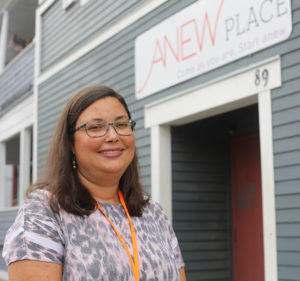
In addition to serving with her husband, Matthew, at Capital Community Church in Montpelier, Vermont, Kathryn Nunnelley works part-time as the administrator of Anew Place, a transitional housing program in Burlington. (WMU photo / Pam Henderson)
How did the Nunnelleys’ transition from Alabama to New England unfold? The bottom line, she said, is that they “just felt God was calling us to go.”
The couple married in 2000, two weeks after they both graduated from the University of Alabama. The newlyweds moved to Anniston, Ala., and became involved in his home congregation—Chulafinnee Baptist Church in nearby Heflin, Ala.
“I was a new Christian, so it was really my first time to serve a church, and they put me right to work,” Kathryn Nunnelley said. “It was a great time of learning from mentors who had been there for years.”
Chulafinnee Baptist “is where I got introduced to Mission Friends and WMU (Woman’s Missionary Union) and missions education,” she added. Their local church experience “really strengthened us and we both started feeling the call to more than what we were doing.”
Searching for mission options through the North American Mission Board website, she said, they kept feeling drawn to a ministry opportunity in Worcester, Mass.
“We had a 1-year-old when we started feeling the call,” she said. “We both had full-time jobs. I was a teacher at a high school. Matthew owned his own business. We had the American dream. We had our own house and lived close to our parents, but we just felt like God was calling us to go.”
Serving as church strengtheners
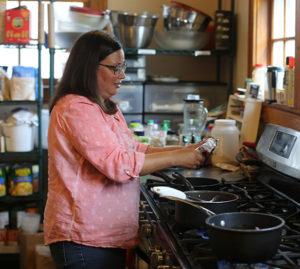
Kathryn Nunnelley helps cook Capital Community Church’s weekly church dinner. She and her husband, Matthew, “do basically whatever the church needs,” she explained. “Where gaps are, we fill them.” (WMU Photo / Pam Henderson)
They ended up making the connection with Pleasant Street Baptist Church in Worcester and made the transition in 2007 to serve there as church strengtheners.
“That was a great experience—a lot of growth and just learning how to love anybody and everybody,” she recalled.
Ministering to the homeless community, former convicts, families with financial struggles and others, she said, “We got exposed to a lot of different kinds of people and learned to see them the way God sees all of us.”
Leading a Children in Action group in that setting, she said, the children’s missions education program “is a great way to expose them to the idea that God calls all of us as Christians to share the gospel with others.”
When the Nunnelleys had the opportunity to move back to Anniston, Ala., to serve Greenbrier Road Baptist Church, she acknowledged that leaving New England was “the hardest decision I’ve ever made.” They returned to Alabama “hoping to inspire others to join in missions,” she added.
As she again led a Children in Action group, she noted that season of life “was another time of learning and seeking God’s will.” It was “a time to rest and recharge and focus,” she said. However, she added: “We knew this is not where we’re meant to be forever. … We just felt God was calling us back to New England.”
They connected with Austin and Ashlea Smith, who were working to plant a church in Montpelier.
“We knew that Vermont was one of the least religious, least churched states,” she said. “We knew it would be a challenge, but we felt like God was calling us here to work with them and to help the church thrive and grow and to reach people in this community for Jesus.”
Once again following their missions calling, the Nunnelleys bid farewell to Alabama a second time and moved to Montpelier to serve at Capital Community Church.
Raising their own financial support as MSC missionaries, they balance their ministry roles with other jobs and a busy family life. Matthew works as a pool and spa service technician, and Kathryn serves part-time as the administrator of Anew Place, a 26-bed group home and transitional housing program in Burlington. The Nunnelleys have three children: Taylor, age 15; Jacob, 8; and Julia, 5.
Seeing Christ transform lives
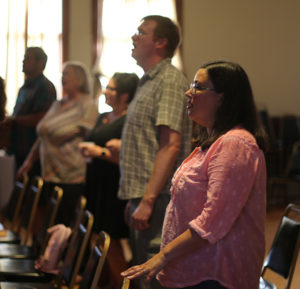
Mission Service Corps missionary Kathryn Nunnelley joins in worship during Capital Community Church’s weekly Thursday night Bible study. “We felt like God was calling us here,” she said, “to help the church thrive and grow and to reach people in this community for Jesus.” (WMU Photo / Pam Henderson)
The Nunnelleys joined Capital Community Church’s ministry team in 2015, about a year and a half after the Smiths launched the church start in their home. The congregation currently rents space from an Episcopal church in downtown Montpelier, just a few blocks from the state capitol.
Citing the challenges of seeking to make a spiritual impact in a largely unchurched setting, Kathryn Nunnelley said: “Sin is still what equalizes all of us. The only way to be free of that is through Jesus. To be a part of telling people that and seeing life transformation through what Jesus can do is a great opportunity and an honor.”
Their ongoing ministry efforts take “time and effort and intentionality,” she said. “Those are all things I’ve learned through missions education, through WMU curriculum, through events I’ve gone to. My favorite thing is always listening to the missionaries’ stories and learning from them.”
Affirming that “we’re all called to tell others about Jesus,” she said a primary prayer request for their ministry is that “people’s hearts and minds would be open to hear and that they would allow themselves to surrender to Jesus. … We know how freeing that is and what an impact on the world that can be.”
That’s the same spiritual truth she taught over and over to Mission Friends and Children in Action. And it continues to motivate her to faithfully follow God’s call from Alabama to New England.
Escuelas bautistas de Texas se preparan para un crecimiento hispano
August 26, 2019
En un estado donde la mayoría de estudiantes en escuelas públicas son hispanos y donde los hispanos están proyectados a sobrepasar a los anglos en población general en los próximos tres años, universidades bautistas en Texas se preparan para ese cambio.
Durante el año académico 2017-18, los hispanos formaron la mayoría de la población estudiantil en una escuela asociada con la Convención Bautista General de Texas (BGCT por sus siglas en inglés)—Baptist University of the Américas en San Antonio, en la cual ellos forman el 54.9 por ciento del total de estudiantes.
Otras dos universidades—Houston Baptist y Wayland Baptist—calificaron como Hispanic Serving Institutions (HSI por sus siglas en inglés), la cual es asignada a universidades que tienen al menos un 25 por ciento de estudiantes hispanos en su totalidad de inscripciones.
Universidades y colegios saben que pueden atraer a más estudiantes hispanos si llegan a conseguir la nominación HSI y tampoco desdeñarán los subsidios obtenidos cuando logran ser denominadas como escuelas HSI. Las universidades que logran ser Hispanic Serving Institutions califican para obtener subsidios federales que proveen apoyo académico y social a estudiantes hispanos.
Cinco escuelas bautistas de Texas—University of Mary Hardin-Baylor, Howard Payne University, Hardin-Simmons University, Dallas Baptist University and Baylor University—calificaron como Hispanic Serving Institutions emergentes.
Estudiantes hispanos representaron el 21 por ciento del total inscrito en UMHB, 20.7 por ciento de Howard Payne, 18.9 por ciento en Hardin-Simmons, 15.9 por ciento de DBU y 15.2 por ciento de Baylor, de acuerdo con la Hispanic Association of Colleges and Universities.
First in Line de Baylor University
Aunque el 51 por ciento de todos los estudiantes de escuelas públicas en el estado son hispanos, solo el 27 por ciento de hispanos en Texas tienen un título universitario. Ese porcentaje baja al 22 por ciento en todo el país, dijo Mito Díaz- Espinoza, gerente del programa Student Success-First in Line de Baylor University.
Los hispanos representan un segmento significativo de estudiantes universitarios de primera generación, él notó. En Baylor, un quinto de cada estudiante son de primera generación. Más de un tercio—el 36 por ciento—de estudiantes de primera generación en Baylor son hispanos.
“Estamos aquí para apoyar a estudiantes de primera generación,” dijo Díaz-Espinoza. “Este programa es para cualquier estudiante que viene de una familia donde sus padres no recibieron una licenciatura universitaria.”
First in Line ofrece becas, programas que juntan estudiantes con estudiantes líderes, así como también con profesores, miembros del staff y otros mentores que desean apoyar a estudiantes de primera generación, él dijo.
“Tenemos que atraer a más estudiantes de primera generación si queremos ver una diferencia en nuestra demografía,” observó Díaz-Espinoza.
Estudiantes de coaching
La vida universitaria requiere entregar trabajos antes de las fechas límite, esquivar trabas y balancear cinco cosas a la vez—incluyendo finanzas, comentó Díaz-Espinoza.
“Les decimos, ‘Así es el juego de la universidad y estos son los pasos que debes tomar.’ De esa manera les enseñamos cómo navegar aquí y los guiamos cuando se encuentran en momentos difíciles,” él dijo.
Los estudiantes de primera generación necesitan ese apoyo ya que se les puede dificultar sentirse como si estuvieran en casa cuando las universidades ya han desarrollado maneras de comunicarse con términos que los estudiantes no conocían antes, él notó. Términos como “provost” (rector), “credit hours” (horas de crédito), o hasta “dining hall” (comedor) pueden oírse tan extraños cuando los estudiantes comparten lo que están viviendo con sus familiares, dijo Díaz-Espinoza.
Muchos estudiantes de primera generación vienen de programas académicos donde ellos sobresalían, pero en la universidad, ellos se encuentran en un lugar donde se sienten aislados, él mencionó.
“En sus familias, los estudiantes normalmente eran los más inteligentes o los mejores académicamente porque les iba bien en la escuela y fácilmente tenían éxito en sus clases,” él dijo.
“Así que si no pueden pasar una clase de química en la universidad cuando en la preparatoria recibían calificaciones de no menos que un 99, eso les hace cuestionar su identidad. Ellos pueden pensar, ‘Tal vez no soy lo suficientemente inteligente para la universidad,’ o ‘Tal vez yo no pertenezco aquí,’ o ‘Tal vez hay una razón por la que nadie más en mi familia fue a la universidad.’”
No sólo los estudiantes de primera generación necesitan consejo sobre las diferencias culturales que encontrarán en la universidad, también los miembros del staff y los profesores necesitan aprender cómo comunicarse mejor transculturalmente, añadió Díaz-Espinoza.
“Trato de ayudar a los profesores a entender que en algún momento ellos también fueron los primeros de sus familias en hacer algo diferente,” él dijo. “Tal vez sus padres si fueron a la universidad, pero ellos fueron los primeros en obtener una maestría, los primeros en enseñar en una universidad o tener una carrera en investigaciones académicas.”
Mary Herridge, directora superior de la oficina de asesoramiento para admisiones de Baylor, recalcó lo vital que es para los reclutas conectar en el lenguaje y la cultura de aquellos que forman parte de la mayoría de estudiantes en escuelas públicas. Casi un tercio del equipo de reclutas habla español, ella dijo.
Díaz-Espinoza también habló de la necesidad de más diversidad en los profesores y miembros del staff de Baylor. Más profesores y staff que se parezcan a los estudiantes que sirven sería el siguiente paso, él insistió.
HPU se conecta con alumnos hispanos
Escuelas relacionadas con BGCT han adoptado una variedad de métodos para atraer a más estudiantes hispanos y poner atención a sus respectivas necesidades.
Cory Hines, nuevo presidente de Howard Payne University, se reunió con miembros de la comunidad local en su primer día de trabajo. (Foto/HPU)
Cuando Cory Hines fue nombrado presidente de Howard Payne University, la escuela renovó sus esfuerzos para apoyar a estudiantes hispanos, dijo Kevin Kirk, vicepresidente asociado de administración de inscripciones.
“Los estudiantes hispanos han sido históricamente parte de Howard Payne,” dijo Kirk, señalando que HPU ha preparado un número significativo de líderes hispanos bautistas en Texas.
Después de que Hines llegó a tomar su puesto, el presidente fijó fechas para conocer y reunirse con graduados hispanos así como líderes bautistas hispanos que también fuesen amigos de la universidad, Kirk notó.
Las reuniones sirvieron como punto de partida para que la universidad mejorara su entendimiento de cómo HPU puede conectar con estudiantes hispanos y ofrecerles apoyo mientras ellos continúan sus estudios, dijo Kirk.
“Siempre ha sido parte importante de nuestra cultura el querer ser la opción cristiana de educación superior para estudiantes hispanos,” Kirk dijo. “Con el Dr. Hines, se ha renovado esa identidad de estar tan involucrados como sea posible, establecer las conexiones necesarias para que estudiantes bautistas hispanos sepan de nosotros y de las oportunidades que tendrán aquí.”
Durante los últimos 10 años, estudiantes de otros trasfondos que no son anglos han incrementado del 26 por ciento al 54 por ciento, él dijo. También añadió que el 27 por ciento de los 246 nuevos estudiantes que empezaron el año pasado fueron hispanos.
Una comunidad cercana y centrada en Cristo como Howard Payne puede ser el tipo de ambiente que muchos hispanos buscan, comentó Kirk.
“Queremos ser la mejor opción para los estudiante hispanos,” él insistió.
DBU quiere que los estudiantes hispanos prosperen
Dallas Baptist University tiene aspiraciones similares—“ser la escuela principal para estudiantes hispanos” de acuerdo a David Reyes, director de vida estudiantil de DBU.
Harold Aguirre graduó de Dallas Baptist University con una doble licenciatura en teoria de la comunicación y estudios interculturales. También empezó a trabajar en la oficina de admisiones de DBU mientras termina su maestria en educación bilingüe. (Foto/Isa Torres)
La visión empezó cuando Gary Cook era presidente de la escuela y busco incrementar el número de estudiantes hispanos en la misma. Cook después tomó el rol de canciller de DBU en el 2015, pero su visión continuó floreciendo cuando Adam Wright se convirtió en el presidente de la universidad en el 2016, Reyes explicó.
“La meta no sólo implica ver cómo acoger a más estudiantes hispanos aquí. Pero también ver cómo ellos pueden prosperar mientras estudien aquí,” dijo Reyes.
Esa visión de DBU requiere un conocimiento cultural, Reyes dijo.
“Entendemos que no sólo estamos reclutando estudiantes, pero también estamos reclutando a las familias de esos estudiantes,” él mencionó.
Desde el 2015, DBU empezó a otorgar dos becas cada año a estudiantes hispanos, las cuales cubren el 50 por ciento de la colegiatura y el 100 por ciento del alojamiento y comida. Los primeros estudiantes en recibir esas becas fueron Bethany Morales y Harold Aguirre, quienes graduaron de DBU este mayo.
DBU contrató a Aguirre después de graduarse para trabajar en la oficina de admisiones. Reyes espera que otros estudiantes hispanos encuentren en Aguirre el apoyo que necesitan para entender lo que la educación universitaria demanda y el apoyo que DBU ofrece.
“Harold es un ejemplo del tipo de educación DBU se ha comprometido a dar,” Reyes dijo. “Con él y con nuestras asociaciones, nosotros queremos estar al frente de lo que está pasando.”
“Nuestro deseo es apoyar a los estudiantes que están empezando en la escuela, mantenernos involucrados, ayudarles a desarrollarse como líderes y que usen sus habilidades para la iglesia cuando terminen la escuela.”
‘Una una reflexión directa del reino de Dios’
Otras escuelas han dicho algo similar al expresar su deseo de incrementar la diversidad de su cuerpo estudiantil, el cual viene de una visión cristiana.
“En East Texas Baptist University, creemos que una comunidad diversa es una reflexión directa del reino de Dios,” dijo Kevin Caffey, vicepresidente de inscripciones y asuntos administrativos.
“Creamos un plan para aumentar los esfuerzos de la institución y aumentar la población hispana en nuestro campus,” dijo Caffey. “Reconocemos que esa visión requiere de un compromiso de parte de todos para apoyar el éxito de nuestros estudiantes hispanos.”
Ese esfuerzo requerirá proveer un ambiente de bienvenida para que los estudiantes se sientan como en casa—donde ellos se sientan en familia.
“Los estudiantes hispanos en ETBU pueden esperar verse rodeados de profesores, staff y compañeros quienes aprecian la cultura hispana,” dijo Ana Asencio, consejera de admisiones para estudiantes de primer año en ETBU.
“Ellos serán bienvenidos por mentores, quienes les animarán a tomar y usar su cultura y diversidad para contribuir a la riqueza y bendición de la variada estructura en el campus de ETBU.”
Logsdon busca servir a la población desatendida
Desde el principio de Logsdon Seminary en San Antonio, el cual es parte de Hardin-Simmons University, la prioridad ha sido dar oportunidades a comunidades que antes no han tenido ese sustento para la educación.
Wally Goodman, director de los programas de Logsdon Seminary en San Antonio, comenzó su posición en Baptist University of the Américas en el 2010. En BUA, Goodman pudo aprender acerca de las diferencias generacionales y culturales entre los hispanos. Ese conocimiento le ha servido ahora en el campus de Logsdon en San Antonio, donde un tercio de los estudiantes son hispanos.
Desde el 2011, Logsdon en San Antonio ha crecido hasta ofrecer las mismas tres maestrías que se brindan en el campus principal en Abilene, así como el doctorado en ministerio.
Al principio, el crecimiento vino con algunos desafíos en el horario de clases y la ubicación del campus, dijo Goodman. Pero ahora los desafíos que los estudiantes enfrentan son en términos de educación en un ambiente multicultural, con un cuerpo estudiantil compuesto de un tercio de hispanos, un tercio de afro-americanos y el otro de anglos.
“Los estudiantes se llevan bien y muestran amor unos con otros,” Goodman dijo. “Ellos aprecian la diversidad y creo que eso les ayuda a entenderse más.”
Su experiencia en BUA y ahora en Logsdon en San Antonio le dio a Goodman el sentido para apreciar un ambiente multicultural en el que la iglesia puede existir, él dijo. Pero eso también significa que las universidades y los seminarios deben de preparar a sus estudiantes para funcionar en ministerios multiculturales, él remarcó.
Por primera vez el año pasado, la mayoría de los estudiantes en los dos campus de Logsdon Seminary no consistía de anglos, dijo Meredith Stone, decana asistente de academia y profesor asistente de escritura y ministerio en Logsdon Seminary. A través de todos los campus de Logsdon Seminary, el 21 por ciento de los estudiantes se identifica como hispanos, ella detalló.
Por su diversidad estudiantil, la Association of Theological Schools (Asociación de Escuelas Teológicas) invitó a Logsdon y a otras 19 escuelas a ser parte de un proyecto llamado Cultivando la Capacidad de Diseminación Educativa. El programa de dos años apunta a incrementar la efectividad de escuelas de ATS en educar y capacitar a estudiantes de todas las razas y grupos étnicos.
Universidades y seminarios bautistas se benefician cuando preparan a estudiantes de diferentes culturas a servir en marcos multiculturales, observó Goodman.
“Todos somos bien servidos cuando aprendemos a relacionarnos más allá de nuestra experiencia cultural,” dijo él.
Obituary: Eddy Lee Curry
August 26, 2019
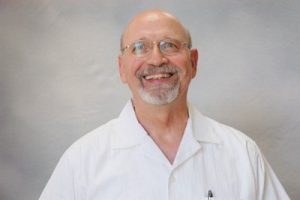
Eddy Lee Curry of Abilene, longtime Texas Baptist minister of education, died Aug. 14. He was 66. Curry was born in Brownfield to Bill and Alice Curry on June 4, 1953. He graduated from Ropesville High School and Wayland Baptist University. He married Dee Ann Adkins on Aug. 10, 1973, in Lubbock. Curry graduated from Southwestern Baptist Seminary in 1992 and served various churches in Texas and New Mexico during a 30-year career in ministry. The last 14 years, he was minister of education at Pioneer Drive Baptist Church in Abilene. Curry served on several boards with the Baptist General Convention of Texas and the Texas Baptist Educators Association. He is survived by his wife of 46 years, Dee Ann; daughter Kamber Bailey and husband Kelvin of Lubbock; son Kade and wife Jenni of Springdale, Ark.; six grandchildren; and brothers Dan Curry and wife Alicia of Arlington and Larry Curry and wife Amanda of Abernathy.
HSU makes impression across generations
August 26, 2019
ABILENE—With four generations of Hardin-Simmons University graduates in her family, Mandy Cunningham has many tales to tell about the school—from dorm shenanigans to love stories.
Cunningham’s great-grandmother, grandparents and parents attended HSU, but that was not the reason she made her way to the Texas Baptist university in Abilene.
“I didn’t want to be that kid,” she said. “But I came to campus and fell in love with it.”
Cunningham earned her undergraduate degree in 1998. Today, she coordinates merchandise and booking and manages social media for Super Summer, a Christian discipleship camp directed by the Baptist General Convention of Texas, HSU’s denominational partner since 1941.
“Hardin-Simmons prepared me really well,” she said. “Even though I took classes to become a teacher, I learned to communicate with people no matter what the age.
“I’ve used things that I’ve learned in class in my job as a coordinator of an event. My professors did a good job of teaching us things we would use throughout our life, not just creating busywork.”
A place ‘where people cared about me’
During her time at HSU, Cunningham attended and worked at University Baptist Church, located across the street from campus. She was the children’s minister and worked with the youth for two years.
At HSU, Cunningham was involved in Freshman SING and worked in the Spanish lab. She remembers the tradition where freshmen students stood in the reflection pond to sing the freshman song.
“I loved being at Hardin-Simmons and connecting with people,” she said. “I made friends the first day that I’m still friends with today. It was almost like going to church camp for four and a half years.”
Cunningham fondly remembers one cafeteria worker named Linda.
“She would always say ‘hello’ and ask how we are,” Cunningham said. “The staff knew who you were and took the time to learn your name. Even though my parents lived far away, I felt like I was somewhere where people cared about me.”
Because HSU hosts Super Summer camps, Cunningham has the opportunity to return to campus often.
“I love seeing the new changes on campus and how it’s growing,” she said. “Regardless of how much time has passed, there is always someone welcoming you back to campus. It’s a sweet feeling that makes me want to keep coming back.”
Silly pranks and serious conversations
Jeanne and Jack Meeker (right) pose with daughter Mandy Cunningham and her family.
Cunningham’s mother, Teresa Jeanne (Vinson) Meeker, graduated from HSU in 1974. She met her husband, Jack Meeker during her sophomore year. The two were one of the first married couples to serve as residence directors for a dorm.
Meeker remembers pranks the boys would pull on her and her husband. Once they heated a bowling ball on a hot plate and rolled it down the stairs. Another time they brought a car into the dorm lobby. They even bricked in the couple’s doorway. The pranks were all in good fun, however, she said.
Residents often came to the Meekers’ door when they were feeling homesick.
“We would counsel and encourage them and pray for them,” Meeker said. “We would ask: ‘What does God have for you here? Why did you come in the first place?’”
The couple also invited international students to their home to share in holiday festivities.
‘It was all meant to be’
The Meekers both worked on campus—she in the business office and he as the night manager for the student center. They were involved with the rodeo team, the Six White Horses, the drama department, intramural sports and choir.
When Meeker was considering her options for college, a hurricane damaged her hometown of Harlingen. Students from HSU came to help with clean-up and restoration during spring break.
“I got close to the students,” she said. “That tipped the scales for me in choosing HSU. It was all meant to be.”
Meeker also went on mission trips with HSU. She traveled to El Paso to do mission work across the border and traveled with a revival team to Indiana.
“It was great to go somewhere out of your comfort zone,” she said. “We continued that in our lives serving in ministries in children’s homes and boys’ ranches.”
Meeker’s parents attended HSU, as well. Peggy Vinson was going on a date with someone else when she saw Lester Vinson walking. She asked her date to pick up Lester, and the two sat together in the back of the car and at the movies. The two later married.
Cunningham’s great-grandmother, Dorothy Thomas Warren, attended HSU when it was still called Simmons College. When she turned 100, she received a signed certificate from then-President Lanny Hall.
CommonCall: Coastal Bend adjusts to the ‘new normal’
August 26, 2019
ROCKPORT—Two years after Hurricane Harvey, Coastal Bend communities and the churches that serve them continue to adjust to what they call the “new normal.”
While some homes in rural areas remain semi-covered with tattered blue tarps bearing the faded logos of the non-profit agencies that donated them, much of the region no longer acutely resembles a disaster area.
The huge piles of debris that lined highway medians and curbsides for months have disappeared. Many homes have bright new siding, and lawns are bordered by perfectly straight fences—clear signs of recent reconstruction.
But ride through the area with a pastor who lived through Harvey, and a visitor gains a different perspective. The pastor will point to the vacant treeless lots, describing buildings that once stood there surrounded by long-gone majestic old-growth oak trees. Outside the city limits, he will note the “pop-up” RV parks where some displaced local residents continue to live.
“It’s not only the community and the church property that have changed,” said Scott Jones, pastor of First Baptist Church in Rockport. “But I’ve realized through the process of all this that I was changing, and the church—the people—have been changing. … The members of our church found out they can do hard, painful things and survive.”
‘It looked like a war zone’
Jones and his family evacuated to the home of friends in Kerrville when Hurricane Harvey—originally expected to be a Category 1 storm—rapidly escalated to a deadly Category 4 hurricane with 130 mph winds.
He and Jeff Lanningham, executive pastor at First Baptist, initially returned to Rockport three days after the storm made landfall and “camped out at the church”—in the section of the building that still had a roof—for a week.
“It looked like a war zone. The National Guard was here, and first responders throughout the area were here. There were not a lot of citizens out and about. There was a 7 p.m. curfew in effect. It was dark and quiet,” Jones recalled.
After returning to their families and moving them closer to Rockport, the ministers began doing whatever was possible to aid the disaster relief efforts.
Decided to say ‘yes’
Trailers that belong to various disaster-assistance agencies and ministries continue to fill much of the parking lot at First Baptist Church in Rockport. (Photo / Ken Camp)
“We made the decision early on: We would say ‘yes’ to everything we could,” Jones said.
First Baptist sustained $1.5 million in damage to its facility. Lanningham took responsibility for dealing with insurance issues and with the restoration company that handled reconstruction, allowing Jones to focus on ministry to church members and the community.
First Baptist made its parking lot—and indoor facilities, as soon as possible—available to a variety of agencies and nonprofit ministries, including Texas Baptist Men, who worked in the area several months.
Nearly two years later, trailers from various agencies and ministries continue to consume much of the church parking lot.
Donated items poured in
Hallways filled with supplies became a fixture at First Baptist Church in Rockport in the two years since Hurricane Harvey. (Photo / Ken Camp)
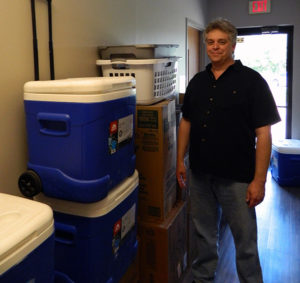
Within days after the hurricane hit, First Baptist in Rockport began receiving donated cleaning supplies, food, toiletries, baby items and bottled water. For about six months, the church made available donated items at its facility and delivered them to unreached areas of the community.
“We distributed what would fill between four and five 50-foot semis,” said Cyndi Powell, who worked to coordinate the efforts.
At the request of Texas State Emergency Management, First Baptist also housed a volunteer reception center seven days a week.
“We couldn’t have operated the volunteer reception center without the Winter Texans,” Jones said, pointing to retirees from northern states who spend winter months in South Texas. “They didn’t have to do it, but they came because they wanted to help, while our members who live here were busy taking care of their own homes.”
Rockport Hands of Hope created
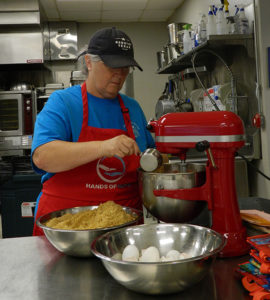
Cyndi Powell, a member of First Baptist Church in Rockport and executive director of Rockport Hands of Hope, works in the kitchen preparing meatloaf for 70 disaster recovery and rebuilding volunteers. (Photo / Ken Camp)
About a year after Harvey, members of First Baptist recognized case management as a full-time job demanding more than church staff with other responsibilities could handle. They were instrumental in developing Rockport Hands of Hope as a separate nonprofit organization to meet needs and coordinate volunteers, with Powell as executive director. In that role, she coordinates volunteers—about 10,000 since the process began.
She also applies for grants and oversees compliance. In the past year, Rockport Hands of Hope has received about $3 million in grants, primarily through the Rebuild Texas Fund and American Red Cross. Powell also solicits and receives individual donations, particularly to help individuals and families who might not qualify for grants for a variety of reasons.
“The Winter Texans have given generously,” Powell said. “It’s gratifying when we can help the people no one else will help.”
Building a base of operations
In the months after the immediate disaster, as recovery and rebuilding efforts began, First Baptist housed volunteer groups in Sunday school rooms, office space, hallways—anywhere possible. Then the facilities had to be restored to some semblance of normalcy for Sunday, when Bible study classes met and members gathered to worship.
Samaritan’s Purse offered to build a permanent facility on the church’s property as a base of operations for volunteers, complete with shower facilities and other amenities.
When Samaritan’s Purse eventually completes its work in the Coastal Bend area, the international ministry will give the $1.3 million facility to First Baptist. The church plans to use it as a family life center most of the time and as a base for visiting mission groups that serve in South Texas.
‘We’ve turned the corner’
A neighboring congregation in Rockport—Coastal Oaks Baptist—has not fared as well. Initially, the church used its gymnasium as a drop-off point for donated goods and as a distribution center. The church also housed Southern Baptist disaster relief teams and other volunteers there for about six weeks.
However, when the church’s contractor began looking at the building, he questioned its structural integrity—or at least whether it could be upgraded to comply with windstorm code standards. So, it remains unused and covered by blue tarps.
Although Pastor Kevin Muilenburg noted the church lost about 25 families who relocated, the congregation has gained new families since Hurricane Harvey.
“God has provided,” he said. “In some ways, I feel like we’ve turned the corner. People know we are still here, we’re going to stay, and we’re going to get through this.”
‘It’s been a grind’
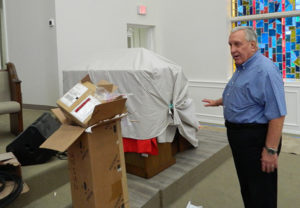
T. Wayne Price, pastor of First Baptist Church in Refugio, shows the final stages of reconstruction taking place in his congregation’s sanctuary. (Photo / Ken Camp)
In Refugio, 24 miles inland, another congregation also has only recently begun to feel as if it has “turned the corner.”
First Baptist Church in Refugio lost its facility’s roof to Hurricane Harvey, destroying its sanctuary and virtually all of its contents, along with about three-fourths of the church’s education space.
The first month after the storm, the congregation met in a funeral home chapel. Since then, the church has gathered on Sunday at a local elementary school cafetorium for Bible study and worship.
After multiple delays, the church move back into its facility and held its first worship service in the renovated sanctuary in late July.
“It has been a grind, but it’s been a grind for everyone,” Pastor T. Wayne Price said. “The greatest challenge has been to communicate with our people and keep the fellowship strong when we’re only together on Sunday morning.”
Still, Price noted God has blessed the church throughout the experience. On the church’s second Sunday in the remodeled sanctuary, he planned to baptize two adults and two preteens who had made professions of faith in Christ.
First Baptist in Refugio plans to hold its formal dedication service for its rebuilt and renovated facility on Aug. 25—the second anniversary of Hurricane Harvey.
Streamlining operations
During the past two years, Jones, Muilenburg and Price noted each of their congregations had to streamline operations—not only cutting back on scheduled activities but also granting a small group of leaders the authority to make decisions for the congregation at a point when committee meetings were impossible.
“The trust level is good,” Price said. “That’s why it has worked.”
First Baptist Church in Aransas Pass suffered extensive damage due to Hurricane Harvey, but Pastor William Campbell noted one silver lining. The storm enabled the congregation to accelerate a process of refocusing on disciple-making it already had started, based on Thom Rainer’s book, Simple Church.
“Our members have developed a servant mentality,” Campbell said.
Even so, he acknowledged the difficulty in coping with all the changes the storm caused.
“I don’t know if I can honestly say we’ve completely recovered,” Campbell said.
High anxiety
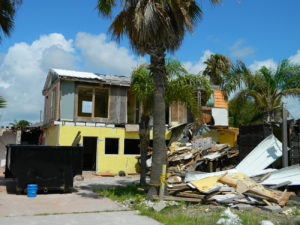
Some parts of the Coastal Bend still bear the physical signs of destruction caused by Hurricane Harvey two years ago. But the more prevalent lasting evidence of change created by the hurricane is in the lives of area residents and in the churches that serve them. (Photo / Ken Camp)
Churches in the area that led the way in relief and recovery efforts in the immediate wake of the hurricane continue to deal with the human toll.
With the arrival of another hurricane season in the Gulf of Mexico, the anxiety level rises among residents of some Coastal Bend towns two years after Hurricane Harvey. Pastors who minister in the region recognize the signs.
Otherwise mild-mannered men display short tempers. Generally good-natured women are irritable. Adults who accompany children and youth to summer camp notice an unusually high percentage of kids who take prescription anti-anxiety and anti-depressant medication.
“We’ve seen trauma-related stress in marriages. People who know better have made dumb decisions—the kind of choices that hurt themselves and their families,” Jones said.
Lack of ‘emotional energy’
Caregivers pay a price in that kind of environment. The pastors talked about “not having the emotional energy” to implement all the ministries they would have liked or failing to meet all the needs in their communities.
“I finally gave myself a pass,” Muilenburg said. “I can’t be the pastor who rescues everybody.”
Campbell still recalls how emotional he and his wife became every time they passed the “Harvey piles” where debris—including recognizable furniture and personal items from homes—accumulated before it eventually was taken to a landfill.
Muilenburg acknowledged it gave him a new less-judgmental perspective on the attitude people have toward material things.
“I’ve always said: ‘It’s just stuff. It doesn’t really matter.’ But when it’s your stuff piled out in the front yard, it’s not just stuff. It’s memories,” he said. “And it’s there for everyone to see. There’s a real vulnerability in that.”
Greater empathy
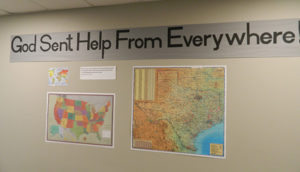
Maps in the foyer at First Baptist Church in Rockport display red dots showing all of the places from which volunteers traveled to help the Rockport/Fulton area—throughout Texas, all 50 states and seven foreign countries. (Photo / Ken Camp)
Muilenburg also noted how different it felt to be on the receiving end of ministry.
“People would set up grills and smokers and cook, giving away food. Some of those were hardened people our church had tried to reach and couldn’t. And there they were, ministering to me,” he said.
The pastors noted their experiences gave them a greater sense of empathy and provided a genuine point of connection with people who were—and are—hurting.
“I’ve started a lot of conversations by saying: ‘This is what I’m feeling. Do you ever feel like that?’” Jones said.
Neither First Baptist in Rockport nor Coastal Oaks plans to mark Hurricane Harvey’s second anniversary with any kind of special service.
Jones wonders how long it’s appropriate to continue to display maps in the church’s foyer that show the home locations of volunteer groups that have served their community—red dots in all 50 states and seven foreign countries.
“It’s not so much about moving on,” he said. “It’s about moving forward.”
Read more articles like this in CommonCall magazine. CommonCall explores issues important to Christians and features inspiring stories about disciples of Jesus living out their faith. An annual subscription is only $24 and comes with two free subscriptions to the Baptist Standard. To subscribe to CommonCall, click here.




 Eddy Lee Curry