Correctional officers receive timely ‘thank you’ from TBM

BEAUMONT—Texas Baptist Men volunteers delivered a timely “thank you” to correctional officers at the Mark W. Stiles Unit.

TBM crews served meals to officers at the Stiles Unit on the ninth day of a lockdown following a foiled escape attempt. Hours before volunteers served the first shift, a correctional officer was rushed to the hospital after being assaulted.

As a result, 50 extra officers were called in to the Stiles Unit, a few miles southeast of Beaumont, said Jim Young, coordinator of restorative justice ministries for TBM.

“Thank you for all you do,” volunteers repeatedly told officers and other prison employees as they served them chicken fajita salad and peach cobbler.

Texas Baptist Men volunteers delivered devotional booklets and “thank you” notes drawn by children at area churches to correctional officers at the Stiles Unit near Beaumont. (Photo / Ken Camp)

The TBM cooking crew began work before 5 a.m. to prepare the meals for the first group of officers who arrived to eat at the 11 a.m. shift change. Volunteers from churches in the Golden Triangle Baptist Network joined TBM in serving the officers.

In an atmosphere of heightened security and increased tension, tangible expressions of appreciation provide officers much-needed encouragement, said Young, former chaplaincy program administrator for the Texas Department of Criminal Justice.

The TBM volunteers gave officers at the Stiles Unit a meal, devotional books, candy bars and hand-drawn “thank you” notes from children in area churches as part of National Correctional Officers Week. Another TBM team served at the Barry B. Telford Unit near New Boston, and other volunteers worked at the John Middleton Unit in Abilene.

‘Just to know somebody cares’

“If somebody had brought in a meal like this when I served, it would have meant the world—just to know somebody cares,” said Bryan Arender, a TBM volunteer from Cottonwood Creek Baptist Church in Allen who worked 14 years as a correctional officer.

Bryan Arender, a Texas Baptist Men volunteer and former correctional officer, visits with officers at the Stiles Unit southeast of Beaumont. (Photo / Ken Camp)

Early in his career, working in the correctional system was “just a job—just a paycheck,” he said.

“Then I realized I could do so much more. It became a calling,” he said.

In recent years, Arender has focused on delivering Bibles—and words of encouragement—to administrators and officers in correctional facilities.

“This is my passion,” he said.

About 25,000 correctional officers work in more than 100 Texas Department of Criminal Justice facilities around the state, overseeing about 140,000 offenders.

Few on the outside understand

The Stiles Unit faces frequent turnover in its workforce, said Officer Steve Bennett, who has worked as a correctional officer since 2006.

Officer Steve Bennett (right), who works at the Stiles Unit near Beaumont, visits with Texas Baptist Men volunteer Joe Crutchfield from First Baptist Church in Lewisville. (Photo / Ken Camp)

“The refineries offer five times what we make here. When the oil companies or the railroad or the port authority are hiring, it’s hard to keep people working here,” Bennett said.

Correctional officers face danger, stress and pressure few people outside the correctional system understand, he added.

“If anybody wants to know what we do every day, let ’em follow Bennett around for one day,” he said.

“How often do we hear ‘thank you’ from anybody? From each other, we hear it a lot. From people on the outside who come in, rarely. From the general public, never.”

‘Hard beyond belief on the families’
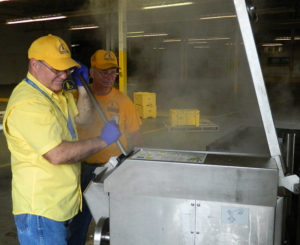
Scot Hanks, a Texas Baptist Men volunteer from North Orange Baptist Church, began work early preparing meals for correctional officers at the Stiles Unit near Beaumont. (Photo / Ken Camp)

A national study of about 4,000 correctional officers and staff in 2012 revealed a 27 percent post-traumatic stress rate among them and a depression rate of 26 percent. Specifically among security personnel, the rate of PTSD and depression is 34 percent, significantly higher than the general population and all other first responders. Correctional officer also are at least 20 percent more likely to get a divorce than the general population.

“It is hard beyond belief on the families,” Bennett said. “You have to have an awesome plan in place. You have to have an awesome spouse. Then you might make it.”

Texas Baptist Men volunteers serve correctional officers at the Stiles Unit near Beaumont. (Photo / Ken Camp)

David Hamel works as a mental health officer at the Stiles Unit. Officers who are most confident in their self-identity are most likely to seek and receive the help they need, he said.

Those who feel most vulnerable are least likely to acknowledge that vulnerability and seek assistance, because they worry it could be exploited, said Hamel, a licensed professional counselor.

He noted he saw quite a few officers when he was in private practice, but many are reluctant to visit a mental health professional on staff.

“Here they feel like they have to stay guarded,” he said, noting a pervasive fear of the “prison grapevine”—the news and gossip that travels quickly among officers, staff and offenders.

“It’s a place where Satan likes to dance and play,” he said.


Churchgoers good at relationships but not making disciples

NASHVILLE, Tenn.—Building relationships with other believers seems to come naturally to Protestant churchgoers, but those relationships often are built apart from Bible study and spiritual growth, a LifeWay Research study concludes.

The 2019 Discipleship Pathway Assessment study from LifeWay Research found 78 percent of Protestant churchgoers say they have developed significant relationships with people at their church, including 43 percent who strongly agree.

Fewer than one in 10 disagree (8 percent), while 14 percent neither agree nor disagree.

The survey of Protestant churchgoers identifies building relationships as one of eight signposts that consistently show up in the lives of growing Christians. The survey is part of the 2019 Discipleship Pathway Assessment, a larger study identifying traits of Christian discipleship.

“In an American culture in which significant relationships are hard to form, most churchgoers have had at least some success at making friends at church,” said Scott McConnell, executive director of LifeWay Research. “But the majority aren’t as confident as they could be about the significance of those relationships.”

Few leverage relationships to make disciples

While there is no evidence of a gender divide on developing significant relationships at church, age plays a role in the likelihood someone has strong friendships at church. More than four in 10 churchgoers 65 and older (46 percent) strongly agree they have significant relationships within the congregation compared to 38 percent of 18-year-olds to 34-year-olds.

Not surprisingly, those who attend worship services more frequently—four times a month or more—are more likely to confirm strongly they have developed such relationships than those who attend less frequently (47 percent to 33 percent).

Fewer churchgoers, however, are intentionally leveraging their relationships with other believers to help them grow in their faith. Fewer than half of churchgoers (48 percent) agree with the statement, “I intentionally spend time with other believers to help them grow in their faith.” This includes 19 percent who strongly agree. The same number (19 percent) disagree.

“There is a different element to relationships at church that the majority of churchgoers haven’t prioritized,” McConnell said, noting that “investing in other believers” is one way Christians demonstrate love for God. “The relationship isn’t just about mutual interests; it is about proactively being interested in the faith of others.”

While older churchgoers (65 and older) are more likely to say they have significant relationships, they are less likely to strongly agree they intentionally spend time with other believers to help them grow (13 percent). Young adults (ages 18 to 34) are the most likely to strongly agree they are intentional about investing time in the spiritual growth of others (26 percent).

Hispanics (32 percent) are more likely to strongly agree than African Americans (22 percent), whites (17 percent) or churchgoers of other ethnicities (17 percent).

Black Protestants (24 percent) and evangelicals (21 percent) are significantly more likely than mainline Protestants (12 percent) to agree strongly they are intentional about spending time to help others grow spiritually.

Lack of involvement in small groups

While many churchgoers aren’t seeking to spend time with others to help them grow, they aren’t spending time with a small group that could benefit their own personal discipleship either.

According to the survey, 35 percent of churchgoers attend a class or small group four or more times in a typical month. Fourteen percent attend two to three times a month. About four in 10 (38 percent) Protestant churchgoers do not attend a class or small group in a typical month, while 13 percent attend once a month.

“For much of church history, small groups or classes have been one of the most effective ways churches offer for attendees to connect with others, study the Bible and serve together,” McConnell said. “This avenue of seeking God together is both relational and devotional.”

White churchgoers (41 percent) are more likely to say they never attend a small group of some kind than African-Americans (35 percent) and Hispanics (26 percent).

Mainline Protestants (48 percent) are more likely to never attend a small group than black Protestants (36 percent) and evangelicals (35 percent).

Blessed are the peacemakers

Half of churchgoers (49 percent) say they intentionally try to make peace at church, including 24 percent who strongly agree.

Almost four in 10 are noncommittal (38 percent), while 13 percent say they aren’t trying to be peacemakers.

“As Jesus prayed about his future followers, his priority was their unity,” McConnell said. “It takes work to keep the peace among a group of people. Stepping in to make that happen benefits everyone in the church.”

Younger churchgoers (28 percent) are most likely to strongly agree they intentionally try to be a peacemaker.

Hispanic (34 percent) and African-American churchgoers (32 percent) are more likely than white churchgoers (19 percent) to strongly agree they try to bring peace at church.

Black Protestants (32 percent) are most likely to strongly agree they try to be peacemakers followed by evangelicals (24 percent) and mainline Protestants (16 percent).

Researchers conducted the online survey of 2,500 Protestant churchgoers Jan. 14–29, 2019. They screened respondents to include those who identified as Protestant/non-denominational and attend religious services at least once a month. Analysts used quotas and slight weights to balance gender, age, region, ethnicity, income and denominational affiliation. The completed sample is 2,500 surveys, providing 95 percent confidence that the sampling error does not exceed plus or minus 2.0 percent. Margins of error are higher in sub-groups.


Asia Bibi exits Pakistan, joins family in Canada

LAHORE, Pakistan (BP)—Asia Bibi has joined her husband and children in Canada, months after her acquittal of false blasphemy charges and her release from Pakistan’s death row.

Bibi’s attorney Saif-ul-Malook told several news outlets of her safe arrival in Ottawa.

“It’s a big day,” The Guardian quoted Malook as saying. “Justice has been dispensed.”

Pakistani authorities had secured Bibi in secret since her October 2018 acquittal and subsequent January victory against an appeal by her accusers. Radical Muslim mobs had rioted for her death and have threatened to kill her.

Bibi, a 54-year-old Catholic mother of five, is not well, having suffered depression from her ordeal of nearly a decade, Wilson Chowdhry, chairman of the British Pakistani Christian Association, told The Telegraph.

“She must be treated with utmost care and receive appropriate medical care now she is free,” Chowdhry said, according to the Telegraph.

Bibi’s husband Ashiq “has always remained hopeful of an imminent release from Pakistan,” Chowdhry said, adding he was “shocked at how long it has taken.”

Other Christians still face death sentences

Asia Bibi

Bibi was released while other Christians still are sentenced to death in Pakistan on blasphemy allegations. Many countries have pledged with the United States to fight internationally for the freedom of those imprisoned.

As recently as Feb. 13, Open Doors USA told of Christian brothers Qasir and Amoon Ayub, sentenced to death in Pakistan in a blasphemy case dating to 2010. A coworker accused them after a statement was allegedly made insulting the worker’s sister, Open Doors said, and the Ayub brothers eventually were convicted by a judge who said they were guilty of insulting the Muhammad “beyond (a) shadow of reasonable doubt.”

In Bibi’s case, she was sentenced to death by hanging in 2010 on charges of insulting the prophet Muhammad while working in a field as a day laborer in 2009. When Bibi offered a coworker a cup of water, the woman said Bibi’s Christianity made the water ceremonially unclean. This set off a chain of false accusations related to Bibi’s beliefs, backed by Muslim clerics. Bibi refused to convert to Islam.

Accusations of blasphemy often are based on personal animosity against Christians, according to the U.S. State Department Ministerial to Advance Religious Freedom, describing them as “a pretext to justify vigilantism or mob violence in the name of religion or as a false pretense to settle personal grievances.”

In addition to the United States, the statement was signed by representatives from Canada, Sri Lanka, Armenia, Australia, Brazil, Denmark, Estonia, Georgia, Hungary, Israel, Kosovo, Oman, Poland and the United Kingdom.

Call to repeal blasphemy laws

Religious liberty advocates hailed Bibi’s arrival in Canada.

William Stark, regional manager for International Christian Concern, said Bibi’s “case remains highly sensitive and the ignition point for many acts of religious hatred. It is our hope that Pakistan will be able to secure all Pakistani Christians, as extremists may seek revenge against their community.”

Tenzin Dorjee, chair of the U.S. Commission on International Religious Freedom, expressed relief and gratitude that Bibi was allowed to leave Pakistan and reunite with her family.

“While we are grateful that Asia Bibi will be able to start anew in Canada, she lost nearly a decade of her life in prison after being falsely accused of blasphemy,” Dorjee said.

“Unfortunately, there are at least 40 other individuals in Pakistan sentenced to death or serving life sentences on blasphemy charges. We ask the Pakistani government to nullify the blasphemy law and acquit them of the charges.”

Omar Waraich, deputy South Asia director for Amnesty International, agreed.

“This case illustrates the dangers of Pakistan’s blasphemy laws and the urgent need to repeal them,” he said.

Pakistan is one of three countries, along with Iran and Mauritania, where blasphemy is punishable by death, the U.S. Commission on International Religious Freedom reported.

Every year since 2002, the commission has recommended that the U.S. Department of State designate Pakistan a “Country of Particular Concern” for “ongoing, systematic, egregious” violations of religious freedom.

More than 40 people convicted of blasphemy are currently on death row or serving life sentences in Pakistan, the American Center for Law and Justice said in 2018. Hundreds are serving or have served prison terms ranging from three years to 10 years.

Since 1986 when Pakistan updated its blasphemy laws, at least 150 Christians, 564 Muslims, 459 Ahmadis and 21 Hindus have been jailed on blasphemy charges, according to Open Doors.

With additional reporting by Managing Editor Ken Camp.


Boxer-turned-pastor testifies to God’s abundant grace

PLAINVIEW—Training as a boxer taught Joe Barrera a clear life message: Work hard with what you have and perfect it. But as a follower of Christ, Barrera believes whatever he has belongs to God, who called him to ministry.

Since Barrera and his wife Frances committed their lives to serve God, they have started three churches in Texas, including Abundant Grace Church in Plainview, where he is pastor.

Like boxing, ministry takes a toll, Barrera acknowledged, but he finds continuing refreshment in witnessing God at work.

‘God has provided’

Barrera started Abundant Grace in 2011. Since then, God has opened doors for the ministry to grow, the couple agreed.

“God has provided every step of the way,” she said. “Along the way, God has placed people to support us in ministry.”

Five years ago, a person donated a building at a prime location near Interstate 27, they noted.

“God has us in a place where he is pulling the church,” he said. “We have seen how God calls people to follow Christ and serve him.”

Barrera works both as a car salesman and as pastor. His wife is vice president of a bank in Plainview. She also serves as multicultural consultant with Unión Femenil Misionera of Texas.

So, they both work hard to find a balance between their ministry, their family and their secular jobs.

The Barreras often begin hours of ministry after finishing long days on their other jobs.

“We know the vision God has given us is a big one, and we also know we must be faithful,” Barrera said.

In an area where most Hispanics either attend a Catholic church or a megachurch, Barrera said, God continues to provide what they need at the right time.

“God just wants us to walk out in faith,” he noted. “It’s amazing to see what he has done here.”

Nurture and challenge new leaders

Like in boxing, ministry requires consistency, Barrera understands. That is what he and his wife aim to accomplish, he said.

Pastor Joe Barrera baptizes a new Christian at Abundant Grace Church in Plainview. (Photo courtesy of Joe Barrera)

They hope new servant leaders will commit their lives to Christ, while also receiving the mentoring they need, Barrera added.

“We want to continue to grow and challenge new leaders here,” he said.

Abundant Grace has a passion to support missions, and the church’s goal now is to reach more people in Plainview, his wife added.

Whether in cooperation with Convención Bautista Hispana of Texas, local churches or by itself, Abundant Grace seeks to reach more people in Plainview, Barrera said.

“We know God has called us to work together, so we must keep doing what he called us to do,” Barrera said.

Although sometimes ministry demands a lot of ministers, and sometimes it is hard to see significant change, Barrera believes God always is at work.

“If we get tired, we have to remember God has never stopped being faithful, and he continues to transform lives,” he said. “At the end, we must remember the one who is in control of the ministry is God.”


Around the State: ETBU nursing school moves to Marshall Grand

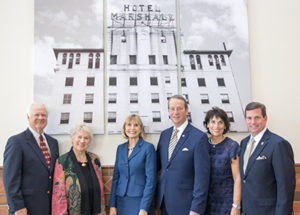
Jerry and Judy Cargill, along with former Texas State Senator and former Harrison County Judge Richard Anderson and his wife, Christina, see steps toward their vision of restoring downtown Marshall come to fruition. The Cargill and Anderson families donated the building, formerly known as the Hotel Marshall, to East Texas Baptist University in 2013. (ETBU Photo)

East Texas Baptist University hosted alumni, donors and friends of the university at the grand opening of the ETBU School of Nursing at the Marshall Grand in downtown Marshall on May 4. The event included facility tours, recognition of donors and a dedication ceremony. Jerry and Judy Cargill, along with Richard and Christina Anderson, donated the historic eight-story building—formerly the Hotel Marshall—to ETBU in 2013. ETBU raised $3 million to continue the renovations the Cargills and Andersons started. The university received significant contributions from the Andersen Foundation, the Moody Foundation, the Meadows Foundation, and the J.E. and L.E. Mabee Foundation. The campaign to relocate the School of Nursing also garnered support from the Rosa May Griffin Foundation, the T. J. and LaVerne Plunkett Foundation, and the Wece and Martha Johnson Foundation, along with many individual donors and the Marshall Economic Development Corporation.

Sara Diaz (center) shares a laugh with Wayland President Bobby Hall (right) and her father Lozaro. She is the first recipient of Wayland’s Hispanic Leadership Scholarship, which pays tuition, room and board to a qualified student. (Wayland Photo)

Sara Diaz of Midland is the initial recipient of the Hispanic Christian Leadership Scholarship offered by Wayland Baptist University. She is the daughter of Lazaro Diaz and Eva Rangel, both Wayland graduates. In the fall, she will begin her studies at Wayland, where she plans to earn a degree in sociology and hopes to put it to use helping victims of human trafficking. For information about the scholarship, click here.

The University of Mary Hardin-Baylor named Michele Hackney as dean of the Scott & White School of Nursing. She served as interim dean during this academic year and previously as associate dean. She has been on the UMHB faculty nine years. Hackney holds a Master of Science in Nursing from Walden University with a specialization in nursing education and earned a doctorate in education from UMHB.  She also holds certification as a nurse educator from the National League for Nursing.

Howard Payne University has opened registration for its Young Scholars and Summer Scholars day camps for children. The camps are scheduled July 15-19 from 9 a.m. to noon each day. In the Young Scholars program, designed for children entering first through third grades, campers will receive instruction in music, robotics, science and recreation. In the Summer Scholars program, students entering fourth through sixth grades will study robotics, 3D printing, science and recreation. The camps will be held in HPU’s Winebrenner Memorial Hall of Science. Program participants will also have supervised access to HPU’s wellness center and other campus locations. Cost is $110 per student. To register online, click here.  For more information, call (325) 649-8508 or e-mail jwelker@hputx.edu.

The Faith and Sport Institute at Baylor University’s Truett Theological Seminary is accepting applications for its second annual retreat, June 16-22. The institute seeks to train and equip high school athletes physically, emotionally and spiritually to help cultivate greatness in sports and in life, Program Director Cindy White explained. To apply, click here.

Houston Baptist University is accepting applicants for the inaugural class of two new graduate degrees within its School of Fine Arts. The Master of Fine Arts in Creative Writing is for students who wish to pursue poetry or fiction, and the Master of Fine Arts in Screenwriting is designed to prepare students to write for film, television, video games and emerging digital media. For more information on how to apply, click here.

Retirement

George Loutherback will retire at the end of the semester after 22 years as chaplain at the University of Mary Hardin-Baylor. Previously, he served 14 years as director of the Baptist Student Union at Baylor University.


In African refugee camps, app replaces Bibles left behind

KAMPALA, Uganda (RNS)—On a recent Sunday morning, dozens of South Sudanese refugees gathered inside a tent at Imvepi Refugee Camp to thank God for enabling them to found a new church.

The new Pentecostal church was partly made possible by a new app that links preachers to Bible translations and theological resources from which they can prepare sermons and teach congregants about their faith.

‘A new dawn for refugees’

“It’s a new dawn for refugees,” said Pastor Chol Mayak, 48, a father of four who recently attended a training on the app. “We are going to train other refugees so that they can open more churches and spread the gospel across the camps.”

The eVitabu app was developed by Jonathan Haddock and Michael Berry, members of Canterbury Baptist Church in the United Kingdom, and the African Pastors Fellowship launched it last year. The group provides pastors with durable solar-powered Android tablets that have the app pre-installed, turning the device into an engine for spiritual and pastoral growth.

A teacher uses the eVitabu app on a tablet. (Video screenshot via African Pastors Fellowship)

The digital library has done much to replace the reference books many South Sudanese churches lost to the tumult of the country’s civil war. Pastor Mayak, of the Soul Pentecostal Church, fled Yei, a town in South Sudan’s southwest, after government forces attacked, setting fire to his church and his congregants’ homes. All of the church’s Bibles were lost, along with the pastor’s books. He has been unable to continue with his ministry since.

The app is equally aimed at improving the quality of clergy for Africans unaffected by violence. The African Pastors Fellowship, a charity based in the U.K., estimates more than 3 million churches in the developing world are led by people with few or no qualifications. In Africa, the organization estimates more than 90 percent of pastors never have received a single day’s training on their responsibilities. The APF app is designed to help with this knowledge shortage as well.

Boon to church starting

But the immediate boon has been the sudden availability of biblical texts for South Sudanese, some of whom fled their war-torn country as long as five years ago. Since the app became available, more than a dozen churches have been established in the more than 20 refugee camps in northern Uganda.

People browse the eVitabu app on a tablet provided by African Pastors Fellowship. (Video screenshot via African Pastors Fellowship)

Alex Sokiri, who recently planted a church in Morobi refugee camp, was able to do so only after being trained on how to use the eVitabu app.

Sokiri and his wife, Harriet, lost all their possessions after militants raided residents of Kajo Keji in South Sudan in July of 2016.

“It was hard to encourage people who were disturbed and traumatized because of the civil war,” he said. “There were no Bibles in the camp, and we had lost everything in South Sudan. I told members of our church to continue to pray so that God opens a way.”

Sokiri can browse and download the searchable library for the lessons that he uses to teach and support other pastors and congregations in the camps.

“The app provides information on how to plant a church, offer counseling and farming. It’s changing the lives of refugees.”

Deng Bol, a refugee at Imvepi Refugee Camp, agreed.

“The eVitabu app is really helping refugees,” he said. “I have been traumatized for the last one year after I lost my family in Yei, but our pastor has been counseling me using the information in the gadget. It’s helpful.”


Storms severely damage church buildings in LaGrange

LAGRANGE—Storms that swept through Fayette County on May 3 seriously damaged two LaGrange church buildings.

Justin Lopez, discipleship minister and interim pastor at First Baptist Church in LaGrange, reported a tornado hit his church’s new property west of town on Highway 71. Another suspected tornado destroyed Mount Zion Baptist Church, a historic African-American congregation in LaGrange.

“We’re trusting the Lord that something good will come of this. We’re just thankful nobody was hurt,” Lopez said.

Construction and relocation project

First Baptist purchased its property six years ago with a plan to relocate, he explained. The second phase of a three-part building program was about two months from completion when the tornado hit, he said.

The tornado destroyed the first phase of the building program—a large pavilion the church used for equipment storage. It also ripped a hole in the roof of the church’s discipleship building, causing extensive water damage to the building’s interior.

Broken limbs, splintered trees and twisted sheet metal covered the property of First Baptist Church in LaGrange after a tornado hit. (Photo courtesy of Elizabeth Tucker / First Baptist Church, LaGrange)

A video posted on the church’s Facebook page hours after the storm hit showed the extent of the damage it caused, including the splintering of large old-growth oak trees on the property.

An insurance adjustor examined the damage on May 4, and the church is awaiting his report, Lopez said.

“We’ll start the clean-up in another day or so, and then we’ll get back to work,” he said.

Construction had not begun yet on the final phase of the building project—a worship center that would connect the other two buildings.

Providential protection

“The discipleship building was going to be finished in early July,” Lopez said. “The ceiling literally had just been put in seven hours before the tornado. The workers had finished it about 2 o’clock in the morning.”

The construction manager for the building project—a member of First Baptist—had planned to go to the discipleship building Friday morning with his daughter to lay tile, Lopez said. He was delayed when he decided to take his wife to breakfast first.

“He arrived five minutes after the storm hit,” Lopez said. “In the providence of God, no one was there. We are praising God nobody was hurt. Buildings can be replaced. Lives can’t. We know the Lord will see us through this.

“Mount Zion Church lost everything, in terms of their building. We still have a place to worship.”

Two days after the tornado, Lopez preached to the congregation at First Baptist from James 1—a passage that urges Christians to “count it all joy” when they face trials.

“As we trust in God, we know we’ll come out of this with our faith stronger,” he said. “The Lord will give us a witness in our community when people recognize how the Lord sees us through it.”


Baylor announces $100 million gift for Give Light campaign

WACO—Baylor University announced a $100 million gift from an anonymous donor for the school’s $1.1 billion Give Light campaign.

Excluding planned estate gifts, it is the largest donation in Baylor’s history.

A significant portion of the $100 million gift will create a matching fund to launch the Baylor Academic Challenge, along with other components of the Give Light campaign.

The Baylor Academic Challenge will maximize Baylor’s investments in research and academic programs by matching dollar-for-dollar significant additional gifts from other donors. The program seeks to increase the number of endowed faculty positions, helping Baylor generate additional funding to sustain and grow teaching and research in key areas.

Livingstone 200
Linda Livingstone

“This is a truly momentous day in the 174-year history of Baylor University, as we celebrate Give Light and this extraordinary $100 million gift from members of the Baylor Family that illustrates their powerful belief in the promise of the University’s future and Baylor’s distinct place in higher education,” Baylor President Linda Livingstone said.

“We are deeply grateful to these members of the Baylor Family whose spirit of generosity and undying love for Baylor and its Christian mission will galvanize support from others who will come alongside and invest in Baylor, our strategic priorities under Illuminate (the university’s strategic plan) and our faculty and students in areas of greatest need and significant impact.”

Livingstone announced the gift at a Give Light campaign event in Houston.

“This is a great day for Baylor University,” said David Rosselli, vice president for advancement for Baylor. “We give thanks for the generosity and vision of this family, and for the transformational effect this generational gift will have at Baylor.

“It is especially heartening to see the way that this family is encouraging our Baylor alumni, parents and friends to come alongside their generous commitment through the academic matching program—and how their call to support the university will truly reap incredible blessings for Baylor and so many generations of Baylor students to come. This builds upon an incredible tradition of philanthropy here at Baylor, and I am grateful for the support it will create among our alumni, parents and friends.”

Baylor publicly launched the Give Light campaign on Nov. 1, 2018. To date, the campaign has raised $692 million, more than halfway to the $1.1 billion goal. Gifts from more than 53,000 donors have established endowed funds for 17 faculty chairs and professorships, 411 scholarships and 129 funds for growth priorities.


Church offers Oasis for adults with dementia and for caregivers

LEWISVILLE—For four hours a week, a Lewisville church provides adults with dementia and their caregivers a much-needed Oasis—a safe haven and place to find refreshment.

From 10 a.m. to 2 p.m. each Thursday during the school year, up to 26 adults with early to mid-stage Alzheimer’s disease or related dementia gather at First Baptist Church in Lewisville.

Volunteers lead memory-stimulating activities and physical exercises. Participants—who range in age from 40 to 92—delight in hymn singing, a shared meal and opportunities for social engagement.

For those four hours, their caregivers enjoy a welcome break that allows them time to attend to personal business—or just unwind.

Ministry birthed from personal experience

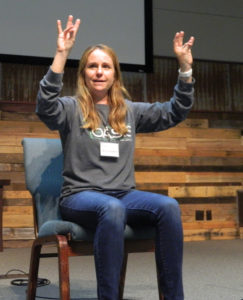
Bronwen Zilmer leads participants at The Oasis through a series of dexterity exercises during a time set aside for chair aerobics. (Photo / Ken Camp)

Bronwen Zilmer founded The Oasis out of a need she discovered through personal experience. Her father, Billy Hyden, was diagnosed with Alzheimer’s at age 58. Six months later, her mother died from complications related to treatment for leukemia.

Zilmer—a 20-something young professional who had just been married two years—suddenly became the primary caregiver for an adult with dementia.

“It was a role that I never thought I’d be in,” she said. “I was a businessperson, involved in software implementation. I was not expecting life to take that turn when I became the fulltime caregiver for Dad.”

Zilmer learned two important truths. First, she wanted her father to have opportunities to socialize and participate in meaningful activities. Second, she found out caregivers need a respite from the 24-hour-a-day stress of watching over their loved ones.

Eventually, her father’s illness advanced to the point where he moved into a memory care facility, where he lived until his death nine years ago.

Provide a break

Stephen Hatfield (left), pastor of First Baptist Church in Lewisville, leads a time of hymn singing during The Oasis. (Photo / Ken Camp)

Zilmer started a monthly support group for caregivers at First Baptist Church, sponsored in partnership with the Alzheimer’s Association of Greater Dallas. She learned how vitally important—and often inaccessible—respite care can be for caregivers.

“Caregivers need a break—a free break,” she said, pointing out that adult daycare for individuals with Alzheimer’s or related conditions can be “so expensive.”

The idea of The Oasis began to take shape, and she presented the idea to church leaders who pledged their support. Then she began to recruit volunteers—enough for a one-to-one ratio of volunteers to program participants. The Oasis launched in February 2015.

‘Moments of joy’

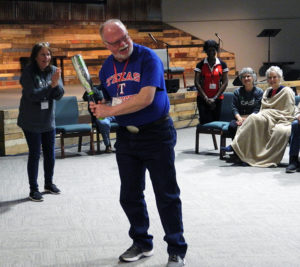
Steve Kavli, former Southern Baptist missionary to Thailand, enjoys his turn at bat during a wiffle ball game at The Oasis, while founder and coordinator Bronwen Zilmer cheers him on. (Photo / Ken Camp)

“We started with 12 participants and 12 volunteers. Within two years, we had eight on the waiting list,” Zilmer said. “I just couldn’t stand the thought of keeping them waiting. By the time we had an opening, the people who would benefit might not qualify anymore. So, we more than doubled the size of the program, with two groups of 13 participants.”

Each week, the four-hour event centers on a theme. At a recent baseball-focused gathering, participants shared memories of playing ball as children and took part in a “name that player” game in which they tried to identify famous baseball players from the past. They even participated in an indoor wiffle ball game where nobody was allowed to strike out.

“Our goal is to create moments of joy, and I feel like we do a good job at that,” Zilmer said. “We give participants a home—a place to belong again.”

The majority of participants are from outside the membership of First Baptist in Lewisville. The volunteer base typically has been 60 percent members and 40 percent nonmembers, but several volunteers have started attending the church as a result of the relationships they developed at The Oasis.

‘We do life together’

Steve Kavli, who served 15 years in Thailand with his wife Sue as Southern Baptist missionaries, became an Oasis participant last November after an early diagnosis of Lewy body dementia.

Sue Kavli, professor and director of research at Dallas Baptist University, grades papers during the four-hour break The Oasis offers from caregiving. (Photo / Ken Camp)

“The Oasis enables people with dementia to have life,” he said. “We do life together. We talk, share stories and do activities. It’s so easy to get caught up in the medical aspects of our conditions that we don’t do life.”

Sue Kavli, a professor and director of research in the Gary Cook School of Leadership at Dallas Baptist University, spends her four-hour break each week grading papers and taking care of other professional responsibilities.

“The church has been so kind to let me keep office hours here and to make me feel at home,” she said.

‘The body of Christ to us’

During her time at First Baptist in Lewisville, she sometimes meets with DBU students from the northern part of the Dallas-Fort Worth Metroplex and participates in videoconferences on equipment the church makes available.

The Kavlis drive about 60 miles roundtrip from their home in Grand Prairie to participate in The Oasis. They found nothing comparable—certainly nothing as “Christ-centered”—closer to where they live, Sue Kavli said.

“Steve was so desperate to be with other people. This is a place where you don’t have to pretend. You don’t have to hide anything,” she said. “They really are the body of Christ to us.”

‘Time to give back’

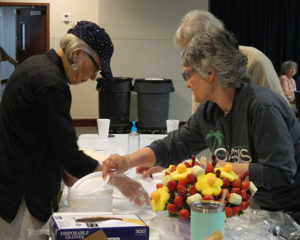
Virginia Polser (left), a volunteer at The Oasis, works with other volunteers to prepare a fruit snack for program participants. The fruit bouquet was a gift from a Tyler church that observed the Lewisville program and hopes to start a similar ministry. (Photo / Ken Camp)

Virginia Polser’s husband, James, was diagnosed with temporal dementia in 2007. She was part of the caregiver support group where Zilmer first began to discuss the possibility of The Oasis. Her husband benefited from its ministry until shortly before his death in 2017.

“I decided it was time to give back, because it meant so much to me,” Polser said.

Initially, she volunteered once a month, but she soon decided that wasn’t enough.

“It’s such a rewarding thing—such a blessing both to the participant and the caregivers—that I started volunteering once a week,” she said. “And it turned out to be such a blessing to me. It’s opened up a new group of friends for me.”

Share the program

As The Oasis has grown and gained a positive reputation, other churches have approached Zilmer for advice on how to launch a similar ministry.

“My mission now is to share the program with anyone who wants it,” she said.

Zilmer helped Wilshire Baptist Church in Dallas launch its Friday Friends ministry several months ago, and she also has consulted with Methodist, Episcopal and Disciples of Christ congregations.

“I am eager to share all of our materials and information,” she said.

Contact Zilmer at (214) 394-4721 or bronwenzilmer@gmail.com.


Christian writer Rachel Held Evans dies at age 37

WASHINGTON (RNS)—Rachel Held Evans, a popular progressive Christian writer and speaker, died May 4 at age 37 after a brief illness.

Evans had been in a medically induced coma for several weeks and never returned to an alert state.

Her husband, Dan, informed followers and supporters of his wife’s death on her website.

“This entire experience is surreal. I keep hoping it’s a nightmare from which I’ll awake. I feel like I’m telling someone else’s story,” her husband Dan Evans wrote in an update on Evan’s blog.

“I cannot express how much the support means to me and our kids. To everyone who has prayed, called, texted, driven, flown, given of themselves physically and financially to help ease this burden: Thank you. We are privileged. Rachel’s presence in this world was a gift to us all and her work will long survive her.”

Hospitalized for flu complications

On April 14, Evans, who was particularly gifted at using social media to connect with her readers, tweeted that she had been admitted to the hospital with a “flu + UTI combo and a severe allergic reaction” to antibiotics, asking for prayer and—with the characteristic humor she often used to defuse difficult conversations—lamenting she would miss “Game of Thrones.”

Later, in an update on her website, Dan Evans, said that she began having “unexpected symptoms” while receiving treatment for an infection and that doctors found her brain was experiencing constant seizures. Doctors had placed her in a medically induced coma while working to determine the cause and treatment, he said.

Influential writer

rachel evans
(Courtesy photo by Maki Evans)

Evans is best known for her popular blog and best-selling books, including New York Times best-seller A Year of Biblical Womanhood, Searching for Sunday and, most recently, Inspired. She also served on President Obama’s Advisory Council on Faith-based and Neighborhood Partnerships.

In her books and blog posts, she wrote openly about her faith journey, which led her from Bryan College—a conservative evangelical school known for promoting belief in a literal, six-day creation—to the mainline Episcopal Church. Along the way, she chronicled her faith, doubt, honest questions and evolving beliefs with a sense of humor.

That didn’t come without controversy, including pushback from more conservative Christians over A Year of Biblical Womanhood, which celebrated an egalitarian view of women’s roles in both marriage and the church.

But in her writing, she rarely lapsed into us-versus-them arguments, instead presenting a vision of the church as a place with room for everyone.

Influential encourager

A number of women said during an online prayer vigil they would not have pursued ministry if not for Evans, and others said the only reason they had hung onto faith amid doubt was because of Evans.

Fellow writers praised Evans for sharing the considerable platform she has built, both on her blog and at “Why Christian?” and “Evolving Faith,” the conferences she co-founded for evolving or progressive Christians who aren’t sure where they belong on the spiritual landscape.

The news of Evans’ hospitalization had been met with an outpouring of support from readers, writers and Christian leaders, both conservative and progressive.

Upbringing in evangelicalism

Evans was raised in a nondenominational, evangelical Christian family in Dayton, Tenn.—the home, she liked to point out, of the 1925 Scopes Monkey Trial, the watershed case about teaching evolution in schools that caused many conservative Christians to feel alienated from the American mainstream.

She joked about the prizes she won as a kid for having all the answers when it came to Christianity, such as the time she won the “Best Christian Attitude Award.”

But as a student at Bryan, Evans began asking tough questions about her faith, like why God would send people to hell, which she wrote about in her first book. Evolving in Monkey Town was published in 2010 and later re-released as Faith Unraveled.

Evans brought her sense of humor to those questions in 2012’s A Year of Biblical Womanhood, in which she took the Bible’s instructions for women to hilarious extremes and shared what she learned from women of diverse faiths, including Amish and Jewish women.

Move away from evangelicalism

When she was growing up, the word “evangelical” had seemed synonymous to her with “real” or “authentic,” she told Religion News Service several years ago. She finally abandoned the label in 2014, after a number of evangelical Christians canceled sponsorships for children in need after the charity World Vision announced it would employ people in same-sex marriages. (World Vision later reversed that decision.)

That incident “confirmed what I’d been suspecting for a while—that my values were simply out of line with the evangelical culture’s values,” she said. “And by then, I’d just grown weary of fighting for a label that no longer fit.”

She wrote about her subsequent journey away from church and what kept leading her back in 2015’s Searching for Sunday, and about rediscovering a love for Scripture in 2018’s Inspired.

She worshipped with her family at St. Luke’s Episcopal Church in Cleveland, Tenn.

“Death is a part of life,” Evans wrote this year in a Facebook post at the beginning of Lent, the solemn time of penance and fasting many Christians observe leading up to Easter.

“My prayer for you this season is that you make time to celebrate that reality, and to grieve that reality, and that you will know you are not alone. Ashes to ashes, dust to dust.”


Bulletin: Storms severely damage churches in LaGrange

LAGRANGE—Storms that swept through Fayette County on May 3 seriously damaged two LaGrange churches.

Justin Lopez, discipleship pastor at First Baptist Church in LaGrange, reported his church’s new property was hit by a tornado.

In a video posted on the church’s Facebook page, Lopez reported “significant damage” to the property from a tornado. The video showed a pavilion destroyed by the high winds, as well as major roof and water damage to the church’s main building.

No church personnel were at the property when the storm hit.

FOX 7 from Austin reported a possible tornado damaged Mt. Zion Baptist Church, a historic African-American congregation in LaGrange.

The Baptist Standard will continue to provide additional updated information as it becomes available.


Around the State: TBM wraps up after tornadoes; Olympian Retton lectures at UMHB

Texas Baptist Men disaster relief volunteers completed work in the aftermath of tornadoes that hit Franklin and Alto, donating more than 10,000 volunteer hours. Collectively, the teams prepared more than 3,000 meals, purified 2,183 gallons of water, distributed more than 1,400 boxes, completed 100 chainsaw jobs and logged more than 400 heavy equipment hours. They made more than 800 personal contacts, distributed 98 Bibles and recorded nine professions of faith in Christ.

Mary Lou Retton, the first American woman to win an Olympic gold medal in gymnastics, delivered the 2019 McLane Lecture at the University of Mary Hardin-Baylor. (UMHB Photo)

Mary Lou Retton, the first American woman to win an Olympic gold medal in gymnastics, delivered the 2019 McLane Lecture at the University of Mary Hardin-Baylor. In the final two rounds of competition at the 1984 Summer Olympics, Retton earned perfect 10-point scores on both her floor exercise and vault. “I wasn’t supposed to be there, and I certainly wasn’t supposed to do that,” Retton told the UMHB crowd, emphasizing the importance of hard work, dedication and sacrifice. She recalled sustaining a catastrophic knee injury that required immediate surgery five weeks prior to the Olympics. “To say the least, the doctors were not optimistic about my chances. … It was at that moment, I felt a surge in my stomach, and I know it was the Holy Spirit,” Retton said. “He was blessing me and telling me, ‘You can do this.’” Retton told the UMHB audience: “Don’t let other people put limitations on you. Taking those risks and meeting those challenges head-on is sometimes the only way to make your dreams come true.”

East Texas Baptist University named John Sargent as the 2019 J. Ward Walker Award recipient. Sargent, dean of ETBU’s School of Education and professor of teacher education, presented the J. Ward Walker Lecture on April 24. Walker was vice president for spiritual life at ETBU in the 1990s, and recipients of the award named in his memory are selected based on their exemplary and consistent engagement of faith with scholarship, teaching or administrative service.

Five Howard Payne University students were honored as Sumners Scholars—(left to right)
Augusta Johnson, Jessica Catlett, Emma Reed, Tyler Olin and Joel Justice. They are pictured with HPU President Cory Hines and representatives from the Sumners Foundation—(left to right) Eileen Resnick, program officer; Charles Pierson, executive officer; Lon Williams, trustee; and Scott Higginbotham, trustee. (HPU Photo)

Five graduating seniors from Howard Payne University’s Guy D. Newman Honors Academy were recognized during the recent Sumners Scholars Banquet. The students, who were selected as Hatton W. Sumners Foundation Scholars during their junior year, each received a plaque and a copy of The Wisdom of Hatton W. Sumners and The Sumners Foundation Scholarships. Honored for completing four semesters as Sumners Scholars were Joel Justice of Brownwood, Augusta Johnson of Gatesville, Emma Reed of Fort Worth, Jessica Catlett of Allyton and Tyler Olin of Howe. The Sumners Scholar program offers students the opportunity to attend special lectures, seminars and conferences featuring leaders from both public and private sectors. It also provides a $7,500 per semester scholarship for two years.

The Master’s Singers from First Baptist Church in Arlington were featured at the Norvell Slater Hymn Sing at Dallas Baptist University. (DBU Photo)

Dallas Baptist University hosted the 31st annual Norvell Slater Hymn Sing in Pilgrim Chapel. The event followed the DBU Grandparents’ Day luncheon, and it featured the Master’s Singers from First Baptist Church in Arlington. The event is named for the longtime host of the “Hymns We Love” Sunday morning radio program, heard for more than four decades in North Texas.

Baylor Law School dedicated the Charles E. Wallace Family Courtyard at the Sheila and Walter Umphrey Law Center today in the memory of Waco lawyer Charles “Chuck” Wallace. The Wallace Family Courtyard was named in appreciation for a $2 million gift from Sherri W. and Robert “Bobby” L. Patton Jr. of Fort Worth in memory of her father and in honor of her mother, Sandra Stoesser Wallace. In addition to enhancements to the courtyard, the gift helps underwrite the legal writing and pro bono programs within Baylor Law School.

Howard Payne University’s Fellowship of Christian Athletes raised about $1,500 through the Tony Daniel Memorial 5K. (HPU Photo)

Howard Payne University’s Fellowship of Christian Athletes raised about $1,500 through theTony Daniel Memorial 5K. Money raised from the event is set aside in the FCA’s scholarship fund and used to send athletes and coaches to FCA camps in Texas. The event honors the memory of the FCA Brownwood area director who died last year.

Cole Franklin, director of the East Texas Baptist University debate team, received the 2019 Bennett Strange Coach of the Year Award at the International Public Debate Association’s national championship tournament and convention in Shreveport, La. Determined by a vote of all university programs attending the national tournament, the Coach of the Year award is presented to a debate director annually and honors the coach for his or her dedication to students, mentoring, debate education and pedagogy, and service to the association and debate community. Franklin is chair of the Department of Communication Studies and professor of communication at ETBU.

Howard Payne University recently held its sixth annual Wellness Fair, providing health screenings, demonstrations, exhibits and games, including a tug-of-war contest between teams made up of HPU faculty, staff and students. HPU personnel staffed booths focused on seven dimensions of wellness—emotional, intellectual, spiritual, environmental, occupational, social and physical.

Anniversaries

10 years for DeWayne Bush as pastor of First Baptist Church is Tuscola.

10 years for Joseph Fields as pastor of New Beginnings Church in Lewisville.

5 years for Charles McDermett as pastor of First Baptist Church of Eula in Clyde.

Retirement

Gene W. Jones will retire May 31 after 50 years in fulltime vocational ministry. He has been an associate pastor at First Baptist Church in Canyon since 1997, initially in the area of education and administration and for the last 10 years in senior adult ministry. He previously served churches in Sherman, Baytown, Houston, Big Spring, Dallas, Dimmit and Stanton, as well as in Clovis, N.M.