Around the State: Pinsons receive Landry Award from DBU; Lady Bears national champs
April 10, 2019
The Daraja Children’s Choir recently led worship during a University of Mary Hardin-Baylor chapel service. The ministry has brought hundreds of children from Uganda and Kenya to tour the United States and lead worship since 2007, bridging cultures and discipling young leaders.
Bill and Bobbie Pinson received the Tom Landry Leadership Award from Dallas Baptist University. He is executive director emeritus of the Baptist General Convention of Texas, distinguished university professor at DBU and volunteer director of the Texas Baptist Heritage Center. She has served 18 years on the DBU board of trustees. The Pinsons are members of First Baptist Church in Lancaster.
Baylor University’s Lady Bears women’s basketball team won the NCAA national championship. In spite of an injury that forced junior Lauren Cox, the Big 12 Defensive Player of the Year, from the game, the Lady Bears defeated Notre Dame 82-81. The national championship is the third in Baylor women’s basketball history, all under the leadership of Coach Kim Mulkey.
The Wayland Baptist University Flying Queens women’s basketball program will be inducted into the Naismith Memorial Basketball Hall of Fame at a Sept. 5-7 ceremony in Springfield, Mass. The hall of fame’s direct-elect committee recognized the program from 1948 to 1982, when the Queens were instrumental in affecting changes made to women’s basketball—using community sponsors, offering athletic scholarships for women decades before Title IX, and changing the game to the full-court, 5-on-5 with unlimited dribble. The Queens hold the record for the longest winning streak in basketball at 131 games, accomplished from 1953 to 1958. The team earned 10 AAU national titles, national runner-up finishes, nine consecutive NWIT titles and success throughout the decades that has led to more than 1,600 wins—more than any team in history.
Howard Payne University’s Criminal Justice Club and Amigos Unidos Club will collect new and gently used items for the Heart of Texas Children’s Advocacy Center in Early. The organizations particularly request blankets, backpacks, stuffed animals and hygiene products. The event will be held from 9 a.m. to 2 p.m., April 13, in the parking lot of Abundant Life Church on West Commerce in Brownwood. For more information, email Danny Brunette-López at dbrunette@hputx.edu.
Buckner Retirement Services marked the expansion and renovation of Buckner Calder Woods in Beaumont with an April 2 ribbon-cutting ceremony. The project involved an 80,000–square-foot expansion and 51,000-square-foot renovation, resulting in the addition of 67 residences and 24 skilled-nursing rooms. It also included the renovation of all independent-living common areas and construction of a wellness center with an indoor pool, gym, activity space and bistro.
On the Move: Gravens and Smith
April 10, 2019
Jeff Gravens to First Baptist Church in Sulphur Springs as pastor from First Baptist Church in Crawford.
Vince Smith to First Baptist Church in San Angelo as pastor. He previously served on staff as minister to families.
Plano church’s partnership supports church planting in Mexico
April 10, 2019
PLANO—A North Texas church’s longstanding partnership with a Baptist pastor and hospital administrator in western Mexico undergirds a church-starting movement in the southern Mexican state of Chiapas.
The relationship began about 20 years ago when Don Sewell, who directed partnership missions for the Baptist General Convention of Texas, contacted Wayne Stevenson from First Baptist Church in Plano.
Early in his ministry, Sewell had served as minister to youth at First Baptist in Plano, where he became acquainted with Stevenson, an engineer, entrepreneur and philanthropist.
Significant visit to Guadalajara
Omar Nicolas is administrator of Hospital Mexico Americana and pastor of Tercera Iglesia Bautista in Guadalajara, Mexico. (Photo courtesy of Craig Curry)
Sewell, a former missionary to Mexico, invited Stevenson to accompany him to Guadalajara, where he introduced him to Omar Nicolas, administrator of Hospital Mexico Americana and pastor of Tercera Iglesia Bautista.
Sewell now directs the Joel T. Allison Faith in Action Initiatives at Baylor Scott & White Health in Dallas, and Baylor regularly donates medical equipment and provides other assistance to the Baptist hospital in Guadalajara.
Stevenson and Nicolas developed a deep and abiding friendship, and the Plano layman began to support the bivocational Mexican Baptist pastor’s work—not only at the hospital and his congregation in Guadalajara, but particularly the churches Tercera Iglesia Bautista began planting.
“His father had been a Baptist minister in Chiapas, and he convinced me to take a trip with him down there,” Stevenson recalled.
Nicolas grew up in Chiapas—an area in South Mexico long dominated by a hybrid blend of Roman Catholicism and indigenous folk religion—and was familiar with its people and culture. As a result, his efforts to start churches and train pastors in the region met with more success than most previous attempts.
Growing movement to start churches
After Stevenson learned more about the opportunities in Chiapas, he worked with Jerry Carlisle, then pastor at First Baptist in Plano, and leaders of the congregation’s missions committee to support work in Chenalhó, where Nicolas helped plant a church and start a seminario—a training and equipping center for pastors.
Worshippers gather at the original building used by the Baptist church in Chenalho, Mexico. (Photo courtesy of Jerry Carlisle)
“There were about seven members at the church in Chenalhó then. They met in one room, about 12 by 15 feet, with one light bulb hanging from the ceiling,” Stevenson recalled.
However, the church’s members had secured a plot of land on a hill that they cleared and leveled with hand shovels to prepare a building site. First Baptist in Plano provided the $3,000 in building materials the church needed, and members constructed a building.
“A few months later, they called us to invite us to the building dedication,” Stevenson said. “The church had more than 100 in attendance that day, and they baptized 17 people in a creek.”
Later, when the church outgrew its facility, the congregation built another sanctuary capable of seating about 300 and converted the earlier building into classrooms for the pastor training center.
That center trained ministers who served in about a dozen churches Tercera Iglesia Bautista in Guadalajara started in villages throughout Central and South Mexico.
Planting a church in San Cristóbal
Miguel Santiz Hernandez, who grew up in the area and attended the training school Nicolas founded, started a church at his home in San Cristóbal—a strategically placed colonial-era city that previously lacked a strong evangelical presence.
Assembled for the dedication of a Baptist church building in San Cristobal, Chiapas, with the church’s pastor, Miguel Santiz Hernandez, are (left to right) Pastor Craig Curry and layman Wayne Stevenson from First Baptist Church in Plano; Don Sewell, director of Faith in Action Initiatives at Baylor Scott & White Health; Bill Arnold, president of the Texas Baptist Missions Foundation; and Omar Nicolas, administrator of Hospital Mexico Americana and pastor of Tercera Iglesia Bautista in Guadalajara. (Photo courtesy of Craig Curry)
When the congregation outgrew the pastor’s home, First Baptist in Plano and Tercera Iglesia Bautista in Guadalajara helped purchase property for a worship center.
“My first trip to Chiapas, the church had obtained property, but it was just dirt,” said Craig Curry, who became pastor at First Baptist in Plano three years ago.
An architect donated his services, and the members of the congregation in San Cristóbal provided labor for the church building. Donors channeled more than $100,000 through the Texas Baptist Missions Foundation to support the church construction project in San Cristóbal.
In February, Curry, Stevenson and Sewell—along with Bill Arnold, president of the Texas Baptist Missions Foundation—attended the dedication service for the church building in San Cristóbal, joined by about 400 others.
“During the two and a half hour service, Pastor Miguel told about his mother’s dream of a church” in San Cristóbal, Curry recalled. Choked with emotion, the pastor was unable to continue, noting his mother died a short time before she saw her prayers answered.
Curry wants to see First Baptist continue its relationship with the church in San Cristóbal by providing the congregation the equipment and supplies it needs to care for infants and toddlers, as well as supporting Nicolas in varied aspects of his work.
“This is a picture of cooperation,” Curry said. “Omar Nicolas is the catalyst for a church planting movement in Chiapas, and Baylor Scott & White helps his hospital in Guadalajara. First Baptist in Plano, the Texas Baptist Missions Foundation and others helped provide funding in San Cristóbal, and members of the church there did the construction. It shows what we can do when we work together.”
With additional reporting by Editor Eric Black.
Overflow from immigration centers heightens need for ministry
April 10, 2019
LAREDO—U.S. Immigration and Customs Enforcement have called Lorenzo Ortiz daily since last February to inform him how many immigrants will be dropped off at the city’s bus station.
Typically, eight to 10 arrive. Ortiz, pastor of Iglesia Bautista Emanuel in Laredo, usually receives the first phone call in late afternoon, but several more calls follow throughout the evening.
Along with several organizations, Ortiz coordinates meals, schedules rides and helps immigrant families at the bus station contact relatives in the United States.
And that’s just the initial ministry provided to the 80 or so people released each day from immigration detention centers.
Not enough space available
Families who crossed the border to seek asylum cannot be held at detention facilities because of overcrowding. As a result, Laredo and other border towns see more immigrant families in need, Ortiz said.
Lorenzo Ortiz, pastor of Iglesia Bautista Emanuel in Laredo, coordinates meals, schedules rides and helps immigrant families contact relatives in the United States. (Photo courtesy of Imelda Corona)
“They are rushing families through the process because they do not have space for them,” he reported.
Homeland Security officials reported agents expected to stop about 100,000 immigrants at the border last month—more than double the number of unauthorized crossings at the same time in the past few years.
For the past two months, Ortiz said, his ministry has seen close to 2,000 immigrants.
As families arrive at the bus station, Ortiz and other organizations assist them. Volunteers distribute food, while others perform health screenings or help new arrivals contact family members.
They also help protect the immigrants from predators who come to lure families away or to scam them, taking away the limited money they have, he said.
Offering the hope of Christ
Immigrants also receive Bibles, and Ortiz said he tells them about the love God has for them.
Families who are running away from home in fear, many of whom also suffered along the way, find a new hope when they hear the gospel at the bus station, Ortiz said.
“Many families hear about Christ and decide they want to follow him after we talk with them,” he said.
After Ortiz meets families at the bus station, he often goes back to the church where some of the families stay until they find the means to travel and meet their relatives.
Iglesia Bautista Emanuel helps families with the most basic needs, which also means the church needs the assistance of other congregations and individuals to provide food, hygiene kits, clothing of all sizes for adults and children, shoes and diapers, as well as cleaning and cooking supplies.
“The demand is bigger than the resources, but God has provided through other churches,” Ortiz said.
‘Teaching us to be Good Samaritans’
Immigrant families wait at the bus station in Laredo. (Photo / Isa Torres)
The church offers Vacation Bible School-type classes for the children, and families are invited to attend the church’s worship services throughout their stay.
A majority of the families are from Central America, but some have roots in places as far away as Angola, Russia and Uzbekistan, Ortiz noted.
For the church and the families themselves, this means constant friction with unfamiliar cultures and social norms, Ortiz noted.
But instead of seeing it as a problem, Ortiz said, the church sees it as an opportunity for growth.
“Even in their own need, they are teaching us to be the Good Samaritans we have been called to be,” Ortiz said.
The ministry Ortiz began has grown more than he envisioned.
Every day, Ortiz also answers the calls of family members back home looking to find the relatives who made the trip to the United States. Many are desperate because they lost touch with their relatives as they traveled north. So, they call Ortiz, hoping he interacted with them already or can give more information about the process immigrants go through before they are released.
Missionaries with Texas Baptists’ River Ministry have seen similar needs. Recently, River Ministry sent out a call for individuals and churches to support the mission efforts on the border directed toward new arrivals.
Ortiz sees no immediate end to the days when he will handle phone calls from U.S. agents and relatives of immigrant families. So, he is preparing to launch a non-profit organization that will focus solely on that area of ministry.
“People are coming here, and they have come looking for hope,” Ortiz said. “Christ has given us the hope they are looking for to share it with them.”
Christ’s light shines in darkened Venezuela
April 10, 2019
VENEZUELA (BP)—Beatriz paused in her struggle to lug a bucket of water up seven flights without sloshing any out. She rubbed her aching arms, then grabbed the bucket and continued up the fire escape to her sister’s apartment—one step at a time.
If her husband Leo, a Venezuelan pastor, could find parts to repair their ailing car, if he could secure gasoline, and if he didn’t find too many roadblocks, he would join Beatriz there in the capital, bringing two large containers of water from his mother’s home in the country.
Regardless of a torn rotator cuff, he would need to hoist the containers to his shoulders and carry them up all seven flights.
It marked the sixth day of no electricity in some regions—the fourth day for 21 of 24 states in Venezuela—days without water, with food spoiled, without much public transportation, with work called off, without functioning hospitals, with school called off. It was the nation’s second round without electricity, less than a month after the first round lasted nearly seven days in most regions.
In survival mode
Life for the vast majority of Venezuelans is strictly about survival, some people in the country observed.
“People are walking around like zombies, not knowing what to do, or even why they are walking around,” Paula reported from her city in eastern Venezuela. (Due to political instability and security concerns in Venezuela, last names are withheld.)
Most of the day is spent resolviendo—”figuring out” where and how to get enough water to cook, flush toilets and take sponge baths; where and how to get food each day since there is no means of preserving food in a tropical land; how to pay for the food when no cash is available nationwide and, now without electricity, debit cards are useless; how to prepare a meal when the electric stove is useless. Even if one has a gas stove and a ration of water, matches are hard to come by and gas bombonas—tanks—are not being delivered.
Venezuela is in darkness in every possible way. Christians there often feel helpless because, although they see—and live—the need, and have a great desire to help, they are enormously impeded by the electrical outages, their own critical situation and lack of resources.
It is “breaking our hearts to see people go into eternity without Christ,” one evangelical said. Yet even in their own daily struggles, Venezuela Baptists are looking for and finding ways to share the light of Jesus Christ as they minister to those around them.
“We are in the most critical time in Venezuela, and it is the best opportunity for sharing Christ,” said Francisco, a pastor in central Venezuela.
Leo, a pastor for over a quarter century, now mentoring young pastors, agreed: “It isn’t easy living in this situation that has come upon us. Nevertheless, we have learned to be content whatever our situation. That doesn’t imply resignation. No, we need to move forward, trusting and hoping in God, but doing what each one, working from the trenches, should do to generate change.”
Seeking to meet needs
That is what Venezuelan Baptists are seeking to do at every level, with work going forward in 23 of the nation’s 24 states. At an associational and regional level, programs have been in place since last year to help pastoral families with basic pantry items once a month through The RaVenz Project, while also providing food for church feeding centers directed to the most vulnerable in the community such as children, pregnant and nursing mothers and the elderly.
Venezuelan Baptist churches and individuals are serving during the crisis in a variety of ways. They include:
Two self-sustaining farm projects, one in central Venezuela and another in eastern Venezuela also with a fishery.
Medical clinics for the communities at large.
Ophthalmology and dental clinics for children.
Classes and mentoring for disadvantaged parents.
Water provided for the community from tanks on church property.
Hospital visits that include prayer and food for the sick.
The International Mission Board is working alongside Venezuelan Baptists to help mitigate the suffering. Several of the current ministries are partially-to-completely funded by the IMB Special Gifts Fund for Venezuela and/or Baptist Global Response.
RaVenz Project
The RaVenz Project, named after the ravens that fed the Old Testament prophet Elijah during a crisis in his life, partners with the Venezuelan convention and Baptist associations to provide food for major events in Baptist life such as pastors’ camps and annual convention, Woman’s Missionary Union and youth meetings. The RaVenz Project also helps monthly with church-based feeding centers that were providing 300,000 meals per month at the end of 2018.
Venezuelan Baptist leaders particularly are grateful and thankful for two key training events, one by Baptist Global Relief, the other by the IMB. In September 2017, Baptist relief ministry partners spent a week along the Venezuelan/Colombian border, training 51 Venezuelan Baptist leaders and several Colombian Baptist leaders in community development.
That training, through the creativity and hard work of Venezuelan believers, has multiplied across Venezuela in such forms as sports clinics, various cottage industries and new feeding programs.
A year later, in September 2018, the IMB facilitated a Trauma Healing Institute training on “healing heart wounds,” again along the border, and again encompassing Venezuela Baptist leaders.
Pastor Felipe referenced both training events as crucial for these dark times in Venezuela, saying they “helped tremendously to prepare us for what is happening in our nation.”
Meanwhile, while climbing stairs at her apartment, Beatriz met an elderly woman whose husband is in bed dying of cancer. As Beatriz began to visit with the her, the woman burst into tears and threw herself into Beatriz’ arms, saying she was overcome by depression at the situation. Beatriz spoke to her of Christ, and she and Leo prayed for her.
“It is really difficult seeing the lack of hope in people,” Leo said. “Last night, a trickle of water came in at street level and neighbors stood in line, in the dark, all night, to fill pots and pans and bottles. All night. This morning the tail of the line had not yet reached the water faucet.”
Congreso Experiences give Hispanic youth a look at schools
April 10, 2019
In addition to its focus on evangelism and discipleship, Congreso—an annual event for Hispanic Baptist young people—long has promoted education among Hispanic middle-school and high-school students.
Weeks ahead of this year’s conference, scheduled April 18-20 at Baylor University, six Baptist universities around the state served as host sites for Congreso Experiences that drew more than 600 students.
Gabriel Cortes, coordinator of Congreso Experiences, talked about the importance of living for Christ, not for oneself. (Photo / Isa Torres)
“We have partnered with Baptist universities to give students an overview of the education possibilities they have,” said Gabriel Cortes, Congreso coordinator.
Wayland Baptist University, East Texas Baptist University, Dallas Baptist University, Hardin-Simmons University, Baptist University of the Américas and the University of Mary Hardin-Baylor hosted these events in February and March.
First Baptist Church of Weslaco and Iglesia Bautista in Houston also served as host sites for Congreso Experiences in South Texas.
Universities and churches had the freedom to set the agenda of each Congreso Experience and provide students with workshops similar to the ones at the statewide Congreso in Waco, Cortes explained.
While each location’s workshops differed, some included classes on how to apply for college, what college life is like and what Hispanics can expect at certain universities, as well as classes on money management and how to develop spiritual discipline while in college, he noted.
Students had the opportunity to tour the universities and hear about what they could study at each of the schools, Cortes said.
Congreso Experiences also provided a preview of what students can expect at the statewide Congreso and also bring some of what Congreso offers to those who cannot make it all the way to Waco, he added.
“We want students to know the opportunities Texas Baptists offer,” Cortes said. “Many times, they have not heard about what is out there, and these universities have stepped up to prepare students for the future.”
While Congreso aims to empower more students with education, the goal ultimately serves the greater goal of empowering the church to serve more holistically and more efficiently, Cortes said.
“More education brings better equipped leaders,” he said. “And with better leaders, you also have a better church.”
New HPU president enjoys fast-paced first day
April 10, 2019
BROWNWOOD—On the first day of a new job, many people prefer a relatively light schedule with plenty of time to get acclimated to new surroundings. Not Howard Payne University’s new president, Cory Hines.
When Hines looked at the blank schedule for what would be his first official eight hours, he promptly planned a day full of meetings.
“There will be time to finish unpacking later,” Hines said. “I couldn’t wait to begin getting connected to the life of our campus and community.”
Cory Hines gets acquainted with Howard Payne University students over lunch in the dining hall. (HPU Photo)
Hines, a 1997 graduate of HPU, noted he wants to build relationships and promote his alma mater. Hines was so eager that he arrived on campus the weekend of March 23, ahead of taking office on April 1, so he could participate in a preview event for prospective students and their families, attend a meeting of the Alumni Association board of directors and enjoy performances at Spring Sing, HPU’s annual event featuring musical productions by student organizations.
Then, on his first official day, he spent several hours at HPU’s Mabee University Center with various groups of university personnel and representatives from Brownwood and Early. At noon, he enjoyed lunch with students in the university’s dining hall.
On his way back to his office toward the end of the day, he even tried his hand at Jacket Golf—a popular HPU Yellow Jackets pastime played with golf clubs and tennis balls—after some students invited him to join them in the midst of a game.
‘Build strong, vital relationships’
“As I begin my duties as HPU’s president, the most important item on my agenda is to get to know the people around us so I can hear what’s on their hearts and visit about how we can build strong, vital relationships,” Hines said.
“This first day was an important step. I look forward to getting to know more and more people as we move ahead at our main campus and extension centers.”
On his way back to his office after a day full of meetings, two students invite Cory Hines to try Jacket Golf, a popular HPU pastime. (HPU Photo)
In his conversations with the people he meets, he enthusiastically shares what HPU has to offer.
“I want our alumni to know that this is still the same university they know and love, and they play an important role in its ongoing vitality,” he said. “I want parents to know HPU is a safe place, and they can trust HPU with their kids. I want students to know that we’ll prepare them academically, vocationally and spiritually.
“I want HPU to be a good neighbor to our local and area communities. God has blessed HPU by placing our university in Brownwood, and I look forward to fostering and deepening our connections here.”
At every stage throughout his first day in office, Hines articulated his passion for HPU and the promise of what can be achieved through a vast but close-knit network of partnerships.
“This is very much a team effort that involves many, many people,” he said. “I’m eager for everyone to join us on this exciting journey. I look forward to all God has for us.”
With his first official day behind him, Hines took a moment to catch his breath and express appreciation for all who took time to visit and help put the groundwork into place for this new era at HPU.
“Today has been busy, but what a wonderful day it was,” he said. “I’ll get a good night’s sleep tonight and be ready for another great day tomorrow.”
Baptist statesman James Wood dies at age 96
April 10, 2019
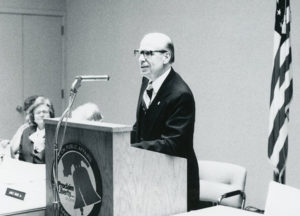
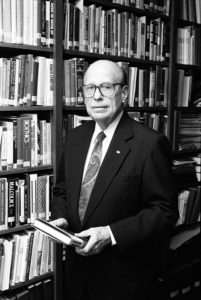
James E. Wood Jr., former executive director of the Baptist Joint Committee for Religious Liberty and longtime director of Baylor University’s J.M. Dawson Center for Church-State Studies, died March 24 at age 96.
Wood was born on July 29, 1922, in Portsmouth, Va., and served as a Baptist missionary in Japan before joining the Baylor faculty in 1955 as an associate professor of religious history.
James E. Wood Jr.
After publishing the landmark book Church and State in Scripture, History and Constitutional Law in 1958 with Baylor colleagues E. Bruce Thompson and Robert T. Miller, Wood became director of the Dawson Institute.
He led the Dawson Institute to develop several undergraduate and graduate programs, launched the Journal of Church and State and opened the J.M. Dawson Church-State Research Center in Carroll Library on the Baylor campus.
“Dr. James Wood certainly put the academic study of church-state relations on the map at Baylor and beyond,” said Doug Weaver, current director of the Dawson Institute and professor of Baptist studies at Baylor.
“As a Baptist, Wood understood the importance of the separation of church and state and how that separation was good for both. As he noted that spread of authoritarian governments in his day, he strongly advocated for the religious liberty ‘as an axiomatic principle basic to all human rights.’”
Wood left Baylor in 1972 to lead what then was called the Baptist Joint Committee on Public Affairs in Washington, D.C., for eight years.
In his inaugural address as head of Baptist Joint Committee, Wood said the concern of the church for religious liberty “must necessarily include the concern of the church for all civil liberties as inalienable rights of all men.”
Wood viewed the issue of religious liberty through the lens of God’s care for every human.
“To be true to its mission, therefore, the church must be involved in public affairs because it seeks to minister to the whole man in the world, and no aspect of life can be regarded as outside of God’s concern, dominion, and power,” he said.
James E. Wood Jr. addressed a 1980 meeting of the Baptist Joint Committee board. (BJC Photo)
During his tenure at the Baptist Joint Committee, he led the agency to expand its mission to include issues such as international human rights and seeking an end to the nuclear arms race.
“It is safe to say that James Wood’s views were known inside the White House and the Department of State and that they helped the Carter Administration lay a sound foundation in formulating an international policy based in large measure on the bedrock commitment of Baptists and others to freedom of conscience,” said Stan Hastey, who worked with Wood at the Baptist Joint Committee.
For example, Hastey remembered Wood’s impassioned pleas on behalf of the imprisoned Soviet Baptist dissenter Georgi Vins were instrumental in securing Vins’ release from the USSR.
James E. Wood Jr. was director of the J.M. Dawson Institute for Church-State Studies at Baylor University. (Photo courtesy of the Texas Collection at Baylor)
“James Wood was indefatigable, working tirelessly on a wide range of public policy issues he considered the rightful agenda of the Baptist Joint Committee,” he said.
Wood returned to Baylor in 1980, serving both as director of the Dawson Institute and as the Simon and Ethel Bun Professor of Church-State Studies. He retired from Baylor in 1999.
Wood served on various religious liberties committees, such as the World Council of Churches Committee on Religious Liberty, the First World Congress on Religious Liberty and the International Academy for Freedom of Religion and Belief, of which he was president.
He served as a consultant to many Eastern European countries following the collapse of the Soviet Union, advising them on the creation of new religious freedom laws. He received many awards, including the Religious Liberty Award by the Alliance for the Preservation of Religious Liberty and the Abner V. McCall Religious Liberty Award from the Baylor Alumni Association.
Wood was preceded in death by his wife of 58 years, Alma McKenzie Wood. He is survived by their son, James E. Wood III.
Compiled from reports by the Baptist Joint Committee and Baylor University.
Around the State: Baptist Temple in San Antonio recognized
April 10, 2019
San Antonio Mayor Ron Nirenberg presented the Compassionate San Antonian Award to Pastor Jorge Zayasbazan and members of Baptist Temple in San Antonio. The award recognizes individuals who serve the community through acts of kindness and compassion, making a difference in the lives of others. Baptist Temple was nominated along with several District 3 churches by Ann Helmke, the City of San Antonio’s faith-based initiative liaison. The city recognized Baptist Temple for the innovative ways it has used its inner-city campus to meet the community’s spiritual and physical needs. Services include a charter school, an early learning center, a thrift store, a food pantry, a prison ministry, a performing arts ministry, crafts classes, support groups and counseling. On Sundays, six congregations meet at the Baptist Temple campus, including one congregation that worships in Spanish and one in American Sign Language. Baptist Temple also has launched an initiative for children ages 9 to 14 designed to break the cycle of generational poverty. The church also built an inclusive playground to enable children with special needs and children with typical abilities to play together.
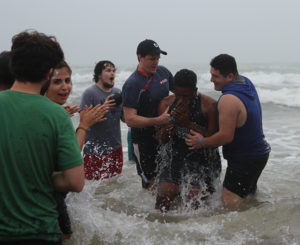
David Griffin, Baptist Student Ministry director at East Texas Baptist University, and ETBU junior Jerry Villela baptize ETBU senior Jamarcia “JC” Banks. In conjunction with Island Baptist Church, 500 college students celebrated his decision to follow Christ on one of the major party beaches on the island.
Students from around the state involved in Baptist Student Ministry traveled to South Padre Island during spring break as a part of Beach Reach. Through the annual Texas Baptist evangelism initiative, college students share the hope of Jesus as they provide free food and transportation to beach visitors. The Beach Reach volunteers provided 19,552 rides, served 11,495 pancake breakfasts, prayed with 11,327 vacationers and engaged in 10,239 gospel conversations, resulting in 112 students beginning a relationship with Jesus and 52 recommitting their lives to Christ.
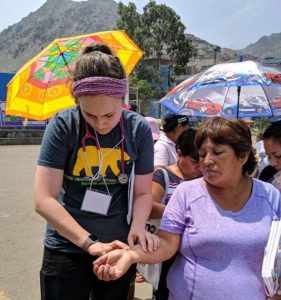
A student from Baylor University Louise Herrington School of Nursing checks the pulse of a woman in Peru during a recent mission trip.
Six students from the Baylor University’s Louise Herrington School of Nursing joined with 19 students from Baylor University’s Medical Service Organization on a medical mission trip to Peru during spring break. The group worked with Operacion San Andres to offer a health clinic to the underserved populations in Collique, a shantytown on the outskirts of Lima, Peru. In one week, the 25-member team conducted health screenings for 370 people, ranging in age from 6 months old to 94 years old. Baylor students also provided educational sessions for children who visit Operacion San Andres daily after school. The Baylor group led five 90-minute sessions in three classrooms with 30 children each, ages 7 to 12 years old. They also led a session for the children’s parents, teaching 42 adults.
Buckner International and the U.S. Department of Agriculture partnered to host a listening session in Alamo on March 28 to discuss how to promote agriculture and rural prosperity. Randy Daniels, vice president of program development and support for Buckner Children and Family Services, and Mike Beatty, USDA director of the office of partnership and public engagement, facilitated the conversation where local leaders shared about needs in the Rio Grande Valley, and the group discussed ways to promote economic development in the area. Representatives from First Baptist Church in Edinburg and Baylor University’s Texas Hunger Initiative participated in the listening session, along with various Rio Grande Valley civic and educational organizations. The Rio Grande Valley is home to the highest poverty, child poverty and hunger rates in the nation, heightening the need for economic development and opportunity.
Christians from varied backgrounds pray together at Marshall United, held on the East Texas Baptist University campus. (ETBU Photo)
East Texas Baptist University, in partnership with Truth Infusion Ministries and Soda Lake Baptist Association, hosted the inaugural Marshall United event on March 23 in Baker Chapel of the Ornelas Spiritual Life Center. Nearly 200 East Texas churches representing varied racial and ethnic backgrounds gathered for a night of worship led by David Markham and Truth Infusion Worship.
Brent Taylor, pastor of First Baptist Church in Carrollton, delivers a lecture to Dallas Baptist University students at Monticello. (DBU Photo)
Dallas Baptist University student groups traveled to Washington, D.C., New York City and two locations in Arkansas during spring break for educational and service opportunities. The group who visited the nation’s capital visited the White House, the National Cathedral, Arlington National Cemetery, the Museum of the Bible and several other museums. At monuments and historic sites, they heard lectures by Adam Wright, DBU president; Dale Meinecke, director of the Master of Arts in Leadership program at DBU; and Brent Taylor, adjunct professor and pastor of First Baptist Church in Carrollton. Students who traveled to New York volunteered at The Bowery Mission and Street Life Ministries, serving the city’s homeless population. They also worshipped at Hillsong Church NYC, attended a jazz worship service at Redeemer Church and visited various tourist attractions. Student volunteers in Arkansas worked on Habitat for Humanity building projects in Van Buren and Fort Smith.
Poet Aimee Nezhukumatathil will speak at Hardin-Simmons University on April 5 as part of the Lawrence Clayton Poets and Writers Speaker Series. Nezhukumatathil, professor of English at the University of Mississippi, will participate in a question-and-answer session from 3:30 to 4:30. A poetry reading is scheduled at 7:30 p.m., followed by a reception and book signing at 8:30 p.m. Her published books of poetry include Oceanic, Lucky Fish, At the Drive-In Volcano and Miracle Fruit. All events—which are free and open to the public—will be in the multipurpose room of the Johnson Building on the HSU campus.
Juan Carlos Esparza Ochoa, a scholar who has researched and taught about religion in Latin America for nearly two decades, joined the Baylor University faculty. Esparza Ochoa was named director of the Program on Religion and Latin America Studies in the Institute for Studies of Religion at Baylor. He also will serve as research assistant professor in both the institute and Baylor’s Diana R. Garland School of Social Work. From 2011 to 2018, Esparza Ochoa managed data for the global religious demography projects housed at the Pew Research Center. He is the co-director of the Project on Religion and Economic Change, where he measures the impact of Protestant and Catholic pastoral care, missionary activity and humanitarian work on education, health, economic development and political outcomes around the world.
The Howard Payne University Woman’s Club will host its annual Yellow Rose Scholarship Luncheon on April 11, with area businesses and individuals serving as sponsors. The ticketed luncheon will begin at 11:30 a.m. in the Bullion Suites of HPU’s Mabee University Center.
Pam Erickson, HPU alumna and author of You First, Me Second … Getting to the Heart of Social Responsibility, is the featured speaker. Erickson oversees Operation Blessing’s procurement and corporate relations staff in the daily acquisition of food, medical and relief supplies for both domestic and international programs. Luncheon tickets are $25, and space is limited. Tickets are available at HPU’s office of alumni relations and the university’s business office or click here. For information, call Nikki Donathan at (325) 649-8013 or Sareta Delgado at (325) 649-8048 or email womansclub@hputx.edu.
“Creativity in the Classroom” is the theme of Houston Baptist University’s annual Writers Conference from 9 a.m. to 4 p.m., April 27, in the University Academic Center on the HBU campus. Jayme McGhan, dean of the HBU School of Fine Arts, and a noted playwright, will deliver the keynote address, “High-Impact Storytelling in the Classroom (or How to Be More Interesting Than Your Students’ Smartphones).” The family-friendly conference is designed for educators, seasoned writers and beginning writers. Four hours of TEA-recognized Continuing Education Units hours are available for educators. Session topics include: “Using Media Well,” “Deliberate Practice and Creative Pedagogy,” “Narration: Path to Writing Fluency,” “Processes for Preparing Students for College-Level Learning,” “Memory Blueprint: A WITS Writing Experience” and “Teaching the Analytic Essay through Film.” The cost is $30 for general admission and $50 for CEU credit. To register, click here.
Students from East Texas Baptist University traveled to Birmingham, Ala., during spring break to participate in the national Habitat for Humanity Collegiate Challenge. Led by Scott Stevens, dean of spiritual life, the ETBU students earned service credit hours while being involved in hands-on mission work through home construction and rehabilitation.
Hardin-Simmons University will host a National Day of Prayer breakfast in cooperation with BCFS Health and Human Services-Abilene and Hendrick Health System at 7:30 a.m., May 2, in the Mabee Gym on the HSU campus. For more information, contact Kristina.campos@hsutx.edu or call (325) 829-0364.
Billy Graham archives headed for his North Carolina library
April 10, 2019
WASHINGTON (RNS)—The archives of the late evangelist Billy Graham will be moved from Wheaton College in Illinois to the library named after him in North Carolina.
The Billy Graham Evangelistic Association announced the decision about the transfer of the evangelist’s papers and the association’s archives on March 28.
Consolidating resources
Franklin Graham
“This is part of our continuing consolidation in Billy Graham’s hometown,” said evangelist Franklin Graham, president and CEO of the evangelistic association and son of Billy Graham.
“Some 214,000 people visited the Billy Graham Library here in Charlotte last year alone, and it makes sense for my father’s archives to be housed and maintained here for visiting scholars to conduct research, and for our guests to see when they come visit our ministry headquarters, the library and my parents’ gravesites.”
The Billy Graham Center was dedicated in 1980 at Wheaton College, the older evangelist’s alma mater in the Chicago suburb of Wheaton, Ill.
The Billy Graham Center Archives and the rest of the center are housed in an on-campus building that bears the evangelist’s name. The archives include materials in addition to those related to Graham, who died last year, and the center serves as a networking hub for evangelism and missions for churches, ministries and scholars.
Billy Graham
At the time the center was dedicated, the BGEA was located in Minneapolis. After the association announced the relocation of its headquarters to Charlotte in 2001, it began to consolidate its operations on a 63-acre campus that now includes the 40,000-square-foot Billy Graham Library.
The evangelistic association said records that will be moved after June 1 include sermon transcripts, personal correspondence, and radio and TV recordings.
Wheaton officials respond
Wheaton College acknowledged the request in a statement.
“College leaders are in communication with the BGEA regarding its planned consolidation,” the statement reads. “Wheaton College affirms its longstanding respect for the BGEA and looks forward to continuing the positive relationship that the College and the BGEA have enjoyed for decades.”
The school said the evangelistic vision of Graham, who was also a longtime trustee of the college, continues through programs and events of Wheaton’s Billy Graham Center.
“More than 19,000 scholars, journalists and other researchers have spent 67,000 hours in the Billy Graham Center Archives since it opened, producing dozens of books, articles and papers annually,” it said.
The center will continue to house other archives including those of evangelist Billy Sunday and evangelical organizations such as InterVarsity Christian Fellowship and the Lausanne Movement.
A webpage of Wheaton’s Billy Graham Center Archives lists a wide range of resources about Graham and his association. It also includes links to oral histories of Wheaton alumni who recalled his personality and preaching style during their college days.
The most recent blog post about the Billy Graham Library’s archive collection is a reposting of an article from Wheaton’s “From the Vault” blog that included images of a yellowed, creased 1941 sermon by Graham and a newspaper article from the same year about his appointment as the pastor of a local church.
Concerns about access
Messiah College history professor John Fea expressed concern about future access to the elder evangelist’s archives and said its move could represent “a larger manifestation of evangelical anti-intellectualism.”
“By taking the papers away from Wheaton, where access is open, Franklin Graham and the BGEA can now control access and can thus control the narrative of his father’s life in terms of who gets to read them,” Fea said in an interview.
“Evangelicals must come face to face with both the good side and bad side of their history by taking an honest look at people like Billy Graham. I am not sure this will happen in Charlotte. The Billy Graham Library in Charlotte is not a library.”
Asked what will be publicly accessible after the transfer, BGEA Executive Vice President Ken Barun said that final decisions will be made over the next several weeks.
“Discussions are continuing between BGEA and Wheaton College about the transfer of archives, including decisions on the breadth and scope of the collection, future accessibility and online opportunities for research,” he said.
Obituary: Virginia Connally
April 10, 2019
Virginia Connally, Baptist philanthropist and the first female physician in Abilene, died March 31. She was 106. Connally was born Ada Virginia Hawkins in Temple on Dec. 4, 1912. After one year at Temple Junior College, she transferred to Simmons University in 1930, and she graduated from what is now Hardin-Simmons University in 1933 with a Bachelor of Arts degree. At a time when it was rare for a woman to pursue a career in the medical profession, she entered Louisiana State University Medical School in 1933 and earned her M.D. degree in 1937. She was awarded an internship and residency in the field of eye, ear, nose and throat at Charity Hospital in New Orleans from 1937 to 1940. Upon completing this residency, she returned to Abilene and began a medical practice she continued until 1982. She served as chief of staff at both St. Ann’s Hospital and Hendrick Medical Center. She also was the physician for Hendrick Home for Children for many years and was the medical director and senior vice president of HSU’s Fairleigh Dickenson Science Research Center. With her husband Ed, an oilman and former state Democratic Executive Committee Chairman, she traveled widely, using the trips abroad to visit Baptist missionaries and study their work. She also spent time as a medical missionary in Venezuela. Upon her husband’s death in 1975, she became president of Connally Oil Company. She received numerous honors from HSU, including the Distinguished Alumna Award, the Keeter Alumni Service Award, an Honorary Doctor of Humanities Degree, induction into the university’s Hall of Leaders and being named the inaugural recipient of the James B. Simmons Award. She established the Connally Endowed Professorship of Missions at HSU in 1981, which was upgraded to a Chair of Missions in 1988. She provided the lead gift in the establishment of the Connally Missions Center on the HSU campus, which was dedicated in 2000. She became a trustee of the university in 1977, serving until 1987, and then became a member of the school’s board of development. She served on the original advisory board of the Texas Baptist Missions Foundation, and she was instrumental in the Mission Texas effort to start 2,000 churches in the state between 1985 and 2000. She received both a Distinguished Service Award and the Texas Baptist Legacy Award from the Baptist General Convention of Texas. She was active in numerous civic organizations in Abilene. She was a member of First Baptist Church in Abilene since 1933, and she was one of the first women to serve as a deacon there. She was preceded in death by her husband. She is survived by a daughter, Genna Davis, and by two step-children, Edwina Roberts and Aubrey Connally.
Ronnie Floyd elected SBC Executive Committee president
April 10, 2019
The Southern Baptist Convention’s Executive Committee chose Ronnie Floyd, former SBC president and Arkansas megachurch pastor, as its new president.
Members of the Southern Baptist Convention Executive Committee gather around Ronnie Floyd and his wife, Jeana, after his election as the agency’s president and chief executive officer. (Photo / Ken Camp)
During a called meeting at a hotel at Dallas-Fort Worth International Airport, the SBC Executive Committee voted 68-1 to elect Floyd, 63, as its seventh chief executive.
Floyd has been senior pastor of Cross Church in northwest Arkansas for 33 years. During his time at the multi-campus church, which grew out of First Baptist Church in Springdale, Ark., it reported baptizing more than 22,000 people and starting 148 other churches.
Evangelical adviser to Trump
He has served on President Trump’s informal council of evangelical advisers and was appointed president of the National Day of Prayer Task Force in 2017.
Asked at a news conference following his election whether he plans to continue to serve with the Trump evangelical advisory group, Floyd explained he never endorsed Trump for office. Rather, he agreed to serve on an advisory council during the presidential campaign to advise Trump about issues of concern to evangelical Christians, noting specifically sanctity of life, dignity of life and religious liberty, he said.
After Trump was elected, Floyd said, he has been part of “a few experiences—not very many” consulting with the president by phone along with other evangelical leaders. Floyd noted he was involved in one Oval Office visit, where he was one of two people invited to pray for Trump.
“That was the only time in my life I’ve been in the Oval Office. … I want to make this really clear, if that had been Hillary Clinton elected, if she would have asked me to the Oval Office, I would have been glad to have gone,” he said.
In his new role at the Executive Committee, Floyd emphasized he would be “glad to meet with any president” to pray, offer counsel and call attention to issues of concern to evangelical Christians.
‘Ready to lead on Day One’
At his news conference, Floyd also stressed he will “continue to think like a pastor” as he leads the SBC Executive Committee.
“I will champion pastors,” he said. “I will champion local churches.”
Ronnie Floyd, newly elected president of the Southern Baptist Convention’s Executive Committee, is shown in this 2016 file photo holding a news conference as SBC president. (BP file photo)
Mike Stone, chair of the SBC Executive Committee, praised Floyd as “a trusted voice of experienced leadership” who “will be ready to lead on Day One” as the agency’s chief executive.
Floyd was chair of the SBC Executive Committee in 1995-97 when the convention adopted the Covenant for a New Century strategic plan that reduced the number of SBC entities from 19 to 12.
Later, he also chaired the SBC Great Commission Resurgence Task Force, which revised the ministry assignments of the International Mission Board and the North American Mission Board.
Floyd succeeds Frank Page, who stepped down in March 2018 after acknowledging a “morally inappropriate relationship.” D. August “Augie” Boto has served as interim president since April 2018, and Boto named Jimmy Draper as “Executive Committee ambassador”—essentially his liaison to churches.
Racial reconciliation
Steve Swofford, pastor of First Baptist Church in Rockwall and chair of the SBC Executive Committee’s presidential search committee, announced Floyd’s nomination in a letter emailed to Executive Committee members, calling him “no stranger to any of us.”
Ronnie Floyd, newly elected president of the Southern Baptist Convention’s Executive Committee, and his wife Jeana of 42 years have two sons and seven grandchildren. (BP file photo)
“He has been a leader in racial reconciliation and has a stellar record of bringing together brothers and sisters from all generations, all races and all walks of life to work in harmony for kingdom purposes,” Swofford wrote.
“We firmly believe he is the man God has uniquely prepared and gifted to lead our Executive Committee at this challenging time in our nation’s and our denomination’s history.”
Floyd was born in Gonzales, earned his undergraduate degree from Howard Payne University and received his Master of Divinity and Doctor of Ministry degrees from Southwestern Baptist Theological Seminary. His Texas pastorates include First Baptist churches in Cherokee, Milford, Palacios and Nederland.
When he was SBC president, Floyd and Jerry Young, president of the historically black National Baptist Convention U.S.A., Inc., coordinated a November 2015 meeting of 10 Southern Baptist pastors and 10 National Baptist pastors to discuss ways to promote racial reconciliation.
Floyd also presided over the 2016 SBC annual meeting when messengers adopted a resolution renouncing the display of the Confederate battle flag.
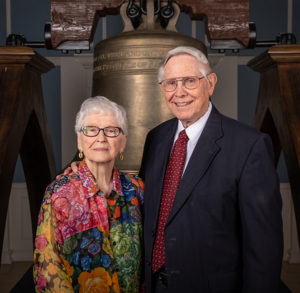 Bill and Bobbie Pinson received the Tom Landry Leadership Award from Dallas Baptist University. He is executive director emeritus of the Baptist General Convention of Texas, distinguished university professor at DBU and volunteer director of the Texas Baptist Heritage Center. She has served 18 years on the DBU board of trustees. The Pinsons are members of First Baptist Church in Lancaster.
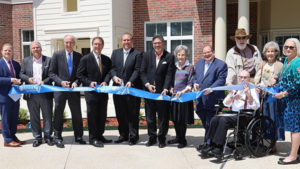 Buckner Retirement Services marked the expansion and renovation of Buckner Calder Woods in Beaumont with an April 2 ribbon-cutting ceremony. The project involved an 80,000–square-foot expansion and 51,000-square-foot renovation, resulting in the addition of 67 residences and 24 skilled-nursing rooms. It also included the renovation of all independent-living common areas and construction of a wellness center with an indoor pool, gym, activity space and bistro.


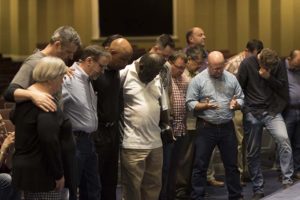
 The
The 



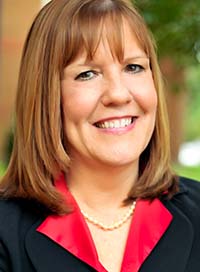 Pam Erickson, HPU alumna and author of You First, Me Second … Getting to the Heart of Social Responsibility, is the featured speaker. Erickson oversees Operation Blessing’s procurement and corporate relations staff in the daily acquisition of food, medical and relief supplies for both domestic and international programs. Luncheon tickets are $25, and space is limited. Tickets are available at HPU’s office of alumni relations and the university’s business office or click

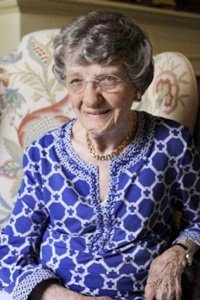 Virginia Connally, Baptist philanthropist and the first female physician in Abilene, died March 31. She was 106. Connally was born Ada Virginia Hawkins in Temple on Dec. 4, 1912. After one year at Temple Junior College, she transferred to Simmons University in 1930, and she graduated from what is now Hardin-Simmons University in 1933 with a Bachelor of Arts degree. At a time when it was rare for a woman to pursue a career in the medical profession, she entered Louisiana State University Medical School in 1933 and earned her M.D. degree in 1937. She was awarded an internship and residency in the field of eye, ear, nose and throat at Charity Hospital in New Orleans from 1937 to 1940. Upon completing this residency, she returned to Abilene and began a medical practice she continued until 1982. She served as chief of staff at both St. Ann’s Hospital and Hendrick Medical Center. She also was the physician for Hendrick Home for Children for many years and was the medical director and senior vice president of HSU’s Fairleigh Dickenson Science Research Center. With her husband Ed, an oilman and former state Democratic Executive Committee Chairman, she traveled widely, using the trips abroad to visit Baptist missionaries and study their work. She also spent time as a medical missionary in Venezuela. Upon her husband’s death in 1975, she became president of Connally Oil Company. She received numerous honors from HSU, including the Distinguished Alumna Award, the Keeter Alumni Service Award, an Honorary Doctor of Humanities Degree, induction into the university’s Hall of Leaders and being named the inaugural recipient of the James B. Simmons Award. She established the Connally Endowed Professorship of Missions at HSU in 1981, which was upgraded to a Chair of Missions in 1988. She provided the lead gift in the establishment of the Connally Missions Center on the HSU campus, which was dedicated in 2000. She became a trustee of the university in 1977, serving until 1987, and then became a member of the school’s board of development. She served on the original advisory board of the Texas Baptist Missions Foundation, and she was instrumental in the Mission Texas effort to start 2,000 churches in the state between 1985 and 2000. She received both a Distinguished Service Award and the Texas Baptist Legacy Award from the Baptist General Convention of Texas. She was active in numerous civic organizations in Abilene. She was a member of First Baptist Church in Abilene since 1933, and she was one of the first women to serve as a deacon there. She was preceded in death by her husband. She is survived by a daughter, Genna Davis, and by two step-children, Edwina Roberts and Aubrey Connally.