‘Tiny’ Dominguez tackles big job of bridging generations
January 18, 2019
LUBBOCK—Daniel “Tiny” Dominguez understands the challenge of honoring tradition and embracing change.
His first calling to ministry focused on youth ministry, but after 12 years as pastor of Community Heights Church in Lubbock, he recognizes his role as bridging the older and younger generations and helping them understand each other.
“You are not the church of tomorrow; you are the church now,” Dominguez tells students.
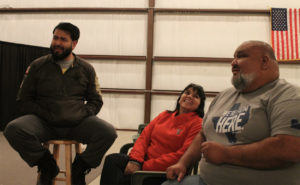
Daniel “Tiny” Dominguez (right), pastor of Community Heights Church in Lubbock, has been a frequent speaker at youth events and conferences.
In turn, he advises adult church leaders, “You must give them the space to participate now.”
Before he became pastor at Community Heights, Dominguez already had extensive ministry experience as a speaker at various youth camps, rallies and student events. He will speak at Congreso, an annual event for Hispanic teenagers and young adults, April 18-20 at Baylor University.
Many of the young people at those events were the sons and daughters of first-generation immigrants from Latin America, he noted.
Since then, Dominguez said, he has worked to help teenagers find their own identity between the world their parents came from and the world where they are growing up.
Because they live between two cultures, Hispanic teenagers may need help finding their own voice, he said.
As a pastor, Dominguez has seen how important it is for churches to open spaces for young men and women to serve. He rejects the idea that youth ministry is just about investing in the church of the future. Rather, it involves being present with students right now, he said.
Dominguez understands his role in the church requires him to help people of all ages understand Christ’s call to serve others. Based on his experience, he believes many young men and women are ready to serve.
“A lot of them are the most giving, but they do not give without a reason,” he said. “They already want to serve, so we need to support them.”
Teenagers and young adults already want to participate in the church, but if older Christians are not willing to collaborate with them, give them space to grow, and mentor them, then churches are not doing all they can to disciple others, he insisted.
“Discipleship is about giving people the tools they need,” Dominguez said. “When we are not willing to give them space to grow, then we are limiting them.”
Dominguez explained he believes churches that are open to listening to younger generations and willing to let them lead are churches that help them grow in discipleship.
“We want to walk with them as they find the identity Christ wants them to have,” he said.
Dementia and religion: What to do, what not to do
January 18, 2019
WASHINGTON (RNS)—When a congregant has dementia, what can a house of worship do?
RNS photo illustration by Kit Doyle
Although each person is different and advice varies depending on an individual’s condition, here are some basic suggestions from experts on how congregations and individuals can help and not hurt.
Congregations
Do
Visit people in homes, at care facilities
• Offer respite to caregivers
• Create support group; connect with local ones
• Hold a hymn sing; recite traditional prayers
• Use name tags
Don’t
Exclude—instead, make accommodations
• Offer traditional service in home setting
• Give weekend sermon at weekday nursing home visit
Individuals
Do
Treat people with respect
• Reintroduce yourself
• Sing—make a playlist of favorite hymns and songs
• Listen and validate feelings
• Phone caregivers
Don’t
Ask, “Do you remember me?”
• Be condescending—treat like adults, not children
• Try to correct—accept their reality
• Ask about recent activities
Sources: Faith United Against Alzheimer’s, RNS research
Inside a church’s Alzheimer’s caregiver support group
January 18, 2019
LOUISVILLE, Ky. (RNS)—Adults sat in a circle in a room usually used by high schoolers and talked about the people they loved who no longer recognized them or who had died forgetting the names of family caregivers in their last days.
The Alzheimer’s caregiver support group on a campus of Southeast Christian Church started with a devotional lesson referring to Charlie Brown pal Linus’ lack of fear as he told the story of the birth of Jesus.
RNS photo illustration by Kit Doyle
“It’s only through our relationship with Christ that we can have the inner peace that can help us just get through the day,” said a facilitator before the group of 10 bowed their heads for an opening prayer.
Her petition acknowledged the challenges of both caring for someone and coping with the “job” being done if that someone had recently died.
Caregivers need supportive social networks
The monthly caregivers’ gathering at this evangelical megachurch is among the hundreds of support groups held at houses of worship and affiliated with the Alzheimer’s Association.
From the nearby University of Louisville to the University of Exeter, researchers have found that people caring for loved ones with dementia benefit from supportive social networks. Church and association leaders say they recognize that people may feel more at ease disclosing their difficult circumstances within a congregational setting.
“We know that one of the first places many families and individuals may turn is to their faith community, so it is important that faith leaders know about our services and resources,” said Ruth Drew, director of the association’s information and support services. “We also strive to have volunteers engaged in these communities to give people a chance to access resources and guidance in a place where they feel safe and comfortable.”
The association said in its 2018 report that nearly half of all caregivers who provide help to older adults do so for someone with Alzheimer’s or another form of dementia. It is a condition that has afflicted everyone from retired Supreme Court Justice Sandra Day O’Connor to Harvard Law School professor Charles Ogletree, who announced his diagnosis at an African Methodist Episcopal Church bicentennial event.
The U.S. Centers for Disease Control and Prevention estimates more than 5.7 million Americans have Alzheimer’s. Experts predict twice as many Americans 65 and older will have the disease by 2040.
Support group participants share stories
At the Southeast Christian gathering, the group met for an hour and a quarter, their sniffles mixed with their sharing.
One man passed around an album of photos of his wedding after describing his wife, who is in the late stages of Alzheimer’s. Members of the group joked about his hair before it was gray and praised him for standing by his wife as she no longer remembers who he is. The group encouraged him to draft a list of friends he can meet for coffee while his daughters watch his wife.
But he said most of his friends are dead.
One woman, whose father had died the month before, struggled to figure out what she might do next. Others spoke of family division over a mother’s dementia. A woman said she fixed her mother’s hair and then took a photo of her mom. She then shared the photo with her brother, who can’t handle visiting their mom. At least that way he could see how she looks.
As one group member told a story, others nodded knowingly and made gentle rejoinders to show they empathized.
“It’s hard to become the parent to your parent,” one woman said.
Between prayers, they gave one another advice, such as turning on child locks in their cars and putting away bills before loved ones move them and can’t remember where they are.
Participants in an Alzheimer’s caregiver support group pass around a “Please Be Patient…” card that they could use when on outings with their loved ones. (RNS Photo / Adelle M. Banks)
One person recalled a breakfast outing when a loved one with Alzheimer’s started piling napkins high and moving other items off the table. Someone had a suggestion—passing around a card that reads: “Please Be Patient … The person with me is challenged with Alzheimer’s. Thank you for understanding.”
When they shared how they can be angry or wonder why God gave them this situation, a facilitator reminded the caregivers: “Job also questioned God.”
Ministry of presence
An analysis by University of Exeter researchers of 1,283 caregivers of people with mild to moderate dementia found it was important for them to have resources to aid their own physical and psychological health. Three-quarters of those interviewed said they were Christian and a fifth claimed no religion.
“The number one response that I got over and over again was presence,” said Mast, who has had members of his family affected by Alzheimer’s. “They would tell me things like, ‘I would just love to have a phone call, either from the pastor or from somebody from the church, to check in on me and to see how I was doing.’ What they were telling me was they didn’t really need some elaborate intervention or something complicated, but they wanted to feel as if they had somebody to go with them on this journey.”
That’s why Valerie Washington, pastor of Hughlett Temple African Methodist Episcopal Zion Church—across town from where the Southeast Christian group meets—started an Alzheimer’s caregiver support group in August after a longtime church officer was diagnosed with dementia.
“He would be the first one to open the door, last one to leave,” she said of the man in his 80s who continues to attend the predominantly black church regularly but can no longer run meetings due to his condition. “I just wanted to be able to not only help him but help my congregation as well as his family.”
Washington, whose father had Alzheimer’s and who has an aging congregation (a third are older than 70), said the group, which varies from five to a dozen, includes another member whose wife has Alzheimer’s. Others are survivors whose loved ones had dementia.
“They’re there to help the ones that are going through it to know what to either expect or what they went through,” she said. “Most of them make the statement: ‘If it wasn’t for God, I wouldn’t be able to go through this. I wouldn’t be able to handle this.’”
Shared experiences provide empathy
Facilitators of caregiver groups, who generally have had their own experiences with loved ones with dementia, often are ready to volunteer to help others.
Debbie Buckler (RNS Photo / Adelle M. Banks)
Debbie Buckler, who helps lead a caregiver support group on another Southeast Church campus, lost her husband, Frank, to dementia in 2004. She also lost her mother to dementia on Jan. 2.
“For people that are going through this, especially a spouse, there is what I call a first widowhood, where I had to realize I had lost my husband,” she said in an interview. “And that first widowhood was worse than the second.”
She said she tries to help people cope with the challenges of being a caregiver, from being up in the middle of the night on watch for a loved one wandering around the house to being a “prisoner in your own home” who is exhausted and has little social life.
“Every day is a heartbreak,” said Buckler, whose husband had to retire early as a machine shop teacher at a vocational school as his symptoms became evident. She left her work as a physician recruiter to care for him.
Nevertheless, Buckler said she tried to note “small miracles” and celebrate them.
“The most disturbing thing was that my husband also had Parkinson’s and they lose the ability to smile and I remember praying that—to God—I could really deal with this better if only he could still smile,” she recalled. “And I went home that day and he was smiling. Now, he was able to smile up to about two weeks before his death.”
Norm Meyer (RNS Photo / Adelle M. Banks)
Norm Meyer, a member of Southeast whose wife, Carol, died in June 2017, helps lead a group at another Louisville church. He also travels five hours once a month to guide a group in Missouri, where their hometowns are located. At her memorial service there, he was greeted by several families that were coping with dementia and realized the rural area didn’t have a caregiver support group while the Louisville metro area has more than a dozen.
Meyer, who was married for “15 days shy of 50” years, fondly recalls his wife, who was a homecoming queen and played in her college band before they raised three children together. For 10 years they traveled through her dementia together, at first attending couples’ counseling as they adjusted to her condition. He later went on his own to as many as three support groups a month to share experiences with other caregivers.
Meyer said the groups helped him so much he didn’t choose to attend grief counseling regularly after her death.
Instead, the air conditioning company retiree is taking what he learned and passing it on to others, offering what he considers “a little bit” of a ministry.
“Honestly, I always thought support groups were for sissies, but they’re not,” he said. “I know that now.”
The group that meets on the megachurch’s southwest campus talked about the family bond that has formed among them as they confidentially share what they’re going through. Their meeting concluded that November day with heads bowed, eyes closed, tears dabbed.
The final prayer sought divine intervention for the next times each of them might be with a relative with some form of dementia.
“Lord, I just pray that you would give them sweet moments,” said the prayer leader. “And they can see, just by looking in their eyes that they can see their mom, and they can see their wife, they can see their spouse and, Lord, that they will have a connection, even if it’s just a little glimpse of a moment.”
This article is one in a series from Religion News Service, made possible by support from the John Templeton Foundation. Opinions expressed in this article do not necessarily reflect the views of the John Templeton Foundation.
Around the State: Buckner enters agreement with Lifeline Children’s Services
January 18, 2019
Buckner Children and Family Services entered into an agreement to provide temporary foster care for children in Texas on behalf of Lifeline Children’s Services. Lifeline, a faith-based domestic and international child placement agency headquartered in Birmingham, Ala., opened its first Texas offices last June. The organization approached Buckner, seeking temporary respite care and/or foster care services for infants and children being considered for adoption placement through Lifeline. According to the agreement, Buckner will provide interim homes for children connected with a potential adoption plan. All interim homes will be state-approved foster homes, and placement services are provided on an as-needed basis. Buckner also will provide for the physical, medical and emotional needs of all children in care, as requested by Lifeline. “Finding homes for vulnerable children in Texas is something Buckner has done for 140 years, and we are honored to use our experience to help Lifeline continue to grow its operations and carry out its mission of ensuring all God’s children have a loving home,” said Albert Reyes, president and CEO of Buckner International. Last year, Buckner oversaw the care of nearly 1,500 children in foster care in Texas and internationally and placed about 120 children with permanent adoptive families in Texas; Lifeline facilitated 190 international adoptions from 13 countries and 17 domestic adoptions.
The Global Center for Mental Healthcare and Ministry at Houston Baptist University will host specialized training, “The Opioid Addiction Crisis: Creating an Effective Church and Community Collaboration and Resolution Strategy,” from 9 a.m. to 5 p.m., Feb. 16. The training is designed for mental health leaders, pastors, laity, coaches, concerned family members and community leaders. Panelists include Shannon Rose and Ben O’Dell, the Center for Faith and Opportunity Initiatives for the U.S. Department of Health and Human Services; Matt Stanford, CEO of the Hope and Healing Center & Institute in Houston; Michael Lyles, psychiatrist; John Spoede, director of the Center for Research and Doctoral Studies in the HBU College of Education and Behavioral Sciences; and David Jenkins, professor of counseling at Liberty University. Registration cost is $49 before Feb. 1 ($29 for students) and $89 after that date. To register, click here.
Retirement
Mike Couch from First Baptist Church in Big Spring, effective Jan. 31, after 38 years as minister of education and administration.
On the Move: Holman
January 18, 2019
Skip Holman completed his tenure as minister of discipleship at Northeast Baptist Church in San Antonio. He is available for pulpit supply and interim ministry.
Dementia and religion: ‘What if I forget about God?’
January 18, 2019
LOUISVILLE, Ky. (RNS)—When geropsychologist Benjamin Mast evaluates dementia clients at his University of Louisville research lab, there’s a question some people of faith ask him: “What if I forget about God?”
It’s a query that reflects the struggles of people facing diseases like Alzheimer’s.
The earliest stages of Alzheimer’s involve the buildup of protein fragments, or plaques, on some brain cells and the growth of twisted fibers, or tangles, within those cells. That process, Mast said in an interview, “damages a particular aspect of the memory system more significantly than others.”
In his book, Second Forgetting: Remembering the Power of the Gospel During Alzheimer’s Disease, Mast describes a man who may not always remember his grown children’s names but “quickly joins in” when someone reads one of his favorite psalms.
What remains intact is the part of the memory that’s held longest, Mast said. In some cases, that relates to faith—hymns and creeds that people may have recited for years.
“If you ask a person who’s been deeply affected by Alzheimer’s about something that happened yesterday, you’re going to their weakness in terms of memory,” said Mast.
“But if we can engage them, for example, in the context of faith services with older songs and hymns that they’ve known for many years, we’re meeting them where they’re strong.”
From congregations to chaplains’ offices, there are stories of kept faith and questions about whether it has been lost. Experts and everyday individuals speak of “magical” moments when people who usually stare into space are suddenly enlivened by worship and tough times when a loved one no longer avows a long-term belief.
‘Christ holds her’
Al Mohler, president of Southern Baptist Theological Seminary—whose campus is about seven miles from Mast’s lab—has learned of both sides of this aspect of dementia. His mother is in a memory care facility years after receiving a diagnosis of Alzheimer’s.
“Thankfully, she is very aware of God’s love,” said Mohler, recalling family members’ visits with her. “She just constantly reminds us all of how blessed we are and will just make statements of how much God has blessed us.”
But he has counseled congregants and students who have had a different experience. One student told him recently that his grandmother denied she was ever a Christian when she was reminded that she had been one.
“I just tried to assure this student: ‘Your grandmother loved Christ, confessed Christ,’” the seminary president said. “‘She has lost the knowledge of much of her life, but Christ holds her just as fast.’”
Need to train ministers
Mast said clergy have often told him they grapple with how to help congregants whose families are coping with dementia.
Geropsychologist Benjamin Mast (Photo by Michael Winters/RNS)
“The common refrain is, ‘Seminary didn’t prepare me for this,’” he said.
Mast succeeded in having fellow Southern Baptists adopt a 2016 resolution that called for pastors to seek training about Alzheimer’s and other forms of dementia and churches to expand their ministries to meet needs of caregivers and the people for whom they are providing care.
Mohler said the growing aging population and new awareness of dementia have prompted theological schools to include more about these topics in ministry, theology and ethics courses.
The U.S. Centers for Disease Control and Prevention estimates more than 5.7 million Americans have Alzheimer’s. Experts predict twice as many Americans 65 and older will have the disease by 2040.
“Are we doing enough?” Mohler asked. “The answer is certainly no, because we are playing catch-up a bit on this.”
Remembering hymns
Chaplains in senior citizens’ facilities have long dealt with residents with dementia and have noticed how some residents may recall their religion more than other aspects of their lives.
“Their faith is the thing, even as they move further into dementia, that they will retain,” said Rebecca Church, director of pastoral services at Wesley Manor, a United Methodist-affiliated retirement community in Louisville. “They will remember how to say the Lord’s Prayer when they won’t remember anyone’s name. They’ll remember the words to ‘Amazing Grace’ when they don’t know what day it is.”
Some churches have found that special worship services may meet a need when a longtime congregant can no longer manage the typical sermons and contemporary music that may be heard in a sanctuary.
Jane Gumbiner, a member of Southeast Christian Church, a megachurch in Louisville, tears up when she speaks of how nice it is to hear her husband, Hal, sing at its “Classic Worship” service on Thursdays.
Once, when they lived in Florida, they were immersed in the life of a church they started—washing Communion cups, counting money, assisting in the nursery. Now, she relishes the moments when his memory of church appears three and a half years after his diagnosis with dementia.
The Thursday gathering, basically a weekday Bible study attended by more than 100 people, allows the retired veterinarian to sing “old-timey hymns” like “The Old Rugged Cross” and “I Surrender All.”
“He sings them, he knows them,” said the retired educator who wears a pendant with a fish next to her cross to underline her faith. She adds more softly: “As opposed to just being totally silent.”
At Phoebe Richland, a United Church of Christ-affiliated senior care facility 50 miles north of Philadelphia, four residents with dementia who had just attended a “Spirit Alive” worship service spoke about how they liked the music and the prayers that had just concluded.
Though some did not directly answer a question about God, a couple of them distinctly remembered earlier church gatherings. One resident, Doris Fosbenner, recalled the names of the streets at the corner where she attended an Italian chapel in Philadelphia. Shirley Derstine, who remembered sending greeting cards to missionaries and helping out with Sunday school, hopes the choir from her Christian Reformed congregation that visited and sang for residents last fall will return.
“There were so many comments that they enjoyed it a lot so I’m staying in touch with our organist and have her think about doing it once again,” she said.
In response to a request to confirm the choir’s visit, Jamie Moyer, Phoebe Richland’s chaplain, added in an email: “Her church community means a lot to her, and she is usually beaming for a week after they are here!”
Former SBC President Bailey Smith dies
January 18, 2019
DULUTH, Ga. (BP)—Evangelist Bailey Smith, former president of the Southern Baptist Convention, died Jan. 14 at his home in Duluth, Ga. He was 79.
Bailey Smith
Smith was elected SBC president in 1980, one year after Memphis pastor Adrian Rogers’ election signaled the beginning of what supporters called the “conservative resurgence” and critics called the “fundamentalist takeover” of the convention.
Gerald Harris, retired editor of Georgia Baptists’ Christian Index newsjournal, described Smith as “a powerful preacher, devoted pastor and faithful friend” in an obituary posted Jan. 15 on the Index’s website.
Harris wrote that Smith told him he had been diagnosed with pancreatic cancer in April 2017. “I was stunned and heartbroken, but he was calm and demonstrated an imperturbable peace at the threshold of the personal physical storm he was entering,” he wrote.
After receiving care from Atlanta-area cancer specialists, Smith went to the MD Anderson Cancer Center in Houston. Smith and his wife Sandy remained in a Houston hotel for months for further diagnosis, chemotherapy and observation. Doctors ultimately recommended a complicated cancer surgery known as the Whipple procedure that, as Harris described it, offered “a five-year survival rate of up to 25 percent. Although the skill of the surgeon and excellent care of the hospital was commendable, the surgery was not successful.”
Sparked national controversy
Smith’s two one-year terms as SBC president were marked by his resolute preaching and by national controversy, particularly his declaration at a Religious Right gathering in Dallas that “God Almighty does not hear the prayer of a Jew.”
Bailey Smith responds to reporters’ questions at the 1981 Southern Baptist Convention. (File Photo)
“For how in the world can God hear the prayer of a man who says that Jesus Christ is not the true Messiah? It is blasphemy. It may be politically expedient, but no one can pray unless he prays through the name of Jesus Christ,” Smith told the Religious Roundtable’s National Affairs Briefing, Aug. 22, 1980.
Smith was born in Dallas on Jan. 30, 1939, the son of Bailey E. and Frances Smith. He graduated from Ouachita Baptist University in Arkadelphia, Ark., in 1961 and from Southwestern Baptist Theological Seminary in Fort Worth in 1966.
Smith led churches in Texas, Arkansas and New Mexico before being called, at age 34, as pastor of First Southern Baptist Church in Del City, Okla., where he served 12 years. At the time of his election as SBC president, Smith was the youngest man ever to lead the convention.
Earlier, he had served as president of the Southern Baptist Convention Pastors’ Conference and the Baptist General Convention of Oklahoma simultaneously.
‘An inerrancy superstar’
Harris wrote that TIME magazine described Smith as “a formidable figure, a fiery, red-haired, old style prairie stemwinder.” Christianity Today referred to him as “an inerrancy superstar.”
In 1980, First Southern Baptist in Del City recorded 2,000 baptisms, Harris reported.
“In the 12 years Smith was the pastor … the membership grew from 6,600 to more than 20,000, and in a convention that was known for thriving on growth and soul-winning, Bailey Smith was known as a pacesetter,” he said.
Smith became a vocational evangelist in 1985. Bailey Smith Ministries conducted area-wide crusades, church revivals, Bible conferences, women’s retreats and overseas ministries.
Smith is survived by his wife of 55 years, Sandy, and three sons, Bailey Scott; Steven, pastor of Immanuel Baptist Church in Little Rock, Ark.; and Josh, pastor of Prince Avenue Baptist Church in Bogart, Ga.; and eight grandchildren.
Baxley unanimously elected to lead CBF
January 18, 2019
DECATUR, Ga.—The Cooperative Baptist Fellowship Governing Board voted unanimously Jan. 15 to elect Paul Baxley as the organization’s fourth executive coordinator.
Baxley, who has served since 2010 as senior minister of First Baptist Church, Athens, Ga., was selected based upon the unanimous recommendation of the 11-member executive coordinator search committee formed last July.
A native of Winston-Salem, N.C., Baxley has held pastorates and ministry positions in Georgia, North Carolina and Virginia and is a former member of the CBF Governing Board. He is the first CBF executive coordinator without ministry experience in Texas.
He succeeds Suzii Paynter, who became the third executive coordinator of CBF in March 2013 and announced in July 2018 plans to transition her leadership of the Fellowship. Other previous executive coordinators were Daniel Vestal, who served 1996-2012, and Cecil Sherman, who served 1992-96.
Experienced in life of CBF
During his two-terms on the CBF Governing Board, Baxley chaired the personnel committee as well as the global mission structure and staffing committee, an ad hoc body that worked for 18 months to develop a comprehensive plan for CBF Global Missions.
Baxley also provided leadership as member of the ad-hoc committee of the Illumination Project, an 18-month effort to seek ways to model unity through cooperation on matters of human sexuality in CBF.
Additionally, he served on the CBF Coordinating Council, the Fellowship’s earlier governance body, and chaired the Engaging Missionally Collaborative Team.
He has been a leader to two CBF state organizations as chair of the New Day Task Force of CBF of North Carolina and as a coordinating council member of CBF of Georgia,where he chaired the missions committee and was moderator.
Baxley is a graduate of Wake Forest University, Duke Divinity School and Baptist Theological Seminary at Richmond.
‘Deep faith and authenticity’
Jeff Roberts, chair of the executive coordinator search committee and senior pastor of Trinity Baptist Church in Raleigh, N.C., reflected on the search process.
“As part of this process, I have been able to spend time with very talented individuals who are devoted to following Jesus and committed to our CBF fellowship,” Roberts said. “Our committee quickly discovered that our love for CBF far outweighed any of our differences. We also were reminded of how many talented individuals there are in CBF life. We were impressed with our candidates and this gave us great confidence not only in this process but for the future of our Fellowship.
“I am grateful for this experience and am looking forward to what God is doing in our lives together. I celebrate that our committee is unanimous in our recommendation of Dr. Paul Baxley as our next executive coordinator.”
Search committee member Jackie Baugh Moore, vice president of the Eula Mae and John Baugh Foundation, cited Baxley’s hope, creativity, energy, spiritual resilience and strong faith.
“Paul’s wisdom, theological maturity and knowledge coupled with his desire to listen and love people will help him guide CBF through this next chapter in our narrative,” she said. “His leadership style reflects deep faith and authenticity. Paul is dedicated to equipping and strengthening theological education, mission work, the church, partner organizations and all of us involved in the life of CBF.”
CBF Moderator Gary Dollar congratulated the search committee and Governing Board on their selection of Baxley.
“Paul is a deeply committed Christian and a lifelong Baptist. He loves the church and the way it is expressed through the Cooperative Baptist Fellowship,” Dollar said. “I am convinced that Paul will lead all of us in CBF to new levels of service in the name of Christ.”
‘Not afraid’
In accepting the call to serve as CBF executive coordinator, Baxley expressed his optimism for the future of CBF and emphasized the central role of congregations in this future.
Paul Baxley
“I accept the call of the Governing Board and this calling from God, with the opportunities and challenges that I know they both hold,” Baxley said. “I’m aware of all the research about the state of congregations and denominations in the Western world. I’m aware that every day won’t be easy and that every question won’t be soft. But I’m not afraid.
“Instead, I’m confident because I have this conviction, the God who raised Jesus from the dead and who has carried his people through 2,000 years of challenge and adversity, much of it our own making, is still in the business of drawing the world to divine love through us.
“Congregations are at the center of the Cooperative Baptist Fellowship, and CBF exists to bless and serve churches. I’m eager to see what kind of powerful collaborations can emerge between CBF pastors, lay leaders, leaders of our partner ministries and our state and regional coordinators. Imagine the power that could come from the best kind of convening and collaboration, where we see that CBF’s future is not held by whoever is the executive coordinator, but our life, work and witness together. My experience as a pastor in CBF congregations has taught me that when we open ourselves to serve and lead together, God does incredible work.”
Outgoing CBF Executive Coordinator Suzii Paynter welcomed the selection of Baxley as her successor.
Cooperative Baptist Fellowship Executive Coordinator Suzii Paynter announced last July her plans to retire. (CBF Photo)
“Paul Baxley has already been an exemplary leader for CBF. I welcome him into the executive coordinator’s role with enthusiasm and certain hope for the future,” Paynter said. “God has shown faithfulness to CBF by preparing the way in every era and through each transition and so it is with Paul.
“As a pastor, he has the respect and admiration of generations across CBF life. His wisdom and energy are gifts that he generously contributes in every endeavor. Personally, he is a true friend and warmly regarded colleague. One keystone of his leadership is building consensus and participation by charting a purposeful course worthy of engagement. He has asked big questions and sought high callings. His love for the church, his Lord and the people of the world have equipped him with God’s gifts and God’s blessing to be the best-ever executive coordinator of CBF.”
Former CBF Executive Coordinator Daniel Vestal praised Baxley as “a person of impeccable integrity and deep Christian conviction.”
Baxley was ordained to gospel ministry in 1993 at his home church of First Baptist Church on Fifth in Winston-Salem, N.C. Baxley and his wife, Jennifer, a licensed physical therapist, have four children—Olivia, 17; Maria, 11; and twins Caroline and Matthew, 8.
New translation of the Old Testament completed
January 18, 2019
During NPR’s Morning Edition on Jan. 14, host Rachel Martin interviewed Robert Alter about his newly released translation of the Hebrew Bible, a 24-year labor of love. Alter approaches the Hebrew Bible as a literary work of art and sought to translate it in a way to restore its artistry.Click here to listen to the interview or to read a transcript on NPR.org.
Two-thirds of teenagers drop out of church as young adults
January 18, 2019
Church pews may be full of teenagers, but a new study says most of them likely won’t be in church on Sunday mornings after they graduate from high school.
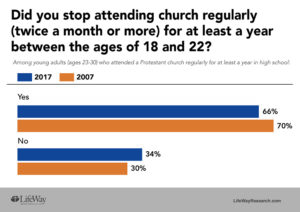
Two-thirds (66 percent) of American young adults who attended a Protestant church regularly for at least a year as a teenager say they also dropped out for at least a year between the ages of 18 and 22, according to a new study by LifeWay Research. Thirty-four percent say they continued to attend twice a month or more.
While the 66 percent may be troubling for many church leaders, the numbers may appear more hopeful when compared to a 2007 LifeWay Research study. Previously, 70 percent of 18- to 22-year-olds left church for at least one year.
“The good news for Christian leaders is that churches don’t seem to be losing more students than they were 10 years ago. However, the difference in the dropout rate now and then is not large enough statistically to say it has actually improved,” said Scott McConnell, executive director of LifeWay Research.
“The reality is that Protestant churches continue to see the new generation walk away as young adults. Regardless of any external factors, the Protestant church is slowly shrinking from within.”
One-year break or gone for longer?
The dropout rate for young adults accelerates with age, the study found.
While 69 percent say they were attending at age 17, that fell to 58 percent at age 18 and 40 percent at age 19. Once they reach their 20s, around one in three say they were attending church regularly.
“Overall Protestant churches see many teenagers attending regularly only for a season. Many families just don’t attend that often,” said McConnell.
“As those teenagers reach their late teen years, even those with a history of regular church attendance are pulled away as they get increased independence, a driver’s license or a job. The question becomes: Will they become like older adults who have all those things and still attend, or will students choose to stay away longer than a year?”
Ben Trueblood, director of student ministry at LifeWay, said those numbers speak to the issue at hand. “We are seeing teenagers drop out of the church as they make the transition out of high school and student ministry,” he said. “This moment of transition is often too late to act for churches.”
Virtually all of those who dropped out (96 percent) listed a change in their life situation as a reason for their dropping out. Fewer say it was related to the church or pastor (73 percent); religious, ethical or political beliefs (70 percent); or the student ministry (63 percent).
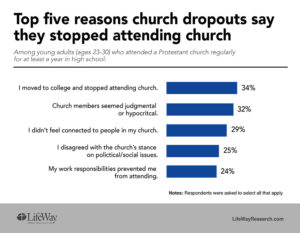
The five most frequently chosen specific reasons for dropping out were: moving to college and no longer attending (34 percent); church members seeming judgmental or hypocritical (32 percent); no longer feeling connected to people in their church (29 percent); disagreeing with the church’s stance on political or social issues (25 percent); and work responsibilities (24 percent).
Almost half (47 percent) of those who dropped out and attended college say moving to college played a role in their no longer attending church for at least a year.
“Most of the reasons young adults leave the church reflect shifting personal priorities and changes in their own habits,” McConnel said. “Even when churches have faithfully communicated their beliefs through words and actions, not every teenager who attends embraces or prioritizes those beliefs.”
Among all those who dropped out, 29 percent say they planned on taking a break from church once they graduated high school. Seven in 10 (71 percent) say their leaving wasn’t an intentional decision.
“For the most part, people aren’t leaving the church out of bitterness, the influence of college atheists, or a renunciation of their faith,” Trueblood said.
“What the research tells us may be even more concerning for Protestant churches: there was nothing about the church experience or faith foundation of those teenagers that caused them to seek out a connection to a local church once they entered a new phase of life. The time they spent with activity in church was simply replaced by something else.”
Why some stay connected
Not all teenagers leave church as a young adult. A third (34 percent) say they consistently attended twice a month or more through the age of 22.
Those who stayed saw the church as an important part of their entire life. When asked why they stayed in church, more than half say the church was a vital part of their relationship with God (56 percent) and that they wanted the church to help guide their decisions in everyday life (54 percent).
Around four in 10 (43 percent) say they wanted to follow the example of a parent or other family member.
Similar numbers say they continued to attend because church activities were a big part of their life (39 percent), they felt church was helping them become a better person (39 percent), or they were committed to the purpose and work of the church (37 percent).
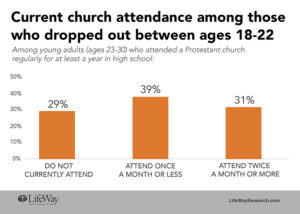
Among all young adults who attended church regularly at least one year as a teenager, almost half (45 percent) currently attend at least twice a month, including more than a quarter (27 percent) who attend once a week or more.
Another 8 percent say they attend once a month, while 25 percent say they attend a few times a year. Twenty-two percent of those who attended regularly at least one year as a teenager now say they do not currently attend at all.
Among those who dropped out for at least a year, 31 percent are currently attending twice or month or more.
“On some level, we can be encouraged that some return,” said Trueblood, “while at the same time, we should recognize that when someone drops out in these years there is a 69 percent chance they will stay gone.”
Intentional ministry required
He advised churches to begin by working to lower the number who leave in the first place. “There are steps we can begin taking with those currently in student ministry that will keep them connected from the beginning of these years.”
An important step involves equipping adult leaders for ministry to teenagers.
“One of the most influential aspects of a student’s spiritual development is the investment of multiple adults speaking into their lives,” Trueblood said. “Since that’s the case, church leaders need to make an intentional effort to regularly train the volunteers who work with students. Equipping adults to serve in student ministry is vital to the spiritual health of students.”
Trueblood also asserted churches should have a strategic focus on individuals during those traditional college years. “In many places this is a forgotten, under-resourced ministry area,” he said. “Focus is placed on children, students, and then not again until someone enters the ‘young family’ stage. This needs to change.”
Among those who attended a Protestant church as teenager, 7 in 10 say they’re Protestant now. Another 10 percent identify as Catholic. Few say they are agnostic (4 percent) or atheist (3 percent).
“While some young adults who leave church are rejecting their childhood faith, most are choosing to keep many of the beliefs they had, but with a smaller dose of church,” said McConnell.
The survey was conducted September 15 – October 13, 2017. A demographically balanced online panel was used for interviewing American adults between the ages of 23 and 30 years old.
Analysts used light weights to balance gender, ethnicity, education and region. The sample was screened to include only those who attended a Protestant church twice a month or more for at least a year in high school. The completed sample is 2,002 surveys.
The sample provides 95 percent confidence that the sampling error from the online panel does not exceed plus or minus 2.4 percent. This margin of error accounts for the effect of weighting. Margins of error are higher in sub-groups.
Al-Shabab militants target Christian teachers in northern Kenya
January 18, 2019
WAJIR, Kenya (RNS)—After the militant group al-Shabab killed three of his colleagues in a recent attack on Christian schoolteachers here, Jared Nyanchong’i packed his few belongings and boarded a bus to Kenya’s capital, Nairobi.
“These people call us black Satan, devil and kafir,” said Nyanchong’i, 40, a father of three. “The life of teachers is very important. We love teaching, and we can teach in all parts of the country—but only when our lives are not threatened.”
Nyanchong’i is one of more than 1,100 Christian teachers who have fled since al-Shabab began coming across the border into northern Kenya from Somalia in 2017, mostly targeting non-Muslim teachers. While about 85 percent of Kenya is Christian, the country’s north is occupied predominantly by Muslim ethnic Somalis.
In October, the militants hurled an improvised explosive device into one of the two apartment blocks housing Christian teachers at the Arabia Boys Secondary School, killing two.
Now, nonlocal teachers in the region want to be transferred to safer areas for security reasons.
“I’m very lucky to be alive,” said Elijah Nderitu, who teaches English and literature at the school. “I had a chilling encounter with the militants but I hid under my bed. They wanted to kill all of us who are nonlocal teachers. I will never teach in this region and I want to be transferred to safer areas.”
The latest attacks represent a return of al-Shabab, which has singled out and killed non-Muslim teachers and students in the past. In April 2015, al-Shabab killed more than 148 Christian students from Garissa University, about 200 miles south of Wajir.
The attacks have come in retaliation against the country’s sending its troops to Somalia to fight the extremist group in 2011.
Non-Muslim teachers suffer discrimination
The Kenya National Union of Teachers has said nonlocal teachers, who make up as many as 60 percent of the teachers in the area, have long suffered discrimination by locals, who, officials said, often aid the militants in targeting Christians.
“We have heard cases of locals pretending to be al-Shabab or conspiring with the same group to target nonlocal teachers,” Wilson Sossion, secretary general of the union, said last year. “Students have attacked teachers through stoning, clobbering and issuing verbal attacks.”
Cyntia Chepkemoi, a teacher, said she was forced to adopt customary Muslim dress and was told Sharia law prohibited her from correcting her male students in class.
“It’s difficult to teach them,” she said. “You are forced to wear hijabs before you can go to class. Whatever a male student says or does, it’s right and you can’t afford to correct him. They will beat you and call you all bad names.”
Teachers from other parts of Kenya are commonly sent to the north to make up for shortages. For decades, many local teaching candidates have not performed well enough on national qualifying exams to be trained as teachers.
Religious leaders have urged Kenyans not to be divided by the militants’ provocations.
Bishop Philip Anyolo, chairman of the Kenya Conference of Catholic Bishops, said the church will continue to open more Catholic-sponsored and private schools in the volatile region to ensure all children have equal access to education.
“We have mutual relationships with Muslims and we understand one another,” Anyolo said in an interview. “These are criminals who are hiding behind religion and we know. I don’t think there is any religion that supports the killing of innocent people.”
Nyanchong’i, a teacher, disagreed.
“They hate nonlocal teachers, and that’s the reason we are leaving the region,” he said. “You can only become their friends if you accept to convert and be a Muslim.”
International students find home away from home
January 18, 2019
ABILENE—Laughs, joy, fellowship and a spirit of home is what the Green’s weekly dinner is all about. Every Friday, Art and Susan Green serve dinner to all the international students from Hardin-Simmons University and Abilene Christian University—at times more than 100 people—making them feel at home even when they are away from their families.
The Green’s home, within walking distance of HSU’s campus, has been the center of activity for international students in Abilene more than 16 years.
The tradition started 31 years ago when another Abilene family cooked dinner for Asian students from ACU each Friday. After that family moved away, the Green’s took the tradition into their home and decided to open their doors to every international student in Abilene.
Every week, Susan Green prepared her best American recipes to serve for the students. She had such good feedback that every time there were more and more students coming for dinner to try her well-known food.
“We used to have 20 at first, then it kept on growing, and there was a time when we hosted approximately 100 people for dinner. Now, we expect around 50 students,” her husband said.
Being part of this event is special for international students because it brings a sense of unity, respect, fellowship and love.
Sharing is intentional
The Greens prepare homemade food served in a buffet for all the students. After dinner, everyone retires to the living room to worship and praise the Lord by singing. Art Green usually offers a short lesson about the importance of sharing, and he makes those present participate by telling their stories before enjoying dessert and departing for the evening.
“I think the Green’s dinner is the best community for international students who are far away from home and for getting to know different cultures. What I like the most is that there are good food and friendly, warm people,” said Chelvy Eunike, a freshman student from Indonesia.
The Greens work hard to make this experience the best they can for students. They want to embrace the family spirit as much as possible, even with small actions like remembering everyone’s names from week to week. That may seem like a small detail, but when a student is far from home, being recognized and welcomed can make a huge difference.
Another weekly tradition is to take a photo with those attending for the first time and write their name and country on the photo so that everyone can remember their visit. Many students are surprised at how well Art Green remembers their names.
“I was very impressed at how welcoming and intentional the Greens were in getting to know each person. Even though there were plenty of students from all over Abilene on any given week, the Greens remembered each student by name and always greeted us with such remarkable hospitality,” said Michelle Chahyadi, a junior from Malaysia.
Sharing is a group effort
The Greens have also been blessed by friends and family who help them bring together the weekly meal. For example, their next-door neighbors go over to the Greens every Friday after all the guests have left to help them do the dishes and clean up.
“We want to bring everyone together. We want to serve all these students no matter where they come from,” Art Green said.
Zoey Abigail, a freshman from Indonesia, shared her experience at the dinner and what it means to her. “The Greens is a good place for international students to know that they are not alone, that there are others that can understand what they are going through, that builds a unique community that I think everyone should have. Plus, they serve free food.”
The message that Art and Susan Green are trying to impart to these students is that sharing is what makes us the best people. They learned to open their home to different cultures and different people with the mission of bringing them together. International students are thankful for having the opportunity to feel like they have a home far away from home.
Lucila Decia, a freshman strategic communications major at HSU, is from Buenos Aires, Argentina.




 In his book, Second Forgetting: Remembering the Power of the Gospel During Alzheimer’s Disease, Mast describes a man who may not always remember his grown children’s names but “quickly joins in” when someone reads one of his favorite psalms.


 Two-thirds (66 percent) of American young adults who attended a Protestant church regularly for at least a year as a teenager say they also dropped out for at least a year between the ages of 18 and 22, according to a
  Virtually all of those who dropped out (96 percent) listed a change in their life situation as a reason for their dropping out. Fewer say it was related to the church or pastor (73 percent); religious, ethical or political beliefs (70 percent); or the student ministry (63 percent).
 Those who stayed saw the church as an important part of their entire life. When asked why they stayed in church, more than half say the church was a vital part of their relationship with God (56 percent) and that they wanted the church to help guide their decisions in everyday life (54 percent).