T-shirt dresses become worldwide ministry

BIRMINGHAM, Ala. (BP)—About a year ago, when Linda Johnson’s friend Linda Jacobson asked if she was ready to see God do big things, Johnson said yes.

“But I’ve thought a thousand times since then that I never could’ve imagined what was coming,” Johnson said.

Since Johnson, Jacobson and fellow volunteers launched the We Sew Love ministry at Huffman Baptist Church in Birmingham, Ala., they have sent hundreds of clothing items made from old T-shirts to children in Uganda, Zambia, Haiti and other places around the world.

They’ve made crib pads for children’s homes and burial gowns for children who die in hospice facilities.

And with about 40 volunteers and nearly an entire wing of the church dedicated to the ministry, they’re just getting bigger.

“God has provided, and it’s growing by leaps and bounds,” Johnson said.

Simple beginnings

As it often goes with good ideas, the ministry started small. Jacobson said she kind of stumbled into it when she was on a trip to California to visit one of her daughters a couple of years ago.

“My daughter had some school T-shirts that she wanted me to convert into dresses for her girls,” Jacobson said. “She also wanted me to try making the girls some comfy underwear.”

With a little creativity, Jacobson took those T-shirts and turned them into fabulous, bright-colored little dresses—the kind little girls love to wear. She used some of her stretch-knit pajamas and made the underwear, which quickly became favorites. She figured it was a one-time thing.

But then back in Birmingham, a granddaughter who lives locally was at her house one day playing in the yard, and Jacobson sprayed her with the hose.

“She loved it, but I didn’t think that through,” she said with a laugh. “She was drenched and had no extra clothes along.”

Little girls in several places around the world, like this girl in Haiti, love the bright colors and unique designs of dresses made by We Sew Love.

Jacobson got her in some dry clothes, but she had to make her a pair of underwear from one of her shirts.

“Her mom called me a few days later and said: ‘Can you make her some more? She refuses to take them off because they are so much more comfy than her other undies.’ So I made her 17 more,” Jacobson said.

And with those 17 pairs of underwear, it seemed her calling was sealed. Soon after that, she met a missionary from Birmingham who serves in Haiti at a hospice center for children.

“I asked her if she could use some dresses or underwear there like the kind I was making,” Jacobson said. “I just wanted to give her the idea. I never thought I’d be the one to make them.”

The missionary’s answer was a resounding yes. They needed as many as they could get.

So on a weekend not too long after, Jacobson traveled with her husband to a college football tournament with things on her mind other than football. While he was at the games, she stayed back at the hotel and cut enough pieces to make 500 pairs of underwear for the children at Real Hope for Haiti.

Sewing ministry launched at church

Grace Klein Community, a nonprofit ministry in Vestavia Hills, began bringing Jacobson bags filled with cast-off knit clothing and T-shirts on a regular basis.

“I was overburdened with all the T-shirts at my house,” Jacobson said. “Then my daughter Stacey mentioned that this kind of sewing could be an opportunity for the women at Huffman Baptist Church during their summer break. She invited me to bring all my supplies and let the women help.”

Jacobson didn’t hesitate. She filled up a classroom at the church with her supplies, and the women went to work. In eight weeks, they cut countless shirts into parts for dresses, underwear and shorts.

“The excitement among the women was infectious,” she said.

The men noticed the growing excitement and told Jacobson if she would bring her ministry up there to stay, they would make room for it.

Johnson noted what happened next breathed new life into a mostly unused preschool wing that had been empty as the church has transitioned in recent years.

“We’re without a pastor, and most of us are older,” Johnson said. “This ministry has been a wonderful thing for our church to be a part of.”

Nothing goes to waste

And it has given new momentum to the church’s women’s ministry. Like clockwork every Wednesday and Thursday—and other days of the week here and there, too—women gather for Bible study, then head over to the sewing suite to work on T-shirt clothes.
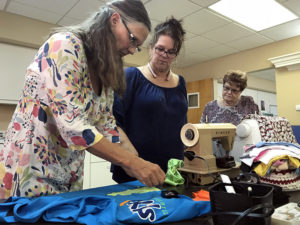
Linda Jacobson (left) started out making clothes for her granddaughters out of old T-shirts. What she thought was a one-time thing has turned into a world-wide ministry using more than 40 volunteers. (BP Photo / Grace Thornton)

What they do has spread by word of mouth, and people bring them bags and bags of T-shirts. Volunteers—both men and women—wash and dry the shirts in a dedicated laundry room or in their homes, then move them into the harvesting room.

In that room, they cut the T-shirts into different pieces like neckbands, pockets, bodices, hem bands and hemmed sleeves—pieces that save them time when they’re putting the dresses together.

They’ve found ways to make nearly every inch of a T-shirt usable. Nothing goes to waste.

Then they put all those pieces in the inventory room in color-coordinated bins. Volunteers can go shopping in the bins to find the pieces they want to use to make the clothes. They put them together in the sewing room, a room with two tables full of sewing machines, and get to work on the clothing.

The result is hundreds of unique dresses, boxers, panties, shorts and other articles of clothing that easily can be laundered and re-worn.

“It’s a running joke—we’re a sewing ministry where there aren’t many people who can sew,” Johnson said with a laugh. “There’s so much to do other than just sewing. I’m learning how to sew now, but I started out washing T-shirts and praying over them. It’s so amazing to see them change from when you first get the T-shirts to the finished product. It just fills you up.”

The volunteers pour their love into those dresses, and they share that joy with others, too.

As Jacobson has crossed paths with people—God-ordained meetings, she insists—she has told others about what they are doing and then taught them how to do it too. Because of that, groups are now doing the same thing in Tallahassee, Idaho and Iowa.

Johnson said We Sew Love has become bigger than they ever imagined. She says it’s given her and so many others new purpose in ministry.

“This has gone beyond what one Baptist church can do,” she said. “And as much as people want to learn to do this, we would love to teach them.”

For more information about the ministry, visit the We Sew Love page on Facebook.


Obituary: Joe Gerault

Joe Gerault, who served more than 18 years in a variety of ministerial roles at Calvary Baptist Church in McAllen, died Nov. 5 after a lengthy battle with Ataxia. He was 63. Gerault graduated from Howard Payne University in Brownwood in 1977. He went on to attend several institutions of higher learning, where he earned a specialist’s certification in gerontology, a master’s degree in religious education and a doctorate in educational ministries. Prior to arriving in the Rio Grande Valley in 1993, he served on the staff of churches in St. Louis, Mo., Hillsboro and Fort Worth. In his varied positions at Calvary Baptist Church, he organized and oversaw the Sunday school, provided direction to the remodeling of the church facility, served as consultant and church representative on the construction of two buildings, and provided pastoral care and senior adult ministry. In addition to his church staff duties, he found time to be a writer, teacher, occasional preacher and a professor on several continents. He also served in leadership positions in several professional, public and denominational organizations. He was preceded in death by a sister, Donna Treonne Gerault Odom Wick. He is survived by his wife of more than 42 years, Janet Kay Calhoun Gerault; his sister Andrea Louise Peterson and her husband Wes of Lincoln, Neb.; his sister Katie Nealeigh of Terrell; and numerous nieces and nephews, great-nieces and nephews, and three great-great nieces.


On the Move: Boney and Hoyt

Joe Boney to Cowboy Heritage Church in Clyde as pastor.

Chuck and Jan Hoyt to First Baptist Church in Tuscola as youth ministers.


CommonCall: South Dallas church committed to ‘Feed 5,000’

DALLAS—Jesus fed hungry multitudes, and a South Dallas church believes it should do no less.

New El Bethel Baptist Church in Dallas launched Feed 5,000 about 11 years ago to provide food to homeless people living in shelters, street camps, tent cities and under bridges, said Lillian Tarkington, one of the leaders of the congregation’s outreach ministry.

‘We’ve got to do more’

Sara Blake, who has worked with the Feed 5,000 ministry since its beginning, still vividly remembers her first experience delivering meals on the streets.

“We knew there was a need, but we didn’t know how great it was. We fixed 50 bags of food and drove up to where the homeless were, thinking we were fixing to make a difference,” she recalled.

In a matter of minutes, the volunteers gave away all the food they brought, and it seemed to them they hardly had scratched the surface.

“We watched people who needed help, and we had nothing for them,” she said. “We went back to the church, regrouped and said: ‘We’ve got to do more. We’ve got to do better.’ So, we increased the number each time we went out.”

Over the past decade, volunteers have served hot breakfasts during the winter and cold water in the summer. Pastor Timothy Brown strongly supports the ministry, she added, noting his commitment to community ministry.

‘Whatever we have, we’re eager to share’

“For most of these people, the sky is their roof, and the ground is their bed,” Blake said. “Whatever we have, we’re eager to share.”

During the summer, volunteers from New El Bethel Baptist Church provided about 100 snack bags per week that they distributed to the homeless and disadvantaged at the the Martin Luther King Community Center near Fair Park. (Photo / Ken Camp)

New El Bethel has received support from the Texas Baptist Hunger Offering for its Feed 5000 ministry.

In July and August, volunteers from New El Bethel provide about 100 snack packs per week they distribute to homeless and disadvantaged people at the Martin Luther King Community Center near Fair Park.

More than two dozen members meet at the church to assemble the bags, and about a half dozen give them away at the community center.

“The first time we meet somebody, we focus on feeding them the physical food they need first,” Blake said. But as the volunteers get acquainted with some of the same people week after week, they are able to talk with them more and pray with them.

“Every once in a while, we manage to get the word of God in,” she said. “Sometimes, they will come in saying: ‘God is good. He let me wake up this morning.’ There are people in church every week who never stop to thank God for another day.”

You’re that church that feeds us good’

At Christmas, volunteers from New El Bethel transport homeless people from shelters and other places they gather to the Larry Johnson Recreation Center in South Dallas for a Christmas party.

“We’ll give away toys to the children, food baskets and toiletries, and we’ll let people shop for clothes and shoes” at no cost, volunteer Yvette McCree said. Between 400 and 500 people from the shelters and the streets sit down to a hearty meal.

Word spreads among the homeless population, she noted.

“I can remember going to deliver water bottles to the shelter and to a tent city,” she recalled. “When people found out where we were from, somebody said, ‘You’re that church that feeds us good.’”

Read more articles like this in CommonCall magazine. CommonCall explores issues important to Christians and features inspiring stories about disciples of Jesus living out their faith. An annual subscription is only $24 and comes with two free subscriptions to the Baptist Standard. To subscribe to CommonCallclick here.


‘Fixer Upper’ stars to host church for the homeless

WACO, Texas (RNS)—Tractor-trailer rigs roared overhead. Cigarette smoke wafted in the air as a praise band played drums and electric guitars on a stage set up amid tall concrete columns.

On the Sunday before Thanksgiving, poor people riding bicycles and pushing old grocery carts lined up—as they do every week—to eat and worship God underneath Interstate 35.

Church Under the Bridge marks 25 years of changed lives
Pastor Jimmy Dorrell (right) participates in fervent and celebrative worship that characterizes Church Under the Bridge in Waco. (Photo courtesy of Church Under the Bridge / https://www.facebook.com/Church-Under-the-Bridge-105391686233756/)

For now, a patch of gravel between Baylor University and a series of fast-food restaurants serves as the meeting place for Church Under the Bridge, which began with a handful of homeless people studying the Bible with Pastor Jimmy Dorrell in 1992.

“These people loved me when I didn’t love myself,” said Robert Walker, 50, who has battled drug addiction and spent time in and out of prison. “The only reason why I wouldn’t be here is if I was incarcerated.”

But next March, the 26-year-old church—which serves hundreds of this Central Texas city’s neediest and most vulnerable residents—will become homeless itself.

A $300 million, multiyear widening project along I-35 in Waco—a city of about 135,000 halfway between Dallas and Austin—will displace Church Under the Bridge.

The Texas Department of Transportation began warning Dorrell, co-founder and president of a ministry called Mission Waco, about the impending construction several years ago. He jokingly refers to the project as “our church remodel.”

“They were concerned about us,” Dorrell said of the highway officials. “We laugh about that because we’re just squatters. We have no right to be at the table.”

Moving to the Silos

After the Waco Tribune-Herald reported on the church’s plight, Dorrell got a call from one of this city’s most famous residents: Chip Gaines, who with his wife, Joanna, starred in the HGTV home-improvement reality series “Fixer Upper.”

Chip and Joanna Gaines, hosts of HGTV’s “Fixer Upper.” (RNS Photo/ Courtesy of HGTV)

Gaines offered the lawn of Magnolia Market at the Silos—the couple’s popular tourist destination, which drew an estimated 1.6 million visitors to Waco last year—as a temporary home for Church Under the Bridge. The attraction, closed on Sundays, is about four blocks from the bridge.

“I’ve known about Jimmy and the way he’s been selflessly serving this community for a while, since back when I was in college,” Chip Gaines, a Baylor alumnus, said in an emailed statement. “A few months ago, I read about how the I-35 project would impact his church, so we reached out to discuss his options and ultimately, to see if there was a way we might be able to help.

“I’ve always admired Jimmy from afar, so when we both agreed that the location of the Silos made sense for Church Under the Bridge, I knew we wanted to be part of the solution for this congregation,” Gaines added.

Dorrell, who also teaches courses at nearby Baylor and Truett Theological Seminary, said he has known Chip and Joanna Gaines since they were students. They’ve supported the church in the past, he noted.

Joanna Gaines has appeared in Mission Waco’s “Fashion with a Passion” style show, an annual fundraiser. More recently, the couple donated $51,000 to the ministry’s nonprofit grocery store, Jubilee Market, through an auction of items from the old Elite Cafe, now known as Magnolia Table, he said.

“They’re committed Christians. It’s very consistent with who they are,” Dorrell said of the celebrity couple inviting the church to meet on their property.

‘We’re here for the poor’

Dorrell expressed hope that Church Under the Bridge’s faithful will make the short trek to the new location and that tourists who show up to take pictures on Magnolia Market’s off day might join them.

If not, he’ll come up with an alternate plan.

“If the poor don’t show up, we’ll move,” he said, “because we’re there for the poor.”

Robert Walker, who has attended Church of the Bridge in Waco, Texas, since 1998, says, “The only reason why I wouldn’t be here is if I was incarcerated.” He has been in and out of prison a few times but finds support in the congregation serving the Central Texas city’s poor and homeless. (RNS photo / Bobby Ross Jr.)

As Sunday’s crowd devoured bowls of stew and cornbread and chomped giant pieces of chocolate cake, longtime attendee Walker—sporting a Dallas Cowboys jersey—said he sees pros and cons to the move.

“It might be a little different because I’m used to coming here. I love it here,” he said as worshippers clad in hoodies and wrapped in blankets took seats in metal-legged folding chairs on this cloudy, 45-degree morning. “This is sacred ground to me.”

Still, he’s ready to make the move.

“The main thing is to keep the body (of Christ) together, wherever we are,” he said. “As long as we allow the Spirit to usher in and the Bible to be preached, I think we’ll be all right. … What registers is the music, the people. You know what I’m saying?”

Leta Johnson, 60, is skeptical.

Johnson, who said she lives in a house with no electricity or running water, voiced apprehension about the change. She prefers the church move to a similar location.

“This is for people who don’t have clothes, that are embarrassed to go to church, that ain’t got a shower,” said Johnson, who worked as an underwater welder before addiction took hold of her. “You’re taking a lot away from us by redoing this bridge. Move us to another bridge, why can’t you? Sending us to a tourist attraction isn’t what we want.”

Brenda Coffman, 76, joins a group from Central Christian Church in feeding the souls below I-35 once a month. Her congregation is one of about 20 Waco churches that help with Church Under the Bridge.

Besides dipping homemade stew into plastic foam bowls, Coffman and her fellow volunteers make sack lunches with peanut butter sandwiches, bananas and fresh-cut carrots and celery for worshippers to take with them.

“I love to serve other people that are on the margins that don’t have enough to eat,” Coffman said. “I think that’s what Jesus taught us to do—to care about those people who are in need.”

She said the current location is easier to get to and worshippers can come and go as they please. To get to Magnolia, she said, worshippers will have to go through a single entrance, so “it’s going to be interesting to see how it works out.”

“But I think they’re very generous to offer,” Coffman said of the Gaineses.

Incarnational ministry

Eventually, Church Under the Bridge will return to its roots—only with better digs, Dorrell said.

Plans call for replacing the gravel lot with concrete and installing lower curbs, which will benefit the handicapped, the pastor said. Meanwhile, the lane widening will expand “the roof” over the bridge, which will keep the crowd dry on rainy days.

But regardless of the location, he said, the focus will remain the same—incarnational ministry emphasizing authentic Christian living.

“The church of Jesus Christ in America is, in so many ways, shallow,” Dorrell said during Sunday’s sermon,  speaking over the rumble of traffic. “You’ve got to grow up. Christianity is not just about being saved. That’s just the first step in a lifetime process.”

In a world full of sinners, though, Church Under the Bridge has an advantage, he suggested.

“We are a broken church with people who admit we’ve done things we shouldn’t have done.”


Waco pastor featured in first documentary of women ministers

Mary Alice Birdwhistell knew at a young age she was called to ministry. So did her mom. The only question was what kind.

As far as Birdwhistell knew, the only options for her were children’s ministry, music ministry or maybe becoming a missionary to China. The answer became clear, however, the first time she stepped behind a pulpit to preach.

No. 1: Mary Alice Birdwhistell,” a documentary of Birdwhistell’s journey to the pastorate, is a co-production of Ethics Daily and Baptist Women in Ministry that premiered Nov. 16 in Waco, where she is the senior pastor of Calvary Baptist.

Though Birdwhistell was and is Baptist, a Methodist minister in Kentucky was the first to ask Birdwhistell to fill the pulpit for him. To his astonishment, she said she’d never had the opportunity before. His question set in motion serious soul-searching.

Birdwhistell agonized over whether or not her preaching would disobey God.

“Is this what I want or what you want?” she asked God.

Ultimately, she accepted the invitation and discovered new life when she stepped behind the pulpit.

Mitch Randall, executive director of Ethics Daily, introduced the premiere as a celebration of women in ministry, but not everyone sees women in ministry as something to celebrate. Many disagree with and criticize the calling of women pastors. In responding to critics, Birdwhistell says she is her own worst critic, noting she constantly is seeking the Holy Spirit’s guidance.

Birdwhistell’s father—whose great-grandfather was an influential Baptist pastor in Lawrenceburg, Kentucky—also struggled to affirm women as pastors. After his own journey, which involved seeing God at work in his daughter’s life, he became supportive and proud of Birdwhistell in the pastorate.

Pam Durso, executive director of Baptist Women in Ministry, explained the hope behind the co-produced series of documentaries that begins with “No. 1: Mary Alice Birdwhistell.” She said when young girls can see women in the pulpit, taking up the offering and making decisions in the church, they will know it’s possible for God to call them to leadership in the church. Likewise, when search committees see women pastoring in these documentaries, they will know they can call women as pastors.

Randall went a step further. A large reason for co-producing these documentaries is to make clear “not only do we support women in senior pastor roles, but we are calling women to senior pastor roles,” he said. Despite more women graduating from seminary prepared for the pastorate, the number of women graduates afforded places to serve is exceedingly small.

In the face of such odds, Birdwhistell’s advice to her younger self is to remember she can do hard things and that God has been preparing and providing for her in many ways for the role of pastor.

To other young women who sense a call to ministry, Birdwhistell says, “You really have to bring your best self. I wish there weren’t different standards [for women], but there are.” Also, “believe in yourself.”


Who’s going to say grace at Thanksgiving?—Baptist families in ministry

Ask almost any Baptist minister about family, and you stand a good chance of hearing about fathers, grandfathers or great-grandfathers who were ministers.

My own family includes several pastors and missionaries on my mother’s side. My father-in-law was a pastor and is now a director of missions. I recently ate breakfast with a pastor who traces the pastorate back four generations in his family. Marv Knox, my predecessor here at the Baptist Standard comes from a family of ministers. We are just a few examples of the legacy of ministry in some Baptist families.

Danny Curry

In September 2018, I learned of the Crosby family coming together for their First Family Conference to celebrate at least 60 years of ministry by their family. Having known of the Crosbys and ministering in the same association as Danny, I wanted to know more. Joannah Buffington, daughter of Sam Crosby, compiled a list of family members in ministry, a small portion of which is included here.

Then I discovered the Curry family has a similar legacy and so invited them to be part of this story. Danny Curry thrilled in writing a history of his family legacy, some of which also is included here.

The Crosby family legacy

Russell and Donna Crosby raised 13 children during their 61 years of marriage, many of whom serve or have served in ministry. Their family now counts 72 grandchildren and 83 great-grandchildren.

The Crosby family was built on the deep faith of Russell and Donna and their commitment to serve the Lord and to lead their family to serve the Lord. Their abiding Christian faith is a living testimony of their devotion to Christ and the deliberate decision to practice Christian habits in their home that would shape the faith of generations to come.

Russell and Donna’s family has seen multiple children and grandchildren attend and graduate from Texas Baptist schools, including University of Mary Hardin Baylor, Baylor University, Hardin-Simmons University, Howard Payne University and Houston Baptist University; and Baptist seminaries, including New Orleans Baptist Theological Seminary, Southwestern Baptist Theological Seminary, Truett Seminary, Southern Baptist Theological Seminary and others.

Today, members of the Crosby family are part of churches across the state of Texas and beyond as children and student volunteers, Sunday school teachers, deacons, elders and worship leaders, to name a few of the roles in which they serve.

Of the 13 Crosby children, four are pastors—Tim (Trinity Baptist, Gatesville); Danny, who is fluent in Spanish and electric bass (First Baptist, Cleburne); Jon (Turnersville Baptist); Sam (First Baptist, San Saba)—and David is pastor emeritus of First Baptist New Orleans, where he was the pastor during Hurricane Katrina.

Four of the sons—Tom, Joe, James and Matt—have served on church staffs in other ministry positions, and three of the daughters are married to ministers.

Ten of the Crosby grandchildren are either serving in ministry positions or are preparing for them, and the importance of ministry continues to be evidenced among the Crosby great-grandchildren.

The Curry family legacy

Hugh Franklin Curry was ordained in Arkansas in 1878 and moved his family to MacGregor in 1883, where he organized several churches before heading out to the Texas frontier to serve as a Baptist General Convention of Texas missionary.

Hugh’s son, John, married the daughter of a pastor before becoming a pastor and associational missionary himself. John pastored numerous churches, many of them in West Texas.

Joseph Curry, one of John’s 11 children, moved out near the New Mexico border. During a meeting at the church he and his family attended in Plains, he and his son Billy Joe accepted Christ. Bill later attended Wayland Baptist University to prepare for ministry and was a pastor of churches in Texas and New Mexico, even trying to start a church in San Diego, Calif.

Eddy Curry

Bill’s son, Eddy, followed in his father’s footsteps, attending Wayland and serving as pastor of churches in Texas and Curry County, N.M. He also attended Southwestern Baptist Theological Seminary and now serves as the education minister at Pioneer Drive Baptist in Abilene. Eddy’s son, Kade, attended Hardin-Simmons University and Logsdon and has been a Presbyterian minister in Texas and Arkansas.

Craig Curry

Another of Bill’s sons, Danny, also attended Wayland and pastored several churches throughout Texas before joining the BGCT staff as the area representative for Area 9, which stretches from Tarrant County to Wichita Falls and down to Stephenville.

Danny’s son, Craig, continues the Curry legacy as pastor of First Baptist in Plano. Craig already was leading in ministry before he attended Hardin-Simmons University and later Logsdon and Truett seminaries.

*******

The Crosby and Curry families’ reach and dedication to Christian ministry truly are remarkable. Not only are their families shaped by the local church, missions and theological education, but they have shaped countless other families and individuals for the sake of Christ and will continue to do so for years to come.

This Thanksgiving, in many ministry families, the pastor at the table will be expected to say grace. But in the Crosby and Curry families, they may have to play “Rock, Paper, Scissors” to decide which pastor will pray.

The following people contributed to this story: Joannah R. Buffington is the daughter of Sam Crosby and is the editor and social media coordinator in the office of the president at Houston Baptist University. Danny Crosby is pastor of First Baptist in Cleburne. Danny Curry is the area representative for area 9 of the BGCT. Eric Black is the executive director, publisher and editor of the Baptist Standard.


No vote yet on law restricting religious freedom in Bulgaria

Christians in Bulgaria pledged to continue public prayer meetings and peaceful protests until the nation’s lawmakers either withdraw legislation that would severely restrict religious freedom or make substantive changes to it.

Christians rally at Parliament Square in Sofia, Bulgaria, to pray and protest proposed restrictions on religious liberty. (Photo courtesy of Teodor Oprenov)

In early October, the Bulgarian Parliament approved on first reading changes to the Religious Denominations Act that would significantly restrict the rights of minority religions, including missionary activity and theological training.

The Nov. 16 deadline for receiving public comment on the amendments passed with the nation’s parliament taking no immediate action.

International pressure

Prior to the deadline, international attention to the situation in Bulgaria grew. Baptist World Alliance General Secretary Elijah Brown and European Baptist Federation General Secretary Anthony Peck sent a Nov. 8 letter to Bulgarian Prime Minister Boyko Borissov asking the proposed legislation be withdrawn.

“No state, we believe, should be in a position to control the training and activities of ecclesiastic ministers, nor should a state favor one faith expression over another,” they wrote. “The Bulgarian constitution rightly guarantees freedom of religion; we urge that this principle be adhered to as the right of all the Bulgarian people.”

Bulgarian Christians gather in Sofia to pray and peacefully protest proposed restrictions on religious freedom. (Photo courtesy of Teodor Oprenov)

On Nov. 15, the United States Commission on International Religious Freedom tweeted: “USCIRF is concerned about proposed changes to be voted on tomorrow that would restrict #ReligiousFreedom in #Bulgaria.” The tweet included a link to the BWA Nov. 8 letter.

Christer Daelander, religious freedom representative of the European Baptist Federation and member of the BWA Religious Liberty Commission, wrote to the Organization for Security and Cooperation in Europe, saying the proposed changes in Bulgarian law would violate the United Nations Convention on Freedom of Religion or Belief, as well as similar European Conventions.

Kishan Manocha, senior adviser on freedom of religion or belief at the OSCE, replied in a Nov. 14 email, saying her organization’s Office for Democratic Institutions and Human Rights “has submitted a letter to the Bulgarian authorities signaling its readiness to prepare a legal opinion on said draft law.”

“We will also continue to closely follow developments pertaining to freedom of religion or belief in Bulgaria and would be pleased to hear from you again concerning further developments,” Manocha wrote.

Continue prayers and protests

In the days immediately preceding the Bulgarian Parliament’s Nov. 16 deadline, a working group of politicians and representatives of major religious bodies met to discuss the legislation. The meetings reportedly produced “some softening” on certain provisions, said Teodor Oprenov, pastor of Evangelical Baptist Church in Sofia and leader in the Baptist Union of Bulgaria.

“We hope to be able to see the changed document before they have it discussed in the parliament and vote on it,” Oprenov said in a Nov. 16 email.

Bulgarian Christians march in downtown Sofia to protest proposed restrictions on religious freedom. (Photo courtesy of Teodor Oprenov)

However, fearing the changes may be “merely cosmetic,” Oprenov said, “many evangelicals have decided to continue with our prayers and peaceful protests until the suggestions for he changes of the religious law are completely withdrawn or until we see realistic suggestions which fairly guard the religious freedom and right to a belief of everyone in Bulgaria.”

About 2,000 Christians rallied in Sofia outside the Bulgarian Parliament and marched peacefully to the National Palace of Culture on Nov. 11, and smaller groups gathered to pray and protest around the country.

In spite of inclement weather, about 1,000 people participated in a second public demonstration Nov. 18, Oprenov reported in a Nov. 20 email.

“The weather was not kind to us, as rain and very cold wind made the open-air gathering very unpleasant,” he wrote. “The first snow of this winter came a few hours later. Some 1,000 people, though, still gathered in front of the Monument of the Soviet Army in Sofia to pray and peacefully protest against the discriminative bill in question.

“Words were said, prayers were offered, hymns were sung and a clear statement was declared that the evangelical Christians are against the entire set of suggestions for changes, not merely some clauses in the bill. We still believe that there is nothing in that text that is really of benefit to faith and religious freedom, but quite the opposite.”

Oprenov acknowledged proposed changes removed “some of the initial harsh and anti-constitutional and anti-freedom of religion clauses.” However, some discriminatory clauses remained, he said, and some reportedly were more restrictive than in the original amendments, such as raising the minimum membership requirement for registered religious groups from 300 to 3,000.

Protestants in Bulgaria planned another prayer meeting and protest in Sofia Nov. 25, along with additional public demonstrations in towns and cities throughout central and eastern Bulgaria, Oprenov said.


Around the State: ETBU athletes pack presents; Michael Evans lectures at UMHB

The East Texas Baptist University Tiger athletic department packed 230 boxes for Samaritan’s Purse Operation Christmas Child with donations from more than 500 student athletes. (ETBU Photo)

East Texas Baptist University student athletes participated in the school’s  third annual Operation Christmas Child Wrapping Party for the Samaritan’s Purse National Collection Week. All of ETBU’s 16 NCAA Division III and five club sports participated by contributing toys and wrapping each box. “The ETBU student athletes contributed over 230 shoeboxes that are full of gifts and will enable children all over the world to hear the story of Christ and the true meaning of Christmas,” said Ryan Erwin, vice president for athletics at ETBU.

Michael Evans

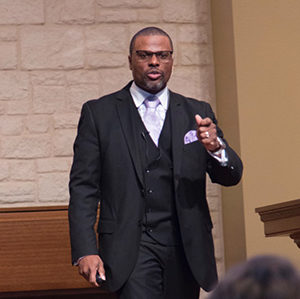
Michael Evans, president of the Baptist General Convention of Texas and pastor of Bethlehem Baptist Church in Mansfield, delivered a Nov. 13 lecture on race relations in Baptist life during a Christian Studies Forum at the University of Mary Hardin-Baylor. “Race Matters: Where Are We Now, And Where Do We Go From Here?” traced the history of African-American Baptist churches and conventions from the days of slavery to the present. Evans noted the BGCT has more African-Americans on staff and in positions of leadership today than at any time in its history. He called for church leaders to approach diversity with a goal of allowing all parties to start on even ground with equal stakes. “What I’m talking to you about is being a generation that can look beyond my melanin and see giftedness,” Evans said. “If you can see me as a person who God has poured giftedness into, if you can see what God is doing with your fellow students, then the very diversity that you’ve prayed about and hoped for will come to pass.

Dennis Myers

Baylor University installed Dennis R. Myers as the inaugural holder of the Danny and Lenn Prince Chair in Social Work within its Diana R. Garland School of Social Work. Myers is the chair of the school’s Gerontology Initiative. As holder of the Prince Chair, he will conduct research and develop evidence-based practice models, educational programs and practical resources to strengthen the care environment of residential facilities and enrich the lives of residents.

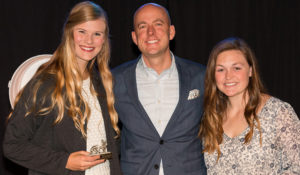
Brandon Skaggs, vice president for student life at the University of Mary Hardin-Baylor, presents the Gary and Diane Heavin Servant Leadership Award to Sydney Stolz (left) and Allison Stevens (right). (UMHB Photo)

The University of Mary Hardin-Baylor recognized seniors Sydney Stolz of College Station and Allison Stevens of Weatherford as recipients of the Gary and Diane Heavin Servant Leadership Award. The award is presented in recognition of extraordinary time and energy students have devoted to ministry and community service during their time at UMHB. It includes a $1,000 cash award for each student, a portion of which can be donated to an organization of the student’s choice. Stoltz, a communications major who played on the women’s volleyball team three years, served as director of the Psalm 139 event at UMHB, a day designed to help women grow in their faith and foster community with others. She gave a portion of her cash award to Young Life, a teen outreach ministry. Stevens, a nursing major who has been active in Baptist Student Ministries, has been a leader in Heart for the Nations, a community of students that meets regularly to pray, study the Bible and support the spread of Christianity throughout the world. She has engaged in missions in Uganda, the Arabian Peninsula and France. Stevens gave a portion of her cash award to Agape Impact Ministries, an organization that works with abandoned, abused and orphaned children in the Philippines.

Carolyn Porterfield

“Woven Together in Unity” is the theme of a Women’s World Day of Prayer brunch Nov. 29 in the Piper Great Hall of Truett Theological Seminary at Baylor University. Carolyn Porterfield, former Missionary Journeyman to Japan and retiring missional lifestyle leader for Woman’s Missionary Union of Texas, is the featured speaker. Cheryl Segura Gochis, vice president of human resources at Baylor, will lead a Bible study and devotional. Lexi English from Greater Bosqueville Baptist Church will provide the Scripture focus. The event will begin with a light complimentary brunch at 9:30 a.m., followed by a program and prayer at 10 a.m. Reservations are requested. Contact Kathy Hillman at Kathy_Hillman@baylor.edu or (254) 749-5347. The event is sponsored by WMU/Women’s Ministries of Waco Regional Baptist Association in cooperation with Truett Seminary and the Keston Center for Religion, Politics and Society at Baylor.


Radical Reformation commemorated at BUA

SAN ANTONIO—Almost 500 years after he helped birth—and died for—the Anabaptist movement, Felix Manz, among others, was verbally resurrected at Baptist University of the Américas’ annual Rollins Lecture given by Karen Bullock, professor of Christian heritage at B.H. Carroll Theological Institute.

BUA was an appropriate setting since Manz and the movement’s early leaders were university students when their study of the Greek New Testament with Ulrich Zwingli launched a quest for the “true visible church,” resulting in the Anabaptist movement and the bitter and bloody persecution that followed. Its theological descendants today include Baptists, Mennonites and Amish.

Radical Reformation reformers commemorated

Bullock described Manz’s martyrdom: “As some in the watching crowded taunted, ‘You wanted to be baptized?’ he was taken to the Limmat River and rowed out to the fisherman’s hut in the center of the strong current. His hands were lashed to a stick tied to his knees and a rope was tied around his neck. Given an opportunity to speak his last, he quoted in Latin, ‘In manus tuas, Domine, commendo spiritum meum’(Into your hands, Lord, I commend my spirit). He was thrown into the icy water, drowned, retrieved and burned.”

His crimes included refusing to have his children baptized as infants—convinced instead that believer’s baptism was the mark of the New Testament Church—and for advocating separation of church and state and the refusal to take an oath of loyalty to any other than God. Ulrich Zwingli, Manz’s former mentor, endorsed the killing to protect his own reform movement, which seemed threatened by these young scholars who were calling for a swifter, more radical reform.

The Anabaptists, Bullock explained, were the Fourth Wing, “the underground wing” of the reformation of the Christian church. “Not the Lutheran wing, which gave us the Lutheran Church; not the English wing, which birthed the Anglican church; and not even the Reformed wing primarily, which first emerged in Zurich with Zwingli and eventually became the Reformed movement. But we celebrate today that underground Reformation wing, which also sprang from Zurich in those explosive days—the Biblical Anabaptists.”

Bullock maintains the Biblical Anabaptists, among all of the other Radical groups, took the most direct route to reclaim the gospel message, biblical ecclesiology and social action in the world, than any other radical reformed group of that era. They paid a bloody price. According to historian Justo Gonzalez, there were more Anabaptist martyrs in the 16th century than Christians in the 1st century under pagan Roman emperors.

Bullock’s use of the term “Biblical Anabaptist” draws a distinction between those who continued to hold the basic tenets of the first Anabaptists and those, also called Radical Reformers and Anabaptists, who later veered into wildly divergent theologies and discarded basic doctrines.

In Münster in 1534-35, followers of Melchior Hoffmann attempted to fulfill their “obligation” to set up the kingdom of God and destroy the ungodly, forcing out Catholics and Lutherans out of the city.

A string of new edicts declared Münster the New Jerusalem and proclaimed that all adult citizens who refused to be baptized “by faith” would be killed as “godless” and “wicked.” And they were. When the city was retaken, thousands of Anabaptists who had flocked to this New Jerusalem were slaughtered.

After Münster, a generation of moderate Anabaptist leaders—like Menno Simons—had enough influence to limit the radicals and lead the rest of the compromised movement in a peaceful and orderly direction and restored biblical Anabaptism.

This, along with turmoil within the Church of England, laid a foundation for Baptists.

In 1607, Separatist pastors John Smythe and Thomas Helwys fled with their congregation from Gainsborough, England, to Amsterdam to escape government persecution. They found welcome in a Mennonite bakery with Jan Munter and his congregation of Dutch Mennonites.

In 1609, Smythe, Helwys and the Separatist congregation disbanded their church and reconstituted their assembly as the first Baptist church, having a strong family likeness to the Anabaptists.

Radical Reformation lays foundation for Baptist beliefs and practices

Most Baptists in America today share eight of the nine major doctrines espoused by the earliest Swiss Brethren—the Biblical Anabaptists—in Zurich almost 500 years ago:

  • The authority of scripture for faith and practice, opposed to creeds, dogmas, culture, reason or traditions.
  • A New Testament model for the church—regenerate, responsible and voluntary church membership should be without coercion or arraignment by the courts.
  • Believer’s baptism, as opposed to infant baptism.
  • The Eucharist as a non-sacramental Solemn Memorial.
  • The priesthood of all believers.
  • Separation of church and state.
  • Religious liberty for all and no civil punishments for religious heresies.
  • Living “in the world, but not of the world.”

The exception is refusal to serve in the military, which is still a major tenet for Mennonites.

In 2004, Mennonite representatives from around the world were invited to a service where the Reformed church officially and humbly asked forgiveness for the violence that had been perpetrated against the Anabaptists for more than 300 years, admitting the guilt of their church for the actions.

The Anabaptist responded: “History may recognize us as victims, and could incite us to find satisfaction in that. However, those here among you today, direct descendants of those Anabaptists persecuted in the past, no longer feel as victims. We do not ask for material retribution for the past; that would seem to us to be contrary to the Spirit of the Gospel. But the fact that you recognize the difficult points of your history in relation to ours helps us to see ourselves and to meet you differently. We thank you, therefore, for your statement, and wish to accept it in a spirit of forgiveness.”

Bullock urged the BUA students to learn from and honor the Biblical Radical Reformers: “When considering the courage, the enduring faithfulness, the almost endless suffering this people of God have absorbed, it is perhaps the most telling characteristic of the Biblical Anabaptists that they forgave their enemies. And in this way, perhaps more than in any other, demonstrated whose they were, and still are; for their beliefs and actions and responses mirror the Jesus they serve. May God instruct us from their witness.”

Craig Bird is the director of special projects in academic affairs for the Baptist University of the Américas in San Antonio.


James Lawson recommended for Congressional Gold Medal

WASHINGTON (RNS)—James Lawson, a minister known for his advocacy of nonviolence in the civil rights era and beyond, has been recommended for a Congressional Gold Medal.

“It is, I think, time for us as a nation to really recognize all that he has done for people in this country and for people in the world,” said Rep. Ro Khanna, D-Calif., at a Nov. 14 reception where he announced legislation to honor the 90-year-old Lawson.

“He’s a shining light at a time where so many of these values are being called into question,” said Khanna.

More than a half dozen members of Congress, including civil rights veteran John Lewis and California Reps. Karen Bass and Barbara Lee, joined Khanna and Lawson at the Cannon House Office Building to support Khanna’s proposal and to praise Lawson for his decades of work. The medal is the highest civilian award given by Congress.

Trained students in nonviolent resistance

Lawson, a United Methodist minister, is renowned for training college students in Nashville, Tenn., in nonviolent protest so they could withstand harsh mistreatment as they defied Jim Crow laws by occupying segregated lunch counters.

Lewis, now a congressman from Georgia, recalled Lawson’s instructions before Lewis had to endure being spat upon and having lit cigarettes put in his hair and down his back.

“Every Tuesday night, this man taught us about the teaching of Gandhi. He inspired us and many of us grew to accept the way of peace, the way of love, to accept the philosophy and the discipline for nonviolence as a way of life,” Lewis said.

“If it hadn’t been for Jim Lawson, I don’t know what would have happened to our country; I don’t know what would have happened to me,” he added.

Decades later, Lawson, who lives in Los Angeles, still teaches students about civil rights.

Calling Lawson “one of the most consequential members of the civil rights movement,” Rep. Emanuel Cleaver, D-Mo., credited him with introducing Martin Luther King Jr. to “the whole concept of nonviolence.”

Lawson studied Gandhi’s principles of nonviolence as a missionary in India and after his return became a mentor of the Student Nonviolent Coordinating Committee. Later he was an adviser to King and the Southern Christian Leadership Conference, and the Southern field secretary of the Fellowship of Reconciliation.

But his influence is most felt in the education in specific nonviolent techniques that he gave activists who worked in the Freedom Rides and the March on Washington, and the high schoolers who became the first African-Americans to enroll at Central High School in Little Rock, Ark., known as the “Little Rock Nine.”

Nobody did more to ‘fix the flaws’

Rep. Jim Cooper, D-Tenn., son of the late segregationist Tennessee Gov. Prentice Cooper, said his father “was on the wrong side of history” and called Lawson “one of the greatest leaders of the 20th century and the 21st century.”

“The history of the South, the history of America, is a deeply flawed history but nobody has done more to fix those flaws than Dr. Lawson,” said Cooper.

Lee Saunders, president of the American Federation of State, County and Municipal Employees, said Lawson was among those who gathered to mark the 50th anniversary of the sanitation workers’ strike that brought King to Memphis just before his assassination. Lawson preached at Clayborn Temple, the church from which strikers marched in 1968. Despite his age, Lawson insisted on marching with them five decades later.

“He still had that fire,” said Saunders. “He still believed strongly that if we fight and if we make our voices heard every single day in a nonviolent way, then we can win and we can be successful.”

William “Bill” Lucy, a longtime secretary-treasurer of the union, praised Lawson for agreeing to help the strikers as a young pastor at Centenary Methodist Church.

“Without Jim Lawson, we’d be on strike now, 50 years later,” Lucy said.

Lawson thanked the more than two dozen co-sponsors of the legislation for shedding light on a topic that he sees as crucial for a nation that has become more violent than he ever imagined it could be.

“While the gun discussion may be an important discussion, it doesn’t get into the virus that needs to be attacked—the spirit of violence, the language of violence, the thinking of violence, the despising of one another,” he said. “Nonviolence is the force that can save our nation from itself.”


Author contrasts slaveholder religion and the freedom church

DALLAS—Throughout American history, two versions of Christianity have competed for the loyalty of believers—slaveholder religion and the freedom church, author Jonathan Wilson-Hartgrove told a Dallas audience.

“We are facing a moral crisis. What pains me most is that white evangelical Christians are making it possible,” said Wilson-Hartgrove, an Anglo who is an associate minister at the historically black St. John’s Missionary Baptist Church in Durham, N.C.

He led a workshop on “Finding Freedom from Slaveholder Religion” during the Red Letter Revival, an event sponsored by a group that emphasizes applying the teachings of Jesus to modern social issues.

Growing up in North Carolina—“just down the road from Mayberry,” in his words—Wilson-Hartgrove “trusted the moral narrative” he inherited from his family and neighbors, including its racist underpinnings, he said.

As a politically ambitious teenager who dreamed of becoming president someday, he received an appointment by Sen. Strom Thurmond from neighboring South Carolina to serve as a page in the U.S. Senate.

‘The narrative began to unravel”

In that role, he learned more about Thurmond’s history as an ardent segregationist who ran as the “Dixiecrat” candidate for president in 1948 and conducted the longest filibuster on record by a single senator in opposition to the Civil Rights Act of 1957.

“That’s when the narrative began to unravel for me,” particularly since most of the people he knew praised Thurmond as a moral champion who protected their Christian Southern heritage, he said.

Wilson-Hartgrove realized the version of the gospel he had learned as a white person growing up in the South was not good news for African-Americans.

“I began to ask, ‘What would another way of being Christian look like?’” he said.

A different understanding of gospel

At a key point in his life, Wilson-Hartgrove encountered William Barber II, pastor of Greenleaf Christian Church in Goldsboro, N.C.

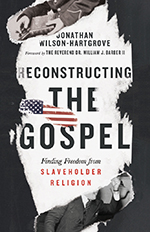
“He began to teach me about a black-led, faith-rooted freedom struggle,” said Wilson-Hartgrove, author of Reconstructing the Gospel: Finding Freedom from Slaveholder Religion.

He learned how slaveholders and their allies used the Bible to support their arguments in favor of slavery and of an economic system dependent upon slave labor.

However, he also learned about “the freedom church that was born on the edge of the plantations,” he said. Meeting in brush arbors for worship, African-American slaves identified with biblical stories about how God delivered his people from slavery in Egypt and liberated them from exile in Babylon.

“There has always been a struggle between slaveholder religion and the freedom church,” Wilson-Hartgrove said.

Continuing influence of slaveholder religion

While the North won the Civil War, the South essentially won the narrative in terms of perpetuating immoral arguments couched in biblical language, throughout the Jim Crow era and continuing to the present, he asserted.

“Extremism claims moral language to justify sin,” he said. “The patterns we inherited from the 19th century are with us still. But the faith that was at the heart of the civil rights movement is also with us still.”

Slaveholder religion has taken a spiritual toll on the United States, he insisted.

“We have split the gospel in two, and its warps us,” he said. “The narrative cuts off compassion and shriveled our hearts, leaving us with a diminished capacity to love God.”

Wilson-Hartgrove endorsed the idea of “fusion politics” Barber promotes as leader of the Poor People’s Campaign, bringing together people of faith from different races and political parties to support policies that advance economic justice for all people.

However, rather than focusing exclusively on electoral victories, Wilson-Hartgrove discussed how bringing people together around biblically based moral principles can lead to “surprising friendships.”

“God can transform relationships,” he said.

At its heart, racism in the United States is a spiritual problem that requires “soul work” to solve, Wilson-Hartgrove said.

“Deep healing is needed,” he said. “To be segregated from our neighbors by racial divisions and economic inequities makes it harder to know God. But as we listen to one another, we draw closer to one another and closer to God.”