BUA student assists with Bible translation to his native language

Nicolás López-Merino’s involvement in translating the Old Testament into the Amuzgo language shaped his trajectory and led him to study theology and music at Baptist University of the Américas.

Not many people have heard of the Amuzgo language, which is spoken by approximately 50,0000 indigenous people in the Guerrero state in southern Mexico.

Amuzgo is the first language of Nicolás López-Merino, a third-year student at Baptist University of the Américas, who helped translate the Old Testament into Amuzgo.

Wycliffe Bible Translators came to López’s hometown, Xochistlahuaca, and began learning the language. In 1973, they successfully translated the New Testament into Amuzgo, but for the next several decades, translation of the Old Testament scriptures was incomplete.

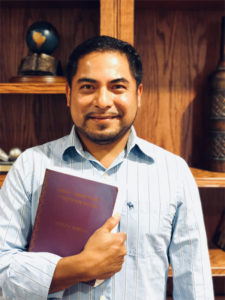
Nicolás López-Merino, BUA student and biblical translator from Guerrero in southern Mexico. He is holding a copy of the Bible translated into his native language, Amuzgo. (Photo: Jaclyn Bonner / BUA)

When López was a young man, he was asked to help with the translation process. He and locals from different churches were needed to assist with text revisions. They started revising Genesis in 2003, working in group settings. López said one person would read, and the others would listen.

Like translating from English to Spanish, the text could not be translated word for word, requiring López to understand the concepts and essence of Scripture and communicate those in his own language.

During the more than 10-year-long process, López came to the United States to pursue his academic studies. He received a call from his home pastor in 2016, with the news that the entire Bible finally was translated and ready to be printed. López continued his involvement in its completion by helping financially with printing costs.

López describes the practicality of having the Bible in Amuzgo, as well as the joy it brings him to have the Scriptures in his first language.

“When I can’t understand [the Scripture] well in a foreign language, I go to this Bible,” said López, who is perfecting his English at BUA. “When I read this Bible [in my own language], it’s a special time. When I pronounce the name of God in my language, “Tyˈo̱o̱tsˈom,” it is awesome!”

Nicolás López-Merino, BUA student and biblical translator from Guerrero in southern Mexico. He is holding a copy of the Bible translated into his native language, Amuzgo. (Photo: Jaclyn Bonner / BUA)

López smiled, pointing out his home community now has access to the entire Bible in its first language. His community is bilingual, speaking Spanish as a second language. Since they have the Scripture in their first language, they can understand many things that were challenging to comprehend in Spanish.

Less than 10 percent of the Amuzgo are practicing Christians, estimates The Seed Company, a Bible translation group. López believes the translation is critical for reaching his home community with the truth.

The Amuzgo Bible impacted López’s family. It opened their eyes to faith in Christ, freeing them from dead religion, he noted.

He wants everyone in Guerrero—as well as Amuzgo speakers in the neighboring state of Oaxaca—to have access to the Amuzgo Bible. His dream is to plant a Bible Institute or seminary in his home state of Guerrero, saying it is on his heart to be part of a translation team.

“If they [the translation team from Wycliffe] didn’t come, I wouldn’t have a reason to be here at BUA,” López explained. “I am here because God has called me to serve him.”

López added that pursuing a dual bachelor’s degree in theology and music at BUA is about following Christ. “I am also really grateful for BUA because it is helping me to understand and learn more about Jesus.”

For audio of López reading John 3:16 in his language, click here.

Jaclyn Bonner is the communication specialist for Baptist University of the Américas in San Antonio, Texas.


Cooperation key to Unión Femenil Misionera of Texas

Christians who are called to serve can do more if they are able to encourage others to come alongside them and cooperate. That idea has guided Unión Femenil Misionera of Texas for more than 100 years, UFM Executive Director-Treasurer Bea Mesquias said.

Looking back

The first Woman’s Missionary Union in Texas was established in 1880, 48 years after Massie Millard and Lea Annette Bledsoe began creating missionary societies in Texas.

Since the beginning, WMU has been deeply entwined with the Hispanic population in Texas. As Bledsoe worked with women in Nacogdoches to form the first missionary society of Old North Church, she realized she had to learn Spanish to communicate effectively with the women who spoke that language.

Unión Femenil Misionera was born after seven churches met in San Marcos in 1917, seven years after the Mexican Baptist Convention of Texas began.

But like the organization that became the Hispanic Baptist Convention, UFM also saw some difficult years, Mesquias said. In the early 1940s, the work of UFM was almost non-existent. UFM came under the umbrella of Texas WMU in 1962 as part of a unification program.

More than 50 years later, on Aug. 25, 2015, UFM became independent from WMU and now is part of Convención, the Hispanic Baptist Convention of Texas.

Looking forward

The desire to multiply the service UFM offers to God continues as UFM invests in the lives of a growing Hispanic population and younger generations, Mesquias said.

“I am only one person, but I need to multiply myself to reach more people,” she explained. “We have new people who bring new ideas.”

To multiply the work of UFM, Mesquias said, younger women must receive opportunities to participate more in ministry and programs geared to address the issues they face.

Kirby Minnick, a communications major at Dallas Baptist University and social media influencer, was keynote speaker at the two-day SHINE conference at Crossroads Baptist Church in San Antonio, sponsored by Union Femenil Misionera de Texas. (Photo / Isa Torres)

Last year, UFM organized the first “Shine Girls Conference,” intended for teenage and college age women. The third Shine Conference is scheduled Feb. 22-26, 2019, in San Antonio.

Earlier this year, UFM also started the Bloom Conference for mothers. The second Bloom Conference, April 5-6, 2019, also will take place in San Antonio.

Although UFM hopes young women and girls can develop their leadership skills and find the space to practice new ideas, Mesquias also emphasized the importance of the women who have come before.

Through previous generations, UFM consolidated its desire to support missionaries and the ministries of churches in Texas and in other parts of the world, she said.

“We are women of action,” Mesquias said. “We know it is better to use what we have for the kingdom.”

When UFM uses what it has to help support evangelism, offer assistance to poor families or support educational initiatives, its members see God’s faithfulness and blessing in their lives, as well, Mesquias said.

Last year UFM donated $10,000 to Baptist University of the Americas. The support UFM gives to other institutions and ministries is possible because the organization faithfully has challenged women across the state to follow the call God has given them to serve the church, Mesquias said.

Mesquias and other UFM leaders travel across the state to train women in leadership, so they can help groups of women collaborate to reach more people with the good news of Jesus, she said.

While other groups also want to help others serve God and the church, Mesquias notes, it is important that service be carried out contextually. UFM uniquely is positioned to provide contextual ministry with Hispanic women who deal with specific cultural issues, she said.

For women with tight schedules, or specific societal conflicts—like immigration or lack of opportunities—UFM wants to help them respond to the calling God has given them, Mesquias said.


Baptist leaders condemn synagogue shooting

Leaders of the Baptist General Convention of Texas, the Southern Baptist Convention and the Cooperative Baptist Fellowship condemned anti-Semitism and expressed grief over the loss of life in a Pittsburgh synagogue shooting.

Accused shooter Robert Bowers entered the Tree of Life Synagogue and shouted, “All Jews must die,” before opening fire, killing 11 worshippers, officials reported. Police arrested Bowers, who had posted anti-Semitic rhetoric on social media, and federal prosecutors filed hate crime charges against him.

‘Words of hate’ remain in public discourse

Ferrell Foster, director of ethics and justice with the Texas Baptist Christian Life Commission, wrote in a personal blog he had been reading a novel when he learned about the shooting at the Pittsburgh synagogue. In the novel, a character talked about Hitler and the countless people who “helped” him carry out the Holocaust by acts of complicity.

“Hitler provided the words, the passion, the motive for hate. Six million deaths followed,” Foster wrote. “But evil still roams about seeking whom it might consume. Words of hate still spill into public discourse. Such words kill spirits, and such words sometimes lead to the killing of living persons.

“Again, we weep,” he continued. “We think it cannot happen again. It can. It, the possibility for hate, is inside all of us. May we all suppress the little Hitler inside us that wants to escape, that wants to despise, hate and even hurt those who are different and are a perceived threat.”

The “way of hate and ridicule” is not the way of Jesus, Foster wrote, noting with irony that the Holocaust “arose among a ‘Christian’ people.”

“Beware of ‘Christian’ nations. Seek Jesus people,” Foster wrote. “It is those people who seek to follow Christ who bring life and love to their neighbors.”

David Hardage, executive director of the BGCT, tweeted: “Thank you for joining our Texas Baptist family in praying for the families (and Jewish Community) of those who were killed & wounded in the attack on the synagogue in Pittsburgh.”

Anti-Semitic rhetoric ‘a despicable lie’

Anti-Semitic comments made by the accused synagogue murderer of 11 is “a despicable lie of the enemy which we unequivocally reject,” SBC President J.D. Greear tweeted.

SBC First Vice President A.B. Vines, pastor of New Seasons Church in Spring Valley, Calif., and SBC Second Vice President Felix Cabrera, lead pastor of Iglesia Bautista Central in Oklahoma City, were listed in a signature line with Greear’s tweet.

“We grieve with the city of Pittsburgh, the Jewish community, and especially the families of the victims,” wrote Greear, pastor of The Summit Church in Raleigh-Durham, N.C. “In a nation seemingly full of hatred, we remain committed to demonstrating and sharing the gospel of Jesus Christ, pursuing religious freedom for all peoples, and praying for a more civil and loving society.”

Hateful ideologies condemned

Suzii Paynter, executive coordinator of CBF, also issued a statement acknowledging “tears and lament for violence and wanton murder at the Tree of Life synagogue of Pittsburgh,” while also condemning ideologies “that motivate support for domestic terrorism” based on religion or race.

“We offer love, strong support and the pledge of solidarity to our Jewish neighbors and friends in cities and towns across the country in the aftermath of hatred and violence,” Paynter said.

“Our words and deeds of compassionate and true friendship must follow our lament. We grieve for each family suffering loss and join hands in protection of houses of worship to forge bonds of solidarity to end hatred and violence. We condemn ideologies of white nationalism and white supremacy that motivate support for domestic terrorism against Jews, Muslims, African Americans, political rivals and persons of color.”

“Our nation is beautiful in its tapestry of religious freedom and beautiful in the diversity of all people of goodwill that bless and do not curse their neighbors,” she continued, noting Jesus’ Parable of the Good Samaritan.

“Shaking our heads in sorrow and grief is not a strong enough response to the actions of such violence and evil,” Paynter said. “Ideologies, words of hatred and murder are not the final response. In each community, we need responses of unmistakable public solidarity, friendship and condolences. As a witness and response to acts of violence, we need words of blessing, acts of neighborly love and generous, public goodwill.”


Immigrant detainees access to clergy may be infrequent

WASHINGTON (RNS)—In May, Roberto Rauda, an undocumented immigrant, went to a New London, Conn., courthouse to pay a fine for carrying an open container of beer. Instead he was detained by U.S. Immigration and Customs Enforcement agents in a routine sweep and ended up in the Bristol County House of Corrections in North Dartmouth, Mass.

Rauda, 37, came to New York from El Salvador as a teen and several years ago found work in construction and at a lobster processing plant in Connecticut. He was released in September, after members of the New London advocacy group Unidos Sin Fronteras paid his legal fees and $3,500 bail.

Sitting in his lawyer’s living room, Rauda grimly recalled conditions at the Massachusetts facility, such as cramped and uncomfortable sleeping arrangements and inedible food.

Yet his face softened as he recounted how prayer helped him endure.

“We had a Catholic priest who came every two weeks, and we would get together in a room to pray and sing hymns,” Rauda said through a translator. “I was scared I wouldn’t get out, that my wife would be left alone, and I prayed to God that she would be all right.”

For detainees like Rauda, comfort from clergy and faith in God often are the only glimmers of hope in a climate of deep despair.

But for many of the more than 39,000 undocumented immigrants locked up on any given day in ICE detention centers nationally—the highest number in history—visits from clergy, access to religious material, and opportunities to engage in religious worship can be infrequent, inconsistent and in some cases absent altogether.

‘The last time I saw a priest was in El Salvador’

At the Northeast Ohio Correctional Center in Youngstown, Ohio, several detainees told their attorneys they rarely saw clergy. “The last time I saw a priest was when I was in El Salvador,” said one detainee incarcerated at the Youngstown facility, which is operated by CoreCivic, one of the largest private corrections companies in the United States.

A 30-year-old Brazilian asylum-seeker who was transferred to Youngstown from San Antonio said that in Texas, a pastor visited on Sundays.

“But here, they just show us (a) video. I would like to have a pastor come every Sunday. We need this, because it helps us when we’re suffering a lot and don’t know what’s going on,” he said.

Both detainees in Youngstown related these and other details during interviews with a pro bono attorney working for the International Institute of Akron, an immigration legal services and refugee resettlement organization. Lawyers from the organization shared transcripts of these interviews with RNS and asked for anonymity on their clients’ behalf.

CoreCivic Manager of Public Affairs Rodney E. King, in an email, said the correctional center provides for the spiritual needs of detainees. The facility, he said, has “a full-time chaplain, as well as a part-time chaplain.”

He added that there are six active religious service volunteers who currently serve evangelical Christians, Catholics, Muslims, Jehovah’s Witnesses and Sikhs for the U.S. Marshals Service and the Ohio Department of Rehabilitation and Correction. One of those, the Catholic volunteer, recently was cleared by ICE to minister to detainees, and approvals are pending for a Muslim and a Sikh, King wrote.

But reports from human rights organizations, immigrant advocacy groups and the Department of Homeland Security’s inspector general chronicle religious rights concerns at various ICE detention centers. The concerns range from prison guards mocking some faith traditions to the disruption or denial of detainees’ rights to worship.

Religious rights of detainees protected by law

The religious rights of all prisoners in the United States, undocumented or not, are protected under the Religious Land Use and Institutionalized Persons Act of 2000.

Additionally, ICE National Detention Standards of 2011 require that detainees “shall have regular opportunities to participate in practices of their religious faiths” and that every facility have a chaplain or religious services coordinator to “recruit external clergy or religious service providers” for detainees whose faiths are not represented by on-site clergy.

The sheer number of detainees can make it difficult, even impossible, for staff chaplains alone to minister to such a needy and multitudinous flock. The Youngstown facility at full capacity houses just over 2,000 prisoners, including as many as 352 detainees.

Raising red flags

Without visiting volunteer clergy, a chaplain could only minister to all inmates for a few seconds a day, or less than two minutes per week, said Dustin White, pastor at Radial Church in Canton, Ohio.

White was among a group of five clergy arrested outside the Youngstown correctional center in August for refusing to leave unless they were allowed to offer religious support to detainees there.

White said he attempted to go through the proper channels of applying to be a visiting clergy, but the process took months before it dead-ended.

For White, who said he philosophically opposes for-profit prisons, applying to become a CoreCivic volunteer was also morally questionable.

“CoreCivic is incompatible with my faith. Visiting clergy have to fill out an application as a CoreCivic volunteer. As a person of faith, that raised a lot of red flags for me,” said White.

The application process is standard at all ICE detention facilities, according to ICE national spokesperson Danielle Bennett, via email correspondence.

“All volunteers, including religious leaders/clergy/laypeople must be approved prior to conducting religious services or counseling,” Bennett wrote. “Additionally, each volunteer must go through a facility orientation and agree to applicable facility rules and procedures.”

Practices vary from one facility to another

For clergy who have gotten access to detention centers, the experience is sometimes jarring, even for those experienced in prison ministry. Southern Baptist minister Alan Cross of Montgomery, Ala., said he was surprised to learn that his contact with detainees when visiting the Stewart Detention Center in Lumpkin, Ga., would only be through glass windows or via video screen.

“There is no physical contact. I’ve done jail ministry before and been able to have contact with inmates. This is not how ministry is supposed to be,” Cross said.

Gathering for worship also has been problematic, according to ICE’s inspector general’s office. At Stewart, staff have reportedly delayed or interrupted Muslim prayer times.

At the ICE processing center in Adelanto, Calif., a privately owned facility run by the GEO Group, Christian women gathering to pray, sing or read the Bible were ordered to disperse, according to interviews conducted by Freedom for Immigrants, a nonprofit organization that monitors human and civil rights abuses at 55 of the largest ICE detention centers. The Adelanto facility was also the subject of a Sept. 27 inspector general’s report that chronicled numerous human rights abuses.

“There’s a rule at some of these facilities that groups must be facilitated by an outside volunteer, so if there’s no outside volunteer, there cannot be any group discussions,” said Freedom for Immigrants’ co-founder and executive director, Christina Fialho.

Fialho said clergy visits and the frequency of religious services vary from detention center to detention center.

At the Northwest Detention Center in Tacoma, Wash., another GEO facility, “pastoral visits, worship services and baptisms” as well as Muslim and Sikh services regularly take place, according to Jose-Luis Bonilla, coordinator for volunteer visits at the Seattle office of World Relief, a nonprofit serving refugees and asylum-seekers.

Build relationships with administration

Some clergy have found that the best way to gain access to detention facilities is to foster relationships with wardens or resident chaplains.

Francois Pellissier of the Glenmary Home Missioners in Cincinnati said he was able to spend four days a week from April 2014 until May 2016 at the Stewart Detention Center in Georgia after developing a working relationship with the facility’s former chaplain.

Pellissier said it took patience and determination but he was eventually allowed to minister one-on-one and in groups to detainees of all faiths, including Muslims.

“It was hard to get in at first. The mentality at the door is extremely suspicious with ministers,” said Pellissier.

Delle McCormick, senior pastor at Rincon Congregational Church in Tucson, Ariz., similarly found that it’s possible, once inside, to gain the trust of prison authorities.

“As time went by, the staff really became supportive of the worship service,” said McCormick, who ministered to detained children at a government-contracted shelter in Tucson from 2016 to 2017.

The children, mostly evangelicals from Guatemala, Honduras and El Salvador, arrived in the United States prior to the Trump administration’s policy of separating children from families at the border taking effect.

Singing was a popular activity during worship services, McCormick said. Even some guards, she said, were moved to join in, if only from the sidelines.

“It was contagious. There was one song about making their way through the desert and the perils of the desert, and the kids would sob and just raise the roof. There was a great amount of collective grief and lamentation. It was very powerful,” McCormick recalled.

While moving, the experience of ministering to immigrants in detention can also be demanding, draining and frustrating, especially when trying to navigate the requirements imposed by some detention facilities, say several clergy.

Still, many persist in their mission to comfort detainees, bringing them Bibles, rosary beads and Qurans, but above all, a compassionate ear.

“I can listen to you, I have time for you,” is Pellissier’s message to detainees. “The guards don’t have any time for you, so I am the visitor who comes and pays attention to you and prays with you,” he said.


Legal battle continues over religious leader housing tax break

WASHINGTON (RNS)—A federal court heard oral arguments on whether a longstanding housing tax break for clergy called a “parsonage allowance exclusion” is constitutional, setting the stage for a clash over competing claims of religious privilege and religious discrimination.

The Seventh Circuit Court of Appeals heard oral arguments on the case Oct. 24 as lawyers made pitches for and against an IRS provision that allows “ministers of the gospel” to exclude the cost of their housing when filing their taxes.

It’s the latest chapter in the legal battle over the housing allowance, which dates back to the 1920s and originally applied only to clergy who lived in homes owned by churches or other religious groups. It later was applied to clergy who receive a cash allowance for their house.

Since 2002, the allowance has been capped at the fair rental value of the housing in question.

Freedom from Religion Foundation lawsuit

The Freedom from Religion Foundation filed suit over the housing allowance in 2011. The nonprofit organization claims the tax code allows clergy to take the tax break but excludes leaders of other nonprofits. That, the foundation argues, is unconstitutional.

Wisconsin U.S. District Judge Barbara Crabb ruled in favor of the foundation in 2013. The decision was overturned in 2014 when a higher court threw out the case on a technicality, arguing the Freedom from Religion Foundation did not have standing because its leaders had not filed a tax return that included a housing allowance or a claim for a refund after payment.

Opponents of the tax break won a victory in October 2017, however, after the Freedom from Religion Foundation refiled the case and Crabb again declared the tax break to be a violation of the establishment clause—the section of the U.S. Constitution that prohibits the establishment of religion. Two months later Crabb enjoined the Internal Revenue Service from enforcing it. The ruling was subsequently appealed in April, sending it to the Seventh Circuit.

“It’s a subsidy for religion, a privilege for religion … and discriminatory toward us,” said Annie Laurie Gaylor, co-president of the Freedom from Religion Foundation and one of the plaintiffs. “We are being penalized, and the churches are being rewarded.”

She added: “The government cannot discriminate against atheist leaders and reward religious leaders.”

Justice Department argues against religious discrimination

U.S. Department of Justice lawyers defended the provision last week, saying that doing away with the parsonage allowance exclusion would amount to religious discrimination, as similar provisions also exist for other kinds of workers such as college students and those working in the military or government.

“If the Congress were allowed to make these categorical exceptions for everyone but clergy, then it would look like discrimination against religion and they’d run into another problem,” DOJ attorney Jesse Panuccio told the court on Wednesday, according to Law360.

Frank Sommerville, a Texas attorney who has tried numerous housing allowance cases, noted that tax terms such as “church” and “minister of the gospel” have long been interpreted as not being exclusive to one religion—or even necessarily to religious organizations. He also agreed that tossing out the provision could be seen as targeting religious groups.

“It is taking a group that has historically been classified within the broader category of employer-provided and employer-assisted housing and saying, ‘If you have religion in here, you get to be treated differently,’” he said, noting that the practice of providing housing to religious leaders dates back thousands of years.

Other groups have rushed to defend the provision as well.

After the Wisconsin decision against the measure, a group of more than 5,000 pastors signed on to an Alliance Defending Freedom letter defending the exemption in April. The Becket Fund for Religious Liberty also intervened in the case, representing several churches, alongside government lawyers.

Gaylor, for her part, described supporters of the provision as relying on “alternative facts.”

“A sailor who has to work at sea cannot be compared to a minister who gets to buy his home and choose to live wherever he jolly well likes,” she said. “There are many people who would like or prefer to live near their workplaces who are not given this tax benefit.”

Meanwhile, a group of professors specializing in tax law from institutions across the country—including schools with religious affiliations—submitted their own amicus brief in July backing the Freedom from Religion Foundation’s position.

The issue could affect a number of faith leaders, including those who live in housing provided to them by the religious community they serve, which some Christian traditions refer to as parsonages or manses, but still have to take care of expenses in their living space.

According to Christianity Today, where Sommerville is an editorial adviser for a publication on church-related legal matters, 81 percent of full-time senior pastors in the U.S. receive a housing allowance.


Hoogstra: Called to build bridges in divisive times

DALLAS—A mass shooting at a Pittsburgh synagogue, pipe bombs mailed to political leaders, and a massive caravan of Central Americans approaching the U.S. border underscore the importance of Christians’ calling to build bridges, the president of the Council for Christian Colleges and Universities told a Dallas Baptist University audience.

Shirley Hoogstra, president of the Council for Christian Colleges and Universities, challenges students at Dallas Baptist University to become bridge-builders. (Photo / Ken Camp)

“Bridge-building work, by its nature, will be in the most vulnerable and contentious spaces of our times,” Shirley Hoogstra told DBU students in a chapel address.

Hoogstra delivered the T.B. Maston Foundation Lecture in Christian Ethics at DBU on Oct. 29. The lecture series, held each year at several Baptist universities and seminaries, is named in memory of a pioneering 20th century Baptist professor of Christian ethics.

“We cannot escape talking about the news,” she said, pointing to the violence of the previous week and the ongoing situation developing at the nation’s southern border.

Build bridges, not resumes

In “complex times” characterized by polarization, Hoogstra voiced her belief Christian universities are positioned uniquely to become thought leaders and bridge-builders.

Shirley Hoostra speaks at Dallas Baptist University. (Photo / Ken Camp)

She challenged DBU students to follow the example of Jesus, who noticed a tax-collector named Zaccheus and responded to him with love.

“Friendship with Zaccheus was not a resume-builder for Jesus,” she quipped.

Zaccheus was despised as a traitor to his people and as one who enriched himself by taking advantage of others, she noted.

“Jesus is a friend to the despised,” Hoogstra said. “Loving the despised, loving the rejected, often has a cost. But Jesus came to seek and save the lost.”

Respect the dignity of each person

Hoogstra recalled an event from Holy Week in 2016 she called “Christ-inspired bridge-building.” In the wake of terrorist attacks by ISIS in Brussels, Belgium, Pope Francis washed and kissed the feet of a dozen Muslim, Hindu and Christian immigrants and refugees.

“His mercy restored their dignity,” she said.

Today, Christians must determine how they will respond to the challenge of 70 million displaced people around the world, she said. More specifically, Christians in the United States must decide how they will greet the thousands of people from Central America who are making their way to the U.S. southern border.

Hoogstra, an attorney, pointed out the United States has a right to secure its borders, and she emphasized the importance of the rule of law. She also noted the law allows individuals who have a credible fear of persecution to request asylum.

She commended the Evangelical Immigration Table and its call to seek a solution that “respects the God-given dignity of every person, protects the unity of the immediate family, respects the rule of law, guarantees secure national borders, ensures fairness to taxpayers and establishes a path toward legal status and/or citizenship for those who qualify and who wish to become permanent residents.”

She challenged students to follow Jesus by becoming bridge-builders in contentious times.

“We can serve the world lavishly and risk boldly, stepping outside our comfort zones with our time, money and reputations,” Hoogstra said. “We have no reason to fear, because we know God holds our lives and the world in his hands.”

Seek the common good

At a luncheon for Dallas Baptist University faculty, Shirley Hoogstra emphasized the important role of Christian higher education in building bridges and seeking the common good in a pluralistic society. (Photo / Ken Camp)

At a luncheon for DBU faculty following her chapel address, Hoogstra continued to emphasize the important role of Christian higher education in building bridges and seeking the common good in a pluralistic society.

“Christian higher education must provide thought leadership to bridge the gaps that could undo the very institutions and principles we hold dear in a flourishing democracy,” she said.

She quoted from the eulogy former President Obama delivered at the funeral of Sen. John McCain, where he referred to his friend and former political opponent as possessing “largeness of spirit.”

“What if the first thing that others said about Christ followers was that they seemed to have this ‘largeness of spirit’—a posture that because of the promise of Christ and our glorious salvation, we live with less fear, more love and generosity?” she asked.

Hoogstra cited John Inazu, author of Confident Pluralism: Surviving and Thriving through Deep Differences.

“We can make room for one another and our differences, even as we are holding strongly to our own beliefs and practices,” she said.

Hoogstra named four ingredients of confident pluralism:

  • Respect. “Respect is not a synonym for agreement,” she said. However, it acknowledges each person as possessing inherent dignity as an individual who bears God’s image.
  • Humility. The humble person approaches differences by acknowledging he or she does not know everything and is in a position to learn. “It requires patience and forbearance to listen,” she said.
  • Trustworthiness. It means delivering on agreed-upon results. “Trustworthiness is built after investigating all of the facts that underlie the differences before opining publicly,” she said.
  • Love. 1 Corinthians 13 provides the best description, she noted. “The opposite of love is fear,” she said. “And that can sabotage our best intentions.”


Artist Makoto Fujimura links culture care and creation care

WACO—A visual artist cited the work of a reclusive 19th century New England poet and a 20th century marine biologist to connect culture care to creation care.

The writings of poet Emily Dickinson and conservationist Rachel Carson and their shared appreciation for the beauty of creation offer guideposts to help Christians navigate the divided terrain created by culture wars, artist Makoto Fujimura told a Baylor University symposium.

Describing God as “the poet who sang creation into being,” Fujimura linked stewardship of creation and stewardship of culture.

Makoto Fujimura, director of the Brehm Center for Worship, Theology and the Arts at Fuller Theological Seminary, delivered the Carl F.H. Henry Lecture at the annual Baylor Symposium on Faith and Culture. (Photo / Ken Camp)

Fujimura pointed to culture care as an act of generosity that sees the world not as a battleground in which people are competing for limited resources but as an “abundant ecosystem” filled with possibility and promise. He emphasized the “generative” and life-giving role of art that offers a foretaste of the New Creation.

Fujimura, director of the Brehm Center for Worship, Theology and the Arts at Fuller Theological Seminary and author of Culture Care: Reconnecting with Beauty for Our Common Life, delivered the Carl F.H. Henry Lecture at the annual Baylor Symposium on Faith and Culture.

‘Consider the lilies’

Dickinson composed more than 1,800 poems in about six years, but none of her neighbors in Amherst, Mass., knew her as a poet, Fujimura said. Instead, they knew her as a baker and a master gardener. Dickinson, a deeply spiritual but not conventionally religious person, named one commandment she was able to keep: “Consider the lilies.”

In her garden, she witnessed a hummingbird seeking nectar and wrote, “The Humming-bird,” which Fujimura examined line by line.

“Emily Dickinson acutely observed a singular, momentary event, only seconds long, and she expanded the glimpse of that micro-experience,” he said. “This is the nature of the poetic gift. The poet takes quick glance, a moment most of us would not even see, and expands it to a cosmic level of significance.”

Carson provided language for creation care

Fujimura compared Dickinson’s focus on the “minute particularities” of what she saw in her garden to the attention Carson paid to the tiniest lifeforms in the ocean, as she described them in The Sea Around Us.

“If Dickinson considered the lilies, Carson considered the ocean with scientific precision,” he said.

In Silent Spring, Carson exposed the damage DDT and other pesticides were causing the environment. Through her “prophetic” writing, she gave birth to the modern environmental movement, Fujimura said.

“Before Rachel Carson, we had no language for creation care,” he said.

The carefully chosen words of Dickinson and Carson had generative power as they called attention to the beauty of creation, even lifting readers into “an upward vortex toward the new creation,” Fujimura said.

The “exiled voices” of artists “on the margins” who awaken a sense of wonder and awe have the power to bring healing to a politically fractured culture, he asserted.

“Stewardship of creation needs to be led by poets,” he said.


Greear joins call for genocide label in Myanmar

WASHINGTON (BP)—Southern Baptist Convention President J.D. Greear joined a diverse coalition in urging the Trump administration to label as genocide the brutalities against religious and ethnic minorities in Myanmar.

Greear and more than 75 other signers—including Bob Roberts, senior pastor of Northwood Church in Keller—sent a letter to Secretary of State Mike Pompeo Oct. 17 requesting the official designation in response to what they described as the Myanmar military’s “planned, coordinated campaign of mass killings, gang rapes and other atrocities” against the country’s Rohingya Muslim minority. Myanmar, also known as Burma, is located in Southeast Asia.

Immediate action by the Trump administration is needed because the military forces that brutalized the Rohingya have moved to Kachin state to “commit the same atrocities” against Christians there, according to the letter from The Faith Coalition to Stop Genocide in Burma.

“The atrocities in Myanmar cry out for justice to be done, especially for those of us who see the image of God in all persons. The U.S. government must face this evil and call it what it is—genocide,” said Russell Moore, president of the SBC’s Ethics & Religious Liberty Commission.

“Now is the time for action to prevent further killings, bring perpetrators to justice and provide relief for the victims.”

Call to ‘take immediate action’

Military-led violence against the Rohingya Muslims of Rakhine state in 2017 reportedly included the murder of possibly 10,000 people and the forced evacuation from the predominantly Buddhist country of more than 700,000 others.

The coalition called for Pompeo “to take immediate action by articulating a moral, political and policy designation of genocide respecting the dignity and safety of victimized Burmese individuals. We call on you as the chief diplomat for the United States, to take this bold humanitarian step and provide the leadership to the international community that is desperately needed with this declaration.”

Genocide—according to a 1948 United Nations treaty—includes the commission of prohibited acts with the “intent to destroy, in whole or in part, a national, ethnical, racial or religious group.”

A U.N. report in August concluded conduct by the Myanmar military—in collaboration with some civilians—against the Rohingya constituted four of the acts banned under genocide, the coalition said in the letter. Those acts are killing, causing serious bodily or mental harm, inflicting conditions of life calculated to bring about the physical destruction of the group in whole or in part, and imposing measures intending to prevent births, the letter stated.

Rohingya refugees surveyed

In another August report, a State Department survey of more than 1,000 Rohingya refugees who had fled to Bangladesh found widespread experiences of witnessing severe violence. The interviews showed these percentages of refugees witnessed different forms of violence:

  • 82 percent witnessed the killing of human beings.
  • 82 percent observed the destruction of a hut or village.
  • 65 percent saw an abduction, arrest or detention.
  • 51 percent witnessed sexual violence.
  • 51 percent watched armed assault on the ground.

The State Department report said the violence against the Rohingya “was extreme, large-scale, widespread, and seemingly geared toward both terrorizing the population and driving out the Rohingya residents. The scope and scale of the military’s operations indicate they were well-planned and coordinated.”

Kachin, which is Myanmar’s northernmost state, has an estimated four to six million Christians, according to the coalition letter.

In September, Morning Star News reported at least 12 churches—mostly Baptist—were closed or their buildings destroyed in the Eastern Myanmar state of Shan. The United Wa State Army, a large ethnic rebel group, carried out the attacks, Christian leaders said, according to the report.

Myanmar has been included on State Department’s list of “Countries of Particular Concern” for religious freedom since the designation first was implemented in 1999. The country is one of 10 CPCs, a designation reserved for countries that commit or tolerate “systematic, ongoing and egregious violations of religious freedom.”


South Texas School prepared for HSU action

CORPUS CHRISTI—Although Hardin-Simmons University is closing its Logsdon Seminary extension in Corpus Christi, the South Texas School of Christian Studies will continue to offer courses designed to prepare students for ministry, the school’s president said.

The Corpus Christi-based school was saddened but not surprised by the HSU announcement it will seek to improve its financial security by closing four seminary extension campuses and making a series of programmatic and personnel cuts in other areas, said Tony Celelli, president of South Texas School of Christian Studies.

‘Disheartening’ news, but not unexpected

Celelli wrote in an Oct. 24 letter his school received “with a heavy heart” the news about HSU’s decision to close Logsdon Seminary extensions in Corpus Christi, Coppell, Lubbock and McAllen.

“While this news was disheartening, we were prepared. This change was anticipated two years ago, and a plan was put in motion,” Celelli said.

The South Texas School already established its own undergraduate program “due to previous concerns,” he explained.

The school “will continue to provide theological training for all students who wish to pursue a bachelor’s degree, diploma, and certificate in ministry preparation,” he wrote.

While HSU will not accept any new students into its seminary satellite programs, Celelli assured students already enrolled that they will be able to complete their degrees.

Different financial situation at South Texas School

In an Oct. 15 email to the “HSU family” announcing the cuts the university’s trustees made at the recommendation of the Abilene school’s administration, Hardin-Simmons President Eric Bruntmyer noted the decisions were necessary because “some external revenue sources are evaporating.”

He pointed particularly to Cooperative Program assistance from the Baptist General Convention of Texas and funds made available from the Texas Equalization Grant, a state program that provides eligible students financial assistance to help them attend private nonprofit universities.

The South Texas School does not rely on either funding source, Celelli emphasized, adding, “The financial issues of HSU should not be confused with SCS’s financial position.”

The Corpus Christi-based school “has a diversified financial position that combines tuition, endowment revenue, and contributions from generous supporters,” and it has no institutional debt, he wrote.

Texas Baptists founded the University of Corpus Christi in 1945. The campus sustained considerable damage due to Hurricane Celia in 1970, and the school closed two years later.

However, Texas Baptist maintained interest in providing Christian education in the region, particularly for students who were preparing for ministry. In 1977, Howard Payne University began offering undergraduate classes in Corpus Christi, and the first buildings of the South Texas School of Christian Studies opened in 1980.

HSU’s Logsdon School of Theology began offering graduate-level classes at the Corpus Christi campus in 1997. In 2005, the Association of Theological Schools approved the Corpus Christi school status as a degree-granting extension site, eliminating the need for students to fulfill residency requirements at the HSU Abilene campus.

Hardin-Simmons began offering undergraduate courses for South Texas students in 2011. A year later, the South Texas School of Christian Studies purchased another campus site in McAllen and expanded its partnership with HSU by offering classes there.

“Throughout this time, SCS has always been an independently operated theological education institution, rather than a subsidiary of HSU,” a spokesperson for the school explained in an email.


Recognize kinship to the land, Old Testament scholar urges

WACO—The Bible speaks both of the created world and of humankind as “the works of God’s hands,” and people should recognize their kinship to the land, an Old Testament scholar told a Baylor University symposium on stewardship of creation.

Speaking at a Baylor University symposium on stewardship of creation, Ellen Davis from Duke Divinity School discusses humanity’s kinship to the soil. (Photo / Ken Camp)

“The Bible is the best single resource for reimagining our place in the created order,” said Ellen Davis, professor of Bible and practical theology at Duke Divinity School.

Davis delivered the William Carey Crane Scholars Lecture during the annual Baylor Symposium on Faith and Culture.

“There is a direct correlation between the core concerns of Scripture and our most urgent contemporary need; namely, to reckon with the character of the world as it really is—the work of God’s hands—and reckon also with the degradation our hands have wrought,” she said.

Appeals to the moral imagination

The Bible appeals to the moral imagination and offers true hope, not a hollow fantasy based on wishful thinking, she insisted.

“Scripture is essential for building genuine hope, as distinct from a baseless fantasy that everything will work out OK if we just want it badly enough,” Davis said. “Politicians may traffic in fantasy, but the biblical writers aim at building substantial hope—a hope grounded in realistic possibilities. And building hope of that kind is always and everywhere an act of the moral imagination.”

The biblical writers had a clearer understanding of the physical world and their place in it than most contemporary readers because they lived close to the land said Davis, author of Scripture, Culture and Agriculture: An Agrarian Reading of the Bible.

The Bible offers “depictions of the unique creature we are in a world we probe and manipulate, celebrate and change, but a world we do not and can never control,” she said.

Read the Bible through agrarian lens

Scripture read through the lens of agrarianism recognizes that “human health and wellbeing—shalom—is indivisible from the shalom of the land and its nonhuman creatures,” she said.

Ellen Davis

“Agrarianism is a perspective we are now prepared to recognize once again as being essential for human survival,” Davis said.

“We are able to recognize it for the simple but sobering reason that around the globe, we have no more arable land that can be put to cultivation without irreversible destruction. … More than 40 percent of the land globally, the land under cultivation, is degraded—much of it seriously degraded.”

The Genesis depiction of God creating the human—Adam—from the fertile reddish-brown soil makes clear the connection between humanity and the land, she said: “We are humans from humus.”

According to Genesis, “The fertile land is the ancestor. … The soil comes first,” Davis said.

In Leviticus 26:42, God tells the people of Israel he will remember his covenant to Jacob, Isaac and Abraham and will remember the land, she noted, pointing to the land itself as a “covenantal ancestor.”

“The land is the first ancestor from the perspective of Leviticus,” she said. “And therefore, the land is worthy of honor, possibly above all other ancestors.”

Turning to the Psalms, Davis pointed to metaphors that illustrate God’s salvation in terms of preserving and protecting. In Psalm 65, for example, God is compared to an attentive farmer who cares for the soil—a word-picture with deep meaning for farmers seeking to grow crops in the steep, fragile and semi-arid soil of Canaan.

The region could be farmed successfully only by experienced farmers who understood the possibilities and limits of each particular piece of land, she stressed. Davis contrasted that individualized approach with modern industrial agriculture practices that ignore the particularities of a given place and seek to maximize short-term yields at the expense of the future.

‘Economy of sufficiency’

Davis noted the Feeding of the 5,000 as the one miracle of Jesus recorded in all four Gospels, focusing particularly on the story told in John 6. That account describes divine generosity in providing all the people needed, but also speaks of collecting what was left over so nothing went to waste.

“You might say that Jesus is establishing an economy of sufficiency—an economy of enough but not too much,” Davis said.

The biblical writers lived in “a hungry world,” she observed, and some people played off of the fear food scarcity engenders, just as they do today.

“The vicious combination of greed and fear generates inevitably a destructive food system such as our own—a system that plays on the fear of food scarcity and ironically guarantees long-term scarcity by exhausting the land,” she said.

“We as a nation and as a culture have lost confidence that we can have enough food without overproducing and hoarding, without laying waste to our land. In other words, we have lost the vision that communities can produce food within the limits of nature rather than industry producing food by violating those limits.

“This gospel story speaks into our lack of confidence. It speaks of the daily generosity of God working through the created order, as well as through human hands and hearts. God’s generosity is sufficient to satisfy our genuine needs, though not our greed.”


Evangelicals passionate about politics, open to other opinions

NASHVILLE, Tenn.—Politics is important for most evangelicals, but not so important that they question the faith of those who vote differently from them.

A new survey from LifeWay Research sponsored by the Billy Graham Center at Wheaton College explored the voting habits and political motivations of three groups of Americans—evangelicals by belief, self-identified evangelicals and those who are not evangelical by belief or self-identity.

Evangelicals by belief—those who hold to four key theological statements developed by LifeWay Research and the National Association of Evangelicals—were most likely to say politics is at least somewhat important to them (87 percent), with 30 percent saying it is extremely important.

DividedNationSelf-identified evangelicals (85 percent) gave similar overall importance to politics. Non-evangelicals (78 percent) are less likely to see politics as at least somewhat important. But few self-identified (23 percent) and non-evangelicals (18 percent) say politics is extremely important.

“These numbers show evangelicals have a greater passion for politics than most, which could say something about the issues of our day. Some of the biggest political issues today involve evangelicals, which could explain why they are engaged at a higher level than others,” said Ed Stetzer, executive director of the Billy Graham Center.

“Evangelicals care for and tend to be involved in the communities in which they live. We have come a long way from 50 years ago, when many evangelicals thought political involvement was worldly.”

Four in 10 African-American evangelicals by belief say politics is extremely important to them—more than any other ethnicity.

Evangelicals by belief and self-identified evangelicals are more likely than non-evangelicals to belong to one of the two major political parties.

Among evangelicals by belief, 44 percent are Republicans, 32 percent Democrats and 14 percent independents. Self-identified evangelicals are slightly less Republican. Forty-one percent say they are part of the Republican party, 32 percent Democratic party and 15 percent independent. Non-evangelicals are more diverse with 23 percent Republicans, 36 percent Democrats and 23 percent independents.

2016 presidential election

Evangelical by belief voters are the most likely to say they felt strong support for their candidate when they voted and are most likely to still feel strong support for that candidate today.

Thinking back to 2016, nine in 10 evangelicals agree they felt strong support for their preferred candidate, with 69 percent strongly agreeing.

Little has changed when evangelical by belief voters think about who they voted for in the last presidential election. Today, 88 percent agree they feel strong support for who they voted for in 2016, with 70 percent strongly agreeing.

“Given the nominated presidential candidates in 2016, most voters with evangelical beliefs were sure about their choice and few have changed their minds,” said Scott McConnell, executive director of LifeWay Research.

Self-identified evangelical voters and non-evangelical voters are less likely to say they felt strong support in 2016 and today.

Among evangelicals who voted, most did so for Donald Trump. More than half of evangelicals by belief (58 percent) and self-identified evangelicals (53 percent) cast their ballot for the Republican nominee. Slightly more than a third of evangelicals by belief (36 percent) and self-identified evangelicals (38 percent) voted for Hillary Clinton.

A majority of non-evangelical voters (53 percent) voted for Clinton, while 36 percent voted for Trump.

African-American voters with evangelical beliefs overwhelmingly voted for Clinton (86 percent), while more than three-quarters of white voters with evangelical beliefs voted for Trump (77 percent).

Around half of younger voters with evangelical beliefs cast their ballot for Clinton—47 percent of those 18 to 49. A majority of voters 65 and over who have evangelical beliefs voted for Trump (72 percent).

Single-issue voters? Not necessarily

The survey found evangelicals by belief (62 percent) and self-identified evangelicals (59 percent) were most likely to say one of the reasons for their 2016 vote was choosing the candidate with the ability to improve the economy.

Close to half those numbers—36 percent of evangelical by belief and 31 percent of self-identified evangelical voters—listed the candidate’s position on abortion as a factor in their vote. Similar numbers said a likely Supreme Court nominee played a role.
When asked the most important reason for voting the way they did, again evangelicals by belief (17 percent) and self-identified evangelicals (18 percent) chose an ability to improve the economy. That was followed by positions on health care and immigration.

Few evangelicals by belief (5 percent) and self-identified evangelicals (4 percent) said abortion was the most important issue in deciding their 2016 vote. And 7 percent of evangelicals by belief and 6 percent of self-identified evangelicals chose likely Supreme court nominees as the most important reason.

“In many ways, evangelical voters are a lot like everyone else when it comes to deciding their vote,” said McConnell.

“The issues often tied to evangelicals—like abortion and the Supreme Court—are further down the average evangelical’s list of deciding factors, behind topics like the economy and health care.”

Political divides in the pews?

Most evangelicals by belief and self-identified evangelicals say the 2016 election brought to the surface some underlying divisions among Christians.

Six in 10 evangelicals by belief (59 percent) and 57 percent of self-identified evangelicals agree the election revealed political divides within the church that have existed for a long time.

Younger and ethnic minority self-identified evangelicals are more likely to say those political divides were exposed during the election. Sixty-three percent of those 18 to 34 agree, compared to 53 percent of those 50 and over. African-American (62 percent) and Hispanic evangelicals (64 percent) are more likely to agree than whites (54 percent).

Yet, most evangelicals by belief and self-identified evangelicals believe someone in the opposing party can be a devout Christian.

Among Republicans, 68 percent of evangelicals by belief and 71 percent of self-identified evangelicals say someone can be a committed Christian and a Democrat. Fewer than a quarter of each disagree—25 percent of evangelicals by belief and 22 percent of self-identified evangelicals.

Among Democrats, 74 percent of evangelicals by belief and 77 percent of self-identified evangelicals say someone can be a committed Christian and a Republican. Fifteen percent of Democratic evangelicals by belief and 13 percent of self-identified evangelicals disagree.

When evangelicals encounter someone using biblical beliefs to justify political views that are opposite of their own, few question their political opponent’s faith. Twenty percent of evangelicals by belief and self-identified evangelicals say they doubt the validity of the other person’s faith.

Evangelicals by belief are most likely to say they are hopeful they can find common ground biblically (40 percent), while self-identified evangelicals are most likely to agree to disagree (38 percent) with the other person.

“Jesus is not coming back on a donkey or an elephant,” said Stetzer. “We have to acknowledge that people vote for different and complex reasons and that Christians can differ on politics and agree on the gospel.”

Other findings include:

  • 59 percent of evangelicals by belief, 61 percent of self-identified evangelicals and 56 percent of non-evangelicals say their political support should focus on praising or criticizing issues rather than supporting individual political leaders.
  • 27 percent of evangelicals by belief, 30 percent of self-identified evangelicals and 34 percent of non-evangelicals say evangelical Christians are too closely aligned with President Trump.
  • 43 percent of evangelicals by belief, 41 percent of self-identified evangelicals and 27 percent of non-evangelicals say when a leader is making important political decisions they support, they should also support the leader when they say or do things they disagree with.
  • 57 percent of evangelicals by belief and 54 percent of self-identified evangelicals say the goals conservatives achieve under President Trump will last after his presidency.
  • 67 percent of evangelicals by belief and 66 percent of self-identified evangelicals agree committed Christians can benefit from a political leader even if that leader’s personal life does not line up with Christian teaching.

In his new book, Christians in the Age of Outrage, Stetzer said he describes how Christians should “gear down the outrage and turn up the mission. We certainly can’t go to war with people with whom we disagree because you can’t be at war with a people and reach a people at the same time.”

The online survey of Americans was conducted May 9-16, with a completed sample of 3,000 surveys. Analysts used slight weights for each group—evangelicals by belief, self-identified evangelicals and those who are not evangelical by belief or self-identity—to balance gender, age, region, ethnicity and education.

The sample provides 95 percent confidence the sampling error from the online panel does not exceed plus or minus 3.2 percent for non-evangelicals, plus or minus 3.1 percent for those with evangelical beliefs, and plus or minus 2.4 percent for self-identified evangelicals. These margins of error account for the effect of weighting. Margins of error are higher in sub-groups.


Bob White: Blame human choices, not ‘acts of God’

WACO—Human choices and actions—not “acts of God”—typically turn natural events into disasters, Christian geophysicist Bob White told a Stewardship of Creation symposium at Baylor University.

Disasters are products of human agency—and usually not the agency of the people who suffer, Christian geophysicist Bob White told a symposium at Baylor University, (Photo / Ken Camp)

“Disasters happen when God’s good processes go wrong because of human agency,” White told the Baylor Symposium on Faith and Culture. “Disasters are interesting because they really bring into sharp focus the relationship between God the Creator, his creation and us, his creatures.”

White, a professor of geophysics at the University of Cambridge, delivered the W.H. Brian Jr. Family Lecture at the event sponsored by Baylor’s Institute for Faith and Learning.

Disasters: ‘Products of human agency’

White, director of the Faraday Institute for Science and Religion, eschewed the term “natural disasters,” emphasizing natural events such as volcanic eruptions and floods have positive effects on the ecosystem and make the Earth “a fertile and inhabitable world,” but they often have devastating consequences on people when individuals misuse power.

“Disasters are products of human agency—and usually not the agency of the people who suffer,” said White, author of Who is to Blame? Disasters, Nature and Acts of God.

Often, natural events are predictable, and loss of life is preventable, he noted. However, he cited multiple examples—throughout history and in recent times—illustrating how the poor and vulnerable suffer disproportionately from natural events due to abuse of power and unjust distribution of resources.

Christians have a responsibility to minister to those who suffer as a result of injustice, he asserted.

For example, he noted the 2010 earthquake in Haiti claimed at least 230,000 lives, compared to about 60 who died when an earthquake of comparable magnitude occurred in Loma Prieta, Calif., in 1989 and a stretch of freeway collapsed. More than 99 percent of the fatalities in Haiti were due to poor construction, political corruption and poverty, White said.

However, he added, Christian groups have been instrumental in rebuilding in Haiti and in alleviating much of the suffering after the earthquake.

Furthermore, White emphasized the interdependence of the world and the shared environment—as well as shared responsibility for the impact human beings make on it.

“We’ve built our prosperity on the back of burning carbon. … Climate change causes more extreme weather events­—floods and droughts,” he said.

Likewise, White asserted, cycles of famine occur naturally, but people suffer due to lack of access to the resources that are available elsewhere.

“There is enough food in the world for everybody. It’s just not equitably distributed,” he said.

What does the Bible say?

Turning to Scripture, White examined the biblical examples of Joseph and Job in the Old Testament and the teaching of Jesus in the Gospels.

Joseph was sold into Egyptian slavery before he rose to power in that foreign country and used his influence to help his people cope with famine. Job suffered from disasters and pestilence, not because he was evil but as a direct consequence of his righteousness. Both stories emphasize the sovereignty of God, who is capable of bringing good out of bad circumstances, White asserted.

In the Gospels, Jesus refused to subscribe to the prevailing view that linked the suffering of others with specific sins, in all instances, White said. Rather, he used those circumstances to call individuals to examine their own lives and turn to God.

White acknowledged the brokenness of the world, but he insisted Christ inaugurated the coming of God’s kingdom and pointed to the promise of a New Creation in which “God will come to dwell with his people.”

In that New Creation, White predicted, humanity will enjoy the “awesome” display of volcanic eruptions and other demonstrations of God’s power without fear of suffering due to human agency.