Robin Drake to Agape Baptist Church in Fort Worth as associate pastor of administration.
Travis Garcia to Southland Baptist Church in San Angelo as minister to students.
Chuck Gartman to First Baptist Church in San Angelo as interim pastor. He is associate professor of Christian studies and director of ministry guidance at Howard Payne University.
Michael Slaughter to Columbus Avenue Baptist Church in Waco as associate pastor of music and worship.
DALLAS—The Baptist General Convention of Texas Executive Board approved a 2019 budget based on $1 million less than this year’s spending plan.
At the same meeting, the board learned about a $1 million designated grant from the Baptist Health Foundation of San Antonio to fund health initiatives for ministers and churches in South Texas. See the related story here.
The $33.25 million net Texas budget for 2019—which depends on Cooperative Program giving by churches and earnings from investments—compares to $34.25 million this year.
The 2019 budget relies on $28.35 million in Cooperative Program receipts from churches, compared to $29.6 million in the 2018 budget.
Jill Larsen, BGCT treasurer and chief financial officer, reported Texas Cooperative Program receipts through July 31 totaled $16.9 million, or 95.4 percent of year-to-date budget. Last year, receipts at the same time totaled just under $17.4 million, or 97.3 percent of budget.
The basic Texas budget anticipates $4.9 million in investment income next year, while this year’s budget projected $4.65 million.
In addition, the 2019 total budget includes more than $2.7 million in additional revenue from conference and booth fees, product sales, the Southern Baptist Convention’s North American Mission Board and other sources. Including that additional revenue, next year’s operating budget totals $35,968,634, compared to this year’s $37,135,129 goal—a decrease of about $1.17 million.
The budget includes a 1 percent raise for BGCT Executive Board staff, the first salary increase in several years.
Board OKs $1 million for worldwide partnerships
The board also approved continued division of undesignated receipts from affiliated churches, with 79 percent allocated for the BGCT and 21 percent for worldwide causes. Each church determines the recipient or recipients of its worldwide giving.
The board authorized $1 million for Texas worldwide missions partnerships and initiatives in 2019, down from $1,161,000 this year. It reflects across-the-board reductions in the eight funded areas—missions mobilization, River Ministry/Mexico missions, Texas Partnerships, Baptist World Alliance, intercultural international initiatives, Go Now Missions, Hispanic Education Task Force and chaplaincy.
Normally, the board approves a proposed budget at its September meeting, which then is considered by messengers to the BGCT annual meeting in the fall. However, the annual meeting was held this year as part of Texas Baptists Family Gathering in July.
In 2012, Texas Baptists amended the BGCT constitution to state, “The Executive Board will be responsible for budget adoption at its fall meeting in years when a summer annual meeting is held.”
The board allocated $256,000 of J.K. Wadley Mission Fund investment income to church starts and $100,000 to fund campus missionary interns.
Progress in church starting and missionary adoption
In his report to the board, Executive Director David Hardage noted some people had asked if the more than 600 house churches Texas Baptists have helped start are “real churches.” He reported those home-based congregations reported about 1,600 professions of faith in Christ.
“Sounds like real churches to me,” he said.
He also reported on progress in the Missionary Adoption Program, which creates partnerships between Texas-based churches and churches in a foreign country to support indigenous missionaries.
Since the BGCT began a partnership 18 months ago with Baptists in Brazil to send missionaries to unreached areas, Texas Baptist churches have provided ongoing sponsorship for 43 missionaries in the Amazon rain forest, Hardage said. BGCT leaders are in conversation with Baptist leaders in other countries about expanding the Missionary Adoption Program, he added.
‘Rich in diversity,’ united in mission
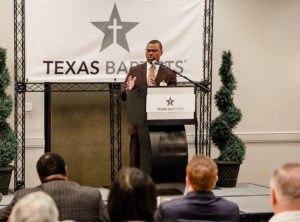
Baptist General Convention of Texas President Michael Evans challenges the BGCT Executive Board to seek unity in diversity. (BGCT Photo)
In his first address to the board as BGCT president, Michael Evans, pastor of Bethlehem Baptist Church in Mansfield, urged Texas Baptists to set a standard for unity based on a shared commitment to reach people for Christ.
“We find ourselves in the midst of a divided country,” he said. “We are living in a defining moment.”
Evans reminded Texas Baptists they are “rich in diversity,” worshipping in multiple languages in a variety of cultural contexts and ministering among an array of racial and ethnic groups.
“Are we there yet?” he asked, answering “no” and pointing to the challenge ahead.
“Old stereotypes have to die,” he said, emphasizing small-membership churches, congregations served by bivocational pastors, and various ethnic churches must be recognized as “full partners in the mission.”
God can use churches—Texas Baptist churches in particular—as “the adhesive” that holds people together “in the midst of a divided country and culture,” Evans said.
In other business, the BGCT Executive Board:
Approved a recommendation to approve a restated certificate of formation with amendments that would allow the University of Mary Hardin-Baylor to reduce the size of its board. The BGCT will continue to elect a majority of trustees to the UMHB board, and the amended document does not alter the relationship between the university and the convention. The Executive Board granted authorization pending approval of the UMHB board of trustees at its October meeting.
Elected four members to the Christian Life Commission—Jacob West from First Baptist Church in Plainview, Chuck Gartman from First Baptist Church in Brownwood, Dwaina Six from Scotsdale Baptist Church in El Paso; and Bryant Lee from High Expectations Church in Humble.
Approved Vickey Linn Thornton from Second Baptist Church in Corpus Christi and David Koonce from First Baptist Church in Center to serve on the Committee on Nominations for Boards of Affiliated Ministries.
Re-elected three trustees to the Baptist Standard board of directors—John Whitten from The Gathering at Pioneer Drive Baptist Church in Abilene, Taylor Sandlin from Sugar Land Baptist Church in Sugar Land and Jay Abernathy from First Baptist Church in Lubbock—and elected three new trustees to the board—Joe Fields from New Beginnings Baptist Church in Lewisville, Scott Jones from First Baptist Church in Rockport and Jana Pinson from Windsor Park Baptist Church in Corpus Christi.
Approved five members to the Texas Baptist Missions Foundation Council—Elaine Eiland from First Baptist Church in Midland, Steve Dalrymple from First Baptist Church in Amarillo, Alice Curtis from Agape Baptist Church in Fort Worth, Michael Griffin from Park Cities Baptist Church and Carla Robinson from Park Cities Baptist Church in Dallas.
Elected four members to the Hispanic Education Initiative Council—Felipe Garza from Bill Harrod Memorial Baptist Church in Dallas, Ryan Jespersen from Shiloh Terrace Baptist Church in Dallas, Pedro Lopez from Hunters Glen Baptist Church in Plano and Tina V. Cooper from Calvary Baptist Church in Corpus Christi.
Approved three members to the Theological Education Council—John Hall from Field Street Baptist Church in Cleburne, Van Christian from First Baptist Church in Comanche and Meredith Pinson-Creasey from South Main Baptist Church in Houston.
Filled several vacancies on other councils, electing Larry Post from Sugar Land Baptist Church in Sugar Land and Stacy Leonard from First Baptist Church in Garland to the Institutional Audits Council, Joseph Adams from First Baptist Church in Hughes Springs to the Missions Funding Council, Hector Mendez from Iglesia Bautista Central in Fort Worth to the Cultural Engagement Council, Dylan Price from Woodway First Baptist Church of Waco to the Texas Baptist Historical Collection Council and C.V. Blake from First Baptist Church in Abilene to the BaptistWay Press Advisory Council.
BGCT receives $1 million for church health initiatives
September 26, 2018
The Baptist Health Foundation of San Antonio awarded a $1 million grant to the Baptist General Convention of Texas to fund health initiatives for South Texas churches and their ministers.
Over five years, the grant will be used for three initiatives—a “pastor to pastors” staff position to develop deeper interpersonal relationships with area pastors; a financial relief fund to offer financial aid to alleviate stress and anxiety for pastors; and church health conferences and retreats, designed to strengthen awareness and knowledge around holistic health services and practices.
“We are grateful to the Baptist Health Foundation of San Antonio for their generous investment and entrustment to Texas Baptists to provide for the health of our church leaders in South Texas,” BGCT Executive Director David Hardage said. “We know this $1 million grant will help alleviate the financial burden of many ministers and provide for the long-term health of our congregations.”
Pastors face financial, emotional and spiritual challenges
In 2016, Texas Baptists conducted a statewide survey showing 30 percent of pastors acknowledge being under financial stress, 40 percent work more than 60 hours per week, and 17 percent work more than 70 hours a week.
Responses indicated pastors without seminary degrees statistically find themselves with even more setbacks. On average, they serve congregations of about 76 people, 44 percent do not have retirement funds, and the average annual compensation is $26,115.
The financial, emotional and spiritual struggles led Texas Baptist leaders to seek ways to minister to church leaders and help alleviate some of the burdens. They felt the indicators the survey revealed directly affect the health not only of the pastor, but also the congregation and the community.
“The Baptist Health Foundation of San Antonio is honored to partner with Texas Baptists to improve the health of church leaders in our community,” said Cody Knowlton, the foundation’s president and chief executive officer.
“By meeting the needs of pastors in South Texas, we know this will strengthen churches, which will allow them to better serve our communities. We agree with Texas Baptists that when a pastor is healthy, the church is healthy, and if the church is healthy, the community is healthy.”
Grants makes possible three initiatives
The BGCT plans to fill the pastor to pastors position with a seasoned minister who has extensive pastoral experience and can serve as a shepherd to shepherds. The role will function as a mentor/coach/spiritual leader to pastors by gauging, monitoring and aiding leaders toward spiritual health, while considering other factors such as financial strain and relational, emotional, mental and physical health.
The financial relief fund will be matched with Lilly Endowment funds annually to alleviate financial stress of pastors and churches. Since many pastors work bivocationally and serve small congregations, when significant financial needs arise, they often are left without options.
In an effort to generate awareness and education around holistic church health, Texas Baptists will offer learning and spiritual renewal experiences for churches and pastors through church health conferences and retreats.
Through the collaborative work of various Baptist institutions in the San Antonio area, funding from Baptist Health Foundation and BGCT staff efforts, these new initiatives will launch in 2019.
“Portions of the proposal have been hopes and dreams of certain Baptist institutions in our area for a long time,” said Elizabeth Biedrzycki, Texas Baptists’ South Texas regional coordinator, based in San Antonio.
“I’m grateful for the generosity of the BHFSA and the cooperation and collaboration of institutions in this region to develop learning and equipping opportunities for local churches and local church leaders. I believe South Texas will be better because of this work.”
SBC president’s sexual abuse advisory study underway
September 26, 2018
NASHVILLE (BP)—Southern Baptist Convention President J.D. Greear’s sexual abuse advisory study is “actively involved” in the first phase of its two-year process, the Ethics & Religious Liberty Commission announced Sept. 19 following appropriation of $250,000 for the study by the SBC Executive Committee.
Greear announced in late July he would form a working study group, in partnership with the ERLC, to “consider how Southern Baptists at every level can take discernable action to respond swiftly and compassionately to incidents of abuse, as well as to foster safe environments within churches and institutions.”
J.D. Greear
The study will receive the first $250,000 of any money received beyond the 2017-18 Cooperative Program Allocation Budget, the Executive Committee voted. Expenditures for the study will be administered by the ERLC and reimbursed quarterly by the Executive Committee.
The budgeted goal of $192 million for the SBC portion of the Cooperative Program allocation budget was surpassed Sept. 21, said Bill Townes, vice president for convention finance.
Russell Moore
“It was a joy to see on display this week at Executive Committee meetings such generosity and unity in mission,” ERLC President Russell Moore. “I am deeply thankful that the SBC Executive Committee showed their commitment to the sexual abuse advisory study by providing these resources.
“Southern Baptists have made it clear that we must address this crisis with the gospel and for the sake of the gospel. And these funds will make it possible for this study group to provide the very best resources and recommendations possible for our churches. I’m thankful for the opportunity to partner with this study group in order to serve our churches every way possible.”
Assessment, development, implementation
ERLC Executive Vice President Phillip Bethancourt wrote in a Sept. 19 update on the ERLC website: “The study group is already actively involved in the assessment phase. The purpose of this phase is to review existing organizations, strategies, experts, and resources in order to better understand the landscape of needs and opportunities when it comes to sexual abuse.”
Next, during the “development phase,” the study group will “develop recommendations, resources, strategies, and partnerships that will address the needs and opportunities that have been identified.”
Then an “implementation phase” will “launch a wide-scale, comprehensive effort to educate, saturate, and motivate Southern Baptist churches, entities, and leaders to embrace and incorporate the recommendations and findings of the study group,” Bethancourt wrote.
Unlike previous task forces in SBC life, the Sexual Abuse Advisory Study will not be limited to one “representative group of leaders and experts,” Bethancourt wrote. Rather, the study will comprise “a constellation of various work groups specializing in particular areas like orbits in a solar system. As the study group progresses, various orbits will be identified and addressed such as resources, church-based strategies, seminary and higher education, state convention and association initiatives, and more.”
One “orbit” in the study, Bethancourt wrote, will involve “a collaborative effort among the (six SBC) seminaries in order to identify common principles and outcomes that can be appropriately implemented in each unique seminary context.”
August Boto
August Boto, interim president of the SBC Executive Committee, thanked Cooperative Program-funded convention entities for sacrificing funds for the study and others for “offering to contribute needed support and resources.”
“Of course, behind the national ministry demonstration of willingness is the fact that the funding originates at the local church level where believers contribute their tithes and offerings, and then vote to support ministry through the Cooperative Program,” Boto said in written comments. “In other words, this effort is truly one supported by all Southern Baptists.
“Joining together sacrificially, collaboratively and voluntarily to address evil, human failure and the consequences of sin is a Southern Baptist characteristic,” Boto said. “More importantly, it is biblical (as passages such as Matthew 22:36-40 and John 4:23-24 indicate) and as ‘people of the Book,’ Southern Baptists can do no less.”
Questions, comments and suggestions regarding the study can be emailed to studygroup@erlc.com.
Crackdown on Nigerian Muslim group could spark militancy
September 26, 2018
ABUJA, Nigeria (RNS)—Two years ago, Modu Bukar, a leader of the Islamic Movement of Nigeria, was gunned down in Potiskum, a city in northeastern Nigeria.
“We spoke only about five minutes before. He had just said the late evening prayer and was just chatting with some people outside when gunmen shot and killed him,” said Mala Mohammed, a 24-year-old student at Bayero University Kano. He is a member of the Movement, led by Sheikh Ibrahim Zakzaky, a radical Shiite cleric who has called for an Iranian-style Islamic revolution in Africa’s most populous country.
Authorities investigated Bukar’s shooting. But Mohammed and others believe it was an extrajudicial killing—a security officer executing the religious leader without due process.
Analysts worry such killings could convince the Islamic Movement of Nigeria to follow in the footsteps of Boko Haram, the militant group that has wrought havoc in Nigeria for years, killing people indiscriminately, kidnapping girls and displacing thousands.
Killing of leaders can radicalize followers
The alleged extrajudicial killing of Boko Haram founder Mohammed Yusuf in 2009 and other leaders led to that group’s full-scale uprising in northern Nigeria.
In 2015, Nigerian security forces arrested Sheikh Zakzaky, also known as Ibrahim Yaqoub El Zakzaky, after 350 of his followers clashed with Nigerian troops in Zaria in northwestern Nigeria. Two of Zakzaky’s sons were killed in the fracas. Another Islamic Movement leader, Sheikh Umar Sokoto, was shot and killed by police during a protest in January.
Since the 2015 arrest, Zakzaky and his wife have been in detention on charges of murder, and the government has refused to let him go, despite a December 2016 court order for his release.
“It is quite possible for the Islamic Movement of Nigeria to transform into militancy like the Boko Haram,” said Ishaq Akintola, a professor and director of the Muslim Rights Concern, an advocacy group for Nigerian Muslims. “There is a serious security implication for the continued detention of Zakzaki.”
Muslims make up about half of Nigeria’s almost 200 million people but suffer discrimination, according to the Nigerian Supreme Council for Islamic Affairs. Analysts see it as a legacy from the colonial era, when Christian missions established Nigeria’s educational institutions, including the Muslim north. The country won independence from Britain in 1960.
“We have been maltreated, oppressed,” said Abdullahi Musa, secretary of the Academic Forum of the Movement, a branch of the group based at universities. “And many of us have been killed by the police.”
Christians in Nigeria subject to severe persecution
At the same time, Open Doors ranks Nigeria No. 14 on its World Watch list of countries where persecution of Christians is most severe, due both to attacks by Boko Haram and radicalized Hausa-Fulani Muslims.
Last month, The Guardian reported gunmen attacked Nasara Baptist Church in Guguwa in the state of Kaduna, killed the pastor, Hosea Akuchi, and abducted his wife.
The Nigerian Baptist Convention is the largest Baptist World Alliance member organization in Africa, with 3 million baptized members and 6.5 million worshippers in more than 10,000 churches.
Authorities stress national security
Sidi Sani, a longtime disciple of Zakzaky who lost two brothers in the Zaria violence, said: “Our struggle was not built on the foundation of militancy. Even our leader said members will not carry arms.”
After the court order to end Zakzaky’s detention, the sheikh’s only surviving son, Mohammed Ibrahim Zakzaky, petitioned the Nigerian Bar Association to compel the government’s justice minister to advise President Muhammadu Buhari to release his parents.
In an apparent response, Buhari, in a speech to the bar association, urged the country’s legal practitioners to seek to prioritize national security above the rule of law.
“The rule of law must be subject to the supremacy of the nation’s security and national interest,” said Buhari, who ruled the country as a military dictator in the 1980s but calls himself “a converted democrat.”
“The individual rights of those allegedly responsible must take second place in favor of the greater good of society.”
Hezbollah provides military training
In June, the Middle East Institute, a nonpartisan think tank in Washington, D.C., claimed members of the Islamic Movement of Nigeria have received military training from Hezbollah, the Shiite Islamist political party and militant group based in Lebanon.
“Tall men, in long, traditional African garb specific to northern Nigeria are sometimes spotted in Dahieh, a predominantly Shiite suburb south of Beirut where Hezbollah runs a cultural center,” wrote the institute in an analysis. “The Shiite Nigerians initially receive a religious training before a military one that is provided in two camps in the Lebanese Bekaa.”
Akintola, at Muslim Rights Concern, said his group initially defended Zakzaky after the 2015 incident, but he and his organization have pulled back.
“The Movement has become a huge security threat, the cause of discomfort, with bullies intimidating fellow Muslims,” said Akintola. “For these reasons, we found that in good conscience, we could not continue fighting their cause.”
Meanwhile, fears continue to mount over the group’s activities in Nigeria even as the crackdown continues.
In April, authorities sought to prevent the group from using the Unity Fountain in Abuja as a venue for sit-ins to protest the detention of their leader. A fight erupted and police killed a Movement follower.
Movement members say they will continue to fight.
“Our struggle has been carried out in Lebanon, Syria and Iran,” Mohammed said. “It’s now ongoing in Nigeria and Ghana.”
With additional reporting by Managing Editor Ken Camp.
Rebel force attacks Baptist churches in Burma
September 26, 2018
YANGON, Burma (BP)—Ethnic Wa rebels this month shut down churches or destroyed their buildings and temporarily detained several clergymen in eastern Burma, also known as Myanmar, Morning Star News reported.
On the border with China, soldiers of Myanmar’s largest ethnic rebel group, the United Wa State Army, attacked the churches in the rebel’s autonomous region in Shan state, according to Christian leaders.
At least 12 churches destroyed or closed
“We confirmed that at least 12 churches have been destroyed or closed as of Sept. 20,” a Christian leader who has lived in the Wa region for several decades told Morning Star News, an independent new service focused on the persecution of Christians.
The Wa people worship ancestral spirits, and the move by the UWSA was meant to hamper Christian missionary activity, said the leader on condition of anonymity.
Most of the targets were Baptist churches in Panghsang, where Wa soldiers destroyed crosses, the source said. The headquarters of the rebel group is located in Panhsang, on Burma’s border with China.
A video showing UWSA soldiers damaging a church building in Mong Maw town on Sept. 19 was widely circulated by Myanmar Facebook users. Local sources said schools built by Christian organizations in Panghsand town also have been shut down.
Some church leaders arrested
“Not only churches in Panghsang city were shut down, but churches in Mong Maw town were also destroyed,” said Ah Kar, a local resident in Mong Maw town. “Some religious leaders were arrested, and some people who worship were briefly arrested, and they were head-shaved before release. Some of those who were head-shaved were women.”
Local media reported the rebels attacked because the church buildings were built without UWSA permission. The rebel soldiers in the past week detained and questioned several Christian leaders in the UWSA controlled region, sources said.
U Nyi Rang, a spokesperson for the UWSA, described the rebels as controlled by extremist elements and added UWSA officials are looking into whether the arrested religious leaders are allowed to carry out their activities in rebel-controlled territory, according to the Myanmar Times.
“I heard that some churches were demolished that had been built without the permission of the UWSA central committee,” U Nyi Rang told the Myanmar Times. “We are trying to control the instability in the region caused by extremist, unregistered religious leaders from outside.”
Minority faiths persecuted
Although most of the population in Wa territory worships spirits, there also are Buddhists, as well as Baptist and Roman Catholic communities. Many area members of ethnic minority groups, such as the Ahkar, Lahu and Kachin, as well as the Wa, are Christians, sources said.
“We live in hills and were isolated,” said Tat Nyi Nat, a Christian who lives in Nang Pang in the Wa region. “But we got a chance to study and became educated persons because of the Christian missionaries. We were happy. But we are not happy for the future of our children.”
Missionary activity among the Wa has long been carried out, but attacks have been growing steadily worse, and some suspect Chinese authorities are behind them, a local Christian leader who is a long-time resident in the Wa region told Morning Star News.
“There have been more restrictions on Christian religious organizations for three years,” he said on condition of anonymity. “It has become worse. We don’t criticize other religions and don’t force non-Christians to convert into Christian.”
Chinese apply pressure
Bertil Lintner, a veteran journalist who has written several books on Myanmar ethnic minorities, wrote in Asian Times Online that pressure from Chinese authorities on the border is believed to be behind the restriction on Christian activities in Wa areas.
The Chinese Communist Party sees missionaries as tools of Western influence among Myanmar’s ethnic minorities, including the ethnic Wa who have Christians among them, Lintner writes.
Asia Times Online obtained a Chinese-language, UWSA statement stating all Wa military officers and administrators are instructed to “find out what the Christian missionaries are doing.”
The statement promises to punish local administration officials who support missionary activities, it prevents the construction of church buildings and requires that leaders of existing churches be native and not foreign, Asia Times Online reported.
Burma is about 80 percent Buddhist and 9 percent Christian. The country is ranked 24th on Christian support organization Open Doors’ 2018 World Watch List of the countries where it is most difficult to be a Christian.
Dallas church desires justice in Botham Jean’s death
September 26, 2018
DALLAS—The preacher stood wearily on stage, wiping tears from his eyes. The mayor, working to bring healing to a city of 1.3 million, sought solace on a front pew.
Allison Jean, mourning the fatal shooting of her son Botham Shem Jean by a police officer, wailed as the 250-member, predominantly black congregation sang hymns such as “Trouble in My Way.”
“I know that Jesus—Jesus—he will fix it after a while,” the church sang.
Television and newspaper cameras captured the emotion—and heartbreak—as the Dallas West Church of Christ gathered to worship just days after the inexplicable killing of 26-year-old Botham Jean in his own apartment.
Congregation praise Jean as man of faith
The recent Sunday was no ordinary Lord’s Day for the congregation, grieving the sudden loss of a beloved song leader and Bible class teacher—and doing so under an immense media spotlight stretching from Texas all the way to the Caribbean island nation of St. Lucia.
“Somebody like Bo—why?” church member Sherron Rodgers said, uttering the question on everybody’s mind. “Why did it happen to somebody like him? I’m just sad. He was a special, kind person who would never mess with anybody.”
Those who knew him described Botham Jean as a devoted man of faith with a “beautiful” and “powerful” singing voice. Baptized at age 10 in his native St. Lucia, Jean moved to the United States at age 19 to attend Harding University, a Christian liberal arts university in Searcy, Ark. He often led worship at Harding’s daily chapel assembly and served three years as a ministry intern with the nearby College Church of Christ.
Officer Amber Guyger, who lived in the same apartment complex as Botham Jean, was charged Sept. 9 with manslaughter and booked into jail before posting bond.
According to an arrest affidavit filed by Texas Ranger peace officer David L. Armstrong, Guyger worked her shift Sept. 6 and then returned home. At the apartment complex’s multi-level garage, she parked on the wrong floor and then mistook Botham Jean’s home for her own. After entering through his slightly ajar door, she confused him with a burglar and opened fire.
‘What happened?’
But for the victim’s mother, a former top government official in St. Lucia, many perplexing questions remain. The official narrative about how her son died doesn’t make sense to her.
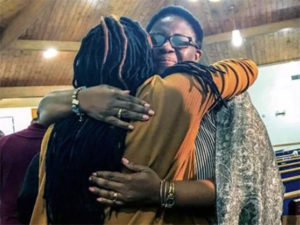
Allison Jean (right), mother of shooting victim Botham Jean, hugs a mourner after a prayer vigil Sept. 8 at the Dallas West Church of Christ. (RNS photo / Bobby Ross Jr.)
“The No. 1 answer I want is: What happened?” said Allison Jean, who was joined at a recent news conference by attorneys and Allen Chastanet, the prime minister of St. Lucia, a nation of 178,000 people. “I have asked too many questions and been told there are no answers yet.”
At the microphone, Allison Jean was flanked by Botham Jean’s older sister, Allisa Findley, and his younger brother, Brandt.
Botham Jean’s death has refocused national attention—and even international attention, given the St. Lucia connection—on police shootings of unarmed black males by white police officers.
A group of Dallas religious leaders, including megachurch pastors Matt Chandler of the Village Church and T.D. Jakes of the Potter’s House, along with pastors Jeff Warren of Park Cities Baptist and George Mason of Wilshire Baptist, wrote a letter expressing grief over Botham’s death and calling for “fair, consistent application of the law” in the investigation. Guyger’s status as a police officer should give her “no advantage in the current investigation nor upcoming prosecution.”
“We demand full transparency, consistency, and integrity in the days ahead as the judicial process progresses,” they wrote.
A criminal investigation is ongoing. So far, Guyger has not faced disciplinary action from the Dallas Police Department for the shooting.
“An exhaustive and thorough criminal investigation is essential, and as soon as we are assured that conducting an administrative investigation will not impede on the criminal investigation, we will proceed,” Dallas Police Chief U. Reneé Hall said.
‘Singing with the angels’
At the Dallas West Church of Christ, minister Sammie L. Berry said the congregation will work to support the family and make sure justice is served.
“Bo was an outstanding young man,” Berry said of Botham Jean, who had started preaching occasionally on Sunday nights. “You just can’t think of how this could happen to him. I mean, all he did was go to work, go to church, help people.
“We’re going to make sure that his name is lifted up. We’re going to make sure that we get answers to what happened. We won’t allow this to be just brushed to the side and move on to the next case. He meant too much to his family. He meant too much to this congregation, to his college, to the place where he worked.”
Allison Jean told the congregation at a prayer vigil her middle son “did everything with a passion,” including serving God.
“I can never give up, because I know that Botham is singing with the angels, and I want to be in that choir,” she said. “I want to see my son. I want to look upon his face.”
‘Never saw color’
When Botham Jean was born in 1991, his mother said, “God gave me an angel.”
While much of the national conversation focuses on race, Botham Jean “never saw color,” she said. “He never saw race. He wanted all of us to unite, to be together.”
Dallas Mayor Mike Rawlings, who earlier met with Botham Jean’s family to express his condolences, stayed for the entire two-hour Sunday service.
At the end of the service, Rawlings told the congregation he came not in an official capacity but as a citizen, “wanting to soothe some of my hurt because the city of Dallas is hurting so bad.
“To be able to sing with you, to be able to pray with you, to be able to listen to this wonderful sermon was just what I needed because I feel like, as mayor, I’m in the perfect storm,” he said.
The mayor drew cheers when he agreed with Berry that “we all need to be like Bo.”
“God bless you,” Rawlings said as he wrapped up his remarks. “Let us pull together. We will be a better city once we know the truth and once we come together and heal.”
Tommy Bush, a retired executive minister, works with a small congregation in Romance, Ark., an unincorporated community about 20 miles west of Searcy. Bush, 70, served as a professional mentor to Botham Jean his senior year in college and helped the accounting graduate land a job with PwC, formerly PricewaterhouseCoopers, in Dallas.
The two became close friends and worked together to support missions in St. Lucia and Kenya.
“His theology—his philosophy—was to get as good a job as he could and to make money to be able to give,” said Bush, who came to worship with the Dallas West church and comfort Botham Jean’s family. “He had great ideas for serving poor children and orphans in St. Lucia.”
Bush said he prays the charged officer knows Jesus.
“I just hope that she has the indwelling presence of Christ,” Bush said, breaking into tears, “because Botham will be the first one in line to give her a hug and welcome her home.”
Bobby Ross Jr. writes for the Christian Chronicle.
Baylor and BGCT relaunch BSM as chartered organization
September 26, 2018
WACO—After two decades when Baptist Student Ministries functioned a part of Baylor University’s student life office, the university and the Baptist General Convention of Texas relaunched BSM as a chartered on-campus student organization.
Baylor and BGCT leaders signed a cooperative agreement Sept. 19 at the Bobo Spiritual Life Center representing a renewed vision for BSM at the university.
After reading a Scripture passage from Psalm 133—“How good and pleasant it is when God’s people live together in unity”—Kevin Jackson, vice president for student life at Baylor, and Burt Burleson, university chaplain and dean of spiritual life and missions, joined BGCT Executive Director David Hardage and Bruce McGowan, director of Texas Baptists’ Collegiate Ministry Team, to sign and offer prayer over the agreement.
Baptist General Convention of Texas Executive Director David Hardage (left) and Baylor University Vice President for Student Life Kevin Jackson sign a cooperative agreement for a renewed vision of Baptist Student Ministries as a chartered student organization on campus. Looking on are Baylor University Chaplain Burt L. Burleson and BGCT Collegiate Ministry Team Director Bruce McGowan. (Robert Rogers/Baylor University)
“Denominational heritage, connections and involvement are one of the keys to a vibrant Christian university,” Burleson said. “Baylor and Texas Baptists have been invested in one another for a long time and both have thrived because of that. As we move further into what many consider a ‘post-denominational’ era, our relationships and partnerships with the BGCT are all the more important.
“I’m thankful for the rich history of student ministry we’ve known together and for this new affirmation of the work we will do in the years to come.”
The last two decades, when BSM was related to and considered as a department in Baylor’s student life office, led to some important ministry on campus, Burleson said.
However, BSM, BGCT and Baylor leaders discerned it was time to move to a more traditional campus ministry model centered in a chartered student religious organization, he added.
‘Re-envision and reinvigorate’ BSM at Baylor
Hardage expressed his gratitude to Baylor leaders “for their wonderful willingness and eagerness to re-envision and help us reinvigorate Baptist Student Ministries on this campus.”
BSM, a cooperative ministry of Texas Baptist churches, operates on 110 campuses across the state. The student-led organization provides opportunities for spiritual growth, making friends, leadership, service and missions.
“We believe in Christian higher education and have from the very beginning,” Hardage said. “We also believe in the spiritual movement of God on the campus of these (Texas Baptist) universities, and that’s what we hope, believe and pray for regarding Baylor and BSM here in the days, weeks, months and years to come.”
At Baylor, BSM’s mission is to equip Christian men and women for worldwide leadership and service by integrating catalytic discipleship and vocational excellence within a dynamic community, BSM Director Charles Ramsey explained.
BSM engages Baylor students during its regular Thursday night meetings at the Bobo Spiritual Life Center, as well as additional opportunities throughout the week for prayer, Bible study and missions.
‘A new chapter’
“BSM has a special place in the history and character of Baylor University, and the agreement signed today marks the beginning of a new chapter in our shared ministry,” Ramsey said.
“It is a timely recommitment to the centrality of the gospel in the founding vision of the university and an affirmation of our joint mission to equip Christian men and women for worldwide leadership and service. It signifies that Baylor has strong ties to its Baptist heritage, and that BSM will continue to take a central role in strengthening this partnership by equipping students to make a difference in the lives of those they will lead and serve,” he said.
For almost a century, BSM—previously known as Baptist Student Union—has played a significant role in the spiritual formation of Baylor students, Jackson noted. It has served as a foundational experience for students as they lived their life based on God’s plans and purposes, not their own, he said.
The foundation for a national vision of campus ministry that eventually became Baptist Student Union was laid at Baylor on Oct. 21, 1905, when six students formed a prayer covenant after attending a student YMCA meeting. Fifteen years later, Joseph P. Boone, one of the participants at that meeting, became the first full-time Baptist student worker in the South as Baptist Student Secretary of the BGCT, according to Baptist historian H. Leon McBeth.
In addition, many of Baylor’s activities and traditions find their roots with the BSU, including Welcome Week, which started in 1979 as a ministry of the BSU, the Baylor Religious Hour choir, Missions Emphasis Week and Spring Revival Week.
“At Baylor, we want to not only inform the mind, we want to inform the heart and the soul. That’s an exciting journey for us, and praise be to God that we are not on it alone,” Jackson said. “We have many, many good partners, and we have one particularly good partner today in the BGCT. We are so excited about the work that we’ve been doing, especially around Baptist Student Ministries. It is with great energy and enthusiasm that we gather today, and we look forward to a renewed relationship for the BGCT, BSM and Baylor University and a future where the vital nature of BSM on this campus will continue to grow.”
WorldCrafts expands aid for children’s causes
September 26, 2018
BIRMINGHAM, Ala. (BP)—WorldCrafts, the fair trade division of Woman’s Missionary Union, has launched a new initiative to benefit the work of Lifeline Children’s Services and families adopting domestically or internationally through Lifeline.
Meanwhile, WorldCrafts is continuing its benefit initiative through the Baptist Coalition for Children and Families’ connection with children’s home ministries in Alabama, Arizona, Arkansas, Florida, Louisiana and South Carolina.
Each of the participating organizations benefits from the sale of handcrafted items ranging from jewelry and accessories to home décor and Christmas-themed craft items to support more than 2,000 artisans and their families around the world.
Any individual or church can host an online WorldCrafts benefit for Lifeline, for families adopting through Lifeline, or for one of the participating Baptist children’s home ministries.
Each benefit lasts one month, and at the end of the month, 20 percent of all sales generated by the benefit will go directly to the host’s selected beneficiary.
To begin the process of hosting a benefit, a prospective host or church simply completes an online registration form. Upon receipt of the form, WorldCrafts will create a unique promotion kit for the host including a webpage, promotion code, media slides and sliders, social media images and a bulletin insert.
Lifeline supports families in their adoption journey, as “a way God gives families to vulnerable children who need to know the love of a family and the love of Christ,” according to the organization.
For families adopting through Lifeline, registration can be done online by completing a form to be entered into WorldCrafts’ system.
Upon receipt of the registration, WorldCrafts creates a webpage and promotional kit for the family. After a family is registered as a beneficiary, their family, friends, coworkers and churches can go to the family’s webpage and sign up to host benefits for their adoption.
Emily Swader, marketing strategist for WorldCrafts, said the WMU ministry “joins Lifeline in its dedication to the rescue and transformation of vulnerable children and families throughout the world.”
“WorldCrafts’ vision is to offer an income with dignity and the hope of everlasting life to every person on earth,” Swader said. “Coming alongside of and offering financial support to families pursuing adoption is a natural connection for us.”
WMU Executive Director Sandy Wisdom-Martin highlighted WorldCrafts’ initiative for Baptist children’s home ministries noting: “Many people have a desire to assist foster children but don’t know how or where to get started. This initiative through WorldCrafts can help create connections between churches and families and their local Baptist children and family ministry.”
Compiled by Baptist Press Senior Editor Art Toalston from reporting by the Woman’s Missionary Union communications staff.
CBF seeks to defend restrictions on predatory lending
September 26, 2018
DECATUR, Ga.—The Cooperative Baptist Fellowship has asked to join litigation to defend regulation intended to restrict payday lending practices it considers predatory.
CBF is requesting “intervenor” status in a case filed by two payday lending industry associations challenging the Consumer Financial Protection Bureau rule that will strengthen protections for consumers against predatory lending tactics.
The rule is currently set to be implemented by August 19, 2019. However, since the bureau released the rule last October, the agency has changed its approach to consumer protection, including a plan to reconsider the rule as written.
CBF has asked the court to allow it to step into the shoes of a defendant and take the litigation steps necessary to defend the CFPB’s rule against the industry associations’ claims. The Public Citizen Litigation Group and the Equal Justice Center will represent CBF pro bono.
The associations claim, among other things, the bureau did not follow proper procedure in issuing the rule; that it improperly deemed certain lending practices unfair and abusive; that the agency’s authority to address unfair and abusive practices is unconstitutional; and that the agency’s structure is unconstitutional.
‘A matter of faith for us’
“Payday lending is an industry that relies on products designed to be most profitable when borrowers fail,” said Suzii Paynter, CBF executive coordinator. “CBF’s leadership among the religious community to oppose predatory lending is a matter of faith for us. We are called to bolster human dignity, not diminish it, and to support people created in the image of God, not undermine their flourishing.”
Stephen Reeves, associate coordinator of partnerships and advocacy, added: “Advocates in CBF life have worked for years against predatory lending practices, including support of the CFPB. It is wrong to take advantage of others when they’re desperate. This rule is the best hope we have right now to reform these practices nationwide. People of faith should do all we can to stop the abuse of our neighbors for profit. If the CFPB won’t defend its own work, we will.”
CBF Moderator Gary Dollar said the Fellowship’s governing board affirms the national role CBF is playing to stop predatory lending practices and the effort to seek intervenor status.
“I’m proud that the work of our churches, pastors, field personnel and advocates has resulted in this opportunity to intervene,” Dollar said. “We are motivated because of the harm these bad loans do to vulnerable people and communities. In this moment, our faith requires us to stand up and defend the rule created to protect families, even when others will not.”
‘This must change’
Scarlette Jasper, CBF field worker in McCreary and Pulaski counties and other parts of Kentucky, has been an advocate for her neighbors struggling to make ends meet for years. She provides group workshops and one-on-one financial education that focuses on budgeting and other sustainable financial management skills, and warns people about the pitfalls of payday loans, as part of CBF’s rural development coalition, Together for Hope. She also is developing a micro-loan program as an alternative for these families.
“Families need a place to go for financial assistance, but they do not need to be taken advantage of,” Jasper said. “These companies prey on the elderly, disabled, and the working poor. This must change, and with the support of CBF and others who speak out against lenders’ harmful practices, I pray that it will.”
Steven Porter, coordinator of CBF Global Missions, noted he “saw firsthand those victimized by predatory lending” when he was a CBF field worker.
“The Bible condemns the exploitation of poor people,” he said, calling efforts to reform lending practices that target the poor “mission work that takes Jesus at his word.”
Hunger offering helps Buckner strengthen families in Peru
September 26, 2018
LIMA, Peru–When Elizabeth Mejía Laguna first arrived at a Buckner Family Hope Center in Lima, she was shy and kept to herself. She often stayed in her home and did not interact with her neighbors.
“There was no light in my house. I was always behind closed doors,” she said.
She struggled in her marriage and lacked resources to buy proper nutritional food, so her young daughter, Luana, suffered from anemia. As a first-time parent, Elizabeth did not know how to care for Luana.
“I didn’t know how to raise her,” she said. “I had so many problems inside.”
After attending classes and meeting with a psychologist at the Family Hope Center, she experienced a transformation in her life and home.
Instruction from parenting classes helped Elizabeth and her husband, José, learn how to express love to Luana. They began to play and interact with her. The couple also learned how to interact and talk with one another to strengthen their marriage.
“I started opening up,” Elizabeth said. “I discovered that, when you open your windows, light comes in.”
Offering aids healthy growth
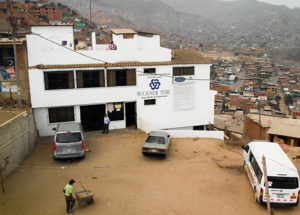
Gifts to the Texas Baptist Hunger Offering provide Manna Packs and water filters to families at the Buckner Family Hope Center. The center not only meets immediate physical needs, but also addresses severe spiritual poverty. (BGCT Photo)
The family received a much-needed resource in the Manna Packs they received at the center. Manna Packs are a blend of rice, dehydrated vegetables and soy nuggets mixed with vitamins, minerals and other nutrients.
By incorporating the Manna Packs into their weekly meals, Elizabeth saw immediate health improvements. Luana overcame her anemia, and the family began to strengthen physically.
Gifts to the Texas Baptist Hunger Offering provide Manna Packs and water filters to families at the Buckner Family Hope Center. he center not only meets immediate physical needs, but also addresses severe spiritual poverty.
Elizabeth Mejía Laguna expressed gratitude to God for using the center to change her life and her family.
“Without God, I would not be me, who I am now,” Elizabeth said. “We love God very much. He is our strength to face each day.”
The family, now involved in a local church and growing in their faith, is one of about 200 served through Buckner’s Family Hope Centers in Lima. Through the centers, families receive Bible teaching, life skills, parenting classes and access to psychological care, providing a holistic approach to family care. By meeting the spiritual, physical and emotional need of families, Buckner builds healthy families that can withstand the trials of life.
The Texas Baptist Hunger Offering partners with 130 hunger relief and development ministries worldwide like Buckner that help individuals overcome the cycle of poverty and shine Christ’s love in the darkness.
Dallas faith leaders call for justice for Botham Jean
September 26, 2018
Republished with permission.
Editor’s note: On Sept. 6, Dallas Police Officer Amber Guyger entered the apartment of Botham Jean. Guyger maintains she mistakenly thought she was in her apartment and believed Jean was an intruder. Guyger shot and killed him.
News of the shooting has prompted protests against what many consider an instance of police violence against a minority. Some protesters also have questioned whether the police are being transparent enough with the public about the case. It’s unclear how Guyger got into the apartment, and the accounts differ between the Dallas Police Department and Texas Rangers records.
The following letter was signed by a diverse group of Christian faith leaders in North Texas, including a handful of Baptist faith leaders.
As leaders of Jesus’ church, we are committed to speaking the truth in love, doing justice, loving kindness and walking humbly before our Lord. We speak as clergy of one blood, one faith, with one Father seeking the welfare of our city as servants of Christ in the city of Dallas.
Whether one’s skin is white, black or brown and whether the uniform is blue or that of a civilian, there should be no difference in treatment in a just society or in its courts of law. True justice is impartial to race, wealth, status or social position.
In our city’s current tragedy, we believe that Officer Amber Guyger’s blue uniform should grant her no advantage in the current investigation nor upcoming prosecution. We are committed to stand together, as spiritual leaders in our city, against any who threaten justice and thereby threaten our peace.
We grieve for all involved in this unfortunate situation and believe that a commitment to truth and a fair, consistent application of the law are best for our city, the family of Botham Shem Jean and Officer Guyger.
Past injustices are not remedied by further injustices, but they do explain the strong reaction amongst some of our fellow citizens. For this reason, we stand together in our call for the acknowledgment of any undeserved privileges already unjustly granted to Officer Guyger by virtue of her uniform. We demand full transparency, consistency, and integrity in the days ahead as the judicial process progresses.
May God bless our city’s leaders, justice system and citizens as we seek justice together.
Jeff Warren, Park Cities Baptist Church
Todd Wagner, Watermark Church
Bryan Dunagan, Highland Park Presbyterian
Matt Chandler, The Village Church
Andy Stoker, First United Methodist Church of Dallas



 Stephen Reeves, associate coordinator of partnerships and advocacy, added: “Advocates in CBF life have worked for years against predatory lending practices, including support of the CFPB. It is wrong to take advantage of others when they’re desperate. This rule is the best hope we have right now to reform these practices nationwide. People of faith should do all we can to stop the abuse of our neighbors for profit. If the CFPB won’t defend its own work, we will.”