SAN ANTONIO—This summer, Baptist Temple in San Antonio found a way both to strengthen its community ministries and provide hands-on experience for a Baptist University of the Américas student.
Miguel Garcia, a BUA student, served as an intern at Baptist Temple through Student.Church, a program coordinated by the Cooperative Baptist Fellowship. Garcia was one of 46 undergraduate and graduate students who explored ministry opportunities at churches across the country through Student.Church.
Pastor Jorge Zayasbazan noted Baptist Temple already had bought a house and refurbished it for student missionaries who will live there while they serve in the congregation’s varied community ministries.
Baptist Temple’s hope to expand its involvement in the community and Garcia’s search to gain ministry experience came together through Student.Church, said Wanda Kidd, director of the program and collegiate ministries specialist at CBF.
Offer guidance and support
Student.Church internships, which begin at the end of May and conclude in early August, differ from many other church internships in the exposure and guidance students receive, Kidd noted.
“It’s not unusual for churches to have interns,” she said. “What is unusual is for church interns to know they are not insular in their experience.”
The Cooperative Baptist Fellowship sent 46 Student.Church interns across the country to learn and explore different areas of church ministry. (Photo / Wanda Kidd)
Student.Church supports interns by connecting them with mentors outside the church and bringing the students together so they can share experiences with each other, Kidd said.
Connections between students grow even more during debriefing at the end of the summer, when CBF assembles 40 to 50 student interns who bond as they relate their common experiences, Kidd said.
“People are always fascinated by how close these students are when they only have known each other for one week,” said Kidd. “There is a sense of community and shared experience.”
Student.Church internships offer a wide range of ministry experiences, including hospital visitation, business and church administration meetings, as well as sermon preparation and children’s lessons, she said.
A clear picture of congregational ministry
The experience gained at Baptist Temple gave Garcia a clearer picture of what ministry in the church can be like, he said.
Garcia, who hopes to serve as a worship leader in a church, noted he is on track to graduate from BUA next year. As an intern, he learned worship ministers can help other Christians be more active in the church, Garcia added.
“We’re meant to grow in our faith and plant other seeds,” he said.
Garcia’s experience and the lessons he learned while he served at Baptist Temple exemplify the reason CBF created Student.Church, Kidd noted. When the program started, she noted, more than 60 percent of students entering seminary reported they never wanted to serve in a local church.
“Since our organization is based in local congregation ministry, we said, ‘Maybe if we placed them in congregations and help them see the purpose and value of church, it might change that,’” she said.
Hands-on internship experiences in congregations tend to confirm a sense of calling, Kidd noted. Since Student.Church began, CBF has worked with 400 churches and somewhere between 400 and 500 students.
Every summer, one or two students decide they are not meant for ministry in a local church, she acknowledged.
However, many others—including some who accepted an internship because they could not find a summer job or because someone recommended the program to them—fall in love with ministry in a local church setting, and their lives are shaped by the experience, Kidd said.
“I would have not done this for 10 years if I did not think this had intrinsic and lifelong value,” she said.
CommonCall: God gave the vision
August 28, 2018
KILGORE—Talk to James Bell even for a few minutes, and the subject of “vision” will arise.
“My vision is equipping people to see God’s love,” said Bell, bivocational pastor of Greater St. John Baptist Church in Laird Hill, an unincorporated community southwest of Kilgore. “God is with us always, but we don’t always focus on that. God had a vision for this church, even when nobody saw it.”
‘God has allowed me to see his power’
Since Bell became the congregation’s pastor 12 years ago, he has seen the rural church grow from three or four worshippers on a typical Sunday to more than 200, and he gives God all the glory.
“The Lord has been here the whole time,” Bell said, referring both to his personal testimony and the life of the church. “God has allowed me to see his power.”
About 15 years ago, God used Bell’s concern for a seriously ill friend to help begin the process of discerning his call to ministry.
“The Lord put him on my heart, to try to get him into church,” Bell recalled. “It took me and the Lord about a year and a half, but he ended up in church, and I found a calling.”
Later, God used a request from his sister to confirm that calling both to him and members of Greater St. John Baptist Church.
His sister had been diagnosed with what appeared to be a potentially life-threatening thyroid disease requiring multiple medications that created other health concerns. So, Bell prayed with his sister, asking God to heal her.
Later, his sister called him to say her doctor pronounced her completely free from the disease and took her off all the medicine she had been taking for three years.
At her request, he preached the Mother’s Day sermon at Greater St. John Baptist, where he had been teaching a Sunday school class. In time, he was licensed and ordained to the ministry, and the church called him as pastor.
“When God began calling me to the ministry, the Lord let me see some tremendous things,” Bell said, recalling multiple instances of answered prayers and changed lives. “I was eager to tell the story and let people know how good God is.”
‘Help the kids see there is a better future’
Pastor James Bell points with pride to graduation photos of young people who grew up as part of Greater St. John Baptist Church, near Kilgore. (Photo / Ken Camp)
Early in his pastorate, Bell particularly found success in reaching children, teenagers and young adults with the gospel, including many who would have been considered at-risk.
“I wanted to help the kids see there is a better future—a better day ahead,” he said.
However, he realized, he could not provide the kind of discipleship opportunities they needed and fulfill God’s vision for making an impact on the community alone.
About that time, he attended a Christmas program at First Baptist Church in Kilgore, and received a follow-up call from a church representative. Bell told the caller he was pastor of a small, rural church, and he needed help.
“I need tools to help build up the church,” Bell recalled telling him.
‘Unlocking the door to so many opportunities’
The caller introduced Bell to the staff at Gregg Baptist Association, and he learned about the advantages of working cooperatively in missions. Bell subsequently led Greater St. John Baptist to affiliate both with Gregg Baptist Association and the Baptist General Convention of Texas.
“The BGCT and the association have been like locksmiths to me, unlocking the door to so many opportunities,” Bell said.
When the church outgrew its sanctuary, the BGCT helped the congregation secure a low-interest loan and—with the help of volunteer builders and the sponsorship of First Baptist in Kilgore—construct a new facility.
Bell anticipates Greater St. John Baptist will pay off the 10-year note within a few months—about six years after obtaining the loan.
Greater St. John Baptist led Gregg Association in baptisms several years ago, based on percentage increases, and the congregation has been a statewide leader among African-American churches of its size in giving to the Cooperative Program unified budget.
Meanwhile, the church has increased its involvement in community ministry. Greater St. John Baptist provides food boxes to families in need at Thanksgiving and bicycles for children at Christmas.
“We’ve also been able to help people within the church who have almost lost a house after they lost their job,” Bell said.
Through good times and bad
As young people in the church have grown, the congregation celebrates their achievement, displaying their graduation photos on its “wall of honor.”
When some have strayed, Bell and his congregation have walked with them through their difficult times.
He recalled one young woman, a former leader among the youth, who made bad choices and entered into a relationship with a boyfriend who got her pregnant and physically abused her.
Her life took an even more drastic turn when he forced her to drive the car while he and another man committed an armed robbery, shooting and killing someone.
After the young woman was arrested and charged as an accomplice, Bell continued to visit her. He assured her even though she had turned her back on God, he had not forsaken her. They prayed together, asking God to use her even behind bars, and to open doors for a fresh start.
Eventually, her former boyfriend confessed he had forced her to participate in the crime against her will. She was released and returned to church. Now she holds down a steady job, and when she recently bought a small house, she asked Bell to say a prayer of blessing over it, committing her household to God.
“When I tell our church, ‘God is good all the time,’ they know it’s true, because they have seen it,” Bell said.
In the coming years, he trusts God to continue to “keep pouring blessings through the window,” as the church remains obedient to Christ’s call to love.
“If we keep showing love, we’ll continue to grow,” he said. “Jesus showed love. We need to love people the same way Jesus loves us. … People are watching to see how much love you have. What God pours into us, we need to pour off to others.”
Read more articles like this in CommonCall magazine. CommonCall explores issues important to Christians and features inspiring stories about disciples of Jesus living out their faith. An annual subscription is only $24 and comes with two free subscriptions to the Baptist Standard. To subscribe to CommonCall, click here.
John McCain known as a man of quiet faith
August 28, 2018
WASHINGTON (RNS)—Sen. John McCain, a former prisoner of war who embraced patriotism loudly and religion quietly, died Aug. 25 at age 81.
He was diagnosed in July 2017 with glioblastoma, an aggressive form of brain cancer.
The longtime Arizona Republican senator, reared in the Episcopal Church, attended a Southern Baptist megachurch—North Phoenix Baptist Church—in his later years.
He viewed himself as a Christian but had “a distrust of the Religious Right and a faith that is too public, too political,” said Stephen Mansfield, author of books about the faiths of presidents and presidential candidates, in an interview last December.
‘Saved and forgiven’
During McCain’s runs for president, especially his second campaign in 2008, he spoke about his faith. But, even then, he tended to tell a story about a silent expression of belief in God.
Candidates Sen. John McCain (left) and Sen. Barack Obama (right) joined Saddleback Church Pastor Rick Warren on stage during a presidential forum held at the church. (BP File Photo by Meredith Day)
In a family memoir and a campaign ad, as well as a televised interview with Pastor Rick Warren of Saddleback Church in Southern California, McCain recalled a guard in his prisoner of war camp in Vietnam who shared his faith one Christmas.
“He stood there for a minute, and with his sandal on the dirt in the courtyard, he drew a cross and he stood there,” McCain told Warren at the Saddleback Civil Forum. “And a minute later, he rubbed it out, and walked away. For a minute there, there were just two Christians worshipping together.”
Asked by Warren what being a Christian means, McCain simply replied: “It means I’m saved and forgiven.”
At the time of his presidential campaign, McCain biographer Paul Alexander said the senator’s military and faith backgrounds were responsible for his religious reserve.
“He’s a very spiritual person but … in his core, he’s a military man,” said Alexander, author of Man of the People: The Maverick Life and Career of John McCain. “They don’t feel comfortable talking about religion.”
Prayed ‘more often and more fervently’
During more than five years in a POW camp in Vietnam, McCain drew on his Episcopal roots—his great-grandfather was an Episcopal minister, and McCain attended Episcopal day and boarding schools.
In his family memoir, Faith of My Fathers, he recounted how he “prayed more often and more fervently than I ever had as a free man.”
George “Bud” Day, a fellow POW, said McCain was among those who volunteered to preach at religious services the prisoners eventually were permitted to hold at the prison known as the “Hanoi Hilton.”
“He was a very good preacher, much to my surprise,” Day said in 2008, when he was 83. “He could remember all of the liturgy from the Episcopal services … word for word.”
Day died in 2013, and McCain spoke at his funeral.
One Christmas in captivity, McCain recalled in the memoir, as “room chaplain” he was given a few minutes to copy passages from a Bible. Then, in between hymns sung with emotion by his comrades, he read portions of the story of the birth of Christ.
“It was more sacred to me than any service I had attended in the past, or any service I have attended since,” he wrote.
In recent years, McCain sometimes spoke in person and online of his reliance on prayer. He tweeted about praying for people who were victims of tragedies, from a church in Sutherland Springs to the tourist attractions of New York City.
Kept distance from Religious Right
“Prayer was the most important thing for him when he was a POW, and he often mentions prayer in times of national crisis,” Mansfield said. “Otherwise, he’s been cautious about mentioning it very publicly, because he does not want to be identified with the Religious Right or some of the more religious politicians he despises.”
McCain’s differences with some conservative Christians were displayed prominently in the 2000 campaign when he called Pat Robertson and Jerry Falwell “agents of intolerance,” remarks for which he later apologized.
In a conciliatory move, McCain spoke at the 2006 commencement at Falwell’s Liberty University and, in an even greater outreach to the Religious Right, he chose then-Alaska Gov. Sarah Palin, an anti-abortion evangelical, as his 2008 running mate.
He made an immediate defense of then-Sen. Barack Obama when a woman at a 2008 campaign appearance expressed her lack of trust in the Democratic candidate because she believed he was “an Arab.” McCain corrected her and said Obama was a “decent, family man.”
“For a few moments in his own campaign stop, he defended his opponent,” Mansfield recalled in a January 2018 interview. “He, like Reagan, has no problem speaking kindly of the other side and in personal terms.”
Paul Kengor, a political scientist at Grove City College in Pennsylvania, said a story about McCain’s family life demonstrated to him McCain’s Christian character.
His wife, Cindy, unexpectedly adopted a child with a cleft palate from an orphanage run by Mother Teresa in Bangladesh in 1991. He first learned of her decision when she arrived at the airport with the child, The Telegraph reported.
Kengor, author of books on the faith of politicians, said: “Some people talk the faith and some people walk the faith. That story struck me as an impressive example of a Christian living the faith. Yes, it was Cindy’s bold initiative, but John McCain accepted it and became a father to that girl—by all accounts, a loving father.”
Obituary: J.B. Fowler
August 28, 2018
J.B. Fowler, retired Texas Baptist pastor and New Mexico Baptist newspaper editor, died Aug. 21 in San Antonio. He was 88. Fowler was born July 8, 1930, in Pawhuska, Okla., to J.B. and Ona Thurman Fowler. He began preaching at age 17. He earned an undergraduate degree from Howard Payne University and a Master of Divinity degree from Southwestern Baptist Theological Seminary. He also received an honorary doctorate from Howard Payne University. He was pastor of churches in Van, Moran, Ballinger, Kendalia and Lubbock, as well as in McComb, Miss. He served 13 years as editor of the Baptist New Mexican and was named editor emeritus when he retired. His denominational service included terms as president of the Southern Baptist Press Association, a director of the Baptist General Convention of Texas Executive Board, and a trustee of Howard Payne University, William Carey College and Hendrick Memorial Hospital. He was preceded in death by his wife of 65 years, Wanda Lee Orrick Fowler. He is survived by sons Bruce of San Antonio and David of New York City; one grandson, one great-granddaughter and a sister, Betty Smith of Arlington.
When faith competes with materialism, charitable giving suffers
August 28, 2018
WACO—Religious people tend to be more charitable than their nonreligious counterparts, but they’ll think twice about opening their wallets if it prolongs their next big purchase, according to new research from Baylor University’s Hankamer School of Business.
Baylor researchers James A. Roberts and Meredith David partnered on a study that examined the relationship between religiosity and charitable giving, and what drives the latter.
They found religiosity—the way people live out their lives based on their faith—can drive donors to give. But when materialism—that self-serving want for more money or material possessions—enters the equation, giving decreases.
“At once, we want to help others, but at the same time, we desire the money and possessions that we all cherish to a greater or lesser degree,” the researchers wrote. “It is the result of such give-and-take between opposing values that drives our behavior as donors to charitable causes.”
A total of 180 adults participated in the study, published in International Journal of Nonprofit and Voluntary Sector Marketing.
Attitudes toward giving to help others examined
Roberts and David looked specifically at religiosity’s effect on peoples’ attitudes toward helping others and attitudes toward charitable organizations.
Religiosity, they explained, is different from religious affiliation. It is “something that individuals experience outside of their place of worship and constitutes a way of viewing and experiencing the world that is different from their less religious (or nonreligious) counterparts,” they wrote.
Roberts and David said they approached the study with the idea that helping others is a common rule among major religions.
In general, research showed those expressing higher levels of religiosity were found to possess more favorable attitudes toward helping others and to charitable organizations. And those with stronger attitudes toward helping others also expressed a greater breadth in their giving.
More religion does not equal more charity
But higher levels of religiosity do not guarantee open wallets, David said.
“We can’t always assume that religiosity ensures charitable giving,” she said.
Study results suggest increasing materialism lessened the positive effect of one’s attitude toward helping others in terms of “the breadth of giving,” she said.
Roberts, a nationally recognized expert on consumerism, said he and David, a nationally recognized expert on consumer behavior and well-being, weren’t too surprised by the study’s findings, given a basic understanding of human nature and the self-centeredness that accompanies materialism.
However, they believe understanding these dynamics can benefit charitable organizations as they identify potential donors and prepare for “the ask.”
“Although materialism was found to reduce the breadth and likelihood of charitable giving in the present study, it could spur charitable giving if it is driven by self-serving motivations,” they wrote in the “managerial implications” section of the study.
In other words, appeal to the donors’ inclination to give and their desire for public acknowledgment.
“Large donations that come with naming rights, spur news coverage or exceed the donations of other prominent individuals are all examples of how materialism can be used to drive charitable donations,” they wrote.
Churchgoers tend to congregate along political lines, survey says
August 28, 2018
NASHVILLE, Tenn.—America has become increasingly divided by politics in recent years. So have its Protestant churches.
More than half—57 percent—of Protestant churchgoers under 50 say they prefer to go to church with people who share their political views. And few adult Protestant churchgoers say they attend services with people of a different political persuasion.
Churches divided by politics
Those are among the findings in a new report on churchgoing and politics from Nashville-based LifeWay Research.
“Like many places in America, churches are divided by politics,” said Scott McConnell, executive director of LifeWay Research. “And churchgoers under 50 seem to want it that way.”
For the study, LifeWay Research surveyed 1,010 Americans who attend services at least once a month at a Protestant or nondenominational church.
Forty-six percent agree with the statement, “I prefer to attend a church where people share my political views.” Forty-two percent disagree. Twelve percent are not sure.
More than half (57 percent) of churchgoers ages 18 to 49 agree. Fewer churchgoers ages 50 to 64 (39 percent) or ages 65 and over (33 percent) agree. Men (51 percent) are more likely to agree than women (43 percent).
Methodist (57 percent), nondenominational (51 percent) and Baptist (49 percent) churchgoers are more likely to agree than churchgoers from other denominations. Lutherans (33 percent) are less likely to agree.
“Only a third of churchgoers in the study had strong feelings on this subject,” McConnell said. Twelve percent strongly agree, while 22 percent strongly disagree.
“Politics doesn’t seem to be a high priority for most Protestants when choosing a church to attend,” he said. “But for a small group of churchgoers, it’s really crucial.”
Birds of a feather …
LifeWay Research also asked Protestant churchgoers if their political views match those of people in their church. Half agree (51 percent), while 19 percent disagree and 30 percent are uncertain.
Churchgoers ages 35 to 49 (61 percent) are more likely to agree than those ages 50 to 64 (47 percent) or those 65 and older (44 percent). Men (58 percent) are more likely to agree than women (46 percent). Those who attend services at least once a week (52 percent) are more likely to agree than those who attend once or twice a month (43 percent).
American churchgoers who hold evangelical beliefs (57 percent) are more likely to agree their political views match others in their church, compared to those who don’t hold evangelical beliefs (44 percent). Baptist (58 percent), nondenominational (54 percent) and Assemblies of God/Pentecostal (53 percent) churchgoers are more likely to agree. Lutherans (31 percent) are less likely.
Protestant churchgoers and other Americans who attend worship services at least once a month made up about half of voters (52 percent) in the 2016 presidential election, according to data from Pew Research.
Churchgoers might stick around even if they disagree over politics.
A previous LifeWay Research study of Protestant and nondenominational churchgoers found only 9 percent would consider leaving their church over political views.
“More than a few churchgoers in the most recent study (30 percent) don’t know the political views of people besides them in the pews,” said McConnell.
“Politics isn’t the only thing that churchgoers care about,” he said. “In some churches, politics isn’t mentioned at all—at least in the pews.”
LifeWay Research conducted the study Aug. 22–30, 2017. For this survey, a nationally representative sample of U.S. Protestant and nondenominational adults (18 and older) who attend religious services once a month or more often was selected from the Web-enabled KnowledgePanel.
Analysts used sample stratification and base weights for gender, age, race/ethnicity, region, metro/non-metro, home ownership, education and income to reflect the most recent U.S. Census data. Study-specific weights included for gender by age, race/ethnicity, region and education. The completed sample is 1,010 surveys. The sample provides 95 percent confidence that the sampling error does not exceed plus or minus 3.1 percentage points. Margins of error are higher in sub-groups.
Committee named to seek new Southwestern Seminary president
August 28, 2018
FORT WORTH (BP)—Nine Southwestern Baptist Theological Seminary trustees were appointed to a search committee to recommend the seminary’s next president.
Trustee Chair Kevin Ueckert, pastor of First Baptist Church in Georgetown, appointed the committee and announced it to the full board Aug. 23.
Danny Roberts, an at-large trustee and executive pastor of North Richland Hills Baptist Church, in suburban Fort Worth, will chair the search committee. Roberts is an alumnus of Southwestern Seminary, earning a Master of Church Music degree in 1979, and has served as a trustee since 2016, sitting on the communications, policies and strategic initiatives committee.
Other committee members are Denise Ewing (Ill.), Jamie Green of Katy (at-large, search committee secretary), Guy Grimes (Calif.), Todd Houston (N.C.), Tom James (Ky.), Philip Levant of Hurst (at-large), Andre Palmer (N.Y.) and Calvin Wittman (Colo., search committee vice chair). Ueckert and board vice chair Connie Hancock (Ohio) are ex officio members of the committee.
The committee includes two women, one African-American and one Hispanic, according to an Aug. 24 news release from the seminary. The committee is diverse geographically and mixed in terms of trustee tenure, with five in their first five-year term and the other four in their second five-year term. Two search committee members are members of the trustee executive committee.
“Between now and the October board meeting, the presidential search committee will be focused on developing the candidate profile and the application process, as well as entering a time of focused prayer,” Ueckert said.
The committee will nominate a successor to former Southwestern Seminary President Paige Patterson, who was moved to president emeritus status in May and terminated less than a week later. Patterson had been under fire since late April for statements he made about domestic abuse and women’s physical appearance. He also drew criticism for his handling of an alleged 2003 sexual assault at Southeastern Baptist Theological Seminary, where he served as president from 1992 to 2003.
Southwestern Seminary’s bylaws state a president must be elected by the trustee board. The search committee is accepting nominations sent to swbtspresidentialsearch@gmail.com.
Around the State: UMHB art faculty featured in exhibition
August 28, 2018
The Baugh Center for the Visual Arts gallery at the University of Mary Hardin-Baylor features an exhibit of works by faculty members in the UMHB College of Visual and Performing Arts. Participants are Ted Barnes, Barbara Fontaine-White, John Hancock, David Hill, Helen Kwiatkowski, Robin McLaurin, Richard Skurla, Hugo Shi, Matthew Smith, Sarah Andyshak, David Harmon and Hershall Seals. The exhibit, on display until Sept. 14, is free and open to the public.
Michael Evans, senior pastor of Bethlehem Baptist Church in Mansfield and president of the Baptist General Convention of Texas, will speak at the Hardin-Simmons University convocation. The event is scheduled for 9 a.m., Sept. 6, in Behrens Chapel on the HSU campus.
ETBU women’s basketball team serves in Jamaica
August 28, 2018
MARSHALL—The East Texas Baptist University women’s basketball team journeyed to Jamaica recently to “share the joy of the Lord with the people of the island,” a leader of the mission trip said.
As part of the Tiger Athletic Mission Experience, the group of 27—led by Head Coach Rusty Rainbolt and Lisa Seeley, director of global education at ETBU—worked in partnership with Ignite International.
‘Experience of a lifetime’
The ETBU women’s basketball team competed with international basketball teams, conducted sports clinics for children, volunteered in schools and visited orphanages in Jamaica. (ETBU Photo)
“The mission trip to Jamaica was an experience of a lifetime in so many ways,” Rainbolt said. “I can’t begin to describe all that we saw and experienced through those nine days. I can say that, more than ever, our team experienced the biblical elements of love, patience, longsuffering and kindness. May we never forget, and may we never be the same.”
Coaches prepared the student athletes both physically and spiritually for their time in Jamaica, Seeley said.
“From the beginning, the team was ready to share the joy of the Lord with the people of this island,” she said. “These young women are amazing and love God with all of their hearts. It has been a blessing to travel and serve with them.”
The ETBU team competed with international basketball teams, conducted sports clinics for children, volunteered in schools and visited orphanages.
‘This is why we are here’
A trip to the Melody House for Girls, a home for abused teenage young women, made a deep impression on Kayla Bise, an ETBU junior.
“A few of my teammates shared their testimonies, a powerful experience that created a connection with the girls,” she said. “Afterwards, the women had the opportunity to share their story with us and ask questions. One girl expressed how she knew who Jesus was but felt like God didn’t love her.
“We had the chance to open the Bible and show her how much God cares for her. By the end of the conversation, she accepted Jesus into her heart, and at that moment, I thought to myself: ‘This is it. This is why we are here.’”
The Tigers played at the University of West Indies against Jamaican Olympic and National Team athletes. During half-time, the groups gathered on the court to share Christian testimonies and pray together. Following the games, the teams spent time together in worship and fellowship.
“We were blessed to play with ladies from another country, who we could relate to on and off the court,” ETBU senior Valarie Matlock said. “At half-time, we brought the team in the middle of the court and told the crowd about what God does for us. We prayed together and showed them that God is more significant than our ability to play basketball. ETBU won 41-39, but the score was not as important as the fact that we were able to spread the word of God as a team.”
Both the student athletes and coaches mentioned how the seeds they planted will continue to sprout in the lives of the Jamaican people and in their own lives in the future.
“These staff members and student-athletes have poured their hearts into advancing the kingdom of God, encouraging the people of Jamaica, and building the team’s chemistry,” ETBU Assistant Coach Caleb Henson said.
“Our players have learned not to allow their youth to hinder them as they profess the name of Jesus. They have set an example for all believers with their vulnerability, love and faith. I believe this experience is going to serve as a foundation for our program as we head into the upcoming season.”
The trip to Jamaica marked the seventh Tiger Athletic Mission Experience, which provides student athletes opportunities to use sports as a platform to connect with people and share the gospel of Jesus. Ryan Erwin, ETBU vice president for athletics, will lead the ETBU hockey team to Austria and Slovakia in early January for the next trip.
Greear: Catholic abuse report requires ‘bold steps’ by SBC
August 28, 2018
HARRISBURG, Pa. (BP)—Southern Baptist Convention President J.D. Greear said a Pennsylvania grand jury’s report alleging unprecedented levels of sexual abuse and cover-up by Roman Catholic clergy should prompt Baptists to take all steps necessary to eradicate sexual abuse “from within our community.”
The 900-page report, released Aug. 14, named more than 300 Catholic clergy members in Pennsylvania—although some names are redacted—who allegedly abused more than 1,000 victims over seven decades, beginning in the 1940s.
The victims, “most of whom were boys,” were “brushed aside, in every part of the state, by church leaders who preferred to protect the abusers and their institution above all,” the report stated.
The report noted “much has changed over the last 15 years” in the Catholic Church, including better reporting to law enforcement by church officials and the establishment of “internal review processes.”
Yet “child abuse in the church has not yet disappeared,” according to the report. The grand jury charged two priests earlier in its investigation with sexual abuse.
Many of the accused priests are dead or their alleged crimes are beyond the state’s statute of limitations for prosecution, The Philadelphia Inquirer reported.
Some accused clergy disputed the report’s allegations, and their responses were included in the report. A spokesman for one accused cardinal told The Inquirer the grand jury investigation involved a “flawed process” aimed “unwaveringly toward a predetermined result.”
‘This is not an isolated problem’
J.D. Greear, president of the Southern Baptist Convention. (SBC Newsroom Photo / Matt Miller)
“We grieve over this report from the grand jury. The safety and healing for victims is paramount,” said Greear, who announced in July he would form a Sexual Abuse Prevention Study Group.
“I also recognize that this is not an isolated problem. We must ask ourselves what bold steps need to be taken in eradicating this horrific sin from within our community. Over the last several weeks, I have heard from many advocates, victims, counselors, denominational leaders and legal experts and look forward to unveiling new steps that we as Southern Baptists can take together,” said Greear, pastor of The Summit Church in Raleigh-Durham, N.C.
Over the past six months, allegations have surfaced at Southern Baptist churches, at least one state Baptist convention and SBC entities.
At the SBC annual meeting in June, messengers addressed sexual abuse through motions, a resolution on abuse and questions to entity leaders.
A news release announcing Greear’s sexual abuse study group July 26, formed in partnership with the SBC Ethics & Religious Liberty Commission, said the group’s purpose “will be to consider how Southern Baptists at every level can take discernable action to respond swiftly and compassionately to incidents of abuse, as well as to foster safe environments within churches and institutions.”
‘Free churches have their own systemic problem’
Malcolm Yarnell, a Southwestern Baptist Theological Seminary professor who has written on Roman Catholicism, said the Catholic hierarchy may have “fostered an environment for abuse,” and “the Roman church’s extra-biblical and supra-local governing structure bears some responsibility for covering up such evil.”
Participants in the “For Such a Time as This Rally” hold signs outside of the Kay Bailey Hutchison Convention Center on the first day of the two-day Southern Baptist Convention annual meeting in Dallas. The rally called for Southern Baptist clergy to receive training on how to treat women with respect, how to handle allegations of abuse, and how to minister to victims of abuse. (Photo / Marc Ira Hooks / SBC Newsroom)
Yet “the free churches have their own systematic problem,” Yarnell added.
While a Catholic bishop may attempt to “cover up a minister’s deeds by silently and arbitrarily moving the alleged miscreant from one parish to another,” a “problem we face as free churches is that a deviant minister might move from one local church to another without the people in the new church becoming any wiser to the minister’s past misconduct,” Yarnell, research professor of systematic theology at Southwestern, said in written comments.
“If one church allows a minister to go without reporting an accusation to the appropriate child protection agency or to a police department, what is to keep another church informed about the deviant minister’s past? Without the first church reporting the problem, the second church may suffer a hidden evil,” he said.
“This is not to say that the free church structure is just as problematic as the Roman church structure,” Yarnell said. “It is more difficult for a cabal of people to hide sinfulness in a free church structure, especially in a congregational one. However, if an entire church culture is ignoring the problem of sexual abuse of the weak—whether of children or women—then a more biblical structure will not help stem the problem. The problem of the abuse of power, especially among those who are supposed to be holy, is one that all Christians, whatever their church, must address through education.”
#ChurchToo: Karen Swallow Prior builds bridges
August 28, 2018
WASHINGTON (RNS)—Karen Swallow Prior is an evangelical English professor in rural Virginia who can claim something most others who fit that description can’t—more than 25,000 Twitter followers.
A native of Maine, she is a vocal presence in the Southern Baptist Convention. And while she is known for building common ground with those who disagree with her, Prior made national news this spring for questioning the leadership of one of her denomination’s most powerful men, helping to bring the #MeToo culture into a male-dominated hierarchy.
‘Passionate about holism and balance’
What might seem like contradictions, Prior might call balance.
“I’m passionate about holism and balance,” she said in a recent interview, citing Aristotle’s definition of virtue as the balance between extremes. “To me, that’s the virtuous life, to balance all of those things.”
That principle has led to a career as a professor at Jerry Falwell’s Liberty University in Lynchburg, Va., and a writer of books—her latest is On Reading Well: Finding the Good Life through Great Books— and articles in publications like The Atlantic and the liberal website Vox.com.
A lifelong Baptist, Prior grew up in Maine and earned her Ph.D. from the State University of New York at Buffalo, where being “Southern Baptist wasn’t a big thing.” While in graduate school she worked as the principal of an inner-city private school that was both interracial and interdenominational.
Prior is affiliated with two hallmark fundamentalist institutions—Liberty University, led by one of founder Jerry Falwell Sr.’s sons, and Thomas Road Baptist Church, pastored by the other.
‘The emperor has no clothes’
But since the spring, Prior has become known for her outspokenness about allegations of abuse in the SBC, especially the scandal that broke in April around one of its biggest names— Paige Patterson, then-president of Southwestern Baptist Theological Seminary.
After an audio file started circulating of Patterson saying divorce is wrong even when a husband is abusive, and another clip that followed caught Patterson calling a 16-year-old “built,” Prior and other Southern Baptist women wrote to Southwestern Baptist’s trustees. When they did not hear back for several days, Prior helped draft a letter saying that “a leader with an unbiblical view of authority, womanhood and sexuality” should not be allowed to remain in his position.
Southwestern Baptist Theological Seminary trustee chairman Kevin Ueckert (left) addresses trustees at a special called meeting at the Fort Worth campus May 22. The board met to discuss the controversy surrounding Paige Patterson (right), then president of the seminary. (Photo by Adam Covington/SWBTS via BP)
“That letter was 3,000 women saying, ‘The emperor has no clothes,’” Prior said. “And I think it just simply sent notice that the gig was up.”
On May 23, the day Patterson was gently ushered out and given the title of president emeritus by Southwestern Seminary trustees, Prior was hit by a bus in Nashville, Tenn., fracturing her pelvis, shoulder and several ribs and vertebrae. A week later, as she left the hospital, Patterson was removed entirely from leadership at the seminary.
“This is serious spiritual warfare,” she tweeted that day.
Although she thanks God for the “miracle” of preserving her life, she believes disparate powers are at play in her denomination and beyond it.
“I believe that this whole issue about women in the church and the treatment of women and the treatment of minorities, that that is an evil in the church and that those who are speaking out against it are vulnerable to the works of the enemy,” she said.
Taking risks, creating safe space for others
Boz Tchividjian, a law professor at Liberty and the founder of GRACE, or Godly Response to Abuse in the Christian Environment, said Prior took a risk in speaking out against abuse, and praised her integrity in not attacking Patterson personally. Rather, she raised her voice, he said, because she “loves the denomination to the point of wanting to see changes made.”
Advocating change is nothing new to Prior. Tchividjian noted Prior long has been noticed inside and outside the evangelical world for her “refreshing” way of engaging orthodox beliefs with an unorthodox approach.
“Young people, I think especially at Liberty, really admire and look up to her,” he said. “The younger generation has an interest in a lot of the very same issues that she’s dialoguing about, and she creates safe spaces for them to talk.”
Brandon Ambrosino, a freelance writer and onetime student of Prior’s, said his former professor just looks approachable.
“She dresses like Oscar Wilde, and she’s wearing all of these funky colors, and she has a dozen different textures in one outfit,” he said, adding that her Twitter comments are as versatile as her apparel—from literature to history to animal rights.
“She appeals to so many different groups of people,” he said.
‘Truth is somewhere in the middle’
Prior’s appeal is also reflected in her attempts to build bridges with those with whom she disagrees. A former protester outside abortion clinics, she ran in 1998 for New York lieutenant governor as the Right to Life Party candidate. But she also served on a steering committee of the Common Ground Network for Life and Choice, which aimed to reduce polarization between abortion rights opponents and advocates.
“She sees them as humans to be reached and connected with, not villains to be distanced from, so she’s always cultivating conversations,” said Cristy Horsley, a 2008 Liberty graduate who works for a Virginia child advocacy organization and recalls Prior teaching her to be a critical thinker.
“She has never been afraid to analyze, to question. She always is looking for the medium between the two extremes. She says the truth is somewhere in the middle.”
Boldly going where few evangelicals venture
Prior also has delved into another area where many conservative Christians would not venture. She chose to be listed among endorsers of the recent Revoice conference, a gathering of LGBTQ evangelicals.
“I know many people who are same-sex attracted but yet still believe in the traditional biblical sexual ethic, and they need our support, and so I endorsed the conference,” she said.
Some questioned her support of Revoice, including one Southern Baptist who spoke from the floor of the convention’s June meeting to oppose her endorsement of the group.
In response, Russell Moore, president of the SBC Ethics and Religious Liberty Commission, said, “Karen Swallow Prior has committed herself to go anywhere and everywhere to stand up and tell the truth about God’s word about human sexuality.” Moore added he knew no one “more committed to the biblical message that marriage is between a man and a woman and that sexual immorality leads not just to bad consequences but to hell.”
Using social media
Prior’s “anywhere and everywhere” approach extends to social media, where she engages with students, former students, evangelical leaders and grassroots people, whether they agree with her or not.
One day she’s tweeting her thanks to the “warm and welcoming” audience at her recent talk at Washington’s National Presbyterian Church, where she spoke on abolitionist and animal rights activist Hannah More, her 19th-century role model and book subject.
A couple days later, she is outlining her definition of biblical Christianity: “I believe in protecting human life at all stages, stewarding all of creation humanely & well, celebrating maleness & femaleness as God created us, upholding marriage as a picture of Christ & church, holding predators accountable, welcoming aliens, and speaking the truth in love.” One of her latest articles suggested “9 Ways to Make Social Media More Christian.”
“I think she just has a really smart way of writing about things in an unexpected way,” said Eleanor Barkhorn, the editor at The Atlantic who commissioned Prior’s first piece for that magazine’s website in 2012, “Don’t Let the Petraeus Affair Keep Men from Mentoring Women.”
Prior has written about her belief that God called her to childlessness, condemned dog fighting and extolled the merits of marrying young—which she did herself, to her husband of 33 years, Roy.
“I don’t think she falls into a really clear category one way or another, but the perspective is really unique,” said Barkhorn, now deputy managing editor at Vox.com.
As Prior gets ready this month to release her book and prepares to leave her wheelchair behind for her 20th year at Liberty, she plans to keep teaching, writing and tweeting.
“I say, ignore what the experts tell you about building platform and use social media to serve people,” she said. “I don’t care about platform. I’m there to have fun and to spread my love of life, literature and God.”
Critics call pope’s comments on sex abuse ‘too little, too late’
August 28, 2018
WASHINGTON (RNS)—In his response to a Pennsylvania grand jury report detailing allegations of sexual abuse of more than 1,000 children by Roman Catholic clergy, Pope Francis condemned the abuse as a crime and called the church to solidarity with its victims.
“With shame and repentance, we acknowledge as an ecclesial community that we were not where we should have been, that we did not act in a timely manner, realizing the magnitude and the gravity of the damage done to so many lives,” Francis wrote in a letter published Aug. 20. “We showed no care for the little ones; we abandoned them.”
It was a statement some following the Catholic Church’s clergy sexual abuse crisis called “the boldest we have heard from the Vatican” and others termed, “too little, too late.”
Directly addressed Pennsylvania grand jury report
What makes the letter different from other statements by Francis and previous popes is that it addresses the Pennsylvania grand jury report specifically and not just sex abuse in general, said James Martin, a Jesuit priest and editor at large of America magazine. The report found Catholic priests had abused more than 1,000 children over 70 years and church officials had shielded those abusers, often by transferring them to other parishes.
“The question is what specific actions will be taken, other than the letter to address the growing crisis,” Martin said.
In the three-page letter addressed to the “people of God,” Francis called all Catholics to pray and fast, writing, “This can awaken our conscience and arouse our solidarity and commitment to a culture of care that says ‘never again’ to every form of abuse.”
The pope also denounced clericalism, or elevating clergy above other members of the church, saying, “to say ‘no’ to abuse is to say an emphatic ‘no’ to all forms of clericalism.”
For Natalia Imperatori-Lee, associate professor of religious studies at Manhattan College, that marked a “major shift” for the pope—“centering the pain of the victims and pointing to clericalism as a root cause.”
“He talks about the sex abuse crisis as an abuse of power and a failure of church culture, not individual failures of chastity which for so long has dominated the way the crisis is discussed in the U.S., with our longing to point out that there are still ‘good priests’ and ‘good bishops,’” Imperatori-Lee said.
Thomas Groome, the director of the Church in the 21st Century Center at Boston College, praised the pope’s letter for its boldness in calling the abuse a crime—a departure from previous statements—and noting the failure of church leadership to address it.
“Now Francis has clearly cranked it up to a new level and that is the bishops themselves clearly must be investigated,” Groome said.
Lack of concrete actions
But the letter falls short of creating structures or naming actions to ensure accountability for clergy and safety for children and other vulnerable people, he said.
Kathleen McChesney, a former FBI executive and the first director of the U.S. Bishops’ Secretariat of Child and Youth Protection, said she would have preferred to see more concrete actions, although she appreciated that the pope acknowledged efforts to implement those things have been delayed.
Since the Boston Globe’s 2002 investigative report shone a light on clergy sex abuse in the Catholic Church, various groups have recommended ways survivors could obtain some sort of justice, including being recognized and heard and naming abusers—which the Pennsylvania report does, McChesney said.
Some have suggested financial compensation for victims, the immediate release of records by dioceses and religious orders, or the creation of a tribunal of church and lay leaders that can investigate and punish negligent bishops and others.
SNAP, the Survivors Network of those Abused by Priests, also issued a statement urging survivors and supporters to demand that every state’s attorney general launch similar investigations.
“Looking back to the past, no effort to beg pardon and to seek to repair the harm done will ever be sufficient,” Francis wrote. “Looking ahead to the future, no effort must be spared to create a culture able to prevent such situations from happening, but also to prevent the possibility of their being covered up and perpetuated.”
But while the pope’s letter struck the “correct” tone of shame, fasting and penance, it still feels like “too little, too late” to Candida Moss, professor of theology at the University of Birmingham in the United Kingdom.
Not only does it come a week after the grand jury report, Moss said, but also the Vatican has been aware it was coming for years.
The Vatican released the three-page letter ahead of the pope’s trip to Ireland, which has been rocked by similar accusations of abuse and cover-ups going back years. So have Chile, where the pope caused controversy by insisting victims of clergy sexual abuse needed to present proof to be believed, and Australia.
Historian Kathleen Sprows Cummings, director of the University of Notre Dame’s Cushwa Center for the Study of American Catholicism, said she knows change comes slowly and few people give up power and authority willingly.
But, she added: “I have hope, and I’m optimistic because this feels different to me. There are actions being planned. There are many people who stood up in churches yesterday and disrupted services, particularly if the priest did not preach about the crisis in his homily.”


 J.B. Fowler, retired Texas Baptist pastor and New Mexico Baptist newspaper editor, died Aug. 21 in San Antonio. He was 88. Fowler was born July 8, 1930, in Pawhuska, Okla., to J.B. and Ona Thurman Fowler. He began preaching at age 17. He earned an undergraduate degree from Howard Payne University and a Master of Divinity degree from Southwestern Baptist Theological Seminary. He also received an honorary doctorate from Howard Payne University. He was pastor of churches in Van, Moran, Ballinger, Kendalia and Lubbock, as well as in McComb, Miss. He served 13 years as editor of the Baptist New Mexican and was named editor emeritus when he retired. His denominational service included terms as president of the Southern Baptist Press Association, a director of the Baptist General Convention of Texas Executive Board, and a trustee of Howard Payne University, William Carey College and Hendrick Memorial Hospital. He was preceded in death by his wife of 65 years, Wanda Lee Orrick Fowler. He is survived by sons Bruce of San Antonio and David of New York City; one grandson, one great-granddaughter and a sister, Betty Smith of Arlington.
 Forty-six percent agree with the statement, “I prefer to attend a church where people share my political views.” Forty-two percent disagree. Twelve percent are not sure.
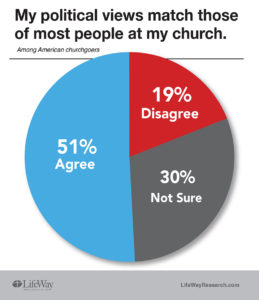 Churchgoers ages 35 to 49 (61 percent) are more likely to agree than those ages 50 to 64 (47 percent) or those 65 and older (44 percent). Men (58 percent) are more likely to agree than women (46 percent). Those who attend services at least once a week (52 percent) are more likely to agree than those who attend once or twice a month (43 percent).


 That principle has led to a career as a professor at Jerry Falwell’s Liberty University in Lynchburg, Va., and a writer of books—her latest is On Reading Well: Finding the Good Life through Great Books— and articles in publications like The Atlantic and the liberal website