Can the Ethics and Religious Liberty Commission survive?

(RNS)—During their annual meeting in Dallas next month, Southern Baptists will sing, bless missionaries, pass a budget, listen to sermons and engage in lively debate about a host of issues.

Among those issues: what to do with the Southern Baptist Convention’s Ethics and Religious Liberty Commission.

For nearly a decade, the ERLC has been a source of controversy as the SBC has navigated the cultural and political divides of the Trump era.

While Southern Baptists, like many evangelicals, have been strong supporters of President Donald Trump in the voting booth, some of the president’s policy decisions and personal conduct have clashed with Baptist ethics and beliefs.

That’s left the ERLC, which speaks to ethical issues and public policy debates, occasionally at odds with the denomination’s 12.7 million members, leading to three attempts to disband or defund the agency over the past decade.

President says ERLC fate not up to him
Pastor Clint Pressley stands for a portrait in his office at Hickory Grove Baptist Church in Charlotte, N.C.(RNS photos/Yonat Shimron)

Clint Pressley, president of the Southern Baptist Convention, said he has spoken to a number of Southern Baptists about the ERLC—including Pastor Jack Graham of Prestonwood Baptist Church in Plano, a past critic of the agency.

Some like what the agency is doing, he said. Others don’t.

While he suspects there will be a motion to close the agency at the denomination’s annual meeting in June, Pressley said the future of the ERLC is not up to him. Even if he had concerns about it, he has no power to make a decision. Instead, that power rests with church representatives known as messengers.

“I think those concerns about the ERLC will be answered by the messengers,” said Pressley, pastor of Hickory Grove Baptist Church in Charlotte, N.C. “I can’t do anything about the ERLC.”

Pressley added that his role as chair of the SBC’s annual meeting means he cannot take sides in any debate over the ERLC.

Online dialogue about ERLC heats up

In recent months, both the ERLC and its critics have engaged in an online public relations war over the agency’s reputation and future.

The Center for Baptist Leadership, a startup activist group with ties to American Reformer magazine, has run a series of articles, podcast episodes and social media posts critical of the ERLC, primarily for its stances on immigration reform and lack of close ties to the Trump administration.

The ERLC has promoted its ties to House Speaker Mike Johnson, a former ERLC trustee, and its support for defunding Planned Parenthood, as well as its opposition to gender-affirming care for minors and “radical gender ideology.”

“The ERLC team has been diligently working to advocate for Southern Baptist beliefs in the public square while also providing meaningful resources that help our churches navigate today’s cultural challenges and gospel opportunities,” Scott Foshie, chair of the ERLC’s trustees, told RNS in an email.

“Southern Baptists have supported an ethics and public policy entity for over a hundred years. We need an effective, responsive ERLC now more than ever.”

Discontent dates back several years

Discontent with the ERLC has been festering for years—and much of it dates back to the tenure of former ERLC President Russell Moore, who led the agency from 2013 to 2021.

A popular figure at first, Moore faced intense backlash from Trump allies such as Graham, a former SBC president and megachurch pastor, when he refused to back Trump’s first run for presidency and criticized him instead.

In 2017, Prestonwood and about 100 other churches withheld their donations to the SBC’s Cooperative Program in protest of Moore’s action. A pair of leaders of the SBC’s Executive Committee also clashed with Moore over his criticism of Trump.

While Moore resigned in 2021, tension over the ERLC has remained a constant in SBC life. The agency has also faced internal conflict. Last summer, a former ERLC chair announced the agency’s president, Brent Leatherwood, had been fired after a social media post praising then-President Joe Biden. The following day, that chair was ousted and the entity’s board announced Leatherwood was still on the job.

There have been three votes to defund or disband the ERLC since Trump took office the first time. All of them have failed, but between a quarter and a third of messengers at the 2024 annual meeting appeared to support closing the agency. The SBC’s rules require two votes in successive annual meetings to shut down an entity such as the ERLC.

Consider where ERLC fits into overall mission

Randy Davis, executive director of the Tennessee Mission Board, told Religion News Service in an interview he still believes the ERLC plays a helpful role for Southern Baptists. He said the ERLC, for example, had worked closely with Tennessee Baptists on issues such as sexuality and gender. Tennessee Baptists, like the ERLC, support a state law that bans gender transition surgery for minors.

Davis doesn’t think the convention floor is the best place to decide the future of the ERLC. Instead, he’d rather a commission be set up to discuss the SBC’s ministry as a whole—and where the ERLC fits into that mission.

“I think Southern Baptists would appreciate that kind of careful collaboration and consideration, rather than being divided on the floor of the convention,” he said.

The ERLC set up a church engagement office after the vote at the 2024 SBC meeting—and encouraged staff to abide by a set of guidelines in deciding what issues the entity should speak to.

“We have sent surveys requesting feedback, hosted pastor calls, led groups of pastors to meet with elected leaders in D.C., and intentionally attended events where pastors and other ministry leaders were gathered,” Miles Mullin, an ERLC vice president, said in an email.

Mohler has ‘grave doubts’ about ERLC usefulness

Al Mohler, a former ally of Moore and the ERLC and president of the SBC’s largest seminary, is now among those who have doubts about the entity’s future.

Mohler, a former “Never Trumper” turned supporter of the president, told a popular SBC podcast recently that he had “grave doubts” about the usefulness of the ERLC—and that having an entity that addresses controversial cultural issues is “a risky proposition.”

“Other entities and the churches themselves have grave doubts about the utility of the ERLC,” Mohler told the “Baptist 21” podcast last month. Mohler added as the head of an SBC entity, he could not lead any effort to disband the ERLC.

Pastor Andrew Hebert of Mobberly Baptist Church in Longview said he’d like to see the ERLC limit itself to speaking only about issues that are directly addressed in the denomination’s statement of faith—the 2000 Baptist Faith & Message—or in recent resolutions passed at the SBC’s annual meeting.

He outlined that proposal in a recent article on The Baptist Review, a website that discusses SBC issues and theology. Those boundaries, he said, could help the ERLC from stepping on land mines.

Hebert admits his solution isn’t perfect. For example, the SBC has passed a series of resolutions on immigration that call for both border security and humane treatment of immigrants—praising churches that assist immigrants and refugees—as well as calling for “a just and compassionate path to legal status.”

Yet the ERLC has been criticized for its involvement in immigration reform—as well as for refusing to back legislation that would jail women who choose abortions.

The ERLC will deal with some controversy, Hebert said. But he hopes for the most part, the ERLC will speak on issues where Southern Baptists have a “broad consensus.”

Something has to change for the ERLC to continue, he said.

“I think the writing is on the wall that there is a trust and credibility issue,” he said. “My motion is an attempt to provide a solution without defunding or disbanding the ERLC.”



Forced out at Myers Park, Boswell starts new church

CHARLOTTE, N.C. (RNS)—Nearly six months ago, Pastor Ben Boswell gave a sermon begging members of his Charlotte, N.C., church not to give up after Donald Trump’s election.

“We may not have been able to stop the darkness from coming,” he told members of his church on Nov. 10. “But that does not mean the fight is over. It has only just begun.”

Two weeks after giving that sermon, he was forced to resign as senior pastor of Myers Park Baptist Church. But just as he urged his flock not to give up the fight, he is now following his own advice.

On June 1, Boswell, 44, will give his first sermon at a new Baptist church he is founding with the support of dozens of his former members.

The logo for the new Collective Liberation Church features a butterfly breaking free of chains locked around its legs. Boswell promises in a promotional website video to build a church committed to “dismantl[ing] systems of oppression and creat[ing] justice, equity, and freedom for everybody—for all people.”
For Boswell, who has a 15-year-old adopted Black daughter, a big piece of that project is becoming anti-racist.

He is proud to advocate for diversity, equity and inclusion, even as the government has shut down DEI efforts in federal offices and pressured businesses and universities to do likewise. He stands for the rights of LGBTQ+ and Indigenous people. He wants expanded economic opportunities for the poor.

“I think the church needs to find itself in deeper and deeper solidarity with the people the empire is specifically targeting and harming: Palestinians, immigrants, transgender people, women in need of reproductive care, people of color,” he said. “I could just go on.”

The new church, with an inaugural service on June 1 on the campus of Union Presbyterian Seminary, is expected to bring together a mix of people.

Its newly appointed associate pastor, Rodney Sadler, a professor of Bible at Union Presbyterian Seminary and director of the seminary’s Center for Social Justice and Reconciliation, is Black.

“We are presenting a welcoming, inclusive, broad-based, justice-oriented, love-focused congregation at a time when our nation is going through intense division, divisiveness and fomenting hatred,” said Sadler. “We want to be a witness to a different way of being.”

Over the past nine years, Boswell led one of the city’s most progressive white churches. Myers Park Baptist, a tall steepled church, was an early leader in the city’s racial integration efforts. It split off from the Southern Baptist Convention in 1998 and has long been committed to LGBTQ+ inclusion.

Focused on racial justice at Myers Park

Boswell, who became senior pastor in 2015, dedicated his pastorate to racial justice and to increasing the church’s nonwhite ranks to about 20 percent.

The Sunday after Trump was first elected in 2016, Boswell invited prominent pastor and progressive activist William J. Barber II to preach a sermon on race.

During Boswell’s time at Myers Park, he developed an anti-racism training called “Confronting Whiteness,” also the name of his book and a conference. Some 1,000 people have participated in those conferences, and Boswell has trained 100 facilitators to continue the work.

Monica X. Thompson, a psychotherapist who moved from New York City to Charlotte two years ago, attended the Confronting Whiteness conference and within a week joined Myers Park Baptist.

“I was not a churchgoer at all,” Thompson said. “But I was really inspired by the work of the Confront Whiteness conference, and I was like, oh, so there’s a church that’s a part of it.”

Thompson has since quit Myers Park and is now on the leadership team of Collective Liberation Church. She said she was put off by the church’s decision to let Boswell go.

“Many times when people are going against systems of oppression, they tend to be removed forcefully outside of whatever system they’re working in, so it was really disheartening,” Thompson said.

Myers Park attendance declined significantly

Publicly, church leaders said Boswell’s removal had nothing to do with politics or his preaching. Two weeks after his passionate sermon decrying Trump’s election, and four days before Thanksgiving, the deacon board called a meeting over Zoom and voted to ask Boswell to resign.

In a recording of the meeting obtained by RNS, Chairwoman Marcy McClanahan defined the problem as declining membership and revenues. Attendance at Myers Park had shrunk to 150 from a high of 350 before Boswell arrived, she said. She was also hearing dissatisfaction from church staff about his leadership.

But another deacon hinted at an underlying problem with Boswell’s preaching.

On the recording, Robert Dulin is heard saying: “A lot of these people left the church … in the last few years. If any of you talked to them, you heard the same thing over and over again: I’m tired of being indicted because I’m white. I’m tired of being banged over the head every week about immigrants and LGBTQ, and I just want to come to church and be encouraged. … I think what we need is 80 percent comfort and 20 percent social justice.”

The vote to ask for Boswell’s resignation was 17-3.

‘More than enough work for all of us’

Tim Emry, one of the three dissenting deacons who has since resigned to join Collective Liberation, said the older deacons were increasingly feeling uncomfortable with Boswell’s critique of whiteness.

“They didn’t want to transform the core of the church because they believed they are liberal and progressive and accepting of all. So why do we need to change?” said Emry, a white man married to a Black woman.

“We’re the good white people, right? We want different people to come in, but we want them to learn how to do it our way.”

Boswell, a graduate of Duke Divinity School and St. Paul School of Theology, said he never imagined starting a new church. But people around him gradually convinced him he should try.

Six months after his firing, his old church supports his efforts.

“We wish him success on his new endeavor as I’m sure he wishes us continued success in our efforts,” wrote Scott Crowder, the new deacon board chair, in an email. “There are many ways to fight injustice and help underserved and overlooked communities—there is more than enough work for all of us!”

The first service for Collective Liberation will be in the afternoon, at 4 p.m., so as not to conflict with those attending morning church services elsewhere but still interested in checking out the new church.

The congregation will be affiliated with both the American Baptist Church, a historically Black denomination, and with the Alliance of Baptists, a small progressive denomination of about 140 congregations.

But as much as Boswell wants to be strategic and accommodating in shaping his new church, he is clear that he will not deviate from his critique of what he calls “American Empire.”

“A lot of folks will imagine you only say what the congregation has ears to hear,” Boswell said. “I have come from a different way of thinking.”

Instead of compartmentalizing social justice as just one of many offerings within the church, he wants to make it the heart and soul.

“When we compartmentalize (social justice), we kind of make it into the stepchild or the forgotten part of what it means to follow Jesus, when actually it’s the core of what it means. Justice is primary. If any of those other things take the place of justice, we’ve lost the gospel.”


Around the State: Texas Baptist students graduate

Houston Christian University held its 2025 spring commencement ceremonies May 10, marking the 59th year degrees have been awarded to graduating students. The university presented diplomas to 484 graduates, bringing the number of students who have received degrees from HCU since the institution’s first commencement in 1967 to a total of 27,391 graduates. The graduates included the first class of graduates from HCU’s Houston Theological Seminary Doctor of Ministry programs in New Testament and in Faith and Culture.

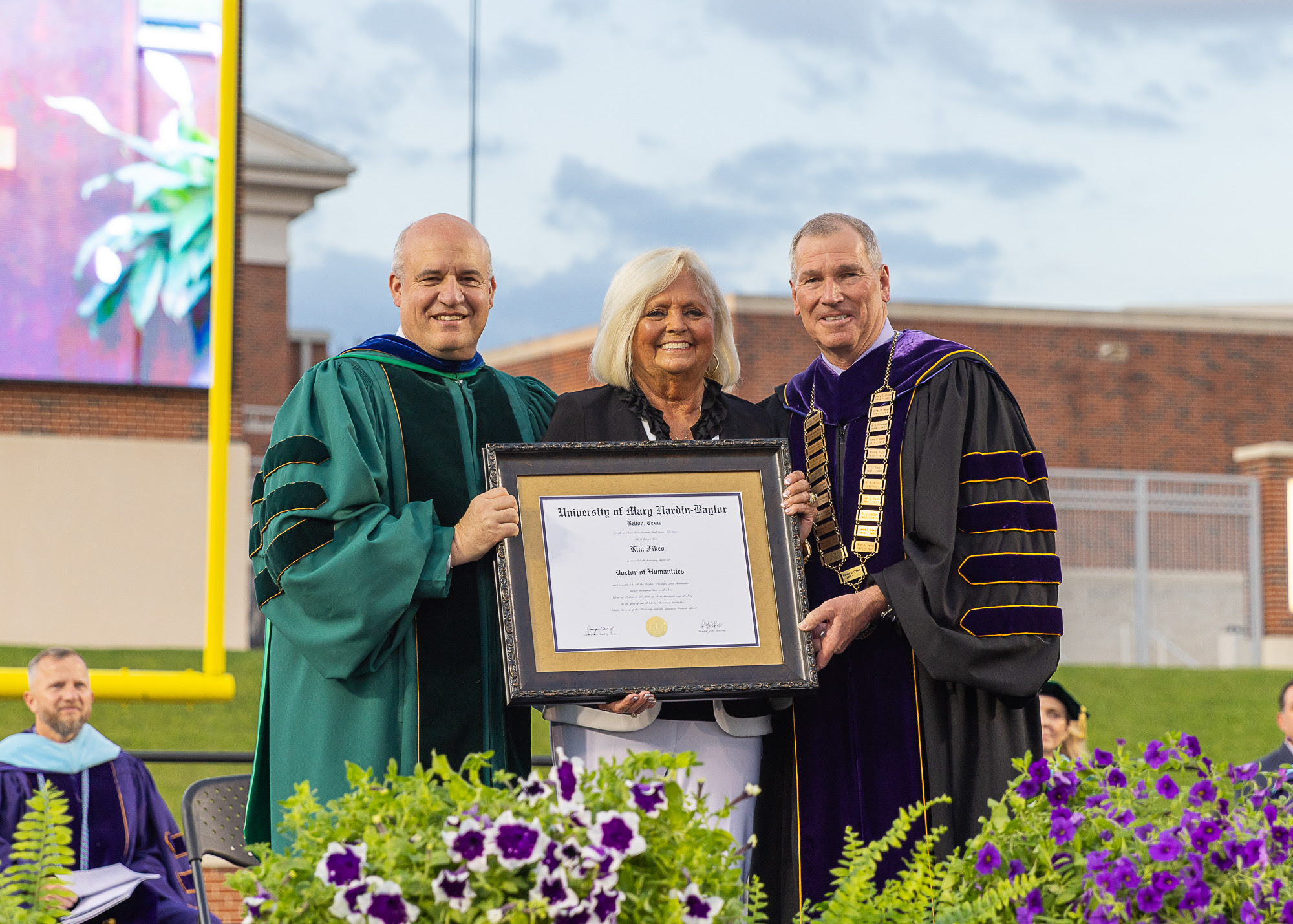
During UMHB commencement, Kim Fikes was awarded the Honorary Doctorate of Humanities degree. (UMHB Photo)

The University of Mary Hardin-Baylor held commencement services for the spring 2025 semester at Crusader Stadium. During the ceremony, Kim Fikes was awarded the Honorary Doctorate of Humanities degree, the highest award the university can present to someone. Over the years, she and her late husband, James Fikes grew the family filling station business to more than 200 CEFCO convenience stores in four states and expanded from 12 to over 3,500 employees. Many in the UMHB community have benefited from the Fikes’ generosity. This was the university’s 169th graduating class, and an estimated 537 students were awarded degrees—including 401 baccalaureate degrees, 130 master’s degrees and six doctoral degrees. Three commissioning officers also participated in the graduation ceremony—Reagan Baker of McKinney, Gabriel Feliciano of Belton, and Maximilian Noriega of Belton. Will Kalfayan of Georgetown read the Scripture.

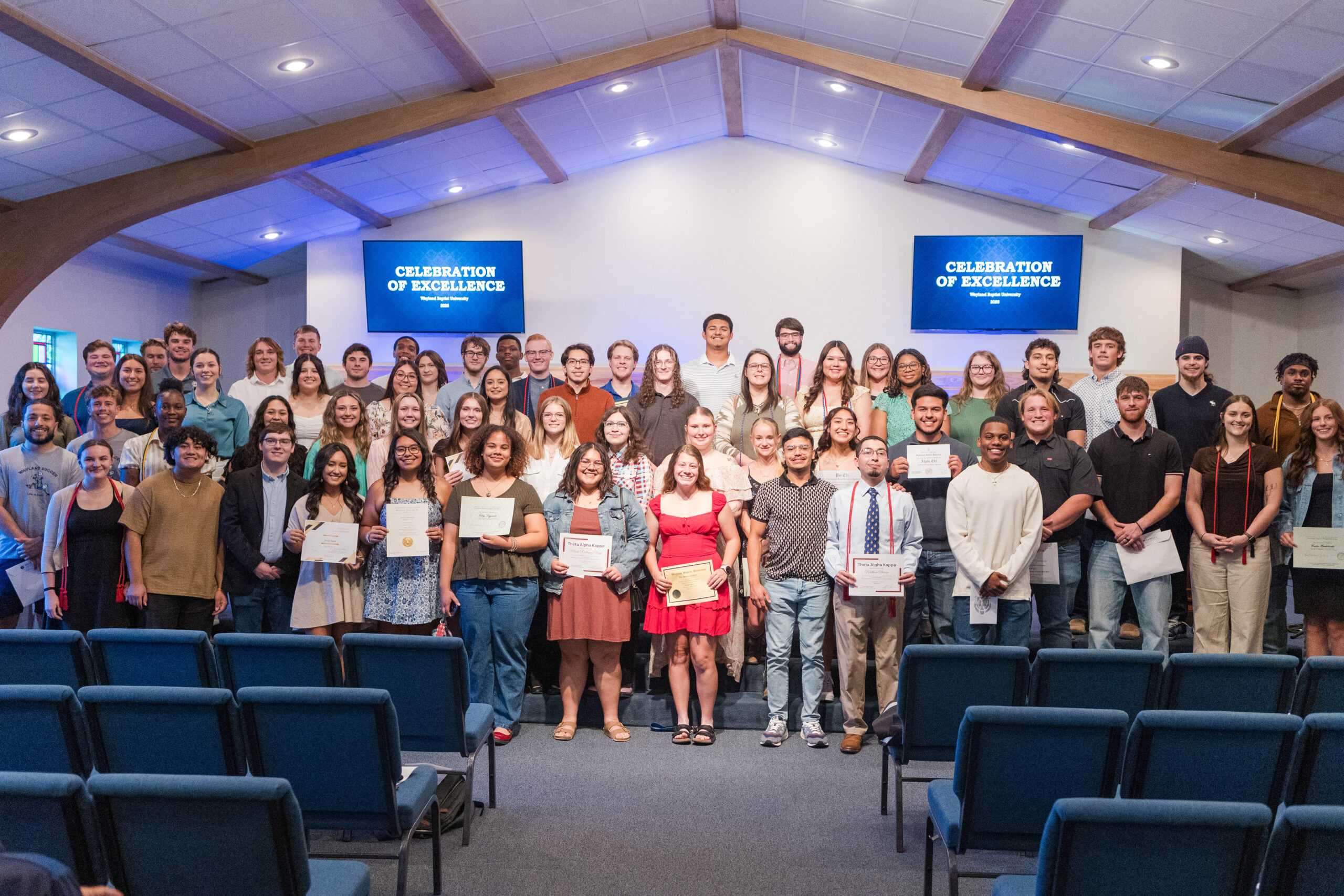
Wayland Baptist University honored its top academic students May 1, during the annual Celebration of Excellence ceremony. (Wayland Photo)

Wayland Baptist University honored its top academic students May 1, during the annual Celebration of Excellence ceremony. The ceremony recognized current members and graduating seniors in Wayland’s Honors Program, special scholar cohorts and students inducted into academic honor societies. The 2024-2025 Honors Program members are Marissa Armendariz, Elizabeth Berry, Koda Bigham, John Bray, Gabriella Chappa, Trinity Davis, Garrett DeYong, Noah Dyson, Arturo Flores, Narriah Gomez, Tyler Hartgrove, Kyson Hensarling, Seth Hernandez, Peyton North, Jazmin Ortega, Juanita Pardo, Anna Perez, Ariana Sanders, Mikayla Shires and Lily Taylor. Students in two distinguished scholar cohorts also were recognized, as were students inducted into or graduating from several academic honor societies.

HPU graduates proceed through the Wilson Gate as a part of HPU’s Chime Out tradition. (HPU Photo)

Howard Payne University hosted commencement ceremonies and additional events on May 9 and 10 to celebrate graduates from August 2024, December 2024 and May 2025. HPU alumnus Tim Viertel, author and retired U.S. Secret Service deputy assistant director, addressed the graduates during two ceremonies on May 10. “Go out and do something significant, something extraordinary that only you are gifted to do,” Viertel urged. “Then, use the platform that God has given you to do something lasting, something of eternal significance.” Additionally, HPU held Chime Out on May 9, a tradition dating back to 1957. In the ceremony, graduates pass a chain of ivy to underclassmen walking partners as a symbol of the passing of authority, responsibility and privileges to those students who remain at HPU. Alli Harvey, a senior jurisprudence and Honors Academy major, gave a charge to the juniors. Diondray Parker, a junior youth ministry and kinesiology major, accepted the charge on behalf of the Junior Class. The ceremony concluded with the graduates walking through the Wilson Gate, symbolizing their send off from HPU to make a Kingdom-impact in the world.

Stark College & Seminary invites the community to celebrate its spring graduation ceremony May 16 at 7 p.m. at First Baptist Church in Corpus Christi. The evening will honor more than 60 graduates from Stark’s undergraduate and graduate programs, each trained and equipped to serve faithfully in their churches and communities. The celebration also will include a recognition of Dana Moore, pastor of Second Baptist Church in Corpus Christi, who will be honored as Faculty of the Year for his faithful service.

East Texas Baptist University presented 218 graduates with degrees during its commencement ceremony on May 10. (ETBU Photo)

East Texas Baptist University presented 218 graduates with degrees during its commencement ceremonies on May 10. During the ceremonies, 189 students received undergraduate degrees, and 29 received graduate degrees. The worship ceremony featured Scripture readings, praise and worship through song, prayers and blessings over the graduates. During the first ceremony, Warren Johnson, professor of Christian ministry, delivered the keynote address. Each semester, ETBU presents the President’s Award to a graduate who represents a Christian leader, scholar and servant within the campus and the local community. Mary Frances Ellis from Elysian Fields, who graduated Summa Cum Laude with a Bachelor of Business Administration in accounting and finance, was named this semester’s recipient.

Following the symposium, students gathered for a ceremonial planting of three fig trees in the newly designed Pool of Bethesda Prayer Garden. (DBU Photo)

Dallas Baptist University students showed commitment to environmental stewardship during the second annual Creation Care/Green Faith Symposium and Tree Planting Ceremony, held in celebration of Earth Day. The event featured a panel discussion exploring the intersection of faith and environmental responsibility. Panelists included: Jim Lemons, moderator and professor of theological studies and leadership; Mark Bloom, professor of biology; Debra Hinson, professor of biology; Rob Lewis, assistant vice president for administrative affairs; Jack Sezer, recent DBU graduate and creation care advocate. The panel addressed key topics surrounding creation care from theological and scientific perspectives, inspiring attendees to consider how faith can inform sustainable living. Following the symposium, students gathered for a ceremonial planting of three fig trees in the newly designed Pool of Bethesda Prayer Garden. The day concluded with a time of reflection and worship.

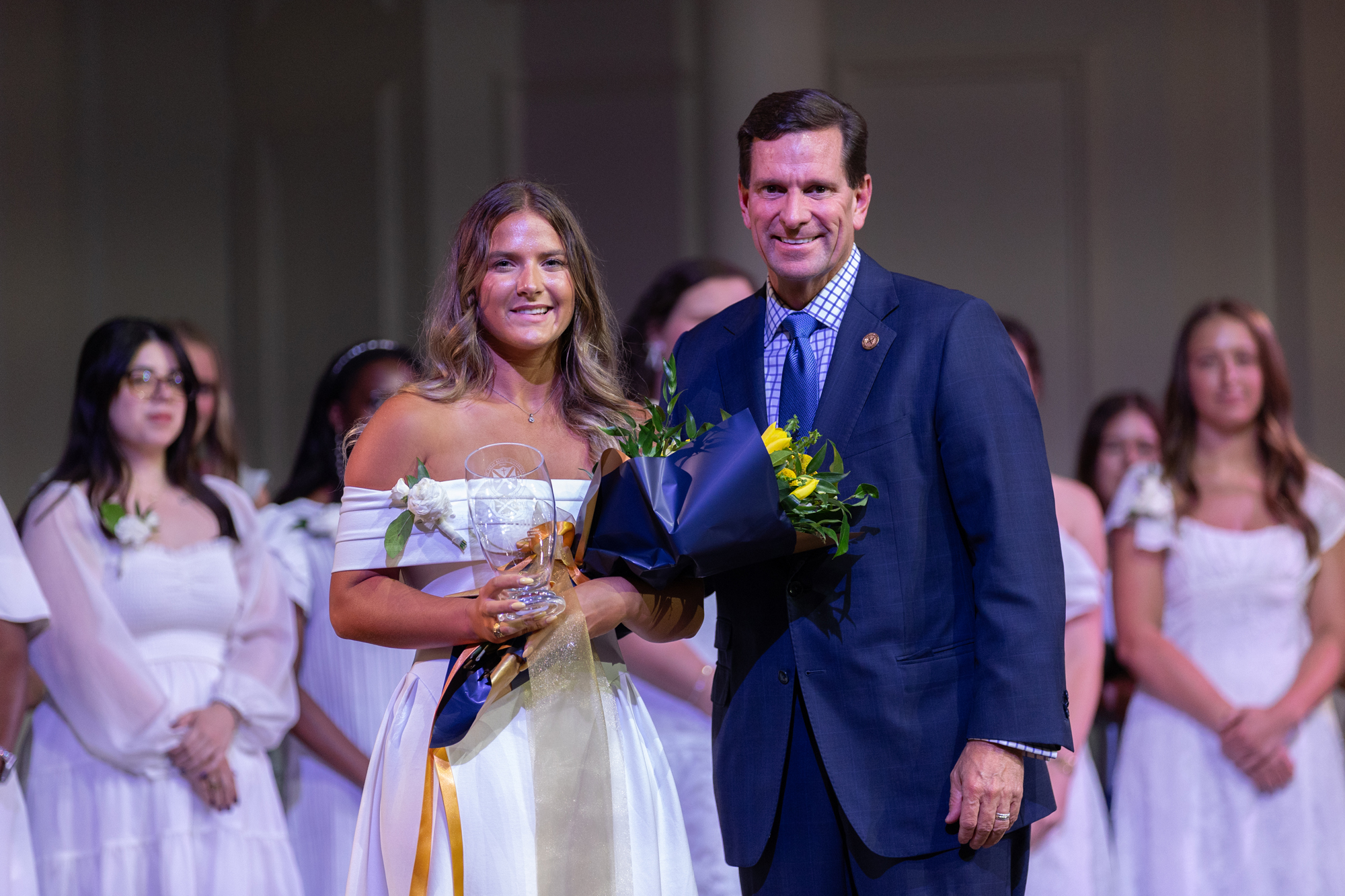
Bailee Kitchen, pictured with ETBU President J. Blair Blackburn, was recognized on April 30, during ETBU’s 78th annual Senior Girl Call-Out. (ETBU Photo)

Bailee Kitchen of Clovis, Calif., was recognized April 30, during East Texas Baptist University’s 78th annual Senior Girl Call-Out. Selected by a faculty and staff vote, the senior student “called out” each year is distinguished for her exemplary Christian character, social consciousness, personal poise, academic achievement and spiritual vision. Kitchen, a Christian Ministry major, has poured into the East Texas Baptist University community through her extensive campus involvement. During her time at ETBU, Kitchen has been recognized for both academic and spiritual leadership. A member of Macedonia Baptist Church in Marshall, Kitchen helps lead the children’s ministry and teaches a class for first through fourth graders. Following graduation, she will marry David Clair in June and continue serving at Macedonia Baptist while pursuing a Master of Divinity through B.H. Carroll Theological Seminary at ETBU.

Campers making a team flag during Camp Fusion, July 2024. (Camp Fusion courtesy photo)

BGCT Intercultural Ministries announced registration is now open for Camp Fusion 2025, to be held July 22-26 at Latham Springs Camp & Retreat Center in Aquilla. Camp Fusion offers spiritual formation and leadership experience for intercultural students—primarily from Asian and African Texas Baptist churches, though Brazilian Baptist students from Plano have joined in recent years. For questions about financial assistance, registration, schedules and programs, please click here. Registration closes June 30th.

Hardin-Simmons University’s Master of Physician Assistant program is partnering with Communities in Schools of the Big Country and Abilene Independent School District’s Clack Middle School to offer free physicals to more than 170 students this May. The initiative brought 70 girls on May 13 and will bring 100 boys on May 16 to the HSU campus to receive free physicals conducted by certified PA providers with support from HSU PA students and campus tours. The PA students, currently in their didactic training phase, are required to complete 50 hours of community service prior to graduation. HSU’s PA program—currently the smallest in Texas—recently was named one of the top 100 PA programs in the country by U.S. News & World Report. The program also leads both international and domestic medical mission trips, including partnerships with the disability ministry Joni & Friends.

In late April, Baylor University sent student missionaries off with a special short-term mission trip commissioning ceremony. (Baylor Photo)

Every summer, Baylor University students head out on mission trips around the world, putting what they’ve learned in the classroom to use serving others. In late April, Baylor sent these students off with a special student mission trip commissioning ceremony. Following the disciples’ example, Baylor representatives gathered to send the short-term missionaries off with prayer and encouragement (plus some treats to sweeten the celebration). Facilitated by Baylor Missions, Service and Public Life, as well as local churches and organizations, students with Baylor connections will demonstrate God’s love this summer on a dozen trips to places like Costa Rica, the Dominican Republic and South Africa, in areas ranging from nursing to business to sports ministry. Last summer, Baylor became a full member partner in the Baptist World Alliance, which uses the month of May to celebrate missions and evangelism. Baylor is identifying how missions, academic and other relationships can be strengthened across the globe through BWA membership.

Registration for the 2025 HPU Summer and Young Scholars program is now open. (HPU Photo)

Howard Payne University’s Summer and Young Scholars annual academic summer camp for elementary age students is scheduled July 14-18, from 9 a.m. to 12 p.m. on the HPU campus. The registration fee for the program is $165 and includes tuition, a t-shirt, promotional items, daily snacks and supplies. T-shirts are only guaranteed to those who pre-register by June 27. The deadline for late registration is July 5. The Summer and Young Scholars week-long day camp programs are designed to provide intense, fun and academically stimulating camp programming for children entering grades K-6. The theme for this year’s programming is Camp Curiosity. Students in grades 1-3 will experience a rotation of classes in math, science, art and physical education. Students entering grades 4-6 will engage in STEM classes and physical education. Registration is online at www.hputx.edu/summerandyoungscholars.

Michael E. Young, professor of psychological sciences, graduate program director and former Graduate School faculty associate at Kansas State University, has been selected as vice provost and dean of the Baylor University Graduate School, effective Aug. 1. Young will lead the Baylor Graduate School’s student experience at the Christian Research 1 university while providing leadership and advancing the priorities of the Baylor in Deeds strategic plan. He also will contribute to national conversations around graduate education and research and collaborate with deans and the Office of Graduate Professional Education to enhance Baylor’s traditional (on-campus), online and hybrid professional programs. Young will succeed Larry Lyon, who will retire Aug. 1 after serving 27 years as vice provost and dean of the Graduate School and 50 years overall on the Baylor faculty.

Literacy ConneXus announced a new teaching manual release—Teaching English ConneXus ESL Training Manual: Equipping Churches to Love Their Neighbors Through English Ministry. (Courtesy Photo)

Literacy ConneXus announced a new teaching manual release—Teaching English ConneXus ESL Training Manual: Equipping Churches to Love Their Neighbors Through English Ministry. For two decades, Literacy ConneXus has empowered Texas Baptist churches and other faith-based organizations to meet literacy needs in their communities through practical, Christ-centered outreach. Hundreds of congregations across Texas serve through English language learning, family literacy and adult basic education. One of the organization’s most effective tools is Teaching English ConneXus—a training program designed especially for churches who want to start or strengthen an English as a Second Language ministry. During the COVID-19 pandemic, Literacy ConneXus revised and rebuilt the training to be fully online. Then, they adjusted to a hybrid format—combining online modules with engaging, in-person workshops. The new Teaching English ConneXus ESL Training Manual reflects the update and offers practical, research-informed strategies for ESL instruction; step-by-step guidance for starting or improving an ESL ministry; and reproducible handouts and classroom-ready activities designed for churches. The new manual is available in print through Amazon at https://a.co/d/8VvLuzo. Order a copy or contact the team for upcoming training opportunities.


U.S. the outlier in biblical reverence in ‘secular west’

PHILADELPHIA (BP)—From a global vantage point unique to its study of the Bible’s impact on U.S. adults, the American Bible Society said Americans revere Scripture, faith and church more than others in a geographical cluster described as the “Secular West.”

The United States, Canada, Western Europe, Australia and New Zealand are included in the secular west cluster.

The American Bible Society said only 37 percent of secular west residents say the Bible is personally relevant. The United States is the outlier, with 51 percent of adults affirming Scripture’s relevance to them personally.

This mirrors a Lifeway Research study released May 13 showing 51 percent of American adults have read at least half of the Bible.

The American Bible Society includes the findings in the second chapter of its 15th annual State of the Bible, relying on data from the 2025 Patmos World Bible Attitudes Survey, with permission, with Gallup as the source research agency.

“These insights, made possible by invaluable contributions and expertise among our partner organizations, give us an unprecedented view of worldwide attitudes toward and engagement with the Bible,” said John Plake, chief innovation officer at the American Bible Society and State of the Bible series editor.

“This study helps us see where God’s word is spreading and his church is growing. We also see vast opportunities to share his word with the world.”

The American Bible Society draws on its membership in United Bible Societies, a fellowship active in more than 240 nations, in releasing the data.

In partnership with the British and Foreign Bible Society, the United Bible Societies and Gallup, the Patmos World Bible Attitudes Survey polled 91,000 people in 85 countries on Bible attitudes and practices.

The initiative draws from John’s letters to the seven churches in Asia Minor as recorded in Revelation, identifying seven geographical clusters and putting the United States in the fifth cluster described as the secular west.

Americans view Bible more favorably

In the secular west, the vast majority of adults do not find the Bible personally relevant, researchers said. Only 40 percent of residents in the cluster said religion is an important part of their daily life, compared to 69 percent of the global population.

But also in the secular west, Americans outpace other nations in key areas of biblical engagement, and judge the Bible more favorably.


While an average of 18 percent of adults in the cluster use the Bible “a few times a week or more,” 28 percent of Americans do so, compared to 18 percent of the Irish, the nearest ranking country in the cluster, and 8 percent of the French, the lowest use found.

While an average of 19 percent in the secular west attend church at least weekly, 28 percent in the United States do so, followed by 26 percent of Irish and 21 percent of Italians, with the lowest weekly attendance, 10 percent, found in France.

More than half of Americans, 53 percent, said religion is an important part of their daily lives, outpacing the average of 40 percent in the cluster who said so. Comparatively, 50 percent of Italians also said so, with Norwegians least often saying so at 17 percent.

When asked whether “It’s difficult to trust the Bible because it clashes with the scientific worldview,” the United States was the only nation with more respondents who said, “It’s not difficult to trust the Bible,” the American Bible Society noted.

“The U.S. is the only nation in this group with more disagreement (41 percent) than agreement (31 percent)—more who say it’s not difficult to trust the Bible,” researchers wrote. “The level of ‘strong’ disagreement in the U.S. (23 percent) more than doubles that of nearly every other nation in the cluster.”

Still, some U.S. responses varied.

When an average of 48 percent of respondents in the cluster disagreed or strongly disagreed that the Bible is a source of harm in the world, 55 percent of Americans said the same, outpaced by 65 percent of Italians.

And while 23 percent of Americans said the Bible is indeed a source of harm in the world—outpacing the secular west average of 22 percent—only 12 percent of Italians said so.

Other clusters in the Patmos Initiative are:

  • The “Majority Muslim” cluster 1, West Africa, Chad, Sudan, Pakistan and Afghanistan.
  • The “Majority Christian” cluster 2, Russia, Eastern Europe and Portugal, citing a historical connection to Orthodox Christianity.
  • The “Majority Muslim” cluster 3, North Africa, Middle East, Turkey and Central Asia.
  • The “Majority Christian” cluster 4, Latin America, Caribbean, Philippines.
  • The “Religiously Diverse” cluster 6, India, China, Indonesia, Japan.
  • The “Majority Christian” cluster 7, Sub-Saharan Africa.

Fieldwork details for all countries can be found in the methodology chapter of The Patmos Survey report, available here.

The American Bible Society will release additional chapters of the State of the Bible monthly through December, focusing on trust, flourishing, identity and church and Bible engagement.


Constance “Connie” Gayle Billinger Davis

Constance “Connie” Gayle Billinger Davis of Abilene, teacher and social worker, died May 8. She was 70. She was born in Darnall Army Hospital at Fort Hood on Dec. 20, 1954. After she graduated from Killeen High School, she went on to Baylor University in Waco, graduating in 1975 with a degree in psychology. She married John Norman Davis on April 24, 1976, in Killeen. She later completed a master’s degree in education from Southwest Texas State University and a master’s degree in counseling from East Texas State University. She spent much of her adult life as an advocate for women and children in her various professional positions. She was named director of the newly rejuvenated YWCA in Paris, and she instituted many programs there, including girls’ softball and other girls’ sports and rebuilt an annual art fair that brought talent and visitors to the Northeast Texas town. While in Paris, she began working for Texas Child Protective Services, working her way up to supervisor and program director in Lubbock, and capping her 25-plus year career as program administrator in Abilene. She considered her work with and for children to be a calling from God. She was preceded in death by her father, Major (Ret.) Elmer Billinger. She is survived by her husband, Lieutenant Colonel (Ret.) John N. Davis of Hardin-Simmons University; son Jeffrey Davis and his wife Morgan; daughter Sara Klooster and her husband Andrew; five grandchildren; brother Jeffrey Billinger; sister Kathy Renz; and mother Vera Billinger. A funeral service will be held at 11 a.m. on May 16 at Pioneer Drive Baptist Church in Abilene. Memorials may be given to the Foster Care and Adoption Ministry at Pioneer Drive Baptist Church.


Senate bill introduced to move lottery administration

The Texas lawmaker who authored a bill to abolish the Texas Lottery filed alternative legislation May 13 that would dissolve the Texas Lottery Commission and move regulation of the lottery to another state agency.

 “If there isn’t enough of an appetite to get rid of the lottery outright, then this bill represents the next best thing,” Sen. Bob Hall, R-Edgewood, said as he presented SB 3070 in a Senate Committee on State Affairs hearing, where the bill was left pending.

Hall briefly reiterated ways key leaders of the Texas Lottery Commission failed to abide by state laws.

“You already understand the Lottery Commission’s long list of wrongful and illegal acts,” Hall told members of Senate Committee on State Affairs.

“The Lottery Commission changed its administrative rules to help criminals rig the lottery. Most of these changes were made in direct contradiction to existing law.”

Give TDLR authority to oversee the lottery

The Texas Lottery Commission needs to be abolished, Hall insisted.

His new bill, SB 3070, would dissolve the Texas Lottery Commission and transfer the administration of the lottery—as well as licensing and regulation of charitable bingo—to the Texas Department of Licensing and Regulation.

The bill mandates a limited-scope Sunset Advisory Commission review of the state lottery during the next fiscal biennium, ending Aug. 21, 2027. Unless the lottery is continued at that time, it will be abolished Sept. 1, 2027.

SB 3070 places limits on the number of lottery tickets a retailer may sell to one individual in a single transaction and prohibits the purchase of lottery tickets by phone or through the internet. It also establishes a lottery advisory committee and limits the number of ticket-printing lottery terminals any given licensed retailer can have.

The bill also encompasses provisions in SB 28, a bill Hall introduced early in the legislative session, which bans lottery couriers—third-party vendors who enable buyers to purchase lottery tickets through their websites or mobile apps. The Senate unanimously passed SB 28—a priority bill of Lt. Gov. Dan Patrick—in February.

SB 3070 also establishes a department of security within Texas’ Financial Crimes and Intelligence Center to identify and respond to criminal activities associated with the lottery and charitable bingo.

Further reforms to be introduced

As he laid out SB 3070, Hall mentioned several amendments that will be introduced once the bill reaches the Senate floor.

They would increase criminal penalties for illegal ticket sales; restrict where tickets can be purchased; require individuals—not businesses or limited liability corporations—to cash in winning tickets; and deputize the governor, lieutenant governor, attorney general and speaker of the House of Representatives as authorized inspectors for the lottery.

Rob Kohler, consultant with Texas Baptists’ Christian Life Commission, testified in support of SB 3070.

In a phone interview, Kohler identified SB 3070 as “another option” lawmakers have in this session to prevent the kind of abuses that have occurred under the Texas Lottery Commission in recent years.

“The fact that SB 3070 was introduced and scheduled for hearing the same day indicates there is momentum behind it,” he observed.

If the lottery does continue to operate under the administration of the Texas Department of Licensing and Regulation, it will “be under a bright light for the next two years,” Kohler said.

“Legislators are taking seriously a lot of the concerns that have been raised by the CLC for years,” he said.


Podcast reflects on the first 100 days of Trump

Good Faith podcast host Curtis Chang recently sat down with New York Times columnist David French and Russell Moore, editor in chief of Christianity Today, for a Zoom discussion about the first 100 days of President Trump’s second term.

Chang approached the conversation by having each panelist reflect on how his impressions have changed since Trump won his reelection bid. He played clips showing each panelist’s initial reactions to Trump’s reelection from a prior podcast on November 6.

Moore and French both reported feeling exhausted last November.

With Trump’s reelection, Moore said, he knew there was going to be a lot of drama—“drama that is going to be, you know, in every American’s life, all the time from now on.” And, he said he thinks actually, “a lot of people like that.”

But he felt reassured, because Americans had been intentional about who they elected. No one had been “hoodwinked,” and Moore said that was reassuring to him, because people “know the drama they’re signing up for.”

In November, he saw the challenge as being how to navigate the drama, spiritually, without being completely “driven down by it,” regardless of political persuasion.

Chang noted Moore seemed to be right about people being exhausted by the drama, citing recent polls that show 1 in 4 Trump voters now disapproves of the job Trump is doing.

But Moore said he’s less exhausted now than he was in November, because he’s developed a kind of “carbon monoxide detector” to help navigate the exhaustion.

Moore noted he discovered less time on social media resulted in him feeling “much less anxious and much less angry,” an anger he explained was rooted in “the fact that nobody seems to be angry or concerned about what is quite obviously … a crazy time in the country.”

But limiting how much social media he consumes has helped with those feelings, Moore explained.

On November 6, French noted a similar exhaustion after the election and wondered what that exhaustion “should lead us to do.”

Defend vulnerable people and tell the truth

French noted those like himself, who have the resources to weather the effects of the current political situation in the United States, still have a responsibility to “defend the vulnerable and speak the truth.”

“If we give in to despair,” French noted, “that’s going to lead us to retreat into our own sort of cocoon, our own bubble, right? So, we have to lean out of that and into the defense of people.”

French also said in November that even if one isn’t a lawyer or legislator, individuals can “stand up for the dignity, for the humanity of vulnerable people.”

Chang asked French to explain what he’d “seen done to truth and to the vulnerable” in the first 100 days of this Trump administration.

French said with a history of covering President Trump through the years, he “knew truth and defending the vulnerable would be a salient aspect of responding to these times.”

But he noted, “I had no idea how quickly and how dramatically we would reach a point” of vulnerable people being exploited and where the “truth was being destroyed.”

French emphasized he was “not new here,” and acknowledged from his time around Trump and the Trump movement for the past nine years, he “knew this was a movement that lies as easily as it breathes.”

He said he also knew to expect a major effort “toward mass deportations.”

“I had an intellectual knowledge that you would have dishonesty,” and that vulnerable populations would be attacked, he said.

“But I had no idea how comprehensively you would see an attack on the truth” and on the vulnerable, French said.

He noted another thing he “absolutely did not expect at all was how many powerful institutions would completely, not just abandon the field, but essentially just yield to Trump.”

In Trump’s first term, he’d taken comfort in many pieces of civil society—including resistance from within the Republican party and the administration and opposition from Democrats—who figuratively would “throw their body” in front of some of the worst actions Trump attempted.

But “by and large” this time the president is not surrounded by wise counselors and advisers, but by “enablers,” French said.

So, while the “attack on the vulnerable was so immediate and so dramatic, it is the breakdown of civil society, in response” and the lineup of billionaires at the inauguration and the oligarchy on display there that really surprised French, he noted.

He hasn’t been especially surprised by Trump’s behavior, French said, because “Trump is Trump.”

However, he has been surprised and alarmed by the response to Trump’s demands by some of the most powerful people and institutions in the United States.

French said the spectacle of wealthy, powerful law firms and institutions “tripping all over themselves to give into” Trump’s demands, even unlawful ones, was “staggering to [him].”

“They’re acting as if they hold no cards. They’re acting as if Trump can control them at a whim, and that’s just absolutely not the case. It’s shocking to me,” he observed.

Turning towards Ukraine

Chang’s November comments related to going into “avoidance mode.” He said the election was a “disaster for our country,” but a boon to his “to-do list.”

But after he stopped throwing himself into being busy, he realized what he was feeling about the election was anger, wanting to blame someone, sadness and even anguish—especially for immigrants, the vulnerable and the people of Ukraine.

So, he turned the conversation to what has happened in the Russian war against Ukraine in the first 100 days of President Trump’s second administration. He asked French to weigh in on Ukraine.

French said, again, he was aware of Trump’s history of disliking Ukraine before he returned to office, and was “extremely pessimistic” about how Trump would treat Ukraine in this term.

He noted for some extreme factions of MAGA, Vladimir Putin is a “hero” whom they admire as an example of strong Christian nationalism in opposition to the “woke, weak West.”

French also pointed out some conspiracy-minded MAGA diehards blame Ukraine for impeachment investigations into Trump and Russia after 2016 and consider Ukraine a “villain.”

But when “negotiations” got underway, he didn’t expect Trump to “lean entirely on Ukraine” with “Putin’s demands, in essence,” and on American allies to support Ukraine less, French noted.

And at first, he didn’t see the “trade war” with the United States’ closest allies for what it actually is. It’s not just isolationism, French asserted.

Trump sees things in terms of influence spheres, and Trump sees Ukraine as within Putin’s “sphere of influence,” French explained. The responsibility of the smaller country, in Trump’s estimation, is to “yield to the bigger country.”

“That’s what he’s demanding of Canada, Denmark and Mexico,” he said.

And he noted, this is Zelensky’s offense to Trump and a “very Putinesque” way of seeing things—which helps make sense of America “essentially switching sides in the conflict.”

In November, French only anticipated a “worst case scenario” of some sort of neutrality that benefitted Russia, “but we’ve seen something beyond that … a switching of teams.”

And it’s such an emergency in the “geopolitics of the moment” and “in the history of the world,” European countries are reacting dramatically to the shift, French said. This “shaking at the core of our alliances” can’t easily be undone.

Chang asked Moore how to listen to the dark observations from French and “maintain your carbon monoxide detector” for managing anxiety.

Moore said when people “feel powerless” about specific aspects of what’s happening—such as concern for Ukrainian churches being bombed by Russia or people being laid off by DOGE cuts—they want to do something, but don’t know what they can do.

Moore said sometimes the answer to managing anxiety is to “embrace the broken heartedness.”

Chang agreed, noting “grief” may be a necessary step to navigating the unclear path forward from here.

The full podcast can be watched here.


Former Southern Baptist Josh Buice quits G3 Conference

(RNS)—An influential Calvinist pastor who quit the Southern Baptist Convention after claiming it was too woke and liberal has been suspended by his church for causing controversy online, running fake social media accounts that criticized his church’s elders and other pastors from a conference he ran.

Josh Buice, founder of the G3 Conference and pastor of Pray’s Mill Baptist Church in Douglasville, Ga., was placed on indefinite leave last week after church leaders “uncovered irrefutable evidence that Dr. Buice has, for the past three years, operated at least four anonymous social media accounts, two anonymous email addresses, and two Substack platforms.”

“These accounts were used to publicly and anonymously slander numerous Christian leaders, including faithful pastors (some of whom have spoken at G3 conferences), several PMBC elders, and others,” according to a statement from the church.

“These actions were not only sinful in nature but deeply divisive, causing unnecessary suspicion and strife within the body of Christ, and particularly within the eldership of PMBC.”

Buice has also resigned as president of G3, which was founded in 2019 and brought in $2.3 million in revenue for the 2023 calendar year, according to its public IRS financial disclosures.

Annual GC3 Conference canceled

The group grew out of a conference Buice started in 2013. Its name stands for “Gospel, Grace, Glory.” The group claimed its annual conference drew 6,500 people in 2021, according to the G3 website.

The board of G3 has canceled the group’s annual conference, which had been planned for September, and promised full refunds. Organizers of the conference previously apologized for charging nearly $1,000 for a Legacy Pass to the conference, which would have allowed attendees to eat a meal with speakers and have special access.

Buice was an outspoken leader among the so-called “theobros”—a set of often-bearded Calvinist preachers and speakers known for their conservative beliefs, especially about the role of women in the church, and their criticism of other evangelicals whose faith is less strict.

He was one of the organizers of the 2018 “Statement on Social Justice,” which warned liberal ideas about race—in particular, critical race theory—and women’s leadership had infiltrated evangelical churches.

Critic of Russell Moore and Beth Moore

The statement was issued a few months after a number of high-profile evangelical leaders had gathered in Memphis to commemorate the 50th anniversary of the death of civil rights leader and pastor Martin Luther King Jr. and to denounce racism in the modern church.

Buice especially criticized former Southern Baptist ethicist Russell Moore and Bible teacher Beth Moore (not related) for allegedly promoting liberal ideas in the church, as well as former SBC President Ed Litton for alleged sermon plagiarism.

He also apparently had been running anonymous social media accounts that criticized other pastors from his own movement and elders at Pray’s Mill Church, according to the statement from the church. The church did not give any details about those accounts in their statement.

Buice previously had criticized such anonymous accounts.

“Dr. Buice had been asked on multiple occasions over the past two years whether he had any connection to these anonymous accounts. In each case, he denied any knowledge of them,” the church said in their statement.

Buice also initially denied, at a meeting on May 4, having anything to do with the anonymous accounts, according to the church statement, but then admitted his involvement.

“Since then, Josh has acknowledged his sin, expressed sorrow, and asked for forgiveness,” according to the church’s statement. “His desire is to personally ask forgiveness of every person he has slandered or lied to.”

Leaders of G3 said the ministry would continue to publish material on its website.

“As we look to the ministry’s future, we will prioritize the publication of helpful biblical content that strengthens the church and avoids the dangerous celebrity culture that has unfortunately come to characterize so much of modern evangelicalism.”


Religious coercion lawsuit in Chicago schools settled

(RNS)—The Chicago Board of Education and New York’s David Lynch Foundation have agreed to settle a three-year-long class-action lawsuit that alleged public high school students were forced to practice Hindu rituals through the guise of a meditation program.

The “Quiet Time” initiative of the David Lynch Foundation for Consciousness-Based Education and World Peace implemented a twice-daily 15-minute meditation session in five Chicago high schools between 2015 and 2019.

The initiative—the late filmmaker’s project to bring Transcendental Meditation to “at-risk populations” around the world, including inner-city students and prison inmates—was part of a study designed to “decrease stress and the effects of trauma” for students living in high-crime neighborhoods.

More than 2,000 students participated in the study, co-run by the University of Chicago’s Urban Labs social and behavioral research initiative on community violence.

The foundation argued TM’s form of mantra meditation—the silent repetition of one word or sound to enter a state of self-hypnosis—was completely nonreligious.

Invocations of Hindu deities

Plaintiffs argued the Sanskrit invocations of Hindu deities and an initiation puja, called a “ceremony of gratitude” by instructors, felt distinctly religious.

“Everybody that I talked to was outraged and angry, particularly the students,” attorney John Mauck, who represented the 200 plaintiffs who filed claims, told RNS.

“They felt manipulated and lied to. TM lies. They say it’s not religious, but it plunges students into a religious ritual.”

More than 700 of the participants, who were under 18 at the time of the program, will be rewarded a portion of $2.6 million. They include students who were part of the control group and did not meditate, according to the settlement negotiation, ruled on by Federal Judge Matthew Kennelly.

Though representatives of the foundation and Chicago Public Schools asserted the program was not mandatory, several students said they were reprimanded or their academic standing threatened if they refused.

Various participants in the lawsuit allegedly were told not to inform their parents of the TM practice, “especially if they were religious,” Mauck said. Some claimed they were told by instructors the Sanskrit prayer in the initiation process “didn’t have any meaning.”

Placing an offering at a shrine

Kaya Hudgins, the Muslim student at the forefront of the class-action lawsuit, told RNS she and her classmates were taken individually to a small room. They were instructed to place an offering of fruit at an altar with brass cups of camphor, incense and rice and a photograph of Brahmananda Saraswati.

Marharishi Mahesh Yogi, an Indian guru, lectures students on “Transcendental Meditation” at the Harvard Law School Forum on Jan. 22, 1968 in Cambridge, Mass. (AP File Photo)

Also known as Guru Dev, Brahmananda Saraswati was the master of Maharishi Mahesh Yogi, the Hindu guru who started the global TM movement in 1955.

Students were asked to repeat the Sanskrit words a representative uttered and, at the end of the ceremony, were given a one-word mantra and told not to repeat it to anyone.

The CEO of the David Lynch Foundation, Bob Roth, testified in the case’s deposition saying instructors never asked the students to participate in the puja ceremony. Roth has also refuted that the mantras have “any deity connection,” despite Maharishi’s statements the mantras “fetch to us the grace of personal gods.”

In another instance, Roth has called the initiation ceremony a “lovely cultural tradition, and not religious in any way,” again contrary to the founder’s views, according to former TM instructor and key witness Aryeh Siegel.

“They (The David Lynch Foundation) consider the puja an inviolable requirement for learning TM, because TM teachers believe the ceremony ties the participant spiritually to the gurus being worshipped,” Siegel, the author of Transcendental Deception, told RNS in an email.

Neither the David Lynch Foundation nor UChicago’s Urban Labs responded to requests for comments. No results from the “Quiet Time” study have been publicly released.

Prior legal troubles for TM

This is not the first time TM has gotten into legal trouble. A New Jersey case from 1979 titled Malnak vs. Yogi found TM in schools to be “unlawful,” after a thorough review of the meanings behind the Sanskrit incantations.

Mauck’s firm has settled two other similar cases, one in which a Christian student was awarded $150,000 in damages after refusing to “kneel before anyone except the Lord God.”

According to Mauck, who used the word “demon” interchangeably with “Hindu deity,” there is “only one God to believers, the monotheists.”

“If you talk to the most knowledgeable Muslims, Jews or Christians, they would agree that all these little gods are not gods at all,” he said.

Mat McDermott, the communications director for the Hindu America Foundation, bristles at the claim Hindu gods are demonic, saying such accusations “show a profound religious bias and lack of understanding about anything related to Hinduism.”

“Calling TM demonic shows an utter lack of understanding about the techniques actually taught in TM,” McDermott said.

TM rests ‘within a Hindu context’

Even so, McDermott and the Hindu America Foundation agree TM sits “within a Hindu context of meditation techniques,” and McDermott said there are other, less religious ways to do meditation in schools.

“(It’s) entirely possible to teach many breath-focused meditation techniques without any religious component to them, and not run afoul of separation of church and state issues,” McDermott said.

“Focusing on the breath alone has powerful benefits for calming and concentration. If that’s all you do, I’d still call it meditating, and that has no inherent religious or spiritual component.”

Retired journalism professor Joseph Weber, who wrote the book Transcendental Meditation in America: How a New Age Movement Remade a Small Town in Iowa, agrees meditation itself should not be demonized.

“The idea of meditation in schools—especially troubled ones—seems like a positive thing,” he told RNS in a written statement. “Anything that helps kids settle their minds seems useful. The problem with TM-oriented work in schools, however, is that it can be propagandistic for the TM organization.”

“One wishes that a secular group untainted by the TM group, would teach the meditation, not the TM folks. It would be like yoga teachers uninvolved with the practice’s history teaching it as a stretching and fitness technique. That would seem fine.”


Afghans who fled Taliban face repatriation

About 14,000 Afghans who came to the United States to escape the Taliban—including religious minorities who experienced persecution in their homeland—face forced repatriation in less than two weeks.

U.S. Department of Homeland Security Secretary Kristi Noem announced April 11 the termination of Temporary Protected Status for Afghan nationals who relocated to the United States, effective May 20.

Afghan children receive loving attention at Vila Minhya Pátria, operated by Baptists in Brazil. (Photo courtesy of Fernando Brandão)

Homeland Security instructed the Afghans—some of whom assisted U.S. military or western nongovernmental organizations in Afghanistan—to leave the United States.

After the U.S. military withdrawal from Afghanistan in August 2021, more than 1 million Afghans sought refuge in 98 countries.

Assistant Secretary Tricia McLaughlin said conditions in Afghanistan no longer merit U.S. protection.

“Secretary Noem made the decision to terminate TPS for individuals from Afghanistan because the country’s improved security situation and its stabilizing economy no longer prevent them from returning to their home country,” McLaughlin stated.

‘Situation in Afghanistan remains dire’

Less than a month earlier, when the U.S. Commission on International Religious Freedom convened a virtual hearing on “Religious Freedom Conditions in Taliban-Controlled Afghanistan,” panelists came to a starkly different conclusion.

Afghan girls read the Quran in the Noor Mosque outside Kabul, Afghanistan. With no sign the ruling Taliban will allow them back to school, some girls and parents are trying to find ways to keep education from stalling for a generation of young women. (AP File Photo/Ebrahim Noroozi, File)

Human rights and religious freedom in Afghanistan have deteriorated since the Taliban regained control in 2021, and recent executive orders by President Donald Trump could make matters worse, expert panelists testified at the hearing.

On April 28, the commission issued a statement expressing alarm about Pakistan’s “rapid and ongoing repatriation of Afghan refugees,” which has affected 80,000 people. At the same time, the commission expressed concern about Homeland Security’s announcement regarding the termination of TPS for Afghans in the United States.

“The situation in Afghanistan remains dire for those who do not share the Taliban’s strict interpretation of Islam, including Christians, Shi’a Hazara, Ahmadiyya Muslims, and Sikhs,” said Stephen Schneck, chair of the U.S. Commission on International Religious Freedom.

“We are deeply concerned that religious minority communities will be in grave danger, especially women and girls, as Taliban officials seek retaliation against Afghans returned by the Pakistani government’s forced and accelerated repatriation efforts.”

Need to ‘protect vulnerable populations’

Legal protections for refugees and asylum seekers need to be strengthened to protect vulnerable groups, including individuals who are persecuted for their faith, said Wissam al-Saliby, president of 21Wilberforce, a human rights organization focused on international religious freedom.

Wissam al-Saliby

“It is important that the legal and institutional frameworks that protect refugees and asylum seekers are strengthened in the United States, in Europe, in Pakistan where they are repatriating a lot of Afghan refugees, in my home country of Lebanon, and everywhere else in the world,” al-Saliby said.

“These systems that were put in place after the Second World War have very specific definitions for persecution and they are important to protect vulnerable populations including Christians and those who have converted to the Christian faith and would have faced persecution in their home country.

“I experienced this first-hand when, a decade ago, I was assisting asylum seekers who converted to the Christian faith in Lebanon and came from other Arab countries. In addition to protecting their lives, the legal and institutional frameworks gave hope to them and their children.”

In a May 1 news release about the plight of Afghan refugees, 21Wilberforce stated: “Returning religious minorities to a country where they are likely to face systematic repression and possibly extrajudicial punishment runs counter to both international human rights U.S. norms and U.S. commitments to religious freedom.”

 The statement from 21Wilberforce continued: “Protections for religious minorities under U.S. immigration and asylum law are grounded in the recognition that persecution for one’s faith is a fundamental violation of human rights.

“The United States has legal obligations under international and domestic law to process asylum claims and protect individuals fleeing persecution, including those targeted for their religious beliefs.”


Musician Squire Parsons moves on to ‘Sweet Beulah Land’

Squire Parsons Jr., a native of West Virginia and longtime Southern Gospel singer, died May 5. He was 77.

Parsons’ father, who was a choir director and deacon at his church, taught his son how to sing using shaped notes.

Parsons held a bachelor of science degree in music from West Virginia University Institute of Technology in Montgomery, where he was trained on the piano and bassoon, and received an honorary doctorate from the university in 1999.

After graduating from college, he taught at Hannan High School in Mason County, W.Va., and served as music director of various churches.

He began singing Southern Gospel music professionally when he joined the Calvarymen Quartet in 1969 before he graduated from college. He went on to sing with The Kingsmen, where he served as the baritone for the quartet.

His voice became the standard for several songs, including “It Made News In Heaven,” “Hello Mama,” “The Lovely Name Of Jesus,” “I’ve Got A Reservation,” “Master Of The Sea” and “Look For Me At Jesus’ Feet.”

Parsons focused on a solo ministry in 1979. He is known for writing several songs, including “Sweet Beulah Land,” “He Came To Me,” “The Broken Rose,” “The Greatest Of All Miracles,” “I’m Not Giving Up,” “I Sing Because” and “I Call It Home.”

He was ordained as a minister in 1979 at his home church, Trinity Baptist Church in Asheville, N.C.

Parsons also worked with Squire Parsons & Redeemed (1984–1991) and The Squire Parsons Trio (1995–2009). He appeared during a Billy Graham Crusade in Arkansas and performed with the Gaither Homecoming Choir.

Sweet Beulah Land” was voted song of the year in 1981 by readers of Singing News Magazine, where he was voted favorite baritone (1986–1987), favorite male singer (1988) and favorite songwriter (1986, 1992, 1993, 1994, 1995).

He received a Dove Award nomination in 1999 for contributing to a Dottie Rambo tribute album.

Parsons was inducted in the Southern Gospel Music Hall of Fame in 2008. He had also been inducted in the Gospel Music Association’s Hall of Fame in 2000 as a former member of The Kingsmen.

Parsons retired from traveling in 2019 and only made limited appearances after that.

Funeral arrangements are pending.


God sustains in times of drought, Truett student proclaims

Jessalyn Brown, recipient of the 2025 Robert Jackson Robinson Outstanding Student Preacher award, preached the final chapel sermon of the semester at Baylor University’s Truett Theological Seminary on May 6.

Taking as her text 1 Kings 17:8-16, the story of Elijah and the widow of Sidon, Brown assured chapel participants God will provide in times of spiritual drought.

Brown read the text, which recounts Elijah’s trip to Sidon during a time of drought, where God said he would find a widow who would provide him with water and food.

In the text, the widow tells Elijah she has only enough oil and meal to feed her son and herself one last meal before they die. But God allows the meal and the oil to last, sustaining all three of them until rain finally comes, “according to the word of the Lord that he spoke by Elijah.”

Brown noted since she came from Kentucky, a far less arid state, she was unfamiliar with the practice of praying for rain until she arrived at Truett.

Understanding drought

But after one summer in Texas, she said she understood why it is a practice. And she also gained a greater understanding of the biblical setting where drought was a constant threat.

“It makes sense,” she noted. And as regions can be arid, souls also experience drought at times.

“Just as certain environments have their dry seasons,” Brown said, “there are also dry seasons within our lives. Seasons where we feel empty,” exhausted or when “joy feels distant.”

There are seasons “when we pray not for physical rain, but for spiritual rain.”

In those times, Brown noted, “We wonder, ‘Will I be nourished as I await the rain?”

The widow of Zarephath likely had the same question, as she ran out of meal and oil, Brown observed. “Like us, she knew what discouragement felt like. … She understood the harsh impacts of drought.”

“But drought was not the whole of her story.” The widow experienced nourishment as she waited for the rain.

“This chapter of her life offers us encouragement and clarity, even for our souls’ most severe droughts,” Brown said.

The widow was “commissioned by God to provide hospitality” and share sustenance with Elijah, a commission Brown said “should be familiar to us.”

Elijah got right to the point of what he needed.

“He was thirsty,” Brown noted. That was a request the widow could handle. “That request was doable.”

However, she knew she could not help with his request for food. She could not even continue to provide for her own household. She had only enough to prepare their own “last meal” before they died.

“She was sure that the contents of her jar and jug were insufficient,” Brown said. “Not even enough for her and her son to carry on.”

Brown wondered how many in the room had dealt with “feelings of insufficiency.”

“Many of us come to work and school and ministry tasks saying: ‘I only have a handful of skills and a little bit of talent. I only have a handful of funds and little bit of support, … a handful of strength and a little bit of courage.’

In God’s hands, our little is enough

“In our hands, our handful is never enough,” Brown noted. “But in the hands of God, our little bit is sufficient.”

Elijah assured the widow God’s word had said the jar and jug would not fail, and when she moved beyond her doubts, the widow learned “God supplies an abundance.”

Brown noted this abundance is like the leftover loaves and fishes in the Gospels, when Jesus told the disciples to use five loaves and two fish to feed a multitude.

Like the widow’s portion increased, so did the disciples,’ she asserted. And “like Elijah was fed,” so was the crowd.

“In the hands of God, our less turns into more. What we think is insufficient, God sees as enough,” Brown said.

She encouraged chapel participants to look beyond “what you seem to lack.”

The widow could give Elijah what he needed because God was “the one making provisions.”

Christians can take inventory of what is lacking in their lives and “spiral in feelings of insufficiency and inadequacy,” having lost sight of God’s power to see us through.

But, “let us not forget who first called us,” Brown urged.

“God has commissioned us,” and that commissioning is backed by God’s faithfulness. He will provide the increase.

“All we are called to do is walk with obedience. While you await the rain,” Brown said, “you will be nourished through God’s provision.”

Elijah had a history of God providing for him even before he arrived at the widow’s house in Sidon. With faith, he followed God’s commands to go to Sidon, when the wadi he’d been drinking from in 1 Kings 17:1-7 dried up. He knew he could trust God to continue to provide.

And the woman was prepared for her and her son to die before Elijah showed up and hope walked in.

“She was looking towards death, while Elijah came expecting more life.” Elijah’s faith had an impact on the widow, Brown noted. Her response to Elijah’s requests shows “that Elijah’s faith brought an attitude of possibility to a space that had the lowest of expectations.”

Brown noted the love and worship of God expressed by “saints who have been kept by God is contagious.” The joy of people of great faith spreads to everyone they encounter, she observed, so in times of drought, “allow God to sustain you through the resilient faith of others.”

Elijah and the Sidonian woman were “witnesses to the goodness of God,” and “the lasting elements of the jug and jar serve as tangible evidence that God’s promises are kept.”

God promised the meal and oil would not run out and he promised future rain. They didn’t know how long the drought would last, but “rain was on its way. The drought wouldn’t last forever.”

The promise of life

Drought is a constant threat in the Bible, Brown observed, citing Walter Bruggeman. But with the threat of drought, there is also “always the promise of life” seen most clearly in Jesus coming to provide “living water … gushing up into eternal life” and to be the bread of life.

If “we are not certain about anything else, let us be certain that God feeds and strengthens God’s people,” she urged.

“As you await the rain, you will be sustained by God’s promise.” God will nourish and sustain in dry seasons. Brown assured, “God has not forgotten about you.”

Let the truth revealed to the widow “be the same truth revealed to you,” she said.

“You have enough to carry on. … And you have enough to carry on because God is enough.”

God is a god who keeps jugs and jars “full through provision, testimony and promise.”

So “hold onto this,” Brown urged, “as the Lord your God lives, you will be nourished, even as you hold out for rain.”

The full chapel service can be viewed here.