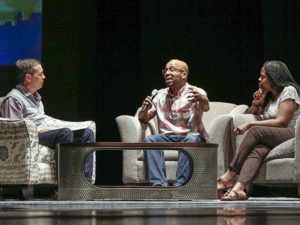
Baptist Women in Ministry urged: ‘Dare to be brave’
June 15, 2018
DALLAS—In times of rising hostility, exclusivity and hate that bring divisions, Christians should strive to understand how God hears and sees people whom others neglect, speakers urged Baptist Women in Ministry.
“Dare to be Brave” was the theme and the challenge of the group’s annual gathering, held at Wilshire Baptist Church in Dallas prior to the Cooperative Baptist Fellowship general assembly.
When confronted with antagonism, followers of Christ should emulate the way God responds to injustice, said Raquel Contreras, director and publisher for the Baptist Spanish Publishing House.
God cares for outcasts
The story of Hagar in Genesis 16 reveals God’s care for outcasts, Contreras said.
Hagar bore a son for Abram at the insistence of Sarai and then was rejected by both of them.
Although Hagar was obeying the command of her mistress, Contreras confessed she grew up seeing it as the story of a slave who had done something wrong and deserved God’s punishment.
“I grew up believing God was always seeing what we did, and he did that to then judge us,” Contreras said.
But Genesis does not talk about God seeing Hagar to judge her, she noted. Instead, the story says God saw Hagar even when Sarai mistreated her and Abram ignored her, she observed.
It is easy to ignore the humanity of a slave, even when modern readers first encounter Hagar’s story, Contreras said. But the complexity of the conflict can be seen when one considers Sarai and Hagar came from distinct backgrounds, she added.
Sarai “forgot, even though Hagar was a slave, she had her own personality,” Contreras said. “Hagar had her own position in the world.”
‘The God who sees me’
Genesis 16 says the conflict with Sarai lead Hagar to run away to the desert, but even though everyone else had pushed her out, God still met Hagar where she was.
“In the midst of all, God heard and saw” Hagar, Contreras said.
Hagar gives God the name “El Roi,” meaning “the God who sees me,” she said, a testimony to God’s concern for outcasts.
“She was a servant, an outcast, and she is still able to give God a name,” Contreras said.
Just as God saw and heard Hagar, Christ’s church must hear and see the one who have been cast away, Contreras insisted.
Even when divisions emerge, the focus of the church must remain on the one who has promised complete redemption, she said.
When Hagar felt lost and desperate, God saw her and heard her, and then God gave her the promise of many descendants through her son Ishmael, Contreras noted.
The church must announce that hope and live in light of it, she said.
“Be brave,” Contreras urged. “God is with us.”
Paynter urges CBF to break sex abuse ‘culture of complicity’
June 15, 2018
DALLAS—Suzii Paynter challenged the Cooperative Baptist Fellowship to “break a culture of complicity” in regard to clergy sexual abuse.
#MeToo, #ChurchToo and clergy sexual abuse and misconduct were the focus when Paynter presented her executive coordinator’s report to the Cooperative Baptist Fellowship general assembly in Dallas.
‘Not an isolated incident’
She asked people in attendance to stand if they had any connection to incidents, victims or survivors of clergy sexual abuse and misconduct.
“Look around. This is not an isolated incident,” Paynter said, as nearly half of attendees.
“This is worth the honor and work of church leadership,” she said. “If you are a man in ministry, if you are a layperson in leadership in your church—don’t wait for women to demand training. Be proactive.
“If your church is free from this wrenching legacy, do something to keep it that way. If your church has suffered this wound, do something—more than denial—to ensure protection for the future to break a culture of complicity.”
Paynter challenged Cooperative Baptists to “let this moment” for the @MeToo movement to “prompt us to give all the time, the priority and compassionate Samaritan response that Jesus requires,” citing the biblical model of assistance to a victim as demonstrated in Luke 10:30.
“This model of Samaritan care and investment in restoration should be an example for congregations and leaders,” she said.
Listen to survivors’ stories
She pointed to the good example provided by CBF Moderator Shauw Chin Capps, who serves as the CEO for Hopeful Horizons, an organization committed to support victims of violence and sexual abuse in Beaufort, S.C.
Shauw Chin Capps is CEO of Hopeful Horizons. (CBF Photo)
Capps joined Paynter in urging Cooperative Baptists to listen to the stories of survivors and take steps toward bringing about social change, telling the story of a gathering of three victims of clergy sexual abuse with Capps and Paynter in January of 2018.
“When asked what they wished to see happen from this meeting, they all expressed a desire and hope that Baptist organizations and churches could have policies in place that would protect others within the organization from the harm they have experienced,” Capps explained. “They all stated that this is the first time they really felt heard and felt hopeful.”
These stories are difficult to hold, Capps added, and the history of abuse within Baptist churches is one that we all prefer to forget, but one that must be brought into the light. “While we cannot change the past,” she said. “We have every opportunity to set a healthier path for the future.”
‘No one is asking you to leave’
CBF Past Moderator Doug Dortch delivered a report to attendees about the work of the governing board over the past year, focusing on the board’s adoption of a new hiring policy and announcement of an implementation procedure that grew out of the Illumination Project.
The revised policy and procedure allows LGBT individuals to be considered for some staff positions but maintains limits for ministry leadership positions and missions field personnel.
“Regardless of where you or your church is on this particular matter, no one is going to ask you to leave,” Dortch said. “If anything, your governing board is committed to making space for you to be a part of what the Spirit of God is doing in us and through us—a commitment that stems from Jesus’ high priestly prayer—that we all may be ‘one.’”
Angela Project focuses on racial justice
Kevin Cosby, pastor of St. Stephen Church and president of Simmons College of Kentucky in Louisville, Ky., brought an update to the assembly regarding the Angela Project—a three-year partnership of the Cooperative Baptist Fellowship, National Baptist Convention of America International, Inc., and the Progressive National Baptist Convention focused on racial justice.
Kevin Cosby, pastor of St. Stephen Church in Louisville, Ky., reported on the Angela Project. (CBF Photo)
The Angela Project’s goal is to set a new trajectory for racial justice in America over the next 400 years, striving to “make right what has been made wrong for so many years.” Cosby said.
He challenged the assembly to join in this crucial work as the Angela Project will convene in September of 2018 and then during the 2019 CBF general assembly in Birmingham, Ala.
“It is only right that Christians lead the way toward racial justice, because Christians led the way in racial injustice,” Cosby said. “We taught the nation how to divide on the basis of race. … Since we led the nation in injustice in the 19th century, let us be leaders in justice in the 21st.”
CBF Foundation presents awards
The CBF Foundation honored three recipients with awards for their contributions to the work of the Fellowship. Gary Skeen, president of CBF Church Benefits, was recognized with the Patricia Ayers Award of Excellence for his commitment to generous giving and longtime leadership.
Skeen, who retires later this month from CBF Church Benefits, served as chief financial officer of CBF from 1994-2000 and assisted in forming the CBF Foundation and has introduced many donor clients to the foundation.
The inaugural George Bowling Award of Excellence, named in honor of the late CBF Foundation trustee, was presented to former CBF field personnel Bob and Janice Newell and to the PORTA Albania House in Athens, Greece, which ministers to refugees and immigrants as well as other populations. PORTA—a ministry launched by the Newells—celebrates its 10th anniversary this year.
The general assembly also heard a report from Bo Prosser of the CBF Ministerial Excellence Initiative, as well as the Ministries Council, which recently awarded grants to bolster church-community connections.
The 2018 grant recipients include:
Moving Forward Looking Backward—project of a small African-American congregation in Helena-West Helena, Ark., to expand the activities of a community center to help the town adjust to increasing publicity from racial violence in past decades through a youth education project, a water festival and an educational focus on the history of racial violence
Blessings in the STORM—project of Rolling Hills Baptist Church in Fayetteville, Ark., to enhance a soccer ministry serving Hispanic, African-American, Marshallese and white youth and their low-income families.
Computer Lab for Immigration Advocacy—project of Oakland Baptist Church in Rock Hill, S.C., to provide online courses to help immigrants and refugees complete their high school education or get a GED and support the work of a legal aid and advocacy ministry serving immigrants
Enhancing our Welcome to Refugees—project of Knollwood Baptist Church in Winston-Salem, N.C., to heighten the congregation’s outreach services to refugee families arriving in the city from the Congo, Ethiopia, Eritrea, Iraq and other locations
Ready for School Program for Immigrant Community—project of Willow Meadows Baptist Church in Houston to support an early literacy program for children with limited English in being ready for pre-kindergarten and to equip parents in the critical role as their children’s first teacher
Former HSU President Jesse Fletcher dies at age 87
June 15, 2018
ABILENE—Jesse Fletcher, president emeritus of Hardin-Simmons University and originator of Southern Baptists’ missionary Journeyman program, died June 14 after a lengthy illness. He was 87.
Fletcher served the university as president from 1977 until 1991 and as chancellor from 1991 to 2001.
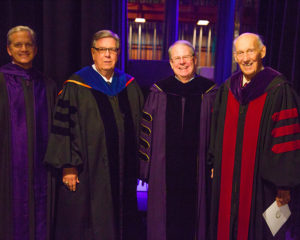
Jesse Fletcher (right) is joined by (from left) current Hardin-Simmons University President Eric Bruntmyer and former presidents Lanny Hall and Craig Turner. (HSU Photo)
“From the first day I met Dr. Fletcher, his prayers and encouragement poured down on me,” HSU President Eric Bruntmyer said. “As an older and wiser brother, Dr. Fletcher’s humility and kindness modeled how a follower of Christ lives.”
Longtime HSU President Lanny Hall called Fletcher “one of my all-time heroes and a very special friend.” He praised Fletcher as “a remarkable individual who excelled in so many fields.”
“He had a brilliant mind, was a gifted author and possessed the ability to relate to all types of people,” Hall said.
Former HSU President Craig Turner noted he could not think of Fletcher without smiling.
“Jesse Fletcher was a friend and a mentor who always had a smile and a warm greeting whenever we met, invariably addressing me with, ‘Hello, Mr. President,’” Turner said.
“What a remarkable legacy he created, full of a wide variety of accomplishments and brimming over with wonderful memories for those who were privileged to know him. Personally, I admired him, I respected him, and I loved him.”
Jesse Fletcher served Hardin-Simmons University as president from 1977 until 1991 and as chancellor from 1991 to 2001. (HSU Photo)
Fletcher was born April 9, 1931, in San Antonio, where he graduated from Thomas Jefferson High School in 1948.
At Texas A&M University, where he was an honor student, Fletcher served as a lieutenant colonel in the Corps of Cadets and twice lettered with the golf team. Upon graduation, he received a commission as a second lieutenant in the U.S. Army Reserves.
During his senior year, Manor Baptist Church in San Antonio ordained him to the ministry. He subsequently enrolled at Southwestern Baptist Theological Seminary, where he earned both his master of divinity degree and his doctorate of philosophy degree.
Fletcher was pastor of Wellborn Baptist Church in College Station and First Baptist Church in Kopperl during his time as a seminary student.
His post-graduate studies included terms at the Chaplain’s School at Fort Slocum, N.Y., the Institute of Religion at the Texas Medical Center in Houston and the University of Richmond.
In 1953, he was introduced to Dorothy Jordan on a blind date, and he proposed after that first date. They married in February 1954. She preceded him in death in 2013.
In 1960, Fletcher went to work for the Southern Baptist Convention’s Foreign Mission Board. In the mid-1960s, inspired both by the popularity of the Peace Corps and by student involvement in summer missions, he founded the missionary Journeyman program. The program enlisted recent college graduates to serve two years in overseas missions service.
After holding a series of administrative posts, he resigned from the Foreign Mission Board in 1975 and became pastor of First Baptist Church in Knoxville, Tenn., where he served until 1977, when he became the 12th president of Hardin-Simmons University.
During his 14 years as president at HSU, Fletcher established and raised the funds to endow schools in education, theology and nursing. The university added seven new facilities and renovated numerous others during his tenure, and its endowment quadrupled.
He also led the institution into the NCAA’s Division III athletic programs, including football in 1989. During his years as chancellor and president emeritus, Fletcher held a professorship in the Logsdon School of Theology, aided development efforts and represented the university in numerous academic and community roles.
Beyond his work at Hardin-Simmons, Dr. Fletcher was a key force in organizing the NCAA Division I Trans America Athletic Conference, now the Atlantic Sun Conference.
Abilene’s Chamber of Commerce recognized him as Citizen of the Year in 2002.
He wrote 11 books, including the official sesquicentennial history of the Southern Baptist Convention, and after he retired as university president, he became an accomplished landscape artist whose works have been exhibited in several museums.
Fletcher is survived by a son Scott and his family of Rockport, Maine; daughter Melissa Fletcher Dupree and her family of Abilene; five grandchildren; and one great-grandchild.
SBC apologizes to abused women, clings to traditional roles
June 15, 2018
DALLAS—Messengers to the Southern Baptist Convention annual meeting in Dallas approved resolutions offering an apology to abuse survivors and affirming the dignity of women, while also emphasizing women’s “distinctive God-assigned roles.”
While demonstrators outside the Kay Bailey Hutchison Convention Center insisted the #MeToo movement to stop sexual abuse demands a comparable #ChurchToo movement, messengers inside facility’s meeting hall attempted to respond to their concerns while holding onto a traditional understanding about the role of women in church life.
Call to ‘foster safe environments’
A resolution on abuse stated Southern Baptists “deplore failures to protect the abused, failures that have occurred in evangelical churches and ministries, including such failures within our own denomination.”
The convention’s resolution accepted an amendment from a messenger adding an apology to those who have suffered abuse and asking their forgiveness for failing to protect them.
The resolution stated spousal abuse “dishonors the marriage covenant and fundamentally blasphemes the relationship between Christ and the church.”
The convention-approved statement urged “pastors and ministry leaders to foster safe environments in which abused persons may both recognized the reprehensible nature of their abuse and reveal such abuse to pastors and ministry leaders in safety and expectation of being believed and protected.”
It also noted “church and ministry leaders have an obligation to implement policies and practices that protect against and confront any form of abuse.”
Underscores commitment to complementarianism
Another resolution, which marked the 100th anniversary of women being accepted as messengers to the SBC annual meeting, affirmed the “immeasurable contribution of women” to the convention and its ministries.
At the same time, it asserted, “God calls and gifts women for a variety of roles within the biblical framework of complementary gender relationships.”
It also called on Southern Baptists “to encourage, cultivate and celebrate the diverse gifts, callings and contributions of women in biblically appropriate ways.”
Another resolution called on ministers and denominational leaders to practice sexual purity and set a high moral standard of behavior.
“Sexual infidelity and other violations of ministerial integrity egregiously pervert and demean the image of God and always have tragic consequences for the ministry leader, for those who are victimized, and for others impacted by the transgressions,” the resolution stated.
The resolution included a covenant to “recommit ourselves to confession, repentance and contrition, and to mortify sin in our won hearts and in our churches.”
No progress on immigration reform
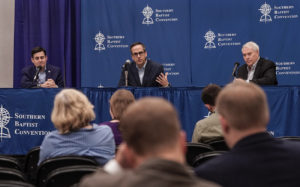
Russell Moore, president of the Ethics & Religious Liberty Commission; Jason Duesing, chairman of the Southern Baptist Convention’s Resolutions Committee and Sing Oldham, vice president for convention communications and relations, address the media in a press conference June 12. SBC messengers affirmed the dignity of women, denounce abuse, urge sexual purity among pastors in resolutions adopted June 12. (Photo / Matt Miller / SBC Newsroom)
A resolution on immigration noted “seven years of policy gridlock” since the SBC last spoke to the issue, asserting “there have been no substantive changes in the immigration system that would make it more just, humane, efficient and orderly.”
The resolution stated messengers’ desire for reform that would include “an emphasis on securing our borders and providing a pathway to legal status with appropriate restitutionary measures, maintaining the priority of family unity, resulting in an efficient immigration system that honors the value and dignity of those seeking a better life for themselves and their families.”
Another resolution disavowed the “curse of Ham,” mentioned in Genesis 9, as a justification for racism.
The resolution says the misinterpretation of that biblical text “has been used to enslave and continues to be used by white supremacists as a cloak to involve God’s holy name in unholy acts of demeaning, dishonoring and dehumanizing certain people who bear his image.”
A resolution on gun violence and mass shootings specifically noted the lives lost and individuals injured when a gunman opened fire on First Baptist Church in Sutherland Springs.
The statement calls on federal, state and local authorities “to implement preventative measures that would reduce gun violence and mass shootings while operating in accordance with the Second Amendment of the United States Constitution.”
The SBC resolutions committee declined to present a resolution submitted by Grady Arnold of Cuero opposing “the anti-gospel of the social justice movement.”
In a printed rationale, the committee concluded “this resolution did not on the one hand present a comparable biblical understanding of justice, while on the other hand did address and intend to instruct SBC entities in a manner inconsistent with SBC resolutions.”
Arnold challenged the decision from the convention floor, but messengers supported the committee’s decision.
Other resolutions approved by messengers:
Reaffirmed the full dignity of every human being, denouncing “the heinous murder of the unborn child in the womb, the enforced withdrawal of life-sustaining medical care from the ill or infirm, the prejudices and discrimination of racism and ethnocentrism, various abuses of other human persons, the denigration of opposing political groups and the persecution of religious minorities.”
Called for “Christlike communication,” particularly in using social media.
Urged greater awareness about opioid abuse and addiction and called on churches to demonstrate “grace toward the addict and hope for recovery that individuals might prosper and flourish.”
Called Southern Baptists to pray for and support Arab Christians.
Marked the 50th anniversary of Southern Baptist involvement in disaster relief and the centennial anniversaries of GuideStone Financial Resources and New Orleans Baptist Theological Seminary.
Paid tribute to the life and ministry of evangelist Billy Graham.
Reaffirmed Southern Baptists’ commitment to biblical inerrancy, to the exclusivity of salvation through Jesus Christ, to care for refugees, and to adopt or provide foster homes to children.
Expressed appreciation to the host city, local volunteers and personnel involved in making the annual meeting possible.
Messengers debate action of Southwestern Seminary trustees
June 15, 2018
DALLAS (BP)—Messengers to the Southern Baptist Convention debated—and defeated—a motion to dismiss Southwestern Baptist Theological Seminary’s trustee executive committee.
Debate included comments from two current seminary trustees, a former convention president and a laywoman.
Tom Hatley of Immanuel Baptist Church in Rogers, Ark., a former International Mission Board trustee chairman, said his proposal was based on his perception the seminary trustee executive committee acted with “haste, lack of proper investigation,” apparent disregard of the seminary’s founding documents and failure to allow former seminary President Paige Patterson to respond to accusations against him.
On May 30, the executive committee terminated Patterson, president of Southwestern Seminary since 2003.
The previous week, the seminary’s trustees moved him to president emeritus status on the same day allegations surfaced that he mishandled a sexual assault report during his presidency of Southeastern Baptist Theological Seminary.
Since late April, Patterson also has been under fire for statements he made in the past about domestic violence and women’s physical appearance.
Former SBC President Ronnie Floyd spoke against the motion, asking messengers to look past whether these trustees made the right or wrong decision. He adopting a motion to remove trustees “would destroy our own system of government.”
Bart Barber, pastor of First Baptist Church in Farmersville, and a member of the trustee executive committee, spoke on a point of personal privilege.
Barber asserted Patterson, as Southwestern’s president, attempted to remove a trustee, disregarded a request from trustee chairman Kevin Ueckert and refused to attend trustee Executive Committee meetings when asked to do so.
Once Patterson was president emeritus, his attorney “sent an email questioning the legal validity” of the full board’s action.
“What is your seminary to do when a president emeritus is working to undermine the legitimacy and validity of the seminary’s board of trustees?” Barber said. “If you take away the spine of the trustees, you take away the messengers’ voice.”
The motion failed decisively on a show of ballots.
Motions referred to Executive Committee
Grant Ethridge, a messenger from Liberty Road Baptist Church in Hampton Roads, Va. and chairman of the SBC Order of Business Committee, moved on behalf of the committee that the following motions be referred to the SBC Executive Committee for consideration and report to the 2019 SBC annual meeting in Birmingham, Ala.:
A motion by Sam Fordham of Oak Bowery Baptist Church in Ohatchee, Ala., that the Executive Committee consider a separate entity for evangelism.
A motion by Marshal Ausberry of Antioch Baptist Church in Fairfax Station, Va., that the convention cease inviting elected officials to speak at the annual meeting.
A motion by Jason Pamblanco of Thomasville Road Baptist Church in Tallahassee, Fla., to amend SBC Bylaw 21 to prohibit elected officials from addressing convention messengers.
A motion by Tim Overton of Kingston Avenue Baptist Church in Anderson, Ind., that the SBC Executive Committee strengthen trustee training.
A motion by Steve Bailey of Calvary Baptist Church in Osceola, Ark., that SBC Bylaw 10C be amended to include the Cooperative Program percentage giving of churches where candidates for office are members.
A motion by Lewis Richardson of Woodlawn Baptist Church in Baton Rouge, La. that the chairman of the Executive Committee develop and provide more comprehensive trustee training.
A motion by Dale Jenkins of Airway Heights Baptist Church in Airway Heights, Wash., that the Executive Committee study the feasibility of remote site and digital participation in the annual meeting.
A motion by Brent Lay of Englewood Baptist Church in Jackson, Tenn., that the Executive Committee recommend a program assignment for church revitalization.
A motion by Zak McCullar of Carbon Hill Baptist Church in Carbon Hill, Ala., that a children’s ministry Sunday be added to the SBC Calendar.
A motion by A.J. Smith of Bay Springs Baptist Church in Shelby, Ala., that the SBC president appoint a committee to articulate the relationship between the Old Testament and the gospel.
A motion by David Prince of Ashland Avenue Baptist Church in Lexington, Ky., that the Executive Committee study the process of the Committee on Nominations and its standards.
A motion by Michael Turner of Pleasant Ridge Baptist Church in Walhalla, S.C., that the Executive Committee study the biblical authority for a woman serving as SBC president.
Motions referred to SBC entities
The following motions were automatically referred to the appropriate SBC entity under Bylaw 26B for consideration and report to the 2019 SBC annual meeting.
A motion by Wade Burleson of Emmanuel Baptist Church in Enid, Okla., that the Ethics & Religious Liberty Commission study expanded resources to help churches protect themselves from sexual predators.
A motion by Phillip Bethancourt of Redemption City Church in Franklin, Tenn., requesting a task force for helping churches protect themselves from sexual predators.
A motion by Samuel Ray Henry of Belvedere Baptist Church in West Palm Beach, Fla., that the Southwestern Seminary board of trustees reconsider its decision regarding Paige Patterson.
Out of order
The following motions were ruled out of order because they would direct the officers of the convention to act outside the scope of their duties as established by the convention’s constitution and bylaws, were in the nature of a resolution, or were similar to other motions already referred:
A motion by Ron Wilson of Lakewood Baptist Church in Phenix City, Ala., that the Southwestern Baptist Theological Seminary Executive Committee resign from the board of trustees.
A motion by David Lewis of Mount Lebanon Baptist Church in Sheraton that messengers be engaged in pro-life issues.
A motion by Scott Gordon of Claycomo Baptist Church in Kansas City, Mo., that elected officials not be a part of the annual meeting program.
A motion by Caleb Potter of Shady Oaks Baptist Church in Hurst requesting focus on the John 3:16 gospel.
A motion by Caleb Peterson of Dayton Avenue Bapitst Church in Xenia, Ohio, requesting Vice President Pence to format his address to the messengers in a particular manner.
Hispanic Southern Baptists hear calls to unity
June 15, 2018
DALLAS—Hispanic Baptists heard calls for unity—organizationally and in individual relations—throughout multiple gatherings held in conjunction with the Southern Baptist Convention annual meeting in Dallas.
Need for umbrella organization
Throughout the meetings of several Hispanic organizations, leaders affirmed the purposes for which they exist and the need to create an umbrella organization to bring them all together.
“No organization can cover all of the needs of all Hispanics,” said Bobby Sena, a Hispanic relations consultant of the SBC Executive Committee.
Sena announced an umbrella organization will be revealed during next year’s SBC annual meeting in Birmingham, Ala.
Let go of differences
At the Church2Church fellowship, the first Hispanic event of the annual convention, Co-founder Robert Lopez urged participants let go of differences.
“We must break every chain that could separate us,” Lopez said.
Ramon Osorio, national Hispanic mobilizer for the North American Mission Board, said too often the church focuses on other things instead of God.
“We must understand God is sovereign over the body of Christ,” Osorio said. “That is the first thing we must understand for the church to have unity.”
Divisions are caused when Christians put their faith in anything else rather than Christ, Osorio added, including leaders, pastors, associations or conventions.
“Nobody owns the church, not its founders, its pastors, or even the convention,” said Osorio.
Diversity is intended as a gift from God so the body of Christ will effectively function, Osorio said.
“We often act like the church in Corinth and say, ‘Because I am not a hand, I am not part of the body,’” he said.
‘Go on the offensive’
Keynote speaker Otto Sanchez, pastor of Iglesia Bautista Ozama en Santo Domingo in the Dominican Republic, urged pastors at the Hispanic Baptist Pastors Alliance to take an offensive position with the gospel instead of the defensive position it has been stuck in during recent decades. (Photo / Marc Ira Hooks / SBC Newsroom)
Otto Sanchez, pastor of Iglesia Bautista Ozama in the Dominican Republic defended the division that resulted from the self-identified “conservative resurgence” as a necessary step to affirm the Bible’s inerrancy.]
However, he called on Hispanic churches today to move forward.
“While it was necessary to produce a defensive theology, we have also forgotten to go on the offensive,” Sanchez said during the Hispanic Pastors Alliance meeting.
After church and convention leaders have fallen, and division has been created among Baptist churches, Sanchez said, the hope is still in God’s plan for the church to emerge victorious.
Rising generations, different culture
In order for the church to be the victorious light God has called it to be, Jesse Rincones, executive director of the Hispanic Baptist Convention of Texas, said the Hispanic church needs to reach the nations already present in the United States.
“We do not have to just look at other countries around the world to see other cultures,” Rincones said at the National Hispanic Fellowship of Southern Baptist Churches. “Among us we have Millennial and Generation Z Hispanics who are already part of a different culture.”
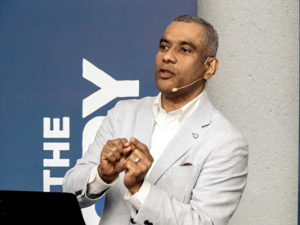
Jesse Rincones, executive director of the Hispanic Baptist Convention of Texas, addresses the the National Hispanic Fellowship of Southern Baptist Churches. (Photo / Isa Torres)
More than half of all Hispanics in the U.S. fall under those two generations, Rincones noted.
Just like missionaries would use contextualized ministry to reach people in other nations, the Hispanic church needs to do the same to reach younger generations, he insisted.
“The missionary needs to be willing to change himself to reach others,” Rincones added. “We must do the same to reach that nation in our pews.”
Because no single church or pastor working alone can accomplish the mission, Rincones called for Hispanic congregations to come together under the only One who can make this possible.
“What we need is the Spirit of the Living God,” Rincones emphasized. “Only then will we show the light of Christ to the nations.”
Around the State: Senior adults gather at ETBU; historian Karen Bullock recognized
June 15, 2018
David Hardage
More than 200 senior adults participated in worship, Bible study, fellowship and entertainment on the East Texas Baptist University campus during the annual Hilltop University three-day retreat. Guest speakers were David Hardage, executive director of the Baptist General Convention of Texas; Ron Lyles, pastor of South Main Baptist Church in Pasadena; and Bob Utley, founder of Bible Lessons International.
Karen Bullock
Karen Bullock, professor of church history and director of the Ph.D. program at the B.H. Carroll Theological Institute, received the W.O. Carver Distinguished Service Award at the Baptist History & Heritage Society’s annual conference in Stone Mountain, Ga. The award—the highest honor the society bestows—recognizes individuals who have made outstanding contributions to the cause of Baptist history. Bullock is a fellow at the B.H. Carroll Theological Institute, where she has been on the faculty since 2007. She previously taught Christian history and Baptist heritage years at Southwestern Baptist Theological Seminary and Dallas Baptist University. She serves the Baptist World Alliance as member of its Religious Freedom Commission and as vice chair of its Baptist Heritage and Identity Commission. She has been a guest professor at seminaries in Uganda, Nigeria and Canada, as well as at numerous Baptist universities throughout the United States. She and her husband, John, live in Granbury. They have two adult children and six grandchildren.
A $2.5 million gift from the estate of Lorene Taylor Davidson, who died in 2013 at age 100, enabled Baylor University to establish the Floyd F. Davidson Endowed Memorial Chair in Biology. It is named for her husband, who served on the Baylor faculty from 1946 to 1977 and was chair of the university’s biology department. He preceded her in death in 1990.
Dallas Baptist University received a $1.5 million challenge grant from the J. E. and L. E. Mabee Foundation of Tulsa, Okla. The funds are committed toward the construction of Phase I of the Transform Campaign, which will develop the university’s east campus and establish DBU’s first Residential College.
Howard Payne University will offer a 50th anniversary reunion concert of the university’s Swingin’ Stingers Band at 2 p.m. July 1. The free concert will be presented at Mims Auditorium on the university’s campus and is open to the public.
Gaines insists ‘big God’ can lift Southern Baptists
June 15, 2018
DALLAS (BP)—Amid the perplexing and potentially divisive issues facing the Southern Baptist Convention, President Steve Gaines said the formula for unity and restoration is surprisingly uncomplicated.
“Stop talking about how big your problems are, and start talking about how big your God is,” Gaines said in his presidential address at the SBC annual meeting in Dallas.
Believe and trust
Believing and trusting in the supernatural abilities of God are key to overcoming all obstacles Southern Baptists are facing, said Gaines, pastor of the Memphis-area Bellevue Baptist Church, who completed his second year as the convention’s president.
“What is going to be the solution to our decline? What can God do with us? First of all, you have to believe in a bigger God than you believe in right now,” Gaines said. “You need to believe in the God of the Bible and the Lord Jesus Christ.”
Gaines opened his message with a song, joining his daughter Bethany for a duet of “At the Cross.” He also closed with a song, this time going solo, for a rendition of the resurrection anthem, “He’s Alive.”
Between the two songs, Gaines delivered a message on four supernatural characteristics of God—his promises, protection, power and provisions—that can bring harmony and help the SBC fulfill its gospel mission.
God’s power is greater
“God’s supernatural power is greater than any problem that Southern Baptists have,” he said. “God’s supernatural power is greater than any problem you have in your church.”
Gaines opened his message by citing both biblical and personal examples of instances in which God showed his supernatural promises being fulfilled.
First, Gaines referred to the story of the Apostle Paul in which, being transported as a prisoner, he was shipwrecked on the island of Malta, and God provided for all his needs. Paul was able to use the miracles to point the other passengers toward God.
“Encouragement is putting courage back into people,” Gaines said. “Discouragement is when the devil, or the world, or sin, pulls courage out of you. Paul encouraged the sailors” who had experienced the shipwreck.
Gaines then described how God’s supernatural powers appeared in how own life, when his son Grant was restored to health after doctors had feared that, at age 2, he might have leukemia. Grant now serves as pastor of a growing church.
“I can assure you that every promise of God comes true,” Gaines said. “If you have a need, God has a promise.”
God protects
Gaines also spoke of the protective powers of God, pointing to Paul’s ability to shake off a snake bite. God gives similar protection to Christians today who believe in his abilities, Gaines said, noting this is true for each facet of everyday life—guarding marriages, protecting children and safeguarding finances in times of needs and challenges.
“God can protect you completely and absolutely in every way when you pray it through, when you seek to live under an open heaven and when you steadfastly obey the living God,” Gaines said. “He will be your shield until it is time to take you heaven. No human is stronger than almighty God.”
God’s supernatural power is as much on display today as it was in biblical times, Gaines said.
“Our God can still move mountains,” he said. “Our God can still say, ‘Hush, be still’ to raging seas. Our God can still heal the sick and raise the dead. He can save you if you are lost.”
God heals
God’s healing power can include deliverance from all types of sexual immorality and other moral crises, Gaines said.
“God is still alive, God is still sovereign,” he said. “He is the same yesterday, today and forever. If you will exercise faith, God will exercise power.”
Gaines—who said many Christians are more focused on their resources than their true source of joy and comfort—closed his message by challenging messengers to spread the hope and joy of the gospel into their everyday lives.
“I believe one of the greatest things we could walk out of here with in a few days is to tell the world that God is still on his throne,” Gaines said. “I believe there is a supernatural God. And I thank God that the hero of our Bible is not dead.”
Crossover events and Harvest America crusade proclaim gospel
June 15, 2018
DALLAS (BP)—Evangelistic emphases prior to the Southern Baptist Convention annual meeting in Dallas produced 4,229 professions of faith in Christ, including 2,339 at a crusade event at the AT&T Stadium in Arlington.
Evangelist Greg Laurie addresses a crowd of more than 35,000 at Crossover Harvest America at AT&T Stadium in Arlington, June 10. (Photo / Adam Covington / SBC Newsroom)
“I’m not here to talk to you about religion,” evangelist Greg Laurie told the crowd at the Harvest America crusade. “I’m here to talk to you about a relationship with God that you can experience.
“Christ can fill that big hole that is in your heart right now. We all need him. We all need a Savior. There’s so much stuff to distract us and emptiness to make us feel alone. Yet Jesus, who created us, also gives us purpose. Jesus loves us all—no matter what we do or say or have done before—so much.”
In an era of divisiveness and lost hope, Laurie brought a message of unity in Christ and salvation to a crowd of about 35,000 people. Laurie repeatedly pointed those in attendance back to the cross—back to Jesus.
Sunday night’s crusade followed a week of evangelistic Crossover activities throughout the Dallas-Fort Worth Metroplex. Participants from all over the area and the nation came to North Texas prior to the Southern Baptist Convention’s annual meeting so they could take part in outreach activities such as door-to-door evangelism, reporting 1,015 commitments to Christ.
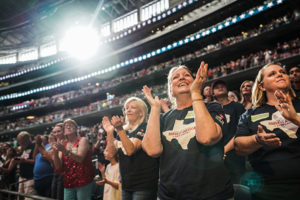
Thousands of attendees at the June 10 Crossover Harvest America crusade at AT&T Stadium in Arlington worshiped together. The crusade featured music from top Christian artists such as Phil Wickham, Chris Tomlin, David Crowder, Trip Lee, Tedashii, KB and Switchfoot. (Photo / Matt Miller / SBC Newsroom)
The Harvest America crusade included musical guests Switchfoot, Crowder, Trip Lee, Phil Wickham and Chris Tomlin, who kicked off the event with a mix of new music and classic songs that supported the crusade’s straightforward, evangelistic message—the world needs Jesus.
‘A future worth living’
“There is someone who loves you and someone who values you,” Laurie said. “He’s called Jesus Christ. He’ll give you a future worth living.”
In the wake of two high-profile suicides the previous week—designer Kate Spade and television personality Anthony Bourdain—Laurie’s message and the entire event aimed to send the hope of the gospel to people in attendance at the stadium and those watching at simulcast locations around the world.
“So many people in our generation and across generations are living in quiet desperation,” said Jack Graham, pastor of Prestonwood Baptist Church in Plano, before the event. “Those two were celebrities. So, their stories are all in the news. Yet, many struggle with depression and thoughts of suicide.
“So often you hear people say, ‘We didn’t know they were living in such pain.’ As Christians, this makes us aware that every person needs the Lord. There’s a hunger for meaning and purpose in life. There’s so much brokenness in people’s lives, but we know of a way they can heal from those wounds—the gospel message of hope and love.”
Global reach
The Crossover Dallas and Harvest America evangelism event had global reach through simulcasting. Laurie said the event could not have come at a better time as the nation and the world seem to be on edge with each other and themselves. Graham agreed.
“People might say crusades are over, but all you have to do is look around,” Graham said of the thousands who gathered at the stadium in Arlington. “It works because it brings people together in a time when we have so much dissonance and division.”
Graham led his church and many others in the Dallas-area to mobilize their congregations to invite spiritually lost friends to the event and support it by volunteering.
“I believe in invitational evangelism,” Graham said. “We invite many to come to know and follow Christ in our churches. And in a great environment like AT&T Stadium, a crusade can bring churches together and allow a great evangelist to proclaim the gospel and invite people to Christ in an effective way.”
Christians who brought friends to the event were encouraged by how clearly the gospel was proclaimed.
“This was a great opportunity for people to hear, ‘God loves you,’” said Brian Cole, minister of communications and worship at Hillcrest Baptist Church in Cedar Hill.
Laurie ended the evening by inviting people to the stadium floor if they wanted to begin a relationship with Christ.
“No matter what, come with your sins. Come with your questions,” Laurie said to a quiet crowd. “Don’t live another day without Jesus Christ.”
Generational change evident at SBC annual meeting
June 15, 2018
DALLAS—A key architect of the self-identified “conservative resurgence” in the Southern Baptist Convention withdrew from a scheduled opportunity to address the SBC after being fired from his seminary post, and messengers to the annual meeting elected the youngest SBC president in nearly 40 years.
Paige Patterson, until recently president of Southwestern Baptist Theological Seminary in Fort Worth, notified the incumbent SBC president four days before the SBC annual meeting in Dallas he would not preach the convention sermon.
Then by a more than two-to-one margin, SBC messengers chose 45-year-old J.D. Greear, pastor of The Summit Church in Durham, N.C., as the convention’s president over 70-year-old Ken Hemphill, a former seminary president and denominational executive.
Many observers saw the two events, among other signs, as evidence of a generational shift within the nation’s largest Protestant denominational organization.
Patterson backs out
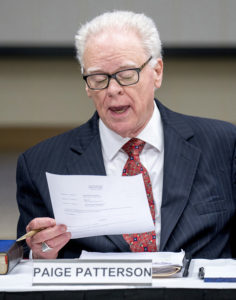
Former Southwestern Seminary President Paige Patterson, pictured here at a May 22 trustee meeting, was terminated by the seminary May 30. His attorney has issued a statement defending Patterson against alleged “misinformation.” (Photo by Adam Covington/ SWBTS via BP)
Patterson had been at the center of a firestorm first triggered by his comments about spousal abuse and a woman’s appearance and later by allegations he mishandled rape claims by students at schools he led. He sent an email June 8 to Steve Gaines, incumbent SBC president, withdrawing as the scheduled convention preacher. He also resigned as chair of an evangelism task force to which Gaines had appointed him a year ago.
In a 13-hour closed-door meeting that began May 22 and stretched into the predawn hours of May 23, the Southwestern Seminary board of trustees removed Patterson as the seminary’s president but named him “president emeritus.”
One week later, the board’s executive committee cut its ties to Patterson, stripping him of titles and benefits the board had granted, citing “new information” about how Patterson had inappropriately handled claims of sexual abuse both at the Fort Worth campus and at Southeastern Baptist Theological Seminary, where he served previously.
The committee also rescinded the board’s invitation for Patterson and his wife, Dorothy, to continue to live on campus as “theologians-in-residence” at the Baptist Heritage Center.
In his June 8 email, Patterson identified his withdrawal as convention speaker and resignation as task force chair as “an effort to do what I can to contribute to harmony within the Southern Baptist Convention and to respond to the request that has come especially from Gaines and other Southern Baptist leadership.”
Soon after he sent the email to Gaines, Patterson also released an open letter to the “Southern Baptist family” in which he expressed regret for “a poor choice of words” on some occasions but defiantly defended himself against serious wrongdoing.
“Recently, I have been accused, publicly and privately, of a number of things—none of which I acknowledge as having done in the way portrayed, and others that I am confident I absolutely did not do,” he wrote.
Patterson specifically denied he “ever knowingly ignored or failed to follow appropriate protocols in cases of reported abuse of women, students or staff at any institution where I have served.”
In his open letter, Patterson noted the 2018 gathering would be the first SBC annual meeting he failed to attend in 66 years.
It also was the first for a significant number of messengers, based on those who stand to identify themselves as such during the annual meeting’s opening session.
Gen X pastor elected president
Their impact was evident in the election of the SBC president, when Greear received 5,410 votes (68.6 percent) compared to Hemphill’s 2,459 (31.2 percent).
Other officers are A.B. Vines, pastor of New Seasons Church in San Diego, first vice president; Felix Cabrera, pastor of Iglesia Bautista Central in Oklahoma City, second vice president; John Yeats, executive director of the Missouri Baptist Convention, recording secretary; and Don Currence, minister of children and administration at First Baptist Church in Ozark, Mo., registration secretary.
J.D. Greear, pastor of The Summit Church in North Carolina, spoke at a pre-Southern Baptist Convention conference in Flower Mound. (Photo / Amber Dion)
At a pre-SBC conference in Flower Mound geared primarily toward a group often identified as “young, restless and Reformed,” several speakers alluded to the need for a new generation to assume leadership in the convention.
During a panel discussion on the future of the SBC at that event, Greear spoke of the need to view recent events in Southern Baptist life “from a posture of humility and repentance.”
When asked at a news conference following the presidential vote if he perceived his election as marking a generational shift in the SBC, he acknowledged, “We’re definitely seeing something.”
However, he rejected any suggestion it signaled a repudiation of the past or a “passing of the torch” that meant the the older generation would “fade into the sunset.”
“We need to walk forward together,” he said.
No place for politics
The praise band from The Village Church in Flower Mound led in worship during a conference prior to the Southern Baptist Convention annual meeting. Observers noted the beginning of a shift at the SBC, with a younger and more ethnically diverse group taking leadership. (Photo / Amber Dion)
Messengers faced their first challenge in walking together in the first hour of the annual meeting’s opening business session, when some messengers challenged a last-minute addition to the order of business—a Wednesday morning address by Vice President Mike Pence.
Garrett Kell, a messenger from Alexandria, Va., makes a motion to disinvite Vice President Mike Pence during the opening session June 12 of the two-day Southern Baptist Convention annual meeting at the Kay Bailey Hutchison Convention Center in Dallas. Messengers defeated the motion to amend the agenda to replace Pence’s address with a time of prayer. (Photo / Matt Miller / SBC Newsroom)
While a motion by Garrett Kell from Alexandria, Va., to replace Pence’s speech with a time of prayer was defeated, it sparked spirited debate about the propriety of an elected official addressing the convention’s annual meeting.
After the initial motion failed, several messengers introduced a variety of related motions, seeking to restrict future annual meetings from inviting any elected officials other than the mayor of a host city to offer greetings.
Messengers soundly defeated a proposed amendment to defund the SBC Ethic & Religious Liberty from the Cooperative Program unified budget and redirect the funds to the International Mission Board.
Nathan Rager from The Peoples Church in Clearwater, Fla., presented the amendment, focusing primarily on ERLC President Russell Moore, for his outspoken criticism of Donald Trump during the last presidential election before SBC President Steve Gaines admonished him “not to disparage” anyone.
Vance Pitman, pastor of a multi-ethnic church in Las Vegas, spoke against the amendment and in Moore’s defense, saying, “The ERLC under Russell Moore’s leadership has done more to bring healing to damaged relationships with people of color, minorities and a younger generation of SBC pastors than all of our resolutions combined.”
WMU challenged to ‘unshakable pursuit’ of God’s mission
June 15, 2018
DALLAS—Speakers at the 2018 National Woman’s Missionary Union Missions Celebration and annual meeting called Baptist women to the “unshakable pursuit” of God’s glory and God’s mission.
With 1 Corinthians 15:58 as their theme, missions speakers challenged Baptist women to “faithful, courageous, steadfast” devotion as they pursue the mission of the same God who pursued them.
“God has been pursuing you your whole life,” said WMU President Linda Cooper of Tompkinsville, Ky., urging Baptist women to enter into a “missional journey” wherever God leads.
“God has a plan for your life,” Cooper said. “His plan is for you to know him and help others do the same.”
Cooper was re-elected as president of national WMU at the annual meeting. Jackie Hardy of Social Circle, Ga., was elected recording secretary.
See where God is at work
Former Woman’s Missionary Union presidents Kaye Miller (left) and Debby Ackerman speak June 10 at the WMU Missions Celebration general session in Dallas. They congratulated the Baptist Nursing Association on its 35th Anniversary. (Photo / Van Payne / SBC Newsroom)
Missionary speakers included two couples whose names were withheld due to security concerns in the areas where they serve.
One missionary described a Kurd who was “falsely accused of starting a political rebellion” and confined in a tiny cell. Through dreams and visions of Jesus, he became a follower of Christ.
The other missionary couple described how they initially worked among an unreached people group in Central Asia before transferring to Germany, due to family medical issues.
“We had to leave behind the people we loved,” one of the missionaries said.
However, in Germany, in addition to developing urban strategies to reach secular Germans, they also work with immigrants, refugees and other displaced people—including members of the same people group they sought to reach with the gospel in Central Asia.
“When you pray consistently, God will give you a new pair of glasses that allow you to see where he is at work,” one of the missionaries said.
‘Stand firm’
Irma Moss—a WMU leader in Florida—recalled how her father lost his business and his financial holdings after the Cuban Revolution. He left Cuba, where he had owned restaurants, to work 16-hour days as a dishwasher at restaurants in the United States.
When the last airplane bound for the United States left Cuba, Moss recalled, she and her mother and sister took the last available seats to be reunited with her father—even though her mother had been told it was impossible, because 13 other people were on a waiting list ahead of them.
From her mother, Moss said, she learned to “stand firm and not be shaken” in her faith, keeping her eyes on God.
David Melber, vice president of the Send Relief ministry at the North American Mission Board, reported on ministry to refugees and immigrants, victims of human trafficking and other vulnerable people.
He described the work of a ministry center in Clarkston, Ga., where missionaries minister in one of the most ethnically diverse areas of the United States, and another ministry center that addresses poverty in Appalachia. Additional ministry centers are planned in Puerto Rico, Las Vegas and New York, he reported.
‘A beautiful and broken place’
Kempton and Caryn Turner, church planters in East St. Louis, Ill., church planters with the North American Mission Board, share their story with NAMB President Kevin Ezell during the Woman’s Missionary Union annual meeting in Dallas. Their church plant, City of Joy Fellowship, focuses on the tough inner city where Kempton grew up. (Photo / Van Payne / SBC Newsroom)
NAMB President Kevin Ezell moderated a discussion with Kempton and Caryn Turner, missionaries and church planters in East St. Louis, Ill.
Turner, pastor of City of Joy Fellowship in East St. Louis, described his city as “a beautiful and deeply broken place.”
He talked about growing up in the gang-ridden neighborhoods of the southern Illinois city before his family moved to Houston. Later, during a trip to New Orleans in which he intended to sample all the sin that city could offer, he met a couple who shared the gospel with him.
“I was saved on Bourbon Street,” he said.
Serving in East St. Louis with his wife and their five children, he is seeking to create avenues to share that same life-changing gospel message in a city where 45 percent of the people live below the poverty line.
City of Joy has been instrumental in creating community development initiatives to learn job skills while repairing and renovating homes.
‘Power to change lives’
Ruba Abbassi (left) of Arab Women Today received the 2018 Dellanna West O’Brien Award for Women’s Leadership Development from Sandy Wisdom-Martin, executive director of the Woman’s Missionary Union, June 10 during the opening session of the 2018 WMU Annual Meeting in Dallas. (Photo / Van Payne / SBC Newsroom)
David Platt, president of the International Mission Board, described a recent trip to the Amazon, where he recalled telling indigenous people stories around the campfire each night about “Jesus, the one true God.”
Globally, about 2.8 billion people have little or no knowledge of Christ and the gospel, Platt said.
“We need churches that have a passion for calling out men and women to go where the gospel has not gone yet,” he said. “God is seeking and saving the lost. The gospel has power to change lives.”
The missions celebration also included testimonies by National Acteens Panelists Allison Agthe from Austin Baptist Church in Austin; Abby Kriss from Bethany Baptist Church in Callao, Va.; Daisy Major from Mount Carmel Baptist Church in Hickman, Ky.; and Emma Kirkemier from Asheville First Baptist Church in Gallant, Ala.
WMU presented its Dellanna West O’Brien Award for Women’s Leadership Development to Ruba Abbassi, chief executive officer of Arab Woman Today, a Christian ministry that operates in 22 Arabic-speaking countries in the Middle East and North Africa.
SBC mulls ways to increase women’s roles in #MeToo Culture
June 15, 2018
DALLAS (RNS)—Over scones and chocolates, hundreds of Southern Baptist women gathered for tea in a convention center ballroom June 11 on the eve of their convention’s annual meeting.
Tea time for some
They attended “Tea@3,” a tradition of Southwestern Baptist Theological Seminary, the school until recently led by Paige Patterson. The executive committee of the seminary’s board of trustees terminated the Southern Baptist leader after reports he mishandled student rape allegations and made comments demeaning to women.
Dorothy Patterson (left) and Rhonda Kelley participate in “Tea@3,” a tradition of Southwestern Baptist Theological Seminary, prior to the Southern Baptist Convention annual meeting in Dallas. (RNS Photo / Adelle M. Banks)
Patterson announced a few days before the SBC annual meeting he would not preach the convention sermon or even attend so as not “to detract in any way from the important business of our convention.” But at “Tea@3,” Patterson’s wife, Dorothy, was seated at one of the front reserved tables, not commenting much on the recent scandal.
“We served at the pleasure of the board these years, and they no longer have pleasure,” she told Religion News Service.
Although her husband was not mentioned by name, the program highlighted his seminary’s recent history of promoting women into what Southern Baptists deem gender-appropriate teaching roles—but not preaching positions.
Long known for his resistance to feminist ideas, Patterson boasted previously about the programs for women he established at Southwestern Baptist. In an interview at last year’s meeting, he said he holds to the Apostle Paul’s teaching in 1 Timothy that a woman should not teach or have authority over a man. However, he added, “that doesn’t mean that there’s nothing a woman can do except stay home and wash dishes.”
“We believe that women have a tremendous impact on 51 percent of the population of the world that we men will never touch effectively,” he said.
Greater expectations
But others have wider expectations. In the hallways of the Kay Bailey Hutchinson Convention Center and in eateries and hotel lobbies nearby, messengers held heart-to-heart discussions about future possibilities for women in a denomination that walks a “complementarian” line—belief that women and men are equal before God but have different roles in church and home life.
The discussions, which came as the denomination marked 100 years since women first were welcomed as messengers, made their way to the meeting floor.
Southern Baptists approved a resolution in which they called upon “all Southern Baptists to encourage, cultivate and celebrate the diverse gifts, callings and contributions of women in biblically appropriate ways.”
Rhonda Kelley, wife of the president of New Orleans Baptist Theological Seminary who chaired a Women’s Advisory Council last year, said she hopes to see Southern Baptists move beyond having “token women on committees.” She would like to see more elected to serve on trustee boards, she said, where they can use their educational and professional expertise.
“What we discovered, more than anything, Southern Baptist women do not know about training opportunities and ministry opportunities, mission opportunities,” said Kelley, who is Dorothy Patterson’s sister-in-law, regarding her work with the council. “We need you all to be sharing with other women that you know, mentoring them and encouraging them, helping them to know how to use their gifts and abilities.”
Discussions on sexual abuse and misogyny
The pro-woman talk buzzing in the halls even included speculation about a suggestion, floated in a Christianity Today column, that a woman could be president of the Southern Baptist Convention. Citing “her qualifications and the current context the SBC finds itself in,” Pastor Dwight McKissic put forward the name of Beth Moore, a popular author and speaker, who herself has recently blogged about facing “misogynistic attitudes.”
McKissic, a Texas pastor known for prodding last year’s meeting to pass a statement condemning “alt-right white supremacy,” wrote that “a woman would not be usurping authority over a man by serving as SBC president.”
Moore declined to comment on McKissic’s proposal, but it may have helped make her something of a sensation. On Monday, she took part in a panel discussion about abuse in the church that drew hundreds to an exhibit hall space that had seating for about 25. She declined to comment on a possible nomination for president.
The next day, messengers elected North Carolina megachurch pastor J.D. Greear as the next SBC president—its first top official from Generation X.
Ready or not?
Bobbi Jackson, wife of a just-retired senior pastor in Huntsville, Ala. who served for years on Southwestern Seminary’s trustee board and has known the Pattersons more than four decades, rejected the notion of Moore serving in that role.
“I would totally disagree just because I think that she does the best where she’s serving—writing books for women and Bible studies,” said Jackson, who described herself as “very sad” about Paige Patterson’s termination. “I don’t think she can have a higher calling than what she’s doing right now.”
Jackson said she doesn’t know any woman who has been the “helpmate” of a Southern Baptist pastor who would want that role.
“I know a lot of the strong minister’s wives in the convention,” she said. “I don’t know any of them that want to be president of the convention.”
Krissie Inserra, 36, the wife of the pastor at City Church in Tallahassee, Fla., takes another view.
“I don’t see why she can’t,” said Inserra, whose husband hired a woman as an executive director, a rare administrative role for a woman in SBC life. “This is not a church. And so I don’t know that that would happen anytime in the next few years but just the fact that it was even suggested says something, I think.”
Greater roles for women
Inserra was one of the more than 3,300 women who signed a petition seeking action against Patterson after his statements about women came to light. Southern Baptist women are starting to band together in ways that could lead to more involvement in leadership, she said. Some male ministers, too, are beginning to speak up about the need to embrace the presence of women in prominent roles.
“When we see the men stepping up alongside the women, saying this is what we recognize in you and there’s nothing in the Bible that says you can’t lead this committee or you can’t do this, that’s helpful,” said Inserra. “I’m encouraged.”
Within hours of Inserra mentioning male encouragement of women’s roles, suburban Atlanta megapastor James Merritt, speaking on a panel about “Gospel Sexuality in a #MeToo Culture,” mentioned women at his church who serve on teams dealing with personnel and finance. Complementarians, he suggested, can get too legalistic in their approach to Scripture.
“A woman could be the president of the Southern Baptist Convention,” he said. “I think sometimes we complementarians suddenly have gone into a Pharisaic mode of going beyond what the Scriptures teach, and I think this is a good wake-up moment for us in that area as well.”