Shane Claiborne arrested while praying at the capitol

WASHINGTON (RNS)—Five faith leaders were arrested while praying in the U.S. Capitol Rotunda on May 5.

It marked the second time in as many weeks clergy and others have been handcuffed as they speak out against the Republican-led budget bill.

Among those arrested was Shane Claiborne, a longtime activist and co-director of Red Letter Christians, a Christian social justice group.

Claiborne, who is based in Philadelphia and known for his longstanding opposition to the death penalty and gun violence, prayed side by side with others for several minutes in the Rotunda before eventually being arrested by Capitol police.

‘Stir the conscience of our nation’

“Reorder our moral compass,” Claiborne said, standing near a statue commemorating famous suffragettes and abolitionists.

“Stir the conscience of our nation. Let justice rise up on these very steps, let truth trouble the chambers of the Capitol. Let there be no peace where there is no justice. Let there be no comfort for those who legislate cruelty.”

Claiborne added: “Let those of us gathered here rise not with fear but with fire, because as long as the details are still being worked out in committee…”

The group of Christian and Jewish activists responded in unison: “You can work a miracle.”

Shortly after an officer gave multiple verbal warnings, roughly two-dozen officers surrounded the group and began arresting them one by one. Members of the group prayed and some sang “This Little Light of Mine” as they were led away from the Rotunda.

According to organizers, also arrested were Alvin Jackson and Hanna Broome, both affiliated with the activist group Repairers of the Breach; Ariel Gold, USA director of the interfaith The Fellowship of Reconciliation; and Joel Simpson, pastor at First United Methodist Church in Taylorsville, N.C.

Police cleared the Capitol Rotunda to make the arrests but allowed press to continue documenting the scene as they placed the five people in handcuffs. At a similar protest a week before, members of the press were steered into a section with a closed door and then instructed to leave the floor entirely.

In an email to RNS on Monday, Capitol Police confirmed they arrested five people after warning them multiple times, charging them with “crowding, obstructing and incommoding.”

‘Bear witness nonviolently’

Reached by phone after he was released from police custody several hours after the demonstration, Claiborne said his interactions with officers were largely positive but he felt protest was necessary.

He cited inspiration from Martin Luther King Jr.’s civil rights advocacy and argued the GOP-led budget constituted an emergency for the poor, comparing the legislation to an out-of-control fire.

“We think that these are extreme times, and they warrant extreme measures,” Claiborne said. “So, we’re going to bear witness, nonviolently.”

The demonstrators initially approached the U.S. Capitol steps to stage their prayer, but police erected barricades as they approached and temporarily closed off the area on the east side of the Capitol.
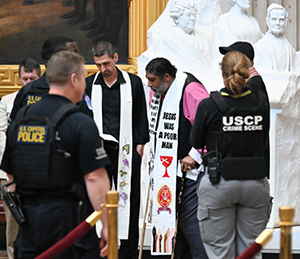
Capitol police officers gather around Jonathan Wilson-Hartgrove (center left) and William Barber II (center right) as they pray in the Capitol Rotunda, Monday, April 28, 2025. (RNS Photo/Jack Jenkins)

The protest is the latest in an ongoing Monday protest effort launched last month by William Barber, a prominent pastor, anti-poverty activist and founder of the Center for Public Theology and Public Policy at Yale Divinity School.

The campaign is focused on countering the proposed Republican budget, with organizers protesting potential cuts to Medicaid and other programs designed to help low-income Americans.

Last week, Barber and two others were arrested while praying in the Rotunda.

“It is a sad day in America when you can be arrested in the people’s house for merely praying because the congresspeople in a party in that house are choosing to prey—P-R-E-Y—on the most vulnerable of this nation, along with the president of the nation,” Barber told RNS in a phone interview, referring to the latest arrests.

“But we will not bow. We will not stop. We have to raise moral dissent.”

The arrests both weeks followed rallies earlier in the day in front of the U.S. Supreme Court, where faith leaders repeatedly decried the bill.

“We are gathered here in front of the U.S. Supreme Court, and in the shadow of the Capitol, to stand up and to speak out about a federal budget that seems to have emerged like a phoenix from the very pit of hell,” said Leslie Copeland-Tune of the National Council of Churches on May 5.

Claiborne also railed against the bill and criticized those who have invoked faith to defend President Donald Trump’s policies. He held up a version of the four biblical gospels that had all verses relating to the poor, love and compassion redacted to make his point.

“It’s called the Gospel of Donald Trump,” he said.

Organizers say they plan to continue the demonstrations over the next few weeks as Congress continues to debate the budget bill, which Trump has described as a “big, beautiful bill.”

Claiborne said even as he and the others sat in the back of a police van on Monday, the group was already planning future demonstrations.

“We were doing two hours of organizing with Rev. Alvin (Jackson) in there,” Claiborne said, laughing. “One less Zoom call.”


Obituary: Freddy Mason

Freddy Mason of Carthage, who served the same rural Panola County church as pastor more than five and a half decades, died May 5. He was 79. He was born Nov. 30, 1945, in Texarkana, Ark., to Fred and Pansy Joy Woods Mason. After he graduated from Carthage High School, he attended Panola College, where he served as the sophomore class president. He also was choir president, an All-Star Cast Member and participated in one-act plays. He was a one-man show on stage and performed in many one-act and two-act plays throughout his career, notably for playwright Ben Z. Grant in a play about Caddo Lake. He went on to earn his undergraduate degree at East Texas Baptist University before continuing his education at New Orleans Baptist Theological Seminary. He was pastor of Cedar Grove Baptist Church in Panola County’s Snap community for 57 years. During his tenure at Cedar Grove, he pastored generations of Panola County families, officiating countless numbers of baptisms, weddings and funerals. He married Suzanne Treadwell on June 15, 1990, in Clayton. He taught at Panola College, where he also served many years as director of the Baptist Student Ministry. At the time of his retirement, he was dean of the Liberal Arts Department. He was a longtime member of the Carthage Noon Lions Club and served with the 100 Men of East Texas. He is survived by his wife Suzanne; daughter Staci Self and husband Toby; daughter Katrina Randall and husband Tuff; three grandchildren; three great-grandchildren; and sister Janie Cromer. A funeral service will be held at 2 p.m. on May 7 at Cedar Grove Baptist Church. His family will receive friends for a visitation beginning at 12 noon prior to the funeral service. Memorial gifts may be made to Cedar Grove Baptist Church, 1050 CR 108, Carthage, TX 75633 or to the Panola College Foundation, “Freddy Mason Scholarship,” Attn: Institute of Advancement, 1109 W. Panola, Carthage, TX 75633.


Senate committee considers bill to abolish Texas Lottery

The Texas Senate Committee on State Affairs heard public testimony May 5 on a bill calling for the Texas Lottery to be abolished.

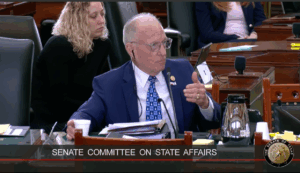
In presenting his bill to abolish the Texas Lottery to the Senate Committee on State Affairs, Sen. Bob Hall laid out a detailed recounting of how the Texas Lottery Commission in recent years failed to abide by state laws. (Screen capture image)

“There is no way to reorganize, restructure or restore the integrity of the government-run Texas Lottery,” said Sen. Bob Hall, R-Edgewood, who introduced SB 1988. Hall’s bill calls for the abolition of the Texas Lottery, effective Jan. 1, 2026.

In presenting his bill—which the Senate Committee on State Affairs left pending—Hall laid out a detailed recounting of how the Texas Lottery Commission in recent years failed to abide by state laws.

Without legislative approval, the commission changed rules to enable “a private/public syndicated crime partnership” to “engage in a criminal conspiracy to defraud Texans,” he asserted.

‘Serious breach of trust’

“I and those who know the details even as they continue to evolve are convinced that this organized crime scandal that has been operating behind the shield of being a Texas state government agency is probably the most serious breach of trust since the Sharpstown scandal in 1971 and 1972,” Hall told the committee.

The Sharpstown scandal Hall referred to was a stock-fraud scandal that resulted in charges being brought against nearly two dozen state officials and former officials.

Among other abuses, Hall described how the Texas Lottery Commission enabled out-of-state investors to purchase practically every combination of numbers to rig the lottery to win a $95 million jackpot.

“Multiple investigations into the lottery’s criminal operations are ongoing and evidence of multiple crimes against the people of Texas continue to be uncovered,” Hall said.

In response to a question about how much the lottery contributes to public education, Hall noted it funds three days of public-school operations in the calendar year, which he characterized as “chump change.”

Lottery is ‘the antithesis of Texas values’

Rob Kohler, consultant with Texas Baptists’ Christian Life Commission, testified in favor of SB 1988.

Rob Kohler, consultant with Texas Baptists’ Christian Life Commission, testified in favor of SB 1988, which would abolish the Texas Lottery. (Screen capture image)

When Texas approved the creation of a state lottery in the early 1990s, proponents presented it as a voluntary alternative to a regressive sales tax, Kohler noted.

The lottery “would make a sales tax blush in terms of regressivity,” he asserted.

Kohler presented data demonstrating the correlation between areas where incomes are low and purchases of “immediate gratification” scratch-off ticket sales are high.

“They’re selling $100 scratch-off tickets now in convenience stores. They’ve gone from the price of a Snickers bar at a dollar to the most expensive product in the store,” Kohler said.

John Litzler, public policy director for the Christian Life Commission, also testified in support of SB 1988.

Texas Baptist churches are “on the front lines” of helping people who suffer due to financial crises “caused at least in part by the Texas Lottery,” he noted.

He called the Texas Lottery “the antithesis of Texas values” and said the time has come for the Texas Lottery Commission to be abolished.

“We support legislation that promotes both fair and just financial practices and legislation that promotes human flourishing in Texas,” Litzler said. “We believe this bill does both of those things and that the Texas Lottery games don’t do either of those things.”


Lowrie named dean of HPU School of Christian Studies

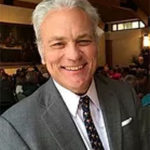
BROWNWOOD—Howard Payne University appointed David Lowrie, longtime Texas Baptist pastor and former president of the Baptist General Convention of Texas, as dean of the School of Christian Studies.

Lowrie brings more than 43 years of ministry experience and leadership to the role and will begin the position in August. Gary Gramling, current dean of the School of Christian Studies, will continue to serve as director of Christian studies graduate programs and professor of Christian studies.

 “I am excited to welcome Dr. David Lowrie to this new leadership role at HPU,” said HPU President Cory Hines. “Dr. Lowrie is passionate about equipping young leaders to be faithful and effective pastors and ministers.

“He brings tremendous ministry experience and has provided leadership for 20 years through our board of trustees. We look forward to Dr. Lowrie and his wife Robyn joining the HPU family.”

Lowrie has served First Baptist Church of Decatur as senior pastor for the last eight years. His career in ministry spans four decades and encompasses rural and urban settings, as well as church planting and mission work. He was pastor in El Paso, Canyon, Mabank, Lewisville and Roanoke, as well as Milwaukee, Wisc.

He has led mission teams to Mexico, Paraguay, Brazil and East Asia.

He was president of Texas Baptists for two years and has served in numerous Baptist associational and state leadership positions.

‘Equip and train the next generation of ministers’

Lowrie served on the HPU board of trustees since 2005, including as chair for two years. He previously taught several Christian studies courses at HPU’s extension center in El Paso when he served as pastor of First Baptist Church in El Paso. He also assisted in the relocation of the extension center to the First Baptist location during his time there.

He holds a Bachelor of Arts degree from Baylor University, a Master of Divinity degree from Southwestern Baptist Theological Seminary and a Doctor of Ministry from Bethel Seminary in St. Paul, Minn.

“I am deeply humbled to be given the opportunity to build on the great legacy of the School of Christian Studies,” Lowrie said. “For decades, HPU has turned out world changing leaders.

“The Lord has given me a calling to join this mission to equip and train the next generation of ministers with spiritual depth, intellectual rigor and practical tools to be effective in leading churches to change the world.”

Robyn Lowrie has served as an adjunct professor at HPU. The Lowries have four daughters—Kalie Lowrie, Lorin Scott, Jamie Villanueva and Madison Lowrie—and six grandchildren.

 “Robyn and I love HPU. We cannot wait to plant our lives in Brownwood. In many ways, HPU is our ‘family business,’” Lowrie said.


Suit alleges illegal power grab at Second Baptist Houston

HOUSTON (BP)—A lawsuit alleges Second Baptist Church in Houston unlawfully changed its governing documents to eliminate the congregation’s power to vote on virtually everything, including budgets and the selection of a senior pastor.

One reason for changing the church’s bylaws and articles of incorporation, the suit claims, was “to secure the ascendance” of Ben Young, son of longtime pastor Ed Young, to the senior pastorate.

Ed Young is a former SBC president, and Second Baptist is among the convention’s largest cooperating churches with more than 90,000 members across six campuses.

“The represented and ostensible purpose for these amendments was to clarify the church’s beliefs, and to reinforce its stance on social issues such as marriage and family, in response to the ‘woke agenda,’” states the suit, filed in a Harris County court by a group of current and former church members known as the Jeremiah Counsel Corporation.

“However, the true objective for the amendments was to radically alter Second Baptist’s long-observed democratic governance processes—and to eliminate the congregants’ voice in church matters in its entirety.”

Second Baptist sent the following statement to Baptist Press: “Our leadership and legal team are aware of the lawsuit and will respond appropriately.”

In line with a growing trend

The case aligns with a trend of congregationally-governed churches in various denominations “contemplating—and in many cases adopting through revised bylaws—structures that consolidate the decision-making power to fewer individuals, such as a group of elders or the board of directors,” according to an article by Erika Cole, a Washington-area attorney specializing in churches and faith-based organizations.

Shifting governance structures has led to “a corresponding increase in litigation,” Cole wrote for the website Church Law & Tax.

Among Southern Baptists, any move away from congregational church government could stir a discussion of biblical church polity. The SBC’s confession of faith, The Baptist Faith and Message, states in Article VI, “Each congregation operates under the Lordship of Christ through democratic processes.”

The suit against Second Baptist concedes that a vote was taken in May 2023 on the new bylaws. But it claims proper procedures were not followed leading up to the vote and that notice of the meeting where the vote occurred was “legally insufficient.”

Decisions now left to pastor and his appointees

Church committees did not conduct required reviews of the then-proposed bylaws before the vote, according to the suit, and “the purported notices advising recipients of the May 31 meeting were intentionally misleading by omitting material facts about the impact these radical changes would have on church governance.”

The lawsuit further alleges that notices of the meeting “were also deceptive in that they were intended to minimize the number of members who would become aware of the meeting.”

Most of the approximately 200 people attending the meeting allegedly “were never provided a copy of the proposed Amended Bylaws or the proposed Amendments to the Articles of Incorporation.”

At the meeting, attendees were told “that the purpose of the ‘updates’” was “not to effect any change in governance of the church,” the suit claims.

Second Baptist’s former bylaws called for church votes on various matters, including adoption of an annual budget and selection of a senior pastor.

Those and other decisions now are made by a Ministry Leadership Team comprising “the Senior Pastor, and those individuals appointed by the Senior Pastor,” the new bylaws state, adding, “Members are not entitled to vote in person, by proxy or otherwise.”

The changes were driven, the suit alleges, by church leaders’ “dual motives of controlling Pastor succession and seizing control of church finances.”

The suit asks a court to declare that the church must revert to the previous bylaws.

Cole told Baptist Press governance structures and leadership succession “comes up quite a bit” in legal cases and likely will arise increasingly in years to come.

“We know that the leadership of the church is an aging population,” she said. “There are fewer people going into ministry and more church leaders reaching a traditional retirement age. I expect that areas and challenges around succession will continue to increase.”

When changing governance structures, Cole said, churches should exercise caution and transparency. Rules for amendments stated in previous bylaws are not the only relevant standards for bylaw changes, she said. State laws, IRS requirements and state and federal case law may dictate that some types of bylaw changes are impermissible.

Though courts tend not to adjudicate spiritual or theological conflicts, they may rule against churches when bylaw changes are unlawful, Cole said. “We have many cases to point to showing courts may interpret whether the bylaws have been properly followed.”

The legal name of the case involving Second Baptist is Jeremiah Counsel Corporation v. Ben Young, Homer Edwin Young, et al.


Governor signs education savings account bill into law

Gov. Greg Abbott signed into law a bill establishing an education savings account program that allows families to direct public funds to private—often religious—schools.

“I am signing this law that will ensure Texas families, whose children can no longer be served by the public school assigned to them, have the choice to take their money and find the school that is right for them,” Abbott said during a May 3 signing ceremony at the Governor’s Mansion in Austin.

The $1 billion program—Abbott’s top legislative priority—will provide about $10,000 to each participating private school student and up to $2,000 to each participating homeschool student.

It dedicates 80 percent to students with disabilities and—broadly defined—low-income families. The general population, including families with students already enrolled in private schools, can apply for the remaining 20 percent.

Cost of the program considered

The Legislative Budget Board estimates the education savings account program’s cost will grow from $1 billion in 2027 to more than $3.75 billion from general revenue in 2030, plus an additional $805 million from the Foundation School Fund.

Charles Foster Johnson

The cost to the principles of justice and the separation of church and state are even higher, said Charles Foster Johnson, founding executive director of Pastors for Texas Children.

“An old preacher told me a long time ago that God’s justice was figuring out what belongs to others and giving it to them. Universal education for all children is God’s justice. A $1 billion voucher subsidy program for children already in private schools—mostly religious schools that use Caesar to support their religion—is not,” Johnson said.

The same day Abbott signed the education savings account bill, Johnson noted signs of strong voter support for public education in local elections throughout Texas. Voters approved public school bond proposals and elected school board trustees supportive of public schools, he said.

House joined Senate in backing the bill

Lt. Gov. Dan Patrick—a longtime proponent of school vouchers—called the enactment of the educational savings account program “one of the hallmark policy victories of my career.”

“The Texas Senate and I have passed school choice six times since 2015, because we firmly believe in this principle,” Patrick said.

In previous legislative sessions, a coalition of rural Republicans and urban Democrats defeated each of the Senate-backed school voucher bills.

Jeff Yass, cofounder and managing director of the Philadelphia-based Susquehanna International Group and supporter of “school choice,” made the largest single campaign donation in Texas history to Abbott.

Abbott subsequently supported the primary opponents of rural Republicans who defeated a voucher-style bill in the 2023 legislative session, changing the makeup of the Texas House.

“This session, the Texas Legislature worked together to deliver what parents have long been asking for—more opportunities for our students to reach their full potential,” House Speaker Dustin Burrows said.

“School choice, paired with the House’s additional proposal to initiate the largest increase in public education funding in Texas history, will elevate the overall quality of our educational system and make a generational impact on our state.”

Step still missing

The Texas House approved a public education funding bill increasing the basic allotment per public school from $6,160 to $6,555, with 40 percent earmarked for school staff salaries. The bill includes close to $2 billion in special education funding and $750 million to increase teacher pay.

Burrows touted House passage of the education savings account bill and its school funding legislation as the “Texas two-step.”

John Litzler

“While the voucher bill was signed into law by Gov. Abbott this weekend, the school funding bill has yet to be scheduled for a hearing in the Senate,” said John Litzler, public policy director for Texas Baptists’ Christian Life Commission.

“Proponents of school vouchers often state that Texas can fully fund both public education and a voucher program. But the second step of the legislative plan for improving educational outcomes is already lagging behind.

“The Christian Life Commission urges the Texas Senate to pass HB2 and cultivate the flourishing of the 5.5 million public school children in Texas.”


First Baptist Crosbyton experiences new life

Since arriving at First Baptist Church in Crosbyton in July 2022, Pastor Mark Davis had been praying for the church, after it saw only two baptisms the previous year.

He believed the church had potential to be “filled with life and baptisms and joy and people who love each other and people who are growing in Christ.”

“But when [my family] got here, the church was a little bit down,” Davis said.

Prior to his arrival, First Baptist faced severe storm damage that left the church “in a state of mourning” and required the congregation to meet in a different facility for six months while the building was being repaired.

When Davis was called to be their pastor, he saw a need for change.

“[The church] needed to be reminded of who they were and the power that our God has,” he said.

“So, how do you do that? How do you bring life back? You evangelize … and then you get outside of your context, and you remind yourself of the global kingdom.”

Being molded by the mission

Four months into Davis’ pastorate at First Baptist Church in Crosbyton, he received an invitation to go to Seattle to meet some church planters.

Davis thought the vision trip to Seattle might be a “good opportunity to connect us with a church outside of our context, so that we can start to build a relationship,” of prayer and financial support, but “also that we’re able to send people there and allow them to be molded by the mission.”

“What we say to our church is, ‘If you see the Spirit of God moving, you run to that,’” Davis said.

So, he took the trip, met with church planters and visited their facilities. He brought back “profiles and notes from conversations that I had with the church planters” to pray over.

As the church prayed, God began to burden their hearts for Ivan Shepel, pastor of Bellevue Bible Church in Seattle.

“[Ivan is] a Ukrainian pastor, [and] he planted a Russian speaking church at the very beginning … [of] the war that’s going on,” Davis explained.

“And to see that there was a body of believers that is helping refugees from both sides, that is leading people to Christ from both countries, that is doing a work very much like the New Testament in the book of Acts with the Jews and Gentiles, but with Russians and Ukrainians … choosing to worship together … it’s unifying for the body,” he noted.

“Why would you not want to be involved in something like that and have your people be molded by that?”

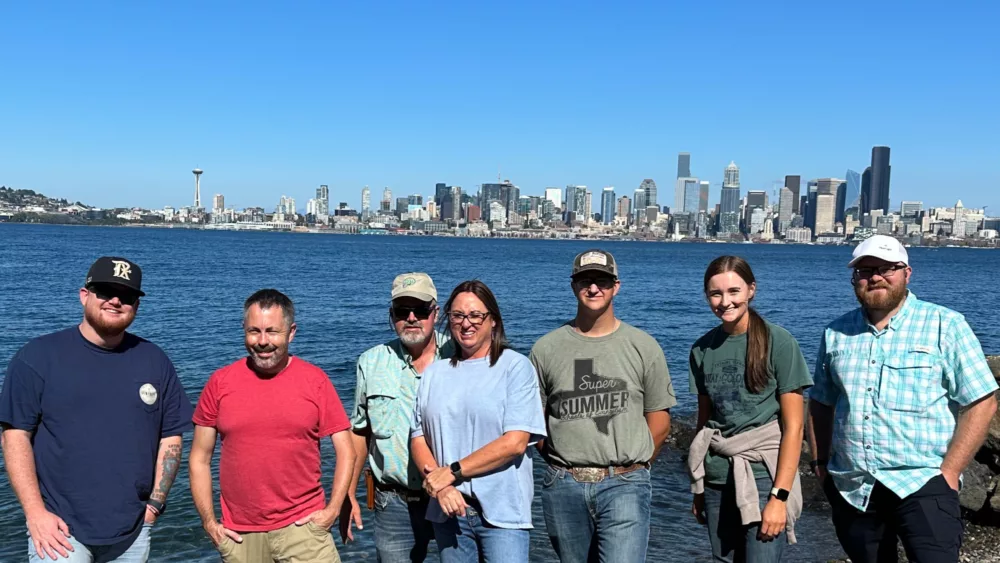
FBC Crosbyton’s first mission team sent to visit Bellevue, Wa., in 2023. (Courtesy Photo)

In January 2023, the congregation began sending financial support, then in September sent their first team to Seattle to “love and encourage” Shepel’s congregation.

The team attended a Ukrainian festival and did evangelism with Bellevue members.

In September 2024, First Baptist sent another team and invited a team from Bellevue to visit Crosbyton in hopes of making it an annual opportunity to “be molded by each other.”

“A lot of times we forget [how great God is] whenever we’re down in the rut, but getting outside of our own context opens our eyes to who God is and what he’s doing,” Davis said.

Partnering with Bellevue Bible Church has sparked “a burden for missions” within his congregation, Davis said. It led to more missions opportunities, such as serving with Texas Baptists’ River Ministry, a ministry that connects churches to projects along the Texas/Mexico border.

“It had been a while since we had sent a mission team anywhere, and so now the fact that we’re even talking about [it] was really exciting for the church, and [they had] all kinds of questions whenever we got back,” Davis said.

Davis recalled from his time in Pave, a Texas Baptist ministry that provides customized church revitalization training to pastors, being challenged to expand impact by using unique moments in the church strategically.

He leaned into that challenge to “expand their impact” with his congregation’s curiosity about the Seattle trips.

“[We showed] two videos of people who went on the trip talking about them [on] different weeks,” said Davis. “[Then] we just talked about it week after week after week and shared different elements of the trips that we took.”

“One of the coolest” moments from the two trips to Bellevue Bible Church was when a 15-year-old student shared his testimony of coming to know Jesus, then leading his mom, sister and best friend to Christ “within the next year.”

“You have people standing up and sharing their testimony in Ukrainian, and some of the brothers and sisters are translating for us in English. Then you have people from our church going up and sharing in English, and they’re translating into Russian for them,” he said.

“[But] no matter what language you speak or where you’re born, the whole room is weeping and praising God for it.”

Celebrating new life with a birthday party

Davis also is “expanding the impact” of how God is moving through the baptism strategy he learned in Pave.

He said Jonathan Smith, director of Church Health and Growth at Texas Baptists, introduced the idea of “stretching out” baptisms by promoting and emphasizing them on Sunday mornings.

First Crosbyton adopted this strategy and developed a unique way to celebrate each baptism.

“We announce and we promote the baptism a week before we have the baptism, and we put on the testimony video [before they are baptized].

“Then immediately after that service, we have a meal … We turned it into a little bit of a birthday party because I figured: ‘It’s a new life. It’s a new birth.’ So, we buy a birthday cake, and we put ‘Happy Baptism Day (whoever’s getting baptized)’,” Davis explained.

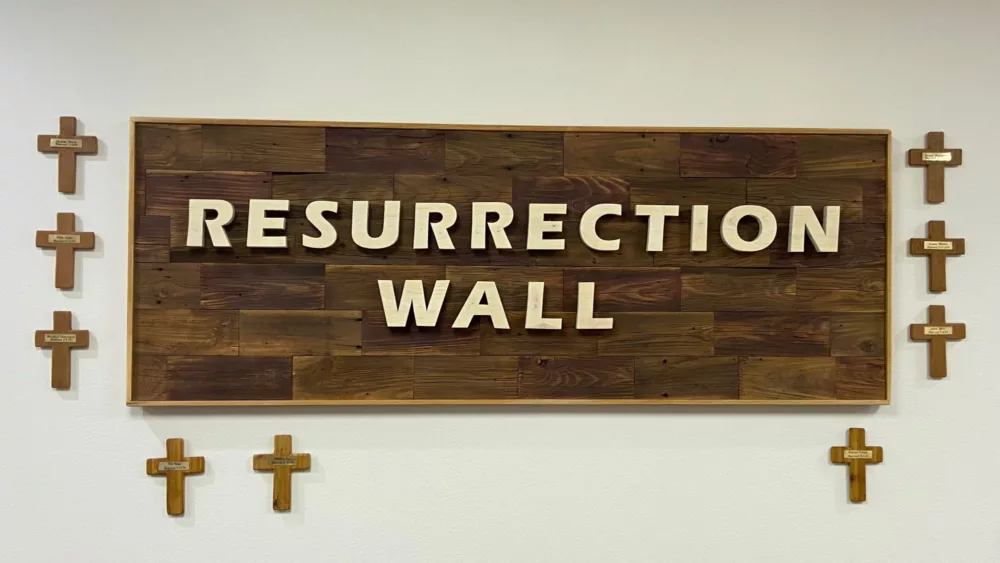
The Resurrection Wall

The Resurrection Wall (Courtesy Photo)

Each baptism is a “time of joy” for the church family, Davis said, but the celebration doesn’t stop there. The week following a baptism, the new believer gets a cross on the “Resurrection Wall.”

“[The Resurrection Wall sign] has so much symbolism in it. It’s made from scrap wood that had no use. … It’s stained dark to represent our sin.

 “And then in just pure white maple, untouched wood, is the word ‘Resurrection,’ and it’s like a 3D effect coming out of the darkness,” Davis said.

“[The church member who made it] was so upset when she made it, because those letters were pure white, [but] she couldn’t figure out how to cover up the nail holes. … And I was like: ‘No, don’t cover up the nail holes. That represents the nails that Jesus took for us [on the cross].’”

Evangelistic fervor and ‘almost 100 percent’ growth

Putting Pave training into practice has sparked “evangelistic fervor” in the church, Davis said.

The congregation has grown by “almost 100 percent in just over two years,” he noted.

Davis said the Pave principle, “if you can explain what you’re doing, God’s not the one doing it,” has become the banner of the church.

“We haven’t put a strategy in place for [evangelism]. People are just telling their friends about Jesus. They’re just inviting them to church.

“They’re choosing to spend time together outside of the church doing real life discipleship, having gospel conversations around the dinner table regularly,” Davis said. “That’s so beautiful.”


Sena se jubila después de seis décadas sirviendo a la comunidad cristiana hispana de la SBC

“Estoy profundamente agradecido por la vida fiel de servicio del Dr. Sena. Desde la iglesia local hasta un seminario nacional, los bautistas hispanos han tenido la bendición de contar con su liderazgo, influencia e impacto en nuestra comunidad. Oramos para que Dios bendiga su nueva etapa”, dijo Jesse Rincones, director de la Convención Bautista Hispana de Texas y presidente de la junta directiva de la Red Nacional Bautista Hispana (RNBH). Rincones reconoció y le entregó a Sena el Premio de Siervo de Gary Cook en 2021.

El Dr. Bob Sena ha sido un pionero e innovador a lo largo de sus muchos años de ministerio. Sirvió como plantador de iglesias misioneras en Nuevo México, como pastor principal en Texas y Georgia, fue asociado de evangelismo hispano en la Convención General Bautista de Texas, consultor nacional de evangelismo multiétnico de la Junta de Misiones Nacionales, consultor de relaciones hispanas del Comité Ejecutivo de la Convención Bautista del Sur (SBC), copresidente del Consejo Asesor Hispano del Comité Ejecutivo y, más recientemente, profesor y director del programa de español del Seminario Teológico Bautista Midwestern (MBTS), a la vez que asesoraba a líderes hispanos en Estados Unidos y en el extranjero.

“Nos ha acompañado, nos ha formado y nos ha recordado que nuestro llamado a servir a Dios es valioso y urgente. El Dr. Sena ha sido clave en el camino que hemos recorrido como bautistas hispanos”, dijo Ramón Medina, exalumno de Sena, quien pastorea a más de 3,000 hispanos en Champion Forest en Español en Houston, Texas.

Líderes hispanos de América del Norte, América Central, América del Sur y el Caribe consideran a MBTS como su lugar educativo, debido a la influencia de Sena en ellos de obtener una educación cristiana en un seminario de los Bautistas del Sur.

“Ha sido, y sigue siendo, una voz clara y comprometida entre los bautistas hispanos de Estados Unidos. No solo ha trabajado incansablemente para llevar el evangelio a nuestra comunidad con claridad y poder, sino que también ha invertido profundamente en las nuevas generaciones; ha moldeado nuestras vidas con su ejemplo, su fe y su visión. Con pasión, amor y paciencia, nos ha animado a prepararnos, a crecer, a creer que podemos servir a Dios con excelencia y fidelidad. Nos ha desafiado en el pasado, nos anima en el presente y su influencia se proyecta poderosamente hacia el futuro —añadió Medina—.

Después de seis décadas de servicio a la comunidad hispana bautista del sur, el Dr. Sena se retiró de su puesto ministerial de tiempo completo como Director del Seminario Teológico Bautista del Medio Oeste (MBTS), y será sucedido por el Dr. Arnaldo Achucarro, quien también se desempeñará como decano asistente del programa.

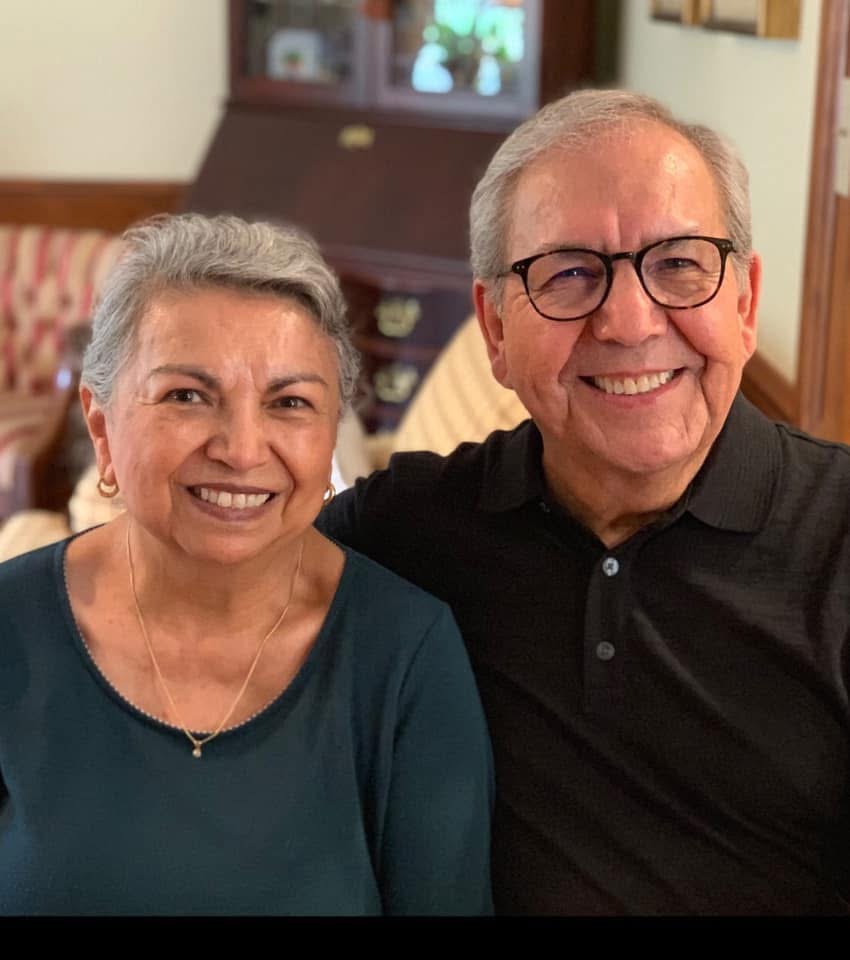
Bobby y Priscilla Sena (Baptist Press Photo)

Achucarro, nacido en Paraguay, dijo: “El Dr. Sena ha sido un gran mentor para mí… Tuve el privilegio de trabajar con él en la Oficina de Estudios Hispanos de MBTS, y ahí fue donde obtuve el mejor aprendizaje y pude aprovechar al máximo su combinación de sabiduría y experiencia ministerial. Para mí, es un gran líder y educador, pero también un gran siervo de Dios y, personalmente, un excelente amigo”.

Sena continuará como profesor de Ministerio en MBTS y siendo vicepresidente de la Junta Directiva de la Red Nacional Bautista Hispana (NHBN). “Estoy muy agradecido por las décadas de fiel servicio del Dr. Sena a los bautistas del sur y a través de ellos. Su fecundidad como pastor, líder denominacional, profesor de seminario y director del Programa de Español en el Seminario Midwestern ha impactado la vida de muchas personas y lo continuará haciendo por muchas futuras generaciones”, dijo el Dr. Bruno Molina, director ejecutivo de la NHBN.

“¡Gracias a Dios por el Dr. Bob Sena y su liderazgo visionario! Su ministerio y sus contribuciones educativas han impactado a la comunidad hispana al igual que a futuras generaciones”, dijo Gus Reyes, Director de Asociaciones Hispanas de la Universidad Bautista de Dallas (DBU).

Reyes y Molina le entregaron a Sena el Premio de Liderazgo de la NHBN, patrocinado por DBU, por su largo tiempo de excelencia en liderazgo entre los hispanos bautistas del sur, durante la celebración anual de la NHBN en Indianápolis el junio pasado.

Emanuel Roque, Catalizador Multicultural Hispano de la Convención Bautista de Florida, compartió: “El Dr. Bobby Sena siempre ha sido un líder perseverante durante décadas, abriendo camino para la obra de los bautistas hispanos del sur en este país y más allá. Su entusiasmo y visión por el crecimiento del reino nos ayudan y nos animan a mantener una actitud de expectativa y fe en lo que Dios puede seguir haciendo cuando nos unimos en la misión”.

“El es un ejemplo de liderazgo servidor a través de todo el país, buscando continuamente conexiones que faciliten y emprendan a los hispanos bautistas dentro de la gran familia de los bautista del sur, como parte integral de la Misión que todos tenemos juntos”, agregó Roque.

Al Sena promover la educación para todos, la Dra. Clara Molina comentó: “Cuando estaba a punto de rendirme y abandonar mi doctorado por problemas de salud, negocios y otros cosas, el Dr. Sena me dijo: ‘Ya habrá tiempo para todo lo demás. Las mujeres hispanas también necesitan una educación superior. Tú puedes abrir el camino para que otras hagan lo mismo, y algún día alabarás a Dios por haberlo logrado”.

Sena atribuye su disponibilidad para servir a Dios y a la comunidad bautista del sur a su esposa Priscilla. “Ha sido una maravillosa esposa, compañera de ministerio, madre y abuela. Llevamos 59 años casados. Ella ha dedicado su vida a la familia y al ministerio”, dijo Sena. Priscilla trabajó y se jubiló en el Departamento de Programas Federales y Especiales de las Escuelas Públicas del Condado de Gwinnett, Georgia.

Expresó su gratitud al Dr. Daniel Sánchez, Distinguido Profesor Emérito de Misiones del Seminario Teológico Bautista del Southwestern, por su mentoría y amistad durante los últimos 50 años. Ambos colaboraron, al igual que el Dr. Rudy González el subdirector del programa de Ph.D en español en MBTS, en el desarrollo de la Educación Cristiana Hispana en Estados Unidos y en muchos países latinoamericanos, incluyendo Cuba.

Sena se graduó de la Universidad Bautista Wayland, obtuvo una Maestría en Educación Religiosa del Seminario Teológico Bautista Southwestern y un Doctorado en Ministerio del Seminario Gateway (anteriormente Seminario Golden Gate). También fue coautor del libro Alcanzando a los hispanos en Norteamérica, como recurso para la plantación de iglesias.


Dan Patrick to chair Trump’s religious liberty commission

President Donald Trump named Texas Lt. Gov. Dan Patrick as chair of his administration’s newly created commission on religious liberty.

Trump signed an executive order establishing the religious liberty commission and announced Patrick’s appointment at a National Day of Prayer observance May 1 at the White House.

 “Americans need to be reacquainted with our nation’s superb experiment in religious freedom in order to preserve it against emerging threats,” the executive order stated.

The commission is tasked with producing “a comprehensive report on the foundations of religious liberty in America, strategies to increase awareness of and celebrate America’s peaceful religious pluralism, current threats to religious liberty, and strategies to preserve and enhance protections for future generations.”

“Key focus areas include parental rights in religious education, school choice, conscience protections, attacks on houses of worship, free speech for religious entities, and institutional autonomy,” a White House fact sheet stated.

A White House statement announcing Patrick’s appointment touted his leadership in the Texas Senate, “passing legislation to end the teaching of critical race theory in public schools, abolish DEI practices in our universities, place ‘In God We Trust’ in the Texas Senate, and add ‘Under God’ to the state pledge of allegiance.”

Recently, Patrick spearheaded Gov. Greg Abbott’s education savings account plan to send public funds to private schools, including religious schools. He also strongly supported a bill to mandate the display of a prescribed version of the Ten Commandments in every Texas public school classroom.

Return to ‘founding principles’

Patrick issued a public statement saying he was honored to be selected to chair a commission “comprised of some of the foremost faith leaders, scholars and thinkers of our time.”

“We will carry out the president’s important mission to preserve and strengthen religious liberty in our country,” Patrick stated. “I thank President Trump for his steadfast commitment to ensuring our nation returns to our founding principles of faith and religious liberty.”

Ben Carson, a pediatric neurosurgeon and Secretary of Housing and Urban Development during the first Trump administration, was named vice chair of the commission.

Televangelist Paula White, senior adviser to the White House Faith Office, also was named to the commission, along with other outspoken Trump supporters evangelist Franklin Graham of Samaritan’s Purse and Eric Metaxas, author and radio host.

Others commissioners are Ryan Anderson, president of the Ethics and Public Policy Center and a teaching fellow at the University of Dallas; Bishop Robert Barron of the Winona-Rochester Diocese in Minnesota; author Carrie Prejean Boller, former Miss California USA; Cardinal Timothy Dolan, archbishop of New York; attorney Allyson Ho; psychologist and television personality Phil McGraw; Kelly Shackelford, president and CEO of the First Liberty Institute in Plano; and Rabbi Meir Soloveichick of Congregation Shearith Israel of New York.

‘All about advancing Christian nationalism’

“This commission is not about religious liberty, but about advancing Christian nationalism,” said Rachel Laser, president and CEO of Americans United for Separation of Church and State.

“True religious freedom requires equality among religions and between religion and nonreligion in the eyes of the law and at every level of our government. Trump clearly designed this commission to favor conservative Christians, especially those who want to use the power of our government to impose their religion on others.”

Laser asserted the commission is “all about advancing Christian nationalism.”

“Chairman Patrick has frequently claimed that America is a ‘Christian nation,’ and his actions repeatedly show a desire to impose his personal religion on all Americans using the machinery of the state—a gross violation of our religious freedom,” she said.

“True religious freedom means we each have the right to live as ourselves and believe as we choose, so long as we don’t harm others. This commission makes a mockery of religious freedom.”


Hispanic Baptist ministry trailblazer Bobby Sena retires

(KANSAS CITY, Mo.)—Bobby Sena, a trailblazer in Hispanic ministry in the SBC, is retiring.

Sena’s many roles include missionary church planter in New Mexico, senior pastor in Texas and Georgia, Hispanic evangelism associate at the Baptist General Convention of Texas and national multi-ethnic evangelism consultant for the Home (now North American) Mission Board.

He also was Hispanic relations consultant to the Southern Baptist Convention Executive Committee, co-chair of the Hispanic Advisory Council for the SBC Executive Committee and, most recently, professor and director of the Spanish-language program at Midwestern Baptist Theological Seminary.

He held all these roles while mentoring Hispanic leaders in the United States and abroad.

“I am so grateful for Dr. Sena’s life of faithful service. From the local church to a national seminary, Hispanic Baptists have been blessed to have his leadership, influence and impact in our community,” said Jesse Rincones, director of the Convención Bautista Hispana de Texas and chairman of the board for the National Hispanic Baptist Network.

“We pray God’s great blessings on his new season.”

Ramon Medina is a former student of Sena’s who pastors more than 3,000 Hispanic believers at Champion Forest en Español in Houston.

“He has accompanied us, formed us and reminded us that our calling to serve God is valuable and urgent,” Medina said of Sena. “Dr. Sena has been a key part of the journey we have taken as Hispanic Baptists.”

Hispanic leaders across North America, Central America, South America and the Caribbean claim Midwestern Baptist Theological Seminary as their alma mater because of Sena’s mission to help people get a Christian education at a Southern Baptist seminary.

“He has been, and continues to be, a clear and committed voice among Hispanic Baptists in the United States,” Medina said. “Not only has he worked tirelessly to bring the gospel to our community with clarity and power, but he has also invested deeply in the new generations [and] shaped our lives with his example, his faith and his vision.

“With passion, love and patience, he has encouraged us to prepare, to grow, to believe that we can serve God with excellence and faithfulness. He has challenged us in the past, encourages us in the present, and his influence projects powerfully into the future.”

Six decades of service

After six decades of service to the Southern Baptist Hispanic community, Sena retired from his full-time ministry position at Midwestern Baptist Theological Seminary.

Bobby and Priscilla Sena (Baptist Press Photo)

He will be succeeded by Arnaldo Achucarro, who will also serve as assistant dean of the program.

Achucarro, born in Paraguay, said: “Dr. Sena has been a great mentor to me. … I had the privilege of working under him in the Spanish studies office at MBTS, and that’s where I learned the most from him, as I was able to make the most of his blend of wisdom and ministerial experience.

“For me, he’s a great leader and educator, but he’s also a great servant of God and, personally, an excellent friend.”

Sena will continue serving as professor of ministry at Midwestern Baptist Theological Seminary and as vice chairman of the board of directors for the National Hispanic Baptist Network.

Bruno Molina, executive director of the network, expressed his gratitude for Sena’s “decades of faithful service to and through Southern Baptists.”

“His fruitfulness as a pastor, denominational leader, seminary professor and director of the Spanish language program at Midwestern Seminary has impacted the lives of so many and will continue to do so for generations to come,” Molina said.

Molina, along with Gus Reyes, director of Hispanic Partnerships at Dallas Baptist University, presented Sena with the network’s Leadership Award, sponsored by DBU, for his longtime excellence in leadership among Hispanic Southern Baptists, during the network’s annual celebration in Indianapolis last June.

“Thank God for Dr. Bob Sena and his visionary leadership,” Reyes said. “Dr. Sena’s ministry and educational contributions impact the Hispanic community today as well as in future generations.”

Emanuel Roque, Hispanic multicultural catalyst for the Florida Baptist Convention, said Sena’s enthusiasm and vision were inspiring.

“He is an example of servant leadership across the country, continually seeking out connections that facilitate and empower Hispanic Baptists within the greater Southern Baptist family as an integral part of the mission we all share together,” Roque said.

Sena attributes his availability to serve God and the Southern Baptist community to his wife Priscilla.

“She has been a wonderful wife, ministry partner, mother and grandmother,” he said. “We have been married for 59 years. She has devoted her life to family and ministry.”

Priscilla is retired from the Department of Federal and Special Programs Gwinnett County Public Schools in Georgia.

Sena expressed gratitude to his ministry partners, including Daniel Sanchez at Southwestern Baptist Theological Seminary and Rudy Gonzales at Midwestern Seminary, who helped him develop Hispanic Christian education in the United States and in many Latin American countries, including Cuba.

Sena graduated with a bachelor’s degree from Wayland Baptist University, received a Master of Religious Education degree from Southwestern Seminary, and a Doctor of Ministry from Gateway Seminary (formerly Golden Gate Seminary).

He also coauthored the book Reaching Hispanics in North America as a church-planting resource, and he prepared MBTS Español to educate the next generation of Hispanic leaders.


International missionaries face new restrictions in China

BEIJING (BP)—The Chinese Communist Party enacted new restrictions on foreign missionaries there May 1, preventing them from preaching, evangelizing and establishing various religious organizations among other activities without official government approval.

Establishing schools, appointing clergy, using the internet to conduct illegal religious activities and producing, selling or distributing Bibles and religious audio-visual products are among activities punishable by law for foreigners and Chinese nationals that aid them, according to the rules posted online by China’s National Religious Affairs Administration.

The rules are among the latest in the Communist nation’s drive to Sinicize Christianity and other religions under the leadership of President Xi Jinping. The Chinese Communist Party cited national unity in justifying the rules.

State-run churches, such as the Protestant Three Self Church and the Chinese Catholic Patriotic Association, are tightly controlled.

Human rights and religious liberty violations noted

China is one of the most severe state persecutors of Christians and other religious groups, requiring clergy to pledge allegiance to the Chinese Communist Party and socialism, resist certain religious activities and extremist ideology and resist infiltration by foreign forces using religion.

The U.S. State Department annually names China as a Country of Particular Concern for egregious religious freedom violations, and the 2025 Open Doors’ World Watch List ranks China as 15th among the 50 worst places for Christians to live, citing Communist and post-Communist oppression.

Under Xi’s Sinicization, the Chinese Communist Party allows five organized religions and tightly controls all aspects of them, including their houses of worship, beliefs, activities, leadership, language and even how the adherents dress, according to a September 2024 factsheet from the U.S. Commission on International Religious Freedom.

“Enforcement of such Sinicization policies has consistently resulted in systematic, ongoing, and egregious violations of religious freedom and related human rights, including genocide, crimes against humanity, mass incarceration, enforced disappearances and the destruction of cultural and religious heritage,” USCIRF wrote in “Sinicization of Religion: China’s Coercive Religious Policy.”

In April, the Chinese Communist Party-sanctioned China Christian Council and the National Committee of the Three-Self Patriotic Movement announced the upcoming publication of the book Sinicization of Christianity, China Aid announced.

The book is marketed as emphasizing harmony with Chinese culture and socialist society, China Aid reported, but is seen as a tool in the implementation of Xi’s “Five-Year Work Plan for Further Advancing the Sinicization of Christianity (2023–2027).”


Study links flourishing to religious service attendance

An international survey reveals a strong correlation between regular attendance at religious services and higher levels of individual flourishing.

The link between well-being and regular attendance at religious services was among the key insights gleaned from the first wave of data released April 30 from the Global Flourishing Study.

The study is a collaborative research project carried out by Baylor University’s Institute for Studies of Religion, the Human Flourishing Program at Harvard University, Gallup and the Center for Open Science.

Launch of Baylor Institute for Global Flourishing

In conjunction with the release of the first round of data, Baylor University announced the launch of its Institute for Global Flourishing, an initiative university officials said aligns with the university’s Pro Mundo (for the world) vision and its Baylor in Deeds strategic plan.

Byron Johnson

“I am grateful that Baylor’s mission aligns so perfectly with the bold vision to launch the Institute for Global Human Flourishing,” said Byron Johnson, inaugural director of the Institute for Global Human Flourishing, co-principal investigator of the Global Flourishing Study and current director of the Institute for Studies of Religion.

“This extraordinary commitment positions Baylor to be a leader not only in advancing scientific knowledge via the Global Flourishing Study and related research, but it will also provide the infrastructure to offer much needed resources and tools to support the application of this knowledge to power a global flourishing movement.”

Creating the Institute for Global Flourishing advances Baylor’s “vision of human flourishing that is evidence-based, practical, faith-animated and inspirational,” said Provost Nancy Brickhouse.

“The Institute for Global Human Flourishing is uniquely positioned to serve as a catalyst for transformative impact on individuals and communities, while also engaging students, alumni, faculty, staff, Texas and the world in a shared pursuit of human flourishing, fostering a life of purpose, well-being and meaningful contribution,” Brickhouse said.

First round of data offers insights

The five-year, longitudinal Global Flourishing Study involves about 200,000 individuals in more than 20 countries, representing 45 languages.

Researchers measure global human flourishing across six domains including happiness and life satisfaction, physical and mental health, meaning and purpose, character and virtue, close social relationships, and financial and material stability.

“The first round of findings from the study showed attendance at religious services appears to be an important element related to flourishing across almost all countries,” the report “What Contributes to a Life Well-lived?” states.

“Attendance is generally associated with greater flourishing, even after controlling for other well-known predictors.”

In most countries, the report notes, the positive relationship between flourishing and attendance at religious services is more prevalent than between flourishing and civic participation.

“A statistically significant positive relationship exists between flourishing and religious service attendance in 21 out of 23 countries and territories, compared with 15 out of 23 between flourishing and civil society participation,” the report states.

About 50 Global Flourishing Study researchers spent the past year gleaning insights from the first wave of data.

In addition to the correlation between flourishing and attendance at religious services, they identified two other key insights.

  • Global differences in flourishing: The study revealed many middle-income developing countries were doing better in terms of meaning, purpose and relationships than the richer developed world. Countries like Indonesia, Mexico and the Philippines fared particularly well, while other nearby countries like Japan, Turkey and the United Kingdom did not.
  • Younger generations lagging:The study revealed younger people appear to be not doing as well as older people when compared to the generations that came before them. Flourishing tends to increase with age in many countries including Argentina, Australia, Brazil, Germany, Mexico, Spain, Sweden, the United Kingdom and the United States. Many the youngest age group (18- to 24-year-olds) reported the lowest levels of flourishing.

Based in part on information provided by Lori Fogleman of Baylor University Media and Public Relations.