LGBT advocacy group plans protest at SBC meeting

PHOENIX (BP)—An advocacy group seeking to have homosexuality and transgenderism “removed from the sin list” announced plans to “politely disrupt” the Southern Baptist Convention annual meeting June 13-14 in Phoenix.

Faith in America hopes to persuade the nation’s largest Protestant denomination to change its interpretation of Scripture, the organization said in a press release. The statement accused the SBC of marginalizing and harming lesbian, gay, homosexual and transgender children in particular.

Leaders invited to meet in Nashville

Faith in America requested a Phoenix meeting with SBC leaders, who offered instead to receive the group’s representatives in Nashville after the Phoenix convention. Offering to meet with the organization’s representatives in Nashville is not an indication of compromise, but rather an opportunity to share the gospel, said Frank Page, president of the SBC Executive Committee.

“I am always delighted to share the truths of the gospel with anyone who wishes to meet with me,” Page said. “Scripture predicts a time when people will stray from biblical truth. We are saddened when we encounter erroneous teaching and pray for a return to biblical faithfulness.”

In written comments, the Southern Baptist Ethics and Religious Liberty Commission reiterated Christians are encouraged to share Christ’s love with all people, including LGBT youth and adults.

“As gospel Christians who believe that every human being is made in the image of God, Southern Baptists have stood for the dignity of all human persons for decades,” said ERLC President Russell Moore. “At the same time, we cannot and we will not ignore the teachings of Jesus himself, as some would wish Southern Baptists and others to do.

“To minimize or adjust a Christian sexual ethic would be to abandon the very message Jesus handed to us, and we have no authority to do this. As Baptists, we want to be the first to be known by our love and compassion to those in the world around us, but we also must hold fast to the ‘faith which was once for all delivered to the saints’ (Jude 1:3).”

‘A historic moment’

Faith in America announced details of its Phoenix plans in a May 31 news release. Medical professionals, clergy, homosexual country music performer Ty Herndon, founders of the Tyler Clementi Foundation and others plan to engage SBC messengers in conversations about the plight of LGBT children, the group said.

Billboard advertising throughout Phoenix will proclaim Faith in America messages, and “a robust social media campaign” will take place throughout the SBC annual meeting, the group said.

“This is an historic moment and we, at Faith in America, are taking action,” Co-founder and Co-chair Mitchell Gold said. “This is not about conflict and division. It is about speaking the truth and standing up for our kids and teens being hurt. It is also about finding common ground around our children and youth.”

Respond with cordiality

SBC Executive Committee representative Roger Oldham expressed optimism the Faith in Action activities will be conducted lawfully and its representatives responded to cordially.

“We anticipate representatives of FIA will abide by the city of Phoenix’s guidelines for their planned assembly,” said Oldham, the Executive Committee’s vice president for convention communications and relations. “We also anticipate that messengers to the SBC annual meeting who choose to participate in conversations with representatives of FIA will do so with the same cordial spirit of Christian witness they have shown in similar settings in times past.”

Pro-LGBT advocacy groups have protested at previous SBC annual meetings, including outcries in 2000–2002, and in 2011 when the event was last held in Phoenix.

SBC on record

Southern Baptists have affirmed in many resolutions the application of Scripture regarding homosexual lifestyles and the church’s proper treatment of those who engage in LGBT lifestyles, Oldham noted.

“Southern Baptists are on record opposing bullying of any kind, including those who struggle with sexual identity issues,” he said. “We believe all people bear the image of God and should be treated with dignity and respect. We also believe God’s image in us has been marred by sin and is only restored when we enter a saving relationship with God through Jesus Christ as Lord.”

Most recently, SBC messengers stated those beliefs in a resolution, “On Biblical Sexuality And The Freedom Of Conscience,” approved at the 2016 SBC annual meeting in St. Louis, Mo.

Among the resolution’s many affirmations are “we reiterate our love for our neighbors who identify as transgender, seek their good always, welcome them to our churches, and, as they repent and believe in Christ, receive them into church membership (2 Corinthians 5:18–20; Galatians 5:14),” and “we applaud and encourage our brothers and sisters who struggle with gender identity or same-sex attraction, but who have chosen holiness and God’s design instead (Romans 3:23; 1 Corinthians 6:11).”

Additionally, a 2014 SBC resolution condemns “acts of abuse or bullying committed against” transgender individuals in particular.

Faith in America identifies itself as a nonprofit group founded in 2006 “to end decades and centuries of using religious teachings to justify marginalizing and discriminating against others,” and is “dedicated to influencing media and faith community narratives on religion and sexuality.”


50 years after the Six-Day War, Israeli Jews reflect on the victory

JERUSALEM (RNS)—Ron Kronish was an American college student when Israel defeated the Egyptian, Syrian and Jordanian armies during the 1967 Six-Day War.

Israel marked the war’s 50th anniversary June 5, and the conflict had a profound effect on many Israeli and Diaspora Jews that is felt until this day.

Jews—as well as many Christians—viewed Israel’s capture of East Jerusalem and the West Bank from Jordan as a kind of miracle. Israel had beaten three much larger countries and, for the first time in 2,000 years, Jewish holy sites were in Jewish hands.

But the war—which also saw the capture of the Golan Heights, Gaza and the Sinai—displaced up to 325,000 Palestinians. Now, an estimated 2.5 million refugees and their descendants live in the West Bank; Israel has relinquished the Sinai and the Gaza Strip.

Victory made Jewish identity ‘very Israel-centric’

For Kronish, now 70 and a Reform rabbi dedicated to interreligious peace building, Israel’s lightning victory over its hostile neighbors “was life-changing. It made our Jewish identity very Israel-centric.”

Until then, Kronish said, young American Jewish activists largely were preoccupied with the Vietnam War and the American civil rights movement.

“I was caught up in the victory, I felt that history was happening, and I wanted to be part of it,” Kronish said. As it did for tens of thousands of other North Americans, the war spurred him to move to Israel, albeit several years later.

Inspiration to persecuted Jews

The war, which reunited the eastern and western parts of Jerusalem, also inspired Jews being persecuted in what was then the Soviet Union to fight for the right to emigrate and freely practice their religion.

“When the soldiers of the Israel Defense Forces broke through the gates of Jerusalem’s Old City, they also punched a hole in the Iron Curtain, inspiring us Soviet Jews to start our struggle for freedom,” recalled Natan Sharansky, a former Soviet refusenik and current chairman of the Jewish Agency for Israel.

“This struggle, supported by Jews around the world, ultimately brought down the Iron Curtain and enabled a million (Soviet) Jews to come home to Israel,” Sharansky said.

North American immigration, though far more modest, jumped from 739 people per year in 1967 to 8,100 in 1969, for example.

‘A watershed moment’

Sara Yael Hirschhorn, whose new book City on a Hilltop explores why thousands of North American Jews decided to settle in the West Bank in the aftermath of the Six-Day War, said the war was “a watershed moment for American Jewry, emotionally, intellectually and spiritually.”

Jews in Israel and abroad watched in dread as Egyptian, Syrian and Jordanian troops amassed on Israel’s borders in May 1967 and viewed Israel’s victory as a “modern-day miracle, something that prevented a second Holocaust,” Hirschhorn said.

The Americans who moved to the West Bank—she estimates 15 percent of Jewish settlers are American citizens—viewed the captured territory “as the unconquered or newly conquered frontier, and they wanted to be pioneers. They felt that founding a settlement was taking an active role in their realization of Jewish and Zionist aspirations.”

Two kinds of Israelis

Yossi Klein Halevi, a senior fellow at the Shalom Hartman Institute and author of Like Dreamers, which examines the divergent ideologies that have shaped Israel since the Six-Day War, said the war created two kinds of Israelis:

“There are the ones whose primal memory of May 1967 is the sense of existential fear, aloneness and the world’s abandonment. Then there are the June 1967 Israelis whose primary experience from the war was one of empowerment and who insist that Israel needs to take responsibility for the moral consequences of power.”

In practice, Halevi said, most Israelis have elements of both sensibilities, and the political debate over whether to relinquish the land Israel captured during the war “is often between which of these experiences is more powerful today.”

“Are we as a people still existentially threatened or under siege or a people who know unprecedented power and face agonizing moral dilemmas vis-à-vis the Palestinians? My answer to both questions is yes,” Halevi said.

What makes the debate so difficult is that Israel still faces long-term threats from Iran, Hezbollah, Hamas and ISIS, Halevi said, noting that “there are hundreds of thousands of rockets and missiles aimed at Israeli cities.”

On the other hand, the political “disintegration” of much of the Middle East “has ended any credible conventional threat to Israel, and growing numbers of Arab leaders are looking to Israel to defend the Sunni world against Iranian expansionism,” Halevi said.

Moral questions

Yisrael Medad, an American-born settler activist and resident of the West Bank settlement of Shilo, believes there is no contradiction between living on land Israel captured in 1967—most of which the Palestinians claim as their own—and Jewish moral values.

Shilo was a Jewish town in biblical times, “and if the Arabs refuse to make peace, refuse to negotiate, they are the ones who are immoral,” Medad said.

The biblical land of Israel “is our homeland, and it was the Arabs who, between 1920 and 1948, ethnically cleansed the Jews who lived in Jerusalem, Gush Etzion, Hebron and Gaza. People forget that chapter of history,” Medad said.

Decades after the Six-Day War, Kronish—who lives in Jerusalem, reared his children here and now is mostly retired—said he was “naïve and enthusiastic” when he immigrated in 1979.

“I didn’t think about the consequences of what it would mean to rule over another people,” he said. “What it would mean to have a proper democracy. What it was going to do to our morals and ethics. It wasn’t uppermost in my mind.”

Which is not to say he regrets having moved to Israel.

“I feel generally positive about Israel. It’s my home. My disenchantment in recent years comes from the failure of the governments of Israel to seriously seek peace with our neighbors. I would be happy if the Palestinians were prepared to make similar painful compromises.”

Moving to Israel “has made it possible for me to contribute to peaceful relations between people of different faiths. I still believe peace is possible,” Kronish said.

Michele Chabin is Jerusalem correspondent for Religion News Service.


Embrace hope in an age of cynicism, former congressman urges

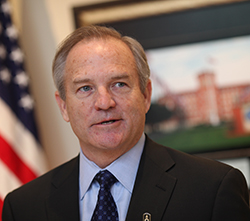
WACO—Cynicism damages public discourse and threatens the political process, but hope offers greater power, former Congressman Chet Edwards told the Civic Life Summit at Baylor University.

“Cynicism is a powerful and a destructive force,” said Edwards, a Democrat who represented a predominantly Republican Central Texas district in the U.S. Congress 20 years. “It can suck the energy out of an individual, a community and—yes, even now—the country.

Chet Edwards 250“If unchecked, cynicism can spread like a virus, killing all that is good in its path—faith, hope and love. It can rob us of the belief that one can make a difference and that ‘we the people’ can make a difference in our democracy. And like the massive black holes of outer space, cynicism if gone to its extreme can literally turn light into darkness.”

The loss of hope in upward mobility, the loss of faith in fundamental institutions and the loss of trust in elected officials all represent evidence of cynicism, Edwards told the summit, convened by Baylor’s Public Deliberation Initiative.

Yielding to the ‘siren song of cynicism”

“In the face of the political and social challenges we face in our country today, cynicism can be a temptation for all of us, regardless of our political or social views,” he said. “It is the path of least resistance. It is the easy course to take—an excuse for giving up, for not voting, for not trying to make a difference anymore.”

Edwards, who holds the W.R. Poage Distinguished Chair in Public Service at Baylor, acknowledged he easily could have surrendered to the “siren song of cynicism” in 2008 when, after he endorsed Barack Obama’s bid for the presidency, his district office was “deluged by racist, bitter, bigoted calls.”

Likewise, Edwards called the 2016 presidential election “a body blow to my hope for the future of our country,” citing a list of well-publicized remarks by then-candidate Donald Trump that initially made his election seem unthinkable.

“While I detest the politics of fear and division, I have come to accept that is it wrong to assume that most people who voted for Mr. Trump did so out of racial bigotry,” he said. “I have more faith in the American people than that.

“While, sadly, there are still too many whose votes, politics and views are influenced by bigotry and race, I believe most voters voted for Mr. Trump for one simple reason: They believed our political system is broken, which it is, and they wanted to try to change it, to see if they could make it better.”

Although he described recent presidential campaigns as “blood sport,” Edwards cited quotations from the 1800 presidential race between John Adams and Thomas Jefferson to illustrate vitriolic political rhetoric is nothing new.

‘Never give up our hope for a better future’

In spite of cynics who have predicted catastrophe in the United States if their candidate did not prevail in an election, the republic has endured and thrived, he noted.

“We are a people who never give up our hope for a better future,” Edwards said.

In every generation, some people strive to reach the highest ideals expressed in the Declaration of Independence and the Bill of Rights to the U.S. Constitution, he said. The nation’s hope rests in people who recognize the country’s imperfections but work to make it “a more perfect union,” he insisted.

Edwards challenged summit participants to follow the admonition of Martin Luther King Jr., who said, “We must accept finite disappointments but never lose infinite hope.”

Make a difference

In 28 years of public service—first in the Texas Senate and then in the U.S. House of Representatives, Edwards said, he saw examples of goodness and courage as ordinary people worked to make others’ lives better.

“We are blessed to live in a country where one person can make a difference,” he said.

The belief that each individual finds meaning and purpose in helping improve the lives of others is “for many of us, part of our faith (and) for all of us, part of our DNA,” he insisted.

“In my faith, the calling to ‘love thy neighbor’ is not a calling to have good feelings about one’s neighbor. It’s a call to action,” said Edwards, a longtime Methodist who regularly attends Calvary Baptist Church in Waco and McLean Baptist Church in McLean, Va.

He pointed to the example of John Lewis, the Civil Rights leader who has served in the U.S. Congress since 1987, and read a passage from Lewis’ memoir, Walking with the Wind.

Lewis described a childhood experience when he and 14 other young relatives sought shelter in an aunt’s house during a violent storm. When winds threatened to lift the house off its piers, his aunt told the children to clasp hands and walk to the corner that needed reinforcement to weigh it down.

In his book, Lewis compared that incident to times in U.S. history when storms rocked the country but “people of conscience never left the house.” Instead, he said, they clasped hands and moved toward the weakest corner of the house.

Edwards challenged the Civic Life Summit participants to accept Lewis’ invitation to embrace hope and “make our community a more beloved community and our nation a more perfect union.”


Address ‘wicked problems,’ don’t see ‘wicked people’

WACO—Communities can overcome challenges and bridge divisions when they focus on addressing “wicked problems” instead of seeing individuals with different viewpoints as “wicked people,” a Colorado-based expert in communications studies and deliberative democracy told the Civic Life Summit at Baylor University.

“We have to change the conversation,” Martin Carcasson, founding director of the Center for Public Deliberation at Colorado State University, told the conference, convened by Baylor’s Public Deliberation Initiative. “We need to change the game, not just play a bad game better.”

Tame problem vs. wicked problems

Carcasson drew on the distinction between “tame problems” and “wicked problems,” as professors Horst Rittel and Melvin M. Webber formulated them more than 40 years ago. “Tame problems” are technical in nature and can be solved by experts using scientific means, he explained.

“Wicked problems inherently involve competing underlying values, paradoxes and tradeoffs that cannot be resolved by science,” he said. “Wicked problems are systemic and interconnected.”

Because wicked problems demand adaptive change instead of technical fixes, they require public involvement in the deliberative process, he insisted.

“Wicked problems require creativity, innovation and imagination,” he said.

Instead of adopting an adversarial approach to public communication about problems or reliance on experts to solve problems that defy technical solutions, Carcasson advocated deliberative democracy.

“Good data is undermined in a polarized environment,” he said. “An overly adversarial process plays into the flaws of human nature.”

Deliberative engagement provides a helpful process

Rather than seeing every problem as a struggle between good versus evil, Carcasson encouraged his audience to consider a process that recognizes citizens often hold competing good values.

Martin Carcasson 125Martin CarcassonDeliberative engagement provides a process that encourages the development of mutual understanding, builds trust and respect, facilitates the refinement of opinions and creates the potential for creative collaboration, he insisted.

Using a facilitator to guide discussions, “citizens come together and consider relevant facts and values from multiple points of view,” he explained.

Deliberative engagement offers tools to encourage people to listen, think critically about options, recognize underlying tensions, consider consequences and agree upon collaborative action, he said.

“We can overcome our bad tendencies and build better habits, particularly at the local level,” he insisted.

Make tough choices together

In a breakout session on public deliberation, John Ritter and Erin Payseur emphasized the importance of moving beyond “either/or” choices and adopting a process that encourages discovery of common ground.

PDI 250“Deliberation is making tough choices together,” said Ritter, assistant director of spiritual formation at Baylor
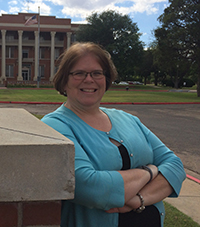
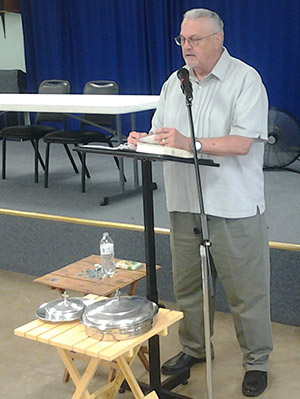
The process requires participants to possess both convictions and humility, he emphasized. Convictions without humility lead to fanaticism, while humility without conviction creates indecision and the inability to arrive at a solution, he said.

Payseur, associate director of civic learning initiatives at Baylor, described the importance of a guide to “name and frame” the conversation, help participants wrestle with issues and move forward to positive actions.

Public deliberation offers participants an opportunity to put names and faces to different perspectives, Ritter and Payseur stressed.

Recognize ‘wonderful opportunities’ for change

In a breakout session on deliberative work and church life, Gaynor Yancey affirmed the process of deliberation but took issue with the language of “wicked problems.”

“If we see a problem as wicked, we’re probably not doing our best work there,” said Yancey, director of Baylor’s Center for Family and Community Ministries.

Instead, churches should see so-called “wicked problems” as “wonderful opportunities” for meaningful change by building on strengths, she insisted.


Cross the bridge from consumer to creator of community

WACO—Civic engagement involves “crossing the bridge” from being a consumer of what a community offers to a creator of what it has the potential to become, a Waco-based community activist told the Civic Life Summit at Baylor University.

Creators of community operate in “a lively state of optimistic discontent,” Ashley Bean Thornton, senior director for informed engagement and continuous improvement at Baylor, told the summit, convened by the university’s Public Deliberation Initiative.

“Whatever else we are … we are all citizens,” she said. “We are responsible for building the kind of community and world that we want.”

Thornton, chair of the Poverty Solutions Steering Committee named by the Waco City Council and a leader of Act Locally Waco, acknowledged when she was growing up, her involvement in volunteer community service was limited to helping with Vacation Bible School at church or participating in an occasional mission trip.

“I was a terrible Campfire leader and was the world’s worst Big Brother/Big Sister mentor,” she confessed.

Change in perspective

She gained a new perspective in August 2006 when she accompanied a group from Lake Shore Baptist Church in Waco to a Passport camp for students in New Orleans. As part of the missions camp, teenagers participated in helping residents clean their homes and neighborhoods a year after Hurricane Katrina.

“It was the biggest mess I had ever seen and ever hope to see,” she said.

The group with whom she worked noted New Orleans’ wealthy residents had recovered from the hurricane and resultant floods, and middle-income residents made significant progress toward recovery. But for the poor, “the hurricane might as well have been last week,” she said.

However, one high school student voiced an observation that changed her perspective: “We have poverty just as bad in Waco.”

When she returned home, she began to research her city’s poverty rate and discovered the truth in the student’s comment. Although she acknowledged lacking the spiritual gifts of mercy and compassion, Thornton said her discovery “offended my sense of how systems should work.”

She began to attend meetings of various community-improvement organizations and social service agencies, and she eventually even ran an unsuccessful campaign for a seat on the city council.

Along the way, she made another discovery.

“We are at our happiest when we are working on something meaningful and doing it with other people,” she said.

Thornton offered suggestions for becoming engaged in civic life:

  • “Start to talk like a creator.” Instead of focusing on what “they” are not doing in a community, claim ownership by speaking of “we” and “I.”
  • “Start working on a personal vision of the community you want to live in.”
  • “Find others who care about what you care about.”
  • “Get in the game in some small way. … Then get involved to the point where it is aggravating.” Begin by giving a small donation or volunteering on a limited basis. Then move beyond “the point of feeling good to doing good.” Evaluate whether involvement is moving the community toward one’s personal vision of what it needs to become.
  • “Take the time to appreciate the people who are already involved and working.” Value the contributions of other people who are building the community in different ways.

She also emphasized the importance of moving outside one’s usual circles of acquaintance to have meaningful conversations with other people in the community. That may just mean sharing social activities or enjoying walks together, she noted.

“Everything doesn’t have to be about saving the world,” she said. “Part of saving the world is just getting to know each other.”


BGCT gift benefits addiction recovery center at Baylor University

WACO—A financial contribution from the Baptist General Convention of Texas will support Baylor University’s recently created Beauchamp Addiction Recovery Center.

The convention made the gift from its Thomas Meeker Fund. A portion of the endowment is designated for programs that address issues related to substance use disorders.

“When we learned about the Beauchamp Addiction Recovery Center being established at Baylor, we felt a gift to support its work would be a confirmation of our institutions’ mutual core values. Therefore, we are very happy to provide these additional resources to help students,” BGCT Executive Director David Hardage said.

Will help student life, spiritual life initiatives

The gift will enable the Beauchamp Addiction Recovery Center staff to educate Baylor’s student life staff on addiction and collegiate recovery and support efforts to improve recovery ministry education for Baylor’s ministry guidance students.

The funds also will be used to help create a recovery prayer project and worship services in conjunction with spiritual life and to improve the recovery library available to students at the addiction recovery center.

The BGCT gift also will help in September when Baylor observes National Recovery Month in a variety of ways on campus.

‘Stigma grows when we don’t speak honestly’

“It’s so important for our students to know that they’re not alone in recovery,” said Lilly Ettinger, recovery program coordinator in Baylor’s department of wellness. “Stigma grows when we don’t speak honestly about the struggles in our community. Everyone is affected by addiction, and we all have a responsibility to help.

“The BGCT’s support will help us continue to talk about the effects of alcohol use disorders, substance use disorders and the blessings of recovery. The support of alumni and donors is absolutely crucial here.”

Hardage emphasized the gift for the addiction recovery center grows out of Texas Baptist churches’ desire to demonstrate love for God and love for others.

“We realize that addiction disorders are a real problem and that the (recovery center) can provide real solutions and answers,” he said.

Made possible by a gift from Bob and Laura Beauchamp of Houston in December 2016, the university hopes the center will enhance its efforts to foster the holistic well-being of students through on-campus recovery support services, as well as stronger prevention education and intervention support.

David Garland, who completed his time as Baylor’s interim president May 31, expressed appreciation to the BGCT, not only for the gift to the addiction recovery center, but also for ongoing support to the university and Truett Theological Seminary.

“The Baptist General Convention of Texas and Baylor University have been close partners over many decades in the effort to enlarge the kingdom of God and to empower Texans and Texas Baptists by educating men and women for leadership and service,” Garland said.

“From nominating denominational leaders to serve on our board of regents to providing unwavering and unequaled financial support for our students and academic programs, the BGCT has been an indispensable friend and a constant source of institutional strength.”

Based on reporting by Lori Fogleman


On the Move: Russell

Ryan Russell to First Baptist Church in Waco as associate pastor of college and missions.


Around the State: Hispanic Education Fair set; Howell and Stripling to receive Legacy Awards

Texas Baptists’ Hispanic Education Initiative will sponsor the Educate Texas Hispanic Education Fair from 8:30 a.m. to 2:30 p.m. June 24 at Life Church of San Antonio, 2483 W. Southcross Blvd. Fabian Ramirez, a youth motivational speaker, will deliver the keynote address. The event includes workshops for middle-school, high-school and college students and for parents of children of all ages. Up to 10 $1,000 scholarships will be awarded to recent graduating high school seniors and current undergraduate students. Applicants must present an official high school or college transcript in person, complete an application and attend three workshops. 

Elmin Howell, founding director of the Baptist General Convention of Texas River Ministry, and Paul Stripling, executive director emeritus of Waco Baptist Association, will receive the 2017 Texas Baptist Legacy Awards. The awards will be presented 10 a.m. to 12:30 p.m. June 4 at the historic Independence Baptist Church, 10400 FM 50 near Brenham. A lunch will be served following the worship service.

Teresa Young 200Teresa YoungWayland Baptist University named Teresa Young as director of alumni relations. She has served nearly four years as director of the annual fund in Wayland’s office of advancement. Prior to that, she spent 11 years as the university’s director of communications and public relations before leaving Wayland for a two-year stint with the communications staff of Athletes in Action, a sports ministry based in Xenia, Ohio. She earned her undergraduate degree in English and mass communication from Wayland and a master’s degree in mass communication from Texas Tech University.

Anniversary

60th for Trinity Memorial Baptist Church in Marlin. The congregation will observe its anniversary in the 10:30 a.m. worship service June 11, followed by lunch. Cost for the meal is $10 per person, and reservations are requested. Call (817) 307-2313 or email glowb@sbcglobal.net. Ross Mullens is pastor.

Ordinations

Joe Carrillo, Anastacio Rey Curiel and Daniel Keith McDowell as deacons by First Baptist Church in Castroville May 21.

John Hill to the gospel ministry at Speegleville Baptist Church in Waco, where he is associate pastor.

Retirement

Randy Kilpatrick after 35 years as associate minister of music at Tallowood Baptist Church in Houston, where he directed the Heartlight and Sonlight choirs and the Tallowood Players drama team.


First Longview Buckner Family Pathways mom earns college degree

LONGVIEW—Stephanie Fletcher’s grandmother was her best friend. She could tell the family matriarch anything and receive wise council. Her grandmother always was there for her.

That’s why Stephanie needed to be there for her grandmother in her time of need. 

In 2011, Stephanie’s grandmother was diagnosed with congestive heart failure, which led to a five-year string of heart-related health problems. She struggled with blood pressure issues, then diabetes. Finally, she had open-heart surgery.

Through it all, Stephanie was there for her grandmother, often living with her so she could take care of her around the clock.

“She had to have somebody there at all times to help her,” Stephanie said. “She got to the point that she had so many medications, she couldn’t remember which ones she took. Then she got to the point she needed help getting around at all times.”

Putting dreams on the back burner

Taking care of her grandmother meant putting some dreams on the back burner. She wanted to go to college, but between working full time, raising her son and caring for her grandmother, Stephanie had little time. She squeezed in online courses when should could, but her son and her grandmother were her priorities.

In January 2016, her grandmother died. 

“My grandmother and I were really close to each other,” Stephanie said. “I could tell her anything. I have my mom. I have my son. They mean the world to me. But my grandmother was the glue that held the family together. She even gave my son his middle name. It was a very difficult time.” 

Determined to continue education

In the aftermath of her grandmother’s death, Stephanie was determined to continue her education. Her grandmother encouraged her to keep working at it, and Stephanie wanted to honor her grandmother as well as do something for herself and her son.

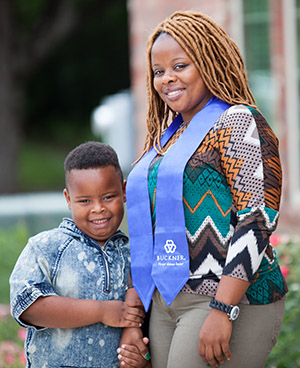
Stephanie Fletcher 300Stephanie Fletcher seeks to set a good example for her son, DeVondre.She discovered a new program in Longview—Buckner Family Pathways, a residential program for single-parent families that provides housing and child care assistance so single parents can be empowered to attain their educational goals. It was everything Stephanie wanted, and she was one of the first women selected for the program.

“That was a blessing,” Stephanie said. “It was meant for me.”

She continued working hard and increased her course load. The academic hours she’d already earned put her ahead of the other women in the program. On May 12, she walked across the stage of Kilgore College, the first Buckner Family Pathways resident in Longview to earn a college degree.

“I enjoyed it so much,” Stephanie said. “It was overwhelming. I was really in shock that I got to that point. I had a good time. It was so much fun. I’ve gotten my degree. I’m ready to move on to the next part of my life. I’ll never forget it.”

An inspiration to others

In a celebration of her accomplishment, several Family Pathways mothers told how Stephanie inspired each of them. They’ve seen the hard work she put in to make this happen. They know they can do it as well.

“She’s been an inspiration to the other ladies,” said Kimberly Clough, program director for Family Pathways in Longview. “She encourages others when they go through tough times. She picks them up and helps them keep going. She’s always the encourager and the motivator. She’s a leader in general.”

Hearing their words was moving. 

“It means a lot to me,” Stephanie said. “I didn’t shed any tears in front of y’all, but I did when I got back home. “

Clough said Stephanie is the ideal resident to earn the first degree through the program. Her hard work and positive attitude set the standard for other residents.

“Stephanie has been amazing,” Clough said. “She came in very focused, very dedicated. She’s always the first one to register for classes and take care of her schedule. She’s doing what she needs to do. She’s very focused on her goals.”

Her influence goes beyond the classroom.

“She’s always there for her son, DeVondre,” Clough said. “She’s always there for his events. She volunteers at his school. That’s very important to her. She wants to be there for him.”

With her associate’s degree in criminal justice in hand, Stephanie already has enrolled at the University of Texas at Tyler, where she’s seeking a bachelor’s degree in the same field. She continues in the Family Pathways program.

She hopes to continue inspiring single mothers along the next steps of her journey.

“It means a lot that I’m a single mother who did it,” Stephanie said. “I can show other single mothers that they can do it.”


Truett certificate program opened doors to resort ministry late in life

WACO—Richard and Miwes Baggett were on vacation in the summer of 2016, standing on Deception Pass Bridge in Washington and marveling at the view when Baggett’s phone rang.

Richard Baggett 300Richard Baggett serves six months a year as chaplain at an RV park in the Rio Grande Valley, providing a ministry of presence.The caller, a supervisor with Christian Resort Ministries International, wondered whether Baggett would be willing to tackle a start-up ministry for an RV park in Texas’ Rio Grande Valley, where “snowbirds” from northern states seek warmer climates in winter.

The year before, at age 70, Baggett had completed a two-year ministry certificate program at Baylor University’s Truett Theological Seminary. And with the couple’s 40-plus years of spare-time experience traveling in an RV—plus a pleasant year spent in the Valley more than 40 years ago—the opportunity seemed a perfect fit.

“I said, ‘We’ll find out what we can online about Gateway RV Park, and then we’ll pray about it.’ In a couple days, we said, ‘We’ll take it,’” said Baggett, now 72, of San Angelo, who had applied for an RV ministry position and been interviewed a year earlier.

The Truett ministry certificate program is tailor-made for people who feel called to the ministry but may be challenged by busy schedules or tight budgets, said the program’s leaders.

“While a master’s degree of divinity is the gold standard for ministry education, it is often out of reach for those who follow a calling,” said David Tate, coordinator of the certificate of ministry program.

No debt, no Greek, no Hebrew

A two-year Certificate of Ministry program began in 2004, but it wasn’t until 2015 when the self-paced program—with all-new content and structure—went online.

For Baggett, “the certification worked out marvelously,” he said. “It gave me the credentials I needed. I didn’t have to go in debt to do it. And I didn’t have to mess with Greek and Hebrew.”

He is among more than 120 ministers who have completed the ministry certificate program. Among their ranks are a chaplain who designs pastoral crisis intervention for SWAT teams, pastors of cowboy churches, bivocational pastors and church leaders. One certificate recipient runs a New Mexico program offering veterans experience with horses and ranch life, camaraderie with other vets and an opportunity to heal spiritually as they deal with combat injuries or trauma.

Truett 300In recent months, Truett also began offering the 16-month online certificate of Christian foundation to help laypeople enrich their faith. More than 150 students—ages 18 to 75—are working toward the certificate of Christian foundation, Tate said. They are from 13 states, with one student studying in Rwanda, and they represent several races, cultures and backgrounds. Nearly all plan to work toward the certificate of ministry as well, Tate said.

Filling ministerial niches

Graduates can help meet a need for churches with declining memberships who might struggle to pay a pastor a full-time salary. They also can help fill ministerial niches at truck stops, oil fields and RV parks, said Ira Antoine, director of bivocational ministry for the Baptist General Convention of Texas.

“There is going to be a huge need for bivocational pastors,” he said. “And there are more opportunities for ministries other than the garden-variety ones.”

For many students, enrolling in the program is a leap of faith.

“In the beginning, I was terrified, not knowing what to expect,” said Terri Davidson, 55, a bookkeeper in Seminole, who recently completed a class in biblical interpretation in the certificate of Christian foundation program. “But after my first chapter, my attitude changed from being scared to having confidence in myself and being ready and excited for the next chapter.”

She visits people in hospitals, is involved in a prayer ministry and would love to start a church.

“I know I am on the path that God has led me to, because I find myself hungry for more of the teaching of God’s word that is being offered to us,” Davidson said.

‘A major game changer in my ministry’

For Gerald Armbrister, 49, of Roseville, Mich., “these courses have been a major game changer in my ministry.”

He is an associate minister at Second Sweet Home Baptist Church in Detroit and also works as a HIPAA security officer for a technology company. In April, he became the first student to complete the certificate of Christian foundation, and he plans to earn the ministerial certificate.

Armbrister has a bachelor’s degree in engineering and a master’s in leadership studies.

“I was not seeking another degree,” he said. “The certificate program allows me to expand my knowledge without the major financial expense of another degree,” he said. “I have been able to couple my learned and hands-on experiences with pointed instruction and become a better minister.”

Answering a call from long ago

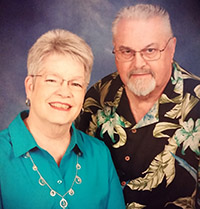
Baggetts 200Richard and Miwes BaggettBaggett reported the program brought him full circle. As an undergraduate student, he had felt God calling him to the ministry, but “the Vietnam War and other things precluded that,” he said.

He served in the Air Force as a sergeant, and after completing his bachelor’s and master’s degrees, he pursued two careers—first in healthcare management, in which he sought to follow Jesus’ example to help the poor and sick, and later in human resources, which he saw as a way to work for fairness.

But in semi-retirement, he again felt the ministerial call, this time during a sermon at his San Angelo church.

“The preacher said he was always amazed at what age God called people into the ministry. He talked about a dentist who sold his practice and went to Truett. And then he said, ‘We have more pulpits than we have preachers.’

“I wondered: ‘Is it too late? Do I still have something to offer? And if I do, how in the world do I go about it?’”

RV Park 300He found the answer at Truett. Today, he lives in Raymondville, in the Rio Grande Valley, half the year. Much of his work is supporting RV park residents dealing with health issues, and he also helps people working through grief over the loss of loved ones and close friends.

“Being a chaplain is called ‘a ministry of presence,’” he said. “You’re there as much as you can—potluck, bingo, sitting and talking and mingling so they get to know you as a person, an RVer instead of just as a chaplain.”

In his new role, he feels a kinship with a biblical character.

“Jonah’s story is my story,” Baggett said. “Like Jonah, the first time God called, I ran the other way. But God called again—and I answered the second time, at age 68.”

All courses in Truett’s certificate programs have continuous open enrollment and may be started at any time. Assignments generally only require minimal writing, and most certificate students spend approximately two to three hours weekly on their studies. The courses are non-academic, so there are no grades or due dates for assignments. For information on cost and application, click here or contact David Tate at 254-710-6351 or david_tate@baylor.edu.


Texas band MercyMe seeks to connect fans to victory in Jesus

GREENVILLE—With the songs on their latest album LIFER, Texas-based band MercyMe hopes to encourage and equip audiences to live for what matters most and make a difference for eternity.

mercymelifer 250“This new album is all about living in victory and what that really means—that our victory lies in what Christ has already done for us,” bass player Nathan Cochran said. “Our victory lies in who Christ is and who we are because of him. It’s a follow-up to our last album, Welcome to the New, which focused on grace and identity.”
While touring across the country, the group emphasizes the album’s theme by sharing verses about God’s design for creation and the importance of living with passion and purpose, such as Genesis 2:7, 1 Timothy 6:12 and Psalm 146:2.

Since their debut in 2001, the group has multiple American Music Awards and Dove Awards. In spite of their success, the group has stayed true to their Texas Baptist roots and remained focused on shining the spotlight on Christ.

Lead singer Bart Millard grew up in Greenville, where his grandfather, Lloyd Lindsey, served as pastor of Ardis Heights Baptist Church throughout the 1960s and early 1970s. 

mercyme 350Throughout their musical journey, the award-winning group MercyMe has stayed true to their Texas Baptist roots and remained focused on shining the spotlight on Christ.Through their music and message, band members hope to connect audiences to Christ’s love, forgiveness and grace while sharing personal stories of struggles, pain and redemption.

“When you write a song, you are always thankful for the impact it has on people,” Cochran said. “We’ve been grateful for the impact these songs have had on so many people. We’re continually getting stories about people walking through struggles and finding hope, regardless of the situation they are in, by being reminded about what Christ has done for us on the cross. It’s the most important and most powerful message we can share about, because it’s going to impact people for eternity.

“We’ve all gone through rough seasons in our own lives and wanting to be like Shadrach, Meshach and Abednego and have the courage to say that we know that God is able to deliver us, but even if he doesn’t, we’re still not going to surrender or bow down, because Christ is still worthy.

“That’s not always an easy thing to say, but it’s certainly how we want to live and how we want to encourage others, because Christ is bigger than anything we could face, and our hope rests in him.”

MercyMe recently wrapped up a national tour with Texas worship leader Micah Tyler and the Canadian rock band Hawk Nelson. This summer, MercyMe will headline a string of outdoor concerts alongside recording artists Jeremy Camp and Natalie Grant.

 “Our desire is that the message of the gospel resonates with people and helps them realize that God loves them unconditionally and is calling them to pursue a personal relationship with him,” Millard said. “During concerts, we emphasize that salvation is not based on works but what Christ has already done on the cross. 

“There is nothing anyone can do to make God love them more than he already does. All you have to do is accept his invitation and respond by resting in the finished work of the cross. It’s the simplicity of the gospel and who you are in Christ—realizing why you can show grace to other people because grace has been shown to you.”

Editor’s note: A deluxe edition of the MercyMe album, LIFER, is available at all Cracker Barrel Old Country Stores locations nationwide and features three bonus tracks, including “His Eye Is On The Sparrow.” MercyMe will perform a concert following the Houston Astros Game at Minute Maid Park, June 10.


Former ERLC legislative counsel joins Trump administration

WASHINGTON (BP)—Shannon Royce, a former leader at the Family Research Council and the Southern Baptist Convention’s Ethics & Religious Liberty Commission, has been appointed as the Trump administration’s director of the Center for Faith-Based and Neighborhood Partnerships.

Part of the Department of Health and Human Services, the center seeks to forge government partnerships with faith-based and community organizations to address community needs.

During Royce’s tenure, the center’s focus will include combatting opioid addiction, childhood obesity and mental illness, as well as fostering health reform.

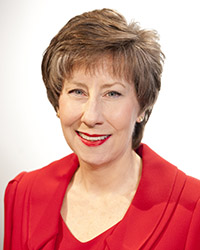
Shannon Royce 200Shannon Royce “I am eager to work with our faith and community partners in their service and stewardship to bring help and healing in their communities,” Royce said. “In doing so, I believe our work can help HHS fulfill its mission to enhance and protect the health and wellbeing of all Americans. The faith-based and neighborhood partners are instrumental in addressing community needs and concerns in the work they do every day, serving their members and neighbors and meeting the needs of our most vulnerable citizens.”

Royce, who began her work at the center in May, served as chief of staff and chief operating officer at the Family Research Council from 2015 to 2017. As ERLC director of government relations and legislative counsel from 1999 to 2003, she directed the commission’s Washington office.

Additionally, Royce has served as counsel to Sen. Chuck Grassley, R-Iowa, and as executive director of the Cornwall Alliance for the Stewardship of Creation.

The mother of a child with special needs, Royce has worked to raise awareness of mental health issues within the Southern Baptist Convention and beyond, including service on SBC Executive Committee’s Mental Health Advisory Council.

“She has served Southern Baptists in numerous ways in the past,” said Frank Page, president of the Executive Committee. “She was the prime motivator for our mental health advisory group. Her competency and compassion will be used by God in this service to our country.”

Royce received her law degree from George Washington University. She and her husband, Bill, have two adult sons.