Gordon pastor returns to Brazil amid visa backlog
GORDON (BP)—Albert Oliveira, pastor of First Baptist Church in Gordon, voluntarily returned to his birth country of Brazil after a visa rule change and years-long processing backlog blocked him from renewing his legal status.
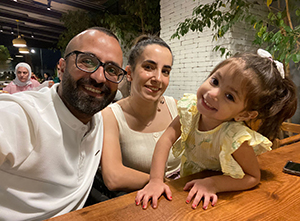
“We exhausted all the possibilities,” Oliveira told Baptist Press from his mother’s home in Brazil, where he, his wife Caroline and their 3-year-old son arrived Nov. 9. “What I’m doing isn’t necessarily self-deporting, but simply leaving before the visa expires.”
Oliveira plans to continue to serve the church in Gordon, preaching and holding meetings online while the church’s pastor of discipleship handles local duties.
After a year, he will reapply for an R-1 visa for religious workers in an attempt to return to Texas and continue to serve the church.
“For this visa, you need to stay out of the country for at least 12 months in order to reset the possibility to apply again for another possible five years,” Oliveira said.
“I will stay here (in Brazil) until we can go back after the 12 months. But our hope is that something still happens and we possibly can go back earlier, maybe a rule change.”
Unexpected rule change
Oliveira was among an unspecified number of pastors in a line of 214,771 individuals seeking EB-4 visas as of March 2025, according to an analysis of U.S. Citizenship and Immigration Services data by the CBS News Data Team.
An unexpected rule change in April 2023 lumped R-1 visa applications with others in the EB-4 category. In March 2022, there were 71,147 applicants, already a backlog for the program that issues 10,000 EB-4 visas a year. The numbers indicate a 200 percent increase in applications in a three-year span.
Oliveira, who speaks five languages, earned his degree from Southwestern Baptist Theological Seminary after coming to the United States in 2010 as a 19-year-old on a student visa.
He was called to the lead pastorate at First Baptist Gordon in May 2022, after serving as the church’s youth and missions pastor.
The Oliveiras’ son was born in the United States and holds citizenship here.
Oliveira continued to work legally in the United States under an R-1 religious worker visa until the rule change exacerbated a backlog in applications and later limited the number of visas that could be distributed.
Afterward, he sought to remain on an EB-4 visa for general workers, but the requirements could not be met, he said, under his service as a pastor.
‘Suffering uncertainty’
Oliveira estimates he already has spent $25,000 to $30,000 on attorney fees, application fees, airfare and other costs that he has no way to recoup.
“I know of other pastors in other churches that are going through this,” he said. “And you can only imagine that many of them don’t have the resources to help them in this way. And all that is left for them is really to leave.”
He expressed appreciation for the love and support of his church, sharing his desire that other Baptists consider the plight of similarly situated religious workers.
“I would like them to know that the church is being affected, that there are brothers and sisters in Christ that are suffering uncertainty and they’re unable to make plans with their church for the gospel,” he said.
Religious Workforce Protection Act still in committee
Messengers to the 2023 Southern Baptist Convention annual meeting adopted a resolution “On Wisely Engaging Immigration,” commending Southern Baptists for their work on the issue and urging Congress to improve legal pathways to immigration while protecting U.S. borders.
A bill to establish the Religious Workforce Protection Act, which would allow certain EB-4 visa applicants to remain in the United States while their applications are pending, was introduced in both houses of Congress in April.
Although it has bipartisan support, it remains in committee, according to the congress.gov bill tracking service. The National Immigration Forum stated several benefits of the legislation in its analysis, including extending the R-1 visa status beyond the five-year cap.
Oliveira encourages fellow Southern Baptists to study such issues that hold interest within the church community.
“Personally, the feeling that I have is that people should study and be knowledgeable of the topic that they care about,” he said. “There are a lot of people with opinions on things that they don’t understand, and it just doesn’t help. It just hurts those that are being affected.”
Oliveira remains thankful
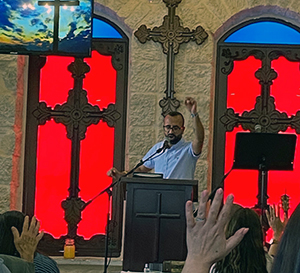
More than 200 worshipers attended the Nov. 2 service at First Baptist Gordon, a congregation that averages 150 in attendance. It was Oliveira’s last in-person sermon before he left for Brazil.
He baptized four new believers Nov. 2, and 11 others joined the congregation, he told Baptist Press. The church will continue to support him as a full-time pastor as he seeks a new path to legal residency here, he said.
Oliveira remains thankful.
“I’m thankful for what God has done. I have seen his providence through everything,” he said. “I’m thankful for the church, for their love and care. I honestly feel very loved by that church. And I’m thankful for everyone that was once unaware of this problem and learned about it, and started supporting and making a difference.”