Convención Hispana Bautista de Texas and Fellowship Southwest joined more than two dozen religious organizations in a lawsuit challenging a policy change allowing immigration officers to enter churches and other sensitive locations.
On Jan. 20, a U.S. Department of Homeland Security directive rescinded guidelines for Customs and Border Protection and for Immigration and Customs Enforcement officers that previously restricted enforcement in sensitive locations such as houses of worship, schools and hospitals.
The lawsuit asserts the change in policy for immigration enforcement violates both the First Amendment and the Religious Freedom Restoration Act.
The suit claims allowing immigration enforcement at places of worship imposes a substantial burden on the plaintiffs’ free exercise of religion and does not reflect the “least restrictive means” to accomplish “a compelling government interest.”
“An immigration enforcement action during worship services, ministry work, or other congregational activities would be devastating to their religious practices,” the lawsuit states.
“It would shatter the consecrated spaces of sanctuary, thwart communal worship, and undermine the social service outreach that is central to religious expression and spiritual practice for Plaintiffs’ congregations and members.”
The Institute for Constitutional Advocacy and Protection at Georgetown Law School filed the suit—Mennonite Church USA et al v. United States Department of Homeland Security et al—Feb. 11 in the U.S. District Court for the District of Columbia on behalf of a broad-based Christian and Jewish coalition.
“The extreme actions of our government call us to step up as we recognize that our practice of loving our neighbor outweighs our traditional stance of nonresistance,” Iris de Leon-Harshorn with the Mennonite Church USA said in a noon call with news media after the suit was filed.
Plaintiffs include 12 national denominational bodies and representatives, four regional denominational bodies and 11 denominational and interdenominational associations.
Subjecting places of worship to immigration enforcement actions “without judicial warrant or exigent circumstances” interferes with congregations’ freedom to freely practice their religion, lead counsel Kelsi Corkran said.
The suit is similar in many respects to an earlier suit brought by a group of Quaker congregations in the U.S. District Court for the District of Maryland. The Cooperative Baptist Fellowship joined in that suit last week.
Substantial burden on free exercise of religion
The latest lawsuit claims the change in the sensitive locations policy already is placing a substantial burden on the plaintiffs’ free exercise of religion and their right to “expressive association.”
“Congregations are experiencing decreases in worship attendance and social services participation due to fear of immigration enforcement action,” the lawsuit states.
“For the vulnerable congregants who continue to attend worship services, congregations must choose between either exposing them to arrest or undertaking security measures that are in direction tension with their religious duties of welcome and hospitality.”
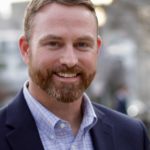
Jesse Rincones
Convención Hispana Bautista de Texas is a “family of churches dedicated to serving vulnerable populations and ministering to our communities,” said Jesse Rincones, executive director of Convención.
“We deeply value our nation’s longstanding commitment to protecting the local church’s constitutional right to carry out its biblical mission without government interference,” said Rincones, who is both a pastor and an attorney.
“The erosion of these protections leaves our congregations vulnerable to government intrusion, disrupting worship services, funerals, Bible studies and other vital ministries that serve our communities.”
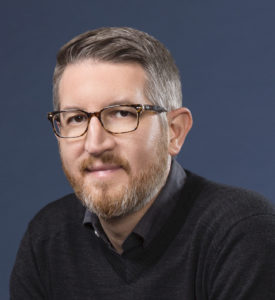
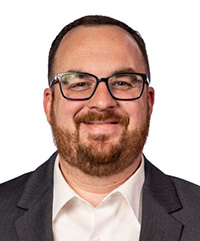
Stephen Reeves
Fellowship Southwest encourages and strengthens “the compassionate mission and prophetic advocacy work” of its partnering churches, said Stephen Reeves, executive director of Fellowship Southwest.
“We support an active network serving migrants every day, because we take the words of Jesus seriously,” said Reeves, who also is an attorney.
“Every church should be able to follow the divine mandates to love our neighbors and welcome the stranger without fear of ICE intrusions into sacred spaces or retribution from government officials who don’t share our faith convictions.”
Trump names Paula White-Cain to lead faith office
February 11, 2025
WASHINGTON (RNS)—President Donald Trump issued an executive order reinstating his version of the White House Faith Office and once again placing Florida pastor and longtime supporter Paula White-Cain in charge of the initiative.
Trump already announced both moves during a speech related to the National Prayer Breakfast on Feb. 6 but issued a formal executive order on Friday evening, Feb. 7.
“The executive branch wants faith-based entities, community organizations, and houses of worship, to the fullest extent permitted by law, to compete on a level playing field for grants, contracts, programs, and other Federal funding opportunities,” the executive order read.
“The efforts of faith-based entities, community organizations, and houses of worship are essential to strengthening families and revitalizing communities, and the Federal Government welcomes opportunities to partner with such organizations through innovative, measurable, and outcome-driven initiatives.”
The order appeared to acknowledge that the Trump administration is essentially replacing the existing White House Office of Faith-Based and Community Initiatives, which was created by former President George W. Bush’s administration and used by former presidents Barack Obama and Joe Biden.
Trump left that office vacant for most of his first term before creating the White House Faith and Opportunity Initiative in 2018 and appointing White-Cain to lead it in late 2019.
The new office, according to the order, is tasked with various projects, such as making recommendations to the president, advising various federal agencies and consulting with faith leaders who hold expertise in a broad range of areas, such as “strengthening marriage and family,” “lifting up individuals through work and self-sufficiency,” and “defending religious liberty.”
The order also mentioned prioritizing faith leaders with expertise in “combatting anti-Semitic, anti-Christian, and additional forms of anti-religious bias.” It stated the Faith Office would work with the attorney general to “identify concerns raised by faith-based entities, community organizations, and houses of worship about any failures of the executive branch to enforce constitutional and Federal statutory protections for religious liberty.”
The lines may be references to two other recent announcements from Trump—the creation of a task force on “anti-Christian bias,” which he mentioned on the campaign trail, as well as a new presidential task force dedicated to religious freedom.
In addition, the order encouraged the office to promote grant opportunities for religious organizations, “especially those inexperienced with public funding but that operate effective programs.”
In a separate statement, the White House announced White-Cain will resume leadership, and Jennifer S. Korn will serve as deputy assistant to the president and faith director of the office. White-Cain and Korn have spent the past few years working with the National Faith Advisory Board, a group founded as an attempt to continue work done by the faith office during Trump’s first term.
Mixed reaction to announcement
Several of Trump’s evangelical supporters celebrated the reestablishment of the office and the appointment of White-Cain, with Georgia megapastor Jentezen Franklin congratulating her in a post on social media site X.
Others, however, were quick to criticize the move. Americans United for Separation of Church and State condemned White-Cain’s appointment, saying she “was unfit to serve in the White House when Trump first appointed her in 2019 and she’s still unfit today—particularly in a position that could focus on combatting discrimination and advancing religious freedom for all.”
Americans United also accused White-Cain of being a “Christian Nationalist powerbroker” who’s spent much of her career operating in the shadows to influence public policies that discriminate against women, LGBTQ people and religious minorities, and the nomination of partisan judges who will support those policies.
The White House also announced Jackson Lane, who worked on Trump’s faith outreach team during the campaign, will serve as special assistant to the president and deputy director of faith engagement.
Photo courtesy of Johnnie Moore via RNS.
On social media, the White House promoted the new office alongside a photo of Trump surrounded by religious supporters as they prayed over the president. It was not immediately clear when the photograph was taken, but some in the picture were evangelical leaders who, like White, served as advisers during his first term, such as Franklin and Johnnie Moore, who is credited with organizing the informal but influential group of evangelical leaders who advised Trump during his first term.
Moore, a close confidante of White-Cain who was involved in Trump’s 2016 campaign, told Religion News Service via email in August 2023 he was focusing on projects trying to reduce polarization in the U.S. and had no plans to participate in Trump’s 2024 White House bid, saying he was “trying to avoid partisanship.”
However, during a faith-focused Trump campaign event just a week before Election Day, Moore appeared onstage alongside White-Cain, Korn and several other religious leaders as they prayed over Trump.
Reached by email after the announcement of the re-instated White House Faith Office, Moore did not immediately respond to questions about whether he plans to be involved with the second Trump administration.
The Faith Office announcement came as the Trump administration has spent its first three weeks publicly feuding with some religious groups that have criticized his early executive orders, which have included freezing the U.S. refugee program and cutting off international aid funds used by numerous religious organizations that do humanitarian work abroad.
Additionally, a group of Quakers and the Cooperative Baptist Fellowship are suing the Trump administration. They assert, among other things, the administration violated the Religious Freedom Restoration Act when it rescinded an internal government policy developed in 2011 that discouraged immigration raids on “sensitive locations” such as hospitals, schools and churches.
Meanwhile, Vice President JD Vance, a Catholic, has been locked in a war of words with the U.S. Conference of Catholic Bishops. After the prelates issued statements expressing concern about Trump’s executive orders, the vice president falsely accused the bishops of resettling “illegal immigrants” and of being more concerned about their “bottom line” than humanitarian work.
Similarly, billionaire Elon Musk, who runs the Department of Government Efficiency that has rapidly winnowed the federal government and all but shut down the U.S. Agency for International Development, recently described federal funds for Lutheran aid groups as “illegal,” sparking a fiery rebuttal from the head of the Evangelical Lutheran Church in America debunking his claim.
Obituary: Melissa Kaye Yeary Wells
February 11, 2025
Melissa Kaye Yeary Wells, children’s Sunday school teacher and daughter of one Baptist pastor and wife of another, died Feb. 4 in Houston. She was 59. She was born Jan. 5, 1966, in Louisville, Ky., to Dan and Melinda Yeary. Missy made her profession of faith and was baptized at South Main Baptist Church in Houston in 1974, when her father was on staff as minister to single adults. Shortly after, the family moved to Coral Gables, Fla., where her father was pastor of University Baptist Church. In 1984, Missy traveled back to Texas to attend Baylor University, where she was president of Pi Beta Phi and eventually reigned as Homecoming Queen in her senior year. After graduation, she returned to her alma mater in 1989 to lead the Baylor Student Foundation. She met Steve Wells in her first week in that work, and they married a few days shy of a year later. She returned to South Main in 2003 when her husband became the congregation’s pastor. She served South Main in countless ways, particularly as a Sunday school teacher of 2-year-olds, making it her mission for young children to know and love Jesus and his church as she did. She is survived by her husband of 34 years Steve; daughter Rachel Lawrence and her husband Blake; sons Ben and Josh; grandchildren Fischer, Lila and Shepherd; her brother Wes Yeary and his wife Erica and their four children; and her brother Doak Yeary and his wife Amy and their three children.
Deadline looming for program to reduce child hunger
February 11, 2025
Texas missed out on $450 million in federal food aid for children last year, but Texas lawmakers have until March 1 to keep that from happening this summer.
The Summer Electronic Benefit Card program is a U.S. Department of Agriculture program allowing low-income families with school-aged children to receive additional benefits when schools are on summer break. In Texas, the program could benefit 3.7 million children.
Jeremy Everett
The program provides funds for each eligible child on an electronic benefit card that families can use like a debit card to buy groceries. Benefits are federally funded, and administrative costs are shared on an equal basis by state and federal agencies.
The Texas Legislature has until March 1 to authorize budget funds requested by the Texas Health and Human Services Commission for additional personnel and computer support to implement the summer program this year.
“HHSC is understaffed right now. They have not caught up with the pandemic staffing losses,” Everett said.
Even if additional funds are allocated to the commission, hiring staff, building out a new program in three months, and getting school-aged children enrolled in it will be challenging, he noted.
Furthermore, major cuts to multiple federal programs might affect the program at the national level—or not.
“Fortunately, USDA has not been one of the targets of any significant budget cuts,” Everett said. “Their programs are not currently being focused on, and the programs that directly affect the individual are not supposed to be touched in any federal funding freeze.”
At the same time, he noted, USDA at some point likely will be called on to cut some personnel to streamline their agency.
Significant return on investment
“But here’s what we do know. We know Texas right now is the second-hungriest state in the country. We know that there’s a high majority of children in our public schools who are on—or eligible to be on—the free or reduced lunch program,” Everett said.
“We know that hungry children can’t learn. We know that food insecurity is directly tied to diet-related disease and all kinds of health impacts like asthma and depression. We know that food insecurity is not experienced in a vacuum—that it is typically the same household that is experiencing the weight of a number of our broken social systems.”
One child in four in Texas experiences hunger, and child hunger historically has spiked in the summer months when students lose access to free or reduced meals at school.
However, the Summer Emergency Food Program—along with summer meal sites at churches and other locations in urban and suburban areas and home-delivered meals in rural areas—offer “a pathway” to help eliminate child hunger, he noted.
“You’re not going to end child hunger with one approach. Our contexts are too diverse in Texas. So, now we finally have three different ways to address child hunger in the summer. In my opinion, let’s use all three of them, and use them to their fullest capacity,” Everett said. “Those are the kids who need us to come alongside them the most.”
The Summer Electronic Benefit Card program and increased household access to the Supplemental Nutrition Assistance Program not only meet the essential nutritional needs of children, but also provide economic benefits to communities, to farmers and ranchers, and to everyone involved in the food supply chain, he added.
Texas is one of only 11 states currently not enrolled in the Summer Electronic Benefit Card program.
“When it comes to programs like Summer EBT, if you’re leaving $450 million on the table in resources that could benefit approximately 3.7 million kids and that would ultimately have an economic impact of $1.3 billion for the state economy, that’s huge,” Everett said.
“That’s a no-brainer. That’s a marginal investment on the state’s part to get a significant return—first and foremost in food security for children and secondarily in the economic impact it would have on our state.”
Americans bet and lose big money on the Super Bowl
February 11, 2025
(RNS)—Les Bernal has a message for the millions of Americans who bet on this year’s Super Bowl using betting apps and other legal sports books. The house always wins.
Les Bernal, national director of Stop Predatory Gambling (Courtesy Photo)
Americans lose billions gambling, while sports-betting companies rack up profits, said Bernal, national director of Stop Predatory Gambling.
Once considered a vice and the realm of Vegas casinos and organized crime, legal commercial sports betting has become America’s favorite pastime.
Americans were expected to bet $1.39 billion with commercial gaming companies during Sunday’s Super Bowl, according to projections from the American Gaming Association.
Since the Supreme Court struck down a 1992 federal law that limited legal sports betting to Nevada in 2018, $450 billion has been wagered on sporting events in the United States, according to Legal Sports Report, a website that covers the sports-gaming industry.
Sports-betting company revenues have reached nearly $40 billion. Much of that growth has been driven by online and mobile betting, which essentially turn cell phones into sports-betting windows, say critics like Bernal.
Data from a 2024 AGA survey found that 88 percent of Americans see gambling as an acceptable form of entertainment, and many (76 percent) see gambling as good for the economy. Gaming industry officials see rising revenue as a sign that Americans love to bet—and that legal betting is a good thing.
“No single event unites sports fans like the Super Bowl, and that excitement extends to sports betting, with this year’s record legal handle reflecting its widespread appeal,” Bill Miller, AGA president and CEO, said in a recent press release, referring to the total amount bet on the big game.
Big money promotes gambling
The success of the gaming industry has critics like Bernal and faith leaders who oppose sports betting often fighting an uphill battle. They have little money to work with—Stop Predatory Gambling, for example, has a budget of $138,000. And because the gaming industry is regulated by states, there’s not a national coalition of gambling critics.
Thirty-nine states currently allow legal sports betting, though some, like Wisconsin and Washington, restrict wagers to in-person betting sites.
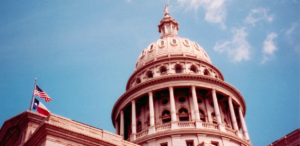
Texas State Capitol (Bigstock Image)
Sports betting remains illegal in Texas, and a constitutional amendment would be required to change that.
However, lobbyists paid by out-of-state gambling interests and some professional sports teams continue to try to persuade lawmakers to submit to voters a constitutional amendment to legalize sports gambling in Texas.
And in a recent interview with the Houston Chronicle and its “Texas Take” podcast, Gov. Greg Abbott said for the first time, “I don’t have a problem with online sports betting.”
Bernal said commercialized gambling is the only business where the relationship with customers is “adversarial and predatory.”
“They want to take you down,” he said.
The advent of smart phone apps and online betting and the growth of parlay bets—where bettors wager on a series of outcomes in a game, like which player scores the first touchdown—has changed the nature of sports betting, he said, allowing customers to place repeated bets on the same game.
“They made sports gambling like playing a slot machine,” he said, and have made betting more addictive and socially harmful. He’s particularly concerned about the overall business model of gaming companies, where customers with gambling problems provide most of the profits.
Industry depends on problem gamblers
For example, at PointsBet, a sportsbook owned by Fanatics, a major company, 70 percent of the revenue came from less than 1 percent of the customers in 2019 and 2020, according to The Wall Street Journal.
A 2024 report from the University of Massachusetts found that 90 percent of revenue at that state’s casinos came from only 10 percent of customers, which researchers found problematic.
“There needs to be a reduction of the industry’s financial reliance on at-risk and problem gamblers, as the 90 percent of revenue from this 9.9 percent of the population is much too high,” researchers wrote in the report’s recommendation. (That report looked at casinos, not online sports betting.)
As a Catholic, Bernal said he was concerned that state governments are essentially benefiting from problem gamblers in the form of tax revenue.
“We’re talking about loving our neighbors like God loves us,” he said. “This public policy is the complete opposite.”
In Minnesota, where mobile sports betting is illegal, the state’s Catholic bishops wrote to Governor Tim Walz recently, urging him to oppose making such betting legal.
Jason Adkins, executive director of the Minnesota Catholic Conference, the public policy voice for Catholics in that state, said expanding gambling is not worth the cost.
Adkins said Catholics don’t see all games of chance, such as raffles or bingo, as unethical, but commercial sports betting is something different, with little social benefit and a great deal of harm due to gambling addictions.
“When you put a sports book in the cell phone of every person and give them 24/7 access to the most addictive forms of gambling and then make it easy to chase their losses with in-game betting, we think this is a serious problem,” he told Religion News Service in an interview.
Social harm of gambling identified
Kathleen Benfield, legislative director for the Louisiana Family Forum, said her organization has long opposed legalized gambling—seeing it as a public health risk. She pointed to a recent study in The Lancet, which outlines the social harms of gambling.
“Gambling is not an ordinary kind of leisure; it can be a health-harming, addictive behaviour,” the summary of the Lancet study read.
“The harms associated with gambling are wide-ranging, affecting not only an individual’s health and wellbeing, but also their wealth and relationships, families and communities, and deepening health and societal inequalities.”
Benfield believes nothing good will come from legalized gambling in the long run.
“It’s a house of cards,” she said. “And it’s going to fall.”
A new national survey of sports fans by Sport Spectrum, a faith-based magazine, found few people saw sports betting in a negative light. Only 23 percent said they felt negative about sports betting, while 43 percent said they felt positive about sports betting.
A third (35 percent) felt neutral. A third (32 percent) said they had bet on sports. Twenty-seven percent said they know of someone who’d been negatively impacted by sports betting.
Few sports fans felt enthusiastic about betting being part of sports broadcasts, with 28 percent seeing that as positive, and 40 percent seeing it as negative. A third (32 percent) were neutral.
Think through the issue
Andy Konigsmark, a Presbyterian minister from Colorado, is among those who think sports gambling can be an enjoyable experience, if done within limits.
Konigsmark said that his parents, conservative Christians who taught Sunday school, would take him to a dog track while on vacation and give him a few dollars. He said betting made watching the race more exciting—and having only $5 meant the stakes were low.
Konigsmark said these days, he occasionally places a bet on a sports-betting app.
“I could spend $20 a month on this—and that’s it,” he said. “It’s the same as going to the movies.”
If he were betting every day, or for larger amounts of money, that would be a problem, said Konigsmark. And he’d like to see fewer gambling ads on television and more limits on what people can bet.
He also said faith leaders could do more to help their people think through the issue. This past fall, he wrote an online article titled, “A Christian Minister’s Guide to Gambling with Wisdom,” to do just that.
Benjamin Watson, an author and college football commentator who played 16 years in the NFL, said the rise of sports gambling has had little effect on players so far. Fans have time to think about gambling and fantasy sports, he said, while players are focused on trying to win. While pro sports teams and broadcasters have ties to gaming companies, he said, for the most part players are isolated from those concerns.
“It doesn’t impact what we do on the field,” Watson said.
Watson, who played in a pair of Super Bowls—winning with the Patriots in 2004, losing with the same team in 2007—said he’d learned to be grateful in both outcomes. Winning and losing is part of life, he said, adding that “losing is terrible.”
“God is in control,” he said. “My goal is to glorify him, whether I win or whether I lose, there’s still growth that happens across the board.”
Watson, who comments on college games for the SEC Network and other sports media, said he does not bet on sports—in part because he hates to lose. And he has no interest in promoting gambling.
“There’s a lot of data that’s come out, a lot of studies, showing that gambling is not beneficial on a cultural or a wholesale level,” he said. Those studies, he said, show increases in bankruptcies and addictions. So much so that ads for sports betting often come with a warning about those addictions.
“I’d just rather stay away from it,” said Watson, who is known for his outspoken advocacy of social issues like racial reconciliation and his opposition to abortion. “I don’t see the benefit.”
With additional reporting by Managing Editor Ken Camp.
‘He Gets Us’ ads return to Super Bowl LIX
February 11, 2025
(RNS)—Fans of the Kansas City Chiefs, Philadelphia Eagles, game day food and creative advertising—as well as those just in it for Kendrick Lamar’s halftime show—all were invited to think about Jesus Christ once again during the 2025 Super Bowl.
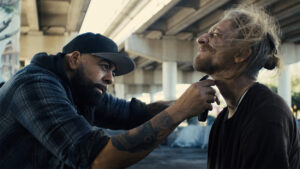
A barber trims the beard of an unhoused individual in a “He Gets Us” campaign video about how Jesus redefined greatness. (Image courtesy Come Near)
The “He Gets Us” ad campaign aired a new commercial during the first half of the Super Bowl on Feb. 9, marking the project’s third consecutive year of having a presence in the big game, with the hopes of spurring dialogue and curiosity about Jesus.
The ad featured a slideshow of images of people demonstrating love by serving each other while Johnny Cash’s 2002 rendition of Depeche Mode’s “Personal Jesus” played in the background.
The commercials, created by Dallas-based advertising agency Lerma, ends with the text “He Gets Us. All of Us.”
From the “He Gets Us” Super Bowl ad. (Screen capture image)
This year’s ad, titled “What is Greatness?”, invites the audience to explore “what Jesus showed and said greatness is and the contrast to how culture defines greatness today,” according to a press release from Come Near, the nonprofit startup that acquired the He Gets Us project in 2024.
“In a society struggling with division, loneliness and a crisis of meaning, Jesus’ life and teachings offer a countercultural path toward healing,” said Ken Calwell, CEO at Come Near.
On Super Bowl Sunday, the “He Gets Us” website was turned into a hub of content that highlight “stories of greatness” and offer self-paced resources to “rediscover or learn more about the person and teachings of Jesus.”
The “He Gets Us” project originally was overseen by the Servant Foundation, a Christian foundation that launched the project in 2022, with an initial effort of raising $100 million.
But by 2023—when those first Super Bowl ads premiered—the branding firm Haven had taken over the project, and its president told RNS at the time that “the goal is to invest about a billion dollars over the next three years.”
In the three years since “He Gets Us” launched, the advertising campaign has shown up on everything from buses, to billboards, to YouTube channels. The ads have sometimes focused on personal messaging (“Jesus Wept Too”) but also have veered more political (“Jesus was a refugee”).
Campaign has drawn some criticism
The campaign’s thematic focus in the 2024 Super Bowl drew backlash from both sides of the aisle. The images all centered on a foot washing—in one, an abortion protester washes the foot of a young woman outside a “Family Planning Clinic,” in another a police officer washes the feet of a young Black man—all seeming to highlight people you might see as on “opposite sides.”
More progressive critics accused the ads of offering visuals of “white saviorism,” while conservative critics describe the ads as too “woke.”
The ads have garnered questions over the years about who is behind the funding. In late 2022, David Green, the co-founder and CEO of the craft store chain Hobby Lobby and a major funder for The Museum of the Bible, told talk show host Glenn Beck he was a major contributor.
As he told Beck about the ads, “We are wanting to say—we being a lot of people—that he gets us. He understands us. He loves who we hate. I think we have to let the public know and create a movement.”
Hobby Lobby won a 2014 Supreme Court case arguing for a religious exemption to a law requiring employers to offer a health insurance plan that pays for contraception. Additionally, the Servant Foundation had ties to the Alliance Defending Freedom, a legal organization that helped overturn Roe v. Wade and has represented clients challenging same-sex marriage and transgender rights, according to The Associated Press.
Nonprofit Come Near describes itself as an innovation studio creating “personally engaging stories and experiences that reveal the authentic Jesus.” Its board of directors includes Rob Hoskins, Nicole Martin, John Kim, Mart Green, Joey Sager and Gary Nelson, according to the nonprofit’s website.
He Gets Us is just one of Come Near’s projects to teach people about Jesus. The nonprofit also collaborated with Christian musician Jon Batiste, who sang the national anthem for the 2025 Super Bowl.
Come Near and Batiste hosted the Love Riot Festival the day before Super Bowl Sunday on the grounds of George Washington Carver High School in New Orleans and near the site of a future home sports field planned to serve 9th Ward high schools and middle schools.
Logsdon School of Theology to become college
February 11, 2025
The university’s board of trustees voted to elevate the Logsdon School of Theology by making it a distinct college, five years after Hardin-Simmons University closed Logsdon Seminary.
Soon after the board voted on Feb. 6, the university announced the Logsdon School of Theology will transition out of the Cynthia Ann Parker College of Liberal Arts, where it has been housed, effective June 1.
The public announcement from the university stated the move will allow for “a stronger focus on ministry education, deeper connections with churches, and a continued emphasis on HSU’s Baptist heritage.”
The Logsdon School of Theology will focus its offerings on undergraduate education “with the intent to thoughtfully and strategically expand.”
The new college will offer a major or minor in Christian studies—with courses in biblical studies, church history, ministry and theology, the release said.
Students majoring in worship leadership within the College of Arts and Media will continue to take Logsdon ministry courses, and the new college will continue to provide the instruction for Bible courses all undergraduate students must take.
“The Logsdon School of Theology has proudly carried its official name since 1983, a tradition that remains unchanged” a follow-up email noted.
“To honor Logsdon’s legacy, the Board of Trustees chose to preserve its name, ensuring continuity and recognition for generations to come.”
With Logsdon’s elevation, the university has six colleges: Logsdon School of Theology, College of Arts and Media, College of Health Professions, Cynthia Ann Parker College of Liberal Arts, Kelley College of Business and Professional Studies, and Holland School of Sciences and Mathematics.
In March 2024, the university named Jacob West associate dean of Logsdon School of Theology. West has a long history with Hardin-Simmons and ministered in several West Texas churches, including an extended time as pastor of First Baptist Church in Plainview.
A dean for the new college is yet to be named, but West will continue to provide leadership for the school until a dean is named.
“HSU has a strong group of students, and I believe God will do a great work in their lives. We have men and women in the Christian studies program eager to share the gospel,” West said.
“Logsdon has a strong partnership with the College of Arts and Media to assist the preparation of worship ministers. Logsdon ministers to nearly 400 students every semester through foundational curriculum courses, in addition to being the host site for campus chapel,” led by Director of Spiritual Formation Shelli Presley.
West also noted Logsdon School of Theology has forged a new partnership with the North American Baptist Fellowship. Additionally, the school will host the Pinson Lectures on April 23. Elijah Brown, Baptist World Alliance general secretary, will provide the luncheon keynote.
“Since its founding in 1983, the Logsdon School of Theology has been an integral part of Hardin-Simmons University,” the university stated.
“Logsdon has remained steadfast in its mission—preparing students for ministry, deepening their understanding of Scripture, and equipping all students across campus with the tools for Christian leadership.
“After much prayer and thoughtful consideration, we look forward to this significant step in meeting the growing demand for well-equipped leaders.”
Background
When the HSU board of trustees voted in February 2020 to begin the process of closing Logsdon Seminary as part of a larger university restructuring, President Eric Bruntmeyer wrote in a letter to the “HSU family” the action was “solely a financial decision,” reached after an extended period of analysis.
Bruntmeyer released his letter after some Logsdon Seminary alumni asserted a “small, but very influential group” had undermined the seminary by accusing its professors of liberalism.
“While theological issues did come up in our discussions, this was solely a financial decision,” Bruntmeyer wrote. He did not elaborate on the nature of the “theological issues” discussed.
“From the very beginning, the seminary lacked appropriate funding,” he wrote.
Over a course of 15 years, when the seminary graduated more than 400 students, funds designated for the seminary had to be moved from the Logsdon School of Theology “to cover the deficits that occurred from the initial and continual lack of funding,” he wrote.
Four years earlier, HSU administrators launched a serious analysis of the university’s financial situation and “created metrics to identify low-performing programs,” he continued.
“In this process, the seminary and School of Theology were identified as low-performing programs,” Bruntmeyer wrote, citing declining enrollment both in Logsdon Seminary and in the Logsdon School of Theology.
A few days later, Bruntmeyer addressed the Baptist General Convention of Texas Executive Board. He told the board the HSU trustees made the decision to close Logsdon Seminary and redirect endowment earnings back to the undergraduate programs in the Logsdon School of Theology because the university could not “keep two financially weak programs going.”
Bruntmeyer said about 300 students would be needed to make the programs financially sustainable. At that time, he reported, 40 to 45 undergraduates were pursuing majors in the Logsdon School of Theology, and the program had experienced a study decline in enrollment.
About 90 students were enrolled in seminary graduate classes in Abilene and San Antonio, but those numbers did not represent full-time equivalency.
In the previous academic year, combined losses from the Logsdon School of Theology and Logsdon Seminary totaled $1.26 million, Bruntmeyer told the BGCT Executive Board.
Looking to the future
HSU did not provide current information about enrollment in the Logsdon School of Theology, but stated: “Logsdon School of Theology has maintained steady enrollment since 2020. However, with churches across the state and nation expressing a growing need for well-equipped leaders, the goal is to expand our reach and cultivate even more high-quality candidates for ministry and service.”
Kyle Tubbs, now state coordinator for the Cooperative Baptist Fellowship of Oklahoma, was president of the Logsdon Alumni Council at HSU when the seminary closed in 2020. He offered a significantly different perspective on the health of HSU today.
“Since the trustees closed Logsdon in February 2020, Hardin-Simmons has experienced an overall student enrollment decline from 2,324 in 2019-2020 to 1,665 in 2024-2025. Losing nearly 30 percent of its population is deeply concerning,” Tubbs wrote in an email.
The university also reported enrollment of 1,665 but noted that represented an increase from the prior year and an 8.5 percent increase in first-time freshmen.
Additionally, the university noted by email it achieved “an 88.51 percent persistence rate for Fall 2024, a 2.67 percent increase from 2023 and higher than the national average of 76.5 percent,” reported by National Student Clearinghouse.
Several new entities came into existence or expanded in the aftermath of the decision to close Logsdon Seminary.
Abilene Christian University launched a Baptist Studies Center within its Graduate School of Theology. ACU named Myles Werntz, formerly the T.B. Maston Chair of Christian Ethics and Practical Theology at Logsdon, as the center’s director.
Baylor University’s Truett Theological Seminary opened an extension campus in San Antonio, offering classes at Trinity Baptist Church—the previous host site of Logsdon Seminary’s San Antonio campus. In addition to its flagship campus in Waco, Truett Seminary also offers courses in Houston at the Lanier Theological Library and Learning Center.
With a start-up grant from the Eula Mae and John Baugh Foundation, the Jesse C. Fletcher Seminary—named for the 14th president of HSU—began offering classes in 2022 at Baptist Temple in San Antonio.
Don Williford, dean of Logsdon Seminary from 2011 to 2017, was the founding dean of Fletcher Seminary. Dan Stiver, a former professor of theology at HSU, succeeded Williford in 2024.
Regarding the future of Logsdon School of Theology, Bruntmyer commented: “Logsdon has long been a cornerstone of Hardin-Simmons University, shaping students with a strong faith, ministry and Christian leadership foundation.
“As we take this next step, we reaffirm our commitment to equipping future leaders with the knowledge, skills, and spiritual depth needed to serve their communities. This transition reflects the board of trustees’ dedication to meeting the evolving needs of our students, churches and the world around us.”
An inaugural open house for the new Logsdon School of Theology, guest lectures with church leaders and theologians, and meet-and-greet sessions with faculty will be announced at a later date.
With additional reporting by Managing Editor Ken Camp
Editor’s note: The story was posted at 5 p.m. on Friday. It will be updated if additional information is made available. The paragraph regarding enrollment figures was edited the next morning to clarify that the 8.5 percent increase was among first-time freshmen.
Worship Initiative a partner in training worship leaders
February 11, 2025
Founded by Texas worship leaders Shane and Shane, the Worship Initiative equips and encourages thousands of worship leaders and church musicians.
Several Texas Baptist schools have seen the value of partnering with the Worship Initiative.
Robbie Seay, executive vice president of leader development and content at the Worship Initiative, explained when Shane and Shane began the initiative, their “aim was really to come around worship leaders, any men and women who were leading churches, leading college students, college students, high school students, all of the above.”
“How can we come around them and equip them for the work of ministry?” they asked.
The founders also saw a need to encourage worship leaders by providing a space to build community with other worship leaders when they began the Worship Initiative about a decade ago, Seay noted.
Seay described Worship Initiative as “a training and resourcing platform.”
When worship leaders subscribe and login to the platform, “they engage with content that teaches them from the basics of learning a song to the complexities of what it means to actually have a theology of worship.”
Content also answers questions such as: “How do I lead a team? How do I play with a band? How do I grow on my instrument?”
“There’s nothing quite like the training and resourcing platform that we provide,” Seay said.
Texas Baptists-related partnerships
At Houston Christian University, one Texas Baptists-related school that utilizes Worship Initiative, student worship leaders go to the platform to learn hymns and spiritual songs—and the scriptures associated with those songs—to prepare for student-led convocation worship.
HCU students engage the platform “as a team as they lead their peers in worship,” Seay explained.
Dallas Baptist University also subscribes to the Worship Initiative. But in their partnership, a team from the Worship Initiative goes to the campus once a semester for in-person training.
“The drummers are gathering with one of our experts, and they’re talking about what it means to play drums in the context of worship,” Seay gave as an example.
Whether the students are receiving training for chapel or other worship leading opportunities on campus, they are learning and growing through in-person engagement, he said.
At Baylor University, Chason Disharoon, associate director of the Dunn Center for Christian Music Studies in the Baylor School of Music, explained the Dunn Center hosts an annual summer music camp geared specifically toward high school students with an interest in worship leadership.
Worship Lab brings high school students interested in worship leadership together for summer worship camp at Baylor. (Baylor Photo)
He noted 2025 will be the 11th year of the event, called Worship Lab. Through the years, the Dunn Center has partnered with Worship Initiative for Worship Lab in several ways.
At times, Worship Initiative has offered product trials of their platform to the students. Other times, Worship Initiative team members have talked in-person to campers about Worship Initiative’s products.
This July, Disheroon said, “Worship Initiative will send a team of leaders to our event to teach in breakout classes on specific instruments within the worship band.
“This partnership is invaluable, in that it allows our students to receive training directly from those who are pouring attention and energy into building the Worship Initiative platform and further championing the equipping of young people,” he explained.
Disheroon noted as an aside that Seay is a past member of the board of advisers for the Dunn Center and “one of the key leaders in the design of our program at Baylor.
“His position at Worship Initiative is a continuation of his passion for educating future ministers and building leaders, starting with the young people who are committed to serving in churches across the country.”
At Hardin-Simmons University, a closer partnership with Worship Initiative is under discussion.
“We are currently in the planning stages of partnering with them to offer more resources and valuable experiences for our worship leadership students at HSU,” said Tiffany Stotts, director of worship leadership, associate director of spiritual formation for worship and instructor of worship at HSU.
HSU developed the worship leadership major in 2020, officially opening it to students in 2021. The degree is custom designed and not offered anywhere else.
In fact, “it’s the only degree in Texas where you can get a full worship leadership degree (as a) major and not just, like, a track or emphasis,” Stotts said.
Stotts also oversees all the worship teams for the whole school. That includes chapel twice a week, with student-led worship. Additionally, the school outsources worship teams to provide worship leadership in the community and at events around the state.
In the past, Stotts explained, HSU used Worship Initiative just as “an amazing resource” for anyone in the worship field.
“They have a great, affordable system that you can just sign up for as a user—where you get access to all of their trainings, and their chord charts and recordings.”
But over time, people she knew well from her work at HSU, and DBU previously, joined the staff of the Worship Initiative. One of these connections, Adam Westlake, served on her worship team at DBU on electric guitar as a freshman.
Westlake now is responsible for much of the electric guitar training for Worship Initiative, as well as running the studio and producing tracks, Stotts explained. Their friendship has led to multiple conversations over the past year about ways their partnership may expand at HSU.
Stotts noted “everything at Hardin-Simmons is really growing.”
HSU recently opened a new College of Arts and Media, which includes the school of music, theater, arts and communications.
“There’s not really another College of Arts and Media in Texas, especially at a Christian college,” she explained. Hardin-Simmons is trying to “offer something here that you can’t get anywhere else,” she said.
While nothing is finalized yet, the two organizations are working out the details of an expanded partnership. One of their main goals is to help HSU worship leadership students build community and have resources when they graduate. So, Stotts sees this as an area where Worship Initiative can provide additional value.
“Because of all their connections at Worship Initiative, … they’re kind of the hub,” Stotts said. “If I need to know something about worship, and I need to talk to people who are professionals in their field, but also love the Lord and who genuinely are doing this with a ministry heart, I’m going to call Robbie Seay.”
‘Worship pastors,’ not ‘worship artists’
Stotts said worship leaders don’t make a relationship with God happen, but they do strive to facilitate an environment where people are invited to come and meet God.
Chapel musicians at HSU grow through Worship Initiative partnership. (HSU Photo)
“We are musicians. And we want it to be done well, but we don’t want it to be a performance,” she said. “We want to be so good at what we do that we kind of disappear.”
“There’s a difference between worship pastor and worship artist,” Stotts explained. It’s a different mindset that the team at Worship Initiative understands, she said.
Tom Tillman, director of music and worship in Texas Baptists’ Center for Church Health, said he has worked with the Worship Initiative team on a number of occasions.
“We are here to help people in their ministries, so we point folks to resources like this all the time,” Tillman said, noting “networking and partnerships are always important.”
The Worship Initiative seeks to address three concerns with their platform: lack of Christ-centered, biblically rooted worship in the church; lack of qualified, passionate and healthy leaders to assume roles of worship leadership in the church; and lack of effective resourcing and training for worship leaders and musicians in the church.
The platform currently serves about 10,000 worship leaders, but expects that number to triple through their expanding partnerships with Texas Baptists-related universities and Baptist seminaries within and outside of Texas, along with other organizations, Seay said.
Trump pledges to ‘bring religion back’ stronger
February 11, 2025
WASHINGTON (RNS)—Appearing at two events Feb. 6, both part of the festivities surrounding the National Prayer Breakfast, President Donald Trump spoke about the centrality of religious belief to the United States and announced he would create a new presidential commission on religious liberty.
“From the earliest days of our republic, faith in God has always been the ultimate source of the strength that beats in the hearts of our nation,” Trump said in his first appearance in front of a gathering of lawmakers in the U.S. Capitol’s Statuary Hall.
“We have to bring religion back. We have to bring it back much stronger.”
Later, at a separate National Prayer Breakfast gathering at the Washington Hilton hotel, Trump announced he would appoint Florida Pastor Paula White to lead his White House faith office, as she did at the end of the first Trump administration.
At the Capitol, talking to members of Congress from both parties, Trump expressed hope lawmakers will find common ground—specifically mentioning transgender rights, which he inveighed against during his presidential campaign.
He related a conversation with a transgender rights supporter who opposed the president’s recent executive order banning transgender women from women’s sports. While he didn’t agree with the person, Trump added, “He’s a good person, and just believes it.”
Trump, once identifying as a Presbyterian but in recent years calling himself a nondenominational Christian, closed his speech to lawmakers with an endorsement of religious belief.
“I really believe you can’t be happy without religion, without that belief,” Trump said.
The remarks came as his administration finds itself at odds with several religious groups that have objected to recent orders halting humanitarian aid, ending the U.S. refugee program and giving law enforcement officials permission to raid houses of worship in search of migrants.
Several administration figures, including Elon Musk and Vice President JD Vance, have criticized U.S. Catholic bishops and other faith leaders for their use of federal funds.
Background for the two events
The National Prayer Breakfast, which has been held since 1953, was convened for most of its history by the International Foundation, a Christian group more familiarly referred to as “The Family,” and for decades met at the Washington Hilton.
Beginning in 2010, after the publication of journalist Jeff Sharlet’s 2008 book on the group, questions arose about how the breakfast granted access for conservative Christians to the White House and Congress.
In 2023, a new organization held its breakfast on Capitol Hill, while many of the previous organizers of the International Foundation continued to meet at the hotel.
Trump saved his announcements about the new religious liberty commission and the return of White for the crowd of thousands at the Hilton. After White introduced the president, he said, “This week, I’m also creating the White House faith office led by Pastor Paula White, who is so amazing.”
Trump did not give any other details about the commission, other than saying: “It’s going to be a very big deal, which will work tirelessly to uphold this most fundamental right. Unfortunately, in recent years, we’ve seen the sacred liberty threatened like never before in American history.”
The president also said he will create a task force, which will be overseen by Attorney General Pam Bondi, that will “eradicate anti-Christian bias,” making good on a promise he made on the campaign trail.
Trump pointed to his recent decision to pardon 23 anti-abortion protesters who were convicted of illegally blockading a reproductive health clinic in D.C. as evidence of his dedication to the cause.
President George W. Bush originally instituted the White House faith-based office as the Office of Faith-Based and Community Initiatives to coordinate outreach to faith communities and help foster economic opportunity.
President Barack Obama recast it as the Office of Faith-Based and Neighborhood Partnerships, a name later reinstated by Joe Biden.
In the past, the director of the faith-based initiative has been involved with supporting national and Cabinet-level efforts to partner with religious and community groups to address social needs, from fighting the Ebola virus to feeding hungry schoolchildren.
In his first administration, Trump only set up his version of the office, under White, late in his administration, but White already had been filling some functions in connecting the White House to faith groups, mostly evangelical pastors.
Several groups push back
On Feb. 4, religious groups that help resettle refugees in the United States demonstrated outside the White House to protest the administration’s decision to bar refugees from the country and the administration’s alleged refusal to pay for already completed resettlement work.
Musk, the president’s adviser and head of the Department of Government Efficiency, has alleged—without evidence—that federal funding for various Lutheran organizations that perform humanitarian work is “illegal.”
Vance has chastised the U.S. Conference of Catholic Bishops for joining with an array of religious groups that have condemned the president’s executive orders related to immigration, questioning the prelates’ motivations as rooted in a concern for their “bottom line.”
Several Quaker groups have filed a lawsuit aimed at overturning an executive order rescinding the sensitive-locations policy, which discouraged immigration enforcement agents from raiding schools, hospitals and churches. The groups say the order violates the Religious Freedom Restoration Act.
On Feb. 5, the Cooperative Baptist Fellowship joined the suit.
Trump spent his first full day in sparring with Episcopal Bishop Mariann Budde, decrying her as a “so-called bishop” for a sermon at the Washington National Cathedral in which she pleaded with Trump to have mercy on transgender children and immigrants.
As they have in the past, atheist and secular groups criticized the prayer gatherings themselves as an inappropriate mixing of politics and religion. The Freedom From Religion Foundation Action Fund joined other groups in a letter urging members of Congress not to attend the breakfasts or related events.
In a separate letter to House Speaker Mike Johnson, four members of Congress called the Statuary Hall event “an affront to the Establishment Clause” of the U.S. Constitution that “promotes division by excluding certain people while privileging others.”
“Just as there will always be prayer in school as long as there are math tests, there will always be prayer in the Capitol as long as there are tough votes,” Scott MacConomy, director of policy and government affairs for the Secular Coalition for America, told RNS.
“That doesn’t mean it should be institutionalized with an annual event inside the Capitol near the statue of Thomas Jefferson, the author of the ‘wall of separation’ between church and state.”
Richa Karmarkar and Adelle M. Banks contributed to this report.
Marsh Institute for Chaplains launched
February 11, 2025
Organizers announced the formation and launch of The Marsh Institute for Chaplains, a nonprofit organization dedicated to collaborating, equipping, supporting and advocating for chaplains in diverse settings.
The Marsh Institute builds on five and a half years of work of the Gerald E. Marsh Center for Chaplain Studies, a chaplain-focused endeavor of B.H. Carroll Theological Seminary.
“The Marsh Institute marks a transformative step in our mission,” said Jim Browning, a career military chaplain and co-founder of the Marsh Center for Chaplain Studies.
“It all started with the simple idea that we can do more to enhance a chaplain’s ministry by working together than apart. By establishing this new nonprofit organization focused entirely on enhancing the diverse ministry of chaplains through collaborative engagements with chaplains, institutions, organizations and seminaries, we achieve synergy in our combined efforts.”
As the Marsh Institute’s director and chairman of the board, Browning added, “Our response to God’s sacred calling to care and support people from all walks of life anchors this work.”
Demands for qualified and effective chaplains are growing in the United States and globally, organizers said. But they are concerned the equipping and training pieces often lag behind the demand for more chaplains.
Find ways to collaborate
The Marsh Institute’s vision is to enhance the competency and effectiveness of chaplains by working alongside partners. By leveraging this synergy, the Marsh Institute can strengthen the effectiveness of chaplains through shared curriculum development, research of chaplain-related issues, and public advocacy of chaplains and their ministries, Browning said.
“Many wonderful chaplain organizations exist with amazing operations, but they often operate independently with each other,” he said. “When we find ways to collaborate on issues affecting chaplains and their ministries, we learn so much from each other. Additionally, we will then leverage limited resources by not ‘reinventing the wheel.’”
Jim Spivey, a founding fellow of the B.H. Carroll Theological Seminary and Marsh Center for Chaplain Studies, joins in the launch of the new Marsh Institute.
Spivey, a retired military chaplain and long-time educator, said too many institutions work with limited resources and insufficient capacity to meet the growing demand for highly skilled chaplains.
“Seminaries are responding, but most lack the resources to offer more than an introductory course,” Spivey said. “For instance, by developing and making curriculum widely available to seminaries, we strengthen a stronger foundation for the role and function of chaplains in every setting.”
Carroll Seminary will continue to train chaplains
B.H. Carroll Theological Seminary at East Texas Baptist University will continue to offer chaplaincy training through its Master of Divinity in Chaplaincy program and its Master of Arts in Christian Ministry degree with a chaplaincy specialization, said Gene Wilkes, dean of the seminary.
“I am grateful for the partnership we have shared with the Marsh Center, and I look forward to opportunities to equip chaplains with Drs. Browning and Spivey and the Marsh Institute,” Wilkes said.
Named after a former seminary professor and chaplain Gerald E. Marsh, the Marsh Institute honors his long legacy of dedication and service as an educator and chaplain, organizers noted.
In conjunction with the Institute’s launch, organizers announced the second edition release of The Heart of a Chaplain: Exploring Essentials for Ministry.
Initially released in 2022, the second edition adds several new chapters, reflection questions, case studies, and a more global perspective of chaplaincy. It will be available online and through The Marsh Institute for Chaplains in the spring.
Convicted killer of Arlington pastor executed in Huntsville
February 11, 2025
Texas executed Steven Nelson on Feb. 5 for the 2011 murder of Clint Dobson, pastor of NorthPointe Baptist Church in Arlington.
Nelson was sentenced to die after a Tarrant County jury found him guilty of capital murder for beating and suffocating the 28-year-old pastor in his church office during a robbery attempt.
Church secretary Judy Elliott also was beaten severely and left for dead but survived the assault. She died last September.
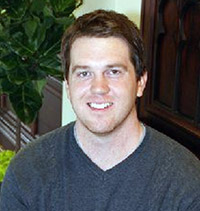
Clint Dobson
Dobson earned his undergraduate degree from Baylor University and his Master of Divinity degree from Baylor’s Truett Theological Seminary, where he was named 2008 Preacher of the Year.
No members of Dobson’s family witnessed Nelson’s execution, but the Dallas Morning News reported Elliott’s son was present.
Nelson’s wife Noa Dubois also attended the execution, and his spiritual adviser Jeff Hood was in the death chamber when Nelson received a lethal injection.
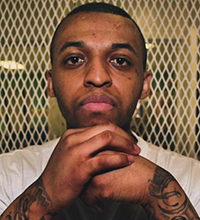
Steven Nelson
At the time of his trial and in the intervening years, Nelson admitted to the attempted robbery but claimed two other men involved in the crime killed Dobson and bludgeoned Elliott.
Physical evidence placed Nelson in proximity to Dobson and Elliott, and investigating officers found his fingerprints at the crime scene.
His death sentence was upheld after multiple appeals. The Texas Court of Criminal Appeals denied his request for a stay of execution one week before he was put to death. The U.S. Supreme Court rejected his final appeal hours before his execution.
“After years of legal battles, Steven Nelson was punished for his heinous crimes, and justice finally has been served,” Attorney General Ken Paxton said in a public statement released soon after Nelson’s execution.
“My heart is with the family and friends of Pastor Clint Dobson, as well as the loved ones of every victim who suffered at the hands of this monster. Ensuring that Texas law is upheld and capital sentences are carried out is a somber responsibility. Victims deserve justice, and criminals who commit heinous crimes such as this must be punished.”
Nelson’s execution marked the first in Texas this year and the second in the United States in 2025.
Voucher bill goes to Texas House after Senate approval
February 11, 2025
The Texas Senate approved an education savings account bill that would allow public funds to go to private religious schools. The measure now will be considered in the House of Representatives, where it has faced stiff opposition in past legislative sessions.
Sen. Brandon Creighton, R-Conroe, sponsored Senate Bill 2, legislation to create an education savings account program that he asserted will offer “expanded education freedom.” (Screen Grab)
Senate Bill 2, sponsored by Sen. Brandon Creighton, R-Conroe, passed 19-12 with all but one Republican in favor and all Democrats in opposition. Sen. Robert Nichols of Jacksonville was the lone Republican who voted in opposition.
Creighton asserted the education savings account program the bill creates would offer “expanded education freedom to our students and our families” in Texas.
John Litzler
John Litzler, director of public policy for the Christian Life Commission, noted Texas Baptists’ moral concerns agency “historically opposed vouchers, including Education Savings Accounts, on many grounds, but chief among them is concerns about infringement on religious liberty.”
Senate Bill 2 provides a $10,000 education savings account for an approved student without disabilities and $11,500 for a student with disabilities to attend an accredited private school. Payments are directed by parents but sent directly to the schools.
“Many of the private schools that will receive tax dollars are religious and include religious instruction and worship as part of the curriculum,” Litzler noted.
Supported by governor and lieutenant governor
Both Lt. Gov. Dan Patrick and Gov. Greg Abbott have expressed strong support for the education savings account program.
Patrick made Creighton’s bill a priority item for the Senate, second only to the state budget.
“Texans across the political spectrum agree that parents must have options to choose the school that best fits the needs of their child to ensure their success,” Patrick said.
During his State of the State address Feb. 2 in Austin, Abbott declared “school choice” an emergency item for the 89th Texas Legislative Session. Emergency items can be voted on during the first 60 days of the session, a period typically devoted to forming committees and other organizational matters.
“Government-mandated schools cannot meet the unique needs of every student. But Texas can provide families with choices to meet those needs,” Abbott said.
“We will continue to fully fund public schools and raise teacher pay, while also giving parents the choice they deserve.”
The Senate has passed school voucher-style initiatives in previous legislative sessions, but those bills have been defeated in the Texas House by a coalition of rural Republicans and urban Democrats.
However, Abbott targeted House Republicans who voted against the education savings account bill he supported in 2023. He successfully campaigned to replace 11 House Republicans with new lawmakers who support his voucher-style plan.
Of the $1 billion allocated for the education savings account program in the proposed budget—twice the amount of a similar bill that passed the Senate in the 2023 session before being defeated in the House—the Senate bill makes $200 million available to any students.
The bulk of the funds—$800 million—would be earmarked for special-needs children and “low-income” families, broadly defined as families making five times the federal poverty level.
That means a single parent making $105,000 a year—or a family of four making more than $150,000 a year—would qualify. During the Senate debate, Creighton repeatedly referred to the maximum as the combined income of a firefighter and a schoolteacher.
Opposition voiced
“Pure and simple, this voucher scheme is a scam,” said Charles Foster Johnson, executive director of Pastors for Texas Children.
Charles Foster Johnson
It would benefit “private schools that do not take every child, that do not provide transportation, breakfast and lunch, and that will likely raise their tuition the amount of the voucher anyway,” he said.
A majority of Texas senators long ago “forsook their oath” to support “free public schools,” as required by Article 7 of the Texas Constitution, he asserted.
“So, this is no surprise,” said Johnson, interim senior pastor of Second Baptist Church in Lubbock.
“It is the Texas House that has held the line against private school vouchers session after session, because that is the chamber closest to the people, who clearly do not want their public-school dollars diverted to subsidize private schools far away from them and religious schools that teach religion contrary to their own,” Johnson said.
However, stopping the measure from passing in the House will be “harder than ever,” he acknowledged.
“Out-of-state billionaires wanting to make money off our kids are pouring millions of dollars into Texas elections to defeat pro-public-education candidates,” he said. “The only resistance we have to this filthy lucre are committed people of faith who refuse to bow to Caesar coming into their church schools.”
Litzler said the CLC anticipates the House version of an education savings account “may differ significantly” from the Senate bill, noting House members “have a different perspective from senators on this issue.”
Governor insists on ‘universal’ program
Abbott has stated he will oppose any “school choice” bill that is not a “universal” program. Although the Senate bill prioritizes certain students if the number of applicants exceeds available funding, the education savings account “would be universal in the sense that every student, except for children of legislators, would be eligible to apply,” Litzler noted.
“It’s certainly possible that a bill filed in the House would not be universal and would limit ESA availability based on certain criteria like household income or attendance at a school assigned a failing letter grade by TEA,” he said.
“The House and the Senate would then have to agree on the bill’s language—or reconcile the differing bills. If the Texas Legislature passes a version of an ESA that is not universal, the governor may veto the bill.”
Litzler noted the importance of voters communicating their concerns to elected representatives.
“The most persuasive argument to a state representative is the one that affects you, the constituent, directly,” he said.
“We’ve heard from parents who are concerned because many private schools can’t accommodate their child who has a disability. We’ve heard concern from parents that their public school will be underfunded and may have to cut programs, extracurriculars, or close campuses all together.
“Many of our state representatives are Christians, and several are Baptists. They often share our religious liberty concerns. Legislators want to hear the concerns that their constituents are most passionate about.”