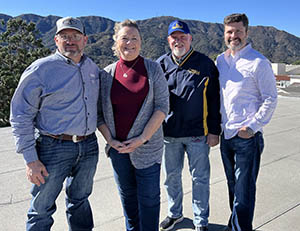
Around the State: HPU to host Currie-Strickland Lectures
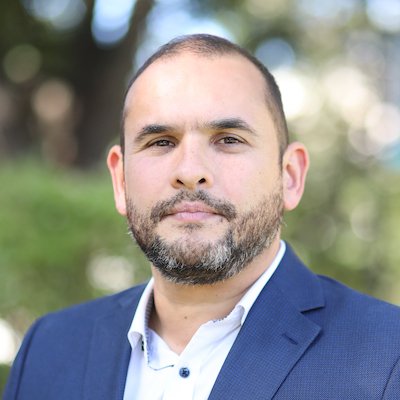
HPU’s 17th annual Currie-Strickland Distinguished Lectures in Christian Ethics will feature guest speaker João Chaves. (Courtesy Photo)

Howard Payne University’s 17th annual Currie-Strickland Distinguished Lectures in Christian Ethics will feature guest speaker João Chaves, assistant professor of history of religion in the Américas at Baylor University. The lectures will be held on Jan. 29, at 10 a.m. during HPU’s chapel service in L.J. Mims Auditorium, and on Jan. 30, at 7 p.m. in the Richard and Wanda Jackson Conference Room of HPU’s Paul and Jane Meyer Faith and Life Leadership Center. The theme for Chaves’ lectures will be “Faith Crossing Borders: How Immigrant Churches are Shaping the Future of Christianity.” Chaves is co-director of the Baptist Scholars International Roundtable in the religion department at Baylor University and an affiliated faculty with the university’s Ethics Initiative. Both lectures are open and free to the public, but reservations are requested. To R.S.V.P, contact HPU’s School of Christian Studies by e-mail at currie-strickland@hputx.edu or by phone at 325-649-8403.

The University of Mary Hardin-Baylor announced 563 students were listed on the fall 2024 Provost’s Honor Roll. To receive this recognition, a student must achieve a 3.85 grade point average or better on a 4.0 scale. Additionally, 577 students were named on the Dean’s Honor Roll for fall 2024. To receive this recognition, a student must achieve a 3.5 to 3.849 grade point average on a 4.0 scale. To see a complete list of honor roll recipients, visit www.umhb.edu/news.
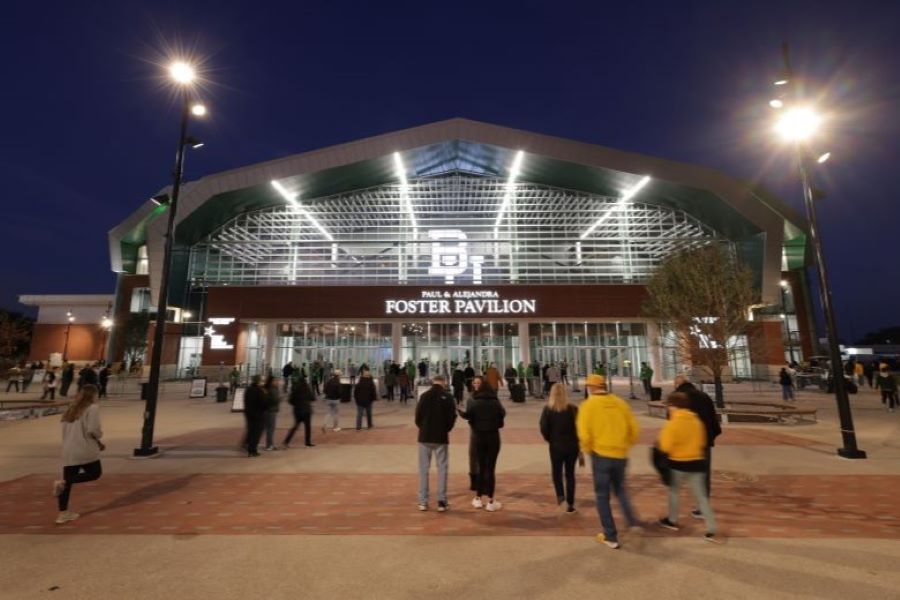
Fans enjoying the Foster Pavilion at Baylor soon will experience concerts and other live event experiences through a partnership with Nashville-based Noise New Media. (Photo/Robert Rogers/Baylor University)

Baylor University has engaged Nashville-based entertainment and digital marketing agency Noise New Media to elevate the university’s concert programming and live event experiences at the Paul and Alejandra Foster Pavilion and other campus venues. The Foster Pavilion hosted its first basketball games in January 2024. The 7,000-seat venue officially became available in November 2024 for non-basketball events and external bookings. Noise New Media, under a three-year exclusive contract with the university, will lead strategic event booking, marketing and consulting efforts for the Foster Pavilion. The agency will work with Baylor to attract top-tier entertainment talent across music, comedy, artistic performances and non-NCAA-sponsored sports events. Noise New Media drives more than 11 million ticket sales annually for concert and entertainment events across the country. The City of Waco contributed $35 million to the construction of the $212.6 million Foster Pavilion. Under Baylor’s agreement with the city, the university will host at least 10 “performance” events at the pavilion over the next two years—ticketed entertainment events open to the public in the areas of music, theater, comedy or non-Baylor sports competitions. Baylor also is required to host at least 10 “university events” annually, or university-produced fine arts shows, performances or other events for the benefit of Baylor students and/or alumni as well as the Waco community. In addition to these economic and entertainment benefits developed by Baylor, the city receives at least 25 days per year to host “community events” at the Foster Pavilion.

Baptist University of the Américas will host Congreso Experience at BUA on March 1. This free event—with workshops, group activities and worship led by BUA students—offers an opportunity to equip and encourage those serving in ministry. Congreso Experience is designed with Hispanic students in mind, seeking to encourage them in their educational journeys and spiritual walks. Rudy Gonzalez will lead a preaching seminar for pastors and church leaders. Churches may register their youth at https://texasbaptists.tfaforms.net/4964194.

The inaugural Hardin-Simmons University nursing cohort and HSU nursing instructors pose for a photo at the Nursing & Pre-Nursing Inaugural Ceremony in early January. (HSU Photo)

Hardin-Simmons University launched its inaugural on-campus nursing program this week, welcoming 30 first-year students who will begin clinical nursing experience and 45 pre-nursing track students. In contrast to many universities that introduce a nursing curriculum during a student’s junior year, HSU allows students to enroll in a nursing foundations course as early as their freshman year, providing a solid foundation in nursing education from the beginning of their academic journey. “Hardin-Simmons School of Nursing boasts over 50 clinical affiliation agreements,” said Katie Martin, instructor of nursing and simulation lab coordinator. The partnerships provide students diverse and comprehensive hands-on experience in various clinical settings. With state-of-the-art learning environments—including a six-bed simulation lab, an eight-bed skills lab and a cutting-edge virtual cadaver lab—HSU facilities are designed to replicate real-world healthcare settings and enhance nursing students’ anatomy and physiology instruction through advanced technology. To learn more about the HSU nursing program, visit hsutx.edu.

Retirements

Mark Newton, pastor at First Baptist Church in Lufkin, will retire after 42 years of ministry, effective Jan. 31. Newton served as associate pastor at First Baptist Church in Marlin, and held senior pastorates at First Baptist Church in Chilton, First Baptist Church in McGregor, Baptist Temple in San Antonio and First Baptist Church in San Marcos. He also served as director of church engagement at Baylor University before becoming pastor at First Baptist Lufkin in 2016.

Editor’s note: The column was revised on Jan. 22 to include Mark Newton’s retirement.


Trump says he was ‘saved by God’ to make America great

WASHINGTON (RNS)—The second inauguration of President Donald Trump was marked by the language of faith, as the former president marked his return to the White House with religious services and prayers from a range of faith leaders, albeit with one notable absence.

“The golden age of America begins right now,” Trump said during his inaugural address, which was delivered inside the U.S. Capitol Rotunda instead of outside due to cold temperatures. “From this day forward our country will flourish and be respected again all over the world.”

Trump recalled the assassination attempt on his life during the campaign.

“I felt then, and I believe even more so now, that my life was saved by God to make America great again,” Trump said.

He later added that his administration “will not forget our country, we will not forget our Constitution and we will not forget our God.”

Trump insisted the United States will be respected and admired again under his leadership, “including by people of religion, faith and good will.”

Cardinal and Franklin Graham offer invocation

The inauguration featured a series of prayers, beginning with an invocation from two faith leaders who prayed at Trump’s last inauguration. Cardinal Timothy Dolan, head of the Archdiocese of New York, joined Franklin Graham, the son of evangelist Billy Graham and head of Samaritan’s Purse, in offering the invocation.

Dolan, who submits his retirement to the Vatican next month, called on God to offer Trump wisdom, saying, “We blessed citizens of this one nation under God, humbled by our claim ‘in God we trust,’ gather on this Inauguration Day to pray.”

Graham began his remarks by addressing Trump directly, saying, “Mr. President, the last four years, there are times I’m sure you thought it was pretty dark, but look what God has done.” The line sparked applause.

Graham then offered a prayer thanking God for aiding Trump, saying, “When Donald Trump’s enemies thought he was down and out, you and you alone saved his life and raised him up with strength and power.”

Shortly thereafter, Trump was sworn in by Chief Justice John Roberts. The first lady held up two Bibles, a family Bible and the one used by President Abraham Lincoln at his 1861 inauguration, although Trump did not place his hand on them. Then the band broke out into the “Battle Hymn of the Republic,” whose refrain declares: “Glory, glory, hallelujah! His truth is marching on.”

Michigan imam not included

After Trump’s remarks, the benediction was offered by three different religious leaders: Rabbi Ari Berman, president of Yeshiva University; Pastor Lorenzo Sewell of 180 Church in Detroit; and Frank Mann, a priest in the Diocese of Brooklyn.

Missing was Imam Husham Al-Husainy, leader of the Karbalaa Islamic Education Center in Dearborn, Mich., who expressed support for Trump during the campaign before the president went on to win an unexpected victory in Dearborn.

Al-Husainy originally was announced as one of the faith leaders who would be part of the benediction but was not introduced during the proceedings. The reason for his absence was not immediately clear, and Al-Husainy could not be reached for comment.

In his prayer, Berman referenced the prophet Jeremiah, recalling his blessing for Jerusalem: “Blessed is the one who trusts in God.”

“America is called to greatness, to be a beacon of light and a mover of history,” he said. “May our nation merit the fulfillment of Jeremiah’s blessing, that like a tree planted by water, we shall not cease to bear fruit.”

He was followed by Sewell, who thanked God for calling Trump “for such a time as this, that America would begin to dream again,” before he began to recite pieces of Martin Luther King Jr.’s “I Have a Dream” speech, a nod to Martin Luther King Jr. Day, which coincided with Trump’s inauguration.

Finally, Mann asked God to “inspire our new leaders to be champions for the vulnerable and advocates for those whose voices are often silenced.”

Mann closed out his prayer with a quote from Trump, referencing a line the president used on the campaign trail: “Americans kneel to God and to God alone.”

Trump and the faith leaders spoke while flanked by Vice President JD Vance, members of the Trump family and a group of tech CEOs: Elon Musk, head of SpaceX and the X social media platform; Mark Zuckerberg, CEO of Meta, which owns Facebook; Tim Cook, CEO of Apple; Jeff Bezos, CEO of Amazon; and Sundar Pichai, CEO of Google.

Seated behind them were Trump’s various cabinet nominees, such as Fox News host Pete Hegseth, an evangelical Christian and the president’s pick to run the Department of Defense.

All living former presidents were in attendance, along with the former first ladies, with the exception of Michelle Obama, who in her 2024 Democratic National Convention speech sought to juxtapose Trump against values she held dear, such as “do unto others” and “love thy neighbor.”

Began day at ‘church of the presidents’

Earlier that morning, Trump, who won a second term in November over former Vice President Kamala Harris after being defeated by former President Joe Biden in 2020, began his day with a service at St. John’s Church, Lafayette Square.

The Episcopal church, which sits near the White House and sometimes is referred to as the “church of the presidents,” traditionally hosts a service on Inauguration Day for incoming presidents, as it did for Trump on the morning of his first inauguration in 2017.

After being greeted by Robert Fisher, the church’s rector, Trump—who was raised Presbyterian but began identifying as a nondenominational Christian in 2020—took his seat in the front pew.

The service included participants associated with Trump and Vance, such as Pastor Jack Graham of Prestonwood Baptist Church in Plano, who has long supported Trump. Graham read Proverbs 3:5-8, 13-18.

In addition, Henry Stephan from the University of Notre Dame—a Dominican priest whom Vance credits with helping him convert to Catholicism—read 1 Peter 4:10-11, and Alveda C. King, founder of Alveda King Ministries, read Galatians 3:25-29.

The service also included a brief benediction from Fisher, in which he called on God to guide Trump and Vance before invoking Micah 6:8.

“May they, and we all, heed the words of Micah who proclaimed that, ‘What the Lord asks of us is to do justice, love mercy, and walk humbly with our God,’” Fisher said, according to an email exchange with Religion News Service.

Fisher also noted in the email that he had final say over which prayers and Scripture readings were selected for the service, and his goal was to choose things that were “unifying, elevating, and nonpartisan.”

Hymns and songs sung at the gathering included “O God, Our Help in Ages Past,” “This Little Light of Mine,” “My Country, ’Tis of Thee” and “America the Beautiful.”

During the service, Trump sat next to his wife, as well as Vance and second lady Usha Vance, who was raised Hindu.

Members of the extended Trump family sat nearby, prominent podcaster Joe Rogan was seen across the aisle, and Sen. Marco Rubio, Trump’s nominee for Secretary of State, sat behind the first family.

In addition, a trio of tech titans who voiced various levels of support for Trump after his victory in November—Zuckerberg, Cook and Bezos—were spotted sitting alongside each other in the pews. Pichai sat behind them.

Musk was not spotted in photographs of the service, despite attending the inauguration later. Musk, an enthusiastic supporter of Trump who spoke at his victory rally in Washington on Sunday night, was raised Anglican and now identifies as a “cultural Christian.”

Unlike 2017, when Dallas pastor Robert Jeffress preached a sermon during the service voicing support for a border wall, this year the church chose to nix a homily altogether. Fisher said in a message to church members, this change was an attempt to return the service to its “original, simpler nature.”

After the service, Trump joined Biden at the White House for tea—a traditional ritual in the transfer of power that did not occur in 2021, after supporters of Trump stormed the U.S. Capitol in an attempt to overturn the 2020 presidential election results.

Trump was scheduled to attend another interfaith prayer Jan. 21 at the Washington National Cathedral, featuring a sermon from Mariann Budde, the Episcopal bishop of Washington, who has been critical of Trump in the past.

Inauguration coincided with MLK Day

Trump’s inauguration coincided with MLK Day, a federal holiday. Some of Trump’s longtime religious critics used the moment as an opportunity to both celebrate King’s legacy and voice pushback to Trump.

In Atlanta, at Ebenezer Baptist Church, where King once preached, Pastor William Barber II, an activist who preached at Biden’s inaugural prayer service, described a “schizophrenic America” that waffles between different ideals.

“In this moment we must remember whose we are and who we are,” Barber said. “We are not of those who shrink back into destruction.”

Referencing the inauguration, Barber rejected claims by Trump and his allies that the president won a “mandate” in the November election. “You never win a mandate to violate justice. You never win a mandate to hurt people with your power,” Barber said.

He added: “We come today to remember Dr. King but more so to commit ourselves to the spirit, to the commitment … that every day we’ve got life in our bodies, to tell America who she is supposed to be.”


Southwestern reports measurement of financial health

FORT WORTH—Southwestern Baptist Theological Seminary released on Jan. 17 the institution’s most recent Composite Financial Index score of +3.0, which President David Dockery called an “objective” metric that “quantifies the significant progress made in the past 28 months.”

CFI is a “standard measuring tool used by the U.S. Department of Education and almost all accrediting agencies to assess the financial health of higher education institutions,” Dockery said.

An institution’s CFI score can range from -1.0 to +3.0 for private institutions based on primary reserves, expendable net assets, change in net assets, and net revenue from operating activities resulting in a composite score.

David S. Dockery

Southwestern Seminary’s CFI scores over the last three years have moved from below zero at the end of 2022 to +1.2 for 2023 to +3.0 for 2024, demonstrating the institution has moved from a “place of significant stress” to a “place of institutional responsibility related to finances,” he said.

While noting remaining at +3.0 will not be easy and scores can fluctuate based on various factors, Dockery said the “metric is another sign of God’s amazing faithfulness to Southwestern.”

“We rejoice at this good news and the hopeful marker of real progress from an objective source,” he said.

“The Southwestern community has prayed for God’s favor and blessings, and we continue to live in dependence upon God while offering regular thanks and gratitude to our Lord for his provision and help. Thanks be to God.”

Accreditation warning subject to review

In 2023, the Southern Association of Colleges and Schools Commission on Colleges placed the seminary on accreditation warning, due in part to financial issues. The accrediting body extended that warning for the seminary last year, but it is subject to review this summer.

Under SACS Principles of Accreditation, an educational institution is required to have “sound financial resources and a demonstrated, stable financial base to support the mission of the institution and the scope of its programs and services.” The institution also is expected to “manage its financial resources in a responsible manner.”

financial overview released by the seminary’s board of trustees in June 2023 revealed from 2002 to 2022, annual operating expenses at Southwestern Seminary rose 35 percent, while full-time-enrollment figures dropped 67 percent, resulting in a cumulative $140 million operating deficit.

The seminary ran an operational deficit 19 years during the period from 2002 through 2022, spending an average $6.67 million more than it received in revenue those years.

“Due to the timeline of financial reporting and the need to demonstrate positive trends over multiple fiscal years, it was our expectation that a full review of financial progress would not be possible until June 2025,” Dockery said last summer.

With additional reporting by Managing Editor Ken Camp.


Survivors in Gaza ‘desperate,’ Palestinian pastor says

JERUSALEM (BP)—Crucial humanitarian aid, the phased release of hostages in exchange for prisoners, and an end to Israel’s bombing of Gaza were among the terms of a ceasefire agreement announced Jan. 14 between Israel and Hamas.

Christian Mission to Gaza distributed food to 1,000 people in north Gaza and 800 in south Gaza Jan. 14, the same day the tentative ceasefire agreement was announced.

Christian Mission to Gaza distributed food to 1,000 people in north Gaza and 800 in south Gaza Jan. 14, the same day the tentative ceasefire agreement was announced. (Christian Mission to Gaza photo)

Survivors in Gaza, including perhaps 620 Christians, are desperate, anxious and hopeful for relief, said Hanna Massad, former pastor of Gaza Baptist Church and leader of Baptist Mission to Gaza, a gospel humanitarian outreach to the area.

“This agreement is very thin, and we hope and pray it will be implemented. Anything could happen, but this is why people are a bit nervous,” Massad told Baptist Press.

“People are really tired and exhausted in Gaza and they’re really desperate for this, and they hope it will continue—the agreement—and be implemented.”

Ric Worshill, executive director of the Southern Baptist Messianic Fellowship, discussed the agreement with skepticism he described as likely common among fellow Southern Baptist Messianic believers.

“It’s only as real as what Hamas does,” Worshill said of the ceasefire. “And it’s really not that good, because there’s like 93 or 94 actual hostages, and only 33 or so are being released? So there’s something wrong here and there’s more to it.

“If they (Hamas) were really going to be honest about what they’re doing, they would just release all the hostages. The sad part about is, for the few they’re going to release, they’re going to get about 100 terrorists back.”

Officials have said perhaps a third of the 100 or so hostages still held in Gaza are believed to be deceased, and Worshill pointed out Jews practice burial within a certain amount of time.

“They’ve held onto the bodies so that they would have leverage,” Worshill said of Hamas’ treatment of the deceased hostages.

“They know that in the Jewish faith, a dead person is supposed to be buried before the next Sabbath. So, they know that’s hurtful to the family.”

Israel continued to shell Gaza after the ceasefire was announced, with the Palestinian Health Ministry announcing about 80 deaths since the announcement, in addition to 46,500 since the war began.

U.S. Secretary of State Antony Blinken, in his farewell press conference Jan. 16, expressed confidence in the ceasefire agreement announced through mediators Qatar and the U.S.

Brent Leatherwood, Southern Baptist Ethics & Religious Liberty Commission president, did not comment on the ceasefire agreement, but stated stipulations he would like to see achieved.

“It is an outrage that nearly a year and a half after the October 7th (2023) atrocities, that there are still hostages being held by terrorists,” Leatherwood said in a comment submitted to Baptist Press Jan. 16. “As we’ve maintained throughout this moment, the hostages must be returned. Period.

“At the same time, Israel’s right to exist must not be threatened,” Leatherwood said. “I am praying for these objectives to be agreed to by all parties in the Middle East as quickly as possible.”

Agreement details

As announced in the multiphase ceasefire agreement to start Jan. 19—as reported by the Associated Press—in the first phase of 42 days:

  • Hamas would release 33 hostages, including female civilians and soldiers, children and civilians over 50, beginning with three the first week, four hostages the next seven days, and weekly releases thereafter.
  • In exchange, Israel would release 30 Palestinian prisoners for each civilian hostage and 50 for each female soldier.
  • Fighting would stop, and Israeli forces move out of populated areas in Gaza, retreating to the edges of the Gaza Strip.
  • Displaced Palestinians would begin returning home, and more humanitarian aid would be allowed to enter the strip.

Conflict’s effects on Gaza Christians

Gaza Baptist Church, the lone Protestant congregation that served residents of the Gaza Strip, was heavily damaged in the war and used as a military site for Hamas.

Massad pastored the church before founding Christian Mission to Gaza, which continues to provide food and other humanitarian aid to survivors still in Gaza, keeping the name of Gaza Baptist Church in the forefront.

“We look forward and we hope that both sides will implement this ceasefire and hopefully doors will be opened and we’re able to do more concerning relief and start to help more people rebuild their life,” he said, “not only with food and medical relief, but also with other necessities.”

At least 33 Christians have been killed in Gaza in the war, Open Doors U.S. said in supplemental materials released Jan. 15 with its 2025 World Watch List of the 50 worst places for Christians, although Israel and Gaza were not included on the list.

An estimated 800-1,000 Christians were in Gaza when the war began.

“In the time of war, there’s a number of people from the Christian community who have been killed,” Massad said, among them his aunt as well as a longtime member of Gaza Baptist Church, both elderly women.

“Civilians of course have been killed from the Christian community as well.

“We cannot really imagine the pain, the suffering, the fear,” he said. “The community continues to hold to their faith but really are waiting for this moment (of ceasefire).”

On the day the ceasefire was announced, Christian Mission to Gaza was busy serving food to nearly 2,000 survivors in Gaza, including 800 in the south and 1,000 in the north, Massad said.

“Our hearts are torn as we witness the innocent children, women and elderly suffering and being killed in this unimaginable tragedy in Gaza. Under such difficult weather and terrible circumstances, we are left asking what more we can do in the face of this nightmare” he shared in a ministry update.

“Yet, we continue to pray, trusting in the good Lord to bring peace and an end to this suffering.”

Subsequent phases of the ceasefire aimed at securing an end to the war, AP reported Jan. 14, would include the declaration of a “sustainable calm;” the release of the remaining male hostages in exchange for a yet-to-be-determined number of Palestinian prisoners and a full Israeli withdrawal from the Gaza Strip; the exchange of the bodies of deceased Israeli hostages for the bodies of deceased Palestinian fighters; the implementation of a reconstruction plan in Gaza and the reopening of border crossings in and out of Gaza.


CLC weighs in on precedent-setting religious freedom case

Texas Baptists’ Christian Life Commission filed a legal brief urging the Texas Supreme Court to refrain from overly narrowing the scope of the Religious Service Protections amendment to the Texas Constitution.

The CLC filed the amicus brief Dec. 30 in response to oral arguments on the religious freedom case Perez v. City of San Antonio.

John Litzler, CLC director of public policy, explained the case involves the Religious Services Protections amendment to the state constitution.

Voters approved the amendment in 2021 in response to restrictions imposed by local governments on religious services during the COVID-19 pandemic.

Background

The lawsuit concerns the City of San Antonio’s development plan for Brackenridge Park—a city-owned park surrounding a bend in the San Antonio River where Native Americans have an ancestral connection and have worshipped for hundreds of years.

The suit, brought by Gary Perez and Matilde Torres, asserts the city’s plan would prevent the free practice of their religion by preventing them from performing ceremonies essential to their beliefs.

The original opinion in the case was filed April 11, 2024. The U.S. Court of Appeals for the Fifth Circuit held the appellants’ argument lacked merit, affirmed the district court’s judgment and denied an emergency injunction pending appeal to stop the city’s public improvements in the Lambert Beach area of the park.

The Fifth Circuit Court later withdrew its opinion and certified a question to the Supreme Court of Texas to interpret the Religious Services Protections amendment for the first time.

Perez and Torres—ceremonial leaders of the Lipan-Apache Native American Church—sued the city citing the free exercise clause of the U.S. Constitution’s First Amendment, the Texas Religious Freedom Restoration Act and the Texas Constitution.

The suit sought to require the city to grant them access to the area for religious worship, minimize tree removal and allow birds to nest there.

“Following a preliminary injunction hearing, the district court ordered the City to allow Appellants access to the area for religious ceremonies but declined to enjoin the City’s planned tree removal and rookery management measures,” a report on FindLaw explains.

At issue is access to the Lambert Beach area—which will be limited during renovation to the San Antonio River retaining-wall—and the removal of many trees in that section of the park to allow for construction and discourage cormorant nesting in the area where people frequently concentrate.

The Lipan-Apache Native American Church—which blends Native American and Christian beliefs—consider the waters, trees, birds and constellations above the bend in the river a “sacred ecology.”

Perez and Torres contend relocating the birds and removing the trees will prohibit them from performing religious ceremonies dependent on the “sacred ecology” of the riverbend—“the only place in the world” where the practices can be performed, according to Notre Dame Law School’s Lindsay and Matt Moroun Religious Liberty Clinic.

John Greil, an attorney and professor at the University of Texas law school’s Law & Religion Clinic, represents Perez and Torres in Perez v. City of San Antonio. He told a reporter last month Perez and Torres are the first claimants to bring a suit under the Religious Services Amendment. So, the decision in the case will carry significant weight as a precedent.

Concerns about oral arguments

In an email Litzler noted, “while I didn’t ‘take a side’ of either party in the case, I did write to the Court asking them not to agree with an interpretation of the amendment presented during oral argument which we feel would have unnecessarily limited the scope of the amendment.”

The brief points to oral arguments offered by the State of Texas given by Deputy Solicitor General Billy Cole, in which the state suggested the right to take communion “was not within the scope of the amendment.”

The state’s argument relative to these points begins at 3:04:55 in the linked video.

When asked about the right to sing during a worship service, the brief points out, the state suggested “the amendment’s scope was designed to protect the right to gather,” but suggested the amendment’s protections did not extend to the acts of worship taking place at religious gatherings.

The state suggested questions about worship practices, including singing and communion, would be handled under the Texas Religious Freedom Restoration Act and are protected by the First Amendment, but Cole asserted they are beyond the intended scope of the 2021 Religious Services Protections amendment.

However, the CLC brief notes Rep. Jeff Leach and Sen. Kelly Hancock—authors of the amendment—specifically addressed efforts to prohibit singing in worship when they talked about the impetus for introducing the amendment. They told a gathering of pastors the amendment was designed both to protect the freedom to assemble and the freedom to worship.

“The distinction between the Amendment only protecting the right to gather as opposed to the right to gather and freely engage in worship practices is not merely academic, but essential to protecting religious freedoms of Texas Baptists,” the CLC brief reads.

Using as an example the Baptist ordinances of believer’s baptism by immersion and the Lord’s Supper as core practices of all who identify as Baptist, Litzler argued Article 1, Section 6a of the Texas Constitution should extend to protecting these practices, not merely the freedom to gather.

The amendment reads: “This state or a political subdivision of this state may not enact, adopt, or issue a statute, order, proclamation, decision, or rule that prohibits or limits religious services, including religious services conducted in churches, congregations, and places of worship, in this state by a religious organization established to support and serve the propagation of a sincerely held religious belief.”

Litzler said the CLC is not siding with either the city or the appellants in Perez v. City of San Antonio, but emphasized, “However the Supreme Court decides this case, they should definitely not decide it doesn’t protect singing and the Lord’s Supper, especially on private property.”


Imprisoned evangelical Cuban pastor Fajardo released

Lorenzo Rosales Fajardo, an evangelical Cuban pastor who has been imprisoned since 2021 for participating in peaceful protests, was released in mid-January as part of a mass amnesty, an international human rights organization reported.

Christian Solidarity Worldwide reported Fajardo was released Jan. 17 from Mar Verde prison. The Cuban government said it planned to release 553 political prisoners following the White House announcement the U.S. Department of State would remove Cuba from its list of state sponsors of terrorism.

Fajardo’s release came days after the release of Donaida Pérez Paseiro, an Afro-Cuban Yoruba religious leader. Her husband Loreto Hernandez Garcia remains in prison.

Anna Lee Stangl, director of advocacy for Christian Solidarity Worldwide, stated: “CSW welcomes the release of Pastor Lorenzo Rosales Fajardo and of Donaida Pérez Paseiro, neither of whom should ever have spent a day in detention in the first place. They have endured abusive treatment and been forcibly separated from their spouses and children since July 2021.

“We call on the Cuban government to immediately release Loreto Hernández García, and to ensure that Pastor Rosales Fajardo and all political prisoners and their families enjoy their freedom without any further harassment.”

Accused of attack on Cuban Communist Party HQ

Fajardo, pastor of the nondenominational Monte de Sion Church in Palma Soriano, was arrested after he and some members of his church participated in nationwide protests on July 11, 2021.

A document the Cuban government sent to the United Nations claimed Fajardo was involved in a violent attack on the headquarters of the Cuban Communist Party in Palma Soriano—a charge Fajardo denied.

Video and photographic evidence showed Black Beret paramilitary personnel and police attacking Farjardo and other unarmed civilians during a peaceful protest.

Fajardo was charged with four crimes under the Cuban Criminal Code—criminal incitement, public disorder, disrespect and assault. He initially received an eight-year prison sentence, which later was reduced to seven years.

‘Arbitrary detention’

During his initial detention at the Versalles State Security facility, Farjardo reportedly was beaten by guards, who also urinated on him. He lost a tooth due to physical abuse. The following month, he was moved to Boniato Maximum Security Prison and later to La Coaba prison before his transfer to Mar Verde prison.

“In 2022, in the days leading up to Easter, prison officials subjected him to solitary confinement in a ‘punishment cell’ for his refusal to obey orders to stop sharing his faith inside the prison,” the International Religious Freedom or Belief Alliance wrote in a statement released last June.

Fajardo appealed his case, but a Cuban court upheld his sentence in June 2022. During the court hearings, only the prosecution was permitted to present evidence.

In February 2024, the United Nations Working Group on Arbitrary Detention determined Fajardo’s treatment violated the Universal Declaration of Human Rights in multiple ways and constituted “arbitrary detention.”

EDITOR’S NOTE: After this article was published, the U.S. Commission on International Religious Freedom released a statement on Jan. 18 welcoming the release of Lorenzo Rosales Fajardo and Donaida Pérez Paseiro, along with Santeria practitioner Lisidiani Rodriguez Isaac. Commissioner Susie Gelman also stated: “USCIRF continues to call for the release of all Cuban religious leaders wrongfully imprisoned for participating in the July 11, 2021 protests, such as Loreto Hernández García, We urge the U.S. Department of State to make clear to the Cuban authorities that those who remain wrongfully imprisoned must be released and to remain vigilant to confront any future harassment, intimidation, or detention by the Cuban government.”


California churches praying and seeing answers

LOS ANGELES—Southern California churches have been praying in the midst of the devastating fires in their area, and the answer to a specific Sunday evening prayer has been noticed and appreciated by others in the community.

Rand Jenkins, Texans on Mission’s chief strategy officer, participated in the Sunday evening prayer service at Highlands Church, north of downtown Los Angeles.

“On Sunday, the weather forecast anticipated winds topping 70 miles per hour through Wednesday,” he said. “The high winds never came, and forecasters canceled the warning.”

Pastor David Johnson shared about the prayer service on Instagram.

“On Sunday night we rebuked the wind in Jesus’ name,” the pastor said. “We contended for our city and its people. … While we aren’t out of the woods, … we are certainly praising God for his faithfulness.”

After the social media post, Johnson received a “thank you” text from a neighbor who doesn’t go to church.

‘Glimmers of hope rising from the ash’

“In the midst of this tragedy, people are noticing that Christians are both praying and working to help,” Jenkins said. “Prayer is our first job, but it’s also important for someone who is hurting to see we care about them.”

Johnson said the prayers and helpfulness are “so consistent with the gospel.”

“We’re just starting to see those glimmers of hope rising from the ash,” he said.

Los Angeles-area Christians believe “God is going to do an amazing work of calling the city back to himself,” he added.

Texans on Mission is partnering with churches to provide respite centers for fire victims. These are places where volunteers will do people’s laundry in special units provided by Texans on Mission.

“Volunteers are going to wash their clothes while the people, the homeowners, can sit and have a cup of coffee and their children will be entertained,” Jenkins said. “It will be time to breathe, to rest and to recover.”

‘Ash out’ ministry likely in weeks ahead

Fire recovery efforts—typically known as “ash out”—will follow in the weeks to come.

In that next stage of relief, volunteers will “sit down with a homeowner and find out what mementos they hope to recover,” Jenkins explained. “What are they trying to find that ties them back to their history?

“We sit next to them and scoop the ashes and then sift, hoping you find that memorabilia. It could be wedding bands. It could be photos. It could be Christmas ornaments, something that ties you back to your house. Those things don’t have a monetary value, but they have so much meaning to people. They connect you back to who you are.”

Texans on Mission shower/laundry units left Dallas for California Jan. 15. Other volunteer disaster relief leaders are expected to arrive in Los Angeles Jan. 19 to establish incident command centers for coordinating relief efforts.

In the meantime, Texans on Mission supporters are asked to pray and give toward the effort.

Chief Executive Officer Mickey Lenamon has asked people to pray specifically for:

  • A swift end to the fires.
  • Those who have been affected by the fires.
  • Strength for the firefighters who are serving valiantly.
  • The churches serving with Texans on Mission to minister to people impacted by the fires.
  • The clear proclamation of the gospel.

To learn more about financially supporting the effort, visit TexansOnMission.org/wildfires or call (214) 275-1100.


Obituary: Margie Ann Mines

Margie Ann Mines, long-time Southern Baptist missionary, died Dec. 29. She was 89. She was born April 10, 1935, in Fort Worth to J.T. and Genevieve DeLoach. After graduating from Stephen F. Austin High School in Houston, she earned a bachelor’s degree in elementary education and English at Baylor University. She met her future husband, Donald Mines, when they went on a blind date to see a movie. Despite the fact Friendly Persuasion was on the screen that night in 1956, the first-year seminary student later recalled his date would not let him hold her hand. However, she did invite him to be her guest at a Baylor student dinner. They dated for a year before marrying at North End Baptist Church in Beaumont, where her father was pastor. The Mines served in churches in Southeast Texas before they were appointed in 1965 as Southern Baptist missionaries to Argentina. They served in Córdoba, Bahía Blanca and Buenos Aires until 1997. She was active in the work of the Baptist Women’s Union. In later years, she was involved in an English-language Bible study group that extended her ministry to families from around the world. She often said moving to Argentina was one of God’s most gracious gifts in her life. After 33 years in Argentina, the Mines retired and settled in Pflugerville in 1998. In retirement, Margie Mines was active in prayer and Bible study groups at both First Baptist Church in Austin and First Baptist Church in Round Rock. She was preceded in death by daughter Danna, who was killed in a vehicle accident in 1981. She is survived by her husband of 66 years Don; son Steve; son David and his wife Melissa; granddaughter Sarah; grandson Benjamin; and brother Roy. Memorial gifts in her honor can be made to Children At Heart Ministries or No More Violence/No Mas Violencia.


Daniel Ritchie nominee for SBC first vice president

APEX, N.C—Evangelist and author Daniel Ritchie will be nominated for first vice president of the Southern Baptist Convention during the 2025 SBC annual meeting in Dallas.

Matt Capps, lead pastor of Fairview Baptist Church in Apex, N.C., told the Biblical Recorder he plans to nominate Ritchie.

“Daniel Ritchie is among the most faithful, consistent, and passionate witnesses for Christ that Southern Baptists have seen raised up in this generation,” Capps said.

“I am eager to see our convention recognize this gospel servant and unapologetically champion the vital ministries of vocational evangelists like Daniel by electing him to serve as first vice president.”

A native of Greensboro, N.C., Ritchie previously served as a student pastor at churches in North Carolina and Arizona before answering a call to become a vocational evangelist and speaker.

For the past 20 years, Ritchie has traveled the country speaking to churches, schools, camps, conferences, colleges, corporations, sports teams and more, according to his website.

Ritchie also preached during the 2022 SBC Pastors’ Conference in Anaheim, Calif.

Ritchie has written two books—My Affliction for His Glory: Living Out Your Identity in Christ and Endure: Building Faith for the Long Run. He also has been a contributing writer to other online ministry outlets and publications.

In My Affliction for His Glory, Ritchie shares his life story, which includes being born without arms and struggling with a sense of value and worth while growing up. After placing his faith in Christ during a church youth event at age 15, Ritchie discovered God had a plan and purpose for his life.

“A man with no arms was never going to fit in a world where everyone has two arms,” Ritchie wrote. “But God had more in store for me than to be a victim of a life defined by the things that I was never going to be.”

Ritchie’s life story and testimony have been featured on Fox News, Focus on the Family and other media outlets.

Ritchie holds a bachelor’s degree in biblical studies from the College at Southeastern, now known as Judson College. He currently is pursuing a master of divinity degree from Southeastern Baptist Theological Seminary.

Ritchie has been married to his wife, Heather, 18 years, and they have two children. The Ritchies reside in Raleigh, N.C., where they are members of The Summit Church, a multisite congregation in the Raleigh-Durham area.

According to the most recent data available, The Summit Church reported an average worship attendance of 7,891 and 448 baptisms in 2023. The church reported $810,000 (2.45 percent) given through the Cooperative Program based on $33,061,224 in undesignated receipts. The church also gave $368,500 to the Lottie Moon Christmas Offering and $154,000 to the Annie Armstrong Easter Offering.

“As a model husband, father, ministry leader, and church member, Daniel Ritchie lives the gospel he preaches, calling hundreds of thousands every year to follow Jesus by both his life-changing testimony and his determination to make Christ known through a bold preaching ministry,” Capps added.

The 2025 SBC annual meeting is scheduled June 10-11 at the Kay Bailey Hutchison Convention Center in Dallas.


Laws guarding kids from online porn at risk in appeal

WASHINGTON (BP)—Laws in 20 states aimed at shielding minors from online pornography are under fire as the U.S. Supreme Court hears a legal challenge Jan. 15, with the Texas Baptists’ Christian Life Commission joining the Southern Baptist Ethics & Religious Liberty Commission among many interceding for the Texas law at the center of the case.

At issue in the case, Free Speech Coalition, Inc. v. Paxton, is Texas House Bill 1181, one of a string of 20 such laws passed since Louisiana began the charge in 2022 to require websites containing at least 33 percent pornographic materials to verify that a user is at least 18 years old.

The Free Speech Coalition, an adult entertainment industry trade association, is challenging the laws and has a hearing before the High Court, arguing the regulations endanger free speech and privacy rights of site users. The Texas case is appealed from the U.S. Fifth Circuit, which upheld for Texas.

The public policy organizations’ brief said the U.S. Constitution does not prohibit states from regulating materials that are obscene to minors and presented historical evidence dating to the 17th century.

“The Fifth Circuit’s decision aligns with the history of State regulation of obscenity and this Court’s tradition of respecting the broad police powers enjoyed by the States to protect minors from obscene entertainment,” the brief stated.

“While Texas might have done more, it legislated only as much as was necessary to protect children from exposure to harmful, obscene sexual materials. H.B. 1181 accords with the history of State regulation of material that is obscene for minors, and so it is plainly constitutional.”

Tennessee’s law, originally scheduled to take effect Jan. 1, was allowed to take effect late in the day on Jan. 13 when the U.S. Court of Appeals for the Sixth Circuit stayed an injunction the Free Speech Coalition had secured in December to block the law’s implementation. In Georgia, a law passed in 2024 is set to take effect in July.

In response, the most-visited adult website Pornhub has blocked access to its site in most of the states where age verification laws have been passed, leaving access available in Georgia, Louisiana and Tennessee, CNN reported.

Much support for Texas law

Nearly 60 lawmakers from 15 of the states where laws are in effect jointly filed an amici brief in support of the Texas law—and by extension their own.

“In sum, speech regulations are scrutinized more leniently, and First Amendment protections are at their weakest when children are at risk; where no criminal prosecution or total ban or prior restraint or viewpoint discrimination is present; where the law regulates conduct; and where the content is sexually graphic and is broadly disseminated in a manner that may expose children,” reads the brief submitted by lawmakers. “H.B. 1181 is just such a law. Its sole purpose is to restrict children’s access to sexually graphic material.”

Legislators signing the brief, filed Nov. 15, 2024, represented Alabama, Arkansas, Florida, Idaho, Indiana, Kansas, Kentucky, Louisiana, Mississippi, Montana, Nebraska, North and South Carolina, Tennessee and Utah. In addition to the aforenamed states and Texas, similar laws are in effect in Virginia, South Dakota and Oklahoma.

“As articulated in their statement of faith, Southern Baptists believe that God gave all of humanity free choice when it comes to questions of morality,” the ERLC wrote. “But minors often lack the developmental capacity or moral maturity to know how to exercise that free choice responsibly.

“Thus, Southern Baptists believe it is important to structure society and society’s rules to maximize the ability to educate and train minors on their social and moral responsibilities.

“And while it is primarily the role of families to provide this education and training, the States certainly have an important role to play in this process—most significantly by protecting the ability of families to perform their role.”

Scholars from the Wheatley Institute at Brigham Young University and the Institute for Family Studies—affiliated with the Church of Jesus Christ of Latter-Day Saints—recently analyzed research studies of pornography use conducted over the last 20 years, documenting “trends in pornography use among children and teens and to identify how its use may be harmful to their development in significant ways,” a press release explained.

The researchers used their findings to submit an additional amicus brief to the U.S. Supreme Court in Free Speech Coalition, Inc. v. Paxton.

The report, released Jan. 14, concludes that “not only is pornography linked to development risk for minors, but it is actually more dangerous for young people than acknowledged in some research studies,” the press release reads.

Laura Schlegel, a Republican Louisiana representative who authored the first successful online age verification law in the nation, is also a licensed professional counselor and certified sex addiction therapist. Exposure to porn harms children and adolescents, she said in her brief.

Girls who view pornography are more likely to see themselves as objects of male pleasure, struggle with self-esteem issues, have higher rates of self-harm and suffer more vulnerability to sexual exploitation. Boys develop unrealistic and harmful attitudes toward sex and relationships that lead to increased aggression and difficulties in forming genuine intimate connections, Schlegel said.

Anxiety, depression and engagement in risky sexual behavior are pronounced.

“Protecting minors from obscene content isn’t just a compelling interest legally,” Schlegel noted. “It is a compelling, bipartisan issue at every kitchen table in this country.”

With additional reporting by Calli Keener.


One global Christian in seven faces high-level persecution

(RNS)—Driven by Islamic extremism, authoritarian regimes and war, high-level persecution and discrimination impacted 380 million Christians around the world in 2024, according to the annual World Watch List report by the evangelical nonprofit Open Doors released Jan. 15.

The World Watch List ranks the 50 countries where Christians experienced the most persecution and discrimination.

A map of the 2025 World Watch List Top 50 compiled by Open Doors. (Image courtesy of Open Doors via RNS)

The 2025 report draws concerns about escalating violence in sub-Saharan countries, authoritarian regimes targeting Christians, conflicts forcing Christians to flee their homes and churches forced underground.

North Korea topped the list for the 23rd year, followed by Somalia, Yemen, Libya, Sudan, Eritrea, Nigeria, Pakistan, Iran and Afghanistan.

The report also counted 209,771 Christians displaced because of their faith and 54,780 Christians physically or mentally abused, 10,000 of whom lived in Pakistan. In total, 1 in 7 Christians faced “high-level” persecution.

“While the numbers and rankings only partially tell the story, they do help draw the world’s attention to the 380 million believers who are suffering for their faith. This presents an opportunity for us to communicate the rest of the story,” said Ryan Brown, CEO of Open Doors US.

Since it debuted in 1993, the Open Doors’ World Watch List relies on data provided by on-the-ground local researchers and attributes a persecution score to countries based on the evidence collected.

How the list is determined

Countries in the “extreme” category scored between 81 and 100 points. Scores between 61 and 80 points are associated with a “very high” level of persecution, and scores between 41 and 60 with a “high” level.

The report defines persecution as “any hostile action towards a person or community motivated by their identification with the person of Jesus Christ.”

It takes into consideration insults, abuse and workplace discrimination. It also distinguishes “smashes”—cases of physical violence, bombings, shootings and sexual violence—from “squeezes”—policies and laws forcing Christians into isolation and underground practices.

(Graphic courtesy of Open Doors via RNS)

Several countries have pushed more Christians to worship underground, the report found, including Afghanistan, ranked 10th, and China, ranked 15th. World Watch List researchers found more Christians in China feared online and real-life surveillance than in previous years.

The report also mentions cases of churches facing ideological pressures and new laws enrolling pastors into indoctrination sessions.

In Eritrea, called the North Korea of Africa for its internet and phone surveillance of citizens, Christians were arrested en masse in house-to-house raids. Only certain denominations are allowed, excluding evangelicals and Christians from a Muslim background.

Algeria, ranked 19th, has forced its Protestant churches to close or operate secretly. This caused its score to decrease by 2 points, as it lowered the number of persecuted churches to observe. The report also notes the number of Christians awaiting trials and sentencing for faith-related allegations in Algeria is at an all-time high.

The persecution score of Kyrgyzstan increased by 7 points, pushing its rank on the list to 47th, the most dramatic increase of all countries. The government there has taken an authoritarian turn and used laws against public criticism to target Christian minorities, explained the report.

In Kazakhstan, which is ranked 38th and gained 3 points on its persecution score, churches have been attacked by police and security services, and Christian women have been forced to marry Muslim men.

Like in past years, the report reiterates Islamic terrorism remains the main threat to Christian communities worldwide. In sub-Saharan countries, jihadist militants have benefited from unstable governments to seize control of specific areas.

‘Extremely-high’ sub-Saharan persecution

All 15 countries of the sub-Saharan region were among the top 50 list, and 13 had “extremely high” persecution scores.

With more than 106 million Christians, Nigeria, ranked seventh, remains “among the most urgently dangerous places for Christians on earth,” according to the report, primarily because of violent attacks by Islamic, ethnic Fulani militias in the country’s northern states. The attacks are meant to drive Christian communities off the land they farm.

According to the Observatory for Religious Freedom in Africa, quoted in the report, 30,880 civilians have been killed in Nigeria from 2020 to 2023, including 22,360 Christians and 8,315 Muslims.

Groups such as Boko Haram and the Islamic State West Africa Province also remain influential and have tightened their control over certain areas.

The report also flagged the emergence of a new armed jihadist group, Lakurawa, affiliated with the al-Qaida splinter group Jama’at Nusrat al-Islam wal-Muslimin, which operates on the Nigeria-Niger border.

In Burkina Faso, where armed groups control about 40 percent of the territory, a local Open Doors researcher identified as Pastor Soré described repetitive attacks against farming communities by jihadist groups that led him and his family to flee to a refugee camp.

The Sudanese civil war has dashed hopes for religious freedom and caused the world’s largest hunger and displacement crisis. Out of a population of 49 million people, more than 7.7 million had fled in mid-2024.

Islamic extremists have taken the opportunity to destroy more than 100 churches and abduct and kill Christians, the report’s researchers found.

Violence in India’s northeastern state of Manipur has caused tens of thousands of Christians to flee their homes. India was ranked 11th for the increasing popularity of Hindu nationalism and laws that discriminate against Christians.

In Yemen, the conflict that has raged between the government and Houthi rebels since 2015 also left Christian communities more vulnerable to attacks.

In Houthi-controlled areas, Christians face numerous persecutions and also are targeted by Yemeni laws outlawing non-Muslim practices.

Since their involvement in the Israel-Gaza war, Houthi rebels have gained more power in Yemen and tightened their restrictions on churches, impeding dozens of assemblies from gathering.

The persecution of the countries ranked closer to 50th echoes much of the same occurring in the first 10.

In Chad, also located in the Sahel region, Christians are caught in the middle of a conflict opposing jihadist groups and military power. They are targeted on allegations of being affiliated with the opposing party. Chad is ranked 49th on this year’s list.

While Gaza and the West Bank were not ranked, the report collected stories from there too.

Since the beginning of the Israel-Hamas war, Christian communities in Gaza are on the brink of extinction, with nearly all their houses destroyed.

Christians in the West Bank, who represent about 1 percent of the population, also have been affected by stricter travel limitations imposed by the Israeli government.


Texans on Mission disaster relief units head to California

DALLAS—Trucks and trailers rolled out of Texans on Mission headquarters in Dallas early on Jan. 15 to support California churches responding to devastating wildfires.

Shower/laundry units are on the way. A semi-truck load of supplies also left Dallas with masks, water filters, Tyvek suits, Bibles, cots and gloves.

The four-member advance team of Texans on Mission serving in Southern California is (left to right) Mitch Chapman, director of Texans on Mission Water Impact; Ann and Curt Neal, volunteer disaster relief coordinators; and Rand Jenkins, chief strategy officer. (Texans on Mission Photo)

A Texans on Mission team already is in California meeting with church partners to determine how best to respond.

The churches have asked Texans on Mission to help establish on-site services, thus “creating a respite for people that don’t have another place to go to get away from the stress, be encouraged and have someone pray with them,” said Chief Strategy Officer Rand Jenkins.

“Their children will have a place to play,” Jenkins said. “They’ll have their clothes washed for them. They’ll get a hot cup of coffee and be able to talk to some of our volunteers and some of the local pastors.”

While Texans on Mission focuses now on helping churches provide respite for weary residents, fire recovery efforts—commonly called “ash out”—likely will emerge in the coming weeks.

“As with the 2023 fires in Maui, authorities have to keep sites secure for a time,” said Texans on Mission Chief Mission Officer John Hall. “And, in this situation, fires are still blazing and battling the flames is a top priority.

“Recovery time will come, and Texans on Mission will continue to work with churches in how best to be of support. As we like to say, we’re bringing help, hope and healing now, and we will need to do so for quite some time.”

In a video for Texans on Mission supporters, Jenkins said: “Thank you for what you’re doing. Thank you for the prayers you’re sending this way. This is an amazing need, and you are an amazing group of people that come together every time.”

To give financially to support Texans on Mission disaster relief, click here.