Associate pastor from Plano nominated for HUD secretary
December 4, 2024
PLANO (BP)—An associate pastor at Prestonwood Baptist Church in Plano is poised to return to the White House as part of the Trump administration with the nomination of Scott Turner for secretary of Housing and Urban Development.
Turner and his wife Robin have been members at Prestonwood for 18 years, where he has served as associate pastor the last four. The couple have a grown son, Solomon.
During Donald Trump’s first term, Turner was executive director for the White House Opportunity and Revitalization Council.
In 2021, he returned to Texas and founded the Community Engagement and Opportunity Council, which works toward revitalization in communities “through sports, mentorship and economic opportunity.”
“Thank you, Mr. President,” Turner posted on X after Trump’s Nov. 22 announcement. “I am thrilled to continue the outstanding work we began in your last administration at HUD with an incredible team. I am deeply humbled by your confidence in my nomination.”
Turner went on to express gratitude to his mentor, Ben Carson, who served as Trump’s HUD secretary during the first term.
“Few people are as compassionate and gracious as he is, and I am aware that I have big shoes to fill,” Turner said. “The forgotten men and women of this great country over the past four years will be honored in the Trump administration.”
A native of the Dallas area, Turner played football and ran track at the University of Illinois. He was drafted as a cornerback by the Washington Redskins in 1995 to begin an eight-year NFL career that included stops with the San Diego Chargers and Denver Broncos. He continues to serve as a senior advisor to the NFL’s executive vice president of Football Operations.
Prior to working at the White House, Turner was a two-term member of the Texas House of Representatives.
“Scott Turner is a beloved pastor at Prestonwood and a dear friend,” said Senior Pastor Jack Graham. “I met Scott when he was 17 and the football teammate of one of my sons. He is a man of impeccable character and dynamic leadership skills. This is truly his calling, as he brings much experience and passion to this role.
“Scott loves the Lord, he loves people, and he will be a mighty instrument for God in this new role, serving and elevating local communities and blessing America with compassionate conservatism.”
David Tate to Chalk Bluff Baptist Church as bivocational pastor. He previously served as interim pastor at the church. He will continue to work as director of the Online Certificate Program at Baylor University’s Truett Theological Seminary.
Around the State: ETBU packs Christmas boxes
December 4, 2024
East Texas Baptist University participated in its ninth annual Operation Christmas Child, an outreach program organized by Samaritan’s Purse. This ministry involves filling shoeboxes with small toys, school supplies, hygiene products and other items sent to children worldwide as Christmas gifts and tangible reminders of God’s love for them. This year, ETBU also served as a designated drop-off location, inviting the surrounding community to join in spreading joy and hope. During national collection week, all 27 of ETBU’s athletic teams and various student groups and organizations across campus come together to pack the boxes. The outreach effort has grown each year, with ETBU packing more than 370 boxes in one month. With additional Operation Christmas Child donations from community members, the grand total came to 3,367 boxes packed. Students continue to express how participating in Operation Christmas Child impacts their understanding of generosity and the true meaning of Christmas.
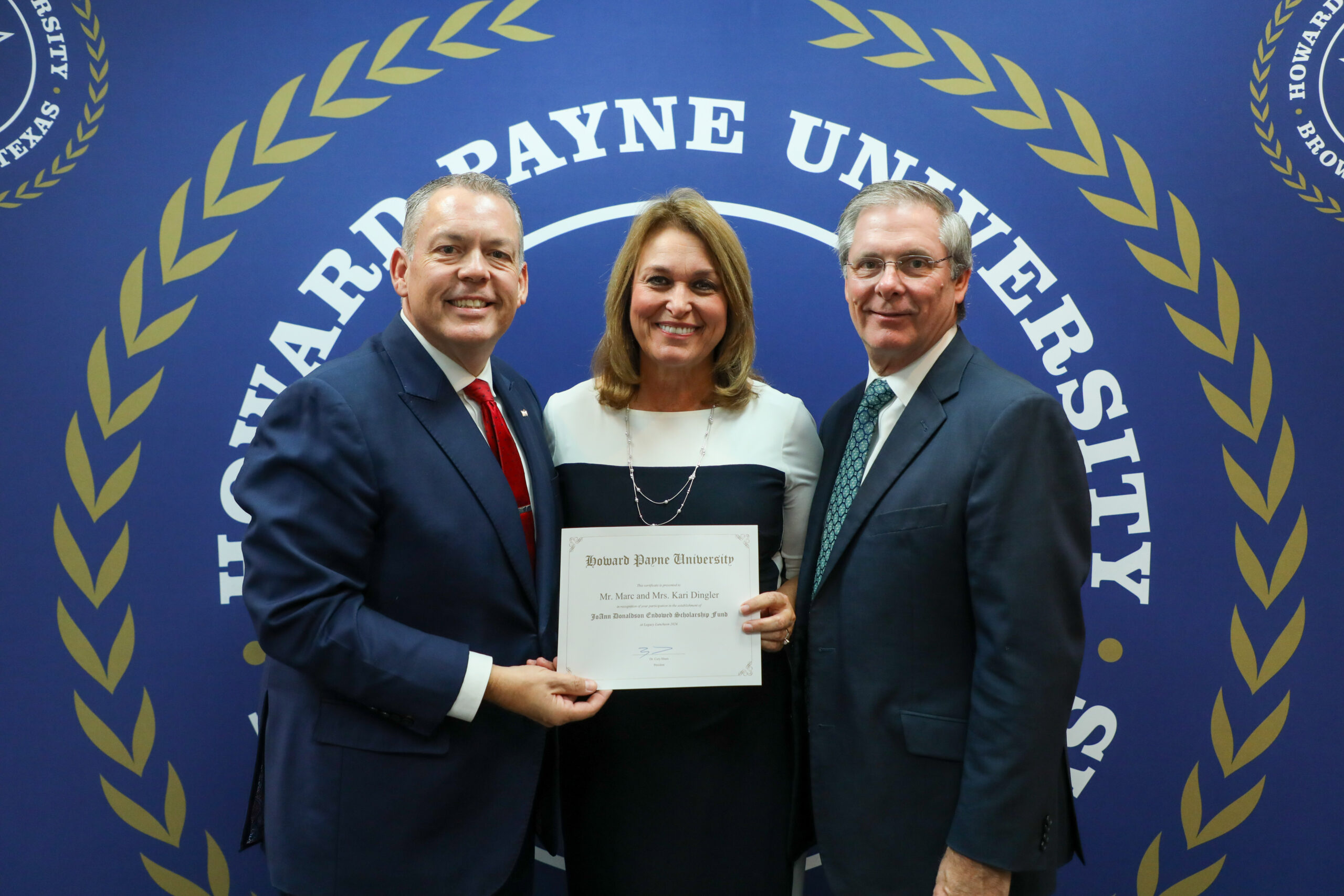
HPU alumni Marc and Kari Dingler, pictured with HPU President Cory Hines (left), were recognized, among other supporters, for establishing an endowed scholarship. (HPU Photo)
Howard Payne University hosted alumni and friends, Nov. 23, at the Legacy Luncheon, an event celebrating the impact of scholarships and giving on students and the campus. The luncheon honored university supporters who have endowed scholarships, who have been named to the Robnett Legacy Society because of their participation in planned giving or who have become a part of the 1889 Society by giving $1,889 or more within the 2023-2024 fiscal year. The founders of 10 endowed scholarships at HPU established over the last five years also were recognized during the program. Additionally, student scholarship recipients attended the luncheon and sat with donors connected to their scholarships.
June Hunt of Hope for the Heart with HCU President Robert Sloan. (HCU Photo)
Houston Christian University and Hope for the Heart held a joint symposium on mental health in the church, on the HCU campus, Nov. 21. The event featured guest speaker, June Hunt, founder of Hope for the Heart, who spoke on the topic, “Why Do I Do What I Don’t Want to Do?” Hunt is an author, singer, speaker and host of Hope in the Night, a live one-hour call-in counseling program, now in its 29th year, that helps people address problems with biblical hope and practical help. An accomplished musician, she has been a guest on the NBC Today show, has toured overseas with the USO and been a guest soloist with the Billy Graham Crusades. The panel of speakers also included: Eric Scalise, president of Hope for the Heart; Michael Cook, HCU associate professor of counseling; and Haley Scully, senior vice president of ministry operations. Pastors and licensed clinical counselors, as well as students in HCU’s psychology, clinical mental health, marriage and family, human services, divinity, theological studies and Doctor of Ministry degree programs were invited to attend.
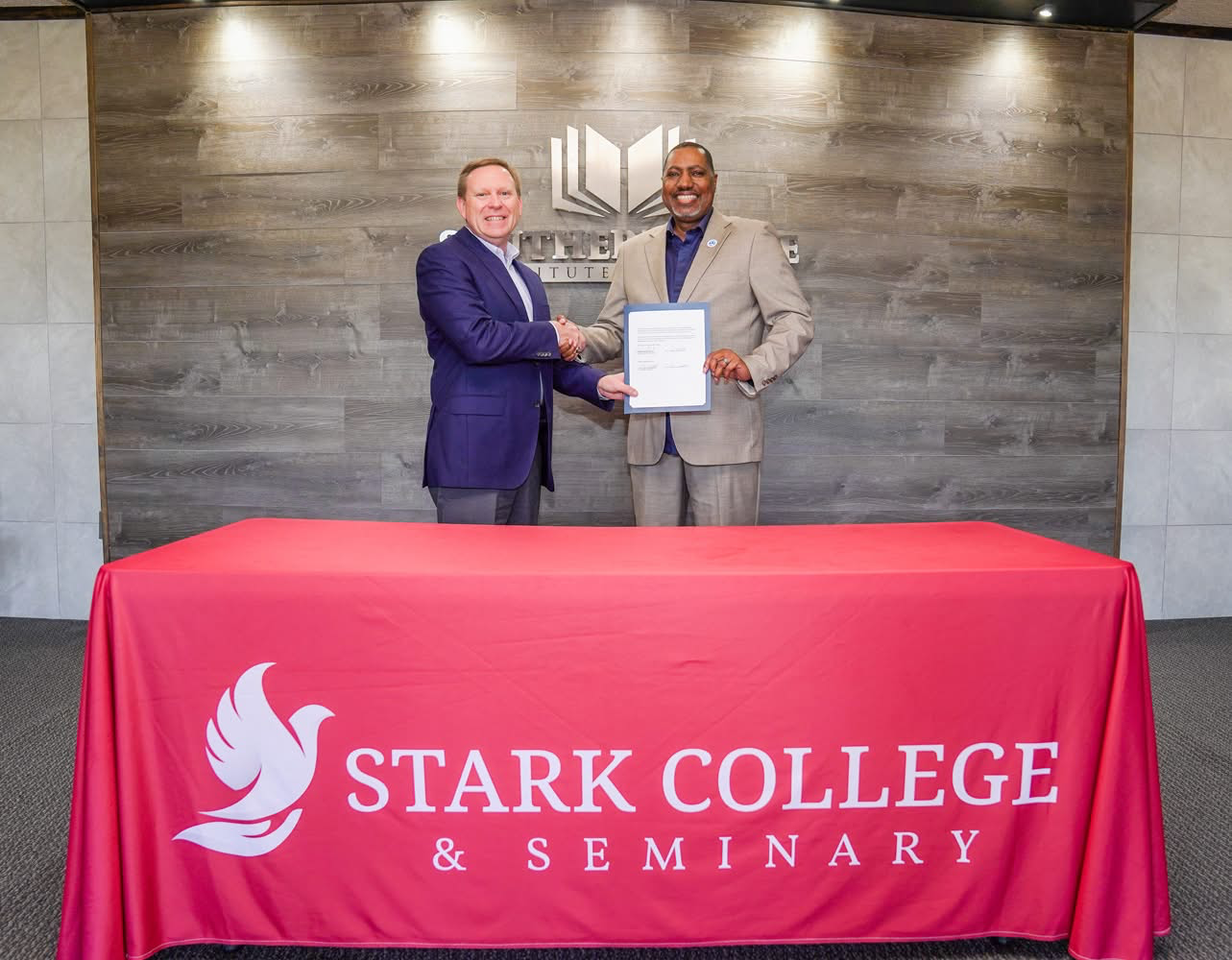
Tony Celelli, president of Stark Seminary and Terrance A. Ford, president of Foster College, holding the partnership agreement between the two institutions. (Stark Photo)
On Nov. 25, Foster College—formerly Southern Bible Institute & College—announced a strategic partnership with Stark College & Seminary to create new pathways for students pursuing graduate level ministry education. Through this agreement, graduates of Foster College’s Bachelor of Arts in Biblical & Theological Studies program will have streamlined access to Stark Seminary’s Master of Arts in Ministry and Master of Divinity programs. This collaboration ensures that students can transition seamlessly into graduate studies, maximizing transferable credits and minimizing additional educational debt. Stark Seminary also will offer an individualized degree plan for each Foster College graduate, further supporting their academic and vocational goals.
East Texas Baptist University Teague School of Nursing assistant professor Antay Waters has been appointed by Gov. Greg Abbott to the Texas Perinatal Advisory Council. (ETBU Photo)
East Texas Baptist University Teague School of Nursing assistant professor Antay Waters has been appointed by Gov. Greg Abbott to the Texas Perinatal Advisory Council. Waters, the only advanced practice nurse on the 19-member council, will serve a three-year term. The council is tasked with developing and recommending neonatal and maternal care standards for clinical care settings across the state. In addition to this appointment, the Texas Health & Human Services Commission also selected Waters to serve as a Texas Alliance for Innovation on Maternal Health Implementation mentor. In this role, she will lead efforts to implement evidence-based practices to improve maternal health outcomes statewide. Waters holds advanced degrees in nursing administration, women’s health and midwifery, along with a Doctor of Nursing Practice. Currently pursuing her Ph.D. in nursing at the University of Texas at Tyler, Waters has a rich clinical background in women’s health and perioperative services and owns a surgical first-assist practice.
Wayland Baptist University encourages high school seniors and prospective college students to submit their Free Application for Federal Student Aid, which officially opened, Nov. 21, as soon as possible to maximize opportunities for federal, state and institutional financial aid. After a challenging rollout last year, the U.S. Department of Education has implemented fixes to streamline the FAFSA process. “This year’s FAFSA form has undergone rigorous testing and is now fully operational, making it easier for students to access the financial aid they need to pursue higher education,” Miguel Cardona, U.S. Secretary of Education, told the Associated Press. The FAFSA form, which is required for determining eligibility for federal financial aid, also is used by colleges to award additional scholarships and grants. According to the U.S. Department of Education, more than 140,000 students already have submitted the form, allowing their information to be shared with thousands of colleges. Robert Hamilton, executive director of financial aid at Wayland, stressed the university’s commitment to helping students every step of the way. Students can complete the FAFSA at www.fafsa.gov and should have their Social Security number, tax records and other financial documents on hand. For more personalized assistance, students and families are encouraged to contact Wayland Baptist University’s financial aid office at finaidhelp@wbu.edu.
State board approves Bible-infused curriculum
December 4, 2024
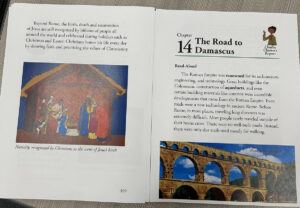
A majority of the Texas State Board of Education gave final approval Nov. 22 to a state-authored curriculum under intense scrutiny in recent months for its heavy inclusion of biblical teachings.
Eight of the 15 board members voted to approve Bluebonnet Learning, the elementary school curriculum proposed by the Texas Education Agency earlier this year. The curriculum will become available in the spring, with schools that choose to adopt the materials expected to begin using them at the start of the 2025-26 school year.
“The Road to Damascus” is a chapter in 4th Grade Reader (student book) ELAR Bluebonnet curriculum. (Photo / Calli Keener)
The curriculum was designed with a cross-disciplinary approach that uses reading and language arts lessons to advance or cement concepts in other disciplines, such as history and social studies.
Critics, which included religious studies scholars, say the curriculum’s lessons allude to Christianity more than any other religion, which they say could lead to the bullying and isolation of non-Christian students, undermine church-state separation and grant the state far-reaching control over how children learn about religion. They also questioned the accuracy of some lessons.
The curriculum’s defenders say references to Christianity will provide students with a better understanding of the country’s history.
Texas school districts have the freedom to choose their own lesson plans, so the choice to adopt the materials will remain with them. But the state will offer an incentive of $60 per student to districts that adopt the lessons, which could appeal to some as schools struggle financially after several years without a significant raise in state funding.
Three Republicans—Evelyn Brooks, Patricia Hardy and Pam Little—joined the board’s four Democrats in opposition to the materials.
Leslie Recine—a Republican whom Gov. Greg Abbott appointed to temporarily fill the State Board of Education’s District 13 seat vacated by former member Aicha Davis, a Democrat who ran successfully for a Texas House seat earlier this year—voted for the curriculum.
Abbott handpicked Recine, who was the deciding vote on the materials, to fill the seat through the end of the year days before the general election, bypassing Democrat Tiffany Clark. A majority of District 13 residents voted this election for Clark to represent them on the board next year. She ran unopposed.
Board members who expressed support for the curriculum said during the week they believed the materials would help students improve their reading and understanding of the world.
‘Establishing cultural literacy’
Members also said politics in no way influenced their vote and that they supported the materials because they believed it would best serve Texas children.
“In my view, these stories are on the education side and are establishing cultural literacy,” Houston Republican Will Hickman said. “And there’s religious concepts like the Good Samaritan and the Golden Rule and Moses that all students should be exposed to.”
The proposed curriculum prompts teachers to relay the story of The Good Samaritan to kindergarteners as an example of what it means to follow the Golden Rule: “Do unto others as you would have them do to you.” The curriculum teaches other religions have their own version of the Golden Rule.
Brooks, one of the Republicans who opposed the materials, noted the Texas Education Agency is not a textbook publishing company and said treating it like such has created an uneven playing field for companies in the textbook industry.
Brooks also said she has yet to see evidence showing the curriculum would improve student learning and that she was opposed to the state using Texas schoolchildren as “experiments.”
Hardy, a Fort Worth Republican who also opposed the materials, said she did so without regard for the religious references. She expressed concern about the curriculum’s age appropriateness and her belief it does not align with state standards on reading and other subjects.
Little, a Fairview Republican, expressed concern on Nov. 22 that the state would have no way to see its “return on investment” with the materials, considering schools have wide latitude to adopt lessons as they see fit—meaning districts could pair Bluebonnet Learning with other learning materials, making the effectiveness of Bluebonnet as a standalone curriculum unclear.
Little said on social media earlier in the week she supports “the teaching of biblical values in education” but criticized the curriculum for some of its teaching methods, which she said leave “little time for students to practice reading and develop critical skills like fluency and comprehension.”
‘Needs to be … free of any establishment clause issues’
Meanwhile, some of the Democrats who voted against the curriculum said they worried the materials would inappropriately force Christianity on public school children. Others cited concerns about Texas violating the Establishment Clause, which prohibits states from endorsing a particular religion.
“If this is the standard for students in Texas, then it needs to be exactly that,” said Staci Childs, a Houston Democrat. “It needs to be high quality, and it needs to be the standard, free of any establishment clause issues, free of any lies, and it needs to be accurate.”
The state had until late Nov. 20 to submit revisions in response to concerns raised by board members and the general public before the official vote took place Nov. 22.
Democratic members said, however, their concerns still remained. Childs, who is also an attorney, said she believes if someone were to sue the state for a violation of the Establishment Clause, they likely would succeed.
San Antonio Democrat Marisa B. Pérez-Diaz said she found value in the materials, but the Christian bias kept her from supporting it. Rebecca Bell-Metereau, a San Marcos Democrat, said although the curriculum attempts to reference faith traditions other than Christianity, she doesn’t feel the state did so in a meaningful way.
“It seems to me like it is trying to place a Band-Aid on a gaping wound,” Bell-Metereau said.
In a statement Friday, Texas Education Agency Commissioner Mike Morath said the approval of Bluebonnet Learning “means that an important, optional new resource will be available for students, teachers and schools.”
“These materials were developed using the best evidence on how to teach reading and math with extensive feedback from teachers and parents to construct a product that is effective, engaging and grade-level appropriate,” Morath said.
“Bluebonnet Learning provides Texas teachers with textbooks and instructional materials that are of the highest quality, aligned to our state’s standards and foundational for student success.”
Abbott called the State Board of Education’s approval of the materials “a critical step forward to bring students back to the basics of education and provide the best education in the nation.”
‘More appropriate for Sunday schools than public schools’
In contrast, the approval drew immediate criticism from both national and local organizations.
Americans United for Separation of Church and State said in a statemen: “Texas’ new Bible-infused elementary curriculum is part of the nationwide effort by Christian Nationalists to impose their religious beliefs on public school students.”
The Texas American Federation of Teachers blasted the state for infusing school lessons with “Bible-based references more appropriate for Sunday schools than public schools.”
“We can anticipate what will come next, whether that’s the erasure of contributions of marginalized populations in social studies or the minimization of climate change in science,” the union said.
Meanwhile, conservative organizations like the Texas Public Policy Foundation, which helped develop the materials, applauded education officials for taking “the next big step toward dramatically improving the quality of education in Texas.”
“Teachers will be able to spend more of their time doing the critical job of teaching and evaluating students, rather than spending their nights and weekends searching for lesson plans,” said Greg Sindelar, the organization’s CEO. “And parents will get to follow along as their children learn thanks to the online resources that come with the lessons.”
More than 100 Texans signed up to speak for and against the state-authored curriculum.
Courtnie Bagley, education director for the Texas Public Policy Foundation, told board members the Texas Education Agency has made every effort to respond to concerns from the public. She said rejecting the lessons would give other materials not owned by the state an unfair advantage.
“It would create a double standard, as Bluebonnet Learning has been held to a different and more stringent review process than other materials under consideration,” Bagley said.
Opponents argued revisions did not go far enough, and some questioned whether the state’s intentions with crafting a curriculum that leans heavily on Christianity are political.
“I am a Christian, and I do believe that religion is a part of our culture, but our nation does not have a religion. We’re unique in that,” said Mary Lowe, co-founder of Families Engaged for an Effective Education.
“So, I do not think that our school districts should imply or try to overtly impress to young impressionable children that the state does have a state religion.”
Half of panel have history of faith-based advocacy
Education officials say references to Christianity will provide students with a better understanding of the country’s history, while other supporters have stated their belief that the use of religious references does not violate the U.S. Constitution’s Establishment Clause.
Legal experts note recent rulings by the U.S. Supreme Court’s conservative majority have eroded decades of precedent and made it unclear what state actions constitute a violation of the Establishment Clause.
State leaders also say the materials cover a broad range of faiths and only make references to religion when appropriate. Education Commissioner Mike Morath has said the materials are based on extensive cognitive science research and will help improve student outcomes.
Of 10 people appointed to an advisory panel by the Texas Education Agency to ensure the materials are accurate, age-appropriate and free from bias, at least half of the members have a history of faith-based advocacy.
The Texas Tribune recently reported how parents, historians and educators have criticized the ways the materials address America’s history of racism, slavery and civil rights.
In public input submitted in response to the curriculum and in interviews with the Tribune, they have said the materials strip key historical figures of their complexities and flaws while omitting certain context they say would offer children a more accurate understanding of the country’s past and present. Bell-Metereau and other Texans referenced the Tribune’s reporting during public testimony.
In response to those concerns, the Texas Education Agency has said the lessons will provide students with “a strong foundation” to understand more complex concepts as they reach later grades. State officials have also said those materials are written in an age-appropriate manner.
This article originally appeared in The Texas Tribune and is reprinted with permission. It has been edited for clarity.
Religious freedom concerns voiced over Azerbaijan
December 4, 2024
(RNS)—Azerbaijan, which hosted a United Nations climate summit last month, has come under international scrutiny for human rights and religious freedom violations.
Days before the climate summit, the Azerbaijani government held a summit of religious leaders working on climate issues, calling itself “well-known for its traditions of tolerance, multicultural values and inter-civilizational and inter-religious cooperation.
However, outside observers repeatedly have raised concerns about religious freedom in the former Soviet country.
The government, led by President Ilham Aliyev, part of a family that has led the Muslim-majority country since 1993, requires religious groups to register with the government to operate legally.
In the last two years, the number of religious activists who are being held as political prisoners has increased sharply, according to Azerbaijani watchdog Institute for Peace and Democracy, part of a broader escalation of a campaign of repression that also has led to the arrests of journalists and other opposition figures.
The country has strengthened its army and recently carried out what the European Parliament called an “ethnic cleansing” of the breakaway region of Nagorno-Karabakh. Though internationally recognized as part of Azerbaijan, Nagorno-Karabakh had been governed by ethnic Armenians since the fall of the Soviet Union.
Treatment of ethnic Armenians
Armenians, who trace their heritage to the establishment of the oldest Christian nation, have called attention to Azerbaijani destruction of their religious sites in the region, even as the Azerbaijani government has said Armenians have destroyed Azerbaijani religious sites.
Sergey Astsetryan, an ethnic Armenian resident of Nagorno-Karabakh, drives his Soviet-made vehicle past Azerbaijani border guard servicemen after been checked at the Lachin checkpoint on the way from Nagorno-Karabakh to Armenia, in Azerbaijan, Oct. 1, 2023. A human rights organization representing ethnic Armenians submitted evidence to the International Criminal Court arguing that Azerbaijan is committing an ongoing genocide against them. (AP File Photo/Aziz Karimov)
These concerns helped Azerbaijan land on the U.S. Commission of International Religious Freedom’s 2024 “countries of particular concern” list, its designation for governments that engage in or tolerate “particularly severe” violations of religious freedom.
“When something is happening to the first Christian nation in the world, they don’t care,” said Arshak Makichyan, an ethnic Armenian Apostolic Christian and climate activist who lost his Russian citizenship after speaking out against the war in Ukraine.
“What is happening to Armenians is really terrible, and we need international solidarity,” he said, warning he worries Azerbaijan will be emboldened to go to war with Armenia.
The activist sees Armenian issues as a natural part of the COP discussion of Indigenous issues.
“If you have been colonized by Western countries, then it is colonization, but if you were colonized by Turkey or Azerbaijan, then it’s not colonization,” he said of Western people’s ignorance of Armenian history. That history included centuries of Ottoman control and repression before somewhere between 600,000 and 1.5 million Armenians were killed by the Ottoman Empire during World War I, in what widely is considered a genocide.
Makichyan explained he thought it was really important to raise the Armenian issue at the conference.
He is part of a group calling for the international community who attended the climate summit to demand the release of Armenian and other political prisoners held by the Azerbaijani government.
The group also is calling for sanctions, the right of return for “Artsakh Armenians to Indigenous lands,” an end to anti-Armenian destruction of cultural heritage and propaganda and divestment from Azerbaijani oil, in addition to a commitment to cease holding the climate change summit in countries with political prisoners.
Azerbaijan has dismissed international concerns about religious freedom in the country as holding pro-Armenian bias.
Kamal Gasimov, a researcher on Islam in Azerbaijan and visiting assistant professor of Arabic at Swarthmore College in Pennsylvania, said the USCIRF report should have cited third-party sources instead of relying on Armenian scholars to write about Armenian monuments.
Gasimov said the USCIRF report is a “political document,” which is indicative of relationships between Azerbaijan and the United States. Some Azeris see the document as evidence of U.S. imperialism, while others whose family members are imprisoned are grateful for it, he said.
Mohamed Elsanousi, a commissioner who joined USCIRF after the most recent report’s deliberation process had been completed, said: “Our aim here is not really to blame and shame countries. Our aim is to improve religious freedom.”
USCIRF is made up of appointees by the U.S. president and congressional leaders. A minority of four dissented the Azerbaijan decision, expressing concerns the country should be given a less severe designation for its religious freedom violations.
Politics motivate religious controls
Despite controversy over the report, Gasimov said the Azerbaijani government plays a significant role regulating religion in the Muslim-majority country, adapting an approach from the Soviet Union that is common across post-Soviet countries.
“If you are a registered religious community within the state institution, the state gives you a passport, then you exist. If the state refuses your registration, then you don’t exist,” he said.
The goal is “making Islam part of the state bureaucracy, which makes Islam predictable,” as well as “easily observed” and “controlled.” They also accomplish this by “controlling books” and “trying to co-opt the religious leaders, charismatic leaders, (by) offering them jobs in the government.”
Other religious groups, like the Jehovah’s Witnesses, have not been able to register. Jehovah’s Witnesses also highlight the state has not followed through on its stated exemptions to compulsory military service for conscientious objectors, with some believers experiencing beatings and legal sentences.
USCIRF cites the 2009 Azerbaijani law requiring registration as a major source of the violation of international human rights standards. However, Gasimov said the Arab Spring protests motivated the government to double down on control in the name of preventing radicalization and legitimized those actions by juxtaposing “the security of Azerbaijan with what’s happening in the Middle East.”
Azerbaijani watchdog Institute for Peace and Democracy says the majority of the 319 political prisoners in the Muslim-majority country are “peaceful believers.” Those 228 prisoners include members of the Muslim Unity Movement and other Muslim theologians. Before early 2023, the number of religious political prisoners had been below 100.
Makichyan said Azerbaijan previously has used “greenwashing,” or a type of spin that portrays the country as an environmental protector, to get away with human rights violations, including against ethnic Armenians.
Looking forward, he emphasized the importance of religious pluralism. As a Christian who knows of genocides that Muslim Indigenous groups have lived through, “it’s really important to be against Islamophobia, because we Armenians, hopefully, we will be able to return to western Armenia also and try to coexist with other people,” he said.
‘Hope in the Heartland’ brings the gospel center stage
December 4, 2024
IRVING—Desiring to bring the gospel center stage through an evening of toe-tapping entertainment, award-winning songwriters and worship leaders Chris and Diane Machen, members of Preston Ridge Baptist Church in Frisco, wrote and produced “Hope in the Heartland.”
“For people who attend the show and are not believers, we’re hoping this is a watershed moment for them,” Chris Machen said. “We’re praying that it opens up meaningful faith conversations and that people will meet the Lord in a real, life-changing way.
“We hope that everyone who attends will be encouraged by this story of struggle, friendship, community and faith. We also want believers to remember that the message of Christmas is to be shared, not kept, and that they will bring unbelieving friends to hear how a life can be forever altered by an encounter with Christ.”
Based on personal family stories
For Chris Machen, the idea for this musical started almost a decade ago when he felt the Lord leading him to share his own family’s personal stories of the Great Depression. He recalled the stories his father passed down about how their family’s unwavering faith in Christ helped carry them through the difficult times.
“About 10 years ago, I was trying to come up with an idea for our church’s Christmas dinner theater,” Chris Machen said. “I attended a music conference, but didn’t really find what I was looking for there. I remember praying, ‘Lord, what do I do?’
“Now you might think this strange, but I got the answer as if the Lord was whispering in my ear, ‘Write your own.’ I perked up, because as a songwriter, that sounded like a wonderful challenge. As I sat there pondering, I prayed again, ‘Lord, what story do I tell?’ Again, almost louder than words, I heard in my spirit, ‘Tell your dad’s story.’”
He remembered stories his father told him about growing up during the Great Depression and how his grandfather, an out-of-work carpenter, struggled to provide for his family.
“He literally wore holes in three pairs of shoes walking the streets of Amarillo trying to find work to support his family. It was a difficult time for everyone, but for my grandparents, it was made more difficult by losing infant twins,” Machen said.
“Not only that, in the midst of trying to keep food on the table, they discovered they were expecting another child. They could barely support the three children that they had, including my dad. But what got them through these difficult days was their faith in Jesus.
“I’m here today, walking with Jesus because of the faith my family clung to and passed down to me. The whole time I was writing this musical for our church, I couldn’t get it out of my head that if we could find a way to put the show in secular theaters, then people who might not ever go to church could hear the gospel if someone invited them to this show.”
Machen describes the presentation as “a fun, bluegrass, Broadway-style musical that people will really enjoy,” but he adds, “Its main purpose is to introduce people to Jesus in a unique way.”
“Hope in the Heartland” debuted in 2019 at theaters in the Dallas-Fort Worth area. “And we have been performing it ever since,” Machen said.
Open doors to spiritual conversations
With five performances scheduled Dec. 12-15 at the Irving Arts Center, Machen desires these shows will provide audiences with an encouraging evening for families to enjoy. But most of all, he prays it opens doors for conversations about the reason for the season.
“One thing that has surprised and blessed Diane and me about this production is that not only has it been an outreach to the community, but it’s also been an in-reach to our cast members,” he said.
“We have never stipulated that you have to be a Christian to be in our show. We just searched for the most talented people we could find. As a result, some of our cast members are believers, but every year many who have joined us are not. It’s given us a marvelous opportunity to encourage them, love them, provide a positive environment for them and speak about how deeply God cares for them.
“The theater world can be pretty dark. So, at most rehearsals, I share a word of encouragement based on Scripture. And little by little, we’ve tried to introduce them to the one who loves them the most and can change their lives forever.”
Some of the entertainers have experienced “church hurt” and are reluctant to attend a church service, Machen noted.
“But we’re trying to change that culture and help them see that God loves them and that they are fearfully and wonderfully made, as stated in Psalm 139,” Machen said.
The production involves 32 cast members, a production crew of about 10 and more than 20 volunteers.
“It’s a huge undertaking,” Machen said, “but worth it to see people introduced to Jesus, who is our hope in the heartland.”
Texas Baptist missions leader Joy Fenner died at age 89
December 4, 2024
Joy Fenner, a Baptist missionary, Woman’s Missionary Union of Texas leader and the first woman elected as president of the Baptist General Convention of Texas, died Nov. 29 in Dallas. She was 89.
Fenner served two decades as executive director-treasurer of WMU of Texas and was named executive director-treasurer emeritus after her retirement. She was elected president of WMU of Texas in 2009.
“Possessing sterling qualities, such as a deep devotion to Christ and his Great Commission, imaginative creativity, thoughtfulness and a cooperative team spirit, enabled her to lead the Texas WMU productively,” said William M. Pinson Jr., who served alongside Fenner during his time as BGCT executive director.
Joy Phillips Fenner was born March 3, 1935, in Avinger to Samuel and Beulah Mae Phillips and grew up in East Texas. She attended Paris Junior College and what was then East Texas Baptist College.
She was secretary at First Baptist Church in Marshall before she joined the staff of Texas WMU to serve as state director of the Girl’s Auxiliary, now known as Girls in Action, from 1959 to 1966.
Joy Fenner (2nd from right) and Texas WMU President Gloria Mills (right) are pictured in this 2010 photo with former presidents (left to right) Amelia “Millie” Bishop, Gerry Dunkin, Mary Humphries, Jeane Law, Kathy Hillman, Nelda Taylor (now Hoffman) and Paula Jeser. (File Photo by Kathy Hillman)
Kathy Hillman, who served as president both of Texas WMU and the BGCT, noted she was a GA when Fenner was state director of the program. So, she sometimes joked that she was “a Joy Phillips GA.”
“Later, she referred to me as her first Joy Phillips Fenner GA Texas WMU president, which I assume was true. At least she claimed me,” Hillman said.
“Through the years, many of us had the wonderful privilege of working with Joy and count her as a wise mentor, consistent encourager and dear friend.”
Joy and Charlie Fenner married on Oct. 8, 1966, and they served together as Southern Baptist missionaries in Fukuoka, Japan, until 1980.
Carolyn Porterfield—who served in a variety of roles with Texas WMU—first met the Fenners when they were in Fukuoka and she was a missionary Journeyman based in Kyoto.
“Who could imagine that years later, Joy would invite me to join her staff at WMU of Texas?” Porterfield asked.
“Joy taught me much about missions and being a woman in leadership in Baptist life, which is not always welcomed or easy. At some point, she became more than my boss, but also my friend.”
Executive leader of Texas WMU for two decades
Soon after the Fenners returned to Texas, Joy Fenner became executive director-treasurer of Texas WMU in January 1981.
“Her experience serving on a church staff, then as a member of the Texas WMU staff, and then as a missionary in Japan prepared her in special ways for the role she filled successfully as the executive leader of the WMU of Texas,” Pinson said.
“Leading a highly skilled, hard-working staff in praying for God’s guidance and laboring to follow his direction, she advanced the missionary endeavors of Baptists.”
As chief executive of Texas WMU, Fenner was a key leader in raising funds to start new churches as part of the Mission Texas emphasis. That included the “triple-triple” campaign for the Mary Hill Davis Offering for State Missions, challenging churches to triple one year’s offering and then triple it again the next year.
Fenner also was instrumental in developing the WorldTouch and Touch Tomorrow Today endowments to support mission work through Texas WMU.
Soon after she retired from Texas WMU, she served as interim executive director of Tennessee WMU from 2001 to 2003.
First woman elected as BGCT president
Messengers to the 2007 BGCT annual meeting in Amarillo elected Fenner as president of the state convention. She served previously as BGCT second vice president and then first vice president.
Joy Fenner was the first woman elected as president of the Baptist General Convention of Texas. (File Photo)
BGCT Executive Director Charles Wade served with Fenner first when she was executive director-treasurer of Texas WMU and later when she was a BGCT officer.
When Wade expanded the executive director’s leadership council to include the top executive leaders of Texas WMU and Texas Baptist Men, Fenner was the first woman to serve on that council, where she offered “valued input” and thoughtful counsel, he said.
In all her leadership roles, she “raised the level of any conversation” in which she participated, he said.
“Joy Fenner had a clear-eyed view of what it meant to be a Baptist on mission,” Wade said. “She encouraged, called out, challenged and led by example.”
Fenner was a longtime member of Gaston Oaks Baptist Church in Dallas and served on the board of the Gaston Christian Center.
At various times, she served on the board of trustees of East Texas Baptist University and the boards of the WMU Foundation, Baylor University’s School of Social Work and Healing Hands Ministries.
Joy Fenner received the Texas Baptist Elder Statesman Award at Independence Baptist Church. (File Photo)
She received honorary doctorates from ETBU and the University of Mary Hardin-Baylor and was named an honorary alumnus of Baylor’s Truett Theological Seminary.
She was named a Texas Baptist Elder Statesman, and she received the Pioneer Award for Service from the Texas Baptist Missions Foundation and the George W. Truett Distinguished Church Service Award from the Baylor Alumni Association.
She was preceded in death by her husband of 50 years, Charlie, in 2017. She will be buried alongside him at the Dallas-Fort Worth National Cemetery at a date to be determined.
A memorial service is scheduled at Gaston Oaks Baptist Church at 1 p.m. on Dec. 19. A reception will follow the service. Memorial gifts can be made to the Gaston Christian Center, c/o Nataly Sorenson, 8515 Greenville Ave., Dallas TX 75243.
EDITOR’S NOTE: The article originally was posted Tuesday morning, Dec. 3. The last paragraph was revised later that afternoon after arrangements for the memorial service were finalized.
Obituary: Glenn Majors
December 4, 2024
Glenn Grady Majors, longtime denominational worker and missions pastor, died Nov. 27, one week before his 82nd birthday. He was born Dec. 3, 1942, in Hartford, Ala., to Grady Dupree and Ruby Maclyn Plunkett Majors. He graduated from Killeen High School in Texas in 1960. He earned his bachelor’s degree in business and a master’s degree in marketing from Samford University in Birmingham, Ala. He met his wife Linda in 1966 in Arlington, Va., when he was serving in the U.S. Army at Fort Myers. They married shortly after at First Baptist Church in Wheeling, W. Va., on Dec. 10, 1966. Glenn worked for multiple publishing companies and eventually transitioned to careers in Baptist denominational service and ministry. He worked first for the Baptist Standard and then the Baptist General Convention of Texas, where he was director of Cooperative Program promotion. At the time of his death, he was associate pastor/missions pastor of High Pointe Baptist Church in Cedar Hill. Previously, the Majors were members of First Baptist Church in Duncanville. He was preceded in death by a sister, Jackie Brown, and a grandson, Logan Williamson. He is survived by his wife of more than 57 years Linda Majors; son John Grady Majors and his wife Amanda; son Jeremy Robert Majors and his wife Holly; son Joshua David Majors and his wife Jen; grandchildren Benjamin, Zachary, Ashleigh, Emmett and Annalyn Majors and Xander Williamson; great-grandson Weston Lemire; and sisters Pam Stewart Fields and Kathy Dunlap. A celebration of life service is scheduled at 11 a.m. on Jan. 18 at High Pointe Baptist Church in Cedar Hill.
Hispanic Protestants go on pilgrimage to Darien Gap
December 4, 2024
(RNS)—Elket Rodríguez, the Cooperative Baptist Fellowship’s global migration advocate, has served migrants on the Texas-Mexico border for years. But until last month, he never had been to the Darien Gap—a dangerous jungle route many migrants traverse as they move from Colombia to Panama, most often en route to the United States.
In early November, just days after former U.S. President Donald Trump was elected to a second term, Rodríguez joined a pilgrimage sponsored by Como Nacido Entre Nosotros, or “As Born Among Us,” an ecumenical Protestant Christian network working on migration issues.
“It’s a level of vulnerability, even much higher than what I see at the border,” Rodríguez said of his experience.
The trip brought 25 Hispanic Protestant leaders and pastors to Panama to help them understand the experiences of migrants who arrive in their communities and to explore opportunities to collaborate with Panamanian churches and other partners to support migrants.
Participants came from 10 Latin American countries and several states across the United States, and they included representatives of Mission Talk, Latino Christian National Network, Mygration Christian Conference and Avance Latino.
‘Experiencing face-to-face the pain of people’
Carlos Malavé, a southern Virginia pastor of two churches and president of Latino Christian National Network, said he was motivated to go on the trip because “it’s not the same to listen or hear about stories as a religious leader in the U.S. than experiencing face-to-face the pain of people,” saying he’d heard “horrific stories” and understood “the reasons why they risk their lives” when he was in Panama.
Many of these pastors count immigrants from Latin America among their congregants. Even for their churchgoers who have not migrated, a story of a loved one’s migration is always close at hand.
“The person who arrives here is already bathed, clean and ready. They’re only thinking about work, about the next thing, about beginning to grow and beginning to produce,” said Rubén Ortiz, Latino field ministries coordinator for the Cooperative Baptist Fellowship, who took a leading role in the two Darien Gap pilgrimages sponsored by the Como Nacido Entre Nosotros network.
Ortiz, a Cuban immigrant who now lives in Deltona, Fla., where he formerly pastored a church, now coordinates the work local churches in his denomination do with migrants, including food distribution and connecting them with services.
“We want people to understand where this person comes from and to understand the traumas and possible circumstances that they will find in their pastoral life with them,” Ortiz explained. “It would be terrible, for example, to deport them,” he said, “because those people have already lived trauma.”
Beginning their work in Panama on Nov. 8—two days after Trump, who campaigned on a platform that included mass deportations, had been declared the winner—was an experience of “grief,” Ortiz said.
“It wasn’t easy at all, because many of us had no words of hope” to share with migrants, he said.
Struck by commitment of Panamanian Christians
The pilgrims met with evangelical and Catholic church groups and Panamanian government officials, and they visited Lajas Blancas migrant reception center, where migrants arrive, often hungry, injured or exhausted, after crossing the Darien Gap.
Volunteers with Como Nacido Entre Nosotros, in blue shirts, distribute donations to migrants at the Lajas Blancas migrant reception center, Nov. 8, 2024, in southern Panama. (Photo courtesy of Como Nacido Entre Nosotros)
The Como Nacido Entre Nosotros delivered donations of food, clothing and personal hygiene items, as well as medical assistance and spiritual care.
Rodríguez said he was struck by the commitment of the Panamanian Christian young adults who woke up at 2 a.m. on a Saturday to fill two buses of donations and then drive more than five hours to the Darien Gap, where they served until late at night.
“In this country, we live a Christianity completely privileged, comfortable and of cheap grace,” Rodríguez said of the United States, where he has not seen a similar commitment by Christians.
The Darien Gap, a jungle and marshland landscape covering a 60-mile break in the Pan-American Highway, is the only overland route connecting North and South America.
Crossings through the Darien Gap rose from an average of 2,400 crossings annually in the early 2010s to more than half a million people last year, as more migrants flee South American countries, such as Venezuela.
Dangerous journey over difficult terrain
A Panamanian border police officer carries Adriana Rodriguez to banks of the Tuquesa River, near Bajo Chiquito, Panama, after she walked with other Venezuelan migrants across the Darien Gap from Colombia on their way north to the United States, Saturday, Nov. 9, 2024. (AP Photo/Matias Delacroix)
Migrants through the jungle face criminal gangs, difficult terrain and lack of cellphone service, clean water and food.
Meeting the migrants also moved Rodríguez.
“I am a man. I identify with the men who cannot provide for or protect their families, that type of powerlessness,” said Rodríguez, clarifying that the men are not physically powerless, but instead morally powerless.
Rodríguez was outraged by reports of sexual violence against migrant women on the journey—and by the “silence” and lack of action to address it.
“As if it is something normal, that many migrant women are sexually abused on their journey, and no one does anything. There is total impunity,” he said. “My conscience does not allow me to get to the level of having to accept that as a given fact of the migration process.”
Ortiz said the migrants he spoke with were fleeing from personal experiences of violence, and many were hoping to reunite with family. In the camp, they met migrants from Latin America and Africa, including the Congo and Cameroon, as well as Pakistan and Nepal.
He provided RNS with recordings of conversations he had with migrants in Lajas Blancas, where many repeatedly urged other migrants to avoid crossing the Darien Gap because of its danger, and some recommended against migrating altogether.
An Ecuadorian father named Carlos told Ortiz that “the voyage was extremely difficult,” mentioning hunger, as well as big cats and snakes in the jungle. He said he had been tricked by his guides, who had not followed through on their promises, and his wife had miscarried her pregnancy of two months.
Carlos also recounted jumping back in a river after his own crossing in order to rescue a family from drowning who had been swept away by a current. Other migrants talked about losing people who had traveled with them or seeing dead bodies
William, a 57-year-old migrant with infected wounds on his legs from a fall during the crossing, said the vast majority of people crossing the jungle suffered some kind of injury.
During their meeting with Panamanian authorities, Ortiz said, the Christian group learned that, while crossings of the Darien Gap have dropped significantly since their peak in 2023, the government believes it will run out of money to feed migrants in December. The Panamanian officials also said migrants leave over 2,000 tons of garbage in the jungle, which is a national park.
Prayed for Panamanian soldiers
Ortiz said at the request of the Panamanian government officials, the pilgrims prayed for the soldiers during the camp visit and the trauma they experience in their work with migrants.
After conversations with local churches and the government, the network is looking for more ways to collaborate on humanitarian support and logistics.
Instead of just welcoming migrants who arrive in the United States, Ortiz said the idea is to “encounter the people on their journey and get to know them on their journey so that they feel accompanied by the church, because the church is one, no matter which country it is in.”
Looking ahead, the network hopes to plan more pilgrimages, especially in response to changes in government policy in the United States, Panama and Venezuela, because, regardless of policy, leaders of the network cannot imagine migration stopping.
“Migration is the crisis of the 21st century,” Ortiz said.
Malavé said: “As I deal with the new reality that we are experiencing in our country, the anti-immigrant sentiment, it is very powerful when you can look back and look at the faces of people, having heard their stories, and that motivates you to keep working and to not give up even though this scenario looks very grim and very difficult.”
Rodríguez said Christians have a choice between seeing migrants as angels or as criminals or “scum.” Citing Matthew 25, Rodríguez said, “The decision that we take on how to see the migrant will be the material for our judgment in front of the Lord.”
India’s anti-conversion law allows policing of Christians
December 4, 2024
NEW DELHI (RNS)—More than two years after a Christian prayer service at his home was raided by police, a court in Uttar Pradesh in northern India acquitted Abhishek Gupta, a 41-year-old radiologist, of violating the state’s anti-conversion law.
Legally, his victory was more than a win; it was a rout. The judge in the case cleared Gupta and a co-defendant of trying to recruit Hindus into Utter Pradesh’s tiny Christian minority.
The judge further ruled the complainant, a member of a Hindu nationalist activist group, was not eligible to file the case and police investigators were “the real culprits.”
But personally, the case has ruined Gupta, he said.
“My entire family is Christian. I pray on Sundays. I don’t know why anyone would think I was converting anyone,” Gupta told RNS by phone from his home village in Gorakhpur.
Gupta moved after he and his wife, a nurse, were asked to resign their jobs for fear their employers would be harassed by vigilantes.
“We exhausted our life savings, and our life was turned upside down,” he said.
Hindu nationalists use law to harass Christians
A study by Article 14, a watchdog group, revealed in the first year after the original 2021 statute passed, half of the 101 reported violations came from third parties. Most of the third parties were Hindu nationalist groups using the law to harass Christians.
Gupta plans to file a civil case against the police and the Hindu nationalist group, called Hindu Jagaran Manch, that accused him. But the day Gupta was acquitted, the Uttar Pradesh government passed a series of amendments to the conversion statute, making converting others a crime punishable by life imprisonment, and empowering third parties to file complaints.
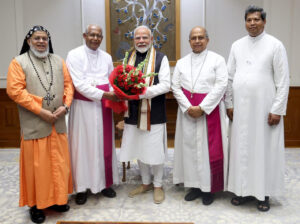
Indian Prime Minister Narendra Modi (center) with Archbishop Andrews Thazhath (2nd from left), president of the Catholic Bishops’ Conference of India, along with other clergy attend a meeting in New Delhi, July 12, 2024. (Photo by PMO Office via RNS)
India Prime Minister Narendra Modi and his ruling Bharatiya Janata Party, are often accused of advancing Hindutva, a political ideology usually referred to as Hindu nationalism, that seeks to empower the country’s Hindu majority while relegating Muslims and Christians to second-class citizens. The Bharatiya Janata Party historically has presented Christians as a threat because of their history of missionary work in the country.
The Bharatiya Janata Party and the Hindutva group RSS that gave birth to the political party historically have accused evangelical Christian missionaries of misusing medical and educational welfare efforts to convert India’s vulnerable tribal and Dalit populations.
Eight of India’s 28 states have passed laws banning conversions, including Modi’s home state of Gujarat and Uttar Pradesh, whose chief minister, Adityanath, is a prominent yogi and a Hindu nationalist.
While they purport to protect poor Hindus from being exploited, anti-conversion laws have been found to have a more demonstrable effect of generating violence against Christians.
Anti-conversion laws spark violence against Christians
A 2019 paper by Nilay Saiya and Stuti Manchanda, professors of public policy and global affairs at Nanyang Technological University in Singapore, showed the states that enforce anti-conversion laws statistically are more likely to give rise to violent persecution against Christians than states that have no such laws.
In 2003, allegations of conversion led to the brutal murder of Australian Christian missionary Graham Stains and his two young sons, Philip and Timothy, who were burned alive by members of Bajrang Dal, an RSS affiliate.
There have been 733 incidents of violence against Christians in the past two years, according to the United Christian Forum, with 585 such incidents through September of 2024 alone. Most have been spurred by false allegations of conversion.
United Christian Forum officials told RNS they are preparing to meet with senior ministers in the Modi government to request that the government issue an advisory to the state governments to repeal the anti-conversion laws.
Pramod Singh of the Christian Legal Association, which has been overseeing the legal defense of hundreds of Christians across India, called the amendments to the UP anti-conversion law “absolute madness.”
“Can a citizen of India be harassed by a mob like this?” he said. “Now, anyone can barge inside your home with the police, accusing you of converting people when you are praying in the privacy of your home.”
He said the law imposes undue limitations on individuals’ ability to choose their faith and puts the onus of proving their innocence on the accused, not the police or the complainants.
But Vivek Premi, a Bharatiya Janata Party official in Uttar Pradesh, defended the law on religious freedom grounds. “Everyone has a right to pray as per their religious tradition, but it is totally unacceptable to use your way of praying to lure anyone and convert them.”
Premi, a former member of the Hindu nationalist youth organization Bajrang Dal, has used WhatsApp and Facebook to create a network of hundreds of volunteers who alert him of conversion.
Objections from National Council of Churches of India
The National Council of Churches of India has strongly objected to the new Uttar Pradesh measure, saying it violates the Indian Constitution, which supports religious freedom of Indian citizens.
Asir Ebenezer, general secretary of National Council of Churches of India, said the amendment encroaches on the constitutional right to freely practice and profess religion, a fundamental human right recognized by the Indian Constitution.
The Uttar Pradesh government, however, described the ordinance as “good legislation” necessary to “check cases of deceitful, fraudulent and forceful conversions.”
A senior state official told RNS: “The law does not espouse any motive to single out any religion or faith. Such legislation was necessary to prevent only those marriages that are done with the sole purpose of conversion. The law, in fact, safeguards human rights by preventing fake, fraudulent or deceitful premises of marriage.”
Conexión Esposas ministers to Hispanic pastors’ wives
December 4, 2024
“There is no area of your heart or your life that escapes the presence of God or that he does not have within the reach of his hand. … The Lord loves us, and we need to be united, have fellowship together, remembering what God has prepared for us,” said Brenda Rincones, director of Conexión Esposas, a ministry of Convención Bautista Hispana de Texas.
“The enemy has already made plans to destroy it. We have to be prepared and united, serving together for the glory of God,” she added.
“Together, faithful and healthy” is the motto of Conexión Esposas (Wives’ Connection), which includes retreats, conferences, connection groups and resources.
“I have been waiting 32 years for this event,” said Martha Aranda, pastor’s wife, who participated in the event. “It was very refreshing to come to South Padre Island away from everything to spend time with God, fellowship and also learn together with my sisters,” she added.
During the retreat, the participants had the opportunity to spend time together, meditate on the word of God, pray together, participate in games, exchange information, walk on the beach, express their opinions on current issues in the ministry, praise and worship God.
According to Rincones, there is a great need to hold this retreat every year. “For several years, we have had a connection for pastors, but the pastors who attended wanted to bring their wives, and I volunteered to minister to them,” Rincones said.
“But thank God, now, for the first time, this Conexión retreat is only for the pastor’s wife,” Rincones continued. “We want them to have companionship, to stay together, faithful and healthy, supporting each other to build lasting relationships,” added Rincones.
Sharing struggles
Lulú Martínez of First Baptist Church in San Antonio, who is undergoing cancer treatment for the second time, prayed for Sunday’s session and encouraged her fellow pastor’s wives to do self-examinations for cancer and to go to the doctor every year to get tested.
“Remember that you are never too young or too old to get tested for cancer,” Martínez said.
Martínez also shared how she accepted her cancer diagnosis, the will of God, and how she continues to serve God with faith and determination.
“I didn’t want to see my cancer as a tribulation, or as a struggle. I want to really use my cancer this time as an opportunity to get closer to God. … I have been able to see God work in me, because sometimes in ministry, we feel so overwhelmed that everything we do becomes a routine and an awakening is needed,” she continued.
Her cancer has served as her awakening. “I know that through this opportunity, this cancer, God has allowed my husband and I to become closer. It has allowed me to get closer to my family, and our prayers have become more meaningful and are no longer empty, because now I have learned to pray specifically,” Martinez said.
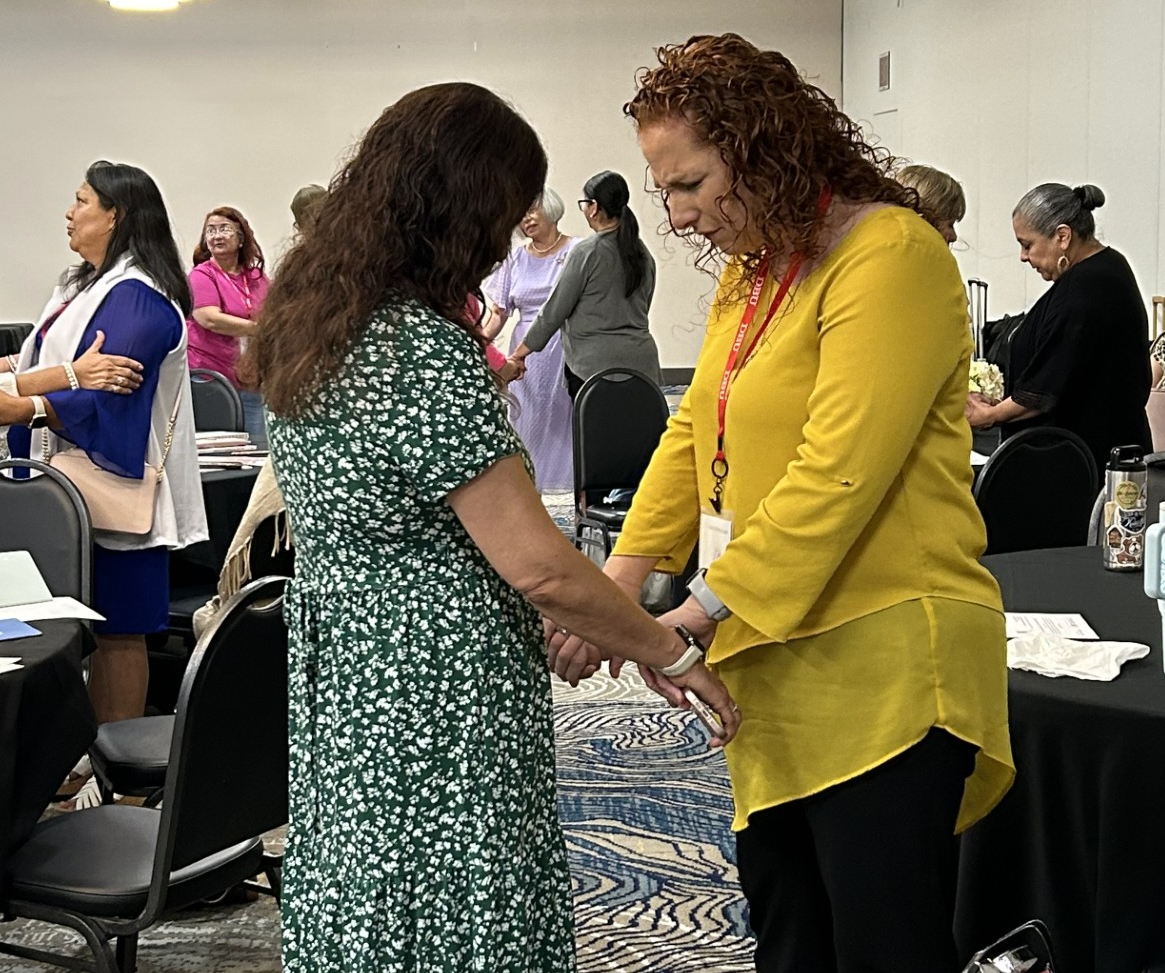
Pastors’ wives praying for each other during Conexión Esposas. (Courtesy photo
Purpose for connecting pastors’ wives
Lydia Martínez-Lara, another pastor’s wife, said: “I feel renewed. We don’t know why God put us in the positions we are in now, as pastors’ wives. We don’t know, but no matter what comes, we praise God for this ministry.”
“Serving God is a blessing. Let’s meet next year to share what God will be doing among us. I am encouraged and ready to go reach and win more souls for God,” Martínez-Lara noted.
Jesse Rincones, executive director of Convención Bautista Hispana de Texas and senior pastor of Alliance Church in Lubbock, welcomed all pastors’ wives. He invited them to be part of a new initiative through the convention that encourages them to start connection groups of pastors’ wives in their community and throughout the state of Texas.
“You need to meet once a month, and we will be offering you financial aid sponsored by the Lily Endowment and our convention” as part of Convención’s Pastors Intiative, said Rincones.
According to Rincones: “The objective of the Conexión Pastors Initiative is to strengthen and support Hispanic Baptist pastors in the state of Texas with the objective of advancing in their ministry, forming a like-minded group of pastors, contextualizing ‘peer groups’ for each network of fellowships (compañerismos), and fostering ongoing relationships that lead to healthy development on a personal and ministerial level.”
Resourcing pastors’ wives
During the retreat, Zoricelis Dávila—professor at Liberty University, professional counselor and native of Puerto Rico—led the wives to examine their emotions and learn to control them based on her book ¡No sé lo que me pasa! (I Don’t Know What’s Happening to me!), published by Mundo Hispano.
With a biblical basis, Dávila offered them tools so they can control their emotions. Being a professional counselor, she spent one-on-one time with some of the women and was part of a panel where pastors’ wives were able to ask her questions about various health topics that affect or could affect their ministries.
Clara Molina—adjunct professor at Southwestern Baptist Theological Seminary and women’s team leader of the National Hispanic Baptist Network, originally from the Dominican Republic—guided the pastors’ wives to consider how they can serve God together.
Molina also helped them to identify seven thorns that could grow in their ministry that can take away their focus from ministering to their families and other women, and badly influence their marriages. Molina also gave each of them her book, ¡Oh no! Mi esposo es el pastor, published by Mundo Hispano (Oh no! I Married the Pastor is published by Thomas Nelson/Zondervan in English).
Convención’s vision for the Conexión Pastors Initiative is “to see healthy pastoral families,” said Jorge Vázquez, who leads the initiative. “As director, my main goal at Conexión is to see pastors and their wives prosper and sustain their relationship in the ministry they already have, offer them resources and minister to them through the events we offer,” Vázquez added.
The retreat took place Oct. 25-27, at the Holiday Inn Resort on South Padre Island, and the next retreat is scheduled for Oct. 24-25, 2025, in San Antonio. For more information visit conventionbautista.org.
Conexión Esposas ministra a esposas de pastores hispanos
December 4, 2024
“No hay área de tu corazón o de tu vida que se escape de la presencia de Dios o que Él no tenga al alcance de Su mano. … El señor nos ama y necesitamos estar unidas y tener compañerismo juntas, recordando que lo que Dios tiene preparado para nosotras el enemigo ya hizo planes para destruirlo. Tenemos que estar preparadas y unidas, sirviendo juntas para la gloria de Dios”, dijo Brenda Rincones, directora de Conexión Esposas de la Convención Bautista Hispana de Texas.
Conexión Esposas incluye retiros, conferencias, grupos de conexión, ofrece recursos y tiene el lema: “Juntas, fieles, y saludables”.
“Yo he estado esperando 32 años para este evento”, dijo Martha Aranda, esposa de pastor, quien participó en el evento. “Fue de gran refrigerio venir a South Padre Island, lejos de todo para pasar tiempo con Dios y también aprender junta con mis hermanas”, añadió Aranda.
Esposas de pastores orando unas por otras durante Conexión Esposas. (Foto cortesía)
Durante el retiro, las participantes tuvieron la oportunidad de pasar tiempo juntas, meditar en la palabra de Dios, orar juntas, participar en juegos, intercambiar información, caminar por la playa, expresar sus opiniones sobre temas actuales en el ministerio, alabar y adorar a Dios.
De acuerdo con Rincones, existe una gran necesidad para llevar a cabo este retiro todos los años. “Desde hace varios años hemos tenido conexión para los pastores, pero los pastores que asistían quería traer a su esposa y yo me ofrecía como voluntaria para ministrarles a ellas,” dijo Rincones.
“Pero, gracias a Dios, ahora, por primera vez, este retiro Conexión es sólo para la esposa del pastor”, continuó Rincones. “Queremos que ellas tengan compañerismo, que permanezcan juntas, fieles y saludables, apoyándose una a la otra para que construyan relaciones duraderas”, añadió Rincones.
Compartiendo luchas
Lulú Martínez, de la First Baptist Church en San Antonio, quien está en tratamiento de cáncer, oró por la sesión del domingo y animó a sus compañeras a que se auto examinen como prueba de detección del cáncer y que vayan al doctor todos los años a
Examinarse. “Recuerden que nunca eres muy joven o anciana para examinarte para el cáncer”, dijo Martínez.
Martínez también explico cómo fue que ella acepto su diagnóstico de cáncer, la voluntad de Dios y como ellas sigue sirviéndole a Dios con fe y determinación. “No quería ver mi cáncer como una tribulación, o como una lucha, quiero usar este tiempo realmente como una oportunidad para acercarme más a Dios. … He podido ver a Dios obrar en mi porque, a veces en el ministerio, nos sentimos tan abrumadas que todo lo que hacemos se convierte en una rutina y se necesita ‘un despertar’”, dijo Martínez.
Su cáncer le ha servido como éste despertar. “Sé que a través de esta oportunidad, este cáncer, Dios ha permitido que mi esposo y yo nos acerquemos más. Me ha permitido acercarme más a mi familia, y nuestras oraciones se han vuelto más significativas y ya no son vacías porque ahora aprendí a orar específicamente,” añadió Martínez.
Propósito de conectar a las esposas de pastores
Lydia Martínez-Lara, otra esposa de pastor, dijo: “Me siento renovada, no sabemos por qué Dios nos puso en las posiciones que estamos ahora, como esposas de pastor. No sabemos, pero no importa lo que venga, alabamos a Dios por este ministerio. Servirle a Dios es una bendición. Reunámonos de nuevo el próximo año para compartir lo que Dios estará haciendo entre nosotras. Estoy animada y lista para ir a alcanzar y ganar más almas para Dios.”
El director ejecutivo de la Convención Bautista Hispana de Texas, Jesse Rincones, y pastor principal de la iglesia Alliance Church en Lubbock, les dio la bienvenida a todas esposa de pastores. Rincones les ofreció la oportunidad de ser parte de la una nueva iniciativa por medio de la convención, la cual las anima a comenzar grupos de conexión de esposas de pastores en su comunidad y por todas partes del estado de Texas.
“Es necesario que se reúnan una vez al mes, y les estaremos ofreciendo ayuda financiera patrocinado por la Lily Endowment y Convención”, dijo Rincones.
El ministerio para la esposa del pastor es parte de la Iniciativa de Pastores Conexión de Convención y de acuerdo con Rincones: “El objetivo de la Iniciativa de Pastores Conexión es fortalecer y apoyar a los pastores bautistas hispanos del estado de Texas con el objetivo de avanzar en su ministerio, formar un grupo afín de pastores, ‘peer group’ contextualizando para cada red de Compañerismos y fomentar relaciones continuas que conduzcan hacia un desarrollo saludable a nivel personal y ministerial.”
Recursos para las esposas de los pastores
Durante el retiro, Zoricelis Dávila—profesora en la Universidad Liberty, consejera profesional, y originaria de Puerto Rico—dirigió a las esposas a examinar sus emociones, a aprender a controlarlas, basándose en su libro ¡No sé lo que me pasa!, publicado por Mundo Hispano.
Con una base bíblica, ella les ofreció herramientas para que ellas mismas lo puedan hacer. Al ser una consejera profesional, Dávila pasó tiempo individual con algunas de ellas y fue parte de un panel dónde las esposas de pastores pudieron hacerle preguntas sobre diversos temas de la salud que afectan o puedan afectar sus ministerios.
Clara Molina—profesora adjunta en el Seminario Teológico Bautista Southwestern, líder del equipo de mujeres de la Red Nacional Bautista Hispana, originaria de la Republica Dominicana—guio a las esposas de pastor a considerar como pueden ellas vivir sirviendo a Dios unidas.
También las ayudó a identificar siete espinas que crecen en el ministerio que le pueden quitar el enfoque para ministrar a sus familias, a otras mujeres, e influenciar a sus matrimonios. Molina también le
La visión de la Iniciativa Pastoral de la Conexión es “ver familias pastorales saludables”, dijo Jorge Vázquez, quien dirige la iniciativa. “Como director, mi objetivo principal en Conexión es ver a los pastores y sus esposas prosperar y sostener su relación en el ministerio que ya tienen, ofrecerle recursos, y ministrarle a través de los eventos que ofrecemos para ellos”, dijo Vázquez.
El retiro tomó lugar del 25 al 27 de octubre, en el Holiday Inn Resort en South Padre Island, y el próximo retiro está programado para el 24 al 25 de octubre 2025, en San Antonio Texas. Para más información visite convencionbautista.org.



 With five performances scheduled Dec. 12-15 at the Irving Arts Center, Machen desires these shows will provide audiences with an encouraging evening for families to enjoy. But most of all, he prays it opens doors for conversations about the reason for the season.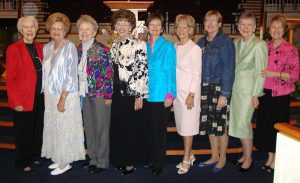

 Glenn Grady Majors, longtime denominational worker and missions pastor, died Nov. 27, one week before his 82nd birthday. He was born Dec. 3, 1942, in Hartford, Ala., to Grady Dupree and Ruby Maclyn Plunkett Majors. He graduated from Killeen High School in Texas in 1960. He earned his bachelor’s degree in business and a master’s degree in marketing from Samford University in Birmingham, Ala. He met his wife Linda in 1966 in Arlington, Va., when he was serving in the U.S. Army at Fort Myers. They married shortly after at First Baptist Church in Wheeling, W. Va., on Dec. 10, 1966. Glenn worked for multiple publishing companies and eventually transitioned to careers in Baptist denominational service and ministry. He worked first for the Baptist Standard and then the Baptist General Convention of Texas, where he was director of Cooperative Program promotion. At the time of his death, he was associate pastor/missions pastor of High Pointe Baptist Church in Cedar Hill. Previously, the Majors were members of First Baptist Church in Duncanville. He was preceded in death by a sister, Jackie Brown, and a grandson, Logan Williamson. He is survived by his wife of more than 57 years Linda Majors; son John Grady Majors and his wife Amanda; son Jeremy Robert Majors and his wife Holly; son Joshua David Majors and his wife Jen; grandchildren Benjamin, Zachary, Ashleigh, Emmett and Annalyn Majors and Xander Williamson; great-grandson Weston Lemire; and sisters Pam Stewart Fields and Kathy Dunlap. A celebration of life service is scheduled at 11 a.m. on Jan. 18 at High Pointe Baptist Church in Cedar Hill.